Cerca:distinction
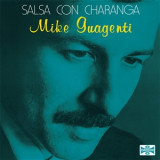
- Salsa Con Charanga
- Sonaremo El Tambo
- Delirio
- La Peluca
- La Puerta Del Dolor
- A Los Muchachos De Belén
- Ensaya Chamaco
- El Tibiri Tabara
"Salsa con charanga" is really a feast for all salsa music lovers, a true jewel, which deserved much better when it originally came out in 1978. In addition to being a great salsa album, has the distinction that was released on Orfeon, a Mexican record label, due to the diligent work of the extraordinary producer Bobby Marin, and which miraculously received air play when powerhouse Fania label and few others ruled radio in the salsa music world. It comprises eight great, solid tracks; some, new interpretations from other albums in which Mike Guagenti participated with his handsome and captivating voice - a crooner with a salsero soul -, that, at times, could remind us of the late Tito Rodríguez, and even Ray Ramos. "The Mike Guagenti album," as indicated by Marin, "is a compilation of recordings by other artists. Originally a salsa album, I brought in Cuban Pupi Legarreta (violin and flute) and [Panamanian] Mauricio Smith (flute) to give it a charanga sound." With the exception of the cut 'Salsa con charanga,' which is an instrumental, the rest feature vocals by Guagenti. "Salsa con charanga" has developed a cult following, and finding a copy of the original could be quite expensive. Luckily, this officially licensed and restored edition will fill that void.
- A1: Mamehy - Je Mitsiko Ro Mokotse (“Those Who Talk Dirty Behind Your Back Tire Themselves Out For Nothing”)
- A2: Drick - Sinjake Panambola (“Dance Of The Rich”)
- A3: Befila - Eka Ndao (“Let's Go”)
- A4: Behaja - Marolinta (Name Of A Village On The South-Western Tip Of Madagascar)
- B1: Mahafaly Mihisa - Fanoigna (“Heated Debate“
- B2: Meny & Ando - Ka Tseriky Iha (“Don't Be Surprised”)
- B3: Rebona - Zana-Konko
- B4: Mirasoa & Mahapoteke - Bleu Bleu (“Blue Blue“)
Wild ecstatic vocals, distorted electric guitars, rocket bass, and the amphetamine beat! // Unlike anything else, this is THE high life music you've always wanted // Ceremonial music played with abandon and extreme intent, honoring the living and dead alike // Recorded on location in SW Madagascar by Maxime Bobo // “Tsapiky music from Southwest Madagascar features wild ecstatic vocals, distorted electric guitars, rocket bass, and the amphetamine beat! Unlike anything else, this is THE high life music you've always wanted - ceremonial music played with abandon and extreme intent, honoring the living and dead alike. In Toliara and its surrounding region, funerals, weddings, circumcisions and other rites of passage have been celebrated for decades in ceremonies called mandriampototse. During these celebrations – which last between three and seven days – cigarettes, beer and toaky gasy (artisanal rum) are passed around while electric orchestras play on the same dirt floor as the dancing crowds and zebus. The music, tsapiky, defies any classification. This compilation showcases the diversity of contemporary tsapiky music. Locally and even nationally renowned bands played their own songs on makeshift instruments, blaring through patched-up amps and horn speakers hung in tamarind trees, projecting the music kilometers away. Lead guitarists and female lead singers are the central figures of tsapiky. Driven as much by their creative impulses as by the need to stand out in a competitive market, the artists distinguish themselves stylistically through their lyrics, rhythms or guitar riffs. They must also master a wide repertoire of current tsapiky hits, which the families that attend inevitably request before parading in front of the orchestra with their offerings. This work, a constant push and pull between distinction and imitation, is nourished by fertile exchanges between various groups: acoustic and electric, rural and urban, coastal or inland. What results during these ceremonies is a music of astonishing intensity and creativity, played by artists carving out their own path, indifferent to the standards of any other music industry: Malagasy, African or global. Recorded live on location by Maxime Bobo, this vinyl LP includes a 4-page full-color insert with detailed liner notes plus photos of the musicians and surroundings.”
“Salsa con charanga” is really a feast for all salsa music lovers, a true jewel, which deserved much better when it originally came out in 1978. It comprises eight great, solid tracks; some, new interpretations from other albums in which Mike Guagenti participated with his handsome and captivating voice - a crooner with a salsero soul -, that, at times, could remind us of the late Tito Rodríguez, and even Ray Ramos.
It In addition to being a great salsa album, has the distinction that was released on Orfeon, a Mexican record label, due to the diligent work of the extraordinary producer Bobby Marin, and which miraculously received air play when powerhouse Fania label and few others ruled radio in the salsa music world. It comprises eight great, solid tracks; some, new interpretations from other albums in which Mike Guagenti participated with his handsome and captivating voice - a crooner with a salsero soul -, that, at times, could remind us of the late Tito Rodríguez, and even Ray Ramos. "The Mike Guagenti album," as indicated by Marin, "is a compilation of recordings by other artists. Originally a salsa album, I brought in Cuban Pupi Legarreta (violin and flute) and Panamanian Mauricio Smith (flute) to give it a charanga sound." With the exception of the cut ‘Salsa con charanga,’ which is an instrumental, the rest feature vocals by Guagenti. “Salsa con charanga” has developed a cult following, and finding a copy of the original could be quite expensive. Luckily, this officially licensed and restored edition will fill that void.
The lost companion EP to The Unbearable Tightness of Being, by Ohio's,
Sweetheart
Recorded by the band in a warehouse in Columbus, Ohio, spring 2005.
A single sided 12" record containing one 12 minute song. Limited to 300 copies on
180 gram vinyl and digital.
This record is meant to go together with EW017- Sweetheart- The Unbearable
Tightness of Being LP. We highly suggest getting both records.
Sweetheart's latest offering, "The Process Of Making Us Well," serves as an intricate
sonic landscape woven with a fearless fusion of genres, defying the established
norms of post- hardcore. This one- track EP, released under theExpert Work Records
banner, is not just an auditory journey but a rock-solid proof of their ability to blend
post-hardcore, noise rock, punk, screamo, emo, and indie influences into an immersive
sonic experience that transcends conventional boundaries. Setting themselves apart
from the early noughties post- hardcore scene, Sweetheart skillfully navigate away
from the cliches that often haunted many underground acts of the era. "The Process
Of Making Us Well" unfolds as an epic composition, a 12-minute sonic odyssey that
takes the listener on a transformative journey. The band showcases a mastery of
dynamics, skillfully transitioning from serene, ethereal instrumentations to intense,
powerful crescendos, creating an emotional landscape that captivates the listener
from scratch to finish.
Released as part of Expert Work Records' series, "The Process Of Making Us Well"
holds the distinction of being Sweetheart's longest recorded piece. The record arrives
in a high- quality cardboard sleeve, decorated with an entirely minimalistic lettering,
leaving audio content in the sole focus. It's a wise choice, considering that
Sweetheart's music deserves your utmost attention. "The Process Of Making Us Well"
is an essential exploration into endless possibilities of post- hardcore, noise rock,
screamo, and emo music. Sweetheart, sadly overlooked amidst a sea of similar bands
during their era, emerges as a beacon of innovation with this remarkable release. "The
Process Of Making Us Well" solidifies Sweetheart's status as one of the best bands of
their time, a hidden gem deserving of retrospective recognition and appreciation
On his third album as Etelin, Alex Cobb explores the intricacies of separation and belonging using field recordings and electronics, reconfiguring the dividing line between what is artificial and natural in the process. Maintaining a sense of playful reverence and lurking melancholy in its glitchy pastoralism, Patio User Manual hums with a meticulous and singular energy. From the loops and static pulses of "The Chemistry of Cobalt" to the tension and release of "Electrical Sailing," the listener is pulled into a sound world at once ambivalent and radiant, reaching its denouement in the lovely melody that closes the final track, "Picnic at Gas Station Park". Although the album might bring to mind the nuanced and imaginative ambient music published by labels such as Mille Plateaux, Sonig, and Silent Records in the 1990s, it is, in the end, a world of its own and very much of today. The patio as a stage for alienated life, pyrrhic in its isolation, deceptive in its promise of distinction. Orientation as disorientation, often unseen inside the frame but felt in the bones. What is out there, anyway, other than the thing we fear the most?
"Another day of weird weather and screens. What type of perfume did Philip Johnson wear when he designed Glass House? Is it actually possible to flee to the country when you’ve internalized a lifetime of intellectualized urban living? When you buy a DIY patio kit, you get instructions for how best to embed concrete or brick or flagstone into the natural world. The patio will make you enjoy your environment more. It will become yours. You can stand on it and think “this is Mine.” The structuralists talked about the importance of fixed camera position, but didn’t properly interrogate it because to do so would be impossible. It’s hard to believe that it really wasn’t long ago that computer music seemed exciting, novel, even radical. We’re now thoroughly estranged from eating what’s in season. Walking around the woods in southern Ohio in spring, I thought about the curious imperative of the patio, how my kids get excited about picking oyster mushrooms, the dynamics of switched capacitor filters, and how adequacy is tethered to doubt." - AC, May 2024
Moody cacophonies, sonic dispatches from Japan, crystalline breakbeats that are more environment than rhythm: Jake Muir’s enmixed, described by Muir as a “(re)mixtape,” is a mind-bending deep dive into the enmossed archive. Besides reflecting the history of the label, Muir’s mix is a production in its own right. A Los Angeles native based in Berlin, Muir is a DJ and field recordist who “sees mixes as a vehicle to explore narratives outside of the album format.”
In Bathhouse Blues (2023), where Muir sampled various sources to explore gay cruising culture and sensuality, his more expansive, conceptual approach to the form is illuminated. Mixes are not just a linear succession of tracks with transitions—they’re excavations that also result in the creation of new audio artifacts. Inspired by the psychedelic impulses of illbient, Muir uses DJ and sound engineering techniques to melt down genre distinctions and create alien atmospheres.
From the enmossed community, Muir pulls from artists like bad lsd trips, Angelo Harmsworth, Nick Klein, Tetsuya Nakayama, and Patrick Gallagher to coalesce a super-compendium of the global sonic underground, all viewed through his own unique lens. Muir takes major liberties with processing and effects automation to carve new worlds from the soil of these preexisting works. Some of the tracks and material on enmixed are heavily edited, emphasizing specific harmonics or bass frequencies, and some portions contain three or four layers, putting artists in direct conversation with each other.
This heady approach—using the tools of both mixtape and remix—results in a super textual and dense palimpsest of the enmossed catalog. “Because mixes are more open- source,” Muir says, “it’s easier to express some ideas since there is more material to pull from.”
- Rob Goyanes
Silver foil printed j-cards on heavyweight iridescent ('Lapis Lazuli') recycled paper Duplicated at a carbon-neutral facility
- A1: Silent Night (3:39)
- A2: All I Want For Christmas Is You (4:01)
- A3: O Holy Night (4:27)
- A4: Christmas (Baby Please Come Home) (2:33)
- A5: Miss You Most (At Christmas Time) (4:32)
- B1: Joy To The World (4:18)
- B2: Jesus Born On This Day (3:41)
- B3: Santa Claus Is Comin' To Town (3:24)
- B4: Hark! The Herald Angels Sing/Gloria (In Excelsis Deo) (2:59)
- B5: Jesus Oh What A Wonderful Child (4:26)
- B6: God Rest Ye Merry Gentlemen (1:18)
LP 2x12"[46,18 €]
LP[26,68 €]
LP[26,68 €]
7" single[15,92 €]
12" single[15,92 €]
12" single[17,61 €]
LP[19,75 €]
2LP[90,34 €]
The Holiday Album That Turned Mariah Carey into the Queen of Christmas: Featuring the Standard “All I Want for Christmas Is You,” the Singer’s Blockbuster Merry Christmas Exudes Joy, Spirituality, and Conviction
Sourced from the Original Master Tapes, Presented in Audiophile Sound for the First Time, and Strictly Limited to 3,000 Numbered Copies:
Mobile Fidelity’s UltraDisc One-Step 180g 33RPM LP Set Plays with Superb Detail, Openness, and Definition
1/2" / 30 IPS / Dolby SR analogue master to DSD 256 to analogue console to lathe
Mariah Carey didn’t become the Queen of Christmas just because of her fervent love of the holiday. Or as the result of a brilliant marketing plan. The iconic singer earned her title by way of her blockbuster Merry Christmas, a 1994 album that quickly joined the likes of Bing Crosby’s White Christmas, A Jolly Christmas from Frank Sinatra, and Nat King Cole’s The Christmas Song as an all-time holiday vocal classic. Featuring a balanced mix of inspired originals and well-chosen covers, Carey’s fourth studio record has only grown in stature as new generations discover its magic. Mobile Fidelity’s 30th anniversary edition reissue of Merry Christmas makes her spellbinding performances and upper-tier register come alive like never before.
Sourced from the original master tapes, pressed at Fidelity Record Pressing, and strictly limited to 3,000 numbered copies, the pioneering label’s UltraDisc One-Step 180g 33RPM LP set of Merry Christmas plays with superb detail, depth, and dimensionality. Available in audiophile quality for the first time since its original release three decades ago, and featuring the bonus track “God Rest Ye Merry, Gentlemen,” the nine-times-platinum set breathes with a newfound openness and transparency that enhance the spirituality, passion, and festive tenor of Carey’s singing.
Benefitting from superb groove definition, a nearly inaudible noise floor, and dead-quiet vinyl surfaces, the music takes on a heightened energy and anticipatory emotion synonymous with the holiday season. Carey’s signature vocals explode with liveliness and dynamics, the full scope of her acrobatic range presented in clear, transparent sound that practically places her on a small stage in your listening room. This collectible version also breathes with the kind of warmth, intimacy, and coziness you want from a landmark vocal album.
Recorded when Carey helped put “diva” back into everyone’s vocabulary, Merry Christmas gave the New York native another smash right out of the box. What nobody knew at the time was the degree of the album’s staying power — and how, many years removed from its initial promotion cycle, its legend would still grow and even spark a 2010 sequel. Having re-entered the Top 200 charts every year since 2019, Merry Christmas ranks as one of the three most commercially successful holiday LPs ever made and, in due time, will likely earn the top distinction in that class. A global blockbuster, it seamlessly ties together Christian, gospel, and secular threads and speaks to a boundless audience, independent of denomination.
Most obviously, the record remains inescapably connected to “All I Want for Christmas Is You,” an uptempo anthem that towers as a holiday standard and one of the biggest-selling singles in history. Punctuated with celesta chimes, sleigh bells, springy keyboards, and joyous beats, the song echoes the simple albeit engaging melodies and doo-wop style of beloved holiday classics of yore — and blends such elements with contagious dance-pop rhythms to create an atmosphere rich in joy, wonder, and excitement. Radiant with golden soulfulness and sincere conviction, Carey’s exuberant singing and on-point phrasing put it all over the top. And how.
The song stands as the only effort in Billboard history to top the Hot 100 chart during at least three separate runs. Carey’s blockbuster has already hit No. 1 during five runs, spanning every year between 2019 and 2024. That’s just one of the many records the singer holds — and only one of the multiple highlights from Merry Christmas, which includes two other Carey-penned originals, “Miss You Most (At Christmas Time)” and “Jesus Born on This Day.”
Though slightly lesser known, Carey’s remarkable rendition of Darlene Love’s “Christmas (Baby Please Come Home)” further links her album with the big, lush, Wall of Sound heritage that helped inspire its production. Carey’s heartfelt take and transformation of the traditional “Santa Claus Is Coming to Town” into an animated tune that even adults can believe, as well as her clairon reading of “Joy to the World” — cleverly augmented with bits of Three Dog Night’s 1971 hit of the same name — further reinforce her status as Queen of Christmas.
At the peak of her powers, Carey finds equivalent success when tapping more spiritual veins. Witness the reverence she brings to the timeless carol “Silent Night,” the piousness she invests in “Jesus Oh What a Wonderful Child,” and the sacred feeling she conveys throughout “O Holy Night.” You’ll also never think of “Hark! The Herald Angels Sing” and “Gloria (In Excelsis Deo)” the same way again after hearing Mimi pour her heart and soul into them, and pair the songs together.
Indeed, it’s Carey’s pliable voice, melismatic technique, and five-octave range — on display here in definitive fashion — coupled with her undeniable love for Christmas and understanding of the religious significance of the season that make Merry Christmas a must-have holiday staple. And on Mobile Fidelity’s LP, something you better add to your wish list.
Brussels based pianist Giovanni Di Domenicowas born in Rome in 1977. Majoring in 'jazz piano' at music school - he further built on an encyclopaedic technique; rhythm, harmony and tone are informed by non-western traditions yet equally sensitive to Debussy's "Préludes", Luciano Berio's "Sequenzas", to the 'ambi-ideation' heard in Borah Bergman's Soul Note recordings, Cecil Taylor's polissemic density, Paul Bley's bruised transparency and of course, the most radical manifestations stemming from the underworld of pop music, invariably tied together by his own original praxis.
A distinction - one would call it generational - he shares with many of the musicians he has crossed paths with recently, of which we could enumerate Nate Wooley, Chris Corsano, ArveHenriksen, Jim O'Rourke, Alexandra Grimal, Tetuzi Akiyama, João Lobo or Toshimaru Nakamura.
At the request of W.E.R.F. Records, Giovanni created an entirely new repertoire, teaming up with saxophonist Alexandra Grimal and drummer Eric Thielemans. This collaboration resulted in Echolalia, a suite consisting of three parts: Aoede, Melete, and Mneme. The music is captivating, adventurous, and above all, fascinating.
- A1: To The Hilt Of Humanity
- A2: Cloisters
- A3: Panicle Of Lowliness (Hawley Bog Hymn)
- B1: Unforgeable Key
- B2: Eastern Woodland Reverie
- B3: Moss Stone
- C1: Clairvoyance Anxiety
- C2: The Dimunitive Principle
- C3: Aphelion
- D1: Annulment
- D2: Hall Of Mages
To give you an idea of what the New Jersey, USA band Cowardice sound like, “Atavist” exists somewhere on the spectrum between the sombre strains of Bell Witch and the tormented tones of Body Void, with the first half of the album (“Suzerain”) erring more towards the bleakly melodic style of the former, while part two (“Sentinel”) shifts the focus towards a darker, dirgier approach; somewhere on the edges between melancholic doom and experimental sludge metal. Perhaps inevitably, it’s not quite that cut and dry - the gut-churning grind of “Unforgeable Key” for example, is just as nasty and gnarly as anything found on “Sentinel”, while the desolate disharmonies of “The Diminutive Principle” channel a similarly angst-ridden aura as much of “Suzerain” - but this distinction between the two halves, subtle as it may be, plays a big role in giving the whole album its sense of direction and progression.
And while it is always recommended to listen to the totality of “Atavist” so as to get the most out of it - especially if you’re a fan of the likes of Cavernlight and/or Chained To The Bottom Of The Ocean, both of whom also serve as useful touchstones for any prospective listener - also pay extra attention to the gorgeously gloomy slow-burn of opener “To The Hilt Of Humanity”, the haunting melodies and heaving grooves of the sludge-soaked “Clairvoyance Anxiety” and the morbid majesty of “Hall Of Mages”, as some of the record’s major highlights. Indeed, it’s this last track which will both test your resolve and prove, once and for all, that “Atavist” is more than worth every second you’ve invested into listening to it so far, with every crushing, cathartic chord and ringing, harmonic note… every tortured, suffering snarl and trembling, melancholy melody… coming together over the course of seventeen absolutely massive minutes to demonstrate that, despite its imposing size and intense sound, “Atavist” is nothing to be afraid of. Green and red coloured double vinyl edition.
Pedro Bertho, following the positive reception of his debut
album Mêlé, which features notable tracks like "Tigueretá"
and "Jour 4"—both frequently highlighted in Boiler Rooms
and sets around—has launched his own label, Chez Pedro.
Dedicated to consistently releasing new music, the label
plans to unveil monthly tracks, showcasing Bertho's ongoing
creative drive and deep passion for music without
distinctions of genre. His latest offering, Starlit Craves,
compiles tracks curated over the past two years. Previously
unreleased, these tunes have been meticulously crafted for
the dance oor. Each track on this EP reects Pedro Bertho's
distinct style and artistic vision, guiding listeners through an
immersive and exhilarating musical journey. Let Me Tell You:
Infused with electro vibes and inuenced by Detroit’s rich
musical legacy, this track blends intricate rhythms with
soulful melodies, delivering a captivating sonic experience.
Blue Hot Monday: A hypnotic techno odyssey where
pulsating beats merge with deep bass grooves, creating an
enveloping atmosphere that lingers long after the music
ends. Shaved: A dynamic fusion of house and techno,
pulsing with rhythmic intensity and layered textures, inviting
listeners on a groove-driven exploration. Rouya: Radiant
melodies and hypnotic rhythms transport listeners to a sunlit
realm, intertwining uplifting harmonies with intricate sonic
nuances seamlessly. Have You Ever Played in Abidjan:
Exploring percussive intricacies and dub-infused textures,
this track offers a captivating blend of rhythmic diversity andatmospheric depth, evoking vivid imagery and immersive
storytelling.
About this book
The growth of the Jamaican recording industry…
Records have played an integral part in the history of Jamaican music and the importance of making records, as opposed to making music, can never be overstated. These are the stories, told through first-hand accounts wherever possible, of the men and women… manufacturers, musicians, singers, deejays, arrangers and record producers… who made the records and who made the sound of reggae available worldwide.
“Clearly this series is set to become the standard reference work on Jamaican music, such is its dizzying depths of research and the vast amount of oral evidence it has compiled from many years of interviews alongside critical quotes from recognised existing literature.”
Steve Barker
The Wire
"In this third volume the authors skillfully weave interview material into its narrative. Among other histories, it examines the work of Lee ‘Scratch’ Perry, who transcended genre and became author of his own productions and, in the process, influenced the development of the major global artist Bob Marley. It examines the development of dub, the studio process that transformed the music, and in doing so exerted yet another influence on popular music on the world scale. It also examines the work of Lloyd 'King Jammy' James who utilised digital technological innovation to become a champion of sound system and record production and, thus, became the Eighties equivalent of the earlier innovator Clement ‘Coxsone’ Dodd.
All this, and much more, is told by many of the protagonists who created the phenomenon of reggae as a cultural force that has travelled far beyond the confines of Jamaica.”
Steve Barrow
Co-Author of “Reggae The Rough Guide”
“Noel Hawks’ & Jah Floyd’s third book on the history of the Jamaican recording business is another triumph. As with the first two volumes, they seamlessly weave quotes and recollections from the key players into the narrative, giving the reader a unique, and genuine, insight into the development of Jamaican music and the business of selling it. An essential read for anyone interested in ska or reggae and for all music lovers.”
Chris Lane
Fashion Records
“I can confidently say, without fear of contradiction, that the final part of Noel Hawks’ & Jah Floyd’s trilogy is every bit as meticulously researched and mentally stimulating as the first two volumes. It may be that no history of Jamaican music can ever be totally definitive given how many of reggae’s key singers, players and producers had already left Earth before anyone had the opportunity to get their takes on how it evolved. But, as of now, you will not find a more accomplished telling of the tale than that which is presented across the three volumes of ‘Jamaican Recordings’… an Order of Distinction-worthy accomplishment that should henceforth become an essential component of everyone’s reggae library.”
Tony Rounce
Ace Records Ltd
- Together Again
- I Like To Hear It Sometime
- I've Got A Tiger By The Tail (Swingova)
- Please Forgive And Forget (From The Motion Picture Ballad In Blue)
- I Don't Care
- Next Door To The Blues
- Blue Moon Of Kentucky (Swingova)
- Light Out Of Darkness
- Maybe It's Nothing At All
- All Night Long
- Don't Let Her Know
- Watch It Baby
The success of the 1962 Modern Sounds in Country And Western Music albums paved the way for Charles’ creative freedom as an artist. Throughout the rest of his career, he continued to show his deep affinity for country music. 1965’s Country and Western Meets Rhythm and Blues (aka Together Again) features Ray’s timeless version of the Buck Owens country standard “Together Again.” It also holds the distinction of being the first album Charles recorded in his own RPM International recording studio. While on 1996’s Crying Time album Ray delivers the definitive version of that Owens song and earned Ray the GRAMMY for Best Rhythm & Blues Solo Vocal Performance Male and recognition as Producer of Best Rhythm & Blues Recording by The National Academy of Recording Arts and Sciences. As if that weren’t enough, the album also boasts Charles #1 Billboard smash “Let’s Go Get Stoned.”
"Pretty (Ugly Before)" b/w "A Distorted Reality Is Now A Necessity To Be Free" holds the distinction of being the last recording by Elliott Smith to be released while he was still alive. Originally released as a single in August 2003, the songs were a part of the recording sessions that would ultimately yield the acclaimed posthumous album From A Basement On The Hill. The two songs serve as a powerful reminder of why Smith became the voice for a dejected generation. This repress is limited to 500 copies on tri-color vinyl - mustard, baby blue, and coke bottle green.
40 Years ago, Hunting Lodge was nearing the peak of its fertile 'tribal' period. In celebration of this anniversary we are releasing a book-style 3LP set including Nomad Souls, 'Tribal Warning Shot' (expanded) and The Harvest (live/expanded). All of the included tracks have been lovingly remastered from the original reels and cassettes, restored by Grant Richardson and mastered for vinyl by Sion Orgon. The Nomad Souls LP was originally released in the autumn of 1984 on S/M Operations in the USA, and in the following spring on Side Effekts Records, UK. The 'Tribal Warning Shot' 12” 4-track EP was released early 1985 on S/M Operations (USA). The title track was remixed with drums added for a 12” 45 release on Normal Records (Germany) soon thereafter. This version, along with the other three EP tracks appear on the second record in the set. A new remix of the 1983 7” 'Night From Night' b/w 'Untitled' is also included, along with 2 tracks that appeared on compilation albums and one previously unreleased track. To round off this LP we launch into a track from original The Harvest live cassette, to ease you into the album to come. The Harvest cassette was a collection of live Hunting Lodge tracks circa 1984 which has never appeared on LP until now. To make for a more cohesive theme we have separated the two LP sides by shows: Side A from Chicago, where the original 'Tribal Warning Shot (live)' was recorded, while the other side features a Detroit show which bears the distinction of being the only time Roselle Williams (The Wolf Hour) sang live with the band. Each side features one song that was NOT included on the original The Harvest release This set features a replica of the original S/M Operations' Nomad Souls cover, and of the original Normal Records 12” art on the second LP. The third sleeve features a newly designed back cover by Rolaid Alpo Cola, and an inner panel including the original promo poster artwork along with an essay from Graeme Revell.
Black Truffle is thrilled to present the first vinyl reissue of David Rosenboom’s unique Future Travel, originally released on the short-lived Detroit label Street Records in 1981 and here presented in an expanded edition with an additional LP of wild, previously unheard live and studio material from the same period.
Future Travel emerged from the confluence of two important streams in Rosenboom’s work at this time. First, his exploration of ‘propositional music’, defined as ‘complete cognitive models of music’ that start from the radical question, ‘What is music?’ In this case, the music belongs to the universe of Rosenboom’s In the Beginning (1978-1981), in which proportional relationships determine the material available to the composer in all musical parameters (harmonic relationships, melodic shapes, rhythmic subdivisions, dynamics, and so on). Second, the work documents a key moment in Rosenboom’s long collaboration with synthesizer pioneer Don Buchla. Having played a role in developing concepts for some of the modules of the Buchla 300 Series Electric Music Box (an innovative analogue modular system controlled by micro-processors), Rosenboom went on to write the software for Buchla’s hybrid analogue-digital keyboard synthesiser, the Touché, the instrument heard most prominently here.
In a way that no purely analogue synthesizer could, the 300 Series and Touché allowed Rosenboom to work with the In the Beginning algorithms in real time, the synthesizers becoming ‘intelligent instruments’ that actively collaborate with the performer. Developing the open structures of the electronic pieces from In the Beginning, Future Travel explored the possibilities of simply ‘playing the system’, recording live at Francis Ford Coppola’s Zoetrope studio in San Francisco. Working from loose sketches, Rosenboom added acoustic instruments to the electronic sounds and, on some pieces, the processed voice of Jacqueline Humbert. Like Rosenboom’s collaboration with Humbert on the abstracted synth-chanson of Daytime Viewing, this music set out deliberately to challenge the ‘stratified and illusorily coagulated identities in the musical culture of the time,’ refusing distinctions between ‘serious’ and popular music. But where Daytime Viewing achieves this in part through genre references, Future Travel is bracingly sui generis, existing in a unique universe where radical formalisation à la Xenakis spontaneously gives rise to expressive jazz harmonies and old-timey folk melodies.
The crystalline quality of many of the Touché sounds gives Future Travel a sparkling, immediately enticing surface, its layers of shifting ostinato patterns pulsating outside conventional meter, rippling like waves on the surface of water. On opener ‘Station Oaxaca’, ping-ponging synth arpeggios and hand percussion accompany a sentimental violin melody, abruptly overtaken by layered keyboard runs, before the entry of tinkling marimba-like sounds reframe the scene as sci-fi Martin Denny exotica. ‘Time Arroyo’ begins as an austere study in staccato synth sounds in multiple overlapping tempi, reminiscent of Ligeti’s famous ‘clock’ rhythmic effects. Before long, it opens up into a melodic passage with the gentle heroism of classic Roedelius, which proves to be only a brief interlude before the layers of rhythmically distinct synthesiser patterns begin to build and accelerate into an increasingly dense cacophony. The wildest twists and turns are saved for the epic closer ‘Nova Wind’, where the arrangement focuses on Rosenboom’s virtuoso piano playing, perfectly embodying the project’s radical disregard of stylistic orthodoxies as he moves from hyperactive pointillistic flurries to a kind of space-age gospel.
At several points throughout the record, the distinctive voice of Jacqueline Humbert is heard reading passages from the text component of In the Beginning, a dialogue between The Double (an embodiment of humanity’s timeless desire to replicate itself in spiritual and technological copies) and two Spirit Characters. Fittingly, as all are conceived as embodiments of a future form of techno-human collective consciousness, distinctions between the three characters are not immediately evident in Humbert’s delivery, just as the music blurs the boundaries between intelligent computing and human spontaneity. Adorned with a striking retro-futurist cover (and here accompanied by extensive new liner notes and archival images), Future Travel is a time capsule of radical imaginings at the birth of our digital age, reminding us of utopian possibilities of which our own present seems so often to fall short.
Rare debut LP by the eccentric Peruvian singer Jean Paul "El Troglodita", known for his wild performances and extreme way of life. Enrique Roberto Tellería made his Peruvian television debut in 1965 under the stage name Jean Paul El Troglodita and wearing an imitation leopard skin suit. He would switch from melodic calm to shouting wildly or suddenly drop to the floor on his knees and smash the furniture like crazy. At the age of 19, DisPerú signed him to the label on the strength of these early performances. His first single included a freely translated version of 'Secret Agent Man' in Spanish. He began to work on the eleven cover versions that would feature on his first LP immediately, writing all his own lyrics and accompanied by the beat band Los Steivos. Despite the predominance of English beat music in Peru, the album only included three songs directly related to the British invasion: 'Bus Stop' by The Hollies, also played in raga rock style; 'Paint it Black' by The Rolling Stones; and 'The House of the Rising Sun', which follows the arrangement recorded by The Animals. So most songs come the American songbook. Apart from 'Tema de El Troglodita' (a versión of 'Secret Agent' by The Challengers), we find the bluesy 'Mustang Sally' (Sir Mack Rice). Two other US numbers, originally performed with orchestral accompaniment, were adapted to fit the rock band format: 'Poor Side of Town' (Johnny Rivers) and 'Take Me to the Moon' (Kaye Ballard). 'El verdadero amor' ('True Love'), an uncredited version is in a similar vein. The Spanish song 'Negro es negro' (Los Bravos) and the Brazilian track 'Que todo se vaya al infierno' (Roberto Carlos) also feature on the LP. El Troglodita's association with the so-called nueva ola, indicated on the back cover, needs clarification. In Peru, nueva ola was a mixed bag rather than a specific musical style and encompassed slow rock, twist, bossa nova and all the styles that the record industry produced to tame the wild rock 'n' roll impulses of teenagers in the early sixties. The Peruvian artists that performed these inoffensive Spanish adaptations of Paul Anka, Neil Sedaka or Frankie Avalon, were presented as successful models of youth culture. This was until 1964, when the Beatles with their mop-top haircuts hit the charts, vindicating rock 'n' roll and imposing the group format over the soloist model. Meanwhile the press continued to call any youth music recorded during the rest of the decade nueva ola. Jean Paul noted these distinctions early on and distanced himself from it in several statements. He saw his performance more in a style as a solo artist as following in the footsteps of e.g. Los Saicos. His 'hippie' lifestyle got him arrested by the new de facto military government in 1968, who accused him of promoting drug consumption and corrupting the Peruvian youth. The charges were soon dropped but his reputation was tarnished, and he ended up emigrating to Central America. The album includes Spanish sung versions of British beat songs and covers of the American songbook as well as various international hits.
Elaine Brown has led a life of distinction. Appointed in August 1974 by Huey Newton from his exile in Cuba to be the one and only female leader of the Black Panther Party, Elaine has pursued a career of community service that continues to this day. But her debut 1969 album Seize the Time leaves one wondering what would have happened had she not put her musical career second. She was first discovered as a performer while singing Thomas Dorsey’s “Precious Lord” at the funeral service for Panther Bunchy Carter. Afterwards, Panther’s Chief of Staff David Hilliard had her audition for him accompanying herself on piano. That session led to her composition “The Meeting” (about an encounter with Eldridge Cleaver) being adopted as the Black Panther Party National Anthem, and an album was commissioned. Elaine enlisted Los Angeles jazz legend Horace Tapscott and his PanAfrikan Peoples Arkestra to arrange and back her, and Seize the Time was born—which the Black Panther Party’s newspaper called “the first songs of the American revolution.” Blending influences ranging from Bob Dylan to classical, and anchored by Elaine’s powerful delivery of her deeply-felt lyrics, this album will stir your blood whether you agree with its politics or not. Now, with the cooperation of Elaine Brown herself, Seize the Time sees its first-ever American LP reissue, complete with original “uni-pak” packaging featuring lyrics and liner notes, plus an insert with new liner notes by Pat Thomas, author of Listen Whitey! The Sounds of Black Power 1965-1975.Limited run of 950 copies in deep purple vinyl. SIDE ONE 1. Seize the Time 2. The Panther 3. And All Stood By 4. The End of Silence 5. The Meeting (The Black Panther Party National Anthem SIDE TWO 1. Very Black Man 2. Take It Away 3. One Time 4. Assassination 5. Poppa’s Come Home SELLING POINTS • Elaine Brown Is an Activist First and Musician Second • But Her 1969 Debut Seize the Time Shows Things Could Have Gone the Other Way • She Was Appointed in 1974 by Huey Newton from His Exile in Cuba to Be the One and Only Female Head of The Black Panther Party • She Has Pursued a Career in Community Service That Continues to This Day • First Discovered as a Performer When Singing Thomas Dorsey’s “Precious Lord” at the Funeral for Panther Bunchy Carter • Then Panther’s Chief of Staff David Hilliard Had Her Audition for Him Accompanying Herself on Piano • An Album Was Commissioned, and Brown’s “The Meeting” (About an Encounter with Eldridge Cleaver) Became the Black Panther Party National Anthem • Seize the Time Was Arranged by L.A. Jazz Legend Horace Tapscott, and Features His Pan-Afrikan Peoples Arkestra • A Unique Record Featuring Influences Ranging from Dylan to Classical, All Anchored by Brown’s Impassioned Singing and Deeply-Felt Lyrics • First-Ever American LP Reissue • Includes Original Uni-Pak Jacket with Notes and Lyrics • Also Contains Insert with Notes by Pat Thomas, Author of Listen Whitey! The Sounds of Black Power 1965-1975 • Deep Purple Vinyl Pressing • Limited to 950 Copes • This Release of Seize the Time Is Fully Authorized by Elaine Brown Herself STREET DATE: MAY 3, 2024 (Limited Deep Purple Vinyl Edition) iBarcoder Trial ELAINE BROWN BLACK PANTHER PARTY BLACK PANTHER PARTY ELAINE BROWN VAULT
REISSUE OF THEE HEADCOATS' FINAL ALBUM IN THEIR ORIGINAL INCARNATION! Originally released by Friends Of The Buff Medway Fanciers Association Records in 2000! The final studio release by Thee Headcoats (until last year's Irregularis: The Great Hiatus) gets a long-awaited vinyl reissue! Includes eleven Billy Childish originals plus a cover of Bo Diddley's 'Great Grandfather'! Recorded at May Road & Red Studios. Engineered by Graham Semark. "Thee Headcoats, who put out their first album in 1989, have recorded raw, primordial romps that seem inspired by American Delta blues musicians like Sonny Boy Williamson or the Southern swamp rock of Hasil Adkins, while maintaining a decidedly English sound. They've recorded under a slew of monikers, and issued an amazing discography of full-lengths, EPs, 7"s, and what-have-you for virtually every cool indie label since they formed (including US-based labels like Sub Pop, Get Hip, Sympathy for the Record Industry, and K, among others). Whether he's covering songs with a Bo Diddley beat, garage rock chug, or playing one of his angry young man/dysfunctional family rantings ('The Day I Beat My Father Up', for example), Billy Childish has built up a solid and somewhat rabid fanbase by releasing songs that you wouldn't normally think would attract a huge audience to begin with. However, I Am the Object of Your Desire has the distinction of being the last album by this band, as their prolific leader Billy Childish moved on to a new band; they're called the Buff Medways, which is apparently an ancient and now extinct breed of chicken which had feathered legs. It's also the name of the UK imprint this record was released on. This collection kicks right off with the album-titled track reveling in pure Headcoats fashion: that warm, fuzzy vibrato guitar with Childish's fuzzy, electronically distorted voice (an effect repeated throughout the album); Johnny Johnson's soft, flowing bassline; and Bruce Brand's primeval drums. The group keeps this sort of mid-tempo riffage going for the next couple of tracks. Johnson plays a mean harp on 'Hurt Me (Slight Return)', but things don't really take off until 'In a Dead Man's Suit' and the swaggering, Texas blues 'Chatham Town Welcomes Desperate Men'. The band's punk roots show up in songs like 'An Image of You' and 'Your Crying Means Nothing to Me' while 'Come into My Mind' has a definite Kinks influence. All in all, an excellent album from this soon to be sadly missed band." - Review from 2000 by Bryan Thomas (All Music Guide)
The duo's third album of instrumental guitar recordings pushes their sinuous compositions into labyrinthine new shapes, interlocking and interlocutory, supported by a cast of stellar collaborators. Interwoven among the dazzling original pieces is a fascinating array of covers, ranging from traditional Breton dance tunes to a deconstruction of Neneh Cherry's "Buffalo Stance." Their melody-first sensibilities are perfectly suited to each other _ playfully complex guitar work that sounds as if it was tossed off in an afternoon of whiskey and laughs. - NPR An intoxicating, intricate web _ Wherever Salsburg and Elkington go, it's always a pleasure. - Aquarium Drunkard Sounds like winter has always been approaching, like Indian summer never quite fades, like fall isn't built around loss. - Stereogum
Utilising a mammoth bank of saxophone samples, Shmuel Hatchwellpresents his new alias hoyah with an engrossing album captured in tape and digital form on Bruk.
The process leading to Set + Setting started out with a need for limitations to provide some focus for long-serving sound engineer and producer Hatchwell. He set out the following guidelines to accompany the overarching idea of 'set + setting':
No 'beats'
Saxophones are the voice
Stay away from the computer for as long as possible
Hatchwell took a deep dive in search of every saxophone sample he could find, threw them all into his MPC and then proceeded to weave together a variety of pieces. The focus on a particular instrument brings cohesion to the album, but equally the limited sound inspired freedom to experiment with other techniques and tools. At times one or two sax voices sound naked and undisturbed, while elsewhere you might only hear jagged shards or distant ghosts as they pass through aggravated processing.
Beyond the sound itself, the name hoyah was born with the flippancy of the 21st Century and ratified by ancient tradition. After the music had been made, After the music had been made, Hatchwell plucked the name out of thin air as a play on the TikTok meme 'can I get a hoya,' and subsequently discovered on a dive into his Jewish heritage that in old Hebrew hoyah means, 'to be, become, come to pass, exist, happen, fall out.' This distinction between Jewish concepts and modern political conflations is important to Hatchwell, who finds himself consistently having to separate Judaism from the situation in the Middle East and its ongoing genocide.
Subtly calling to mind the understated cosiness of real-life sax players like Sam Gendel as well as the fragmented sample manipulation of Matmos and Tim Hecker's approach to processed noise, hoyah's debut album absolutely manifests an idea and musical practice as something new and intentional
Ach, komm, ein Mensch kann nicht immer gut sein... This sentiment rings amusingly true for us. How did we find ourselves in this post-truth era, and why does such a term actually exist? In a world where distinctions between right and wrong blur, does the clarity of a black-and-white delineation persist? Are we progressing, or are we regressing to a state reminiscent of the past?
Weaving together the complex tapestry of gore, politics, emotions, and, of course, the human experience in this work is done intricately and reflectively by the hands of Christoph de Babalon.
French pianist Dorian Dumont is an exceptionally gifted, Brussels-based jazzman and member of electronic experimentalists, ECHT! In 2021, he released his debut solo album 'APHEXionS' - a challenging exercise of solo piano focussed entirely on the music of one of the most influential and important artists in contemporary electronic music, Richard James, aka Aphex Twin. Dumont's sophomore album, 'to the APhEX', released 23rd February via W.E.R.F. Records, continues that fascination with his musical hero and acts as a musical love letter of sorts - a groundbreaking experience, where the enchanting world of classical piano collides with the electronic brilliance of Aphex Twin. Richard James' music serves as a starting point for Dumont's musical developments which are sometimes composed and often improvised, letting him find his playing field around the concepts and the poetics of the genius of electro music. Contrary to what one would expect, there are no electronics involved but Dumont carefully transcribes a wide selection of Aphex Twin's music to the grand piano, giving the songs a whole new dimension. Dumont starts from the melody lines and rhythmic structures found in the original tracks but builds on them, deconstructing pieces and adding his own improvisations. Lovingly recreated, the songs take on a completely new dimension, and it exposes both the genius and musicality of Aphex Twin and Dumont himself. "Aphex Twin is a fascinating artist and character. At first, I started transcribing his pieces just to understand them. I then sat on my acoustic piano for the pleasure of hearing these pieces that I loved so much only to realize that in the end I was improvising, I was playing. In short: I was having fun. That's how this project was born: through pleasure and games. The challenge then was to develop the concept of this project to find my own playground and my own responses around the musical principles of Mr. Richard James, in order to make this project a celebration on my own terms."
Always curious about new sounds and cultivating eclecticism, 'to the APhEX' stays truthful to the minimalistic aesthetics from the original tracks. From the unruly, emotionally stirring '180db_ 130' to the simple beauty of 'Windowlicker', Dumont is part of a new generation of musicians who have no intention of sticking to the rules. Dumont dances across the keys, perfectly capturing the mood and feeling of Aphex Twin, where classical meets electronic. Elsewhere, 'PAPAT4 155[pineal mix]' is stripped to the core showcasing Dumont's ingenuity, while 'Avril 14th' and album finale '#3 (Rhubarb)', unfolds with delicate piano, evoking a sense of tranquil introspection.
Born in Montpellier where he studied classical piano at the Conservatory, in 2005, Dumont achieved the highest distinctions in piano and chamber music. With a broadening interest in jazz and improvised music, he moved to Brussels in 2008 and after studying in the Jazz sections at the Royal Conservatory of Brussels then at the Koninklijk Conservatorium van Brussel, he obtained his master's degree in 2013. In recent years, he has played an integral part of the critically acclaimed four-piece 'ECHT!' which breaks the boundaries between jazz, electronic music and hip-hop. In addition, Dumont also participates in numerous other projects across various genres including 'Edges' with Guillaume Vierset, Jim Black, and Anders Christensen or 'Easy Pieces' with Ben Sauzereau and Hendrik Lasure. He also collaborates with bands including Juicy, Vaague, Kuna Maze, and Pol Belardi's Force, among others.
[a] A1. 180db_ [130]
[d] A4. PAPAT4 [155][pineal mix]
“I like to work with a variety of instruments and set ups,” says Mark Van Hoen, sometimes known as Locust or Autocreation but here working under his own name on the excellent Plan For A Miracle, his first physical release of solo music since 2018’s Invisible Threads. ”Sometimes it’s literally in my studio, with all the hardware electronics available. Sometimes the laptop, using software instruments. Some of the tracks on this record were recorded in the desert (Joshua Tree) using a 4-track tape machine and small modular synthesiser set up. Each track was recorded in different location using different instruments, which accounts for the distinction between each piece. It’s also about my own reaction to my environment, and what’s going on in my life at the time.”
The Croydon-born Van Hoen started musical life in the early 1990s, signing for R&S records in 1993 but developing his own, myriad and distinctive style across a range of releases on Touch, Editions Mego and other labels, using a battery of instruments, including analogue synthesizers and taking a number of different approaches to recording, rather than ploughing a single sonic furrow. He has worked on a number of collaborations, including with Nick Holton and Neil Halstead of Slowdive, under the moniker of Black Hearted Brother - their Stars Are Our Home was released in 2013. “I have known Neil Halstead since 1992,” says Van Hoen. “He shared a house with me for a couple of years, and the music I was making and listening to along with clubs I was attending had an influence particularly on Pygmalion, the final Slowdive album on Creation.”
Each track on Plan For A Miracle does indeed sound like a world unto itself, a mini-environment, a weather condition, an ecosystem created for the moment. It’s a collection of tracks recorded over the past few years, released on Bandcamp - despite his apparent absence, Van Hoen works constantly. Opener “Climates”, in its exquisite limpidity, feels like a homage to Brian Eno, one of his most formative influences in his teen years, commencing with Music For Films, which he bought in 1979. “This Is For Them”, feels like a ghostlike throwback to early drum & bass or electronica, reminiscent of his own, earliest outings. “There have been a number of requests from labels to make some more music like my very early releases on R&S,” says Van Hoen. “This is part of ‘letting go’ and realising that there’s nothing less creative about going back to those styles again.”
“Pencil Of Spheres” is something else again, a magnificent, imaginary glass structure, shimmering, refracting, without visible means of suspension, a thing of impossible beauty. “Electric Lights” evokes an abandoned fairground, its lights still pulsating, its music lingering. “The Underpass”, meanwhile, insofar as it reminds of anything at all, is faintly reminiscent of Cluster or Neu’s! West German ambience, the urban mundane rendered magical, the sodium lights, the whitewashed walls. The reverberant, faintly oriental chimes of “Insight” transport us yet again, burgeoning and intensifying.
The landscapes, the skyscapes rendered on Plan For A Miracle feel unpopulated as a rule - but when he does introduce vocal elements, Van Hoen has a history of doing so to spectacular effect - think of “Real Love” from 1998’s Playing With Time, the seductive intonation of its title recurring throughout like a series of massive holograms, echoing, stuttering, breaking up, surging. Here, there are just the faintest of vocals, barely distinct, disquieting. “There’s been a bit of a game changer in recent times,” explains Van Hoen. “AI software that enables you to extract vocals and instrument parts from virtually any recording. That means sampling individual parts from existing sources is no longer limited to the original mix exposing certain parts soloed. The vocal parts I use are from multiple sources and often pitch shifted altered rhythmically and melodically.“ There’s further vocal chatter on “I Really Do”, proceeding at a faster pace as if giving chase, or being pursued - distant, enigmatic. “The Music”, meanwhile, its beat tolling, lost in its own fog of static, features a curious intonation, like the ghost of a lost Walker Brother.
Sadly, the album’s title is in reference to a personal tragedy on Van Hoen’s part - the loss of his wife. Titles such as “I Won’t Give Up”, which faintly reminds of another Eno masterpiece, Another Green World, in its nautical hurly-bury, or the pastoral strains of “Mrs Who”, heavily clouded with sadness, seem to allude to this. “In fact the record was recorded entirely before she passed away,” says Van Hoen, “most of it before she even became very ill. The title was given to the album when it started to look like she wasn’t going to make it beyond a few months. It was something Osho said - “plan for a miracle” - so it was a statement of hope. Unfortunately it was not to be.” Although the album is non-thematic, non-specific in its atmospheres, sound paintings, elegant structures it most certainly stands as a magnificent monument to Osho’s memory.
-David Stubbs.
Limited Transparent Blue vinyl. “Pop” is a tag that’s been assigned to Minus the Bear throughout their career. It’s been used to set a distinction between the unique brand of complex indie rock they introduced on their first EP, and the more angular and aggravated sounds of their previous bands Botch, Kill Sadie, and Sharks Keep Moving. It’s also a tag that was thrown around frequently in the wake of their streamlined fourth album, OMNI. And it’s a descriptor that immediately comes to mind within the first few seconds of their classic second formal EP, They Make Beer Commercials Like This. Beer Commercials is the evolutionary step between Minus The Bear’s first two landmark albums, Highly Refined Pirates and Menos El Oso. Opening track “Fine + 2 Points” remains one of the band’s strongest opening tracks in their discography, charging out of the gates with a syncopated stomp that comes across as a more agitated take on Kylie Minogue’s “Can’t Get You Outta My Head.” If Minus The Bear were looking to make pop music without any of its major-scale bubblegum trappings, they nailed it here. The band follows it with “Let’s Play Clowns” and “Dog Park”—nods to Highly Refined Pirates’ formula of frenetic clean guitar work, bombastic choruses, and Jake Snider’s lyrics of detached romantic nostalgia. These tracks may represent Minus the Bear’s original trademark version of pop but on songs like “I’m Totally Not Down With Rob’s Alien,” the band eschews its restless energy for atmosphere and dynamics, creating a sound that’s inspired more than a handful of contemporary melodic post-rock bands. By the time the band belts out “Pony Up!” the listener has watched the three-year sonic transition between Minus the Bear’s first two full-lengths transpire within under half an hour, with their earlier math rock predilections yielding to the tightly wound club-banging pedalboard trickery that defined their sophomore album. Even if Beer Commercials doesn’t fit within your definition of pop music, the unorthodox energetic charm of this relatively low-profile release serves as an exciting reminder of why Minus the Bear became one of the most important and influential indie rock bands of the new century
- A1: Sincerity Commercial
- A2: Our Funeral
- A3: Pet Rock
- A4: I Hate My Best Friends
- A5: I Killed Your Dog
- A6: All The Days You Remember
- A7: 5 To 8 Hours A Day (W Wwa G)
- B1: Sometimes
- B2: R(Emote)
- B3: Uncertainty Principle
- B4: Oh Wow, A Bird!
- B5: Knead Bee
- B6: Monsoon Of Regret
- B7: Clumsy
- B8: What's That Song?
- B9: New Year's Unresolution
Multi-instrumentalist, composer, performer and curator L’Rain (Taja Cheek) returns with her third album I Killed Your Dog. Over-writing themes of grief and identity that informed her previous work, I Killed Your Dog considers what it means to hurt the people you love the most. Multi-layered in subject and form, L’Rain’s sonic explorations interrogate instead how multiplicities of emotion and experience intersect with identity. The experimental and the hyper-commercial; the expectation and the reality; the hope and the despair. “I’m envisioning a world of contradictions, as always,” Cheek explains. “Sensual, maybe even sexy, but terrifying, and strange.” Written amidst heartbreaks from the perspective of an earned maturity, I Killed Your Dog takes the sonic world laid out by L’Rain in 2021’s album Fatigue on a compelling new trajectory. Described by Cheek as an “anti-break-up” record, I Killed Your Dog takes the universal pop theme of love as its starting point – bold, bratty and even a touch diabolical – and inspects it through the form of a conversation with her younger self, untangling her relationship with femininity and the formal musical conventions that others have come to expect of her. Alongside long-time collaborators Andrew Lappin and Ben Chapoteau-Katz, Cheek has developed L’Rain into a shape-shifting entity that blurs the distinction between band and individual
Candlemass was formed by bassist & songwriter Leif Edling in Stockholm, Sweden in 1984 & is well known for its epic doom metal, having a great influence over a generation of the genre's subsequent greats such as Paradise Lost & My Dying Bride - Candlemass themselves taking a large influence from Black Sabbath.
'Ancient Dreams' was Candlemass' third album, released in 1988 & it featured a natural progression of slow- mid tempo epic arrangements from their previous release, 'Nightfall' - perhaps even more distinction between slow & faster parts - with the unique tones & unmistakable voice of Messiah Marcolin still dominating proceedings on this pure doom metal classic.
With a perfect balance between melody & sheer heaviness, it is still debatable as to whether this is the ultimate Candlemass & therefore greatest doom metal album of all time, with some giving this particular title preference over the seminal 'Nightfall' album. 'Ancient Dreams' was produced by Leif Edling & Candlemass & was recorded at Stockholm Recording studios in 1988.
Marking 35 years since release, this edition of 'Ancient Dreams' is presented on limited green marble-effect vinyl, featuring the original cover art
Spearheaded by brothers Sakis & Themis Tolis, Rotting Christ have remained one of the strongest & most respected forces in the black metal scene since their debut release 'Passage Of Arcturo'. Their legacy towards greatness was cemented even further by the genre classic follow- up 'Thy Mighty Contract', helping to firmly establish the Greek scene as being among the most essential black metal movements of the early 90's.
'Thy Mighty Contract' was originally released in 1993 & featured a brutal, yet also melodic & atmospheric approach, incorporating different elements of extreme metal mixed with haunting keys & dark/ occult themes. With a clear distinction between their sound & what was appearing in Scandinavia at the time, Rotting Christ were highly influential & revered for forging their own sound while retaining the rawness of the old-school masters such as Celtic Frost & Venom. The band also notably embarked upon the infamous 'Fuck Christ' tour in 1993 with then label-mates Blasphemy & Immortal.
This limited vinyl edition of 'Thy Mighty Contract' marks 30 years since release & is presented on limited double red/black vinyl with gatefold sleeve. The second LP contains tracks from the infamous 'Fuck Christ' tour of 1993, which Rotting Christ shared with two other legends of black metal; Blasphemy & Immortal
Since I started collecting records I have been slightly obsessed with underwater music. I could analyse this in many ways but the most obvious starting point for me was the weekly dose of Sunday afternoon TV onboard the Calypso with Jacques Cousteau throughout the 1970s.
My collection of underwater LPs and singles is now extensive - in the hundreds I reckon. But in amongst it all is only one underwater soundtrack from the UK. And this is it. It took me an age to track down Jezz, but I did. And now you don’t have to take an age to track down an original super rare copy of the 1981 pressing.
These days when there are so may represses, rediscoveries and reissues, I thought we’d make this stand out a little more, so I decided to take us all back to my childhood 1970’s when I used to get a little “Action Transfer” set on very special occasions, and stick the little transfers of scuba divers, fish and mini subs all over a small paper underwater landscape. Sadly we couldn’t get classic rub down Letraset style transfers but I think Kev (DJ Food) has done a miraculous job in creating a modern version.
So sit back (mess about with the stickers) and wonder at the beautiful, submersive electronic sounds created by Jezz all those years ago. Dive in, the water is lovely.
Jonny Trunk 2023
THE SLEEVE
To put together such a unique sleeve Jonny Trunk teamed up with Kevin Foakes / DJ Food who used AI programming to generate this underwater wonderland, the sleeve images and the record labels. The sticker sheet was generated using influences from vintage 1970s “Action Transfer” imagery and period graphic styles. The result is a magical clash of then and now tech and a totally unique sleeve for an incredible soundtrack.
THE MUSIC
As underwater albums go, this is the very peak. Made using the best cutting edge synth tech of the day (see tech list below - most used by Vangelis at the time too!!!), the result is a sublime wash of underwater ambience, emotions and more. IT GETS NO BETTER.
THE COMPOSER
Jezz Woodroffe (aged 29 when this LP was originally made), having played keyboards from the age of five and reaching musical distinction at the age of ten, has played in many bands.
Jezz left ‘Black Sabbath’ in his pursuit to find alternative ways to stretch his ability and because of his obsession with perfection released his first solo album “Opposite Directions” and single “Peace In Our Space” (Graduate Records). The resulted in the offer to score for the film ‘Wonders Of The Underwater World”. Faced with a difficult task, Jezz set up his complex of equipment at the foot of the screen (as in the silent movies) and played to the action. It soon became obvious that his talents and sympathy for the underwater environment were enhancing the filming beautifully.
Having been totally involved in this project from its original conception I could only sit back in awe and admiration during the three months it took Jezz to complete the soundtrack, which, when viewed with the film is a very moving experience. The music, listened to in its own right - as an album - is for me as much an amazing trip as the two years around the world it took to make the film!
THE STUDIO EQUIPMENT USED ON THE LP
Yamaha Polyphonic Synthesisers CS80 & CS60 ~ Yamaha Symphonic Ensemble SK20 ~ Yamaha Monophonic Synthesisers CS30, CS150 & CS20M ~ Yamaha Electric Grand CP708 ~ Roland Monophonic Synthesisers SH1, PRO-MARS ~ Roland Digital Sequencer CSQ600 ~ Roland Vocoder VP330 ~ Roland Organ / String Synth. RS09 ~ Mini Moog & Moog Prodigy Monophonic Synthesisers ~ Godwin String Concert 649 ~ H/H Electric Piano P73
Reissued for the first time on vinyl, an amazing showcase of roots & reggae lovers, originally released on Trojan in 1977. Although his place as a reggae pioneer cannot be questioned, Owen Gray has felt for many years that he never got his due from Jamaica, his homeland. On August 6 2023, the government finally recognized his contribution awarding him with the honour of Order Of Distinction, Jamaica’s sixth-highest honour. Gray, now 87, is ecstatic about what he considers an overdue and deserved reward. In the rocksteady era, he recorded for producer Sir Clancy Collins AKA sir collins. His popularity continued throughout the 1960s, working with producers such as Clement Dodd, Prince Buster, Sydney Crooks, Arthur "Duke" Reid, Leslie Kong, and Clancy Eccles, including work as a duo with Millie Small, with songs ranging from ska to ballads. He continued to record regularly, having a big hit in 1968 with "Cupid". His 1970 track "Apollo 12" found favour with the early skinheads, and in 1972 he returned to Island Records, recording reggae versions of The Rolling Stones' "Tumblin' Dice" and John Lennon's "Jealous Guy", although they met with little success. During this period, he regularly had releases on Pama and Pioneer Internacional label, Camel Records, and one single on Hot Lead Records. He had greater success in Jamaica, however, with "Hail the Man", a tribute to Emperor Haile Selassie, which was popular with the increasing Rastafari following.
Lush"s fi nal studio, Lovelife, landed whilst Britpop was in full swing (Jarvis Cocker even duets with Miki on the track "Ciao!"), managing to fi t in whilst sticking to the rules they set themselves with prior albums. Produced by Pete Bartlett (Therapy?, Kitchens of Distinction), it features three of the band"s biggest singles in "Single Girl", "Ladykillers" and "500 (Shake Baby Shake)".
- A1: Zagueiro 3:05
- A2: Assim Falou Santo Tomaz De Aquino 3:04
- A3: Velhos, Flores, Criancinhas E Cachorros 3:16
- A4: Dorothy 3:58
- A5: Cuidado Com O Bulldog 2:53
- A6: Para Ouvir No Rádio (Luciana) 4:20
- B1: O Rei Chegou, Viva O Rei 3:03
- B2: Jorge De Capadócia 3:53
- B3: Se Segura Malandro 2:53
- B4: Dumingaz 3:30
- B5: Luz Polarizada 2:20
- B6: Tesualda 4:06
A reissue of Jorge Ben's Solta o Pavao, originally released in 1975. Jorge Ben is one of Brazilian music's iconic and best-loved figures. Born Jorge Duilio Lima Menezes in Rio in 1942, he took the stage name, Jorge Ben, in deference to his mother's Ethiopian roots, and later used Jorge Ben Jorge for further distinction. Playing tambourine and singing in a church choir from an early age, Ben began playing in Carnival blocos and was performing in nightclubs as a teen. Signed to Philips in 1963, his "Mas Que Nada" became an instant international sensation that has never waned, despite being sung entirely in Portuguese. Beginning in samba, Ben's openminded approach saw him embrace aspects of bossa nova, the "Jovem Guarda" rock movement of the mid-1960s and the experimental Tropicalia form, the broad palette and diverse influences yielding a number of adventurous and abstruse albums during the 1970s, of which Solta o Pavao is one of the most rated by connoisseurs, though somewhat overlooked in general; its title translates roughly to "Unleash the Peacock" and apparently concerns the outward expression of inner beauty. Against a backdrop of lushly produced samba rock with shades of MPB, highlights include opener "Zagueiro", in which Ben salutes football center-backs in typically playful and poetic language; closing number "Jesualda" is a heady ballad of a chance encounter leading to a girl's social climbing and "Para Ouvir No Radio (Luciana)" a love song with striking flute and string arrangements; Dadi Flavi's bubbling bass and occasional string synths help keep the sound non-standard.
Rare Detroit Jazz-Funk Fusion Album from 1988.
Wendell delivers a unique and different sound compared to his earlier body of work.
First ever vinyl reissue. Mastered on 45 RPM for an optimal audiophile experience.
Featuring an all-star line-up including Tribe alumni Marcus Belgrave & Duke Billingslea.
180g BLACK vinyl limited to 500 copies (w/obi strip). Non-Returnable.
Wendell Harrison was born in Detroit in 1942 where he began formal jazz studies for piano, clarinet and tenor saxophone. At 14, while still in high school, Harrison started performing & recording professionally with artists such as Marvin Gaye, Grant Green, Sun Ra, Hank Crawford … and many others.
In 1971, Harrison began teaching music at Metro Arts (a multi-arts complex for youth) where he also connected with Marcus Belgrave, Harold McKinney and Phil Ranelin…soon after they formed the (now legendary) Afro-centric TRIBErecord label and artist collective. TRIBE used the Metro Arts complex as a vehicle to convey a growing black political consciousness. Wendell Harrison also published the very popular TRIBE magazine, a publication dedicated to local and national social and political issues, as well as featuring artistic contributions such as poetry and visual pieces.
In 1978 Harrison and McKinney co-founded REBIRTH, a non-profit jazz performance and education organization, in which many notable jazz artists have participated. Around the same time Wendell Harrison also created the WENHArecord label and publishing company, which released many of his (now classic) recordings as well as those of other artists, such as Phil Ranelin, Doug Hammond and Reggie Fields (The Real ShooBeeDoo).
In the early 1990s, Wendell Harrison was awarded the title of “Jazz Master” by Arts Midwest. This distinction led Harrison to collaborate with fellow honorees and gave him the chance to tour throughout the United States, Middle East and Africa. Even to this day Wendell Harrison’s recordings for the TRIBE, WENHA and REBIRTH labels have a large worldwide fanbase.
It is on REBIRTH that Harrison released the opus: THE CARNIVOROUS LADY (1988), which we are proudly presenting you today.
‘The Carnivorous Lady’ is a monster of an album featuring an all-star line-up that includes Marcus Belgrave (Ray Charles, Houston Person, Charlie Mingus) on guitar, Duke Billingslea (Martha Reeves) & Pamela Wise (Tribe) on keyboards, Larry Fratangelo (Fred Wesley, Dennis Coffey) on percussion and Shirley Hayden (Parliament/Funkadelic) on vocals.
On this fantastic sounding album (produced by the maestro himself) the listener is invited to experience a synthesis of what has been and what is now. The record shows Wendell’s trademark proficiency on saxophone, flute and clarinet. Although you can hear the 80ies creeping in with a smoother fusion sound, infectious boogie synths, R&B vocals and a lot of mind-blowing Jazz-Funk percussions…this album remains a very spiritual (and soulful) hard bop jazz record. From the first to the last note you get an irresistible blend of so
From Elvis in Memphis retains the distinction of being the most cohesive, passionate, mature, and emotionally invested record Elvis Presley ever made. Named one of the 500 Greatest Albums of All Time by Rolling Stone, the white-soul landmark features backing by "The "Memphis Boys" and teems with rhythm-heavy country, gospel, R&B, and blues. Lauded for its natural, open sonics, the 1969 set now comes across with remarkable clarity, presence, and warmth courtesy of a premium restoration befitting a king.
Mastered from the original master tapes, pressed on MoFi SuperVinyl at RTI, and strictly limited to 10,000 numbered copies, Mobile Fidelity's UltraDisc One-Step 180g 45RPM 2LP box set of From Elvis in Memphis unearths the ravishing inner detail, sticky rhythms, and brilliant arrangements of Chips Moman's inspired production. In short, this unparalleled reissue unlocks the spirit and gestalt of the recording and takes you inside American Sound Studio. It also brings you up close and personal with Presley's singing – widely considered by many to represent the finest of his career – located dead-centre amidst the instrumental hurricane. Equally impressive are the contributions of the aforementioned Boys, and how their Southern-brewed playing – a balance of leisure with swiftness, grandiosity with concision, freedom with control – dovetails with Presley's vernacular.
The lavish packaging and gorgeous presentation of the UD1S From Elvis in Memphis pressing befit its extremely select status. Housed in a deluxe box, it features special foil-stamped jackets and faithful-to-the-original graphics that illuminate the splendor of the recording. No expense has been spared. Aurally and visually, this UD1S reissue exists as a curatorial artifact meant to be preserved, pored over, touched, and examined. It is made for discerning listeners that prize sound quality and production, and who desire to fully immerse themselves in the art – and everything involved with the album, from the images to the finishes.
Sharing much in common with the full, rich, orchestrated Stax Records sound, From Elvis in Memphis oozes with choice nuances and distinctive flourishes that on this ultra-hi-fi edition not only arise with previously unheard transparency and sharpness, but complement and serve the whole. Take the specific tonalities and blending of violas, cellos, and horns that communicate mood and serve as counterpoints. Or lively performances of the backing quintet, and how the piano and Hammond organ trace the lines of the melodies and Presley's lead. Listen to the uplifting support provided by the cadre of backing vocalists (more than a dozen credited), unrivalled in Presley's canon and a precursor to the approach he'd soon adopt in Las Vegas.
Of course, From Elvis in Memphis precedes the icon's transition into his glitzy jumpsuit phase – and follows his merciful move away from the hoary soundtrack work that consumed nearly a decade of his creative life and prompted a rebirth that began in 1968. As the bridge between eras, the record seizes on Presley's rejuvenated attitude and commitment to quality, facets that drip from the fervency with which he delivers every word. For the same reasons, and for the fact it traces back to Presley's original roots and hip-shaking guise, the album further remains a cornerstone of American music history.
Writing about the work's 40th anniversary for Rolling Stone, James Hunter correctly observed: "From Elvis in Memphis represented the full-on immersion in the Memphis idea of Elvis Presley, the American singer second only to Frank Sinatra for the ability to conjure a particular sonic universe with his merest vocal utterance. And from the album's first song, in which a bluesy Elvis espies a woman 'Wearin' That Loved On Look,' to its last, in which a more straight-up-pop Elvis regrets the injustices of life 'In the Ghetto,' his fully engaged, newly energized voice finds its most logical album setting in years."
Incredibly, Presley and company completed more than two dozen cuts for From Elvis in Memphis. One, "Suspicious Minds," turned into the vocalist's final chart-topping single and lingers as one of his most beloved rock n' roll numbers. Even though it never formally appeared on the record, the non-album song is included here as a bonus track and attains newfound depth, energy, and swagger. Coupled with the other dozen tracks – including the sultry "Power of My Love," balladic take of Dallas Frazier's "True Love Travels on a Gravel Road," and driving cover of Hank Snow's I'm Moving On" – it makes for the finest Elvis listening experience available.
The next chapter of the Natural Information Society is here. Since Time Is Gravity, credited to Natural Information Society Community Ensemble with Ari Brown, presents a newly expanded manifestation of acclaimed composer & multi-instrumentalist Joshua Abrams nearly 15 year, 7 albums &-counting flagship ensemble. Joining the core NIS of Abrams (guimbri & bass), Lisa Alvarado (harmonium) Mikel Patrick Avery (drums) & Jason Stein (bass clarinet) are Hamid Drake (percussion), Josh Berman & Ben Lamar Gay (cornets), Nick Mazzarella & Mai Sugimoto (alto saxophones & flute), Kara Bershad (harp) & Chicago living legend of the tenor saxophone Ari Brown. Recorded live to tape at Electrical Audio & The Graham Foundation, cover painting Vibratory Cartography: Nepantla, by Lisa Alvarado. 2xLP on Eremite USA, 2xLP & CD on Aguirre/Eremite Europe. Out 14-04.
Since first developing Natural Information Society in 2010, Joshua Abrams has been gradually expanding the group’s conceptual underpinnings, its musical references & the sheer number of the group’s members. Its music is, in a sense, an expansive form of minimalism, based in repeated & overlaid rhythmic patterns, ostinatos & modality. Its roots, its scale & its meaning become clearer in time. If time is gravity, it also allows us to carry more. Having begun as fundamentally a rhythm section with Abrams’ guimbri at its core, the version here can stretch to a tentet, including six horns.
Abrams has been expanding his minimalism gradually, but he has long understood a key to minimalism’s potential: the breadth of its roots in the late 1950s & early 1960s, ranging from the dissatisfaction of young European-stream composers with the limitations of serialism to the simultaneous dissatisfaction of jazz musicians with the dense harmonic vocabulary of bop & hard bop. The former began exploring rhythmic complexity & narrow tonal palates in place of harmonic abstraction (Steve Reich’s Drumming, Philip Glass’ Music with Changing Parts; perhaps above all Terry Riley’s In C & his late ‘60s all-night organ & loop concerts); the later reduced dense chord changes to scales (signally with Miles Davis' Kind of Blue, but rapidly expanding with John Coltrane’s vast project). In the 1950s the LP record opened the world with documentation of Asian & African musics, key influences on both minimalists & jazz musicians. If John Coltrane’s soprano saxophone suggested the keening shehnai of Bismillah Khan, the instrument was rapidly taken up by two key minimalists, LaMonte Young & Riley, similarly appreciative of its flexible intonation, the same thing that kept it out of big bands.
If the guimbri, the North African hide-covered lute that Abrams plays with NIS, involves a rich tradition of hypnotic healing music associated with the Gnawa people, Abrams’ music also touches on other musics as well — other depths, memories & healings, different drones, rhythms & modes. As the group expands on Since Time Is Gravity, he has made certain jazz traditions in the same stream more explicit as well. If there is a mystical & elastic quality involved in the experience of time, both in direction & duration, you will catch it here. The parts for the choir of winds expand on the roles of Abrams’ guimbri, Mikel Patrick Avery & Hamid Drake’s percussion & Lisa Alvarado’s harmonium: at times, the winds are almost looping in the tentet version, each hitting a repeating note in turn, at once drone & distinct inflection on temporal sequence. The brilliance of the work resides in Abrams’ compositions, the NIS’ intuitive execution & in Ari Brown’s singular embodiment of the great tenor saxophone tradition, including the oracular genius of Eddie “Lockjaw” Davis, & Yusef Lateef. The three pieces by the expanded NIS featuring Brown —the opening “Moontide Chorus” & “Is” & the ultimate “Gravity”— have an immediate impact, & togther might be considered a kind of concerto for tenor saxophone. Here Brown presses almost indistinguishably from composed melody to improvised speech, getting so close to language that he might have a text. Everything here is a sign. Note the tap of the Rhythm Ace that links “Moontide Chorus” to “Is”, the attentive heart always present, even when signed by a machine. There’s a link here to the methodologies & meanings of dub music & the linear & vertical collage of beats, textures & tongues: treated with reverence, a sample of a beat-box can be as soulful, as hypnotic, as a mbira or a tamboura. If those pieces with Brown are heard as a suspended concerto, the three embrace & enfold the other works, like the sepals of a flower. That placement will also touch on the mysteries of our perception of time.
Particularly in “Is”, but elsewhere as well, a phenomenon of transcendence arises in which time appears to be tripartite, at once moving backwards & forwards & standing still. This is an act of technical brilliance certainly, but also an illumination of music’s ability to represent temporal consciousness through polymetrics. This particular listener has only heard it before in a few places, including the horn shouts & bowed basses of Coltrane’s Africa, in moments of Charles Mingus’ The Black Saint & the Sinner Lady, in certain pieces where tapes were literally running backwards, & earlier still in Dizzy Gillespie’s Cubana Be, Cubana Bop, in which the composer George Russell & conguero Chano Pozo found a music that spoke at once in the voices of Stravinsky’s Rite of Spring & the vestigial rites, rhythms & songs of the Yoruba language & Santeria religion of inland Cuba.
In Joshua Abrams’ compositions & the realization of them by the NIS, in the time of one’s close listening & memory thereof, distinctions between the “natural” & the “social”, the “quotidian” & the “transcendent” are erased, suspended or perhaps irrelevant. Consider two of the ensemble pieces, one named for nature, the other social science. In “Murmuration” the repeated wind figures of flute & alto saxophone combine with the interlocking patterns of harp, guimbri & frame drum (tar) to create a perfect moving stillness, not an imitation but a witness to the miracle of the starlings’ astonishing collective art, a surfeit of beauty that might be the ultimate defense tactic.
“Stigmergy” takes its name & concept from the Occupy movement’s Heather Marsh, who proposes a social system based on a cooperative rather than competitive models, one in which ideas are freely contributed & developed as ideas rather than an individual’s property. In its form, Abrams’ “Stigmergy” is the closes thing to traditional jazz, a series of accompanied solos by each of the wind players. However, the composed accompaniment is a radically collectivist notion: a repeated rhythmic figure, call it ostinato or riff, in which the different winds each play only a note or two of the figure, a concept both more collectivist & individualistic in its conception than any typical unison figure. It suggests another of the underlying recognitions that propel the Natural Information Society, the group as social organism, the teleology of hypnotic anarchy, all parts in place, functioning systematically, evolving & expressing itself, its nature & society, as a transformative organism.
George Lewis has described music as “a space for reflection on the human condition”. This suggests that, rather than a “distraction”, at least some music might serve as a distraction from distraction. It’s a focus, a clarity, a awareness, an external invitation to interiority, as if music itself is a model for form & contemplation, an organism contemplating for us or as us. If that is a possibility, & I am sure I have heard such musics, than this music is among them. How many of our rhythms, melodies & harmonies (cultural, historical, biological, psychic) might such music carry, translate & transform in the particulate ecstasy of our own murmuration? (Stuart Broomer, April 2022)
Tidal Waves Music proudly presents ‘Fly By Night’ for the FIRST TIME on vinyl (the album was only released as a limited compact disc back in the early nineties).
This unique record comes as a deluxe 180g vinyl edition (strictly limited to 500 copies) with obi strip.NonReturnable.
This vinyl edition also features the original painted front cover artwork by Virgil Grady (known for his work with Tribe records) and back photography by acclaimed Detroit scene photographer & author Barbara Barefield, whose work has appeared in many renowned publications such as The New York Times, LA Times, People magazine and countless others.
Released exclusively for Record Store Day 2023 (UK/Europe) and available in participating stores on April 22, 2023.
Wendell Harrison was born in Detroit in 1942 where he began formal jazz studies for piano, clarinet and tenor saxophone. At 14, while still in high school, Harrison started performing & recording professionally with artists such as Marvin Gaye, Grant Green, Sun Ra, Hank Crawford … and many others.
In 1971, Harrison began teaching music at Metro Arts (a multi-arts complex for youth) where he also connected with Marcus Belgrave, Harold McKinney and Phil Ranelin…soon after they formed the (now
legendary) Afro-centric TRIBE record label and artist collective. TRIBE used the Metro Arts complex as a vehicle to convey a growing black political consciousness. Wendell Harrison also published the very popular TRIBE magazine, a publication dedicated to local and national social and political issues, as well as featuring artistic contributions such as poetry and visual pieces.
In 1978 Harrison and McKinney co-founded REBIRTH, a non-profit jazz performance and education organization, in which many notable jazz artists have participated. Around the same time Wendell Harrison
also created the WENHA record label and publishing company, which released many of his (now classic) recordings as well as those of other artists, such as Phil Ranelin, Doug Hammond and Reggie Fields (The Real ShooBeeDoo).
In the early 1990s, Wendell Harrison was awarded the title of “Jazz Master” by Arts Midwest. This distinction led Harrison to collaborate with fellow honorees and gave him the chance to tour throughout the UnitedStates, Middle East and Africa. Even to this day Wendell Harrison's recordings for the TRIBE, WENHA and REBIRTH labels have a large worldwide fanbase.
It is on WEHHA in 1990 that Harrison released (and self-produced) the opus: ‘Fly By Night’ which we are proudly presenting you today. ‘Fly By Night’ is a monster of an album featuring an all-star line-up that
includes Doug Hammond (Mingus, Lonnie Liston Smith) on drums, Kirk Lightsey (Chet Baker, Calvin Keys) on piano, Cecil McBee (John Hicks, Pharoah Sanders, Alice Coltrane) on bass, Jaribu Shahid (Sun Ra) on contrabass and Pamela Wise (Tribe) on Piano. Harrison is killing it here with this selected ensemble (guys he grew up with in Detroit in the late 50’s, when hard bop was the thing and Miles and Coltrane were the heroes of the day). This group of talented veterans are taking this classic album to unseen heights.
On ‘Fly By Night’ the gloves come off…no more jazzy-funk or poppy-jazz. Wendell picks up his tenor for one tune but the remainder of the sessions he performs on clarinet. Wendell’s mastery coaxes the sweet piquant sound of the instrument and as it re-emerges in the contemporary jazz scene. The eight handpicked tunes demonstrate the fertile new directions Wendell Harrison has been working on, combing standards with a fresh new approach.
On these amazing recordings (recorded at the Rebirth Studios in Detroit) the listener is invited to experience a synthesis of what has been and what is now. The record shows Wendell’s trademark proficiency. All of the above makes this incredible record both timeless and as relevant today as it was back when it was initially
released.
Black vinyl pressing 2022! "Funny to think there was a time not so long ago when Stiff Richards was a name that required explanation - but not to you, of course, o punk connoisseur. This is your territory, after all. Music is your oxygen and the sound of the underground is your clarion call. You can explain the distinction between 'Know Your Product' and 'No, You're Product'. Hey, you're probably pretty good-looking too. You know your shit, either way. So no wonder you're drawn to this relative holy grail of modern garage rock - the 2017 self-titled debut album by the aforementioned Stiff Richards. Originally released on their own Stiff Records (and again by Legless in 2020), it lays down all the elements that made last year's mighty 'State of Mind' LP such an instant classic. OK, we've established you know the drill, but let's recap: scintillating Aus-punk that recalls the heroic high-speed riffs of their countrymen The Saints and Radio Birdman. It sounds like Royal Headache covering Motörhead, or maybe the other way around. It's a full-on riot in 30 minutes - the rawest of rock'n'roll bleeding into the grimiest of power chords with hooks for days. You already know you're gonna love it. Whether going full-throttle and aiming straight for the nerve receptors that get your head a-nodding and your toes a-tapping - like on sub-three-minute highlight 'Strung Out' - or sludgin' their way through groovier cuts like 'Bustin' Out', they're never less than a treat that's guaranteed to get your serotonin flowing and your speakers up to 11 (or beyond). As a certain similarly-named record label once said, if it ain't Stiff, it ain't worth a fuck. Frightfully rude, but that's rock music for you, I suppose. Get it in your ears." - Will Fitzpatrick.