Looking for the perfect backpack for your next DJ gig or music production trip? Look no further than the SOLID BLAZE PACK 180, the ultimate tech backpack for pro-DJs, producers, and traveling artists. Crafted from 180 recycled 0.5l (16oz) plastic bottles, this backpack is not only environmentally friendly but also incredibly durable. Its water-repellent RPET 900D shell and YKK® AquaGuard® zippers ensure that your DJ and production gear stay protected from the elements. Its versatile interior layout is designed to make packing a breeze, with removable EVA padding and dividers that allow you to customize the interior to fit your gear perfectly. The spacious and expandable main compartment provides plenty of storage space, while additional compartments, pouches, and zippered pockets make it easy to keep your laptop and accessories organized and within easy reach. Whether you're hauling a battle-mixer, DJ-controller, MPC, midi keyboard, or other gear, the SOLID BLAZE PACK 180 makes it easy to hold and organize your equipment. With its thoughtful design, high-quality materials, and exceptional durability, this backpack is sure to become your go-to choice for all your travel needs.
Fabrics made from recycled PET plastic bottles - Global Recycling Standard certified
Outer material crafted from robust and water-repellent RPET 900D Polyester with eco-friendly water-based PU-coating
Lining made from RPET TC Polyester
Lockable dual PVC-coated YKK® AquaGuard® zippers
Expendable equipment storage compartment doubles the main compartment’s capacity
Includes multiple removable foam paddings and dividers to adjust then main compartment’s interior
Hanging mesh pocket inside the main compartment for headphones, cabels etc.
Separate padded laptop compartment fits up to 17” laptops + foldable laptop-stand
Two individual front pockets including internal pouches and zippered pockets to organize smaller gear
USB charger port (power bank not included)
Comfortable air channel back padding with hidden document pocket
Contoured and ergonomic riveted shoulder-strap with metal buckles + adjustable chest-strap
Detachable hip-belt transfers heavy-loads to your hips
Vertical and horizontal carrying-handle
Trolley-Sling
+ Outer dimensions (H/B/T): 56 x 37 x 23-31*cm / 22,05 x 14,57 x 9,06-12,20" (*extended)
+ Inner dimensions: 51 x 32 x 9 -16* cm / 20,08 x 12,60 x 3,54-6,29" (*extended)
+ Weight: 2,5 kg / 5,5 lbs
+ Color: black/grey (Item-No.: 47894 / EAN:4041212478948)
quête:dj remo
Features
NEW features of the MK2 version
Built for the club: Rigid chassis construction with an even heavier design with additional reinforcements made of metal, rubber and molding compound for high vibration damping and isolation
More powerful starting torque (adjustable from 2.8 - 4.5 kg/cm)
Fine-tuned motor control for further optimization of wow and flutter and rotation
Newly developed, height-adjustable tone arm base (VTA) and Anti-Skating control
Particularly light weight and rigid, satin aluminium material used for tone arm pipe
Pitch scale for precise adjustments
Optional ground terminal offers additional protection in complex club & studio environments
Easily replaceable, freely rotatable LED needle light in new aluminium design
High-quality and hard-wearing silver metallic finish
Quartz driven DJ turntable with upper-torque direct drive
Adjustable stop speed (0.2 - 6 sec.)
Precise control of motor with 3 speeds (33 1/3, 45 & 78 RPM)
Precision manufactured, die cast aluminium turntable
Rubber inlays for reduction of vibrations and background noise
Statically-balanced universal S-shaped tonearm with hydraulic lift and anti-skating mechanism
Universal connection for pickup systems (SME)
Pitch range +/-8 %, +/-16 %, +/-50 % (Ultra Pitch)
Quartz lock
Additional start/stop button for vertical positioning
Reverse function: switch for forwards and reverse operation
Recessed connection cavity for easy installation in cases & seamless adjustment
Phono and line out (no grounding required)
Removable mains and RCA cable
Safety mains switch
Shock-absorbing feet against vibrations
Technical Data
Turntable:
Type: direct-drive turntable
Drive: quartz driven upper-torque direct drive
Motor: 16-pole, 3-phase, brushless motor
Turntable speeds: 3 speeds, manual (33 1/3, 45, 78 RPM)
Starting torque: 2.8 - 4.5 kg/cm (adjustable)
Adjustable stop time (0.2 - 6 sec.)
Start-up time / change to RPM: 55dB (DIN-B)
Brake system: electronic brake
Platter:
Material: die cast aluminium
Diameter: 332 mm
Weight: approx. 1.5 kg
Tone arm:
Type: universal, statically balanced, S-shaped
Effective length: 230 mm
Overhang: 15 mm
Tracking error range: < 3°
VTA setting range: 0-6 mm
Useable weight of pickups: 3.5~8.5 g (incl. headshell 13~18 g)
Anti-skating range: 0 - 3 g
Effective tone arm mass: 30 g
Connections: 1x Phono/Line Out (gold-plated), 1x GND earth connection
General:
Power supply: AC 115/230 V, 60/50 Hz (EU/US), AC 100 V, 50/60 Hz (JP)
Power consumption: 13 W
Dimensions: 458 x 354 x 144,6 mm
Weight: approx. 11.7 kg
Accessories included: turntable, slipmat, LED needle light, counterweight, PHONO Cinch cable with earth, AC mains adapter, operating instructions
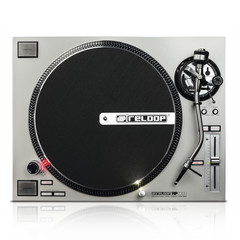
Belt drive DJ turntable, silver
Delivery includes pick-up system
Adjustable ±10 % speed control
Large start/stop button
Strobe lamp for exact speed adjustment
Delivery includes removable dustcover
Adjustable anti-skating
Shock-absorbing feet
Power supply: 115/230 V AC, 50/60 Hz
Power consumption: 8.00 W
Protection class: Protection class II
Power connection: Fixed Power supply cord with Euro plug
Drive type: Belt Drive
Brushless DC motor
Drive: Start time: 1 sec.
Stop time: 1 sec.
Speed change time: <1s 1khz 5cm/sec
Wow and flutter: <0.25 % WRMS
Rumble: 50 dB DIN B
Speed: 33 RPM, 45 RPM
Tonearm: S-shape with Cardan''s suspension
Length: 220
Overhang: 10 mm
stylus pressure: 0-4 g, adjustable
output level: phono 1.7-3.5 mV/ 1 kHz 5 cm/sec
Color: Silver
Connections: Output: phono via Stereo RCA
Pitchrange: ±10%
Material: Plastic
Width: 45 cm
Height: 14.5 cm
Depth: 35 cm
Weight: 3.2 kg
Turntable platter
Material: Plastic
Diameter: 33 cm
Weight: 0.3 kg
The RIOT DJ-Stashpack XL Plus is a versatile and lightweight gig bag that and was designed to be flexible in order to accommodate a variety of equipment. It features a practical, height-adjustable Rolltop opening to easily stash a battle-mixer, records, production gear or a DJ-controller. With its durable material, solid processing and a unique design, the new RIOT DJ-Stashpack XL Plus is perhaps the most versatile gear bag in the market.
+ FITS
Laptop up to 17"
Akai MPK-25
Akai MPC Renaissance
Denon MC-4000
NI Kontrol S4 MK3
NI Kontrol S2 MK3
NI Kontrol S5
NI Kontrol S4
NI Kontrol S2
NI Kontrol Z2
Numark NS6II
Numark NV2
Numark Mixtrack Pro 2
Numark Mixtrack Pro 3
Rane Seventy-Two
Rane Sixty-Two
Rane Sixty-Eigth
Reloop Elite
Reloop Terminal Mix 4
Roland DJ-202
Pioneer DDJ-REV1
Pioneer DDJ-SR2
Pioneer DDJ-RR
Pioneer DDJ-SB2
Pioneer DDJ-RB
Pioneer DJM-S11
Pioneer DJM-S9
Pioneer DJM-S7
Pioneer DJM-900 SRT/NXT
Vestax VCI-400
Vestax VCI-380
12“ Vinyl
Accessories
+ BASICS
Crafted from hardwearing and 100% waterproof PVC Tarpaulin
Soft-fleece lining
PVC-coated (waterproof zippers)
Lockable zippers on main and laptop compartment
Flexible height adjustment through variable Rolltop Closure
Main compartment includes removable bottom foam and padded side walls
The included (removable) Protection Panel protects jog wheels and faders and the folding top part works like an additional lid when e.g. battle-mixers are stowed.
Separate side entry compartment provides quick access to your laptop (up to 17’’)
Large front pocket with internal zip-pouches and organizers
1 side quick-access side pocket for small accessories and personal belongings
1 side bottle holder
Padded back panel with airflow system, ergonomic backpack straps and chest straps
Detachable trolley sling
Hand-luggage compatible (up to 56 cm height)
+ SPECS
+ Outer dimensions: (H/B/T): 49-65 x 38 x 26 cm
+ Inner dimensions: : 47-56 x 32 x 20 cm
+ Weight: 2,4 kg
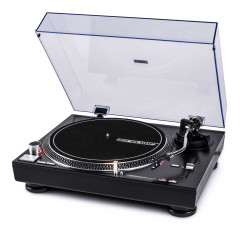
The RP-4000 MK2 is a solid DJ turntable for advanced users. The new MK2 version comes with several improvements, including a newly developed top panel and reworked metallic buttons with enhanced feel as well as a variety of functions. Precise motor control with 3 speeds: The precision-engineered die-cast platter is accelerated by a powerful motor with a high-torque direct drive of more than 1.8 kg/cm. The precise motor control with 3 speeds (33 1/3, 45 & 78 rpm) allows for the RP-4000 MK2 to play back any record. The pitch section with a selectable range of +/-8% and +/-16%, respectively, is suitable for the finest pitch adjustments. Statically balanced s-shaped tone arm: The RP-4000 MK2 features a statically balanced s-shaped tone arm with hydraulic lift and anti-skating mechanism. Via the universal connection for pick-up systems (SME) a large number of pick-up systems can be connected. Reverse function, pitch reset and extendible needle illumination: Additional features, such as reverse play and pitch reset, offer all DJs direct control of their turntable. With the push of a button the aluminium target light can be extended, so that the needle position can be seen in dark surroundings. Newly developed top panel and sturdy housing design: The new deep black metallic top panel construction is equipped with metallic buttons for start/stop, platter speed, pitch control, reverse function and tempo reset. The improved touch upon hit offers a clear haptic feedback. The sturdy construction with optimized damping features and shock-absorbing feet improve isolation from unwanted vibrations. With pick-up and headshell (made by Ortofon in Denmark): The RP-4000 MK2 comes with the high-quality OM Black pick-up, handmade by Ortofon in Denmark, pre-fitted to a headshell ready for immediate playback.
Technical data Turntable:
Type: direct drive turntable
Drive: quartz-driven high-torque direct drive
Motor: 8-pol., 3-phase, brushless DC motor
Turntable speeds: 3 speeds, manual (33 1/3, 45, 78 rpm)
Starting torque: > 1.8 kg/cm
Brake time: 50 dB (DIN-B)
Brake system: electronic brake
Platter:
Material: aluminium die-cast
Diameter: 332 mm
Tone arm:
Type: universal, statically balanced, s-shaped
Effective length: 230.5 mm
Overhang: 16 mm
Tracking angle error: < 3°
Applicable pick-up weight: 3.5 - 8.5 g (incl. headshell 13 - 18 g)
Anti-skating range: 0 - 7 g
Connections:
1x PHONO out (gold-plated), 1x GND
General:
Power supply: AC 115/230 V, 60/50 Hz (EU/US), AC 100 V, 50/60 Hz (JP)
Power consumption: 12 W
Dimensions: 450 (w) x 352 (d) x 144 (h) mm
Weight: appr. 9.8 kg
Included accessories:
Platter, OM Black pick-up system (by Ortofon), headshell, slipmat, counterweight, AC psu, instruction manual
Features
NEW in the MK2 version:
Newly developed top panel and reinforced housing construction
Reworked metallic buttons with improved feel & tactile response
Precision Pitch with selectable ranges of +/-8 % & +/-16 %
Tempo reset (Quartz Lock) feature
Superior finish in deep black metallic
Quartz-driven DJ turntable with high-torque direct drive
Designed for professional use
Powerful brushless DC motor with more than 1.8 kg/cm torque
Precise motor control with 3 speeds selectable (33 1/3, 45 & 78 rpm)
Reverse function: switch for forward/reverse playback
Precision-engineered die-cast aluminium platter with stable rotation
Statically balanced s-shaped tone arm with hydraulic lift and anti-skating mechanism
Universal connection for pick-up systems (SME)
Extendible needle illumination
Shock-absorbing feet for vibration isolation
Sturdy, heavy construction with optimized damping features
Prepared for dust cover (available as optional accessory)
Incl. slipmat, removable headshell and ready-mounted OM Black pick-up made by Ortofon
The RIOT DJ-BACKPACK II is a compact and midsized model of the RIOT PACK line. It was especially designed for digital-DJs travelling with a basic DVS setup such as 15” laptop, Timecode records and accessories or small controllers.
The clever interior layout of the main compartment includes one padded, removable divider and multiple internal storage pouches for clear organization of your equipment. The featured “Zip-Around-Expansion-System” doubles the main compartment’s capacity, providing useful extra space for even more gear or clothing for overnight trips.
+ FITS
Laptop up to 15"
12“ Vinyl
Accessories
+ BASICS
Crafted from durable and 100% waterproof PVC Tarpaulin
PVC-coated (waterproof zippers)
Soft-fleece lining
Lockable zippers on main and laptop compartment
Rubber corner protectors and rubber feet
Main compartment includes one padded, removable divider
Clear organisation Layout and multiple Pockets
The “Zip-Around-Expansion-System” doubles the main compartment’s capacity, providing useful extra space for even more gear or clothing for overnight trips.
Separate side entry compartment provides quick access to your 15,4’’ laptop
One internal hanging mesh accessory pocket comfortably fill out the upper area of the backpack
Large front pocket with internal pouches and organizers
Padded back panel with airflow system, ergonomic backpack straps and chest straps
Detachable trolley sling
Hand luggage compatible
+ SPECS
+ Outer dimensions: (H/B/T): 53 x 33 x 16-22 cm
+ Inner dimensions: : 40 x 31 x 12-16 cm
+ Weight: 2,2 kg
- Hand made carbon hair brush for removing dust from vinyl records
- The brush makes the record antistatic so it does not attract dust
- For those who care for their collection of vintage or brand new vinyl records
- Can also be used for Schellack records
- Handgefertigte Kohlefaserbüste, zur Entfernung von Staub auf Schallpaltten
- Die Bürste macht Schallplatten antistatisch, so dass Staub nicht angezogen wird
- Für die Pflege von alten und neuen Schallplatten
The AT-LP140XP fully manual professional DJ turntable features a high-torque direct-drive motor and anti-resonant, mass-damped, die-cast aluminum platter to ensure stable, on-axis rotation at 33-1/3, 45, and 78 RPM. It is equipped with an S-shaped tonearm with height adjustment, adjustable tracking force (counterweight) and adjustable dynamic anti-skate control.
Features:
Experience high-fidelity audio and professional DJ performance
Direct-drive, high-torque servo motor with speed stabilization
Fully manual operation
Adjustable dynamic anti-skate control
Selectable 33/45/78 RPM speeds
Professional anti-resonance, mass-damped, die-cast aluminum platter with felt mat
AT-HS6 universal ½"-mount headshell and AT-XP3 DJ cartridge with 0.6 mil conical bonded stylus
Balanced S-shaped tonearm with hydraulically damped lift control, height adjustment, and lockable rest
Dedicated phono-level output (5.5 mV)
Stroboscopic platter with speed indicator
Forward/reverse operation and variable pitch control with quartz speed lock
Popup stylus target light for easier cueing in low light
Damped base construction for reduced low-frequency feedback coloration
Includes: detachable RCA output cable (dual RCA male to dual RCA male), power cable, 45 RPM adapter, counterweight, felt mat, and removable hinged dust cover
Turntable
Type 3-speed, fully manual operation
Motor High-torque DC motor
Drive Method Direct drive
Speeds 33-1/3 RPM, 45 RPM, 78 RPM
Turntable Platter Die-cast aluminium
Starting Torque 2.2 kgf-cm
Wow and Flutter 50 dB
Output Level 5.5 mV nominal at 1 kHz, 5 cm/sec
Power Supply Requirements 115/230V AC, 60/50 Hz
Weight 10.0 kg
Pitch Variation +/-8% or +/-16% or +/-24%
DJ Moplen has outdone himself with this reimagining of Machine’s disco classic. Sticking purely to elements from the original, he’s managed to completely redesign the song, starting with an extended version of the soulful piano intro. Punching up the kick drums and handclaps moves the track into house territory, complemented by a funky guitar riff that was completely buried in the original. When the bass enters front and center Moplen practically forces you to the dancefloor, leaving you vulnerable to August Darnell’s controversial lyrics. Fresh from a career-making start with Dr. Buzzard’s Original Savannah Band, lyricist/vocalist Darnell’s collaboration here with Machine was only months from his next incarnation as Kid Creole. Just like those groups, Darnell here fills his song with the politics of race, religion, and sexuality under the guise of a great beat. This release features that rarest of things: a dub just as good as the original. Rather than just removing the vocals, Moplen again rearranges the song, removing the slow intro and building a killer groove from the ground up. As well as the 1979 version, this 12” also features Timmy Regisford’s 1994 house mix and an alternate “acapella reprise” take of that mix, both of which capture the dark energy of the song perfectly.
- A1: Brainticket - Places Of Light
- A2: T.j. Lawrence - Fireplay
- A3: Robert Rental - Double Heart
- B1: African Head Charge - No, Don't Follow Fashion
- B2: Keith Hudson - Nuh Skin Up Dub
- C1: Smokin' Cheeba - When I Was A Youth
- C2: The Wad - 15 Inches
- D1: Idjut Boys & Laj - Foolin' (Beatin On Dave)
- D2: Jbb Et Soprann - Tibi Lap
Part 2.[29,83 €]
Optimo (Espacio) started life as a weekly club night. It was born at The Sub Club in Glasgow on a wet, windy, wintry November Sunday night in 1997. Run by JD Twitch and partner in crime Jonnie Wilkes. Optimo was a reaction against what felt like an increasingly conservative musical soundtrack in clubs here at that time. Clubland felt as if it had become very bland and a bit too serious; it was the era of the dawn of the Superstar DJ. Clubs often felt like bastions of male energy. It seemed dance music and culture was going somewhere far, far away from where it was meant to be. The notion of fun had got lost.
It was no longer the world they had devoted ten years of their lives to already, and lots of their friends felt the same. When the opportunity came up to do a Sunday night at The Sub Club it felt like the perfect opportunity to rip it all up and start again. So they did. There was nothing in the city (or possibly anywhere) like it. As the club believed wholeheartedly in what they were doing, there was no pressure from The Sub Club to fill the club. So, they embraced the freedom. Groups of people who had never been in the same room at the same time before came together. A community of kindred spirits started to emerge.
Word spread, slowly. Lots of people checked it out. Many loved it, some hated it. The core of the Optimo idea was to embrace music they loved that might work on the dancefloor from whatever era or genre they thought felt right. It might not seem very radical now but at that time it was revolutionary.
After about a year and a half, the club went from having 100 people attending most nights to suddenly one week having 500 people turn up. It was very weird. It was as if a collective light bulb went off in people’s heads in Glasgow. From that week on, until the very last weekly Sunday night at the Sub Club, in 2010, over a decade later, it was packed.
There were 550 Sunday Optimo nights. A LOT of music was played. So, what was the music? People often find it hard to pin down exactly what Optimo is. This has been a positive but also a negative as we live in a world where people want easily defined “brand identities”. The simplest definition of the music played is “music for dancing”, which of course is a very broad definition. Even better than trying to define it in words, we have these 2 volumes of music that give a hint of what that might be.
This is not a “Best of Optimo” or a “Greatest Hits of Optimo” compilation. For people who come to, or used to come to the nights there are of course “Greatest Hits”. But, over such a long timespan they are “hits” belonging to a certain moment in time and space. Someone who came to Optimo in 1997 would have a completely different notion of the big tracks at the club to someone coming in 2003, or 2010, or today. This compilation is just a snap shot missing several genres that might make up the DNA of Optimo. There is though a broad sweep through lots of music Optimo loves, that they believe is amazing. Music that they know will rock a dancefloor, that they have played between 1997 and 2023. Of course Optimo nights were not all about rocking the dancefloor. The first hour was always a time for them to play music they loved that often was far removed from the dance. Side 1, Volume 1 of this compilation is the kind of music one might hear at the very start of an Optimo night.
Optimo have always loved a good slogan. The most long lived, and fitting Optimo slogan is "We Love Your Ears", which is in essence what it is all about to them.
- A1: Chris & Cosey - Take Control
- A2: Isolators - Concentrate On Us
- B1: Mike Dunn - Life Goes On
- B2: Kc Flight - Voices (Original Dub Mix)
- C1: Faze Action - Good Lovin' (Special Disco Mix)
- C2: Hannah Holland - Ekotypic
- D1: Divine - Shake It Up
- D2: Xs-5 - I Need More (Extended Dance Version)
- D3: Liquid Liquid - Optimo
Part 1.[29,83 €]
Optimo (Espacio) started life as a weekly club night. It was born at The Sub Club in Glasgow on a wet, windy, wintry November Sunday night in 1997. Run by JD Twitch and partner in crime Jonnie Wilkes. Optimo was a reaction against what felt like an increasingly conservative musical soundtrack in clubs here at that time. Clubland felt as if it had become very bland and a bit too serious; it was the era of the dawn of the Superstar DJ. Clubs often felt like bastions of male energy. It seemed dance music and culture was going somewhere far, far away from where it was meant to be. The notion of fun had got lost.
It was no longer the world they had devoted ten years of their lives to already, and lots of their friends felt the same. When the opportunity came up to do a Sunday night at The Sub Club it felt like the perfect opportunity to rip it all up and start again. So they did. There was nothing in the city (or possibly anywhere) like it. As the club believed wholeheartedly in what they were doing, there was no pressure from The Sub Club to fill the club. So, they embraced the freedom. Groups of people who had never been in the same room at the same time before came together. A community of kindred spirits started to emerge.
Word spread, slowly. Lots of people checked it out. Many loved it, some hated it. The core of the Optimo idea was to embrace music they loved that might work on the dancefloor from whatever era or genre they thought felt right. It might not seem very radical now but at that time it was revolutionary.
After about a year and a half, the club went from having 100 people attending most nights to suddenly one week having 500 people turn up. It was very weird. It was as if a collective light bulb went off in people’s heads in Glasgow. From that week on, until the very last weekly Sunday night at the Sub Club, in 2010, over a decade later, it was packed.
There were 550 Sunday Optimo nights. A LOT of music was played. So, what was the music? People often find it hard to pin down exactly what Optimo is. This has been a positive but also a negative as we live in a world where people want easily defined “brand identities”. The simplest definition of the music played is “music for dancing”, which of course is a very broad definition. Even better than trying to define it in words, we have these 2 volumes of music that give a hint of what that might be.
This is not a “Best of Optimo” or a “Greatest Hits of Optimo” compilation. For people who come to, or used to come to the nights there are of course “Greatest Hits”. But, over such a long timespan they are “hits” belonging to a certain moment in time and space. Someone who came to Optimo in 1997 would have a completely different notion of the big tracks at the club to someone coming in 2003, or 2010, or today. This compilation is just a snap shot missing several genres that might make up the DNA of Optimo. There is though a broad sweep through lots of music Optimo loves, that they believe is amazing. Music that they know will rock a dancefloor, that they have played between 1997 and 2023. Of course Optimo nights were not all about rocking the dancefloor. The first hour was always a time for them to play music they loved that often was far removed from the dance. Side 1, Volume 1 of this compilation is the kind of music one might hear at the very start of an Optimo night.
Optimo have always loved a good slogan. The most long lived, and fitting Optimo slogan is "We Love Your Ears", which is in essence what it is all about to them.
Jason Grimez is a Cincinnati-based DJ and producer. He has a long history of record collecting, sampling, and creating new sounds with analog gear. Grimez works with some of Cincinnati's finest studio musicians to create raw, soulful, instrumental hip-hop under the moniker Doctor Bionic. The next LP, In The Infinite, is due out 12/01/2023 via Chiefdom Records. Grimez fell in love with music during the golden era of early 90's east coast hip hop - when digging for jazz and funky samples were the backbone of beats. He became comfortable scratching on a pair of 1200s and sampling records with an MPC 3000 in high school. After years of collecting music and working on his sound behind the scenes, he has compiled a huge discography of original songs. In 2015, Grimez started his independent label Chiefdom Records. His studio persona Doctor Bionic was one of the first to see a release on the new imprint. The project features a studio band of session musicians. Grimez is responsible for writing, recording, producing, mixing, and releasing the records. He gathers a group of musicians in his studio, presents a few ideas, and hits record. Due to a rotating cast of musicians and ever-changing inspirations, no two sessions are alike. "There's no set pattern," Grimez explained. "I'll invite some session players and have them jam on a few ideas. Sometimes we'll start with a drum break and add melodies over top. It's mostly improv, and I can always go back and chop it up." One common thread is the fresh, original sounds. "I like to call it Organic Groove," he shared. "I'm inspired by all kinds of music - instrumental hip-hop, soul, classic rock, jazz, you name it. When we get in the studio, all of the pieces add up to a new sound." In The Infinite features some of the best players in the Cincinnati music scene. Cameron Brown played guitar on several tracks. Brian Batchelor-Glader, an award-winning pianist, was also involved. All 12 tracks provide the perfect backdrop for hanging with a group of good friends or cruising in the car. The drums are solid, consistent, and lay an effortless foundation for all kinds of instrumentation. Jazzy trumpet lines, ethereal keyboards, choppy soul guitar licks, and much more. "Do You Remember?" (track 2) heroes a busy, poppy guitar and a head-bobbing bassline. The record scratching and tape-recorded drum tones on "Plastic Art" (track 7) feels like a hip-hop instrumental from the early aughts. From top to bottom, this record has a lot to offer. Pick up a copy of In The Infinite on vinyl or stream the album on 12/01/2023
The Bollock Brothers are a British punk act formed in 1979 by the London promoter, DJ, and manager Jock McDonald. They are best known for their English language cover of Serge Gainsbourg’s song “Harley David (Son of a Bitch)” (originally in French) and Alex Harvey’s “Faith Healer”.
As well as being known for their original songs “Horror Movies”, “The Bunker”, “The Legend Of The Snake” and "The Slow Removal of The Left Ear of Vincent van Gogh" which featured Martin Glover of the band Killing Joke, they are known for their release of cover versions by artists Led Zeppelin, The Sensational Alex Harvey Band, Steppenwolf, David Bowie, and Vangelis among others.
- A1: Please Come Out
- A2: Wicked
- B1: Working With
- IB2: N My Head
- C1: Got Your Money
- C2: Didn't You Know
- D1: Two-Door
- E1: Memory Lane
- E2: Good Girls And Boys
- F1: All I Want From You
- F2: Don't Sell Rock
- G1: What Yours
- G2: Tweets
- H1: You Check
- H2: Hero Forever
- I1: Don't Pick Up
- I2: You Don't Know Me Anymore
- J1: Tenderly With You
- J2: Now Let's Wait
Sasu Ripatti's complete "Dancefloor Classics" series. Music for imaginary dancefloors, released on Ripatti's own label Rajaton.
”Look up, into the light” she said, while the camera shutter clicked. ”Like this? Does it look holy?” His neck felt stiff. Her reply: ”Yes, just like that. What do you mean holy? Like religious? ”No, more like trying to look very far, somewhere beyond what we can see.” ”Okay, stand still, I’m going to come close to you now. The light hits your face great.” click, click, click.
He noticed her fingernails. They were not polished. Natural. Even somewhat rugged, as if something wore out the fingers slightly. What had these hands held besides the camera? What made the edges of her fingernails drift off?
He thought it’s weird to look straight into the camera. The photographer had closed her left eye, the one not looking into the lens. Then it opened, she looked up, perusing the surroundings, then she closed her eye again, then looked up, closed, looking up, very quickly. It all seemed very professional. Maybe she calculated the light, making sure it’s close to perfect. ”What will these photos look like?” – the thought popped into his head briefly. It was liberating to think it wouldn’t matter.
”What’s that song playing?” he asked. ”Wait a sec, Ol’ Dirty Bastard?” she replied. ”Oh yeah, right. But the sample?” ”Hey, could you look up again, like that. No, lower.”
New directions: ”Look out from the window, turn left.” ”My left or yours?” ”Yours, I always try to think from the direction of my model.” How professional! This is a good shoot, so natural. Should I worry about how the photos look like? No, I don’t want to. His thoughts bounced around. What would the story be like? It’s a big newspaper, everyone will read it. Maybe someone drinks coffee and eats a stroopwafel while they do it. Will they place the waffle on top of the mug for a brief while, so that it gets hot and the syrup melts a little? Then it feels wet, and you can bend the cookie.
She broke his train of thought off midway through: ”Now turn right, but look left, and slightly up, but don’t turn your face right.” ”Umm, like this? Sounds like a set of pilates instructions.” she laughed ”You do pilates?” ”Yeah, it’s hard sometimes. Have you tried?” ”No”, she said. ”I’m not good for sports that are done in groups.” ”Yeah, but in pilates you can just be inside your mind, drowning in your private thoughts.”
”What are you thinking in pilates?” she asked, taking more photos. ”Well, mostly just which way is right. And which left.” click, click.
Q&A with Sasu Ripatti:
1) Tell us something about the EP series ”Dancefloor Classics”, what’s the idea and what can we expect?
I’ve been slowly writing these sort of dance music pieces and finally curated them together for a conceptual release. I like to create music for a dancefloor that exists only in my imagination and doesn’t try to suck up to the standardized reality.
2) Your vinyl format is 10” which is quite special (as opposed to LP / 12”). Why did you choose it?
It’s my favourite format, absolutely. The size is perfect, and you can make it sound really good @ 45 rpm. And you still can make great artwork.
3) You seem interested in sampling/repurposing, what does it mean to you as an artist to approach something already existing from a new angle? How does the source material inform you about the approach to take?
I guess i could flip it around and just say I’ve outgrown synths or electronic sounds to a great extend, and having gotten rid off all my synths already good while ago I’ve used samples as my main source material a lot. It’s obvious on this series that i’ve sampled existing music, but I also sample instruments and things in the studio and resample my own library that I have built over the years, it’s quite large. To me the end result matters, not so much how I get there. Once I have something on my keyboard and play around, it’s all an instrument, though with sampling other music it becomes a really interesting and complex one as you’re possibly playing rhythm, but also harmonic content and maybe hooks or whatever, all at once.
I never sample premeditadedly, like listening to records and looking for that mindblowing 3 sec part. I just throw the cards in the air and see what lands where, just full intuition and hopefully zero mind involved, playing tons of stuff, trying things, just recording hours of stuff. Then comes the interesting part to listen to hours of mostly crazy stuff and finding that mindblowing 3 sec part.
4) What is your relationship with the dancefloor (conceptually and/or in experiences / as a performer)?
Very complicated. I have never really felt comfortable on a dancefloor but have always wanted to. There’s something in club music, in theory, that really speaks to me. It has never really materialized for me – speaking mainly from a performer’s point of view who goes to check on a dancefloor for a moment after a concert. I never have DJ’d or felt much interest towards it. But again, I love the idea and concept of DJing. As well as producing music for imaginary DJs. Lately, as in the past 10+ years, I haven’t even performed in any sort of club spaces. So my relationship to the dancefloor is quite removed and reduced, but there’s quite a bit of passion and interest left.
All tracks composed and produced by Sasu Ripatti.
Artwork & photography by Marc Hohmann.
Mastering by Stephan Mathieu for Schwebung Mastering.
Vinyl cut by SST Brueggemann.
Publishing by WARP Music Ltd.
Swingrowers (pronounced Swing Growers) released their second album REMOTE on 14th August 2014. Since then, it has been streamed over 13 million times on Spotify, while the official music videos for the two main singles have notched up over 10 million YouTube views. Now the album is being released on wax for the first time as we approach its 10th anniversary.
This is a highly desirable LIMITED EDITION pressing on WHITE VINYL with a free download card enclosed.
REMOTE itself is a revelation. It stood the test of time because it's one of very few complete and fully-realised Electro Swing albums that seamlessly blend 20's and 30's influences (violin, gypsy jazz guitar, saxophones, swing music) with polished contemporary production. Here superb musicianship meets great song-writing meets a unique modern sound. Plus jazz-inflected vocals.
It's the sound of a young band (and indeed an up-start young genre) maturing rapidly and would pave the way for the brilliant albums that followed and indeed for the on-going popularity of the genre.
It will be a sought-after release for fans who have bought the more recent two albums on vinyl, and by fans of other vintage influenced swing artists like Caravan Palace or Parov Stelar.
Grand River and Sofie Birch are set to unveil their collaborative EP, titled “Our Circadian,” on November 24, through Melantónia.
The two-track release follows Grand River’s final release under the now-discontinued Editions Mego label earlier this year, and Sofie Birch’s two solo albums from 2022. Our Circadian represents the second collaborative release on Melantónia, a platform founded by Hanna Maria & Mattia Onori in 2021, dedicated to music for non-dance environments, featuring early contributions from artists like Polygonia, Plants Army Revolver, and Melantónia co-founders Hanna Maria & Mattia Onori themselves, amongst others.
“Our Circadian” was conceived remotely in 2021 during the lockdown, with the aim of encapsulating two distinct moments of those days – early morning and late afternoon – along with their subtle emotional nuances. The first track of the release – 7PM – conveys dreamy atmospheres that flow into colorful rhythms, recalling the electroacoustic nature of the label’s melancholic sounds. The gloomier 3AM, on the other side of a 7“ record, offers a timeless introspection of a gently intensifying synth sound’s fling.
Grand River, a composer and sound designer, brings her background in linguistics to her work. She draws inspiration from minimalism and ambient music, resulting in atmospheric and rhythmically intricate compositions. Her artistic pursuits traverse the realms of art and electronic music, exploring forms of communication that transcend language, often influenced by nature, scale, and movement. Grand River’s impressive portfolio includes sound installations at 4DSOUND/Monom and Terraforma’s Il Pianeta, as well as performances at prestigious venues like Barbican, Rewire, MUTEK, Le Guess Who?, CTM, Draaimolen, and Atonal’s Kraftwerk. She has also worked on remixes for notable acts like Tangerine Dream. Since 2016, she has curated the label One Instrument, offering a unique creative challenge to artists: creating music using only a single instrument.
Sofie Birch, a celebrated sound artist and producer, is known for her lush ambient releases, art installations, live performances, DJ sets, and her NTS show “Ambient Abracadabra.” Her sonic creations can manipulate space, infuse it with a profound sense of calm, and invite listeners to engage in meditation and introspection through the healing qualities of sound and vibrations. Her music acts as a conduit for understanding the complexities of the mind and body through artistic expression, characterized by a distinct emphasis on stillness, suspension, and sustain. Sofie’s soundscapes open gateways to dream-like states of perception and heightened presence, providing a transcendental journey into an alchemical biosphere. Her extensive repertoire includes performances at renowned events such as Barbican, Roskilde Festival, MUTEK, Unsound, CTM, Rewire, Monom, and Terraforma, as well as award-winning compositions for VR experiences and animated films, in collaboration with artists like Baum & Leahy and animation director Pernille Kjaer.
As Our Circadian takes its final form, it promises a narrative of resilience, creativity, and the indomitable human spirit guided by the artistic mastery of Grand River and Sofie Birch.
- A1: Super Disco Breakin
- A2: The Move
- A3: Remote Control
- A4: Song For The Man
- A5: Just A Test
- A6: Body Movin
- B1: Intergalactic
- B2: Sneakin' Out The Hospital
- B3: Putting Shame In Your Game
- B4: Flowin' Prose
- B5: And Me
- B6: Three Mc's And One Dj
- C1: The Grasshopper Unit (Keep Movin')
- C2: Song For Junior
- C3: I Don't Know
- C4: The Negotiation Limerick File
- C5: Electrify
- D1: Picture This
- D2: Unite
- D3: Dedication
- D4: Dr. Lee, Phd
- D5: Instant Death
- E1: Description Of A Strange Man
- E2: Dirt Dog
- E3: Intergalactic (Colleone Webb Remix)
- E4: Dr. Lee Version Dub
- E5: Switched On
- F1: Body Movin' (Fatboy Slim Remix)
- F2: Auntie Jackie Poom Poom Delicious
- F3: Putting Shame In Your Game (Prunes Remix)
- F4: Stink Bug
- G1: Peanut Butter & Jelly
- G2: Piano Jam
- G3: Happy To Be In That Perfect Headspace
- G4: The Negotiation Limerick File (The 41 Small Stars Remix)
- G5: The Drone
- G6 20: Questions Version
- H1: The Bizz Grasshopper Experiment
- H2: Hail Sagan (Special K)
- H3: Body Movin' (Kut Masta Kurt Remix)
- H4: Creepin
- H5: Learning Remote Control
- H6: Oh My Goodness This Record's Incredible
A famous anthem once begged: “Don’t Make Me Wait.” Sometimes, though, it’s good to make ‘em wait—even just a little bit. Case in point: The production duo of Fabrizio Mammarella and Phillip Lauer, known to clubbers, DJs and music heads as Black Spuma.
Three years after their last EP—and nearly a decade into their production existence—the duo have finally given us a full-length manifesto. Sure, there have been a smattering of remixes and EPs over the years on labels like Futureboogie, International Feel and Live At Robert Johnson. But on their new LP “No No No,” the Spumas at last get to stretch out and give us their full-meal-deal.
The pair birthed the tracks at Lauer’s famed Pyramide III studio, with 10 tunes finalised and selected remotely, thanks to the wonders of high-speed Internet. While the Spumas are well-known (both together and as solo acts) for their melodic, 80s-tinged club workouts, the album format has allowed the guys to push their sound into parts unknown. The album drops at the end of May on Permanent Vacation, and it distils all the things we love about the duo: The melody, the playfulness and the musicianship of two veterans in full command of their powers.
Take the tune “Obereggen,” which expands a punchy, staccato bassline into that sweet spot where trance and italo can play next to each other. Or the cut “Fracture,” which is built on a Detroit-like chassis but makes room for gorgeous pads, subby bass and a nimble breakbeat.
For the established fans, there’ll be plenty to latch onto, including the title cut (and first single), which sounds like something Robocop may have produced if he’d taught a violence diversion program.
Meanwhile, cuts like “Dillingen” remind us of one of those lost Eurythmics B-sides that show up in the dark corners of MixesDB. The album was mixed and mastered by Lopazz, and boasts a colourful cover from Berlin-based artist Ilja Karilampi.
So, 17 years after initially meeting, we finally have a full album from these Spuma Men. And in the end, it was worth the wait.
Total Annihilation Beach is the latest collection from Caveman LSD, one of the handful of monikers of Special Guest DJ / uon / sometimes just shy. Their releases under this name have always had the character of sonic transmissions – crushed sine-waves hurtling out of a wormhole, remote pirate radio bandwidths, whale-song picked up on radar, and so on. Here, the signal seems to come from a place whose remoteness is not defined by distance, but adjacency: these are alternate reality bops.
What does it sound like? Kind of solarpunk, but dirty; not at all an artifact from a hopeless culture. Percussion at the forefront; warm timbres and tones – never have I heard this producer play with tabla and tambourine loops as they do in “Lost Hours,” the opening track of the EP. The buildup holds tension and dynamics tight, with a vocoder-smoothed moan – sampled from the caveman’s own voice, on the low – alternating between two notes; when the beat decompresses for the first time two and a half minutes in, one hears the amorphous and cavernous pads we know so well from shy. “Bottle Service Angels” picks up with another acoustic drum loop, and a clap entering 18 seconds in swings the rest of the track into your hips – there’s even an alternate percussion interlude
sandwiched in the middle. The drums are turned over by a distorted and delayed wave, almost like a cop siren, which finds an answer in the track’s final seconds: we hear them blaring, but distantly (the demo version of this track, from spring 2020, was called “ACAB Beat”).
The B side begins with a textured, heaving slab of ambience: “The Sun Will Sink Into the Ocean.” It is perhaps the sun one sees setting over “Total Annihilation Beach” – a phrase that came to shy while tripping on LSD in San Francisco, which felt to them like a post-apocalyptic haven for the rich. Seems on point. There is a machinic repetition to the track, but also sweeping curtains of sound that move like mist. But what comes at nightfall? Not cops, not raiders nor bottle service angels – nothing, actually. Just a void into which one lobs praise. “H6 Remix” adapts a Mesopotamian hymn to the divine wife of a moon deity, dated to 1400 BCE; the strings of the sampled oud playing it out are rich and trail beautifully with reverb. Caveman LSD’s gesture of remixing such a song reads sincere – the reality we inhabit is likely just as brutal as the one to which these transmissions belong; however, in both, honor exists. Love follows.
An EP of limbo-inducing squelch courtesy of our good friends Latrec, ft. techno flavored remixes from Bristolian pal Remotif & our very own Matt Cowell & Quinn Whalley as The W.C. Enjoy.
In the furthest reaches of the cosmos, the intergalactic community gathers for the annual Kutika Limbo finals.
Reigning champion Latrec draws the first straw and the percussion rolls excitedly as he steps up to the pole. Kutika glides lithely under the bar, tentacles wobbling to the acid rhythm. He celebrates his victory as the crowd chants in a glitchy alien dialect. “Kutika-tika-tika-tika!”
Second in line, Latrec’s younger brother Dub Mix steps up for his first limbo. Shorter and stockier than his brother, we don’t know what to expect from this one. Once again the percussion rolls, the crowd gasps as his squidgy exoskeleton melts before their eyes, reforming on the other side of the bar - ‘blooooop’. The crowd goes wild “Kut-Kut!”
Next up is The W.C. Events take a strange turn as they forgo the competition, instead they walk to the stage to sweep the band aside, hijacking control of the instruments. Heavy percussive hits twist spacetime with material melting bass throbs. The crowd goes wild as the fabric of reality collapses around them.
Last but by no means least is Remotif, a techno unit resembling a giant cluster of biceps stands staring at the limbo pole, chaos erupting around him. The tempo of the percussion rises in anticipation and acid thunder roars in the background. Remotif picks up the bar, blinks, and hurls it off into the furthest reaches of the galaxy never to be seen again.
DJ Support:
Ivan Smagghe, Manfredas, Dave Harvey, Optimo, Roman Flugel, Red Axes, Vladimir Ivkovic, Powder, Apiento, Kiara Scuro and more.