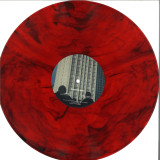
WOW. Daniel O'Sullivan's transcendent new album, Eros, is one of the greatest things we've ever heard. A simply stunning song cycle of hypnotic, experimental contemporary chamber music composed for a 14-piece ensemble. Combining minimalism, complex syncopation, detailed acoustic textures, weird intervals and samurai precision, this record will elegantly blow your mind. When Daniel first sent us this, he pitched it as “Liquid Swords meets Michael Nyman”. Trust us, he wasn't wrong. A "unique hybrid orchestral music", it presents a confluence of Daniel's longstanding fixations; indeed, there's elements of Nyman, Antonio Carlos Jobim, Magma, Aaron Copland and RZA. But this is wholly O'Sullivan's. Originally commissioned for the Sonoton Music Library in Munich, Eros now receives a deluxe vinyl release courtesy of Be With Records, bringing this meticulously crafted work to a wider audience. Limited to just 500 copies for the world, these are gonna fly.
An English composer and multi-instrumentalist, Daniel O'Sullivan’s career has been marked by versatility and innovation. In addition to his work with Sonoton, he has composed extensively for the legendary KPM music library, contributing to its storied legacy of production music. As a deep virtuoso and collaborator, O'Sullivan has also played in a number of influential projects, including Ulver, Sunn O))), This Is Not This Heat, Grumbling Fur and Miracle (with Steve Moore), leaving an indelible mark on the contemporary experimental music landscape.
O’Sullivan’s first foray into classically informed chamber music, Eros is a culmination of his long-standing fixations and expansive musical influences. The album features arrangements that are as detailed as they are emotionally resonant, showcasing his unparalleled ear for intervals and mastery of counterpoint. The music brims with complex rhythmic syncopation and a sensitivity to texture and space, resulting in a soundscape that is both intoxicating and dauntingly precise.
Recorded June 2023 and February 2024, in Brussels, London and Carmarthenshire, Wales, Eros features members of Echo Collective (Neil Leiter and Margaret Hermant), Thighpaulsandra (from seminal post-industrial band Coil), and jazz pioneer Oren Marshall. Daniel's sonic weapons of choice, in his own inimitable words, were "Big Bad Drum, Pee Anne Oh, Low End Brass, Willowy Winds & Samurai Strings." You get the picture. As a cyclical suite, this is a record that really needs to be heard in its entitreity, from start to finish, to truly appreciate the genius at work here.
A jaw-dropping statement of intent, the minimalist "Golden Verses" sets the tone with its complex cue which has your neck snapping right when it feels like it needs to. Listen and you'll understand. A syncopated tangle of sharp strings, crunchy bass, drums percussion and bright piano and mallets vie for position with French horn and woodwind melody in the most compelling and unexpected ways. Quite simply, it's one of the finest album openers I've ever heard. It's followed by the atmospheric rippling minimalism of "Lyre Lyre", a gorgeous gem with shimmering chimes, bright melody, human percussion and syncopated pizzicato strings. It kinda comes on like a less-abstract Boards Of Canada, bursting with typical wonderment. The piano and string-drenched "Dolorous Stroke" effortlessly builds its warm, pastoral orchestration with flowing piano arpeggio, steadfast drums, expressive string quartet, rich low brass, woodwind and lyrical flute. Just sublime.
The insistent frenetic propulsion of "Plain Paper" is utterly beguiling, featuring a determined string motif, urgent drums and percussion, driving low brass and breathless, energetic flute. The haunting, interweaving string arpeggios that propel "Grapes Draped" presents a claustrophobic minimalism for chaos and darkness, with growling low woodwind and brass, spiky harpsichord, skittering flutes and tight drums. Up next, "Xanix Annum" is a stately minimalist waltz with expressive lyrical string quartet and delicate woodwind, anchored by drums and percussion. "Painting Rose" is a bouncy stop-start track with angular syncopated strings and a piano pulse underneath bright harpsichord and flutes. "Rotunda Garden" presents ethereal textural minimalism for landscapes and reflection with flowing string arpeggios, warm, low woodwind drones, floating choir and cymbal swells. Closing out this extraordinary side of music, the glowing, flowing minimalism of "Flowry Orb" features urgent organ, piano and woodwind arpeggios, half-time drums with shimmering cymbals, a soaring, beautiful violin solo and hypnotic vocal chant.
Side 2 opens with "Theia Mania" a determinedly off-kilter, angular track featuring low wind, brass and drum stomp in dialogue with lively string trio, woodwind and solo horn. The light, airy minimalism of "Painting Percy" is built around an interplay of rhythmic motifs for piano, low brass, bassoon, fluttering flutes, urgent strings, drums and percussion whilst "For Archetypes" is a delicate, gently syncopated chamber cue for nostalgia, nature, reflection and moments of calm, with steady piano motif, intimate woodwind and French horn, and warm, graceful strings. The urgent Ars Memoriae is a propulsive march for progress, processes and industry, underpinned by driving tuba, with determined strings, resolute drums, and vivid, expressive flute, clarinet and French horn.
The syncopated energetic minimalism of "Mirrored Seven" presents layers of melodic and cyclical piano, drums, low brass, harp, flute and strings. "Pure Ornament" follows, a slowly evolving chamber cue with flowing clarinet, string and harp arpeggio, plodding tuba and percussion, fluttering flute and graceful, lyrical solos. Stunning! Up next, "Brave Boy" moves from its tender, warm, lullaby-like intro with lyrical flute, clarinet and strings before opening into a playful backend driven by a bouncy tuba riff and syncopated piano, woodwind, string trio, and drums and percussion. Rounding out this astonishing piece, "Waxen Waned" is a warm, pastoral chamber cue with light lyrical woodwind, tender French horn and subtly pulsing string trio.
The album's title is a reference to Plato’s conception of Eros, which is more than romantic or physical desire. It is a dynamic and creative force that drives individuals to seek perfection whether in art, relationships, philosophy or the pursuit of truth. Wholly appropriate, here, we think. When asked what his influences were in making this astounding record, he answered thusly: "Non-musical: Householding, Pythagoras, Goethe, Grail romances, Hermeticism, Doctrine of Signatures (Parcelsus, Bohme, Pliny), Eric Rohmer, John Stezaker, Yasujiro Ozu. Musical: Duke Ellington (late suites), Smile-era Brian, early RZA, Wagner (Parsifal Overture), Magma, Mancini, Axelrod, YMO, Hildegard, Nyman, Penguin Cafe Orchestra, Jobim (Stone Flower), Alessandro Alessandroni, Tavener, Moondog, Orthodox Music, Secular Music." That's some pretty deep shit. Makes you want to dive in, no?
Mastering for this vinyl edition was overseen by Be With regular Simon Francis, and it was cut by the esteemed Cicely Balston at Abbey Road Studios to be pressed in the Netherlands by Record Industry. Truly, Eros is a work of extraordinary depth and sophistication. It invites listeners to immerse themselves in its intricate layers, to lose themselves in its hypnotic rhythms, and to marvel at the precision of its execution. With this release, O’Sullivan reaffirms his position as one of the most inventive and uncompromising voices in contemporary music. Do. Not. Sleep.

Cerca:doctrine
Alternative Tentacles Records is thrilled to announce the first-ever vinyl release of two long-awaited tracks, previously available only in digital format. This highly anticipated split 7" features Jello Biafra & The Guantanamo School of Medicine and The November 3, with two explosive songs: "Blunder Blubber" and "IFAR." "Blunder Blubber," originally released as a digital single to mark Rush Limbaugh's passing and was recorded during the TEA PARTY REVENGE PORN recording sessions, highlights everything iconic about Jello Biafra & The Guantanamo School of Medicine. The song critiques the rise of right-wing extremism, tracing its roots back to Rush Limbaugh's influence and the repeal of the Fairness Doctrine under President Reagan in 1987—a policy change that allowed one-sided political commentary on public airwaves. Biafra argues that this set the stage for the toxic media landscape, fueling figures like Limbaugh and the current wave of ""MAGA"" rhetoric. Reflecting on the political climate, Biafra notes, "I wrote the song back when Clinton was president, seeing the writing on the wall. I was hoping never to use it, but we had no choice but to update and perform it now." On the flip side, The November 3 delivers "IFAR," a fiery debut track that first dropped during the 2020 Republican National Convention. Blending punk rock energy with raw political outrage, lead vocalist Billie O' Rights unleashes a bold, biting rant, backed by Tom Pain’s searing guitars. Pat Triotte and Justice Ferrall add their creative touches to this electrifying anthem, capturing the chaotic spirit of the times. "IFAR," is a raucous, tongue-in-cheek commentary on partisan divides, clocking in at just two minutes of catchy, irreverent fun. Interestingly, the song was reportedly conceived during a mundane moment: Pat Triotte was baking blueberry muffins one Saturday afternoon when the idea hit, and within hours, the track was recorded— and the muffins were supposedly amazing. Despite the humorous and often provocative tone of both songs, the core message of this release is clear: a call to action to vote. With this limited 7" vinyl, Alternative Tentacles Records urges everyone to make their voices heard in the 2024 election and beyond! Don't forget to VOTE!
- A1: Progetto Tribale - The Sweep
- A2: Onirico - Echo Giomini
- A3: Open Spaces - Artist In Wonderland
- B1: Alex Neri – The Wizard (Hot Funky Version)
- B2: M C.j. Feat. Sima - To Yourself Be Free - Instrumental Mix Energy Prod
- B3: Mato Grosso - Titanic Expande
- C1: Dreamatic - I Can Feel It (Part 1)
- C2: Carol Bailey - Understand Me Free Your Mind (Dream Piano Remix)
- C3: The True Underground Sound Of Rome - Secret Doctrine
- D1: Don Carlos - Boy
- D2: Lazy Bird – Jazzy Doll (Odyssey Dub)
Vol 2[28,99 €]
Volume 1 of this expertly curated project of 90s Italian House - put together by Don Carlos.
If Paradise was half as nice… by Fabio De Luca.
Googling “paradise house”, the first results to pop up are an endless list of European b&b’s with whitewashed lime façades, all of them promising “…an unmatched travel experience a few steps from the sea”. Next, a little further down, are the institutional websites of a few select semi-luxury retirement homes (no photos shown, but lots of stock images of smiling nurses with reassuring looks). To find the “paradise house” we’re after, we have to scroll even further down. Much further down.
It feels like yesterday, and at the same time it seems like a million years ago. The Eighties had just ended, and it was still unclear what to expect from the Nineties. Mobile phones that were not the size of a briefcase and did not cost as much as a car? A frightening economic crisis? The guitar-rock revival?! Certainly, the best place to observe that moment of transition was the dancefloor. Truly epochal transformations were happening there. From America, within a short distance one from the other, two revolutionary new musical styles had arrived: the first one sounded a bit like an “on a budget” version of the best Seventies disco-music – Philly sound made with a set of piano-bar keyboards! – the other was even more sparse, futuristic and extraterrestrial. It was a music with a quite distinct “physical” component, which at the same time, to be fully grasped, seemed to call for the knotty theories of certain French post-modern philosophers: Gilles Deleuze, Félix Guattari, Paul Virilio... Both those genres – we would learn shortly after – were born in the black communities of Chicago and Detroit, although listening to those vinyl 12” (often wrapped in generic white covers, and with little indication in the label) you could not easily guess whether behind them there was a black boy from somewhere in the Usa, or a girl from Berlin, or a pale kid from a Cornish coastal town.
Quickly, similar sounds began to show up from all corners of Europe. A thousand variations of the same intuition: leaner, less lean, happier, slightly less intoxicated, more broken, slower, faster, much faster... Boom! From the dancefloors – the London ones at least, whose chronicles we eagerly read every month in the pages of The Face and i-D – came tales of a new generation of clubbers who had completely stopped “dressing up” to go dancing; of hot tempered hooligans bursting into tears and hugging everyone under the strobe lights as the notes of Strings of Life rose up through the fumes of dry ice (certain “smiling” pills were also involved, sure). At this point, however, we must move on to Switzerland.
In Switzerland, in the quiet and diligent town of Lugano, between the 1980s and 1990s there was a club called “Morandi”. Its hot night was on Wednesdays, when the audience also came from Milan, Como, Varese and Zurich. Legend goes that, one night, none less than Prince and Sheila E were spotted hiding among the sofas, on a day-off of the Italian dates of the Nude Tour… The Wednesday resident and superstar was an Italian dj with an exotic name: Don Carlos. The soundtrack he devised was a mixture of Chicago, Detroit, the most progressive R&B and certain forgotten classics of old disco music: practically, what the Paradise Garage in New York might have sounded like had it not closed in 1987. In between, Don Carlos also managed to squeeze in some tracks he had worked on in his studio on Lago Maggiore. One in particular: a track that was rather slow compared to the BPM in fashion at the time, but which was a perfect bridge between house and R&B. The title was Alone: Don Carlos would explain years later that it had to be intended both in the English meaning of “by itself” and like the Italian word meaning “halo”. That wasn’t the only double entendre about the song, anyway. Its own very deep nature was, indeed, double. On the one hand, Alone was built around an angelic keyboard pattern and a romantic piano riff that took you straight to heaven; on the other, it showcased enough electronic squelches (plus a sax part that sounded like it had been dissolved by acid rain) to pigeonhole the tune into the “junk modernity” section, aka the hallmark of all the most innovative sounds of the time: music that sounded like it was hand-crafted from the scraps of glittering overground pop.
No one knows who was the first to call it “paradise house”, nor when it happened. Alternative definitions on the same topic one happened to hear included “ambient house”, “dream house”, “Mediterranean progressive”… but of course none were as good (and alluring) as “paradise house”. What is certain is that such inclination for sounds that were in equal measure angelic and neurotic, romantic and unaffective, quickly became the trademark of the second generation of Italian house. Music that seemed shyly equidistant from all the rhythmic and electronic revolutions that had happened up to that moment (“Music perfectly adept at going nowhere slowly” as noted by English journalist Craig McLean in a legendary field report for Blah Blah Blah magazine). Music that to a inattentive ear might have sounded as anonymous as a snapshot of a random group of passers-by at 10AM in the centre of any major city, but perfectly described the (slow) awakening in the real world after the universal love binge of the so-called Second Summer of Love.
For a brief but unforgettable season, in Italy “paradise house” was the official soundtrack of interminable weekends spent inside the car, darting from one club to another, cutting the peninsula from North to centre, from East to West coast in pursuit of the latest after-hours disco, trading kilometres per hour with beats per minute: practically, a new New Year’s Eve every Friday and Saturday night. This too was no small transformation, as well as a shock for an adult Italy that was encountering for the first time – thanks to its sons and daughters – the wild side of industrial modernity. The clubbers of the so-called “fuoriorario” scene were the balls gone mad in the pinball machine most feared by newspapers, magazines and TV pundits. What they did each and every weekend, apart from going crazy to the sound of the current white labels, was linking distant geographical points and non-places (thank you Marc Augé!) – old dance halls, farmhouses and business centres – transformed for one night into house music heaven. As Marco D’Eramo wrote in his 1995 essay on Chicago, Il maiale e il grattacielo: “Four-wheeled capitalism distorts our age-old image of the city, it allows the suburbs to be connected to each other, whereas before they were connected only by the centre (…) It makes possible a metropolitan area without a metropolis, without a city centre, without downtown. The periphery is no longer a periphery of any centre, but is self-centred”.
“Paradise house” perfectly understood all of this and turned it into a sort of cyber-blues that didn’t even need words, and unexpectedly brought back a drop of melancholic (post?)-humanity within a world that by then – as we would wholly realise in the decades to come – was fully inhuman and heartless. A world where we were all alone, and surrounded by a sinister yellowish halo, like a neon at the end of its life cycle. But, for one night at least, happy.
Repress!
5 Years Anniversary Release - Red Marbled Vinyl
- Pervert Divine Doctrine
- Recm In The Ungodly Lands
- Ruins Of Empire
- Curtain Of Night
- Beyond The Forgotten Gates Of The Otherside
- Venomous Saints
- Forsaken Home Of The Dead
THE SMELL OF DEATH CRAWLS OUT OF THE TOMBS... ...hailing from Turkey let's welcome the classic Death Metal squad ABOLISH to the FDA Records roster. Without any demo or EP release let's start with the debut full length album '...From The Depths". Rotten and morbid female fronted Death Metal for fans of CEREBRAL ROT, GRAVE MIASMA or DISMA. '...From The Depths' was recorded, mixed and mastered by Ozan Y?ld?r?m-Atakan Güçlü at Deadhouse studio, coverartwork by Ozan Y?ld?r?m.
- A1: Stelae Of Vultures
- A2: Chapter For Not Being Hung Upside Down On A Stake In The Underworld And Made To Eat Feces By The Four Apes
- A3: To Strike With Secret Fang
- B1: Naqada Ii Enter The Golden Age
- B2: The Pentagrammathion Of Nephren-Ka
- B3: Overlords Of The Black Earth
- C1: Under The Curse Of The One God
- C2: Doctrine Of Last Things
- C3: True Gods Of The Desert
- D1: The Underworld Awaits Us All
- D2: Lament For The Destruction Of Time
Die US Death Metal-Ikonen NILE kehren mit ihrem mit lang ersehnten, zehnten Studioalbum The Underworld Awaits Us All zurück, das via Napalm Records erscheint.
Wieder einmal verbinden sie technische Präzision mit unbarmherziger Brutalität zu einer markerschütternden Death Metal-Attacke. Dabei beweisen ausnahmslos alle Bandmitglieder – von Gründungsmitglied und Gitarrist Karl Sanders, Schlagzeuger George Kollias, bis hin zu Sänger und Gitarristen Brian Kingsland Zach Jeter, sowie Bassist Dan Vadim Von – enormes musikalisches Können an ihren Instrumenten.
Das neue Album wurde erneut in Sanders' eigenem Serpent Headed Studios in Greenville, South Carolina produziert und aufgenommen. Für das Mixing und Mastering arbeitete die Band mit dem Produzenten Mark Lewis (Dying Fetus, Whitechapel, The Black Dahlia Murder) zusammen, der auch schon am Vorgängeralbum Vile Nilotic Rites beteiligt war und die gewaltige Bildwelt des Covers wurde von Micha "Xaay" Loranc gestaltet, der sich vom Jüngsten Gericht inspirieren ließ.
3 cuts of the classic rhythm from Yabby You. ‘King Pharoah’s plague is coming down on the land’, righteous soulful rendition of old testament doctrine. Yabby always delivered his lyrics with authenticity and passion. This 3 track EP comes with the Tommy McCook cut and a thumping Tubbys dub. One of Yabby's most essential rhythms. Comes in a Pressure Sounds house disco bag. Rocking time is here!
Das Debütalbum der erbarmungslosen “Duft” zeigt unerbittliche Musikalität inmitten des kalkulierten Chaos zermalmender metallischer Riffs, rasender Tempi, strafender Breakdowns und der lyrischen Wut des Hardcore-Punk. Das Hauptthema der Band aus Reykjavik ist das allgegenwärtige Gefühl, dass der Planet Erde in Trümmer fällt: Die meisten Menschen sind zu sehr mit der kindischen Suche nach sofortiger Befriedigung und der Vermeidung von Schmerz beschäftigt, um die Tatsache zu akzeptieren, dass die Welt ein trostloser Hardcore-Ort geworden ist! Um in ihr zu bestehen,
muss man bereit sein, Mut zu zeigen, selbst kritisch zu denken und sich nicht von dogmatischen Wahrheiten leiten zu lassen - man muss sich selbst verantworten und treu bleiben. Dies ist in der Tat keine Platte für schwache Herzen.
Of the countless accolades and analyses that surround Blue, no point is more significant than the fact that the 1971 Joni Mitchell album continues to become more popular, revered, referenced, and relevant with each passing day. Such vitality is not only extremely singular; it is the ultimate measure of great art and, in the context of Blue, indisputable proof of the record's accessibility, integrity, and timelessness. If the most brilliant and everlasting music seeks to find truths shared by all of humanity, Blue can be said to be universal doctrine.
Sourced from the original analogue master tapes, pressed on MoFi SuperVinyl, and strictly limited to 12,000 numbered copies, Mobile Fidelity's UltraDisc One-Step 180g 45RPM 2LP box set presents the landmark album with reference-grade detail, tonality, and directness. Marking the first time the beloved LP has received audiophile-quality treatment, it's one of six iconic 1970s Mitchell records Mobile Fidelity is reissuing on definitive-sounding vinyl and SACD sets.
Everything about Blue sounds more intimate, involving, and inescapable on this transparent pressing, which benefits from a virtually non-existent noise floor and superior groove definition. Mitchell's voice, positioned front and center, and primarily accompanied by minimalist acoustic guitar, piano, and dulcimer playing, comes across clearly and prominently. Suspended notes and radiant chords double as question marks, commas, and phrases. The in-the-room presence and spatial dimensionality make absolute the full-range spectrum of introspective emotions — hurt and distress, self-awareness and joy, difficulty and uncertainty, warmth and desire — Mitchell navigates, queries, and contemplates throughout the record. The defencelessness the singer once spoke about is laid bare here like never before.
The packaging of the Blue UD1S set complements its distinguished status. Housed in a deluxe box, both LPs come in special foil-stamped jackets with faithful-to-the-original graphics that illuminate the splendor of the recording. This UD1S reissue exists as a curatorial artifact for listeners who prize sound quality and production, and who desire to engage themselves in everything involved with the album, including the unforgettable cover photograph of a ruminative Mitchell shot by Tim Considine.
Deemed the third Greatest Album of All Time by Rolling Stone; universally celebrated by critics, fans, artists, and educators; and defined by a spell of disarmingly vulnerable songs that are at once confessional, intense, spare, honest, painful, hopeful, and exquisite, Blue charts love, spiritualism, independence, and loss like no record before or since. Widely considered the album that established the singer-songwriter template, the largely autobiographical LP changed everything shortly after its original release in June 1971. Amazingly, it continues to do so more than five decades later.
An incalculable influence on generations of artists, it stands as the through-line from Carole King, Elton John, James Taylor, Joan Armatrading, and Leonard Cohen to Patti Smith, Carly Simon, Emmylou Harris, and Rosanne Cash to 21st century contemporaries like Brandi Carlile, Taylor Swift, Sharon Van Etten, and Courtney Barnett. Teetering between agony and optimism, it is — to borrow a phrase from Mitchell's eternal "A Case of You" — a bottomless "box of paints."
The beauty of the stripped-down arrangements, intoxicating melodies, and Mitchell's wisdom on Blue didn't go unnoticed. Critical acclaim, coupled with the depth of the material and Mitchell's reputation, propelled the album into the Top 20 in the U.S. and Top 10 in the U.K. Yet while so much pop music diminishes with age, Blue has defied norms and headed in the opposite direction. Its 50th anniversary year witnessed an outpouring of tributes, reflections, and testimonials that helped frame the record's escalating importance and symbolism — apt in an age in which women have become the prominent trailblazers in rock, R&B, and hip-hop.
Perhaps most succinctly, in a 2021 article celebrating the LP, the Los Angeles Times declared: "In 1971, nothing sounded like Joni Mitchell's Blue. 50 years later, it's still a miracle." Nothing, indeed. Yet "miracle" suggests Blue partially owes to a divine agent or inexplicable circumstance. And though Mitchell's bracing conviction and forthright sincerity can appear otherworldly, her musical approach and lyrical storytelling is nothing if not personal and human. What we hear is pure truth — no matter how aching, complicated, or stark.
Much has been written about the circumstances that inspired the songs on Blue: Mitchell's romances; her time overseas; her disdain for celebrity; her lingering sense of loss at having given up her daughter for adoption; her treatment by the very same industry that her music made uncomfortable; her prolonged search for resolution. These situations and experiences pushed Mitchell to question everything — especially big-picture concepts that have always obsessed mankind: fulfilment, autonomy, love, honesty, being.
"I wanna make you feel free," Mitchell sings on the record-opening "All I Want." Mission accomplished. Blue is liberation — and the start of a freedom that continues to impact music, culture, and identity today.
More About Mobile Fidelity UltraDisc One-Step and Why It Is Superior
Mobile Fidelity Sound Lab's UltraDisc One-Step (UD1S) technique bypasses generational losses inherent to the traditional three-step plating process by removing two steps: the production of father and mother plates, which are created to yield numerous stampers from each lacquer that is cut. For UD1S plating, stampers (also called "converts") are made directly from the lacquers. Since each lacquer yields only one stamper, multiple lacquers need to be cut. Mobile Fidelity's UD1S process produces a final LP with the lowest-possible noise floor. The removal of two steps of the plating process also reveals musical details and dynamics that would otherwise be lost due to the standard multi-step process. With UD1S, every aspect of vinyl production is optimized to produce the best-sounding vinyl album available today.
- X-Men Doctrine And Declaration: Target=40:40:11N 73:56:38W
- General P. Counterintelligence: Target=37:47:36N 122:33:17W
- ?Get Up, Punk! 0200 Hrs. (Joint Special Operations Task Force)
- Roc Raida: Riot Control Agent / Combat Stress Control
- Improvised Explosive Device 0300 Hrs
- ?Vaqueros Y Indios! (Joint Special Operations Task Force)
- Precision Guided Needle-Dropping And Larynx Munitions (Pgndlm)
- Duelling Banjo Marching Drill
- Battle Hymn Of The Technics Republic
- ?Fire In The Hole! 0400 Hrs. (Joint Special Operations Task Force)
- Convulsive Antidote For Nerve Agent Autoinjector (Canaa)
- Modified Combined Obstacle Overlay (Mcoo) …Or... How I Learned To Stop Worrying And Love The Turntables
- Surprise Swing Insurgency / Tabla And Tongue Twist Counterattack / Dragon Seeks Path
- ?Kamikaze! 0500 Hrs. (Take A Piece Of Me)
- We'll Paint This Town -- Throat And Phonograph Fire Support Coordination Measures (Tpfscm)
- Imitative Electromagnetic Deception (Ied) / Digital Nonsecure Voice Terminal (Dnvt)
- A.w.o.l. Block Party Brawl 0600 Hrs
- Eastside Multichannel Tactical Scratch Communications (Emtsc)
- ?Pimps Up, Aces High! 0700 Hrs. (Westside Swashbuckling Parade)
- Warcry / Infrared R'n'b Hallucination / Jungle Operations Exfiltration System
- L.o.l. - ¡Loser On Line! (Hate The Player, Hate The Game)
- Low Altitude Vocal Parachute Extraction System (Lavpes)
- Battle Damage Assessment And Repair / White Flag Surrender / Wake Me Up In Heaven
Nächstes Jahr feiern Ipecac ihr 25-jähriges Bestehen. Um die Feierlichkeiten einzuläuten, veröffentlicht das Künstlerfreundliche Label das 2005er Album General Patton vs. The X-Ecutioners zum ersten Mal auf Vinyl..., in einer limitierten Silver Streak-Ausgabe.
Die Veröffentlichung bringt Mike Patton, den legendären Frontmann von Faith No More, Mr. Bungle, Tomahawk und vielen anderen, mit einer der angesehensten DJ-Crews des Hip-Hop, The X-Ecutioners, zusammen. Die Zusammenarbeit kam zustande, nachdem die beiden Gruppen einige improvisierte Live-Shows zusammen gespielt hatten. Der süße Duft der Chemie wehte schon bald durch die Luft, und so beschloss man, einen Schritt weiter zu gehen und gemeinsam an einem kompletten Album zu arbeiten. Das Ergebnis sind 23 Tracks, die einen direkten Zusammenprall zwischen Hip-Hop und der wilden und verrückten Welt von Ipecac darstellen.
- Ltd. Col. LP: (Silver Streak Vinyl; zum ersten Mal auf Vinyl erhältlich; mit einem 24x36 ausklappbaren Poster und einigen metallischen PMS Farben)
Das 2. Album der wahnsinnigsten Horde, die man sich vorstellen kann. Nerve Butcherer" übertrifft seinen Vorgänger "Primitive Force" noch an Aggression, Perversion, Wut und musikalischem Wahnsinn. Bereiten Sie sich auf die gröbste akustische Detonation vor, die möglich ist, denn das hier ist wirklich geistig gestört! Seien Sie darauf gefasst, schockiert zu sein, Sie sind gewarnt!
Bring back my Bass Butches! They’re bossy & they mean business. Rag-tag rhythm riders Maara and Roza Terenzi come together for a freaky friday sound swap; trading auditory secrets only a mixologist would know to conjure up a 2 track tek-trailblazer. Not for the faint hearted deejay, the record flaunts their distinct signature sounds as they reincarnate the status quo of experimental club music one snare at a time.
Percussively penetrating the core ethics of composition, the A side flirts and squirts all over a rhythm so raucous, the bass battens down the hatches. Stir the pot, rock the boat, roll the dice and ride the bass, surrender to the unruly structure as the groove gets full custody.
The bareback B side breaks rules and regulations; leading you to high-tech temptation, fast and furious with an explosive temper that can’t be tamed.
Tickling the rim of electro and bass yet ditching the doctrine, Loose Lips Sink Ships is a take-no-prisoners secret source of dancefloor dopamine, the sleek modern rendition of a ritualistic beatdown destined to weave motifs together and breed atmosphere.
It takes 2 to techno, but these are the number 1 drum degenerates of the future wave party starters.
Lunatic Rec. delivers a diverse album by Electro veteran Manasyt.
On this record the artist shows his own dystopic view on the random game of life. Black or white? Women or men? Sexuality? IQ? State? Religion? Destiny or American Dream? The darkness of this record’s sound doesn’t really leave a choice to answer. Between fast edged drums and offkey harmonics you get thrown into the ups and downs of a likewise horrible as appealing fever dream in seven sequences. The vinyl comes in a handmade screenprinted fullcover, limited to 300 copies. Download code included.
Der Geruch des Todes kriecht aus den Gräbern...
...aus der Türkei kommend, begrüßen wir die klassische Death Metal Truppe ABOLISH im Roster von FDA Records. Ohne Demo oder EP-Veröffentlichung beginnen wir mit dem Debüt-Album '...From The Depths'.
Verdorbener und morbider Female Fronted Death Metal für Fans von CEREBRAL ROT, GRAVE MIASMA oder DISMA.
'...From The Depths' wurde von Ozan Yildirim-Atakan Güçlü im Deadhouse Studio aufgenommen, gemischt und gemastert, Coverartwork von Ozan Yildirim.
White Vinyl / Dl Code
Finely selected, wide range of 11 tracks form a full journey that embodies the prolific duo's vibrant past decade. The doctrine-like title encourages listeners to introspect and challenge themselves.
- A1: Zion Gates- Jacob Miller
- A2: Satta Massaganna- Don Carlos
- A3: Dem Say A Rasta- Johnny Clarke
- A4: Its Gonna Be Dread- Horace Andy
- A5: Decleration Of Rights- Dennis Brown
- A6: Two Faced Rasta- Cornell Campbell
- A7: Every Rasta Is A Star- Bonnie Davis
- B1: This World - Horace Andy
- B2: Man Like Me- Johnny Clarke
- B3: Satta And Praise Jah- Frankie Jones
- B4: Never Conquer Jah- Linval Thompson
- B5: Bightess Rasta Man- Cornell Campbell
- B6: Live On Jah - Wayne Jarrett
- B7: Wicked Babylon - Linval Thompson
Rastafarianism came to prominence in the late 1960's/ 1970's and had a huge influence on the musical culture in Jamaica. The sentiments of the songs reflected the struggles of life, as reggae music always did but now with an added spiritual/conscious element to the lyrics. By the mid 1970's most, if not all the top flight singers were following the doctrine and growing their har to dreadlocks.
Everything was truly 'Dread'.
At the heart of this musical explosion was again Bunny 'Striker' Lee a man who was always at the heart of the action and many times in his career ahead of the musical game. As Bunny Lee's stable of singers were at this time nearly all Rasta's and with the worldwide acceptance of Bob Marley, in especially the foreign territories, this musical style was the way forward for reggae music in the mid 1970's. The visual focal point of this new turn in reggae music would be a call to all things 'Dread'. Add to the mix Bunny Lee's close working relationship with studio wizard King Tubby, again not a Rasta himself, but someone who could sonically bring what was needed to the table and enable the whole musical chemistry to fall into place.
Heavy rhythms were created to match the heavy and serious lyrics and 'Versions Galore' as they say were coming out fast and furious.
We have compiled a set of conscious tunes that not only match the 'Dread' criteria, but also are just great tunes. The great Jacob Miller's 'Zion Gates', Cornell Campbells 'Two Faced Rasta', Horace Andy's 'It's Gonna Be Dread' alongside Linval Thompson's 'Never Conquer Jah'. Two timeless cuts from the 'The Abyssinians' get a fresh outing by two great singers, firstly Don Carlos' cut to 'Satta Massaganna' and the prince of reggae himself, Dennis Brown works 'Declaration of Rights' in fine style. Johnny Clarke's 'Man like Me' and 'Dem Say Rasta' still sound as fresh today as when they were first laid down and Wayne Jarrett's 'Live On Jah' and Frankie Jones 'Satta and Praise Jah' add to this great selection. All great 'Dread' tunes that were cut or voiced at King Tubby's giving them that extra shine.
So if you are Rasta or not this is a great set of tunes to make you move and also like all of the best things in life, make you think.........
Track 14 WICKED BABYLON - LINVAL THOMPSON
Ingredient is the elegant collaboration of Toronto poets, composers, producers and dear friends Ian Daniel Kehoe and Luka Kuplowsky. Their self-titled release is an enigmatic electronic avant-pop record attuned to the micro and macro perspectives of the natural world. Ingredient is an album whose lyrics are more poem than lyric, and whose songs exist in a merger of house music, philosophically-minded lyricism and contemporary R&B. One might recall electronic and art-pop luminaries such as Yukihiro Takahashi, The Blue Nile, and Arthur Russell, or connect it to contemporaries like Nite Jewel, Westerman and Blood Orange. A distinct world of dance, of questions, of secrecy and ultimate softness.
Eight years of friendship forges strange telepathy.
In the summer of 2020, Ian Daniel Kehoe was entrenched in a new feeling of heaviness; psychosomatic symptoms had started to proliferate; stress made new pores across the body, bending sensitivity into pain. His days were met with confusion, detachment, sleeplessness and pain without causation. Disfigured, he felt that what had been central and centering was blown out to the periphery of things. In a moment of self-preservation he reached out to his dear friend Luka Kuplowsky to make an album together. For Kehoe, it was an instinctual grasp for the anchoring truthfulness of deep friendship and the potential for a dedicated creative collaboration. Kuplowsky’s presence was light, supportful and curious, eager to explore musically the sounds they were mutually drawn to: house music, ambient pop, dub. The duality between Kuplowsky and Kehoe – between the Aflight and the Unmoored – is a portrait of a friendship whose exchanges came easy and produced an outpouring of song. Creation and therapy crisscross. In email correspondence that catalogs their process of collaboration, affection abounds: “feels bare without the Luka Licks”, or “Love you so much”, or “Kinda just overwhelmed with deadliness coming in at all angles.” When their voices first come in together on “Wolf,” that harmony arrives in a dramatic avant-pop sound that is bold and wondrous.
Kuplowsky and Kehoe both arrive at Ingredient as established artists whose works are committed to language’s propensity to provoke and mystify. Kuplowsky’s 2020 album Stardust is an idiosyncratic and otherworldly blend of pop and jazz romanticism grounded by Cohen-esque vocals and a stirring philosophical curiosity. Kehoe’s entrance into the new decade has hatched four records of pop experimentation, most recently 2022’s Yes Very So, a euphoric and bold album of poetic synth-pop and meditative ambient instrumentals. Kuplowsky and Kehoe’s union as Ingredient is a beautiful and unusual chemistry that integrates their distinct approaches while bringing forth a newness: a sound that alternates between cinematic technicolor and dubbed out fogginess; a lyricism that exchanges their lucid and clear poetics for a playful and obtuse verse. The album intuitively taps into the opposing emotional states of Kuplowsky and Kehoe during the conception of the record, contrasting the buoyancy of trumpeting keyboards (“Resurface”), angelic synthesized voices (“Come”), and rolling bass (“Photo”) with the record’s underlying darkness of whirring buzzsaw textures (“Transmission”), whooping sirens (“Wolf”) and murky ambience (“Illumination”). Lyrically, this duality arises in the record’s flux between openness (“Variation”, “Raindrop”) and existential dread (“Wolf”). “Illumination” most clearly crystalizes this opposition, reconciling the verses’ neurotic yearning for enlightenment with the chorus’ liberating doctrine of negation: “no more devotion… no more delusion”. Amidst the gradations of light and dark, Kuplowsky and Kehoe trade indelible, lush melodies as though their voices are made of a substance that melts easily one into the other. The harmony of poetry, sound, and texture cuts through your brain fog like a wet diamond.
Ingredient’s self-titled record was assembled by Kuplowsky and Kehoe over the course of six months in a home studio they frequented daily. Amidst synthesizers and drum machines they composed, re-composed, and workshopped a wide array of music, ultimately focusing on a set of eight songs that lived in a shared musical and philosophical world. Recording days often ended in basketball games at a local court or a rooftop commune over a pot of tulsi tea and a crossword puzzle. Kuplowsky brought in the Blue Cliff Record – the classic anthology of Chan Buddhism – whose inscrutable and sublime insights remained constant throughout the recording process as an activator of reorientation and reflection. While Kehoe was frequently rendered physically immobile by bouts of anxiety, a patience and mutual caring governed the pace of their creation; rest, stretching and meditation became equally important as the act of arrangement. Invited into their intimate circle of composition was Thom Gill, whose heavenly voice uplifts “Variation” and “Raindrop,” and Karen Ng, whose alto sax simmers and dances around the funky strut of “Raindrop.”
The lyrics on Ingredient reflect the persistence of change, the infinite variability of nature where randomness and divergence are no accidents. In Daoism, duality, in the form of Yin and Yang, is not contradictory as it is in Western idealist philosophy, but rather composes the eternal and lived paradox of our changeless-changing universe: changeless because all is change, and changing because the dynamism of the Dao makes each moment transformational. Kuplowsky and Kehoe refract this way of seeing the world, as in Variation: “Variation in the natural world / there it is.” Ingredient is an experience of the manifold ways of saying there it is of the transformational world, and there it is, unfolding. Elsewhere, change and ephemerality is addressed through the record’s preoccupation with non-human perspectives, reorienting the listener to the wolf, the mouse, the emerald frog, the centipede, the bird, the fly in the lamp. The album cover visualizes this fascination with the striking image of a reddish-orange frog atop a defamiliarized landscape of dark green leaves. Mirroring the exploratory process of the record’s collaboration, the frog also signals the amphibian’s natural inclination to leap into boundless potential. Kuplowsky and Kehoe’s lyrics manifest philosopher and ecologist Timothy Morton’s concept of “the mesh,” drawing attention to the “vast, entangled web” of interconnectedness that connects all life forms and interweaving the songwriters’ shared wonder into the Animal’s unknowability. As Luka narrates in the breakdown of the dance-floor ready “Photo,” “the closer we observe things, the further they retreat into abstraction.” In Ingredient’s ecosystem, perception is a reversible fractal where the world’s minutest details mirror the shape of the cosmos.
According to the Dao, the path to healing starts by reorienting perception away from the self and toward the self’s subsumption in Totality. For Kehoe, collaborating with Kuplowsky became the reorientation necessary for the self-preservation he was seeking, opening up a shared creative practice to navigate and soften the complexity of his psychological shattering. The album begins with Kuplowsky intoning “colossal faith” which bounces around the stereo field in a cloud of echo, and it is the enormity of “faith” that centers both Kuplowsky and Kehoe’s collaboration and their inquisitiveness in the vast mysteries of our very being. Truth in Ingredient is not an essential nugget, but a bending of the light – it is the equivocal entanglement of how we are in nature as nature, but with a plea or prayer under our breath that marks our felt distance from what we are a part of: “carry me towards the mountains of my birth / returning to the nest / the silence of the earth.”
Bezbog is a duo formed in 2013 by David Machado and Dora Vieira. Since their first release in 2014, the self-titled Bezbog EP, they have been exploring both acoustic and electronic instruments to create music that lives somewhere in between genres, styles, doctrines and musical cultures. Alongside many underground venues throughout Portugal and Spain, they have shown their work in festivals such as No Noise, Milhões de Festa, Out.Fest, and TESLA at the Castile and León Museum of Contemporary Art, and other places such as the Serralves Museum in Porto and MK Gallery in the UK.
Their latest long play takes its name from the solar deity of the slavic pantheon, Dazhbog - the god that gives, and its idea flows into the concept of this record, through the themes of life, light and darkness, birth and rebirth, and the idea of the omnipresent cycle. We can find cycles in nature, music and life itself can be thought of as a cycle, from the micro to the macro scale.
As they seek to embed their music with these ideas, in a way, their music becomes new sacred music, the music of modern pagan rituals. While Bezbog’s music seeks to replicate the meaning of what that music was, an escape from the profane and a connection to the sacred plane, in form it reconstructs it in light of the duo’s influences, from the obvious portuguese and pagan folklore, chamber and sacred music, to the darkness of doom and heavy metal, the structured improvisations of north-american jazz and psycho-acoustic hallucinations and the hash transients of electronic music.
Dazhbog, while a passenger of the same train of thought as their previous studio work, comes in a different direction from it. Chernobog consists of two short and heavy tracks, painstakingly crafted during several months, while their latest studio effort is a long suite of 8 tracks, composed and recorded live throughout 2020, that form a light and bright record where the duo embedded most of their influences. The album will come out on vinyl in late March, in time for the pagan celebration of Spring and Fertility.
- A1: Allegiance
- A2: Progenies Of The Great Apocalypse
- 3: Lepers Among Us
- B1: Vredesbyrd
- B2: For The World To Dictate Our Death
- B3: Blood Hunger Doctrine
- B4: Allehelgens Dod I Helveds Rike
- C1: Cataclysm Children
- C2: Eradication Instincts Defend
- C3: Unorthodox Manifesto
- D1: Heavenly Perverse
- D2: Satan My Master
- D3: Progenies Of The Great Apocalypse (Orchestral Version)
- D4: Eradication Instincts Defined (Orchestral Version)
Following their critically well received debut album, Seekers, in 2017 - Our Kingdom Undone sees BEYOND GRACE refining and redefining their sound into something that’s simultaneously more intricate and more intense than ever before, combining conceptually ambitious songwriting and high octane heaviness in equal measure. Our Kingdom Undone’s gestation period took place under a pall of social unrest and political uncertainty the world over, so it’s perhaps no surprise that each of these eight songs is a cathartic scream of raw emotion and primal poetry. Full to the brim with lyrics that rage with unfettered fury and unbound frustration against the rise of isolationism, exploitation, rampant militarism, and religious indoctrination. Recorded at Stuck On A Name studio by Ian Boult and Bookhouse studio by Tom Hill, before being mixed and mastered by Charles Elliott (Tastemaker Audio / Abysmal Dawn), Our Kingdom Undone (whose stunning artwork was provided by in-demand UK artist Shindy Reehal) is both a crushing statement of intent and a vital reminder that the personal is political, that the ends do not justify the means, and that we must not let our fear divide us and drive us into an age of unreason.