TSR are a trio of Swedish musical mentalists made up of Tomas Nordstrom, Fredrik Askebris .......... & Otto. This crazed technologically berserk band of electronic wizards under Otto’s command relentlessly conjure up thee most brilliant, silliest, toughest, most dance bootable funky shizzle on this highway of existence.
Continuing with the ‘Limited As Fuck’ series of releases, on our fiercely independent techno label based in Scotland, we present the more than welcome return to the label by those Swedish farting techno wasp keepers themselves with their very first ever album, and a double vinyl one at that.
Along-with the vocal talents of he that should be King, Tunnan, and the mystical musical mayhem of fellow Swede Joseph Garber, they’ve put together a cooler than cool selection of music that’s even cooler than the contents of a fully stocked ice cream truck ……… or your pants (if you just happened to keep your ice cream there) that gets more squawking, hand pumping and more noise crackin’ than a Spanish whip.
This is completely over the top shoogle, woogle and boogaloo boppin’ techno mind control shenanigans that’s waiting in store for you so ‘Don’t’ blame us if your feet fall off from dancin’ like pigs in heat.
WARNING: BOONCE YER BONCE ONE TOO MANY TIMES AND YOU’LL TURN INTO AN UNRULY UNDERWORLD HAMMERHEAD
Buscar:don t ask
- A1: Moanin’ At Midnight 2:54
- A2: How Many More Years 2:41
- A3: Smokestack Lightnin’ 3:07
- A4: Baby, How Long 2:53
- 5: No Place To Go (You Gonna Break My Life) 2:4
- A6: All Night Boogie 2:13
- A7: Mama’s Baby 2:08*
- A8: Sittin’ On Top Of The World 2:33*
- A9: I Better Go Now 2:43
- B1: Evil (Is Goin’ On) 2:54
- B2: I’m Leavin’ You 2:57
- B3: Moanin’ For My Baby 2:47
- B4: I Asked For Water (She Gave Me Gasoline) 2:50
- B5: Forty-Four 2:47
- B6: Somebody In My Home 2:25
- B7: Hidden Charms 2:22*
- B8: Don’t Mess With My Baby 2:38*
- B9: Just Like I Treat You 2:56*
Howlin’ Wolf was the primal force of blues music spun out to its ultimate conclusion. He was an imposing presence, blessed with a thunderous voice and enormous physical strength. Like his friend and rival Muddy Waters, Wolf transformed Mississippi’s archaic country blues into the electric urban blues of Chicago, his adopted home. Presented here is his outstanding debut album for Chess Records, Moanin’ in the Moonlight (1959) – one of the alltime cornerstones of the genre.
TLM034 will be our 45th release since 1996 and 25th since reforrning the label in 2019. It seemed inevitable that this release would be one of our Best Of Various EPs featuring new and established artists as we have done previously. Starting off this milestone release we have the ever growing Cumulative Collective with AskaFara.
An Epic 10 minute track pushing all the right buttons for listening and the dancefloor alike. Featuring Cormac Fulton, Stefano De Santis, Takashi Nakazato, Ayumi Suzuki and Mitsuru Tanaka, musicians from England, Italy and Japan respectively. All brought together by head of the label Steve Conry who also produced and mixed the track with Stefano De Santis. Track 2 on the A side is by a new name to most, Takahiro Fuchigami with Strange Acquaintance. A beautiful broken beat track with a distinctively Japanese sound.
Onto side AA and that kicks off with Melchior Sultana and The Playground. Melchior has previously released on TLM in 2022 and 2023. For 2024 he delivers a superb jazzy deep house track in his own particular Mediterranean style. Next up is Brazilian multi instrumentalist Fabio Santanna with Melô Da Cuíca, a fantastic Brazilian Boogie track. Fabio came to our attention from his release Chega Mais Lincoln on Joutro Mundo’s superb Brazilian label Onda Boa. Finally rounding off the AA side is The Robinson from Italy with Song 1. A brilliant blues tinged broken beat track that gets better every time you hear it.
The Morning Papers Have Given Us the Vapours was made with the black watch bandmates and producers/engineers Rob Campanella (Brian Jonestown Massacre, The Tyde, The Warlocks) and Andy Creighton (The World Record, Parson Red Heads). Ben Eshbach, formerly of The Sugarplastic, arranged the strings. Kesha Rose guests on lead vocals on the second single, Oh Do Shut Up. And the great Lindsay Murray once again lends her beautiful backing vox to a number of tracks.
the black watch songwriter/frontman John Andrew Fredrick wrote the ten songs on this, his Los Angeles-based band's latest album, entirely unselfconsciously, with no set goal in mind other than to revel in the joy of songwriting, and, eventually, the luxury of recording his music with his more-than-accomplished band. The Morning Papers Have Given Us the Vapours, produced separately and together by Rob Campanella and Andy Creighton evinces the black watch's often stunning ability to, as Andy Gill once observed in The Independent, "find chaos in the calm, melody in the miasma."
Fredrick, who has also published four comedic novels and a book on the early films of Wes Anderson, jovially describes himself as "a recovering Anglophile--one who'll never, one hopes, fully recover." From his home studio in the Angeleno Heights district of L.A., he waxes eloquent about how being branded, as it were, as a too-ardent lover of British music, film, and literature has left him as bemused as has the tag "prolific" that is often affixed to reviews of his work.
"I just don't think it's all that interesting to note that we've made so many records. Looked at one way, it's a sort of deflection from talking about the timbre if not the quality of the individual songs. Though I know it can be intimidating for fans who've just discovered us--a sort of 'My goodness, where do I start with this band that has put out LPs since 1988?' I get it. I do. I picture someone standing at our slot at a bin at a record store becoming overwhelmed at the prospect of picking the 'wrong' title. And then walking away and not picking up anything from us!" Fredrick laughs. "What can you do indeed?"
He started his career as a songwriter as a result of an American Football injury that left him bedridden in the home he grew up in in Santa Barbara, California. The year The Beatles immortal double-album came out at Christmastime he broke his leg so badly that he had to be home-schooled for an entire year. His parents, ex-teachers themselves, refused to let him watch telly for more than an hour a day. He propped a Silvertone acoustic on top of the massive cast that screamed all the way up to his thigh from his toes, and began to write little melodies and lyrics that, doubtless, did not in the least mask his love for the Fabs, The White Album in especial.
And he read and read and read--histories of the American Revolution and Civil War, mostly, and as many Dickens novels as his mum and dad could bring him. "That year," Fredrick observes, "surely made me who I am today. Proof that intensely unfortunate-seeming events can prove most fortunate. As a sport-mad kid, it made me absolutely mental that I was exiled from the activities I loved most and the school teams I played on. What a blessing undisguised that injury was! Not that I'd like to experience anything like it ever again, mind you."
Fredrick can even recall a few of the melodies he wrote as boy ("Utterly trite, of course, completely jejune"); and in a way, The Morning Papers Have Given Us the Vapours showcases a kind of get-back-to-where-you-once-belonged sensibility. "I didn't intend, this time, to make an album per se. I write both songs and fiction in order to find out what happens, to find out what I might want to say," he notes. "Rob often asks me what a particular song is about; and I often reply that I either don't know, or would prefer that others say. Same thing goes for when people ask me where they should start with our discography. I never know what to say. Our LP from 2011, Led Zeppelin Five (remastered in 2021 for its tenth anniversary), has been our best seller, I think--but that may be because some stoned Zepheads thought their gods had perhaps put out a record they'd missed!"
Despite being deadly serious about music-making, TBW's been known to either whimsically or perversely title their albums. Examples: Jiggery-Pokery (an allusion to John Lennon assessing George Martin's productions), After the Gold Room (a pun on the Neil Young classic plus a local eastside L.A. watering hole), Sugarplum Fairy, Sugarplum Fairy (echoing Lennon's famous count-off to A Day in the Life), Fromthing Somethat (a garbled spoonerism/lyric while doing a vocal), Brilliant Failures (the 2020 release that, along with Fromthing Somethat, was named Album of the Year by venerable indie rock magazine The Big Takeover), and the aforementioned LZ5.
For the new LP, the band recruited longtime friends and allies Ben Eshbach (the Emmy-Award-winning frontman of The Sugarplastic) and Lindsay Murray (Gretchens Wheel) to compose and arrange strings and sing heaps of lovely backing vocals, respectively.
And the result? A collection of songs that Fredrick, in his quite-but-not-quite self-deprecatory way, might call another set of brilliant failures. "Every song, every LP we do, is a failure of sorts--no matter how powerful or beautiful or pleasing-to-us it turns out," John concludes. "I have often said that my aim is to write songs as good as anything on The Beatles... and I will never achieve my goal. And thus I'll have to keep at it, keep trying. And chin-chin to that!"
And now your attention's been brought to a band (or you've heard of them or heard a track or two down the years) that has been pegged by The L.A. Weekly as "a national treasure" as well as "the most criminally-neglected indie pop group imaginable."
So here's to the prospect of that ostensible neglect becoming as much of a thing of the past as John Andrew Fredrick's year-long stint in bed.
To back such a legendary artist, TABOU1 asked Sly & Robbie and the Revolutionaries (Channel One studio band in the late 70's) to work the "old school" way: all musicians would play live, together and in one take, as opposed to recording their parts separately as is now done in modern music. The result is stunning, with luminaries Ansel Collins and Robbie Lyn on keyboards and organ, Sticky Thompson and Skully Sims on percussions, Dalton Browne and Dougie Bryan on guitar. Bob Marley's synth wizard Tyrone Downie added some musical pixie dust while Stepper did the horns.
In Season 5, the long-awaited fifth full-length by beach-pop project The Tyde, frontman Darren Rademaker unveils his vision of an ’80s-inspired Suave Nouveau, with a clutch of sweet, melancholic love songs evoking lush mustaches, mellow macho, the ghost of Jimmy Buffett, white sand beaches, flamingos swooping across a cerulean sky, speedboats cutting through the bay and pastel linen suits billowing in the breeze as the sun dips beneath the horizon. “Spanish conquistador Juan Ponce de León ‘discovered’ Florida in 1513, naming the peninsula La Florida, the flowering land. In Season 5, Rademaker reflects on his own return to the flowering land, and the artistic diaspora that caused him to quit California in 2020 in search of a New World of his own. ‘I lived in Florida from the ages of ten to twenty-five, but never really got to explore it,’ he says. ‘When I came back, I decided to really embrace the whole Florida aesthetic. I moved into an art deco home in Sarasota with pink seashell lamps. I visited Key West, like seven times. I also quit smoking weed and cigarettes, and stopped saying shit like LOL and amazeballs. It felt different. It felt good.’ “The record features the talents of many good friends, including Dan Horne, Colby Buddelmeyer, Matt Correia (Allah-Las), Clay Finch (Mapache), Albert Hickman, Derek James (The Entrance Band), Alex Knost (Tomorrow’s Tulips) and Adam MacDougall (Circles Around The Sun / Black Crowes), with artist / musician Matt Fishbeck (Holy Shit) designing the deco-inspired album artwork. “And as much as they are inspired by the past, these songs are keenly aware of an uncertain future—because there is no such thing as a time machine, and there is no going back. Ultimately, Season 5 asks the question—where do we go after the sun sets on our dreams? Where the fuck is the New New World? In Rademaker’s eyes, it no longer exists in any specific American geography—rather, all hope remains in the timeless, unending power of music, and its power to take us to the places we wish we could be. Even if they don’t exist anymore.” — Caroline Ryder
Donovan invited fans to submit their top 5 favourite songs of his to help curate this limited edition Record Store Day exclusive vinyl. With over 680 submissions, the top songs were chosen and became the tracklist. Each fan who submitted their song picks will have their name listed in the liner notes of the record. Description from Donovan Woods: People like vinyl records, you may have heard. So folks are always asking me about when certain songs will be available on vinyl. The problem is, some of these songs were singles. They were never on an album. I’m not gonna make vinyl singles. This ain’t 1952. I was hoping that vinyl’s popularity would wane and I could wait it out, but that doesn’t seem to be happening. So, we had an idea to let fans vote on which songs they’d like on a vinyl release. Not like a greatest hits, because I have no “hits”, but like a compilation. So, you voted (thank you) and these are all of the popular choices that would fit on an album. Do I agree with all of them? No, of course not. But it's not up to me, that's the beauty of it. It’s not a greatest hits, I can’t stress that enough. It’s just a compilation of songs that a certain set of people enjoy and they'd like to hear these songs with a few more vintagey crackley-pops. Canada RSD Exclusive Pressing - 300 Units - Recycled Mixed-Blend Colourway USA RSD Exclusive Pressing - 200 Units - Recycled Mixed-Blend Colourway Merch Store Exclusive Pressing - 200 Units - Pink Colourway (DW Online Sales Only)
Stu Chapman one of the hardest working producers in the breakbeat rave revival scene has had recent releases on Remix Records, Amen Brother, Monky Records & Ars Musica Imprendere Vitah out of Spain to name a few and has a repress series on his noughties label Enormous Mouse planned for 2024. Stu makes his debut on the Hardcore Vinylists label with 3 tracks of rave breakbeat proving what you can do when 90s rave meets modern samples we didn't ask for a free ride, we only asked Stu to show me a real good time...
What Do We Do Now is the fifth solo studio LP recorded by J Mascis since 1996. This is obviously not a very aggressive release schedule, but when you figure in the live albums, guest spots, and records done with his various other bands (Dinosaur Jr., The Fog, Heavy Blanket, Witch, Sweet Apple, and so on), well, to paraphrase Lou Reed, "J's week beats your year." What Do We Do Now began to come together during the waning days of the Pandemic. Utilizing his own Bisquiteen Studio, J started working on writing a series of tunes on acoustic with a different dynamic than the stuff he creates for Dino. "When I'm writing for the band," he says, "I'm always trying to think of doing things Lou and Murph would fit into. For myself, I'm thinking more about what I can do with just an acoustic guitar, even for the leads. Of course, this time, I added full drums and electric leads, although the rhythm parts are still all acoustic. Usually, I try to do the solo stuff more simply so I can play it by myself, but I really wanted to add the drums. Once that started, everything else just fell into place. So it ended up sounding a lot more like a band record. I dunno why I did that exactly, but it's just what happened." Two guest musicians are playing this time out; Western Mass local Ken Mauri (of the B52s) plays piano on several tracks. Since J himself has some experience with keys, when asked why he needed a hired gun, he says, "Ken is great, and he plays all the keys. I tried playing some keyboards on the first Fog album, but I'm really only comfortable playing the white notes, so it's kind of limiting. laughs Nowadays, I could just turn the pitch on a mini Mellotron to play different sounds, but black keys just seem hard. For whatever reason, I just like banging on the white ones. Seems like it's harder to figure out how to stretch your fingers around the other ones." Mauri has no such qualms and plays all the keys very damn well. He sounds especially great on "I Can't Find You," where he is Jack Nitzsche to J's Neil Young, creating one of the album's loveliest tunes. The other guest musician, Matthew "Doc" Dunn, is also prominent on this track. Dunn's steel guitar manages to both widen and soften the musical edges of the music, giving it a full classicist profile. Dunn is an Ontario-based polymath who J met through Matt Valentine. After J played on Doc's great 2022 Sub Pop single, "Your Feel," he figured it was time for payback. Both Dunn and Mauri add beautifully to the songs here, helping to transform them from acoustic sketches into full-blown post-core power ballads. What Do We Do Now is the finest set of solo tunes J has yet penned, and the way they're presented is just about perfect. Asked if he would be touring to support the album, J says he'll be doing some weekend dates, but he probably won't be putting a band together. And I'm sure these songs will sound great solo and acoustic, but the arrangements on this album are truly great and put a cool, different spin on Mascis' instantly Recognizable approach to making music. So, what do we do now? Not sure. But apparently, what J does is to make one of his most killer records ever. Hats off to him. - Byron Coley
Ivan The Tolerable is the alter ego solo project of Middlesbrough based musical wizard Oli Heffernan. Aside from his solo work as ITT, Oli has played in numerous bands over the years including Year Of Birds, King Champion Sounds with members of the Ex, Detective Instinct, and Shrug, and has collaborated with icons like Mike Watts of the Minutemen, and J Mascis of Dinosaur Jr.
Ivan The Tolerable started by accident in 2013 when Heffernan recorded a bunch of songs for his band at the time (Year Of Birds). These were a bit too left-field for a speedy garage band, so Oli decided to put them out on tape himself, and hasn’t looked back since with releases on Up In Her Room, Stolen Body Records and Library of the Occult to name just a few.
We are delighted to bring you our next entry from the Ivan The Tolerable archive reissue series, 2019’s ‘Wild Nature!’ Originally released on CD by Ack Ack Ack Records back in 2019, the album has now been remastered and repackaged, and will be released on super ltd edition orange wax. Here’s a bit about the album in Oli’s own words.
‘Wild Nature was originally recorded sporadically during the first half of 2019. It started life in one house, then I moved and it was finished in another. I remember screenprinting the original CD artwork on the sly at my old job during my lunch breaks and hand-assembled a small run of about 50 that are all long gone. I also remember walking around Albert Park early one morning in thick fog with a field recorder to capture the sounds that were then processed to form 23 Minutes Over Albert Park (condensed to 4 mins for the reissue due to time constraints). I think this was also the last album I recorded vocals on and also the last one I recorded completely by myself - all instruments, recording, mixing, mastering and artwork done by me at home. I know the first and last tracks were recorded as a birthday present for someone but I cant remember much about the other songs i'm afraid - 4 years is a long time in my speedy world. I've been asked a bunch over the years about a vinyl edition of this one - so here it is. Enjoy - especially everything that went through the delay pedal, which is sadly no longer with us.’
Everything Everything, die für ihre innovative Mischung aus dystopischen Konzepten und experimentellem Art-Pop bekannt sind, kündigen ihr siebtes Studioalbum "Mountainhead" für den 1. März an. Dieses Album setzt ihre lange Tradition fort, gesellschaftliche Themen und kulturelle Trends zu erforschen. Die Band hat bereits beeindruckende Erfolge erzielt, darunter fünf Ivor-Novello-Nominierungen, zwei Mercury-Preis-Nominierungen und fünf aufeinanderfolgende Top-10-Alben. Ihre Musik zeichnet sich durch unkonventionelle Gesangssamples, Synthesizer und exzentrische Melodien aus, die eine faszinierende und einnehmende Atmosphäre schaffen. Mountainhead" vertieft ihre einzigartige Fähigkeit, die möglichen Auswirkungen zukünftiger Technologie auf unsere Gesellschaft zu erforschen. "Mountainhead" konzentriert sich auf das Konzept eines dystopischen Szenarios, in dem die Gesellschaft einen metaphorischen Berg errichtet. Menschen am unteren Ende dieser sozialen Hierarchie arbeiten unermüdlich, um die Elite an der Spitze zu unterstützen. Dieses Konzept dient als Metapher für verschiedene Aspekte unseres gegenwärtigen Lebens, von Kapitalismus bis hin zu Umweltschutz und Prominentenverehrung.
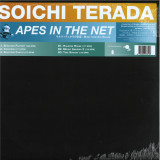
6-track EP compilation with Terada's work for the Ape Escape games, tip!
Outside of the international house underground, where his early ‘90s works for the Far East Recording label he co-founded with Shinichiro Yokota are rightly celebrated as bona-fide classics, Soichi Terada is best-known for his work composing music for video games. Yet until now, few of his productions for video games have been released outside of Japan, especially on vinyl.
Apes In The Net, a six-track EP featuring music composed for the popular PlayStation 1 series Ape Escape, sets the record straight. It not only showcases Terada’s quality as a composer and producer, but also his versatility. Like much of Terada’s work on the Ape Escape series, the tracks featured don’t explore deep, New York and New Jersey influenced house sounds, but rather his lesser-celebrated love of jungle and drum & bass – a sound he fully explored on 1996 album Sumo Jungle.
“The producer of the Ape Escape games heard that and got in touch,” Soichi remembers. “They asked me to make the soundtrack, and then work on the music for the sequels after that. I used to love making music with AKAI hardware samplers, synthesisers, and computers, so I played and recorded the tracks using almost the same methods as I did when I made house music. Using breakbeats and audio samples with a sampler was the most useful way to make the soundtracks.”
The six tracks on show, which were originally recorded in the ‘90s but reconstructed and remastered for Japan-only CD and digital releases over a decade ago, mix elements of Terada’s familiar deep house style – think warming chords and pads, memorable melodies, and emotive musical motifs – with blistering D&B breakbeats, 16-bit synth sounds, electronic bleeps and undeniably weighty basslines. They’ve stood the test of time and arguably sound just as fresh now as they did at the turn of the millennium.
For proof, check the soaring, spellbinding ‘Spectors Castle’, where uplifting lead lines and sumptuous chords dance atop punchy beats and growling bass, the jazzy and saucer-eyed rush of ‘Mount Amazing’ (all twinkling piano motifs, alien synth sounds, squelchy bass and skittish drums) and the intergalactic, liquid D&B excellence of ‘Time Station’, whose whistling melodies and stargazing chords are undeniably alluring.
There are plenty of other delights to be found across the EP, too, from the bustling, race-to-the-finish breathlessness of D&B/bleep techno fusion workout ‘Spectors Factory In’, and the rumbling sub-bass, creepy pads and suspenseful melodies of ‘Haunted House’, to the bombastic, all-out-assault on the senses that is ‘Coaster’, the set’s most “purist” jungle workout – albeit one that also doffs a cap to the pulsating world of big room techno.
Apes In The Net, then, celebrates Soichi Terada’s mastery as a video games composer and early Japanese junglist. Props are well and truly overdue.
- 1: Frankie & Johnny - I'll Hold You
- 2: David Essex - So-Called Loving
- 3: The Flirtations - Nothing But A Heartache
- 4: Fearns Brass Foundry - Don't Change It
- 5: Clyde Mcphatter - Baby You've Got It
- 6: Micky Moonshine - Name It You Got It
- 1: Ronnie Jones - My Love
- 2: Fantastics - Ask The Lonely
- 3: Tom Jones - Stop Breaking My Heart
- 4: Billie Davis - Billy Sunshine
- 5: Amen Corner - Our Love (Is In The Pocket)
- 6: Danny Williams - Whose Little Girl Are You
- 1: Eyes Of Blue - Heart Trouble
- 2: Bobby Hanna - Everybody Needs Love
- 3: Dave Berry - Picture Me Gone
- 4: John E. Paul - I Wanna Know
- 5: Elkie Brooks - The Way You Do The Things You Do
- 6: Jon Gunn - I Just Made Up My Mind
- 7: Adrienne Poster - Something Beautiful
- 1: Brotherhood Of Man - Reach Out Your Hand
- 2: Sonny Childe - Giving Up On Love
- 3: Truly Smith - My Smile Is Just A Frown (Turned Upside Down)
- 4: Stevie Kimble - All The Time In The World
- 5: Tony Newman - Let The Good Times Roll
- 6: The Bats - Listen To My Heart
Today's club culture all started with Northern Soul and its roots in the Mod all-nighter scene of London clubs. All the ingredients were there: DJs privy to the latest imports and advance promos, dancers fuelled by illegal uppers, venues which had scarcely opened when the pubs were all but deserted. The records, drugs and clubs have all changed, true, but the lifestyle is identical. Featuring classics from the Northern Soul Scene including Tom Jones, Ronnie Jones, Brotherhood of Man, Sonny Childe, Billie Davis, Tony Newman, Bats and more. Presented for the first time on orange colour vinyl and CD, this is essential for any funk and soul lovers.
Audiophile reviews rave about saxophone master John Coltrane's immortal Impulse! records, A Love Supreme (1964) and Ballads (1963). Ballads is an album that will never go out of style and never be unwelcome on any jazz lover's turntable.
You're about to experience Ballads at its peak of vinyl perfection — in UHQR format on Clarity Vinyl, with the added bonus of a double 45 RPM cut by Ryan K. Smith at Sterling Sound. Ryan's cut has his characteristic clarity and transparency all set against Quality Record Pressing's usual noiseless backgrounds on 200-gram flawless records. Each UHQR will be packaged in a deluxe box and will include a booklet detailing the entire process of making a UHQR along with a hand-signed certificate of inspection. This will be a truly deluxe, collectible product.
For this 45 RPM 2LP edition you'll also receive a !2" x 12" 12-page booklet featuring liner notes by Ashley Kahn and recording session images by Jim Marshall.
The intense passionate Coltrane interpretation of standards such as "All Or Nothing At All," "What's New," "It's Easy To Remember" and the Sinatra classic "Nancy (With The Laughing Face)" are the essence of Ballads. When asked why attempt such an undertaking, Coltrane replied "Variety."
While it may have been a short detour by Trane before he exploded off into the nether regions of jazz music a few years later, it is still a fantastic document of one of the premier jazz groups of the 1960s.
Recorded December 21, 1961 and September 18 & November 13, 1962 at Rudy Van Gelder Studios.
"It's impossible to sleepwalk through tracks like "You Don't Know What Love Is" and "I Wish I Knew" and impart them with even a fraction of the emotional heft that the Quartet achieves. This is the type of jazz album in which the music just washes over the listener with it's restrained grace and beauty, and while it may not have the adventurousness that some listeners think Trane should have had each and every time he recorded, I'd say it shows off a side of him that only makes us appreciate his more bold and daring albums even more." — The Jazz Record
2023 Repress
Frank Maston’s Tulips is a sample-ready film score to the best 70s movie never made. Originally a super-limited self-release on his Phonoscope label in late 2017, Tulips has already become incredibly sought-after. Be With were introduced to Maston by mutual friends Aquarium Drunkard and it didn’t take long before we decided this modern classic deserved a reissue.
Inspired by the deep-grooving soundtracks of Italian cinema - think Morricone, Umiliani and Alessandroni - Maston conceived the entire Tulips project as a continuation of these revered works. Frank designed the artwork and made two 16mm films to accompany the music: “It wasn’t just the LP… it was kind of a whole vibe I was trying to create. Not really trying to emulate the things that influenced me but more trying to make something that could sit alongside those records on a shelf. I’m still very proud of the project.”
There’s a distinct library music feel too, with wiry organ, spacey keyboards and loping 60s guitar hinting at KPM and DeWolfe. Like the best library music, Tulips creates a cinematic universe through sound alone, evoking moving images in the listener’s technicolour imagination. It turns out that was accidentally on purpose: “I was discovering a lot of library music for the first time… listening to a composer’s entire catalog or finding all this obscure stuff. I wasn’t entirely conscious of the influence until I started making this music and realized I was channeling the vibe. That’s when I began focusing more on weaving melodic themes throughout the record to make it function more like a soundtrack”.
Tulips was recorded between 2015 and 2017 in a small studio in a village called Zwaag in Holland, during downtime from Frank’s touring duties with Jacco Gardner’s band. “Tulips” comes from the title of the very first demo he made in Holland, it was the first thing that came to mind. Makes sense.
Recording in Europe with some very European influences in mind, Frank wanted to eschew any American influences. But we can still feel the studio wizardry of the likes of Brian Wilson and Harry Nilsson in there somewhere. A psychedelic bedroom-pop song-cycle, full of hypnotic hooks and dusty drums, Tulips manages to sound charmingly homemade yet wholly widescreen.
Dreamy opener “Swans” is an exquisite soul instrumental and recalls the soft-psych of Koushik, which Be With loves of course. Tropicalia influences abound in the cool and breezy “New Danger” and the KPM-references are loud and proud on the lush organ pop of “Old Habits”. Fast-paced “Chase Theme No. 1” manages to be both tense and laid back, decorated by acid-drenched spaghetti Western guitars. The glorious Gainsbourg-esque melancholia of “Infinite Bliss” is all gauzy flutes and happy-sad vocalizing and the title is almost perfect: it’s bliss, no question; *if only* it went on forever. Side A closes with “Evening”, a subtle bossa nova beat thing. Gorgeous.
Side B opens with the heat-shimmer guitars of “Rain Dance”, evoking an unreleased Byrds or Buffalo Springfield backing track. Yes, it’s that good. “Sure Thing” is music to accompany an elevator ride you never want to end, but in a good way! The ornate “Garçon Manqué” is as beautiful as the instrumentals on Pet Sounds (think “Let’s Go Away For A While”) and the wistful “Turning In” starts like a stroll in the park before Maston introduces a scorched-Earth guitar solo that would startle if it wasn’t so pitch-perfect. “Chase Theme No. 2” is a briefer, more keening counterpart to what we hear on side A. The head-nod bass-drums-keys funk of “Hues” rounds out this staggeringly assured set; still opening each phrase with a plaintive strum, but using vibrato and heavy reverb to accent the electric organ melody. Sublime.
All these top drawer musical references might sound like just more of the usual release notes hyperbole, but there’s a reason that this still-young LP already changes hands for big money. It really is that good. Of course that first pressing didn’t hang around for long and Frank’s regularly been asked about a re-press pretty much ever since.
Re-issuing Tulips on Be With made sense to Frank “because the record would fit in so well with the catalogue”. Having already delved into the archives of KPM and Themes, and beginning to do the same with Coloursound and Selected Sounds, the collaboration “just makes sense and seems inevitable”. We agree.
Frank wasn’t sure a record of instrumentals with obscure soundtrack references would be an easy sell when it was originally released, and was surprised when Tulips turned out to be exactly what some people wanted to hear. We reckon its timeless beauty ensures that it’ll *always* have an audience.
The record was originally cut to be played at 45rpm, a technical quirk that grants the home listener the opportunity to go deeper, for longer. Played at 33rpm, the more languid unfurling of the tracks proves just as wonderful a trip. As a psilocybin-soaked case study from Aquarium Drunkard back in January of 2019 describes, some of the songs sound as if they were intended to be heard that way. The slower speed allowing the listener to step inside and perhaps even “crack the code” of the music’s meaning.
Mastered for this vinyl reissue by Simon Francis and featuring alternative burnt orange artwork from Maston himself, this Be With pressing is limited to just 500 copies. Hypnagogic it may be, but please don’t sleep.
- A1: Porcelain Id Feat. Emma - Habibi (R U Alone?)
- A2: Porcelain Id - Low Poly
- A3: Porcelain Id - You Are The Heaven
- A4: Porcelain Id - Adam Coming Home
- B1: Porcelain Id - Moon
- B2: Porcelain Id - Feeling
- B3: Porcelain Id Feat. Emma - Brilliant
- B4: Porcelain Id - Cellophane
- B5: Porcelain Id - Man Down!
- B6: Porcelain Id Feat. Youniss - Reach Me/Reaching Higher
- B7: Porcelain Id - Lights!
You just moved to the big city, you end up at a party where you don't know anyone and someone walks up to you and asks: "Hey, are you alone here?". That is exactly the feeling that Porcelain id describes on their debut album Bibi:1, short for the Arabic pet name Habibi. Porcelain id is the pseudonym under which Hubert Tuyishime (they/them/their) has been unleashing unique songs since 2020.
The album - inspired by their move from a quiet provincial town to Antwerp - is the soundtrack to walking into city traffic during rush hour and trusting to get out of the chaos in one piece. It is an ode to exciting encounters with complete strangers and to the friends you can come home to afterwards. A story about being a stranger in a city you've romanticized for so long, the rejection that comes with it, and the false nostalgia with which you look back on it all later on.
At first hearing, the completely English-language Bibi:1 may seem like a brusque farewell to the autobiographical intimacy and lo-fi singer-songwriter music on the previously released EPs Mango and Reprise, and especially on songs like Vlaanderen. But to Porcelain id it feels like an organic evolution. One towards more abstraction, experimentation and electronics, but never detached, and still building on the core of Porcelain id.
The new sound is the result of an intense collaboration with producer and partner in crime Youniss Ahamad, who, despite their different musical backgrounds, immediately felt challenged after Porcelain id's legendary elevator pitch: 'I want to make something that is situated between Nick Cave and the Bad Seeds and Yeezus by Kanye West'.
Together they drew the blueprint for Bibi:1 in Youniss' home studio. Track by track, without looking back. A sporadic, but rigid process that added to the intensity of the album. In the studio, the songs were taken to a higher level. The two invited a pack of talented friends and young musicians to the studio to add parts, a stark contrast to the solitary approach of previous EPs. Aram Abgaryan (recording engineer/synths/vocals), Nard Houdmeyers (guitar), Tim Caramin (drums), David Idrisov (bass), Alban Sarens (sax) and Emma Hessels (vocals) came by. Aram Santy was at the controls during the mixing sessions.
The result sounds like the ultimate symbiosis of Porcelain id and Youniss. Lofi, but ambitious. Fragile, but rough. Poppy, but disruptive. Sometimes challenging. Then welcoming again. Sometimes even danceable. Each song forms a small vignette that is part of a diverse, but coherent unity. Adam Coming Home and Low Poly are closest to the melancholy of Porcelain id's earlier work, while Lights! strikes a new path. First single Man Down, on the other hand, is inspired by the Antwerp students who drown every year and sounds like a wandering nightly stroll through the city. For Brilliant, David Idrisov was asked to 'play bass as if Chet Baker were not a trumpet player, but a bass player', a bizarre assignment that he accomplished with verve. And Cellophane flirts with emo trap and was sung with raspberries between the teeth, to simulate the effect of grills.
J. Robbins on Basilisk:
2020 gave us the pandemic, which despite all its awfulness also gave me a lot of opportunities to write and demo music - but everyone was terrified to get into the same room together to play. Finally, around February of 2021, I called up Brooks Harlan and Darren Zentek and asked if they would be down to meet me at the studio and do a 2-day session and see how it turns out. Brooks and Darren were into the idea - we were all in full cabin fever mode at that point and dying to do anything - so I sent them the demos and we did it. The musical connection had always already been there, but the energy that came from all being in the same room doing this together - something we had just spent a year wondering if we’d ever get to do again - was wonderful. It felt like having been lost in the desert, and then finding an oasis. I’ve never been so happy with a session - both the results and the experience, and the outcome was exactly what I had wanted: something more stripped down and very immediate.
We were all fired up and we did a second session in March 2022. In the interim I enlisted some collaborators:Gordon Withers to add cello and second guitar to a few songs, Janet Morgan and her two sisters to sing some harmonies, Dave Hadley to play pedal steel on “Not The End,” and Chicago punk legend John Haggerty to add an actual blazing guitar solo to the song "Exquisite Corpse." And I went on working on vocals and overdubs at home. The lyrics were (as always) somewhat therapeutical: “Automaticity” came out of thoughts on aging and remaining present in a world increasingly going on auto-pilot; “Last War” and “Dead Eyed God” work out fears prompted by January 6th and the rise of neo-fascism. More personal matters were trying to work themselves out as well. Recurring childhood dreams ("Deception Island"), surrealist games ("Exquisite Corpse"), and trephination guru Amanda Feilding ("Open Mind") were also in the mix.
Another result of pandemic isolation was that I had also been working on more abstract, electronic based music(inspired by my love of film soundtracks, Peter Gabriel’s music, and by studio work I had done not long ago with the band Locrian), using granular synthesis, sampling, and software synths. So as Basilisk came together, I wanted to see if I could pull those sounds into the flow of the record, open up its vocabulary a little and still make something cohesive. Connection has always been the whole point of music making for me. There are so many ways to come at it, and i don't want to close any of those doors. Going forward, I only want to open more of them.
Vladislav Delay presents the fifth and last EP in his "Hide Behind The Silence" series. Intuitive and raw music, momentary and reflective, released on Ripatti's own label "Rajaton".
--
Stillness is a myth. Consider concepts such as ”still water”, or ”still air” for that matter. Go to a restaurant, ask them for a glass of still water, hold it against the light and see where we’re at. Even though the water itself has been captured and imprisoned in the glass, it never stops breathing. It’s filled with tiny particles, dancing. Everything can be explained on a molecular level, but since we’re not scientists – and even if you happen to be – it’s the natural world of perception that moves me.
Still air is very similar. A hot summer’s day with zero wind feels completely still. It’s the closest I have felt to complete stillness. Or for a more urban adaptation, imagine the same vibe inside a normal apartment. In those moments, revelations and mind- blowing experiences can be had with experiments in stillness.
Try this: Just sit down for a minute on a sunny day, making sure there’s enough natural light. Do absolutely nothing. Try not to breathe for a bit. (If you need a mental anchor, you can play Cage’s 4’33” in your head but nothing else.) Watch the tiny dots of dust dancing :..’ ̈.:; ́ ́*°.,’:,. ̈ ̈ ̈ ̈:,.’
The movement is crazy, but the feeling of stillness comes from witnessing how subtle it is. In (perceived) complete stillness, every act of microscopic mobility seems to speak volumes. Yet, it feels both reassuring and oddly threatening that the stillness is never complete. What if we would need absolute stillness? Or is it just enough that we can perceive something as such? Extremes attract, so for both water and air, extraordinary movement is equally fascinating. That is also a luxury item of sorts. For us to enjoy a very ”loud” body of water or air, we need to be safe, in enough control of the situation. So when you are, it’s worthwhile to pay attention and take it all in.
A rapid flowing free with extreme strength and just barely in control. Look at that water go! No still water on this one, only ”sparkling”. A windy day when birds seem surprised how hard it is to fly, but in the end they make it. Trees bend but don’t break. The wind shows you its movement but doesn’t hurt you. It feels friendly, like a big clumsy dog that doesn’t quite understand its size.
It’s beautiful to be a guest of the elements, but not at the mercy of them. A new kind of dialogue forms.
What Do We Do Now is the fifth solo studio LP recorded by J Mascis since 1996. This is obviously not a very aggressive release schedule, but when you figure in the live albums, guest spots, and records done with his various other bands (Dinosaur Jr., The Fog, Heavy Blanket, Witch, Sweet Apple, and so on), well, to paraphrase Lou Reed, "J's week beats your year." What Do We Do Now began to come together during the waning days of the Pandemic. Utilizing his own Bisquiteen Studio, J started working on writing a series of tunes on acoustic with a different dynamic than the stuff he creates for Dino. "When I'm writing for the band," he says, "I'm always trying to think of doing things Lou and Murph would fit into. For myself, I'm thinking more about what I can do with just an acoustic guitar, even for the leads. Of course, this time, I added full drums and electric leads, although the rhythm parts are still all acoustic. Usually, I try to do the solo stuff more simply so I can play it by myself, but I really wanted to add the drums. Once that started, everything else just fell into place. So it ended up sounding a lot more like a band record. I dunno why I did that exactly, but it's just what happened." Two guest musicians are playing this time out; Western Mass local Ken Mauri (of the B52s) plays piano on several tracks. Since J himself has some experience with keys, when asked why he needed a hired gun, he says, "Ken is great, and he plays all the keys. I tried playing some keyboards on the first Fog album, but I'm really only comfortable playing the white notes, so it's kind of limiting. laughs Nowadays, I could just turn the pitch on a mini Mellotron to play different sounds, but black keys just seem hard. For whatever reason, I just like banging on the white ones. Seems like it's harder to figure out how to stretch your fingers around the other ones." Mauri has no such qualms and plays all the keys very damn well. He sounds especially great on "I Can't Find You," where he is Jack Nitzsche to J's Neil Young, creating one of the album's loveliest tunes. The other guest musician, Matthew "Doc" Dunn, is also prominent on this track. Dunn's steel guitar manages to both widen and soften the musical edges of the music, giving it a full classicist profile. Dunn is an Ontario-based polymath who J met through Matt Valentine. After J played on Doc's great 2022 Sub Pop single, "Your Feel," he figured it was time for payback. Both Dunn and Mauri add beautifully to the songs here, helping to transform them from acoustic sketches into full-blown post-core power ballads. What Do We Do Now is the finest set of solo tunes J has yet penned, and the way they're presented is just about perfect. Asked if he would be touring to support the album, J says he'll be doing some weekend dates, but he probably won't be putting a band together. And I'm sure these songs will sound great solo and acoustic, but the arrangements on this album are truly great and put a cool, different spin on Mascis' instantly Recognizable approach to making music. So, what do we do now? Not sure. But apparently, what J does is to make one of his most killer records ever. Hats off to him. - Byron Coley