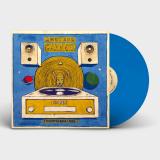
Hiroshi Sato's masterpiece “Awakening” has been reissued for the fourth time in a new color “Pastel Blue Vinyl”. The album was cut by world-renowned engineer Bernie Grundman based on high-spec sound data digitally converted to 96KHz/24bit from the original master tapes. The pressing was done at Sony Music's factory in Japan. This is Hiroshi Sato's fourth original album released in June 1982 after his career in Los Angeles, and his first album for Alpha Records. Featuring Canadian female vocalist Wendy Matthews and using the most advanced drum machine at the time, “LinnDrum,” this mellow and soulful album is a perfect fusion of Sato's sound sense and the atmosphere of American West Coast, and has transcended generations, continues to influence many musicians. Guest guitarists include Tatsuro Yamashita, Tsunehide Matsuki, and Yuji Toriyama! Limited edition.
quête:dr m
Black[25,17 €]
Chicago's finest lyricist MC Juice, infamous from the mid 90s from beating Eminem in the Rap Olympics, is back with a scorching 9 track EP (3 instrumentals and an accapella included) on 12" vinyl! Following on from his two 45s on Nobody Buys Records and well as the hit album The Man, all of 3 of which rapidly sold out this is some of Juice's best work displaying his razor sharp wordplay and effortless flow to its fullest. The sound scape provided by Bankrupt Europeans for their 3rd collabo with Juice ranges from the upbeat & funky original version of All Day to the murky oboe of its remix, the dramatic strings on Where You Go and the sinister vibes of Unseen, in short, the perfect set up for Juice to get loose! We are beyond excited to be delivering some of MC JUICE’s finest ever work and there is a general feeling around Nobody-Buys-Records HQ that this may just be our finest release yet. Between the absolutely incredible artwork by the immensely talented Big Crunch, the beautiful marble vinyl, and the exquisite beats and rhymes, this EP is quite simply the perfect summer package. As always, every record is hand numbered!
K.W. Cahill records and plays acoustic and electric guitars, mandolin, karimba, melodica and an AM/FM portable radio on March 2024 time.
Mastered by James A. Toth in Toronto.
Follow up to Goodge's 2023 album Echoes Of Yesterday. Previous releases found on Hip Dozer and Cascade Records. Tracks found on the popular Spotify Mellow Beats playlist. 11th in 'Jet Set' Cold Busted series. Designed and manufactured similar to the vintage 60's style rice paper sleeves. In his latest EP, Sunday Soul, Goodge takes listeners on a four-track journey through the heart of funk, masterfully blending elements of R&B, jazz, and chilled lo-fi. Released as part of Cold Busted's Jet Set series, this four-song offering follows Goodge's 2023 album Echoes Of Yesterday and showcases his dedication to crafting timeless music. "Lights Out" kicks off the EP with heavy funk and stirring breakbeats, accompanied by a scratchy guitar that summons the revolutionary spirit of the '70s. Horns serve as a call to action, while a rollicking bass line and chunky electric piano might inspire listeners to go out and fight crime. "Promised Land" follows, featuring a formidable funk bass guitar and lead guitar chords that rhythmically play off the delightfully busy drums, creating an atmosphere reminiscent of the city's bustle. The title track, "Sunday Soul," is a rowdy affair with a speech-over-beats leading to crispy snare rolls and chiming electric piano. Shaker magic, staccato horn bleats, and spiral flute bits combine to create a swirling vintage-hued photograph of sound. The EP concludes with "Within Myself," a spacier sonic experience that could serve as the soundtrack for chasing someone across rooftops. It's funk spelled with a capital K. Sunday Soul is a must-listen for fans of of the heavier side of funk, solidifying Goodge's position as a master of his craft, creating a nostalgic yet fresh soundscape that keeps listeners grooving back for more.
- 1: Dead Smile (5:0)
- 2: Morning Song (4:15)
- 3: The Ocean In-Between (2:51)
- 4: I Love You (1:1)
- 5: I Don’t Want To Know (3:46)
- 6: Warning (4:04)
- 7: Spiral (1:50)
- 8: Love Is Gone (3:27)
- 9: Hear This (3:22)
- 10: Wait (2:38)
- 11: Tonight We Ride (2:44)
- 12: Through Your Eyes (7:13)
Originally released on CD in Japan in 2003, as a love letter & thank you to his Japanese fans. Recorded at home, produced, engineered & mixed by Matthew Sweet (bass, guirars & vocals) with the classic ‘Girlfriend’ era lineup of Ric Menck (drums), Greg Leisz (guitars) and the genius electric lead guitar of Television’s Richard Lloyd. The sleeve art is by renowned artist Yoshimoto Nara. In the liner notes, Sweet describes the album's title as an attempt at reverse English: "If I did it correctly, the title should seem a little strange or wrong, but still meaningful! The true definition is supposed to be a 'love you' life, one devoted to loving someone or something, even life itself!"
“an excellent modern guitar pop album, filled with great hooks and harmonies and irresistible ringing six-strings”
Allmusic
“Kimi crackles with Girlfriend‘s energy, as Lloyd and Sweet’s guitars provide antagonistic foils as they did more than a decade before on cuts like “Tonight We Ride.”
Rolling Stone
2024 Reissue
Transparent grünes Vinyl! Wieder lieferbar! Zum ersten Mal überhaupt seit der digital-only Veröffentlichung 2011 erscheint nun der erste "Minecraft"-Soundtrack in physischer Form. Die Vinylversion enthält zwölf Tracks! "Minecraft - Volume Alpha" ist das Werk des deutschen Komponisten und Musikers Daniel Rosenfeld. Unter seinem Künstlernamen C418 erschuf Rosenfeld den weitreichenden Soundtrack und das lebendige Sounddesign, das das auf Voxel aufgebaute Universum von "Minecraft" zum Leben erweckte. Fans und Kritiker waren durch die Bank weg begeistert von seinen beatlosen, ausgewogenen Electro-Stücken. Die bekannte Gaming Seite "Kotaku" führte den Soundtrack unter der "Best Game Music" 2011 und nannte die Musik "beeindruckend beruhigend", während The Guardian die zerbrechlichen Stücke Rosenfelds aus Klavier und minimalistischem Ambient mit den legendären Künstlern ERIK SATIE und BRIAN ENO. In einem Interview destillierte Polygon "Volume Alpha" auf seine Essenz hinuntern: "Der Soundtrack ist nicht gebunden an die Retro-Ästhetik der Minecraft Graphik. Der Soundtrack setzt sich über sie hinweg. Das Album ist ein Versuch, die kombinierte Game/Music Erfahrung in etwas Himmlisches zu übersetzen."
- A1: Coming To Town
- A2: Empty Bank
- A3: Harry's Philosophy
- A4: Dolly's Arrival
- B1: Harry And Dolly
- B2: Sawmill
- B3: Bank Robbery
- C1: Moanin
- C2: Gloria's Story
- C3: Harry Sets Up Sutton
- D1: Murder
- D2: Blackmail
- D3: End Credits
Unlock the allure of The Hot Spot through its unforgettable soundtrack, a captivating collection that brings the film's sultry ambiance to life.
Set against the backdrop of a small Texas town, The Hot Spot follows Harry Madox, a charming drifter with a dark past. As he arrives in town, he becomes embroiled in a web of seduction and deceit, navigating his way through a love triangle involving the sultry waitress, Gloria, and the alluring femme fatale, Dolly. Tensions rise and passions ignite, leading to a thrilling climax where desire and danger intertwine. Directed by the visionary Dennis Hopper, the film is a masterclass in mood and atmosphere, capturing the essence of 1990s neo-noir.
The Hot Spot has garnered acclaim for its stylish cinematography and gripping narrative, but it's the music that truly sets it apart. It's an amalgamation of swampy blues, jazz and rock — all mixed and recorded in a sparse, bloomy and eerie sort of way.
Critics hailed the soundtrack as "an electrifying fusion of jazz and blues that perfectly complements the film's seductive undertones." The blend of sultry melodies and haunting instrumentals creates an immersive experience that resonates long after the credits roll.
This recording is just so damn fine, so airy and warm. And the musicians aboard on this Dennis Hopper film are a who's who, including Miles Davis, John Lee Hooker, Taj Mahal, Roy Rodgers, Earl Palmer and Tim Drummond. This has long been a highly sought-after and collectible record among audiophiles. This soundtrack is essential for any music lover or film buff, capturing the very essence of the film's seductive spirit.
For her new and most radical album »Electroacoustic Works for Halldorophone«, Martina Bertoni used the electronic instrument at EMS Stockholm to create four pieces that are massive in scale and incredibly intimate, sonically restrained and emotionally overwhelming—almost ambient and always demanding your full attention.
Martina Bertoni returns to Karlrecords with »Electroacoustic Works for Halldorophone,« her most radical album yet. The foundation for the four electroacoustic pieces was laid during a residency at Stockholm’s legendary Elektronmusikstudion (EMS) that the Berlin-based cellist and composer used to explore the curious instrument, originally designed by Halldór Úlfarsson in 2008, as an algorithmic system in order to examine tunings and the mathematical relationships between Aiming to analyse and understand their interaction beyond the composer’s control, Bertoni sought to engage more deeply with the concepts of time, tuning, and, most importantly, control. Accordingly, her four »Electroacoustic Works for Halldorophone« seem both massive in scale and incredibly intimate, sonically restrained and emotionally overwhelming— almost ambient and always demanding your full attention.
While the halldorophone—famously used by Hildur Guðnadóttir for her »Joker« score—roughly resembles a cello and can be played like one, it is an electronic instrument. The vibration of its strings is being picked up, amplified, and then routed through a speaker. This creates a feedback loop that becomes increasingly complex depending on how much gain is added to individual strings. Úlfarsson gave Bertoni a carte blanche for how to handle the instrument, but she stresses that she relied on »minimal interventions—some string strumming and plucking« that set the interactions of different sounds and frequencies into motion. »I decided to not approach it like a cellist would,« she explains. »Instead I used it as a kind of generative organ by turning it into a feedback machine, with tuned feedback triggering more feedback depending on the tuning, which was based on tetraphonic scales that I could apply on the four main strings as well as the sympathetic group of strings.«
Bertoni recorded the material in the EMS studio, later composing and arranging the four complex pieces in her home in Berlin, after which they were mixed and mastered by Ciaran O’Shea. While this can be considered a compositional abstraction process, traces of her concrete work as a performer are firmly ingrained in the music. »The halldorophone doesn’t have a line output, just a double set of speakers, which is why I recorded all sounds with two microphones in the EMS studio,« she explains. »That’s why there’s plenty of breathing sounds here and there—label owner Thomas Herbst and I jokingly refer to the album as my ›chamber music record‹.« And indeed, there is a striking sense of intimacy to these four pieces throughout which individual sounds, harmonic frequencies, and even subtle rhythmic figures seem to move both on their own accord but also according to a underlying vision that steers their interplay.
Indeed, »Electroacoustic Works for Halldorophone« is an album built on and marked by contrasts. The soothing polylogue of single sounds in the higher register on opener »Omen in G« is counterpointed by massive bass drones, while the second piece, »Nominal in D,« plays a cunning game of repetition and difference by combining thick textures with all kinds of rhythmic elements. »Fades in C«—the longest of the four pieces, clocking in at 17 minutes—unlocks the emotional potentials of the sonic qualities of the halldorophone, sounding at once serene and anthemic, and »Organon in D« closes the album by underscoring how Bertoni’s unconventional approach allows her to seamlessly transform simple, quiet tones into complex, towering walls of sound.
- 1: Come Away
- 2: Dance
- 3: You Make No Sense
- 4: Parking Lot Blues
- 5: Chistelle
- 6: About You
- 7: It’s Alright
- 8: Moody (Spaced Out)
- 9: Tiny Sticks
- 10: The Beat
- 11: My Love For You
Repressed LP on Neon Orange Vinyl. Come Away With ESG - 35-year anniversary release of the classic genre-busting debut album by the Bronx sisters ESG. The sample-friendly opus that’s the inspiration for hip-hop, house and post punk. Music that falls outside of the no wave, new wave and post punk library, it’s for the dance floor but it’s not funk, there’s no horns, no driving organ; it’s the opposite of Sly And The Family Stone but no less cool and no less groovy. “A lasting document of their unique brand of minimal funk that would influence subsequent post-punk, hip-hop, and dance music acts. Stripped down to the most basic of drumbeats and rudimentary bass lines, ‘Come Away’ confirms the notion that the real rhythm is what happens between the beats. AllMusic // “This is dub disco with a punk edge.” Paste // “Uncut punk-funk straight off the streets of the South Bronx.” Record Collector // “ESG are that rare thing” Guardian // “Come Away with ESG sounds so shockingly current.” Paste // “A musical snapshot of New York City at the beginning of the '80s.” Allmusic
Since 1992, Robin Storey (founding member of the pioneering post-industrial band Zoviet*France) has been creating innovative and thought-provoking music under the Rapoon moniker. Drawing inspiration from his early days with Z*F, he continues to push the boundaries of ambient, industrial, and world music genres, earning him a dedicated following across the globe.
Originally available in 1994 as a limited-edition DAT tape through Staalplaat Records, Cidar was later included as a bonus CD in the reissue of another Rapoon classic, Fallen Gods. Now, after years of anticipation, fans can experience this mesmerizing work as a stand-alone release – remastered and expanded with three previously unreleased tracks from the original 1994 recording sessions.
Cidar showcases Robin’s signature sound – a seamless blend of Z*F-inspired drones and loops intertwined with vibrant African percussion and hauntingly beautiful Asian string instruments. This combination creates an immersive, trance-like atmosphere that transports listeners into a world of meditative sonic exploration.
With its enchanting rhythms and deeply textured layers, Cidar stands as a testament to Robin’s unparalleled ability to craft music that defies genre boundaries while remaining instantly recognizable. Fans of both Zoviet*France and Rapoon will find themselves drawn into the hypnotic sounds of this timeless masterpiece.
The standalone release of Cidar marks an important milestone in the history of experimental music, offering audiences worldwide the opportunity to rediscover or experience for the first time one of Robin Storey’s most influential works.
- 1: Scimitarium I
- 2: Aconitum
- 3: Red Ruins
- 4: Hungry Hallucinations
- 5: Fever Dance
- 6:
- 7: Ophidia
Crypt of the Wizard is proud to present Scimitar – Scimitarium I on vinyl and digital formats. Formed in 2024 by veterans of Copenhagen’s underground music scene—including members of Slaegt, Endless Glory, and Shaam Larein—Scimitar arrives as a fully formed force of nature. In their raucous wake lies Scimitarium I, a frenzied, whirling dervish of black occult rock. For those familiar with the members' previous efforts, this should come as no surprise. This piece of musical alchemy is a perfect knife-edge dance, seamlessly blending elements of black metal, post-punk, and occult rock. Dark and serpentine, onyx black, scaled and sacred, Scimitarium I unfurls itself like an endless snake wrapped tight around the world. With a dark heart and a head full of fever dreams, this is an album of breathless intensity. Shaam A.’s constant presence provides an abundance of rich, overflowing lyrics, delivered in her distinctive and haunting voice—written as if hurriedly scrawled in feverish reverie—and reinforced by winding, twisted narratives played out on violent yet harmonic duelling guitars, alongside a rhythm section of unyielding intensity. Scimitar has quickly become an indelible part of the city's fertile and ever-evolving metal scene—a place where stalwarts continue to push boundaries and break moulds with seemingly effortless zeal. This is an album of forged perfection, honed and sharpened like a curved blade—shimmering with lethal precision—driven straight into the heart of all matters
- A1: Core
- A2: Anticipate
- A3: War Game
- A4: Mantra
- A5: Unlearn
- A6: Disarm
- B1: Open
- B2: Safe
- B3: Heal
- B4: Dmz
Demilitarize follows Nazar’s remarkable 2020 debut Guerrilla, which reprocessed Angolan kuduro music with rough textures, field recordings and media clips, telling a personal story of the civil war that exiled his family to Europe, while his father, a rebel General, fought a losing battle in the jungle back home. After Guerrilla, and an extended period of serious illness, now Demilitarize is motivated by a reckoning with mortality and the flowering of new love, turning the ‘rough kuduro’ of Guerrilla inside out.This is a deep sound world, genuinely dreamy, the arc of the album describing shedding the armour of trauma and surrendering to this new situation. A constant and unexpected aspect of Demilitarize is Nazar's gentle, submerged vocal. Insistent and mantra-like, it’s like a cross between Elisabeth Frazer, Arthur Russell and Frank Ocean, and the music is fragile and opaque in response. The rhythms of kuduro are still here,but move around his voice like fish around a swimmer, while precise sound design illuminates from different angles. Chords spiral, ripple and shoot through the beats giving tracks the loosest of settings; songs disassemble; vocals float off-centre.
- 1: Die For Allah
- 2: Deathwish
- 3: What?S The News
- 4: Life Inside Iran
- 5: Iranians On Bikes
- 6: Simple Life
- 7: Fifh
- 8: Blow Up The Embassy
- 9: Theme
- 10: Iranian Klan
- 11: Ultraviolence
- 12: Chant
- 13: Land Of The Free
The classic Fearless Iranians From Hell Die For Allah LP is now back in print after a twenty-five year hiatus. Remastered and repressed on nuclear green vinyl, this hardcore punk arsenal also includes all tracks from their literally explosive Blow Up The Embassy 7-inch debut. FIFH was a mysterious Texan monstrosity formed in 1983 by Iranian expat (and modern day hashashin) Amir Mamori, who gathered to his side various mutants and apocalyptic freaks from the San Antonio punk rock blast zone, even throwing in two Butthole Surfers rejects for good measure (including none other than the notorious Anus Presley himself). The subsequent recording sessions were a chaotic affair, as guitars were rarely in tune and the drums were seemingly scavenged from the trash. It was all directed by Amir who, with fanatical focus, would inspire the band on to victory from behind a stupifying cloud of hash smoke. The resulting releases were widely praised; from places like Maximum Rock n Roll and the Village Voice in the US, to Sounds and New Musical Express in the UK. They were even cited as forerunners of the musical genre known as Taqwacore. After touring the US in the late ’80s—and leaving in their wake crowd turbulence, police intimidation, and even bounties being place on the heads of the members—the band disbanded in 1989 upon the death of the Ayatollah Khomeini (may Allah have mercy on him). “We’re stoned as shit, and we’re ready to roll.” - F.I.F.H. ’87
- 1: As We Stand On The Hill
- 2: In The Age Of Night
- 3: Forged Iron
- 4: Hallowed Waters
- 5: The Clock Tower
- 6: Blazing Spirits (Rising High)
- 7: Oath Of The Paladins
Alchemical amalgamations abound on Gloomy Reflection's Debut LP. The combining of two explosive musical forces in Lord Gordith (Quest Master, Steröid) and Will Spectre (Crypt Vapor, Dracula, Tarot, The Wizar'd) is in and of itself an act of strong and dangerous magick yielding the potent chemical reaction that has brought forth The Oath of the Paladins.
These seven tracks of synth drenched hard rock/heavy metal are each the product of significant symbiosis. Wrenching together lofi basement blackened heavy metal, with bombastic fist pumping progressive hard rock. The fusion of these ever so unstable elements has resulted in one of the most electric albums of 2025.
- 303: Eyelashes Out {16’52’’}
- Her Panties {11’31’’}
- Unwashed (105 Oven) {05’28’’}
- Another Stain {04’32’’}
'Tense from the first note and decisively uncompromising ‘GHSTING’ is the debut collaboration by Polish artists Alex Freiheit and Aleksandra Słyż, an incredibly unique piece of work that mixes fiction, spoken word poetry, theatrical antics, dense synthesis, acoustic ensemble and dark landscapes all set within the backdrop of a sinister Eastern Europe hotel. The resulting sound is menacing, humorous, harmonious, tumultuous, and at times quietly erotic.
Alex Freiheit, a poet and vocalist, is widely recognized for her captivating work with the SIKSA duo. Over the past decade, she has delved into the realms of personal feminist storytelling, postmodern fairy tales, and queer legends, crafting unique and thought-provoking narratives. In this groundbreaking collaboration with talented composer Aleksandra Słyż, they are now delving into the herstory of lies and exaggerations, extracting the raw essence of these tales filled with stench, stains, secretions, and torn organs. Eyeless Freiheit haunts the hotel guests while dressed in a binder and holding a bottle filled with a corrosive substance. She shares compelling stories about the hidden activities and other secrets that unfold within the walls of hotels when no one is watching. Her gripping narrative is complemented by equally haunting and eerie music. Słyż divides the text into four chapters, skillfully intertwining synthetic and acoustic elements. She combines the sounds of synthesizers, woodwind and percussive instruments with vocals, creating a tense, dynamic soundscape. Freiheit’s voice possesses an earnest quality, where a frightening cadence suspiciously flips into a meditative cycle.
Together, Freiheit and Słyż have crafted a bold and suggestive story that feels like the mesmerizing soundtrack to a contemporary Eastern European horror film, captivating an essence that is hard to pinpoint but instantly recognizable. This is abstractly powerful music that pushes listeners into a kaleidoscopic spiral that channels ecstatic over loss.
There’s no direct English translation for the word “hiraeth”. In the Welsh language, it describes a form of longing for an intangible something, somewhere or someone that no longer exists. Sofie Birch and Antonina Nowacka draw on the concept to guide their second collaborative album, a suite of vulnerable, open-hearted improvisations and reflections that attempt to grasp an image of the past that’s chimeric, dissolving almost as soon as it materializes. The duo’s process follows the same distant beacon; unlike Languoria, their critically acclaimed debut, Hiraeth is, at heart, an acoustic record, informed by in-person improvisations with voices and string instruments that gesture to an era before computers, AI and DAWs. It’s just as lush, but Hiraeth is warmer and more muted than its predecessor.
Nowacka and Birch conceived the album in the wake of a slew of collaborative live concerts, spurred on by serendipitous improvisations and an interest in paring down their setup. Unsound arranged a retreat in Sokołowsko, an idyllic village nestled in the verdant hills of Southern Poland, close to the Czech border. Sokołowsko surrounds a large ruined sanatorium that’s rumored to have inspired Thomas Mann’s 1924 novel The Magic Mountain, and has long been a magnet for artists. The two took the opportunity to rethink their approach completely, arriving with just a guitar, a zither and a portable Nagra reel-to-reel machine. Recording directly to tape, they sketched out ideas with just their voices and instruments, reflecting their surroundings without being distracted or mediated by modern technology.
“We wanted to get away from screens as much as possible,” says Birch, “to bring to the world something vulnerable and honest. Without advance preparation, every day we went out into the open air, finding places to sit, during sunset or the midday sun. We discovered new tunings on our instruments, picked up a melody, and started the machine, playing over
and over till we got a take.” In the autumn, they met again in a Copenhagen studio, sparingly and carefully layering old synths and organs to add more depth without muddying the mix.
Both Nowacka and Birch sing throughout, their voices threading the acoustic instruments and tangling with each other, almost becoming one. But it’s the environment of Sokołowsko, “the birds and the light, even the wind playing against the harps,” that’s woven into the music’s lining. Affected by time spent meditating and in nature, as well as the fact that Birch was pregnant whilst recording, the album feels alive and remarkably present. Even the sound quality of the tape machine gives Hiraeth a tactile, organic quality, as Nowacka puts it, “like being in a warm bath.”
They still have the raw recordings from Sokołowsko on old reels, physical souvenirs of their time spent making music in a “habitat for intuitive songs, a little ecosystem, alive and spirited.” The outmoded gear and remote setting helped the duo disengage from the modern world for a few moments and imagine an existence that’s been lost to time and nominal progress. With digital technology receding into the background, Nowacka and Birch had space to make “intuitive connections with frequencies and people,” as Birch explains. Hiraeth is a testament not to nostalgia, but to the power of kinship.
When a Russian missile struck the ground not far from my studio in Kyiv, I vividly remember how my body reacted to the explosion, milliseconds before my mind did. That traumatic explosion reduced my essence to a primal state. There existed nothing but dread—the kind that, in scripture, accompanies the appearance of angels announcing, ’Be not afraid’.
The visions of Abbess, composer and mystic Hildegard von Bingen were preceded by bright, excruciating flashes of light. Modern medicine reduces them to cluster migraines, one symptom of which is the retinal aura, often accompanied by blurred vision and blind spots. Hildegard’s music can place great demands on the bodies of its performers, emphasizing uncomfortable intervals and the wide distance between the lowest and highest pitch. In comparison, Gregorian chant, the liturgical standard of the time, represents a tempered attempt to grasp God intellectually; indeed, Hildegard’s music was once described as a stick of dynamite thrown into a Gregorian chant.
This album is not a historically informed performance. Hildegard’s persona and music are a starting point—a distant mirror, akin to the shield of Perseus, used to reflect Medusa. It allows us to reflect, comprehend, externalise, and transcend traumatic wartime experience, reinstating the embodied origins of Christianity, which contained suffering but also offered the promise of transcendence. Andriana-Yaroslava Saienko emphasises this physical aspect of Hildegard’s music by drawing on authentic Ukrainian folk singing, a form that survived despite efforts by the Soviet occupation to replace it with a simulacrum that is naive, harmless, and devoid of contradictions—an attempt to ‘civilise’ the body by disembodying it.
The musical approach is also informed by my ongoing practice of reimagining early music in modular synthesis. I accompany Andriana-Yaroslava’s fiery singing with drones—extended sounds that also occurred in medieval music. The drones alternate with improvisations, one taking its starting point in medieval polyphony, the other working with the concept of the interchangeability of sound and light, referring both to Hildegard’s visions and the space in which we recorded the album: the Cistercian abbey of Sylvanès in Occitania, known for contemporary stained glass windows whose patterns reference the dispersion of acoustic waves inside the church.
The album features two compositions by Hildegard von Bingen: O Ignis Spiritus Paracliti (O Fire of the Spirit and Defender), dedicated to the Holy Spirit, and O Tu Suavissima Virga (O Sweetest Branch), in honour of the Virgin Mary. Both pieces are performed radically slower than usual, expanding in time and space. On vinyl, the compositions are designed to reflect one another and can be listened to in either order. In the digital edition, there is a bonus track titled Zelenaia Dubrovonka (The Green Oak Grove). Based on a Ukrainian folk song from the Polissia region, Andriana Yaroslava adapted the lyrics to reflect our contemporary reality. The green oak grove does not rustle with the wind; instead, it resonates with a different sound—perhaps the missile that struck near my Kyiv studio.
- 1: Intro - Featuring Kiki Hitomi
- 2: Unfinished - Featuring Kiki Hitomi | Franco Franco
- 3: Dandelion Crackers - Featuring Laure Boer | Mc Schlumbo
- 4: My Brothel The Wind - Featuring Rully Shabara
- 5: Botu
- 6: Directions - Featuring Rully Shabara
- 7: Everybody, Shake Your Body, We Chill At Party - Featuring Mc Schlumbo
- 8: The Beginning Of The End - Featuring Mc Schlumbo
- 9: Saq4Ime - Featuring Sara Persico
- 10: Kibotu - Featuring Mc Schlumbo
DJ DIE SOON is the apocalyptic alter-ego Daisuke Imamura, whose performances of masked malice have been a fixture in the Berlin underground for the past decade. His latest record My Brothel The Wind takes inspiration from Sun Ra at his most grotesque, conjuring a distorted phantasmagoria with an eclectic crew of compatriots like Rully Shabara, Sara Persico, and longtime collaborator Kiki Hitomi. Film director Hiroo Tanaka’s visual contributions in the album art, poster, and music video complete the album’s narrative, telling a story not of villainy but of phantom caprice in a dying world.
My Brothel The Wind shows DJ DIE SOON as an alchemist of distortion, transmuting the club-forward beats of his 2020 debut Kappa Slap and the seething horrorscapes of DIEMAJIN, his 2022 collaboration with Tokyo vocalist MA. Imamura’s obsession with noise stems from his upbringing in Tokyo, where he grew up hearing the deafening roar of trains every day. “The buildings were really tall, so the sounds reflected so much and it was so loud that you couldn’t even have a conversation on the phone. Hearing this noise every minute when living in this flat, it became a normal thing,” he says. While most would content themselves with avoiding loudness, DJ DIE SOON seeks to unpack its visceral potential.
DJ DIE SOON’s subterranean productions form a monstrous gestalt with the eclectic contributions of his network of co-conspirators. “Unfinished” and “Directions” are pulsating chimeras that highlight animalistic vocalizations from Hitomi and Shabara; Italian MC Franco Franco’s verses snake underneath the noisy onslaught. The tectonic textures of “Dandelion Crackers” are courtesy of multi-instrumentalist Laure Boer’s handmade stone synth. Sara Persico’s mangled vocables hang as fleshy reminders of human fragility on “SAQ4IME”; in the Hiroo Tanaka-directed music video, the track’s sonic uncanniness is made cinematic, with an ambient dread that references Hiroshi Teshigahara’s 1964 psychological thriller Woman in the Dunes.
While Sun Ra’s intergalactic Moog reached for the stars, DJ DIE SOON plunges into the depths of hell. “Everybody, Shake Your Body, We Chill At Party” feels like the sonic equivalent of a wax museum burning to the ground, rigid smiles melting into the fire. Rather than a vision of the future, My Brothel The Wind is a laugh-cry of despair in the face of a Hadean present. DJ DIE SOON confronts the world with a new hand-made mask, reborn in the ashes.
- Kneel
- Where To Look
- Cold Heart
- Treason
Nilüfer Yanya has built a reputation as one of the UK’s mostdistinctive and compelling voices, seamlessly blending indie rock,soul and jazz into a sound uniquely her own. She released her third studio album, ‘My Method Actor’, onSeptember 13th, 2024, via Ninja Tune. The album receivedwidespread critical acclaim, earning the No. 13 spot on Pitchfork’s listof The 50 Best Albums Of 2024. Now, she releases her highly anticipated our-track EP, ‘DancingShoes’, co-written with her frequent collaborator Wilma Archer. Run of UK / EU festivals this summer including Glastonbury on theWest Holts stage (recorded and broadcasted via BBC 6 Music),Green Man, All Points East, Primavera a la Ciutat, Best Kept Secret,Way Out West and Oya Festival. Supporting Alex G on his US tour, and Lorde (90K cap) on her arenatour, with stop offs at the 02 Arena, Utilita Arena and OVO Hydro,plus Michael Kiwanuka in Istanbul for a one-off show (8K cap). Nilüfer Yanya has previously opened for Adele, The xx and Mitski, aswell as selling out her own headlining shows across Europe,Australia, Japan and the US. Previous collaborators include Sampha, King Krule, Nick Hakim,Bullion, Dave Okumu, and more. For fans of Arlo Parks, King Krule, Sharon Van Etten, Helado Negro,Sudan Archives. “It’s a neat, cohesive body of work, one that stretches past theboundaries of her prior album.” - NME
“Over a lo-fi drum machine and eerie guitar figures, ‘Cold Heart’ floatsabout like ‘In Rainbows’-era Radiohead, while ‘Where To Look’’satmosphere is eventually punctured by sonic implosion.”- TheGuardian
“Colored with the London singer-songwriter’s signature smoky voiceand searing guitar riffs” - Pitchfork
- A1: And The Native Hipsters-There Goes Concorde Again
- A2: Dislocation Dance - Yops Course
- A3: Laughter In The Garden - Clutching At Straws
- A4: Airkraft- Here Comes That Sound
- B1: Prana - All The Earth Is Sacred
- B2: Surface Mutants - Souls Will Cry
- B3: Ingrid- A Dream
- B4: The Flying Lizards-Another Story
- C1: Siren -Breaking It Down
- C2: Blank Students - We Are Native
- C3: The Drezznels-Class Distinction
- C4: Some Now Are – Aftermath
- D1: The Gist-Fool For A Version
- D2: Johnny G - Miles & Miles
- D3: Janet Armstrong-Exploitation
- D4: The Sticks-Dole Queue Rock
Now, following great acclaim for Volume 1, CTR is proud to unveil another equally eclectic Post-Punk Era Selection Compiled by Jason Boardman ( Before I Die Records) Celebrated Manchester club-night curator & record Label Owner , DJ & digger - supreme.
A second compilation of late 1970s / early 1980s Post-Punk era bedroom & small studio innovations & DIY Inspirations - Featuring more rarely & never heard cuts from that period. Including tracks from the enigmatic Prana, Blank Students, Janet Armstrong & The Native Hipsters ..A rich vein .
Jason Writes Of Volume 2 :
"It was a delightful shock that No Ones Listening Anyway Volume One was so well received - thanks to everyone one who bought & enjoyed it. This led to John asking me to collate Volume Two, so here it is.
This time all the material was recorded & released in the UK between 1978 & 1984.
I was conscious that there was minimal female energy on Volume One so have tried to rectify that here on Volume Two. I have also tried to make it as varied as possible with none hit wonders, oddities, collectables, under the radar B-sides & a couple of previously unreleased on vinyl selections."