New Jersey-born Ali Berger is a drum machine specialist and low-key US dance music standby, now based in Pittsburgh after spending the 2010s in Boston and Detroit. His catalog of original music runs deep, with over 60 releases on his Trackland label and EPs on imprints like Spectral Sound and Sequencias, all resulting from a lovingly-cultivated studio approach which respects improvisation as a spiritual practice.
Here with this sublime release on Scissors and Thread, Ali shares a multitude of sounds and atmospheres across the five tracks. As Ali himself puts it “This record collects tracks from the last three years, plus 0221 (Serious Mix) which is from 2018. There's a full cross-section of production techniques represented here, from one-take jams to multi-tracked compositions, but through it all there's a deep melancholy which (I hope) is tempered by enough groove to be uplifting. Maintaining emotional balance takes constant, caring attention; music is a part of that process for me and these tracks reflect that.”
This balancing of melancholic atmospheres and groove is evident throughout - Rhythm & Simplicity is a low key thoughtful banger for the more discerning dancefloors, while A New World To Forget also exhibits a deep love of cultured house music and analog drum machines. Tape Jam pt 2 is the perfect mix of improvisation and pure groove, put down in a rough and gritty fashion. 0221 (Serious Mix) merges a breakbeat with pads and synths that give off a balearic sunrise vibe, while Motion Anthem wraps up the EP with a tougher groove coupled with wistful melodies and oceans of feeling.
quête:dr res
“Not a lot of people talk about the true origins of bluegrass music,” says Swamp Dogg, “but it came from Black people. The banjo, the washtub, all that stuff started with African Americans. We were playing it before it even had a name.” Blackgrass, Swamp Dogg’s remarkable new album, is no history lesson, though. Produced by Ryan Olson (Bon Iver, Poliça) andrecorded with an all-star band including Noam Pikelny, Sierra Hull, Jerry Douglas, Chris Scruggs, Billy Contreras, and Kenny Vaughan, the collection is a riotous blend of past and present, mixing the sacred and the profane in typical Swamp Dogg fashion as it blurs the lines between folk, roots, country, blues, and soul. The tracklist is an eclectic one—brand new originals and vintage Swamp Dogg classics sit side by side with reimaginings of ’70s R&B hits and timeless ’50s pop tunes—but the performances are thoroughly cohesive, filtering everything through a progressive Appalachian lens that nods to tradition without ever being bound by it. Special guests like Margo Price, Jenny Lewis, Justin Vernon, and The Cactus Blossoms all add to the excitement here, but it’s ultimately the 81-year-old Swamp Dogg’s delivery—sly and playful and full of genuine joy and ache—that steals the show. The result is a record that’s as reverent as it is raunchy, a collection that challenges conventional notions of genre and race while at the same time celebrating the music that helped make Swamp Dogg the beloved iconoclast he’s known as today.
Volume 3 of a set of collaborations between the prolific Argentine polymaths Reynols and the inescapable Acid Mothers Temple. Recorded in Buenos Aries on AMT’s 2017 South American Tour, the music has identifiable sonic elements from both groups but ends up sounding like neither, with a surprising weightlessness that keeps things jammy and psychedelic until the final track’s blustering rock. Taking up most of side 1, “Kicking Air Bricks” has a loose Gong/’70s Euro-classic vibe, with Satoshima Nani getting to swing on the drums in a way that isn’t always part of AMT’s steamroller, while the rest of the gang layers in abstract piano, percussion, glissando guitar, etc. “Multiverse Turtle Reflex” closes the side with a thick drone coda. Side two starts with Miguel Tomasin’s gentle vocal and organ accompaniment on “Smelling Oneiric Asado” before the group gradually gathers momentum with Wolf’s thick bass anchoring layers of clean and loose guitar interplay. “Lemurian Tsunami Inside A Hat” is a thriteen-minute heavy rock epic, with the Reynols’ guitars going head to head with Makota Kawabata’s easily recognized interjections, ramping up into a riffy crescendo.
Colored[29,37 €]
Atmosphere and gravity lean into each other. They are simultaneously expansive, and anchoring. They hold us, and lend a sense of perspective. They provide a stability and a knowingness which is essential in the absolute, and yet we can't help but find ourselves gazing upward, outward and reaching towards that which sits outside those things and ways we know. Selene is a record about that this lingering desire for that which sits beyond. It is work that seeks new perspectives snatched from familiar vistas, and it meditates on that sense of anchor and perspective. The work is also a speculative hymn to the visions of the celestial zones that spill ever outward. These visions, once merely what we could perceive with the naked eye are now so much more. Our minds eye is fed in equal parts by radio telecopy, filmic dreams and fiction renders of a place most of us will never know first-hand. This recording ties into a linage that reaches back, while stretching forward. It is just one story of so many, told across places, across cultures, across generations. It sits in the in-between of before and after, and in that moment invites us to situate ourselves and lean into it.
The phenomenal three-piece band includes members of Oranssi Pazuzu, K-X-P, Grave Pleasures and Aavikko
Svart Records is proud to release the debut album, I, from Haunted Plasma, a powerhouse of futuristic synth in symbiosis with the super violent atmospherics of kosmische Black Metal. Haunted Plasma is “man meets machine” in a cybernetic wasteland, set to a conceptual backdrop of William Gibson and Phillip K. Dick style mind-melt. The highly evolved creatives at the heart of Haunted Plasma’s sound, cite Terry Riley, Massive Attack, a contemporary take on Krautrock hypnosis, psychedelic Black Metal and 90s Techno, resulting in an orgy of mutant sound.
The phantoms at the beating nucleus of this unearthly machine are Juho Vanhanen (Oranssi Pazuzu, Grave Pleasures), Timo Kaukolampi (K-X-P, Op:l Bastards) and Tomi Leppänen (Circle, Aavikko, K-X-P), transmitting a music form evolved from a life of redefining sonic boundaries in their respective projects. Also featuring guest vocals from Mat McNerney (Hexvessel, Carpenter Brut, Grave Pleasures/Beastmilk), Pauliina Lindell (Vuono, Dust Mountain) and Ringa Manner (Ruusut, The Hearing). Haunted Plasma promises an extraterrestrial experience from some of the foremost contemporary musicians at the heart of the Finnish heavy and avant-garde musical underworld.
Haunted Plasma reveals:
“We are liberated futurists, embracing free-form and natural composition, mirroring the merciless forces of cosmic creation. We have a motto to stay true to our feelings, to spawn a sound that’s never been heard before. Servants of music. Energizing, radical and pure”
The first single from Haunted Plasma’s cascading debut, Reverse Engineer, is a creepy, slowly erupting, synthetic nightmare, of a downloaded being waking up in the wrong future. Ghostly vocals demand the listener to “give us what we want” in an Orwellian glimpse into the current dystopia we live in, where information is controlled, and thoughts are bought and sold. As McNerney intones the words “technology of power” he describes the threat of a malevolent and omnipresent artificial intelligence, as much as describing the oppressive and electromagnetic sonar pulse of Haunted Plasma’s sound itself. Psychedelic guitar hypnosis from Vanhanen snakes around Kaukolampi’s molten and morphing synths, while Leppänen’s uncanny man/machine rhythms pull our strings and animate their other-worldly mechanisms. Have a look at the official visualiser of "Reverse Engineer" on the Svart YouTube channel here
Culminating in the full-blown fast Krautrock of the final self-titled track, oozing with blistering noise elements and enigmatic vocals from Ringa Manner, the album's journey reaches its zenith, taking you to unknown territories on a Kubrikian space trip. I is a rare record of talented musicians coming together to create a completely new sound, which is entirely their own, boldly glowing, where no light has shone before. From the dreamy psychedelia of Echoes to the discombobulated Spectral Embrace, Haunted Plasma is a willful force of deliberate sound contortion.
Whether you want to give in to Haunted Plasma’s sound or not, you are being watched, you are being recorded and your every move is monitored. Haunted Plasma will enter your system on the 31st of May 2024. Turn on your phantom circuits and be prepared for an interdimensional excursion into Haunted Plasma’s alien dreams.
The debut album from Haunted Plasma will be packaged in a beautiful tip-on sleeve, swirling fog artwork, complete with 12” booklet and pressed on 3 exclusive vinyl colours: 300 copies on Standard Black Wax, 500 copies in Amber + Black Smoke and 200 copies of Svart exclusive Turquoise/Black Marble. The album will also be available on CD and digital platforms.
Introducing "Azerbaijani Gitara vol. 2" by Rahman Mammadli, the eagerly awaited sequel to Bongo Joe"s acclaimed debut featuring Rüstam Quliyev. Born from the vibrant streets of Baku, Azerbaijani gitara culture has evolved into a mesmerizing fusion of indigenous traditions and global influences. From the oil boom era to Soviet rule, musicians have embraced the electric guitar as a symbol of cultural expression. Rahman Mammadli, a legend in his own right, revolutionized the sound with his innovative techniques and impassioned performances. Drawing inspiration from mugham music, Mammadli"s compositions resonate with soul-stirring melodies and electrifying solos.
THE 1968 ALBUM ON WHICH JOHNNY CASH BECAME A LEGEND: AT FOLSOM PRISON AMONG THE MOST IMPORTANT AND POTENT STATEMENTS OF THE 20TH CENTURY
Johnny Cash already knew his way around Folsom Prison when he and his band stepped inside the institution’s forbidding walls on the morning of January 13, 1968 to record At Folsom Prison. He’d played there two years prior. But this time was different.
Cash took the stage that day for two shows amid a darkening sociopolitical atmosphere and a raging war in Vietnam, as well as the knowledge his career and health hung on by a thread. The Arkansas native shared many of the long odds and abject failures of the inmates for which he performed. The songs he chose, and the conviction with which he delivered them, say as much. The point at which Cash transformed from a country star into a legendary artist, and a bold statement about the American prison state and its commitment to rehabilitation, the triple-platinum At Folsom Prison remains one the most important, potent, and fabled records of the 20th century.
You can hear it echo off the walls of the room; pulse through the itchiness of the Tennessee Three’s acoustic-based boom-chick rhythms; crackle in the announcements conveyed over the intercom; ring in the comedy of the off-cuff remarks and pair of novelty tunes; sense it in palpable energy that wells up within Cash and his audience. And you can experience it like never before via Cash’s knockout singing. The bedrock foundation of all his music, the singer’s baritone resonates with profound degrees of depth, pliability, and passion that underscore how much this appearance meant to him — and the extent he was living the narratives.
Indeed, every song on At Folsom Prison serves a purpose and speaks to the conditions — mental, emotional, physical, geographical, legal, social — the inmates confronted on a daily basis. Beginning with the explicit messages of the opening “Folsom Prison Blues,” Cash makes it clear he understands and shares many of their plights. Not for nothing did the myth of Cash having done hard time persist for decades once this record hit the streets. That’s how real it is, and how dedicated Cash remains to conveying every note with the same truth he invests in the impromptu comments he makes between and amid songs.
Listen to the sorrow, regret, pity, and loneliness of Merle Travis’ “Dark as the Dungeon,” Cash pulling syllables til they threaten to break and inhabiting the mood of bleak phrases such as “pleasures are few” and “the sun never shines.” Witness the isolation, dejection, and sadness punctuating the walking-blues “I Still Miss Someone,” matched in gravity by a solemn reading of “The Long Black Veil” — a traditional dirge that involves murder, cheating, and deception. Cash cuts even deeper on a heartbreaking solo rendition of “Send a Picture of Mother” and plainspoken version of Harlan Howard’s “The Wall,” detailing a suicide disguised as jailbreak through cliched-jaw deliveries that softly curse the impossible situation.
In chronicling temptations, mistakes, mortality, punishment, and life “inside” — for better or worse, the stories of the disenfranchised, forgotten, written-off, and unrepentant — At Folsom Prison also has a blast playing the outlaw role. Cash captures wild-eyed craziness and out-of-control mayhem on a revved-up take of “Cocaine Blues,” taking extra satisfaction in its dastardly tales by way of voice that shifts into character for the sheriff and judge. The gallows humor and racing drama of “25 Minutes to Go”; quicksilver accents and resigned acceptance of “I Got Stripes”; train-whistle blare and twangy locomotion of “Folsom Prison Blues” — all fight the law only to see the law win.
Cash remains deeply committed at every moment, and inseparably connected with the tortured souls removed from the goings-on of the outside world. No wonder all but two songs here stem from the day’s first performance that saw Cash, Luther Perkins, Marshall Grant, and company give everything. As does the Man in Black’s soon-to-be-wife, June Carter. The couple’s fiery duet on “Jackson” scorches; their combination of surrender and fortitude “Give My Love to Rose” puts us in the dying protagonist’s shoes.
And with the closing “Greystone Chapel,” famously penned by convict Glen Sherley, who watched it all happen under the watchful eye of guards, Cash separates the corporeal from the spiritual, relaying lessons about salvation and survival. Heady themes to which he’d return for the remainder of his illustrious career.
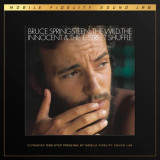
Released only eight months after his exhilarating debut, Bruce Springsteen's The Wild, the Innocent & the E Street Shuffle contains rousing dispatches from the boardwalk, the street, the beach, and the bedroom. It explodes with energy, dares to dream, teases with humour, crackles with tragedy, clings to hope, and overflows with discovery, youthfulness, and personality. It features an unforgettable cast of characters — corner boys, teenage hustlers, doomed lovers, jazz men, junk men, factory girls, fortune tellers, alley cats, pimps, escorts, and more — illuminated by vivid colour, breathtaking detail, and poetic action.
Musically, the heartfelt 1973 record is inhabited by sympathetic vignettes and cinematic arrangements steeped in rock 'n' roll, soul, jazz, and R&B. It finds the New Jersey native looking beyond the parameters of his preceding record and seeking to move on from environments he knows well (and chronicles here) by rushing headlong toward unknown territories, adventures, and people. Underpinned by the singer-guitarist's ambitious poetic enterprise and will to succeed, The Wild, the Innocent & the E Street Shuffle is the album on which Springsteen becomes the Boss.
Mastered on Mobile Fidelity's renowned mastering system, pressed at RTI on MoFi SuperVinyl, and strictly limited to 7,500 numbered copies, Mobile Fidelity's UltraDisc One-Step 180g 33RPM LP set is the definitive-sounding version of Springsteen's sophomore record. Benefitting from SuperVinyl’s nearly non-existent noise floor, superb groove definition, and dead-quiet surfaces, The Wild, the Innocent & the E Street Shuffle plays with a clarity, energy, presence, and openness that complement the expressiveness, dynamics, and scope of the seven restless songs that comprise a work Rolling Stone ranked the 345th Greatest Album of All Time.
Beyond the audiophile sonics that practically place you behind the console at 914 Sound Studios — listen to the separation between the instruments, natural decay of the notes, interplay within the widescreen soundstaging, and nothing-to-lose youthfulness of Springsteen’s voice — this reissue takes seriously this record’s influential merit by presenting it in packaging that underlines its status. Tucked in a beautiful slipcase, the LP is housed in a special foil-stamped jacket with faithful-to-the-original graphics. This reissue is made for listeners who prize sound quality and who want to engage themselves in everything involved with the invigorating set that busted Springsteen loose from the club circuit and landed him on the radio
Determined to liberate anyone within earshot and unafraid to come on strong, The Wild, the Innocent & the E Street Shuffle serves as the debut of the E Street Band — not only heard but seen for the first time by most of the public courtesy of the back-cover photograph. This is where saxophonist Clarence Clemons, organist-accordionist Danny Federici, and pianist David Sancious step out of the shadows — and drummer Vini Lopez and bassist Garry Tallent again stoke a fiery rhythmic engine that helps drive the untamed, reimagined big-band swing of “Kitty’s Back,” breathless R&B thrust of “Rosalita (Come Out Tonight),” and carefree dance steps of the funky “The E Street Shuffle.”
Of course, the main attraction remains a then-24-year-old visionary on the precipice of becoming a sensation and turning a then-bloated rock scene on its head. Recorded over three months while Springsteen and company were busy touring his debut LP, The Wild, the Innocent & the E Street Shuffle reflects the high-octane approach the vocalist embraced onstage and drifts away from the label-dictated acoustic-based frameworks of his debut. The set also witnesses Springsteen deepening his observational skills, with narratives such as the romantically tinged “4th of July, Asbury Park (Sandy)” and redemptive epic “Incident on 57th Street” mirroring changes taking place in the singer’s own life, small towns, and America at large.
A thrilling collision of memories, reflections, and composites — Sandy, Rosalita, and the latter’s parents are all based on actual people Springsteen knew, as is the community depicted in the opening track — the aptly titled The Wild, the Innocent & the E Street Shuffle resonates decades on due to its truths, authenticity, and spirit. Those characteristics — as well as the fact that many of its lengthy songs come on as the equivalent of sweaty, feverish soul revue that won’t stop until you’ve been exhausted — also explain how this now-iconic album triumphed over the reservations of industry “experts” that both demanded Springsteen re-record it and instructed deejays not to play it.
Yet there’d be no stopping a record that saw the past, present, and future, a band whose will would not be denied, and a phenomenon who was born to run. A never-ending invitation to act real cool and stay up all night, The Wild, the Innocent & the E Street Shuffle always feels alright.
Luxury Apartments have spent long enough pondering in the orb of creative frustration as art charged city dwellers and have alchemised a jagged piece of guitar work that calls on the past for a quick catch up before cracking on with their day as a witty, energised and wiry punk band. Formed before your favourite East London neighbourhood became full of high rises, cockapoos and pubs with Madri & Beavertown on Draft, there’s a whole swath of words you could use to describe Luxury Apartments, but doing so might draw too many parallels to estate agent listings wo we’re gonna let their track record and new LP do the talking… LA played with the likes of TOY, TELEGRAM, Deep Tan, Es, The Chisel and Rifle before even having an LP. Mixing dry humour with a belting live show served them well while the guys were woodshedding and earnt them early fans such as Graham Coxon and Jamie Reynolds, who I can only gather shed a single tear of seeing where they came from with all the chaotic guitar-busting, skin-splitting, bottle-smashing madness of an early LA show. But we’re here talking about NOW and NOW is the time to get your pre-order for their first LP, a half hour of power smashing the atoms of 80s c86 indie on lead track ‘Energy’, 77 punk on ‘Wire’ and new garage rock explosions on ‘Taliban’ which morph in to a piece of black wax that’s 100% guaranteed to get the disenfranchised wiggling, the fed-up hurling half bricks through foxtons windows and the punk lifers flipping off yet another boss before carving out another fork in their paths of resistance.
To address the weight of the world without speaking of weariness. To march the song to breathlessness but loosen your grip when the band wanders. To tell all your secrets but shield your loved ones from vulnerability. To dress up in the charm and temptation of the pop song but maintain a core of peculiarity, of a single voice trying to navigate this world. This is the project of the Spatulas. Think of the few songwriters who know they're the only ones in the world who could write their songs. The ones who sing in the confidence that the song couldn't exist without them: Peter Jefferies, Jenny Mae, Ron House, Heather Lewis. Jonathan Richman? Put Miranda Soileau-Pratt and the Spatulas on this list. All eleven songs on `Beehive Mind' share a percussive, unshadowed presence, a steady, clear-voiced clop. Every note on the record is a little bit sad on its own but then they're organized in a way that you don't actually notice. Credit this to the band's skill_Jon Grothman, Lila Jarzombek, Kyle Raquipiso and Miranda Soileau-Pratt all play with no limits and they all play with profound ease. The songs breathe in warmth and patience, they are immediate and sweet. And then they start to meander. The guitar skitters with the deliberate unpredictability of a wild animal. Parts repeat and reset with the obsessiveness of an anxious mind. The lyrics open doors to unexpected scenes of lovers, family, and violence. This is all intentional: "I need to play music and listen to music as a form of therapy," explains Soileau. This means safety, this means encouragement, this means trauma, this means hard questions. Only a band so comfortable at the margins, only a band so capable, only a band so trusting can achieve all this. Miranda Solileau-Pratt wrote the first Spatulas song in 2020, while living in Oregon. Since that time, the band has released two cassettes and toured the United States. Members of the Spatulas have also played in The Blimp, Honey Bucket, Hot Gum, and Meerkaz. The band has shared stages with Helen, Lavender Flu, Debt Rag, Pink Reason, Blues Ambush, and Kath Bloom. `Beehive Mind' is their debut LP.
After five long years, Balance and Composure return with Too Quick To Forgive--newly signed to Grammy-nominated producer Will Yip's label, Memory Music, the alt-rock darlings sound more assured and adventurous than ever across two vulnerable tracks. Too Quick To Forgive is a reflection on personal perseverance in the wake of confrontation, told through two distinctly different scenarios. "Savior Mode" finds frontman Jon Simmons baring his soul in a way that is unparalleled in their discography, while "Last To Know" is an emotionally-resonant highlight that leaves a lasting impact well after its final notes play out. Simmons' vulnerability and emotional delivery across both tracks cut through with unflinching precision courtesy of Andy Slaymaker (guitar), Matt Warner (bass), Erik Petersen (guitar), Dennis Wilson (drums), and who the band considers their 6th member--producer Will Yip. In the fall of 2022, the group got together at his Conshohocken, PA studio, Studio 4, with a few ideas that Yip helped turn into these otherworldly tracks. "It was all magic," Jon says. With a renewed sense of purpose, Balance and Composure will return to the stage for a series of Too Quick To Forgive release shows in some of the biggest rooms they've ever played.
- A1: St Thomas 7 32
- A2: There Will Never Be Another You 5 52
- A3: Stay As Sweet As You Are 4 41
- A4: I've Told Ev'ry Little Star 4 52
- B1: How High The Moon 10 46
- B2: Oleo 6 00
- B3: Paul's Pal 9 30
- C1: Sonny Rollins Interview 1 54
- C2: It Don't Mean A Thing 4 54
- C3: Paul's Pal #2 7 00
- C4: Love Letters 5 34
- D1: I Remember You 6 50
- D2: I've Told Ev'ry Little Star #2 6 33
- D3: It Could Happen To You 3 27
- D4: Oleo #2 3 15
- D5: Will You Still Be Mine? 4 16
- D6: I've Told Ev'ry Little Star #3 4 26
- E1: I Want To Be Happy 4 08
- E2: A Weaver Of Dreams 4 12
- E3: It Don't Mean A Thing #2 4 31
- E4: Cocktails For Two 4 58
- E5: I've Told Ev'ry Little Star #4 5 54
- E6: I Want To Be Happy #2 5 15
- F1: Woody 'N' You 15 54
- G1: But Not For Me 17 39
- H1: Lady Bird 18 49
Freedom Weaver: The 1959 European Tour Recordings is the first official release of the 'Saxophone Colossus' Sonny Rollins’ European tour in 1959 with bassist Henry Grimes, and drummers Pete La Roca, Kenny Clarke and Joe Harris. Available previously only as a bootleg release, this is the first official release in cooperation with Sonny Rollins and released as a 3-CD set. Freedom Weaver includes an elaborate booklet with rare photos by Ed van der Elsken, Jean-Pierre Leloir, Bob Parent and many others; lead liners by jazz scholar Bob Blumenthal, and new interviews with Rollins himself, Branford Marsalis, James Carter, Joe Lovano, James Brandon Lewis and Peter Brötzmann. Mastered by the legendary mastering engineer Bernie Grundman.
Gemma Blackshaw is a scholar, writer and curator currently Senior Tutor for research at the Royal College of Art. She has curated major exhibitions for galleries and museums in London (National Gallery; Wellcome Collection and Vienna (Leopold Museum; Wien Museum).
This is her debut album.
Who Will You Love is the debut collaborative album from The Dengie Hundred with Gemma Blackshaw. In 2023, The Dengie Hundred co-produced with Japan Blues two albums for Demdike Stare’s DDS label, and released the solo album Tube on London’s Sagome imprint; their solo debut Brackenbank appeared on Ethbo in 2022, when they also contributed to World of Echo’s Thorn Valley compilation. Here, they collaborate with Gemma Blackshaw on an album of smudged dream pop.
Gemma’s vocals were recorded from home at night on an old iPhone. Who Will You Love surfaces dark, desiring songs on the passion and exhaustion of looking after others. Emerging in simple rounds that expand with layers of field recordings, synths and drum machines, the songs include lullabies for baby boys and men, enchantments of wary lovers and spells of protection for a daughter.
Moving between her children and her lover, the mother sings of the demands of daily intimacy (play with me, carry me, sing to me…) that echo through adult relationships too.
Who Will You Love was mastered by Carim Clasmann, and mastered and cut for vinyl by Stefan Betke (aka Pole). Artist Alexis-Soul-Gray gifted Screen Memory of 2022, a painting on found paper, for the artwork. Mark Thomson designed the sleev
Introducing "Azerbaijani Gitara vol. 2" by Rəhman Məmmədli, the eagerly awaited sequel to Bongo Joe’s acclaimed debut featuring Rüstəm Quliyev. Born from the vibrant streets of Baku, Azerbaijani gitara culture has evolved into a mesmerizing fusion of indigenous traditions and global influences. From the oil boom era to Soviet rule, musicians have embraced the electric guitar as a symbol of cultural expression.
Rəhman Məmmədli, a legend in his own right, revolutionized the sound with his innovative techniques and impassioned performances. Drawing inspiration from mugham music, Məmmədli's compositions resonate with soul-stirring melodies and electrifying solos.
Join us as we honor the pioneers of Azerbaijani gitara culture while celebrating the continued evolution of this rich musical tradition. "Azerbaijani Gitara vol. 2" promises to captivate listeners with its depth, diversity, and unbridled passion, inviting you on a journey through the heart and soul of Azerbaijan's musical heritage.
LIMITED BOXSET[117,61 €]
10 Year Anniversary Gatefold 2LP 10 year anniversary gatefold 2LP edition of Cult of Luna's take on Fritz Lang's Metropolis film, Vertikal. "Somewhere Along The Highway" and "Eternal Kingdom" were inspired by the landscape of Västerbotten, the county we are from. We realised that there was only one way to go for us: to the city, into the future. Making a droney John Carpenter-esque album would be too easy and we've never been about taking the simple route. I was studying film at the time and had been floored by the aesthetic of German expressionism. This resonated perfectly with Erik Olofsson, who had just got into Italian futurism. This was a real challenge. We put in a lot of effort to realize our vision of the stale, artificial city in all aspects of what an album is. The way we played guitar (only down strokes), the production, artwork and band photos, everything was done with the vision as a guide. "Vertikal" is the album where we had the most precise vision of what we wanted to do and worked hardest to transform it from an idea into reality. A lot of things happened during the years between "Eternal Kingdom" and "Vertikal" and I could continue writing for ages but this will do for now. Ten years have passed since its release and what felt like a rebirth of the band, the band that is still ongoing with new goals and missions. It's a full circle kind of thing. At the time we had no label and now we are releasing it on our very own. Life is strange. Johannes Persson - Umeå December 2022
BLUE VINYL[24,79 €]
SALTPIG is a bit of a mystery. The band just showed up seemingly out of nowhere, album in hand, with the music loudly speaking for itself. As it soon became known, SALTPIG is a two person band with Fabio Alessandrini (formerly of Annihilator) on drums and Mitch Davis handling vocals, guitar and all of the other layers of noise that can be heard on the record. The music that came out of this pairing has elements of doom/stoner/psych/occult metal and others, but they didn't go into it with anything that specific in mind. They just make the music they want to hear. Davis has been working with bands/artists including LA Guns, Damon Albarn, Billy Squier, Stephen Malkmus, Mark Lanegan, Sunbomb and U2, but SALTPIG is obviously a very different animal. For his own band, Mitch created a sound that is much darker. When he started writing the SALTPIG tracks, it pretty quickly turned into this debut album. Most of the tracking was done in their respective studios, with Fabio in Italy, and Mitch in New York where he'd do all of the final recording, production and mixing. It's melodic but embraces dissonance. It's noisy and dirty and evil sounding. Underproduced and real. It embraces imperfections as only a human can do.
Black Vinyl[21,64 €]
SALTPIG is a bit of a mystery. The band just showed up seemingly out of nowhere, album in hand, with the music loudly speaking for itself. As it soon became known, SALTPIG is a two person band with Fabio Alessandrini (formerly of Annihilator) on drums and Mitch Davis handling vocals, guitar and all of the other layers of noise that can be heard on the record. The music that came out of this pairing has elements of doom/stoner/psych/occult metal and others, but they didn't go into it with anything that specific in mind. They just make the music they want to hear. Davis has been working with bands/artists including LA Guns, Damon Albarn, Billy Squier, Stephen Malkmus, Mark Lanegan, Sunbomb and U2, but SALTPIG is obviously a very different animal. For his own band, Mitch created a sound that is much darker. When he started writing the SALTPIG tracks, it pretty quickly turned into this debut album. Most of the tracking was done in their respective studios, with Fabio in Italy, and Mitch in New York where he'd do all of the final recording, production and mixing. It's melodic but embraces dissonance. It's noisy and dirty and evil sounding. Underproduced and real. It embraces imperfections as only a human can do.
Co-founded by Detroit natives Rahill Jamalifard and Lenny Lynch, Habibi got its start in Brooklyn in 2011, earning early raves every- where from Pitchfork and NME to All Things Considered and The New Yorker, who praised the band for infusing “the Colgate-white glisten of sixties-girl-group pop with an uncensored edge.” Dreamachine, Habibi’s mesmerizing new record releasing on Kill Rock Stars, marks a major sonic evolution for the band, rising beyond the critically acclaimed five-piece’s garage rock roots to arrive at a singular swirl of analog and digital elements that underpin their search for spiritual and physical transcendence. Produced by Tyler Love and longtime collaborator Jay Heiselmann and featuring MGMT multi-instrumentalist James Richard-son, the collection draws on a mix of post-punk, experimental pop, and vintage disco, calling to mind Tom Verlaine, Diana Ross, Kate Bush, and Kim Deal, all filtered through the band’s shared love of Middle Eastern psych music. The songs here are their own distinct worlds, each an immersive quest in pursuit of something greater, and the band’s performances are relentless and hypnotic to match, driven by lush synthesizers, sinewy guitars, and a muscular rhythm section. The result is a record as fearless as it is enthralling, an alternatingly fierce and joyous work that ascends to new heights as it reckons with desire and escape, love and surrender, rebellion and reality.
THIRD EAR BAND stammen aus Canterbury und begannen als psychedelische Band namens THE GIANT SUN TROLLEY, die in Südlondoner Clubs lange und improvisierte Sets spielte. Nach einem Auftritt wurde der Band fast die gesamte Ausrüstung gestohlen. So wurden sie aus purem Zufall und offensichtlicher Notwendigkeit eine Akustikband und nahmen den Namen THIRD EAR BAND an. Von 1969 bis 1972 veröffentlichte die Band drei Alben auf dem progressivem Harvest-Label, "Music From Macbeth" (1972) war davon das bekannteste und kommerziell erfolgreichste. Am 24. April 1970 traten die Third Ear Band beim 2. Essener Pop & Blues Festival. Aus welchen Gründen auch immer tauchten sie aber weder auf dem offiziellen Plakat zur Veranstaltung noch in den Programmheften zum Festival auf. Das Billing des Tages war mit Acts wie The Flock, Ekseption, Rhinocerous, The Groundhogs, It"s A Beautiful Day und den noch unbekannten Black Sabbath, die gerade ihr erstes Album veröffentlicht hatten, prall gefüllt. Das Essener Konzert in der Quartettbesetzung mit Sweeney am Schlagzeug, Minns an der Oboe, Coff an der Violine und Smith am Cello fand nur wenige Wochen vor der Veröffentlichung des zweiten Albums statt, das die Fans als "Elements" kennen, obwohl es schlicht "Third Ear Band" heißt und im Juni 1970 erschien. Von den vier Elementen spielte die Band an dem Abend "Earth" und "Water", aber in einer kürzeren Fassung im Vergleich zu den Albumversionen. Erst vor kurzem sind die professionellen Tonaufnahmen vom Festivalauftritt der Third Ear Band wieder aufgetaucht und jetzt restauriert, klanglich aufgearbeitet und gemastert worden.
Zobol - Retrofuturism EP is a nostalgic yet forward-looking release that invokes past visions of the future.
It features five original tracks, ranging from upbeat and energetic to more ambient and introspective. Each track is a storytelling journey, exploring different aspects of Electro and Braindance.
Crafted with both analog and digital machines while enhanced by modern production techniques, it epitomizes the main concept of Retrofuturism. The result is a series of warm, melancholic soundscapes where the past meets the future.