LTD Edition inklusive 3 Bonustracks auf Vinyl!
The Cinematic Orchestra haben eine ganz besondere Wiederveröffentlichung ihres Klassikers, „Ma Fleur“aus dem Jahr 2007, angekündigt. Es wird eine limitierte Version auf transparentem Vinyl geben welche drei Songs aus dieser Zeit enthält, die noch nie auf Vinyl veröffentlicht wurden; „Flowers“, „Talking About Freedom“ und „Colours“, und werden mit vier doppelseitigen Kunstkarten/Drucken geliefert: Seinerzeit wurde das Album für seine kühne Abkehr von den klanglichen Traditionen der Gruppe gelobt. In den Jahren seither wurde es kontinuierlich gefeiert, wobei Tracks wie „To Build A Home“ mit über einer halben Milliarde Streams bis heute ein riesiges Publikum erreichten. Die Band hat ausverkaufte Shows in einigen der prestigeträchtigsten Veranstaltungsorte der Welt gespielt, darunter die Royal Albert Hall in London, die Philharmonie de Paris, das Auditorium Parco Della Musica in Rom und das Sydney Opera House, außerdem waren Festivals wie Coachella, Glastonbury, Fuji Rock, Montreux und Sónar allesamt Gastgeber*innen für die beliebten Live-Auftritte der Band. Ihr letztes Album, „To Believe“ aus dem Jahr 2019, debütierte auf einem Karrierehoch auf Platz 19 der offiziellen UK-Album-Charts und war #1 in den UK-Vinyl-Charts.
Cerca:dr space
Following on from their 'Junction EP' at the tail end of last year, My Nu Leng return to provide a selection of rave-tinged cuts that further cement their status as one of the leaders in the bass music scene. Following a packed-out summer tour diary, the 'Alter EP' consolidates elements from the duo's previous releases and influences into five tracks of low-end damage. Harking back to the pair's underground roots with inspirations from Techno, House and Breakbeat, opener 'Spaced' sets the tone.
Featuring their classic bass growls amongst hardcore pad stabs, an acid-esque synth line and raucous interjections from legendary drum & bass MC GQ, this one's designed to make you move. Takura returns to Maraki on 'Echoes', lending his distinctive vocals over a lethal distorted bassline and uncompromising 2-step beat. 'City Lights' provides momentary respite, a scintillating arpeggio motif over blissful chords and an enchanting vocal hook. My Nu Leng team up with DRS on 'Sinking Sand'. The Mancunian host leads the charge into a warping climax, showcasing his penmanship through relentless triplet flow. 'Signal' closes off the EP in sombre fashion, atmospheric synths and lamenting strings building into an emotive vocal and reflective bassline.
If Shelter swam through the serene side of the Library experience on GBR016, CV Vision blasts off in the opposite direction, riding an explosion of funk breaks and frazzled synths into the event horizon on his retro-futurist opus ‘Insolita’.
As contemporary life accelerates way past peak-weird, CV Vision leans into uncertainty and leaves Earth in the rear-view. Strung out on Simulacron-3, World On A Wire and Omaggio Ad Einstein, the Berlin-based musician imagines his own Brave New World, an alternate eXistenZ in a secret simulation.
Using the space age obsession of the Italian libraries as a launch pad, Dennis Schulze slathers a sonic storyboard with ferocious percussion, psychedelic fuzz and the pastoral electronics of Germany’s Kosmische movement. But this is less Can, more uncanny - and Schulze perfectly renders the cognitive estrangement of a simulated reality through his adventurous production. The monolithic live drums, recorded in a Neukölln garage on a battered Soviet kit are smeared with tape hiss, compressed to death and fired through LFOs, re-materialising on record in impossible scale. Time slips out of joint under the wow and flutter of the reel to reel, drum computers add digital interference to organic rhythms and the unfaltering slew of the 303 lends the hallucinatory thrill of the club sound system to an already psychedelic affair.
As Schulze’s imagination runs free, we’re taken through epic space battles and narrow escapes, moments of reflection and affection and a final resolution, all expressed through a dexterous control of movement and mood. For every explosion of break-fuelled adrenaline, there’s a cruise into cryo-chamber music and holodeck exotica. For each neck-snapping blast of acid funk, there’s a zero gravity lullaby waiting just around the corner.
So put isolation on ice and surrender to the strange, this is a trip you don’t want to end.
Issue #02 of ENTHUSIASMS, Efficient Space’s annual publication, further maps the label’s extended universe of contributors and influences across 88 full-colour pages of offline content, featuring extensive conversations with like-minded duos CS + Kreme and Blazer Sound System, Melbourne minimal composer Ros Bandt, the master of paranoia-inducing electronics Richard H Kirk and Tel Aviv-based Isophonic musician Roland P. Young. Rarely seen pictorial spreads find Yolngu cultural warrior and Waak Waak Djungi songman Bobby Bununggurr sharing stories behind his traditional paintings and On-U Sound’s dream team of misfits viewed through the lens of label co-founder and in-house photographer Kishi Yamamoto, alongside the collaborative art of Joshua Petherick and Midnite/3AM Spares compiler Lewis Fidock. The publication’s fantasy mixtapes also continue with playlists from YL Hooi, Julien Dechery and David Pinhas, Time Is Away, Grace Ferguson and Ivan Liechti. Perfect bound and designed, as always, by Steele Bonus.
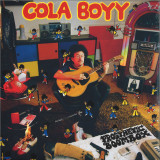
There’s liberation on the dance floor in the songs of Matthew Urango – glimpses of revolution that glimmer beneath the disco ball. “I want my music to bring people together,” says the Californian pop innovator, best known as Cola Boyy. “Because standing together is our best chance at fighting this shit show.” The shit show in question is a broken, brutal system the acclaimed multi-instrumentalist has witnessed up-close. Urango was born with spina bifida and scoliosis in Oxnard, California: a town in which almost 30,000 are estimated to live in poverty. Prosthetic Boombox, his eagerly awaited debut album, might at first glance seem a joyous confetti-burst of pop eclecticism, engineered to sound like “scanning between stations on a car radio, landing on all these different sounds and styles” as Urango puts it. Dig deeper, though, and you’ll discover a simmering sense of rebellion. “The working class are injured, struggling to pay rent and struggling to put food on the table,” he says. “I want to represent that.” Prosthetic Boombox
achieves that goal in a thrilling flurry of inventive indie, funk and soul: take Urango’s car radio analogy, place it in a time-travelling Delorean with Prince in the passenger seat, and you’re half-way there.
Look no closer than Prosthetic Boombox’s euphoric opener, the Avalanches-assisted ‘Don’t Forget Your Neighbourhood.’ The track – which Urango says mixes “the Beach Boys, French disco, house keys and ragtime piano, kinda like the Cheers soundtrack!” – ends with lyrics urging listeners to “fight for your town with your fist closed, strike it and make it more than just a memory.” It’s a reminder that the working classes need to “turn our fists against our oppressors instead of each other,” he explains. After that emphatic introduction comes a horn-laced funk wig-out titled ‘Mailbox’ – a song that gives Dua Lipa’s Future Nostalgia a run for its Studio 54-themed money, featuring rising Londoner JGrrey. Elsewhere, ‘Song for the Mister’ ventures into smooth R&B territory, before ‘Roses’ – a collaboration with Myd of Ed Banger fame – offers a bouquet of bustling disco guitars and infinite bisous of Connan Mockasin’s band drops in on the immaculate ‘Go the Mile’. Urango saves his most introspective moment for the album’s starry closer. ‘Kid Born in Space’, a cosmic collaboration with MGMT frontman Andrew VanWyngarden, sees the artist reflect on what he once had to overcome as a disabled person of colour. “I see them looking down on my dreams of being,” he sings tenderly. “I hear them making fun of my voice, but I keep on moving forward, I refuse to live in anyone else’s shadow.” Prosthetic Boombox, on this subject, is more than an album title – it’s a statement of intent.
“The message of my music is that our class is exploited, oppressed and murdered on the daily. That’s not right, and the system that enables that deserves to be wiped off the face of the earth,” he says. “The only way that happens is if we’re united. That’s the point of my music – to relate to people and unite them.” And what unites more than raucous, irresistibly danceable pop? Prosthetic Boombox is a riot of joyous grooves and catchy hooks for good reason. “I want to reach and spread my message to as many people as possible. You can’t do that if you’re some obscure motherfucker, you know?” he laughs. Don’t bet on him being an “obscure motherfucker” for long.
‘Medieval Femme’, Fatima Al Qadiri’s new ten track suite inspired by the classical poems of Arab women, invokes a daydream through the metaphor of an Islamic garden, at the border between depression and desire, where the present temporarily dissolves, leaving only past and future. Mixing neon drones and the faint outlines of Arabesque melody, ‘Medieval Femme’ reveals a fully-realised, dreamlike setting, shaded with colour and subtle friction. Conveying a thematic state of melancholic longing, Fatima seeks to transport the listener to a place of reverie and desolation, to question the line between two seemingly opposite states and rejoice in celestial sorrow. ‘Medieval Femme’ takes instrumentation from music of the Middle Ages, recast in a futuristic setting; soft-synth lutes, organs and pipes reverberate in space while gauzy pulses ripple in response. Fatima's vocals of repeated, mantra-like phrases are sometimes pitched and altered, drawing out increasingly intense peaks, angelic choruses and yearning incantations. On ‘Tasakuba’, Kaltham Jassim’s recitation of a couplet from the 7th century poet Al-Khansa', the sorrow of her words are given a turbulent, hallucinatory setting, before the album resolves on the final song, the limpid, airy ‘Zandaq’.
Aural Vision debut release with 4 major impressive tracks to sound analog and oldschool. Replaying each part and adding an extra dimension to the tracks through a sparkling synths
topline, a new vocal hook and dreamy arpeggiations.
This release is an exciting aural journey with slamming house & uplifting tracks...hot!
Composer, multi-instrumentalist, poet, griot, improviser and community
leader William Parker presents a pair of brand new trio albums which further expound on his limitless vision.
One of the iconic and enduring music leaders to emerge in the world over the
last half century, William Parker continues to raise the bar higher.
‘Mayan Space Station’ is his first electric guitar trio album, and features Parker
on bass, alongside Ava Mendoza (electric guitar), and Gerald Cleaver (drums).
Cosmic multi-hued blues, perfect for space and time travel. The unparalleled
rhythmic firmament created by Parker & Cleaver is matched by Mendoza in full
flight. All of the promise imagined by a trio recording of these musicians with
compositions by Parker is delivered to the fullest.
Mendoza’s prodigious talents have illuminated many projects and recordings
as both leader and collaborator over the past decade. As is certainly clear here,
she is committed to bringing expressivity, energy and a wide sonic range to the
music. Gerald Cleaver is an exceptionally gifted poet of drum sound who can
play in the deepest of pockets and manifest all manner of sound to perfectly fit
contours within the most open of forms.
Cleaver & Parker have worked closely on numerous projects, notably within the
nonpareil full-improvising trio, Farmers By Nature, together with Craig Taborn.
William Parker is in vibrant grandmaster blossom here on double bass - in both
pizzicato & bow-as-prism modes.
William Parker: bass, compositions,
Ava Mendoza: electric guitar,
Gerald Cleaver: drums
The first release in what will be an ongoing three-part series, Part I features nine tracks for bass guitar and tenor saxophone. Part II, an exploration of a slightly larger, more sonically diverse musical world will feature string quartet and voice. Finally, Part III will collaborate with choreographer Siobhan McKenna, who alongside Nick will develop a percussive movement work that seamlessly intertwines with the musical work.
“My aim is to create music that is sonically and musically atypical whilst still belonging to an accessible contemporary scene. Each project, album or ‘part’ will set out to explore a single ensemble or group of instruments. In the case of Part I, that ensemble is hollow body bass guitar and tenor saxophone. “ - Indigo (Nick Roder)
The Indigo project itself was inspired by Saxophone & Bass Guitar by Sam Gendel and Sam Wilkes, which prompted Nick to write an album of music for the same type of ensemble. Having only just purchased a bass guitar for a different project, the instrument was still very new to him.
“I was curious to see what I would write with my self-imposed rule of not being able to overdub material, and further, how my limitations as a relatively green bass guitarist would influence the writing of the material. A strong focus on harmonic movement and melodic material was where I eventually found my happy place.”
The result is a phenomenal debut. Burrowing into the space between it’s sparse instrumentation and dulcet tones, Part I is the realisation of a minimalist and concise vision of what a symbiotic relationship between two instruments can yield.
About Indigo
Indigo is the moniker and ongoing project of Melbourne-based composer and arranger, Nick Roder. The Indigo project was conceptualised in 2020 and focuses on deep sonic exploration of little-heard ensembles in a contemporary space.
Since 2018, Nick has been composing soundtracks for video games including The Invisible Hand, Roadwarden, N1NE: Splintered Mind, This Dead Winter and Miska. Nick has also played in art-rock ensemble, Tulalah, exploring sonic textures, combining contemporary jazz/rock with chamber sounds. The modular ensemble released The Flood (Equinox Recordings, 2015) and The Question (Independent, 2017).
Multi-instrumentalist/vocalist Dan Friel is unrivaled in his capacity to inject blistering noise and energy into ferocious pop songs. A champion and mainstay of the NYC underground, Friel the has played alongside the likes of Lightning Bolt and Black Dice as well collaborated with acclaimed string quartet ETHEL. Upper Wilds channels Friel's unbreakably ebullient spirit into mountainous rock music dripping with molten fuzz. The trio's exploration of the interstellar expands in parallel to their increasing levels of bombast and precision. Venus synthesizes the experimentation of debut Guitar Module 2017 and the thunder of 2018's Mars into ten lean chunks of cosmic rock laden with scorching hooks. On Venus, Upper Wilds rocket lovestruck anthems centered around the planet named for the Roman goddess of love at full tilt from the moment "Love Song #1" makes liftoff. The album's incendiary opening trilogy crashes with a relentless vigor and addictive melodies. The rhythm section of bassist Jason Binnick (who also mixed the album) and drummer Jeff Ottenbacher tear through off-kilter riffs that pound with meteoric impact. Friel's guitar sputters and froths beneath his voice before soaring into frenetic leads that pack every moment with powerful melody. Alien croons and glitching spasms spill out of Friel's wild, filtered humming, amplified into oblivion. Venus' few moments of respite lay bare the raw efficiency and beauty of Friel's songwriting, like transmissions home to loved ones thousands of miles away slipping through the crackle and chaos of space. Venus traverses the havoc, mystery, and joy of humanity's countless follies in both space and love. Both cosmic and human, Venus is a deeply affecting celebration of the wonders of what is beyond comprehension internally and externally. Upper Wilds' Venus is an exhilarating odyssey of tremendous exuberance and a testament to human resilience in the face of the unknown.
Composer, multi-instrumentalist, poet, griot, improviser and community
leader William Parker presents a pair of brand new trio albums which
further expound on his limitless vision.
One of the iconic and enduring music leaders to emerge in the world over the
last half century, William Parker continues to raise the bar higher.
‘Painters Winter’ features the trio of Daniel Carter (reeds, trumpet, flute) William Parker (bass, trombonium, shakuhachi) and Hamid Drake (drums). Carter
& Parker have been perpetual space-ways traveling companions since first
meeting & immediately beginning to channel music together in early 1970s
NYC. Here, Carter again brings the full assembly of instruments he has for decades been a master of: trumpet, alto & tenor saxophones, clarinet and flute.
Likewise, Hamid Drake is a musician’s musician; one of the most in-demand
drummers in the world. He is in command of a vast lexicon of drum languages,
learned and absorbed directly. His frequent flyer miles could get him a ticket to Saturn and back. Drake & Parker launched their devoted “two-man big
band” partnership in 2000 and haven’t stopped since. In trio with Daniel Carter,
they’ve created one previous album together, ‘Painters Spring’, released that
same year.
Drake has made mention of his awe that William could pick up any new instrument and make beautiful music with it from jump. The title track of ‘Painters
Winter’ features Parker on trombonium, one of those many instruments that
he plays beautifully on. The track “Painted Scarf” features Parker on shakuhachi, upon which he has clearly become a master.
William Parker: bass, trombonium, shakuhachi
Daniel Carter: trumpet, alto & tenor saxophones, clarinet, flute
Hamid Drake: drums
- A1: Peach Of Immortality
- A2: Umbrella Spinner
- A3: Dialogue Between A Grandmaster Of The Knights Hospitaller & A Genoese Sea-Captain
- A4: Vulning
- A5: Lathe Of Heaven
- A6: Sirin
- A5: Nowhere Much Narrower
- A6: Charioteers
- A7: Milk Street
- B1: Magic Mountain
- B2: Ophir
- B3: Paradigm & Places
- B4: Threadneedle
- B5: Ferae
- B6: Forest Of Materials
Black Truffle is pleased to present Sylva Sylvarum, an epic new work from Ora Clementi, the collaborative project of crys cole and James Rushford. Primarily conceived and recorded over several months together in Melbourne, Sylva Sylvarum is a stunning step forward from the mumbled, creaking sound world of the duo’s debut, Cover You Will Softer Me (Penultimate Press, 2014). From the opening ‘Peach of Immortality’, which takes an unpredictable journey from layers of chiming bells, vocal harmonies and lush synth pads to a desolate landscape of half-animal, half-digital wooshes and cries, it is immediately clear that cole and Rushford are working here with an entirely unique sound palette. Throughout the record’s four sides, we hear a large array of carefully detailed synthesizer sounds (many of them recorded at the remarkable Melbourne Electronic Sound Studio), sparse drum machine hits, wind instruments and field recordings of animals, often with a twistedly late 80s/early 90s flavour that at various points calls up New Age references, Robert Ashley’s later operas or the thinned-out textures of early digital GRM.
Threaded through this distinctive array of sounds are the two musicians’ voices, sometimes singing, sometimes speaking through varying degrees of manipulation. A guiding thread through the pair’s collaboration, beginning with their initial experiments with lip-readings, the presence of these two voices – cole’s crisp and sibilant, Rushford’s rich and low – reinforces the sense that the music is immersed in itself, less performed by two people than occurring between them. On Sylva Sylvarum, these voices first come to the forefront on the third piece, ‘Dialogue Between a Grandmaster of the Knights Hospitaller and a Genoese Sea Captain’, where in unison they intone fragments of a description of an imaginary space taken from a 17th century utopian text. The two voices resurface periodically thereafter, most stunningly in the unexpected turn into cushiony dream pop on ‘Magic Mountain’. At other points, the subtle manipulation of pitch and intonation in the close-miked vocal performances filters the recitations through a fog of abstraction that climaxes with the almost incomprehensible alternating syllables of the side-long closer ‘Forest of Materials’. Like the album’s title, these textual elements are drawn from various literary descriptions of utopias, a theme that also informed the pair’s musical approach. Far from anything dryly illustrative, utopia figures into Sylva Sylvarum as an invitation to inhabit otherworldly spaces that, like the empirical details that proliferate in these literary utopias, are grounded in mundane reality but shot through with the eldritch. Admirably framed by the abstracted digital topographies of Sabrina Ratté’s artwork, the uncanny sweep of the album’s fifteen pieces is expansive enough to take in stretches of crackling austerity, warped microtonal keyboard etudes and moments of stunning beauty, the latter most strikingly when cole and Rushford are joined by Callum G’Froerer on trumpet and Joe O’Connor on trombone for a series of dream-like moments moving from growling overtones to poignant lyricism.
Presented in a deluxe gatefold sleeve with stunning artwork by Sabrina Ratté and pressed on mint green vinyl. Mixed and mastered by Joe Talia at Good Mixture, Berlin.
- Generation Genocide
- Let It Slide
- Good Enough
- Something So Clear
- Thorn
- Into The Drink
- Broken Hands
- Who You Drivin’ Now?
- Move Out
- Shoot The Moon
- Fuzzgun ‘91
- Pokin’ Around
- Don’t Fade Iv
- Check-Out Time
- March To Fuzz
- Ounce Of Deception
- Paperback Life (Alternate Version)
- Fuzzbuster
- Bushpusher Man
- Flowers For Industry
- Thorn (1St Attempt)
- Overblown
- March From Fuzz
- You’re Gone
- Something So Clear (24-Track Demo)
- Bushpusher Man (24-Track Demo)
- Pokin’ Around (24-Track Demo)
- Check-Out Time (24-Track Demo)
- Generation Genocide (24-Track Demo)
The classic 1991 album remastered and expanded with rare and previously
unreleased tracks. Extensive liner notes by band biographer Keith Cameron.
A landmark of the grunge era.
By going back to basics with ‘Every Good Boy Deserves Fudge’, Mudhoney
flipped conventional wisdom. Not for the first time - or the last - they would be
vindicated. A month after release in July 1991, the album entered the UK
album chart at Number 34 (five weeks later, Nirvana’s ‘Nevermind’ entered
at 36) and went on to sell 75,000 copies worldwide. A more meaningful
measure of success, however, lay in its revitalisation of the band, casting a
touchstone for the future. The record is a major chapter in Mudhoney’s
ongoing story, the moral of which has to be: when in doubt, fudge it.
The album began at Music Source Studio, a large space equipped with a 24-
track mixing board - downright futuristic, compared to the 8-track setup that
birthed the band’s catalytic 1988 debut, ‘Touch Me I’m Sick’. The Music
Source session quickly turned into a false start when the results, in guitarist
Steve Turner’s words, “sounded a little too fancy, too clean.” Lesson learned,
the band went primitive and got to work at Conrad Uno’s 8-track setup at Egg
Studio. Named after the cartons pasted on the walls in an optimistic attempt
at sound-proofing, Egg boasted a 1960s vintage 8-track Spectra Sonics
recording console, originally built for Stax in Memphis.
So it was that, in the spring of 1991, Mudhoney made ‘Every Good Boy
Deserves Fudge’. The resulting album is a whirlwind of the band’s influences
at the time: the fierce ‘60s garage rock of their Pacific Northwest
predecessors The Sonics and The Lollipop Shoppe, the gnashing posthardcore of Drunks With Guns, the heavy guitar moods of Neil Young, the
lysergic workouts of Spacemen 3 and Hawkwind, the gloomy existentialism
of Zounds and the satirical ferocity of ‘80s hardcore punk. The quartet’s
special alchemy meant these fond homages never slid into pastiche.
Ultimately, ‘Every Good Boy Deserves Fudge’ epitomised the best of
Mudhoney: here was a band reconnecting with its purest instincts and, in the
process, reinventing itself.
This 30th Anniversary edition, remastered by Bob Weston at Chicago
Mastering Service, stands as testimony to the creative surge that drove them
in this period. The album sessions yielded a clutch of material that would
subsequently appear on B-sides, compilations, and split-singles. This edition
includes all those tracks and a slew of previously unreleased songs,
including the entire five-track Music Source session.
Bella Union announce the release of Piroshka’s stunning second album,
‘Love Drips And Gathers’. The album builds on the acclaim of the band’s
2018 debut LP ‘Brickbat’ and the reputations of former members of Lush,
Moose, Elastica and Modern English.
Piroshka emerged in 2018, four individuals with distinct musical identities but
also overlapping histories - a combination that might have unsettled, or even
overwhelmed, some bands. But in their case, the bond only got stronger.
After ‘Brickbat’ explored social and political divisions by way of what MOJO
described as “Forceful, driving garage songs and dream-pop epics,” ‘Love
Drips And Gathers’ follows a more introspective line - the ties that bind us, as
lovers, parents, children, friends - to a suitably subtler, more ethereal sound,
whilst still revelling in energy and drama.
“If ‘Brickbat’ was our Britpop album, then ‘Love Drips And Gathers’ is
shoegaze!” reckons vocalist/guitarist Miki Berenyi, formerly of Lush, a band
that effortlessly bridged the two genres like no other. “It wasn’t intentional; we
just wanted a different focus. I’ve always seen debut albums as capturing a
band’s first moments, when you really have momentum, and then the second
album is the chance for a more thoughtful approach.”
Bassist Mick Conroy (Modern English) agrees. “‘Brickbat’ was a classic first
album; noisy and raucous. On ‘Love Drips And Gathers’, we’ve calmed down
and explored sounds, and space.”
The way ‘Love Drips And Gathers’ changes shape and dynamic is less a
reprise of Nineties Brit indie than a transformation into a more shivery, Euromantic version with glistening electronic filigrees. The opening ‘Hastings’ sets
the tone. Luminous drops of guitar underpin Miki’s becalmed vocal before
drums, bass and a Mellotron add pace while the decorative coda features
their old pal Terry Edwards on flugelhorn.
‘Love Drips And Gathers’ - named after a line in a Dylan Thomas poem - was
inspired by love, family, belonging, memory. Miki and Moose split the eight
lyrics, with some poignant overlaps here too. Miki’s ‘Loveable’ looks to
Moose; Moose’s ‘The Knife-Thrower’s Daughter’ looks to Miki but also their
daughter Stella and his sister Anna; an empathic, touching embrace of the
women in his life.
Staying within the family, Moose eulogises his late mother (the idyllic
childhood seaside trip of ‘Hastings 1973’) and father (the more conflicted
‘Scratching At The Lid’). On ‘V.O.’, Miki pays fond tribute to Vaughan Oliver,
4AD’s legendary in-house art director who died suddenly in December 2019
and who had a particularly close relationship with Lush during their time on
the label (like ‘Brickbat’, ‘Love Drips And Gathers’’ beautiful and enigmatic
artwork is by Vaughan’s former design partner Chris Bigg).
LP pressed on clear vinyl.
oracle and audioMER. are honoured to announce the release of a new LP; Reading the City with music by oracle, Laszlo Umbreit & Mira Sanders.
In 2019 oracle invited artist Mira Sanders to interact with their practice through her writing. Due to the corona crisis, their shared working time couldn’t happen in the planned way:
“The writing project was originally planned as an exchange while travelling together one week on the Buratinas boat, navigating on the canals and rivers starting from Brussels. Due to the sanitary conditions with the Covid19, the trip together could not be realised or at least was complicated.
Instead of seeing the situation as an obstacle, I saw it as an opportunity to travel with them from afar. Me, living outside the city and them, inside. My question was ‘how, through their voices echoing with the urban spaces, will I imagine the city’s everyday life?’. Because one of the things that oracle’s practice does is to offer ways to perceive and encounter the city and its inhabitants.
For the texts I was inspired by the recordings oracle sent me every day during one week. Besides that, the book Invisible Cities written by Italo Calvino gave me a way of structuring my imagination.” – Mira Sanders
Following this artistic exchange and during a collaboration with sound artist Laszlo Umbreit, the idea of the record Reading the City was born. The existing recordings and the written sci-fi episodes by Mira Sanders functioned as a source of inspiration for the electronic sound composition Places, infiltrated by the original voices and city soundscapes. The recordings of the texts From Afar reflect oracle’s playful and spontaneous way of interacting with their given environment. From Afar is an invitation for the reader to immerse in the city while being in movement. Each track on this side has its own identity or colour, often in relation to what Mira’s text evoked, but this also happened in an empirical way, by trial and error.
Places is a composition in movement, following the idea of interaction with imaginary cities but regularly coming back to a presence of the workshop’s raw documentary sound. While being a carefully edited piece, it tries to keep a certain sense of immediacy and improvisation through semi-random dropping of heterogeneous sound materials in the timeline. Accidents are welcome. The arc drawn by the journey through different “places” is an interpretation of what can happen inside (and outside) when experiencing the oracle practice: being around them, imagining what was felt at different moments in the street, from a distance, preparing the itinerary in the city beforehand, talking about what oracle could be as a record and if it can exist outside the moment it happens.
George Otsuka (or Ohtsuka), sadly passed away in March 2020, was one of Japan’s most renowned jazz drummers. ‘Sea Breeze’, released in 1971on the Union label, is his first record in quintet formation and is reissued here on a single LP housed in a gatefold sleeve.
And we can say that George Otsuka knew how to surround himself: Shunzo Ohno is on trumpet and Flugelhorn, Takao Uematsu on tenor sax and soprano, Takashi Mizuhashi on bass and Hideo Ichikawa on electric piano.
If all the tracks on this album are solid, included the astonishing cover of “Fool on the Hill”, it is especially “Sea Breeze”, the eponymous track opening the album that will make an impression. A super and long jazz-funk track where the five musicians, in perfect osmosis, leave each other enough space to express the full extent of their talent.
Recent copies of the original vinyl,which were only released in Japan have sold for £200-300.
Hell Yeah's debut Buena Onda compilation proved hugely successful. It also kept people drenched in exotic dance floor sounds while the pandemic has kept everyone apart. Now the Berlin-based party is back and on a mission to redefine what Balearic means with a first-ever vinyl-only sampler featuring exclusive, unreleased tunes and remixes compiled by Marco Gallerani and Gallo from brothers around the world.
The a-side is all about new kids on the block: Australian cyborg disco don Kayroy appeared on the label in 2020 with his Imaginary Expeditions EP and now links with his friend Jaspar Robinson, a dreamer with his head amongst the stars. He provides the vocals which speak of an astronaut lost in space and aching for a missing loved one while sombre chords and downbeat bass make for a beautifully longing groove. It's a blue-eyed Balearic classic. The up-and-coming Italian Feel Fly of labels like Internasjonal then goes widescreen with his 'Esperanto.' The chords shimmer, the baseline percolates and the guitar riffs arc up to the heavens for some late-night intergalactic bliss.
The flip side features more mature and established artists: label regular Max Essa offers a remix of The Vendetta Suite 'Neon Secrets,' which has naive Eastern melodies and rueful 80s chords with a subtle new age feel that dumps you right on the beach at sundown. Last of all come Chris Coco and Micko Roche with true-school Balearic classic complete with cicada-like shakers, mellifluous Spanish guitar licks, flutes and soft, frothy, rolling beats that break like waves on a sun-kissed Mediterranean coastline.
Balearic Beats 2021 Sampler 1 offers something for every hour of the day, making this a perfectly functional 12" for the modern Balearic DJ.
Support by Prins Thomas, Calm, Chris Coco, Andy Wilson (Ibiza Sonica), Pete Gooding, Severino (Horse Meat disco), Will Nicol, Phil Cooper, Leo Mas, Mike Salta, Balearic For You, Jon Sa trinxa
We're extremely proud to present HAPPENSTANCE, a sprawling jazz-concrète project produced by Johannesburg composer and double bass player Shane Cooper. Approached in 2020 by interdisciplinary arts space The Centre For The Less Good Idea to create audio work, Cooper drew on his network in the thriving South African jazz scene, bringing in Bokani Dyer (piano), Cara Stacey (bows), Daliwonga Tshangela (cello), Gontse Makhene (percussion), Jonno Sweetman (percussion) and Micca Manganye (percussion).
Two days of free-flowing composition, improvisation and investigative recording followed, with the results captured on a vintage reel-to-reel tape machine. This tape was fractured and reassembled by Cooper, bringing into surreal focus tiny ecosystems of sound, like curls of static clasped from the air and brought under the magnifying glass. The results - two long, standalone pieces - are dizzying, weightless; musique concrète melding with jazz-schooled virtuosity in a dubbed out bricolage of interludes and u-turns.
Recommended for fans of Abdullah Ibrahim, Tony Allen, Floating Points and Daphne Oram.
A deep dive into the one of most collectable jazz catalogues in the world, a selection of some of the rarest and most sought-after recordings from the 60s and 70s, a time when British jazz began to find its own identity. Drawn from the iconic labels of Decca, Deram, Argo, EMI Columbia/Lansdowne Series, Fontana, Mercury, & Philips. A figure in British modern jazz for over half a century, Don Rendell was both active protagonist and key witness to the main developments in the music from its rise out of tiny clubs and back rooms on up to the most prestigious national stages. From his earliest performances in London’s West End and his work of the 50s and 60s — most not ably with the Don Rendell-Ian Carr Quintet — to the lower profile work of the 70s and 80s, his quite assurance and consistent performance marked him out as a highly respected figure among his peers. He is one of a handful of British artists to feature on Blue Note Records and appeared on some of the most distinctive and characterful British jazz albums by the likes of Michael Garrick, Stan Tracey, Amancio D’Silva, and Neil Ardley. Even though Rendell eschewed much of the free and electric fusion styles that came to the fore in the late 60s, in the main sticking to an acoustic sound with melody and rhythm at its heart, he similarly bridled at any notion that he was merely a ‘bopper’, a description he positively hated. In many ways, Space Walk was as much a valedictory as transitionary album for Rendell. It was his last for Denis Preston, the fabled producer behind Lansdowne Studios, described by Neil Ardley as a ‘rare Diaghilev like figure’ who steered many of the key figures of the British jazz scene into the studio when nobody else would record them. It was also Rendell’s final project for EMI Columbia and his last as a leader for a major record label. After Space Walk, Rendell would record for smaller, independent labels like Spotlite. But as much as the album is a farewell to one chapter, it also marked the way forward to the next..
Acid Dad is an American alternative-rock band composed of singer-guitarists, Vaughn Hunt and Sean Fahey, and drummer, Trevor Mustoe. Vaughn first started recording the band in his Bushwick, NY basement releasing singles “Brain Body” and their first EP “Let’s Plan a Robbery.” Appearing live in the New York City rock scene in 2016, Acid Dad quickly moved to a world stage with their self-titled debut album, released by Greenway Records in 2018. During 2020, the band spent their time building a new studio space in Queens, NY, while continuing to independently produce all their own music, art and even building their own guitars. With a new space and vision, the band produced their second LP, “Take It From The Dead,” set to be co-released in June 2021 by Brooklyn’s Greenway Records and psych powerhouse LEVITATION’s label, The Reverberation Appreciation Society. “Take It From The Dead” features an array of different influences ranging from 90’s neo-psych, modern post-punk and 70’s rock-n-roll. Acid Dad has crafted a record that sounds new, yet feels nostalgic. In contrast to their earlier work, they make use of slower tempos and expand their sound to include songs that are both more intricate and more hypnotic. To accompany the new record, the band spent the last year collaborating with video artist Webb Hunt, producing psych and glitch art videos that form a visual counterpart to the dreamy distortions of their sound. Take It From The Dead is out June 11th via Greenway Records / The Reverberation Appreciation Society on Deluxe LP & CD.