New EP from Polish label Kooky is a challenging and ambitious one. Jay Tripwire, Canada's finest DJ and producer, offers a solid set of 3 minimal (techno) tracks, crafted with a unique passion for detail, raw energy and dark soundscapes. Every track differs in intensity and dynamics, but all of them are a feast for the ears to demanding music lovers. If you are searching for the true beauty of minimal and want to escape from modern dance music that is unfortunately more and more generic these days, this release is just for you.
quête:dy
Mit "Convex" öffnet Conrad Schnitzler ein Fenster in seine experimentelle Klangwelt der 1980er Jahre - und bleibt dabei geheimnisvoll. Die LP kommt nahezu ohne Informationen aus, der Titel dominiert das Cover, die Musik spricht für sich. Schnitzler nutzt hier einen Sample-and-Hold-Generator, um zufällige Tonfolgen zu erzeugen - gesteuerter Zufall als künstlerisches Prinzip. Besonders auffällig ist das langsame Tempo der Stücke, das sich deutlich von seinen sonst dynamischeren Arbeiten abhebt. Obwohl Schnitzler nie Ambient im Sinn hatte, erinnert "Convex" in seiner Unaufgeregtheit und Gleichförmigkeit an die "musique d"ameublement" von Satie oder die Ambient-Ideen von Brian Eno. Doch Schnitzler bleibt eigenständig: Die Musik fordert keine Aufmerksamkeit, sondern lädt zur freien Interpretation ein. Ein Album, das Fragen stellt, ohne Antworten zu geben - und gerade deshalb fasziniert.
"Sunshine and Balance Beams", das neunte Album von Pile, ist eine Sisyphus-Parabel über Arbeit und Leben. Um es zu schreiben, begab sich Sänger Rick Maguire an ,einen dunklen Ort" und rang mit dem Konzept, dass es keine Erleuchtung und kein Ende des Leidens gibt. Maguire erforscht den Workaholismus, den Mythos der Leistungsgesellschaft und die Akzeptanz der Sterblichkeit - und das alles in einer teuflischen Allegorie, in der es darum geht, durch einen schattigen Wald zu stapfen und dem ungewissen Traum einer hellen Lichtung entgegenzugehen. Pile ringt mit existenziellen und sozialen Widersprüchen, indem sie klangliche Zwischenräume heraufbeschwören. Die Musik existiert irgendwo im temporären Gleichgewicht von Licht und Schatten, Chaos und Ordnung. Heiße, regenähnliche Gitarren, sich verschiebende Drums, die gewundene Wege in Klang und Tempo ebnen, unheimliche Synthesizer und wässrige Streicher fügen sich zu einem Panorama aus Laut-Leise-Dynamik zusammen, das der Emotionalität der donnernden Auftritte der Band entspricht. Die Gruppe engagierte eine Streichergruppe (Geigen, Bratsche, Cello), die glühende, durchkomponierte Arrangements spielten, die von der Cellistin Eden Rayz und Pile mitgeschrieben wurden. Sie ließen sich von Kino- und Opernpartituren von Chopin, Bernard Herrmann und Ralph Vaughan Williams inspirieren, was "Sunshine and Balance Beams" einen überlebensgroßen Sound verleiht, der Piles blitzschnelle Umsetzungen einiger ihrer bisher zugänglichsten Songtexte noch verstärkt. Die Aufnahme ist ein deutlicher Sprung im Produktionswert und stellt Maguires Gesang auf neue und aufregende Weise in den Mittelpunkt. Pile reisten nach Pawtucket, RI, um zwei Wochen lang bei Machines with Magnets mit ihrer langjährigen Tontechnikerin Miranda Serra (Kal Marks, Kira McSpice) aufzunehmen. Das Album wurde von Seth Manchester (Lightning Bolt, Mdou Moctar) gemischt und von Matt Colton (Aphex Twin, Swans, Muse) gemastert. "Sunshine and Balance Beams" ist das erste Album von Pile für das Chicagoer Label Sooper Records.
Auch nach sieben Jahren stehen WIDOWSPEAK immer noch für Atmosphäre. Ihre Musik ist eine Überlappung von Indie Rock, Dreampop, Shoegaze, Slow-Core und "Cowboy Grunge". Die Band aus Brooklyn hat mit dem vierten Album "Expect The Best" die Balance zwischen gegenseitigen Kräften wie hell/dunkel, leise/laut, Stress/Entspannung gefunden. Nachdem er mit der Band viel umhergezogen war, kehrte Hamilton in seine Heimat zurück, an den Ort seiner Kindheit. Dort fand er Halt und neue Energie, was ihm half ein Album zu schreiben, dessen roter Faden die Selbsterkenntnis ist. Die selbstreflektierenden Texte thematisieren die Furcht vor Antriebslosigkeit ("Dog") oder Ängste im digitalen Zeitalter ("Expect The Best") oder Motivationslosigkeit ("When I Tried"). WIDOWSPEAK haben es mit ihrem neuen Album geschafft, die dynamischen Veränderungen ihrer Musik zu steuern und sind dabei feinfühlig und zurückhaltend. Die neun Songs sind geprägt von einer Melancholie, aber auch weiterhin getragen von dem für WIDOWSPEAK typischen Twang-Gitarrensound. "Expect The Best" ist eine abstrakte Hommage an die 90er Jahre und bringt zugleich die gewohnte WIDOWSPEAK Intimität mit sich, für die sie geliebt werden.
- Quaterverse
- Room At The Top
- Hellfire Club
- Found Footage
- Lucky 7
- Tulpa Lover
- Glass Delusion
- Big Blue Beach Blues
- Quatermass 2
Quatermass III bestehen aus Mitgliedern von World of Twist, Earl Brutus, The Dials, der British Experimental Rocket Group und Science Monthly. Ihr Sound ist Space-Rock mit Anleihen aus Progressive- und Glam-Rock. Ihre erste Single "Room At The Top" ist inspiriert von J.G. Ballards Kurzgeschichte "Billenium" (1962), einer düsteren dystopischen Erzählung, die die Unterdrückung urbaner Räume, zwielichtige Mietwohnungen und Überbevölkerung thematisiert. Doch dieser Track ist alles andere als düster: Er bringt seine Absichten mit sprudelndem Gesang, schwebenden Gitarren und "Devil's Interval"-Akkordwechseln zum Ausdruck. Er wird euch umhauen. Genauso wie das selbstbetitelte Debütalbum "Quatermass III".
– "Der okkulte Sound von Eno, Joy Division, Northern Soul/Glam-Beats, Robert Calvert Vox und Open University-Synthies." – MOJO
– "Ein exquisit produziertes Werk." – Crayola Lectern, Musiker
R2 2-CHANNEL ROTARY DJ MIXER
Introducing the Headliner R2, a 2-channel rotary DJ mixer that
is perfect for DJ’s looking for precise control and a warm sound,
without breaking the bank. The R2 is packed with features, like an
analog filter and 3-band isolator EQs on each channel, and uses
only high-quality components, including genuine ALPS potentiometers.
Featuring two stereo channels with selectable Line and Phono
RCA inputs, each channel on the Headliner R2 comes equipped
with gain control with a peak LED, a 3-band isolator EQ, a headphone cue selector, a large channel volume control knob, and a
filter activation switch.
The Master channel boasts an analog filter, headphone monitoring,
and output control section. The analog filter features selectable
High Pass / Low Pass Filter modes with Frequency and Resonance
controls, giving you precise control over your sound. Independent
Master and Booth outputs with volume controls, both with balanced
XLR and unbalanced RCA connectors, give you the flexibility to
connect to any sound system.
The Headliner R2 features genuine ALPS potentiometers, and a
sturdy metal enclosure with stained wood side panels for a classic
look that will complement any DJ setup. The modular internal
construction, coupled with the external power supply connected
via locking Mini XLR ensure superior audio performance.
The Headliner R2 is a reliable, high-quality mixer that will give
your DJ performances that classic vibe. Whether you’re spinning
house, techno, or classic funk/soul/disco jams, this fun little mixer
is the perfect addition to your setup.
• Two stereo channels with selectable Line and Phono RCA inputs
• Each channel features Gain control with Peak LED, 3-Band Isolator EQ, Headphones Cue selector with LED, channel
volume control and filter activation switch with LED
• Master channel features analog filter, headphone monitoring and output control section
• Analog filter features selectable High Pass / Low Pass Filter modes with Frequency and Resonance controls
• Genuine ALPS potentiometers
• Headphone Cue control section features volume control, mix control (Cue/Master), and split monitor switch
• High current headphone amplifier with dual 1/4” and 1/8” jacks
• Independent Master and Booth outputs with volume controls, balanced XLR outputs and unbalanced RCA outputs
• Additional Record output with unbalanced RCA jacks
• Dual LED level meters for the Master output
• Microphone input with level control on front panel
• Sturdy metal enclosure with stained wood side panels
• Modular internal construction for superior audio performance
• External split rail power supply connected via locking Mini XLR connector and push-button power switch
• Measurements: 320 x 219 x 106 mm
• Weight: 2.8 kg
Microphone Input
Nominal Input Level: -50dBu
Frequency Response: 20Hz – 20kHz (+/- 0.1dB)
THD + N: 100dB
Crosstalk: 100dB
Übersprechen: < -65dB
THD + N: < 0,05%
Kopfhörerausgang
Maximaler Ausgangspegel: 70mA/Kanal in 150Ω
Minimale Lastimpedanz: 32 Ohm/Kanal
Stromversorgung
Typ: Extern mit verriegelbarem Mini-XLR-Stecker
Eingangsspannung: 100-240v ~ 50/60Hz
Ausgangsspannung: +/-15V; 500mA
Spannungsbereich: 32 Ohm/Kanal
- My Baby Left Me
- Rollin And Tumblin
- Got Love If You Want It
- Gin House Blues
- Baby What You Want Me To Do
- When Things Go Wrong
- Matchbox
- Mystery Train
- So Glad You're Mine
- Bright Lights, Big City
- Lightnin's Boogie
- Lifeis Good
Throughout a professional career defined by early pop successes, every single one of Andy Fairweather Low's performances has been shaped by his blues, gospel and soul influences, and although the many hits he has enjoyed have to some extent overshadowed his undeniable credentials as a great bluesman - his talent for the blues hasn't escaped the notice of some of the world's finest artists who have drawn on his skills as a guitarist and singer Eric Clapton of course leads this impressive list of Andy's discerning employers and collaborators which includes, BB King, Benmont Tench, Bill Wyman, Bob Dylan, Bonnie Raitt, Buddy Guy, Charlie Dore, Charlie Watts, Chris Barber, Chris Rea, Clarence 'Gatemouth' Brown, Dave Edmunds, David Crosby, David Gilmour, David Sanborn, Donald 'Duck' Dunn, Edie Brickell, Elton John, Emmylou Harris, Garth Hudson, George Harrison, Georgie Fame, Gerry Rafferty, Helen Watson, Jackson Browne, Jeff Beck, Jimi Hendrix, Jimmy Page, Joe Cocker, Joe Satriani, John Mayall, Kate Bush, Levon Helm, Linda Ronstadt, Lonnie Donegan, Mary J. Blige, Mick Hucknall, Otis Rush, Paul Weller, Paul Young, Pete Townshend, Phil Collins, Richard and Linda Thompson, Rick Danko, Ringo Starr, Roger Waters, Ronnie Lane, Sheryl Crow, Steve Gadd, Steve Winwood, Stevie Nicks, The Impressions, The Who, Van Morrison, Warren Zevon, and hundreds more. But, despite the blues having become such a hugely popular genre internationally these days, and Andy having been in the thick of it for most of his professional life, he has largely missed the recognition he deserves in that field because up until now, he has never released a blues album. That's why I wanted to make a record that reveals the identity of the Invisible Bluesman to the world beyond his existing loyal fans. Meet Andy Fairweather Lowdown!
- 1: The Barbarian
- 2: Take A Pebble
- 3: Knife-Edge
- 4: The Three Fates A. Clotho B. Lachesis C. Atropos
- 5: Tank
- 6: Lucky Man
Supergroups existed before Emerson, Lake & Palmer formed in 1970. And, as we all know well, many came after. But few, if any, matched the English trio’s chemistry and its elevated combination of virtuosity, vision, and verve. Having influenced a multitude of followers, ELP’s prowess was obvious from the start. The band’s self-titled debut stands as a towering statement of creative imagination, execution, and discipline more than five decades after its original release.
Mastered at MoFi’s California studio, housed in a Stoughton jacket, and pressed at Fidelity Record Pressing, Mobile Fidelity’s numbered-edition 180g 33RPM LP of Emerson, Lake & Palmer presents the benchmark album in audiophile sound. Clear, dynamic, and balanced, this collectible edition honors the perfectionist approaches that both informed the playing and recording of the record.
Distinguished with black backgrounds, this reissue brings to light the epic scope, tonal depth, and mind-bending degrees of musicianship on display. Aspects — textures, nuances, effects, melodies, tempo changes — that go hand-in-hand with the trio’s compositions and interplay are rendered amid broad soundstages and delivered with pinpoint detail. Whether you’ve owned multiple copies of this touchstone or seeking out your first version, you’ll relish the presence, separation, imaging, and crispness that help make every song come across as if the group has set up shop in your listening space.
Opening the door to the seemingly infinite possibilities of progressive rock while steering clear of excess, Emerson, Lake & Palmer achieved a rare feat in that its complex, cerebral music didn’t prevent it from attaining mainstream success. The gold-certified effort launched the career of a band that would sell tens of millions of records. It also landed a Top 50 single in the form of the ballad “Lucky Man,” whose vocal harmonies, folksy strumming, multi-tracked instrumentation, and breakthrough Moog solo almost feel quaint in the face of the other fare on the album.
Comprised of genre-defying originals and hybrid arrangements of two classical pieces, the album Rolling Stone originally and rightly said is “best heard as a whole” matches outrageous ambition with the otherworldly skills of three musicians who remain among the finest to ever pick up their respective instruments. While Emerson soon drew the lion’s share of headlines for his ability on keys — clavinet, Moog, piano, Hammond organ, and pipe organ included — Greg Lake’s aptitude on guitar and bass, along with well as Carl Palmer’s monster talents behind the kit, created a three-headed hydra that devoured everything in front of it.
That extends to the radical reinterpretation of Bela Bartok’s “The Barbarian” that begins the LP, a performance that in less than four-and-a-half minutes runs the gamut from distorted to churchy to angular and blustery. More classical flourishes, keyboard wizardry, hard-rock heaviness, and gothic signatures emerge throughout “Knife-Edge,” which reimagines music by Leos Janacek and J.S. Bach — and ultimately invites you to explore a cathedral of sound teeming with separate bursts of keys and percussion.
And did someone say “drumming”? Check out Palmer’s monster salvo on “Tank,” a rhythmic showcase that marches out with knee-bent notes and mirror-reflected passages. Or dive into the mythological suite “The Three Fates.” Replete with three parts and Emerson playing the pipe organ at Royal Festival Hall, it shoots off sonic fireworks via sophisticated arpeggios, jazz improvisations, dancing counter-meters, sizzling chords, and a few explosions. Please don’t hold anyone at MoFi responsible if your system cannot handle it; this is heady stuff.
Indeed, everything on Emerson, Lake & Palmer is there for a purpose. Whether you aim to attempt to dissect all of the notes, shifts, and polyrhythmic bluster or just want to absorb this album as one living, breathing organism, this version invites you to do both as many times as you desire.
- Mean Street
- Dirty Movies
- Sinners Swing!
- Hear About It Later
- Unchained
- Push Comes To Shove
- So This Is Love?
- Sunday Afternoon In The Park
- One Foot Out The Door
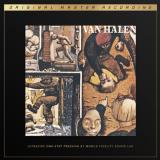
The song titles on Van Halen's aptly titled Fair Warning don't lie. The likes of "Unchained," "Mean Street," "Push Comes to Shove," "One Foot Out the Door," and more indicate the mood the band channels on its double-platinum 1981 record — the nastiest, darkest, and fiercest album of the group's storied career. For the fourth time in four years, Van Halen throws down the gauntlet to all challengers and emerges victorious.
Sourced from the original analog tapes, pressed on MoFi SuperVinyl at Fidelity Record Pressing, and strictly limited to 5,000 numbered copies, Mobile Fidelity's UltraDisc One-Step 180g 45RPM 2LP set plays with unfettered clarity, dynamics, and immediacy. Benefitting from superb groove definition, an ultra-low noise floor, and dead-quiet surfaces, this vinyl edition captures what went down in the studio with tremendous realism and involving presence.
Taking a more controlled approach in the studio and still completing everything in less than two weeks, Van Halen and producer Ted Templeman relied on studio amplifiers to direct the sound. Further diverging from the live-on-the-floor approach of its earlier albums, the ensemble also employed overdubs to great effect. The result: Dense, stacked architecture that underlines the hard-hitting tenor of the songs — and which comes alive like never before on this reference edition that looks as good as it sounds.
The premium packaging and gorgeous presentation befit the reissue's select status. Housed in a deluxe slipcase, it features special foil-stamped jackets and faithful-to-the-original graphics that illuminate the splendor of the recording. Aurally and visually, it is made for listeners who want to immerse themselves in everything involved with the album, including the iconic cover art adopted from William Kurelek's haunting painting, "The Maze."
Isolated frames from Kurelek's childhood-inspired work — including a man bashing his head into a brick wall, a guy pinning down an adversary as he delivers bare-fist blows to his face and others watch with apparent glee, a boy tied down on a conveyer belt and being sent through the equivalent of a meat saw — adorn the front and back covers. The sunnier visual disposition of Van Halen's prior efforts gives way to something sinister and tortured, traits reflective of the music within. The band members, too, are visually depicted not in glamorous shots but in a serious black-and-white portrait in which the quartet is clad in black leather jackets.
Tough, aggressive, stark: Fair Warning comes on like a series of bare-knuckled punches to the solar plexus and boasts lyrical narratives to match. Though not a concept record, the concise album revolves around themes of roughing it on the streets and struggling to survive amid dim prospects. Singer David Lee Roth reportedly penned many of the initial lyrics after traveling to Haiti and observing extreme poverty. The characters and situations populating Fair Warning reflect hardscrabble existence, last-chance desperation, and underlying danger.
Witness the crazies, poor folks, and hunters of “Mean Street”; the former prom queen turned pornographic actress on “Dirty Movies”; the menace and vice of “Sinners Swing!”; the streetwise hustle of “Unchained”; the isolation and alienation of “Push Comes to Shove”; the desire for escape on “One Foot Out the Door”: A carefree California beach party Fair Warning is not.
Having said he felt angry and frustrated during the sessions, guitarist Eddie Van Halen uses the forceful arrangements as a playground for his seemingly unlimited arsenal. Supported by a crack rhythm section and a hyped-up Roth, he performs with an almost impossible combination of punk-like intensity, technical finesse, lyrical fluidity, and unbridled emotion. The virtuoso was increasingly butting heads with Templeton and seeking a freedom in the studio he believed denied him.
No wonder he plays like a bat out of hell. Listen to the rapid-fire manner in which he slaps the high and low E strings on the 12th fret of his instrument on “Mean Street,” instilling the tune with funk flair and metal-spiked sharpness. For the pouty strut of “Dirty Movies,” Eddie Van Halen contributes slide guitar magic made possible after he sawed off the lower portion of a Gibson SG so he could reach further down the fretboard.
Related intensity, urgency, and daredevil momentum punctuate the surging “Sinner’s Swing!” A heavily flanged, delicately melodic introduction frames the attitudinal “Hear About It Later,” among the most creative arrangements of Van Halen’s career. And do riffs come any bigger or magnetic than those on the high-wire kick of “Unchained”? As for the out-of-left-field “Sunday in the Park,” an instrumental composed on an Electro-Harmonix micro-synthesizer: Who but Eddie Van Halen to supply creep factor in such an ingenious way?
Despite selling fewer quantities than Van Halen’s prior efforts, Fair Warning remains for many diehards the record that epitomizes all of the band’s immense strengths —Roth’s manic energy and tongue-wagging humor, Alex Van Halen’s rhythmic heartbeat-in-your-chest bombast, and Michael Anthony’s lucid bass lines included. Arriving when the New Wave of British Heavy Metal and new-wave movements were taking flight, it signaled a shot across the bow from a band determined to stay a step ahead and provide proof nobody could touch what it delivered.
More than four decades later, Fair Warning still sounds that alarm.
- A1: Haven
- A2: Dæmningen
- A3: Til Eline
- A4: Bluesen
- A5: Fløjtesangen
- B1: Post
- B2: Omvej
- B3: Sommer
- B4: Dialekt
- B5: Havn
Reissue des zweiten Albums des dänischen Jazzduos Svaneborg Kardyb, ""Haven"" (2020), auf Bio-Vinyl. Nikolaj Svaneborg (Keyboards) und Jonas Kardyb (Schlagzeug, Percussion) erschaffen komplexe, zyklische Kompositionen, die introspektive Wärme mit einem unterschwelligen Gefühl von Bewegung in Einklang bringen. Jazziger Minimalismus, der zwischen Kontemplation und Dynamik schwankt, wobei sanfte Wurlitzer-Klänge und knackige Percussion wie Echos in stillem Wasser plätschern. Nach zwei Alben auf dem dänischen Jazzlabel BLIK FLAK erhielten Svaneborg Kardyb einen Vertrag beim renommierten Indielabel Gondwana aus Manchester.
We the cyber ants
survivors of the post human era
by smashing dystopic hegemonies
together in colonies we cooperate
through a chemical communication strategy.
Crossing underground labyrinths
as clever roots
in symbiotic relationships we live and
in freaky spirals we dance 'til down.
Catching electricity with feelers
we destroy the buildings of
the enemies of love.
We're a neglected community
an unconquered moltitude of
Yessensis
Longicornis
Solenopsis and Subterranean
Martialis Eureka
Colobopsis Explodens and more.
Souls inside exoskeletons
we don't need your past
'cause we are your future.
- A1: Get Up I Feel Like Being A Sex Machine
- A2: Brother Rapp (Part I & Part Ii)
- A3: Bewildered
- A4: I Got The Feeling
- B1: Give It Up Or Turnit A Loose
- B2: I Don’t Want Nobody To Give Me Nothing
- B3: Licking Stick
- C1: Lowdown Popcorn 9.Spinning Wheel
- C2: If I Ruled The World
- C3: There Was A Time
- C4: It’s A Man’s Man’s Man’s World
- D1: Please, Please, Please
- D2: I Can’t Stand Myself (When You Touch Me)
- D3: Mother Popcorn
James Brown wants to know one thing before he and his band begin Sex Machine. “Can I get into the thing, really?,” he asks. His cohorts enthusiastically respond in the affirmative. And for the next hour and change, Mr. Dynamite gets into it and more, turning in a sweat-soaked, feet-moving, hip-swiveling, emotion-purging, in-the-red, drop-everything-you’re-doing-and-dance performance for the ages. Ranked by Rolling Stone among the 500 Greatest Albums of All Time, the sweeping 1970 effort towers as a testament to Brown’s inimitable legacy as well as the peak powers of his voice, vibrancy, and bands.
Sourced from the original master tapes, pressed at Fidelity Record Pressing, and housed in a Stoughton gatefold jacket, Mobile Fidelity’s numbered-edition 180g 33RPM 2LP set presents Sex Machine in audiophile sound for the first time. It explodes with the energy the lightning-strike music demands. Dynamic, immediate, present, airy: Everything from the brassiness and fluidity of the horns to the snap and decay of the snare to the swell and carry of the organ comes across in full-range perspective.
Then there’s Brown’s superhuman singing, which here emerges with a purity, naturalism, and transparency that ensure you feel everything. Screeching, shouting, pleading, moaning, preaching, stinging, commanding, testifying, crooning, humming: The Godfather of Soul contributes one of the finest vocal performances known to man. This definitive 55th anniversary reissue of Brown’s monster funk statement further exhibits a combination of clarity, solidity, separation, and imaging that helps bring to light what he and his crack ensembles committed to tape. Both in the studio and on the stage.
Just how lifelike does this reissue sound? Senior Mobile Fidelity Sound Lab engineer Krieg Wunderlich, who handled the remaster, notes: “There were some artifacts that sounded a bit like mistracking. But they turned out to be breath blasts on the vocal microphone. That is part of history. JB was workin' hard, and breathin' hard. And there was an edit the timing of that was truly strange. Again, a part of history.”
Originally marketed as a live album, Sex Machine contains six songs recorded in the studio and later overdubbed with canned crowd noise and reverberation. Save for “Low Down Popcorn,” the tracks on the latter half stem from a phenomenal performance captured in October 1969 at Bell Auditorium in Brown’s adopted hometown of Augusta, GA. The special relationship between the singer, the audience, and the location is palpable.
As the 1960s gave way to a new decade, Brown experienced immense success and dealt with unexpected change. Soul Brother Number One soon expanded his idea for an official live album captured in Augusta when the ensemble that backed him on that date morphed into the original version of the world-famous J.B.’s just months after the show. The virtuosic abilities, sticky chemistry, and rhythm-forward nature of the J.B.’s prompted him to book a one-off session in Cincinnati, OH, on a late July night.
Anchored by brothers William “Bootsy” Collins and Phelps “Catfish” Collins, the group — as well as two different drummers — laid down a nearly 11-minute rendition of “Get Up I Feel Like Being Like a Sex Machine” and a thrilling medley of “Bewildered,” “I Got the Feeling,” and “Give It Up or Turnit a Loose.” A pair of then-recent studio singles cut in separate locations in 1969, “Brother Rapp” and “Low Down Popcorn,” each featuring his prior group, took care of the second LP worth of material that complements the originally planned live set.
Complicated? Somewhat. Unusual? Definitely. But just as he elevated the expectations for all present and future R&B artists, Brown not only makes it all work. He makes it positively electrifying.
“Get Up I Feel Like Being Like a Sex Machine” is alone deserving of a dissertation on the art of funk music, seeing it moves up and down akin to an oil derrick, witnesses Brown unleashing a trademark series of grunts, squeaks, and “good god” asides, and glides to a hypnotic groove that won’t quit. Or look to the syncopated rhythms of “Brother Rapp (Part I and Part II),” one of multiple pieces here that signify the point where Brown began viewing every instrument as a percussive tool. Brown closes the three-song medley with his new band with a skedaddling “Give It Up or Turnit a Loose,” which provides jolts on the order of sticking your finger into a socket.
Not that the actual live material falls short in any way. Setting an insistent tempo for the vitality that follows, “I Don’t Want Nobody to Give Me Nothing” positions Brown as a role model, leader, and self-sufficient entrepreneur. All simmer and boil, the short and sweet “Licking Stick” dares you to keep pace. The floating, almost comforting “Spinning Wheel” spotlights the instrumental prowess of Maceo Parker and company, and functions as a seamless segue into the tender, horn-saluted “If I Ruled the World.”
And Brown and his mates still aren’t done. Just try to resist the one-two closing punch of “I Can’t Stand Myself (When You Touch Me)” and “Mother Popcorn.” Mercy.
Ain’t it funky? Sure ‘nuff.
2025 Repress in Gold Vinyl
'End Beginnings', das neue Album von Sandwell District, ist die erste neue Musik des Kollektivs seit dem tragischen Tod von Juan Mendez (Silent Servant) im Januar 2024. Mendez‘ atemberaubende Kunstwerke und Visuals waren immer eine zentrale Säule von Sandwell District, tatsächlich arbeitete er an einem Kunstwerk mit dem Titel 'End Beginnings' - nun der Titel des dritten Albums und eine Hommage an den verstorbenen Freund. 'End Beginnings' bringt gewaltigen Techno und umwerfende Dancefloor-Dynamik zusammen, eine meisterhafte Kombination von Innovation und Ekstase. Nach dem tragischen Einschnitt, steht nun wieder der Spaß im Vordergrund: „Eine gute Zeit zu haben ist so ziemlich der Grund, warum man überhaupt damit anfängt. Und es macht Spaß. Ich denke, wir fühlen uns jetzt viel glücklicher, besonders nach dem, was mit Juan passiert ist. Wir sind dankbar“, sagt Regis. '
The tapes for “Ronnie McNeir Makes A Move” were found in Mickey Stevenson’s extensive master tape collection. A full new LP of classic McNeir is an absolute treat for his many soul fans; particularly in Europe where he is so admired.
Ronnie recorded over twenty tracks with Mickey Stevenson’s production company in 1971. Eleven of these were featured on his RCA LP “Ronnie McNeir”, but another ten were left in the vaults.
The title track, ‘Let’s Make A Move’ is an urgent, exciting funk sound, composed with Ronnie’s frequent writing partner, Andre Moore. ‘I’m Sorry’ is an earlier version of ‘Gone Away’ which featured on the 1972 RCA “Ronnie McNeir” LP, without the female singer’s vocal response track.
‘Say You’ is the Motown song first recorded by the Monitors in 1965. It has a more laid-back treatment here, giving it a whole new dimension. We issued the single version on a Kent Select 45 in 2022; both versions are featured on the CD. Another re-envisaged Motown number is ‘The Girl’s Alright With Me’ which features Hodges, James, Smith & Crawford’s backing vocals − as do other tracks on this album. Surprisingly, Bob Dylan’s ‘Blowing In The Wind’ is also covered; in a pleasing, jaunty treatment.
‘My Day Will Come’ is a slow-burning number Ronnie co-wrote with his wife Mona. It is one he is particularly proud of and has been picked up by modern soul DJs as a potential crossover hit. ‘Tell Your Mama’ is a sensuous, Marvin Gaye-influenced groove, while ‘East Side, West Side’ is more streetwise, dealing with the social problems that face many young people.
As a multi-instrumentalist, heavily influenced by jazz, it comes as no surprise that Ronnie would record two jazz / soul instrumental jams which he simply named ‘Ronnie’s Bag #1’ and ‘Ronnie’s Bag #2’. The tracks are keyboard-lead, piano and possibly organ – or more likely one of the early synthesisers that Ronnie pioneered. ‘Ronnie’s Bag #1’ is more jazz-oriented, while ‘Ronnie’s Bag #2’ goes funky.
Hydro-grind maniacs CEPHALIC CARNAGE presents the deluxe 25th anniversary reissue of their monumental Relapse Records debut album Exploiting Dysfunction! The 2LP/2CD reissue was remixed and remastered by Dave Otero (Cattle Decapitation, Allegaeon, Khemmis) and features CEPHALIC CARNAGE classic tracks "Hybrid" & "Rehab" + previously unreleased bonus and demo tracks!
The second release on Samurai Music sub label Saibai welcomes Italian sound-world-builder Pianeti Sintetici for a richly rendered foray into dynamic electronica that moves like a set of vibrant ecosystems.
Davide Perrone has developed his Pianeti Sintetici ('synthetic planets') alias to explore the idea of creating imaginary worlds through teeming, densely layered arrangements of modulating synthesis. He's previously delivered spellbinding albums and EPs to respected labels like Astral Industries and Hypnus. On SAIBAI2, Perrone ably blurs the lines between percussive, textural and melodic parts, letting voices bend and warp as each sound evolves through the labyrinthe lattice of his constructions. This is electronic music so dynamic and ever-shifting, it sounds positively sentient, and yet there's a strong emotional sentiment that binds these fantastic visions together as sincere expressions from a grounded, human perspective.
True to Saibai's focus on deeper, mellower flights of fantasy away from the dancefloor, SAIBAI2 offers a kinetic, engaging listening experience dressed up in opulent tones that gleam, shimmer, bend and flex with hypnotising dexterity.
- 1: Enough Abused
- 2: Adore
- 3: Every You
- 4: Brother
- 5: Draining By Your Flame
- 6: Neverhappy
- 7: Let It Rain
- 8: Motherfknway
- 9: Pinman
Mid Price Campaign! Heavy, melodic and passionate, Flat Earth is a hard rock band from Helsinki, Finland, founded by Ex-Amorphis bass player (Niclas Etelävuori) Ex-HIM guitarist (Linde Lindström) Ex-HIM drummer (Gas Lipstick) and Polanski singer (Anthony Pikkarainen). The band produces heavy riffs, blasting beats and cinematic chords that combine to create an unforgiving, passionate, and dynamic sound.
The band's debut single ‘Blame’ premiered on Radio Rock in 2018, immediately gaining popularity, throughout Finland and the rest of Europe. The single Cyanide followed in the footsteps of the debut single, gaining public recognition and earning them a spot opening for ‘Alice in Chains’, in Helsinki. To date, they have over half a million streams on Spotify, alone.
In the beginning of 2019, the band entered the studio to record the follow up to their debut album ‘None for One’. This time with legendary producer Tim Palmer behind the mixing desk.
Flat Earth is: Anthony Pikkarainen - Vocals (Polanski) Linde Lindström - Guitar (ex-HIM) Gas Lipstick - Drums (ex-HIM) Niclas Etelävuori - Bass (ex-Amorphis).
House of Harm are proud to announce the forthcoming release of their new album Playground, out December 1st, 2023. The new record builds and expands upon the three-piece’s enthralling shadow-pop sound, a mix of midnight atmospherics, 90s era jangle pop, and contagious synth drenched hooks that further elevate the transcendent vocals of lead singer Michael Rocheford. Rounded out by Cooper Leardi (guitar / synths) and Tyler Kershaw (guitar / synth), House of Harm have amassed an impressive following as something of a best kept secret among their growing fanbase, leading to sold out shows on both coasts by the power of word of mouth alone.
The band members have been drawn to music for as long as any of them can remember, and the drive to be around like-minded artists and make their own noise drew them all to Boston after high school. There they all quickly enmeshed themselves, playing in other bands before meeting each other. Ever since, House of Harm have been quietly making a name for themselves among music fans with darker pop persuasions via a steady stream of releases in single, ep and album form.
That attention to detail and workmanlike approach at the expense of chasing instant gratification seems to be paying dividends after years of steady effort. The journey of their new album Playground saw House of Harm stay true to that ethos. The band painstakingly narrowed the record down to an efficient 10 tracks that they felt made the most sense, both standing on their own as well as fitting into an LP that built a cohesive world for the listener to get lost in. The album’s name also reflects the experimentation and happy accidents that came about during the writing and recording process.
On “The Face of Grace” they set out to explore different dynamics by writing a song entirely without drums, but couldn’t help themselves from putting emphasis on the song’s 6/8 waltz time signature. “Two Kinds” is another first for House Of Harm in that it’s predominantly driven by acoustic guitar. That aforementioned vulnerability shows up in other areas of the songwriting process as well with “Two Kinds”, one of their most revealing songs to date from a lyrical standpoint, written from a place of reflection and weakness and tackling feelings uneasy to be put on display for public consumption.
Taken as a whole, the end result is an album representing a collection of the band’s most raw and expressive songs yet.