Since the release of the highly acclaimed album Mamari (2021), the Muito Kaballa project has continued to develop.
The new album Little Child (2022) starts with a cracker called Inside Outside. The song addresses the hypocrisy and double standards of the European Union when it comes to refugee policy. The group works together with the renowned German/Nigerian musician Ade Bantu and the Angolan guitarist Juresse Amie Tieti Ndombasi and picks up their listeners where they were parked with Mamari. Fat grooves with clearly recognizable Afrobeat influences.
However, the musical journey leads step by step away from the usual sounds of the band. Already the second track Dansez! Dansez! shows that. The sound leads to Angola, Congo and a bit of Mali. The band stacks so many rhythms on top of each other that the word poly appears in a whole new light. It becomes clear that the nine deal intensively with the music that is the source of their inspiration. The gifted guitarist Juresse Amie Tieti Ndombasi puts the icing on the cake with his sound.
Let's continue with No = No. Here at last it becomes clear: Muito Kaballa has escaped from his drawer and is now in free flight, somewhere between jazz, fusion, afrobeat and whatever. But who cares? The sound is convincing, the feet shake to the beat and cannot be calmed down even with great effort and the message "Don't protect your daughter, educate your son" can't be said often enough.
The next song, Memories, reveals completely different sides of the band. While the sound is suddenly much more relaxed and, let's call it jazzy, the lyrics also become much more intimate and poetic. "Keep in mind, it makes you blind, starring in the sun". We don't find out what memories Niklas Mündemann, composer of the song, has in mind here but that shouldn't bother us. We just put on our sunglasses and let ourselves be carried away by the almost epic track, which with its ten minutes of playing time leaves nothing to be desired in terms of diversity. Sophisticated listeners will wonder if Niklas Mündemann listened to a bit of Kamasi Washington while composing. Maybe even a lot? Be that as it may - a special treat in the piece: the trombonist Saskia-Marleen Dahms, who makes a guest appearance on this song, rounds off the sound of the brass section again.
Last but not least, we come to the namesake of the album: the song Little Child builds on the mood of the previous track and rounds off the musical odyssey with a good portion of goosebumps. But the song doesn't just leave its mark on the surface, no, it also gets under your skin. While the melody has considerable catchy tune potential, it is above all the lyrics and the message that grab you here. Niklas Mündemann wrote the song during a phase of mental depression. Above all, psychotherapy helped him to think more positively again and to comfort his own inner child. We've all heard about that child in us. But when was the last time we hugged it? The song Little Child is the perfect accompaniment for this, because when you hear it, you immediately feel hugged, pressed and safe. Another highlight are the incredibly beautiful solos, played by Benjamin Schneider on guitar and Saskia-Marleen Dahms on trombone.
That's the end of the album and, to be perfectly honest, you don't feel left out in the rain, but you do feel left out in a (warm) shower. Time flies when you hear Muito Kaballa's new album and in the end you want more. 4 remixes for the dancefloor are delivered by French producer Kuna Maze, Polish/Angolan duo Lua Preta, French producer La Dame and Brazilian producer Badsista, tipping the remix balance into more female input.
Search:e wan
12" + 7" !
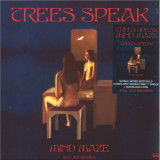
Mind Maze is, amazingly, Trees Speak’s fifth album to be released on Soul Jazz Records in the space of little over two years– an output matched only by the intensity of their music created during this short time.
The first pressing only of the album comes with a bonus seven-inch single containing two tracks that are not available on vinyl anywhere else.
As with all their previous releases, ‘Mind Maze’ is a mind-boggling tightrope walk across an array of musical influences that seamlessly create the unique present-day world of Trees Speak.
The band’s sound is characterized by a combination of German krautrock motoric-beat rhythms, angular New York post-punk attitude, 60s spy soundtracks, psych, rock, jazz, and 70s synthesizers and vocoders. There is also a cosmic spatial awareness to their sound; both personal inner space and galactic outer space, as well as a wilful pushing of sonic boundaries.
Trees Speak are a musical duo based in Tucson, Arizona, composed of Daniel Martin Diaz and Damian Diaz. Their music is heavily influenced by the cosmic magic of the natural desert landscapes of Arizona, creating a unique and captivating sound that is both experimental and innovative.
Here you will find the myriad sounds of 1970s German electronic music (everything from Can to Cluster, Popul Vuh to Tangerine Dream); 1980s New York post-punk and synthcore (from No Wave to Suicide); John Barry’s 1960s movies, John Carpenter’s 1970s horror. You will also hear the influences of French and Italian progressive rock (Magma, Goblin) as well as cosmic, new age and experimental space soundscapes …. an almost endless list of diverse influences that ebb and flow like an ocean of sound, in the process creating a truly unique soundscape that Trees Speak have made wholly their own.
The name Trees Speak reflects their interest in the concept of using future technologies to store information and data in trees and plants, with the idea that trees communicate collectively. This interest in nature and technology, combined with their passion for experimentation, has led Trees Speak to create a truly one-of-a-kind listening experience that is both unique and engaging.
If you ever wanted to hear Can, Neu!, Destroy All Monsters, Pere Ubu, electric eels, John Cage, Liquid Liquid, Tangerine Dream, Suicide, Laurie Spiegel, Art Ensemble of Chicago, John Barry, Mother Mallard’s Portable Masterpiece Company, Sun Ra, Stockhausen, John Carpenter, Electro-Acoustic and Musique Concrete and Mars in one band - then this is it! Trees Speak are a band that defies categorization and offer an eclectic listening experience, both exciting and memorable.
The two bonus tracks (‘Seraphim’ and ‘Orpheus’) included with the album give us a further window into the complex mind maze of the group - two stunning acoustic tracks that explore a distinct early 70s sound of Yes, Argent and other progressive rock accolytes.
George Palmer is a young artist from the DUB and sound system scene where he quickly stood out thanks to these stage appearances. It was with the international label Irie Ites Records that he wanted to collaborate in order to produce his first album.
Entitled "Working Man" this opus is composed of 10 titles including 2 combinations with LION D, famous international singer based in Italy and SOLO BANTON, famous English singer and toaster who needs no introduction.
The instrumentals are composed by big names of the genre: Sly & Robbie (Jamaica), Jammy's (Jamaica), Naram (New Zealand), Med Tone (Israel), Irie Ites (France) giving this project a great scope.
After the release of 6 music videos from the album and the physical (CD) and digital release at the end of June 2022, the project will soon be released on LP due to strong demand from its fans. In addition, this summer you were able to find George Palmer alongside Irie Ites Sound for fiery stage performances at various European festivals.
To accompany the release of the LP, several clips will be released and a new tour is in preparation.
A lost MPB gem from rural Finland! We Jazz presents the first ever reissue of this rare 1990 local release by Brazilian duo Rosanna & Zelia. 7" EP with inside out 3mm spine sleeve. RIYL: Gilberto Gil, Joyce, Musica Popular Brasileira, bossa nova, bossa jazz
Liner notes by Mikko Mattlar:
"Rosanna & Zélia were a Brazilian duo of singers and musicians Rosanna Guimarães Tavares and Zélia Nogueira da Fonseca. They moved from Minas Gerais, Brazil to Europe in 1988, released five albums in Germany between 1993–2004 and featured vocals on an Ian Pooley house track Coração Tambor before Rosanna died of cancer in 2006. Zélia still continues her career in Germany, touring actively and releasing new music.
The duo's journey from Brazil to Germany also included two brief visits to Finland. In the years 1989–1990, they spent time in the small town of Seinäjoki in Ostrobothnia. Rosanna & Zélia performed Brazilian music in Finnish clubs and festivals and recorded a 7" EP for local label Maumau Music. The record was distributed mostly in the Seinäjoki area, but the three songs are well-performed and authentic Brazilian MPB, so the largely unknown record now gets its first reissue for a wider audience on We Jazz Records.
But how did two Brazilian women find their way to a small Finnish town to record an EP? The main reason for this was music journalist and promoter Risto Vuorinen, who was on a holiday in Albufeira, Portugal, where a friend of his lived. The streets were almost empty that evening, but Vuorinen and his friend heard fine guitar playing and singing from a bar. There were Rosanna and Zélia performing on a small stage, and the two Finnish men happened to be the only customers. When the artists ended their performance, Vuorinen's friend, who spoke Portuguese, went to talk to them. Rosanna and Zélia told him they had recently come from Brazil and are trying to gain ground in Europe with their music.
Because Rosanna and Zélia didn't know where they would head next, and because Vuorinen liked their music, he thought of bringing the duo to his hometown, Seinäjoki. They immediately liked the idea, and in the autumn of 1989 they arrived in Finland. The national Finnish jazz festival was held in Seinäjoki, and Vuorinen thought Rosanna & Zélia's Brazilian music would fit right in. They performed at the festival and in November 1989, also made recordings in a local studio with backing musicians from Seinäjoki.
Music enthusiast Pertti Hakala had a record shop and label Maumau Music in Seinäjoki releasing music from local artists. He released a three-track EP from the sessions. with two tracks written by Rosanna & Zelia themselves and their cover version of Extra (Brazilian Reggae), written and originally performed by Gilberto Gil in 1983. A small pressing was made for the Finnish market, and Hakala also sent a box of records to Brazil, but for some reason it was sent back.
After their first visit to Finland, Rosanna & Zélia headed back to central Europe, but Vuorinen decided to organize more performances for them for the next summer. Maybe he also wanted to show them the beautiful Finnish summer, as Rosanna and Zélia had so far seen the country only during the darkest autumn. The duo came back to Finland for the summer of 1990 and performed at the Womad world music festival organized as a part of local Provinssirock. They also played in Nummirock and Puistoblues, both respected music festivals, and performed on TV in Helsinki.
Rosanna and Zélia lived in a small apartment in Seinäjoki and played two to three gigs per week all summer. Because there were only two of them, even small pubs could afford to book them, and in 1990 the economic situation in Finland was good. It was before a major economic depression hit the country. The duo travelled by bus or train, and because they were an acoustic duo, they could easily carry their instruments in public transport. Vuorinen got excellent feedback from organizers. Rosanna and Zélia were good performers, but also really nice people.
With the income from their summer gigs, Rosanna and Zélia could buy a PA mixer and other musical equipment. When the summer 1990 turned to autumn, they continued their journey from Seinäjoki to Germany where they settled down."
"Non Masse" is the new LP from Brussels-based artist and producer Apulati Bien.
After several notable releases on the Parisian label Promesses ("OO:NÉ", "RER TRACKS" & "Azone", jointly released on the Belgian label KRAAK) in solo or via the duo XOLOT he forms with artist Vica Pacheco, navigating in a neo-futuristic aesthetic with glitch and experimental influences mixed with juke, footwork and more broadly bass music heritage, Apulati Bien explores this time new territories, devoid of preconceived forms and leaving more space to each element.
Recorded at the time of the finalization of his last album "Azone" released in February 2022, with the will to proceed with a different method, even opposed to the one he knows, "Non Masse" (whose title is equivocal of the approach) is a more aerial object, with unquantified structures and sliding material, reflecting a feeling of "wanting to get out of (his) own mass", according to his words. A feeling certainly shared by many during the troubled period of the last two years, and which echoes a general desire for detachment, for withdrawal combined with a search for discovery in these overloaded times.
"Non Masse" is not however an object apart from Apulati Bien's discography, where we find the main elements of his music : futuristic references, glitch and digital contortions, which should not be approached as a light object but as a complex one, where the subtle details don't aim at diverting the attention, but on the contrary at nourishing a more global speech. The title "Alone Global" of one of the tracks is probably the most accurate definition of this project.
Seit gut 30 Jahren zählt Adriana Calcanhotto nun schon zu den größten und einflussreichsten Stimmen jener weiblichen Singer/Songwriter-Generation aus Brasilien, deren Vertreterinnen gleichermaßen als Komponistinnen, Instrumentalistinnen und Dichterinnen erfolgreich sind.
Vor drei Jahren hatten die pandemiebedingten Lockdown-Maßnahmen im Land sie dazu gezwungen, das 2020 veröffentlichte Album "Só" ("einsam/allein") unter ungewöhnlichen Bedingungen aufzunehmen: als virtuelle Zusammenarbeit mit anderen Musiker:innen, die (genau
wie sie selbst) in den eigenen vier Wänden festsaßen.
Kein Wunder, dass das Resultat vor allem jene Einsamkeit zum Ausdruck brachte, unter der in jenen Tagen die meisten Menschen leiden mussten.
Nun jedoch meldet sich die zweifache Latin-Grammy-Gewinnerin
(2006 & 2010) mit einem ganz anders klingenden und sehr viel extrovertierteren Longplayer zurück: "Errante" - was im Deutschen so viel wie "umherziehend" bedeutet.
Tatsächlich bewegt sich Adriana Calcanhotto auf ihrem 13. Studioalbum sehr frei und legt große Distanzen zwischen ganz unterschiedlichen Stilen und Genres zurück (alles von Bossa Nova, Samba-Canção, Xote, Maxixe und Samba-de-Roda bis hin zu Rock/Pop und Funk Carioca (Favela Funk)), wobei auch die Themenpalette ähnlich groß angelegt ist, wenn es etwa um die Liebe und deren Ende geht, ums Flirten, um Verluste, um Trauer und Selbstreflexion.
Die renommierte Singer-/ Songwriterin Katie Melua die Details zu ihrem kommenden neunten Studioalbum „Love & Money“ bekanntgegeben - ein atemberaubendes und höchst persönliches, insgesamt zehn Tracks umfassendes Werk, das einen tiefen Einblick gewährt, was innerhalb der letzten zwei Jahre in Katies Leben geschehen ist. Mit 56 Platinauszeichnungen in ihrer nunmehr zwei Dekaden andauernden Karriere ist Katie Melua zu einer der meistverkauften Künstlerinnen Großbritanniens avanciert, nachdem sie mit ihrem Debütalbum „Call Off The Search“ die Charts stürmte und anschließend nicht weniger als acht aufeinanderfolgende Top-10-Alben in Großbritannien veröffentlichte - zuletzt geschehen im Jahr 2020 mit dem „Album No. 8“.
Die Neuigkeit über die Veröffentlichung von „Love & Money“ am 24. März 2023 via BMG folgt auf die erst kürzlich erfolgte Bekanntgabe von Katies bevorstehender UK- und Europa-Tournee im April und Mai diesen Jahres, die mit einer Show in der legendären Royal Albert Hall in London am 16. Mai ein absolutes Highlight beinhaltet.
Produziert von Leo Abrahams (Ghostpoet, Brian Eno, Regina Spektor), wurde „Love & Money“ im Sommer 2022 in Peter Gabriels Real World Studios aufgenommen, während Katie mit ihrem mittlerweile neugeborenen Sohn schwanger war. Das Album ist eine exquisite Sammlung von Songs, die wesentlich von Dankbarkeit und einer Positivität geprägt sind, die sich mit einer neuen Liebe einstellt. Darüber hinaus geht es auch um Selbstakzeptanz angesichts von einschneidenden Veränderungen und wohl auch um den Versuch ist, „die Überzeugung loszulassen, dass Glück weniger schwer ist als das Gegenteil".
Katie Melua stammt ursprünglich aus Tiflis, Georgien, und hat es in jeder Hinsicht weit gebracht. Durch moderne Klassiker wie „The Closest Thing To Crazy" und „Nine Million Bicycles" unsterblich geworden, war ihr letzter Longplayer - das 2020 erschienene „Album No. 8“ - der bisher von der Kritik am meisten gelobte. Es zeigte eindrucksvoll, wie sie als Lyrikerin gereift ist, in dem sie sich sanft gegen den romantischen Idealismus in herkömmlichen Popsongs auflehnte und stattdessen nach etwas suchte, das sich näher an ihrer eigenen Erfahrung anfühlte. Doch ganz gleich, wann es das letzte Mal war, dass man mit ihr in Berührung gekommen ist, es gibt vermutlich keinen besseren Zeitpunkt, die Entwicklung von Katie Melua als Singer- / Songwriterin genauer unter die Lupe zu nehmen als jetzt mit der Veröffentlichung ihres neues, mittlerweile neunten Album „Love & Money“. Das Album wird sowohl digital als auch auf Vinyl und als Standard- oder auch Deluxe-CD erhältlich sein. Die Deluxe-CD enthält vier Bonustracks, darunter ein atemberaubendes Duett mit dem deutschen Künstler Philipp Poisel.
'The album is composed by Cerys Matthews with Hidden Orchestra and features 10 UK poets: MA.MOYO, Raymond Antrobus, Lemn Sissay, Liz Berry, Anthony Anaxagorou, Adam Horovitz, Cia Mangat, Imtiaz Dharker, Kim Moore and Kayo Chingonyi “We are living in extraordinary times, I wanted to respond but had the urge to offer more than one voice, more than one perspective. Not an echo chamber” – Cerys Matthews. In February 2020 Abbey Road studios welcomed each of the 10 poets to record pieces from their collections. Then lock down hit…. But remotely and with the additional help of field recordists and musicians around the world, Cerys and Joe Acheson (Hidden Orchestra) created a sound journey for these poems with the theme of: Genesis: Birth, heritage, a journey about to begin.
You Can Can is an echoed affirmation, an album which traces song forms around silence, field recordings, and degraded analog memories. This is folk music transmogrified and mutated, as if recorded and reconstructed in Pierre Schaffer’s GRM studio.
Not your typical Mariposa folk duo, the group is comprised of Toronto avant-music scene stalwarts, vocalist Felicity Williams (Bernice, Bahamas) and bricolage artist and synthesist Andrew Zukerman (Fleshtone Aura, Badge Epoch). The album feels like a somnambulant conversation, fragmented and half-remembered with Williams’ vocals traveling through a landscape of field recordings and Zukerman’s saturated concrète topographies. It is an electro-acoustic assemblage, both analog and digital, comprised of air, electricity, minerals, wood, and water. Although the album nods towards traditional forms of folk and musique concrète (if at this point it can be called a traditional form), it is outwardly and inwardly contemporary; non-linear, citational, opaque, and sui generis. In a way it feels like a sonic index of the narrative experiments found on the infamous Language school-related publisher The Figures, in the work of Lyn Hejinian, Clark Coolidge, and Lydia Davis. In the musical continuum, the album picks up where Linda Perhacs left off in the early 70’s—explored by Gastr Del Sol in the ‘90s—a convergence of rural acoustic idioms and urban avant-electronics. This is country music for the discerning cosmopolitan citizen of the 21st Century.
RIYL: Luc Ferrari, Brannten Schnüre, William Basinski, Oval, Eric Chenaux, Emmanuelle Parrenin About Everything In Time and Failure Figures, Felicity Williams says:
Everything In Time is indebted to the language of Brazilian author Clarice Lispector (as translated by Alison Entrekin). Drawing on insights from psychoanalysis, we trace the roots of melancholy to render them available to consciousness; words from the ghostly realm of the transpersonal filter through dreams and shine a beam of light onto a lone trillium in a forest at night. Other influences include the experience of not knowing, of being subject to a gestation outside of one’s control. This is an ode to the power of naming to obliterate, to set free.
Failure Figures is a meditation on the radical contingency of reality and the vicissitudes of the will. With Slavoj Zizek as my guide (think: “Hegel for dummies” - I’m the dummy in this scenario), I wander through the valley of the shadow of death, and take heart. The last verse refers to an experience I had recording at a studio in Brussels. I was singing in French, with which I have some fluency, and the producer was complaining to the artist whose song it was that my delivery was not convincing. Thinking I was out of ear shot, he said in French, “c’est comme elle n'est pas là”; I was pronouncing the words correctly, but I failed to express anything. So what or whom is responsible for conveying meaning, if not the form of the word itself? And if the connection between meaning and form is broken, how do we fix it?
Gratitude to Thom Gill (guitar) and Daniel Fortin (bass) who joined us on the recording of Failure Figures. Thanks as well to my old roommate Christopher Willes, who unwittingly left behind his hand bells deep in the hall closet. We unearthed them by accident, and the bells became an important sound element. Thanks to other past roomies Robin Dann and Claire Harvie, whose childhood piano and guitar respectively still reside with us, and were used in the recording. Field recordings were made in Toronto, Canada and Celestún, Mexico in 2020.
Evocative and spooky contemporary prog. Meine U Teksi has absolutely nailed it to fetishist levels. It sounds like the synths were the only thing keeping the castle warm the night this was recorded.
The whole record it's made even more unnerving by the fact that the 4th track doesn't exist.
- A1: Three (Intro)
- A2: Noisia & Camo & Krooked - Nova
- A3: The Upbeats & Noisia - Shibuya Pet Store
- B1: Noisia & Imanu - Shift
- B2: Noisia & Skrillex - Horizon
- B3: Noisia & Former - Cleansing
- C1: Mefjus & Noisia - Foundations
- C2: Scrapped
- C3: Shutters
- D1: Noisia & The Upbeats - Halcyon
- D2: Noisia & Halogenix - Wordless
- D3: Told You
- E1: Noisia & Two Fingers - Dzjengis
- E2: Noisia & Former - Pleasure Model
- F1: Noisia & Phace - Deep Down
- F2: Noisia & Posij - Simplon
- G1: Noisia & Black Sun Empire - Caps Lock
- G2: Skrillex & Noisia & Josh Pan & Dylan Brady - Supersonic (Vip)
- H1: The Hole Pt 1
- H2: Closer
"After Outer Edges we were trying to find a new direction for Noisia. This resulted in an extensive journey that took us through a lot of new ideas and music.
Although we eventually decided to stop, we are proud of the things we made along the way, and these tunes were always meant to be part of a larger whole. So before we finally close the book on Noisia, we wanted to share them with you, on one last album. Previously released or newly finished, they all represent directions we enjoyed exploring.
In the end, we didn't manage to figure things out. But we did get closer." - Nik, Thijs, Martijn (Noisia)
- A1: Report From The Frontlines
- A2: Ask Believe Feel Receive
- A3: Lost In Solitude
- A4: Art Is The Only Real Translation Of Living For Me
- B1: We Belong To Never
- B2: Pain
- B3: Superrare
- B4: We Want To Feel Love
- C1: Musik Ist Meine Sprache
- C2: Equalista
- C3: Mirrors
- C4: Skin
- D1: Free
- D2: Still Feat Pascal Schumacher
- D3: Afterhour
ENARCHY is the debut album by Leipzig-based producer and singer Maria die Ruhe. It is the result of a deep and thorough look the
artist took into both her own inner workings and the world around her. In 14 tracks, she explores different types of energy,
oscillating between head and heart. Final destination of this sometimes painful process of self- exploration is the embodiment of
her own power and creativity; the realization, that she manifests her role as catalyst, healer, and fighter for freedom and equality
by reporting on her experiences. These songs are about nothing less than that. And you can also dance to them.
In a musical sense, Maria surpasses herself compared to previous releases. She is bolder, more explorative and dissolves genre
boundaries. Acoustic instruments like the cello and the piano unite playfully with electronic beats. Her expressive voice speaks and
sings from the lowest lows to the loftiest heights. Her self-disclosing lyrics communicate the deepest messages of the soul. One can
tell right away: something is at stake here, this is about a real human living through something real, and now reporting from the
front lines of the human experience.
With lines like „Things are changing all the fucking time“ (ENARCHY) she posts a reminder for the current zeitgeist and the resulting
global uncertainty. „Some things need to be destroyed before they can heal“ is a demand for openness towards change, even if it is
challenging, requires energy, and leaves behind some scars.
In ART IS THE ONLY REAL TRANSLATION OF LIVING FOR ME, Maria uses sentences like „I’ve been trying to please you, I got headaches
and I still don’t fit“ to express her desperation with existing structures of injustice and the lack of livability of the artist lifestyle.
„Ah, you’re an artist - and what do you do professionally?“ Everyone loves music and art! When, o when, will the understanding
follow that there need to be people who make this art as a central part of their lives?
Frustration takes turns with hope and a growing acceptance of the self. In EQUALISTA, Maria discusses antiquated conditions like the
inequality between the sexes in a kind of manifesto, with a simple proposal for solution: „Let’s both be selfish and raise our
energies, to create a whole world with all the things we need.“
In WE BELONG TO NEVER, Maria sings about the everyday horror of toxic relationships. Lines like „Disengagement and rage, I’ve become such a slave.“ express the despair of the emptiness that results from a lack of affection. She also describes treacherous
narcissistic manipulation: „You cut me small just to feel tall.“
In SKIN, she confesses: „I’m not as enough as everyone else.“ and describes the long and painful way from rejecting her own body
to loving herself unconditionally. „I hate what I feel, while I pretend to be free“ means she doesn’t want to be reduced down to
her body, doesn’t want to be seen as an instagrammable, thoroughly designed product; she wants to be acknowledged as an
individual.
In LOST, she poses a question that many are currently forced to ask themselves: „What do we do with all this solitude?“ Maybe
making use of the reclusion by exploring the shadow self. „Can you cope with the truth?“
The conclusion: energy is being freed up through the means of self-experience and living through the personal darkness -
ENARCHY. The realization: every human being is self-determined and should simply do what they feel. It is everyone’s right to
choose their own life’s path. Here, intuition serves as a signpost. This is both feminine and strong.
ENARCHY celebrates an embodied anarchy by working through the personal shadow and the genuine, healthy integration of the
struggle survived - not as a destructive rebellion, but as a testament of shameless, joyful self-empowerment.
„In the end, I want to be alive, because in reality, I’m free.“
Trikk’s striking debut album Fauna & Flora cultivates a sense of scale, character and broad-minded musicianship across ten genre-fusing tracks. Just as its namesake spans the vast spectrum of life on Earth, so this expansive document draws from a diverse sound palette that jumps from widescreen psychedelia and industrial-crusted pop to baile funk and foreboding techno.
Partly descending from the club-focussed fare with which Trikk made his name, he also reaches for art-rock, punk and post-punk to expand on his electronic foundations.
“I wanted to create that feeling where there are these rays of light and total darkness, it’s a game
2026 Repress
Kerri Chandler delivers ‘Lost & Found Vol.2’ this March, marking the second instalment of the series which focuses on tracks from his archives.
Kerri Chandler’s Kaoz Theory unveiled the label bosses ‘Spaces & Places’ LP in 2022, showcasing Kerri’s globetrotting career of the past few decades and featuring recordings produced on the dance floors of many leading clubs such as DC10, Sub Club, Rex, Printworks and more.
Here the label kicks off 2023 with a glimpse into Chandler’s archived material, offering up four cuts in his inimitable, iconic style.
‘Fluff Rehab’ leads the way and see Kerri offering up crisp drums, spiralling dub stabs and fluttering low-end pulsations throughout.
‘What If’ follows and tips the focus over to a more soulful feel, fusing a wandering bass line and airy textures with vocal chants, choppy keys, and a gritty drum groove.
‘Who Are You (Main Vox)’ then opens the B-side, retaining a similarly soul drenched feel, bringing Kerri’s own harmonious vocals into the mix alongside a crunchy, swinging rhythm and jazzy elements.
‘Dem Joy Ride’ rounds out the EP next, flipping the switch to a funk-infused, organic feel as brass lines, hypnotic keys, dynamic drums, and guitar licks collide across an ever unfolding five and a half minutes.
The timeless ‘’Rhythm of Life ‘’ album by James Mason is possibly one of the greatest vocal Jazz fusion releases of all time. When I first started Dynamite cuts I wanted to make a 7” box set of ths LP. But instead released a double pack (2x7”); plus, another 7”, making 6 tracks from the album. Now 2022 we have been able to release two further monster tracks. “Rhythm of life” the title track from the LP is an up-tempo vocal dancer, a groovy driving jazz fusion masterpiece. And very excitingly, we have been able to make an exclusive 7” cut, the vocal soul gem “Good Thing”, on the flip. This one is huge.
- A1: Interlude Between Brussels & Rio
- A2: Dead End (Ft. Janet King)
- A3: Clout Chaser's Anthem (Ft. Janet King , Hua Li)
- A4: Jazz Cats Run (Ft. Sarah Mk)
- A5: 1996 Inner G
- A6: Shore Apart
- A7: Lord Have Mercy (Ft. Judith Little D ,Raveen)
- B1: Nunca Mais
- B2: In The Gaze
- B3: Mascarade
- B4: Moon Rising (10 Years) (Ft. Judith Little D)
Gayance joins forces with Rhythm Section for her debut album ‘Mascarade’ - a swaying dance that moves between poetic, soulful odes to the past, accounts of the Afro-diasporic feminine experience and playfully energetic dance floor grooves.
Mascarade is a collection of dancey, broken rhythms, interwoven with heartfelt stories and bright, unapologetic outpours of joy. In her own words, “It's the story of my 20's. I wanted to pay homage to this kid everybody knew, but not deeply. It's about taking back a power that is mine and was always in my hands...It's about making peace with the past and moving forward”.
Gayance (real name Aïsha Vertus) takes her alias from the Haitian creole word for joyfulness.Based in Amsterdam, born and raised in Montreal-Nord, she started as a DJ in 2013, and has toured the world with shows in Paris, Brooklyn, Marrakech, Berlin, Sao Paulo and more, bringing electrifying and contagious energy wherever she goes.
Her own production is influenced by underground UKG and the respective house scenes of Detroit and New York, with nods to the vivid, sun-soaked colours of Latin America. Shades of blues, jazz and gospel can also be heard in her newest project, pulling together styles from each corner of the world. Following her catalog of entirely self-released projects, Gayance announces her full-length debut album on Rhythm Section, bringing some fellow Montrealers along for the ride.
Last year the Atlanta artist releaed her debut EP Swan, made with producer Marshall Vore who is known for his work with folk dynamo Phoebe Bridgers. The five song col¬lection found a supportive home with Royal Mountain Re¬cords, and drew remarkable acclaim for a debut EP, earning praise from outlets like NPR, FADER, Nylon, Paste, Under The Radar, Coup De Main and Line of Best Fit among many others.
When I’m Alone is the debut album from Girlpuppy. Across the record, Harvey weaves in several cinematic allusions: a Keanu Reeves look alike pops up in “Teenage Dream,” named for the alternate title of an ‘80s movie he stars in;
- A1: Nigga Type Shit (Original Version)
- A2: Who's Got The Fiah
- A3: Get Off A Niggaz Nutz (Original Version)
- B1: It Aint Easy
- B2: Every Single Bitch
- B3: Dat Bounce
- C1: Just A Murdarah
- C2: Yall Bitches
- C3: They Cant Attack
- C4: It´s Hard Being Black
- D1: We Got Da Weed
- D2: Suck A Nigga Dick
- D3: I Want You
- D4: When I Make It Rich
SMK aka South Memphis King is one of the real godfathers of Memphis rap. He released his first album in 1991 and is still active today. This is one of his early recordings, never released on vinyl before, Straight bangin' underground shit for the streets of your city. Roll a blunt and enjoy the sick madness over here.