‘PEACEMEAL’ is yet another reinvention for Ron
Gallo - a human being on a lifelong chase of
himself and using music as the main vehicle.
On his third LP, he exits the noisy confines of the
garage and goes outside where there’s no limit to
embracing all aspects of himself.
The result is a colourful hodgepodge of 90’s hiphop, r&b, weirdo pop, jazz and punk. The sounds
change but the sense of humanity, humour and a
truly eccentric worldview is the common thread in
all of Gallo’s music.
Mostly written and recorded during a period of
self-isolation in summer 2019, it’s an uncanny
foreshadowing of the global situation that was to
come and give all the songs a new meaning. This
is feel-good music that attempts to confront and
understand human existence.
Ron Gallo just wants to be himself, destroy
expectations and encourage you to do the same in
a world that does just about everything to try and
box us in - not to mention, this is his best most
fun one yet.
Cerca:ecce
Credited as one of the best late '60s German psych-rock albums, Bokaj Retsiem's ('meister Jakob' in reverse) Psychedelic Underground is an eccentric, soulful, acidn and fuzzy rockin' essay that clearly prefigures a part of the krautrock movement. Featuring Rainer Deigner, former guitar for the '60s beat German group Former Bonds, as the only credited musician and composer on this album (although other musicians assisted him on bass, keyboards, and that B3 Hammond and Leslie sound), this is basically Rainer's freaked-out tribute to his favorite children's song, 'Meister Jakob,' consisting in trippy instrumental sections, furiously savage E-guitar crescendos, amazing psych-rock improvisation, with just a hint of '60s US psych-garage. A real enthusiastic psych-kraut trip for fans of Vanilla Fudge, Hendrix,and Iron Butterfly.
‘Dekalb Works’ is the collaborative project of Austin Peru (Vision Fortune) & Daniel Creahan (Sweat Equity / Alien D). Born out of a shared deep sociological interest of dialects and cultural frameworks, and the effects these have on meaning within modes of speech, the pair here delve into the dialects of their own beginnings, mining US/British regional accents and weaving these situational scenes through a textured, intentionally disjointed, hand made soundscape of bass tension and fleeting, glistening melody – adding additional layers of emotion and meaning to everyday observations of language.
‘Duologue’ intends to blur the lines between perceived and constructed reality, occupying a gauzy, dreamlike space shared by the likes of Hype Williams & James Ferraro, where foggy sonars & deep subs provide the backbone to both eccentric and mundane ephemeral flutters of dialect.
‘Duologue’ revels in its variance of linguistic stylings – from the deep US south religious lament of ‘of a’ hovering above an ambience of Zither & Bells, to the doom laden sax skronk and vocal stutter of ‘with’, to the creeping stripped micro dub of ‘only’ which allows the familiar hue of the British news reader and typical West Midlands dialectical moments to clash – aptly documenting of an impending collision.
This is certainly one for heads into all things slow & spacious - for sure there’s a lot to digest and get lost in here across the records quite intentionally intoxicating ark, where touch points and historical nods range from Laraaji’s signature ambience to Ernest Hood’s visionary ‘Neighbourhoods’, filtered through modern outer sound explorers such as John T. Gast, Mark Lecky, and the bass minimalism of SND.
Hunt & Gather’s debut vinyl release comes by way of Pezzner’s cryptic moniker “The Native Language”. Written as a quasi-homeless man living off the rich in the San Juan Islands who writes music once per year to suffice his own delusions.
Walking the streets in these damp, anxious days that all run together lately, I was approached by a man who would blend right into the neighborhood, layered in flannel and sweatshirts for sleeping.
Rough, but for his shoes. (Never cheap out on anything that separates you from the ground.) “Pezzner,” he called out, from a safe distance. “What did the mangrove say to the marauding hordes.” My soul left my body for a moment and my voice responded on its own. “Petrichor.”
He caught my eye, nodded, left a padded envelope on the ground and vanished. The envelope had passed through many hands, slipped into the bed of a ferry-bound truck, passed from one fellow traveler to another, stashed under the counters of anarchist bookstores, left tucked between books at Little Free Libraries. The greenish stains suggested that at one point it had been swum across a lake. Another DAT, contents encoded here unabridged, and a letter from someone who called himself The Sentinel.
The Vessel lived out his days on Shaw Island, under a canopy of trees that gets smaller and smaller every season. His condition the same, any electricity lit his brain on fire, could only bring himself to compose one day a year, only at night, out of sight. Until he met The Angel, an eccentric with means, who built for him a device.
A Faraday Cage to block all electromagnetic emissions. Burlap walls, for atmosphere. A system of pulleys and levers, wood and rope, all running into a box that sat outside. An entirely mechanical control surface. No electrons in here. The Vessel lit fires, watched the shadows dance, closed his eyes and disappeared into the motion for hours at a time. The Sentinel came every morning to change the tapes. The Angel watched and pondered, his plans unknown.
The box sat sealed, bare except for another set of ideograms, scratched in day by day over time. Inside, the usual bedroom-producer shit. Outside, the ideograms told a story, passed from the Vessel to the Sentinel and drawn by the Angel, of a man who became another creature. Alert to the lowest frequencies, feeling music deep in the soil below their feet. Music that brings messages, from distant friends, warning of new creatures and the danger they brought. Skin alive to the world, so sensitive it can detect the landing of a single fly. A mind capable of keeping a map of the world inside. A mind that can look in a mirror and see a soul it knows well. A mind that can grieve.
After processing its contents, I filled the envelope with granola bars and walked it down to the market. The clerk gave me a knowing look as I placed it on the counter behind a stack of pork rinds from the previous century. As I walked out, a young man carrying a plastic bag and wearing impeccable shoes walked in.
- A1: Samba Negra - Eberebijara
- A2: King Somalie - Monkey 'S Dance
- A3: El Grupo Folclórico - Tamba
- A4: Los Viajeros Siderales - El Campanero
- A5: Rio Latino - Ayu
- B1: Aníbal Velásquez - La Mazamorra Del Diablo
- B2: La Francachela - Mosquita Muerta
- B3: El Grupo Folclórico - Juipiti
- B4: King Somalie - Le Mongui
- C1: El Grupo Folclórico - El Tornillito
- C2: Samba Negra - Long Life Africa
- C3: La Banda Africana - Te Clavo La... Mano
- C4: Myrian Makenwa - El Platano
- D1: El Grupo Folclórico - Tucutru
- D2: Grupo Bola Roja - Caracol
- D3: El Grupo D'abelard - Otro Perro Con Ese Hueso
- D4: Conjunto Barbacoa - Wabali
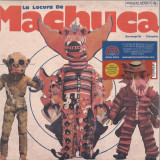
La Locura de Machuca is the story of one man’s bizarre odyssey into Colombia’s coastal music underground, and the wild, hypnotic sounds he helped bring up to the surface.
One night in 1975, a successful tax lawyer named Rafael Machuca had his mind blown in Barranquilla’s ‘Plaza de los Musicos’. Overnight he went from a high ranking position in the Columbian revenue authority to visionary production guru of the newly formed record label that bore his name, Discos Machuca, and for the next six years he devoted his life to releasing some of the strangest, most experimental Afro Psychedelia Cumbias ever produced. La Locura de Machuca is the story of one man’s bizarre odyssey into Colombia’s coastal music underground, and the wild, hypnotic sounds he helped bring up to the surface.
The Colombian music industry was thriving in the mid-seventies, but while homegrown bolero and vallenato tunes were doing well on the charts, it was imported African records that were setting crowds on fire at the picos – the sound-systems that fuelled neighbourhood parties – and wherever those records were played there were always a handful of groups who were inspired to plug traditional Cumbia directly into the electric currents coming from across the Atlantic.
It was these obscure bands, who fused Colombian and African rhythms with the swirling organs and psychedelic guitars of underground rock, that fired Machuca’s imagination. While the label made its money releasing popular hits by legends such as Alejandro Durán and Aníbal Velásquez, that money was poured back into a unique run of experimental releases by fringe artists such as La Banda Africana, King Somalie, Conjunto Barbacoa, and Abelardo Carbono, one of the godfathers of Champeta Criolla.
When Machuca couldn’t find groups to realise his particular vision, he simply created them himself. Drawing on a fearsome roster of musicians associated with the label, he assembled bands that lasted only as long as it took to record an album ,and unleashed the results – complete with arrestingly unusual album covers – under a series of different names such as Samba Negra or El Grupo Folclórico. This unorthodox approach led his longtime recording engineer, Eduardo Dávila, to describes Machuca’s productions as the “B-Movies of Colombian music.”
The story of Doctor Machuca and his eccentric exploits tells of one of Colombia’s most atypical and peculiar record companies; a defining pillar of Afro-Caribbean psychedelia. His productions have come to represent the roots of Champeta and set the pedigree standards for Afro and Costeño avant-garde. The seventeen tracks on La Locura de Machuca, harvested from the darkest, strangest corners of the Discos Machuca catalogue, sound like little else recorded before or since.
When Lindstrom and Prins Thomas get together, expect the unexpected. The Norwegian production duo's third album III is also their first outing together in eleven years, since II from 2009 and as ever, Lindstrom and Prins Thomas have crafted their own unique sonic world between the two of them. This is expansive, luscious electronic music rich with texture and intricacy, patiently revealing every eccentricity while constantly pulling the listener in. Getting lost never sounded so good. Since the release of II, Lindstrom and Prins Thomas have remained more than busy with their respective solo careers, but work on III was taking place behind the scenes the whole time - slow and steady by sending files back and forth. "There's a different process with every album," Thomas explains. "With the first two albums, we had a door between separate rooms in the studio, so I could open my door and play him something. We also toured together a lot after the first album, and after that experience we realized that we work better together at a distance. We're doing our best work by not worrying too much about what the other one of us is doing." Eventually, the bulk of III came together over the last year, as Lindstrom and Prins Thomas teamed up to craft a lush and lovely work that recalls the hazy atmospherics of Air, the loose-fit jazz of Lonnie Liston Smith, and the genreresistant electronic music that both artists have made their name on over the course of their impressive careers. "Our partnership is very democratic "we never turn down each other's ideas. And if it goes wrong, we blame it on the other guy," Thomas says with a laugh. "The tracks that Lindstrom sent me this time were almost like standard house tracks. I already had an idea of what I wanted to do, so I forced those tracks into new shoes and dresses." Above all else, III is a testament to the adventurousness of Lindstrom and Prins Thomas when it comes to soundcraft. Both artists have established separate careers on bodies of work that feature infinite twists and turns, thrilling their audiences with the suggestion of where they've been and where they're about to go. Together, they've crafted what might be their most beguiling and inviting work yet, a jeweled box of electronic music ornately crafted but never losing the sense of playfulness that so many have come to love from them.
restock
Following up on a strong launch with Braintalk, Human Sense Technology returns for their 2nd entry; this time from the man of many styles, Eastern Zurich's very own Dan Piu, with Modern Utopia Thought EP. Dedicated to his youth and influenced by future visions of creation, the atmosphere and arrangement on this EP permeates into the imagination with colors of suspense, harmony, and spherical textures showcasing the finer lines of deep frequency. Courageous indeed as this EP embraces the mysterious in an eccentric bliss that charms the listening experience in a way that grooves the body as much as it moves the mind. Welcome to Modern Utopia EP, where there are no constraints on creation or time.
Ahead of the Meakusma Festival 2019 Don't DJ and NWAQ did an artist residency developing new music together from scratch. Their resulting performance at the festival was a mesmerising descent into the artistic perspectives of two singular artists active in off-kilter club music.Some of the eight tracks on this record were recorded live at the festival while others were recorded during the residency. All
dwell in distorted and eccentric bliss and play around with rhythmic arrhythmic and post-rhythmic tension.
This exclusive EP features an extended version of ‘Partypooper’ and an exclusive track, ‘Marshmallow’, only available on vinyl.
Hailing from Cardiff HMS Morris make a colourful, eclectic and eccentric sound. They’ve previously cited the work of the late Syd Barrett as an influence but their penchant for creating sparkling avantgarde music as deliriously catchy as it is experimental also makes them comparable to their Welsh contemporaries. There’s elements of Gwenno’s bilingual synth-laden pop, touches of Cat le Bon’s otherworldly psychedelic songcraft and lashes of the quirky multi-instrumental indie alt-pop of Gruff Rhys.
Four Flies are proud and honoured to release the first vinyl reissue of Bruno Nicolai's outstanding original score for GEMINUS, a 1969 Italian TV mini-series directed by Luciano Emmer and starring Walter Chiari, Alida Chelli, and Ira von Fürstenberg.
Originally released under Italian label Gemelli, Nicolai's soundtrack has been remastered from the original master tapes and comes in a glossy, tip-on style jacket featuring the restored original cover artwork, as well as extended liner notes by film critics Francesco Cesari and Roberto Curti.
Bruno Nicolai composed and directed an eclectic score that brings together different music genres and influences, from 60s beat, psych, and progrock to baroque and experimental music. He did not hesitate to mix classical forms and structures with new instruments andremarkable, eccentric arrangements.
In 'Giano' (Janus), the interplay between a distorted electric guitar and a hypnotic harpsichord creates a strange, somewhat troubling ambience.
The delicate, celestial voice of Edda Dell'Orso leaves its unique emotional imprint on the most lyricalpiece in the soundtrack, 'Tema Barocco' (Baroque Theme).
The main theme 'Il cielo cade' (The Sky Is Falling) features a luxurious arrangement and stunning orchestration enhanced by enchanting vocal harmonies sung by 'I Cantori Moderni di Alessandroni'.
In other pieces, such as 'Larve' (Larvas), 'Il sognatore' (The Dreamer), 'Eclisse di luna' (Moon Eclipse), 'Visioni' (Visions), 'Catacombe' (Catacombs), and 'Notti romane' (Roman Nights), expressive and experimental solo passages played by instruments such as the vibraphone, sitar, harmonica, or percussions, contribute to the sombre, mysterious atmosphere of the score as a whole.
With the indeed adventurous Aventure EP on Couldn’t Care More Harmonious Thelonious further explores the depths of his unique vision, merging African rhythms, European harmonies and American minimalism: The title track keeps the same yet ever-changing lighthearted melody effortlessly meandering back and forth over electrified beats while Some Blue Beats is more on the minimalist side, as controlled as eccentric. Ta Ta Ta keeps it darker, with hypnotic percussions, organ chords noir and a big bass. Advanced music. Play loud.
ALTER is proud to present ‘Tendrils’, the first LP release from London based artist & musician Malvern Brume. After gathering some hushed praise from the UK underground for a couple of excellent cassette releases and strong local live performances, ‘Tendrils’ is the first definitive document of the Malvern Brume sound world. His instrumentation and sound sources would be considered familiar staples in the world of “experimental” music, but Salter does an admirable job of making them his own. Comprised of 8 pieces, this is electronic music at its core but a kind that sounds as if it’s being played through fog. Like spores growing on a damp surface. Densely composed and thick with an almost asphyxiating atmosphere - even during the record’s more minimal moments - track titles like ‘Caught In The Exhaust Trails’ and ‘Sunk Into Plastics’ only heighten the tone further.
Salter was originally born in the countryside and since relocated to London, a place he finds “over stimulating in every sense”. Much of ‘Tendrils’ could be taken as a response to the city and a means of equating the two. Camberwell is listed as the location for composition, but field recordings are attributed to rural landmarks. The Rollright Stones on the Oxfordshire / Warwickshire border and Seven Sisters Cliffs by the English Channel are two in case, but despite their picturesque origins Salter renders them into abstract clatter. As if dubbed from the private tape archive of an old eccentric. In addition, synthesised electronic tones hum and buzz, occasionally giving away to strange, slurring sequences that sound like lost transmissions from the radiophonic workshop. Despite the nod to this electronic music institution, it’s lacking the sincere level of esteem that can turn one into a heritage act. There is a strangeness and distant other worldliness to the music that feels unselfconscious and keeps Malvern Brume from being easy to define by contemporary terms.
Salter says the album is defined by movement and the environments that have inspired him over the years. In his own words, “each of these tracks is inspired by a journey or moving through a space, not in a wishy-washy cosmic sense but more as a practical A to B.” With that in mind, ‘Tendrils’ is perfect music for solitary inner-city marshland walks and urban bike rides to forgotten local suburbs.
Minyo Crusaders rework historic Japanese folk songs (min'yo) with Latin, African, Caribbean and Asian rhythms for their debut album 'Echoes of Japan'.
Releases from Ryuichi Sakamoto, Haruomi Hosono and Midori Takada have re-ignited global interest in Japanese music and 'Echoes of Japan' marks the arrival of a big band like no other.
'For Japanese people, min'yo is both the closest, and most distant, folk music' explains band-leader Katsumi Tanaka: 'We may not feel it in our daily, urban lives, yet the melodies, the style of singing and the rhythm of the taiko drums are engrained in our DNA'. Initially indifferent to min'yo, a tragic event in recent Japanese history set Tanaka on his current path: 'Following the Tohoku earthquake of 2011, I reflected on my life, work and identity. A fan of world music, I began searching for Japanese roots music I could identify
with. Discovering mid-late 20th century acts Hibari Misora, Chiemi Eri and the Tokyo Cuban Boys, I was
captivated by their eccentric arrangements and how they mixed min'yo with Latin and jazz.'
Originally sung by fishermen (Kushimoto Bushi; Mamurogawa Ondo), coal miners (Tanko Bushi) and sumo wrestlers (Sumo Jinku), these songs deal with topics such as the returning spirits of ancestors (Hohai Bushi), Japan's smallest bird (Toichin Bushi) and a bride's love for her husband's pockmarked face (Otemoyan).
Minyo Crusaders are one of the most hyped acts on the Tokyo music scene that went national in 2018 through festivals such as Fuji Rock. The band features veterans of the Tokyo roots music scene such as bassist DADDY U (Ska Flames), keyboardist Moe (Kidlat), sax player Koichiro Osawa (Matt Sounds/ J.J. Session), Yamauchi Stephan (J.J. Session), percussionist Mutsumi Kobayashi (Banda de la Mumbia), conga player Irochi (Cubatumb) and vocalist Meg (DJ collective Tokyo Sabroso).
- Wild blend of Japanese folk music with cumbia, boogaloo, Ethio jazz, Afro funk + more
- Ry Cooder, Mario Galeano (Ondatropica/Frente Cumbiero), Clap! Clap! are all fans
- European touring plans for autumn/fall 2019
- Includes Japanese lyrics + English translations
- Lacquers cut @ The Carvery
To say Fredfades and Jawn Rice are House music producers would be sneering at their efforts across genres like Hip Hop, Soul, and Jazz. The Mutual Intentions collaborators have forged a sound together in classic House, siphoning a myriad of influences through their intricate constructions in the studio as solo acts since first meeting in 2007. Becoming fast friends over a shared love of the dusty beats of an SP1200, Jawn Rice and Fredfades started working together while the Mutual Intentions collective gestated around them. Individual works by Jawn and Fred dot the collective’s back catalogue like various nodes of evolution through the course of MI’s output.
“We’ve always been sharing sketches,” explains Jawn Rice, “but I feel that these past years have been more productive in getting some of these sketches out as songs with Fredrik. It’s just a continuation of our friendship.” Emboldened by this friendship and with their finely tuned skills in the studio,
honed to near-perfection, they eventually started making music together. Following two seminal solo LPs – Fredfades’ Warmth and Jawn Rice’s Highlights – the pair consolidated their music as a duo in 2019, striking out with their electrifying debut, Jacuzzi Boyz. In a fusion between Jawn’s electronic inclinations and Fred’s soulful eccentricities, Jacuzzi Boyz established the duo as a new force workingNew Release Information within the broad scope of House music, with a sound imbued in the origin story of House and the genre’s hip-hop allegiances.
In 2020 they continue to pursue music together in the sophomore LP, Luv Neva Fades. Following the release of the title track and lead single, Luv Neva Fades finds the producers cementing their artistic voice and re-enforcing their commitment to a singular sound. Lush Rhodes keys and bouncing percussion lay the foundations for the album, while buoyant bass-lines and sparkling synthesisers provide
the catalyst for a crooning vocal or ruminating melody. It’s a record that thrives in a sultry mood; an LP that basks in the warmth of its analogue origins and cools in the shade of languid chord progressions.
Like Jacuzzi Boys, this album is an extended collaborative affair, as Mutual Intentions’ reach stretches across the Atlantic with guest appearances from Byron the Aquarius, Javonntte, Arthur Kay, Bendik HK and the SP1200 that started it all. Shimmering melodies, hazy harmonies and boisterous beats draw Fredfades and Jawn Rice out of the jacuzzi and onto the dance floor, moving under shimmering stars, where the duo cement what they started with Luv Neva Fades.
With a hybrid jazz based on African grooves, Ethio-oriental melodies and psychedelic dub this Belgian five-piece creates an atmosphere where ancient and modern sounds fuse into a powerful, hypnotic and groovy sensation.
Receiving critical acclaim for their second album 'Artifacts' (2017), the Belgian quintet are pleased to announce the release of their much-anticipated third album entitled 'Future Flora', released 12th April via Sdban Ultra on vinyl / cd / digital.
Piloted by saxophonist/flutist/composer Nathan Daems (Ragini Trio, Dijf Sanders, Echoes of Zoo), the input of notorious musicians, drummer Simon Segers (MDC III, De Beren Gieren, Stadt), cornet player Jon Birdsong (dEUS, Beck, Calexico), keyboardist Wouter Haest (Voodoo Boogie) and bassist Filip Vandebril (Lady Linn, The Valerie Solanas) leads to the specific universe that only Black Flower is able to create.
Where debut album 'Abyssinia Afterlife' (2014) and 'Artifacts' (2017) bathed in an atmosphere of psychedelics, mythical figures, ancient sounds and modern cultures, new album 'Future Flora' refers to the power of plants and their importance for the future.
"'Future Flora' is a metaphor for the importance of feeding and watering powerful and revolutionary ideas and initiatives that can save our world. You can compare it with plants that fight between the paving stones of the city for their future. These "urban warriors" need water to survive and grow. Their future and ours depends entirely on how we look at the plant world", says Daems.
Black Flower's musical cross-pollination of sounds and rhythms remain on 'Future Flora', but there is still room for a more Western touch with Romanian and Maloya (Réunion) influences. Daems developed his own arrangements where Western, Oriental and Ethiopian scales and chords are fused together to create a real mix of traditional instrumentation and modern electrical vibrations.
The strong underlying groove is omnipresent, but the room for psychedelics, folklore and experimentation grows. Songs like new single 'Hora de Aksum' combine modern western rhythms with doses of Balkan eccentricities while 'Future Flora' takes you on a psyche-delicious 21th century Ethio-dub-jazz trip with echoes of Mulatu Astatke and Fela Kuti.
"The general feeling that dominates is that of strength and perseverance. The feeling that we have to fight for our future and that we have to do it now! The whole album is interspersed with this atmosphere and sounds swirling, haunting and ecstatic. For those who once saw Black Flower live at work, this energy will be extremely recognizable", he adds.
DJ Die Soon is a local legend and ongoing inspiration in the Berlin underground electronic music scene. Remaining largely unknown outside the city, with only a handful of releases and appearances to date, the man behind the mask delivers truly freakish beats built from chaos driven crushed drums and eerie horror style basslines.
KAPPA SLAP wrenches the Morphine catalog by the neck, takes it off it’s feet and slams it back unsteadily in front of the fans who loved the Container, Metasplice and Hieroglyphic Being output of the label. DJ Die Soon delivers extreme work here. The album is a mixture of instrumental pieces and vocal tracks featuring the talents of five contrasting MC's. Three Ugandan lyricists feature: there’s MC Yallah, with whom he worked during a residency for the Nyege Nyege Festival , Lord Spikeheart from the Duma hardcore pressure band, and the mighty ECKO BAZZ. Long time friend and collaborator Infinite Livez (Ninja Tunes) appears on the cosmic & eccentric Ranthworth, and finally there’s Japan’s MA, who recently dropped the incredible AMA album on the label. Incidentally, the pair (both Japanese) decided to collaborate after acclaimed performance at the Morphine Showcase Berlin’s Berghain in 2019.
KAPPA SLAP contains a lot of our favorite sounds all in one album. Stunningly, DJ Die Soon manages to paint the Morphine picture in one hard stroke.
Artwork courtesy of Lorenzo Mason Studio
- A1: Episode One - Fit The Twenty
- B1: Episode Two - Fit The Twenty-Eighth
- C1: Episode Three - Fit The Twenty-Ninth
- D1: Episode Four - Fit The Thirtieth
- E1: Episode Five - Fit The Thirty-First
- F1: Episode Six - Fit The Thirty-Second
‘Oh, baby, this is where it gets good.’ - Zaphod
The last ever BBC radio series of The Hitchhiker’s Guide to the Galaxy makes its vinyl debut! Materialising in the lavish packaging style of the preceding five series (Primary Phase, Secondary Phase, Tertiary Phase, Quandary Phase and Quintessential Phase) the Hexagonal Phase will make its presence known to all humanity on heavyweight Neon Geen vinyl! First broadcast in 2018, the Hexagonal Phase is based on Eoin Colfer’s And Another Thing…, the first - and, to date, only – official sequel to Douglas Adams’s original book series. This is also the first ever publication of the original radio edits of the Hexagonal Phase, as heard on their original Radio 4 broadcast. Arthur Dent and friends are thrown back into the Whole General Mish Mash in a rattling adventure featuring Viking Gods and Irish confidence tricksters, taking in a rare glimpse of Eccenrica Gallumbits and a brief but memorable moment with The Ravenous Bugblatter Beast of Traal.
Starring John Lloyd as The Book, with Simon Jones as Arthur Dent, Geoff McGivern as Ford Prefect, Mark Wing-Davey as Zaphod, Sandra Dickinson as Trillian/Tricia McMillan, Samantha Béart as Random and Jim Broadbent as Marvin, with a guest cast including Jane Horrocks, Lenny Henry, Jon Culshaw, Mitch Benn, Ed Byrne, Toby Longworth, Professor Stephen Hawking and many more, with music by Philip Pope. Adapted, Directed and Co Produced by Dirk Maggs, based on the novel And Another Thing… by Eoin Colfer, with additional material by Douglas Adams.
Presented on 3 x 180g heavyweight neon green vinyl, and
presented in illustrated wallets inside a rigid, bound 20 page book,
including a perspective sleeve note by Geoff McGivern and a
concluding overview of the series’ development by Jem Roberts,
Adams’s official biograph
You’re home just in time for tea.’ - Fenchurch
- A1: Johanna Knutsson - For Gwendoline
- A2: The Belgium - Sleep Will Do
- A3: Ylia - Regen
- A4: Leif - Nq6
- B1: Steve Hauschildt - Ecce Reverie
- B2: Telefon Tel Aviv - The Means Whereby Lovers Are Waylaid
- B3: Gacha Bakradze - Martivi
- B4: Attraktta - Closer
- C1: Pye Corner Audio - I Follow You
- C2: Patricia - Low And Slow
- C3: Karen Gwyer - Mahler's Heartbeat
- D1: Chevel - Slip
- D2: Gábor Lázár - Wubs And Wahs
- D3: Machine Woman - Technoo
- D4: Rrucculla - Hielo Helio
"QUINZE" -"fifteen" in Catalan- is the title of the new release from Barcelona’s Lapsus Records. Lapsus celebrates its fifteenth anniversary with the launch of a new compilation comprised of today’s most compelling, experimental and ground-breaking electronic music. Fifteen unreleased songs from artists that best define the Lapsus sound: Attraktta, Chevel, Gábor Lázár, Gacha Bakradze, Johanna Knutsson, Karen Gwyer, Leif, Machine Woman, Patricia, Pye Corner Audio, RRUCCULLA, Steve Hauschildt, Telefon Tel Aviv, The Belgium and Ylia. "QUINZE" will be released in late February and two different versions will be available: A standard double LP edition; and a collector's edition LP packaged inside a bespoke cement case of which only fifteen units will be manufactured.
- A1: Graham Dee - Another Night Alone
- A2: Graham Dee - Sampaguita
- A3: Maxine - A Love I Believe In (Horn Version)
- A4: Mike Berry - Soul Ride (Ascete Mix)
- A5: Graham Dee - Carrie
- A6: Graham Dee - Cheatin' On Love
- B1: Graham Dee - As Long As I'm Close To You
- B2: Lenny White - Can't Stop Thinking About Girls
- B3: Mick’s Bunch - I Just Wanna Be Your Friend
- B4: Tony Rivers - Tomorrow's Children
- B5: Razor - It's A Hard Way But It's My Way
- B6: Graham Dee - Somethin' Else
This album is Acid Jazz’s tribute to an eccentric, a charmer, an unsung Sixties hero who still has soul. The character that is Graham Dee has lived one heck of a life, from surviving the blitzing of East London during WW2 to playing with Pink Floyd and Jimmy Page - Graham has done it all and this compilation hopes to look back at the story of his life through music.
Dee was the A&R at Atlantic Records, signing artists and producing their songs plus playing on sessions that included pre-Led Zeppelin Jimmy Page and John Paul Jones. One of his tracks, ‘A Love I Believe In’, narrowly missed being a Number 1 after Tony Blackburn proclaimed the single as his Record Of The Week, only for Blackburn to be playing the flip side, ‘The Bitter With The Sweet’.
Around this period Graham was working with the likes of Georgie Fame, Elkie Brooks and Mike Berry to name just a few and even filled in for the absent Syd Barrett on some Pink Floyd shows.
He eventually parted company with Atlantic after he damaged studio equipment whilst practising pistol fast draws and purchasing a hunting bow and accidentally firing it, flooding the office and terrifying the staff.
A lot of the tracks signal specific moments in Graham’s life that involve a lot of these stories. The stories provide the context for the tracks and this spreads a certain spirit throughout the compilation. Now in his seventies, Graham Dee is still writing, recording, performing and releasing solo records.
- A1: James Tatum Trio Plus - Introduction
- A2: Lloyd Miller - Gol-E-Gandom
- A3: Morris Wilson Beau Bailey Quintet - Paul's Ark
- A4: Mor Thiam - Ayo Ayo Nene
- B1: Ndikho Xaba & The Natives - Nomusa
- B2: Positive Force, The With Ade Olatunji - The Akrikan In Winter
- B3: Salah Ragab And The Cairo Jazz Band - Neveen
- C1: The Frank Derrick Total Experience - No Jive
- C2: Hastings Street Jazz Experience - Ja Mil
- C3: Ronnie Boykins - The Will Come, Is Now
- D1: Leon Gardner - Be There
- D2: Ohio Penitentiary 511 Jazz Ensemble - Psych City
Vol.8 PT2[26,01 €]
Vol.9[22,14 €]
Vol.13 PT2[23,40 €]
Vol.13 PT1[23,49 €]
Vol.15[26,47 €]
Vol.16[26,01 €]
'Esoteric, modal and deep jazz from the undergound, 1968-77'
Jazzman Records presents the sound of the unsung musicians who – in the midst of the Vietnam War and the fallout of the Civil Rights struggle – created some of the most beautiful Spiritual and meditative music of the era. Sometimes funky, sometimes mellow, but always trying to say something about the world in which we live.
Existing completely under the critical radar and largely ignored or unknown by music fans and critics alike, most of the musicians featured in this album won't be familiar to even the most seasoned aficionado. Their records, frequently turned down by distributors and record stores, saw little attention when first released - and have seen even less since. But in this era of musical apathy, where so many music junkies look to the past for their musical fix, we have re-discovered hidden, obscure and esoteric jazz musicians who looked to the four corners of the earth - and beyond - for inspiration. Here we evaluate Spiritual Jazz – music that is a snapshot of the era after Coltrane, a time which saw the evolution of an underground jazz that spoke about the reform of the soul, the reform of the spirit, and the reform of society: a music which was local and international at once, which was a personal journey and a political statement, and which was religious and secular in one non-contradictory breath.
The music on this album reflects the social and historical forces at work during the closedown of the '60s dream; music made by close-knit collectives and individual visionaries, by prisoners and eccentrics, by mystics and political radicals. It includes music by acknowledged masters, and moments of brilliance by unsung figures known to us from just one or two recordings. It is the jazz music of America in the age of civil rights, brutal repression, political assassination and war; a music that would guarantee the survival of the spiritual dimension in a society that was angry and traumatized, but nevertheless had seen hope of better days to come.