For the five members of Punchlove - multi-instrumentalists Jillian Olesen, Ethan Williams, Joey Machina, Ian Lange-McPherson, and visual artist Viz Wel - moving into a maze of a house in Brooklyn together was the transition that created the album they had been writing their whole lives. Quietly evolving from a bedroom project to a headlining live phenom, Punchlove has geared up a densely layered bed of emotionally serrated pain-pop songs that coalesce around a digitally-stimulated, emotional brand of modern neoshoegaze. Channels, out March 1st on Kanine Records, is an album of deeply prepared sounds, sharply honed instrumentals, and a band performing them that knows each other all the way through. Having met studying music technology in college, multiple members of Punchlove work mixing live bands at prominent NYC venues and in the studio. Using that expertise, the inhouse production, mixing, and recording is a palpable highlight; mastered by 2000s shoegaze stalwart Kurt Feldman (The Depreciation Guild), the record melds DIY recording and experimental sonic visions with studio quality. Punchlove is dedicated to pushing the envelope of experimental sonic practices in live performances, where they can be seen performing with real-time audio reactive analog visuals, executing real-time sampling and looping, self-mixing onstage, running radios and tape loops through effects, improvising, and playing guitar with everything from double bass bows to vibrators. In their home recording environment, experimentation is at the core of their creative process, where they integrate self-programmed digital signal processing systems, psychoacoustic phenomena, tailored feedback, elements of 3D audio, immersive field recording soundscapes, early electronic instruments, and experimental recording and mixing techniques into the greater backdrop of pop songwriting. FOR FANS OF: Radiohead, Wednesday, Hum, DIIV, my bloody valentine, The Smashing Pumpkins, bdrmm, A Place to Bury Strangers
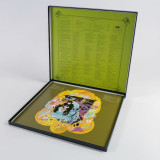
quête:el sam
- A1: Wear Your Love Like Heaven
- A2: Mad John's Escape
- A3: Skip-A-Long Sam
- A4: Sun
- A5: There Was A Time
- B1: Oh Gosh
- B2: Little Boy In Corduroy
- B3: Under The Greenwood Tree" (Words By William Shakespeare, Music By Leitch)
- B4: The Land Of Doesn't Have To Be
- B5: Someone Singing
- C1: The Enchanted Gypsy
- C2: Voyage Into The Golden Screen
- C3: Isle Of Islay
- C4: The Mandolin Man And His Secret
- C5: Lay Of The Last Tinker
- D1: The Tinker And The Crab
- D2: Widow With A Shawl (A Portrait)
- D3: The Lullaby Of Spring
- D4: The Magpie
- D5: Starfish-On-The-Toast
- D6: Epistle To Derrol
Donovan’s Original
A Gift From a Flower to a Garden made for a few firsts: the first double LP of Donovan’s
career, one of the first box sets in pop and, most importantly for Donovan himself; the first
pop album for the children of tomorrow.
He resolved to make A Gift From a Flower to a Garden an album of two halves. The first,
Wear Your Love Like Heaven, was intended for his own generation as they started to think
about the kind of world they wanted to leave behind. The second, For Little Ones, was for
the children they had or would have in the years to come. The result was a kaleidoscopic
folk-jazz suite on the power of love, imbued with all the romance and mystery of an Arthur
Rackham illustration for an ancient English fairy tale. The songs, remarkably adventurous
given Donovan was a globally famous singer at his commercial height, combined the
influences he had amassed so far.
There is something about A Gift From a Flower to a Garden that could never be repeated,
though. It is such an innocent evocation of the childlike imagination, so redolent of its time,
yet set apart from it too. All these years later, the peaceful qualities of this pioneering,
enchanting, deeply unusual album feel more valuable than ever.
The state51 Box Set
With authenticity core to the project, The state51 Conspiracy engaged one of the UK’s
leading experts in box set design, Daniel Mason at Something Else, to painstakingly recreate
the box, records and accompanying ephemera. The first challenge was to find the deep blue
leatherette paper the original box set was covered in; a problem since it was no longer in
production. “I knew people who had stacks of it, gathering dust on top shelves, so I bought it
up wherever I could find it,” says Mason. Then came the reproduction of 12 loose leaf lyric
sheets on fine art watercolour paper, each of them featuring a watermark and a fairytale-like
illustration by Donovan’s artist friends Sheena McCall and Mick Taylor. Where, though, to
find the same paper stock? “I found out that it was made at a paper mill in North Wales
called Abbey Mills. Unfortunately the mill dissolved in the early 70s and very little of the
paper remained. However enough paper remained to allow us to produce the numbered
certificate also signed by Donovan that sits within the box.”
Then to the iconic cover image. Donovan and Jimi Hendrix’s personal photographer Karl
Ferris, used infra-red film to achieve the psychedelic effect on the cover, but the original
negatives couldn’t be found. Mason then used digital technology to ramp up the colour levels
on a reproduction from an original copy of the album while allowing it to remain a little bit
faded, as it would be after half a century. The same labour of love and care has gone into
producing all elements of the box; from the rebuilding of the famous front cover font to the
hand-numbered and signed certificate; letterpress printed on the original paper stock of the
1968 UK release lyric sheets.
To cap it all off the original mono master tapes were waiting safely in the EMI Donovan
Archive and transferred from tape to digital by Abbey Road Studios where new lacquers
were cut, ensuring Donovan's favoured mono version of the album would be presented both
physically (and digitally for the very first time) in striking audiophile quality. The final touch to
Skyllumina represents a new evolution of London-based, Italian-born composer, bassist, and vocalist Ruth Goller. Goller is known for her bass and vocal work with Alabaster DePlume, whose music she elevates in live contexts with her genre-less improvisational intuition, and an incredibly diverse résumé that includes performance and recording with Bex Burch"s Vula Viel, Shabaka Hutchings, Rokia Traore, Melt Yourself Down, Sam Amidon, and even a very brief moment with Paul McCartney. For Skyllumina, her International Anthem debut, Goller expands upon the concept of her first solo album Skylla - de-tuned bass harmonics with layered voices - this time collaborating with a different drummer on each track. Her accompanists on the album include The Smile"s Tom Skinner, go-to London drummer Seb Rochford, Berlin-based International Anthem labelmate Bex Burch, and ex-pat Chicago legend Frank Rosaly. But more importantly, the music is an immersive hyperfocus for Goller and her patently distinct, singular compositional vision.
After making a mark with their first album together, ""Pineto Connection,"" Lorenzo Fortino and Brody return to the studio to advance their idea of music that remains impulsive yet at the same time more structured. Within this EP, you will hear different influences, all traceable back to an ""Italian mood,"" giving life to an album that will linger in turntables and the minds of many for a long time.
The album opens with ""Amarcord"" (A1), where raw drums, bass, and the pad seamlessly drive the piece, taking the dancefloor into the essence of Italian club culture. On side A, ""Sensazione"" (A2) continues, a soft Italo deep house track with Lorenzo's vocals providing an almost melancholic allure. The B side begins with ""Giacio"" (B1), a tightly wound house track (128 bpm) where straight drums, a compelling bassline, and dreamy synths make it a must-have to keep the dancefloor moving. Closing the album is ""Da Qui Al Mare"" (B2), a single despite being part of the EP, reflecting the idea of giving a distinctly Italian imprint. Brody, Angela, and Lorenzo's voices (almost echoing from the beach) blend in this deep tapestry that mixes multiple genres, aligning with their vision of a more elegant Italo disco.
A Colourful Storm begins 2024 with a luxurious suite of daydreaming introspection courtesy of Unchained, the longstanding solo project of Nathaniel Davis who was last seen on vinyl in the final Blackest Ever Black release. Recorded at home between 2020 and 2023, Gabbeh is the latest expression of Davis's guitar-based instrumental musings and represents a stylistic evolution of his self-released noise tapes and CD-Rs into romantic, bossa nova-influenced melody-making. He wrote the tracks sporadically, with minimal instrumentation and intervention. Electric guitar, bass improvisations and rhythms from an old drum machine are layered and given new life, the space between them softly breathing with minutiae of the everyday: the buzz of cicadas, the passing of cars, the whistling of passersby. The psychogeography of Grenoble, Davis' home since 2018, played a conscious role in the weaving of Gabbeh's fabric: "I think certain songs reflect, in ways, Grenoble's natural surroundings. 'Drac' is named after the river that flows from the mountains down to the city… 'Dru' is the name of a well-known peak near Chamonix". Opener 'Largo' sets the mood, its primitive samba rhythm concealed by a cloud of saudade. The bebop sensibility follows suit, the tension between its angular picks and percussive shuffle a wondrous balancing act, while the intoxicating sway of 'Rambler' is perhaps the most poignant expression of longing and loss we've heard in recent years. Highly recommended for fans of Durutti Column, Maurice Feebank, Toninho Horta.
Warehouse Find!
A true studio visionary and son of Incognito's Jean-Paul 'Bluey' Maunick, Daniel Maunick virtually grew up behind the mixing desk and worked his way through the scenes of drum n' bass, acid-jazz, disco, samba, deep house and beyond. As Far Out's in-house producer his work is a key component in the consistency and transience of the label's sound, with key albums include Azymuth's Fênix, Marcos Valle's Estatica, Sabrina Malheiros' Dreaming and Far Out Monster Disco Orchestra. His latest credit on the catalogue is the next chapter of his Dokta Venom alias, Moodswings.Each track brings you a visceral dancefloor experience both sonically and structurally. Opener 'See the Sun' evokes an elevated, cloudy ether, with each kick drum another step up to the sky. Title track 'Mood Swings' deploys components of broken beat, garage, house, IDM and boogie, but shrouds them into a hazy deepness, like a dream through Maunick's musical memories. Whilst keeping the same intensity, 'I Owe u Something' ups the tempo and swings the mood. Propulsive percussion blurs the acoustic with the electric, glowing synths and anguished vocals formulate this eruptive full-floor belter that lodges somewhere in between early Pepe Bradock and Azymuth.With a solo album from Azymuth drummer Ivan 'Mamao' Conti, a collaboration between Sean Khan and Hermeto Pascoal, along with a long awaited new record from Sabrina Malheiros, 2017 is set to be an exceptional year for Maunick and Mood Swings is an inspired prelude of things to come.
Sam Shure drops the Regency EP on December 14th, a DJ favorite embraced by Mind Against. The title track, "Regency," pulsates with relentless beats, while "Heir of Snare" explores rhythmic depths. "Magnus" climaxes with melody and cutting-edge sound design. Shure's EP resonates with innovation and emotion, an electrifying journey for the dancefloor.
Following on from their contribution to theButter SessionsCome Togethercompilation released in March this year, Melbourne'sPolitodeliver their debut EPUltraparallel.Politois the collaboration between musicians Robert Downie and Finnian Langham and dancers Arabella Frahn-Starkieand Hillary Goldsmith. The ensemble integrates improvised techno and contemporary dance to form well-considered and captivating performances. The spirit of these performances are masterfully captured on the 12" record. On the transition between mediums, the group states; "we always aim to capture the unpredictability and liveliness of our improvised performances when we record, and try to sculpt the feeling of continuous movement which is so intrinsically tied to Polito's identity."
Ultraparallelconsists of four tracks that were extracted from studio sessions, emerging organically whilst jamming. The EP's introductionHornet's Webwields mutilated samples of vocals and spoken word, paired with abrupt rhythms to forge anomalous techno. The eponymous trackUltraparallel, recorded in 2018, is a dark and brooding arrangement with a murmuring melody and an infectious recurring bassline. Polito reflects; "this track is from the first batch of studio sessions we had as Polito where our intention was to create more discrete 'tracks' which could be played by DJs, rather than the longform compositions more similar to the live performances which we had recorded up to that point."
Turning the record over,Seventh Limbembodies the music for dance nuance by infusing dub with sounds from outer-space. Polito reveals; "we wanted to explore creating something more in line with the mood of our live performances, which are typically slower and have a rather meditative atmosphere. The more relaxed tempo allows the dancers to move at a sustainable pace and gives the musicians more space to prepare and manipulate the various musical elements in real-time. The result is our first formal exploration of 'the chugger.'"Ultraparallel'sfinaleSublunaryis a playful sequence mingling electronics with an airy clarinet and saxophone.
Attuned to their audience,Politoimagines how their music will be consumed throughout the creative process. They comment "while making music in the studio, we try to transport ourselves mentally to hypothetical dancefloors the music we're making could be played on, adding moments and sounds which would excite, energise, disorient, or have some other desired somatic effect. We're also considering not just how the music sounds, but how it would 'feel' when played on large sound systems."Ultraparallelultimatelypresents a refreshing visual take on literal dance music; a considered and holistic approach to enhancing the experience of listening and moving.
Reggae and Jamaican music have long embraced a symbiotic relationship with the movies. Rooting back to the island's golden era, countless arrangements have either been direct covers, or inspired by, the musicality and mood found in both cinema and television. These reinterpretations would become part of the backbone of the instrumental sound that accompanied the Jamaican record industry's acceleration from the mid-60s and beyond. Talented young musicians, rising from Alpha Boys School and the early studios of Coxsone, Duke Reid and others, found a showcase for their unique playing style on hundreds of different recordings, while appealing to the country's own love affair with Westerns, James Bond canon, and other rebellious themes and motifs that were projected from Hollywood during this time.
In this same tradition, in a new interval, arrives the debut release of Anant Pradhan and Larry McDonald, the latter a master percussionist with direct participation in some of Jamaica's earliest recordings. McDonald, although often uncredited, was a legitimate influence in helping to bridge the Afro-Caribbean sound from calypso into ska and later reggae with his iconic style on hand drums and percussion. A kindred spirit of McDonald, despite 50 years separating them, Anant Pradhan is a bonafide member of the next generation. Although this is his first "solo" record, the talented saxophonist has already played on dozens of incredible sessions for the likes of Victor Axelrod, The Inversions, Andy Bassford, Channel Tubes, Ralph Weeks and Combo Lulo. As an official member of the current touring group of the legendary Skatalites, Pradhan has honed his musicianship under some of the greats of reggae music. His particular soulful, instrumental arrangements are an homage to that influential era of Jamaican music. Pradhan and his band's performance retain the skill and innovation of the old vanguard, and like the generations before, capture a magic that may only be possible when cinema goes reggae.
A cult favorite from A Nightmare Before Christmas, Danny Elfman's "Sally's Song" was immortalized in Tim Burton's 1993 classic stop-motion film. It's immediately recognizable in all its haunting charm, and now, Pradhan and McDonald have managed to transform it into an irrefutable reggae classic, reinvented with its melancholic lead sax and bombastic percussion. The prolific Henry Mancini is already entrenched in the Jamaican canon, yet nobody has knowingly attempted to recreate one of his most magical numbers, "Meglio Stasera" aka "It Had Better Be Tonight," that of the riveting one-take scene in 1963's The Pink Panther. The galloping percussion of the original is transposed through a cloud of smoke, slow and low in a roots style at the hands of McDonald. Pradhan's sax leads the way over the locked-in rhythm section, both deep and cheeky all at once. These first two productions of Anant Pradhan and Larry McDonald are a deserving entry into the canon of reggae covers, and are equally adept to be heard on the screen and or at the dance alike.
From out of nowhere - if nowhere is the febrile, warped and twilit imagination of Julia McFarlane - comes Whoopee, the second album by J.McFarlane’s Reality Guest. Whoopee is an esoteric, kaleidoscopic movie in music form directed by Julia McFarlane and co-conspirator Thomas Kernot. Full of life, breakbeats and smokey vignettes on the fragile nature of interpersonal relationships, Whoopee is a stylistic evolution from everything McFarlane has done before. Surreal, beautiful in parts and replete with the aching wisdom McFarlane’s songwriting has always promised, this Reality Guest pulls back the curtain on a whole scene of naked truth. Recorded in Melbourne in bursts since the release of 2019’s Ta Da, Whoopee features a new sound palette and band member in Kernot. The duo dive deep into electronic pop tropes, mining digital synths, samples, breakbeats and deep bass grooves, largely dispensing with live instrumentation. If Ta Da took twists and turns with your expectations, offering a Dada-ist, monochromatic take on pop music, Whoopee is McFarlane’s subterranean love-sick pinks, reds, greens, purples and blues. Becoming something of a tradition, the album starts with an instrumental intro pilfered from a 90s’ spy film or cinema intro music, puffing up the listener for the heart-squeezing bathos of Full Stops. Over a bleary backdrop of walking bass lines, jazz- inflected keys and smoked-out atmosphere, McFarlane’s poetry narrates the fragile state of a relationship: “You put a full stop where I thought there’d be a comma, I want the story to continue even with all the drama.” Over a palpable pain, the narrator is revelling in the drama of a relationship, addicted to tumult and heightened emotion. On Sensory, a space age bachelor lounge pad ballad, the converse state of the previous song is explored, here the narrator is battling the numbness of being out of the drama, stuck in a sensory-deprivation tank, anaesthesized and battling to emerge from the fog. Wrong Planet explores an otherworldly pop music, hewing a bright hook out of a sense of confusion. A bona-fide, sing-along chorus bursts out of the narrator musing on the absurdity of existing in this reality. It speaks of one of Julia McFarlane’s main talents, her knack of inspecting human relationships and states with a clear perspective, like an alien visiting Earth and realising everything we are is really, really strange. Whoopee is both more accessible than previous Reality Guest work and somehow more obfuscated. Where the production on Ta Da was dry, sharp and strange, this Reality Guest is blurred, almost smeared with the effluvium of 90s+00s culture and existence. Through it all, it’s hard to deny the undeniable pull of the songs. Precious Boy carries on the lounge theme with a whole sampler of cut up sounds fading in and out of the haze as McFarlane’s voice is right up to the speaker cooing and free- associating, maybe in love or maybe in confusion... maybe they’re the same thing? Sometimes the listener is invited to just bathe in the tone of the vocal, as on Apocalypse, where the texture and timbre of the vocal is luxurious, bathing in piano tinkles and double bass throb. On lead single Slinky, a cut up beat reminiscent of Washingtonian Go-Go drum patterns leads, the song slipping through your fingers, elusive and presenting sound as pure pleasure. Closer Caviar jumps back into the broken breakbeats of a surreal funk, fuelled by the sensory pleasure of the music, a hedonistic whirl in rapture, the narrator now living life to the fullest in all its giddy heights and deep troughs. This is the album’s main character fully-actualised and in the terrible, beautiful moment.
Dark Machine Funk is delighted to welcome the first guest producer into the fold, Head Front Panel. A huge source of inspiration to DMF since those highly sought after HFP 12”s hit the record store racks in 2014, Head Front Panel delivers a superb well rounded 4 track EP titled ‘Tactile’ for DMF’s 5th release.
The opening track 'Panama' opens with some otherworldly pads, sweeping resonances tickle the ear before signature HFP drums hit you with pure engaging energy. Broken kick drums and rattling percussion perfectly sit on this hypnotic tribal-esque sonic dream, a depth and area that we've not heard from HFP before. 'Tactile' brings the perfect tool, loopy rhythms that stretch the perception of time whilst getting lost in subtle rides and eerie door creaking atmospheres, deep listening will provide a new journey on every repeat. 'Surdo' open's side B, and we're catapulted into the fire with shaker/hi hat percussions that grab your attention immediately and vocal samples scatter across the stereo field. Shimmering pads take the track into deeper territory but all while keeping in a constant state of forward motion accented by the occasional double kick drum. A huge baseline swings the track to give it it's funk. 'Them' probably the most recognisable HFP track hammers with a thunderous kick drum and a subtle repetitive synth line, groove is king here where percussion elements are pushed and modulated to create enough interest to carry the track through till close.
We are more than honoured to present ‘Head Front Panel - Tactile’ on DMF!
Happy we can introduce a new addition to our catalog THINNER005, an EP called
“ & . . “
as the title tells, it’s a joint release by our friends, KOOLMFL, Sonic Weapon &. . Lemmi Ash
“& . . “ EP includes three club tracks, which been power played by Powder over these years in many different moment.
Each track can add a distinctive touch to the night, as like completing your cocktail with lemon and/or lime.
_
KOOLMFL, fka K-LINE and Sonic Weapon is our regular suspects from Nagoya, motor city of JAPAN.
Some may know them putting out a shared EP “G” before on Thinner Groove and now they back to it again.
atonbow by KOOLMFL features words of a space traveller in state of peaceful sorrow, seemingly communicating their honest thought to the loved one who might not be hearing, Can you hear me ? … Hi astronaut, at least we can :)
KOOL’s clicky drum work pass the words to the floor, and the party breaks down with sudden synth and take all of us home.
,
On track HOMIE, Sonic Weapon shows his signature fast boogie style again in a new approach with much dubbed out, ear pleasing, filtering, minimalistic, and stylistic way. The texture keeps changing but keeping the groove.
Feels like the beauty of watching a bridge getting slowly collapsing after somehow you made it to the other side.
& . .
We also want to introduce Lemmi Ash, a Swedish duo formed by Samo DJ and Martinou, newly joining the TG spectrum,
The duo previously had a release from ESP institute and each of them countless solo appearance on various releases . . .
Nonetheless, they a good long time friend and perfect fit for this release.
The duo features comfy calming ear tickling electronic sound with some kiddish, animalistic, or primitive humor in their own balance. This track Presence grooves with a leaning forward racing gamey phrase drifting around the mini synth explosion, feels like a joyful cruise during regardless the intense highway.
The second album by F.K. Raeithel, just after the operetta DIE WURLITZERORGEL DES GEISTES, explores the realms of interlocked rhythm sample and hold music. On 16 tracks different setups of self generating modular synthesizer patches are gathered on this release.
The concept of Dance With Uncertainty is deeply rooted in philosophical, artistic, and cultural traditions. The notion of embracing uncertainty and change has been explored in various forms throughout history, often symbolizing the human experience and the impermanence of life. In the context of music and sound, Dance With Uncertainty could be seen as a reflection of the constant ebb and flow of life‘s uncertainties, captured and conveyed through sonic textures and evolving compositions.
Interlocked Rhythm Sample & Hold Music, this approach to sound creation weaves a mesmerizing tapestry of rhythm, texture, and sonic exploration, captivating listeners and defying traditional musical boundaries. At its core, Interlocked Rhythm Sample & Hold Music is a synthesis of technology, creativity, and a deep understanding of rhythmic intricacies. The foundation lies in the Sample & Hold circuit, a device that captures and freezes incoming voltages, creating distinct musical snapshots that evolve over time or an Linear Feedback Shift Register (eg. Rungler), a circuit used in electronic music synthesis and sound manipulation to create unique and evolving musical textures. The Rungler was created by Rob Hordijk. A more sophisticated use of a 8 bit shift register and by combining this with a typical sequencer design is the Klee Sequencer developed by Scott Stites. A cheap version of this design is the Turing Machine. Another tool is the Analog Shift Register. In the context of creating arabesque melodies, an analog shift register (invented by Fukushi Kawakami and later adapted by Serge Tcherepnin) can be a fascinating tool to generate intricate and ornamented musical patterns. Yet, it‘s the interlocking of these snapshots that sets this genre apart, infusing the compositions with an intricate dance of patterns and pulses. A fourth device is a pendulum or random addressed sequencer, that in the first case moves in a drunken unpredictable manner. Each of these devices for uncertainty becomes a rhythmic sculptor, freezing the dynamic interplay of melodies, beats, and textures. These frozen moments are then interwoven, each snapshot forming a unique thread in a sound tableau that stretches and contracts, pulses and breathes. The result is an auditory experience that challenges preconceptions of rhythm and structure. The interlocked rhythms give rise to complex grooves that ebb and flow in unpredictable ways, evoking a sense of perpetual motion and transformation. The music becomes a living organism, its heartbeats synchronized yet untamed, its evolution both deliberate and free-spirited. The juxtaposition of staccato bursts and fluid flows, of machine-like precision and organic unpredictability. As listeners delve into the world of Interlocked Rhythmic Sample & Hold Music, they embark on a sonic odyssey. The music becomes a companion, guiding them through a labyrinth of rhythmic landscapes that simultaneously challenge and invite them to the dance with uncertainty.
The Body & Dis Fig are a natural pair. Each has pioneered instantly recognizable worlds of sound all their own that defy any traditional categorizations or boundaries. The Body, Lee Buford and Chip King, continually challenge any conventional conception of metal, collaborating with myriad artists and from the folk-leanings of their work with BIG|BRAVE to their groundbreaking work with the Assembly of Light Choir to the intensity of their collaborations with OAA or Thou. Dis Fig, aka Felicia Chen, pushes electronic music into dark extremes, from warped DJ sets to avant production, from being a member of Tianzhuo Chen’s performance-art series TRANCE to being the vocalist with The Bug. The Body and Dis Fig find kinship in reimagining what it means to make “heavy music”. Their debut Orchards of a Futile Heaven is the perfect synthesis of two forces, twisting melodicism and intoxicating rhythms, layering a dense miasma of distortion with intense beats and a soaring voice clawing its way towards absolution.
Orchards of a Futile Heaven’s walls of sputtering texture and tectonic booms are soaked in the reverence and melancholy of sacred spaces brought to life by palpable intensity by Chen’s voice. Crafted during a time of personal fragility, the album’s devastating force lies beyond any of the expected noise and abrasive textures typically associated with both The Body & Dis Fig. Suffused with a raw vulnerability and a longing for catharsis, Chen’s voice searches for escape in the midst of oppressive atmospheres as if determined to find relief from guilt. “Eternal Hours” patiently unfurls waves of surprising sounds, whispered undulations that are punctuated by sudden crashes, all beneath Chen’s haunting harmonies. “Dissent, Shame” evokes grief and shame with a minimalist drone dirge that gradually builds to an enchanting choral passage. King’s guitar on “Holy Lance” matches the uncanny drone of Chen’s accordion in an all-consuming blast, Chen’s voice transforming the moment from anguish to defiance and empowerment. The album’s arc finishes with “Coils of Kaa” acting as a kind of propulsive exorcism, breaking through a suffocating air before the funeral procession of “Back to the Water” lays the album to rest.
While sampling has long been essential to each, The Body & Dis Fig deftly meld their differing approaches to sampling and creating extreme sounds until the boundaries are entirely blurred. The two found kinship in their desire to find new avenues to make heavy music that looked beyond tropes of metal and electronic music by merging the two. “I always wanted the heavier stuff but I also didn’t really like heavier guitar music,” says Buford. “None of it really felt quite heavy enough to me. A human can’t be as heavy as a machine.” Chen counters, “I love the balance. You could never connect to just a machine as well as you could a human. Which is why the combination is so potent for me. I don’t want to hide. I think nothing connects you more empathetically than another human's voice.”
Orchards of a Futile Heaven affirms The Body & Dis Fig as skilled sound sculptors who have an exceptional ability to make deeply affecting music, bracing as it is touching, harrowing as it is awe-inspiring. Together, the two have harnessed their expansive artistry to make music that is profoundly emotional, and staggering in its beauty.
orange marbled vinyl
A1 - The Construct
Opening the EP in style with a slew of darkly FX, The Construct sets a suspenseful tone before a thorough atmospheric amen on slaught takes center stage - solid, weighted breaks are chopped and edited to the standards fans have come to expect from ASC with a morose, anxious energy to the vocal samples and synthy backdrops punctuating the track in style. A banger for the club as well as the phones.
A2 - Tidal Lock
Distinctive thumping quadruple kicks thunder like a furious heartbeat as Tidal Lock mixes up the vibe and experiments with off-key tones and delivers a neurotic energy to the breaks. Rapid hats and snares accelerate the mix with deep undertone sub bass, as ASC crafts a cacophony of detail and delirium to a track that somehow fuses both calm and a tenacious ferocity in one. Unique, stylish and a joy to listen to.
AA1 - Centurion
A DJ-friendly intro opens Centurion with initially simple breaks which are soon joined with detail and a forceful finesse. Curious, inquisitive FX and melodies bristle melancholically as a stunning deep bassline seizes the attention and the atmosphere elevates. Familiar classic atmospheric signatures add to the complexity later in the track, with all layers continuing to breathe throughout.
AA2 - Nexus
ASC concludes the EP with a deep, rapid fire workout in Nexus -a track which quickly exudes a moody, tense vibe driven by a nervous vigor - inviting you to explore its immersive tapestry of quality modern atmospheric breaks. Persistent hi-hats and snares dominate the mix with vocal samples and otherworldly
effects, and parallel high horn notes complement the composition perfectly.
The English duo Persher, Arthur Cayzer (Pariah) and Jamie Roberts (Blawan), take the same subversive, boundaryless approach to extreme music that underpins their electronic explorations. Their individual singles output are highly anticipated in the dance world in part because of their affinity expression beyond a trend. The debut album Sleep Well is ferocious and innovative. Cayzer and Roberts take a decidedly unconventional approach to writing, using the full potential of the studio in their exploration of extreme music. What sounds like a live band performance is more often than not an amalgam of many different sessions, the duo applying techniques from electronic music to heavier sonics. Recording in Roberts" studio at Funkhaus, the home of the former East German state-owned radio station, Cayzer would improvise long takes on guitar and bass, contorted and mutated by Robert"s using his extensive modular setup to add weight and texture. This primordial ooze of raw sonics was then chopped up and reassembled into bristling hooks and corrosive atmospheres. The duo"s playful, exuberant approach to music is evident in their absurdist themes and lyrics. Much of the album is inspired by "really disgusting food". Medieval Soup from the Milkbar references the epically bad meal of gray, gruel-like soup, and seeps into the track"s noxious slurry and stomach-churning riffs. "Portable Aquarium" was born of a cup of herbal tea overflowing with foliage. Their playful and often self-deprecating sense of humor allows them to find inspiration in the smallest of life"s events. Persher"s Sleep Well provides a daring, revelatory expansion on heavy music"s myriad mutations. The duo uses their production skills and their humor to embrace the powerful release they find in extreme. Persher"s debut album exudes the sheer joy of making music unconstrained by genre boundaries, as gleefully weird as it is visceral and primal.
PAPOOZ is set to release their fourth album, "RESONATE". The eleven tracks on the album showcase Papooz's ability to venture into both rock and pop, fueled by their gift for melodies that go straight to the heart, finely crafted lyrics carried by the sublimely androgynous voices of Armand and Ulysse, and an irresistible, joyful, and nonchalant groove.
While alternating between laughter and tears, melancholy and hedonism, ballads and calls to dance, introspection and letting go, with the same ease and spontaneity. Like life resonating within each of us, in essence.For this album, Ulysse and Armand changed their way of writing for the first time, enlisting the help of Jesse Harris, an American songwriter known for his work with Melody Gardot, Gabi Hartman, and Norah Jones.They then finalized and refined the songs from these writing sessions with producer Patrick Wimberly. Formerly of Chairlift, Wimberly is the sought-after producer who has worked with artists like Blood Orange, MGMT, Solange, Cola Boyy, and recently on Lil Yatchi's incredible rap opera.
Always timely reissue of Muqata'a's first self-released EP from 2017. After years of fertile digital existence on his own Bandcamp, 'La Lisana Lah' now gets a much deserved tactile version through Souk, the Discrepant sublabel responsible for the already classic 'Inkanakuntu'. One of the most prominent figures of the Palestinian electronic scene, Muqata'a's trajectory has been one of resistance and urgency, leaving a sonic imprint of his own from pretty much the beginning.
Without anything tentative or vestigial about its sonic fictions, 'La Lisana Lah' deploys an arsenal of Muqata'a's traits that would be explored on subsequent releases: the glitchy thick textures verging on noise of 'Tib Al Huroof', the narcotic broken beats of 'Taqdirahu Anta' and 'Zyadet Naqs' or the alluring disruptive harmonic suspension of 'Dijla Wal Fada', everything cared for with an essential attention to space and evoking the heritage of Palestinian resistance through his use of samples and scales. A visionary from the get go.
- Strange Stairway
- Spiritual Mansions
- Planet Earth Daytime
- Goodnight Stan
- Tomorrow Tomorrow And Tomorrow
- Just A Moon
- To Be A Part
- Sam
- Lamp Shining
- Turning The Pages
- Love Is The Tune
- After The Revolution
- Jericho Road
- Strange Stairway (Demo)
- Birdman (Bonus Track)
- Life
- Hypocrite
- Man
- Cosmic Boxer
- We Are Raised
- Isle Of Sleep
- Coming Down
- Hypocrite (Demo)
- Spiritual Mansions (Demo)
- Man (Take 1)
- When We Set Sail (Bonus Track)
- Cosmic Boxer (Alternate Version)
- The Coast No Man Can Tell (Bonus Track)
Die Versuchung, Bill Fay zu mythologisieren, kann überwältigend sein. Sein Status als unbesungener Held hat sich langsam, aber stetig, über fünfundzwanzig Jahre hinweg entwickelt und mit jedem neuen Album kommen Fans hinzu, darunter prominente Musiker wie Jeff Tweedy, Kevin Morby, Adam Granduciel und Julia Jacklin, um nur einige zu nennen. Fay war jahrzehntelang ebenso produktiv wie unterschätzt, innerhalb seines Katalogs ist die Bill Fay Group seine bedeutendste Zusammenarbeit. Nach seinem selbstbetitelten Debüt Bill Fay (1970) und dem Klassiker "Time of the Last Persecution" (1971) hatte Decca Records kein Interesse ein drittes Album zu veröffentlichen. Bill Stratton, Gary Smith, Rauf Galip formierten sich mit Fay zur Bill Fay Group und nahmen zwischen 1978 und 1981 in mehreren Sessions, trotz minimaler finanzieller Mittel, ein brillantes Album auf. Die Bandmitglieder beschwören ein elegantes Gegengewicht zu seinem Gespür für das Unauffällige. "Tomorrow Tomorrow and Tomorrow" bringt die galaktischen Qualitäten des frühen Rock, die Komplexität der Jazz-Improvisation und Fays erdigen Folk-Zauber zusammen. Zur Zeit der Fertigstellung fand sich aber leider kein Label für das Projekt. Erst 2005 brachte David Tibet auf seinem Label Durtro Records eine unvollständige, nur auf CD erhältliche Version heraus. Eine Neuauflage von 2006 machte das Album auf Vinyl erhältlich, allerdings mit stark gekürztem Tracklisting, es fehlten neun Songs. Jetzt endlich erscheint Tomorrow Tomorrow and Tomorrow weltweit in voller Länge. Es enthält die 22 Original-Songs des Albums, dazu 6 Bonustracks, sowie seltene und bisher unveröffentlichte Fotos von den ursprünglichen Aufnahmesessions von "Tomorrow Tomorrow and Tomorrow".


