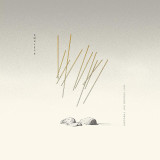
Recorded during a residency in Tenerife powered by Keroxen Festival and Discrepant back in 2020 - amidst the pandemic, no less -, the duo of Carlos Godinho and Mestre André return after their 'Mãe D'Água' debut on Sucata Tapes and an entry on Keroxen's Aquapelago Series through a split with tropical druids Lagoss. Mostly captured in performance through a quadraphonic system placed inside a huge disused fuel tank, with a few tracks recorded out in the open throughout the island, 'Lava Love' evokes the tectonic shifts and motions inherent in their title in 13 tracks.
Based around Godinho's percussive arsenal, from found objects to instruments from all sorts of cartographies, and André's electronic processing, each of these expositions is a point in a map that is created between the island's concrete and fictional existence, discarding any superficial overdubs and crescendos, to focus on the balming and transporting properties of sound itself. From stripped down vignettes like 'Bajamar I' & 'II', 'Chacho' or 'Tangana I' to hypnotic tapestries that confuse the real and imagined like 'Haha No!' or 'La Gomera', Banha da Cobra conjure a collective dream of the island.
All tracks performed and recorded by Banha da Cobra in a quadraphonic system inside an enormous fuel tank (Espacio Cultural El Tanque, Santa Cruz de Tenerife),except Bajamar I and II (recorded outdoors at cantonera de Bajamar, with Lagoss), Taganana I and II (recorded outdoors at Playa de Almáciga) and El Guachinche de Los Realejos (recorded outdoors at Playa de Castro, with Lagoss).
Buscar:elec
Two records came out in 1988 that forever changed the perception of "experimental" or "serious" music produced in Portugal. These were "Plux Quba" by Nuno Canavarro and "Música de Baixa Fidelidade" by Tózé (António) Ferreira. Both were released by the same label - Ama Romanta -, an influential independent imprint closely linked to avantgarde pop band Pop Dell'Arte. Because those records appeared in what could be perceived as an "alternative pop" framework, they rescued this difficult music from Academia. It helps that Canavarro played in a successful new wave pop band (Street Kids) during the period 1980-83. By association, being a friend since 1976, António was in close contact with many of the musicians and bands that were part of the equally celebrated and detested Portuguese Rock Boom (roughly 79-82).
He was not a musician then but through his friendship with Canavarro, who had the means to acquire electronic equipment, António became involved with that equipment and shared Canavarro's passion for experimentation and curiosity for knowledge. They tried to get hold of as many technical magazines as possible and learn while testing ideas. In 1983, Street Kids were about to break up, young lives drafted into the Army and maybe, in Canavarro's case, a whole new passion for challenging music similar to his bandmate Nuno Rebelo, by then in the process of discovering a wide range of "other" music mainly through Jorge Lima Barreto. Barreto, who had started Telectu with Vítor Rua, possessed a huge book and record collection and, like Rua before them, Canavarro, Rebelo and Ferreira became fascinated by the pool of knowledge they now had access to by frequenting Barreto's house in Lisbon. He was roughly a decade older, had published several books and other writings throughout the 1970s, cultivated an anarchic stance and a penchant for cultural indoctrination. Rebelo was the first to be introduced via his contact with Rua (who had invited him to play in his other band GNR).
Overwhelmed, he felt the need to share his enthusiasm with friends and eventually took a few to the house in true pilgrimage fashion. To see the Light. Among the few he led there was even João Peste, founder of Ama Romanta. Canavarro and Ferreira preceded him.
Ferreira recalls an exciting learning process added to his experiments with Canavarro's array of synths such as the Korg Ms 20, Korg polysix, ARP Axxe, Roland SH-01, the Ensoniq Mirage sampler... He read in a magazine article about someone who had studied at the Institute of Sonology (then in Utrecht, Netherlands) and went there during a vacation trip in the Summer of 1983. He became excited by the prospect of studying at the Institute but money was a problem. Canavarro, on the other hand, was admitted there in the following year. Back in Portugal, Ferreira eventually abandoned his Chemical Engineering studies in Lisbon's Technical Institute in favour of a more focused music practice. He collaborated with Telectu during 1984 and 85 as a sort of technical engineer, implementing some recording solutions and background tapes and went to work at a thermoelectric power plant in Sines, hoping to make enough money to fund his musical studies. He did and proceeded with the paperwork for admission at the Institute of Sonology, now based in The Hague. António studied there in 1986-87 and the present album includes two compositions developed at the Institute: "More Adult Music" and "This Is Music, As It Was Expected", both featuring the voice of Rodney Waschka II. Among other activities and talents, Rodney is an expert in computer music and to António his voice sounded similar to Robert Ashley's, whose work he admired.
What happened at the Institute was a systematization of António's self-taught practice. Computer software, Musique Concrète, noise and silence, organisation of abstract ideas and sounds. The original notes on the back sleeve of the LP give some indication of process and thinking, but a more detailed account was given by António in the liner notes of the CD reissue in 2002, which are also included in this 2025 LP reissue.
The music sounds deep and detailed, despite the fact of António calling it low-fi ("Baixa Fidelidade"). It flows like an improvised performance where several musicians might be responding to each other, respectful of their mutual space. Drama occurs, as a natural emotional connection is sought by the listener. Piano, bells, drone, processed voices, even the clear narrative of Rodney Waschka II, contribute to create a sort of alternative perceptual reality. The sounds are almost tangible, more a part of the physical world than ethereal manifestations and thus it would not be correct to invoke "ambient music" as a selling point. But although "physical" and distinct, this music is still alien, more so in Portugal's 1988 environment. In March, helped by Canavarro, António set up a home studio and there he recorded the remaining material for this album: "Algumas Pessoas Olharam O Sul E Viram Deserto", "Um Som, Seguido De Uma Cena Negra E Malva" and "O Verão Nasceu Da Paixão De 1921".
"Música de Baixa Fidelidade" stands not only as a proof of great resilience but as one of those magnificent works of art coming from someone who balanced technical inclination and emotional sensibility. Because of that, Tózé Ferreira is able to decode the phantom world of sound for anyone who cares to experience the sensation of inhabiting a version of the Future. First ever vinyl reissue, reproduction of the original artwork with an additional insert. Made in collaboration with the artist and the support of Paulo Menezes (Plancton Music), who provided valuable assistance. Remastered by Taylor Deupree.
- A1: The Book Of Sounds - Part 1 07 34 Min
- A2: The Book Of Sounds - Part 2 08 32 Min
- B1: The Book Of Sounds - Part 3 05 05 Min
- B2: The Book Of Sounds - Part 4 05 05Min
- B3: The Book Of Sounds - Part 5 05 52 Min
- B4: The Book Of Sounds - Part 6 03 26 Min
- C1: The Book Of Sounds - Part 7 08 01 Min
- C2: The Book Of Sounds - Part 8 05 09 Min
- C3: The Book Of Sounds - Part 9 02 46 Min
- D1: The Book Of Sounds - Part 10 11 49 Min
- D2: The Book Of Sounds - Part 11 03 30 Min
- D3: The Book Of Sounds - Part 12 04 33 Min
The new recording of The Book of Sounds is an intimate exploration of the piano by pianist Carlos Cipa - a way of looking into the sound, of listening into the moment when Cipa's fingers press down on the piano keys. The Book of Sounds, composed between 1979 and 1982 by composer and pianist Hans Otte, is a musical pendulum movement of one hour in twelve 'pieces', as the composer himself describes them. Chords and melodies repeat themselves, sometimes quickly, sometimes slowly; they follow each other in harmonic cadences and yet never dissolve - a timeless back and forth.
The Book of Sounds is the European-German answer to the concert music of American minimalism. But it is also the essence of many questions about society and the human condition at that time. Inspired by Zen Buddhism, Otte was convinced that a return to simplicity, to the unagitated - a piano, harmonic cadences, a middle register - frees the listener to focus on what is really important in art: the human being. Introspection begins with listening. Seldom have simple chords and melodies been so selectively staged. It is a process of endless reduction - no wild sound dramaturgies, no climaxes, hardly any beginning or end. The interpreting pianist simply prepares a tableaux of perception for the listener. Cipa naturally sets accents; he recorded the 12 pieces on three different pianos - a Steinway grand piano, a Yamaha piano, and a Yamaha CP-70, an early electric piano - to help shape the tonal characteristics.
Carlos Cipa hits the nerve of the times with this new recording. What music can be as art is still up for debate today. The Book of Sounds is not 'art-proof' and in this it is still a provocation today; absolutely unspectacular and practising relaxation. It is a wonderful invitation to feel, experience, and perhaps even find oneself in the confrontation with the work - and for a moment not to fuel the discourse. Cipa, who otherwise appears as a composer himself, here carries out Otte's intended gesture of withdrawal in a double sense and steps into the background as creator but also interpreter, in order to bequeath The Book of Sounds to the loudspeakers and headphones at home in one step forward.
The heyday of American baroque pop – or chamber pop - ran from 1966 to the turn of the seventies. It used string quartets, harpsichords and woodwinds to create a summer-into-autumn melancholy that was quite new, and quite far removed from rock’n’roll as Eddie Cochran would have known it. Baroque pop’s musicians often came from a folk background, with an affinity for acoustic instrumentation. Linda Ronstadt's first band the Stone Poneys had introduced the autoharp to their line-ups in 1965, while the likes of Bonnie Dobson and Nico experimented with a string quartet’s, searching for different, post-electric Dylan directions.
Within Tiga’s stripped-down electronic funk and Hudson Mohawke’s grandiose beats exists a common thread; an idea Tiga expresses as “hardcore romance”. Recorded in Los Angeles over the last few years, these commonalities ebbed and flowed through various recordings, culminating in their debut album - L’Ecstasy. Turbo revisits the album with a set of club-driven remixes, bringing together Keinemusik’s Reznik, Montreal masters Priori & Patrick Holland as Jump Source, and Berghain stalwart Quelza. Pressed loud on a stunning 12” picture disc, featuring imagery from none-other-than Wolfgang Tillmans.
- A1: (If You Think You're) Groovy
- A2: The First Cut Is The Deepest
- A3: Angel Of The Morning
- A4: To Love Somebody
- A5: A Likely Piece Of Work
- A6: Medicated Goo
- A7: Bury Me Down By The River
- B1: Will You Love Me Tomorrow - Andy Gibb With P.p. Arnold
- B2: Belle The Sleeping Car - Andrew Lloyd Webber, “Starlight Express” Original Cast, P.p. Arnold
- B3: A Little Pain
- B4: Supergrass
- B5: Electric Dreams
- B6: Burn It Up (7-Inch Edit) - The Beatmasters With P.p. Arnold
- C1: Perfect Sense Part 1 - Roger Waters Feat. P.p. Arnold
- C2: I Believe
- C3: Well Well Well - Steve Howe With P.p. Arnold
- C4: Salobreña - P.p. Arnold With Chaz Jankel
- C5: It's A Beautiful Thing (Radio Edit) - Ocean Colour Scene With P.p. Arnold
- C6: I'm Only Dreaming (Demo) - P.p Arnold With Steve Cradock
- D1: Satellite - Dr. Robert & P.p. Arnold
- D2: Like An Old Fashioned Waltz (Live, May 2012)
- D3: The Love Is Gone - The Mixture With P.p. Arnold
- D4: Different Drum
- D5: When I Was Part Of Your Picture
- D6: Soul Survivor
The very first (and long overdue) career-spanning retrospective from Soul music legend P.P. Arnold • A 57 song 3CD set, or 25 song 2LP set featuring singles, album tracks, demos, and previously unreleased songs • A stylishly packaged collection with new sleeve notes by author Jude Rogers • A companion piece to P.P. Arnold's critically acclaimed autobiography Soul Survivor The term "well-established" might be appropriate for some artists but it barely begins to cover the career of the phenomenal P.P. Arnold, whose records and performances are now in their seventh decade.
Her consistently excellent music covers multiple genres, her high-profile admirers and collaborators are plentiful, and yet 'Soul Survivor - A Life In Song' is the first collection dedicated to this extraordinary body of work. Compiled by the artist, 'Soul Survivor - A Life In Song' is being released on a 57 song 3CD set, and 25 song 2LP set, both formats housed in an eye-catching sleeve created by photographer (and close friend) Gered Mankowitz, with extensive new sleeve notes by author Jude Rogers.
Alongside key singles and album tracks it includes previously unreleased recordings, demo versions, live performances, and some rare mixes that are being reissued for the very first time. From her early days at Andrew Loog Oldham's Immediate label (where she "became one of us", according to Andrew) her allies, associates, and working partners have included the Small Faces, Cat Stevens, Mick Jagger, Barry Gibb, Eric Clapton, Andrew Lloyd Webber, The Blockheads' Chaz Jankel, Roger Waters, Ocean Colour Scene, The Blow Monkeys' Dr. Robert, and Paul Weller. In 2022 P.P. Arnold told her extraordinary life story in her critically acclaimed autobiography Soul Survivor (Mojo magazine called it "a jaw-dropping memoir"); now that book has the soundtrack that it deserves.
- Crude Soil 04:08
- Myriads 05:12
- Lifelike (Feat. Midwife) 04:38
- Veils 05:48
- Sun Unseen 04:49
- Lowercase Letters 05:32
- Infinities 05:31
- Burnt Siennas 05:31
On "Not Around But Through", Portland-based experimental musician and tape wizard Amulets
navigates the process of acceptance and the tumultuous journey of looking within. Over the course of 8 tracks he explores the emotional path of moving through rather than circumventing, in the process soundtracking a purposeful desire to face trauma and vulnerability.
Infusing his trademark ambient soundscapes with ambitious blends of post-hardcore, emo, and metal, "Not Around But Through" connects the dots between personal and social dislocation, leaving us with a taste of the fragmented and fallen future we are all steeling ourselves for. Traversing a landscape that varies from gentle and meandering to explosive and cathartic, Amulets uses cinematic tension and relentless attention to detail to construct his sonic apparitions. On "Lifelike" he collaborates with Midwife, incorporating Madeline Johnston's voice into a song that pulsates with post-shoegaze transcendent energy.
Amulets is the solo project of Portland-based audio + visual artist Randall Taylor. Amulets employs handmade cassette tape loops and live processed guitar loops to create live, lush soundscapes and immersive drones. Through the recontextualisation of cassettes, sampling, field recording, and looping, these long-form compositions blur the genres of ambient, drone, noise, and electronic music.
- Neighborhood Scene
- Speed Freak
- Football
- Gumshoe (Dracula From Arkansas)
- Seersucker
- Lucy Takes A Picture
- Perfect World
- My Beautiful Girl
- Canary
- Parking Lot
- Saturday Cowboy Matinee
- Home Movie (1989-1993)
Das neue Album Rarely Do I Dream wurzelt in Liebe und Kindheitserinnerungen und ist ein Triumph amerikanischer Gothic-Phantasie - wo sich die
Unschuld aus dem Märchenbuch in einer radioaktiven Welle aus jugendlichen Driftern, drogensüchtigen Strippenziehern und Folklore der alten Welt
auflöst.
Trevor Powers' einzigartige Stimme, die zwischen treibender Electronica und halluzinatorischen Rocksongs hin- und herpendelt, leuchtet stets wie ein
neonfarbenes Straßenschild, das nach Hause weist.
Trevor Powers kehrte 2023 mit der Veröffentlichung seines vierten Albums „Heaven Is a Junkyard“ zu Youth Lagoon zurück, das unter anderem von
Pitchfork als „Best New Music“ gelobt wurde. Mit "Rarely Do I Dream" erscheint im februar endlich der Nachfolger.
- Aries - The Charismatic
- Taurus - The Tenacious
- Gemini - The Curious
- Cancer - The Caregiver
- Leo - The Fierce
- Virgo - The Perfectionist
- Libra - The Flirtatious
- Scorpio - The Mysterious
- Sagittarius - The Optimist
- Capricorn - The Ambitious
- Aquarius - The Explorer
- Pisces - The Artist
Reaching yet another creative high watermark, piano virtuoso, multiplatinum songwriter, and social media sensation Tony Ann announces the pre-order of his anxiously awaited full-length sophomore album, 360°, on February 21, 2025.
Once again, Tony advances creatively on 360°. Each song functions as a meditation on a different horoscope, encompassing 12 keys at different meters and tempos. It plunges listeners into a living and breathing musical ecosystem punctuated by bliss and catharsis. He employs the full range of the piano to evoke the singularity of these respective astrological signs. The entire suite revolves around his virtuosic chops, melodic empathy, and electrifying energy. Once again, he redefines the neoclassical space.
- Me And My Shadow
- Gotta Be This Or That
- How Are Ya Fixed For Love
- Lonesome Man Blues
- Moonlight In Vermont: I May Be Wrong
- Nice Work If You Can Get It
- Exactly Like You
- Cherry Pies Ought To Be You
- A Little Learnin Is A Dangerous Thing 1 & 2
- Can T We Be Friends?
- The One I Love Belong To Someone Else
- Peachtree Street
- You, My Love
- The Birth Of The Blues
- You Brought A New Kind Of Love To Me
- Well Did You Evah?
- Witchcraft; Love Me Tender
- Nothing In Common
- Together
"This album is a superb collection of Frank and friends from a part of Frank’s career that’s long been underrated. Here, Sinatra scales the jazz summit with Louis Armstrong on “Birth Of The Blues” and does three electrifying collaborations with one of his favorites, Ella Fitzgerald. Ella’s voice is at her best in each. Rival Elvis Presley gets the Chairman’s respect on a wonderfully playful meeting-of-the-icons medley of “Witchcraft”/”Love Me Tender.” The tunes are bright and lively and many benefit from Nelson Riddle’s arranging genius. Frank and Dean are great, improvising and playing off one another as always. But wait until you hear “Together” in which Bing joins Dino and Frank for a happy, hilarious threesome.
The Young Mothers return with their third album, Better If You Let It, blending a genre-defying mix of jazz, hip-hop, punk, experimental rock, and electronic music. Formed by Norwegian bassist Ingebrigt Håker Flaten in Austin, Texas, the band’s sound is shaped by the diverse musical backgrounds of its members, hailing from both the U.S. and Norway. With influences spanning from Texas’ vibrant hip-hop and punk scenes to Norway’s experimental jazz traditions, the band creates a powerful fusion that feels cinematic and unpredictable.
The lineup includes Jawwaad Taylor (trumpet, rhymes, electronics) and Jason Jackson (tenor and baritone sax) from Houston, Stefan Gonzalez (vibraphone, drums, percussion, voice) from Dallas, Frank Rosaly (drums, electronics) from Chicago and Amsterdam, and Håker Flaten (bass) from Norway.
This global roster brings together a dynamic, cross-cultural sound, with Better If You Let It showcasing their most cohesive and wide-ranging material yet. Recorded in Oslo and set for release on Sonic Transmission Records, the album is a bold statement, proving The Young Mothers’ ability to push musical boundaries across genres and geographies.
- A1: Jump (For My Love)
- A2: Automatic
- A3: I’m So Excited (12” Remix)
- A4: I Need You
- A5: Neutron Dance
- B1: Dance Electric
- B2: Easy Persuasion
- B3: Baby Come And Get It
- B4: Telegraph Your Love
- B5: Operator
Break Out is the tenth studio album by American female vocal group the Pointer Sisters, released on November 1, 1983, on Planet Records. It is the Pointer Sisters’ most successful album to date,
peaking at number eight on the Billboard 200 and earning a triple-platinum certification from the RIAA, with U.S. sales alone totaling 4.5 million copies.
This edition features the hit remix of “I’m So Excited,” contributing to a total of six successful singles from the album, including “Jump (for My Love),” “Automatic,” “Neutron Dance,” “I Need You,” “Baby
Come and Get It,” and “I’m So Excited.” Break Out earned the group two Grammy Awards and two American Music Awards, solidifying its place as a highlight of the Pointer Sisters’ career.
This MOV release comes as a limited edition of 1000 individually numbered copies on purple coloured vinyl.
Up In Her Room are delighted to announce their first release of 2025, and a return to the label from Oli Heffernan, aka Ivan the Tolerable!
10 new chunks of lo-fi instrumental library-hop - recorded in 2 days in Summer 2024, ‘Nocturnes’ is the first ITT album of 2025, and the first one made solo by Heffernan since ‘Wild Nature’ in 2019.
Known for his genre-defying and boundary-pushing approach to music, Heffernan – who has spent years experimenting with various styles, instruments and production techniques has crafted a collection of tracks that defy categorization. The new album is a sonic tapestry of atmospheric library music, dusty hip-hop beats, and the organic, unfiltered essence of field recordings, all neatly packaged up into a format that allows each element space to breathe.
‘Nocturnes’ weaves intricate layers of samples, loops, and live instrumentation, combining elements of hip-hop, dub, jazz, and electronic music, all while maintaining a sense of urban cinematic flair.
The album is released by Up In Her Room on limited edition black heavyweight vinyl
- One Way Train
- Bad Times
- Rise
- Ghosts
- Walking Contradiction
- Cry Baby
- No One Calls Me Baby
- Scornful Heart
- Gone Again
- Lay Your Body
- Debbie Downer
Sunny War, also known as Sydney Ward, found inspiration for her latest album Armageddon In A Summer Dress while living in her late father's 100-year-old house in Chattanooga, TN. She initially thought the house was haunted. Eerie sounds and visions led her to write the song "Ghosts." However, she later discovered that hallucinations were caused by gas leaks, shifting her understanding of those experiences but not her artistic focus. Armageddon In A Summer Dress explores themes of memory, loss, and the ghosts of past selves. After the success of her 2022 album, Anarchist Gospel, Sunny spent more time touring with artists like Bonnie Raitt and Mitski. To avoid falling back into past struggles with alcohol, she channeled her energy into music, crafting intricate demos and experimenting with sound. This process involved shifting from acoustic to electric guitar, aiming for a fuller band sound. Tracks like "One Way Train" and "No One Calls Me Baby" highlight her blend of punk and roots influences, emphasizing the rebellious spirit shared by both genres. A notable collaboration on the album is with Steve Ignorant from Crass, whose participation in "Walking Contradiction" reflects Sunny's admiration for the band and its critique of modern society. Armageddon in a Summer Dress serves as a reflection on identity and choices, balancing heavy themes with empowerment. Sunny War encourages listeners to live authentically and resist societal pressures. Committed to continual growth, she sees every performance and song as an opportunity for exploration. Through her music, Sunny War captures the complexities of life, loss, and the transformative power of creativity.
- A1: Finished With The Dogs
- A2: Current Of Death
- A3: Criminal Assault
- A4: In The Slaughterhouse
- A5: Fortress Of Desperation
- A6: Roadcrew (Bonus Track)
- B1: Six Fat Women
- B2: Corroded Dreams
- B3: Life's Destroyer
- B4: Rest In Pain
- B5: Military Service
High Roller Records, reissue 2025, bonus track "Road Crew", transparent electric blue/ black marble vinyl, ltd 200, 425gsm heavy cardboard cover, insert, poster, mastered for vinyl by Patrick W. Engel at Temple of Disharmony
- A1: Finished With The Dogs
- A2: Current Of Death
- A3: Criminal Assault
- A4: In The Slaughterhouse
- A5: Fortress Of Desperation
- A6: Roadcrew (Bonus Track)
- B1: Six Fat Women
- B2: Corroded Dreams
- B3: Life's Destroyer
- B4: Rest In Pain
- B5: Military Service
High Roller Records, reissue 2025, bonus track "Road Crew", transparent electric blue/ black marble vinyl, ltd 200, 425gsm heavy cardboard cover, insert, poster, mastered for vinyl by Patrick W. Engel at Temple of Disharmony
- A1: Leipzig 87
- A2: Afraid
- B1: Tell Me
- B2: Pool Scene
Mit "Conditions III" vollendet die Electro-Punk-Band Chalk aus Belfast ihre gleichnamige EP-Trilogie. Aufgenommen vor trostlosen Landschaften im abgelegenen Norden Islands, legen Chalk eine weitere Entwicklung ihres bereits konfrontativen Sounds vor, der Industrial-Noise, Post-Punk und Techno-Breakbeats zu einem euphorischen und beängstigenden Gothic-Hybriden verschmelzt. Die Gewinner des nordirischen NI Music Prize als "Bester Live-Act 2023" bewiesen auf ausverkauften Headliner-Shows und Support-Slots für IDLES, SPRINTS und PVA, dass sie diesen Titel verdienen.
Italian composer and saxophonist Laura Agnusdei returns with “Flowers Are Blooming In Antarctica” a career defining record that sees the artist diving into uncharted waters, a profound timeless meditation on our relationship with planet Earth, the eco-conflicts arising and the fascination with non human forms of life, backdropped to a vivid soundtrack of coral exotica, spiritual Jazz, fourth-world minimalism, tropical electronics, tribal futurism and contemporary elegance.
Every step of Laura Agnusdei’s path, from electroacoustic experimentation to her constant research based upon the acoustic dimension of wind instruments and their interaction with polymorphic electronic sounds, seems to have pivoted into a new sense of awareness, as if the mind and intellectual practice has finally caught up with the body, the heart and the soul, resulting in her most organic and transcendent work yet. “Flowers Are Blooming In Antarctica” is loosely inspired around a trifecta of pioneering ideas that explore unconventional reality: James Bridle’s ‘Ways Of Being’ with his radical story that mixes ecology, tech and intelligence; Luigi Serafini’s late-70s fantastical ‘Codex Seraphinianus’, an unparalleled collection of flora, fauna, anatomies metamorphosed into new fragile beings; J.G. Ballard’s climate-fiction foreshadowing sci-fi ruminations. These influences shift Agnusdei’s musical trajectory injecting doses of terrestrial malaise, the earthy sub-saharan ‘Ittiolalia’ with its wah-wah filtered sax and trance inducing groove; the rubbery playfulness of ‘Oasi Bar’; the gentle eco-system of ‘P.P.R.N’ reminiscent of Herbie Hancock’s innovative synthesis of funk, space and synthesizers; the kaleidoscopic northern lights of ‘Emperor Penguin Lullaby’, where south-east Asian echoes reach icy shores; the Jon Hassell hyper-ambience of ‘Cuttlefish REM Phase’; the post-apocalyptic march of ‘The Drowned World, a jazz standard for an artificial civilization on the brink of self-destruction. Nothing feels out of place and it’s no coincidence that one of the most powerful messages on the record is delivered on centerpiece ‘Are We Dinos?’ via an interview conducted with two preschoolers. Radical optimism or sonic liberation?
Laura Agnusdei’s tenor sax cuts deep all across “Flowers Are Blooming In Antarctica”, a laser baton raised up to the clouds, a conductor orchestrating devotional soundscapes for a three-eyed dolphin, guiding us through prismatic pastures and acidic oceans. Her tropicalized realm is pin-pointed with Miles-like sheer clarity, a bristling nakedness on the verge of exploding at any time, creating an album where ascension becomes the unifying code.
Hailing from the Basque Country, Spain, Big Muff Brigade is a stoner-rock powerhouse that is going to make a mark with their ambitious debut album. This full-length release is a bold effort to encapsulate the rich diversity of the stoner-rock genre, blending elements of epic doomy metal and bluesy desert rock, with the grittier edges of indie rock, into a kaleidoscope of sound. Thematically the album delivers a sharp critique of contemporary society, where fleeting attention spans and shallow digital interactions overshadow enduring values like friendship, loyalty and the pursuit of knowledge.
Through their music, Big Muff Brigade confronts this cultural decline with a heavy dose of raw emotion and authenticity. It’s also a tribute to the iconic Electro-Harmonix Big Muff PI fuzz pedal, a cornerstone of their sound and the inspiration for their name. If you’re a fan of stoner-rock in all its forms, Big Muff Brigade’s debut-album is a must-listen; a (distorted) sonic odyssey that pays homage to the genre’s roots while exploring new horizons: it’s loud, raw and alive, with heavy and dynamic grooves, a lot of fuzz and hypnotic riffs!