Words have a force of their own: a life generated by their meaning and by the imaginary world they refer to; a power increased by the dynamic interplay with other words. Just put 'Moon' and 'Apollo' together, and you'll be almost inevitably transported to mankind's greatest adventure: the Moon landing and, before that, the space race between the US and USSR, the early missions, and the incredible technological challenges faced at the time by astronauts and engineers.
It is against this imaginative background that beat-maker and bass player Moonbrew and organist and keyboardist Paolo Apollo Negri conceived The LEM Tales project. Their collaboration, too, is the coming together of 'Moon' and 'Apollo', and of their two worlds: a sonic universe where hip hop meets funk, pop merges with jazz, old school interacts with new possibilities, and urban and space blend into something new.
The LEM Tales - Chapter One narrates the space race from the American point of view. This vinyl edition, which includes two exclusive tracks (*) not on the digital release, takes us on a journey from "Project Gemini" - NASA's second human spaceflight program - to "Tranquillity Base" (*) (the site on the Moon where Armstrong and Aldrin landed and walked in July 1969) , through tracks titled "Capsule Communicator" (the individual in the mission control center who maintained communication with the astronauts in space), "EMU" (Extravehicular Mobility Unit, better known as the spacesuit), "Saturn V" (a threestage, liquid-fuelled rocket used between 1967 and 1973), and "Mercury Seven" (*) (the group of seven astronauts chosen for the Mercury Program in 1959).
Inspired by iconic images that are part of our collective visual memory, Moonbrew and Apollo's first collaborative effort tries to provide a contemporary sonic representation of what the past means to us today – and, perhaps, will mean to future generations. It does so through a feast of vintage synthesizers, transistor and tonewheel organs, string machines, electric pianos, tube amplifiers, obscure analogue devices, electric bass, and modern samplers.
An old-school hip hop approach was used in the first stages of writing the album: individual drums hits from old, dusty records were first sampled and then physically played on real instruments to create patterns and build up the rhythm section. Moonbrew then laid down the electric bass grooves and Apollo layered his dreamy, evocative vintage keyboards on top. The result is a combination of different styles, sounds and genres that is fresh, original and contemporary while being clearly influenced by many musical legends of the past.
The LEM Tales - Chapter One is released by Four Flies in partnership with Record Kicks.
Cerca:electric funk
Matasuna's latest tidbit takes us back to the South American continent once again - to Venezuela to be exact. The song "Zambo" by the band "La Retreta Mayor", which was released in 1976 on the self-titled LP, is now available as an official reissue and the very first time ever on a 7inch vinyl single! The 45 is complemented by an excellent rework of the American producer & DJ "King Most" from San Francisco.
The A-side features the original of the song. "Zambo" is a furious mix with versatile influences of Latin, Jazz & Funk. The rich horn section and percussion of the guest quartet bring pure heat to the track - the drums, bass and piano intensify this even more. An absolute heater for any dance floor!
The B-side features the "King Most" Redirection. The talented producer gently takes on the song, keeping the organic vibe of the original but still giving it a different, new side. His re-arrangement and additional in/outro and a new passage in the middle of the song fit exquisitely. Also his crunchy drums and own piano passages are very tasty and give the song an own flavour!
"Alexandro Rodríguez" was born in Caracas in 1952 and is considered one of Venezuela's most important jazz guitarists of the seventies. He studied classical guitar in his early years, played electric guitar in various rock groups and performed at various national music festivals. He also had the opportunity to play as a musician for renowned orchestras such as "Onda Nueva", "Renny Show's Orchestra" on Venezuelan Television and "Radio Caracas TV's Orchestra".
In the late 1970's he recorded two significant works that may be considered a reference in Venezuelan music history. He formed the short-lived band "La Retreta Mayor" to record a self-titled album, which was released as an LP on the Venezuelan label "Discomoda" in 1976. The 10-piece band and numerous guest musicians created a jazz-funk & fusion gem. The band unfortunately broke up right after the recording and did not play live or record any more music.
His self-released album "Busqueda", released in 1978 under his name, was recorded between New York and Caracas and has an excellent reputation not only in connoisseur circles. In 2012, the album was reissued on CD by a Japanese label, proving the influence Alexandro's music still has in the jazz scene today.
Between 1979 and 1982, Alexandro lived in "New York", where he worked as a composer, arranger, performer and orchestrator in the jazz scene with renowned orchestras before returning to Venezuela. Subsequently, his musical career turned to the classical guitar, both as a composer and performer. In 2013, he settled in "Pittsburgh", Pennsylvania (USA), where he continues his activity as composer, arranger, guitarist, bassist and teacher to the present time.
Wendell Harrison was born in Detroit in 1942 where he began formal jazz studies for piano, clarinet and tenor saxophone. At 14, while still in high school, Harrison started performing & recording professionally with artists such as Marvin Gaye, Grant Green, Sun Ra, Hank Crawford … and many others.
In 1971, Harrison began teaching music at Metro Arts (a multi-arts complex for youth) where he also connected with Marcus Belgrave, Harold McKinney and Phil Ranelin…soon after they formed the (now legendary) Afro-centric TRIBE record label and artist collective. TRIBE used the Metro Arts complex as a vehicle to convey a growing black political consciousness. Wendell Harrison also published the very popular TRIBE magazine, a publication dedicated to local and national social and political issues, as well as featuring artistic contributions such as poetry and visual pieces.
In 1978 Harrison and McKinney co-founded REBIRTH, a non-profit jazz performance and education organization, in which many notable jazz artists have participated. Around the same time Wendell Harrison also created the WENHA record label and publishing company, which released many of his (now classic) recordings as well as those of other artists, such as Phil Ranelin, Doug Hammond and Reggie Fields (The Real ShooBeeDoo).
In the early 1990s, Wendell Harrison was awarded the title of “Jazz Master” by Arts Midwest. This distinction led Harrison to collaborate with fellow honorees and gave him the chance to tour throughout the United States, Middle East and Africa. Even to this day Wendell Harrison's recordings for the TRIBE, WENHA and REBIRTH labels have a large worldwide fanbase.
It is on WENHA that Harrison released the opus: DREAMS OF A LOVE SUPREME (1980), which we are presenting you today.
DREAMS OF A LOVE SUPREME is a monster album that features an all-star line-up that includes Phil Ranelin (Freddie Hubbard, Solomon Burke, Mulatu Astakte) on trombone, Harold McKinney (Tribe) on Keyboards and Roy Brooks (Yusef Lateef, Chet Baker, Mingus) on percussion. Although you can hear the 80ies creeping in with a smoother sound, more synths, and disco/R&B vocals… this remains a very spiritual (and soulful) jazz record. The record’s an irresistible blend of soul jazz combined with funky electric instrumentation…a groovy sound which is very much of its time, yet overtly timeless and as relevant today as it was back when it was initially released.
Tidal Waves Music now proudly presents the first ever vinyl reissue of ‘Dreams of A Love Supreme’ since its release in 1980. This official reissue is now available as a deluxe 180g vinyl edition (limited to 500 copies) and comes with an unreleased bonus track.
Record Kicks presents "Gurami" the first single from the forthcoming "Origin of Forms" album, the vibrant debut album by Moscow funk band The Diasonics with a mix of cinematic funk, instrumental hip-hop and soviet psychedelia.
Record Kicks is proud to present the mesmerizing psychedelic universe of The Diasonics. "Gurami" is the first single taken from "Origin of Forms" the startling debut full-length by the Muscovite band, coming out on January 28 2022 on ltd edition LP, CD and Digital. "Gurami" is an instrumental funk cut with heavy abstract hip hop influences and it will be available on limited edition 45 vinyl and digital.On the flipside the instrumental soul bonus track "Gradients". The 45 is limited to 500 copies wordwide.
Welcome to "hussar funk", that's how The Diasonics call their music: a style that blends infectious deep funk instrumentals, East European flavours, hip-hop rhythms and psychedelia. Firmly rooted in the late 60s and early 70s, their debut album "Origin of Forms" was recorded on an 8-channel Japanese tape recorder Otari MX-5050 MK III at The Diasonics HQ's Magnetone Studio in Moscow and was mixed by Henry Jenkins (The Cactus Channel / Karate Boogaloo) in Melbourne.
The Diasonics are one of the latest additions to the Russian instrumental funk scene. The band was only formed in 2019 and it's made of five young and seriously talented Muscovite musicians: Anton Moskvin (drums), Maxim Brusov (bass guitar), Anton Katyrin (percussions), Daniil Lutsenko (electric guitar) and Kamil Gzizov (keyboards). In just a couple of years the band has amassed a cult following, releasing a shower of ten celebrated singles and various in-demand 45 vinyl records on funk labels such as Funk Night Records and Mocambo Records.
Fans of Khruangbin, Dj Shadow and of instrumental soul, take note!
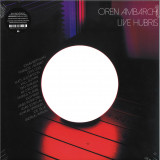
Black Truffle is pleased to announce Live Hubris, documenting the hypnotic and electrifying live performance of Oren Ambarchi’s 2016 LP Hubris by a fifteen-strong band at London’s Café Oto. Over three days in May 2019, Oto toasted Oren Ambarchi at 50/Black Truffle at 10 with Ambarchi and a large group of close friends and collaborators in a series of performances that interspersed existing projects with new collective endeavours, culminating with this: fourteen members of the extended Black Truffle family together on stage, joined by one special virtual guest, to translate the intricately studio-constructed layers of Hubris into a muscular live band workout.
Operating with only the bare minimum of pre-gig preparation after the planned afternoon rehearsal had to be wrapped up prematurely due to noise complaints, the gargantuan group lurches into motion with a 21-minute rendition of ‘Hubris Part 1’, powered by the pulsating electronics of Konrad Sprenger (the ‘ringmaster’ at the ensemble’s core) and no less than seven electric guitars spinning a web of intricately interlocking palm-muted polyrhythms. The layers of closely related but metrically distinct lines create ripples of shifting accents, flickering changes in emphasis that ricochet along the endless central pulse. Gradually building in density, this motorik continuum becomes the backdrop for the haunting tones of Eiko Ishibashi’s processed flute and an extended feature from long-distance guest Jim O’Rourke on guitar synth.
After the brief interlude of the second part, where Albert Marcoeur-esque guitar arpeggios accompany a halting attempt at phone conversation, the full ensemble gears up for the epic side-long rendition of ‘Hubris Part 3’. Now joined by the astonishing triple drum line-up of Joe Talia, Will Guthrie and Andreas Werliin, the layered pulse of the opening piece becomes a burning funk-fusion groove. Beginning on a medium simmer, the ensemble initially stick to its pulsating one-note mantra, over which Ambarchi unfurls a beautiful example of his signature shimmering Leslie-toned guitar harmonics, eventually joined by Ishibashi’s flute and some brooding, distorted dissonance from Julia Reidy’s guitar. Building steadily for the first nine minutes, the heat then rises dramatically with a first, gloriously loose chord change: with the all drummers now rolling and tumbling like a twice-cloned Jack DeJohnette circa 1970, Mats Gustafsson enters on baritone, his tortured roars and shrieks driving the band to peaks of insane intensity. Finally, the exhausted ensemble drops out, leaving only the jagged, skittering fuzz of Ambarchi’s guitar, brought to an abrupt conclusion at the command of crys cole. Arriving on hot pink vinyl with artwork by Lasse Marhaug and an extensive selection of live photos by Ivan Weiss and Fabio Lugaro, Live Hubris brings this ambitious and outrageous evening of music to the safety of the home stereo.
Mega rare 1974 jazz funk rock album recorded by Argentina's top jazzmen Pocho Lapouble, Ricardo Lew and Adalberto Cevasco (also members of Quinteplus, Jorge Lopez Ruiz's band and Gato Barbieri's group among many others). Includes the irresistible fast-paced funk rock track 'Se Acabó el Recreo' and the ethereal 'Todo en Su Medida y Armoniosamente' and 'Haceme Shaft', featuring Patricia Clark on vocals and unexpected moog arrangements. First time reissue, with remastered sound and original artwork.
Those into world jazz will be aware of the amazing modal, big band and post-bop jazz recordings released in Argentina in the '60s. The body of work produced by the likes of Chivo Borraro, Jorge López Ruiz or Enrique Villegas would be able to rival the recordings of their American counterparts.
The following decade would see a great openness to the exploration, with a jazz language, of other musical genres, with a certain preponderance of rhythm. The members of El Trio are part of a jazz generation with a greater propensity to experiment with electricity and with what could be considered an avant la page exercise of what soon afterwards would be called jazz rock -it is music composed and played, in the faraway Buenos Aires, at the same time Miles Davis adventured into new fields, with such records as "In a Silent Way" or "Bitches´ Brew".
"Todo en su medida y armoniosamente" reflects that same spirit of experimentation and fusion of diverse influences with an eye on both rock and local folklore. It's not surprising that the protagonists of this recording -Pocho Lapouble (drums), Ricardo Lew (guitar) and Adalberto Cevasco (bass) - had accompanied Gato Barbieri himself in his project "Latinoamérica" shortly before the release of this album where the presence of rhythms from the southern hemisphere infused the avant-garde jazz of the Argentine saxophonist. Drummer Pocho Lapouble had also created Quinteplus, which in 1972 released a single studio LP inspired by those same premises of fusion jazz.
This album was originally released on the eclectic local label Music Hall in 1974 and probably distributed in tiny quantities, hence the rarity of this record and the current crazy prices in the collectors' market.
Volume 4 "sound Of The Summer Ep " From Tropical Disco Edits Crew Brings In The Summertime With 4 Expertly Crafted Cuts, Each Perfectly Tailored For The Discerning Disco Dance Floor.
Tropical Disco Edits Are Pleased To Present Their Latest Member Of The Family, Moodena Who Premieres On The Label With His Summer Groove "strawberry Jam" A Jazzy Disco Fusion With Tinges Of George Benson, Sure To Sweeten Up Any Dance Floor. Tropical Disco Edits Boss Sartorial Comes In With Two Jazz Funk Rollers In "feel It" And "electric Lane", With Both Tracks Having His Signature Sound That Just Makes You Wont To Shake Your Booty! Finally, "got You The Floor" Sees Simon Kennedy Team Up With Sartorial To Produce A Classic Groovin Tropical Disco Track - A Real Favourite With In The Tropical Disco Family!
- A1: The Mebusas Good Bye Friends
- A2: Georges Happi Hello Friends
- A3: Black Reggae Darling I'm So Proud Of You
- A4: Christy Essien I'll Be Your Man
- A5: The Lijadu Sisters Bobby
- B1: Tala Andre Marie Hop Sy Trong
- B2: Essama Bikoula I'll Cry
- B3: Carlos And Miki All This Nonsense
- B4: Pasteur Lappe Babette D'o (Rastawoman)
On 18th April, 1980, after decades of anti colonial struggle, the Zimbabweian flag was finally raised at midnight at the Rufaro Stadium in Harare. Not long after, the words "Ladies and Gentlemen, Bob Marley and The Wailers!" rang out, and Zimbabwe's independent future began.
In the years that followed, Africa was to produce it's own reggae superstars, as the likes of Alpha Blondy, Majek Fashek and Lucky Dube swept across the continent and beyond, and there's no doubting Bob Marley's explosive impact on this particular narrative.
Marley's unswerving commitment to liberation and unity ranged from the sweeping spiritual sentiments of iconic hits such One Love and Redemption Song to the galvanising, focused tone of 1979's 'Zimbabwe', and his status as global superstar ensured that his (self funded) part in the countries' epochal celebrations meant that the history of reggae in Africa would always be viewed through the prism of his influence ( Wiki/African Reggae : "In 1980, world-famous Jamaican reggae musician Bob Marley performed in Harare, Zimbabwe, and that concert is often credited as marking the beginning of reggae in Africa")
But in fact, the recorded history of reggae produced in Africa stretches back over a decade before Marley's arrival on the continent, and showcases broad pan - diasporic interflows between the Carribean and Africa, with the UK and the US communities playing influential supporting roles, all helping shape the evolution and development of the genre in Africa from late 60's inception to Marley's arrival in 1980, and then well beyond.
Reggae Africa : Roots and Culture, 1972 - 1981 tries to capture a sense of that evolution, starting in 1972 as Mebussa's ultra rare 'Good Bye Friends' effortlessly captures triangular, transatlantic cultural interflows, with the short lived Nigerian group's bitter sweet chords echoing classic US soul, but laid over a gritty, skanking Jimmy Cliff - esque proto reggae rhythm.
Trying to work out the precise provenance of Black Reggae's 'Darling I'm So Proud of You' (1975) isn't easy, but involves Paris based / African focused label Fiesta, some proper OG co-branding exercise with Bols Brandy ( "Bols Brandy presents Black Reggae") - and deeply infectious, lilting Rocksteady.
By 1976, glorious Nigerian sister duo Lijadu Sisters are echoing the chunky roots of a Dennis Brown or U Roy on 'Bobby', and in 1977, bespoke Nigerian drummer Georges Happi is introing 'Hello Friends' with the soon to be universal signature reggae tom roll intro, before veering leftfield with snatches of spoken Afro - English vocal in between the hooky choruses.
Nigerian giant Chrissy Essien's 'I'll Be You Man' (1979) combines floaty Lovers vibes with catchy ska shuffle, and in the same year, Cameroonian afro-funk/disco heavyweight Pasteur Lappe' drifts seamlessly into skanking, Lovers infected reggae on 'Babbette D.O. ( Rastawoman )' (before a sprawling electric guitar solo reminds us how unselfconsiously eclectic so much African music of the era was.)
And finally bookending the compilation, in chronological terms, fellow Cameroonian Tala AM also swaps his funk and soul for the rootsy and infectious 'Hop Sy Trong' (1981), again highlighting the diverse and eclectic approach to this timeless Carribean musical genre taken by African musicians in the years before that Bob Marley year zero event in Zimbabwe.
Paz en La Tierra is a result of a search by the Meridian Brothers & Conjunto Media Luna of the heart of something that can be called a 'power format' of Colombian Caribbean music; Accordion , Guacharaca, Caja, Congas, Electric bass, and vocals.
Departing from this idea, and casually working with the music of a documentary on the famous singer Diomedes Diaz, Iván Medellín (accordionist of Conjunto media luna), and Eblis Álvarez from the Meridian Brothers, embarked on a new work building a sound exclusively on the traditional format, searching for several spaces between the lines in the universe of accordion in Colombian music.
The duo departed from the basic: the line of vallenato, the most famous in the country but not the only one, the line of sabanero music more of the lands of Sucre and Córdoba inclined towards cumbia, bullerengue, son vallenato among other airs fed the group's ideas. The Barranquilla center deserves a separate mention, due to its cosmopolitan approach, using all kinds of influences, from the Caribbean islands to ancient rhythms or even modern rock and funk, also used as an inspiration for this record.
In the process, new ways of melody appeared and new ways of expression emerged. Although the rhythms used in the record are rooted in the traditional, the duo glitched those rhythms turning them into new directions in the style, using exclusively the past references to transmute the sound into something that looks inside a parallel future.
Using several theatrical situations, alterations in musical structures, and slight deformations of the traditional harmony (a tonal center and its dominant) the result of "Paz en la Tierra" is enigmatic and charming, and at the same time directed towards the dance floor keeping the past alive and flourishing the essence of the tradition.
"Life, Love And Faith" - Allen Toussaint (p, g, hca, arr); Alvin Thomas (ts); Francis Rousselle (tp); Clyde Kerr (tp, frh); George Plummer, Vincent Toussaint (g); Walter Payton (b); Joe Lambert, Joseph Modeliste (dr); a.o. & The Meters
Allen Toussaint had it all around him – the voices and spirits of black music, rhythm ’n’ blues, funk and soul. He was born in New Orleans and grew up there, the birthplace of jazz. As from 1960, he worked as a record producer and an A&R man at Minit Records, an independent label, which was closely associated with the transformation of the New Orleans Sound. His compositions for fellow musicians landed them in the charts, he frequently participated by performing with them on the piano, and so became a connoisseur and master of all possible sounds.
"Life, Love And Faith" marks his launch into his solo career, and quite rightly so. In the songs, Toussaint amalgamates all he had mastered with a rocking R&B, funky rhythms and expressive soul to create his highly personal sound.
Although it is a soul album through and through, one has the feeling that one is listening to an album from Reprise’s stable of singers/songwriters – including such artists as Randy Newman, Bonnie Raitt, Little Feat and Joni Mitchell – rather than what usually came out of New Orleans in the early Seventies. And also because "Life, Love And Faith" captures an eccentric genius who pursues his own idiosyncratic vision. It is a structured, multi-layered album, which does not show Toussaint in his purest form, but it is his only album that shows just how widely ranged and profound his many talents were.
This Speakers Corner LP was remastered using pure analogue components only, from the master tapes through to the cutting head.
All royalties and mechanical rights have been paid.
Recording: 1972 at Jazz City Studios, New Orleans, by Cosimo Matassa and Skip Godwin
Production: Allen Toussaint
Kayroy is back! The charismatic gentleman from Melbourne gives us three brand new songs. First, we have “Cutoff Freak” with R.P. Downie on vocal duties. Yes, we shed crocodile tears for a thousand years. The David Byrne-esque vocals perfectly add to Kayroy’s mid-tempo aussie p-funk. Last year’s “Identification Unknown” feat. Miela also sees a vinyl feature finally.
Now imagine a late summer night. You ride your local sunset boulevard in your red convertible and turn on the stereo. They play „Some Kind Of Electric“ on the radio. Kayroy & Miela on the microphone make you feel good, they make you laugh, they make you cry. All at the same time. Irresistible grooves, heartwarming melodies and that voice. Now let this summer night last forever.
Label boss Johannes couldn’t resist and bangs the tracks into a more club-styled direction on the B-side. There is an “Acid Dub” and “Kind Of Dub”. Your choice.
Second in a series of three records of Library Music
miniatures from composer and multi-instrumentalist Daniel
O’Sullivan (Æthenor, Ulver, This Is Not This Heat,
etc) following 2020’s Electric Māyā. For heads, the term
“Library Music” in 2021 might evoke dodgy Italian gray
market LPs and crate-diggers hunting for “funky breaks”—
but London’s venerable KPM Music is working with
groundbreakers like O’Sullivan to open up new avenues
for composers to experiment with. Fourth Density’s fifteen
tracks include several beguiling instrumental beauties,
including the Ashra-like “Astral Survivor” and the drifty
“Faster Than Light.” Mixed in with the instrumental are
almost-pop gems like the hypnotic “Orgone Attenuation”
and “Head In The Belfry,” both with guest vocals from
Astrud Steeholder. Like the other volumes, this is in a
beautiful jacket designed by O’Sullivan and Turner Prizenominee
Mark Titchner and pressed on aesthetically
complimentary blue vinyl.
Javi Frias has earned a solid reputation as a producer on the international disco scene since he began releasing his edits and reworks back in 2015. However, this year, during confinement, he decided to put editing aside to unleash his creativity and start recording his own productions, playing with synthesizers, electric pianos, syncopated basses and tribal percussion, and the result is this 'Sunset Disco EP'. A collection of songs that take us to a summer sunset on a beach in paradise that represent a huge leap in the career of this artist. The A side begins with 'Give Love', a hedonistic and melancholic disco song, followed by 'Noche Tropical', with Balearic overtones and reminiscences of a Caribbean party. Side B opens with 'Are You Really Fellas?', a funky little number featuring jazzy guitars and smashing bass. 'Dance With Me' brings us back to the field of the emotional and evocative disco. And finally 'Musical Connection', with touches of reggae downtempo perfect to say goodbye to this eternal and warm sunset.
- A1: Back Street Kids
- A2: You Won’t Change Me
- A3: It’s Alright
- A4: Gypsy
- B1: All Moving Parts (Stand Still)
- B2: Rock ‘N’ Roll Doctor
- B3: She’s Gone
- B4: Dirty Women
- C1: Back Street Kids (Steven Wilson Mix)
- C2: You Won’t Change Me (Steven Wilson Mix)
- C3: It’s Alright (Mono Version)*
- C4: Gypsy (Steven Wilson Mix)
- D1: All Moving Parts (Stand Still)
- D2: Rock ‘N’ Roll Doctor (Steven Wilson Mix)
- D3: She’s Gone (Steven Wilson Mix)
- D4: Dirty Women (Steven Wilson Mix)
- E1: Back Street Kids (Alternative Mix)
- E2: You Won’t Change Me (Alternative Mix)
- E3: Gypsy (Alternative Mix)
- E4: All Moving Parts (Stand Still) (Alternative Mix)
- F1: Rock ‘N’ Roll Doctor (Alternative Mix)
- F2: She’s Gone (Outtake Version)
- F3: Dirty Women (Alternative Mix)
- F4: She’s Gone (Instrumental Mix)
- G1: Symptom Of The Universe
- G2: War Pigs
- G3: Gypsy
- H1: Black Sabbath
- H2: All Moving Parts (Stand Still)
- I1: Dirty Women
- I2: Drum Solo / Guitar Solo
- J1: Electric Funeral
- J2: Snowblind
- J3: Children Of The Grave
Technical Ecstasy by Black Sabbath, limited edition, remastered, new mix, 90 mins of unreleased outtakes, alt mixes, live tracks from Ozzy, Tony, Geezer and Bill plus extensive book, tour program and poster. LP set on 180g vinyl.
In the summer of 1976, Ozzy Osbourne, Tony Iommi, Geezer Butler and Bill Ward headed to Miami to record Technical Ecstasy at the famed Criteria Studios. The band was coming off a world tour for their previous album, Sabotage, that had found their live performances evolving to include keyboards and synthesizers. These newly incorporated instruments and sounds were then introduced into the recording process on Technical Ecstasy. The new songs encompassed a wide range of styles from the hard charging “Back Street Kids” and single ballad “It’s Alright,” to the funky “All Moving Parts (Stand Still)” and progressive rock “Gypsy.” The Deluxe Edition presents a newly remastered version of the eight-track album, along with an entirely new mix of the album created by Steven Wilson using the original analogue tapes.
With eight previously unreleased outtakes and alternative mixes. Among those are different mixes of “You Won’t Change Me” and “Rock ’n’ Roll Doctor,” as well as both outtake and instrumental versions for “She’s Gone.” The collection concludes with 10 previously unreleased live tracks recorded during the 1976-77 World Tour. The songs touch on different eras of the band’s history with early tracks like “Black Sabbath”, “War Pigs” (from Paranoid), “Symptom Of The Universe”, “Snowblind” and “Children Of The Grave” alongside new songs “Gypsy” and “Dirty Women.”
The collection comes with an extensive hardback book featuring artwork, liner notes, rare memorabilia and photos from the era, plus a replica of the 1976-77 world tour concert book and a large colour poster of the iconic Hipgnosis (Storm Thorgerson/Aubrey Powell/Peter Christopherson) futuristic robots image which is perfect for framing.
Black Sabbath embraced change in 1976 when the heavy metal innovators started managing themselves and began exploring different sounds on the band’s seventh studio album, Technical Ecstasy.
BMG honours this daring album with a collection that includes a newly remastered version of the original, a brand-new mix by Steven Wilson, plus more than 90 minutes of previously unreleased outtakes, alternative mixes and live tracks. TECHNICAL ECSTASY: SUPER DELUXE EDITION will be available as a 4CD box set and 5LP box set on 180g black vinyl.
Contents:
Vinyl box set includes:
Original album newly remastered
New Mix LP
Outtakes and Alternative Mixes LP
2LP live concert from the World Tour 1976 - 77
40-page book with photos, artwork and liner notes
Technical Ecstasy colour poster
Beggars Arkive announce the LP reissue of Gary Numan’s
fifth album, ‘Warriors’, on orange vinyl. Originally released
in 1983 and co-produced with Bill Nelson, the album
continues Numan’s ambient-funk experimentations.
“I still like a lot of the ‘Warriors’ stuff and Bill Nelson did a
lot of very inventive things on it which, because of our
differences, I failed to appreciate at the time. I think the
Mad Max image convinced a lot of people, the press
especially, that it was a sci-fi album. Much of it though was
actually quite autobiographical. Even songs like ‘The
Iceman Comes’ and ‘This Prison Moon’ were more to do
with what I was going through than anything sci-fi. Lyrically
I was already becoming overly focused on the career
struggle. ‘Warriors’ was written, in the main, in a hotel
room in Jersey. My girlfriend had just left me, I’d been
evicted from the house I was living in and I felt pretty much
alone in more ways than one. Despite its surface gloss of
futurism it was really very inward looking. To me the image
was meant to represent someone fighting for survival as
much as anything” - Gary Numan
The achievements over his four-decade career (and
counting) are remarkable for someone who never made
any concessions to mainstream success. Seven Top 10
singles, including ‘Are ‘Friends’ Electric?’ and the debut
solo hit ‘Cars’; seven Top 10 albums, three of which
topped the charts; and huge critical acclaim, most notably
with the Inspiration Award at the prestigious Ivor Novellos.
In a career that spans over forty years, the music evolves
and the themes change. But fans remain fascinated by
Numan for the v
Fresh one on Music With Soul - a channel for hot 7"s that always fly out here. TIP!
"Two and a half frenetic minutes that sound like Aphex Twin and The Incredible Bongo Band dancing Capoeira in the early hours of an illegal rave, somewhere in the deep amazon forest. After the success of his first solo 45, Alex Figueira comes back to the aesthetics of the early Fumaça Preta, with an utterly bonkers 45 that can only be described as an “in-your-face acid macumba techno breakbeat funk freakout”.
The flip side contains a haunting Psychedelic ballad, with the sweet vocals of Maddie Ruthless, from NY’s leading Lovers Reggae sensation, The Far East. Equally trippy and beautiful, the soothing sounds of the Wurlitzer piano and the electric sitar will be bouncing in your head for hours after first listen. The kind of song that finds collectors dropping eye-popping sums, decades after the original release. Guarantee your retirement now by getting a few copies! The song “Maracas” is the main theme of the movie “Maracas, tambourines and other hellish things” directed by fellow record nerds Matteo Fava and Dave Potsma. They managed to convince Figueira to play the main character, and later on, to do the complete music score. The movie tells the story of a struggling underground musician / part time record store clerk, whose music career is basically going nowhere until an improbable encounter gives his life a dramatic turn. They asked Figueira to give them something with “a fresh tropicalized take on Blacksploitation”. One might argue, after listening to the insanity carved on the grooves of this piece of vinyl, that he certainly did deliver.
The characteristic mix of synthesizers and heavy percussion used by Figueira in almost all his projects, gains here a somewhat freer dimension, embracing the chaos openly, without ever neglecting the groove, nor the ancestry axis. Values that are at the core of the label. Even while laying down all the instruments himself, Figueira has managed to capture the same out of control tropical psychedelic spirit of his former band, Fumaça Preta. Fans of the group’s outfit will certainly be rejoiced by this new release.
The flip carries “Grasping & Wishing”, an evocative Psych ballad that retains the same tripped-out flair of the A side, while slowing down the tempo considerably with a decidedly african 6/8 beat. Sung by New Orleans’ own “Rocksteady Queen”, Maddie Ruthless, stepping out of her classic Reggae background, to grace the track with her beautiful voice, permeating the issues of belonging, doubt and introspective reflection portrayed in the lyrics, with a thin layer of exquisite fragility that will comfort your ears.
The production includes a significant number of sound effects, ranging from different types of percussion performed with liquids to bamboo flutes of different sizes and several layers of multiprocessed electric Sitar tracks. Listen carefully and you will discover new sonic nounces every time you put the record on."