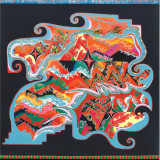
The next chapter of the Natural Information Society is here. Since Time Is Gravity, credited to Natural Information Society Community Ensemble with Ari Brown, presents a newly expanded manifestation of acclaimed composer & multi-instrumentalist Joshua Abrams nearly 15 year, 7 albums &-counting flagship ensemble. Joining the core NIS of Abrams (guimbri & bass), Lisa Alvarado (harmonium) Mikel Patrick Avery (drums) & Jason Stein (bass clarinet) are Hamid Drake (percussion), Josh Berman & Ben Lamar Gay (cornets), Nick Mazzarella & Mai Sugimoto (alto saxophones & flute), Kara Bershad (harp) & Chicago living legend of the tenor saxophone Ari Brown. Recorded live to tape at Electrical Audio & The Graham Foundation, cover painting Vibratory Cartography: Nepantla, by Lisa Alvarado. 2xLP on Eremite USA, 2xLP & CD on Aguirre/Eremite Europe. Out 14-04.
Since first developing Natural Information Society in 2010, Joshua Abrams has been gradually expanding the group’s conceptual underpinnings, its musical references & the sheer number of the group’s members. Its music is, in a sense, an expansive form of minimalism, based in repeated & overlaid rhythmic patterns, ostinatos & modality. Its roots, its scale & its meaning become clearer in time. If time is gravity, it also allows us to carry more. Having begun as fundamentally a rhythm section with Abrams’ guimbri at its core, the version here can stretch to a tentet, including six horns.
Abrams has been expanding his minimalism gradually, but he has long understood a key to minimalism’s potential: the breadth of its roots in the late 1950s & early 1960s, ranging from the dissatisfaction of young European-stream composers with the limitations of serialism to the simultaneous dissatisfaction of jazz musicians with the dense harmonic vocabulary of bop & hard bop. The former began exploring rhythmic complexity & narrow tonal palates in place of harmonic abstraction (Steve Reich’s Drumming, Philip Glass’ Music with Changing Parts; perhaps above all Terry Riley’s In C & his late ‘60s all-night organ & loop concerts); the later reduced dense chord changes to scales (signally with Miles Davis' Kind of Blue, but rapidly expanding with John Coltrane’s vast project). In the 1950s the LP record opened the world with documentation of Asian & African musics, key influences on both minimalists & jazz musicians. If John Coltrane’s soprano saxophone suggested the keening shehnai of Bismillah Khan, the instrument was rapidly taken up by two key minimalists, LaMonte Young & Riley, similarly appreciative of its flexible intonation, the same thing that kept it out of big bands.
If the guimbri, the North African hide-covered lute that Abrams plays with NIS, involves a rich tradition of hypnotic healing music associated with the Gnawa people, Abrams’ music also touches on other musics as well — other depths, memories & healings, different drones, rhythms & modes. As the group expands on Since Time Is Gravity, he has made certain jazz traditions in the same stream more explicit as well. If there is a mystical & elastic quality involved in the experience of time, both in direction & duration, you will catch it here. The parts for the choir of winds expand on the roles of Abrams’ guimbri, Mikel Patrick Avery & Hamid Drake’s percussion & Lisa Alvarado’s harmonium: at times, the winds are almost looping in the tentet version, each hitting a repeating note in turn, at once drone & distinct inflection on temporal sequence. The brilliance of the work resides in Abrams’ compositions, the NIS’ intuitive execution & in Ari Brown’s singular embodiment of the great tenor saxophone tradition, including the oracular genius of Eddie “Lockjaw” Davis, & Yusef Lateef. The three pieces by the expanded NIS featuring Brown —the opening “Moontide Chorus” & “Is” & the ultimate “Gravity”— have an immediate impact, & togther might be considered a kind of concerto for tenor saxophone. Here Brown presses almost indistinguishably from composed melody to improvised speech, getting so close to language that he might have a text. Everything here is a sign. Note the tap of the Rhythm Ace that links “Moontide Chorus” to “Is”, the attentive heart always present, even when signed by a machine. There’s a link here to the methodologies & meanings of dub music & the linear & vertical collage of beats, textures & tongues: treated with reverence, a sample of a beat-box can be as soulful, as hypnotic, as a mbira or a tamboura. If those pieces with Brown are heard as a suspended concerto, the three embrace & enfold the other works, like the sepals of a flower. That placement will also touch on the mysteries of our perception of time.
Particularly in “Is”, but elsewhere as well, a phenomenon of transcendence arises in which time appears to be tripartite, at once moving backwards & forwards & standing still. This is an act of technical brilliance certainly, but also an illumination of music’s ability to represent temporal consciousness through polymetrics. This particular listener has only heard it before in a few places, including the horn shouts & bowed basses of Coltrane’s Africa, in moments of Charles Mingus’ The Black Saint & the Sinner Lady, in certain pieces where tapes were literally running backwards, & earlier still in Dizzy Gillespie’s Cubana Be, Cubana Bop, in which the composer George Russell & conguero Chano Pozo found a music that spoke at once in the voices of Stravinsky’s Rite of Spring & the vestigial rites, rhythms & songs of the Yoruba language & Santeria religion of inland Cuba.
In Joshua Abrams’ compositions & the realization of them by the NIS, in the time of one’s close listening & memory thereof, distinctions between the “natural” & the “social”, the “quotidian” & the “transcendent” are erased, suspended or perhaps irrelevant. Consider two of the ensemble pieces, one named for nature, the other social science. In “Murmuration” the repeated wind figures of flute & alto saxophone combine with the interlocking patterns of harp, guimbri & frame drum (tar) to create a perfect moving stillness, not an imitation but a witness to the miracle of the starlings’ astonishing collective art, a surfeit of beauty that might be the ultimate defense tactic.
“Stigmergy” takes its name & concept from the Occupy movement’s Heather Marsh, who proposes a social system based on a cooperative rather than competitive models, one in which ideas are freely contributed & developed as ideas rather than an individual’s property. In its form, Abrams’ “Stigmergy” is the closes thing to traditional jazz, a series of accompanied solos by each of the wind players. However, the composed accompaniment is a radically collectivist notion: a repeated rhythmic figure, call it ostinato or riff, in which the different winds each play only a note or two of the figure, a concept both more collectivist & individualistic in its conception than any typical unison figure. It suggests another of the underlying recognitions that propel the Natural Information Society, the group as social organism, the teleology of hypnotic anarchy, all parts in place, functioning systematically, evolving & expressing itself, its nature & society, as a transformative organism.
George Lewis has described music as “a space for reflection on the human condition”. This suggests that, rather than a “distraction”, at least some music might serve as a distraction from distraction. It’s a focus, a clarity, a awareness, an external invitation to interiority, as if music itself is a model for form & contemplation, an organism contemplating for us or as us. If that is a possibility, & I am sure I have heard such musics, than this music is among them. How many of our rhythms, melodies & harmonies (cultural, historical, biological, psychic) might such music carry, translate & transform in the particulate ecstasy of our own murmuration? (Stuart Broomer, April 2022)
Suche:electric machine
- A1: Jpye & E11E - Freedom Ain't Free
- A2: Jpye & Da Roc - You Freak Out
- A3: Jpye & E11E - Shiver
- B1: Jpye & Da Roc - Xcuse My French
- B2: Jpye & Renato - Va La-Bas (Feat Michael T)
- B3: Jpye & Renato - Tutto Ok
- C1: Jpye & Leonidas - Lazyjack
- C2: Jpye & Renato - Take Off
- C3: Jpye & Da Roc - Spinnaker
- D1: Jpye & Iamrobd - Fingers Crossed
- D2: Jpye - Freedom Ain't Free (Instrumental)
- D3: Jpye & Da Roc - Spinnaker (Instrumental)
Jean-Philippe Altier’s first full-length excursion as Jpye, 2021’s Samba With You, was heralded a contemporary Balearic pop gem – a superbly summery, sun-kissed set full of atmospheric instrumentation, colourful synth sounds, strong songs and star turns from a wide variety of musical friends and guest performers.
Bleu Your Mind, his hotly anticipated follow-up, takes a similar sonic approach to its predecessor, with Altier being joined in the studio by friends old (vocalist e11e, keyboardist Michael T and fellow Twonk members Leonidas and Renato Tonini all reprise their roles from ‘Samba With You’) and new (Da Roc and Iamrobd) on a set that effortlessly mixes and matches elements of nu-disco, jazz-funk, laidback synth-pop, Italo-disco and Balearic beats.
Those who savoured ‘Samba With You’ will feel at home right away, as e11e sings softly and sweetly atop the gentle Latin infused shuffle, dusk-ready instrumentation and chiming vibraphone solos of ‘Freedom Ain’t Free’. French composer and keyboardist Da Roc make’s his first appearance on the following track, the duelling electric pianos and synths of sun-splashed instrumental Balearic pop gem ‘You Freak Out’, before e11e returns on the throbbing and suspenseful ‘Shiver’– a re-imagined and genuinely glassy-eyed cover of Marie Laure Sachs’ sleazy 1978 Italian disco jam of the same name. So, it continues, with Altier and his collaborators painting scintillating sonic pictures in kaleidoscopic colours.
Impeccable arrangements and pin-sharp instrumentation work in perfect harmony with seductive grooves that pack plenty of subtle swing. Even more impressively, ‘Bleu Your Mind’ is an album that genuinely rewards repeat listens, with each successive spin revealing more musical touches and cannily crafted melodic motifs. As a result, highlights come thick and fast throughout, from the delay-laden jazz-funk-goes-electrofunk fizz of ‘Xcuse My French’ (with Da Roc), and the humid afternoon heat of ‘Va Là-Bas’ – a gorgeous and immersive, sunset-ready affair produced alongside Renato and featuring dazzling kets from Michael T) – to the slow-motion Gallic/Italian reggae-pop of ‘Tutto OK’ (a nod to the tropical-tinged reggae sounds created in France during the 1980s), and the slap-bass sporting, smoothed-out (but low-down) grooves of Renato hook-up ‘Take Off’.
As ‘Bleu Your Mind’ progresses, the musical details become more refined, the grooves drowsier and the mood more horizontal. This subtle shift can be heard in Leonidas co-production ‘Lazyjack’ – all chiming lead lines, languid bass guitar, snappy drum machine beats and glistening guitar motifs – the vocoder-sporting stoner funk of ‘Spinnaker’, and the yearning brilliance of ‘Fingers Crossed’. The album’s most emotive and immersive moment by some distance, ‘Fingers Crossed’ sees Altier and collaborator Iamrobd (also a fellow Twonk member) tease out a slow-motion groove in combination with lilting Spanish guitar solos, ultra-dreamy chords, twinkling pianos and delay-laden drum machine hits. Bittersweet and brilliant, it’s a track guaranteed to send shivers down your spine. By the time it fades out, via a sustained piano chord, you’ll be sat or stood in wide-eyed, open-mouthed wonder.
Foundation is set in the future when the world is barely remembered and humans have colonized the galaxy. The record introduces Donnie Ozone, a brilliant visionary rapper and psychohistorian whose job is to use lyrics and rhymes to predict the future. It is divided into six chapters, each showing a part of the bigger picture portrayed on the outstanding cover by Infidel.
Teslasonic gathers together the galaxy's top scientists and artists on a bleak outer planet and sets out to preserve the accumulated knowledge of humankind and begin a new human galactic empire based on Art, Science and Technology. He calls his sanctuary the Foundation and designs it to withstand a dark age of ignorance, barbarism, and warfare that he predicts will last for a long time.
Their masterpiece? With breaks for dayyyyyys and an almost ambient, heavy jazz atmosphere throughout, *this* is the apex of British jazz-rock fusion. We'll Talk About It Later was first released on Vertigo in 1971 and original copies are now very tricky to score. Like all the Nucleus records, it’s aged ridiculously well and this Be With re-issue, re-mastered from the original analogue tapes, shows off just why this deserves to be back in press.
Genius trumpeter and visionary composer Ian Carr was one of the most respected British musicians of his era. He was a true pioneer and saw the potential in fusing the worlds of jazz with rock, just as Miles Davis and The Tony Williams Lifetime did in the US. In late 1969, following the demise of the Rendell-Carr quintet, and tiring of British jazz, Carr assembled the legendary Nucleus. Regarding music as a continuous process, Nucleus refused to “recognise rigid boundaries” and worked on delivering what they saw as a “total musical experience”. We can get behind that.
Under bandleader Carr, Nucleus existed as a fluid line-up of inventive, skilled musicians. This constant evolution and revolution was all part of the continuous musical exploration and discovery that took jazz to new levels. And the music has kept relevant. To steal a line from a review of our re-issue of Roots, when it comes to anything Nucleus “it’s basically already hip-hop”.
We'll Talk About It Later is arguably Nucleus's best album. Not only that, it's in the top 5 of all fusion albums. By the time Nucleus entered Trident Studios in September 1970 to record Elastic Rock's successor, they had already won a best group award at the Montreux Jazz Festival. Once again presented in a Roger Dean designed die-cut gatefold sleeve it continued to demonstrate the chemistry and interplay that worked so brilliantly on Elastic Rock; Carr's sumptuous trumpet and flügelhorn lines, Karl Jenkins's funk-filled electric keyboards, Chris Spedding's wah-wah guitar, Brian Smith's sax and the rhythmic foundation of drummer John Marshall and bassist Jeff Clyne.
The group work and insane musicianship Nucleus were famed for is in evidence from the off. The intensely funky "Song for the Bearded Lady" is absolute FIRE, blasting out the speakers to leave listeners floored. Counterpoint riffing segues into a spacious groove and a Carr trumpet solo demonstrating the influence of electric Miles from the period. The stop-start funk of "Sun Child" would appeal to Soft Machine devotees whilst the genuinely touching "Lullaby for a Lonely Child" is a lovely downtempo ballad. Featuring an understated, reflective horn line from Carr and Smith and atmospheric, shimmering bouzouki from Spedding, there's an exotic flavour which contributes to the bliss. The ominous, sleazy title track retains a swaggering menace and is not the only track to lend a sort of heavy stoner rock atmosphere. The guitars and bass are deep and low throughout, conjuring heavy psych moments to go with the actual jazz and even funk. To say this album was in conversation with Bitches Brew would not be overstating the sheer brain-frying brilliance.
The Weather Report-adjacent "Oasis" opens Side B, a colossal track featuring nearly 10 minutes of steadily building melodic horns, keys and choppy guitar riffs. So ace, it could easily go on for another 10. Mesmeric. Spedding adds unique vocals to the undeniable groove of "Ballad of Joe Pimp" whilst saxophonist Smith's duet with drummer Marshall at the conclusion of "Easter 1916" - inspired by the Yeats poem about the Irish nationalist uprising in Dublin - adopts the wildness of the most incendiary free jazz.
This Be With edition of We'll Talk About It Later has been re-mastered from the original Vertigo master tapes, Simon Francis’ mastering working together with Cicely Balston's cut at AIR Studios to weave their usual magic with these wonderful recordings. The stunning die-cut sleeve has been restored with the original gatefold window pane depicting the Irish uprising in 1916. Incredible, timeless, guaranteed spine-chills.
Sometimes I sink into the dark side of life,
Lucky me to have music to pull me back into the light” Kutiman
Following on from his critically acclaimed Open LP released in October, revered polymath Kutiman returns to Siyal Music with his Dense EP. Kutiman continues to push forward with developing his sound as we see the artist creating his first ever electric leaning release. Not the only first, as the haunting vocals layered throughout are a result of Kutiman debuting his very own voice. Kutiman pulls elements from various musical inspirations, be it moody electronica, garage and 2step, modern classical music, ambient or twisted r'n'b. The outcome is a unique, cutting edge blend of emotional pitched down vocals, melodic airy pianos and glitching sound effects.
“This EP expresses emotions from a dark period that I went through. At the time I was into dark electronics and also found inspiration from Rhythm and Sound, Burial, The Blaze, Plasticman and more. The EP all started from a little "Volca" drum machine, which I hooked up and set up a mostly analogue setup around it with some synths and drum machines that enabled me to "jam" a lot of the music without the need to stop for overdubbing or editing”. Kutiman
With an illustrious career spanning over a decade, Ophir Kutiel aka Kutiman moved to Tel Aviv as a teenager to study jazz at the prestigious Rimon music college. It was during this time that he was able to immerse himself in music, with influences cited as Massive Attack, DJ Shadow, Amon Tobin and Parliament. Fast forward to 2007 and his self-titled debut album received a 8.2 rating from Pitchfork and set the precedent for what was to come. Other tastemakers to highlight over the years include; The Guardian, Billboard, The New Yorker, The Wire, Uncut and XLR8R among others. Kutiman is forever pushing boundaries with his music, and draws on a range of world influences from spiritual jazz to psychedelic funk. ‘Dense EP’ sees Kutiman adding yet another string to his musical bow, as we enter the era of electronic inspired music.
- A1: Darktide Main Theme
- A2: The Uprising On Hive Tertium
- A3: Prison Break
- A4: Onboard The Tancred Bastion
- A5: Escaping The Prison Ship
- A6: The Imperium Unites
- A7: Immortal Imperium
- A8: Dropship To Hive Tertium
- B1: Entering The Hive City
- B2: The Transit Horde
- B3: Imperium Of Man
- B4: The Mourningstar
- B5: Disposal Unit (Imperium Mix)
- B6: Late Night Entertainment
- B7: Nightsider
- B8: City Of Tertium
- B9: Broadcast Apparatus
- C1: Apparatus Receiving
- C2: Data Interference
- C3: Forge Manufactorum
- C4: Atoma Prime
- C5: Entering Throneside
- C6: Waiting To Strike
- C7: Path Of Trust
- D1: Unrest In Throneside
- D2: Transmission Commences
- D3: Offworld Auspex
- D4: Hive City Lowest Level
- D5: The Torrent Fights Back
- D6: Warp Traveller
- D7: Debriefing
- E1: Escape Initiated
- E2: Imperial Advance
- E3: Hab Block Bonanza
- E4: The Will Of The Imperium
- E5: Write Transmit
- E6: Sublevel Data Interrogation
- E7: Reality Slipping
- E8: Heart Of Heresy
- E9: Embrace Of The Chaos Cult
- F1: Forge Chaos Detected
- F2: Last Man Standing
- F3: The Emperor Of Mankind
- F4: Admonition
- F5: The Imperium Unites Part 2 (Bonus Track)
- F6: Disposal Unit (Original Mix)
- F7: Reality Slipping (Imperium Mix)
- F8: Transmission Commences (Late Night Mix)
A co-op coalition of Laced Records, Fatshark, and Games Workshop has summoned forth a deluxe triple vinyl for Jesper Kyd’s incredible new Warhammer 40,000: Darktide score.
48 tracks have been specially mastered for vinyl and will be pressed onto heavyweight galaxy-effect discs in yellow & black, blue & black, and red & black. The widespined outer sleeve features a spot gloss logo on the front cover; while the three spined inner sleeves sport artwork by the Fatshark team.
Darktide succeeds Fatshark’s much beloved Vermintide series with brutal co-op action set in the dystopian future of Warhammer 40,000. Composer Jesper Kyd’s many challenges included capturing the pomp and propaganda of the Imperium’s Inquisition; finding a way to represent ‘living machines’ the size of city blocks and thousands of years old in the lore of the game, but still tens of thousands of years more advanced than our own; and finding the sound of the dangerous lower levels of the Underhive.
He spectacularly achieves this with characterful choral and folk instrumental performances layered among all manner of vintage analog synths, giving the whole soundtrack a rusty, mechanical but not robotic feel — all dusty data and grinding grooves. It’s a unique score that sheds the orchestral and electric guitar palettes of other Warhammer titles.
- A1: Bowery Electric - Things'll Never Be The Same
- A2: Asteroid #4 - Losing Touch With My Mind
- A3: Mogwai - Honey
- B1: Flowchart - Ode To Secret Hassle
- B2: Fuxa - Amen
- B3: Accelera Deck - I Believe It
- B4: Arab Strap - Revolution
- C1: Bardo Pond - Call The Doctor
- C2: Frontier - Hey Man
- C3: Low - Lord Can You Hear Me?
- D1: Amp - So Hot (Wash Away All Of My Tears) (Wash Away All Of My Tears)
- D2: Piano Magic - How Does It Feel?
- D3: Transient Waves - Billy Whizz
First repress since its original release in May 1998
Celebrating twenty-five years since its release as rgirl2 – the label’s first LP – Rocket Girl is reissuing its seminal compilation A Tribute to Spacemen 3 on double vinyl with spot varnish sleeve in May 2023.
Widely acclaimed at the time of its release (garnering rave reviews in the UK, US, Canadian and European music weeklies and monthlies), the collection sounds as fresh and inventive as it did three decades ago. Launched at a time when tribute albums were prevalent, A Tribute to Spacemen 3 stands apart from other covers albums in that it not only redecorates S3’s songs in a bold new palette of colours, but also acts as a time capsule documenting a very specific wave of 90s US and UK bands that shared many sensibilities – ‘post-rock’ might be the catch-all genre, but their music also encompassed psych, slowcore, analogue electronica, dream pop and space rock to varying degrees – and many of whom (Mogwai, Low, Arab Strap, Bardo Pond) have gone on to reap major critical and commercial success, and are still thriving today. In 1998 the LP was a gateway for fans of Spacemen 3 to discover these relatively unknown experimental artists operating on small independent labels either side of the Atlantic – today it is a celebration of the timeless innovation and longevity of that scene.
As author Richard Milward states in Rocket Girl 20, the 2019 book illuminating the history of the label: ‘In no way is the LP a collection of imitators simply regurgitating Spacemen 3’s songs sound-for-sound – rather, the compilation celebrates the purity and bravery of Pierce’s and Kember’s song writing (themselves never averse to a transformative cover version) while showcasing the originality and diversity of those bands they have inspired.’ It is the simultaneous simplicity and otherworldliness of S3’s songs that make them perfect fodder for reinterpretation, the band’s ‘three chords good, two chords better, one chord best’ mantra providing a solid, tantalising foundation for these bands to experiment with freely. Throbbing and humming with equal parts euphoria and melancholia, over the course of the album’s 69 minutes the tracks slide from slithering stoner psych (Asteroid #4’s ‘Losing Touch With My Mind’) to hymnal delicacy (Amp’s ‘So Hot (Wash Away All of My Tears)’ and Mogwai’s crisp, glockenspiel-chiming ‘Honey’) to zero-gravity lounge jazz (Transient Waves’ closer, ‘Billy Whizz’). There are radical reworkings: the oozing fuzztone lava of Bardo Pond’s ‘Call the Doctor’, and not least Arab Strap’s startling take on S3 live mainstay ‘Revolution’, replete with aggressive, crunching drum machine and the lyrics delivered down the telephone in Aidan Moffatt’s laconic Falkirk drawl – ‘a change, a solution, a wee… a wee revolution’ – before its explosive climax.
The Croatian production powerhouse and disco boogie impresario steps up to International Feel, and takes a left turn into deep space with a new six track LP Pulsar Diaries.
Ilija’s discography stretches back to 2003, and over those 20 years he’s packed it full with albums, versions, remixes and singles. His releases are often perfectly-penned love letters to ‘80s boogie, electro and disco, and like postcards from an old flame, they’ve landed in an array of record label catalogs, from Bear Funk, Rong, and Electric Minds, to Is It Balearic? as well as his own Red Music and Imogen Recordings. He’s long-been an active voice on the underground club scene, and if you’ve been out dancing in Zagreb, Berlin or even Tisno beach, chances are you’ve gotten down to one of his beautifully blended sets of cosmic-tinged electro funk and disco dubs.
On Pulsar Diaries, Ilija delivers a panoramic collection of spaced-out synths and drum machine grooves, dedicated to the planet and our place in the universe. The A side opens up with the blissful, weightless pads of the title track, before it breaks out into filtered stabs over a minimal b-boy bounce. Delphic Expanse ebbs and flows like a lunar eclipse, sounding like a futuristic version of Key-Matic’s Breaking In Space, all uprock rhythms and syrupy synth horns as it spins off beyond the asteroid belt. Side A closes out with Blackburn Tales, a suspenseful and spacious electro rhythm packed with strings and 303 squelch, which you might call anti-gravity acid, if you were so inclined.
Side B picks up the tempo with Fourth Amendment, perfect for the space station discotheque with its sweeping bass filters and ice-cold synth melodies hovering in orbit. Farewell Theme takes an introspective moment, slowing the pace to a cosmic 90 bpm and inviting a certain cinematic feel to proceedings. This feeling applies not just to the vivid landscapes we travel through, but also wider thoughts about humankind: as we pause for a breath and look around, we find ourselves in Ilija’s space, considering human motivations, like the pursuit of happiness, or the eternal struggle with the self.
Every journey begins with a goodbye, and so the last track of the album feels like the arrival at a new destination: Ursa Major is ablaze with cascading drum fills, bubble-wrapped bass riffs and bright synth chords that sparkle like city lights underneath a re-orbiting satellite.
With Pulsar Diaries, Ilija Rudman has created a rare artifact: an album that straddles several worlds at once. Part soundtrack to space travel, part meditation on the human condition, part deep-burning dancefloor dynamo - whether in the club surrounded by friends or at home by yourself, this is a record that expands the mind and lets the imagination soar.
- A1: Captain Clark Welcomes You Aboard
- A2: The Saints Go Marching Through All The Popular Tunes
- A3: Summer Will
- A4: Outside The Pier Prowed Like Electric Turtles
- A5: The Total Taste Is Here - News Cut-Up
- A6: Choral Section, Backwards
- A7: We See The Future Through The Binoculars Of The People
- A8: Just Checking Your Summer Recordings
- B1: Creepy Letter - Cut-Up At The Beat Hotel In Paris
- B2: Inching - Is This Machine Recording
- B3: Handkerchief Masks - News Cut-Up
- B4: Word Falling - Photo Falling
- B5: Throat Microphone Experiment
- B6: It's About Time To Identify Oven Area
- B7: Last Words Of Hassan Sabbah
Clear Vinyl[24,79 €]
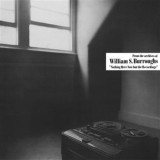
In 1980, Genesis P-Orridge and Peter 'Sleazy' Christopherson (then of Throbbing Gristle renown) travelled to New York City to meet up at the fortified apartment, known as The Bunker, of famed beat writer and cultural pioneer William S. Burroughs and his executor James Grauerholz to starting the daunting task to compile the experimental sounds works of Burroughs, which, up until that point, had never been heard. During those visits, Burroughs would play back his tape recorder experiments featuring his spoken word 'cut-ups', collaged field recordings from his travels and his flirtations with EVP recording techniques, pioneered by Latvian intellectual Konstantins Raudive. Throughout the next year, P-Orridge, Christopherson and Grauerholz would spent countless hours compiling various edits, each collection showcasing Burroughs sensitive ear and keen experimental prowess for audio anomaly within technical limitations. By the time 1981 came through, Burroughs had relocated to Lawrence, KS in which to escape the violence and mania of New York City life. It is in Lawrence that P-Orridge and Christopherson put the finishing touches on the record that would be known as 'Nothing Here Now but the Recordings'. The album would come out in the Spring of 1981 as the final release for the shuttering Industrial Records, brought about by the dissolution of Throbbing Gristle. The album remained out of print until 1998 when John Giorno and the Giorno Poetry Systems included the album on a multi-disc retrospective CD box set compiling the majority of Burroughs seminal recordings.
- A1: Captain Clark Welcomes You Aboard
- A2: The Saints Go Marching Through All The Popular Tunes
- A3: Summer Will
- A4: Outside The Pier Prowed Like Electric Turtles
- A5: The Total Taste Is Here - News Cut-Up
- A6: Choral Section, Backwards
- A7: We See The Future Through The Binoculars Of The People
- A8: Just Checking Your Summer Recordings
- B1: Creepy Letter - Cut-Up At The Beat Hotel In Paris
- B2: Inching - Is This Machine Recording
- B3: Handkerchief Masks - News Cut-Up
- B4: Word Falling - Photo Falling
- B5: Throat Microphone Experiment
- B6: It's About Time To Identify Oven Area
- B7: Last Words Of Hassan Sabbah
Black Vinyl[26,01 €]
In 1980, Genesis P-Orridge and Peter 'Sleazy' Christopherson (then of Throbbing Gristle renown) travelled to New York City to meet up at the fortified apartment, known as The Bunker, of famed beat writer and cultural pioneer William S. Burroughs and his executor James Grauerholz to starting the daunting task to compile the experimental sounds works of Burroughs, which, up until that point, had never been heard. During those visits, Burroughs would play back his tape recorder experiments featuring his spoken word 'cut-ups', collaged field recordings from his travels and his flirtations with EVP recording techniques, pioneered by Latvian intellectual Konstantins Raudive. Throughout the next year, P-Orridge, Christopherson and Grauerholz would spent countless hours compiling various edits, each collection showcasing Burroughs sensitive ear and keen experimental prowess for audio anomaly within technical limitations. By the time 1981 came through, Burroughs had relocated to Lawrence, KS in which to escape the violence and mania of New York City life. It is in Lawrence that P-Orridge and Christopherson put the finishing touches on the record that would be known as 'Nothing Here Now but the Recordings'. The album would come out in the Spring of 1981 as the final release for the shuttering Industrial Records, brought about by the dissolution of Throbbing Gristle. The album remained out of print until 1998 when John Giorno and the Giorno Poetry Systems included the album on a multi-disc retrospective CD box set compiling the majority of Burroughs seminal recordings.
The duo WILDES from the south of Germany, consisting of Jana Pantha and Jenny Tulipa, presents a musical mix of electro-synth-pop, post-punk and dark disco influences. After the release of their first EP “RAWWR” in 2021, their debut album entitled “KLISCHEE” will be released on 3 February 2023. Released via the Kommando 84 label, the album features 11 songs and a musical re-interpretation of German-language Neue Deutsche Welle sounds. The songs combine spoken word passages in which the singers combine a certain irony with word-playful rhymes. In addition to world-political, social issues, the songs revolve around the complexity of the new romance in love - between cosmos and stereo. The strong and experimentally avant-garde lyrics accompany the danceable pulse of the drum computer, melodic synth waves and the shimmering solos of the lead guitar.
The album “Klischee” begins with an electro-pop track that combines consistent grooves with atmo- spheric sound arrangements and a lead guitar that accompanies our journey to the moon. With the chorus’ high-pitched words, „Konsum - leg mich auf den Moon“ (“Consumption - put me on the Moon”), WILDES dryly yet humorously allude to a society that couldn’t fly “higher”.
The following cheeky song Leger in Schwarz combines impeccable post punk with influences from the NNDW scene. A short love story led by the electronic beat of the synthesizer makes the hearts of the night beat faster. With casual reduction, a guitar riff leads through the song. The guitar solo finally rounds off the plea about the longing for a good flirt.
Italo disco shimmers and pulsates on the driving song Capri. With lyrics like “Pack the boats - Vai a bordo”, Capri is a homage to the tried and tested Italo feeling with a cappucino on the terrazza, or indeed on the yacht with a view of the rocky walls of the island. An electric charge of sequencers and synth tracks acts here as a lightness of being in contrast to the porosity of the rock.
An electrifying electric guitar solo kicks off the fourth track with a mysterious invitation to Steig ein translated, get in. Hypnotised by the lights of the road, dazzled in the side mirror, a clearly repeating rhythm leads into the chorus and through the coming verses. English spoken-word lyrics add to the stoicism of the German language. The song’s great power ends with the line Lost in the dark, holding open the finale of the “Night Drive” encounter.
Digital and stereo on all channels, the distinctly tight and robust rhythm sounds in the song Apparat. A clear and simple synth melody is heard as a contrast and the electric bass gives the balance of the machine at points. Hiddenly, WILDES points here to the superior power that can control human action beyond all limits. A piece as a laudation to all the science fiction novels that play with the switching of the individual parts.
Side One of the vinyl is finalised by a song called La Grande Bellezza that motivates to dance and sing along. The punky pop craft lives through the recurring beat of the rhythm guitar. Here the focus is on the woman in all her facets. The great beauty, una donna, who can do everything as well as wanting everything and nothing...a strong woman who, however, also staggers and wants to jump off the cliff. Clearly and distinctly, the musical accompaniment of the drum machine and the accompanying synth melody reflect hidden parallel worlds and the ambiguity of character - of life? We get a desire for more and turn the round record.
The B side starts with a powerful guitar riff, complemented by a catchy and strong bassline that runs through the song. In this work, WILDES provocatively describes the West’s lust for the much-cov- eted Schwarzes Gold black gold. The song is reminiscent of the works of the band D.A.F. and thus ties in with the electronic punk sound spate.
The driving guitar riff joins in with the reduced synth bass sequence - the electro-pop song with the title Hitze (Heat) came onto the digital music market as the first single from the LP in the summer of 2022. Pulsatingly, the drum computer lets the beats vibrate to the rhythm of heated air. The duo po- etically describes heat with supercooled voices, a clarity in the sky that makes everything flow, that makes the breath dry. The work ends with a melodic synth solo.
Ich lad dich ein, I invite you - we have all said or heard this sentence before. A chance meeting of two people later leads to the altar in love. A far-reaching question that more or less arises in many love relationships at some point “Do you dare?” positions itself in lyrical contrast to the simple ques- tion in the refrain “Do you need sugar?”. WILDES plays with laconic poetry and, full of irony, makes the listeners think about living together. Krautrock contours are skilfully used in this piece. Reduced to the essentials, the chorus immediately sticks in the ear. A cheerful mix of steel drums and infec- tious solo.
Toccami - touch me! We sit on padded leather chairs - “you’re a rocket! Peng Puff Peng” - this song by the band WILDES joins experimental art-punk-pop, electronically with flowing synth waves we take off immediately. Melodically sung, lyrical layers of lyrics dance loosely light and gracefully in the ears of the viewer. The rhythmic beat visualises the feeling of floating in a spaceship. It’s love in the universe - “I love you, my darling” sounds tipsy in the beat-heavy disco refrain.
Hypnotically, WILDES launches into the final song of the entire LP. The title Zone takes us on a journey through time. Inspired by the film Stalker, we find ourselves in a science fiction setting that couldn’t be more present in today’s European events. The musicality of the electric guitar riffs ac- companied by simple new wave drums drives the listener into unknown realms.
Repetition and electronic synth sounds play a compositional role alongside rocking guitar riffs like their forerunners in the NDW scene. Lyrically, each song varies between pop-romantic and politically critical passages. Listeners start pondering about hedonistic life and its consequences. Sometimes it feels like listening to a Tarantino soundtrack in German, other times it feels like listening to an 80s track by a James Bond. Science fiction fantasies and reality add up in dadaistic theatricality to spir- ited synthpunk of the New German Wave from the South. Discoid beats and driving drums in digital are included.
Existing somewhere between the post-psychedelic period of Soft Machine and the electric funk of Herbie Hancock's Headhunters, Black And White, the 1976 album from Norway's Vanessa is without question a formidable beast of a jazz-rock record. A potent brew of sonic experimentation and pulsating off-kilter groove. Taking their name from the genus of Nymphalidae butterfly, Vanessa was founded in 1971 by saxophonist Svend Undseth and pianist Frode Holm, the founder of the Oslo record store turned imprint, Compendium Records. Unsurprisingly analogous to the music championed across the Compendium catalogue Black And White is clearly influenced by the UK Canterbury scene, highlighted by Compendium's focus on the recordings of Soft Machine alumni Hugh Hopper and Elton Dean. Vanessa's spirit also lies synonymous with the collective pedigree on the label's roster including British progressive jazz stalwart Keith Tippett and Mirage (a UK group consisting of ex-members of Centipede and The Mike Westbrook Orchestra), together with the avant-rock collective Henry Cow and the experimental synthesiser-jazz of US ex-pat Joe Gallivan (together with Charles Austin).
Often dubbed the 'Compendium house band' owing to Holm's association with the label, the Vanessa sound is inherently familiar yet undeniably original. Each of the album's four long compositions are a meld of complex angular jazz laced with swirling electronic textures - furious rhythms that surge in intoxicating intensity before easing into fluid passages of soulful post-bop. The dichotomy of these styles plants the group firmly into radical new jazz territory alongside their Canterbury contemporaries. Despite their brief existence, the band, alongside the label left an indelible mark on Norwegian jazz-rock and the headier side of European progressive music at large.
Reissue of 1976 Norwegian Jazz-Rock album.
Post-psychedelic period Soft Machine meets the electric funk of Herbie Hancock's Headhunters
Transferred and restored from the original master tape.
NuNorthern Soul may be Ibiza-based, but the label’s connections with Nottingham run deep. Over the years, Phil Cooper’s imprint has offered up countless releases and remixes from some of the East Midlands’ city’s most Balearic-minded residents, including Crazy P’s Jim Baron, Is It Balearic? chiefs Coyote and, most recently, Constellations Workshop associates Brown Fang.
You can also add to that list Torn Sail, a collaboration between Brown Fang members Jon Thompson and Henry Scott, and another Notts-based NuNorthern Soul contributor, Huw Costin. The trio’s mesmerising ‘Disconnected’ recently featured on the label’s deluxe 10th anniversary vinyl box set and now they return with a single credited to both Brown Fang and Torn Sail – the first such occurrence of that happening.
Those who heard Brown Fang’s brilliant mini-album, Sherwood Pines, will immediately feel at home. Both ‘Exit’ and ‘Endless’, the two tracks showcased on this fine single release, feature the same gorgeous, slowly shifting fusion of sun-kissed electric guitar textures, ambient atmospherics and immersive, sunset-friendly sound design.
First up is ‘Exit’, an undulating, slow burning delight where rising and falling electronic melodies and yearning, gently jazzy electric guitar motifs rise above a sparse, shuffling, subtly Latin-tinged drum machine rhythm and warming bass. Endearing, enveloping and endlessly attractive, the track seemingly blossoms in slow motion throughout its’ three-and-a-half-minute duration, with additional musical elements presenting themselves as it progresses. Even by the trio’s high standards, it’s a magical composition.
On ‘Endless’, the long-time collaborators explore their love of mind-soothing ambient soundscapes. Doffing a cap to the 1970s new age ambience of Steve Hillage – whose distinctively languid, stretched out, effects-laden electric guitar solos were undoubtedly an inspiration –Thompson, Scott and Costin deliver a becalmed and brilliant dream-scape full of hazy aural textures, drifting chords and gentle, eyes-closed vocalisations. It feels like a loved-up, smile-inducing evocation of the most visually stunning dawn you’ve ever ushered in after a night dancing under the stars.
160-gram heavyweight Vinyl LP with gatefold jacket displaying the painting series that inspired the music, and the story of Newtok. Newtok is a remote Alaska Native village situated on the Ningliq River, near the west coast of Alaska. Although a very remote and quiet place, Newtok has come face-to-face with climate change. Due to a combination of thawing permafrost, low levels of sea ice, and strong storms, the coastal land of Newtok is eroding dramatically. In 2016, Chicago visual artist Jennifer Cronin embarked on a trip to Newtok to document this changing environment. Upon returning, she spent the next several years developing a series of paintings and screen prints titled Seen and Unseen that captured this eroding landscape. In 2019, Cronin and musical Artist Patrick Mitchell (a/k/a Dusty Patches) began discussing the project after Cronin asked him to perform at the Gallery opening for the series. As a result, Mitchell created this album, Newtok - inspired by Cronin's Seen and Unseen series and the story of Newtok, Alaska. Mitchell is a multi-instrumentalist songwriter and producer from Chicago who has led numerous past projects in the Chicago DIY community including De Triomphe, New Color, and Whiskey Wise. He dove headfirst into synths in 2017 and adopted the electronic alias Dusty Patches. Dusty Patches released his debut project Filthy Four Track Machine: Volumes I & II (2018, Sooper Records), largely made with the Teenage Engineering Pocket Operators and OP-1. In 2020, he released Nocturnal Emissions from the Dablatory, his first project fully realized with modular synthesis. In approaching Newtok, Mitchell composed all of the constituent musical elements of the work and then recorded and live mixed the album during a single live performance on modular synthesizer. The album draws heavily on sprawling ambient synths, electric and acoustic post-punk guitar motifs, cryptic vocal sampling, vintage drum machines, and modular patches that often sound like birds or the sea. The subject matter of the album, the complexity of its arrangement, and its execution as a single live recorded performance makes Newtok a unique musical experience. About Newtok, Mitchell says: This record was an exploration of themes. When faced with the immense canvases Jen Cronin produced upon her return from the village of Newtok, one can't help but feel awe. With the sheer size of the works towering above you, you are compelled. There is overwhelming beauty, desolation, a sense of urgency, and a sense that it is, in fact, far too late. These visual themes, and the emotions they evoke, were connected to the sounds and compositions of this record. There is a coldness to the digital soundscape, but organic sounds of nature and humans tether and steer the album through a journey of musical storytelling. Newtok is a journey of musical storytelling about the tragedy of the Anthropocene in the age of climate change. FOR FANS OF: Mother Earth's Plantasia, Black Moth Super Rainbow, Boards of Canada, Bibio
The Netherlands' premium progressive gothic metal artists The Gathering caught live on the stage of the legendary Paradiso in Amsterdam, 1999. The Svart Records official reissue comes on 180 gram vinyl, wrapped in a heavy gatefold jacket. "It is a very good representation of where we stood back in 1998/99. We also didn’t do any overdubs so what you see is what you get. It’s a very honest document of what THE GATHERING was like in 1999", says Hans Rutten of The Gathering,"It's very pure and I'm very proud of it, especially to see it finally reissued on vinyl after a first, very limited run in 2013."
- A1: Iconoclast
- A2: The End Of Innocence
- A3: Dehumanized
- B1: Bastards Of The Machine
- B2: Heretic
- B3: Children Of A Faceless God
- C1: When All Is Lost
- C2: Electric Messiah
- C3: Prometheus (I Am Alive)
- D1: Light Up The Night
- D2: The Lords Of Chaos
- D3: Reign In Madness
Green Vinyl
Das Iconoclast Album gab es im Juni 2011 damals nur in den Farben blau und weiß als Vinyl in Europa.
Ca 12 Jahre später wurde das Album nun mit grünem Vinyl nachgepresst.
Es scheint keine Superlative zu geben, die diesem Meilenstein gerecht werden könnte. Das Opus ist nicht nur unheimlich innovativ,
sondern auch überraschend hart und trotz der progressiven Perfektion durchaus eingängig ausgefallen.
"Für "Earth Rocker", den Nachfolger des 2009er Werks "Strange Cousins From The West", mussten knapp vier Jahre ins Land ziehen. Ob sich die Wartezeit gelohnt hat? Wer CLUTCH kennt, der weiß: Ja! Das neue Album strotzt nur so vor Energie, beinhaltet aber auch die klassischen ruhigeren Songs, bei denen Sänger Neil Fallon natürlich mit seinen interessanten und gut durchdachten Texten voller Poesie überzeugen kann.
Doch bevor es an ruhigere Nummern geht, die auf dem Album in der Minderheit sind, geht es mit dem Titeltrack "Earth Rocker" erst mal gnadenlos rockig ab. Die schnelle Nummer ist schon mal ein guter Einstand, und Neil's "Muhahahas" in dem Song lassen einem ein breites Grinsen ins Gesicht treiben. Ein weiteres Highlight und garantierte Live-Granate ist den Mannen mit "Crucial Velocity" gelungen. Wer schon "Mob Goes Wild" oder "Electric Worry" mochte, wird diesen Song vergöttern. Tim Sult lässt seine Klampfe gnadenlos im Stoner-Dickicht die Rock-Welt regieren. Hammer!
"Mr. Freedom" groovt ganz gewaltig, Obacht: auch hier unbedingt auf die Textpassagen achten. Bei "D.C. Sound Attack" wird die bewährte Mundharmonika aus der Tasche gezogen und im Sinne von ZZ TOP abgerockt. Weiter über "Unto The Breach", "The Face" (MOTORJESUS lassen grüßen), "Cyborg Bette" oder "Book, Saddle & Go", CLUTCH zeigen sich abgezockt und saucool, wie eh und je. Warum cool? Weil diese Band einfach das macht, was ihnen gefällt, sei es Mucke, Attitüde oder Acting. Wer es mal bluesig mag, dem ist "Gone Cold" ans Herz zu legen. Relaxte Nummer, genau richtig zum chillen mit nem Glas Whisky.
Veredelt wurde "Earth Rocker" durch die Hand von Machine, der schon auf "Blast Tyrant" oder "Pure Rock Fury" für CLUTCH tätig war. Der räudige Sound, wie man ihn von der Gruppe gewohnt ist, wurde beibehalten und noch einmal auf eine höhere Stufe gewuchtet. Da bleiben keine Wünsche offen.
"Earth Rocker" reiht sich nahtlos in die Gassenhauer-Alben der Band hinein. "Blast Tyrant" oder "From Beale Street To Oblivion" gehören zwar noch immer zu den absoluten Highlights, "Earth Rocker" übernimmt ab jetzt jedoch den Vorsitz." (9von10/metal.de)
New artist on Mule Musiq.
Tel Aviv born producer “Nadav Siegel aka Autarkic” has been releasing nice indie dance tracks from Disco Halal, Life And Death, Turbo, Optimo Music and name a few.
This is his first release on Mule, it is a sampler 12inch from the upcoming new album (digital only).
12inch kick off killer psychedelic techno house “Cymbals Powder Rush”, floating deep house which remind us Lawrence stuff “A Petition For Grace”, slow mo electric German progressive new age tune “New Age Swag”, detroit manner machine funk “Breeder”.
We are very happy to welcome the brightest hope from Tel Aviv.
John Scofield's first guitar-solo-recording ever gives a résumé of all the
influences and idioms he has cultivated over his career in performances
on guitar, accompanied by his own rhythmic pulse and chordal backing
using a loop machine
Besides jazz, John is known to have always also had a soft spot for the rock and
roll and country music he grew up with, revealed here in unencumbered renditions
of Buddy Holly's "Not Fade Away" and Hank Williams' "You Win Again". Between
elegant and personal readings of standards, like "It Could Happen To You", the
traditional "Danny Boy" and Keith Jarret's "Coral", Scofield presents his own
timeless compositions - some new, others known.
For the guitarist, it's all about "the way you get the sound out of the string and
what you do with it after you attack it."
John Scofield: electric guitar and looper
Press:
"Scofield is as fiery as ever, plugged in and using loops to give himself a
background groove on some of his gritty originals or putting a punkish spin on
romantic ballads." - **** The Times
"This isn't an album to listen to in a hurry; but if you were pressed for time, the last
two tracks alone would give you a sense of Scofield's extraordinary range. The
bebop- heavy Trance De Jour is antic, angular, questing. But then we close with
You Win Again, a Hank Williams cover, serene as a sunset over the prairie." - ****
The Daily Telegraph
"Here he has distilled his decades in this crazy business into a baker's dozen of
songs that may appear modest in ambition - only one track runs to more than five
minutes, several run to barely three - yet is mighty in impact...This album needed
no other title. This is John Scofield." - **** Jazzwise
"(8/10) The result offers an intimate insight to Sco's skills as both guitarist and
arranger. It's a late-night album - quiet, introspective and really quite beautiful, too,
with Sco's musical soul laid bare before us." - Guitarist
Italian The Villains Inc. moves up a gear with its fourth release to date and already the second in less than a year!
Conscious “Time To Go Back EP” introduces the exclusive collaboration between label owner Gab.Gato (Dominance Electricity, Drivecom, SolarOne) and his partner in crime Jack Bags (La Sabbia) from Milan.
Together, they drop an untouchable dancefloor oriented five tracker based upon a terrific concept.
Coming from the year 2106 with a preventive message to save Earth from manhandled destruction, scientist Dr Boomer understands how much it’s too late to prevent the planet from Armageddon.
A side opens with insane “Man Of The Future”: a pure analogical time machine merging whispers a la Egyptian Lover to heading vocoder sequences over a sharp 808 programming.
Luminous and hypnotizing at the same, this oldschool anthem is instantly followed by enthusiastic “No Permission”.
A groovy bassline melt with acidic loops turns the song into a masterpiece enhanced by funny vocal scanding “You Have No Permission To Get Into My Head”.
Top notch! With its fierce rhythm and relentless beats, title track “Time To Go Back” coming next signs an ode to the glorious days of West Coast electro sound.
Vintage sonorities fuse into cutting-edge drums while a funky atmosphere will propel you through time and space. Ace!
The flipside goes deeper into the realm serving up what appears as the climax of the EP. Combining gloomy strings to progressive swirls and ethereal chords, well named “Darkness” delivers a scary yet prophetic message from the future that will spread guilty feelings to any listener: “There Will Be No Light, No Hope…”. You have been warned! Last cut “The Bad Place” concludes the 12” on a soulful note regarding the state of our world controlled by government and technology.
Completed by a fantastic comic style artwork, awaken and despair “Time To Go Back EP” offers an outstanding retrofuturist release from which no one will come out unscathed.
One of the best outings in The Villains Inc. so far, rush on it!
Damian Schwartz makes a welcome return to Pulp for his third full-length album, La Sal De Tu Especie. The 11 track record was written over the last three years as a way of coping with some tough experiences and features remixes
from K15 and Gifted & Blessed. It once again finds the Madrid producer serving up the sort of richly musical house that has always stood him apart.
Schwartz has been away for a while but emerged in the early 2000s with an artful take on house music. As a student of jazz, composition and bass, his intricate grooves have always been embellished with real melodic craftsmanship. In the past, they have come on this label, Esperanza and A Harmless Deed which he co-runs with Jose Cabrera. He has put out two albums before now and also works under the Epiphany alias as a producer and live act. He is a real master of his analog machinery and someone who never fails to bring fresh ideas. This superbly adventurous and widescreen new album proves that once again and shows off diverse influences such as 90s broken beat by acts like Hanna and 4 Hero, the early IDM of LFO and Aphex Twin and the Detroit house and electro styles of greats such as Juan Atkins, Teknotika, Marcellus Pittman and Kyle Hall.
It kicks off with Renacido which is a cinematic synth opener that places you into orbit. La Elipa is expansive and jazzy house with cosmic chord work over the tight, punchy kicks and Lopp then gets physical with broken beat drums and funky bass dancing around each other to uplifting effect. The superb Zwei Danke is another masterclass in off-grid beat programming and soulful machine sounds that captures the essence of early Detroit house.
It is remixed by K15, a vital London beatmaker with credits on labels like Eglo and Wild Oats. His version showcases rugged, lo-fi and dusty drums softened by heart-melting chords and angelic vocal coos.
Schwartz's 'Morro Da Urca' is a suspensory ambient interlude that makes way for the crisp electro-funk and starry-eyed pads of 'Rufo,' then 'Meco' cuts loose
with boogie bass and glistening drums and perc that voyage through a whole eco-system of bright, nebulous synths. 'Mika' is another out of this world house composition with majestic leads and pixelated pads that bring warmth and future soul. There is real electricity in the freeform keys and corrugated drums of Coney Island that will ensure any dance floor takes off.
Final remixer Gabriel Reyes-Whittaker aka GB (Gifted & Blessed) is a composer and sound artist whose music is a constant exploration of the bridge between the technological and the ancestral. He flips 'Loop' into an Afro-future jazz dance with infectious percussion and expressive chords that never rest.
La Sal De Tu Especie is a timeless fusion of jazz freedom and house grooves that takes you into a magical new dimension.
- A1: St Pauli Second Line (Live)
- A2: Something's Missing (Live)
- A3: Arabesque Breakin&Apos; Suite (Live)
- A4: Theme From Beverly Hills Cop (Axel F)
- A5: Four Two Three (Live)
- A6: Silent Heroes (Live)
- B1: Carry On (Live)
- B2: Munich Psycholympics (Live)
- B3: Ghost Walk (Live)
- B4: Let The Music Play (Live)
- B5: Where Do We Go From Here (Live)
A unique longplayer by Germany's Funk champions The Mighty Mocambos: 'Scénarios' is a wild journey through iconic performances captured on 8-track tape, including celebrated versions of breakdance favourites like 'Axel F.' And 'Let The Music Play' as well as brand new original material composed especially for recordings in unusual settings.
Hamburg's deep funk chefs are known for their intuitive recordings that capture the energy of a live performance, and with this record they go all the way.
Just before the pandemic, the group recorded an in-store live session at legendary Hamburg record shop Groove City and taped an impromptu performance at JAM PDM! breakdance battle in Potsdam. Both were released on vinyl 45s, quickly sold out and became secret weapons for DJs. While most bands shifted their stage to the studio in 2020, producing an abundance of isolated lockdown-inspired material, the Mighty Mocambos – never shy of an antidote - took the mobile version of their recording studio on the road.
With no audience allowed at the Pitt Hopkins Music Session charity concert, the group used the occasion to compose meditative folk-soul instrumentals to be performed exclusively on stringed instruments. Sweaty funk does not work via video stream, but the format provided a welcome opportunity to create something entirely different. Even without electricity and drums, the cinematic "Four Two Three" and "Silent Heroes" are unmistakably recognizable as Mocambo themes.
When you follow Nina Simone's credo that an "artist's duty is to reflect the times", it became evident that once the world slowly started opening up again, further concerts would be captured on the group's portable Fostex R-8 tape machine. Luckily, restrictions fell on the very evening that the band hit the open air stage at the Import Export in Munich on September 11th 2021. The extended afrobeat-inspired jam on J.J. Cale's "Carry On" witnesses people celebrating and dancing together again for the first time after a year and the manic "Munich Psycholympics" unleashes all bottled-up energies that had being lying dormant.
The slightly kafka-esque "Ghost Walk" was taped during a soundcheck for a concert that was eventually called off for safety reasons, reflecting once more the uncertainty of the time. The last scénario sees the Mighty Mocambos returning to a packed indoor venue, playing "Let The Music Play" to a audience of b-boys and -girls – a testament to the sheer power of music. Featured as an encore here, an acoustic version of "Where Do We Go From Here?" (originally recorded with Lee Fields) closes the record and its restless voyage through unusual recording situations.
"Scénarios" differs drastically from other live albums as it does not seek to replicate existing material from studio albums. All songs were written or arranged especially for the live recordings in order to combine the group's DJ-friendly trademark sound with added vibes and momentum from the audience. Most of them were recorded while they were performed in public for the first time ever.
Comes in gatefold sleeve & includes download voucher.
d 04: Theme from Beverly Hills Cop (Axel F) Live
- A1: Dr D Rising
- A2: Spectrangle
- A3: Migera
- A4: Rockwood Riddim
- B1: Sametime Frameline
- B2: Swampland
- B3: Cava
- B4: Stadterboy
- B5: Low End
- B6: Crucial Drone
- C1: Fez
- C2: Wolkenfabrik
- C3: Otherworld
- C4: Scarfacekiller
- C5: Froopy
- C6: Produce Sojuce
- D1: Adventure Time
- D2: Flip Flop Blaster
- D3: Glipglop
- D4: Mr Hyde
- D5: Soft Herbs
- D6: House On Fire
- D7: Roast
First album from Cologne based Jazz / Hip-Hop band for Melting Pot
Music home to artists such as FloFilz, Twit One, Summers Sons,
Pachakuti & young.vishnu, etc.
Bokoya is a four-piece jazz/hip-hop band from Cologne who plays
improvised beat music. Like a four-headed human drum machine, Bokoya improvise, shape, and develop beats in the electric field of repetition and variation. It's impossible to put a tag on Bokoya's music.
BADBADNOTGOOD, Dilla, Krautrock, Ambient and dub might work as
rough reference points for the music but don't do it justice. After a sling of releases on Wadada Records, Bokoya are now signed to Melting Pot Music where they will release their forthcoming projects.
- 1: Killer Klowns (From Outer Space)
- 2: Hidden Klown Ship
- 3: Mike And Debbie's Discovery
- 4: Escape From The Klown Ship
- 5: Killer Klown March
- 6: Visit To The Drugstore
- 7: Glactic Globetheater
- 8: The Empty Forest
- 9: Knock My Block Off
- 10: Little Girl Too Klose
- 11: Top Of The World
- 12: Muscle Klown Kar March
- 13: Growing Korn
- 14: Shadow Show
- 15: Officer Mooney
- 16: Dave And The Aftermath
- 17: Ventriloquist Mooney
- 18: The Inevitable Part I
- 19: The Inevitable Part Ii
- 20: Debbi'es Been Kaught
- 21: Amusement Park / Death Pies
- 22: The Fun House Part I
- 23: The Fun House Part Ii
- 24: Escape Into Klown Kathedral
- 25: Klownfrontation
- 26: Truck Escape And Klownzila
- 27: Final Konfrontation & Reunion
- 28: Klowns Kidnap
- 1: 29Galactic Globe Theater (Extended)
- The Complete 1988 Film Score by John Massari - Available For The First Time On Vinyl 180 Gram Violet and Blue Vinyl (Light In The Attic Exclusive Variant) - Exclusive Liner Notes by Composer John Massari - Exclusive Liner Notes by Killer Klowns Co-Creator Stephen Chiodo - Heavyweight 12" x 12" Art Print - Old-Style Tip-On Jackets with Matte Satin Coating // KILLER KLOWNS FROM OUTER SPACE have finally landed at Waxwork Records! After much anticipation, we are thrilled to present the official 1988 Original Motion Picture Soundtrack by John Massari for the very first time on vinyl! Would you believe someone if they told you a circus tent-shaped spaceship landed in your small town and was abducting your neighbors to store them in cotton candy cocoons? In this '80's cult classic, teens Mike Tobacco (Grant Cramer) and Debbie Stone (Suzanne Snyder) have to fight both the diabolical bozos and the local law enforcement's disbelief to save themselves and their community! The original score to Killer Klowns From Outer Space is kicked off by the classic 80's horror movie theme track, Killer Klowns (From Outer Space) by California punk band, The Dickies. The 'nightmare merry-go-round' continues with a smattering of menacing electronic brass sections, electric guitar, bombastic drum machine beats, & harpsichord combined with sci-fi synth elements to capture the ultra-specific origins of the antagonists. Massari's score to Klowns is a retro-synth joyride from start to finish featuring immediately recognizable cues from the beloved 80's cult-classic! Waxwork Records is thrilled to present the official Killer Klowns From Outer Space double LP, released for the first time on vinyl. Complete with 180 gram "Cotton Candy" and "Popcorn" vinyl, deluxe packaging, new artwork by Ruiz Burgos, old-style tip-on jackets with matte coating, a heavyweight 12"x12" art print, and liner notes by composer Massari and Klowns co-creator Stephen Chiodo!
HOT REPRESS !!! "Who is t his!?" Whether it's a playlist in a cof fee shop in Brooklyn, a cafe in Par is, or a commercial break on NPR, the answer is likely Menahan Street Band. Their idiosyncratic brand of atmospheric instrumental music has lended its timeless cool to countless events, par ties, et al. Now they're back with yet another two sided head-turner. From the heavy drum fill at the top, to the swirling, psychedelic outro, “Midnight Morning” is a beat-forward track blending trippy synths with lush horns that sonically beckon you to get lost in its euphoric swing. “Steppin Through Shadow” paints a cinematic dreamscape that floats along a surreal plume of hypnotic drum machines, and soft, electric piano. The gentle melody and operatic vocal accompaniment disarm, leaving the listener awash in a sea of aural nirvana.
- A1: The Braen's Machine - Fall Out
- A2: Chakachas - Stories
- A3: Roy Ayers - The Fuzz
- A4: Ju-Par Universal Orchestra - Flute Salad
- A5: Flash & The Dynamics - Electric Latin Soul
- B1: Wolker Kriegel - Zoom
- B2: Wild Havana - The Peacock
- B3: Placebo - Balek
- B4: The Chubukus - House Of Rising Funk
- C1: Cymade - Dove
- C2: Ugo Busoni - Nebbie Misteriose
- C3: The Kuhn Brothers & The Mad Rockers - Misty Purple
- C4: Mystic Moods - Cosmic Sea
- D1: Eddie Hazel - California Dreamin
- D2: Demon Fuzz - Past, Present & Future
- D3: Stone Coal White - Stone Coal White
Psychedelic Funk: this is the musical mood of the new Sexopolis. For those who enjoyed in the 70s or those who jus discover them today, will find in this last release internationa and very rare historical songs shuch as “Flute Salad” from JuPar Universal Orchestra, “Misty Purple” by Rolf Kühn, “Dove” by Cymande, and also some Italian gem
such as “Fall out” by The Braen's Machine (Alessandro Alessandroni ), “Nebbie misteriose” by Ugo Busoni.
16 tracks, 80 minutes of a music journey between the mystic and psychedelic, funk and afrofuturism, as always original versions gently remastered, and pressed on limited light blue splattered double vinyl.
With Panorama, Frank Maston pays homage to the classic era of library records and Italian soundtracks of the 70s. A blissed-out, grooving collection of filmic cues, it continues the unique brilliance of Tulips and Darkland. Elegant and easy, subtle and stylish, breezy and beautiful; this is his Maston-piece. Commissioned by legendary label KPM, Panorama cements Maston as a master of modern classics and the most mesmeric of contemporary composers.
In early 2020, Be With suggested to Frank that he should make a KPM record. He wasn't aware that they were still putting out new library records - but he was super keen: "It was completely surreal and it still hasn't fully sank in that I have a record in that catalog, sitting alongside those incredible albums that were so influential to me."
Frank was visiting family in his hometown of LA in March 2020 when the world ground to a halt so the KPM project arrived at a fortuitous moment. Having fantasised about committing to a record with no distractions, with a proper budget, access to his gear and space to work in - to really dig in and try to write and arrange the best work he could possibly make - it was a real "be careful what you wish for" moment. But, as Frank explained, "it completely saved my year and sanity to have something to focus on and get excited about. It was my lifeline." He spent seven months on it, working almost every day.
Maston had already been making library-influenced music so when KPM outlined the criteria for the tracks it was exactly what he had been doing all along. He thought the best approach would be to make a follow-up to Tulips that had a parallel life as a KPM record. Enjoying complete creative freedom, “gave me the drive to power through and dig in deep. I'm not sure if I could have kept myself on such a rigorous recording schedule under my own steam, and I think the momentum I had writing and recording it is part of the strength of this record."
Maston’s sleek retro-groove instrumentals emulate the classic KPM “Greensleeve” reel-to-reel recordings that provided mood-setting music for mid-century cinema, television, and radio programs. Apparently in close conversation with the John Cameron-Keith Mansfield KPM pastoral masterclass Voices In Harmony, Maston's Panorama could be heard as that record's funky follow-up. Yes, it's *that good*. Another reference point from the hallowed library would be Francis Coppieter's wonderful Piano Viberations.
Opener "First Class" is a blissed-out groove, featuring the soothing vocals of Molly Lewis and a glistening harp over drums, a two-note bass motif (from Eli Ghersinu of L'Eclair) and an assemblage of guitars, synths, French horn and glowing vibraphone. Acid Lounge, anyone? The irresistibly funky "Easy Money" is a gorgeous cut led by more of Molly's vocals, pastoral flute and Rhodes, underpinned by drums and percussion, grooving bass, chilled guitars and synth strings. Kicking the tempo up, the percussive "Storm" is a vibin' filmic-fusion jam where psychedelic guitars (courtesy of Pedrum of Allah Las/Paint) organ, jazzy flute, Rhodes and vibes all compete for a place in the sun, over drums and walking bassline.
The heavenly "You Shouldn't Have" is a delicate, melancholic wonder; a dreamy instrumental where the melody is shared by a whistle, harpsichord and celeste, over a cyclical piano chord sequence and bass, synths, guitars, organ and distant French horn. The tempo rises again with the passionate, sticky "Fling", a summery, nostalgic groove with skipping drums and percussion, warm bass and electric guitar, yearning flute and synth strings. The brilliantly titled "Fool Moon" has that Voices In Harmony sound down pat. A romantic slow-mo dreamscape of Rhodes and harpsichord, piano, light drums and softly strummed acoustic guitar.
Side B opens with "Medusa", a hopeful, mellowed-out track with shuffling drums, feel-good flute, muted horns, glowing Rhodes and synth strings. The soft and gentle "Morning Paper" is an elegant way to start the day; a beatless blend of flute, guitar, percussion, ambient synths and vibes. The upbeat head-nod jam "Scenic" has that widescreen car-chase feel, uptempo drums and percussion, grooving bass, piano, synths and ambient electric guitar. "Adieu" is a smooth summer vibe, relaxing with brushed drums, Rhodes, flutes and horns. Molly Lewis's gorgeous vocals steal the show, alongside vibes, jamming organ and synth strings.
"Hydra" is another laid-back 70s-sounding retro cinema cue with light drums and percussion, walking bass, spacey synths, clavinet, glowing vibraphone, vintage organ and electric guitar. Closer "Jet Lag" is a laconic bow out; bass-driven drum machine soul, featuring hand percussion, Rhodes, vibes, synths and organ.
Multi-instrumentalist Frank played a bit of everything across Panorama. Yet, humble as ever, he believes the time, energy, and enthusiasm of all of the musicians invited to the sessions helped him realise his vision: "There were two Italian flautists who really understood what I was going for. Two french horn players, cor anglais, a vibraphonist and a flügel horn player. I've never involved this many people in my projects before, and yet the result is the most "me" record I've ever made."
Musically, a strong Italian theme runs through the record. Frank is fascinated by ancient Rome and both his parents are Italian (Maston was originally Mastrantonio before anglicisation). So, it felt natural to fully embrace these strands and tie everything together with the striking artwork. The Romans were influenced by Greek culture, emulating their art and architecture, which, in turn, influenced Renaissance era artists. Frank acknowledged this tradition when reflecting on his place in the lineage of library and soundtrack composers. He then asked his friend Mattea Perrotta, a painter and sculptor, for some sketches. What he received was exactly what he had in mind: "Especially the theater mask, which really captures the range of moods on the album". Frank arranged them as per the cover and it soon felt right: "I wanted to make a cover that was reminiscent of the classic KPM albums without making it too pastiche - so it has its own identity and looks at home alongside other library records, while still fitting in nicely in the KPM catalogue." The last step was for us to introduce Frank to Be With-KPM’s Rich Robinson, who helped put together the back and centre labels and align it all within the KPM standard.
Panorama is a perfect title for the album. With no opportunity to travel for tours or recording projects, Frank arranged postcards from his collection on his desk with beautiful views of the mediterranean coast, the Roman Colosseum and Cinque Terre. These also served as visual prompts: "That was part of the sonic concept - imagining myself driving down the mediterranean coast with this music on, with the top down." Additionally, the range of moods and vibes - "I tried to make each song very different from the previous one in terms of tempo and arrangement and feeling" - speaks to the idea of a Panorama of music and sounds and emotions. The last track was originally called Panorama, but KPM already had that title in their catalogue so it was changed to "Jet Lag", which, as Frank notes, "is perhaps even more fitting, since the trip is over".
Gazelle Twin, Lali Puna, This Mortal Coil, Slow Walkers, Atlas Sound, Bowery Electric, Broadcast Press Release: Snakeskin is an album of visionary electronic dream pop, shapeshifting above ambient and industrial undercurrents. It is moody, unsettling, luminous – the culmination of a decade of collaboration and friendship between Lebanese producer/musician/ engineer Fadi Tabbal and singer-songwriter Julia Sabra from Beirut-based indie trio Postcards. The duo began working on Snakeskin in the aftermath of the August 2020 Beirut port explosion, which killed at least 218 people, injured 7,000, and left over 300,000 people homeless. Indeed, Julia's home was destroyed by the explosion and her partner and bandmate Pascal badly injured. The first song that they wrote together afterwards was 'Roots', which closes out the album and was composed for the Ruptured-curated series The Drone Sessions in the fall of 2020. Snakeskin utilizes tape loops, synthesizers, vocals, and drum machines, combining Julia’s pop-inspired melodies and choral roots (an echo from her religious upbringing) with Fadi’s affinity for minimalism and musique concrète. The album seamlessly incorporates the melancholy electro-pop of 'All The Birds', the quiet menace of 'In Our Garden' (long-lost treasures, ancient lies / another buried paradise), and the beat-driven 'Signs'. The title track sums up their frame of mind, beginning as a lullaby and evolving into a glittering tapestry of distortion and feedback. As the artists write, Snakeskin is a product of "the disappearance of life as we know it, and with it the decay of nature and living creatures. There is no rebirth, no renewal. It’s about what it means to feel at home in such a place." Some tracks were also inspired by events happening in the surrounding region, such as the invasion of Armenia by Azerbaijan and the Palestinian uprising of May 2021 in Sheikh Jarrah - both events shedding light on relationships to home and land across the wider region. That such compelling art can emerge from unceasing tragedy may be the ultimate testament to human resilience and the pursuit of freedom and justice. "The moon speaks in tongues we can't discern / A plastic dove hangs from a cypress branch / Haven't you heard? / Nothing grows here anymore / The air is burnt / Nothing grows..." Highlights: – This is the second volume in the Corrosion Series, a collaborative effort by Beacon Sound and Ruptured, and the sixth collaboration between the two labels. – Fadi used samples of Julia's voice on his fifth solo album Subject to Potential Errors and Distortions (2020, Beacon Sound/Ruptured) – The Tunefork Studios team, led by Fadi, administered the Beirut Musician's Fund after the port explosion, as covered by Pitchfork, NME, and the Financial Times. – Julia's band Postcards released their third full-length album After The Fire, Before The End on Berlin label T3 Records in 2021 and are currently touring Europe. Credits: All music composed, performed and produced by Julia Sabra and Fadi Tabbal between November 2020 and December 2022. Lyrics by Julia Sabra. Drum samples by Pascal Semerdjian. Recorded by Fadi Tabbal, mixed by Sary Moussa and Fadi Tabbal at Tunefork Studios, Beirut. Cover photo by Lujain Jo. Design by Josette 'ZOoz' Khalil. Mastered by Rashad Becker. Bios: Julia Sabra is a Lebanese musician, songwriter and composer. She co-founded acclaimed Lebanese dream-pop outfit Postcards in 2013 and is the band’s multi-instrumentalist, lead singer and lyricist. Postcards have released two EPs (2013, 2015) and three albums (2018, 2020, 2021) and have been regularly touring Europe and the Middle East since 2015. She has been the manager of Tunefork Studios since 2017. Lebanese musician, producer, and sound engineer Fadi Tabbal’s work consist of minimalist pieces ranging from ambient and electronic to drone and contemporary classical. He has released six solo albums and has collaborated with various musicians, artists and filmmakers through the years. Often referred to as “the hardest-working person in Lebanon’s alternative music scene”, Tabbal established Tunefork Studios, a collective of producers, engineers and musicians, which has helped shape Beirut's contemporary music scene since 2006.
Sympathetic Magic is an ecstatic, delirious, and deeply touching piece of music; a towering new work in Kim Myhr’s increasingly substantial output as an artist and composer. Sympathetic Magic is the follow-up to Kim Myhr’s 2017 album You | me, which was widely praised and received an honorary mention at the 2018 Nordic Music Prize. While the immersive warmth of You | me is still present, Sympathetic Magic is more expansive than its predecessor. A band of eight musicians playing a wide variety of instruments including electric 12-string guitars, drum machines, vocals, synthesizers, organs and lots of drums and percussion, has created a work of a grander scale. The shimmering, oceanic waves of You | me has been traded for cosmic currents in Sympathetic Magic. Put simply, Sympathetic Magic is a collection of song-like structures that has expanded into symphonic proportions. “With You | me, I wanted to create an ocean of sound, where the listener is surrounded by a myriad of elements that has equal importance in the music. I wanted to challenge this a bit, to push certain elements forward. The result is a more song-like kind of music than what I’ve done before.” – Kim Myhr Just before starting working on Sympathetic Magic, Kim bought an old 70s Yamaha organ (the YC45d), after falling in love with the sound of it on different recordings. At first, he thought the organ would be a subtle element on the new record, but it ended up becoming a focal point: “It’s a brilliant in-your-face sound that brought an ecstatic quality to the music. Playing around with this instrument, along with an 80s Roland Juno synth and a new drum machine took the music in new directions.” – Kim Myhr. Thematically, Sympathetic Magic circles around a longing for collectivity and togetherness. While the world was locked down in 2021, thanks to a commission from Oslo Jazz Festival, Kim had the opportunity to delve deeply into this project, working with the members of the band, one at a time: “The music created a situation of unexpected positivity. It felt like a social project even if I spent most of the time on it alone. And all this positive, joyful energy felt quite magical, arriving like out of thin air in this otherwise grim situation. It all felt like a hallucination, which fed back into the music. Sympathetic Magic is like a dream within a dream.” – Kim Myhr The title of the record is a term coined by James Frazer in The Golden Bough. He writes: “things which have once been in contact with each other continue to act on each other at a distance after the physical contact has been severed”. “In a closed down world where all our connections with the outside suddenly are remote or absent, the line between the real and imaginary is blurred. I felt that the term perfectly summed up the thoughts, processes and sentiments that went into the making of this record”, says Myhr. “Kim Myhr is a master of slow-morphing rhythms and sun-dappled textures that seem to glow from the inside”. The Guardian 1/And I Thought These Are My People 2/Gifting Senselessly In Endless Lavishness 3/Move The Rolling Sky 4/Iridescent 5/Up To The Sun Shall Go Your Heartache 6/I Wonder If I Shall Fall Right Through The Earth 7/Heart Streams
Black Truffle is thrilled to continue its program of archival releases from Arnold Dreyblatt with a recently unearthed concert recording from Dreyblatt and Paul Panhuysen’s "Duo Geloso". While isolated examples of Dreyblatt’s collaboration with the legendary Dutch multi-media artist appeared on the CD reissue of Propellers in Love and Black Truffle’s wide-ranging archival Second Selection, this is the first release to document the variety and playfulness of the concerts that Duo Geloso performed throughout Europe in 1987-88. Both working across sonic and visual forms, fascinated by numerical relationship and the infinite complexity of string harmonics, Dreyblatt and Panhuysen had a natural affinity for each other’s work, strengthened through Dreyblatt’s many visits to Het Apollohuis, the important experimental art space Panhuysen helped to found in Eindhoven. However, as René van Peer suggests in the liner notes enclosed within this release, Dreyblatt and Panhuysen took very different approaches to these shared interests; the wonderful energy of these Duo Geloso performances results from the meeting of Dreyblatt’s more austere, compositional process with Panhuysen’s spontaneity.
Recorded at a concert at Het Apollohuis in December 1987 (a series of beautiful photographs of which adorn the LP’s packaging), each of the six pieces presented here is distinctive in terms of instrumentation and performance approach. Using electric guitar and bass tuned by Dreyblatt and played using E-Bow and Panhuysen’s motorised plectrums, the opening ‘Razorburg’ moves slowly through a long series of held notes with a madly insistent tremolo that crosses Dick Dale with a mechanised take on the layered guitars of Günter Schickert. The same pair of instruments returns on ‘Duo for Guitars’, where the mechanised attacks dissolve into a harmonic wash, reminiscent of the machine guitar work of fellow Het Apollohuis alumni Remko Scha. On ‘Love Call’, the guitars and bass are accompanied by Panhuysen’s distant warbled vocals, familiar to Maciunas Ensemble listeners. On the remarkable ‘Synsonic Batterie’, Panhuysen begins proceedings with a solo barrage of electronic percussion on the Synsonics Drum Machine (a simple drum synthesiser produced by the toy manufacturer Mattell), joined eventually by Dreyblatt performing his signature percussive natural harmonics on pedal steel guitar. When Panhuysen adds his bird whistle to the mix, the performance becomes the perfect exemplar of the Duo Geloso’s unique mix of studious close listening and subtle absurdity.
Presented in a gatefold sleeve with archival photos and illuminating liner notes from René van Peer.
- A1: Stephen Brown – Level Steps
- B1: Claude Vonstroke – Moody Fuse
- C1: Denis Horvat – Monomono
- D1: Daniel Avery – Your Future Looks Different In The Light
- E1: Jeroen Search – Subversive Elements
- F1: Marco Bailey – Kanai
- G1: Damiano Von Erckert – 500 People, 500 Hearts, 1 Love
- H1: Yokto – Vision99
- I1: Jonathan Kaspar – Ccc
- J1: The Emperor Machine – The Art Of Electronics
- K1: Carl Finlow – Surface Control
- L1: Defekt – Terraform
Cocoon Recordings presents: Cocoon Compilation T
Limited Vinyl Box Set including 6x blue vinyl & download code
Another year, another expertly curated compilation touches down courtesy of Cocoon Recordings. Somehow, the world keeps turning and with it the Cocoon universe keeps expanding, causing subtle yet persuasive shifts in the sonic soundscape that continue to
capture and captivate the imagination. In time-honored tradition the old guard and the new combine with devastating effect, to define the current state of play…
Veteran Techno producer Stephen Brown makes it clear the compilation series is back with a bang, opening things up in epic fashion with the lucid dreamscape ‘Level Steps’ - a true work of art. Another heavy-weight hitter steps straight up in the form of Claude von Stroke, who adds his own unique swagger to proceedings with those trademark shuffling beats and freaky, hypnotic bleeps scuffling for dominance on ‘Moody Fuse’. Denis Horvat then slows things down on ‘Monomono’, with post-raveNew Release Information
abstractions and disobedient synth-patches causing mayhem before the track finally unfolds in all its terrifying beauty.
Motoring on, the collection wastes no time reaching that familiar tipping point as we enter the techno phase of the journey. A very special appearance from Daniel Avery makes it all the more worthwhile amid a dense forest of chiming melodies and blistering electrical surges on ‘Your Future Looks Different In The Light’, before Jeroen Search’s aptly titled ‘Subversive Elements’ lead us deeper and
deeper, into the matrix.
Marco Bailey then kicks off a triptych of trance with some massive filtered piano action on ‘Kanai’ that’s destined to trigger a serotonin smile with everyone it touches. Revisiting the huge,
ever-growing pulsating brain of planet Orb, Damiano van Erckert continues the loved-up vibe on the gorgeously titled ‘500 People 500 Hearts 1 Love’, expertly complimenting the classic ambience with
some slick 909 snare and cymbal interplay. The melodic pull of ‘Vision99’ then signifies that the party is peaking at just the right moment as YOKTO concocts a glistening, psychedelic groove. The
emotional resonance climbs ever higher with brittle melodies endlessly circling a lush, throbbing bass drone to create the sense of something stirring out of reach.
Just when you think the acid sound is done and dusted, up pops a track like Jonathan Kaspar’s ‘CCC’ that somehow manages to offer an entirely new perspective. Riding in on a wave of expectant
arpeggios, the squelching bass and noise filter go toe to toe before Kaspar gets busy with a freaky tempo excursion that’ll be destroying dance floors all year long. ‘The Art of Electronics’ is, as the title
suggests, another superlative example of pure analogue fire, served up by UK legend, Andrew Meecham aka The Emperor Machine. The funk starts to flow as the bass drops, the machines cut loose and a swarm of cascading bleeps ride the trans-europa express to oblivion.
Electro overlord Carl Finlow, has come to define the UK take on the genre over the last couple of decades. Here, he makes his long overdue label debut, taking us into the closing straight with a
nervous sliver of dystopian futurism, complete with molten basslines and a fuzzy logic that underpins the tight, laser-guided groove on ‘Surface Control’. DeFeKT then draws this great adventure to a close
with the deliciously dark robo-disco overtones of ‘Terraform’ creating a dusky landscape that skillfully seduces the listener before the tension finally breaks in a wash of ecstatic chords.
All in all, it’s a supremely ambitious collection of tracks, generously featuring some of the most inspirational and durable artists of their respective generations. In fact, is this perhaps the best Cocoon
Compilation to date
Hailing from Ancaster, Ontario, Carl Didur has been an enigmatic fixture of Toronto’s underground music community for close to two decades. Originally traversing the Golden Horseshoe with The Battleship, Ethel, a band which sprung from his first outfit CEDRUMATIC, Didur soon moved to Toronto. Throughout the mid-2000’s he could be spotted playing his trademark ace-tone organ as a member of No Dynamics and Rozasia in the city’s crammed rogue venues, such as The Bagel and the infamous and transient Extermination Music Night. During these years The Battleship, Ethel continued to tour, often performing as backup band for Damo Suzuki, while at other shows inviting Dave Byers (Simply Saucer) and Bob Bryden (Spirit Of Christmas) to perform alongside the band. Perhaps the most enduring legacy of "The Battleship, Ethel", which dissolved in 2009, is that it laid the creative foundation for Carl and bandmate Michael McLean's next project, the prolific, studio focused, Zacht Automaat. As Zacht Automaat released music at a frantic pace, Carl continued to collaborate with members of a tight-knit group of Toronto’s downtown scene including touring with U.S. Girls and Slim Twig, performing and recording with Colin Fisher as Fake Humans, guesting on Absolutely Free’s Currency EP and producing New Fries’ most recent album The Idea of Us. Throughout the last decade Didur’s purely solo output has served to document his unimpeachably singular approach to music making. I Cannot See You Too Well (2011), Nothing is the Secret to Anything (2014) and Is It Yesterday? (2020) all released on cassette were followed by a digital album of gentle minimalism called Natural Feelings Vol I (2020). His solo shows consist of multiple tape machines running loops through various analog devices (a Certified Electronics Technician Didur now spends his non-piano playing hours of the day repairing all manner of tape echoes and synthesizers) or solo Wurlitzer electric piano improvisations, his performances gracing both stage and gallery. With his latest release Maybe Next Time, Didur further establishes himself as a singular artist with a unique methodology honed from years of music-making and listening. The album’s compositions swing from lush Axelrod-ish affairs filled with Mellotron strings to the album’s spiritual jazz influenced centerpiece The River Meets The Sea. “I was inspired by Eno's Here Come the Warm Jets, Crazy Horse but only when they are sad, Alice Coltrane, Jessica Pratt, McDonald and Giles, and so many others…” states Didur. Infused with a melancholic tone throughout, tracks such as Close My Eyes and Autumn’s Here invoke cinematic memories with tape echo and reverb applying a softened focus to the proceedings. Carl explains the context for the tone and the setting for the record’s gestation: “Maybe Next Time is a record I made after the world lost a sweet person that many in our community loved. Unlike most of my albums this one never seeks to shock or surprise you. It is about sadness, confusion, dissolution, transformation and ultimately a deeply forgiving sense of love. It is a concept record about being a human being!”
King Tubby and Producer Bunny ‘Striker’ Lee are intertwined in the birth of Dub Music. After discovering a mistake that made a ‘serious joke’ (more of which later...) they went on to release the first pressings of this new musical genre namely ‘Dub Music’. Tubby’s vast knowledge of electronics and Bunny’s vast catalogue of rhythms would lay the foundations of what today is taken as a standard... the Remix / Version cuts to an existing vocal tune.
Osbourne ‘King Tubby’ Ruddock was born in Kingston, Jamaica on 28th January 1941 and grew up in the High Holborn Street area of downtown Kingston. He studied electronics at Kingston’s National Technical College and also on two correspondence courses from the U.S.A... When he had qualified Tubby began repairing radios and other electrical appliances in a shack in the back yard of his mother’s home. His work in the early days included winding transformers and building amplifiers for Kingston’s Sound Systems. Tubby built his first Sound System in 1957 playing jazz and Rhythm & Blues at local weddings and birthday parties. His reputation as a man who knew and understood both electronics and music grew steadily and as the sixties drew to a close. Tubby purchased his own basic two track equipment. He installed this alongside his dub cutting machine, a homemade mixing console and his impressive collection of Jazz albums in the back bedroom of his home at 18 Dromilly Avenue which he christened his music room.
Tubby and Striker were at Treasure Isle Studio’s one day while Ruddy from Spanish Town was working with the engineer Byron Smith....
“Tubby and myself was talking when Ruddy was cutting some dub but Smithy (engineer) made a mistake through we were talking and forgot to put in the voice. It was two track recording in those days. Ruddy said ‘No Man! Make it stay! and so they cut the rhythm. When I went over to Ruddy’s that Saturday night a dance was in progress and when they played the vocal to the tune... then he said we’re going to play ‘Part Two’. They never called it ‘Version’..and then he played the rhythm track. The song was a catchy song and everybody started to sing along and the deejay started to toast so everything went down well. On Monday morning I went up and I said ‘Tubbs the mistake we made was a serious joke. It mash up Spanish Town! The people went wild. So you have to start to do that now ‘cause when the man put on the ‘Part Two’ everyone start singing this song. It played about twenty times. I said you try Tubbs!’...Well the next Saturday night now when Tubby strung up down the farm U Roy said he’s going to play ‘Part Two’ but Tubby did it different now. He started with the voice then dropped it out and let the rhythm run and then he brought in the voice in the middle and from there Tubby started to get really popular.’’
Bunny ‘Striker’ Lee
Dynamic Sounds upgraded to sixteen track recording in 1972 and Tubby purchased, again with the help of a deal brokered by Bunny Lee. The old four track equipment and the MCI console from their Studio B. The four tracks now gave him far wider scope to work with and he began to create a new musical form where the bass and drum parts were brought up while the faders allowed Tubby to ease the vocal and rhythm in and out of the mix. It was only a matter of time before Tubby’s dub plate experiments began to make it on to vinyl and the first ever long-playing King Tubby releases would feature a collection of his mixes to a selection of Strikers rhythms. So please sit back and enjoy this historic set of sounds, mixed by King Tubby and Mr Prince Phillip Smart and another set of scorcher Bunny Lee rhythms.
Tape
Mexican sound artist Concepción Huerta is also a skilled photographer and video artist, and all of these aptitudes come together in the kinematic elements of her musical thesis. Her narrative seems to be an uninterrupted communication with movement as an axis: it pauses and falls with cadence at some moments; it agitates in disturbance at some others. But one movement perpetually crosses the other, even if sometimes imperceptibly.
Her sound work evokes displacements similar to what we could understand as a force of zero gravity. Taking this criterion as a backbone of her most recent work, the idea behind Harmonies from Betelgeuse focuses on the transmission of electricity between body and machine, between the organic and the inorganic. ––Strong loads of sound pulses move away from Earth's gravity through tape-manipulation. Betelgeuse is a star that belongs to the Orion constellation, but, since it has been expelled from its stellar association, it is considered a fugitive ––An exile. Harmonies from Betelgeuse is composed of eight pieces built as a whole, accompanying and destroying each other like theatrical parts of a cosmic tragedy. A beautiful analogy about impending extinction and exile.
Mastered by Rafael Anton Irisarri
Photos by Mateo Barbuzzi, design by Daniel Castrejón
ANZOLA is a recording artist whose loop-based neo-psychedelic music incorporates elements of Instrumental Hip Hop, Electronic, Jazz and Latin influences. The multi-instrumentalist creates a groove-heavy and laid back landscape utilizing samplers, classic synths, drum machines and live instrumentation. His new EP Caracas finds him in a reflective mood, looking back at his youth spent growing up in the city of Caracas, and his experience immigrating to Canada. Entirely self-produced, these six tracks transport us into ANZOLA's kaleidoscopic vision of his youth: a world of heat and haze, colour and texture, of lazy afternoons and late-night dances, languid jungles and chaotic streets. All created instrumentally utilizing drum machines, bass, synths, electric pianos and samplers. "I've always been better at communicating through chords and rhythm than with words. On this record, I followed my feelings and memories to return home."
He may not have known it before, but Toronto-born, New York-based
guitarist Matthew Stevens, prized for his forceful, distinctive electric
sound was an ideal candidate to make an album fully devoted to solo
acoustic guitar: the intimate, unadorned, straightforwardly titled
'Pittsburgh'
September 2020, Stevens was hunkering down in his wife's family's hometown of
Pittsburgh, while navigating his way through the crisis. He had with him a vintage
Martin 00-17, a small- body mahogany guitar. Practicing daily on the Martin, he
began generating a series of short song "starts" - ideas and sketches he thought
might lead somewhere. Then one rainy Pittsburgh day, Stevens' bike slid out from
under him and he broke his right elbow. Rather than getting derailed musically, he
became immersed in a creative process that led straight to 'Pittsburgh': a
document of those short song "starts" from the notebook, now hatched as
completed compositions. "Playing this music became a big part of my rehab,"
Stevens recalls.
As the album took shape, it became clear to Stevens that he was headed in the
direction of a wholly unaccompanied recital, with no overdubs or sound layering
of any kind. Just him and this special Martin, two Neumann U89 mics and enough
peace of mind across two separate sessions to make 'Pittsburgh' the triumph that
it is.
In addition to his extensive high-profile work with Esperanza Spalding (serving as
co- producer on 'Exposure' and '12 Little Spells'), Stevens is also a member,
songwriter and co-producer of Terri Lyne Carrington's GRAMMY-nominated Social
Science band. He has made vital contributions to groups led by Dave Douglas,
Linda May Han Oh, Christian Scott aTunde Adjuah, Ben Williams and more. With
tenor saxophonist Walter Smith III he co-leads the In Common collective. Stevens
has also amassed many credits beyond the jazz world, collaborating on
forthcoming releases by Anna B Savage, Jamila Woods, Tyler Armes
(Murdagang) and Berlin-based electronic artist Robag Wruhme.
A.B. Crentsil is a heavyweight of Highlife music and the main vocalist of Sweet Talks, one of the most popular Ghanaian bands of the 1970’s. In 1992, musician Charles Amoah and producer Richie Osei Kuffour offered him the opportunity to explore a new popular sound: Bürger Highlife. Little did he know these studio sessions would give birth to the biggest song of his career.
Charles Amoah, who had released his Sweet Vibrations LP in 1984 to great acclaim, extensively toured in Europe with bands such as Black Earth and Saraba, was eager to bring a new sound to Crentsil, an artist he had admired for years. Throughout the 1980’s, Highlife had been changing pretty radically, following the same evolution as Congolese Soukous, Caribbean Zouk and most popular black music
genres of that era: Heavy use of drum machines, synths and digital technology was conveniently replacing big bands and expensive
analog studios and equipments. Mostly recorded, produced or mixed in Germany, this new breed of electric Highlife dubbed ‘Bürger Highlife’ could be defined as a fusion of Disco, Jazz, Funk and Pop with the popular Highlife beats, rhythms and lyrics.
According to A.B. Crentsil, the name was a reference to the ever present American cultural influence on Ghanaian musicians. Charles
Amoah has his own take: “I initially called this particular kind of Highlife ‘Ethno Pop’. Bürger is the German word for citizen, and that’s how Ghanaian musicians living and working in Germany were calling each other”.
The music for both “Obi Baa Wiase'' and “Sika Be Ba” was entirely composed and played by Charles Amoah, using minimal equipment: a
DX7 synth, a Korg M1, a Yamaha RX5 drum machine, and an Akai 1000 sampler. A.B. Crentsil provided the lyrics for both tunes on the spot. Obi Ba Wiase’s message is one of gratitude and faith: it says we should appreciate our life way more and follow the example of people who have a lot less but still praise God all day.
Charles remembers fondly Crentsil’s larger than life personality: "A.B. slept a lot, he really loved sleeping. His lack of punctuality was easily dismissed by his wonderful sense of humour and it wasn't uncommon to find musicians rolling with laughter on the studio floor."
Charles also remembers vividly the "Obi Baa Wiase" session: he could feel the magic in the air while working on the soon to be hit, and
knew something special was happening. A.B. asked for a break in the middle of the session, which Charles adamantly refused until the song was finished and the magic fully captured.
Success was not immediate, and Charles was first a little concerned by the lack of buzz following the immediate release of the Gyae Me
Life Ma Me album. But a few months down the line, the situation took a new turn. "Obi Baa Wiase" was making its way into radio playlists,
weddings and festive celebrations. It was covered by local bands, and soon most of Ghana and its European and American diasporas were hooked. It became A.B. Crentsil’s most requested song at live events for the following decades.
As producer Richie Moore wrote on the album back cover : "A perfect integration of two musical geniuses, the result of which are the
scintillating tracks of music on this record… so all you party fans go onto the floor and dance the body music"