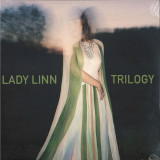
It is no longer a secret that Lady Linn has a very rich and unique voice with a versatility that is second to none, ensuring that she is right at home in a myriad of styles.
She proved exactly that in her new 'trilogy', a series of three E.P.'s - 'I'm Fine', 'Sea of Trees' & 'Nocturne'- each one telling its own unique story, and now bundled on the album 'Trilogy'.
The common thread throughout the album is her affinity with jazz, soul and dance, but also lyrically, various themes return: the tenderness within family life, melancholy, nature, and the magic of the dance floor.
There is also a clear evolution with the arrangements going from a sober, stripped-down quasi-electronic sound of the JX-03 on 'I'm fine' (with contributions from Gustaph, Gregory Frateur and producer Frederik Segers) to dreamy and warm analog synths by producer Joris Caluwaerts on 'Sea of Trees', to an organic, energetic sixties sound on 'Nocturne' with starring role for her partner and bass player Filip Vandebril and partners in crime: The Magnificent Seven, arranger Frederik Heirman and producer Jan Chantrain.
In addition to a selection of the three EPs, 'Trilogy' also includes the extra song 'Hurricane', one of Linn's personal favorites, recorded at Daft Studios with The Magnificent Seven:
'I had just watched a documentary on Laurel Canyon (on the topic of Los Angeles - the epicentre of the 'counter culture' or better 'hippie culture' - in the late 60's and early 70's and the habitat of The Mamas and the Papas, Frank Zappa, Jim Morrison, etc.) which fed my fascination for the 60's that I already had thanks to my parents. The way in which music was created and recorded in that era is a dream for every musician, me included. With the surplus in time due to the lack of gigs during the pandemic the time was right to follow my dream and record in the Daft Studios with my own band. I felt a bit like Carol King behind my piano, but I was also inspired by Joni Mitchell.'
A quote from the lyrics of 'Hurricane': 'I wanna feel the wind like the birds outside/Dive like a seagull, enter the water from flight/Into the deep I slide'.
'A very personal song about losing yourself and the longing for freedom. I composed this one specifically with 60's songs in mind, with loads of modulations and pretty complex chords.'
Lady Linn wrote a versatile trilogy, inspired by a diverse set of influences that had her digging in music history in a very original and contemporary way. She also made her mark on the sound of the productions. On both 'I'm Fine' and 'Nocturne' she was co-producer.
Search:electro one
Swedish drone alchemist Mats Erlandsson is sitting in a fictional room on ‘Gyttjans Topografi’, imagining a virtual chamber orchestra using zithers, tapes, double bass, harmonium, organ, and various synthesisers to draft a treatise on alternative tuning and non-normative harmonic structures. Transcendent material.
“The music on this recording is performed by a kind of fictitious chamber ensemble situated in an imaginary room outlined by textures that alternate between gestural foreground and passive landscape. The three pieces contained within this release are tied together by sharing similar harmonic material and instrumentation and could ideally be perceived as parts of one long performance stretching through the two sides of the record. The textural room in which this musical performance operates is unreliable, unstable, constantly shifting in size and activity from sparse and open to dense and claustrophobic. Inside this non-euclidean performance space a chamber ensemble made up of zithers expanded through analog tape transposition, harmonium and organ, double bass, digital FM, feedback-convolution and Serge modular synthesizer perform a music made from justly tuned intervals arranged in a way that blurs the distinction between traditional minor and major tonal harmony in favour of harmonic progression within an essentially modal framework.
‘Oxidationstabell för Hytta A’ unfolds the harmonic material slowly in three sections where individual lines move independently initiated by the attack of the zither while the textural properties of the room shifts and shimmers. ‘Törnar’ forms a dense harmonic counterpoint where lines built from the same intervallic relationships gradually shift the balance from one spectral focal point to the next while the textural-spatial elements move under pressure and permeate the harmonic layers. The double bass heard on this piece was performed by Yair Elazar Glotman.
The whole of Side B is made up of one piece - ‘Sänka’, using a series of chords made from harmonic inversions of a single set of intervals as an anchor, or synchronisation point, for voices gliding towards, or away, from their designated goal as parts of the harmonic structure of the piece. In addition to the harmonic and textural layers previously present, a third percussive voice is present here whose rhythmic material is intimately tied to the intervallic relationships present throughout the record.
The material used to make these pieces included non-harmonic sounds and contaminated field-recordings that have gone through a sort of feedback process between digital and analog, or acoustic, processing where the recordings were edited, processed and re-amplified and recorded again in acoustic spaces to shape their character and imprint acoustic identities on the recordings. The tonal instruments were treated in a process analogous to this - harmonic material built from recordings and digitally generated synthesis recorded, transcribed, rearranged and overdubbed again with additional electronic or acoustic instruments to form a composite electroacoustic instrumental sound.
Mats Erlandsson is a composer and musician, part of the vibrantly reemerging field of drone music in Stockholm, Sweden, associated with practices characterised by the extensive use of sustained sound. Erlandsson presents his work both as a solo artist and in collaborations, most notably together with Yair Elazar Glotman and Maria W Horn.
- A1: B.e.f. Ident (0.34)
- A2: The Optimum Chant (4:11)
- A3: Uptown Apocalypse (3:11)
- A4: Wipe The Board Clean (3:47)
- A5: Groove Thang (4:07)
- A6: Music To Kill Your Parents By (1:26)
- B1: The Old At Rest (5:37)
- B2: Rise Of The East (2:53)
- B3: Decline Of The West (7:11)
- B4: A Baby Called Billy (4:02)
- B5: Honeymoon In New York (2:16)
- B6: B.e.f. Indent (0:36)
The first reissue of seminal early 1980's electronic recordings from the British Electric Foundation (B.E.F.), aka HEAVEN 17 / ex-THE HUMAN LEAGUE's Martyn Ware and Ian Craig Marsh, with Adi Newton (CLOCK DVA / THE FUTURE), and John Wilson (HEAVEN 17), originally a cassette-only release (1981).
Following two groundbreaking albums ('Reproduction' and 'Travelogue'), the original line-up of Sheffield-based The Human League split in half in late 1980. The two primary musicians in the group, Martyn Ware and Ian Craig Marsh, formed a new production company - the British Electric Foundation (B.E.F.) - and signed a deal with Virgin Records to write and produce up to six albums a year. The artists they were to produce would include Heaven 17, their own new band formed with vocalist Glenn Gregory.
B.E.F. would also release their own material, commencing with the music on this collection, which was issued in various permutations in 1981-82. Its initial release in March 1981 was a limited edition numbered eight song cassette entitled 'Music for Stowaways', with 'Stowaways' being a reference to the original name for the then-new Sony portable cassette player - later renamed the Walkman - of which B.E.F. were great fans. 'Music for Stowaways' was intended to be listened to on such a device. The cassette was followed by a seven song LP, 'Music For Listening To', which had a slightly different tracklisting, while other B.E.F. music was utilised for B-sides of early singles by Heaven 17.
This music was among the first recorded by Martyn and Ian directly after their departure from The Human League. Some tracks had evolved from other recordings they were working on at the time, such as 'Groove Thang' - an instrumental version of the debut single by Heaven 17 - and 'The Old At Rest', which derived from a version of 'Wichita Lineman' by Jimmy Webb, their very first recording with Glenn that would subsequently appear on B.E.F.'s 'Music of Quality and Distinction, Volume One' covers album in 1982.
Supporting musicians on 'Music For Stowaways' included Adi Newton of Clock DVA (who had been a member of The Future with Martyn and Ian pre-Human League) on the track 'Uptown Apocalyse', with John Wilson (who provided incredible guitar and bass for Heaven 17) appearing on Groove Thang.
The innovative sounds heard on 'Music For Stowaways' were an inspiration to many aspiring electronic artists. In 2015, Uncut magazine included it in a list of the '50 Greatest Lost Albums of All Time'.
Spatial & Co Vol. 2 may well be the best album in the Spatial & Co series. It's absolutely flawless. Again created by French disco lord and Arpadys maestro Sauveur Mallia for French library label Tele Music in 1979, it leans far more into the space disco sound than the clean cosmic funk of its predecessor. And it's all the more thrilling for it.
Wide-eyed opener "Discomax" is starts as pure piano-disco brilliance with a bassline to die for before heading off into wigged out territory, all acidic squelches and jaw-dropping percussive breakdowns. Perfection. "Space People" follows, an eerie, half-beatless sci-fi synth workout played out against a hauntingly metronomic pulse for the first half - proper slow-mo space disco business - before the beat kicks in, the electric guitar solo wails beautifully and the bassline that emerges at its conclusion rides in on some other shit.
Closing out the A-Side, the six minute long "Bass Power" is, unsurprisingly, a deep, low-end roller with head-nod drums, whizzing synths, blissed out ambient vibes and Mallia's otherworldly bass playing super high in the mix. It's white hot funk, make no mistake, and it sounds like a re-geared library version of Roxy Music. Yes, *that* good.
Side B is laced firstly by "Holidays Morning", an emotional disco-pop groover, all electric guitars, skipping drums and synthy bleeps with more than a few moments of pure driving funk.
One for the deep heads, longtime favourite "Electric Maneges" follows, a bleepy, haunted dancehall gem, uncut tropical balearic-funk from another dimension. The sophisticated digi-soul of "Loving Discovery" comes on like a weird, interplanetary Sade instrumental, all swelling synths, warm keys and syrupy guitar rhythms. Hearing is believing.
Arguably saving the best til last, the fierce, proto-techno of "Exotic Guide" closes out this extraordinary set. The intro genuinely sounds like Detroit would a good few years later - just wild - before it glides into a driving percussive funk break complete with both stabbing, insistent synths and those of a more winding, laconic variety. The one complaint? It's over far too soon. Remarkable.
Sauveur Mallia is a crucial figure in the history of electronic and dance music and a hugely underrated French library bass player and composer from the Arpadys / Voyage crew. This is just the beginning of Be With's Mallia - Tele Music reissue campaign!
The audio for Spatial & Co Vol. 2 has been remastered by Be With regular Simon Francis, ensuring the punch of Sauveur's bass and those sick drums come through to the fullest. Pete Norman’s expert skills has made sure nothing is lost in the cut whilst the original and iconic sleeve has been restored here at Be With HQ as the finishing touch to this long overdue re-issue.
Roadburn festival is arguably the world's most cutting edge boutique music festival out there, and has been a fertile breeding ground for innovative acts from a broad spectrum of musical genres for many years. Last year saw the unique collaboration of Danish electro-industrial duo John Cxnnor and Hungarian doom-folk artist The Devil's Trade take the stage to deliver a sonic journey into the void of deep space. Today, we are ex- cited to release this iconic set on vinyl to immortalise this one-time convergence of three akin artistic minds. John Cxnnor is made up of one half of Danish sci-fi-sludge metal juggernaut LLNN and sees the brothers Rasmus G. and Ketil G. Sejersen collaborating with numerous fellow artists to explore the synth side of their main project. Inspired by the Terminator-franchise and the scores of other sci-fi movies, the Sejersen brothers have been creating menacing industrial electronic opuses, the frst of which a crushing rendition of a The Devil's Trade track. "We've been enjoying the music from The Devil's Trade for quite some time now," commented the duo on the release of «Dead Sister Merope», describing it as "an interesting match of musical expressions formed by the same DNA." Indeed, the haunting atmospheric folk compositions of The Devil's Trade mastermind Da'vid Mako' carry a similarly cavernous quality which, when taken to the stage of Roadburn, is only reinforced by the sonic violence of John Cxnnor. Unlike many other live records, this set is captured and excellently produced down to the finest level of detail. On centrepiece «Lullaby», the trio seem to have perfected their definition of heaviness, with heavy bass blasts beyond anything you've heard before booming from the speakers. Together John Cxnnor and The Devil's Trade reach new heights in their respective trades capturing both the pressing darkness that gathers `round a bonfire at night as well as the void darkness of deep space. FOR FANS OF Author & Punisher, Godfesh, Lustmord, LLNN, The Devil's Trade, The Body, Uniform Ltd Gold (single colour) edition!
DAFNE VICENTE-SANDOVAL - MINOS CIRCUIT (2021)
Minos Circuit is the resonance of a double exploration, that of an instrument, the bassoon - an instrument dear to Dafne Vicente-Sandoval - and that of a listening, of a gaze, almost. The first exploration deconstructs the instrument, tearing it apart, reducing it to an archipelago of sound bodies stimulated by an electro-acoustic device that generates feedback and infiltrates each part of the bassoon, in order to carry out a methodical, systematic examination. The second exploration is the inner one of attention and listening, the one that measures, at each moment, the necessity or not of an intervention in the very act of the musical work, of this subtle balance that is established between composition and observation, between action and contemplation.
(fr) Minos Circuit est la mise en résonance d’une exploration double, celle d’un instrument, le basson — instrument cher à Dafne Vicente-Sandoval — et celle d’une écoute, d’un regard, presque. La première exploration déconstruit l’instrument, le met en pièce, le réduisant en un archipel de corps sonores stimulés par un dispositif électroacoustique générateurs de larsens qui vont s’infiltrer dans chacune des parties du basson, pour en faire l’examen méthodique, systématique. La seconde exploration, c’est celle, intérieure, de l’attention et de l’écoute, celle qui mesure, à chaque instant, la nécessité ou non d’une intervention dans l’agir même de l’œuvre, de cette bascule subtile qui s’établit entre composition et observation, entre action et contemplation.
LARS PETTER HAGEN - TRANSFIGURATION 4 (2018)
Both a “meditation on musical ruins” and “a study of the material of Richard Strauss’s Metamorphoses”, Transfiguration 4 works on the musical fragment as an expressive and poetic possibility that can be deployed below or beyond simple musical syntax, a syntax that is still too often equated with music itself. What Lars Petter Hagen highlights in this remarkable work is that the power of music lies at its fringes, that is, at the edge of its own disappearance. Transfiguration 4 floats in a particularly moving way in these troubled lands, where nothing is ever resolved, and where everything, however, is suspended, like a stream of blurred memories that memory would summon to form an intuition. A musical intuition.
(fr) A la fois « méditation sur les ruines musicales » et « étude du matériau de Metamorfosen de Richard Strauss », Transfiguration 4 travaille le fragment musical comme possibilité expressive, poétique, pouvant se déployer en-deçà ou au-delà de la simple syntaxe musicale, syntaxe encore trop souvent assimilée à la musique même. Ce que met en lumière Lars Petter Hagen dans cette œuvre remarquable, c’est que la puissance de la musique se situe à ses franges, c’est-à-dire aux lisières de sa propre disparition. Transfiguration 4 flotte de manière particulièrement émouvante dans ces contrées troubles, où rien jamais ne se résout, et où tout, pourtant, se suspend, comme un flux de souvenirs flous que la mémoire convoquerait pour former une intuition. Une intuition musicale.
Liberation is the latest evolution by David West, a dedicated underground dweller and traveler with his groups Rat Columns and Rank/Xerox and previously spotted in Lace Curtain and Total Control. Many familiar elements of West's songwriting creep out from the speakers this time around, albeit in a sonically more adventurous and personal manner. Swathed in analogue and FM synths, pinned down by near-funk drum machines, and with a vision expanded into the past and future. While in previous incarnations, West's alienated and fragile vocal has battled with jangling guitars and distortion, Liberation sets free his woes and ruminations into space. Taking inspiration from the heyday of Mute Records, the beginnings of electronic dance music's rudimentary sampling, broken and sound art, Liberation's debut LP is 10 songs of the road, about the nameless ghosts on the highway, accidental lovers, the alienation of the stranger in a strange land, the unbearable weight of freedom.
Beginning with a curveball, Liberation's first vocal sets out the position of the forever-cuckold, the sad lover hanging on: Looking For A Lover combines a Roland 707's loping mid-tempo with creeped-out synth lines as West intones his intentions close to the ear. Continuing in a more baroque manner, Move Me makes astounding use of string samples and space, with esteemed engineer Mikey Young's (Total Control / Eddy Current Suppression Ring) production prowess making for a distilled yet inviting loneliness. Forget is the night-drive centerpiece of the album, a 7 minute that erupts into a nihilistic sub-disco darkness. A constant theme of Liberation is the friction between West's characters: a frustrated love in victim-status paired with a menacing intent. The adorable, fragile stalker in the moonlight, illuminated by Whatever You Want, a
subjugated protagonist offering they have while the city burns. The brightest pop moment of the album has this in abundance: Cold And Blue, a classic synth pop jam to be played on repeat til the end of time, like New Order played by one man in his bedroom, with no drugs for a cushion, coming down the stairs, she looks like a perfect fear and Im a monument to your existence. But West has moments of touching sincerity that speak direct to the listener, as in album highlight Leaves Falling; a sparse string arrangement frames his vocal, "why do I keep falling for you I must just really like to be alone." Liberation is the freedom from attachments, about how sometimes they're what you want most.
Highly Limited one off pressing of this new Lolina collaboration on her own Relaxin Records.
L4b is the "electronic", "experimental" ,"lots of sounds", "Jazz without instruments", "instruments without jazz", "without jazz instruments" collaboration of Brandon Juhans and Lolina. Other "experimental" albums by Brandon Juhans are Essential Dread (2020) and releases as Hanz; more "lots of sounds" by Lolina include Face The Music (Relaxin Records, 2022), previous projects Inga Copeland, Hype Williams.
Since its beginnings, Hypnótica Colectiva has always shown a special interest in the music recorded and released in the city of Detroit.
A place with which we have both a blood and spiritual bond because of what occurred there socially and artistically during the 20th century.
This love led us to become ambassadors of what was happening there on a musical level, holding cultural events to screen documentaries translated into Spanish, as well as a number of themed sets at our events, dedicated motor city sections in our record shop or recently lectures on the history of the city and its music at the Museum of Illustration and Contemporary Art of Valencia (Muvim).
The time has now come to bring all this history, this musical influence, to the editorial section of our label HC records.
Detroit Legacy was born from the idea of capturing these influences on vinyl. Seeking artists from all over the world who share this passion that inspires them to create their music, what we can define as the universal Neo-Detroit.
For this first edition or first volume, the collective has enlisted in its ranks creators affiliated to the label who have shown us in their careers, this influence and this feeling.
Paul Cignol opens the record with Distance. From Dublin he offers us a track of warm sequences inspired by Deep Techno, with deep pads responding to organ keys and a subtle touch of 303.
Mallorcan LLuis Barcelo Sureda is responsible for the second track Funk Station. With a Techno Soul character that we might hear from Detroitish labels like Acacia or producers like Blake Baxter.
A real eminence in Techno is the Catalan Don Alex Martín, who already released in the mid-90s on Monssieur Garnier's label (France Communications). The Barcelona native brings his wealth of experience and wisdom through Megatech, which transports us to the spectrum of Derrick May’s Transmat who, in his day, was nicknamed "The Innovator". This track provides agile sequences of complex syncopated rhythms, combining with a dreamy Michigan style synth.
The anthem of the album comes from Ghent. The sublime Belgian creator, Mariska Neerman, once again makes our hairs stand on end and our hearts melt with a heavenly composition entitled Stellium.
No one interprets Neo-Detroit quite like Mariska, whom we baptise as a sovereign heiress of the genre in the world. If we have to think of an influence for this piece, we go straight to the genius of Detroit, the one and only Jeff Mills, in his most symphonic and harmonic facet of tracks released on his label Axis Records such as "The March", A Universal Voice That Speaks To All That Will Listen or A New Found Sense Of Being.
Some of these songs have been re-interpreted by world class philharmonic orchestras such as the Montpellier Philharmonic Orchestra at the 2005 Blue Potential (Pont Du Garde). Mariska's score in this song fuses organ keys with harmonic layers and violin - favourite instruments of the Detroitian extraterrestrial - with a harmonic result of strength and hope. An authentic anthem of classic emotional Techno.
Old School electro takes centre stage with the Master from Terrassa Ivan Arnau a.k.a. Dark Vektor. In the influence of Juan Atkins (the creator) as Cybotron or Model 500 and later creators who developed this sound like Aux 88. Metaverso Frik is a great recital of a urban poetry created and interpreted by Ivan, to completely devastating effect.
Croatian Bojan Jascur a.k.a. N-TER, closes the vinyl with We Will Emerge, in a exercise of vindication, a common weapon in the context of Detroit music. Raging, trippy electro in the purest style of Cosmic Force or Dynarec.
This first tribute to 8 Mile doesn't end with the vinyl, as 2 digital bonus tracks are included in the release.
We return to Barcelona with Pastin Futon in another sequence of consecutive oscillated rhythms oscillated much like Kevin Saunderson (The Elevator) in his day and the Techno Groove that we know today.
The most robotic touch of the release is the closer with this synthetic jigsaw puzzle of a track with echoes of the 1967 Detroit Riot, the Detroit Rebellion. Again produced by another Barcelona native, The Bandit (Dj Spy / Util Records). The sequences are very reminiscent of Arpanet and Drexciya.
The idea for the cover comes from Motor City itself by Jon Yowell, first cousin of HC records founder and head of HC records David Verdeguer.
Born, raised and a lifelong resident of Detroit, Jon is an enormously talented musician capable of writing lyrics, performing them on the mic and manipulating a number of stringed instruments as well as the drums, where he is a true master.
The cover is a tribute to the formative backgrounds of many of the city's musicians in every sonic trend. Wayne State University in the capital of Michigan.
Founded in 1868, it has offered didactic teaching to many of the city's musicians.
Not all of Detroit's creators went to university, and even less so when talking about Techno, many artists are self-taught or learned in a non-academic way, but it seems to us a good base to begin to highlight the origins of the city's music in a historic building, where those who have the opportunity to learn about music have been and continue to be educated.
The adapted designs are the work of our image manager Dani Requeni.
Mastering by Steve Voidloss at Black Monolith Studios in London (UK).
An intergenerational meeting of minds, Galaxy is the first collaborative EP from Meanjin, Brisbane musicians Sam Poggioli aka Sampology and Charlie Hill. Equal parts brain dance and body music, Galaxy’s seven tracks represent a vivid intermingling of 70s jazz-funk, fusion, machine-funk, Latin house and broken beat, accented by flourishes of minimalist composition. Considered as a whole, it evokes the possibility and potential of a space-age future where technology and nature exist in simpatico.
One of the most in-demand young jazz drummers in the Meanjin (Brisbane) music scene, Charlie started producing electronic music on his laptop three years ago. It was a vibe shift that hit him after several months spent immersing himself in Europe’s jazz and electronica scenes on the eve of the global coronavirus pandemic. After returning home, he approached Sam about recording some music together.
Sam, a well-travelled Australian DJ, producer and Worldwide FM radio host, was cautious about starting a new side project. However, when he heard his demos, he realised Charlie was blending rhythmic fundamentals he’d learned while completing a music degree with a beautifully wide-eyed approach to jazz-tinged electronica.
With Charlie on drums and Sam on MPC, they set about recording the songs on Galaxy, along the way discovering Sam’s mother taught Charlie visual art as a child. They also learned that Charlie’s mother plays with Sam’s father in the Queensland Symphony Orchestra, synchronicities which made their collaboration feel like it was meant to be.
As part of the Galaxy sessions, Sam and Charlie collaborated with fellow Australian vocalists Tiana Khasi and Merinda Dias-Jayasinha. On ‘Constant Call’, Tiana threads neo-soul/modern soul melodies through a backdrop that sounds like Burial on a future jazz tip. ‘Merinda’, on the other hand, sees Merinda laying a repeated Steve Riech-style vocal refrain over a man/machine instrumental accented by stargazed synths.
At the same time as they were creating Galaxy, Charlie was also busy recording his debut solo EP Yore, both of which are due for release in August 2023, respectively, through Middle Name Records.
Since the beginning, space and the sound of it has been one of the cornerstones of Tapani Rinne and Teho Majamäki's music. The two previous albums contain meditative music recorded in acoustically interesting and atmospheric locations - temples and caves in India, as well as deep underground in the railway tunnels of Helsinki's metropolitan area.
With the new album, the musicians wanted to keep outside factors to a minimum and record compositions in controlled studio conditions. In this way, different spaces can be created electronically afterwards into the works. Aleksi Myllykoski and Mika Kalmi are responsible for mixing and post-production. The tracks are based on Teho's metal percussion instruments and Tapani's woodwinds.
In the finished pieces, the duo went towards free musical dialogue, in which the boundaries between improvisation and composed music become blurred and insignificant. Instead of listening to the sound of the space itself, musicians tuned in to listen to the vibration of the metal and wooden instruments. ”We focused on sensing the mutual resonance of the instruments and the sensitivity of the improvisation. A presence on the border of familiar and unknown.” Says Tapani and Teho. The recordings took place in Kitee, Eastern Finland, near the Russian border. The location and way of working gave birth to the name of the record - On The Border.
Limited Edition COLOR green lime Vinyl – 75 units Hand numbered
Orlando Voorn is a Dutch DJ and electronic music producer. As a solo artist he has released work since the early 80s under a large amount of aliases containing Balance, Frequency, Baruka, Basic Bastard, Fix, Dope Dog, Boy, Stalker and The Nighttripper. He also produced tracks with Blake Baxter under the name Ghetto Brothers and with Jeff Porter as Designer Loops.
Voorn won the Dutch DMC DJ Championships in 1986 which meant the beginning of a large number of released tracks. As a professional DJ he released his first club tracks under the record label Lower East Side Records. Together with Detroit techno music pioneers Juan Atkins, Derrick May and Blake Baxter he produced tracks under various labels. Voorn's music is characterized by its variety of styles such as Techno, Drum n bass, Ambient, Hip hop and Electro. By many people Orlando Voorn is considered the first one to establish a connection (in music) between Detroit and Amsterdam.
Following up his score for the japanese Netflix Anime series “Carole & Tuesday”, Mocky returns to album mode with his new orchestral opus “Overtones For The Omniverse”. Just days before the first Covid lockdowns, Mocky brought a 16 person orchestra comprising of his usual who’s who of underground talent into LA’s Barefoot Studios (and into the same room where Stevie Wonder recorded “Songs in the Key of Life”) to record a pile of scores he had come up with during his previous year’s sabbatical in Portugal. The result is a stunning orchestral album recorded in 36 hours in one or two takes straight off the written page. Shunning the “possible perfection” of today's recording techniques, Mocky looked back as a way to find an alternate future.
According to Mocky:
“We had to do it quick with no rehearsal to capture that big open sound of people working together in a room - in all its imperfect glory. In the imperfections you find the humanity. And in today’s tech driven spaces you have to fight to preserve a space for humanity. I felt a deep desire to create a sonic trajectory path for us to follow as we ascend and evolve our understanding of love and what it means to be human. This is the inspiration for „Overtones for the Omniverse“”.
The album runs the gamut from Steve Reich infused minimalism overlaid with Dorothy Ashby style harp runs (“Overtures”) to atonal analogue synth sounds over Martin Denny style percussion (“Bora!”). There's a classic Mocky crooning number that gives a Jim Henson-esque take on the state of “Humans” and the album as a whole captures Mocky's skill of bringing together the joyful energy of a unique cast of LA collaborators.
Featuring:
Randal Fisher / Flute, Vicky Farewell / Piano, Vocals, Harry Foster / Bass, Vibraphone, Tubular Bells, Vocals Joey Dosik / Organ and Glockenspiel, Vocals, Guilermo E. Brown aka Pw / Percussion, Vocals, Jhan Lee Aponte (TossTones) / Percussion, Vocals, Timpani, Paul Cartwright / Violin, Molly Rogers / Viola, Gabe Noel / Cello, Contrabass, Liza Wallace / Harp, Coco O. / Vocals, Mocky / Compositions, Drums, Vocals, Roland Sh-1000
O for the O Choir :
Nia Andrews, Leslie Feist, Moses Sumney, Durand Bernarr, Eddie Chacon
Recorded at Barefoot Studios, Los Angeles March 6 + 7, 2020.
All songs written by Dominic “Mocky” Salole and published by Heavy Sheet Music/Warner Chappell except "Wishful Thinking" written by Dominic “Mocky” Salole and Matt Corby and "Bora!" written by Dominic “Mocky” Salole, Guillermo Brown, Aponte Poro.
Produced by Mocky, Justin Stanley and Renaud Letang. Mixed by Renaud Letang at Ferber Studios Paris
Mastered by Emilie Daelemans. Cover artwork by Rand Sevilla. Photo by Vice Cooler.
ABOUT MOCKY
Performer, producer, songwriter, composer and multi-instrumentalist, Dominic "Mocky" Salole came to prominence in the Berlin electronic scene of the mid 2000s, releasing three acclaimed solo albums, co-writing and producing classics like Jamie Lidell's "Multiply" and Feist's "The Reminder" and making waves on stage with close collaborators (and fellow Canadians) Peaches, Feist and Chilly Gonzales.
In 2009, his music took a jazz-inflected turn to the acoustic with the release of "Saskamodie" and in 2011, after work in Big Sur on Feist's "Metals", Mocky relocated to Los Angeles, where he quickly established himself as a co-writer with uncommon credentials and eccentric working methods collaborating with L.A.’s brightest breakthrough artists like Kelela, Joey Dosik, Vulfpeck or Moses Sumney.
Whilst in L.A. songs he has written have been sung by Mary J. Blige, Jill Scott and many more and he has collaborated with artists as diverse as Mali’s Bassekou Kouyate and the GZA. His monthly rooftops gigs at the ACE Hotel breathed new life into the LA live scene and Mocky channeled those new creative energies into his fifth full length album "Key Change" and four digital mixtapes/EPs "The Moxtapes" Vol. I-IV.
After co-producing and co-writing Feist's "Pleasure", Kelela's "Take Me Apart" and Joey Dosik's "Inside Voice", in 2018 Mocky released two albums: "Music Save Me (One More Time)" - a collection of the best of Japan-only/unreleased gems and favorites from his so far digital only "Moxtapes" series and "A Day At United", an instrumental jazz album, recorded in a single day in the legendary LA recording studio United Recording.
In 2019 Mocky delved into soundtrack work by collaborating with legendary Anime director Shinichiro Watanabe (Cowboy Bebop) on the first two seasons of the breakthrough show “Carole and Tuesday” (Netflix) for which he won Best Score at the Anime Awards 2020.
TEN. KR3 marks the double-figure release, starring David Foster: the man behind the Huren project, which has been churning out influential tracks for the past three decades. Blood Fire Debt – has been described by David with one word: ‘survival’. Indeed, in this tenth release we rediscover an already legendary artist of the power electronics scene, in his most honest and consistent form. Expressing himself through cinematic-noise, harmonised by dark drones and slo-mo rhythms. Still navigating through the chaos, this ride will take us back to the 90s, thanks to the presence of a track (B2. Mytologinen) produced in those years. There will be a unique insert with the HUREN portrayed under one of the twin towers. Written & Produced by David Foster Mastered and Vinyl Cutting by: Tim Xavier at Manmade Mastering Berlin
From 1985, the beginning of their collaboration in Amsterdam, Peter Bosch and Simone Simons have been involved in performances, concerts and theatre productions. Since 1990, however, they have focused in particular on the development of autonomous music machines.
All these machines are dynamic: Sound and movement are constantly evolving. »Krachtgever« is their best-known piece for its Golden Nica, received at Prix Ars Electronica, Linz, 1998. The other projects on the LP are »Cantan un Huevo«, commissioned by the Ives Ensemble in 2000 and awarded in 2002 at the 29th edition of the International Competition of Electroacoustic Music and Sonic Art, Bourges, France, and one of their first installations, »Was der Wind zum Klingen bringt«, from 1989/90, shown in the Stedelijk Museum, Amsterdam, 1990, as part of the exhibition »Energieën«, and in 1991 at the Multimediale 2, Z.K.M., Karlsruhe. The LP demonstrates that sound produced by the Bosch & Simons music machines can also be listened to as autonomous »music«.
Eliott Litrowski and Voiski’s could have done so 15 years ago, after a first meeting in Paris on the Island of Swans, during a ‘Free Party’ event shut down by the police. But it didn’t. Each one followed his own way, and if their paths crossed many times, they only began collaborating in 2021.
Cracki Records’s 10th anniversary Compilation was the trigger: the two artists locked themselves in the studio to create what has become since their signature sound: The Friendship Spacecake, a perfect alliance, driven by their common love for analogic synthesizers, between Eliott Litrowski’s hybrid electro and Voiski’s post-trance.
Neither of them wanted to stop at this stage. One is living in Copenhagen, the other in Paris, yetcreating an album together quickly became the next obvious step.
This common desire led to the beginning of the suitably called Superski duo: a great name that encapsulates both artists’ committed live performances, their unusual musical language, between electro, trance and Italo, and their vision of an uncompromising, colorful and positive club culture.
Oberheim 6, Jupiter 8, TR808, Roland JX8P, Microwave XT and FutureRetro XS, all synthesizers are limitlessly pushed to their last breath, creating an almost retro-futuristic decor for the artiststo evolve in.
Their debut album “Mondo Moderno” will be out March 31st
French techno titan Madben unveils his much anticipated ‘Troisième Sens’ LP on Maceo Plex’s Ellum Audio.
Madben started absorbing the techno of Jeff Mills, Dave Clarke and Speedy J in the 90s, growing up in Lille in northern France. He retains a passion for DIY culture and warehouse parties thanks to youthful raving at Brussels' Fuse, Gent's Kozzmozz or in abandoned factories in Courtrai. All this has shone through in his music, including a debut album on Astropolis in 2018 that featured a collaboration with Laurent Garnier and a recent EP for Garnier and Scan X’s label.
Over the last decade, he has become a European club and festival favourite playing places like Berghain and Awakenings. His studio boasts a fine array of machines utilised to full effect on this latest opus. ‘Troisième Sens’ perfectly reflects what the artist has always loved, listened to and played, keeping one eye on the dance floor but never at the expense of musical narrative. It’s a genuinely progressive, multi-genre body of work that allows listeners to fully immerse themselves in the seemingly limitless depths of the Frenchman’s sonic capabilities.
He says, “Over the years, I learned to have more fun with the gear in my studio, and this has been the result. The album took three years to finish; I started in an underground basement studio in Paris before moving to Nantes. Therefore, it may surprise listeners with such a diverse selection of moods. It's dark in places but happy in others.”
'Departure' kicks off with uplifting synth work and broken techno beats that have a celebratory feel. 'Addicted' is a lithe cut with steamy vocals and a more fulsome combo of drums and bass, while 'Circuit Breaker' cuts loose in the cosmos. Acid wobbles, smeared synths and metallic percussion all make for a bouncy cut before 'Fade In Fade Out' continues the cosmic trip with vastly oversized synth patterns that will light up a dark space with overwhelming euphoria.
The brilliant 'It's 1 am In A Rave' is a dark, heads-down banger with 'Lost Memories' then layering up melancholic synths and Plastikman-style drum loops into something full of deep thought. There is no let up with the superb acid techno gymnastics of 'No fear', and 'The March' is a turbulent mix of sheet metal synths that whip about over steel-plated drums. 'You Dance Like A Robot' is end-of-the-world electro with a menacing robot vocal, and the electro tip continues with expert drum programming and menacing leads on 'Deep In The Jungle'. 'Meta' is a flailing rhythmic workout that sounds like the machines are in meltdown, and 'I Made A Dream During This Nightmare' is a serene techno soundscape for ruminating about the future of the human race.
Intelligent yet immediate, impactful but emotional, ‘Troisième Sens’ is another standout techno record from Madben.
- A1: Courageous Grieving
- A2: Girl Dick
- A3: Butterfly Drinking Blood
- A4: Cry Gold
- A5: That Was For Luck
- B1: Pixie Ring (Feat Diana Starshine, N Hell & Junior Astronaut)
- B2: Elf Fetish
- B3: Girl Dick (Seth Graham Remix)
- B4: Cry Gold (Giant Claw Feat Tamanaramen Remix)
- B5: Pixie Ring (Feat Diana Starshine, N Hell & Junior Astronaut - Swan Meat Remix)
Unseelie is celebrating the one year anniversary of goddexx by galen tipton, an Ohio-based electronic producer who continues to push boundries in the world of pop experimentalism.
Since releasing goddexx last year, galen has appeared as a guest on Rinse FM, contributed a mix to TANK Magazine, interviewed by PAPER, and featured on The Needledrop's Best of 2021 Spotify playlist as well as Anthony Fantano's official YouTube Channel.
goddexx was instantly met with positive reviews upon its release, with Our Culture magazine giving it 4/5 stars and saying "goddexx rightfully claims its own place in today's flourishing experimental music scene".
The EP was written by galen in her homestate of Ohio with cover art by Sam Rolfes. It was originally released on unseelie in Summer of 2020 and quickly became a best-selling release on Bandcamp.
The deluxe edition includes galen's second single on unseelie called pixie ring, and another song of hers called elf fetish that introduce the listener to the next chapter of the goddexx story. The remaining songs on side B are remixes by Orange Milk artists Seth Graham and Giant Claw (Keith Rankin) ft. Tamanaramen, as well as a dancefloor heater by Cologne-based DJ and producer Swan Meat.
- A1: Petit A Petit (Feat Agnès Hélène) 4 20
- A2: Man Bo Diak (Feat Amatah Keo) 5 06
- A3: Femme Qui Danse (Feat Pat Kalla) 4 11
- A4: Bas Les Masques (Feat Charly Sanga) 4 14
- A5: Oh Ma Cherie (Petit À Petit Part 2) (Feat Agnès Hélène & Charly Sanga) 3 39
- B1: Love Is Jokin (Feat Pat Kalla) 4 35
- B2: Metissage (Feat Sana Bob) 4 24
- B3: Kinkeliba (Feat Jy Cooly) 3 33
- B4: Electro Highlife (Instrumental) 5 10
- B5: T’es Haut (Instrumental) 4 18
After Joao Selva, Dowdelin, The Bongo Hop, Underdog Records continue their exploration of the Black Atlantic with IREKE.Ecstatic brass, 70’s keyboards, elastic guitars, round bass and world percussion: from this sonic heritage, Ireke makes a unique fusion, enhanced by the audacious contribution of his dub science, and a few electronic touches
IREKE
Ireke? Sugar cane in Yoruba. Like her, the duo loves tropical climates and intoxicating rhythms, quick to liberate the bodies gathered on a dancefloor. Afrobeat urgency, funk suppleness, dub alchemy, highlife jubilation: with Tropikadelic, Ireke summons the heritage of the masters and the audacity of machines to give life to new sonic territories. At the crossroads. For the love of groove.
From the West, with their ears to the Black Atlantic, Julien Gervaix and Damien Tes- son are both children of the collective and of improvisation, playgrounds for these complete multi-instrumentalists.
The first one puts his talents of arranger-saxophonist at the service of the Nantes collective Soulshine and of numerous formations - in turn funk or rhythm’n blues - where swinging is the rule.This is notably the case of the afrobeat group Walko, in which Julien Gervaix had the honour of sharing the stage and the studio for several years with Kiala Nzavotunga, guitarist extraordinaire for Fela Kuti and Egypt 80. Meanwhile, Damien Tesson was being trained as a dubmaster-guitarist-arranger at the reggae roots school with the digital option of the Vendée collective Shi Fu Mi Temple.This initiation led Damien Tesson to join, among others, the Nantes-based group BIBA (Bingy Band) and then to collaborate with Jideh High Elements, a key figure on the international dub scene, Roberto Sanchez and the team of his Lone Ark Studio, as well as Sana Bob, a famous reggae singer from Burkina Faso.And then, life being well done, the paths of Julien Gervaix and Damien Tesson ended up crossing within the jazz-funk combo Playtime, before meeting again in the Vendée a few years later.
With an obvious tropism for Afro-Latin grooves, tropical colours, electronic tricks and furious swaying, the two musicians create Ireke like a glass of well arranged rum. Here’s to us, here’s to you! As if guided by the spirit of the plant, Ireke toasts the immense richness of these danceable rhythms, true generators of life, connection and energy.
Like Legba, the Yoruba orisha of intersections and crossroads, Ireke thrives in the between worlds.Aware of the lineage of goldsmiths who preceded them, Ireke
knows his classics and humbly draws inspiration for Tropikadelic from the musical genius of Pat Thomas, Poly-rythmo Orchestra, King Tubby,Tony Allen, Fela Kuti, Maître Gazonga, Ernesto Djédjé or the Vikings of Guadeloupe. Ecstatic brass, 70’s keyboards, elastic guitars, round bass and world percussion: from this sonic heritage, Ireke makes a unique fusion, enhanced by the audacious contribution of his dub science, and a few electronic touches patiently flushed out in the studio - which the duo considers as an instrument in its own right.
Finally, to give voice to his compositions, on Tropikadelic, Ireke calls upon an army of serious enthusiasts, each member of which has come up with his or her own lyrics. Thus, alongside Ireke, we find the groove griot Pat Kalla (“Femme qui Danse”,“Love Is Jokin”), the Franco-Laotian reggaeman Amatah Keo (“Man Bo Diak”), the Vendée- based Agnès Hélène (“Petit à Petit”,“Oh Ma Chérie”) and Charly Sanga (“Bas Les Masques”,“Oh Ma Chérie”), the Burkinabè lion Sana Bob (“Métissage”) as well as the Nantes soulman Jy Cooly (“Kinkeliba”).
For the duo, music is above all a collective practice, an active liberation, a rhythmic approach to letting go, a source of communicative joy... In short, groove is the weap- on! And Ireke knows how to use it.
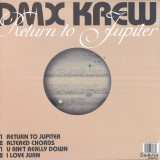
DMX Krew announces his return to Peggy Gou's Gudu Records with a new four-track EP, sharing the dreamy, Detroit-inspired title track, ‘Return to Jupiter’.
The full EP - out 14th April 2023 - will be his second release for the label and Gudu’s first release of 2023, set to be the label’s busiest year yet.
Ed DMX made his debut for Gudu with 2019’s Don’t You Wanna Play? EP, becoming the first artist to release on the label outside Peggy herself. Ed and Gudu have retained a regular working relationship ever since: he mastered Indonesian crate-digger Dea’s ‘Glazer Drum’ release for Gudu, contributed a pair of remixes to the reissue of Riff’s South African electro curio ‘Jacks Jive’, and now returns to the label with Return to Jupiter, a new original four-track EP.
Ed has been one of electronic music’s most respected faces for over 25 years. Debuting in the mid-1990s, he released his first decade of music almost exclusively through Grant Wilson-Claridge and Aphex Twin’s Rephlex label and his own Breakin’ imprint, but recent years have seen him ply his trade across a who’s who of dance music’s most respected underground labels: including Hypercolour, Balkan Vinyl, Central Processing Unit and, of course, Gudu.
Inspired by the futurist funk and vivid synthesiser epics of classic Detroit, ‘Return to Jupiter’ is dripping with richness and colour, driven by the sort of thick analogue basslines and distinctive melodies that have come to define Ed’s catalogue. The EP’s title track sets the tone for what’s to follow, introducing a language of sorts for the record - before ‘Altered Chords’ turns the funk up to 11, ‘U Ain’t Down’ aims its distorted kicks and wiggy, manipulated lead straight at peak time dancefloors, and ‘I Love Juan’ closes the EP on a star-gazing tip.
Founded by Peggy Gou in 2019, Gudu releases music from a global roster of artists, including DMX Krew, Maurice Fulton, Hiver, Dea, Mogwaa, Brain de Palma, Dukwa, JRMS and Peggy herself (including the hits ‘Starry Night’, ‘I Go’ and ‘Nabi’). 2023 will see Gudu’s busiest year to date, with new releases scheduled from the current roster and some exciting new faces.