Reclaiming her original moniker of Kittin, electroclash pioneer - formerly known as Miss Kittin - presents Cosmos, a continuous twelve-track LP of organic, leftfield electronica due 2 November on Dark Entries. Throughout her illustrious career, Kittin has carved a considerable niche for herself, assimilating references from New Wave and 90s techno to form an inimitable sound that resonates with electronic music fans the world over. Despite being most recognizable with 'Miss' before it, Kittin was in fact her original artist name - the prefix often added without her consent at promoter's will and eventually becoming the norm.
Cosmos is her most spiritual release yet, influenced by her time in the French countryside after a bout of touring exhaustion. She gives up any formulas from her past; verses/chorus, pop or club beats, to come to the essence of chords and textures, peeling away the non-essential to find joy in music yet again. In retrieving her chosen name from more than 20 years ago, Kittin also returns to the essence of her musical journey. By liberating herself from the constraints of formal structure she opens the door to a new set of aesthetics, exploring her influences without restraint. Sonically, the voice acts a central instrument, whilst the album drives continuously forward with no breaks, paying homage to her love for ambient and electronica whilst wandering calmly into the unknown. 'With Cosmos everything is energy. We go back to the core with curiosity and freedom.' - Kittin
Buscar:electro pop
- A1: Markus Gibb - Kuru
- A2: C O N T R A - Taurus
- A3: Ben Shemie - A Million Kinds
- B1: Drvg Cvltvre - Last Rites
- B2: Sutja Gutierrez - Allodoxaphobia
- B3: Théo Muller - Douce Transe
- C1: Dave E Brun Vs Frank Agrario - Grace
- C2: Benedikt Frey - Iaon
- C3: Lauer - Pythor
- D1: Bajram Bili - Restart
- D2: Il Est Vilaine - Fahrenheit 451
- D3: Jonathan Fitoussi - Cercles Polaires
- D4: Lumi - Izerditan
In just a year of existence, Chloé's Lumière Noire has brought emerging artists and promising newcomers together - and this first compilation of 13 brand new tracks expands the roster, exposing the label's eclectic vision in full daylight. When Chloé talks about her label, she puts forward the fundamental values that informed her own musical journey, her trust in her own musical taste - and, of course, the predominance of human relationships: 'I followed
my bliss and only commissioned tracks from artists that I respect and whose music I love. That to me is Lumière Noire's musical palette.' With this 13- track, unmixed compilation, Chloé makes a case for a label aesthetic that is based in open-mindedness. Familiar, elemental Lumière Noire artists are represented, as are new faces, producing a kind of group photo presaging what's next for the fledgling label. Lyon's Markus Gibb leads the track listing with Kuru with a deep chiaroscuro matching the label's ethos, followed by other mainstays Il Est Vilaine's Farenheit 451, which evokes Ray Bradbury's retro-dystopic angst with the
band's usual electro-pop elegance. Sutja Gutierrez, who released in debut EP, The Legend of Time on Lumière Noire in April, pursues his electro Shamanism with the ceremonial Allodoxaphobia, while Iñigo Vontier (whose EP Aluxes came out on the label in late 2017) brings his C O N T R A project
online with track Taurus, a further development in voodoo house. Elsewhere, Suuns lead singer Ben Shemie, who lent his fascinating art-rock croon to Recall, a single from Chloé's Endless Revisions LP, contributes A Million Kinds, a synthy, psych-pop debut that is as brilliant as it is surprising. On to the freshman class: Dutch producer Drvg Cvltvre (who gets personal kudos
from Chloé with each new 12') brings the uncompromising dark electro of his hypnotic and claustrophobic Last Rites. Jonathan Fitoussi's airy, minimalistic Cercles Polaires brings the respite of his recent Versatile Espaces Timbrés LP (a collaboration with Clemens Hourrières): 'I met him at Xavier Veilhan's
Studio Venezia at the Venice Biennale. He's a great guy, and his universe is unique,' says Chloé. Benedikt Frey's deep techno track Iaon, is on par with his smash 2017 album, Artificial, out on ESP Institute. First-timers are also part of the recruits: Bajram Bili with the ten cerebral minutes of Restart, Théo Muller with the ultra-deep Douce Transe, and Lumi, a Basque band that fuses
electronic sounds with acoustic instruments, brings the ompilation to a close with a track commissioned by Chloé. These audacious choices are anchored down with the likes of Permanent Vacation pioneer Lauer's hooky, 80s-infused Pythor ('Just like him, I was a resident of the Robert Johnson, and he was a guest of mine at one of my Lumière Noire nights at the Rex. He is one of these people whose music I highly appreciate'); Aergeworc & Franck Agrario, half of English duo Swayzak David Brown's project, weaves an ethno* mood into Grace's techno. Bringing together different generations, genres, and styles That may not necessarily be Chloé's MO. She invokes a more arbitrary, personal logic: 'I like to mix of-the-moment tracks and more timeless one, but the rule is above all 'do I love this or not'. That was my ethos when I started Lumière Noire.' In that way, the label is definitely in keeping with its time
A girl stands at an arcade machine, her eyes fixed on the glowing screen with her back turned on the world. She seems to be alone, somehow lost and yet at one with herself. The cover art (by Carmen Alt-Chaplin) for Peter Zirbs' debut album as a solo artist conveys escapism - being totally immersed in another reality, in the virtual world. His equally futuristic and retro-futuristic aesthetic is permeated with melancholy. What if we really don't exist
Peter Zirbs himself also knows how to escape: how to hunker down in the studio, hide from the outside and lose himself in the music. He emphasizes that such an escape is healing, leading to the world of the romantic. The Viennese musician and producer has always felt most comfortable straddling genres, whether techno and rock in previous band projects, or now as a solo artist combining post-minimalist dramatic synth/piano ("Firmament") with modern wave pop ("Are You Reality") and poignant ballad-kitsch ("Dreamescape"). Here there are subtle changes in emphasis gracing otherwise repetitive harmonies; there a true appreciation of pop. Ten songs - five with lyrics, five without - some threatening, some heartbreaking, all stirring. They project a world - sometimes concrete, sometimes abstract - in which can be found beauty and disquiet, love and fear, failure and perseverance. A world one is happy to get lost in while the cinema in one's head tells its own stories. (by Manuel Fronhofer)
As part of the Viennese rave and techno scene of the 1990s, multi-instrumentalist and electronic producer Peter Zirbs has released music under several pseudonyms, produced and remixed various artists, and scored a range of experimental films. He has broken down genre boundaries over the years with the variety of his output. The circle closes now. In 2018 Peter Zirbs finally steps into the spotlight as a solo artist.
"What If We Do not Exist" by Peter Zirbs is released on 19th October 2018 by Fabrique Records. Guest vocalists include Monika Heidemann (Heidemann, The Phenomenal Handclap Band, The Juan MacLean / DFA Records), Tom Walkden (Wolventrix) and Gerard McNeice.
* Belia Winnewisser is returning to Präsens Editionen with Radikale Akzeptanz. The record is her debut album as a solo artist and it marks her second release on 'the curious label arm of Lucerne's zweikommasieben magazine.'
* Radikale Akzeptanz, a furious amalgamation of (synth-)pop references and more abstract sounds, combines long running traits from Winnewisser's practice in various band projects with rather new interests from her studies in sound art. Thus, bittersweet off-pop-hymns with bubble-y melodies can be found next to austere examinations. Add a good amount of time spent in clubs and you get a Skull Disco-esque banger at the end of this gutsy album.
The title Radikale Akzeptanz—or radical acceptance—stems from a concept in evidence-based psychotherapy. Even more than the concept as such that is about accepting uncompromisingly your situation, however, it is the expression's mere sound that is of interest to Winnewisser. Homey and adventurous, gentle and challenging, at ease with itself and full of tension(s).
Edition of 300copies, artwork (incl. booklet) by Vinzenz Meyner.
Quotes:
'Interesting stuff! It has a surprising bit of post-rock language in it to my ears, just executed with electronics.' - Byron Westbrook (Hands In The Dark, Umor Rex)
'A pleasant listen! Especially 'III,' 'Trapped In My Mind,' 'The View' and 'Albasty.' Also, found that the idea behind the title is weighty to the extent it can be related to relevant issues of today's ways of interaction!' - Arcagelo de Castris (Macao, Dance Affliction)
'Sounds like John T Gast, Caterina Barbieri and Klara Lewis making tunes on a space ship!' - James Marrs of Laura Lies In
'This is really good.' - Hypermedium's Timos Alexandropoulos
Press / Promotion*Airplays on NTS Radio by Flora Yin-Wong, Hypermedium and more, airplay on Radio Raheem by Arcagelo, feature on Noods RadioVarious (release) events upcoming, incl. a show at London's Café Oto, an exhibition in Lucerne and gigs next to Lorenzo Senni, Puce Mary and more.
Premiere of 'WAHDWTH' on Bizaarbazaar.PE / zweikommasieben mailing list = 2000 subscribers
Social NetworkingPräsens Editionen - Facebook = 550 likes / Insta = 500 / Spotify = 350 subscriberszweikommasieben - Facebook = 5200 likes / Insta = 2000 / Twitter: = 680 followers
One of the top drummers in the Israeli scene, Tel-Aviv based songwriter and producer BEÃTFÓØT launches his solo project with the powerful new EP De Vibez, a fanciful gutter-glam cross between stoner-acid-pop and 90's-garage-punk. Side A contains some stunning originals alongside a surprising cover of a melancholic oldie by the legendary german singer Nico. Side B be the remixes: the first, a colorful club-driven remix by Garzen Records head honchos & electronic duo Red Axes, followed by a groovy down tempo drone version by the mesmerizing Smagghe & Cross.
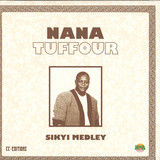
Kalita Records and CC:EDITIONS (a new venture by
Australia's CC:DISCO) jointly announce a 12' EP
comprised of four of Nana Tuffour's greatest electronic
burger highlife tracks, accompanied by interview-based liner
notes. Here, in partnership with Nana, we select two highly
sought-after songs from his 1993 release 'Genesis', namely
'Sikyi Medley' and 'M'Anu Me Ho', and pair them his with two
lesser known yet equally deserving tracks 'Asamando' and
'Jesus' from his 1997 CD-only release 'Highlife Tropicana'.
Hailing from Kumasi, the capital of the Ashanti region in Ghana,
Nana Tuffour is by far one of the most important exponents of
modern highlife music. He studied piano at college and cut his
teeth in the '70s as an organist and vocalist for the incomparable
Kyeremanteng Atwede and Dr. K Gyasi's Noble Kings Band.
Fast forward to 1981 and Ghana was at the apex of its golden age
of music. This era was brought to an abrupt end by political
upheaval when the military took over the government and as a
result a restrictive dusk to dawn curfew was imposed between
1982 and 1984. This resulted in a total obliteration of the country's
night life, and Nana just like many other prominent musicians
including Pat Thomas and George Darko left Ghana for greener
pastures, the most popular destinations being Nigeria and
Germany. The Rheinklang Studio in Düsseldorf run by a young
inimitable German sound engineer Bodo Staiger and another
'exiled' Ghanaian musician Charles Amoah played a crucial role
for those musicians who had chosen Germany. This studio
became the focal point for Ghanaian musicians and the birthplace
of a new sound, now known as 'Burger highlife' - traditional
Ghanaian highlife infused with the more up to date electronic and
disco sounds of the West. It is arguable that Nana has played a
crucial role in Burger highlife and developing the sound of
traditional Ghanaian highlife more widely to what it is today, with
his innovative use of electronic accompaniment pushing its
boundaries to its creative extremes.
It is Burger highlife's transcendence of traditional musical
boundaries that helps make it so accessible to listeners,
appealing not only to Ghanaians back home but now highly
regarded and sought-after by those in the West interested in
more occidental disco and electronic sounds. We hope that you
enjoy the four songs offered here, each chosen to demonstrate
Nana's singular influence on the development of Burger highlife.
The New York Downtown Producer/Composer Returns With His First New Album In 3 Years
EIGHTEEN: the year of release, 2018. EIGHTEEN: the age at which I first used a synthesizer.
In creating EIGHTEEN I worked independently in the studio, initially building up tracks with synthesizers and found sounds recorded in my daily comings and goings. After working with the tracks over a period of months,I shared them with a few musicians, who added their own instrumental layers. Though working independently, we all shared a similar working process: working in our personal recording spaces, as opposed to larger recording studios.
The musicians are: Gabe Gurnsey (drums) of Factory Floor, with whom I collaborated on the Beachcombing EP and performed live at London's ICA. I appear on Gabe's newly released album Physical;
Larry Saltzman (guitar) has played in my Love Of Life Orchestra since the 1970's. Well-known for his work with Arthur Russell ('Kiss Me Again', Flying Hearts), he is in high demand in NYC by acts such as Simon and Garfunkel;
Paul Nowinski, (bass) has played with LOLO since the 1980's. Paul has an impressive list of credits, including Les Paul, Keith Richards, Bernard Purdie and the Boston Pops; Matt Mottel, (electric piano), is the newest addition to the Love Of Life Orchestra. He is half the duo Talibam!, a leading act in the noise jazz scene; Lewin Barringer, (guitar), is a talented guitarist and producer in Philadelphia.
After mixing the final tracks, I brought the mixes to Berlin. There I worked with the brilliant mastering engineer Mike Grinser who helped to give the album a unified sound.
I think of this album as electronic music. It was created in my home studio, using analog and digital synthesizers, found sounds recorded on my phone, and instrumental parts contributed by friends. Finely crafted melodies and harmonies are set against subway noises, street construction, and distant foghorns. Sometimes there are sustained clusters, generated by my leaning against the keyboard. Deliberateness paired with randomness: this is what guided the artistic process.
This album is atypical for me as I am not playing saxophone. (I do play one reed instrument - a harmonica.) I grew up with the sax as my primary instrument. Yet my father was a radio journalist so the reel-to-reel tape recorder was a ubiquitous presence in the family home. From an early age,
I experimented with the tape machine: recording, overdubbing and splicing tape. I learned about Varese from Frank Zappa liner notes; I read John Cage's 'Silence.' Electronic music was on my radar.
My first exposure to an actual synthesizer came when I recorded my first single at the fabled Sound City Studio in Van Nuys, CA. The studio had a custom Neve board, but it also had a firstgeneration Moog modular synthesizer sitting unused in the maintenance room. I asked and they kindly let me experiment with it. Soon, I enrolled at the University of California - San Diego after I discovered they had separate studios for their Moog and Buchla systems. These large modular synthesizers were affordable then only by institutions and rock stars. But these would be soon eclipsed by smaller, cheaper synths in the 70's and early 80's. In the same way, recording studio technology became accessible in the 90's. . And thus the personal computer and digital audio allowed studio quality production in the home studio. Electronic music had become democratized.
Handmade music by way of digital technology: this is the music of EIGHTEEN
The final single in a series featuring regular Ghost Box artists, special guests and one-off projects. This time our guest artist is folk singer, Sharron Kraus with a remix by Belbury Poly on the B side.
'Something Out of Nothing' is a beautifully simple yet profound baroque pop folk song. Kraus sings, plays guitar and synth and is ably assisted by a studio band comprising: Jenny Bliss Bennett on Viola de Gamba & Fiddle, Nick Jonah Davis on Slide Guitar, Neal Heppleston on Bass, Oliver Parfitt on Synths, Nancy Wallace on Backing Vocals and Guy Whittaker on Drums.
Sharron Kraus is a singer of folk songs, a songwriter and multi-instrumentalist whose solo work and collaborations offer a dark and subversive take on traditional music. As well as drawing on the folk traditions of England and Appalachia, her music is influenced by gothic literature, surrealism, myth and magick.
In addition to eight solo albums, Kraus has recorded an album of traditional songs 'Leaves From Off The Tree' with Meg Baird and Helena Espvall (Espers, Beautify Junkyards) written an album of songs to celebrate the seasons of the year, 'Right Wantonly A-Mumming', which was recorded with some of England's finest traditional folk singers including Jon Boden, Fay Hield and Ian Giles. She has also recorded and performed with Ex Reverie's Gillian Chadwick as Rusalnaia, with Tara Burke (Fursaxa) as Tau Emerald and with Irish free-folk collective United Bible Studies.
Jim Jupp, co-founder of the Ghost Box label, records as Belbury Poly. His melodic, folk inflected electronica references 70s library music & TV soundtracks. It's music that's both light and weirdly unsettling.
Fast-moving Times, In Which Popularity And Quality Are Often Equated Or Commonly Confused With One Another, Aids And Abets This Imitation Game Some Call Conformity, Others Professionalism. In The End, Both Paths Will End Up In Predictability. Here's Where Stathis Kalatzis, Aka Mr. Statik, Comes To Play. The Resident At Athens' Multi-purpose Cultural Space Six D.o.g.s Has Not Only Been One Of The Scene's Pivotal Figures, But Since He Started To Release His First Solo Releases In The Mid-00s, The Now Berlin-based Greek Dj Has Earned A Reputation For Being A Trend-ignoring, Unconventional Producer.
Whether His Output For Bpitch Control, Rotary Cocktail, Or Even Last Year's Debut Ep "rogue
Cherub" For Away - Mr. Statik Enjoys Thinking Outside The Box By Crossing His Diverse Pop-cultural Interests And Pulling In Expertise And Perspective From Beyond The Usual Functional Formulas. After A Decade Of Not Staying In One Comfort Zone Or Sticking To One Musical Direction, He Finds Himself More Comfortable In His Producer Shoes Presenting His Debut Album "metamorphose". Housing A Few Film References In This For Mr. Statik Typical Nebulous Fashion, The Ten Tracks Not Only Carrying The Narrative Potential Of An Imaginary Score, But Primarily Exploring A Versatile Array Of Influences, Themes, And Contradictions (which Mr. Statik As An Illustrator Also United On The Albums' Artwork). Ranging From The Sci-fi Infused Album Opener "insomnia", The First Non-dancefloor Piece He Ever Produced Around 7 Years Ago, Over "atastrophe", An Homage To Ancient Greek Theater, To Collaborate With Others Such As Beatrice Ballabile, Jan Niklas Jansen (locas In Love), And Rbma Alumnus Claude Speeed, Who Contributed Synth Work On "soulfur".
"metamorphose" Succeeds In Constantly Changing Its Tones, While Maintaining An Emotional
Frame, In Which Mr. Statik's Melancholic, Introvert, At Times Hopeful And Euphoric, Bottom End
Inclined Electronic Music Can Elaborate.
Mr. Statik On His Album Debut:
"i Have Always Tried To Approach Producing As Storytelling Exercises. This Allowed Me To
Experiment Finding Myself In Uncharted Territories, More Specifically In Music That Doesn't
Necessarily Fit To A Dance Floor - Unless It's A Very Adventurous One. 'metamorphose'' Is Loyal To That Mindset. I Usually Draw Inspiration From Cinema And Comic Books And Have Always Been Fascinated With Sci-fi, South Asian Culture, Surrealism And The Dreamworld. Initially The Album Was Supposed To Be A Collage Of The Various Influences That Had Shaped My Life, But Ended Up Being Something Very Different. During The Conceptualization And Recording Process A Lot Of Things Around Us Have Changed, Primarily For The Worse. I Became More And More Sensitive And Susceptible To Pessimism And Trendy Visions Of 'dystopian Futurism', So That The Lp Emerged Being An Exercise In Positivity: 'metamorphose' Is A Verb Describing The Act Of
Conversion, But In Greeklish It Is Describes The Urge Towards Others To Start Transforming Their
Environment, In This Case For The Better."
Hosono's solo career would take many twists and turns from this point forward, with forays into exotica, electronic, ambient, and techno, culminating in the massive success of techno pop group Yellow Magic Orchestra (YMO), who made their debut in 1978. Admired by artists ranging from Van Dyke Parks to Mac DeMarco, Hosono continues to forge ahead as he heads into his fifth decade as a musician. With the re-release of his key albums for the first time outside of Japan, his genius will be discovered by a whole new generation of fans around the world.
.
The unbelievably prolific Haruomi Hosono is one of the major architects of modern Japanese pop music. With his encyclopedic knowledge of music and boundless curiosity for new sounds, Hosono is the auteur of his own idiosyncratic musical world, putting his unmistakable stamp on hundreds of recordings as an artist, session player, songwriter and producer.
Born and raised in central Tokyo, his adolescent obsession with American pop culture informed his early forays into country music, which he would revisit later in his career. Hosono made his professional debut in 1969 as a member of Apryl Fool, whose heavy psychedelia was somewhat at odds with his influences, which leaned towards the rootsy sounds of Moby Grape and Buffalo Springfield. The latter was one of the main inspirations for his next group, Happy End, whose unique blend of West Coast sounds with Japanese lyrics proved to be highly influential over the course of three albums. After the band’s amicable break up in 1973, Hosono began his solo career with Hosono House, an intimate slice of Japanese Americana recorded inside a rented house with recording gear squeezed into its tiny bedroom.
- A1: Talk To Me (Discomix) (Feat. Fox) Kohib
- A2: Moneymaker (Radio Version) (Feat. Ando) Vinny Villbass
- A3: Serve Chilled (Short Version) Third Attempt
- A4: Errand Boy (Feat. The Man Called Fro) Mørk
- A5: Ting Som Vi Gjør (Feat. Sisi) Peanut Holmes
- B1: High Hopes (Of Norway Short Version) Linnea Dale & Of Norway
- B2: Dare To Touch (Edit) (Feat. Hanna Paulsberg) Legs 11
- B3: Unveil Taigatrost
- B4: Petrified (Skl Floating Mix) Flunk
- B5: Breathe High Heeled Giants
ArchiPOP#2 is the 200th release on Beatservice Records, and the LP-version is a special limited edition celebration vinyl version. It contains a collection of the best electro-pop and house tracks from the last few years of digital singles from Beatservice Records.
ArchiPOP is a series of curated selections from the Beatservice Records archives. Songs that have been on single/EP releases or standout tracks on albums are put together in a new and well-selected environment by label boss Vidar Hanssen. The artwork following these compilations are mirrored and manipulated architectural images from Tromsø, Norway, the hometown of Beatservice Records. The pictures are taken by German born, now Tromsø resident architect and photographer Kristina Schröder. Many of her pictures show familiar architecture in new and unusual perspectives.
Archive curating + architectural manipulations = ArchiPOP!!
To be released on World Mental Health Day, part of the album's proceeds will be donated to a UK-based mental health charity. 'I often wonder how sadness moves through people,' Emika says, 'through time, through stories and history, and if it's something that becomes us rather than coming from us.'
% of album sales will be donated to charity Help Musicians UK
emikarecords. com Invites fans to anonymously share their experiences of depression and create a waterfall of comments inspired by the song Wash It All Away
Studio video promoting the album via Soundcloud, Autumn
Live / DJ video, promoting the album with Beatport, Autumn
Live streaming of the album from Emika's studio via FB, Insta, YT, September.
Bookings by Christopher at Melt Bookings. Team chose to give fans time to listen to the album first, shows starting early 2019, special album show with live band and dome visuals planned in the Berlin Planetarium Feb 2019. A few promo shows summer / fall 2018.
Boiler Room live show as part of Open Dance Floor series tbc
* Given its years of manifestation behind the scenes of other projects, Falling In Love With Sadness reflects a renewed understanding of Emika's own genealogy, kindred lineage and its connection to modernity. Marking a drastic departure from the menacing, stripped-down qualities of albums past, Dva and Drei, Emika has surfaced with a new upwelling of sound gracing the bittersweet, melancholic and sanguine.
* With the interplay of myriad genres both rhythmically and melodically intertwining between spacey, dub tinged Promises, lush synth pop hooks on Escape and the title track's soulful electro, a full spectrum of musicology remains primary to the ever-evolving chroma of Emika's umbrous sound.
* Further characterised by the breathy sibilance and sultry tones of Emika's noirish, vocal aesthetic, the album navigates through the morose and trappings of misanthropy by illuminating a narrative of emotional resilience and recovery.
* Co-produced with Robert Witschakowski of The Exaltics, and continuing her collaboration with guitarist Chris Lockington (as heard on Drei and Dva), Falling In Love With Sadness provides a fifth solo album for Emika, but moreover, defines itself as an overture for her future works.
Terence Fixmer's path through the changing techno landscape of the past 20 years has been anything but direct. Indeed, the French born producer, musician and Planete Rouge label founder has long been influenced by the periphery of continental European dance music subgenres from electronic body music, new beat and acid, before combining them into his own pioneering hybrid of futuristic, EBM-inflected techno with classic releases such as 2001's Muscle Machine or the collaborative Between The Devil LP with Nitzer Ebb's Douglas McCarthy as Fixmer/McCarthy. While the sound in recent years has been rediscovered and recast in diverse contexts by a new generation of producers, Through The Cortex sees Fixmer gravitating toward a different kind of industrial-tinged electronics, led as much (or more) by analogue sequencers, melodies and ultra-saturated sounds of synthesizers than drums and percussion. Across eight tracks at a compact but varied 40 minutes, the LP touches on an aesthetic hinted at in recent Ostgut Ton releases (2016's Beneath The Skin EP and 2017's Force EP), revealing a sonic narrative through noisy, screaming synth/vocal riffs with a jagged, guitar- like post-punk sensibility. Through The Cortex is techno with a voice - or rather multiple voices - guiding listeners through hypnotic, space- and social-themed terrain as a kind of dark soundtrack to darker days. The result ranges from the slow John Carpenter-inspired Escape From Precinct 13 funk of 'Expedition' and the patient yet muscular stomp of 'Fury' to the mesmerizing Suicide-like pop of single 'Accelerate', where Fixmer, using his voice as an instrument, chants the track's ambiguous title in an invocation of systemic change/collapse. Elsewhere, the story is told with more abstract and wailing vocals like on 'Shout in A Black Hole', or in the warm, entrancing chords floating across the stereo image in ostensibly changing time-signatures on 'A Halo Somewhere' - the LP's uncharacteristically kosmische musik come-down. The track, and Through The Cortex as a whole, reflect what can be described as Fixmer's idiosyncratic take on both techno subgenres as well as the larger pool of electronic music in general. This broad approach translates into a sound that is not only difficult to pin down, but also one that lends itself to multiple listens.
The spiritual and uplifting music of Clifford White is highlighted with two of his most sought after songs, taken from his 1989 album The Lifespring, and presented here in a special extended 12" for the first time. Starting in music production at just 15, White could be described as a protegee, however his take is that they were part of a music journey that continues today. With a centre found in electronic music and spirituality, his progress, from simple home use 4-track stereo to working in professional 16-tracks studios was swift, but matched by a deeper appreciation, greater confidence and wider palette of music styles. Utilising his love of early samplers, his first use of the Akai S612 to accompany and expand his keyboard recordings saw continued development from his debut album at just 17 with Ascension (1985), to the follow up Spring Fantasy (1987) and on to The Lifespring (1989). A small review in the local paper literally led to a knock at the door and offer of a deal from the Start (State Of The Art ) label to record his next album. With a subsequent advance, professional studio equipment was hired and out of these sessions his sound expanded to include ambient, orchestral, synth pop and even ballads. From this both Lifestream and Rain Trek emerged. With a love of Jean Michel Jarre's Oxygene in mind, Lifestream's smooth beginning soon gives way to the pulse of an arpeggio driven groove. Aiming for "relaxation with an edge", the track has become a secret play for the more Balearic minded DJ in the decades since and now sees the LP trade for dizzying sums. However, the original is achingly brief, gracefully fading as part of the album's journey. Here though, with DJs and collectors in mind, White returns to the song to craft a specially extended version that completes the song and will be appreciated at sunsets across the globe. Seeking to take the music and listener to another place, Rain Trek took White's interest in Sci-Fi and the mystic powers of water to a rightful conclusion. The healing nature of his music is apparent, the mystery, yearning and travelling, all emotions evident, but with a kick that will grace the more enlightened dance.
RLydmor is Copenhagen based Jenny Rossander, an electronic producer, composer, singer, songwriter and general troublemaker. Now she's about to release her third solo album "I Told You I'd Tell Them Our Story", a multi-layered piece of modern electronic pop music.
In her sounds and with her words, Rossander captures a reflective description of her surroundings and invites the listener to follow her on a very personal journey.
After her first steps with her two solo albums, that have been released in Denmark only, to much applause, the first international coming out was the 'Seven Dreams Of Fire" album as Lydmor & Bon Homme (with Tomas Høffding from WhoMadeWho). In 2016 Lydmor suddenly disappeared to Shanghai for several months. Her life in the Chinese metropolis inspired her to write a piece of modern electronic pop music which will be released as her new solo album "I Told You I'd Tell Them Our Story" in September. "There is a fearless madness in her that might have waited for too long to finally break out." (Nothing But Hope And Passion). With lots of initiative, Lydmor has made her dream come true to tour most of the world with her music. No matter if she plays an acclaimed festival, a famous club or the tiny living room of her greatest fans, every single one of Lydmor's shows means a highly intense experience. With her irresistible voice and unabashed honesty Lydmor places the little hooks of her melodies and lyrics into the electronic soundscape and she will flirt, dance, cry, scream and hug her way into your heart.
After her first two albums - A Pile of Empty Tapes (2012) and Y (2015) - which were only released in Denmark, Lydmor's new record will be released internationally for the first time by hfn music. "I Told You I'd Tell Them Our Story" is a rite of passage captured in intense moments experienced on the edge of the world and on the edge of one self. Lydmor lived in Shanghai for several months in 2016 and the Chinese metropolis inspired her to completely redefine her artistic expression and to write this new album.
Black Truffle is honoured to present the first reissue of a true underground masterpiece, Massimo Toniutti's Il Museo Selvatico (The Wild Museum), originally self-released on LP in 1991. Like his better-known brother Giancarlo (whose classic 1985 Broken Flag LP La Mutazione was reissued by Black Truffle in 2015), Massimo Toniutti was active in the vibrant underground industrial/noise scene of the 1980s, contributing to releases on legendary labels such as Broken Flag and RRR and self-releasing a series of cassettes between 1984 and 1988. Existing in a private world apart from the noise and dark industrial tropes of many of his contemporaries, Toniutti's Il Museo Selvatico is an entirely singular work of domestic electro-acoustic exploration. Made up primarily of what Toniutti calls 'small and rare noises' or sonic 'knick-knacks' recorded between 1987 and 1990, the five pieces that make up the original LP usher us into a crepuscular space populated by mysterious traces of everyday life. Toniutti weaves a loose net of distant clanks, dull thuds, metallic resonance and skittering percussive sounds, allowing the sounds to breathe against a backdrop of near-silent atmosphere. Although the haunted ambience recalls the work of contemporaries like Organum, Toniutti generally steers clear of long tones and drones, preferring to arrange brief, sometimes staccato sonic objects into patters of repeating figures and isolated events whose overall compositional shape remains somehow ungraspable. Although glimpses of recognisable location recordings and instrumental sounds can occasionally be made out, for most of the record the sources of the sounds we hear remain teasingly mysterious, an abstracted memory of everyday actions and atmospheres. l Museo Selvatico is accompanied here by an additional LP of material recorded at the same time, composed especially for this reissue into two side-long suites that inhabit the same haunted space as the original LP while occasionally making use of more maximal compositional strategies. Black Truffle is pleased to return this overlooked masterwork to the world. Essential listening for fans of Organum, Nurse With Wound, Christoph Heemann, and the tradition of outsider musique concrète. Lovingly presented as a double LP in a lavish gatefold with printed inner sleeves featuring archival images and notes. Remastered and cut at D&M, Berlin
Following the release of lo-fi electronic masterpiece I Don't Remember Now / I Don't Want To Talk About It and his brilliant follow-up Plaster Falling, Cincinnati-based artist John Bender began assembling his third and last album, Pop Surgery, in late 1982.
While all of Bender's work draws from intimate home recordings - featuring the artist alone with various keyboards, analogue sequencers and tape delays - Pop Surgery remains the one that perhaps best distills his arrant deconstruction of the "pop" concept. These twelve frenetic tracks, meticulously stitched together with dubbed-out vocals and disjointed drum machines, stretch the boundaries of bedroom electronics.
Bender would forgo the handmade LP sleeves typical of his Record Sluts imprint. The cover depicts an imposing scrapyard crane, ready to pick up discarded objects with its bright red electromagnet, while the center labels détourn Columbia's classic '70s style.
"I pressed a single run of 500 copies," Bender recounts. "The only review I remember railed at the poor production quality. The DIY era had clearly come to an end."
This first-time standalone reissue is recommended for fans of Suicide, TG's 20 Jazz Funk Greats and early Cabaret Voltaire. Liner notes by John Bender.
Beautiful 1 Lp Edition With 140g Vinyl, Stoughton Tip-on Sleeve, Liner Notes (english & Japanese) By Chee Shimizu, Sticker Official Reissue Of Diggers' Favorite Colored Music Available On Vinyl And Cd Or The First Time Since 1981. Genre: Electronic, New Wave, Pop, Synth, Experimental Wrwtfww Records Is Deliriously Happy To Announce The Reissue Of The 1981 Self-titled Album From Cult Japanese Duo Colored Music, Available On Vinyl (housed In A Stoughton Tip-on Sleeve) And Digipack Cd, With Liner Notes By Digger, Curator, Connoisseur, Writer And Legend Chee Shimizu. An Incredible Mix Of Cosmic New Wave, Unconventional Disco, Avant-garde Synth Pop, And Hybrid Electronic Funk, Colored Music Is Enchantingly Unique, A Sort Of Experimental And Magnetizing Take On David Bowie's Berlin Trilogy With A Psychedelic Haruomi Hosono Touch. From The Groovy Post-punk Glam Title Track To The Proto-house Dance Floor Killer heartbeat", Ichiko Hashimoto And Atsuo Fujimoto Hit All The Right (and Sometimes Not-exactly-right-but-truly-genius) Notes To Create The Odd And Beautiful, An Unparalleled Audio Escape To The Best Elsewhere You Can Think Of. Also Playing On The Album Are Celebrated Musicians Mansaku Kimura, Shuichi ponta' Murakami (pacific, Ki-motion By Mkwaju Ensemble, Collaborations With Jun Fukamachi, Yasuaki Shimizu, Haruomi Hosono...) Kiyohiko Semba, Tamio doyo' Kawabata, And Tatsuhiko Hizawa.
Redinho returns with two heavyweight singles 'Square 1 ft. Kimbra' and 'Mmm Mmm ft. Vula'. After a solo album on Numbers, working as Hudson Mohawke's musical director on the Lantern tour, and producing for the transatlantic rap group Swet Shop Boys with Riz Ahmed and Heems, Redinho is now focusing back on his solo output and these new singles feature his signature sugar-rush r&b meets pop and electronic sound.
'Mmm Mmm' was originally released digitally earlier this year, crowned 'World's Hottest Record' by Annie Mac and features Vula of Basement Jaxx Fame. 'Square 1' is the AA side single that features a Timbaland-esque beat with hypnotising sultry vocals from Grammy Award winning artist Kimbra known for her feature on the Gotye single 'Somebody That I Used To Know'.
Really Great Production!
Articulat is the (new) artist name of Ovidiu Stanciu, a Romanian dj/producer living in Rotterdam. Under the moniker Manikin, he worked on several concept albums with titles like Popular Mechanics, Taxim and Grandma's Attic Revival over the last couple of years. While selecting tracks for this debut EP it felt like curating a 'best of', and we chose to put three thriving and pounding slow-beat bangers on the A side, and to show more of Articulat's versatile style on the B-side. Expect experimental electronic songs inspired by themes like Steampunk and Romanian folklore, very precisely engineered to experience storytelling in the most physical way.