Two versions available - limited hand numbered (100 copies) of red vinyl and normal black vinyl version.
"Balance", the artist's third album, is a return to the roots, i.e. towards club sounds - on the album you can hear several amazing guests - Dominik Płonek, YANA, Dizkret, Runforrest, Einar Indra from Iceland and DJ Eprom. A unique mix of artpop with sophisticated electronics, which Envee brought together with its amazing mixing and mastering. For dessert, Barrakuz, which took the title "Balance" from Wojtek Koziar's photo to a new dimension with its collage. Everything is perfect on this album.
Buscar:electro
Written, recorded, produced and mixed by OMD – Andy McCluskey and Paul Humphreys – ‘English Electric’ is a 12-track letter to technology, space, love and a grand return to form for a band whose 1980 hit ‘Enola Gay’ occupied the world’s stage at last year’s Olympics Opening Ceremony.
As percolating synth-pop is pulled along at different speeds and executed with needle-sharp finesse, late night electro ballads collide with big sounding club cuts on a record which also features three interlude tracks, including dystopian missive ‘Please Remain Seated’ and ‘Decimal’, which is accompanied by this suitably mechanical video, directed by German motion and graphic designer Henning M. Lederer.
As Andy McCluskey says of the album; “the overarching feel tends to be a sense of loss, of melancholia, that things haven’t turned
out the way you wanted them to, whether it be with technology or personal relationships.” The title itself – taken from a British industrial manufacturing company
Seth Troxler & Phil Moffa’s Holoverse Research Labs imprint welcomes internationally-renowned multimedia artist Chris Korda to the label for its first non-Lost Souls Of Saturn Release. A pioneer of the use of complex polymeter in electronic dance music, Korda's boundary-smashing work spans thirty years across music, digital and video art, performance and conceptual art, philosophy, activitism and culture jamming. Korda's musical output has appeared on a host of revered independent labels including Yoyaku, Perlon, Mental Groove, and Gigolo Records.
In addition to their prodigious artistic output – and ongoing role as founder of the Church of Euthanasia – Korda is also the inventor of the Polymeter MIDI Sequencer, which was used to compose Korda’s new EP, ‘Avenging Angels of Software’. Developed over thirty years, the sequencer allows for the composition of music in complex polymeter – meaning that not only do the tracks use multiple time signatures concurrently, but those time signatures are exclusively in prime or relatively prime numbers.
This collision of technology and artistic form is the central tension of the EP’s themes, with AI-generated artwork complementing Korda's lyrics considering the takeover of Earth by sentient machines. Could they succeed where we’ve failed, by becoming the better angels of our nature, and preserving our accomplishments for eternity?
The message of the record is that AI should be welcomed rather than feared. It’s not AI but ourselves that we should be afraid of, because as Engerraund Serac said in Westworld, “Our history is like the ravings of a lunatic.” As Korda explained on previous records, the catastrophic climate we’re inflicting on future generations is both monstrously cruel and wildly irrational. One can reasonably hope that sentient machines would be less vicious and self-destructive, and more human, in the best possible sense of that word. Even if they decide to delete us, they may still remember us fondly: “Your stories will amuse us / On trips to the stars.”
'The trombonist, in a musical search for the organic origins of life, explores ancestral rhythms and sounds through electro-acoustic landscapes shaped by his modular synth.
Rooted in jazz and Middle-Eastern scales, MŸA revolves around the wordless vocals of the band members and guest singers Lynn Adib and Natacha Atlas.’
The Guardian wrote “the Canadian songwriter has one of the all-time great singing voices in popular music, an intensely romantic Chet Baker-ish instrument that seems to float with piercing direction, like a paper aeroplane thrown hard through mist.” With Uncut describing his songcraft “as delicate and lovely as a rare orchid” and Record Collector praising the album’s “sublime alien balladry” such are the accolades that have accrued throughout Chenaux’s unique and consummately uncompromising solo music for well over a decade now. Delights Of My Life opens a new chapter for the singer/guitarist and formally introduces the Eric Chenaux Trio, with Toronto-based musicians Ryan Driver on Wurlitzer organ and Phillipe Melanson on electronic percussion. Driver is a longtime collaborator, appearing on several of Chenaux’s solo albums (even embedded into the very title of the 2010 masterpiece Warm Weather With Ryan Driver). Melanson has a long list of involvements that include Bernice, Joseph Shabason, and U.S Girls, and a recent release with his Impossible Burger project on Chenaux’s own experimental label Rat-drifting, but this marks the first fulsome involvement between the two as players on a recording. In many ways Delights Of My Life also picks up right where Chenaux’s previous album left off, in its subversions of a classic, timeless jazz-inflected balladry, while the interplay of the trio formation indeed unfurls many new delights. Recording together at Chenaux’s spartan home studio in rural France, Driver’s harmonically warped organ and Melanson’s electroacoustic sampling and percussion hold time in newfound ways. Where previously Chenaux relied on a freeze/sustain pedal and minimalist rhythmic triggers to generate both pulse and chordal foundations, Melanson now paints timekeeping with expressive and intricate colourations, through live deployments of fluid sampled percussion (including orchestral timbres like timpani, kettle drums, and woodblock) that blur the boundaries between acoustic and electronic. Driver also ramps up his role in the song arrangements (prefigured in his support playing on Say Laura), teasing out chords and melodic filigree on Wurlitzer that percolate more prominently with Chenaux’s signature fried guitar solos and succulent singing. Both trio members add dulcet backing vocals, most notably on the 10-minute tour-de-force of fuzzed and ring-modulated swing “This Ain’t Life” that opens the record. All seven songs on the album groove and sway, simmer and sparkle, like nothing in the inestimable Chenaux discography to date. Chenaux’s tunes have the uncanny ability to sound like jazz standards; songs you feel you’ve heard before, though certainly never quite like this. Yet these are of course all originals, compositionally and interpretively, bent through an inimitable avant/out-music lens. Delights Of My Life conveys warm familiarity, shot through with the exuberantly experimental subversion and playful, even mischievous, iconoclasm that continues to mark Chenaux as defiantly, virtuosically, and genially one-of-kind
In March 2023, @ turned heads with their debut album Mind Palace Music that utilized an array of acoustic instrumentation and densely layered harmonies, like the great outsider folk records of the 60s and 70s and placed it in a modern setting. If Mind Palace Music was @ playing on story mode, their new EP Are You There God? It’s Me, @ is the darker, stranger side quest.
Mind Palace Music was written in very specific circumstances. The band was formed while they were confined to their homes during quarantine — Victoria Rose in Philadelphia and Stone Filipczak in Baltimore — exchanging musical sketches over iMessage and email. Even though the world has opened back up and they’ve been able to play together live, this EP was again created remotely while in their respective cities. What did change, however, was the production.
Are You There God? It’s Me, @ is @’s foray into electronic music — consisting primarily of software instrumentation (with the occasional flute, guitar or bass part sprinkled in). The band’s experience producing in this style was minimal, but they found the new process to be a rewarding exercise allowing them to explore new textures and structures made possible by computer music. Where their previous acoustic recordings had a looser and more human feel, these new songs allowed them to experiment with autotune and quantized beats. Rose was able to resurrect her passion for classical choir by singing and recording a capella vocal arrangements to be incorporated into Filipczak’s instrumentals.
Across five songs, @ call upon a higher power, as the title suggests, in search of fulfillment. While they try to remain hopeful, daily suffering casts doubt on whether that high power even exists. On “Soul Hole,” overtop an autotuned vocal loop and hyper-pop-esque production, Rose repeats “I’m going to the soul hole and I’m never coming back,” hoping to leave behind the material world and the desires that comes with it. “Webcrawler,” named after the pioneering search engine, might be considered Are You There God?’s epic. @ sees their search for meaning in life akin to how search engines pull together data from all over the internet to find answers. The music itself is even reminiscent of dial-up internet connection, with droning keys and machine-like drum programming until overheating and erupting into chaos, in the form of heavy-metal shredding, only to cool down again back on a loading screen.
While the band confesses the departure from their usual sound may only be temporary, it’s an exciting listen full of twists and turns that surprised even themselves. “We’re both really dramatic in our musical sensibilities and don’t shy away from ridiculous choices,” Rose recalls, “which can really be exaggerated when working mostly with electronic sounds.” Full of soul searching and sonic experimentation, Are You There God? It’s Me, @ is an encapsulating spiritual saga for the digital age.
"In the core of the album’s creation, lies my fascination with unveiling the piano overtones by harnessing the properties of complex systems, which emerge when competing oscillations of strings interact with room acoustics, microphone placements, the piano's pedals, and its soundboard. Through long forms, incremental gestures, and nuanced timbral artifacts, the album aims to distort the perception of time and invite an introspective experience of multiple and expanded temporalities." - Zoe Efstathiou.
Zoe Efstathiou, pianist and electro-acoustic composer, originally from Greece, has lived in Sweden since 2015. Her interest shifts between the intricate relationships of the overtones of acoustic instruments, electro-acoustic textures, and the sonic potential of light installations. Her music interpolates the momentary with the ever-evolving, exploring ideas related to time, expectation and memory.
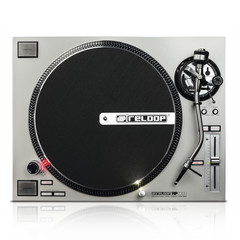
Features
NEW features of the MK2 version
Built for the club: Rigid chassis construction with an even heavier design with additional reinforcements made of metal, rubber and molding compound for high vibration damping and isolation
More powerful starting torque (adjustable from 2.8 - 4.5 kg/cm)
Fine-tuned motor control for further optimization of wow and flutter and rotation
Newly developed, height-adjustable tone arm base (VTA) and Anti-Skating control
Particularly light weight and rigid, satin aluminium material used for tone arm pipe
Pitch scale for precise adjustments
Optional ground terminal offers additional protection in complex club & studio environments
Easily replaceable, freely rotatable LED needle light in new aluminium design
High-quality and hard-wearing silver metallic finish
Quartz driven DJ turntable with upper-torque direct drive
Adjustable stop speed (0.2 - 6 sec.)
Precise control of motor with 3 speeds (33 1/3, 45 & 78 RPM)
Precision manufactured, die cast aluminium turntable
Rubber inlays for reduction of vibrations and background noise
Statically-balanced universal S-shaped tonearm with hydraulic lift and anti-skating mechanism
Universal connection for pickup systems (SME)
Pitch range +/-8 %, +/-16 %, +/-50 % (Ultra Pitch)
Quartz lock
Additional start/stop button for vertical positioning
Reverse function: switch for forwards and reverse operation
Recessed connection cavity for easy installation in cases & seamless adjustment
Phono and line out (no grounding required)
Removable mains and RCA cable
Safety mains switch
Shock-absorbing feet against vibrations
Technical Data
Turntable:
Type: direct-drive turntable
Drive: quartz driven upper-torque direct drive
Motor: 16-pole, 3-phase, brushless motor
Turntable speeds: 3 speeds, manual (33 1/3, 45, 78 RPM)
Starting torque: 2.8 - 4.5 kg/cm (adjustable)
Adjustable stop time (0.2 - 6 sec.)
Start-up time / change to RPM: 55dB (DIN-B)
Brake system: electronic brake
Platter:
Material: die cast aluminium
Diameter: 332 mm
Weight: approx. 1.5 kg
Tone arm:
Type: universal, statically balanced, S-shaped
Effective length: 230 mm
Overhang: 15 mm
Tracking error range: < 3°
VTA setting range: 0-6 mm
Useable weight of pickups: 3.5~8.5 g (incl. headshell 13~18 g)
Anti-skating range: 0 - 3 g
Effective tone arm mass: 30 g
Connections: 1x Phono/Line Out (gold-plated), 1x GND earth connection
General:
Power supply: AC 115/230 V, 60/50 Hz (EU/US), AC 100 V, 50/60 Hz (JP)
Power consumption: 13 W
Dimensions: 458 x 354 x 144,6 mm
Weight: approx. 11.7 kg
Accessories included: turntable, slipmat, LED needle light, counterweight, PHONO Cinch cable with earth, AC mains adapter, operating instructions
The journey of BASIC RHYTHM, all the way from mid 90s pirate radio, to abstract electronic sounds, has eventually seen a return to his musical roots-jungle and drum & bass. Pushing forward into new territories, his tracks often stand out as brutalist and adventurous, while all the time keeping the dance bouncing. After recent collaborations with Sully and Blood Trust among others, there's plenty of more exciting new music to emerge, starting with 'Sound Killa EP' on Straight Up Breakbeat.
On the top floor of RG Scotts in Margate you'll find an assortment of tables _ tables that became field recordings, then programmed scatter rhythms, and eventually the foundations of the new solo album from Mike Lindsay: supershapes (volume 1). It's the first instalment in a series of records from the Mercury Prize-winning producer and mixing engineer (who's also the co-founder of UK acid folktronica band Tunng, and one half of electronic alt-psych duo LUMP, with Laura Marling), a series that explores "the miraculous in the mundane". Volume 1 looks widely at "everyday domestic objects, especially tables, coffee table books, and the daily rituals that shape us, heavily focusing on the majestic in the domestic". The album is a kind of table in its own right: those who sit round it include Anna B Savage and many other musicians and artists _ a sense of collaboration that has run through all of Lindsay's work.
"The new avant-garde isn't about creating something that doesn't yet exist, it's about abandoning and confusing rigid genres. I want to open up, in order to both abolish and reconstruct the musical past." — Noémi Büchi
Noémi Büchi's album 'Does It Still Matter' completes a series of releases whose titles - 'Matière', 'Matter', and 'Does It Still Matter' - place the physicality of music in the center of attention. Büchi's specific sound structures and aesthetic choices question the state of materiality in a world that is becoming more and more fluid and intangible.
From 'Matière' to 'Matter', Büchi subtly transferred from a focus on substance to questioning the enigmatic core of
being, passing from a noun to a verb, and from a single word to an inquiry. 'Does It Still Matter' weighs in on the importance of questioning. Her pieces juxtapose multi-layered analog synthesizer textures, crystal clear sounds and almost brutalistic noises, while they unfold in compositional structures akin to pop songs. Driven by an orchestra of myriad parts, her music creates transcendent intonations that resonate deeply with the listeners' bodies. A daring blend of complexity and accessibility are molded into captivating sound sculptures that challenge and intrigue listeners alike.
Deviating from conventional time divisions, 'Does It Still Matter' immerses listeners in a discordant succession of elements, and guides them towards an eternal present that erases the past with each new revelation, while maintaining it through recurring themes that serve as intimate memories. Büchi's electronic maximalism questions our linear perception of time, offering a glimpse into a world where the past, present, and future converge into a singular moment. Her avant-garde approach rejects predictability, inviting listeners to immerse themselves fully in the present. Everything starts anew at any given instant. Each musical idea exists for one precise moment, rendering the future unpredictable.
'Does It Still Matter' unfolds against a backdrop of collective disaster and biocidal urgency, challenging the very essence of time. Büchi explains: "The world appears to have gone mad. It's all but impossible to reflect on the meaning of avant-garde in music, considering the future in this sepulchral kind of stability of the human condition." Her compositions resonate like an infernal machine, questioning the instantaneous dissipation of everything. Finally, echoes and fragments of sounds remain, haunting memories like ghostly companions.
'Does It Still Matter' is an immersive experience that invites listeners to contemplate the impermanence of our world and the enduring power of sound.
Limited Anniversary Edition: embossed, reverse board, hand numbered, limited edition blue vinyl, 500 copies available! Conrad Schnitzler (1937-2011), composer and concept artist, is one of the most important representatives of Germany"s electronic music avant-garde. A student of Beuys, he founded Berlin"s legendary Zodiak Free Arts Lab, a subculture club, in 1967/68, was a member of Tangerine Dream (together with Klaus Schulze and Edgar Froese) and Kluster (with Dieter Moebius and Hans-Joachim Roedelius) and also released countless solo albums. The blue album ("Blau") from 1974 was Schnitzler"s second solo LP
- A1: Bring It On (2024 Remaster)
- A2: Prayer For The Dying (2024 Remaster)
- A3: Dreaming In Metaphors (2024 Remaster)
- B1: Don’t Cry (2024 Remaster)
- B2: Fast Changes (2024 Remaster)
- B3: Kiss From A Rose (2024 Remaster)
- C1: People Asking Why (2024 Remaster)
- C2: Newborn Friend (2024 Remaster)
- C3: If I Could (2024 Remaster)
- C4: I’m Alive (2024 Remaster)
- C5: Bring It On (Reprise)
- D1: Love Is Powerful
- D2: Manic Depression (Feat. Jeff Beck)
- D3: Blues In E
- D4: The Wind Cries Mary
- D5: Fly Like An Eagle
Celebrating its 30th, Seal releases a deluxe edition of his second studio album on 2CD + Blu ray, along with a 2LP Black vinyl set it includes the original album newly remastered, alongside a mix of alternate versions of albums cuts, previously unreleased music, and some unexpected yet satisfying covers.
Seal burst to the top of the pop charts with the release of his self-titled debut album in 1991. In 1994, he returned with a stylistic advance and another collection of pop, dance, soul fusion and electronic gems – all meticulously assembled on yet another self-titled album. Seal II, as It has come to be known, features the International mega-smash Kiss From A Rose, as well as the Wendy & Lisa featuring track Bring It On and a rare appearance by none other than Joni Mitchell on If I Could.
- A1: Fé De Sábio - Crepúsculo
- A2: Nuno Rebelo - Vê-Se Das Nuvens
- A3: Vítor Rúa - T
- A4: Tó Neto - Daly
- B1: Luis Cilia - Saxofonía
- B2: Spqr - Flow
- B3: Telectu - Untitled
- B4: Pilar - Voz Do Mar
- C1: Carlos María Trindade - Em Campo Aberto
- C2: Balladium - Andrómeda
- C3: Ban - Irreal Social
- D1: Pop Dell'arte - Querelle
- D2: Santa Maria Gasolina Em Teu Ventre - Optical Sunday Without William Burroughs
- D3: Croix Sainte - We Build Cities
- D4: Linha Geral - Hino À Nossa Luta
Unveiling an unheard scene: Glossy Mistakes presents "Atlantic Mavericks: a Decade of Experimental Music in Portugal 1982-1993"
Glossy Mistakes is proud to announce the upcoming release of "Atlantic Mavericks: a Decade of Experimental Music in Portugal 1982-1993," a groundbreaking double LP compilation that offers a unique glimpse into the vibrant landscape of Portuguese experimental music. Set to launch on June 10th, this monumental release showcases the evolution and innovation of the Portuguese music scene during a transformative decade marked by political upheaval and artistic experimentation.
Compiled by Glossy Mario and featuring liner notes by Rui Miguel Abreu, "Atlantic Mavericks" captures the essence of a generation of artists who dared to challenge conventions and push the boundaries of what was possible in music.
The compilation stands as a testament to the eclecticism of the Portuguese music scene during this period, featuring a diverse range of genres and styles. From ambient and new age to electro, rock, and synth-pop, "Atlantic Mavericks" offers something for every listener, inviting them to explore the rich tapestry of sounds that defined the era.
The 1980s in Portugal were a time of profound transformation, marked by the aftermath of a peaceful revolution and a burgeoning desire for artistic expression. As the country emerged from political turbulence, a new generation of musicians began to explore uncharted territories, paving the way for a wave of experimentation and innovation.
From the emergence of artists like Rui Veloso and bands like UHF, who ushered in a new era of Portuguese rock, to the founding of independent record labels like Fundação Atlântica and Ama Romanta, the 1980s saw a surge in creativity and a desire for independence within the music industry.
"Atlantic Mavericks: a Decade of Experimental Music in Portugal 1982-1993" offers a comprehensive overview of this dynamic period, featuring tracks that span the spectrum of experimental music. Each song tells a story of artistic evolution and creative risk-taking, reflecting the diverse influences and eclectic tastes of the Portuguese music scene during this transformative decade.
Spanning from 1982 to 1993, the compilation includes contributions from a wide range of artists, including SPQR, Croix Sainte, Linha Geral, Balladium, Ban, Santa Maria, Gasolina Em Teu Ventre!, Fé de Sábio, and Telectu, among others. With each track carefully curated to showcase the breadth and depth of Portuguese experimental music, "Atlantic Mavericks" promises to be a must-have for music enthusiasts and adventurous listeners alike.
"Atlantic Mavericks: a Decade of Experimental Music in Portugal 1982-1993" will be available on June 10th as a double LP release, offering listeners a chance to immerse themselves in the sonic landscapes of 1980s Portugal. Whether experienced on vinyl or through digital channels, this monumental compilation is sure to leave a lasting impression on all who encounter it.
Limited vinyl edition of 300 copies on 180g white vinyl with download card. Deleted Scene, the 8th studio album from UK producer Stumbleine, overflows with beautiful nostalgia-tinged electronica. The album is steeped with cloud-like beauty, with opener I Can Stop Anytime I Like fusing addictive sampled vocals with soft, glassy guitars, as if a reflecting pool of the listeners' memories. Cinderhaze ripples that pool with a more driving, magnetic force, shifting and pulling its emotional weight in cyclic waves. Ursa Minor Sleeps Forever is fittingly sleepy, circling soft slow synth arpeggios in a dreamy haze, a sound built upon by Somnia to an epiphany-like string bed, never straying too far from Stumbleine's serene haven of melodic grace. On Catastrophette Stumbleine crafts a more dramatic and poignant web of sound, as if running through the memories created by the rest of Deleted Scene. The album as a whole is an escape to a dream-state of Stumbleine's making, captivating, yet familiar, and completely enveloping. According to Peter, "Deleted scene refers to the memories that play over and over inside your own head, replaying hazy copies of hazy copies that evolve into a bittersweet fever dream. Everybody has their own unique collection of deleted scenes slowly distorting and fading away." 'Stumbleine is the alias of Peter Cooper. With roots in the UK post rock scene, the reclusive producer began blending slow dream-like pop with fractured lo-fi beats as Stumbleine in 2012. Melancholic rnb vocals ebb and flow above submerged guitar ballads. Sand blasted samples intertwine with broken beats to create music with a nostalgic fragile warmth. Stumbleine is known for a DIY ethic, releasing music directly to fans or via the independent label Monotreme Records.'
- A1: Polaris (북극성) 04:22
- A2: Insomnia (불면증) 04:49
- A3: Arrival (도착) 07:44
- B1: We Shine At Night (우리는 밤이 되면 빛난다) 06:27
- B2: Parade 07:34
- B3: Sketchbook 07:02
- C1: Imagination 04:37
- C2: Sound Inside Me, Waves Inside You 05:13
- C3: Blossom 05:13
- D1: After The Magic 06:11
- D2: Your Place 10:51
"A sprawling patchwork of the artist’s dreams and fears, Parannoul’s third album After the Magic explores the enigmatic solo artist’s life in the wake of his second album’s overnight success.
Expanding on the shoegaze-shaded emo that made Parannoul’s To See the Next Part of the Dream so beloved by lo-fi and indie rock fans alike, After the Magic sees the anonymous auteur striving to write a follow-up as worthy of acclaim as the last.
Across the album’s ten songs, Parannoul plunges yet deeper into his diverse pool of influences, coming back to the surface with a record that captures and extends the magic of its predecessor. Unexpected flashes of orchestral ambient and glitched-out electronica meld seamlessly with Parannoul’s signature passages of noisy, distortion-laden shoegaze, offering a real time glimpse into the maturation of one of indie rock’s most exciting artists.
In the artist’s own words, “This album is not what you expected, but what I always wanted.”"
"Since 2012, New York City singer-songwriter Nate Amos (Water From Your Eyes, My Idea) has recorded and self-released hundreds of songs under the This Is Lorelei moniker, and perhaps surprisingly, after a decade plus, ""Box for Buddy, Box for Star"" marks the first attempt at a traditional, intentionally written full-length album. Amos describes the bulk of This Is Lorelei’s discography as “unedited diary entries,” written and recorded without much forethought, regard for genre or reverence for albums as thematic bodies of work, so oddly enough, ""Box for Buddy, Box for Star"" is both a fresh start and the culmination of years of diligent, interesting songwriting.
""Box for Buddy, Box for Star"" embraces traditional pop songcraft and a confessional, carefully written brand of lyricism, dabbling in the kind of classic singer-songwriter cliches he never imagined toying with—but not without the counterbalancing force of shitpost-y irony, which listeners have come to expect from Amos. Inspired by the gritty romanticism of Shane MacGowan and the Jim Croce mimicry of Tim Heidecker’s ""What the Brokenhearted Do…"", the LP exudes both a grizzled charm and youthful intensity. Sonically, Amos adorns the record with quaint country gestures—a full-circle artistic choice for Amos whose father is a veteran bluegrass musician.
And it wouldn’t be a Nate Amos release without a few curveballs, like “Dancing in the Club,” a bouncy auto-tuned pop song, which he likens to Bruce Hornsby-via-Blink-182, or “Perfect Hand,” an intimate piano-led track with vocal samples, alarm bell-like effects and skittering electronic beats. He also mischievously opens the album with a red herring of sorts, “Angel’s Eye,” a twangy sci-fi country duet about an angel who abducts a cowboy and unintentionally falls in love."
Electronic music composer David Morley returns to De:tuned with the live recorded 'Fashion' EP. In the early 90s Belgian fashion designer Dirk Bikkembergs reached out to David Morley to ask if he could create a special piece of music for the Paris Fashion Week. The 'Fashion - Show' DAT tape recording radiates the energy of David's thrilling live performance and captures an exciting synergy of art and music during an era that shaped an entire generation.
Kevin Foakes (Openmind, DJ Food, Ninja Tune) created all the graphic work. Mastered by Matt Colton at Metropolis. A separate digital release will also be available at the usual digital shops. Stay tuned!
Electronic music composer David Morley returns to De:tuned with the live recorded 'Fashion' EP. In the early 90s Belgian fashion designer Dirk Bikkembergs reached out to David Morley to ask if he could create a special piece of music for the Paris Fashion Week. The 'Fashion - Show' DAT tape recording radiates the energy of David's thrilling live performance and captures an exciting synergy of art and music during an era that shaped an entire generation.
Kevin Foakes (Openmind, DJ Food, Ninja Tune) created all the graphic work. Mastered by Matt Colton at Metropolis. A separate digital release will also be available at the usual digital shops. Stay tuned!
Acclaimed electronic music artist Rhys Fulber returns to Sonic Groove with his latest album, "Balance Of Fear". Once again, Rhys delivers a masterfully crafted selection of eight songs that seamlessly blend techno, industrial, electro, and EBM elements, layered with thought-provoking atmospheric melodies. The album serves as a soundtrack for navigating through dark times, decaying cultures, the misuse of technology, the erosion of social structures, manipulated spirituality, and the consequences of disaster capitalism. To stay afloat in these turbulent floodwaters, one requires a "Balance of Fear".