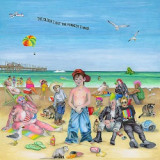
The Locked Room imagines a protagonist who experiences the outside world as an endless escape room, a place where, in the early hours, every passing tail-light, train in the distance, hunched bike rider or crying bird might be a possible riddle, leading to a passage or the discovery of a key.
Once opened, however, a room locked from the other side could just be the same room as the one you're in - only slightly different. And maybe the person wanting to break free is not you at all, but the sum or remnant of all of your online actions and conversations, a locked-in avatar whose consciousness wants to experience the real world, and real emotion with it.
"This album is about a struggle with the experience of reality, and about the places and zones where you cross over into a different territory. I tried to address these fixations on steel mandolin and gut-string violone."
Clues and conclusions, finding your way like a kid in the dark, virtual illusions and contemporary gaming culture all have their place on The Locked Room, an album of minimal, kosmische mandolin and violone music that documents the elegant collapse of our 21st-Century grip on reality.
All music written and performed by Ameel Brecht on steel mandolin, violone and electric piano.
Suche:emo kid
- A1: Rock This Mother
- A2: Talk To Me Girl
- A3: You Can Find Me
- A4: Check This Out
- A5: Jesus Going To Clean House
- A6: Hope You Understood
- A7: Is It What You Want
- A8: Love Is Everlasting
- A9: This Is Hip-Hop Art
- A10: Opposite Of Love
- A11: Do You Know What I Mean
- B1: Saving All My Love For You
- B2: Look Out Here I Come
- B3: Girl You Always Talking
- B4: Have A Great Day
- B5: Take My Hand
- B6: I Need Your Love
- B7: Your Town
- B8: Talk Around Town
- B9: Booty Head/Take A Little Walk
- B10: I Love My Mama
- B11: I Never Found Anyone Like You
Vinyl LP[23,49 €]
As the sun sets on a quaint East Nashville house, a young man bares a piece of his soul. Facing the camera, sporting a silky suit jacket/shirt/slacks/fingerless gloves ensemble that announces "singer" before he's even opened his mouth, Lee Tracy Johnson settles onto his stage, the front yard. He sways to the dirge-like drum machine pulse of a synth-soaked slow jam, extends his arms as if gaining his balance, and croons in affecting, fragile earnest, "I need your love… oh baby…"
Dogs in the yard next door begin barking. A mysterious cardboard robot figure, beamed in from galaxies unknown and affixed to a tree, is less vocal. Lee doesn't acknowledge either's presence. He's busy feeling it, arms and hands gesticulating. His voice rises in falsetto over the now-quiet dogs, over the ambient noise from the street that seeps into the handheld camcorder's microphone, over the recording of his own voice played back from a boombox off-camera. After six minutes the single, continuous shot ends. In this intimate creative universe there are no re-takes. There are many more music videos to shoot, and as Lee later puts it, "The first time you do it is actually the best. Because you can never get that again. You expressing yourself from within."
"I Need Your Love" dates from a lost heyday. From some time in the '80s or early '90s, when Lee Tracy (as he was known in performance) and his music partner/producer/manager Isaac Manning committed hours upon hours of their sonic and visual ideas to tape. Embracing drum machines and synthesizers – electronics that made their personal futurism palpable – they recorded exclusively at home, live in a room into a simple cassette deck. Soul, funk, electro and new wave informed their songs, yet Lee and Isaac eschewed the confinement of conventional categories and genres, preferring to let experimentation guide them.
"Anytime somebody put out a new record they had the same instruments or the same sound," explains Isaac. "So I basically wanted to find something that's really gonna stand out away from all of the rest of 'em." Their ethos meant that every idea they came up with was at least worth trying: echoed out half-rapped exhortations over frantic techno-style beats, gospel synth soul, modal electro-funk, oddball pop reinterpretations, emo AOR balladry, nods to Prince and the Fat Boys, or arrangements that might collapse mid-song into a mess of arcade game-ish blips before rallying to reach the finish line. All of it conjoined by consistent tape hiss, and most vitally, Lee's chameleonic voice, which managed to wildly shape shift and still evoke something sincere – whether toggling between falsetto and tenor exalting Jesus's return, or punctuating a melismatic romantic adlib with a succinct, "We all know how it feels to be alone."
"People think we went to a studio," says Isaac derisively. "We never went to no studio. We didn't have the money to go to no studio! We did this stuff at home. I shot videos in my front yard with whatever we could to get things together." Sometimes Isaac would just put on an instrumental record, be it "Planet Rock" or "Don't Cry For Me Argentina" (from Evita), press "record," and let Lee improvise over it, yielding peculiar love songs, would-be patriotic anthems, or Elvis Presley or Marilyn Monroe tributes. Technical limitations and a lack of professional polish never dissuaded them. They believed they were onto something.
"That struggle," Isaac says, "made that sound sound good to me."
In the parlance of modern music criticism Lee and Isaac's dizzying DIY efforts would inevitably be described as "outsider." But "outsider" carries the burden of untold additional layers of meaning if you're Black and from the South, creating on a budget, and trying to get someone, anyone within the country music capital of the world to take your vision seriously. "What category should we put it in?" Isaac asks rhetorically. "I don't know. All I know is feeling. I ain't gonna name it nothing. It's music. If it grabs your soul and touch your heart that's what it basically is supposed to do."
=
Born in 1963, the baby boy of nine siblings, Lee Tracy spent his earliest years living amidst the shotgun houses on Nashville's south side. "We was poor, man!" he says, recalling the outhouse his family used for a bathroom and the blocks of ice they kept in the kitchen to chill perishables. "But I actually don't think I really realized I was in poverty until I got grown and started thinking about it." Lee's mom worked at the Holiday Inn; his dad did whatever he had to do, from selling fruit from a horse drawn cart to bootlegging. "We didn't have much," Lee continues, "but my mother and my father got us the things we needed, the clothes on our back." By the end of the decade with the city's urban renewal programs razing entire neighborhoods to accommodate construction of the Interstate, the family moved to Edgehill Projects. Lee remembers music and art as a constant source of inspiration for he and his brothers and sisters – especially after seeing the Jackson 5 perform on Ed Sullivan. "As a small child I just knew that was what I wanted to do."
His older brother Don began musically mentoring him, introducing Lee to a variety of instruments and sounds. "He would never play one particular type of music, like R&B," says Lee. "I was surrounded by jazz, hard rock and roll, easy listening, gospel, reggae, country music; I mean I was a sponge absorbing all of that." Lee taught himself to play drums by beating on cardboard boxes, gaining a rep around the way for his timekeeping, and his singing voice. Emulating his favorites, Earth Wind & Fire and Cameo, he formed groups with other kids with era-evocative band names like Concept and TNT Connection, and emerged as the leader of disciplined rehearsals. "I made them practice," says Lee. "We practiced and practiced and practiced. Because I wanted that perfection." By high school the most accomplished of these bands would take top prize in a prominent local talent show. It was a big moment for Lee, and he felt ready to take things to the next level. But his band-mates had other ideas.
"I don't know what happened," he says, still miffed at the memory. "It must have blew they mind after we won and people started showing notice, because it's like everybody quit! I was like, where the hell did everybody go?" Lee had always made a point of interrogating prospective musicians about their intentions before joining his groups: were they really serious or just looking for a way to pick up girls? Now he understood even more the importance of finding a collaborator just as committed to the music as he was.
=
Isaac Manning had spent much of his life immersed in music and the arts – singing in the church choir with his family on Nashville's north side, writing, painting, dancing, and working various gigs within the entertainment industry. After serving in the armed forces, in the early '70s he ran The Teenage Place, a music and performance venue that catered to the local youth. But he was forced out of town when word of one of his recreational routines created a stir beyond the safe haven of his bohemian circles.
"I was growing marijuana," Isaac explains. "It wasn't no business, I was smoking it myself… I would put marijuana in scrambled eggs, cornbread and stuff." His weed use originated as a form of self-medication to combat severe tooth pain. But when he began sharing it with some of the other young people he hung out with, some of who just so happened to be the kids of Nashville politicians, the cops came calling. "When I got busted," he remembers, "they were talking about how they were gonna get rid of me because they didn't want me saying nothing about they children because of the politics and stuff. So I got my family, took two raggedy cars, and left Nashville and went to Vegas."
Out in the desert, Isaac happened to meet Chubby Checker of "The Twist" fame while the singer was gigging at The Flamingo. Impressed by Isaac's zeal, Checker invited him to go on the road with him as his tour manager/roadie/valet. The experience gave Isaac a window into a part of the entertainment world he'd never encountered – a glimpse of what a true pop act's audience looked like. "Chubby Checker, none of his shows were played for Black folks," he remembers. "All his gigs were done at high-class white people areas." Returning home after a few years with Chubby, Isaac was properly motivated to make it in Music City. He began writing songs and scouting around Nashville for local talent anywhere he could find it with an expressed goal: "Find someone who can deliver your songs the way you want 'em delivered and make people feel what you want them to feel."
One day while walking through Edgehill Projects Isaac heard someone playing the drums in a way that made him stop and take notice. "The music was so tight, just the drums made me feel like, oh I'm-a find this person," he recalls. "So I circled through the projects until I found who it was.
"That's how I met him – Lee Tracy. When I found him and he started singing and stuff, I said, ohhh, this is somebody different."
=
Theirs was a true complementary partnership: young Lee possessed the raw talent, the older Isaac the belief. "He's really the only one besides my brother and my family that really seen the potential in me," says Lee. "He made me see that I could do it."
Isaac long being a night owl, his house also made for a fertile collaborative environment – a space where there always seemed to be a new piece of his visual art on display: paintings, illustrations, and dolls and figures (including an enigmatic cardboard robot). Lee and Issac would hang out together and talk, listen to music, conjure ideas, and smoke the herb Isaac had resumed growing in his yard. "It got to where I could trust him, he could trust me," Isaac says of their bond. They also worked together for hours on drawings, spreading larges rolls of paper on the walls and sketching faces with abstract patterns and imagery: alien-like beings, tri-horned horse heads, inverted Janus-like characters where one visage blurred into the other.
Soon it became apparent that they didn't need other collaborators; self-sufficiency was the natural way forward. At Isaac's behest Lee, already fed up with dealing with band musicians, began playing around with a poly-sonic Yamaha keyboard at the local music store. "It had everything on it – trumpet, bass, drums, organ," remembers Lee. "And that's when I started recording my own stuff."
The technology afforded Lee the flexibility and independence he craved, setting him on a path other bedroom musicians and producers around the world were simultaneously following through the '80s into the early '90s. Saving up money from day jobs, he eventually supplemented the Yamaha Isaac had gotten him with Roland and Casio drum machines and a Moog. Lee was living in an apartment in Hillside at that point caring for his dad, who'd been partially paralyzed since early in life. In the evenings up in his second floor room, the music put him in a zone where he could tune out everything and lose himself in his ideas.
"Oh I loved it," he recalls. "I would really experiment with the instruments and use a lot of different sound effects. I was looking for something nobody else had. I wanted something totally different. And once I found the sound I was looking for, I would just smoke me a good joint and just let it go, hit the record button." More potent a creative stimulant than even Isaac's weed was the holistic flow and spontaneity of recording. Between sessions at Isaac's place and Lee's apartment, their volume of output quickly ballooned.
"We was always recording," says Lee. "That's why we have so much music. Even when I went to Isaac's and we start creating, I get home, my mind is racing, I gotta start creating, creating, creating. I remember there were times when I took a 90-minute tape from front to back and just filled it up."
"We never practiced," says Isaac. "See, that was just so odd about the whole thing. I could relate to him, and tell him about the songs I had ideas for and everything and stuff. And then he would bring it back or whatever, and we'd get together and put it down." Once the taskmaster hell bent on rehearsing, Lee had flipped a full 180. Perfection was no longer an aspiration, but the enemy of inspiration.
"I seen where practicing and practicing got me," says Lee. "A lot of musicians you get to playing and they gotta stop, they have to analyze the music. But while you analyzing you losing a lot of the greatness of what you creating. Stop analyzing what you play, just play! And it'll all take shape."
=
"I hope you understood the beginning of the record because this was invented from a dream I had today… (You tell me, I'll tell you, we'll figure it out together)" – Lee Tracy and Isaac Manning, "Hope You Understand"
Lee lets loose a maniacal cackle when he acknowledges that the material that he and Isaac recorded was by anyone's estimation pretty out there. It's the same laugh that commences "Hope You Understand" – a chaotic transmission that encapsulates the duality at the heart of their music: a stated desire to reach people and a compulsion to go as leftfield as they saw fit.
"We just did it," says Lee. "We cut the music on and cut loose. I don't sit around and write. I do it by listening, get a feeling, play the music, and the lyrics and stuff just come out of me."
The approach proved adaptable to interpreting other artists' material. While recording a cover of Whitney Houston's pop ballad "Saving All My Love For You," Lee played Whitney's version in his headphones as he laid down his own vocals – partially following the lyrics, partially using them as a departure point. The end result is barely recognizable compared with the original, Lee and Isaac having switched up the time signature and reinvented the melody along the way towards morphing a slick mainstream radio standard into something that sounds solely their own.
"I really used that song to get me started," says Lee. "Then I said, well I need something else, something is missing. Something just came over me. That's when I came up with 'Is It What You Want.'"
The song would become the centerpiece of Lee and Isaac's repertoire. Pushed along by a percolating metronomic Rhythm King style beat somewhere between a military march and a samba, "Is It What You Want" finds Lee pleading the sincerity of his commitment to a potential love interest embellished by vocal tics and hiccups subtlely reminiscent of his childhood hero MJ. Absent chord changes, only synth riffs gliding in and out like apparitions, the song achieves a lingering lo-fi power that leaves you feeling like it's still playing, somewhere, even after the fade out.
"I don't know, it's like a real spiritual song," Lee reflects. "But it's not just spiritual. To me the more I listen to it it's like about everything that you do in your everyday life, period. Is it what you want? Do you want a car or you don't want a car? Do you want Jesus or do you want the Devil? It's basically asking you the question. Can't nobody answer the question but you yourself."
In 1989 Lee won a lawsuit stemming from injuries sustained from a fight he'd gotten into. He took part of the settlement money and with Isaac pressed up "Saving All My Love For You" b/w "Is It What You Want" as a 45 single. Isaac christened the label One Chance Records. "Because that's all we wanted," he says with a laugh, "one chance."
Isaac sent the record out to radio stations and major labels, hoping for it to make enough noise to get picked up nationally. But the response he and Lee were hoping for never materialized. According to Isaac the closest the single got to getting played on the radio is when a disk jock from a local station made a highly unusual announcement on air: "The dude said on the radio, 107.5 – 'We are not gonna play 'Is It What You Want.' We cracked up! Wow, that's deep.
"It was a whole racist thing that was going on," he reflects. "So we just looked over and kept on going. That was it. That was about the way it goes… If you were Black and you were living in Nashville and stuff, that's the way you got treated." Isaac already knew as much from all the times he'd brought he and Lee's tapes (even their cache of country music tunes) over to Music Row to try to drum up interest to no avail.
"Isaac, he really worked his ass off," says Lee. "He probably been to every record place down on Music Row." Nashville's famed recording and music business corridor wasn't but a few blocks from where Lee grew up. Close enough, he remembers, for him to ride his bike along its back alleys and stumble upon the occasional random treasure, like a discarded box of harmonicas. Getting in through the front door, however, still felt a world away.
"I just don't think at the time our music fell into a category for them," he concedes. "It was before its time."
=
Lee stopped making music some time in the latter part of the '90s, around the time his mom passed away and life became increasingly tough to manage. "When my mother died I had a nervous breakdown," he says, "So I shut down for a long time. I was in such a sadness frame of mind. That's why nobody seen me. I had just disappeared off the map." He fell out of touch with Isaac, and in an indication of just how bad things had gotten for him, lost track of all the recordings they'd made together. Music became a distant memory.
Fortunately, Isaac kept the faith. In a self-published collection of his poetry – paeans to some of his favorite entertainment and public figures entitled Friends and Dick Clark – he'd written that he believed "music has a life of its own." But his prescience and presence of mind were truly manifested in the fact that he kept an archive of he and Lee's work. As perfectly imperfect as "Is It What You Want" now sounds in a post-Personal Space world, Lee and Isaac's lone official release was in fact just a taste. The bulk of the Is It What You Want album is culled from the pair's essentially unheard home recordings – complete songs, half-realized experiments, Isaac's blue monologues and pronouncements et al – compiled, mixed and programmed in the loose and impulsive creative spirit of their regular get-togethers from decades ago. The rest of us, it seems, may have finally caught up to them.
On the prospect of at long last reaching a wider audience, Isaac says simply, "I been trying for a long time, it feels good." Ever the survivor, he adds, "The only way I know how to make it to the top is to keep climbing. If one leg break on the ladder, hey, you gotta fix it and keep on going… That's where I be at. I'll kill death to make it out there."
For Lee it all feels akin to a personal resurrection: "It's like I was in a tomb and the tomb was opened and I'm back… Man, it feels so great. I feel like I'm gonna jump out of my skin." Success at this stage of his life, he realizes, probably means something different than what it did back when he was singing and dancing in Isaac's front yard. "What I really mean by 'making it,'" he explains isn't just the music being heard but, "the story being told."
Occasionally Lee will pull up "Is It What You Want" on YouTube on his phone, put on his headphones, and listen. He remembers the first time he heard his recorded voice. How surreal it was, how he thought to himself, "Is that really me?" What would he say to that younger version of himself now?
"I would probably tell myself, hang in there, don't give up. Keep striving for the goal. And everything will work out."
Despite what's printed on the record label, sometimes you do get more than one chance.
- A1: The Poet Acts
- A2: Morning Passages
- A3: Something She Has To Do
- A4: “For Your Own Benefit”
- B1: Vanessa And The Changelings
- B2: “I'm Going To Make A Cake”
- B3: An Unwelcome Friend
- B4: Dead Things
- C1: The Kiss
- C2: “Why Does Someone Have To Die?”
- C3: Tearing Herself Away
- D1: Escape!
- D2: Choosing Life
- D3: The Hours
‘Was there ever a more perfect film for Glass’s lyrical manner? He refers to his own past, but the way in which the material is treated transforms it inevitably into that eternal present. Such a feeling of fragile beauty is a rare achievement.’ – Gramophone
‘Simple and complex by turn, Glass’s score adds dignity and depth to the movie, and to the tragedies and triumphs, big or small, of ordinary life.’
– Guardian
‘Underpinning the anguish at the heart of The Hours a beautiful score. Glass’s motifs capture the passage of time and the universality of human experience.’ – Classic FM’s Best Soundtracks
Nonesuch releases Philip Glass’s award-winning soundtrack to The Hours on vinyl for the first time to coincide with its 20th anniversary and Glass’ 85th birthday concert season. Originally released in December 2002, Glass’s score to the Academy Award-winning film was itself nominated for an Academy Award, as well as a Golden Globe and a Grammy, and went on to win a BAFTA and a Classical BRIT.
Directed by Stephen Daldry, The Hours is the story of three women searching for more potent, meaningful lives. Based on Michael Cunningham’s 1999 Pulitzer Prize–winning novel, with a screenplay by David Hare, the film interweaves the stories of three women – a book editor in New York (Meryl Streep), a young mother in California (Julianne Moore), and the author Virginia Woolf (Nicole Kidman). Their stories intertwine, and finally come together in a surprising, transcendent moment of shared recognition.
Philip Glass’s score was conducted by Nick Ingman, with Michael Reisman on piano and the Lyric Quartet, and recorded at Abbey Road Studios and Air Studios, London. The score was a key element in this acclaimed triptych of dramatic tales. ‘The inter-cutting of personal stories over a wide span of time,’ said NPR, ‘is held together by a single music approach.’
In his original liner note, Michael Cunningham wrote, ‘Each novel I’ve written has developed a soundtrack of sorts; a body of music that subtly but palpably helped shape the book in question. The one constant since I started trying to write novels, however – my only ongoing act of listening fidelity – has been the work of Philip Glass. I love Glass’s music almost as much as I love Woolf’s Mrs. Dalloway. Glass, like Woolf, is more interested in that which continues than he is in that which begins, climaxes, and ends; he insists, as did Woolf, that beauty often resides more squarely in the present than it does in the present’s relationship to past or future. So, when I heard he’d agreed to contribute the music to the film version of The Hours, it seemed both inevitable and too good to be true. I’m not sure if I can offer any higher praise than this: When I saw the movie with the music added, I thought automatically of how I could use the soundtrack, when it came out, to help me finish my next book.’
“This is a movie about art and how art affects life," explains Philip Glass. “The story is very complicated and the music could take on a very important role in the film, as I saw it – to make it viewable, to make it comprehensible, so the stories of the three women in the film didn’t seem separate, that they were tied together. The music had to be the thread that tied the movie together. There’s no question that the emotional point of view is conveyed by the music. Music is the arrow you shoot in the air. Everything follows that.’
Born in Baltimore, Maryland, in 1937, Philip Glass is a graduate of the University of Chicago and the Juilliard School. By 1974, Glass had created a large collection of music for The Philip Glass Ensemble. The period culminated in the landmark opera, Einstein on the Beach. Since Einstein, Glass’s repertoire has grown to include music for opera, dance, theater, orchestra, and film. His scores have received Academy Award nominations (including Kundun and The Hours, both released on Nonesuch, as well as Notes on a Scandal) and a Golden Globe (The Truman Show). Recent works include Glass’s memoir, Words Without Music, Glass’s first Piano Sonata, opera Circus Days and Nights, and Symphony No. 14. Glass received the Praemium Imperiale in 2012, the US National Medal of the Arts from President Barack Obama in 2016, and 41st Kennedy Center Honors in 2018.
Nonesuch’s relationship with Glass began in 1985, with the release of the score for Paul Schrader’s Mishima. In addition to The Hours (2002) and Kundun (1997), over the years other Glass works on Nonesuch have included Einstein on the Beach (1993), Music in Twelve Parts (1996), the soundtracks for Powaqqatsi (1988) and Koyaanisqatsi (1998), Glass Box (2008), and Kronos Quartet’s Performs Philip Glass (1995), amongst others.
- A1: Rock This Mother
- A2: Talk To Me Girl
- A3: You Can Find Me
- A4: Check This Out
- A5: Jesus Going To Clean House
- A6: Hope You Understood
- A7: Is It What You Want
- A8: Love Is Everlasting
- A9: This Is Hip-Hop Art
- A10: Opposite Of Love
- A11: Do You Know What I Mean
- B1: Saving All My Love For You
- B2: Look Out Here I Come
- B3: Girl You Always Talking
- B4: Have A Great Day
- B5: Take My Hand
- B6: I Need Your Love
- B7: Your Town
- B8: Talk Around Town
- B9: Booty Head/Take A Little Walk
- B10: I Love My Mama
- B11: I Never Found Anyone Like You
Cassette[11,72 €]
As the sun sets on a quaint East Nashville house, a young man bares a piece of his soul. Facing the camera, sporting a silky suit jacket/shirt/slacks/fingerless gloves ensemble that announces "singer" before he's even opened his mouth, Lee Tracy Johnson settles onto his stage, the front yard. He sways to the dirge-like drum machine pulse of a synth-soaked slow jam, extends his arms as if gaining his balance, and croons in affecting, fragile earnest, "I need your love… oh baby…"
Dogs in the yard next door begin barking. A mysterious cardboard robot figure, beamed in from galaxies unknown and affixed to a tree, is less vocal. Lee doesn't acknowledge either's presence. He's busy feeling it, arms and hands gesticulating. His voice rises in falsetto over the now-quiet dogs, over the ambient noise from the street that seeps into the handheld camcorder's microphone, over the recording of his own voice played back from a boombox off-camera. After six minutes the single, continuous shot ends. In this intimate creative universe there are no re-takes. There are many more music videos to shoot, and as Lee later puts it, "The first time you do it is actually the best. Because you can never get that again. You expressing yourself from within."
"I Need Your Love" dates from a lost heyday. From some time in the '80s or early '90s, when Lee Tracy (as he was known in performance) and his music partner/producer/manager Isaac Manning committed hours upon hours of their sonic and visual ideas to tape. Embracing drum machines and synthesizers – electronics that made their personal futurism palpable – they recorded exclusively at home, live in a room into a simple cassette deck. Soul, funk, electro and new wave informed their songs, yet Lee and Isaac eschewed the confinement of conventional categories and genres, preferring to let experimentation guide them.
"Anytime somebody put out a new record they had the same instruments or the same sound," explains Isaac. "So I basically wanted to find something that's really gonna stand out away from all of the rest of 'em." Their ethos meant that every idea they came up with was at least worth trying: echoed out half-rapped exhortations over frantic techno-style beats, gospel synth soul, modal electro-funk, oddball pop reinterpretations, emo AOR balladry, nods to Prince and the Fat Boys, or arrangements that might collapse mid-song into a mess of arcade game-ish blips before rallying to reach the finish line. All of it conjoined by consistent tape hiss, and most vitally, Lee's chameleonic voice, which managed to wildly shape shift and still evoke something sincere – whether toggling between falsetto and tenor exalting Jesus's return, or punctuating a melismatic romantic adlib with a succinct, "We all know how it feels to be alone."
"People think we went to a studio," says Isaac derisively. "We never went to no studio. We didn't have the money to go to no studio! We did this stuff at home. I shot videos in my front yard with whatever we could to get things together." Sometimes Isaac would just put on an instrumental record, be it "Planet Rock" or "Don't Cry For Me Argentina" (from Evita), press "record," and let Lee improvise over it, yielding peculiar love songs, would-be patriotic anthems, or Elvis Presley or Marilyn Monroe tributes. Technical limitations and a lack of professional polish never dissuaded them. They believed they were onto something.
"That struggle," Isaac says, "made that sound sound good to me."
In the parlance of modern music criticism Lee and Isaac's dizzying DIY efforts would inevitably be described as "outsider." But "outsider" carries the burden of untold additional layers of meaning if you're Black and from the South, creating on a budget, and trying to get someone, anyone within the country music capital of the world to take your vision seriously. "What category should we put it in?" Isaac asks rhetorically. "I don't know. All I know is feeling. I ain't gonna name it nothing. It's music. If it grabs your soul and touch your heart that's what it basically is supposed to do."
=
Born in 1963, the baby boy of nine siblings, Lee Tracy spent his earliest years living amidst the shotgun houses on Nashville's south side. "We was poor, man!" he says, recalling the outhouse his family used for a bathroom and the blocks of ice they kept in the kitchen to chill perishables. "But I actually don't think I really realized I was in poverty until I got grown and started thinking about it." Lee's mom worked at the Holiday Inn; his dad did whatever he had to do, from selling fruit from a horse drawn cart to bootlegging. "We didn't have much," Lee continues, "but my mother and my father got us the things we needed, the clothes on our back." By the end of the decade with the city's urban renewal programs razing entire neighborhoods to accommodate construction of the Interstate, the family moved to Edgehill Projects. Lee remembers music and art as a constant source of inspiration for he and his brothers and sisters – especially after seeing the Jackson 5 perform on Ed Sullivan. "As a small child I just knew that was what I wanted to do."
His older brother Don began musically mentoring him, introducing Lee to a variety of instruments and sounds. "He would never play one particular type of music, like R&B," says Lee. "I was surrounded by jazz, hard rock and roll, easy listening, gospel, reggae, country music; I mean I was a sponge absorbing all of that." Lee taught himself to play drums by beating on cardboard boxes, gaining a rep around the way for his timekeeping, and his singing voice. Emulating his favorites, Earth Wind & Fire and Cameo, he formed groups with other kids with era-evocative band names like Concept and TNT Connection, and emerged as the leader of disciplined rehearsals. "I made them practice," says Lee. "We practiced and practiced and practiced. Because I wanted that perfection." By high school the most accomplished of these bands would take top prize in a prominent local talent show. It was a big moment for Lee, and he felt ready to take things to the next level. But his band-mates had other ideas.
"I don't know what happened," he says, still miffed at the memory. "It must have blew they mind after we won and people started showing notice, because it's like everybody quit! I was like, where the hell did everybody go?" Lee had always made a point of interrogating prospective musicians about their intentions before joining his groups: were they really serious or just looking for a way to pick up girls? Now he understood even more the importance of finding a collaborator just as committed to the music as he was.
=
Isaac Manning had spent much of his life immersed in music and the arts – singing in the church choir with his family on Nashville's north side, writing, painting, dancing, and working various gigs within the entertainment industry. After serving in the armed forces, in the early '70s he ran The Teenage Place, a music and performance venue that catered to the local youth. But he was forced out of town when word of one of his recreational routines created a stir beyond the safe haven of his bohemian circles.
"I was growing marijuana," Isaac explains. "It wasn't no business, I was smoking it myself… I would put marijuana in scrambled eggs, cornbread and stuff." His weed use originated as a form of self-medication to combat severe tooth pain. But when he began sharing it with some of the other young people he hung out with, some of who just so happened to be the kids of Nashville politicians, the cops came calling. "When I got busted," he remembers, "they were talking about how they were gonna get rid of me because they didn't want me saying nothing about they children because of the politics and stuff. So I got my family, took two raggedy cars, and left Nashville and went to Vegas."
Out in the desert, Isaac happened to meet Chubby Checker of "The Twist" fame while the singer was gigging at The Flamingo. Impressed by Isaac's zeal, Checker invited him to go on the road with him as his tour manager/roadie/valet. The experience gave Isaac a window into a part of the entertainment world he'd never encountered – a glimpse of what a true pop act's audience looked like. "Chubby Checker, none of his shows were played for Black folks," he remembers. "All his gigs were done at high-class white people areas." Returning home after a few years with Chubby, Isaac was properly motivated to make it in Music City. He began writing songs and scouting around Nashville for local talent anywhere he could find it with an expressed goal: "Find someone who can deliver your songs the way you want 'em delivered and make people feel what you want them to feel."
One day while walking through Edgehill Projects Isaac heard someone playing the drums in a way that made him stop and take notice. "The music was so tight, just the drums made me feel like, oh I'm-a find this person," he recalls. "So I circled through the projects until I found who it was.
"That's how I met him – Lee Tracy. When I found him and he started singing and stuff, I said, ohhh, this is somebody different."
=
Theirs was a true complementary partnership: young Lee possessed the raw talent, the older Isaac the belief. "He's really the only one besides my brother and my family that really seen the potential in me," says Lee. "He made me see that I could do it."
Isaac long being a night owl, his house also made for a fertile collaborative environment – a space where there always seemed to be a new piece of his visual art on display: paintings, illustrations, and dolls and figures (including an enigmatic cardboard robot). Lee and Issac would hang out together and talk, listen to music, conjure ideas, and smoke the herb Isaac had resumed growing in his yard. "It got to where I could trust him, he could trust me," Isaac says of their bond. They also worked together for hours on drawings, spreading larges rolls of paper on the walls and sketching faces with abstract patterns and imagery: alien-like beings, tri-horned horse heads, inverted Janus-like characters where one visage blurred into the other.
Soon it became apparent that they didn't need other collaborators; self-sufficiency was the natural way forward. At Isaac's behest Lee, already fed up with dealing with band musicians, began playing around with a poly-sonic Yamaha keyboard at the local music store. "It had everything on it – trumpet, bass, drums, organ," remembers Lee. "And that's when I started recording my own stuff."
The technology afforded Lee the flexibility and independence he craved, setting him on a path other bedroom musicians and producers around the world were simultaneously following through the '80s into the early '90s. Saving up money from day jobs, he eventually supplemented the Yamaha Isaac had gotten him with Roland and Casio drum machines and a Moog. Lee was living in an apartment in Hillside at that point caring for his dad, who'd been partially paralyzed since early in life. In the evenings up in his second floor room, the music put him in a zone where he could tune out everything and lose himself in his ideas.
"Oh I loved it," he recalls. "I would really experiment with the instruments and use a lot of different sound effects. I was looking for something nobody else had. I wanted something totally different. And once I found the sound I was looking for, I would just smoke me a good joint and just let it go, hit the record button." More potent a creative stimulant than even Isaac's weed was the holistic flow and spontaneity of recording. Between sessions at Isaac's place and Lee's apartment, their volume of output quickly ballooned.
"We was always recording," says Lee. "That's why we have so much music. Even when I went to Isaac's and we start creating, I get home, my mind is racing, I gotta start creating, creating, creating. I remember there were times when I took a 90-minute tape from front to back and just filled it up."
"We never practiced," says Isaac. "See, that was just so odd about the whole thing. I could relate to him, and tell him about the songs I had ideas for and everything and stuff. And then he would bring it back or whatever, and we'd get together and put it down." Once the taskmaster hell bent on rehearsing, Lee had flipped a full 180. Perfection was no longer an aspiration, but the enemy of inspiration.
"I seen where practicing and practicing got me," says Lee. "A lot of musicians you get to playing and they gotta stop, they have to analyze the music. But while you analyzing you losing a lot of the greatness of what you creating. Stop analyzing what you play, just play! And it'll all take shape."
=
"I hope you understood the beginning of the record because this was invented from a dream I had today… (You tell me, I'll tell you, we'll figure it out together)" – Lee Tracy and Isaac Manning, "Hope You Understand"
Lee lets loose a maniacal cackle when he acknowledges that the material that he and Isaac recorded was by anyone's estimation pretty out there. It's the same laugh that commences "Hope You Understand" – a chaotic transmission that encapsulates the duality at the heart of their music: a stated desire to reach people and a compulsion to go as leftfield as they saw fit.
"We just did it," says Lee. "We cut the music on and cut loose. I don't sit around and write. I do it by listening, get a feeling, play the music, and the lyrics and stuff just come out of me."
The approach proved adaptable to interpreting other artists' material. While recording a cover of Whitney Houston's pop ballad "Saving All My Love For You," Lee played Whitney's version in his headphones as he laid down his own vocals – partially following the lyrics, partially using them as a departure point. The end result is barely recognizable compared with the original, Lee and Isaac having switched up the time signature and reinvented the melody along the way towards morphing a slick mainstream radio standard into something that sounds solely their own.
"I really used that song to get me started," says Lee. "Then I said, well I need something else, something is missing. Something just came over me. That's when I came up with 'Is It What You Want.'"
The song would become the centerpiece of Lee and Isaac's repertoire. Pushed along by a percolating metronomic Rhythm King style beat somewhere between a military march and a samba, "Is It What You Want" finds Lee pleading the sincerity of his commitment to a potential love interest embellished by vocal tics and hiccups subtlely reminiscent of his childhood hero MJ. Absent chord changes, only synth riffs gliding in and out like apparitions, the song achieves a lingering lo-fi power that leaves you feeling like it's still playing, somewhere, even after the fade out.
"I don't know, it's like a real spiritual song," Lee reflects. "But it's not just spiritual. To me the more I listen to it it's like about everything that you do in your everyday life, period. Is it what you want? Do you want a car or you don't want a car? Do you want Jesus or do you want the Devil? It's basically asking you the question. Can't nobody answer the question but you yourself."
In 1989 Lee won a lawsuit stemming from injuries sustained from a fight he'd gotten into. He took part of the settlement money and with Isaac pressed up "Saving All My Love For You" b/w "Is It What You Want" as a 45 single. Isaac christened the label One Chance Records. "Because that's all we wanted," he says with a laugh, "one chance."
Isaac sent the record out to radio stations and major labels, hoping for it to make enough noise to get picked up nationally. But the response he and Lee were hoping for never materialized. According to Isaac the closest the single got to getting played on the radio is when a disk jock from a local station made a highly unusual announcement on air: "The dude said on the radio, 107.5 – 'We are not gonna play 'Is It What You Want.' We cracked up! Wow, that's deep.
"It was a whole racist thing that was going on," he reflects. "So we just looked over and kept on going. That was it. That was about the way it goes… If you were Black and you were living in Nashville and stuff, that's the way you got treated." Isaac already knew as much from all the times he'd brought he and Lee's tapes (even their cache of country music tunes) over to Music Row to try to drum up interest to no avail.
"Isaac, he really worked his ass off," says Lee. "He probably been to every record place down on Music Row." Nashville's famed recording and music business corridor wasn't but a few blocks from where Lee grew up. Close enough, he remembers, for him to ride his bike along its back alleys and stumble upon the occasional random treasure, like a discarded box of harmonicas. Getting in through the front door, however, still felt a world away.
"I just don't think at the time our music fell into a category for them," he concedes. "It was before its time."
=
Lee stopped making music some time in the latter part of the '90s, around the time his mom passed away and life became increasingly tough to manage. "When my mother died I had a nervous breakdown," he says, "So I shut down for a long time. I was in such a sadness frame of mind. That's why nobody seen me. I had just disappeared off the map." He fell out of touch with Isaac, and in an indication of just how bad things had gotten for him, lost track of all the recordings they'd made together. Music became a distant memory.
Fortunately, Isaac kept the faith. In a self-published collection of his poetry – paeans to some of his favorite entertainment and public figures entitled Friends and Dick Clark – he'd written that he believed "music has a life of its own." But his prescience and presence of mind were truly manifested in the fact that he kept an archive of he and Lee's work. As perfectly imperfect as "Is It What You Want" now sounds in a post-Personal Space world, Lee and Isaac's lone official release was in fact just a taste. The bulk of the Is It What You Want album is culled from the pair's essentially unheard home recordings – complete songs, half-realized experiments, Isaac's blue monologues and pronouncements et al – compiled, mixed and programmed in the loose and impulsive creative spirit of their regular get-togethers from decades ago. The rest of us, it seems, may have finally caught up to them.
On the prospect of at long last reaching a wider audience, Isaac says simply, "I been trying for a long time, it feels good." Ever the survivor, he adds, "The only way I know how to make it to the top is to keep climbing. If one leg break on the ladder, hey, you gotta fix it and keep on going… That's where I be at. I'll kill death to make it out there."
For Lee it all feels akin to a personal resurrection: "It's like I was in a tomb and the tomb was opened and I'm back… Man, it feels so great. I feel like I'm gonna jump out of my skin." Success at this stage of his life, he realizes, probably means something different than what it did back when he was singing and dancing in Isaac's front yard. "What I really mean by 'making it,'" he explains isn't just the music being heard but, "the story being told."
Occasionally Lee will pull up "Is It What You Want" on YouTube on his phone, put on his headphones, and listen. He remembers the first time he heard his recorded voice. How surreal it was, how he thought to himself, "Is that really me?" What would he say to that younger version of himself now?
"I would probably tell myself, hang in there, don't give up. Keep striving for the goal. And everything will work out."
Despite what's printed on the record label, sometimes you do get more than one chance.
Vinyl Only
Point of art is back with a new vision with this VA curated by Arnaud Is Dancing, Doc Pavlonium, Lorenzo Aribone and Twineffect there is a magic flow thinked for every dancefloor, emotions and positive energies are the key of this fresh compilation.
Slyder Smith first swaggered onto the stage as lead guitarist with glam-tinged power popsters, Last Great Dreamers. After releasing four studio albums and one live album on Ray Records & having toured extensively throughout the UK & Europe with LGD, Slyder now takes centre stage leading Slyder Smith & The Oblivion Kids (Tim Emery, Bass and Rik Pratt, Drums) in an honest outpouring of grit, glamour and emotion. Stepping out of the shadows and into the spotlight, the self-confessed ‘frustrated lead singer’ has been forced to delve deep into his own psyche, to carefully craft lyrics and melodies that speak from the heart. Slyder’s emotive vocals are powerful, yet melancholic, the perfect balance of light and shade sitting effortlessly within the sonic landscape of his varied rhythm guitar sounds and highly melodic & anthemic lead lines. “This album has been a real labour of love for me, I’ve really put my heart & soul into it. Over the last year or so I’ve been working very hard developing my guitar playing, music & lyric writing pulling myself in all sorts of directions, really stretching myself. I feel I have accomplished what I set out to do, create songs from the heart in no specific genre & perform them to the best of my ability on the record. I guess for years I have been a frustrated lead singer so I have relished the opportunity to showcase what I can do vocally too.” – Slyder Smith - Stage left, Slyder is joined by Tim Emery, a towering enigma, whose stylish bass lines are the only thing to outshine his impeccable apparel and at the back sits the Oblivion Kids’ powerhouse and beat master, Welshman, Rik Pratt. A man of few words but whose presence is palpable in this rock steady rhythm section. But this is no ordinary guitar-based rock album; together with producer Pete Brown (George Harrison, Siouxsie & the Banshees, Marc Almond, The Smiths and Sam Brown), Slyder has allowed the songs to dictate the direction they have gone in; discovering melodies and hook lines along the way. Making use of Hammond organ and piano with the help of Neil Scully (Richard Davies & the Dissidents), a 1950s Phillicord organ, lap steel guitar & even a bit of banjo. A chocolate box of sonic sensations offering up a little something for everyone - from heavy riffage with walloping drums akin to the brothers Young to the anticipated sleaze rock shades of Hanoi Rocks. However, this band is not afraid to step away from their rock roots, instead, with nods to the likes of The Doors, Velvet Underground, The Stranglers and The Kinks from the past and the alternative rock sound of Manic Street Preachers, The Oblivion Kids have reimagined an 80s synth pop classic and mastered singalong pop, gothic, dark Americana, and dare I say it, funk rock?! There are a few firsts for Slyder on here too in the form of an instrumental track with a western feel and to a duet featuring the ethereal vocals of Nina Courson (Healthy Junkies). The result is an idiosyncratic 14 track album of outstanding versatility. A Charming debut, I’m sure you’ll agree.
Noah grew up in Hokkaido. Japan's northernmost island, it's an idyllic, snowy place—and a wild, harsh one, too. But it wouldn't be long until, after a stint of living in Aichi Prefecture, found herself living in the tangle of urban centres that is Tokyo. Her production has always been experimental, everchanging, drawing influences from a wide range of styles resulting in a sound that is uniquely her own. Whether it's an R&B feel or the lo-fi magic of vaporwave, her tracks resound with energy and beauty. And, always, her voice weaves like a phantom, emotive, through these exciting soundscapes. Noire is Noah's latest full-length release since 2019's Thirty. Since her debut on FLAU, she has garnered praise from dozens of blogs and media outlets including Dazed & Confused, The Guardian and NYLON, to name just a few, and has worked with producers such as SELA. and kidkanevil.
Directly helping Noah to hone the sound which eventually became 2019's Étoile, her most recent album Noire is a collection of past tracks created between 2015-2020. Through jazz-inflected piano loops and a lo-fi vaporwave sound, alongside carefully considered beats, Noah's latest album showcases the joy of finding freedom in staying up late into the night, and the introspection that comes with it.
This never-before-heard work from Noah is the sound of an artist finding themselves, a maturation. The minimalist tracks—a cocktail of late-night jazz meets Portishead—feature gorgeous space for Noah's crooning vocals to breathe among sprinklings of sampled piano, flute and saxophone. From the emotive line, "The things I've left behind…" on 'Shadow', to the sleepy, far-off sounds of opener 'Twirling', the album showcases a lightness and a sensitivity to self: the joy of night twinned with the inevitable introspection that comes with staying up while the world sleeps.
UK label Dawn State continue their hot streak this summer with further eclectic moods for the dance floor and beyond. On the tools for the fifth outing on the label is KIDWHO, a blossoming talent who through the last years whilst enduring the pandemic found light by burying himself in his studio experiencing new creative flows. The “Warez House” EP varies in tastes, similar to the highs and lows of the times that just passed us by.
Diving into the deep end is the title track, “Warez House”, loopy and hypnotic, swaying between shades of low end leaned house and techno. Off kilter synths and pads maneuver their way around the driving force of the track. “It came together layer by layer, eventually turning into a dense (and at times, unruly!) groove. A final touch
of atmospherics from an old Roland ROMpler and the track was done - bar a generous helping hand in mixdown from Joel Kane (who also turned out a heads-down dub version which might make an appearance!).”
Leaning in a more hazy direction is the blissful cruiser, “Leploop Lagoon”, a deep and emotive vibe crafted especially for the early mornings. A sophisticated deep house energy from the talented producer. “‘Leploop Lagoon’ is the oldest track on the EP, a cleaned-up version of a rough jam I made around four years back. It takes its name from the Leploop, a quirky semi-modular analogue groovebox of sorts, hand-built in Italy. A very unique and unpredictable machine, it’s on bass duties here as well as providing some percussion sounds via the MPC sampler.”
On the flip side lies “Spectral Pattern”, and it packs a certain punch. The rolling arrangement converses in harmony with icy hi-hats that flash in and out teasing the energy, all of the elements having space to breathe and work their magic.“‘Spectral Pattern’ came together quickly one very productive weekend in the studio last year. It developed from the bass sequence, which comes from a Yamaha TG-33, an unassuming 80s digital synth known for its glassy mix of ROM samples and FM tones - very New Age sounding, or 90s computer game soundtracks. But when you strip it back to basics, it punches hard in the low-end.”
Slipping on to the B side is a five minute transcendental trip, offering yet another series of textures to this otherworldly EP. The final track “At Least We Hav Music” is an ethereal soundscape waiting to be explored, wandering amongst ambient realms throughout. “The label was keen to include an ambient track on the release, and I wanted to record something specially for them. At first I had in mind something droning and melancholic, but after a few experiments with cassette
loops and reverb pedals this was the one that stood out. It was recorded during one of the lockdowns, and I guess I needed to create something that sounded more hopeful than brooding. I messaged DS boss Tom Haus with a rough version, and we went on to have a grumble about the gloomy state of things, locked-down in our respective cities and missing friends, family, activities… At some point I wrote ‘at least we have music’ - and almost as soon as I had sent it I knew I had found the track’s title. I’m very lucky to have had my home studio as a refuge through the long months of lockdown, and I’m honoured to have the chance share some of my output from this period on this record.”
KIDWHO fitting the Dawn State ethos to a tee here as they set up shop for what looks to be another fantastic release. “Each of these tracks came about in quite different ways. Like many creative people, I had moments of struggle during the pandemic, where the lack of variety and day-to-day stimulation lead to periods of writer’s block, and so I used those times to focus on smaller, more manageable projects such as making synth patches, recording sounds and and throwing together short loops in my samplers for later use. A number of
these short loops eventually laid the foundations for title track ‘Warez House’. Big thanks to Dawn State, Joel Kane, El Choop and everyone else who has helped make this happen.” -
KIDWHO
Nach ihrem gefeierten Debütalbum „Heard It In A Past Life“ (2019) ist Maggie Rogers nicht aufzuhalten: Erst die GRAMMY-Nominierung als „Best New Artist“ mit ihrem Debüt, dieses Frühjahr ein umjubelter
Auftritt auf dem amerikanischen Coachella-Festival und jetzt veröffentlicht sie ihr erwartetes, zweites Studioalbum „Surrender“! Co-Produziert von Kid Harpoon (Florence + The Machine, Shawn Mendes, Harry Styles) öffnet die Performerin sich in zwölf intensiven Songs und erzählt von Selbsterlösung, Ehrlichkeit, Wut, der Freiheit loslassen zu können und emotionaler Transzendenz durch Intimität.
Im November diesen Jahres wird sie auf ihrer Europa-Tour drei Konzerte in Deutschland spielen - Berlin, Köln und Hamburg.
'The Present Is A Foreign Land' ist ein ausgereiftes und vollendetes Werk mit 12 Tracks, die komplett von den Brüdern James und Matty Veck-Gilodi in Eigenregie geschrieben und eingespielt wurden. Inhaltlich drehen sich die emotionalen Songs um Themen wie das Impostor-Syndrom, dem Überwinden schwieriger Lebenshindernisse und der Selbstfindung. Für die Produktion zeichnet Mike Horner (Hot Chip, Jess Glynne, YONAKA, u.a.) verantworlich. Die erste Singleauskopplung heisst 'Going Clear', ein ehrlicher und verletzlicher Song, der einmal mehr James' unverwechselbare Stimme mit emotionalem Text vereint, der direkt aus dem Herzen zu Herzen geht. Neben dem neuen Album kann man sich auch auf Liveshows der Jungs in diesem Jahr freuen, u.a. beim Slam Dunk Festival im Sommer neben Alexisonfire, The Wonder Years und Meet Me At The Altar.
From Night Slugs’ Bok Bok comes the new label AP Life with their first physical release by seasoned London grime producer Kid D.
“Timing” 12” features 4 essential cuts of cutting-edge beats fusing drill, R&G and grime. From the squarewave bass pressure of Bar 4 Bar to the high emotion of The Eyes, Kid D applies his signature melodic touch to combine the sweet with the sour with devastating results.
Mastered & cut by Sam John @ Precise
"The letter X marks the spot, crosses over, literally with a cross. It’s the former, the ex-. The ex-lover known simply as “an ex”. Ex- is the latin prefix meaning “out”. Exterior, an exit. Extraordinary. Excellent. It’s exciting. Generation X. X-files. X is the unknown. X is Extreme“
Extreme is Molly Nilsson’s tenth studio album. Recorded in 2019 and throughout the 2020 global pandemic at home in Berlin, Extreme is a departure for Nilsson, an explosion of angry love. It’s an album of anthems for the jilted generation, soaked with joy and offering solace, bristling with distorted, Metal guitars and planet-sized choruses that bring light to the dark centre of the galaxy. It’s an album of the times, by the times and for the people. It’s a record about power. About how to fight it, how to take it and how to share it.
Absolute Power explodes with massive guitars, double kick beats and the instantly iconic line “It’s me versus the black hole at the centre of the galaxy.” Nilsson’s performance itself portrays absolute power in its confidence but the song is a call-to-arms, an entreaty to grasp the here and now, to take the power back. It’s Nilsson pacing the ring and we’re instantly in her corner. Earth Girls takes familiar Molly Nilsson themes - female empowerment and subverting the patriarchy - but casually throws in one of the choruses of her career. “Women have no place in this world” she sings, but it’s the world that isn’t good enough. Stadium-sized but still warmly hazy, Earth Girls has its fists in the air, glorifying in harmony, almost ecstatic in its feeling good. Nilsson’s Springsteen-level conviction and righteousness bleeds through the speaker cones, the cognitive dissonance between the song’s cadences and angry lyrics redolent of Bruce in his prime. Female empowerment isn’t always an angry energy on Extreme, however. On Fearless Like A Child, Nilsson’s anthem to the female body and women’s sovereignty of it, she croons over a mid-80s blue-eyed Soul groove. It sets a nocturnal scene as the narrator surveys her past and her surroundings. Before we’re fully submerged in a dreamlike, Steve McQueen-era Prefab Sprout poem to learning from your mistakes the song erupts into one of those lines only Molly Nilsson can get away with: “I love my womb, come inside I feel so alive” she fervently sings. Against the backdrop of ever-encroaching, conservative rulings on women’s reproductive rights in places like Texas, it’s simultaneously angry and full of love.
Every song on Extreme is a gleaming gem in a pouch of jewels. On Kids Today, Nilsson is the voice of wisdom, archly commenting on the eternal struggle between youth and authority. Wisdom infuses Sweet Smell Of Success with a transcendent love that forgives the narrator’s shortcomings and celebrates the moment, it’s a letter to the author from the author that asks “what is success” and concludes that this is it, this song, this moment. It’s a rare moment of simple reflection that is generous in its insight to Nilsson’s inner life. “Success” is a tool of power and we don’t need it… We need power tools and there are moments on Extreme where it feels like Nilsson is showing us how to find them. It's an open conversation through out Extreme. She’s a warm, comforting presence through out the album and specially on these songs of encouragement, songs perhaps sang to a younger Molly Nilsson or, really, to whomever needs to hear them. “They’ll praise your efforts, they’ll call you slurs a rebel, a master, an amateur / Merely with your own existence, you already offer your resistance.” On Avoid Heaven she’s even more direct, pleading with us to avoid concepts of purity and to embrace the glorious, ebullient, emotional mess we’re often in as a method of upending the power structures who need things to be perfect.
They Will Pay brings back the big, distorted power chords in the form of a agit-punk, pop slammer. Of course, when Molly Nilsson does punk pop we get the catchiest chorus this side of The Bangles or The Nerves. It’s rendered in an off the cuff, throwaway manner that is just perfect in its roughness. However, it’s on Pompeii that Nilsson delivers the album’s epic, emotional heartbreaker. Like 1995 on Nilsson’s album Zenith, or Days Of Dust on Twenty Twenty, the lyrics of Pompeii are heavy with a transcendent sadness, an aching poetry that cuts to the truth of the heart like the best Leonard Cohen lines, though here delivered with an uplifting, life-affirming love. It contains the most personal moments of Extreme, a song lit by the dying embers of romance. Yet it’s here where the alchemy at the base of all Nilsson’s best work is found. Turning small nuggets of personal truth into big, generous universal moments that invite everyone to cry, to love and to fight the power. In an album of jewels, it might be the shining star.
Molly Nilsson’s biggest, boldest and most vital album to date, Extreme is about power. Against the love of power and for the power of love.
- A1: Maria Maria
- A2: Cozinha
- A3: Pilar (Do Pila) (Do Pila)
- A4: Trabalhos (Essa Voz) (Essa Voz)
- B1: Lilia
- B2: A Chamada
- B3: Era Rei E Sou Escravo
- B4: Os Escravos De Jo
- B5: Tema Dos Deuses
- C1: Santos Catholicos X Candomble
- C2: Pai Grande
- C3: Seducao
- D1: Francisco
- D2: Maria Solidaria
- D3: De Repente Maria Sumiu
- D4: Eu Sou Uma Preta Velha Aqui Sentada No Sol
- D5: Boca A Boca
- D6: Maria Maria
Repress incoming...
Far Out Recordings proudly presents Milton Nascimento's Maria Maria. Recorded in 1974 and unreleased until almost thirty years later, the album was written as the soundtrack to a ballet which dealt with the legacy of slavery in Brazil. Raw, atmospheric and emotionally charged, Maria Maria reveals one of Brazil's greatest ever songwriters at his creative peak. Featuring an all-star cast of fellow Brazilian legends including Nana Vasconcelos, Joao Donato, Paulinho Jobim, and members of Som Imaginario, Maria Maria holds what Milton considers to be the definitive versions of some of his classic songs, including 'Os Escravos De Jó' and 'Maria Maria'.
Originally released in 2003 as a double CD package, with Milton Nascimento's 1984 follow up ballet soundtrack Ultimo Trem, Maria Maria will be available on vinyl for the very first time from December 2019, with Ultimo Trem set for vinyl release early 2020.
Milton Nascimento possesses one of the most immediately recognizable voices in Brazilian music: high and sweet and as breathtakingly sublime as that of any soul singer. It was this voice that the legendary Brazilian singer Elis Regina fell in love with back in 1964, having heard Milton perform his song 'Canção do Sal (Sultry Song)' at a private party in Sao Paulo. Ellis went on to record the song in 1967 -giving Milton his first hit in Brazil and beginning a career that has spanned over 50 years.
Born in Rio on the 26th October 1942, Milton moved with his adoptive parents at the age of 18 months to Tres Pontas, a rural town in the state of Minas Gerais, 500 miles north of Rio. He began his musical career as a young teenager, singing in a crooner style he learnt from listening to Brazilian singers and US groups such as The Platters on the radio. Hungry for more opportunities to perform, Milton moved to Belo Horizonte, the capital of Minas Gerais, at the age of twenty. By the beginning of the 60s Milton had made a name for himself both as an accomplished singer and guitarist.
Milton became part of a local network of musicians, film makers, dancers, theatre directors and writers that included the journalist and song writer Fernando Brant as well as lyricist Marcio Borges and his younger brother Lo Borges. Together these four wrote and produced what would become Milton's milestone album, 'Clube da Esquina (Club on the Corner)'. The originality of 'Club da Esquina' shaped the local scene, and it reflects the essence of 'the Nascimento Sound'. Milton's religious upbringing as an Afro-Brazilian Catholic saw him exposed to church choral music from an early age. His love of this genre of music is apparent in both his celestial falsetto and vocal choral arrangements. This collection also displays his early fascination with evocative, non-verbal, scat-style singing, spare, harmonic guitar work and local folk music, jazz and rock.
In 1976, Milton and Fernando Brant teamed up with a new contemporary dance company called Grupo Corpo, whose Argentinian choreographer Oscar Araiz, would become a collaborator with the two musicians. Together, they conceived a show based on the composite life story of the daughter of a black slave called Maria. Nascimento wrote music to Brant's lyrics and "Maria Maria" was premiered in the main theatre of the Belo Horizonte Palacio das Artes that year. "Fernando wrote the lyrics for the ballet, but there were originally no lyrics for the theme song, "Maria Maria'". Milton and Fernando worked on the lyrics together, basing them on folk stories about black women of the countryside. Adds Milton "These memories are mostly things that we witnessed – Fernando and I – rather than what we experienced ourselves.
Milton's music is impressionistic, emotional and romantic. Relying on songs without lyrics as well as evocative vocalizing and choruses, Milton experimented heavily with Afro-Brazilian percussion and taped jungle sounds. His composing method for these recordings was highly unconventional: "I wrote the music for 'Maria Maria' in a tiny Rio apartment with friends and their kids running around and having fun! I love to be in noisy places, surrounded by people", he says.
The music on 'Maria Maria' was performed by an impressive group of young musicians who are today household names in Brazilian music, including Naná Vasconcelos (percussion and effects), Toninho Horta (guitars) and Paulo Moura (sax). Several vocalist including Naná Caymmi, Fafá de Belém, Beto Guedes, and Milton himself, had hits in years to come with reworkings of these songs.
Milton says his compositions follow his visions "like a movie", and he believes that reflects his long love affair with cinema. "I only began composing because of enjoying the movies so much," he says. "I wrote my first song "Peace for the Coming Love" after seeing 'Jules et Jim' (the cult 60s French film directed by François Truffaut), with my friend Marcio Borges. We went early in the morning and watched it four or five times in a row, then went to Márcio's home and wrote the song."
The songs also include solo spoken passages set to music, clearly influenced by this style of French art cinema. On the title track, Maria's story is narrated and translated to music through the use of African Percussion, drums and metal signifying the field slave tools of the day. 'Trabalhos (Works)' runs to work rhythms and whipcracks: no words, just pain. 'Lília' documents the beating of the slave woman. After 'A Chamada (The call)' and the triumphant 'Era Rei e Sou Escravo (I was a king now I am a slave' things begin to turn and Milton employs tropical jungle cries to symbolize freedom. 'Santos Catholicos x Candomble (Catholic Saints vs Candomble)' represents the battle between African and European religions through the music of both sides. Milton's heavenly falsetto pours into 'Francisco' and 'Pai Grande (Great Father)' and the outstanding 'Eu Sou Uma Preta Velha Aqui Sentada no Sol (I'm an old black lady, sitting under the sun)' conjures images of an old woman sitting deep in the forest, her memories painted in drums, piano and voices.
Minru is the project of Caroline Blomqvist, a Swedish musician based in Berlin. Woven from light and shadow, the interplay of her folk and indie-rock blend appears from a personal space of finding life after death. On her debut LP »Liminality« she paints melody in soft tones, whispering secrets to navigate feelings of loss.
Built around winding layers of acoustic guitar, piano, and strings, Minru is a surprisingly uplifting and stirring testament to Blomqvist’s own suffering from the passing of someone close to her. Returning to Berlin from Sweden feelings of grief, confusion, and pain travelled with her, and these emotions prompted the journey both of and within the album, heard as a dreamlike actualisation of wandering lost between them. "I read that Carl Jung used the word "»Liminality«” to describe the psychological process of transitioning. I instantly felt seen; it reflected my own experience and the feelings I carried whilst making the album – a sense of the old certainties being gone, but the new not being quite there yet,” she says.
Defined as "the threshold separating one space from another" »Liminality« moves between feeling the ground beneath your feet fall away, fighting through the darkness and the doubt, and the emerging shades of hope and light as you painstakingly make peace with mortality and find yourself as a person again. "I am happy to have encapsulated this moment of time in sound," Blomqvist says, "it will always be there as a memory."
Flourishing from a preferred position of solitude, »Liminality« sees Blomqvist’s vision radiate with intensity from her home-based studio in Neukölln - a small, 2-room apartment with squeaky old wooden floors. Capturing the intimacy of the space, she recorded vocals and synth on gear partly borrowed from friends (to swiftly reunite it with its owners), and the songs flow with a stream of consciousness as feelings become entwined with melody. Time-restraint drew the process to a natural close, preventing Blomqvist from losing herself to experimentation. “Maybe I would have been stuck in »Liminality«, trying out sounds forever,” she suggests of the way ‘Into the well’s instrumental swims into a warm stream of synth pads. "It’s the cosiest moment on the album,” she says, “Cosy is a feeling I always strive for in life."
Finished and self-produced at a Berlin-Lichtenberg recording studio alongside musical friends (Povel Widestrand, Tobias Blessing, Sunniva Lilian Shaw Of-Tordarroch, Marlene Becher and Liv Solveig Wagner), the result is beautifully detailed and rich like the folk of her Swedish roots. First picking up a guitar as a kid and becoming obsessed with it, she would skip school to spend extra hours mastering the instrument, grappling to perfect the ‘Stairway to Heaven’ intro. “As a child I was fascinated by my dad’s acoustic guitars around the house and would hit the strings to make them sound,” she recalls. After attending music high school in Gothenburg and playing in bands during her teens, Blomqvist later moved to Germany. As well as enjoying walks at Tempelhofer Feld and coffee at Leuchtstoff café, she performed with Tuvaband, Adna, and Tara Nome Doyle and played in Berlin venues Loophole and Schokoladen, where music became her world. With the passing of time she felt a growing urge to find an outlet for her own songs; Minru was the answer along with her first »Yearnings« EP.
Now writing whenever she returns to Sweden, within the calm and stillness of her family’s mountainside cabin, her skilfully constructed arrangements summon the comforting atmosphere of home. “I hope listeners will feel inspired to slow down a bit, create, draw, cook something. Just be in the moment that is now.” »Liminality« is the kind of record that rewards attention. Give this album your time, it will give you its soul.
The ninth installment in Numero's Cabinet of Curiosities is 100% chart smashes. Culled from the depths of the private press, Super Hits gathers 12 magical adaptations from the Me Decade's introspective songbook. Pop this oversized 8-Track into your Fleetwood Weltron and enjoy a motley crew of lounge singers, wedding bands, synth enthusiasts, trailer park dreamers, accountants, gym teachers, and more as they bring their own unique energy to classics by Steely Dan, War, Boz Scaggs, Neil Diamond, John Denver, Smokey Robinson, The Carpenters, Redbone, The Box Tops, Fleetwood Mac, and more. Tape warble not included.
Some lucky folk managed to bag a copy of this when it was released as part of the Screamadelica 30th Anniversary 12" Singles Box. Suffice to say, many didn't. It's also probably a given to point out the British and global music scenes are still reeling from the untimely and sudden passing of Andrew Weatherall, a studio mastermind and club DJ icon who managed to influence everyone from ambient and techno heads to indie kids, classical fans and heads in just about any other sonic avenue you care to mention. Arguably, though, his most beloved work was around the Screamadelica era, carving out a landmark crossover album from Primal Scream's original material, making stars out of everyone involved and timeless, decade-spanning tracks from singles like 'Come Together' and 'Loaded'. 'Shine Like the Stars' brought that album to a close in spectacular, trippy, emotive style, and has never left our hearts since.
Awe Kid explores ideas of trans-humanism, evolution and digital immortality on Body Logic, a fantastically lush new album for Atomnation. The immersive 10 track record plays with organic, breathing textures punctuated by moments of digital unrealness to result in an album permeated with a dream-like quality. This contrast is mirrored by the artwork from Portugal's acclaimed The Royal Studio.
Awe Kid is an alias of Sine Language Records co-founder Rick Parsons. It is the product of years spent exploring a multitude of different music. From early days in post-hardcore groups and on to a love of 90s Warp, electronic jazz and more experimental niches, the multi-instrumentalist has now settled on his own unique fusion of breaks, ambient and left-field dance music. This deft studio wizard mixes up melodic nostalgia with forward-thinking sound design using whatever he can get his hands on, from analog and modular hardware, to samplers, field recordings to digital techniques.
Says Parsons, “I love working with digital processes because you get these unexpected moments where you dial something in, that somehow takes on a tangible, organic form in the real world. Searching for these sweet spots was the motivation for the album, contrasting natural textures against synthetic elements, and finding ways to create something that feels like it exists outside of the computer.”
While the album pays homage to dance music traditions, such as the broken beat of title track 'Body Logic', and full-throttle breaks of 'Zenith', these are assimilated and repurposed to create something that defies genre categorization. The listener's journey is perfectly paced, with broody but uplifting cuts of electronica giving way to shimmering, celestial melodies, and dusty breakbeats emerging from dense layers of atmosphere, only for the mood to be reset with soothing, suspenseful synths and haunting vocal samples. Elsewhere, devastatingly emotional ambient is followed by punchy grooves and propulsive melodies to make for a real ride.
The Epitaph debut from pop punk upstarts, MAGNOLIA PARK
Contrary to what some may say, pop punk is alive and well in 2021, and groups
like MAGNOLIA PARK are making sure it stays that way. Hailing from Orlando,
Florida, MAGNOLIA PARK is a five- piece consisting of lead vocalist Joshua
Roberts, guitarists Tristan Torres and Freddie Criales, bassist Jared Kay, and
drummer Joe Horsham.In recent years, experimental sounds and more personal
lyrics have dominated the pop punk scene. While staying true to the genre's roots,
the members of MAGNOLIA PARK bring their own twist to the table with louder,
angrier vocals and a fusion of genres ranging from hip-hop and emo to hardcore
and alt rock.
Muddy Monk was revealed alongside Parisian artists Myth Syzer, Ichon and Bonnie Banane on 'Le Code'. From his native Switzerland, he imposes a fine, synthetic universe that plays a major role in the renewal of French-language song. The journey began in 2018 with 'Longue Ride', a cathartic first album that he describes as 'a kind of therapy' and that was unanimously acclaimed by the critics. In 2020, he returns with 'Ultra Tape', a mixtape which, with the benefit of hindsight, is the first step towards his second album. We discover a more raw universe. Darker too. A superb launching pad for his second album.
With Ultra Dramatic Kid, Muddy Monk delivers a radical new piece, a bubble of just over thirty minutes in which he manages to work his magic and make us dance on the edge of his emotions. As if everything could change in an instant towards happiness or chaos. An electric album and a sublime dive into his universe, which draws equally from Daft Punk, Rage Against The Machine and Travis Scott. A project that takes the form of a global experience, both auditory and visual, since almost all the tracks on the tracklisting have been put into images by Felix de Givry, the whole forming a short film to be discovered with the release of the project. In the end, Ultra Dramatic Kid is an uncompromising album in which it is a pleasure to get lost. An album that further establishes the Swiss artist as one of the artists capable of redefining the contours of French-speaking music for many years to come.
Neutrals return with a stunning new 4 track EP on Static Shock, after an album on Emotional Response in 2019 and two 7”s on Slumberland and Domestic Departure in 2020. Each song on this EP is a golden nugget of DIY Indie pop with clean and jagged guitar work, tunes at every corner and a joyous naivety. Go straight to Gary Borthwick Says - a song about a full time bullshitter with lyrics akin to I, Ludicrous’ Preposterous Tales with music which has the charm of prime The Television Personalties and The Times. New Town Dream is another gem and if it had come out in 1979 as an obscure DIY / Post Punk 7", the kids would be paying £200 for it. Honestly, it’s love at first listen and pure infatuation after repeated plays. This EP will not leave you turntable. The 7" is limited to 550 copies on blue vinyl and housed in wraparound sleeve.
What It Means To Fall Apart sees Mayday Parade wading in a wide range of complex emotions. The band shared the first taste of the album with the anthemic single “Kids of Summer,” which infuses nostalgic memories of their care-free formative summers at Warped Tour into song, followed by the self-confrontational and vulnerable “Bad At Love.” On the newest single “One For The Rocks And One For The Scary,” the band sings about making the most of the time we have with the people we love.
Their seventh studio album together, What It Means To Fall Apart was created with longtime collaborators Zack Odom and Kenneth Mount, and saw the band diverge from their typical path in the studio. With no final destination in mind and setting their sights on just writing the best songs they could, they started chipping away at something, letting go of any attachment to whether they left the studio with a single, an EP, or a full record. They arrived at a fully realized album, 12 contemplative tracks written through the eyes of a band moving forward with the knowledge they could only gain from looking back. Full track listing can be found below.
The band is looking forward to sharing these songs in venues around the world, noting that it’s not just about creating music for them, but how that music connects them with their fans and each other. “We all live in different states and have separate lives with different things going on,” bassist Jeremy Lenzo shares, “But just being able to get back together and play music is always a highlight.” Lead singer Derek Sanders mirrors that sentiment as well, sharing that the spark that started Mayday Parade still shines bright, “Even after all this time and plenty of other ways it could have gone or plenty of other things that we could be doing with our lives, we're lucky to be able to do this.”
A masterful mix of timeless American soul with vintage 1970s African samples in a most rewarding way – musical traveler Eamon teams with production duo Likeminds for No Matter The Season, his second album for Now-Again. “I’ve been singing since I was a tike, promoters used to call me ‘the boy wonder’, but with this record it felt new, almost like I was singing every note as if my life depended on it,” says Eamon from his home in Southern California, a far cry from his native Staten Island, New York City. But you wouldn’t know his birthplace from the way he sings, especially on No Matter The Season, where Eamon put a new spin on vintage samples from the Now-Again catalog, crafting beats from various African rhythms such as Amanaz’s Zamrock, the Hygrades Nigerian funk, and Ayalew Mesfin’s Ethiopian tezetas. Shortly after the release of his last Now-Again project, Captive Thoughts, he began working with the production duo on two original compositions that appear on No Matter The Season. But as time went on, he came upon the idea of completing the album by sending the duo samples from the Now-Again catalog to work with. Which were expanded upon with a multitude of live instruments. “There was something special about combing through the African records at Now-Again,” Eamon reflects. “I had never heard the variety of funk and soul that existed in places like Lagos and Addis Ababa, it was like a history lesson in Rhythm & Blues. I was hearing the godfathers of the movement here in the US. I wanted to pay my respect to that lineage. Since singing in my father’s doo-wop group as a kid, I’ve always used music from the past to create and express something new in the present. But to be able to do that across continents and get back to the roots…that was really impactful for me.” Likeminds, helmed by Chris Soper and Jesse Singer, two East Coast transplants to LA who are as comfortable chopping up samples on an MPC as they are playing classic instruments, using vintage microphones, or recording to tape, offer up what could be described as a West Coast spin on the revivalist soul sound championed by Daptone Records. “For sure, the album is soaked in an old school feel, but to still tap into the depths of my soul today is always the end goal,” Eamon states. All but two tracks are based on Now-Again samples, using the classic rhythms as accompaniment to showcase Eamon’s emotional singing style that is still as honest and raw as when he was a 16, singing about heartbreak. The end result, No Matter the Season, is a celebration of the musical relationship between Africa and America and the thrilling soul music that relationship has spawned since the 60s and 70s. “My hope is people know that I’m not leaving anything on the table in this chapter of my career,” Eamon reflects. “Only thing I can do is pour my heart out on every single line. Even though I’m writing and screaming to the heavens about my joy, my pain, my love…these are songs for everyone, everywhere, anytime. You’re gonna walk away feeling something. This is why I titled the album No Matter The Season.”
Griffit Vigo has been producing music since 2004 and spearheaded the sound of gqom in the early 2010s alongside artists such as DJ Lag, Rudeboyz, Emo Kid, and Dominowe. Predominantly releasing on Gqom Oh!, it was Vigo’s singles ’Ree’s Vibe’ and ‘DJ’ that cemented his reputation and helped gqom go on to become something of a global phenomenon with its intense, heavily syncopated style of dance music filtering into the work of producers around the world.
Cemento Atlantico is the first recording project by the Italian DJ/producer Alessandro “ToffoloMuzik” Zoffoli, conceived between 2020 and 2021, in an orphaned silence from wandering and social sharing due to the lockdown in this Pandemic era. To be released on vinyl, CD and all digital platforms starting from July 29th, 2021 via Bronson Recordings, the album Rotte Interrotte was born from the need to translate the travel experiences of recent years into music: Morocco, Vietnam, Peru, Cambodia, Colombia, India, Guatemala, Myanmar. At the edge of the world. The sound that fills everyday life is often seen as a foregone background, in reality all its connotations can be explored and ordered to create a melody. Without a shadow of a doubt, the threshold of auditory attention rises by being sent, immersed in cultures and countries other than your own. Among those coordinates, Cemento Atlantico has kidnapped fragments, samples and field recordings from nature, history, road and sacred places. Emotions engraved in the mind with occasional recording means, subsequently manipulated through electronics and rhythmic construction creating a truly unique and contemporary sound and of cultural melting-pot. Zoffoli has written and produced the record (then mastered by Giovanni Versari), also taking care of its artwork. Cemento Atlantico’s logo is made up of the initials “C” and “A”: “The letter ‘A’ indicates the first Ocean I crossed, the Atlantic one, while the letter” C “- represented by a crescent Moon, with no political or religious reference – symbolizes rebirth, the growth of a project or the advent of a new life in many ancient and modern cultures“. Trip hop, dubstep and chillout are intertwined with world music and ethnic elements, as if the starting point was Bristol, rather than Cesenatico, and the arrival point was all to be soundtracked, all to be explored. Following the first extract Umm Bulgares, the new singles taken from the album are Beat ’em Bang, Amazonienne, Blade Runner Zero and El congreso de los Fantasmas. More than an album, Rotte Interrotte is a casket of stories set in time with your eyes closed, in the deep belief that through sound you can imagine the world without seeing it.
"The core of confusion and upheaval that drove some of the band's most fiery earlier work, however, is replaced by a more stabilized undercurrent, a mentality that's reflected in songs not afraid to try new things and honestly explore uncomfortable feelings. When combined with exciting production and songwriting choices, that mindset helps make Feels So Good // Feels So Bad one of the Shivas' best albums.” - AllMusic "Portland, Oregon-hailing psych-surf band The Shivas accomplish another time-traveling, reverb-ridden sound that refuses to get boring. Jared Molyneux’s guitar work knows when to be bright or bashful at the right times, breaking into guitar solos that possess a late-’60s groove… The Shivas seem to blissfully flourish” - Paste "a consistent treat for the ears” - The Vinyl District "Though the psych-tinged guitar riff that drives 'Feels So Bad' was written while The Shivas were still on the road, its lyrics didn’t fall into place until the band was well into lockdown, unsure of when they’d be able to return to their most imperative true love: Live shows... Accordingly, 'Feels So Bad' permeates with a sense of urgent desperation, building off a chugging prog-rock instrumental.” - Consequence (on “Feels So Bad”) "They hooked the audience with their throwback rock sounds. The guitar strums and rhythmic drum beats were layered atop smooth and hallucinogenic vocals. The eyes can tell the take at times and there was a sparkle there that said that the band members just love doing live performances." - California Rocker "This single layers on the fuzz but keeps it dreamy, with an especially sticky guitar riff sure to lodge itself in your brain with minimal effort." - Portland Monthly (on “If I Could Choose”) “'My Baby Don’t' translates the genuine vibrant joy
of the live experience into the studio, bringing the band’s ‘60s garage rock roots, sharp pop vocal harmonies, and fervent performances along for the ride." - Under The Radar "Perfectly straddling the line between a solid-head bopping track and an introspective deep cut, The Shivas’ 'Undone' is a rock & roll gem. The track sounds straight out of the late 60s and fits seamlessly in the Portland band’s electrifying catalog." - The Luna Collective "The first time I clicked play on this track, I knew it was a yes for me." - Ear To The Ground Music (on “If I Could Choose”) "The harmonies would make the “Happy Together” Turtles blush, but the unsettling guitar doesn’t shy away from the woollier implications of the ’60s." - Willamette Week (on “If I Could Choose”) "'Undone' is just the perfect song for the good days and the bad ones." - GlamGlare "another hit" - Austin Town Hall (on “Undone”) "one of the best forthcoming albums of the year" - Austin Town Hall RADIO: #3 Most Added @ NACC - 50 official adds BIO Every working musician has had their life turned upside down by Covid-19. For The Shivas, who had recently released a new LP and normally keep a rigorous touring schedule, it was a particularly screeching halt. “We were about to go to SXSW, the following weekend was Treefort in Boise, and then we were going to open for our friends’ band on tour in the US before going to Europe,” Jared Molyneux remembers. Then everything just stopped. They were faced with a dilemma. “It forced us to adapt or just quit,” Molyneux says. “The reality is that shows are our job.” In truth, live shows aren’t just The Shivas job: they are the band’s greatest love. Shivas shows are bombastic, explosive and thoroughly communal live rock and roll experiences where barriers between the performers and their audience seem to dissolve into the sweat and sound. The stage—or the basement, or the living room—that’s The Shivas’ true element. It’s their raison d’etre. It’s their religion. The band’s live urgency may have been born in 2006, when the band’s young members—who began booking West Coast tours while still in high school—waited without fanfare on sidewalks or in parking lots, before being rushed onstage for their sets at 21-and-up clubs. Maybe it developed a little later, as The Shivas blasted their way through Portland’s storied and unsanctioned mid-aughts house show scene. Whatever the origin of their famously kinetic live experience, it’s the show that keeps them coming back after over 1,000 performances spread over 25 countries in 15 years. In those 15 years, The Shivas have grown tight-knit as a group. Guitarist/singer Jared Molyneux, bassist Eric Shanafelt and drummer/singer Kristin Leonard have all been with the band since its earliest days; guitarist Jeff City, another high school friend, joined in 2017. Together they’ve learned to thread a seemingly impossible needle: They’ve honed and tightened their performances without sacrificing the element of surprise that makes each show special. And despite touring and recording for most of their lives, they speak about their project with humility, in the DIY vernacular of their Pacific Northwest upbringing. They talk up their own favorite bands, play all-ages shows as much as possible, and bring a sort of blue-collar humanism to the live performances they relish so much. “We just want to make people feel good,” Molyneux says. “We want them to forget they have to work tomorrow.” Kristin Leonard elaborates, “The live show is all about that feeling of catharsis—in ourselves and in everyone who comes out. We’re creating this safe space where we can all let go. Where we can exhale. And it feels really good when we are able to facilitate that.” So when Covid hit, the band knew it was time for transformation. After a settling realization that live music would be grounded for the foreseeable future, The Shivas booked significant studio time with Cameron Spies, who also produced the 2019 Dark Thoughts LP. They also transformed their lives: three of the band’s four members found work with a local nonprofit serving unhoused Portland residents. They became engaged in protests and fundraisers for social justice. They spent a whole summer actually living in Portland, settling into the city they had always called home, but that sometimes felt like a temporary stop between tours. “We got into a more community-minded headspace,” Leonard says. “And that did give us some purpose. It felt cool to see everybody come together to stick up for what they believe in. It feels like an incredibly formative last twelve months.” The album that emerged from this new moment finds The Shivas reborn as a band that seems seasoned and perfectly at home with itself. There is a calm, even a hopefulness, to Feels So Good // Feels So Bad that sounds new. The Shivas didn’t write or record the album with a particular theme in mind, but one seems to have emerged: where Dark Thoughts was about confronting your demons with fearless self-examination, much of Feels So Good // Feels So Bad is about what happens once you find that peace: how being honest with yourself changes your relationships and your priorities. “I do think it’s about acceptance,” Leonard says. “There’s a weird relaxation that comes with being at peace with things you can’t control or have regrets about.” Maybe that’s why the squealing, riff-laden break-up song opener, “Feels So Bad,” is such a shock to the system. But it’s more of an exorcism than a melodrama: more a song about not being able to do the thing you love (in
this case, playing live shows) than splitting with a partner. “It’s like part of you goes to sleep,” Leonard says. As bandmates who are also in a long-term relationship, Molyneux and Leonard know that their songs might be seen as glimpses into their personal lives, but their songwriting is rarely autobiography. Leonard compares their process to something more akin to screenwriting. “There’s bound to be some autobiographical material in there,” she says. “But the common denominator is the exploration of universal feelings: ones that everyone experiences or can relate to.” The goal is to use the music to drill down into something genuine and sincere, beyond genre or stylistic affectation. That’s where The Shivas have arrived. Whatever growth led the band to Feels So Good // Feels So Bad, plenty of their fascinations remain. They’re still turning love songs into psychedelic, transcendent epics. “Tell Me That You Love Me” subverts doo-wop extravagance and dabbles in Flamenco rhythms. “Rock Me Baby” is a bubblegum anthem soaked in so much reverb that we might just be hearing it from the stadium nosebleeds. “Sometimes” is almost impossibly huge, like a witchy outtake from the Brill Building era. Those songs feel like logical expansions from a band that has always excelled at a timeless sort of rock and roll that tinkers with and explodes elements from every era. But on the towering and mournful “You Wanna Be My Man,” a slow-burning six-minute shoegaze prayer for a higher sort of love, there is a level of emotional nuance that feels like something altogether revolutionary. It’s there again in the stripped-down vulnerability of the album-closing elegy “Please Don’t Go.” Yes, Feels So Good // Feels So Bad is an album about acceptance. Sometimes that acceptance feels enlightened and sometimes it feels like the end result of a lot of kicking and screaming. The Shivas have adapted in both of those ways. With new tours scheduled and a new album on the way, they’re still hoping--like all of us--for a new era of vibrant, cathartic live music. The lessons they learned from having their normal upended, though, have only helped them grow
"It’s a voice that soars –pure, clear and true —above bass and synths, traditional percussion and infectious Mande guitar grooves. A stop-you-in-your-tracks voice instantly familiar to anyone in Mali, West Africa: Rokia Koné, aka the Rose of Bamako. On her debut international release, she’s teamed with Irish-born, California-based rock producer Jacknife Lee —and reimagined the Malian sound in ways leftfield and ground breaking.
BAMANAN is a collaboration that connects the great ancient kingdoms of Mali and the bustling modern street life of its capital, Bamako to a remote recording studio nestled within California’s Topanga Canyon. That bridges deep tradition and forward-facing innovation. One of Mali’s most beloved and dynamic artists, Rokia Koné is a force to be reckoned with. Her captivating performances in the city’s local maquis clubs very often last for hours, as Koné runs the gamut of emotion from joy to despair, fury to tenderness, wielding that astounding voice with grace and power. In 2016, she joined feminist supergroup Les Amazones d’Afrique and made her debut on an international stage alongside the likes of Oumou Sangaré, Angélique Kidjo and Kandia Kouyaté. Jacknife Lee is the acclaimed producer of bands including U2, R.E.M and The Killers, and has a Grammy for his work on Taylor Swift’s multi-million selling Red. Stadium-sized soundscapes are his speciality. Yet BAMANAN finds Lee upholding the stark beauty of Rokia’s voice with subtlety and sensitivity. Every nuance and breath is heard, each inflection and melismatic improvisation carefully preserved on this exciting debut."
- A1: Elle Cato - I Feel Love
- A2: Ultra Nate - I Can Dream
- A3: Michelle Perera - Never Give Up
- B1: Mr V - Dj Rae - Scott Paynter - The Feels
- B2: Blondewearingblack - What Can I Do
- B3: Blakkat - Second Chance
- C1: Joe Roberts – Easy
- C2: Dj Rae - Come Undone
- C3: Blakkat - Can’t Get Enough
- D1: Michelle Perera - Life Is A Song (Philly Mix)
- D2: Lea Lorien - Never Looking Back
- D3: Michelle Perera – Addicted
There is nothing quite like an evening under the rhythmic spell of the legendary David Morales. Stepping on the dancefloor while he's behind the decks requires full trust and surrender. You agree to hand the reins of your mind, body, and spirit to his intuition and ability to guide you to where you need to be at all times. It will occasionally be cathartic and intense. It will often make the hairs on your body stand on end, and make you sweat more than you ever have before. The endorphin release will be powerful. You will feel like you can touch joy and euphoria it in the air around you. As he gently brings you back down to reality, you will feel renewed and ready for anything life brings your way. This is more than a night of dancing. This is an experience at the hands of a magical maestro of music. How is this possible from a night on the dancefloor? Well, it begins with the brilliant mind of an artist at the peak of his creative power, imbued with the empathy necessary to connect with what has become a global legion of fans. "If there is any secret, it's really simple: I love what I do with all of my heart," Morales says. "I'm a DJ first. I thrive on human interaction. I am always adjusting my sets based on what the people in the room need. Each night, we form an emotional connection that inspires the music as it comes."
For Morales, "working in the studio is important, but it exists as a way of supporting the DJing experience. It's all to inform how it will work on the dancefloor."
To that end, you're reading these words as you dive into a new collection of Morales classics. Ever the collaborator, he has enlisted the input of a wide range of voices and talent. There is the diva power of fellow legend Ultra Nate, who brings her signature sass to "I Can Dream," while Michele Perera's explosive chemistry with David is all over the inspiring "Life is a Song" and "Never Give Up", as well as the impassioned "Addicted."
Morales reminds the listener of his ever-evolving musical scope in collaborations with blondewearingblack ("What Can I Do"), Lea Lorien ("Never Looking Back"), and Blakkat ("Can't Get Enough"). There's the clubland supergroup of David with Mr. V, Scotty P. and DJ Rae on "The Feels." Rounding out the set is a reunion with longtime muses Elle Cato ("I Feel Love") and British soul icon Joe Roberts ("Easy"). Just be sure to listen closely, because there's bound to be a surprise tucked between these grooves to tickle your ears and move your body.
The beauty of this sparkling new foray into electronic music is the heightened intimacy between Morales and the music. What you are hearing here is almost exclusively from the man's own fingertips. "The technology has evolved in the most extraordinary and liberating ways," he says, adding that he is now able to be far more directly hands-on during the building of each track. "Back in the '90s, I had to have more people involved, With the changes and growth in technology, I can now do it, myself. I don't even have to be in the studio anymore. It's smart, financially, but it's also way more fun and creative."
David adds, "I don't have to wait to manifest an idea anymore. I can just build my ideas as they come to me." In fact, he reveals that many of these new tracks were born in unique places, like planes, cars, his bedroom, and a host of other settings. "Music is always spinning around my mind. I no longer worry about losing an idea."
Surviving the highs and lows of an ever-changing world has also brought Morales back to the basic essentials of life and music. "The pandemic has brought things full circle for me," he says. "I love what I do and I still have the passion of a kid who is just getting started"
Yet, we know that Morales has been in the game for longer than a minute. He's a Grammy award-winning producer, remixer, and songwriter. He has lent his skill to countless of records by icons that include Mariah Carey, Madonna, Whitney Houston, Michael Jackson, Aretha Franklin, Donna Summer, Seal, and Jamiroquai. As a turntable artist originally from New York City, he earned his bones of credibility back in the '80s and '90s in clubs like the Paradise Garage, Red Zone, Tunnel, and Club USA. He initiated the concept of DJs touring beyond their hometowns with countless, wildly successful treks that have taken him the farthest-reaching corners of the world. As electronic music thrives on pop radium, David tops the list of every young artist and DJ as a primary influence.
Even with such a staggering legacy, Morales never looks over his shoulder.
"That is how you stumble and fall," he says. "If you get all caught up in the past, you're going to lose sight of what is right in front of you. You lose the excitement of discovery. That is what gets me off; taking what I know and combining it with what I don't know as I learn it. There is nothing better than experiencing how it all comes together. It's different every time."
And that is the ultimate secret to that extraordinary spell that David Morales casts over us all every single time.
"We all know what teenagers are like. Bratty little gobshites. Moody shits. Forever toeing the line between cocky arrogance and whiny self-doubt, and to hell with anyone who gets caught in the crossfire. And this old fucker should know; he was really good at all of the above (still keeping on top of the ‘gobshite’ part, you’ll notice). For some reason, the entirety of rock’n’roll is predicated on music made for and about these states of mind - well, I guess if you mix ‘em all together, they can make for one helluva sense of reckless abandon. So it shouldn’t come as a surprise that Melbourne quartet Mr Teenage sound exactly like their name suggests: chaotic, raw, emotionally volatile… and of course they bind all this together with their own brand of heroically melodic garage rock. Produced by Billy Gardener (of Ausmuteants, Smarts, Cereal Killer and god knows how many other vital Aus-punx), this debut EP snarls, spits and swaggers with all the glorious self-belief of a drunken 4am stumble to the petrol station to buy a pack of skins. And the songs are fucking great too. Title track ‘Automatic Love’ expertly showcases the combined sounds of their cited influences (Thin Lizzy, Dictators, Martha Reeves, etc), with frontman Nic Imfeld’s voice at times edging close to the sandpaper soul of their countryman Shogun (ex-Royal Headache). Meanwhile ‘Waste Of Time’ sees him blending their garage licks with Joey Ramone bubblegum, just as ‘The Loser’ fashions a delightfully adolescent chorus of ‘the loser says what?’ from an airy melody that either The Shangri-Las or Del Shannon would be proud of. They wrap things up with another slab of pure punk/pub rock genius called ‘Kids’ that’ll get the hairs on the back of your neck standing on end, as you fight the urge to crank-call your former school teachers and blame the kid who used to take your lunch money. Of course, singing about ‘kids these days’ marks Mr Teenage out as being older than their name suggests, and sure enough their name comes from an old wrestler rather than identifying with an age bracket they’ve outgrown. But with tunes like this… honestly, who gives a fuck what they’re called? This record is perfect." Will Fitzpatrick.
- A1: Simon & Garfunkel - Bridge Over Troubled Water
- A2: Bread - Make It With You
- A3: Elvis Presley - Suspicious Minds
- A4: Deep Purple - Black Night
- A5: Free - All Right Now
- A6: Smokey Robinson & The Miracles - The Tears Of A Clown
- A7: The Jackson 5 - I Want You Back
- A8: Stevie Wonder - Signed, Sealed, Delivered (I'm Yours)
- B1: Elton John - Your Song
- B2: Rod Stewart - Maggie May
- B3: Slade - Coz I Luv You
- B4: The Who - Baba O'riley
- B5: Ike & Tina Turner - Proud Mary
- B6: Marvin Gaye - What's Going On
- B7: Diana Ross - I'm Still Waiting
- C1: Don Mclean - American Pie - Pt. 1
- C2: Sly & The Family Stone - Family Affair
- C3: Bill Withers - Lean On Me
- C4: Harry Nilsson - Without You
- C5: Roxy Music - Virginia Plain
- C6: T. Rex - Metal Guru
- C7: Mott The Hoople - All The Young Dudes
- C8: Lou Reed - Perfect Day
- D1: Roberta Flack - Killing Me Softly With His Song
- D4: Sweet - Ballroom Blitz
- D5: Wizzard - See My Baby Jive
- D6: Billy Joel - Piano Man
- D7: Bob Dylan - Knockin' On Heaven's Door
- E1: Queen - Killer Queen
- E2: Paul Mccartney, Wings - Band On The Run
- E3: Mike Oldfield - Tubular Bells
- E4: Suzi Quatro - Devil Gate Drive
- E5: Mud - Tiger Feet
- E6: Sparks - This Town Ain't Big Enough For Both Of Us
- E7: Barry White - You're The First, The Last, My Everything
- E8: The Three Degrees - When Will I See You Again
- F1: John Lennon - Imagine
- F2: 10Cc - I'm Not In Love
- F3: Barry Manilow - Mandy
- F4: Bay City Rollers - Bye Bye Baby
- F5: David Essex - Hold Me Close
- F6: Steve Harley & Cockney Rebel - Make Me Smile (Come Up And See Me)
- F7: The Stylistics - Can't Give You Anything (But My Love)
- F8: Minnie Riperton - Lovin' You
- G1: Abba - Dancing Queen
- G2: Frankie Valli & The Four Seasons - December, 1963 (Oh, What A Night)
- G3: Chicago - If You Leave Me Now
- G4: Joan Armatrading - Love And Affection
- G5: Electric Light Orchestra - Livin' Thing
- G6: Thin Lizzy - The Boys Are Back In Town
- D2: Harold Melvin & The Blue Notes - If You Don't Know Me By Now
- G7: John Miles - Music
- H1: Fleetwood Mac - Don’t Stop
- H2: Meat Loaf - Bat Out Of Hell
- H3: Status Quo - Rockin' All Over The World
- H4: Donna Summer - I Feel Love
- H5: Baccara - Yes Sir, I Can Boogie
- H6: David Soul - Don’t Give Up On Us
- H7: Commodores - Easy
- J1: Kate Bush - Wuthering Heights
- J2: Althea & Donna - Uptown Top Ranking
- J3: Chic - Le Freak
- J4: Boney M. - Rivers Of Babylon
- J5: The Jam - Down In The Tube Station At Midnight
- J6: The Boomtown Rats - Rat Trap
- J7: Siouxsie And The Banshees - Hong Kong Garden
- K1: The Clash - London Calling
- K2: The Police - Message In A Bottle
- K3: Pretenders - Kid
- K4: Blondie - Heart Of Glass
- K5: Earth, Wind & Fire With The Emotions - Boogie Wonderland
- K6: Tubeway Army - Are 'Friends' Electric?
- K7: The Buggles - Video Killed The Radio Star
- D3: Kiki Dee - Amoureuse
Coloured Vinyl[126,01 €]
NOW Music is delighted to introduce our new sub-brand ‘NOW Presents…’. This new series starts with ‘NOW Presents… The 1970s’, the first-ever NOW vinyl boxset featuring 5 LPs uniquely designed to reflect the era.
The boxset is a musical time capsule of the decade that saw so many different genres find chart success. Across its 74 tracks over 10 sides of vinyl, the massive hits sit alongside enduring classics from each year. The set not only includes 5 beautifully designed front covers on the individual albums (that slot into a rigid slip case), but also features track by track annotations with chart positions and facts about the artists and songs.
Each year, 1970-1979 is presented as 1 side of each LP… Kicking off with the iconic ‘Bridge Over Troubled Water’ by Simon & Garfunkel from the biggest selling album of the year, and of the decade. 1970 also includes Motown classics from Stevie Wonder, Smokey Robinson & The Miracles, and the debut hit ‘I Want You Back’ from the Jackson 5.
1971 includes the seminal ‘What’s Going On’ from Marvin Gaye, alongside Elton John’s breakthrough – the timeless ‘Your Song’, Rod Stewart’s breakthrough ‘Maggie May’, and The Who’s defining rock anthem ‘Baba O’Riley’.
The charts in 1972 began to reflect the popularity of ‘Glam Rock’ – and ‘Virginia Plain’ by Roxy Music, and ‘Metal Guru’ by T. Rex are included, as is the David Bowie-produced ‘Perfect Day’ from Lou Reed.
‘Killing Me Softly With His Song’ – one of the most beautiful songs, and vocals ever from Roberta Flack opens 1973’s side – and is joined by, amongst others, Billy Joel’s signature song ‘Piano Man’ and Bob Dylan’s ‘Knockin’ On Heaven’s Door’.
1974 celebrates Queen having their first Top 5 single with ‘Killer Queen’, and title tracks from two of the decades’ biggest selling albums: Paul McCartney & Wings with ‘Band On The Run’, and ‘Tubular Bells’ from Mike Oldfield.
John Lennon released ‘Imagine’ in 1971 – but it became a UK hit in 1975, and so, starts this side… and finds space for some of the year’s perfect pop from Steve Harley & Cockney Rebel, David Essex, 10cc, and the biggest hit ‘Bye Bye Baby’ from Bay City Rollers, at the peak of their popularity.
ABBA enjoyed 7 UK Number 1’s in the 1970s, and their biggest was the enduringly popular ‘Dancing Queen’ which leads into 1976. Electric Light Orchestra had a huge hit with ‘Livin’ Thing’, as did Thin Lizzy with ‘The Boys Are Back In Town’ – plus Joan Armatrading emerged with ‘Love And Affection’.
1977 saw Fleetwood Mac release their mega-selling album ‘Rumours’, and from it ‘Don’t Stop’ is here, as is Donna Summer’s ‘I Feel Love’ – one of the most influential dance tracks of all time – and one of 1977’s favourite TV stars, David Soul, enjoyed a #1 single with ‘Don’t Give Up On Us’.
With ‘Wuthering Heights’, Kate Bush not only had 4 weeks at number 1 in 1978, but became the first female artist to achieve this with a self-written song. The Jam, The Boomtown Rats and Siouxsie And The Banshees all found consistent success as Punk & New Wave established new chart stars.
1979 concludes the set and opens with the iconic ‘London Calling’ from The Clash, and includes two of the biggest bands of the era, The Police and Blondie. A couple of years later the first video played on MTV would be ‘Video Killed The Radio Star’ from The Buggles – and it’s fitting that this is the final track on the collection, a #1 in late 1979 – it signposted the synth-pop wave that would define the early 80s…. (but that’s a different box set).
DeLaChaud is the home and record label of krewcial.
A young veteran in the game, krewcial released solo albums on PlayItAgainSam and UK’s BBE in the early 2000’s. With longtime friend Lefto, he sampled jazz’s greats for a beatdriven album on the legendary Blue Note label. He's also released records on Nervous, Lumberjacks In Hell, We Play House, Mysterious Works, Midnight Riot and GAMM.
krewcial's DJ-sets reflect his broad musical tastes: centered around disco and house and adding touches of latin, funk, boogie, hiphop classics and afrobeat anthems into the mix. As long as it’s soulful and keeps the dancefloor in motion, there’s a chance he’ll play it. He has shared decks with disco legend John Morales, Marcel Vogel, Mr Mendel, Lefto, DJ Suspect, Mr. Leenknecht and opened for Hiatus Kaiyote, Sergio Mendez, Angie Stone, Cassandra Wilson, Common, Jill Scott, and many many more.
Keaton Henson’s ‘Fragments EP’ was made as a
companion piece to last year’s ‘Monument’ album,
written and recorded at the same time.
‘Monument’ is a fragile, meditative and emotional
unravelling of grief in the aftermath of losing his
father, and for all its hushed acoustics, ‘Monument’
cocooned its emotion in some beautifully tender
melodies and acute observations. It’s a warm and
relatable listen.
On ‘Fragments EP’, whilst the lyrical themes and
subjects may stray from ‘Monument’’s poignant
subject matter, in its sound and atmosphere, it
feels suitably entwined.
The eight tracks that form the EP orbit a sweeping
kaleidoscope of sonic shapes, shades and
textures. Keaton’s voice offers lyrics in an almost
frozen romanticism. It’s a voice that sounds rooted
in turmoil but also of strength. A happy sadness.
Bleakly beautiful.
Julien Baker shares a mic from across the ocean
in Australia on ‘Marionette’. A songwriter of due
reverence herself, Baker and Keaton share an
affinity with the power of hushed words, fizzing
melodies and an innate wisdom.
‘Fragments EP’ and ‘Monument’ are two fine
bodies of work by this singular, unique British
artist, and two empathetic records of sorrow and
strength.
"Produced by Jonathan Wilson (Conor Oberst, Roger Waters, Father John Misty) and recorded at Nashville’s Sound Emporium Studios, Renewal solidifies Strings’ position as a singular artist—one who honors the history of the music that inspires him, while continually pushing it forward. With the record’s sixteen tracks, Strings shares a more personal and honest perspective through his songwriting, while incorporating his wide range of influences with elements of bluegrass, classic rock, metal, psychedelic music and more.
Reflecting on the album, Strings shares, “A lot of people call us a bluegrass band and I don’t even know if that’s what we are anymore. You’ve got to let the song do its thing. So that’s what I try to do—write songs and let them come out however they do. I listen to it now and it’s emotional. I’ve always doubted myself, and I still do, but this album makes me think, ‘Hey, you’re doing all right, kid. You just need to keep going.’”"
Power punks, Hot Milk, have announced their second EP, ‘I JUST WANNA KNOW WHAT HAPPENS WHEN I’M DEAD” via Music For Nations.
It follows the success of the band’s first EP, 2019’s ‘Are You Feeling Alive?’, a fizzy collection of gutsy emo-pop which established them as one of the most exciting new bands in the UK. Their 2019 was a whirlwind year that saw them tour with Foo Fighters, Deaf Havana and You Me At Six, as well as playing some of the UK’s biggest festival stages.
The band were formed in 2018 by vocalist and guitarist duo, Han Mee and Jim Shaw, two friends who met working behind the scenes in the Manchester music scene. Yet they yearned to be in a band themselves. “We got to the point where we were why not? What else have you got to lose?” says Jim. “We thought, we can go for this or we can get to 60 and know we didn’t do right by ourselves.”
Debut EP, ‘Are You Feeling Alive?’, which was penned during a drunken songwriting session, was an effervescent refusal to settle for second best in life. “We’ve both realised that life you don’t get another face,” Han continues. “You get one face and then you’re done, and you will never exist ever again.”
That sense of not letting life slip through your fingers is at the core of Hot Milk’s punk-indebted ethos. And having taken a leap of faith to grasp their platform, the band, completed by bassist Tom Paton and drummer Harry Deller, aren’t about to let it go to waste. “Art is about your interpretation of your own experience,” adds Jim. “The first EP was written five years ago. We’ve grown up and realised who we are and what the world is like right now.”
‘I JUST WANNA KNOW WHAT HAPPENS WHEN I’M DEAD’, which was produced by Jim Shaw, is another vivacious call to arms, rammed with sharp hooks and huge, catchy choruses, to encourage everyone, everywhere, to follow their dreams. But elsewhere, the lyrics are more personal, with the band bottling the anxieties and frustrations of their everyday lives. ‘Woozy’ openly tackles depression, ‘Good Life’ takes on societal corruption and the distribution of wealth, while elsewhere the band address the pursuit of happiness in a modern world.
“These songs are honest,” says Han. “I have nothing to hide. Everyone’s on antidepressants these days. It’s the world we live in, it makes people sad. Capitalism. Is it broken? 100 per cent. I’m angry that the fact that we’re sold a world that actually doesn’t make your inner peace happy. Humans need love and community and a lot of the time, there is no love and the community has dissolved.”
“The anger resides in us at the unfairness of the world,” adds Jim. “Online communities are all about flexing and battling your peers to look or sound a certain way that is better than everyone else. It’s constant and it’s dangerous. You’re teaching kids that to be content, you have to be best. It’s a question again. Are you really living?”
“We’re angry, both politically and existentially in terms of the system we now live in. But also, we’re angry at the fact that we’re sad quite a lot,” continues Han. “But we’re trying to not just sit there and take it. We’re trying to fix it, by building a family through this band.”
Walk into any Hot Milk show and you will feel that sense of community. Through their honest lyrics and inclusive approach, the band say their aim is to create an “aggressively space safe” where fans are empowered to be themselves, “authentically and unapologetically”, as well as opening up a dialogue for people to talk. That will become clear later this year when the band get their chance to air the new material. This summer, they will return to Reading and Leeds Festivals, this time to play the main stage, as well as embarking on a headline UK tour in September. And believe, when the times comes to finally get back into those sweaty pits, these new songs will provide the perfect, life-affirming soundtrack.
“Life is fragile,” says Jim. “You can’t take things with you, but you can make the best memories. That’s the most important thing in life. Your currency is your memory.” “What you can take with you is something that absolutely makes the blood pump round your veins and gives you goosebumps,” agrees Han. “That’s what this band is to us. It’s our passion. That’s what this EP is about.”
- 1: Candy
- 2: Don’t Like Me (Feat. Don Toliver & Gucci Mane)
- 3: Check Me Out
- 4: Iphone
- 5: Stfu
- 6: Back & Forth (Feat. Amine)
- 7: Girl Scouts
- 8: Let It Out
- 9: Loser (Feat. Trippie Redd)
- 10: No Debate
- 11: Pussy Poppin
- 12: Ohfr?
- 13: 10Fo
- 14: Own It
- 15: Smack A Bitch (Feat. Ppcocaine, Sukihana & Rubi Rose)
- 16: Smack A Bitch (Bonus)
NIGHTMARE VACATION vinyl will be released on 27th August via Atlantic Records/Sugar Trap. The genre-defying album features 16 captivating tracks, each showcasing Rico’s out-of-this-world energy and rockstar delivery, complimented by production from the likes of CashMoneyAP, Buddah Bless, Dylan Brady (100 Gecs) and more.
“I feel like this album proved to me that no matter what I’m going through, I can still make powerful music. All of these songs that I ever made were always about power, always about making you feel powerful. Sometimes you give so much power you feel powerless…I just tried to put all the emotions, and the happiness, and the crazy feelings y’all make me feel in this music and give it right back to you to consume and get your power up. So this is a soundtrack to getting back on your shit!” – Rico Nasty
NIGHTMARE VACATION has already drawn early acclaim via a number of international and domestic press looks, ranging from NME, WAVE and CRACK to Rolling Stone, The New York Times, W Mag and more. The album – which includes features from such luminaries as Trippie Redd and Aminé and production also by Take A Daytrip (Lil Nas X, Sheck Wes, Kid Cudi), Avedon (Roddy Ricch, Chloe x Halle), GRAMMY® Award-nominee Tay Keith (Travis Scott, BlocBoy JB, Drake) and longtime collaborator Kenny Beats – is highlighted by the singles, “IPHONE,” “Own It,” “Don’t Like Me (Feat. Don Toliver & Gucci Mane),” and “OHFR?,”.
NIGHMARE VACTION further follows the release of ANGER MANAGEMENT, a collaborative project with longtime producer Kenny Beats which followed the duo’s work together on Rico’s breakthrough 2018 Atlantic Records/Sugar Trap label debut, NASTY.
[o] 15. Smack A Bitch (feat. ppcocaine, Sukihana & Rubi Rose) [Remix]
With over 2.5 million album sales and over 2 billion streams under his belt, Kid Ink returns to his indie roots with this first independent release in nearly 10 years. Following the success of his previous independent album Up & Away, as well as two highly acclaimed releases for RCA, Ink returns with his fourth full-length release, Alive. The record’s lead single "Night & Day" is already a staple of radio and across social media platforms. The Los Angeles-based Kid Ink has brought his distinct style to the musical landscape since 2010, combining a contemporary aesthetic with an indie flair, and the spirit of the underground. Across multiple studio releases and innumerable mixtures he effortlessly dances the line between club bangers and more insular, emotive material. This deft penchant for smooth rhymes and seamless flow can be found across Kid Ink's many Billboard-charting singles, including top 20 hits "Show Me" with Chris Brown, and a noteworthy guest turn on Fifth Harmony's "Worth It". He has previously collaborated with the likes of Meek Mill, YG, DJ Mustard, Tyga, Wale, Fetty Wap, Lil Wayne, Usher, and Ty Dolla $ign, among many more.
Where have you gone, Charles Tolliver? There was such promise in the concept of Music Inc., and in Strata East, but evidently the music world's attention was elsewhere and this tremendous live set was probably heard by only a few hundred sets of ears. On the back of the record sleeve, Tolliver undersigned his mission statement: "Music Inc. was created out of the desire to assemble men able to see the necessity for survival of a heritage and an Art in the hopes that the sacrifices and high level of communication between them will eventually reach every soul." And he isn't kidding. You won't find a much higher level of communication than he, Cecil McBee, Stanley Cowell, and Jimmy Hopps engaged in on May 1, 1970 at Slugs' in New York City. This was much more than an attempt to merely 'preserve acoustic jazz' as in the stilted Marsalis vein. This was an attempt to preserve a measure of authenticity while maintaining the notion of forward-thinking, present-tense improvised music. They deserved a greater response than the lukewarm, sparse applause they received that night, and continue to deserve a far more cognizant audience for their efforts.
Tolliver ('Drought"), McBee ("Felicite"), and Cowell ("Orientale") each contribute a track to the set; though very much distinct, each is equally strong. "Drought" is the kind of dark-hued, well-honed burner which Tolliver routinely produced in his fertile years. "Felicite" is a more contemplative affair, a deeply felt and empathically performed piece; the unit here is in particularly sublime form, merging considerable skill with a staggering depth of emotion. "Orientale" falls somewhere in between the pace of the two, with Cowell's Eastern scales establishing an austere, industrious tone throughout its seventeen-and-a-half-minute length.
Through its duration, the music on Live at Slugs' is often riveting and incessantly compelling. Hopps is a lesser-known entity to me, but the other three players featured here are some of the all-time underrated presences in the jazz pantheon, and they play nothing short of masterfully. Always a presence on his recordings, Tolliver demonstrates tremendous range, flair, and command as a trumpeter and leader. Had he not come along at a time when pure jazz was falling out of favour, I have to believe his name (along with Woody Shaw's) would be every bit as prolific as Freddie Hubbard's or Lee Morgan's; the same holds for the always brilliant and expressive McBee on bass.
I feel saddened that Music Inc. fell so far short of "eventually reaching every soul" - yet fortunate that it eventually reached mine.
Transmeridian is the first album from Departure Lounge (ex-Bella Union) in 19 years. It features all four original members plus a guest appearance from legendary REM guitarist, Peter Buck, one of many long-standing admirers of a band that embodied a lost age of reflective, experimental pop music coming to the fore at the turn of the Millennium alongside The Beta Band, Tunng, Boards Of Canada and Gorky’s Zygotic Mynci.
The surprise new album, named after the defunct ‘golden age of aviation’ cargo airline for which singer/guitarist Tim Keegan’s dad was chief pilot, is released on Violette Records (formed by Michael Head (Shack, The Pale Fountains) and Matt Lockett ) on digital and vinyl formats on Fri 26 March 2021.
Originally scooped up by Simon Raymonde’s Bella Union label (labelmates with John Grant’s Czars) following the self-funded release of their debut album Out Of Here (1999), Departure Lounge’s sophomore outing, Too Late To Die Young (2002) was equally acclaimed and was honoured as the first ever Album Of The Week on the emergent BBC 6 Music. The band toured extensively in the UK, Europe and the US, including outings with The Go-Betweens, Morcheeba, Paul Heaton and Robyn Hitchcock, peers whose stylistic contrasts reflect the eclectic nature of Departure Lounge themselves.
Calling a halt in late 2002, citing family and geographical reasons (drummer Lindsay lives in Nashville, where their second album Jetlag Dreams (2001) was recorded), the four members remained firm friends and occasional collaborators, before reuniting in late 2019 for shows at The Green Door Store, Brighton and The Lexington, London, ostensibly to support the digital reissues of their first three cult-classic albums. With no plans other than to make some new music, the next day they set off for Middle Farm Studios, Devon.
Tim Keegan (vocals/guitar), Chris Anderson (lead guitars/keyboards/bass), Lindsay Jamieson(drums/keyboards) and Jake Kyle (bass/guitar/drums) channelled their evident joy at being back together into a complete 13-track album, largely conceived and recorded in just one 24-hour session in the company of studio owner and co-producer, Peter Miles. Ranging from soulful Americana to piano and mellotron-fuelled melancholia via pastoral musings on the nature of post-youth and eerie Spaghetti Western-tinged instrumentals, the next leg on the Departure Lounge journey is a multi-mood expression of pure artistic freedom.
The ‘leak’ of instrumental track Al Aire Libre (remixed by Parisian groovemeister Kid Loco) in October 2020 gave little away as to what fans could expect from a new Departure Lounge record, the track going gracefully everywhere and nowhere on a whistled Latino breeze. First single proper, Mercury In Retrograde, covered in the twinkling lights of a music box Casio CZ101 melody, turned the clock back - this was an old live favourite that never got past the studio door. Unfinished business brought to a happy conclusion, the single returned Keegan’s honest and distinctive lyrical voice back to British music at just the time listeners needed it.
It was an emotional thread, rather than one musical style, which gave the first three Departure Lounge albums their coherence. The songs told the story of the band. Transmeridian has the same sense of deeply connected musical energy. The purring, campfire acoustica of Timber and So Long bear no obvious resemblance to the ethereal, end-of-the-evening, piano-led interlude Paging Marco Polo, whilst the quasi-glam stomp of Mr Friendly would normally have no business sharing space with the strange, spacey Gurnard Pines (named after an abandoned holiday camp on the Isle Of Wight). Yet the journey’s ebb and flow, accelerations and pauses make for compelling, grown-up listening. Australia, showcasing the chiming Rickenbacker 12-string of Athens, GA’s finest guitar slinger, leaves no doubt that Departure Lounge’s pop sensibilities also remain solidly intact.
These four friends from different musical backgrounds came together originally with the stated aim of ‘creating music to soothe the troubled soul’. Citing their love of (and placing on record their debt to) influences including Robert Wyatt, Nick Drake, Talk Talk, Lou Reed, Arvo Pärt and Cocteau Twins, the band’s diversity of taste is reflected in the music they create.
Transmeridian is only the second full-length LP released by Violette Records, formed by Michael Head (Shack, The Pale Fountains) and Matt Lockett as a platform for Head’s work and developing into a respected independent label as well as multi-disciplinary event organiser, drawing in outsiders working in music, literature, art and design. The label continues to host live events whenever possible and recently initiated an ELP (halfway between and EP and an LP) vinyl series, putting out acclaimed releases by The Pistachio Kid and Studio Electrophonique.
Be With is delighted to present Jorge López Ruiz’s El Grito (Suite Para Orquesta De Jazz), eternal Argentinian magic released on CBS in 1967 that must be one of the most sought-after South American jazz LPs.
Living in Buenos Aires in the 60s, driven by creative impulse and rage Jorge López Ruiz used music as his platform to protest the Argentine military dictatorship: “I could never stand dictatorships, to be told how you have to think, what you have to do. Nor did I endure discrimination”.
A young López Ruiz had appeared on a television panel alongside writer, politician and philosopher Arturo Jauretche, criticising the Onganía dictatorship. Jauretche told López Ruiz “Now say it with music”. This was the deep inhale that lead to El Grito, literally “The Scream”. As López Ruiz later explained “Jauretche urged me that my protests should not remain in words and acquire the consistency of a work… but it was not so much what he told me but how he told me, what prompted me to make the work take shape, first in a live concert and then in a recording”.
As the police and military began resorting to kidnapping, torture and summary executions to quiet dissent, with depressing inevitability the artist community and their work were a particular target of the increasingly brutal regime. El Grito was banned not long after it was released and the majority of original copies were unceremoniously destroyed.
The work of a genius artist living under an opressive dictatorship, erased by the government of the time, this is buried treasure in every sense and it’s been a rare record for over 50 years. But it isn’t just being hard to find that has pushed up the prices of those few original copies that survived, this is a foundational record in the development of jazz in South America.
El Grito (Suite Para Orquesta De Jazz) is a showcase for Jorge López Ruiz’s skills as a composer and arranger as he leads a virtuoso orchestra of the likes of Mario Cosentino (alto sax), Baby López Furst (piano), Pichi Mazzei (drums), Gustavo Bergalli (trumpet), Oscar López Ruiz (guitar), Arturo Schneider (flute) and Jorge López Ruiz himself plays double bass on the fourth and fifth movements.
As the album’s sub-title explains, The album is a Jazz orchestra concept suite. Five movements, to be heard as a whole, that end where they begin.
“When I wrote it there was no history of a cyclical work in jazz. But I didn't notice that, I needed to express something and I did it. At that time they told me I was crazy, that such a thing was very difficult to do. But hey, I like challenges”.
Yet this is not challenging jazz. There are certainly avant garde, free jazz flourishes, but the hard bop characteristics make this a very accessible album: easy to listen to without being easy listening. López Ruiz’s love of film brings a definite cinematic feel.
The title movement opens the album in bombastic style. “El Grito” grabs you by the lapels and refuses to let go. Raw then controlled, it’s by turns stabbing then soothing, with rage weaved in and out of the elegant styles. “M.A.B. = Amor” is our favourite here. With a tense introduction and a patient build, a gentle sax sweeps in to lift everything up to meet the serene piano and soft drums. Elegantly paced, it moves back and forth between deep contemplation and a more urgent call and response between strings and horns. A near-eight-minute, slow motion marvel.
The second side eases in with the beautifully-titled “Hasta El Cielo, Sin Nubes, Con Todas Las Estrellas” (“Up To The Sky, No Clouds, With All The Stars”) a relatively brief mid-tempo piece featuring López Ruiz’s insistent bass notes high in the mix, and again blending the sublime with the emotive with its wild horns and tight rhythm section.
It’s followed by “Tendré El Mundo” (“I Will Have The World”) which also leads with hypnotic bass, but this time swifter, driven by crashing drums, rapid horn conversations and effortlessly cool piano flourishes. Rounding out the suite, “De Nuevo El Grito” (something like “The Next Scream” or “The Scream Renewed”) is a stylish closer. Whilst López Ruiz’s bass shifts the track along, the horns and piano are more restrained, yet no less stunning.
This Be With edition of El Grito sounds sensational, if we do say so ourselves. Working with audio from the original analogue tapes, the vinyl mastering chops of Simon Francis are on full show here in what he considers to be some of his best ever work for Be With. Pete Norman’s cutting skills have made sure nothing is lost. The tortured artwork has been restored here at Be With HQ as the finishing touch to helping this revered work find a rightful place in every protest art collection.
A reliable traditionalist with a penchant for bittersweet songs of heartbreak and loss, Ashley Monroe pulled a complete 180 for her spectacular new album, Rosegold, riding the joyful emotional wave that followed the birth of her son to create her most ecstatic, blissed-out collection yet. Written and recorded over the past two years, the record finds the GRAMMY-nominated Nashville star pushing her sound in bold new directions, drawing on everything from Kanye West and Kid Cudi to Beck and The Beach Boys as she layers lush vocal harmonies atop dreamy, synthesized soundscapes and sensual, intoxicating beats. Monroe worked with a variety of producers on the album, letting the tracks dictate her direction rather than any arbitrary adherence to genre or tradition, and the result is a record as daring as it is rewarding, an ecstatic, revelatory meditation on happiness and gratitude that tosses expectation to the wind as it celebrates our endless capacity to love, and to be loved, even in the midst of chaos and tragedy.Born in Knoxville, TN, Monroe first began turning heads in Nashville as a teenager, when she arrived in town with a notebook full of mature, emotionally sophisticated songs that belied her young age. A jack-of-all-trades, she picked up work behind the scenes at first, singing on sessions at Jack White’s Third Man Studios and penning tunes that would appear on albums by the likes of Guy Clark, Carrie Underwood, Jason Aldean, and Miranda Lambert. Monroe and Lambert forged a close personal bond through their collaborations, and in 2011, they teamed up with fellow Nashville journey woman Angaleena Presley to launch the critically acclaimed trio Pistol Annies, which would go on to top the Country Album charts, crack the Top 5 on the Billboard 200, and earn a GRAMMY nomination for Best Country Album. Monroe’s solo output was equally lauded, with NPRhailing her work as “subtle and breathtaking” and Rolling Stone praising her writing as “riveting and sharp-witted.” Over the course of three studio albums, Monroe would land her own GRAMMY nomination for Best Country Album, share bills with the likes of Vince Gill and John Prine, and perform everywhere from The Tonight Show and Conan to Late Night and The View.