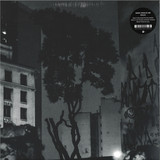
Cobalt Chapel release ‘Orange Synthetic’, the follow-up to their much lauded self-titled debut album and its companion piece ‘Variants’. ‘Orange Synthetic’ is an exploration of the epic county they call home, Yorkshire. Written during this tumultuous turn of the decade, it is inspired by the humanity, anecdotes and folklore of the region, and the surrounding landscape.
The album delves into stories which exist at the edge of history and myth: the drowning of a village under Lake Semerwater, the mystery of the lost geodesic domes of RAF Fylingdales, the fate of John Hotham of Hull, beheaded for treason during the English Civil War, a psychedelic folk song about an infamous Cragg Vale farmer killed in a fight over a flock of sheep, the cry of Skylarks over Erringden Moor.
The album’s name stems from a line in the title track, telling the story of the fateful Yorkshire Folk, Blues & Jazz Festival in Krumlin, fifty years ago. Hit by a violent storm, it resulted in the devastation of the site, near-deaths from exposure and the promoter being found wandering the moors, days later.
Cobalt Chapel’s atmospheric style remains distinctively their own, through Cecilia Fage’s crisp English vocals and choral arrangements, and Jarrod Gosling’s use of organs such as the Vox Continental, Philicorda, and the USSR-era Elektronika Organ. These are the foundations of their rich, experimental yet melodic sound, and this album sees them expand on it with the addition of mandolin, guitars, and drawing on Cecilia’s classical background, with clarinets and recorders.
Cerca:english man
- 01: Cuore Nero - Samurai
- 02: S.u.b.u.r.r.a. - Manfredi &Amp; Cinaglia
- 03: S.u.b.u.r.r.a. Theme Song
- 04: Fiore Dell&Apos;Infame - Angelica &Amp; Nadia
- 05: La Giostra - Anacleti&Apos;S Groove
- 06: É Ora Di Andare - Spadino
- 07: Scivola Via - Aureliano
- 08: Su Di Me - Cinaglia
- 09: É Ora Di Andare (F.f. Rmx)
- 10: Overture
Netflix's acclaimed series Suburra: Blood on Rome (available in over 190 countries) focuses on the deep connections between politics and organised crime in the Italian capital. The soundtrack to the third and final season was written, produced and performed by Roman rapper and songwriter PIOTTA, whose "7 Vizi Capitale" was already the theme song for seasons 1 and 2. His music beautifully complements the gripping plot and the characters' journey, capturing the atmosphere of a side of Rome unknown to many. The vinyl LP contains 10 previously unreleased tracks, including 2 instrumentals and a remix; the CD features 3 bonus tracks.
With 9 albums under his belt, Tommaso Zanello, also known as PIOTTA, is one of the pioneers of Italian hip hop. Active on the Roman rap scene since the mid-90s, he earned national fame with his award-winning single "Supercafone" (1998), which was later used by Sky Japan as a theme song for the Italian football championship. He can boast collaborations with hip hop legend Afrika Bambaataa and English musician Captain Sensible and has toured the United States with the Vans Warped Tour.
Blues singer and harmonica player Brian Knight (1939-2001) is counted as one of the initial members of The Rolling Stones. Co-founder of Brian Jones first band together with Ian Stewart and Dick Taylor (later Pretty Things) among others. Musical disagreement with Jones, who fancied Bo Diddley and Chuck Berry while Knight was a Muddy Waters follower, led to his departure from the group - later to be replaced by Jagger and Richards. He formed his own "Blues By Six" band, frequently with Charlie Watts on drums, and spent the following years touring and playing London clubs. In the seventies he continued with Bradford-Knight Blues Band. Always a high profile act on the English blues circuit Knight has performed with many known artists through the decades, as Rick Wakeman, Peter Green, Paul Jones, Zoot Money, Ronnie Lane, Charie Watts, Chris Farlowe...and many more. After two successful decades of touring and performing he finally got to record his debut in 1981on the independent label PVK Records. The album is a mix of standard blues and rock numbers as traditional "white blues", sometimes reminding of early British R&B from Cyril Davies or Alexis Korner. It features Dick Heckstall-Smith (Colosseum) on sax, Peter Green on guitar and Stones own Charlie Watts on drums
The Pink Fairies were and English Rock band in the London underground and psychedelic scene of the early 70s. Their first album Neverneverland, from 1971, is a mix of psychedelic, proto-punk (“Do It”), rock (“Teenage Rebel” & “Say You Love Me”) and even American R&B (on “War Girl”) sounds which shows their wide style. Also included is the b-side of their debut single “Do It” which was later covered by The Henry Rollins Band on their 1988 Do It album. The 50th Anniversary edition includes an insert with extensive liner-notes by Mark Powell, credits, cutout pieces and photos.
- A Intro (My Single Isn't Finished Yet)
- Deep Blue Monday
- In The Game
- Chance Encounter (Jungle Theme)
- Call Of Beauty
- Welcome To Soma
- Unreal
- Superstar
- One Nation
- Beware Your Fans, Diva
- Call Of Beauty (Esports Reprise)
- Followers (Diva's Theme )
- Farsight's Greatest Star
- In My Prime (Bonus Track)
- Apocalypse (End Credits)
500 COPY LIMITED EDITION ~ INCLUDES 4 INDIVIDUAL FULL SIZE ARTWORK INSERTS. Hyperdub are excited to present our first soundtrack release, Lawrence Lek's score for his debut feature film `AIDOL', which premiered at Sadie Coles HQ in 2019 and has been shown at numerous virtual and physical festivals and exhibitions worldwide. Lawrence Lek is a simulation artist who uses computer-generated animation and video game engines to create films and virtual worlds that play with the language of science fiction, music videos and corporate world building. He has released soundtracks to five of his previous projects, most recently `Temple' OST (Vinyl Factory, 2020). `AIDOL' continues his on-going 'Sinofuturist' cinematic universe, which posits the creative theory that China's technological rise is an emergent form of Artificial Intelligence. `AIDOL' is a CGI fantasy that tells the story of a fading superstar, Diva, who enlists an aspiring AI songwriter to mount a comeback performance at the 2065 eSports Olympic finale. Set in a realm of spectacular architecture, sentient drones and snow-deluged jungles, `AIDOL' revolves around the long and evolving struggle between humanity and Artificial Intelligence; a shifting and seductive virtual reality, punctuated by Diva's songs and the voice of Kode9 as the unforgiving label boss. The soundtrack is a delicate lattice - complex, opaque and entirely synthetic. Diva's yearning vocals - created with a Vocaloid voice synthesiser, sung in English and Mandarin - cast classical melodies over billowing, intricate arrangements. The instrumental tracks, produced with composer Seth Scott, are elegiac and beautiful, hybridising the film score archetype, folding in patterns from game soundtracks, vaporwave, and ambient fourth world music.
Flaming Tunes' sole release is perhaps the finest elegy to the '80s home recording ethos that you've never heard. Originally released in 1985 on cassette (with individually hand-colored covers), this self-titled album grew out of the collaboration between childhood friends Gareth Williams and Mary Currie.
Williams is best known as a member of English art-rock band This Heat. After leaving the group in the early '80s, he travelled to India where he studied classical Kathakali dance – an experience that would profoundly shape the music of Flaming Tunes.
In an old Victorian house in South London, the duo recorded during the day while Currie's young son attended school and Williams conducted tape treatments at night. They were joined by various guests including This Heat guitarist Charles Bullen as well as long-term collaborators Martin Harrison and Rick Wilson.
Using whatever instruments they had on hand (clarinet, piano, bells, etc.), Flaming Tunes create lo-fi melodies around simple arrangements, oblique rhythms and densely layered natural sounds. The results are a mesmeric collage of instrumental daydreams and sideways pop songs, floating into one another in a hazy confluence of late '60s Canterbury psych-folk and early Residents experimentation.
All of these beguiling elements converge in a personal manner, quietly insistent in listeners' ears like the blood pulsing in one's veins on a warm summer day.
Obscure rock group Nite People was formed in 1964 in the southern English town of Poole by drummer/singer, Chris ‘Fergy’ Ferguson; later, guitarist Jimmy Shipstone joined (as Jimmy Warwick), along with organist Barry Curtis and Jimmy’s brother Francis on bass (as
Francis Gordon). Following inconsequential singles for Fontana, with bassist Scott Kirkpatrick, the group signed to Larry Page’s Page One. P.M., issued in 1970, showed heavier leanings and although originals “Funky Hoe” and “P.M.” were captivating, the album probably had too many covers, though the driving cut of The Four Tops’ “Reach Out” was certainly unique. Page also had the group record as The Banana Bunch, before the final split.
Limited 180gr orange vinyl press for RSD2020.
- A1: Mano Negra
- A2: King Kong Five
- A3: Soledad
- A4: Mala Vida
- A5: Sidi H'bibi
- A6: Rock Island Line
- B1: Noche De Accion
- B2: Guayaquil City
- B3: Peligro
- B4: Sueno De Solentiname
- B5: Indios De Barcelona
- B6: Mad Man's Dead
- C1: Senor Matanza
- C2: Out Of Time Man
- C3: Pas Assez De Toi
- C4: King Of Bongo
- C5: Ronde De Nuit
- C6: Patchanka
- D1: Salga La Luna
- D2: Santa Maradona
- D3: El Sur
- D4: Long Long Lite (Inedit)
- D5: On Telefon (Inedit)
- D6: Darling Darling
First timer ever Best Of Mano Negra on vinyl ! Double black 140G vinyl edition. 24 sons – all their hits : "King Kong Five", "Mala Vida" , "Pas assez de toi" , "Out of time man", "King of Bongo", "Sidi H'Bibi", “Santa Maradona”, “Senor Matenza”… Mano Negra are the legendary French alternative rock band whose leader was Manu Chao. Singing in French, Spanish, English & even Arabic. They toured throughout the world and recorded 4 studio albums : “Patchanka”, “Puta’s fever”, “King of Bongo” & “Casa Babylon” & a live album “In the hell of Patchinko” , all reissued by Because Music and still available on CD & Vinyl. After their split, Manu Chao started a solo carreer in 1998 with the classic “Clandestino” album.
Soweto-born Sello Twala emerged as a key figure in South Africa’s bubblegum scene, initially cutting his teeth in the early 80s as part of groups Umoja, Harari and Image, who in 1985 released the track that would give him his nickname: ‘Chicco’. Teaming up with co-producer Attie van Wyk, later that year he released his first single as a solo artist, ‘We Can Dance’. It was followed in 1986 by ‘I Need Some Money’. Both tracks add accessible English lyrics and catchy call-and-response vocals to infectious Shangaan-rooted dance rhythms, appealing to a wide audience that defied apartheid categories and established Chicco as a charismatic solo star, as well as a talented producer, both in SA and across the continent. Based on the success of these breakthrough singles, Chicco would go on to release politically charged pop albums We Miss You Manelow (1987), Thina Sizwe Esimnyama (1989), Soldier (1989) and Papa Stop the War (1990) and Nomari (1991).
"Secretsundaze continue their quest to uncover amazing new music with the signing of exciting young Dominican artist Boundary. At just 19 years old Boundary aka Josue Suero makes music that is brimming full of ideas and influences that belie his young age. The 'Interlazados' EP is his debut release for a UK label.
Taking cues from his fascination with video game music, his first real gateway to electronic music, the four track EP showcases Boundary's melodic sensibilities and ear for a killer rhythm.ALead track 'Opticamente Avanzando' unwinds over 12 minutes of deep, mesmeric melodic, contemplative electronica with hints of 90's UK rave influences.ACheck the grins when the killer bassline drops half way through!A
The glossy melodies, jazzy motifs and hip-tugging bass of 'OP.AV' and the breakbeat house of 'Interlazados' channel more lo-fi, ambient house influences but all sent through that unique Boundary filter. Finally, the brain-warming, hypnagogic, tempo-changing rhythms of 'Planos de Ausencia Casualidad' could be the EP highlight and recalls the work of Lone and Actress.
You could listen to these tracks and be mistaken for thinking this is an artist who has maybe been lost in the throws of extended Villalobos DJ set or the deep pads of old Sun Electric records, but as an artist who is an outsider to the European dance scene, his inspiration comes from closer to home, as Boundary explains:
"For this EP I was interested to see if i could hit close to the feelings i have when I listen to certain video game music, how I could convey the amazing and deep storytelling in these songs. I really wanted them to feel like a ride/adventure. 'Opticamente Avanzando' ('Optically Advancing' in English) for me is like a venture into a machine that analyses a bunch of electronic music genres and it outputs as many different variations of these genres it can, each with their own little quirk/details, creating something unique in the process."
With previous releases on LA based label, Point Records, and Paris' Third Try label (Axel Boman, SFV Acid) Boundary's emergence represents a promising prospect for the electronic music world and 'Interlazados' another essential release on Secretsundaze."
- A1: Ave Do Deserto
- A2: L Varrido
- A3: Doctor Albert Hofmann Encontra Em Barcelona Os Irmaos Siameses (2 Cabecas E 1 Cerebro) "Pico & Peco" Com Sus Sombreros A Admirar La Raponesita De Osaka
- B1: She Is Going To "The Hell" & Everybody Knows & Everybody Goes
- B2: Massacre Da Serra Eletrica I
- B3: Massacre De Serra Eletrica Ii
"Lugar Alto's newest project is the idiosyncratic album MUMIA (portuguese for MUMMY). Never released before, it is a work that was originally recorded on cassette and combines elements of post-punk, industrial and ambient music.
Kodiak Bachine and Celso Alves formed the ephemeral and eponymous duo in 1988. The partnership resulted in a single recording derived from improvised sessions using minimal amounts of electronic equipment at Celso's country house, located in the interior of São Paulo.
Bachine was an important figure in the São Paulo underground. His most renowned project was the band Agentss from 1981, which also consisted of Miguel Barella, Eduardo Amarante, Elias Glik and Lyses Pupo (later replaced by Thomas Susemihl). In its brief duration, the band released only two seven inches that were considered seminal artifacts in the Brazilian post-punk scene: “Agentes / Angra” from 1982 and “Professor Digital / Cidade Industrial” from 1983. These two rare records are highly sought after by collectors and DJs from around the world for their inventiveness and originality.
Similar to Agentss, MUMIA brings with it extreme authenticity, managing to extrapolate the barriers of more traditional Brazilian music and interact with unorthodox elements. The lyrics are a mixture of Portuguese and English and it is still possible to identify picturesque fragments of Spanish, French and German. In addition, sonically, the record portrays aesthetics from the eighties and dialogues with themes relating to LSD. Another notable feature is the fixation on Egyptian post-mortem themes, providing a cinematic and lysergic experience of the desert landscapes from the African country.
It is a recording with comic passages which provokes an unpretentious reaction from the listener. However, it still has more ethereal and atmospheric moments, such as the opening song “Ave do Deserto”. In the final two tracks, it is possible to enjoy a darker MUMIA, which with “Massacre da Serra Elétrica I” and “Massacre da Serra Elétrica II”, provide a sound experience capable of accompanying intense scenes from the macabre productions by Tobe Hooper and George Romero.
The striking new artwork was created by the Sometimes Always studio, a partner of Lugar Alto and responsible for diverse graphic collaborations with artists, venues and parties in Brazil. The album, mastered by the prolific Arthur Joly, also has a booklet containing Kodiak’s texts in Portuguese and English, in addition to the lyrics, which serve as a logical exercise for further understanding of the album.
MUMIA was unearthed by the renowned Brazilian DJ Millos Kaiser, who in addition to kindly curating this album, put together the compilation “Onda de Amor: Synthesized Brazilian Hits That Never Were (1984-94)”, released by Soundway Records.
Now, after 32 years in its tomb, the MUMIA has risen and thanks to Lugar Alto it can finally be celebrated and appreciated."
- A1: L'aventurier (Feat Helena Noguerra & Louis Ronan Choisy)
- A2: Putain Putain (Feat Camille)
- A3: Marcia Balla (Feat Adrienne Pauly)
- A4: Sandy Sandy (Feat Soko)
- A5: Ou Veux-Tu Qu'je R'garde (Feat Emily Loizeau)
- A6: Two People In A Room (Feat Cocoon)
- A7: Dereglee (Feat Melanie Pain)
- A8: Oublions L'amerique (Feat Nadeah Miranda)
- B1: Voila Les Anges (Feat Coeur De Pirate)
- B2: Week-End A Rome (Feat Vanessa Paradis)
- B3: Mala Vida (Feat Olivia Ruiz)
- B4: Anne Cherchait L'amour (Feat Julien Dore)
- B5: Ophelie (Feat Yelle)
- B6: Amoureux Solitaires (Feat Hugh Coltman)
- B7: So Young But So Cold (Feat Charlie Winston)
- B8: Je Suis Deja Parti (Feat Coralie Clement)
The 80s owed everything to the punk revolution ... and betrayed it time and again.
ln 76-77, the incredible explosion of English-speaking bands focused the energies of a whole generation of Western youth - rebels ready to pick up a guitar and use it like a weapon. Yet more than punk music itself, it was the creative burst it triggered that radically shaped 80s pop and heralded an unending stream of inspired performers.
Although we often speak of the British and American golden age of post-punk from 78 to 84, with artists that included Talking Heads, Joy Division, PIL and Devo, France (together with Switzerland and Belgium) joined the movement too. Today, on a new album, the group Nouvelle Vague have paid tribute to this sumptuous "Frenchy" period clothed in the nihilism of punk, along with bitterness fuelled by the economic crisis and, paradoxically, the bewitching spirit of pop.
lts title, Couleurs sur Paris (Colours on Paris) is based on both a famous postcard collection and Oberkampf's 1981 punk anthem, and reflects the period, which oscillated between elation and despair. Written by artists sometimes known as "the modern young people" and including faux naïf electropop nursery rhymes by Elli & Jacno ("Anne cherchait l'amour", 1979), Lio ("Amoureux solitaires" , 1980)
and Etienne Daho ("Week-end à Rome", 1984), along with Lili Drop ("Sur ma mob", 1979) and Taxi Girl ("Je suis déjà parti", 1986), the songs clearly express the hopes and disappointments of the day.
The sense of melancholy suggested by the disenchanted lyrics of "Déréglée" - performed in 1977 by Marie-France, an icon of Paris nightlife - is even more noticeable on the 1981 hit by The Civils, who cynically sang, "Tonight, they're dying in Chad, but l'm buying my dream Walkman" before taking it to the chorus: "The economic crisis is fantastic, decadence is the right feel".
The punk shockwave con also be felt in the music of bands who radically shaped French culture and song. Like Rouen, with Les Dogs ("Sandy, Sandy", 1982), every provincial town and city in France began to produce bands at the end of the 70s and the start of the 80s. Wunderbach's 1983 punk pamphlet "Oublions l'Amérique" was a foretaste of what is now called alternative punk, a genre that won acclaim in 1988 with Mano Negra's "Mala Vida". Indochine, French pop legends for the last thirty years, also encouraged the trend in the summer of 1983 with "L'aventurier", after a first single brimming with the spirit of rebellion, "Dizzidence Politik".
Rita Mitsouko, the duo that emerged from the underground Parisian punk scene of the late 70s, rocketed to stardom in 1984 with "Marcia Baïla". Equally baroque, TC Matic - the first band fronted by Belgian singer Arno - released an ironic, political underground hit in 1983: "Putain, putain". Other artists fuelled a post-punk movement that explored the romanticism of machines and the darkness of new wave, including the cult, much-neglected duo from Nancy, Kas Product ("So Young but so Cold", 1982) and Switzerland's Stephan Eicher, whose "Two People ln A Room" (1985) followed on from "Eisbaer", a hit in a more underground style written with Grauzone in 1981. However, the genre's most influential practitioners were certainly Noir Désir. From their first single in 1987 ("Où veux-tu qu' je r'garde?"), they won mainstream success with their unique fusion of 80s gloom and power rock. Beyond from the meteoric success of Bordeaux's Gamine ("Voilà les anges", 1988) and the subversive spirit of Jad Wio ("Ophélie", 1989), French post-punk reached its climax with the success of Noir Désir, Rita Mitsouko, Stephan Eicher and Manu Chao, whose albums reigned supreme in the 90s French charts. From the underground scene to gold records: the eternal story of pop.
- A1: The World Has Changed
- A2: When The Money Runs Out
- A3: The End
- A4: Lost Control
- A5: An Englishman In The U.s.a
- B1: Who Will The Next Fool Be
- B2: Work
- B3: Oh Girl
- B4: Ghosts
- B5: Takin' The Easy Way Out
In a career spanning 45 years, Leo Sayer has sold more than 80 MILLION records worldwide. ‘Here’ is Leo Sayer’s 7th album, originally released in 1979 and features the singles ‘When The Money Runs Out’, ‘The World Has Changed’, as well as his cover of The Chi-Lites classic ‘Oh Girl’. This album reunited Leo with early producer and collaborator, David Courtney. Leo Sayer has overseen his entire reissue programme and from reading the reviews from many of his sold-out concerts, he remains one of the UK's great singer/songwriters and performers of all time.
For that 15th Acid Avengers split EP, we welcome two providers of acid music who know each other very well, as they're also associated in the duo Nite Vision.
On the A-Side, English producer Perseus Traxx, known for his raw house & electro bombs on Bunker, Solar One, I Love Acid or his own imprint Future Flash.
On the B-Side, Barcelona-based producer Mantra, also know under his aliases Myriadd or Acid Phreex, and responsible of several ravey bangers on Pinkman, Creme Organization, Bunker and Polybius Trax.
Two virtuoso producers for five acid pearls!
'IMB12001' shipping to You in a designed Uni Cover with a Sticker of the Label "The Inbeciles" on it!
This is the music for our times; our darkening times. The Imbeciles are making the soundtrack for the world we really live in, which is set to become increasingly angry, unhappy, unfair, and messed up. “The world is slowly imploding.” That’s the warning from The Imbeciles, and the message behind its first album. The idea of what to do emerged like a surprise attack.
“I don’t even know where it came from… it ambushed us,” says Butch Dante, of the band’s forthcoming self-titled debut album. “To us it looks like mankind will endgame itself in this millennium, and probably within the next 100 or 200 years. The Imbeciles as harbingers of that fall. We’re pointing out that the world is imploding, for many reasons — environmental, political, technological, and ultimately because human beings themselves forgot how to be humane, how to be kind.”
“Saying we are political would infer that we have some faith in the political system. We don’t. Or that we have answers, a solution to prevent this coming slow apocalypse. But we don’t. We are sitting at the side of an innocent-looking pool saying: hey, you’re drowning but you don’t even know it. And we’re giving you some music to listen to as you go down.”
Inspired by the likes of Wire, Devo, Gang Of Four, but utterly unique, a new form of avant-garde art punk, against greed and mendacity. The band’s forthcoming album was recorded deep down at Sonic Ranch on the Texas/Mexico border. All analogue, in seven days. Produced by Calvin Voltz.
Latest single “D.I.E.” is “a lament for the end of the world. With references to global endgames. They’re grim. All self-inflicted. The chorus is epic when played live. It’s incredibly passionate. People really get into it.” And now it’s been remixed.
Red Rack'em's take on is wonderfully curveball as one might expect; homing in on one unique part of the vocal and making it the fullcrum, from which his psychedelic, deep-house, hardcore jazzathon is then able to blossom and unravel before your very eyes. Atmospheric, experimental and hooky too - clever business from the Bergerac boss.
Next up we have the amazing Oliver Ho and his Broken English Club. Here we witness a more flagrant and faithful use of stems, and through layering both the band's parts, and instruments of his own design - he transforms 'D.I.E.' into a towering slab of dark and raw, industrial EBM.
Wewantsounds is delighted to continue its Akiko Yano reissue program with the reissue of her superb double album recorded with YMO at a time when she was part of the group’s touring line up between 1979 and 1980. The album is pure Akiko Yano featuring her superb singing and piano playing, enhanced by touches of YMO’s synth-pop sound (check her cult version of YMO’s classic, “Tong-Poo”). It is the first time the album is released outside of Japan and the deluxe 2-LP set features the original artwork with gatefold sleeve and 4-page insert.
When "Gohan Ga Dekitayo" came out in 1980, Akiko Yano had been touring with Yellow Magic Orchestra for more than a year. She'd play keyboards alongside the three founding members, Haruomi Hosono, Ryuichi Sakamoto and Yukihiro Takahashi, plus guitarist Kenji Omura and Synth wizard programmer Hideki Matsutake (as part of the 1980 North American tour, she'd also feature in the group's cult TV appearance on Soul Train for a memorable rendition of "Tighten Up") and they are all present on "Gohan Ga Dekitayo."
The double LP, whose title could be translated by "Dinner is ready," was co-produced with Ryuichi Sakamoto and recorded at two legendary studios: Tokyo's Alfa Studio "A" and Los Angeles' Sound City. It was Akiko's first shift towards a fuller synth sound following four studio albums mixing Pop and Jazz Funk, including her landmark debut from 1976, "Japanese Girl". A shift that would continue with the release of "Tadaima" in 1981, also featuring the YMO musicians.
?The fourteen tracks featured on "Gohan Ga Dekitayo" find Akiko in top form mixing her singer-songwriter's sensitivity with the electro-pop sound of YMO. It's interesting to note though that it is very much an Akiko Yano album even if the group is present on the album (interestingly they do also play analog instruments on the album). Akiko is clearly the one in charge with a string of beautiful compositions and the rendition of one of the group's classics, "Tong Poo" which she reinvents as a slower, less metronomic-paced song adding her own lyrics.
?Other highlights on the album include "Dogs Awaiting..." an hypnotic composition featuring fascinating electro arrangements or "Coloured Water" sung in English by Akiko accompanying herself on Fender Rhodes with subtle percussion by Tatsuo Hayashi and electronics by Ryuichi Sakamoto.
There are many more great moments on this superb album which announces the further experiments of "Tadaima". "Gohan Ga Dekitayo" is an album that urgently needs to be (re)discovered by her growing international fanbase and Wewantsounds is happy to reissue it worldwide for its 40th anniversary.
THE GOOPY GOONS ARE BACK with another collection of twisted American electronics. For those not familiar, CP/BW is a collaboration between Corporate Park (aka Shane English/Jonah Lange) and Beau Wanzer. This second LP collects tracks from various recording sessions done in Texas over the past 5 years. Humid ditties, bumpkin beats, toothless treats, and only for the freaks.
The newest solo work by Roger Eno in nearly a decade. This Floating World holds rustic and melancholic piano works, as grey and mossy as a country cottage. I hear the LP chiming from the dark corners of a pub, soaking in the damp wood like spilled ale.
I first fell in love with Roger's music with his 1985 debut album Voices, which cradled many rainy and caffeinated mornings when I was living in San Francisco years back. He played on the infamous Apollo, Music for Films vol. 3, and recorded a theme for the Dune soundtrack. Pad-keyboards and veils of reverb pour through those processed tracks.
I later rediscovered Roger Eno in a different light with his 1997 album The Music of Neglected English Composers. A playful and beautiful album of chamber pieces guised as the works of forgotten (and fabricated) composers from the past century. His compositional sensibilities remind me of my favorite recent English composers... Hobbs, White, Bryars, Skempton, etc.
This Floating World feels like a hybrid of these two styles, a melding of both his ambient and 'prelude'-esque compositions. Warm and feathered furniture music. An antique on the shelf gifted from an a cherished relative.
In our communication Roger has been a real charmer, ending every email with Roger and out.' A curious fellow, with a knack for tracing the understated beauties of this world.
In addition to the lovely LP, Roger wrote some brief stories which are set in a 12-page booklet alongside his photography.
Black Truffle is pleased to present Realejo, the first vinyl release from Brazilian sound artist and composer Manuel Pessoa de Lima. Having composed works for diverse contexts including cinema, contemporary dance, theatre and television, Lima’s live appearances often take the form of self-reflexive lecture performances that combine electro-acoustic sound, red light, video and spoken text, moving unpredictably from the hilarious to the distressing.
Realejo consists of two side-long pieces of highly idiosyncratic electro-acoustic collage, beginning with recordings Lima made of himself playing the organ in the Schloss Solitude Chapel in Stuttgart. Exploring the peculiarities of the instrument’s mechanics, Lima made hours of recordings with the organ stops half-way open, moving from haunting gliding tones to oddly tuned fair-ground melodies reminiscent of the record’s namesake realejo, a hand-cranked organ traditionally found in Brazil as the musical accompaniment to the work of fortune-telling parrots.
To these organ sounds, Lima added recordings of a security guard made in São Paulo: ‘Just before coming to Stuttgart, I started making field recordings of a security guard in São Paulo. It's something pretty common in residential areas: they sit in a chair with a whistle, and use that to signal when people arrive, leave or pass by in the street. This particular security guard, Miguel Viana, works on the same street my parents live, and where I had my childhood, and he has worked there since I was a small child. He has watched the street at night, from 8PM to 6AM, every single day, except Sundays, for over 30 years’.
The poignant sounds of the security guard’s whistles punctuate Lima’s electro-acoustic environment, which also includes raw digital synthesis, recordings of his friends’ infant child, audio lifted from Youtube, and, on the LP’s second side, elements taken from an earlier work, ‘36 English to Portuguese Lessons’. Finely chiselled from dozens of hours of source material into a detail-rich, mercurial structure, Realejo is alternately jarring and seductive, introducing listeners to a young composer with a powerfully individual voice.
Dick Verdult, a.k.a Dick el Demasiado is the Philip K. Dick of multi-disciplinary art, the Moby Dick of “cumbia lunática”, and the Charles Dickens of literature and experimental cinema. He first fell in love with cumbia when he heard his nursemaid singing the classic “La pollera colorá”. From this moment on, he adopted the genre and reinvented it, in a perpetual degeneration called Cumbia Lunática, twisting up the elements of traditional cumbia, the “cumbia of the mucamas”, to create an anarchotropical vertebral rhythm, one which supports every moving part.
Celulitis Illuminati is the powerful debut of the anarchotropical gentleman knight of the abstract, Dick el Demasiado, eight dangerous tracks recorded for the first time on vinyl, songs that, upon listening, will liposuck all that grotesque accumulation of adipose tissue out of buttocks and brain. They interweave an amalgam of South American folklore and the cables of electronic music, the plugged-in Ranqueles indians, as in “Asi Que Los Que Sí” (“So That Those Who Yes”) on Side A, surrealist and lugubrious beats, poetry made song and “the dead man’s drool is good for painting watercolors”, as he sings in “Búho Sin Un Ratón” (“Owl With No Mouse”).Euphony that will abduct you away to a viscous street party with “Son Cosas De Hoy” (“They’re Things For Today”) and to an eclectic and excessive dimension with “pero bien bweno” (“but very proper”).
Side B is pure dynamite: “Mecha flan” (“Pudding Fuse”), “Sábado cultural” (“Cultural Saturday”) and “En la jeta” (“In the face”) represent the perfect blend of Lucho Argain (La Sonora Dinamita) and Muslimgauze (Bryn Jones). On top of this, the album includes an as-yet unheard gem, “Llama Mi Abogado” (“Call My Lawyer”), produced by Dick himself and Manuel Schaller, the telepathic mage of the Theremin. When the Dutchman stepped off the boat and onto the block, as well as offering us the TV set, the sculpture of a deranged English woman who devours islands like they were sandwiches, the synthesizer, the sound effect, the African drum, the maraca, the indigenous whistle, he obtained for us the song and the stanza, he provided us with the language and the poetry, the truthful, the epic of the ugly. Cellulite for mortals, cumbia lunática for the enlightened ones! Alfredo Padilla (Trans. Komurki)