Deena Abdelwahed's first album is shifting the epicenter of contemporary electronic music south: 'Khonnar' will be released on November 16, 2018 by InFiné. Pronounced 'Ronnar' (an essential detail so as to avoid facile misinterpretation by French-speakers) it is a term that makes the most of Tunisia's cultural and linguistic spectrum. It evokes the dark, shameful and disturbing side of things, the one we usually seek to hide, but which Deena instead sticks our noses in with her debut. It is a testament to Deena's coming into her own as a world citizen, and as an artist. A self-construction made of frustrations and constraints, borne of retrograde mindsets, which are not the prerogative of either the East or the West, and which she tirelessly strives to expose and break. Throughout the 45 minutes of 'Khonnar", Deena breaks down the codes of bass, techno and experimental music, and writes the manifesto for a generation that does not seek to please or to conform, taking back control of its identity - with all the attendant losses and chaos. A new creative world order is taking shape, a new tilting point between north and south, the response of a connected and liberated youth who takes the control of the new decolonization. About Deena Abdelwahed A Tunisian producer and DJ, Deena Abdelwahed arrived in France at the age of 26 after earning her stripes on the Tunis scene and as part of the Arabstazy collective.
Das französische Label Infiné ist dafür bekannt, elektronische Musik jenseits ausgetretener Pfade zu veröffentlichen - hier wird Techno und House neu definiert. So passt es ganz gut, dass die aufstrebende tunesische DJ und Underground-Produzentin Deena Abdelwahed bei dem Lyoner Imprint eine Veröffentlichungsplattform gefunden hat. Abdelwahed performte in den letzten Jahren zwischen Boiler Room und Berghain in allen namhaften Clubs und hinterließ bei der globalen Dance-Gemeinde mehr als staunende Münder. Nach der im Frühjahr 2017 veröffentlichten EP "Klabb" präsentiert die Tunesierin mit "Khonnar" jetzt ihr sehnlichst erwartetes Debütalbum.
Was beide Tonträger vereint: sie verbinden nordafrikanische Klangelemente mit elektronischen Sounds, haben jedoch mit Weltmusik nichts am Hut.
Suche:essé
Attarazat Addahabia & Faradjallah's album came to us as quite a mystery. Our friends from Radio Martiko got access to the studio archive of the Boussiphone label and a reel labeled “Faradjallah” was among the items they had found there. After listening to the selection of reels they borrowed, Radio Martiko felt it was not a fit for their label and helped us licensing it from Mr. Boussiphone instead. We knew nothing about the band. We just had the reel with the music but very little information. What we knew was that the music was incredible and very unique. Gnawa sounds were combined with funky electronic guitars, very dense layers of percussions and female backing vocals more reminiscent of musical styles further south than Morocco. We started asking around whether anyone knew the band with no immediate success until we asked Tony Day, a musician from Morocco who helped us during our search for Fadoul’s family. His sharp memory came through once again, remembering all the names of the Attarazat Addahabia band members and even how to contact the bands singer and leader Abdelakabir Faradjallah. After visiting him at his home in Casablanca with our Moroccan colleague Sabrina multiple times, he shared his personal story. His father arrived in Casablanca from Aqqa at the age of six and his mother came from Essaouira. Abdelakabir was born in the neighbourhood of Benjdia in 1942. Abdelakabir Faradjallah studied fine arts in Casablanca, graduating in 1962. He also played soccer in the second team of "Jeunesse Societe One". His brother-in-law Ibrahim Sadr worked for one of the biggest football teams of the time in Morocco called "Moroco Sportive Union", which allowed him to travel to France occasionally. While Ibrahim was never part of the band he brought along a few instruments from trips.
Yet the majority of the instruments they could not afford to buy were build by Faradjallah and Abderrazak, Faradjallah's brother who passed away early. For instance they had built a Spanish guitar and a drum made of wood barrel and sheepskin by themselves.During the 1950s Faradjallah was booked as a singer for surprise parties with friends. He started to write his first songs including "L’gnawi" in 1967 and wanted to make people discover Gnawa culture, or maybe rather his take on the culture to be more exact. Faradjallah recalls his first interaction with the genre in the streets of the Dern neighbourhood, where he used to go to elementary school. Gnawa is one of the essential musical genres of Morocco. It combines ritual poetry with traditional dances and music linked with a spiritual foundation. Musically a lot of influences originated from West Africa as well as Sudan. Gnawa is usually played by a selection of specific instruments such as the qaraqab (large iron castanets centrally associated with the music), the hajhouj (a three string lute), guembri loudaâ (a three stringed bass instrument) and the tbel (large drums). People would put shells on their clothes and instruments and use incense at their parties. "Sidi darbo lalla - lala derbo khadem..." came from Gnawa verses Faradjallah used to sing when he was 14. The lyrics tackle a global (im)balance of power and the question of social status in this course. The band Attarazat Addahabia was formed in 1968. The original line-up included 14 members, all from the same family. They played their first small concerts here and there starting in 1969. Later in 1973 they performed bigger shows for instance at the Municipal Theatre followed by the "Al Massira Show" at Velodrome Stadium in downtown Casablanca. Their first album "Al Hadaoui" (the one you are listening to) was recorded at Boussiphone studios in 1972 and was never released before. Nobody seems to remember the exact reason why Boussiphone ended up deciding not to put the album out. The album's title track also served as the basis for Fadoul's "Maktoub Lah", who frequented the same circles as the band for some time.
Their shows sometimes could go as long as 12 hours, starting at 5pm in the afternoon, with an occasional break here and there. In the 1980s the band took a brief break. Faradjallah recalled the reason for that break like this: "Zaki, the bands drummer, had fallen in love with a young girl from Mohammedia. Soon after, he fell very ill. The group members were convinced that the girl had given him ‘s'hor’ (a kind of local Moroccan version of "black magic"). For four years, the whole group stopped playing. It was unthinkable to find another drummer to replace Zaki, even temporarily." So they waited four years for Zaki to "get back on his feet" before going back on stage. Apart from very few gigs here and there Faradjallah stopped playing music in the mid 1990s. Some members from the younger generations formed a new band and still play frequently to this day. Faradjallah runs a television repair shop coupled offerings beverages and snacks in the Belevedere /Ains Sbaa district of Casablanca. While Faradjallah was primarily a musician, he would work for the local cinema and paint their posters for new movies by hand and he designed all artworks and cover posters of the band.
And this eventually led to him participating actively in our first exhibition dealing with Habibi Funk’s work in Dubai 2018. He helped us by creating calligraphic complementations on large photo prints for that show.
Death Waltz Recording Co. are proud to reissue the debut LP from Le Matos. If you dug the Turbo Kid soundtrack then these are the guys responsible for the music! Originally self released by the band in 2013 and now a highly sort after by record collectors the world over. Le Matos produce 80's influenced dance floor electronica with nods to Daft Punk and Ed Banger. An absolutely essential reissue. 2 X 180G VINYL PRESSED ON WHITE AND GREY SWIRL VINYL (200 COPIES ONLY)
This vinyl begins with "Party People" an instrumental track that captures the essence of this artist, with melodies based on arpeggios, pianos and stabs, accompanied by small scratch cuts by hand from "Dj Ades"
On side B we hear “Olleum” this old school version that takes us back to 1986 with that vocal that surely brings back some nice memories “Sweetheart” covered before by great artists like Mariah Carey.
A delight that you should not miss, this edition of 200 copies, black label with matte black and shrink-wrapped sleeves.
Dutch multi-instrumentalist Felbm returns with the conceptual album "cycli infini" : a 38-minute composition of metamorphosing tape loops, musical patterns and instrumental sketches. Further exploring the concept is the vinyl release which features the track spread over both sides and cut to the end of each locked groove - creating an essentially never-ending piece that challenges the idea of the traditional listening process. The idea came to fruition by way of a lifelong interest and growing awareness of the cyclical nature of the world around him - be it through observing nature, or the mathematical and mind-bending works of Dutch artist MC Escher, or minimalist composers such as Erik Satie, Laraaji and Melaine Dalibert.
"The openness of Laraaji"s and Satie"s music have also been an influence to create a certain softness and feeling of comfort, as I like this piece to be a place you want to revisit", says Felbm, real name Eelco Topper. While Topper"s previous releases on Soundway Records comprised series of short, individual sketches, on cycli infini the tapestry is sewn seamlessly together using a step-like progression through the circle of fifths, which as the name suggests, brings the listener back to the musical key and soundscape at which they started. Should the full track be on repeat, it begins anew without being noticed. The piece began life with a layer of drone loops using tapes and delay pedals, over which acoustic instruments such as flute, saxophone and bass trumpet would playfully but gently interpret a melody - toying with jazz, ambient, fourth world and percussive sounds. As the music evolves through the key progression, organic elements such as birdsong and wind chimes ground the piece in nature. Says Topper: "the never-ending metamorphosis of matter has always fascinated me, the idea that nothing ever really disappears and everything has already been here... just in different shapes."
An essential part of the European disco history... "Livin' Up" and "Stop" by B.W.H., these two tracks are true 'milestones' and Italo-Disco in the purest form. The sound that only the most virtuous and innovative young Italian DJs and arrangers were able to create in the early 80s. B.W.H is Stefano Zito (aka Black Way), Stefano Galante, and the late Carlo Favilli, "Stop" is dubbed "the best B-side ever!", but "Livin' Up" is also incredible, making this vinyl the hottest 12" ever assembled in the Italo Domain and for decades incredibly underrated.
It was I-f's Mixed Up The Hague mix that brought this to the attention of a wider audience and have been considered one of the holy grails of Italo ever since. Here the 2 original versions from 1983 remastered with care and passion by Dom Scuteri and Claudio Casalini (Best Record) in two different editions: the classic one in black vinyl and the strictly limited one in gray vinyl. Two essential tracks available in a high quality edition.
Land Of Hits by name, Land Of Hits by nature, this downright delectable 12 inch from Fly Guy, with the aptly named Fly Guy Rap, on Peter Brown and Michael Campbell’s NYC label commands prices of over £750 on the second hand market.
A super rare cut that was been crying out for a reissue for many a moon and those prayers have now been answered. Killer breaks, funk stylings, and one of the most infectious raps you’re ever likely to hear. Essential business produced by P&P bossman Peter Brown that deserves a spot in every collection.
One of the inventors of the modern bebop style of drumming, Blakey is known as a powerful musician and a vital groover; his brand of bluesy, funky hard bop was and continues to be profoundly influential on mainstream jazz.
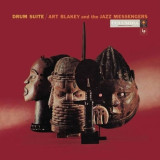
For more than 30 years his band, Art Blakey & The Jazz Messengers included many young musicians who went on to become prominent names in jazz. Recorded in 1956, Art Blakey's Drum Suite is a wonderful hybrid of African, Latin, and hard bop rhythms that prefigures the concept of Afro-beat by at least a decade. The sheer energy, not to mention its very special and fresh-sounding intimacy, make it especially astounding.
Even more amazing is that the three parts of the suite -- Blakey's "The Sacrifice," Ray Bryant's "Cubano Chant," and Oscar Pettiford's "Oscalypso" -- were recorded straight through live, and were only intended to be a pre-take run-through. As is obvious here, Blakey and company nailed the whole thing right out of the box.
Groundbreaking for its time, and still sounding vital, powerful, and visionary, the Drum Suite album is somewhat of a lost masterpiece that deserves a fresh audience.
"Art Blakey's first release for Columbia Records is essentially two records. Side one is a percussion ensemble playing what would, ten years later, be called Afro-Cuban drumming. Side two is the mid-fifties version of the Jazz Messengers featuring Jackie McLean on saxophone. Side one features Blakey, Jo Jones and Charles Wright on drums, Candido and Sabu on bongos, and Oscar Pettiford and bass and cello. The group plays three compositions, one by Blakey, one by Pettiford and one by Ray Bryant, fusing African, Cuban, and calypso percussion into a well-integrated suite.
"The group recorded a run through and it was so perfectly executed that they used the practice run for the release, unedited except to add some Swahili chants by the percussionists during a few passages. One cannot help but think of Olantunji's Drums of Passion, another Afro drumming landmark, here. Blakey's drum suite was recorded at Columbia's 30th Street studios in New York in 1957 and is in mono. The almost stereoscopic image is truly remarkable. Mastered by Kevin Gray and pressed at RTI, Drum Suite is a valuable record of one of the most important figures in jazz history. Recording: 9/10. Music 9/10." - Dennis Davis, Hifi+
"...The three-part suite was laid down in one take with no arrangements, and begins with a few tympani thwacks followed by an African chant. Soon the ensemble kicks in and the group takes off an a sweaty Afro-Cuban-bop journey that will leave you breathless, as the thing crackles with terrific energy. Side Two is more conventional hard bop, but given this group's mastery of if not invention of the style, these tracks are extremely satisfying. Kevin Gray's remastering is detailed and immediate, with plenty of bit and air, if not the widest dynamic range. For anyone interested in percussion of this genre, this is not to be missed." - Wayne Garcia, The Absolute Sound
Hurry has grafted the best qualities of ‘90s bubblegum power pop—the pitch-perfect songwriting, the pop-rock sheen, the borderline saccharine vocal melodies—onto something far more raw and emotionally resonant. Don’t Look Back is striking in its tenderness and candor—approximately half of the lyrics on the record concern the deterioration of an 11- year relationship Scottoline was in, with the other half being a celebration of new love. The first words Scottoline sings, in opening track “Didn’t Have to Try,” is essentially a statement of theme: “And we’re back at the beginning / Never thought I’d see a face like that again / It attacks when we’re not ready / And I won’t play it safe this time.” This is pop music about actual feelings which means it’s automatically better than most pop music. It is challenging and addictive.
There is not a single moment on Don’t Look Back that isn’t completely drenched in melody and emotion. “Parallel Haunting” evokes the tuneful ache of golden age Evan Dando; “Little Brain” sounds like golden age Evan Dando and golden age Noel Gallagher. Don’t Look Back is, in a word, bittersweet, with melodies that feel like a jackhammer on your brain’s pleasure center and lyrics that feel like getting slapped in the heart.
- You Move Me
- Ask Your Mama
- C'mon
- The Wench
- Another School Day
- C'mon Get Together
- Tell Him
- Lightning
- Games Up
- Do It All Night
- Can't Let You Go
- Night Watcher
- Whole Lotta Woman
- Dynamite
- Let's Twist Again
- Hooray Hooray
- Where's The Party
- Shout It Out
Formed as The Age in the late 1960s in the gritty north London neighbourhoods of Wood Green and Tottenham, teen Glam band Hello signed to Bell Records after being auditioned at home by Argent’s lead singer Russ Ballard, the concept being that the band would be supplied with original material by former Zombies manager, David Blaylock, a sure-fire formula that gave them strong overseas followings. This essential compilation gathers the best of the singles they cut for Bell, as well as more obscure rarities, the resulting picture capturing the group in all their Glam Rock glory, from prime beginnings to bittersweet end.
- A1: Nailing Honey To The Bee
- A2: That Girl Suicide
- A3: Nevertheless
- A4: Evergreen
- A5: Starcleaner
- A6: Let Me Stand Next To Your Flower - Live
- B1: Hide & Seek - Live
- B2: In My Life
- B3: Mary Please
- B4: Talk-Action=Shit
- B5: Oh Lord
- B6: This Is Why You Love Me
- C1: Not If You Were The Last Dandy On Earth
- C2: Swallowtail - Live
- C3: Feel So Good
- C4: Fucker
- C5: #1 Hit Jam
- D1: Ballad Of Jim Jones
- D2: Free & Easy - Take 2
- D3: Stolen
- D4: Mansion In The Sky
- D5: Sue
Vol.1[26,85 €]
This comes for the first time on 180g vinyl in a gatefold sleeve. Re-mastered for vinyl.This 22 track compilation spans the years 1995 - 2004 featuring key tracks from all their albums as well and live recordings and many unreleased tracks.BJM has been essential in the development of the modern U.S. garage scene, and many LA and SF musicians got their start playing with Newcombe, including Peter Hayes of The Black Rebel Motorcycle Club. Originally Newcombe was heavily influenced by The Rolling Stones' psychedelic phase - the name comes from Stones guitarist Brian Jones combined with a reference to cult leader Jim Jones, but his work in the 2000s has expanded into aesthetic dimensions approximating the UK Shoegazing genre of the 1990s and incorporating influences from world music, especially Middle Eastern and Brazilian music.
Another essential 45 from the 5 Boroughs of NYC, with Da Youngstas "Pass The Mic" making its first ever appearance on 7" with the original sample source on the flip. This should have mass appeal!
For the 15th release of Self Reflektion we have the talented Rove Ranger from Stuttgart Germany. Ever since he surfaced in 2020 he has been delivering nothing but greatness; a fresh approach on Techno while maintaining that 90s vibe. Purpose Research EP is a selection of four peak time club techno tracks from the man - one of the most promising and cutting-edge techno producers around right now. Highly essential!
Renowned Danish trumpeter Kasper Tranberg reforms his delicate chord-less trio with Nils Davidsen (bass & cello) and Frands Rifbjerg (drums) for the release of "Nobody"s Heart". Active on the jazz and improv scenes since the early 90s, Tranberg has been described as a player of great heart and purpose. Inspired by the iconic improvisers of our time, the album explores the connection between their instrument, their body and their soul. A collection of eight songs that Tranberg has deemed his favorites of the past few decades, the repertoire ranges from tin pan alley legends Rodgers and Hart, to visionaries like Ornette Coleman, to contemporary Danish singer/songwriter C.V. Jorgensen. On selecting the repertoire, Tranberg says "it was not about surface flash, technique or speed, but I followed my heart, my own footsteps and encounters in the previous 2 or 3 decades". Tranberg, Davidsen & Rifbjerg have been performin together since the early 1990"s, united by their passion for an exploratory and unpredictable playing style. With emphasis on stillness, melody, and texture, the record"s tone is melancholy, peaceful, and restorative. Tranberg"s intimate, warm trumpet sound soars above a bed of fluid bass and drum texture, slowly evolving from miniscule and sparse to dense and chaotic. Egoless, mature, and without flash, it is apparent the ensemble holds listening in high regard The trio seems to breathe as one, with each member aiming to make every note and sound mean something. Capturing the essence of each of the songs and making them undeniably their own, "Nobody"s Heart" is deeply personal, meditative and intricate. "Sometimes something else sings through the room and music - not often, but it"s a great feeling when it happens." - Kasper Tranberg
"SAMURAI'S boss only released his debut EP 'RATS' in 2021 (after a quarter-century in the game), but his brutalist productions are already essential. Landing somewhere between Dylan and death metal, iron-clad breaks clash against the digital roar of techstep bass across opener 'Raven', title track 'Sacrifice', and the searing 'Temple'. The dubby halftime ritualism that's become Samurai's calling card is never far away though, and the sinuous 'Anaconda' made with label regular Sam KDC is a prime example, providing a less hectic yet equally intense ride." DJ Mag
- A1: Prince Buster & The Maytals – I Got A Pain
- A2: The Maytals – He Is Real
- A3: T. Mccook – Cast Your Faith To The Wind
- A4: Prine Buster - Faith
- A5: The Ska Busters – Georgia
- A6: Prince Buster – Have Mercy
- B1: The Maytals– I Love You So
- B2: Eric Morris–Those Teardrops
- B3: Prince Buster–Chinaman Ska
- B4: The Skatalites–Super Charge
- B5: Don Drummond–Ska Town
- B6: Prince Buster–Ska School
Ska icon Prince Buster changed the face of Jamaican popular music by helping give birth to the form in the late 1950s by blending Caribbean cadences with a rhythm-and-blues backbeat, its rhythmic emphasis shifted to the afterbeat rather than the fore. National Ska: Pain In My Belly is a killer various artists compilation that Buster produced in 1964 for Blue Beat Records in Britain, its blistering contents featuring Toots and the Maytals, Eric ‘Monty’ Morris, and the Prince himself, as well as the pivotal musicians Don Drummond and Tommy McCook, who would shortly form the Skatalites. Essential listening for all true ska devotees!
The result of blood, sweat, tears, and introspection that have allowed for Stalley
to become a fully realized artist. At one point on "Bear Trap," Stalley evokes a car
ride bumping the Gorillaz and the Bobby Womack, and his latest feels like a
perfect hip-hop middle ground between the two. Pressed on Six Spoke Blue and
White color vinyl.
Skeewiff have gained recognition for their canny ability to turn a retro track into a bona fide modern hit. And so they return with a limited 7" release featuring their outstanding version of the traditional song 'Misirlou'. With its fusion of Eastern Mediterranean and surf rock influences, the memorable riff was made famous by Dick Dale, and it has become a cult classic thanks to the movie 'Pulp Fiction'.
But it doesn't end there, because the duo turn their attention on the flip to the stone-cold classic that is 'Amen Brother' by The Winstons! Known best for the honour of being the most sampled drum break ever, once again Skeewiff make it their own. This pairing represents the essence of Skeewiff's distinct sound, reflecting their musical obsession to achieve perfection whilst having fun along the way.
Born in Berlin, DJ, producer, and label owner Ben Rau has an unmistakable talent for getting to the wants and needs of the dancefloor. Having experienced the vibrant music scene of Berlin during the mid-'90s, Ben found himself at the heart of one of the most exciting periods in musical history. As the Berlin Wall fell, the city opened its arms to the sounds of house, techno, and trance, propelling Ben into a world of endless inspiration.
After also spending some time living in London, this EP combines the essence of his German roots with the energy of UK’s electronic music scene. He brings plenty of studio skill and musical creativity here, with three varied offerings. The EP opens with ‘Won't Stop’, a powerful track infused with acid influences, headed by a ridiculously catchy vocal. Next up is ‘Drop The Bass’, a psychedelic, mid-tempo chugger adorned with rolling drums. Finally, ‘I Luv It’ closes with playful synth patterns tumbling down over invitingly warm deep house drums.
This is a chunky bass-filled EP, ready to do plenty of damage to any dancefloor.