DRAIN – the Santa Cruz, CA based hardcore band, whose energetic live shows have propelled them to peak underground popularity (during a global pandemic) and they are ready to break wide open in 2023.
Living Proof is the band’s Epitaph Records debut and follow up to their 2020 breakout release, California Cursed.
The new album is a testament to the hard work and heartfelt ethos that’s at the center of DRAIN’s good-time psyche. There are a couple surprises on the album. Rapper Shakewell appears on the track, “Intermission”.
There’s also a cover of “Good, Good Things,” a nearly four-decade old melodic punk carol by the Descendents: slam-pit forebearers to DRAIN if there ever were any. “It’s crazy because the song’s been out like forty years, but lyrically it’s a DRAIN song!” exclaims vocalist
Sam Ciaramitaro.
“It just hits on everything that I love, that I’m about.”
What Sammy’s about is plenty wholesome. “I hope with this record that when someone hears it, it gives them hope,” beams. “If we were able to get through the tough times, anyone can. I can’t wait to play these songs and hear a room full of people singing back to us. We’re what the title says, the Living Proof.”
Produced by longtime friend and multi-instrumentalist Taylor Young (God’s Hate, Suicide Silence), then mixed by John Markson (Drug Church, Koyo), this is hardcore for everybody.
“As the band gets bigger, I try and keep that feeling alive,” says the smiling singer. “Every night I set up the merch and run it until it’s time to play. I want to be the guy that everyone says hello to. I want to thank every single kid that comes out for being there.”
Suche:everything for eve
COLORED VINYL
What were they up to? They couldn't explain it. But not explaining it was part of the point. The Danish duo Bremer/McCoy - with Jonathan Bremer on acoustic bass and Morten McCoy on keys and tape delay - recorded straight to tape so that they had as little time as possible to think about it. They just laid it down. The duo has been making music that defies categorization since 2012. They started as a dub group, bringing their own sound system to shows. Now their sound lilts between jazz, ambient, and neoclassical, with contemplative, propulsive melodies that capture the Nordic woods they walk in. Their last full-length release, 2019's clear-eyed Utopia, gained them a cult following in the U.S. and a roster of notable fans, including Nils Frahm and Gilles Peterson. The duo's latest release Natten, which means "The Night" in Danish, strives for even more transcendence, more freedom, more of everything in whatever sound they're making. It's still hard to explain. It's not meant to be explained. These 11 tracks are tinged with the sublime: watching the setting sun, feeling the planet tilt on its axis. If you listen closely, you can hear the constellations. Let Bremer/McCoy bring the night mood to you, whatever you're up to.
Reissue zweier Frühwerke des Banjo spielenden Dark-Folk-Troubadours Amigo The Devil, den LA Weekly als 'Johnny Cash in seiner schwärzesten Form, gemischt mit Father John Misty, wenn er Gräber auf dem Hollywood Forever Cemetery exhumieren würde' beschreibt. Der rare Sampler 'Vol. 1' aus 2015 enthält seine ersten drei EP's aus den Jahren 2010-2015, das Debütalbum 'Everything Is Fine' erschien 2018.
Lost in the depths of space, AAKAARA takes listeners on a journey to the outer limits of the sonic universe with their latest album “Obsidian Promises”. Blending influences from punk and metal, EBM, architectural design and certain celestial objects, AAKAARA offers a fresh take on industrial techno.
This body of work is dark and brooding, full of haunting and thought-provoking soundscapes. Metallic and cold one moment, blisteringly hot the next. Pounding drums create searing rhythms, acid-drenched synths weave abrasive textures, and noise permeates the stereo field. Inspired by the mysterious and alluring world of black holes, the producer explores the beauty of extremes through sound. “If you know my work or me,” AAKAARA says, “it’s no secret that I have a spiritual connection to, and an obsession with, black holes.
It’s not about doom and gloom, but about beautiful extremes: infinite calmness, ultra-high energy, being deeply centered, and inevitable attraction.” “I try to sonify this in a naive sense. It isn’t an attempt at science; it’s a way for me to practice a makeshift spirituality about these entities through craft and functional dance music for people.”
Spirituality and stellar inspiration were essential to AAKAARA’s life during the three years they spent between Los Angeles and London, while writing this album. It provided a sonic home during a period of transition, when they didn’t feel at home and didn’t have access to a studio.
Everything was made “in the box” using only Ableton 10. After collecting guitar pedals and amplifiers for years, AAKAARA has shifted away from a hardware-focused mindset and is now more invested in the conceptual framework, narrative, and cultural implications of their work. Visuals also play an integral role in this maximalist experience.
The outer sleeve (front and back cover) conveys the “big ideas” visually, while the companion poster includes custom typography, detailed drawings, symbol design, and poetry. The poetry provides a textual counterpoint to the lyric-less music, written in parallel but later stages of the production process. The visual identity of this work is inseparable from the music, describing it in an integral way. It’s the other side of the coin, not simply an accompaniment. With its spiritual connection to the infinite and mysterious, “Obsidian Promises” harnesses the beauty and intensity of celestial entities as musical inspiration, transforming the science into mystical, narrative-driven sonic experience. Get ready for a ride through the unknown as AAKAARA’s latest offering takes you on a high-energy trip through the black hole’s playground.
In a scene sometimes too polluted by clout and thirst for instant social media stardom, it's people like Mark Grusane that anchor our minds in truth, a north star that won't budge, operating outside and beyond the standards imposed by “the industry”, he is his own industry. The kind of truth and honesty minimal techno could barely dream of delivering, this is it, the culmination of so much understanding and knowledge in music. Not unlike what Mondrian did for the fine arts, so simple but so powerful.
Mark Grusane condenses in sound a feeling for the dancefloor that could never be described in words, and as simple as it may sound, the driving force behind it is the product of a rich scholarship in the underground. In a time where everything has been done and creating a uniqe style of one's own, Mark Grusane achieves it so effortlessly - every single track on this EP can unmistakably only have been produced by Mark Grusane during those off-hours at his Chicago record store, Mr. Peabody.
We hope you understand. For any further inquiries, please direct your calls to the party hotline.
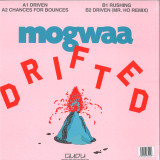
Mogwaa returns to Peggy Gou’s Gudu label with Drifted, his second EP for the imprint and a perfect summary of what makes him one of Korea’s most exciting contemporary artists - complete with a remix by Klasse Werks founder Mr. Ho.
A staple of Seoul’s electronic scene, Mogwaa’s catalogue takes in everything from ambient to jungle - but at the centre of his music, there’s always a distinct sense of melody and pure compositional chops that defines his music regardless of style or tempo. Put simply, you know a Mogwaa track when you hear one.
Quicker in tempo than his last EP for Gudu, Drifted opens with ‘Driven’ - a combo of chopped-up breaks and a relentless riff that does just what the title implies - before Mogwaa really flexes those melodic chops on ‘Chances for Bounces’, getting heady with synthesized voices and an almost Detroit-leaning bassline over an 808 groove. ‘Rushing’ takes things further into peaktime with an acid bassline and some nifty automation to keep things ascending, before Mr. Ho’s remix of ‘Driven’ closes the EP on a dreamy techno tip.
Following several European runs last year that saw Mogwaa perform at Warehouse Project, Pleasure Gardens and more, plus a Boiler Room in Seoul alongside Anz, Sharda, Finn, Closet Yi and Seesea, Drifted is another snapshot into the sound world of this remarkable talent.
Tom Zé and Faust collide in Domenico Lancellotti's "machine samba"
Domenico Lancellotti's SRAMBA reaches back to the roots of samba whilst completely revamping its blueprint, indoctrinating guitar and percussion-led rhythms with analogue synthesisers, courtesy of album producer Ricardo Dias Gomes.
The majority of SRAMBA was recorded over two months in The Cave - Domenico's home studio in Lisbon, the city both Brazilian ex-pats reside in, where the arrival of a couple of Russian-designed synths purchased by Ricardo influenced the direction of their initial experimentation: "Ricardo had these instruments, modular machines" remembers Domenico, "and I had my guitar, some percussion instruments. On the first day we started making sounds and recording them, and songs started to appear, sambas started to appear."
The son of a renowned samba songwriter, at home Domenico would watch his father play and compose. At parties, the adults would hand his father a tamborim (a small tambourine) and ask him to play along. "I grew up inside samba, it's my roots", he says. "For me, everything is samba, I bring it into whatever style of music I am making".
Domenico and Ricardo instantly saw how the synthesisers were not at odds with the sambas they were playing, instead they had a similar sound to its typical percussion instruments (ganza, repinique, surdo, tarol). What's more, they saw a connection with roots samba, the samba that existed before bossa nova and samba jazz came along. This was rhythmic samba, with grooves that could go on ad infinitum. "It's samba de clave, geometrically structured" says Domenico. "It's ostinato samba", adds Ricardo.
"Diga" is a great example of what their proposal is capable of, as what begins as a glitchy machine whirring into action soon turns into a glorious samba in which the gurgles and scratchy beats coming from the analogue equipment only add to the arrangement. Likewise, on "Tá Brabo" it's an aching melody from one of the synths that gives the guitar rhythm its needed counterpoint, and shows how the duo's greatest accomplishment is not in invention alone, but in creating a great samba album. It's an album that can go from the opening track "Ere" with its reverberant bass thud, mantra-like vocals and staccato rhythms to the string-accompanied "Nada Sera de Outra Maneira", a swooning samba that pays tribute to the Brazilian ensemble Tamba Trio, who along with Tom Zé's Estudando O Samba, Domenico names as the biggest influence on their treatment of samba.
Other important reference points are made clear on "Um Abraço No Faust". One of three instrumentals on the album its title riffs off a JoãoGilberto song, "Um Abraço no Bonfá", but whereas JoãoGilberto was giving a hug (um abraço) to bossa nova guitarist Luiz Bonfá, Domenico and Ricardo are giving theirs to the German avant-gardists Faust. "Quem Samba", with its horn section and dramatic melody give a whiff of Domenico's Italian ancestry, while "Descomunal" is devoid of rhythm whatsoever, guest vocalist Tori singing over a bed of electronic drums, cello and swirling synths, that highlights the duo's unwillingness to stick to a particular formula.
Both Domenico Lancellotti and Ricardo Dias Gomes are revered names within Brazilian music over the past 20 years. As a member of the +2's, with Moreno Veloso and Kassin, Domenico released a trio of albums on Luaka Bop in the early 00s that pioneered a new Rio samba sound with elements of funk and psychedelia. With Veloso and Kassin he would later form Orquestra Imperial, a big band intent on reviving ballroom (gafieira) samba, and that has worked with guest vocalists such as Seu Jorge, Elza Soares and Ed Motta. SRAMBA is his fourth solo album. Multi-instrumentalist Ricardo Dias Gomes first came to notice as a member of Caetano Veloso's band Cê which helped reinvigorate Caetano's career with a sound influenced by British new wave. As well as collaborations with Lucas Santtana, Negro Leo and Thiago Nassif, and work with his own group Do Amor, he has released a series of acclaimed solo albums that reveal a restless music-maker.
SRAMBA is a glorious showcase of the duo's style, uniting Domenico's playful lyrics and rhythmic, samba-rooted songs with with Ricardo's assured accompaniment of unorthodox textures and instrumentations. It may be a new language for samba, machine samba (samba de máquina), but as Domenico says, "samba da máquina is samba".
ULTRADISC ONE-STEP BOX SET OF BRUCE SPRINGSTEEN'S 1973 DEBUT PLAYS WITH AUDIOPHILE SOUND: LIMITED TO 7,500 NUMBERED COPIES.
1/4" / 15 IPS analogue master to DSD 256 to analogue console to lathe
Teeming with identifiable characters, youthful romanticism, vivid narratives, and sophisticated arrangements, Greetings from Asbury Park, N.J. is a personal postcard from the heart, soul, and mind of a rock ’n’ roll lifer bent on discovering his world and what lays beyond it. The 1973 album establishes many of the signature themes and sounds Bruce Springsteen would embrace throughout his unparalleled career. No wonder a majority of the songs — “Blinded by the Light,” “Lost in the Flood,” “Spirit in the Night” included — remain staples of the New Jersey native’s fabled concerts.
Sourced from the original analog master tapes, pressed at RTI on MoFi SuperVinyl, and strictly limited to 7,500 numbered copies, Mobile Fidelity's UltraDisc One-Step 180g 33RPM LP set is the definitive-sounding version of Springsteen’s daring debut. Afforded the benefits of SuperVinyl’s nearly non-existent noise floor, Greetings from Asbury Park, N.J. plays with a clarity, directness, and emotionalism that practically whisks you into the New York office in which Springsteen — accompanied by then-manager Mike Appel — played a few originals for legendary Columbia Records executive John Hammond and earned a record deal.
That solo-centric aspect of Greetings from Asbury Park, N.J. — credited only to Springsteen and featuring only a handful of accompanying musicians — helps make it unique in his catalogue. So do the acoustic-based frameworks, revealed on this pressing with newly exposed detail, nuance, and immediacy. The music emerges with an openness that gives flight to the Boss’ storytelling. His words flow with unbridled, stream-of-conscious pacing and vibrant imagery; they pay homage to and update a tradition established by Bob Dylan, Woody Guthrie, and Jack Kerouac. Equally important, Springsteen’s still-underrated vocal performances can now be appreciated in full-range fidelity. Earnest, transparent, and sincere, his singing comes across with an urgency that distinguishes him from the era’s singer-songwriter mold and a raw energy that underlines his unflinching belief in rock ’n’ roll.
Recorded in just three weeks, Greetings from Asbury Park, N.J. also stands out by way of its insightful artwork. Designed by Grammy winner John Berg, the inviting cover is appointed with images of the local landmarks, beachfronts, and geography that provide the backdrops for some of the songs. Those graphics are complemented by the beautiful packaging of Mobile Fidelity’s UD1S edition. Tucked in a sleek slipcase, the LP is housed in a special foil-stamped jacket with faithful-to-the-original graphics. In every way, this reissue is made for listeners who prize sound quality and who want to engage themselves in everything involved with this invigorating album.
An aspirational declaration by a then-23-year-old musician who was already a seasoned veteran of the Jersey Shore bar-band scene, Greetings from Asbury Park, N.J. can in many ways be seen as a semi-fictional autobiography released more than four decades before Springsteen penned his official tome. Elaborate, descriptive, and absorbing, Springsteen’s lyrics spark with the enthusiasm and exuberance of a wide-eyed adventurer ready for possibility, excitement, and fun — but who is also mindful of loss, pain, and disappointment. Words often tumble and collide like dice spilling from a jar; shaken and fully intact, they pour forth with purpose and without self-conscious concern.
One of two songs composed after label president Clive Davis cited the need for a radio-friendly single, the opening “Blinded by the Light” provides an unforgettable introduction. It flares with a blend of confidence, fun, and poetry that helps define Greetings from Asbury Park, N.J. Crackling with wiry guitars, funky chords, Clarence Clemons’ cool-toned saxophone, and action-packed lyrics, the shuffle simultaneously expands and contracts — and establishes Springsteen as a master of rhyme, alliteration, and breathless expression. The thread continues on “Growin’ Up.” Steered by ascending piano lines, soulful grooves, and frisky rhythms, the coming-of-age confessional is at once rebellious and controlled, fearless and vulnerable, honest and boastful. It is a tale to which multiple generations still relate.
Such universality has always been a Springsteen trademark. It surfaces throughout Greetings from Asbury Park, N.J., as does another Boss hallmark: the importance of friendship and tight bonds. These concepts relate to the fact many of the songs — see the feverish “Does This Bus Stop at 82nd Street?,” strutting “It’s So Hard to Be a Saint in the City,” and tender “For You,” the latter complete with brilliant Hammond organ shading — are directly tied to the friends, acquaintances, places, and happenings he knew. “Lost in the Flood,” whose cinematic drama and epic scope hint at the directions Springsteen would pursue on his next LP, extends that familiarity while addressing the kind of socially conscious issues with which he’s forever been associated.
Balancing the label’s vision of him as a folk-based singer-songwriter and his own desire to play rock ‘n’ roll with a full band, Springsteen never again made a record like Greetings from Asbury Park, N.J. One of the most captivating debuts in history, it heralds the start of a legacy whose import Springsteen seemingly foretells on “Blinded by the Light”: “He’s gonna make it tonight.” And how.
- A1: Erstes Kapitel (Verschliffen)
- A2: Zweites Kapitel (Ruckartig)
- A3: Drittes Kapitel (Ungesagt, Dann Vergessen)
- A4: Viertes Kapitel (Bewusstseinsfrei)
- B1: Fünftes Kapitel (Kreuzweis)
- B2: Sechstes Kapitel (Herausgewunden)
- B3: Siebentes Kapitel (Verflochten)
- B4: Letztes Kapitel (Halb Vermutet, Halb Gesehen)
11th album by the one-of-a-kind collective: psychedelia and free form jazz (not jazz) trigger a sophisticated excursion into weird textures with drastic turns. Dislocated dense music full of secret connections!
Kammerflimmer Kollektief – "Schemen"
Before reason prevails, invoked by those who want everything to remain as it is, Kammerflimmer Kollektief disrupts the established supply chains of sound. It seeks more interesting ways to assemble them. Trusting in this, because of the fact that every sound that still comes out of a guitar, a bass, a harmonium, drums and electronic devices has already been taken into the common mangle of meaning anyway. Enough of all that. Here, nothing is explained. Here we speak in schemes. Polished and jerky.
The images that Kammerflimmer Kollektief conjures up therefore happen not in the focus of consciousness, but rather in its outer realms. In those to which one does not give one's full attention at the moment, but which are nevertheless perceived. For example, when a leaf falls from the ground back up to the tree in the corner of your eye, and for an instant you think this is possible, before you realize it was a small bird flying into the tree; it is in just such irritating moments between perception and realization that the art of the Kollektief also unfolds. On "Schemen", familiar fragments float gently around their core – a Fender Rhodes tone, a bass figure, a guitar motif, a masterful drum shuffle, a moment of icy stasis borrowed from the harmonium playing of Christa 'Nico' Päffgen. Triggering brief associations, they slowly rush off in other directions through free jazz-informed editing work, whereupon such zones can also arise in which perception has a few tricks ready and earlier experience suddenly breaks into the now in a completely different way. Half suspected, half seen.
Half-music like Can from Cologne – also masters of improvised editing – sometimes produced a few decades ago in their in-between moments. The first minutes of "Future Days" for example, which fade in gently, sketch a barely graspable figure emerging from all directions of the room. Kammerflimmer Kollektief also engages in similarly open moments of development. Loosely, it eludes the first formative impressions, keeping itself ready for moments that do not follow any logic of appointment. This looseness in handling makes Kammerflimmer Kollektief so fluidly audible, even when dissonant peaks and free playing arise. What Karlheinz Stockhausen is to Can's understanding of composition, the recordings of The Cocoon are to Kammerflimmer Kollektief. The Cocoon, a meeting of garage psychedelics from the Hannover area with free jazzers from the Galaxie Dream Band, whose album "While The Recording Engineer Sleeps", recorded in 1985 in unguarded moments, operates in a very similar way with decentralized perceptual ambivalences and only appeared more or less secretly four years later on Wilhelm Reich Schallspeicher. Other traces of "Schemen" lead to the debut album of Quicksilver Messenger Service. The guitars of Gary Duncan and John Cipollina, which refer to themselves in an unforced manner, are instructions to let go. They don't want to be traced in every note as a solo, but they give their music a sense that the essential takes place off center, in the mutual and intuitive gift of loving attentions. Consciousness-free.
Loving turns like the little guitar phrase that, like a kind of leitmotif, is repeatedly ghosting more or less unchanged through all of the Kammerflimmer Kollektief albums. A Coricidin induced, very catchy slide idea filtered out of ancient Æther, which – who knows – maybe even centuries ago found its way from somewhere to America – the old, the eerie – and from there wafted on through the ages to southern Germany, to a smoky studio in the Upper Rhine lowlands. A memory of which even the memory no longer knows what it once reminded. Unsaid, then forgotten.
In Kammerflimmer Kollektief you will also find a friend of slowly building, unhurried music, which probably would have been appreciated by the old Franz Mesmer, who 200 years ago, after tranquilizing treatments, sometimes used to play for his patients ambient melodies on the enormous glass harmonica. However, in order not to surrender completely to the flow of one's own life energy, as Mesmer had in mind with his therapies, Kammerflimmer Kollektief occasionally adds hectic tensions, gently embraced by the droning of a sine wave generator, as if a trance could briefly refesh. This old analog sine wave generator is new in the Kammerflimmer assortment of sounds. So, the art of the Kollektief likes to dock occasionally in modern times, yet with the past in mind. Mental states begin to flicker between imagination and certainty, between culture-bound art expression and coincidences: A cawing and scraping can always just be a cawing and scraping with Kammerflimmer Kollektief, the way Andy Warhol's mushroom eater just eats a mushroom.
Heike Aumüller's cover works, which illustrate all the Kammerflimmer Kollektief albums, additionally act as amplifiers of unexplained refractions. Her style consists of eye-corner art that remains so, even when looked at directly. Her shots remain disquieting because they do not jolt themselves into a reassuring order, even in retrospect. Rather than evading the fear that arises when looking at them by trying to impose some irrational rhyme or reason, that fear must simply be endured. This strategy of endurance is equally applicable to the music. The trick is to let parts be parts without compulsively seeking delusional patterns that lull us into a false sense of security and in doing so, possibly delude ourselves. In this context, freedom means not having to anxiously attach a fantasized superior meaning to everything. "Schemen" has an conspiracy disintegrating effect.
b A2 Zweites Kapitel (ruckartig) [feat. Heike Aumüller]
For the second vinyl release from Driller records, Lyon based DJ and producer Constantinos delivers four driving and cinematic tracks - the real deal. Leaping from hectic basslines to razor sharp synth lines over his signature drum risers, this EP delivers everything you need for a good club night and beyond. Constantinos knows the drill.
If Susan Subtract of High-Functioning Flesh / Physical Wash personally supports this Portand based duo is because everything that should be the modern american funky ebm / minimal synth is present in “Costo Humano”. Puerta Negra delivers amazing industrial breaks covered in a very simple but extremely effective by funky bass lines perfectly finished by ensoniq style super synth leads culminated by harsh raged vocals sung in castillan language. This is for sure one of the most fresh and brilliant modern ebm work coming from the states recently. For the likes of the west coast modern ebm acts such as Spike Hellis or the mentioned High-Functioning Flesh.
In 2019 we released the Discodrums 12'' on our own newfound The Night Land Records. With its screen-printed cover and limited edition it was a tribute to a format and culture dear to our hearts: Vinyl. Our intention was to keep releasing records in this style, with songs already mixed, mastered and ready to fly.
Had we known it would take three years to get the next EPs out we would probably have reconsidered everything. Series of strange incidents, accidents and negligence made us think this project was cursed but the music felt too important to us to let it go. We kept working to get it out and now we finally arrive with two "new" EPs: Melbourne Bolero and Bosco/Bosca. This is classic Talaboman; Chuggy, hypnotic, dub flavoured Latin-Scando house music, released on vinyl with beautiful screen-printed covers designed by DR.ME in Manchester. Three years too late but a hundred years too soon? Dance is timeless, thanks for listening.
Limited Edition of 2,000 copies, First time ever on vinyl. RIYL: Brian Eno, Max Richter, Eluvium, Tim Hecker, John Cage. Originally released a year after the increasingly iconic The Disintegration Loops, a decade later Melancholia still stands as William Basinski's second most beloved album. To commemorate its 10-year anniversary, we are honored to present the first-ever vinyl edition of this otherworldly piece of music. Remastered from the original recordings and pressed onto audiophile-quality 100% pure virgin vinyl, this limited-edition vinyl reissue is packaged in a stunning gatefold jacket featuring all-new artwork. It is truly a sight and sound to behold. Like many of Basinski's most soul-stirring works, Melancholia began as a series of short tape loops captured in the early 1980s. Basinski then stored them away for decades, revisiting them at a different time in his life, at which point they took on a stunning new sound all their own - one that many consider to be among the finest of the past decade. "Melancholia is probably the best of Basinski's records until now, even if this is hard for me to say given my love for each one of his releases. This music is so beautifully delicate and sad in its auto-reflective moods, it stands right there with everything ranging from the usual suspects in the 'ambient' field, to a distorted damp ghost of Claude Debussy or Maurice Ravel put into a time machine.' - Touching Extremes //
First release on the new french label Disques de la Spirale, featuring an experimental motorik-kraut-dub infused, semi-improvised live act built by Tamara Goukassova, Axel Larsen & Théo Delaunay (Panoptique, Succhiamo, Violent Quand on Aime, Radiante Pourpre..) from Simple Music Experience ; featuring Maoupa Mazzocchetti, Fiesta en el Vacío, Ventre de Biche, Kyle Knapp (Deliluh) …
For fans of Faust, Tomaga, Tony Conrad...
French non-jazz trio overflowed by Simple Music Experience’s funders Tamara Goukassova, Théo Delaunay & Alexandre Larcier, offering a 40mn of non-simple music madness, and navigating between a dozen of etiquettes from undecided space rock to motorik-infused-dub, medieval folk, cartoon trance; everything under the seal of psychedelia and half-improvisation.
Built from drums, violin, springs, samples, reiterations, overdubs, trumpets, synths, distortions; and the appearances of L. Cedrón (Fiesta en el Vacío), L. Retraite (Ventre de Biche), K. Knapp (Deliluh), F. Mazzocchetti (Maoupa Mazzocchetti).
Chimera embraced by three members of the Simple Music Experience label, also (co-) liable at one point for the acts of Axel Larsen, (The) Simplists, Violent Quand On Aime, Constance Chlore, T. Goukassova, Radiante Pourpre, Succhiamo or Panoptique; Parasite Jazz emerged in 2016 in the smoke of a suspicious performance on Simple Music TV. An improvised and protean artifact at birth, the project settled down at the end of 2020 as a trio (Axel Larsen, Constance Chlore, Tamara Goukassova) in Marseille, then as a sextet during the Illusio festival in the summer of 2021. A series of concerts with a shifting line-up followed - Kyle Knapp, Luca Retraite and Luna Cedrón sometimes appeared and with them, spontaneous incandescences. This first series of collective hallucinations took the form of an album during a perilous recording at Grrrnd Zero (Lyon) in October 2021, and is completed by live recordings gleaned over the course of the summer episodes.
All tracks are composed and performed by Parasite Jazz:
Alexandre Larcier: bands, FX, springs
Tamara Goukassova: violin
Théo Delaunay: drums, percussion, synthesizer, tapes
Florent Mazzocchetti: trumpet on "Carton Jazz" and "Alarm Twist" (sampled)
Luca Retraite: bass on “Terciopelo” and guitar on “Alarm Twist”
Luna Cedron: vocals on “Terciopelo”
Kyle Knapp: lap steel on “Terciopelo” and “Untitled live at Gigors”
Around Function: Sketches, band lettering
Recorded and mixed by Théo Delaunay at Grrrnd Zero (Lyon) and l'Embobineuse (Marseille) except "Terciopelo" recorded at Illusio (Pradelles) and "Untitled live at Gigors" at La Sye Electric (Gigors-et-Lozeron).
Mastering: Rupert Clerveaux
Cover: Diane Malatesta
Design: Alan Briand
Parasite Jazz thanks: Quentin Mosko, the Groovedge/Illusio crew, Théo & Clyde, Maoupa Mazzocchetti, the 3 jokers Luna Luca and Kyle, Grrrnd & the Embobineuse.
'Holding A Wolf By The Ears' was From Autumn To Ashes fourth album, originally released in 2007, and their final studio record ahead of their hiatus in 2008. This record is also the only one without the band's original lead vocalist Ben Perri. As part of our ongoing collaboration with Vagrant Records - in celebration of their 25th anniversary - we're pressing this record to vinyl for the very first time, in a stunning orange / white / blue tri-colour striped colourway.
Mit ihrem unverwechselbaren Sound ignorieren As Everything Unfolds traditionelle Grenzen und schaffen durch die Kombination zahlreicher Genres alternativer Musik ein einzigartiges Hörerlebnis. Mit über 20 Millionen Streams für ihr Debütalbum, "Within Each Lies The Other", bleibt ihre Kunst nicht unbemerkt. Die Band wurde für einen Heavy Music Award nominiert, trat auf großen europäischen Festivals wie dem Download, Graspop, Rock For People oder Full Force auf und tourte mit Bands wie Enter Shikari, Wargasm, Holding Absence, Being As An Ocean und vielen anderen. Mit der
Veröffentlichung ihres neuen Albums und vielen weiteren Touren und Festivals in der Pipeline, verspricht 2023 ein großes Jahr für As Everything Unfolds zu werden.
"The new album 'Ultraviolet' is an open work on the thoughts and feelings surrounding us at the time," erzählt Sängerin Charlie Rolfe. "The anger, the frustration, the progress, everything on show, nothing to hide. Darkroom practice is something that has been a large part of my creative path, finding links between the emotion in music, putting everything on display for all to listen and exposing a colour photograph, putting it on display for all to see. Only when you are exposed to Ultraviolet light can you see life in full colour."
The duo WILDES from the south of Germany, consisting of Jana Pantha and Jenny Tulipa, presents a musical mix of electro-synth-pop, post-punk and dark disco influences. After the release of their first EP “RAWWR” in 2021, their debut album entitled “KLISCHEE” will be released on 3 February 2023. Released via the Kommando 84 label, the album features 11 songs and a musical re-interpretation of German-language Neue Deutsche Welle sounds. The songs combine spoken word passages in which the singers combine a certain irony with word-playful rhymes. In addition to world-political, social issues, the songs revolve around the complexity of the new romance in love - between cosmos and stereo. The strong and experimentally avant-garde lyrics accompany the danceable pulse of the drum computer, melodic synth waves and the shimmering solos of the lead guitar.
The album “Klischee” begins with an electro-pop track that combines consistent grooves with atmo- spheric sound arrangements and a lead guitar that accompanies our journey to the moon. With the chorus’ high-pitched words, „Konsum - leg mich auf den Moon“ (“Consumption - put me on the Moon”), WILDES dryly yet humorously allude to a society that couldn’t fly “higher”.
The following cheeky song Leger in Schwarz combines impeccable post punk with influences from the NNDW scene. A short love story led by the electronic beat of the synthesizer makes the hearts of the night beat faster. With casual reduction, a guitar riff leads through the song. The guitar solo finally rounds off the plea about the longing for a good flirt.
Italo disco shimmers and pulsates on the driving song Capri. With lyrics like “Pack the boats - Vai a bordo”, Capri is a homage to the tried and tested Italo feeling with a cappucino on the terrazza, or indeed on the yacht with a view of the rocky walls of the island. An electric charge of sequencers and synth tracks acts here as a lightness of being in contrast to the porosity of the rock.
An electrifying electric guitar solo kicks off the fourth track with a mysterious invitation to Steig ein translated, get in. Hypnotised by the lights of the road, dazzled in the side mirror, a clearly repeating rhythm leads into the chorus and through the coming verses. English spoken-word lyrics add to the stoicism of the German language. The song’s great power ends with the line Lost in the dark, holding open the finale of the “Night Drive” encounter.
Digital and stereo on all channels, the distinctly tight and robust rhythm sounds in the song Apparat. A clear and simple synth melody is heard as a contrast and the electric bass gives the balance of the machine at points. Hiddenly, WILDES points here to the superior power that can control human action beyond all limits. A piece as a laudation to all the science fiction novels that play with the switching of the individual parts.
Side One of the vinyl is finalised by a song called La Grande Bellezza that motivates to dance and sing along. The punky pop craft lives through the recurring beat of the rhythm guitar. Here the focus is on the woman in all her facets. The great beauty, una donna, who can do everything as well as wanting everything and nothing...a strong woman who, however, also staggers and wants to jump off the cliff. Clearly and distinctly, the musical accompaniment of the drum machine and the accompanying synth melody reflect hidden parallel worlds and the ambiguity of character - of life? We get a desire for more and turn the round record.
The B side starts with a powerful guitar riff, complemented by a catchy and strong bassline that runs through the song. In this work, WILDES provocatively describes the West’s lust for the much-cov- eted Schwarzes Gold black gold. The song is reminiscent of the works of the band D.A.F. and thus ties in with the electronic punk sound spate.
The driving guitar riff joins in with the reduced synth bass sequence - the electro-pop song with the title Hitze (Heat) came onto the digital music market as the first single from the LP in the summer of 2022. Pulsatingly, the drum computer lets the beats vibrate to the rhythm of heated air. The duo po- etically describes heat with supercooled voices, a clarity in the sky that makes everything flow, that makes the breath dry. The work ends with a melodic synth solo.
Ich lad dich ein, I invite you - we have all said or heard this sentence before. A chance meeting of two people later leads to the altar in love. A far-reaching question that more or less arises in many love relationships at some point “Do you dare?” positions itself in lyrical contrast to the simple ques- tion in the refrain “Do you need sugar?”. WILDES plays with laconic poetry and, full of irony, makes the listeners think about living together. Krautrock contours are skilfully used in this piece. Reduced to the essentials, the chorus immediately sticks in the ear. A cheerful mix of steel drums and infec- tious solo.
Toccami - touch me! We sit on padded leather chairs - “you’re a rocket! Peng Puff Peng” - this song by the band WILDES joins experimental art-punk-pop, electronically with flowing synth waves we take off immediately. Melodically sung, lyrical layers of lyrics dance loosely light and gracefully in the ears of the viewer. The rhythmic beat visualises the feeling of floating in a spaceship. It’s love in the universe - “I love you, my darling” sounds tipsy in the beat-heavy disco refrain.
Hypnotically, WILDES launches into the final song of the entire LP. The title Zone takes us on a journey through time. Inspired by the film Stalker, we find ourselves in a science fiction setting that couldn’t be more present in today’s European events. The musicality of the electric guitar riffs ac- companied by simple new wave drums drives the listener into unknown realms.
Repetition and electronic synth sounds play a compositional role alongside rocking guitar riffs like their forerunners in the NDW scene. Lyrically, each song varies between pop-romantic and politically critical passages. Listeners start pondering about hedonistic life and its consequences. Sometimes it feels like listening to a Tarantino soundtrack in German, other times it feels like listening to an 80s track by a James Bond. Science fiction fantasies and reality add up in dadaistic theatricality to spir- ited synthpunk of the New German Wave from the South. Discoid beats and driving drums in digital are included.
Since the release of RFR 014 Joannes has remained a quality source of solid techno. With this four track EP he proves his sonic versatility.
„Kiss“ sounds like a lucid dream, when you have spent the nights sleeping upon Robert Hood’s „Internal Empire“ for some time. A respectful homage to Detroit’s grandmaster, combining everything what made and makes techno so unique for decades.
The second track remains true to the minimal approach of this EP. Pictures of a humid rainforest, only sparsely lit by daylight, through whose overgrown paths you’re cutting your way with a machete. Certainly not a place for a „Date”, rather a spot for minimal techno in 90s garments.
A touch of tribal, Chicago infused percussions and gentle melodies are all that it takes to elect „Love“ as one of the highlights of this EP. A wonderful start for those often-underrated record flipsides.
Despite its title, „Hate“ might be the most accessible track of this EP. If you are into melodic Detroit techno with dash of…., you may fall in love with this one and hardly get away from it.
Steven Wilson, four-time Grammy nominee, multi-instrumentalist,
producer & founder member of Porcupine Tree, released his critically
acclaimed third solo album 'The Raven Refused To Sing' in 2013, reaching
#28 in the UK charts & #3 in Germany
In 2017, he shot back into the charts with his fifth solo album 'To The Bone' at #3
in the UK & #2 in Germany, which built on the success of fourth solo album 'Hand.
Cannot. Erase.', which reached #13 in the UK & #3 in Germany.
Originally released in 2011, 'Grace For Drowning' is the second solo album from
Wilson. A more experimental & more eclectic record it built on the artistic inroads
he forged with 2009's exceptionally well- received Insurgentes. It is a modern
homage to the late 60's & early 70's spirit of using the album as an artist's primary
means of expression; combining jazz, classical & psychedelic music to create
"journeys in sound".
'For me the golden period for music was the late sixties & early seventies, when
the album became the primary means of artistic expression, when musicians
liberated themselves from the 3- minute pop song format & started to draw on
jazz & classical music especially, combining it with the spirit of psychedelia to
create "journeys in sound". So, without being retro, 'my album is a kind of homage
to that spirit. There's everything from Ennio Morricone- esque film themes to
choral music to piano ballads to a 23- minute progressive jazz- inspired piece' -
Steven Wilson