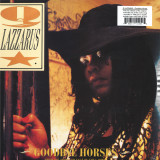
At long last, Q Lazzarus says hello to Dark Entries. Q Lazzarus is the moniker of Diane Luckey, born in New Jersey in 1960. While living in the East Village in New York City in the 1980s, Diane met songwriter Bill Garvey at a party and they recorded “Goodbye Horses” in his home studio. As the story goes, Luckey met Hollywood director Jonathan Demme when she picked him up in her taxi during a snowstorm in 1986. Demme was wowed by her demo tape, which was playing in the cab, and they ended up hanging out at a restaurant for hours talking about life and music. “He liked it so much, I gave him the tape I was listening to, he said he would call me for one of his movies, but I didn’t really take it seriously.” said Luckey. Demme would have the song “Goodbye Horses” first appear in his offbeat comedy Married to the Mob, and then again more memorably in Silence of the Lambs when Buffalo Bill changes into women’s clothing while drowning out his intended victim’s pleas with loud music. Despite the exposure, both Luckey and Garvey languished in relative obscurity. “Goodbye Horses” is the definition of a cult classic, an ethereal tearjerker driven by Garvey’s lush synth work and Luckey’s unmistakably powerful voice. Garvey says, “the song is about transcendence over those who see the world as only earthly and finite.”
Over 15 years of effort have gone into the making of this release. All five songs on this record were previously unreleased and are sourced from original master tapes. The extended version of “Goodbye Horses” was newly mixed from the original stems by Alberto Hernandez at Fantasy Studios. Instrumental and acapella versions of the song are included, which are also available for the first time. Side B opens with “Hellfire,” a brooding number about the New York BDSM nightclub of the same name, showcasing the range and force of Luckey’s voice. “Summertime” follows, with a sauntering synth-reggae spin on the 1937 George Gershwin number. Both B-side tracks are also new mixdowns and edits from the original stems. This record is released alongside Eva Aridjis Fuentes’s documentary on Q Lazzarus, Goodbye Horses: The Many Lives of Q Lazzarus, a work chronicling the life of the enigmatic Luckey. It is an opportune moment to reflect on the underrecognized artists we have lost and the undeniable brilliance of both Diane Luckey and William Garvey.
Suche:exposure
The in demand breakbeat hardcore debut from the reclusive Synthasy. Engineered by Jezz Wright (the man behind the men behind Liquid’s Sweet Harmony and Lemon D’s Toxic Rhythms and Pursuit Of A Vision EPs) at Blockhouse Studios, a private press white label EP was self-distributed across London record shops and received additional exposure courtesy of Entity Records distribution arm. Growing demand warranted a subsequent full artwork label repress, but the record soon evaporated becoming the thing of legend, and now commands big money.
Blues Music Award-winning, GRAMMY-nominated, Memphis-based family band plays original, modern soul and roots music that is uplifting and timeless. The first single "Found A Friend In You," was released last September and charted at Triple A radio, seeing ads at format stalwarts like WFUV/New York, . The release of the track coincided with a 9-date run on the Bob Dylan/Willie Nelson headlined Outlaw Music Festival. In addition to the excellent exposure these shows afforded Southern Avenue, Willie was knocked out by the Jackson sisters' singing and had them sing backup during his set. Not only that, Bob watched their performance from the side of the stage and consented to have his photograph taken with them. On "Family," their fourth album and first for Alligator, the band unleashes one musically memorable performance after another, all delivered with soul-healing power. From triumphant opener Long Is The Road to the emotionally resonant Found A Friend In You to the raucous Rum Boogie, the music is a vibrant blend of Memphis soul and blues, warm sister harmonies, and positive messages reminiscent of The Staple Singers. From the irresistible Upside to the fierce determination of Flying to the closing, ruminative We Are, Family unveils hard-hitting, universal truths about the unshakable power of togetherness.
- Collection 001 - 001 A 23:46
- Collection 001 - 001 B 23:48
- Collection 002 - 002 A 18:12
- Collection 002 - 002 B 20:54
- Collection 003 - 003 A 22:14
- Collection 003 - 003 B1 09:33
- Collection 003 - 003 B2 05:25
- Collection 004 - 004 A 16:11
- Collection 004 - 004 B1 07:08
- Collection 004 - 004 B2 09:52
- Collection 005 - 005 A1 08:38
- Collection 005 - 005 A2 08:54
- Collection 005 - 005 B1 07:14
- Collection 005 - 005 B2 03:53
- Collection 005 - 005 B3 03:57
- Collection 005 - 005 B4 04:03
- Collection 006 - 006 A1 17:35
- Collection 006 - 006 A2 05:12
- Collection 006 - 006 B 23:12
- Collection 007 - Merzrock B1 + Dubbing 5 11:21
- Collection 007 - Merzrock A1 + Anemic Pop 1 02:00
- Collection 007 - Merzrock A1 + Anemic Pop 2 08:32
- Collection 007 - E-Study #3-1 + Merzsolo 1 15:49
- Collection 007 - E-Study #3-1 + Merzsolo 2 05:58
- Collection 008 - Concrete Tape Ph#1~ 05:19
- Collection 008 - E8 A1 + 006 A1 06:03
- Collection 008 - Merzsolo 10/6.81 A1 10:36
- Collection 008 - E8 B2/Concrete Tape Ph#1~ 06:28
- Collection 008 - Sans Titre Merz 1 + Tape Loops 04:54
- Collection 008 E6 A3 + Concrete Tape Ph#1~ 06:46
- Collection 008 - Merzsolo 10/6.81 A5 + Violin 03:21
- Collection 009 - N.a.m.4 + E-8 06:11
- Collection 009 - Telecom 1/3 + N.a.m.5 17:32
- Collection 009 - E-3-1-1 11:24
- Collection 009 - E-3-1-2 01:50
- Collection 009 - Tape Loop + Noise 1 (Concrete Tapes) 02:39
- Collection 009 - Tape Loop + Noise 2 (Concrete Tapes) 04:25
- Collection 010 - 007 B1 + Ah Corps 11:47
- Collection 010 - E3 B2 + Ah Corps 11:28
- Collection 010 - N.a.m.6 With Radio & Tapes 22:47
Carrying on their longstanding dedication to the seminal output of Merzbow, Urashima returns with what is unquestionably their most ambitious release to date: “Collection 001-010”, a deluxe, 10 LP vinyl box set limited to 299 copies, gathering together the entirety of the project’s first ten releases, originally released in 1981. Encountering the band in its early incarnation of the duo of Masami Akita and Kiyoshi Mizutani, raw, exposed and bristling with energy, foreshadowing numerous trajectories they would follow over the coming years, these astounding full lengths - the majority of which have never been released on vinyl - come housed in a beautifully produced, deluxe wooden box, with each LP in its own individual sleeve reproducing the original artwork, and a LP-sized 32-page book containing reproductions of artworls and collages by Masami Akita, an interview conducted by Jim O'Rourke, and liner notes penned by Lasse Marhaug, Thurston Moore, and Akita himself, amounting to what is unquestionably one of the most historically significant releases we’re likely to encounter in 2025.
Deluxe Edition of 299 copies, remastered from the original analog tapes by Masami Akita, each LP comes in its individual sleeve reproducing the original artwork, also includes a LP-sized 32-page book. ** Since its founding during the late 2000s, the Italian imprint, Urashima, has become a definitive voice in the landscape of noise. Bringing forth beautiful limited edition releases, they’ve sculpted a singular vision of one of the most vibrant and revolutionary bodies of experimental sound to have graced the globe. Among the many projects that they have supported over the decades, there has been an undeniable dedication to the output of the seminal Japanese noise outfit, Merzbow, making a significant amount of the project’s out of print back catalog available across a range of formats. Now they return with what is arguably their most stunning and ambitious release dedicated to the project to date: “Collection 001-010”, gathering the entirety of Merzbow’s first ten releases, largely privately released by the band on cassette across 1981, in a deluxe, 10 LP vinyl box set. Representing what is effectively ground zero in Japanese noise and collectively amounting to some of the most sought after releases ever produced within that movement, Urashima’s truly beautiful collection comes fully remastered by Masami Akita himself from the original tapes, presenting all but a small number in their first ever vinyl pressings, with each LP housed in its own individual sleeve reproducing the original artwork, alongside a LP-sized 32-page book containing reproductions of artworks and collages by Masami Akita, an interview conducted by Jim O'Rourke, and liner notes penned by Lasse Marhaug, Thurston Moore and Akita himself. Towering with energy and groundbreaking creative vision, within the realms of noise and experimental music, releases don’t get more monumental or historically important than this!
Merzbow came roaring onto the Tokyo scene in 1979, and remains, to this day, one of the most prolific and aggressively forward-thinking projects in experimental music. Eventually becoming the solo vehicle for the efforts of Masami Akita, in its earliest incarnation the project was the duo of Akita and Kiyoshi Mizutani, taking their name from German artist Kurt Schwitters' pre-war architectural assemblage, The Cathedral of Erotic Misery or Merzbau, and quickly set out to challenge entrenched notions of what music could be. Embracing technology and the machine, even in its earliest iterations, Merzbow pushed toward new territories of the extreme, arriving at a space of pure, unadulterated sonic onslaught that has continued, for over 40 years, to set the pace for the entire genre of noise, and has remained one of the movement’s most important, definitive voices, continuously laying the groundwork for countless artists who have followed in its wake.
When dealing with historical gestures, there’s an invertible aura surrounding original line-ups and early statements, and rightfully so. It is often within a band’s debut that we catch the purest glimpse of the raw energy and creative ferment that made them what they are. This is certainly the case when regarding the coveted early releases of Merzbow, capturing the emergence of the project in its form as the duo of Masami Akita and Kiyoshi Mizutani as they helped set the blue print from the then emerging movement of Japanese noise. Over the course of its nearly five decades of activity, Merzbow has always been noted for how prolific and ambitious the project is. This was no less the case in the very beginning. While they were active for roughly two years prior, in 1981 alone they issued ten self-released cassettes numerically titled “Collection 001-010”, albums which have both individually and collectively become holy grails in the realms of noise, with only two - “Collection 007” and “Collection 009” - ever receiving vinyl reissues prior to now.
As Lasse Marhaug deftly articulates in the newly commissioned liner notes for “Collection 001-010”, despite having been recorded in different location across a span of time, the sum total of Merzbow’s first ten releases might be best regarded as a single release to be listened to in the same, durational sitting, with the material standing well apart from what most came to expect from Merzbow, while foreshadowing numerous trajectories the project would take over the coming years. Not only do these recordings feature a vast array of instrumentation - tapes, acoustic and electric guitar, violin, drums, voice, recorder, organ, found sounds, clarinet, homemade and prepared instruments, a vast arsenal of effects and electronics, and piano, to only begin to scratch the surface - the majority of which would disappear from the project’s active sources of sound generation over the subsequent years, but there is a slow pacing and raw sense of openness and exposure that reveals strong connections to the avant-garde improvisations of groups like AMM, Musica Elettronica Viva, and Gruppo di Improvvisazione Nuova Consonanza, the psychedelia of groups like Taj Mahal Travellers and Flower Traveling band (both of whom Akita mentions having seen in youth within his interview with Jim O’Rourke), and rock in general - albeit in fully abstracted forms - unspooling as brittle, pointillistic, textural, raw and abrasive forms, that occasionally flirts with unexpected tonal sensibilities. As Marhaug describes it in his excellent liner notes: «Sonically, “Collection” sounds more sparse and stripped. It’s dry sounding, up-front, no reverb, and there’s less heavy low-end grime and thin on the signature frequency sweeps. Viewed in a 1981 context, musically, it’s more akin to what the LAFMS (Los Angeles Free Music Society) pool of artists were doing at that time than what was happening in industrial music... There’s a strong playfulness throughout, like the sound objects are being explored for the first time, without neither restraint nor hurry. Events are allowed to be fully examined before the music moves on, or simply cuts off. To a large degree, the music on “Collection” feels acoustic in nature, although a Electro-Harmonix ring-modulator features prominently throughout.»
Easily described as a rarely encountered revelation into the original and earlier documented studio sound of Merzbow, “Collection 001-010” collectively amounts to an engrossing sonic journey in its own right, while also allowing for important, often overlooked connections drawn from numerous other creative wellsprings, notably free jazz, underground rock, the output of European and Japanese avant-garde music, as well as Dada, Fluxus, and Mail Art, much of which, beyond the illumination made possible by the sounds, Jim O’Rourke’s fantastic interview with Akita, published in the booklet, further explores, offering great insights into the origins of Merzbow and the thinking behind the project, as well as aspects of the earliest days of Japanese noise.
Hüma Utku returns to Editions Mego with her new album. The title Dracones makes reference to the mediaeval latin term "Hic sunt dracones" (Here be dragons), marking the unexplored, dangerous places on world maps, expressing the fear of chaos, the unexpected and the unknown.
This new work by the Istanbul sound artist is a sonic journal of an expedition into uncharted territory, one which occupies self and domesticity. Inspired by Utku’s experience of matrescence, Dracones explores the themes of familial demonology, metamorphosis and homecoming as well as human relationship to the experience of love woven layers of euphoria, alienation and consumption.
Musically, Dracones traverses a wide array of sonic tools whereby industrial sounds are imbedded with certain psychological angles, this is an album where, all matter meshes into a sly snapshot of the human experience with a tension and release exposure occurring frequently with dark corners opening up to bright layers of electronic experimentation.
The haunting opening track ‘A World Between Worlds’ tackles pregnancy, of which Utku was experiencing when making this record. The emotional, physical, spiritual and mental experience of this journey is all documented here.. This track features the ‘Lyraei’, an electromagnetic string instrument and modern interpretation of the ancient lyre, that was built and played by Mihalis Shammas. ‘Comfort of The Shadows’ moves from within to without, what was once hidden is now exposed. Utku’s ability to conjure the visual in the sonic is at the forefront as howling electronics give a distinct impression of movement. ‘A Familial Curse’ presents a desire to break the cycle of generational trauma with a creeping sense of dread that rolls into an industrial rhythm prior to landing in a beautiful place represented with shimmering guitar tones. ‘Here be Dragons’ is a rich and dark evocation, a spooked surrender to the themes of the record whereby Utku’s wildly distorted voice beckons all manner of phantasmagoria over cello and recordings of her ultrasound. ‘Care in Consume’ engages in further sonic exploration as a means of conjuring ‘matriphagy’, with its unique psychic energy coursing through electronic veins. ‘A House within a House’ could also be read as a body within a body as the pulse of ultrasound audio rattle amongst a cage of thudding rhythms and swirling electronics, one also ending in optimism as an exquisite melody is born from the prior fire. The striking journey ends with the more soothing ‘Ayaz’a’, a track embracing love and all the hardships that a period of fundamental metamorphosis brings, this is a heartfelt dedication to her son and concludes an album draped in life, experience, joy and pain.
Dracones is a deeply visual journey through inner and outer worlds, a space where symbolic evocation is supreme and passive listening is not an option.
All tracks composed,performed and recorded by Hüma Utku
Buchla 100, vocals, cello, electric guitar performed by Hüma Utku
‘’A World Between Worlds’’ features the ‘Lyraei’ built, played and recorded by Mihalis Shammas
Buchla 100 recorded in EMS Stockholm 2022-2023
Mixed by Enyang Urbiks
Mastered by Heba Kadry, NYC
Cover Artwork by Marco Ciceri
Design by Tina Frank
"Daft Punk brought me here, he brought me Daft Punk"
Just knowing that this slice of hyper-rare disco dynamite was crafted by Thomas Bangalter's dad should be enough for you to buy this on sight, if only to understand a little bit more about Thomas and Daft Punk's background. But this is so much more than a Daft Punk family curio.
Born Bangalter in 1947, Daniel Vangarde is a French songwriter and producer. In 1975, Vangarde founded his label, Zagora Records, who we have worked closely with on this lovingly curated reissue. For years, Vangarde wrote and produced songs that remained underground, under several pseudonyms and for various artists. Dubbed "the secret father of French disco" this here groove-fulled firecracker - using his Who’s Who moniker - is for disco-funk, library music and cosmic beat lovers.
The intense, evocative opener "Palace Palace" positively throbs with raw energy and sounds, honestly, like something off Daft Punk's Discovery. The title refers to the fashionable Parisian club Le Palace, essentially the Parisian Studio 54. "I’d been to a nightclub in New York, a big ring where people were roller skating with a whistle. The atmosphere was great. The music was all disco. I made this song when I came back. A vocoder transformed my voice. Back then, it wasn’t used much." The track rides a killer groove and is deceptively complex, with layers of fantastic percussion and ace synth work going on all over it. Listed to on repeat, it's brilliance is simply undeniable.
The louche, slo-mo heater "Hypno Dance" is, in Be With's opinion, *the* deadly dancefloor track. A svelte slice of ace space disco again geared towards the roller skating dance mania of the day. So deep, so disco, so instrumental. An unreal track and, as the title hints at, totally hypnotic. The side closes with the somewhat throwaway "Popeden" - it's a jaunty number that you're probably best skipping, in all honesty. Have we ever steered you wrong?
The B-Side opens with the frankly enormous "Roll Jacky Roll" is another thrilling, high class roller-rink jam with beautiful melodies that's adored the world over. The wonky, abstract "Ad Libitum 80" is a super dope, swirling, staccato electro-funk bounce which sounds light years ahead of its time. This might be the real lowkey sleeper gem on this record. CHECK! This remarkable LP rounds out with the huge "Dancin' Machine". It's got sleek drums that emit an absolutely ace swagger and elements of Italo synth funk feels. A relaxed, slow rhythm throughout ensures you can't help but get your funk on when this crashes soundsystems. We'll leave the final word on this to Daniel: "It amuses me to think that my son Thomas was influenced by "Dancin’ Machine" for "Around The World", he says. Both songs being based on an hypnotic repetitive refrain. Both songs being, of course, timeless pieces of Euro genius.
Who's Who really is a fantastic late-70s-early 80s roller disco-funk essential. The audio has been carefully remastered by Be With regular Simon Francis, ensuring it sounds better than ever. Cicely Balston's expert skills have made sure nothing is lost in the cut whilst the records have been pressed to the highest possible standard at Record Industry in Holland.
When it came to the sleeve for this we were presented with an unusual problem: we usually have to rely on an original sleeve as the starting point for the restoration, but instead we were able to scan the original 35mm transparency of the front cover photo. The problem is that with a modern scanner the results were far sharper than when they made the original sleeve. We’ve played around with the exposure and the colour grading but we’re sorry to say that our version of the front cover still ended up looking too good! Don’t hate us.
Brooklyn Sounds legendary second album from 1972, full of heavy Nuyorican underground salsa dura propelled by raw trombones, off-kilter piano and in-your-face percussion. A perfect blend of barrio attitude and Caribbean swing, the album proves Brooklyn has sabor y salsa! Pressed on 180 g vinyl, our reissue includes liner notes featuring never-before seen photos. “Libre – Free” is the now legendary second album by the short-lived Brooklyn Sounds and is arguably even better than their self-titled debut, displaying a more mature and practiced sound, no doubt honed by their experiences playing more gigs in support of their first record. Brooklyn Sounds were one of a handful of garage salsa bands from the independent scene that was gathering steam in the early 1970s in the New York boroughs, despite little support or exposure in the mainstream Latin music industry from more dominant labels like Fania, Mericana, Cotique and Alegre. As with many others, Brooklyn Sounds briefly fluoresced in a burst of creativity and defiance, yet flamed out shortly thereafter, dying like a flower among the ruins of burned-out apartment blocks in the barrios of its home city. Though the band only cut two LPs and a couple singles in their brief half-decade of existence, and never really broke out of the cuchifrito circuit in the tri-state area of New York, New Jersey and Connecticut, their music gradually spread far and wide, eventually becoming a sought-after global commodity by the late 1990s. In contrast to the first album “Libre – Free” is uptempo and ebullient, with fewer slow songs and more confident, creative arrangements, full of heavy Nuyorican underground salsa dura propelled by raw trombones, off-kilter piano and in-your-face percussion. Standout tracks include the uplifting, anthemic ‘Libre soy’, and ‘Ha llegado el momento’, with its minor key ‘Moliendo café’ quote at the
beginning—both of which have become dance floor anthems over the years. Another mid-tempo killer is ‘Guaguancó tropical’, a favorite in Colombia since the 1970s. A perfect blend of barrio attitude and Caribbean swing, the album proves Brooklyn has sabor y salsa!
New Source gladly welcomes Juan Bozzolasco aka Juan Dairecshion, unveiling a four track in which he confirms his innovative approach to electronic music production. His works, full of creativity and unexpected interactions between elements, are shown here in full display. His music is a result of a life-long exposure to some of the most seminal works of dance-floor oriented electronic music, ranging from Chicago’s and Detroit’s House and Techno passing through mid-century American Jazz and avant garde Latin-American music. House music composed by a techno-head and housey techno for your grooving pleasure are unequivocally found in his release.
Thoughts of You, as a phrase, might immediately associate one with feelings of love, endearment, fantasy or even obsession. These are the very sentiments that lay as cornerstones in Salvator Dragatto's debut LP for Colemine Records. The allure and drama of black & white photography have always played a vital role in how Salvator (aka Joseph Reina) not only views the world but how he hears music. Parallels in film processing to his own recording methods started becoming more and more apparent as the record was being formed; Limitations in exposures rivaling limitations in tracks. Film grain and dust sediments rivaling tape hiss and dirty EQ pots. What most would consider to be imperfections, Dragatto leaned into and found inspiration. This record is an homage to the likes of Andre' Kerte'sz, Robert Frank, Jean-Luc Godard and Rene' Groebli, who's works have impacted Dragatto's world so greatly both visually and sonically. Thoughts of You is an unabashed reflection of the noir. From the powerful thematic horn lines to the gentlest string passages, this record is a collection of themes and vignettes that explore the emotions set upon by black and white imagery.
Thoughts of You, as a phrase, might immediately associate one with feelings of love, endearment, fantasy or even obsession. These are the very sentiments that lay as cornerstones in Salvator Dragatto's debut LP for Colemine Records. The allure and drama of black & white photography have always played a vital role in how Salvator (aka Joseph Reina) not only views the world but how he hears music. Parallels in film processing to his own recording methods started becoming more and more apparent as the record was being formed; Limitations in exposures rivaling limitations in tracks. Film grain and dust sediments rivaling tape hiss and dirty EQ pots. What most would consider to be imperfections, Dragatto leaned into and found inspiration. Opaque Natural Vinyl. This record is an homage to the likes of Andre' Kerte'sz, Robert Frank, Jean-Luc Godard and Rene' Groebli, who's works have impacted Dragatto's world so greatly both visually and sonically. Thoughts of You is an unabashed reflection of the noir. From the powerful thematic horn lines to the gentlest string passages, this record is a collection of themes and vignettes that explore the emotions set upon by black and white imagery.
- A1: The Style You Haven't Done Yet
- A2: Why Is That? (Single Edit)
- A3: The Blueprint
- A4: Jack Of Spades (Lp Version)
- B1: Jah Rulez
- B2: Breath Contro
- B3: Who Protects Us From You?
- B4: You Must Learn
- C1: Hip Hop Rules
- C2: Bo! Bo! Bo!
- C3: Gimme Dat (Woy)
- C4: Ghetto Music
- D1: World Peace
- D2: Jack Of Spades (Remix)
- D3: Why Is That? (Remix)
PRESSED ON BLUE INK-IN-CLEAR COLORED VINYL IN A GATEFOLD JACKET WITH OBI, A FOLD-OUT LYRIC INSERT AND TWO BONUS REMIXES
Among hip-hop fans, Boogie Down Productions first two albums – Criminal Minded (1987) and By All Means Necessary (1988) – loom very large. And for good reason: they both captured one of the late 1980s most important and influential crews at their highest powers of lyricism and musical invention. That said, too many people sleep on BDPs third LP, Ghetto Music. Released in 1989, when the hip-hop world was truly beginning to explode and reach new heights of sales and exposure around the world, the album is arguably as powerful as the group's first two. As on By All Means Necessary, in the wake of the tragic death of the founder, producer, and DJ Scott LaRock, KRS-One pushed along mightily on the production side, with help from his extended crew. Musically the sound created on albums 2 & 3 was funky, catchy, and continually innovative, giving him the perfect backdrop to build his Edutainment syllabus. Lyrically there was never a question about KRS-One's power, and on Ghetto Music he continues to impress, teach, and ask important questions. Clear cases in point are two of the album's singles, "You Must Learn" and "Why Is That?" but he gets even deeper on tracks like the anti-police thought-piece "Who Protects Us From You" (still sadly relevant in 2024), "Ghetto Music" and "World Peace." Out of print on vinyl since 2017, Get On Down in partnership with Sony's CERTIFIED is proud to present this '89 classic fresh for 2024 you suckas! Pressed for the first time on double-colored vinyl and packaged in a gatefold jacket with a fold-out lyric sheet and two bonus remixes.
- 1: Thoughts Of You
- 2: Shadows
- 3: Precious Time
- 4: Monsoon Season
- 5: Rosewood Ave
- 6: Vignette #1
- 7: Vignette #2
- 8: Carried By Six
- 9: Villano
- 10: 96 Hours
- 11: Insomnia
For Fans Of... 60's and 70's French Noir Scene / Black and White film photography, The Rugged Nuggets, Dirty Art Club, Massive Attack, Misha Panfilov, The Ironsides, Doctor Bionic, Blockhead, DJ Shadow, Sven Wunder. First Salvator Dragatto full length LP to be released on Colemine. All members of The Rugged Nuggets (205k monthly listeners / 8.4k followers on Spotify) played on this LP. 60's French Noir Cinematic Soul. Produced by Joey Reina. This record is an homage to the likes of André Kertész, Robert Frank, Jean-Luc Godard and René Groebli. Artist has previously released three successful 45s. Thoughts of You, as a phrase, might immediately associate one with feelings of love, endearment, fantasy or even obsession. These are the very sentiments that lay as cornerstones in Salvator Dragatto’s debut LP for Colemine Records. The allure and drama of black & white photography have always played a vital role in how Salvator (aka Joseph Reina) not only views the world but how he hears music. Parallels in film processing to his own recording methods started becoming more and more apparent as the record was being formed; Limitations in exposures rivaling limitations in tracks. Film grain and dust sediments rivaling tape hiss and dirty EQ pots. What most would consider to be imperfections, Dragatto leaned into and found inspiration. This record is an homage to the likes of André Kertész, Robert Frank, Jean-Luc Godard and René Groebli, who’s works have impacted Dragatto’s world so greatly both visually and sonically. Thoughts of You is an unabashed reflection of the noir. From the powerful thematic horn lines to the gentlest string passages, this record is a collection of themes and vignettes that explore the emotions set upon by black and white imagery
Having worked silently in her sonic philosophy for almost a decade, vocalist, music producer and Dj Telva has launched her music label byt’, starting with the publication of her debut album. The album, ‘Revelation’, opens with an unusual and experimental offering, which sets the tone for the label's subsequent eclectic and unexpected releases. The compilation of 10 tracks, has been documented for 5 years through an experimental vocal, instrumental sonic journey, that is composed of Telva's life experiences during this period.
Telva is a vocalist, producer and only vinyl Dj based in Berlin. Defining her path through art in every sense of it by turning passion into a way of life, she has been playing and collecting records as main craft since 2016. Followed by uninterrupted hours in the studio, her creations and sonic philosophy, aka record label byt’, have been materialized by the wide range of influences she’s been absorbing along her way as an artist, where different cultures, scenes, and places have shaped and influenced her understanding and projection of her musical vision. Her love for the underground movement and the deep work in silence have made her music shows special and respected. For listeners and dancers, her well-chosen exposure is an unexpected experience. Her purpose is to offer quality music based on eclectic diversity, that surprises the audience with the love it spreads through sound, aiming to touch their hearts. ‘Music is a channel of transmission in where to materialize one’s lifetime vision’
Byt' (быть in Slavic meaning 'to be' / pronounced 'beat') is a music philosophy, also known as a record label, focusing on the connection between music and artist as a primary form of communication and source of expression. It represents 'the music of the being'.
The meaning and purpose are to comprehend the concept of musical interpretation through the artistic vision of the person behind it, by appreciating the significance of conveying a life experience through sound, making a recognition on what is behind the music we listen to. The label will be composed of solo releases, sonic cinematic experiences, collaborations and other archives, spanning an unlimited wide range of genres, yet rooted mainly in electronic music.
Highly regarded as a former resident at Salon Des Amateurs at his native Düsseldorf, Tolouse Low Trax/Detlef Weinrich has carved one of the most distinctive sounds in contemporary leftfield club music thanks to his deeply unusual grooves and hypnotic arrangements over the past 15 years as a solo artist.
Fung Day is his first album with entirely new material since Leave me alone which was released through Bureau B in 2022. Fung Day was written and recorded over the course of two years, slowly mutating and progressing from one state to another. Mixed, produced and finally mastered in Paris, his new domicile by choice.
A few words by Yvan Smagghe about Fung Day:
„He pretended he was in exile from Germany but he was a French lover like all of us; his MPC Sampler was smoking hot, an Enigma machine, an ashtray full of ghosts. I had left Paris for the same reasons he came. I could strangely relate. We’d met before he left Düsseldorf, and I knew of him through his oeuvre, his art over words (they were few) and piercing blue eyes.
He was now texting me on a night train from Warsaw going East, as in a Greene novel, asking me to go over his file. He sent me a spontaneous, fun, brave and bold record which is his new album - one that curiously smelled of mechanical grease - machinery of the soul, broken transport rhythms, samples like memories, noise at peace. Referenced yet uncoded. I don’t believe in ulterior motives and complex explanations. Not here at least. On the other hand, I do believe that works can be exposure - especially with the silent type or mistaken identities - and I knew about these too.“ - London, 2024
Los Angeles’ Jarren returns to Apron Records with a 6 track offering of fresh selections for the autumn.
Following his Apron debut LP, Jarren returns with a new EP titled Fresco that continues to explore his love for analog synths & squelching bass lines.
Los Angeles’ Jarren returns to Apron Records with a 6 track offering of fresh selections for the autumn.
Following his Apron debut LP, Jarren returns with a new EP titled Fresco that continues to explore his love for analog synths & squelching bass lines.
The forthcoming release builds on his signature style with fresh ideas, offering listeners another unique experience reflecting his West Coast origins.
Jarren, an LA-based producer and DJ with Panamanian heritage, draws deeply from his rich musical roots. Growing up with a father who played saxophone, his early exposure to gospel and jazz has shaped his sound. Always in the studio, Jarren’s music reflects this blend of influences. He’s played at some of LA’s coolest spots for the last 10 years and toured overseas, sharing his laid-back dynamic energy with audiences everywhere.
Forgetting You Is Like Breathing Water, the self-titled debut from the duo of trumpeter Will Evans and guitarist, synthesist, producer and multi-instrumentalist Theo Trump, arrives like a vault revelation. It feels like a decades-old yet newly unearthed masterwork of gorgeous ambient improvisation, the sort of thing scholars live to research and shepherd into deluxe reissue.
The patient, crystalline chords that swell and resonate like a series of confessions; the textured brass murmurs that suggest a ’60s or ’70s Fire Music master at their most poignant. Provocative found-sound experiments threading arcane religious recordings through dystopian soundscapes. Ear-shattering free-noise tumult. Where and when did this music come from? Who are these voices?
As it turns out, Forgetting You Is Like Breathing Water springs from an engrossing human story, though it isn’t necessarily the one you’d expect. This work of stunning maturity is in fact an entrance by two little-known explorers in their early 20s, who grew up together in Virginia, in the shadow of the Blue Ridge Mountains. It documents one of those perfect, sparkling moments in post-adolescence when big decisions and responsibilities are right around the corner, but for a spell, two young artists are able to create among the comforts and nostalgia of their shared past.
It also represents a reunion of sorts, as Evans and Trump connected as toddlers, became inseparable as boys, then pursued independent lives and creative paths as young adults. “Theo is my oldest friend,” Evans says, “and I feel like that’s what this band is — us meeting right in the middle of our interests.”
Now, having conjured this magic, they’ve detached once again: Evans, whose other works include the indie/avant-jazz unit Angelica X, is currently based in New York City. Trump recently moved to England, where he’d participated in his family’s theatre company, to go to school and further his solo ambient project. “This album didn’t start out as something super ambitious,” Evans explains. “It was more just an excuse to spend time together again and make music.”
***
In conversation, Evans and Trump are a delight, especially for cynics who might think that Gen-Z is only capable of doomscrolling. They come across as kindly young intellectuals who grew up using the internet as it was intended, for exposure to ideas and art across genres and generations. Trump points to indie-folk and the oracular post-rock of late Talk Talk, Bark Psychosis and Gastr del Sol. Pressed for his guitar heroes, he cites Bill Orcutt, Mary Halvorson and Marc Ribot, and mentions his devotion to alt-country. Heyday electro-industrial stuff like Skinny Puppy and Nine Inch Nails also meant a lot to him.
Evans is equally intrepid, though his background has a greater jazz focus. Ambrose Akinmusire, among today’s most thoughtfully commanding trumpeters, is a favorite. As for the soulful murmur he offers throughout Forgetting You, Pharoah Sanders’ wistful and lyrical contributions to Floating Points’ work is a touchstone.
The two grew up down the street from each other in the northern Piedmont town of Batesville, Virginia. Their families were friends, holidays were celebrated together and they became the most loyal of pals. As children they had a pretend band.
Then life unfolded, they attended different schools and their paths diverged. Evans discovered John Coltrane and became a jazz obsessive, as Trump found punk and hardcore and later began making ambient music. As a dedicated jazz trumpeter, Evans studied formally and widely; Trump was an autodidact, teaching himself guitar and absorbing synthesis and production techniques. The late teens and very early 20s brought moves away from home and back to home, as well as plenty of listening and learning. The Covid pandemic meant an opportunity to reconnect on long walks. Through it all, together and apart, they remained reverent of each other.
By early 2023, they found themselves living again among the Blue Ridge Mountains. In the evening, after giving trumpet lessons in Charlottesville, Evans would make the eerily beautiful trek “over the mountain” to Trump’s home in Staunton, Virginia. They’d talk and eat and begin to improvise, deep into the night. Evans played trumpet and sometimes drums. (Given the wee-hours recording schedule, the neighbors didn’t appreciate the latter.) Trump plugged a rickety, junk-store Telecaster-style guitar into a cheap solid-state amp and explored open tunings; he also layered on lap steel, electric bass, synths and electronics.
They locked in and relished each other’s gifts. In Trump, those include patience and intentionality and sonic decision-making; for Evans, a distinctive trumpet sound that both musicians think of as a singer’s voice. “Will’s playing is so thoughtful and well placed,” Trump says. “My goal from a producer’s mindset is that the trumpet will occupy the space that vocals would take.”
Often, they got lost in the best way. “The thing I look for most when I’m playing is that feeling of disappearing into what you’re doing,” Evans says. “Usually when that happens, the music is good.”
By the same token, they didn’t pursue free improvisation as an ethic, or as a pure process. Their goal was something closer to spontaneous composition. “We were trying to make good songs,” Evans says simply. Later, Trump did brilliant post-production work, expanding a modest setup into an enthralling soundworld. Under his judicious editorship, music that was wholly improvised sounds at times like a carefully composed new-music commission.
The results speak for themselves. “A Happy Death” summons up a swath of American desolation through the viewfinder of Wim Wenders. “Flesh of Lost Summers” and “Partings” are highlights from an essential ECM LP that never was. “A Collapse of Horses” infuses those seminal post-rock influences with the plod of doom metal or slowcore. The album’s final track, “The Mountains Are a Dream That Calls to Me,” was in fact the first thing the duo recorded, as an evocation of those twilit drives across the Blue Ridge Mountains. “Looking back at what we chose to name the songs,” Evans says, “and some of the sounds and how they make me feel, there is an air of impermanence and loss to this album.”
“I’m excited for everything that’s to come,” he adds, “but I recently thought, ‘Damn — that’s not going to happen again.’ It was a privilege for us to have that time together.”
The new dance album by Biicla called HYPER HOUSE is an imaginary club, where the main hero is the listener. The vibe in this house is Uk influenced modern take on bass / garage with a kind flow and naked emotions. The record has been in the making last 3 years and you could have heard some singles from the album already - GAS (4.21), MAKING NEW, MISS YA were all released via System 108 in 2023, the label has also become by accident a new home for the artist. Before arriving on System 108, Biicla has been releasing music for a while and getting exposure in big US Festivals, like Lollapalooza, Hard Summer, Bonaroo and many more, celebrating millions of streams worldwide. With System 108, Biicla found a new home and new dedicated audience, and it seems like a match made in heaven.
The process of production of the album took time during some challenging years - when our ordinary world started to shatter... Therefore the cover is divided in two parts - on the right, we observe chaos and destruction; on the left, people are having a quiet and happy life. Modern / hybrid club sounds in the album co-exist with sensible, soulful vibes, sorrow and hope. On top, the finishing comes in a close to perfection studio-engineered sound. HYPER HOUSE therefore is an intimate record with a personal meaning for Biicla and for us, as a label. Together as a team, we represent Biicla in all facets of his creative output, would it be his self-branded party BIICMAK, live shows or support of new names in the scene, discovered by the artist, as an example here comes the V/A Radar 108, curated by Biicla - tip!
Even though it came out on a major label, this record sells for hundreds of dollars if you can find it at all (we know…we paid for a copy), and it’s no wonder… it’s the perfect blend of raw R&B passion and smooth, sophisticated soul production. First, the passion part… Willie Tee was a New Orleans pianist and singer best known for recording a series of burnin’ 45s (some cut for Harold Battiste’s short-lived AFO label) during the ‘60s. I’m Only a Man was Willie’s album debut, cut for Capitol in 1970, and he brought the same deep-seated intensity to the record that he did his singles. The difference was, for I’m Only a Man, Willie’s warm, raspy voice was lovingly bathed in spectacular arrangements by H. B. Barnum and produced by the great David Axelrod. Strings, brass, xylophone, bluesy guitar licks, and a funky rhythm section are all percolating inside this record’s grooves, with a daring choice of material that ranges from Cannonball Adderley’s “Walk Tall” to the Bacharach-David nugget “Reach Out for Me” to the self-penned highlights “Mirror” and “Bring On the Heartaches” to the album closer “People” from Funny Girl. Capitol wasn’t known for breaking soul acts at the time, which may explain why this record remains a cult classic; we’re happy to give it the exposure it deserves, with a purple vinyl pressing limited to 1000 copies.
The core members of Jaubi are true masters of their craft, coming from a rich lineage of accomplished musicians. Kashif Ali Dhani is a classically trained tabla master from the Punjab gharana, and is the accompanist of choice on the local scene for some of Pakistan's great classical vocalists and instrumentalists, as well as in Europe and the USA. Zohaib Hassan Khan is a 7th generation sarangi master, who has performed globally, and is one of only 3 professional sarangi players left in Pakistan. Multi-instrumentalist, composer and Jaubi bandleader Ali Riaz Baqar aka Ila Zair began his musical journey as a hip-hop enthusiast, evolving into a jazz guitarist following the exposure to the genre’s rich sampling culture. He then became a disciple of the Senia-Shahjahanpur gharana, a lineage of musicians specialising in the sarod. His playing now focuses on merging North Indian classical music with modern jazz harmony on a traditional, unaltered 6-string electric guitar.
The collaborative relationship between the core group and wider collaborators dates back to April 2019, when 22a label founder and multi-instrumentalist Tenderlonious and EABS/Bloto keyboard and synth maestro Marek ‘Latarnik’ Pędziwiatr travelled to Lahore, Pakistan to take part in some improvised recording sessions with Jaubi. Nothing whatsoever was written down during the recording sessions – no sheet music, no song titles. It was sincere, bottled lightning. All egos were left behind, with hearts and souls being opened and poured into the music. The result has been described as spiritual jazz-fusion meets psychedelic Hindustani classical with nods to golden era hip hop.
An adventurous and absorbing record ‘A Sound Heart’ is the next chapter for Jaubi, both sonically and spiritually. The title is inspired from a verse in the Holy Qu’ran (26:89), where one comes to God with a spiritual or sound heart (Qalb) which is sincere, without doubts and free of materialistic attachments. Importantly it refers to a state where the heart is spiritually healthy and content with only God. A Sound Heart’s basis is goodness, rooted in love. In this case, it is the love for one’s creator. The album also acts as a tribute to fallen heroes, paying respect to the greatness that has come before, casting new light via cross-cultural collaboration and improvisation.
Throughout this incredible journey, meditative ragas blend with Herbie Hancock-esque motifs, joined by lament-filled contemporary melodies intertwining with the intricate sounds of the sarangi and earthy layering of the tabla. A true masterpiece of composition from start to finish.
Quill was a Boston-based rock band that had national exposure when they played the Woodstock festival in August of 1969.
The quintet got together in 1967 and played New England and New York over the next few years, getting
some positive regional press for their combination of high- wattage rock with elements of psychedelia and jazz,
and what would later be identified as performance art. Most of the songwriting was handled by John and Dan Cole,
who tended to deliver fairly complex pieces that lent themselves to elaborate performances, sometimes involving some heavy audience participation as well.
Katharine Whalen of Squirrel Nut Zippers fame, makes a triumphant return with her Jazz Squad featuring Austin Riopel on guitar, Danny Grewen on trombone, and the great Griffanzo on pianos. This time the chanteuse delivers an entire album of breezy west coast jazz sounds in the form of a tribute to Chet Baker. It was around 1996 when Katharine Whalen first made her grand entrance onto culture’s collective radar as the sultry, yet effervescent voice of the Squirrel Nut Zippers, where she remained until their initial disbandment around the turn of the century.
In addition to the Zippers putting dixieland jazz on the pop charts in the 1990s, they sneakily introduced an unsuspecting "alternative" crowd to jazz music. Her cultural impact was also felt when she voiced the song "You You You You You" a standout track from Stephin Merritt's (The Magnetic Fields) project titled The 6ths. That song would also find its way into commercials and the film Pieces of April. After recording one solo album for Mammoth Records shortly after leaving the Zippers, Whalen stepped out of the public eye.
However, she’s remained very much in the spotlight of one unique small town; Hillsborough, NC, which has been referred to as Twin Peaks meets Northern Exposure. It’s a surreal literary, liberal Mayberry. If you find yourself in this Southern portal, you can find Katharine Whalen's Jazz Squad playing monthly in a cocktail bar appropriately named Yonder. The album was recorded in an old chapel in Hillsborough by North Carolinian royalty, Jerry Kee (Polvo, Superchunk, The Kingsbury Manx). Each song was recorded with the band all playing together in the same room, the way the old jazz records used to be put to tape.
Heaven Born and Ever Bright is the third studio album by British rock band Cardiacs. It was produced by Tim Smith, engineered by David Murder and mixed by both Available on CD Digifile and Single Sleeve Violet coloured vinyl (pressed from the 1991 master) Cardiacs are an English rock band formed in Kingston upon Thames by Tim Smith (guitar and lead vocals) and his brother Jim (bass, backing vocals) in 1977 under the name Cardiac Arrest. One of Britain's leading cult rock bands, Cardiacs' sound folded in genres including art rock, progressive rock, art punk, post-punk, jazz, psychedelia and heavy metal (as well as elements of circus, baroque pop, medieval music, nursery rhymes and sea shanties), all of which was topped by Smith's anarchic vocals and impressionistic lyrics. Their bizarre sound and image made them unpopular with the press, but they amassed a devoted following Tim Smith was the primary lyricist, noted for his complex and innovative compositional style. He and his brother were the only constant members in the band's regularly changing lineup. The band created their own indie label, the Alphabet Business Concern, in 1984 and found mainstream exposure with the single "Is This the Life?" from their debut album A Little Man and a House and the Whole World Window (1988). Their second album, On Land and in the Sea (1989), was followed by Heaven Born and Ever Bright (1992), which displayed a harder edged, metal-leaning sound retained in the subsequent albums Sing to God (1996) and Guns (1999). Tim Smith was hospitalised with dystonia resulting from a cardiac arrest in 2008, which brought increased and belated critical recognition to Cardiacs, with several music outlets calling Sing to God a masterpiece. His death in 2020 saw a raft of tributes on social media
Reissue 2024
Still' Is A 4 Track Ep And Is The First New Music From Mazzy Star Since 2014. The 12' Includes Three New Tracks Along With An Alternative Version Of 'so Tonight That I Might See' From The Artists Biggest Selling Album Of
The Same Name From 1993, Which Also Featured The Seminal Hit Record 'fade In To You'. Mazzy Star Is Best Known For The Song fade Into You' Which Brought The Band Some Success In The Mid-1990s And Was The Group's Biggest Mainstream
Hit, Earning Extensive Exposure On Mtv, Vh1, And Radio Airplay. Roback And Sandoval Are The Creative Center Of The Band, With Sandoval As Lyricist And Roback As Composer Of The Majority Of The Band's Material.
“Joe McPhee’s first international release, Black Magic Man, was issued on the newly formed Hat Hut imprint in 1975. It was a watershed moment for the 35-year-old musician. Based in Poughkeepsie, New York, he was too far away from Manhattan to have participated extensively in the Loft Jazz happenings of the decade. European exposure, however, would give McPhee an alternative circuit, something of an escape route from the trappings of American cultural myopia. “In support of the new record for this Swiss label, McPhee invited John Snyder on a European tour in October 1975. Snyder was a synthesizer player with whom McPhee had made the duet LP Pieces Of Light, released a year earlier on CjR. The two musicians developed an extensive repertoire, playing diverse spaces in the Hudson Valley. Geographically close gigs were a plus, since it took extra energy to hoist Snyder’s ARP 2600. “McPhee and Snyder were invited to play at the Willisau Jazz Festival in Switzerland. If you compare this live record with Pieces Of Light, a studio effort, it’s considerably more open. South African drummer Makaya Ntshoko is rolling thunder on the choral ‘Voices,’ shuffling under Snyder’s bubbly beat on ‘Bahamian Folksong.’ It is quite a special combination, enough so that Hat Hut chose to release it as their next LP, Hat Hut B in their alphabetical series. The Willisau Concert represents the sound of Joe McPhee opening up, opening out, expanding his field of operations to include new figures, fresh experiences, new continents of sound.” —John Corbett (excerpt from the liner notes)
On Pedro The Lion’s new album Santa Cruz, critically acclaimed musician David Bazan returns with a new chapter in his ambitious and ongoing recording project - 5 albums devoted to places he lived in throughout his life. Santa Cruz is Bazan’s third album in the series and follows up where 2022’s Havasu and 2019’s Phoenix left off. Tracks like "Modesto" and "Little Help" foreshadow Bazan's exposure and ultimate love of classic rock n' roll records, while songs like "It'll All Work Out" showcase his unique approach to synthesizers, something he introduced with the 2005 self-titled Headphones album. The stories on Santa Cruz highlight Bazan’s teenage years and solidifies what he sees as an exposition in a traditional three-act structure. After 25 years refining and building what he calls his “garden of songs,” David Bazan has sold hundreds of thousands of albums, performed in sold-out venues and living rooms around the globe, and played high-profile live sessions with the likes of NPR’s Tiny Desk, KEXP, WNYC’s Soundcheck, WXPN’s World Cafe and many others. His music has been featured in outlets such as The New York Times, Pitchfork, Rolling Stone, SPIN, Vox, Paste, Aquarium Drunkard and others.
Unknown Rivers“ ist das Debüt des Bassisten Luke Stewart bei Pi Recordings. Stewart ist in der Musikszene allgegenwärtig und eine treibende Kraft. Er ist Leader oder Co-Leader von Bands wie Irreversible Entanglements oder des Exposure Quintet. DownBeat bezeichnet ihn als einen der „Twenty-Five Performers Who Could Shape Jazz for Decades“. Er hat mit Künstlern wie David Murray, Archie Shepp, Wadada Leo Smith, Nicole Mitchell, Nate Wooley und zahllosen anderen zusammengearbeitet. Stewart ist außerdem Kurator und Moderator mehrerer Konzertreihen in Washington, D.C. und New York, Schriftsteller, Aktivist, Produzent und DJ. Das neue Album hat er mit seinem langjähriges Silt Trio eingesp
- A1: Simple Minds - Theme For Great Cities
- A2: Cabaret Voltaire - Silent Command
- A3: Ryuichi Sakamoto - Riot In Lagos
- A4: Grauzone - Eisbar
- B1: The Associates - White Car In Germany
- B2: Patrick Cowley - Nightcrawler
- B3: Isabelle Mayereau - On A Trouve
- B4: Chas Jankel - 3,000,000 Synths
- C1: Peter Gabriel - No Self Control
- C2: The Walker Brothers - Nite Flights
- C3: Thomas Leer - Tight As A Drum
- C4: Daryl Hall - The Farther Away I Am
- C5: Harald Grosskopf - So Weit, So Gut
- D1: Robert Fripp - Exposure
- D2: Areski Belkacem & Brigitte Fontaine - Patriarcat
- D3: Basil Kirchin - Silicon Chip
- D4: Holger Czukay - Ode To Perfume
By the turn of the 80s, the impact of David Bowie’s ground- breaking Berlin recordings – the synths, the alienation, the drily futuristic production – was being felt on music across Europe. What’s more, the records being made were reflecting back and influencing Bowie’s own work – 1979’s Lodger and 1980’s Scary Monsters owed a debt to strands of German kosmische (Holger Czukay), new electronica (Patrick Cowley, Harald Grosskopf), and the latest works from old friends and rivals like Robert Fripp, Peter Gabriel and Scott Walker, all of whom had been re-energised by the fizz of 1977.
Compiled by Saint Etienne’s Bob Stanley and the BFI’s Jason Wood, Fantastic Voyage is the companion album to their hugely successful Café Exil collection, which imagined the soundtrack to David Bowie and Iggy Pop’s trans-European train journeys in the mid-to-late seventies. “Fantastic Voyage” is what happened next.
Bowie’s influences and Bowie’s own influence were rebounding off each other as the 70s ended and the 80s began, notably in the emergent synthpop and new romantic scenes as well as through the music of enigmatic acts like the Associates and post-punk pioneers such as Cabaret Voltaire.
Like Low and Heroes, some of the tracks on Fantastic Voyage are spiked with tension (Grauzone’s ‘Eisbär’) while some share those albums’ sense of travel (Simple Minds’ ‘Theme for Great Cities’, Ryuichi Sakamoto’s ‘Riot in Lagos’) and others find common ground with “Lodger’s” dark, subtle humour (Thomas Leer’s ‘Tight as a Drum’, Fripp’s ‘Exposure’).
This is the thrilling, adventurous sound of European music before the watershed moment when Bowie would abandon art- pop for America and the emerging world of MTV with “Let’s Dance” in 1983. Fantastic Voyage soundtracks the few brief years when the echo chamber of Bowie, his inspirations, and his followers created an exciting, borderless music that was ready to challenge Anglo American influences.
PREVIOUSLY UNRELEASED ON VINYL. Syntech’s second album “Atmospheres” originally released in 1991 is entirely composed and produced by Edwin Van Der Laag. On this album, Edwin breaks away from danceable space synth formula and moves towards strongly electronic, ambient, distant, extra-galactic spaces with his Atari 1040 ST. The music from this album had a huge impact on electronic music enthusiasts and remained an inspiration to many young artists.
Danielle Boutet’s P »Pièces« is a mysterious artifact of Quebecois marginalia, self-released in 1985. Moving from languid ennui to high drama, »Pièces« is a dreamy gestalt, an album that borders Chanson, spoken-word, jazz noir, and minimalism, conjured from the chasm between acoustic and electronic realms. »Pièces« allows us a window into the highly intimate songcraft and compositional skill of an artist who longed to linger not in the public eye, but in relation with others and the world around her.
Born in Quebec City, Boutet studied music at the University of Montreal, where she focused on composition and percussion, before becoming involved in Montreal’s feminist and lesbian art scene. Primarily written, performed, and recorded by Boutet, with voice, guitar work, and technical assistance by Sylvie Gagnon, Pièces was created during a paradigm shift in home recording. Originally composed for the piano, Boutet and Gagnon utilized a consumer-friendly Tascam 4-track Portastudio and versatile Yamaha DX-7, alongside guitar, bass, marimba, and the human voice, to expand and contemporize the original composition’s scope.
Inspired by prog rock and British poet and musician Anne Clark, »Pièces« translates Boutet’s influence by moving between sunny, wistful fairytale and dark, wintry dirge. Filled with longing marimba, vertiginous, startling synth pads, and folk guitar, each track on Pièces offers a wholly unique proposition. Some are modal and rife with the ethereal psychological tension of a sci-fi soundtrack, while others are more like entering a smoke-laced lounge, the entertainer embodying seduction.
With the sprechgesang of artists like Serge Gainsbourg, there is an intense intimacy to Boutet’s delivery, sometimes as if she is performing for an audience of one. As one lyric goes, translated to English from French: “Like holograms/ Images from a world/ That inhales souls/ And exudes drama.” Another song contains an excerpt from The Tao of Physics: “The eastern sages specify clearly that they do not identify an ordinary void, but rather, a void having an infinite creative potential.”
To English-language audiences, the album’s title, »Pièces«, might seem to simply refer to the eleven different pieces. The title can also, of course, refer to parts of a larger whole, but Boutet is keen to point out that there is also another meaning: In French, a pièce is a room. On the cover of the original cassette, Boutet is seen sitting on a chair, alone in an empty apartment, a cable snaking at her feet. Listening to »Pièces« is like entering eleven different rooms: whether a study encased in shadow, a greenhouse left to wither in an eternal frost, or a divine nave.
Boutet sold a few dozen copies around Montreal, a scene mostly occupied by the new wave explosion de rigueur, but the inclusion of Pièces in the 1987 issue of Ladyslipper—the North Carolina-based mail order catalog that championed women musicians of all calibers and careers—led to more exposure throughout North America. “In the catalog,” Boutet says, “they included it in the New Age section, but I was, and still am, aware that this album is relatively unclassifiable.”
Boutet would release one more album, titled Musiques Urbaines, before getting pulled in the direction of interdisciplinary art and theory. “Although I never stopped making music, I lost all interest in public diffusion or performance,” Boutet says. Despite her departure from performance and publicly releasing music, she left behind a strange and enthralling document of Montreal’s 1980s feminist fringe, an aural document of the historic moment when self-recorded music and its practical potential became a prismatic reality.
Danielle Boutet’s Pièces arrives February 16, 2024 as part of uncommon¢ (“uncommon sense”), an open-ended, serialized endeavor from Freedom to Spend that provides new meaning for rarefied recordings from music’s outermost fringe.
Clear Vinyl
The fourth Exposure Series release is upon us. If you have not heard, the Exposure series is our signature compilation series that features multiple artists and is pressed on vinyl for the most discerning DJs and collectors. 'Linear Radiance' gathers together 4 extremely hot artists in the scene for one special 12'.
The EP begins with 'Raizel' by the hot newcomer Grush. This early set builder is smooth in the constraint it has rolling along in the sweet spot. A beautiful jaunt that is rich and fluid.
Next, is the amazing Philipp Priebe. 'So Glad' is another Priebe heater. A very talented producer, you can always count on him for great dancefloor business. The melody sneaks up on you as it builds from deep within. A sublime and subdued corker!
'Sonic Shadows' starts out on the B-side from skillful Nicolas Barnes. His contribution is a combination of a big club techno sound and a melodic flow that is almost reminiscent of some prime late 1990's progressive house.
Finally, is 'Grey Rythem' by Cirkel Square. Riding a catchy micro dub sound that is clever, fun, and surprisingly deeper than we could have ever hoped! All four tracks make for a healthy, well-balanced piece of wax!
Linear Radiance is lovingly pressed and shared on crystal clear 180- gram vinyl. Act quick while copies are in stock. This compilation is sure to get picked up by DJs, collectors, and fans.
green LP[30,88 €]
NORMANS was born on the dirty streets of LA and baptized in the punk rich waters of Hermosa Beach; the city that gave us Black Flag, Red Kross, Minutemen and more.
Years of exposure and participation in the myriad of genres and sounds that make up the vibrant music scene resulted in a multi-genre-bending, bass and synth fueled cacophony that pays homage to the ghosts of The Jesus Lizard, Suicide, Butthole Surfers and The Birthday Party.
gold LP[30,80 €]
NORMANS was born on the dirty streets of LA and baptized in the punk rich waters of Hermosa Beach; the city that gave us Black Flag, Red Kross, Minutemen and more.
Years of exposure and participation in the myriad of genres and sounds that make up the vibrant music scene resulted in a multi-genre-bending, bass and synth fueled cacophony that pays homage to the ghosts of The Jesus Lizard, Suicide, Butthole Surfers and The Birthday Party.
After a short break Samosa Records explodes back on the scene with ‘Earth Wind & Funk’, a deadly four-tracker EP that is sure to get the juices flowing and body moving.
A1 sees New Zealander producer ‘Strange’ make a most welcome return, spinning the funk loom with the ‘Hard Working’ (De Gama Re-Drums). A truly addictive and distinctive bassline sets the pace, tone and feel for this gorgeously constructed track. It has it all; sumptuous vocal, high-end brass and an acid squelch to die for. Dig it, you will.
A2 lands with Frank Virgilio’s ‘Love Is Positivity’ – a melting pot of twisted disco, feel-good scatty rhythm and lifting vocals. The melody is literally dripping with positivity, but also has an almost transcendental vibe secretly going on. The last drops of summer are right here. Enjoy them.
On the B-side, Mosaik Kollektive raise the temperature with the De Gama Re-Drums applied ‘Keep’. A tough, perfectly cooked groove that gets right in your face and makes no apologies for screaming at you. The bass on this unstoppable monster is all-consuming. Rhythm guitar licks blend with soaring strings and that’s the full basket. Sublime meaty goodness.
Closing matters for this incredible EP at B2 is the effervescent Monsieur Van Pratt and Funk De Ibiza. MVP stretches his funky legs to the full here, laying down a solid beat, arpeggio and a bass so tough you could train it to box. Expertly blended with J-pop-esque vocal and shrill church organ. Drop this at midnight and watch the carnage unfold and hands in the air.
Earth, Wind and Funk is the exposure to the elements you absolutely want. A more perfect slice of wax you couldn’t find and one that’s sure to find its way into the record boxes of those who know.
The vinyl single LOVE/HATE brings together two sample collages on the theme of good and evil. Often evoked and sung about, but rarely in such concentrated, systematic form, these collages present the words LOVE and HATE in a variegated catalogue of articulations. Poirier’s miniature radio play is anything but misanthropic: never before has the message of hate been conveyed in such a wonderfully warm-hearted manner. The LOVE side features a track originally released by Jan Jelinek in 2005 on the Eastern Developments label under the long-forgotten pseudonym The Exposures.
From the original press release:
Originally intended as the intro to a special edition of the radio broadcast “Abenteuer Forschung” (Adventures in Research) on “sexuality and romance in digital postmodernism”, the composition collages countless “love” samples from the R&B genre. The “collage of digital passion” had a devastating effect, acting as an aphrodisiac that turned the recording session into an orgy. No further details were revealed by the broadcaster. Unfortunately, the programme wasn’t broadcast live so the secret is likely to remain locked away in the station’s archives forever. Nevertheless, Eastern Developments have managed to obtain authorisation for a “toned down” version of the original, providing the listener with a vague idea of the composition’s true impact.
By the early '70s, Milford Graves had more or less stopped gigging. Having learned his lesson the hard way in multiple-night runs like a legendary Slugs' residency with Albert Ayler, he knew that the level of energy that he put out during a performance would be difficult to sustain over the long haul. A concert was a kind of absolute ritual for him, after which he would be totally spent, emotionally and physically. Graves rarely left anything on the table. Any musical performance was an opportunity to present an amalgamated version of all the things he had learned. He was an innovator and a teacher at his core, and the concert venue was one of his first classroom settings.
In March 1976, Verna Gillis invited Graves to perform on WBAI's Free Music Store radio show. For the date, he chose to present a trio lineup which he had been occasionally playing – featuring two saxophonists who were dedicated to the drummer's vision. Hugh Glover is almost exclusively known for his work with Graves, while Arthur Doyle would gain exposure later for an obscure record that he made two years later, Alabama Feeling, which would become a highly collectable item among free jazz enthusiasts.
Originally released in 1977, Bäbi remains one of Graves' most seminal recordings. The music played by the trio was ecstatic. Extreme energy music, buoyant and joyful. It relied on Graves' new way of approaching the drum kit, in which he had opened up the bottoms of his skin-slackened toms and eliminated the snare. Graves' art was always unblemished by commercial interests, and this album is its finest mission statement.
- A1: Q - From Within (Body Mix)
- A2: Integrity Ii - Living In A Fantasy
- A3: Strange Ways - Strange Ways
- B1: Thee J Johanz - Stompin N Rising
- B2: Exposure - Love Quest
- B3: Tons Of Tones - Oh Ah Oh Ah Oh
- C1: Interface - Temazepam
- C2: It’s Thinking - Hyperion
- C3: Eric Nouhan - Technobility
- D1: Secret Cinema - Sundance
- D2: Hole In One - Spiritual Ideas For Virtual Reality
Vol.3[25,17 €]
Through 35 hedonistic highlights stretched across three volumes, Music For The Radical Xenomaniac delivers the first ever deep dive into The Netherlands’ colourful house sound of the 90s and the under-celebrated producers and record labels whose music soundtracked a countrywide cultural movement.
Plenty of books and documentaries have celebrated the riotous raves, legendary clubs, high profile DJs and promoters who shaped The Netherlands’ hedonistic house scene throughout the 90s. Music For The Radical Xenomaniac dares to challenge these narratives by shining a light, for the first time, on those who created the scene’s kaleidoscopic, game-changing and globally influential soundtrack.
Leading the charge were a disparate group of key creators who not only forged links with their counterparts in Detroit, Chicago, New York, Belgium, Germany and the United Kingdom, but also became celebrated figures on the worldwide electronic underground (Eric Nouhan, Aad De Mooy, Orlando Voorn, Stefan Robbers and Steve Rachmad). Alongside key underground imprints (Stealth Records, Basic Energy, ESP, Prime and Outland Records included) and lesser-known producers, these pioneers gave flavour to a radical musical movement via open-mindedness, unheard-of creativity and a genuinely futuristic ethos. All of these artists and labels are represented throughout the series.
So, what defined this hedonistic house sound from The Netherlands? Stylistically, it was varied – as the series so emphatically proves – but was defined by a set of distinctive sonic characteristics: emotive musical motifs, high-frequency synth sounds, mellow basslines, pulsating rhythms and more than a touch of hallucinatory intent.
Volume 2 contains a wealth of notable tracks and slept-on gems. These include Q’s ‘From Within (Body Mix)’, a lesser-known cut from the trio better-known as Quazar (Gert van Veen, R.o.X.Y co-founder Eddy De Clercq and Eric Cycle), Eric Nouhan’s melodic masterpiece ‘Technobility’, which is appearing on vinyl for the first time since 1994, and a rare collaboration between regular production partners Maarten van der Vleuten and Mike Kivits (better known as Aardvarck), which was initially released on a special R&S Records’ offshoot set up by the label’s co-founder, Renaat Renaat Vandepapeliere (Integrity II’s ‘Living In Fantasy’).
Other highlights include Exposure’s ‘Love Quest’, a highly sought-after 1991 track by The Hague-based DJ/producer Maurits Paardekooper, and an ambient-infused Andrew Weatherall favourite originally released by Stealth Records in 1993, Hole In One’s ‘Spiritual Ideas For Virtual Reality’.
Packed full of forward-thinking 90s gems remastered for today’s dance floors by Alden Tyrell, Music For The Radical Xenomaniac Volume 1 is a life-affirming celebration of a distinctly Dutch musical movement, whose rich textures and melodies are still inspiring new generations of DJs and dancers today.
As the music industry continuously evolves, pushing boundaries and challenging conventions, artists like Michael Peter Olsen emerge to redefine the very essence of their chosen instruments. With an
impressive career spanning nearly three decades, Olsen has had mainstream exposure through collaborations with renowned artists like Drake, Ed Sheeran, and Arcade Fire and developed multifaceted talents as a player, producer, composer, and Grammy-nominated songwriter.
However, it is his electric cello based solo project, which debuted in a grimy basement club in Berlin in 2019, and his 2021 album “Yearning Flow'' that truly showcased his desire to subvert expectations of what a cello can be. With the release of "Narrative of a Nervous System," Olsen taps into the prevailing sense of disconnection in modern society, accentuated by the recent pandemic. The record delves into the increasing divisions between the mind and body, metaphorically capturing the struggles many individuals face with their mental health.
Olsen aims to bridge this disconnect through his music,
creating a powerful fusion of sonic and visual elements. While the album is instrumental and conceptually-driven, Olsen remains committed to making the music accessible and relatable. Olsen's
vision is further realized through the inclusion of special guests Owen Pallet, Màiri Chaimbeul, alaska B, and Zoon, each representing older music traditions. Celtic, European, North American Indigenous,
and Traditional Chinese are explored and stretched, offering a modern perspective on ancient intuitively based traditions. While Michael Peter Olsen dismantles the preconceived notions surrounding the cello, he continues to create evocative emotional music.
"Narrative of a Nervous System" invites listeners to explore the disconnections between mind and body, and offers a transformative musical journey that resonates with both the modern world and ancient traditions. “Essentially I’m trying to destroy the cello, but do it in a nice way”
Across the arc of Tristan Allen’s epiphanic, four part journey, Tin Iso and the Dawn, the New York based composer and puppeteer brings sonic life to a fantastical realm of characters whose universal longings mirror our own. In the first release of this mythic trilogy, intricate sound design and spellbinding leitmotifs make sense of loss and what’s beyond.
Formative exposures by way of travel through Asia, studies in Gamelan, a paper mache Christmas angel, and their dad’s Bread and Puppet Theater artifacts formed a web of inspiration from which Tristan’s desire to combine puppetry and their fascination for the narrative power of instrumental music emerged. Years of synchronistic inspirational encounters with “guardian angels” in the form of music mentors and puppeteer masters incentivized Tristan to pursue a project where they could focus on sound and diverse instrumentation.
Through this impulse, Tristan ceremoniously constructed the imaginary world of Tin Iso and the Dawn, loosely based on Wagner’s three act opera Tristan und Isolde. Composed and recorded between 2015 and 2022 across apartments from Boston to Brooklyn, with field recordings from locations of vivid sentiment: Upstate New York—where Tristan grew up, Quebec—where most of their close family lives, and Japan—where they lived briefly as a child, each moment of Tin Iso glimmers with nostalgic immediacy and the prescience of new voyages unfolding.