
8

The neon "pdqb Arcade" sign in Port Astra flickered with the same chaotic energy it had decades ago. Six men, now with more gray hair and worries than they once had, stood at the entrance. They were the "Lucky Six," reunited after years of scattered lives and separate paths.
"I can't believe this place is still here" said Noise, who had flown in from Tokyo. "It hasn't changed 8 bits, haha". CEM, now a father of 3340 synthesizers from Bari, replied with a grin. "We have. Look at Galaxian, he's unrecognizable!"
Each of them held a single, precious coin. Their plan, born of a wave of nostalgia and the understanding that they couldn't stay forever, was simple: one coin, one game, one last chance to be a legend. Each man would choose the game that meant the most to him and play the round of his life…
At the end, pdqb, the arcade owner, came up to the guys. "Don't be sad", he said. "Even if it was your last credit, there's always one more somewhere in some game". He then walked through the arcade and played four different machines that just happened to have an extra credit on them. "See?", he said.
Synaptic Cliffs proudly presents pdqb together with six black belt gamers (PRZ, Noise&Noise, Galaxian, CEM3340, Dark Vektor, Mesak), each a legend in their own right. They don't just replay pdqb's 8 1/2 Bit album; they become it. Together, they embark on a journey through legendary worlds, creating a place filled with soundscapes and challenges that blur the line between music and game. They move with the rhythm of the music and face the challenges within, weaving their own stories into the fabric of the iconic work.

On a "Balearic-Jazz trip", the phenomenally hyped Thought Leadership returns with another X ideas: the deck this time chooses the Ace of Swords. In the acclaim garnered by III of Pentacles, there were many whispers of “Balearic” from those in the know. As soon as you drop the needle on XI you will be basking in turbo Balearica.
Originally out on cassette only, we present the first ever vinyl issue. It's a hideously limited pressing of 300 for the world, so don't sleep on this.
The sonic palate has been augmented by the addition of synth and bass; there are more guitar layers, more pedals and more organic drums this time – a much fuller production. Still DIY, and still recorded straight to multitrack, just ever so slightly grander in scale; think a rough-hewn, long-lost Claremont 56 cut and you’ll have some idea of how XI opens this future classic LP.
The touchstones so key to the vision of Pentacles (Cocteau Twins, Dif Juz, Durutti Column) are all still present and correct; XII could be a piece from Extractions, XIII is pure Garlands-era Guthrie and, now with the shuffling jazz drums, XV makes TL even more LC – but more disparate influences are found this time out too. ECM guitar legends John Abercrombie and Pat Metheny in the more considered melodic phrasing and harmonic structure of the ideas and a nod to the cosmic Balearic spirit in the overall vibe, means more is offered to the listener across Swords.
XVI and XVII are the biggest indicators to Thought Leaderships’ new found love of The Real Book and their grasp of jazz chords. The former sounds like if Mike Hedges had produced on a heavily sedated ECM date in the early 80s, whilst the latter is Bright Size Life condensed into a most post-punk shard of Strat conversation. The syrupy Phase 90 on the lead parts lends much weight to the guitar melodies, a beautiful tonal counterpoint to the Vox-ish chimes of the plangent chords we’ve all come to love.
The flip again treats us to three extended, improvised jams. XVIII owes as much to Canterbury as it does to Krautrock, another modal voyage through the stars. Light the incense and drift away, guided by delayed cymbals and weaving ribbons of guitar. XIX has almost a New-Wave/Sophisti-Pop energy to it in tone, if not in structure and execution. Something almost Tears for Fears-esque in the chiming chorus guitars. An interesting outlier that has already received a lot of love from those that have heard it. XX is the starkest idea, and the only piece this time with no drums. What we do get, however, is a free exploration over a two chord-vamp. It’s Harvest Time meets Planet Caravan and a fitting end to this Balearic jazz trip.
Be With is honoured to present the first ever vinyl release of Ace Of Swords, carefully remastered by Be With's engineer Simon Francis to ensure it sounds better than ever after its initial tape release. Cicely Balston's expert skills have made sure nothing is lost in the cut at Abbey Road Studios whilst the records have been pressed to the highest possible standard at Record Industry, in Holland. The original tape cover artwork, so crucial to Thought Leadership's striking visual aesthetic, has been rejigged for vinyl issue here at Be With.
The last one flew. You have been warned.

Wally Badarou is a synth pioneer and musical polymath. But rarely does he sing over his sumptuous tracks. The 6 songs that comprise new record Simple Things finally realise Wally's vision for select backing tracks from his beloved Colors Of Silence.
The tracks were originally developed back in 2001 for the release of the original CD; here, Wally has “simply" added overdubs and vocals to their mastered mixes with some discerning edits. Simply put, Simple Things is another slice of simply stunning Wally Badarou genius.
Simple Things has been decades in the making. Indeed, Wally struggled not only with the idea of singing these wonderful songs himself but singing them in English and writing his own lyrics, while wrestling with the sensational backing tracks, which themselves seemed to have taken on a life of their own.
As Wally explained to us: "In addition to the instrumental artist I have been known as, so far, there has always been a singer who simply was not sure he was, up until now. Even though “Back To Scales Tonight”, my very first album, was, indeed, a song album."
Opener "It Couldn't Be You" embellishes the uptempo groove of soca-funk gem "The Lights Of Kinshasa". As Wally explained to us, it's about “a simple love story somewhere, one rainy night, under the lights of Kinshasa. A woman, a man, online dating, quite usual in our times. Then they meet, almost missing each other." The guide vocal Wally had laid for Colors Of Silence - with an organ sound - seemed striving for words in Linguala, a Congolese language he could not speak. Therefore the decision to do it himself was not an easy one, for it had to be in English to fit his singing. We think it turned out pretty good!
"You Can't Hide Always" vocalises Wally's deep concerns set to the propulsive "Smiles By The Millions": "Populism, ostracism, radicalism, ethics and values all turned upside down worldwide, are they all inevitably exacerbated by our social networks? It could all melt down one day, like a house of cards in the ocean of fake news and false prophecies”. Wally wanted to keep the track as bare as possible but, inevitably, the backing vocals and the synth-brass arrive ultimately to present a welcome 70s flavour, with no snare-drum added.
The bright and breezy "We'll Make It Again" adds vocals to "Where Were We", a tropical, reggae-tinged bounce through the islands. Here's Waly: "Where were we when we last said: "I love you"? Simple words to express something quite common, but never quite simple to deal with. A simple song about the resilience of the broken hearts.” The reggae came from it being conceived when Wally was scoring for “Third World Cop”, a 1999 Jamaican action movie.
"Walk Straight Ahead" provides Wally's gorgeous, contemplative and idiosyncratic vocals to the deep serenity of Colors Of Silence highlight, "Amber Whispers". It's a gliding, divine, mini melodic masterpiece. It'll make you swoon in its extreme beauty. As Wally describes, "it started as just whispers, sweet amber whispers. Then the colour turned darker, as darker skies seemed to fall upon us while the whole world keeps on walking ahead, straight ahead, regardless of the blatant warnings, feeling much too comfortable in conformity. Initially, the verses were to be spoken only. I realised they could be sung all the while, without overshadowing the ethereal atmosphere." Amen.
The serene, celestial "Painting My Life Blue" presents the vocal version of "Days To Wonder". Says Wally, "how does it feel when your second half is gone after decades of riding life together? Past the temporary loss of your bearings, you come to realise you've been blind to the essential, and suddenly you can see...For this most intimate song of mine, I had tried to come up with a melody on top of the existing backing track, long before realising the melody was in the keyboard part already. It just needed to be properly mixed with it."
The profoundly emotional "Just Two Lovers" works up the formerly-too-brief and glorious "Crystal Falls" into a much fuller masterpiece and features acoustic guitar sparkle before fully glistening with some gentle head-nod percussion. Waly explains further: "Dear little green men, please tell me, what is it about us that makes you want to come and visit us so often (contrary to Fermi's assertion)? And here is the reply I believe I heard them sing: "You've got the key you've been searching for: Love”. I reverted to the initial backing track I had made around 1985, which already bore the melody, and which I added acoustic guitars to, before singing it." An astounding closer.
A synth specialist, there can be few artists more under-appreciated given their vast influence than Wally Badarou. His solo work practically defined the sound of the Balearic DJs of the 1980s, and thus the more sophisticated sound of dance culture thereafter. He was one of the Compass Point All Stars (with Sly and Robbie, Barry Reynolds, Mikey Chung and Uziah "Sticky" Thompson), the in-house recording team of Compass Point Studios responsible for a series of albums in the 1980s recorded by Grace Jones, Tom Tom Club, Mick Jagger, Black Uhuru, Gwen Guthrie, Jimmy Cliff and Gregory Isaacs. Badarou's keyboard playing could also be heard on albums by Robert Palmer, Marianne Faithfull, Herbie Hancock, M (Pop Muzik), Talking Heads, Manu Dibango and Miriam Makeba. He also produced Fela Kuti. Phew!
When we asked Wally about the significance of this collection's title, he explained: "These are "Simple things” that everyday’s life seems to build upon. The simplest are the harder to describe, but when satisfactorily described i.e. with simple words, they are the more genuine and authentic to express and share. I’ve immersed myself in other classic song lyrics, something I hardly did before, just to appreciate the genius behind the simple words they were made of, and had a great time studying how powerful they were in expressing complex ideas such as love."
Recording was twofold: first, most of the backing tracks were recorded in 2001, in Wally's studio in Normandy, mostly using hardware synths and Yamaha digital consoles. Then, he fine-tuned the melodies and wrote the lyrics in late 2023, then added some overdubs and sang them all during summer 2024. States Wally, "Digital Performer was and remains the DAW I’ve been using throughout, ever since the 80s."
Wally's sophisticated synth textures and expressive keyboard runs are so full of character, so full of life, that this work of art transcends any easy genre categorisation. Meticulously remastered and cut by both Simon Francis and Cicely Balston respectively, it has been pressed to the highest possibly quality at Record Industry in Holland. Sometimes, the simple things are the most extraordinary.

Pink Concrete's upcoming EP, Jazz Sultan HNT003, is dedicated to Frederick Bruce Thomas (1872-1928), often called the Jazz Sultan. Born in Mississippi, Thomas overcame the hardships of the post-slavery U.S. and personal tragedy to build an extraordinary life through jazz-from France to Moscow, where he became the first Black Russian citizen, and later to Istanbul, earning his legendary title. The EP honors both his triumphs and struggles-celebrating his role as a pioneer who bridged cultures and left a lasting mark on the European music scene of his era.

An’archives is proud to present Hanabi, a compilation of material from legendary Japanese folk singer, actor and writer, Kazuki Tomokawa. Hanabi draws from Tomokawa’s three most recent albums, Vengeance Bourbon (2014), Gleaming Crayon (2016) and Going To Buy Squid (2024), all released in Japan only on the Modest Launch imprint. Pulling together highlights from these three extraordinary albums, Hanabi collects ten songs of shattering intensity, with Tomokawa performing at an ecstatic peak, a mere six decades into his musical career.
Tomokawa’s life story is one of change, risk and dedication. He appeared on the Japanese folk music circuit in the early 1970s, performing at such significant events as the legendary 1971 Folk Music Jamboree. Over the second half of the decade, he released five stunning albums that cemented his reputation as an expansive, lyrical singer-songwriter and performer whose music jack-knifed between pensive melancholy and righteous fury. His recorded output slowed in the 1980s as he became immersed in theatre, acting and painting, but his connection with the sainted Japanese label P.S.F. led to a prodigious burst of albums across the 1990s and 2000s.
Some of those albums had Tomokawa playing alongside free jazz musicians, such as his long-standing collaborator Toshiaki Ishizuka (Brain Police, Vajra, Cinorama), and late double-bass improviser Motoharu Yoshizawa. Some of that spirit can be found amidst the songs on Hanabi, leavened by a more romantic sensibility on a song like “Night Play”, where Tomokawa’s impassioned vocals and guitar swim and bob amongst a drifting string arrangement. The ferocity of “To The Dead Man” is reinforced by a guest appearance, on saxophone, by upcoming free jazz player Harutaka Mochizuki; the two spar with each other while Hiromichi Sakamoto’s cello and electronics swarm under the surface.
For those who’ve missed the three albums that Tomokawa has released across the past fifteen years – understandably so, given the relative impossibility of finding them outside of Japan – Hanabi is a welcome re-introduction to one of Japan’s most significant, poetic and quixotic folk singers and songwriters. As Michel Henritzi notes in his typically perceptive liner notes, capturing the oneiric and unique spirit of Tomokawa’s song, he is nothing less than “a poet who cries out, opening the darkness and shadows with his song, throwing handfuls of ashes from lives that have fled into the wind, to us, his fellow human beings.”

"The Happening by Tomorrow Comes The Harvest is the least case, a provocative confrontation. It's a challenge or dare to the idea that music can be useful if we are able to experience it. I would imagine that to many, music having an objective beyond the listener doesn't make sense because the general thought is that Music is made for us to consume, to make us remember, to influence us and to make us feel something. The Happening does all those things but much more. What it does is expand the scope from us to "it". Creating and constructing music for the subject of existence is a tall order.
The concept of The Happening is about the beginning and the end of Time and Space; the initial point of when reality starts and its conclusional apex. In the beginning, there is a great light. And from this light, comes life. Life is lived until it isn't.
This is what The Happening implies. It speaks about a 9-minute frame in reality, used to emphasize something that happened a very long time ago, something that happened in its creation and what will eventually happen far in the future.
The Happening was of an accidental birth. The love child of three musicians (Jeff Mills, Prabhu Edouard and Jean-Phillippe Dary) who was just asked to play "something" so that the camera crew could have extra b-roll for all the previous footages of the band while they were working in the recording studio in the North of Paris for their album Forbidden Planet. There was no discussion of what they'll do, no plan, no direction other than to use music to reach a level of consciousness.
Somehow within these transformative 9 minutes, something was felt by each of them, explored to its furthest point, which lead to this extraordinary creation. The Happening refers to the life and death of everything living thing. Infinity."
Jeff Mills

Since the 1940s, Library Music has lurked in the shadows, peripherally touching our lives through TV and film. Among the stalwarts of the industry was UK's Studio G, with cues heard on Doctor Who, and sampled by the likes of The Chemical Brothers, and Tyler, the Creator. Jazz Dispensary's Dream a Dream with Studio G: Cratedigger's Archive (1970–2009) culls some of their most sought-after cuts, with liner note commentary from Saint Etienne’s Bob Stanley, and illustrations by Ivan Minsloff.

Hot Piroski Boss Robin 12Tree Beams Back with “Interstellar Vibes Vol. 1” A Balearic Odyssey in 5 Tracks.. Strap in and sunscreen up - Robin 12Tree is back with Interstellar Vibes Vol. 1, a scorching 5-track EP of cosmic Nu Disco and Balearic goodness inspired by strobe lights, sunsets and surfside odysseys. Opening blast The Wriggler is a peaktime disco/house rocket, all teasing arps and synth liftoffs. Feelin Free glides into deeper territory, with lush strings giving nods to deep house royalty. Then comes Who Will Heal Us, a slo-mo sunset serenade featuring new Barcelona rising soul queen, MaYa. Things get extra-terrestrial with Need You In My Life, a deep-house jam born from a Barcelona afters with Soul Mekanik’s Danny Mekanik. Finally, Tupambame brings us gently back to Earth, dripping sunshine and jazzy warmth thanks to Tanzanian vocalist Miss Vivandra. Robin 12Tree launched Hot Piroski from his Barcelona bunker in 2018, scoring early BBC Radio 1 love with his N’Gwode edit. His studio passport is stamped by the likes of Jose Padilla, Stanton Warriors, Visage, Keith Flint and more. Whether as one half of Bubble Club, founder of The Backstage Sluts, or Slyde co-pilot, he’s brought Balearic vibes to Fabric, Bugged Out!, and far-flung festivals from Australia to South America - often as The Prodigy’s tour DJ. Check out this latest release from the man with disco in his blood and chorizo in his lunchbox… Interstellar Vibes Vol. 1 will be released in digital stores from July 14th with vinyl availability from July 30th.

Shhh. The command to be quiet is not just part of the title of one of the two sprawling compositions on this pioneering album. It's also an apt metaphor for the relaxed hypnotism and spaced-out atmosphere that define In a Silent Way, a record that pushes the boundaries of studio possibilities, artist-producer relationships, and rock-jazz chasms. Recognized as Miles Davis' first full-on fusion effort and part of his "electric" era, the 1969 landmark claims a Who's Who line-up that sends the music into an ethereal stratosphere.
Mastered from the original master tapes and pressed at RTI, this unsurpassed 180g LP edition lifts the veil on the cutting-edge assembly process that created the pair of lengthy suites. Helmed by three electric instruments, the bevelled compositions melt away all preconceived notions of "jazz," ˜rock," and "ambience," following a loose theory Davis dubbed "New Directions."
Few albums are so delicately textured. And on Mobile Fidelity's meticulous reissue, such sulcate elements pour over ink-black backgrounds on a canyon-wide soundstage. In particular, Tony Williams' inventive percussive touch – he causes the cymbals to shimmer as a pieces of silver tend to do when exposed to sunlight – is broadcast with lifelike three-dimensional qualities, the panoramic view extending to Davis' nocturnal trumpet, Wayne Shorter's ribbon-unfurling saxophone, Dave Holland's extrapolative bass, and the mosaic of keys.
If the record's only accomplishment is its introduction of guitarist John McLaughlin to the world, it alone would be enough. Yet In a Silent Way continues to bedazzle, puzzle, and inspire for myriad reasons – not the least of which is the seemingly telepathic communicative methods employed by the group's members. The line-up is great on paper, but, if it's even possible, the octet sounds even better in practice, with the instruments and tonalities conjoining in avant-garde communion like hyper-sensitive tentacles exploring the stippled landscapes of an undiscovered planet.
Diverting from expectation, tubular grooves twist, turn, and spin, sometimes piling atop of each other, always shying away from structure and melody. Ellipsoidal solos provide hesitant guidance, ranging from Chick Corea's Fender Rhodes phrases to Davis' decorative spirals. And as colour is the primary unit of currency on Davis' Sketches of Spain, laid-back episodes, geometric spaces, and quiet sensuality reign here, with the set's maverick reputation attained via musings on solitude rather than explosions of noise.
Controversial for the period, the heavily edited production of In a Silent Way blew open the once-locked doors on what producer's could attempt – and how artists could assist them. Knitted together as one would construct a cross-hatched quilt, songs contain grafts of repeat passages that provide unifying structure and experimental continuity. What a statement.

2025 Repress
More than once Jay Richford and Gary Stevan’s Feelings has been described as the greatest library record ever released. Of course Be With can’t be seen to be playing favourites, but we have to admit, it’s pretty good. Insanely rare and immensely sought-after, it’s a tough funk, street jazz masterpiece coveted for many years by collectors of all musical genres.
Since its original release on Italian label Carosello in 1974, Feelings has appeared on several labels with different sleeves and even under a different artist. Indeed cult library label Conroy put it out in one of their iconic red sleeves in 1976 and yes, Feelings has indeed had more than one modern re-issue since these “original” releases. But a record this special deserves to be kept in press and we think it deserves the Be With treatment.
No, Jay Richford and Gary Stevan aren’t two of the most Italian sounding names. As the story goes these were the pseudonyms adopted by Stefano Torossi and Giancarlo Gazzani who wrote the album but couldn’t use their real names on the original release for legal reasons. But Stefano Torossi himself later both clarified and confused the tale further by explaining that Feelings was the work of four people not just Gazzani and himself. Fellow composers and musicians Sandro Brugnolini and Puccio Roelens also worked on the album and as Torossi himself explained “we all worked together”, with all four gents “dividing the royalties in equal parts… that’s the story.” Right, so, with that all sorted out let’s get back to talking about the music. And what music it is.
Long hailed as a holy grail of library music, Feelings is the epitome of the sort of cinematic orchestral jazzy funk that is “that 70s library music sound”. Infectiously funky, deliciously melodic and with impeccible, elegant production, this record is the showcase for a stunning set of compositions and arrangements and with performances that are nothing short of virtuoso.
The record’s first side lifts off with “Flying High”, soaring brilliant and shimmering. Funk licks, menacing strings and swaggering horns combine for an ice-cold intro groove that Isaac Hayes would surely have envied, before the steady-paced drums deliver the slo-mo TKO. The string-drenched cop-funk of “Going Home” raises the tempo. All funky quick-fire bass lines and killer electric guitar soloing. A real thriller.
“Walking In The Dark” positively drips in blaxploitation-funk drama strings and horn struts, all laced with delicate drums, velvet piano and more filthy wah-wah. “Fighting For Life” is another funk-fuelled workout built around an effortlessly relentless drum track that refuses to give up until even the stiffest-necked head is nodding.
The loping, open drum break that guides the much-loved “Feeling Tense” through its early stages would be good enough on its own. The heavy bass gloss, swirling strings and ominous horns that follow take things to the next level.
The second side opens with another favourite “Running Fast”, and the track does precisely that. This is one fine rollicking chase theme underpinned by frenetic (yet funky) Fender Rhodes and skipping bass and drums. Those sweeping strings are a gorgeous extra. It’s a deliciously feel-good groove that sets the heart racing.
“Loving Tenderly” envelops us in warm, velvety night-time vibes with easy listening horns and slinky strings dialing up the seduction. Definitely one for the lithe lovers out there. The pace picks up on the electrifying “Fearing Much” where strings dart around deep bass, buzzing guitars and another funky drum break. The lush, melancholic “Being Friendly” is another easy beauty, all warm Rhodes and strings. Majestic stuff that puts an aural arm around you. The climactic “Having Fun” rides a pulsating, bass-heavy drum break with snatches of a funky guitar refrain, some luxurious keys, sweeping strings and triumphant horns. Sensational.
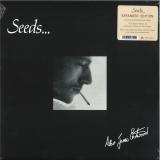
First time vinyl reissue, expanded and deluxe double gatefold 140g double vinyl, remastered audio with restored artwork and fresh liners written by Paul Hillery (Folk Funk & Trippy Troubadours)
Alan James Eastwood's glorious Seeds is a certified folk-funk lost-classic.
But who was Alan James Eastwood? He had never hit the big time and commercial success eluded him. By the mid-1970s, his musical career was pretty much over and he was almost unknown except among deep heads, amongst whom he would gain cult status.
Original copies of the 1971 vinyl release of Seeds exchange hands for high sums, if you can find one. This expanded 2LP contains an extra record, collecting 9 rare non-album singles and is presented in a gatefold sleeve complete with freshly commissioned liner notes courtesy of Paul Hillery (Folk Funk & Trippy Troubadours).
With the long overdue deluxe reissue of this prized artefact, we hope to finally shine a light on the unheralded genius of Alan James Eastwood. RIYL Nick Drake, Rodriguez, Richie Havens.
Alan James ‘Bugsy’ Eastwood was a renowned musician and singer who came to prominence in the late 1960s with The Exception, an unsung but excellent band from Birmingham. The Exception released many singles, the first featuring friend Robert Plant on tambourine, before an album, The Exceptional Exception. However, by this time, Bugsy was feeling constrained and restless; he left the band within weeks of the release.
Having vanished from the scene, he was honing a deeper, introspective edge to his songwriting. His demos found their way to the sound engineer and producer Mike Cooper at Pan Music Studios in Denmark Street. Loving what he heard, Eastwood soon entered a recording session with Cooper. The session was just Alan, his guitar and harmonica and - by all accounts - it was remarkable. With the songs, the voice and such an exceptional talent, it was hard to go wrong. Says Mike: "We had John Hawkins do the big string arrangements and Richard Hewson arranged the string quartet. We overdubbed the orchestrations on Alan's original session recordings, adding Chris Karan on tabla and various percussion. We considered re-recording the vocals but found that the magic on that original session was so exceptional overdubbing would not be as good as the atmospheric 'live' performance."
Mike and Alan viewed each track as a different entity, giving the album a diverse sonic palette. Assessing each song individually, they decided which would be suitable for each arranger. Top-flight session musicians were added to the roster to complete the sound, with Byron Lye Fook (father of musician Omar) on drums, bassist Mike Ward, Brian Pickles on marimba and jazz drummer Chris Karan on tabla and percussion. Recorded in a matter of days in Pan's small 8-track studio, they carefully added overdubs, rhythm sections and four string sessions arranged by Hawkins, with Hewson's arrangements recorded at Trident Studios.
Seeds was Alan James Eastwood's debut solo album – indeed, his only solo album - and was originally issued on President in 1971. It melded Eastwood’s impressive rock sensibilities with a folk thread to superb effect. His arresting voice - its deep, rough-hewn soulfulness - coupled with gorgeous string-drenched backing, make this a phenomenal listen. It really is a great 70s singer-songwriter record - with touches of acid-folk and folk-funk throughout.
It opens with "She's Getting Married In August", a mellow tune with Richard Hewson's strings arranged around Alan's straightforward guitar structure. Up next, the joyous, sun-dappled guitar and strings workout "Evenin' Rain" glides by before the fragile, accordion-enhanced "Les Papillons" breezes out of the speakers. The bluesy "Zeena" follows, featuring vocals and acoustic guitar and showcasing Eastwood's effortless harmonica. Starting out as a ballad, "Virgin Morn" builds with soaring strings and gospel-tinged backing vocals from Marilyn Powell and jazz singer Josephine Stahl. The A-side closes with the title track, "Seeds". With a chugging mid-tempo beat, soulful vocals and a beautiful Bacharach-esque string arrangement, it truly is stop-you-in-your-tracks spectacular.
Side B opens with "Crystal Blue", gilded by Lye Fook's marimba, lush gospel-esque backing vocals and handclaps. Eastwood's acoustic guitar begins "Lady Carole", which starts as a bluesy ballad and builds with more string arrangement, lifting the track to another height. A towering highlight of epic proportions, "Lotus Child" is a true masterpiece of arrangement. It opens with simple yet stunning do-do-dah vocal harmonies blended with John Hawkins's strings, bass lines and rhythmic beats, forming a vibe very much in conversation with the sounds coming from LA's Laurel Canyon. Next up, the heartwarming "Last Prayer", dedicated to Alan's first and last love, contains a melancholic vocal with a wistful string-drenched arrangement that would sit comfortably in a Federico Fellini score. Bringing the album to a close, "Hymn For Today" is a melodic raga with tabla, strings and a soft-psych feel. Eastwood's prophetic whisper - "I am real. At last, I am real" - profoundly hits home.
Kicking off the extra disc is the sparsely funky and country-tinged "Boston", released as the flip to the astonishing "Seeds". Next up are the two tracks that comprised Alan’s debut solo 7" single from 1968. The laconic, Bobby Charles-esque "Blackbird Charlie" evidences a real depth and charm in Eastwood's songwriting whilst the starkly brilliant flip, "My Sun", was a horizontal, atmospheric folk-tinged soundtracky precursor to his later work on Seeds.
In 1972, two further standalone singles followed. The first was the evergreen flute-driven folk-funk bomb, "Closer To The Truth", backed by the funky blues of "Strange News". The second, a deeply moving Havens-inspired "Moonchild" - rightly fawned over to this day - was flipped with "Red Shoe Truckin'", a groove-infused track. Eastwood also paired up with Marilyn Powell for a single produced by Powell's partner, Mike Cooper. Under the name Eastwood & Powell, they released their staggering rendition of "Beautiful", a rock-blues-pop song arranged by Ivor Raymonde and written by Carole King. Over on the flip, a funky Eastwood original "Opal Blue Sunday" lurked. This is not to be overlooked.
Over the years, Alan remained active on the music scene, but problems with alcohol and health complications from diabetes severely impacted his career. He spent his latter years living in London until his untimely death from heart failure on 25 October 2007, just one day before his 62nd birthday and without his music having received the real acclaim it so dearly deserved.
This deluxe reissue, spellbinding from beginning to end, should hopefully go some way to rectifying this tragic fact. Mastering for this special double vinyl edition was overseen by Be With regular Simon Francis and it was cut by the esteemed Cicely Balston at Abbey Road Studios to be pressed in the Netherlands by Record Industry. The original artwork has been lovingly brought back to life at Be With HQ, with the addition of passionately written liner notes specially for this landmark reissue by none other than Paul Hillery.

JTQ Return to Acid Jazz… At the very birth of Acid Jazz there was the James Taylor Quartet. Hammond player extraordinaire James Taylor was fresh from the split of The Prisoners when he recorded Herbie Hancock’s ‘Theme From Blow Up’ and signed with Eddie Piller’s Re-Elect The President label, the precursor of Acid Jazz. Then, in 1993, after albums for Polydor and Big Life, Acid Jazz and James hooked up again and released ‘In The Hand Of The Inevitable’, for many the finest JTQ album. In March this year James found himself backstage at the Royal Albert Hall - The Brand New Heavies were about to take the stage - with Acid Jazz’s Eddie Piller and Dean Rudland and a plot was hatched... James returns to the label with this brand new 7-inch single: ‘Wildflower’ b/w ‘Guiding Light’.
The A-side is Bossa-nova tinged slice of sunshine pop featuring James’ vocals. It sounds like an old private-press 45, unearthed in a dank warehouse basement in Oregon, and is another JTQ classic. The flip takes us into jazz funk territory. Presented in a one-o^ version of the latest Acid Jazz house-bag, with classic labels.

Death Is Not The End release a second part collecting pre-partition film music, compiled by Gary Sullivan of Bodega Pop.
As the 1940s began, South Asian cinema entered a transformative phase. Playback singing, still a new idea in the previous decade, quickly became standard practice. Actors no longer had to sing, and singers no longer had to act, opening the door to a wave of dedicated vocal talent that redefined the sound of the industry.
Voices like Noor Jehan, Shamshad Begum, and Suraiya rose to prominence, becoming household names across the subcontinent. Behind them, composers like Naushad, Anil Biswas, and Ghulam Haider were expanding the sonic palette of film music, blending ragas with Western orchestration, folk tunes with jazz-era instrumentation. Harmoniums, sarangis, violins, accordions, and clarinets filled out increasingly complex arrangements, while ghazals and qawwalis continued to influence mood and structure.
Although the post-Partition years are often considered to be Bollywood's "Golden Age," thanks to filmmakers like Raj Kapoor, Bimal Roy, and Guru Dutt, the music started its peak just before the divide. By 1947, Naushad and others were producing some of the most emotionally rich and musically intricate work in the industry's history, compositions that would prove challenging to surpass in the decades that followed.
Yet this high point came during a time of immense upheaval. The Second World War, the Bengal famine, and the crumbling of colonial rule all loomed large. Film songs often reflected the uncertainty, sometimes mournful, sometimes romantic, sometimes defiant. And when the Partition finally came, it fractured the world that had created this music. Artists became refugees, studios were split, and careers were thrown into flux. Noor Jehan, who would go on to become Pakistan's most iconic singer, recorded many of her most beloved songs in Bombay. Khursheed, another major star, faded from public life after migrating. K.L. Saigal, a towering figure of the 1930s and '40s, died in Lahore just months before the split.
This collection spans those final years before Partition, a time of creative flowering and looming catastrophe. Like Part 1, these songs were sourced from immigrant-run music shops in New York and New Jersey. They are fragments of a vanishing world, each one a snapshot of the art, longing, and resilience that defined this extraordinary era.

The moment the instantly recognizable intertwined guitar passage on the title track to the Eagles' Hotel California begins, the record's genius becomes obvious all over again. Ranked the 118th Greatest Album of All Time by Rolling Stone, certified by RIAA as the third best-selling LP in history, and considered the foundation on which the Golden State's mid-‘70s music scene was built, the 1976 landmark is a music staple immune to shifts in trends, eras, and styles. Fearlessly addressing the chaos and consequences of American life, its songs remain strikingly prescient and gain creedence with each passing day.
Mastered from the original analogue master tapes, pressed on MoFi SuperVinyl, and limited to 17,500 numbered copies, Mobile Fidelity's UltraDisc One-Step 180g 45RPM 2LP vinyl box set ensures you will want to permanently check into and never leave this particular Hotel California. Up to the herculean task of standing head and shoulders above all prior reissues, this collectible edition plays with extreme clarity, organic richness, tube-like warmth, massive dynamics, and microscopic levels of detail. You'll be able to practically smell the colitas and feel the breeze in your hair. Songs come across with an epic sweep and feature immersive, front-to-back soundstages that allow the music unprecedented air, roominess, and separation. As for the noise floor? It's basically as invisible as the spirits that waft in the corridors of the unforgettable title song.
Aesthetically, the premium packaging and presentation of the UD1S Hotel California pressing befit its esteemed status. Housed in a deluxe box, it features gorgeous foil-stamped jackets and faithful-to-the-original graphics that illuminate the splendour of the recording. From every angle, this UD1S reissue exists as a curatorial artefact meant to be preserved, touched, and examined. It is made for discerning listeners that prize sound quality and production, and who desire to fully immerse themselves in the art – and everything involved with the album, from the renowned cover art to the meticulous finishes.
Indeed, the opportunity to zero in on all the particulars of the 26-million-selling Eagles record dubbed "a legitimate rock masterpiece" by vaunted Los Angeles Times scribe Robert Hilburn has never been better. A global phenomenon that marked the band debut of guitarist-singer Joe Walsh, Hotel California continues to resonate and connect with listeners of all generations taken by its narrative depth, stark directness, picturesque melodies, daring majesty, and ardent emotionalism. Adorned with a breathtaking exterior photograph of the Beverly Hills Hotel that serves as the simultaneously haunting and alluring cover art, and rounded out by a rear-cover shot of the Lido Hotel lobby that reinforces a notion that teeters between permanence and transience, Hotel California is brilliantly tied to a specific place that functions as a universally understood metaphor for the American Dream.
Confronting the darker undercurrents and oft-ignored constructs attached to that romantic notion, the record's songs revolve around a host of shared themes: excess, mobility, stability, illusion, fame, destruction, and idealism included. Notably, Hotel California appeared at a crucial junction in American history: During the country's bicentennial and amid escalating controversies related to the Vietnam War, energy crisis, and governmental corruption. That the Eagles manage to channel such cultural, social, and economical matters into a cohesive, stately, big-picture statement is alone a stupendous feat. That the album's reach, boldness, vitality, accessibility, and understated intensity have never waned make it a marvel.
Reflecting on Hotel California 40 years after its original release, and indirectly explaining its enduring appeal and increasing relevance, singer-songwriter Don Henley confirmed the record pertains to the "loss of innocence, the cost of naiveté...the difficulties of balancing loving relationships and work, trying to square the conflicting relationship between business and art; the corruption in politics, the fading away of the Sixties dream of ‘peace, love and understanding.'"
It can be argued that Henley and company squarely hit on and drove home those ideas in the surreal title track, chart-topping "Life in the Fast Lane," and grand "The Last Resort" alone. But that would miss the forest for the trees. Experienced as an unbroken whole, complete with the pristinely shot imagery and physical grooves, Hotel California unfolds like a geography-conscious saga by James Michener and plays like colour-saturated movie shot on 70mm film by Martin Scorsese. It's about our collective and individual decisions – and the shape of our past, present, and future. And, just like that conjured by our imaginations, Hotel California continues to take on a life of its own.
More About Mobile Fidelity UltraDisc One-Step and Why It Is Superior
Mobile Fidelity Sound Lab's UltraDisc One-Step (UD1S) technique bypasses generational losses inherent to the traditional three-step plating process by removing two steps: the production of father and mother plates, which are created to yield numerous stampers from each lacquer that is cut. For UD1S plating, stampers (also called "converts") are made directly from the lacquers. Since each lacquer yields only one stamper, multiple lacquers need to be cut. Mobile Fidelity's UD1S process produces a final LP with the lowest-possible noise floor. The removal of two steps of the plating process also reveals musical details and dynamics that would otherwise be lost due to the standard multi-step process. With UD1S, every aspect of vinyl production is optimized to produce the best-sounding vinyl album available today.
MoFi SuperVinyl
Developed by NEOTECH and RTI, MoFi SuperVinyl is the most exacting-to-specification vinyl compound ever devised. Analogue lovers have never seen (or heard) anything like it. Extraordinarily expensive and extremely painstaking to produce, the special proprietary compound addresses two specific areas of improvement: noise floor reduction and enhanced groove definition. The vinyl composition features a new carbonless dye (hold the disc up to the light and see) and produces the world's quietest surfaces. This high-definition formula also allows for the creation of cleaner grooves that are indistinguishable from the original lacquer. MoFi SuperVinyl provides the closest approximation of what the label's engineers hear in the mastering lab.

Housey Doingz, widely regarded as one of the most influential collectives to emerge from the London scene, returns to Sushitech with an extraordinary new release, set to become a cornerstone for discerning collectors.
This exclusive 10x10” series reflects Sushitech's 20th anniversary, featuring remastered tracks, rare and previously unreleased material carefully selected from the legendary Strange Weather DAT archives.
The third installment features a remastered version of Fonki, the rare Housey Doingz release on Surreal. Originally pressed in a limited quantity and now nearly impossible to find in decent condition. This elusive masterpiece is now being brought back to life.
Sushitech 20th anniversary.

The Aachen Jazz Files
A collection of essential jazz from the NABEL record label (1980-1994), compiled by miche & Rainer Truby.
The Aachen Jazz Files celebrates the pioneering spirit of NABEL Records—one of Germany’s most underrated yet influential independent jazz labels. Founded in 1980 by Rainer Wiedensohler, NABEL became a home for innovative musicians blending classic acoustic jazz with fusion, Brazilian rhythms, and avant-garde flourishes.
This compilation collects some of the label’s finest moments, including the soulful and Latin-tinged brilliance of Monika Linges Quartet (whose album *Floating* was reissued last year by PANORAMA Records for RSD Black Friday), the cosmic jazz explorations of John Thomas & Lifeforce, the deep jazz-funk grooves of Hipsters In The Zone, and the stunning, expressive vocals of Maria João’s quintet.
Nestled in the far west of Germany, near the Dutch and Belgian borders, Aachen has long been a hidden gem for jazz lovers. Its vibrant scene, fueled by music schools and the legendary Malteserkeller jazz club, cultivated a unique sound that resonated far beyond its city limits. In fact, the city didn’t just birth a jazz movement—it also lays claim to opening Germany’s first discotheque in 1959.
From London to Tokyo, NABEL’s releases became secret weapons for jazz DJs seeking deep, danceable cuts. The label’s trademark blend of acoustic jazz, fusion, and Brazilian influences made its way onto turntables in underground clubs and festival stages worldwide.
Expect elegant samba jazz, spiritual grooves, and modal masterpieces that capture the essence of NABEL’s golden years. Monika Linges’ contributions shine with her rich harmonies and heartfelt compositions, while John Thomas & Lifeforce deliver a perfect storm of fiery instrumentation and deep soul. Maria João’s early recordings showcase her extraordinary vocal range, and Hipsters In The Zone bring a forward-thinking, acid jazz-infused perspective to the NABEL sound.
As co-compiler Rainer Truby puts it:
'NABEL Records always had this special ‘Aachen sound’—a jazz flavor that carried its own energy, somewhere between the cool sophistication of fusion and the warmth of Brazilian music. It’s a pleasure to finally bring together some of these classics in one essential collection.'
Compiled by miche & Rainer Truby.
PANORAMA Records is a London-based label dedicated to unearthing and reintroducing rare and essential music to new generations. With a focus on jazz, funk, and global grooves, the label has built a reputation for high-quality reissues that capture the spirit of the originals while providing fresh context for today’s listeners. Their past releases have garnered support from tastemakers like Gilles Peterson, Patrick Forge, and Mr Bongo DJs.

Mr Bongo proudly presents the third album by Melbourne/Naarm multi-instrumentalist, Don Glori, entitled ‘Paper Can’t Wrap Fire’. A kaleidoscopic genre-surfing odyssey that brings together the worlds of jazz, soul and funk. Feeling both contemporary and classic, familiar yet novel, it’s an assured third release that sees an artist in full flight, showcasing their creative prowess and the uniqueness of their musical voice.
Steering in a new direction, Don Glori (aka Gordon Li) has delved headfirst into his songwriting with ‘Paper Can’t Wrap Fire’. Deftly showcasing his talents as a writer and bandleader, he brings with him a whole host of friends from the creative crossroads that is Naarm. It’s an album enriched with more soul, R&B, and funk-oriented songs than his previous jazz-rooted productions, yet there’s still plenty of jazz material for those familiar fans of Don's earlier works.
The album’s title is an old Chinese proverb, roughly translated as 'you can’t deny the truth'. This underlying thread is woven between the songs. “A lot of them are in some way about truth-seeking, observations and the masks you put on to deal with life (hence the cover art)”, Don mentions. Take, for instance, the sensational soul single 'Brown Eyes' featuring silky lead vocals by ML Hall. A dissection of the minority experience, and the power and comfort in building those communities. Elsewhere, 'Disaster' is a satirical take on the structures serving everyone but the artists, and 'Flicker' tackles notations of truth and clarity after introspection.
To marry that meaning with the level of musicianship on these tracks is what really stands out. Don has set out his stall here as an artist who can write songs that hit home in the heart, as much as they do in the head. It’s a journey infused with a glistening jazz finesse, layered with nourishing vocal harmonies and powered by an instantly relatable human soul.
Recorded over two hot summer days in Rolling Stock Studios in Collingwood, Naarm, the lineup of musicians is built up of Don's friends and family. Featuring the backbone team of Tim Cox, Al Kennedy, Joel Trigg, Robyn Cummins and Lachlan Thompson, who were part of Don's touring band before he relocated to London, and a stunning selection of vocalists in the form of ML Hall, Ruby Dargaville, Isadora Lauritz, and Bianca Kyriacou. Also gracing the album are trumpeter extraordinaire Audrey Powne, saxophonist Joshua Moshe, and Alcides Neto who sprinkles some Brazilian magic into the record.
Taking influence from artists including Azymuth, SAULT, Jordan Rakei and Lynda Dawn, as well as from London musical beacons such as NTS and Total Refreshment Centre, Don has run with this, leaned in and come out with a record truly unique to himself and his distinctive core, with no mask necessary.

Archeo Recordings is a record label. Old, lost, obscure and forgotten gems and a boundless focus on the new Balearic scene for a wider audience of collectors, DJs and music lovers. All releases are limited edition. This release is a Limited Edition EP (250 on black vinyl). New life and an expanded treatment of Quiroga's epic Electronic/Future Jazz/House Snaporaz (Really Swing 2020), from none other than L.U.C.A. (AR029). Archeo delights us with this luscious and limited release featuring Quiroga's sleek jazz-house UFO "Snaporaz". This edition includes an exclusive extended version, a brand-new cut from the Neapolitan groover, and a completely cosmic overhaul from the mighty L.U.C.A. Operating at the nexus of future jazz, beatific electronics and deft house, Quiroga (Walter Del Vecchio to his nearest and dearest) has carved his own irresistible niche over the past two decades, gracing countless labels with nuanced body movers and forging his impressive Really Swing imprint, the original home to this melodic masterpiece. Tucked away on Del Vecchio's 2020 EP "Chords and Desire", the sunny and sultry Snaporaz fell foul of our communal pandemic preoccupation, missing out on the widespread acclaim, appreciation and ass-shaking it so richly deserves. Archeo steps in as patron, giving this Rhodes-led jazz-house heater the full 12" treatment it was born for. On the A1, Quiroga's extends the ecstasy of "Snaporaz", stretching its original elements into a loosely grooving, dopamine-deep delight. Sunkissed keys and tender pads ride the rhythm of a bubbling bassline while the sophisticated percussion snaps, crackles and pops in the background - the perfect environment for the P&P leadline to flourish. If that wasn't enough to have you slipping straight into your party pumps, Walter makes the most of the extra runtime with a HOT hand drum freakout down the final stretch, adding the most enticing icing to an already heady cake. A comparative cooldown follows in A2 offering "Escorpião", a fusion-tinged flirtation for aperitivo everywhere. Cutting back on the kick to save space for the swing, Quiroga leads us through a sublime sequence of hooks, riffs and solos, without ever overwhelming the ears but keeping the groove alive. It's a dizzying delight from start to finish and features one of the finest keytar and cowbell interplays you're likely to hear. The B-side belongs to the frankly legendary Francesco de Bellis, a house, disco, Italo and electro hero, appearing here under his deliciously downbeat alias L.U.C.A. Imbuing Quiroga's original with the atmospheric stylings of his Edizioni Mondo oeuvre, the Roman producer delivers a radical rework, slowing the tempo by 20 bpm and translating those jazzy tones into a drifting new age dancer for the cosmic crowd. Zero gravity rhythms meet mystical melodies uptown as the house hippies get down. Lest we overlook the batshit brilliance of the drum programming, L.U.C.A. caps it off with a bonus beats version sure to delight DJs and dancers alike in its otherworldly oddness.

Saṃsāra Cycles – A Spiritual and Ode to Dance Music Trilogy by B From E
Rising French label Happiness Therapy unveils Saṃsāra Cycles, an extraordinary trilogy of EPs crafted by Danish treasure B From E. This ambitious and evocative project dives deep into the spiritual dimensions of music while paying homage to the transformative power of dance.
Through Saṃsāra Cycles, B From E demonstrates the full breadth of his artistic and technical mastery. Spanning ethereal dream house, uplifting garage / piano house and hypnotic neo trance, each record in the trilogy is a testament to his unparalleled versatility and creativity.
This trilogy, available on vinyl and digital formats, will be released between February and April 2025. Each EP embodies a unique stage of the Saṃsāra cycle, creating a cohesive narrative that connects sound, spirituality, and the energy of the dancefloor.
