Second release on iS Records, The A-side, The Future Never Was combines sparse beats and pads held together by a growling stuttered bass, which gives the track an industrial feel but on a techno/house tip. On the flip, Fake The Feeling, draws on sounds beyond the current trend for vintage analogue in an original take on the house blueprint. The B2 track Out of Orbit is 4 minutes 48 seconds of Tech soul, for the floor or the headphones.
quête:fake left
- 1
As Nathan Fake rises from the nocturnal subterranea and rave catharsis of his previous records, on Evaporator, he resurfaces into the domain of daylight, bringing a tangible sense of air rushing against your face, of big skies, and endless landscapes. The idea of pop accessibility that trickled into 2023’s Crystal Vision is refracted here through the prism of sweeping ambient, deep electronica, and trance uplift. Evaporator is Fake’s idea of “airy daytime music”, with each track a different barometer reading across the album’s varying atmospheres, which range from vibrant sunbursts, bracing rainscapes, and fine mists of clement melodics. “It’s not overtly confrontational electronic club music,” states Fake. “It’s quite pleasant, it’s accessible. As I was progressing through making the tracklist, I called it a daytime album. It doesn’t feel like an afterparty album.” For the past decade Fake has been gingerly introducing collaborations with heroes and friends alike into his lone, idiosyncratic working process. Border Community alumni Dextro AKA Ewan Mackenzie transmutes his ferocious drumming for Pigs Pigs Pigs Pigs Pigs Pigs Pigs into the blurred choral thump of ‘Baltasound’. ‘Orbiting Meadows’, meanwhile, is his second collaboration with Clark, an eerily idyllic duet where microtonal 18EDO piano clangs slowly twirl around wailing pads. Evaporator marks the junction point of old technology and ever fresh creativity for Nathan. The trusty “dinosaur” age software, particularly Cubase VST5, that has powered two decades of music is rarely updated. “I used to sort of feel a bit ashamed of using such old software, and then I kind of had an epiphany – that’s just how I work”, comments Fake. “That’s just how I play. I’m very fond of these old tools, and I get the most joy out of them, but now I’ve incorporated new technology too.” When an artist accumulates so much synergy with their instrument, music making becomes instinctual. By Fake’s account, much of Evaporator just fell into place. The album title arrived randomly in his head (“it felt completely perfect. Airy.”), ideas looped and developed until things locked into place and just felt right. ‘The Ice House’ is a fleeting glimpse of the sonic world he taps into in this creative state, its glassy FM synths built around a counterpoint between rough-hewn crystalline arpeggios and sparse yet gravitas-bearing bass. “That riff I just wrote out on the keyboard, I just played it forever and ever and ever. The original track ended up being really short. Here you go, and it’s gone!” These unplanned channellings of sound call forth records from Fake’s past while he looks ahead, perhaps getting at the very essence of his musicianship. The opener ‘Aiwa’ (“the breeziest,” he muses) reminds of the introspection that characterised Providence, excited by the fire and grit of Steam Days’ textural experiments, its chunky slams and clatters surging into a flood of harmonic buzzing as they reach out for old wisdom. ‘Hypercube’ stampedes in a similar chronological confluence, infusing an incessant synth line reminiscent of the golden age of rave with the crackling, ecstatic energy of modern festival anthems. Like the vaporisation of liquid to particles, everything that Evaporator presents has a mutant desire to be amorphous. Sounds rarely settle; the irradiated garage beat of ‘Bialystok’ is pitched downwards to driving, rebounding effect, while ‘You’ll Find a Way’ warps static into shivering energy, cinematic synth strings building anticipation into a gradual gush of chords. This translates into a more expansive stereo field than Fake has explored before. ‘Slow Yamaha’ saves the wildest, most kinetic transformations for last with a cornucopia of crispy melodies and fried drums; a sibilance of cymbals on the left, a susurrus of shakers on the right, and kaleidoscopic lasers pulsing and fizzing all around. Evaporation culminating in pure excited atoms. In a world where music has increasingly become background content, making albums remains lifeblood for Fake: “It makes me realise how long; twenty years is ages! It’s weird to see how much the world has changed. Release day back then you did fuck all, now you spend all day on socials. When I grew up the people who made the electronic music I was into were quite mysterious, and the artwork was very abstract. There was a massive distance between you and that music, and that was a key part of it, really. Now it helps to be an extrovert, and I'm just not, but the album marks the first time my face has graced the cover art. I’ve never wanted to do this before, I'm very shy, and generally I don’t like being seen,” he professes. “But, twenty years in, I supposed I could try something new. I'm very lucky that I'm somehow surviving in this world, where the media world favours extroverts and interesting looking people. It’s not my world but somehow I’m still in it.” Evaporator continues to prove Nathan’s necessary presence, with some of his most engaging, varied, and magical music yet.
INDUSTRIAS MEKANIKAS is back with the third instalment of the ANTIKHRIST VISIONS saga. This release is particularly symbolic: it’s the ninth in the catalogue, marked by the infernal numerology that runs right through the whole series. It’s a descent into a sonic underworld, where noise becomes ritual and pleasure is just pure agony.
The artist tasked with opening this new chapter of the saga is the mighty Óscar Mulero, an essential figure on the national electronic scene and one of our biggest international ambassadors, whose career has left a deep mark on contemporary music. Here, with Faceless, he delves into dark, precise, and devastating electro territory; a spiritual machine that dictates the pulse of chaos.
Next up, we’ve got Pressurized Modulator with Reddrum: hard, crunchy, industrial electro, absolutely buzzing with electrical tension and twisted sonic matter.
Closing out the A-side is Jacko Volvone (aka Hoax Believers) with Quieren Cerrar Las Fábricas: a track that expertly blends electro, techno, and post-punk echoes, resulting in a tense, distorted, and combative sound, like a working-class echo shouting from the abyss.
Flipping over, the B-side opens with Hanging Nuts (made up of Waje Martín, Fake Robotik, and Ruben Montesco). They unleash a murky descent of filthy, distorted, primal electro, slashed through with guitars and raw, guttural vocals: a genuine chant from beyond the grave. The second cut marks the debut of Techselektah & Phil Fork with Champagne No Potable: a raging street anthem packed with fury, energy, and social criticism, where Spanish vocals emerge amidst EBM structures that have that ‘80s spirit, reinterpreted with today’s raw edge. And the big finish is down to HBK1 alongside Rigor Mortis, with Instinto Caníbal: a full-on explosion of electro-industrial and EBM that awakens the body’s most primitive urges.
Antikhrist Visions Vol. III is a sonic summoning from the lands of Hades: ritualistic matter, organic sound, and primal force. A testament to pleasure and torment—Tormento do Gostar—etched into the vinyl as if it were molten iron.
Memento Mori.
Love Raid is first in a series of cassette-only mixtapes with the cult WFMU show and blog Bodega Pop collecting assorted digs from across New York's bodegas and cell-phone stores. This first edition is focused on leftfield, novelty, and protest 45s from across the Arabic world recorded between 1960 & 1974.
"A series of random discoveries in the mid-1990s led me to abandon American and British pop and focus on non-English-language music, predominantly Arabic, for the next two decades.
Feeding my ears required biking down to Bay Ridge, Brooklyn, or hopping on the subway to Steinway Street in Queens, where I would pop into a handful of the local bodegas and immigrant-run cell-phone stores, some of which offered music from North Africa and the Middle East on cassettes and compact discs.
When CDs spiralled into obsolescence in the mid-2010s, I reluctantly made the switch to vinyl, concentrating on 45s and intentionally filling holes not well represented in the digital era – more artists than not hadn't made the transition from analog in the 1980s. This meant focusing on singles by a lot of artists I'd not heard of, and it quickly became evident just how much of the era – from approximately 1960 to 1974, when 7" records were all but abandoned in Egypt and Lebanon – had been forgotten.
What also became evident was the breadth of popular music issued by even hegemonic titan Sono Cairo. The consensus is that state radio and music publishing ignored traditional folk, shaabi, and other lowbrow pop in favor of the exalted art song we associate with Oum Kalthoum, Abdel Halim Hafez, and Farid al-Atrash.
While this active neglect of the broadest Arabic pop spectrum is mostly true, I accumulated a not inconsequential number of what I can only describe as "novelty" records by mostly one- and two-hit wonders. From catchy gimmicks like the "doktor, ya habibi" of Maha's "Doktor" and the "boom boom boom" of twins Thunai Badr's "Love Raid," to the Monty Python-level silliness of Sayed Mandoline's fake Italian crooning and maniacal laughter in "I Present to You the Mandolin," these were sounds I was genuinely surprised to hear.
Even more remarkable were the songs recorded in English: Karim Shukry's celebratory "Ramadan" and Motyaba & Nada's civil-rights plea "No Black No White" are two of my favorites, and thus included in the present collection.
The tracks compiled here are often as beautiful as they are beguiling, but while the intention was to absolutely put together a solid listen, it was also my hope to slightly expand our understanding of Arabic music of this period beyond not just the usual suspects, but also subjects – and treatment of same."
--Gary Sullivan.
On April 7th electronic luminary Nathan Fake presents the new longplayer ‘Crystal Vision’ on his own Cambria Instruments imprint, which features collaborations with Clark and Wizard Apprentice.
This is music for music’s sake – recorded without angles, agendas and themes – so Fake was free to simply continue honing his craft and express himself non-literally. Aptly titled, there’s a clarity of execution and ambition, and a peak effectiveness to the record that just sounds right.
Continuing to set a personal bar higher and topping his own best, the mark of master craftsperson is everywhere, but that doesn’t mean it’s polished; There’s plenty of rawness evident, with spiky sonics keeping ears on high alert – full of endorphin-flooded rave energy.
Following a short, scene-setting ‘Arrival’ – a simple major chord arpeggio played on a Jupiter 6 which sounds like curtains opening at dawn, things begin apace with ‘The Grass’, which hurtles like a precision-tuned bullet train through Arctic tundra. The undulating effect of compression is emphasised by the classic techno trope where 2 rhythms jar yet interlock, creating an exquisitely disorientating strobe-like flutter. On the track’s guest, Fake comments, “I fell in love with Wizard Apprentice's ‘I Am Invisible’ and felt our musical styles were similar. Their vocals are smooth and clear and sharp at the same time. They’re like a calm within the storm.”
Inspired by Italo disco but sounding wholly alien and futuristic, ‘Vimana’’s fizzing buzzsaw arpeggiated bassline, popping snares and bright whirling melody are equally an electro trance melange, with an effervescent major chord Arp that kicks in midway.
Reminiscent of what used to be called ‘funky techno’ but with sparklier sounds, ‘Boss Core’ blinds like sunshine bouncing off ice. Using his trusty Boss DR550 drum machine, and inspired by Autechre's ‘Vose In’, the track peaks by reaching that melancholic/euphoric axis for which he is loved.
With chugging slow breakbeats not a million miles from Board Of Canada or trip hop, ‘Crystal Vision’ rolls along, with the melody opening up, revealing more hidden notes as it progresses, building into a fractal, kaleidoscopic mosaic.
An emotional outpouring with serotonin surging through the circuitry, classic breakbeats and layers of lazers, ‘Bibled’ has all the hallmarks of a classic. This is a bonafide festival-set closing, hugging-your-mates, moment – or, with its guitar solo, “a power ballad” – as Nathan calls it.
A minimalistic moment of calm midway through the album, ‘CMD’’s gently comforting dreamscape is conjured with FM stacked and detuned sine waves which are left to breathe, whilst the chunky Chicagoan house jack of ‘Hawk’ brings to mind classic Relief records, but even more detuned and wibbly, and laden with synths.
As the title suggests, ‘Amen 96’ is in Fake’s own words, “me having a go at jungle. I grew up listening to it, and I remember as a teenager it sounded like the most intense and otherworldly music ever. It still does. This track is an experiment to see how my melodic style works against amen breaks”. Closer to the braindance end of the spectrum than ‘proper’ jungle (and all the more interesting for it), Fake channels the spirit of Squarepusher but makes it his own, brimming with melodious twinkle.
A collaboration with Nathan’s close friend and genuine musical hero Clark. ‘Outsider’ finds this dream team alchemising pure gold that’s bigger than the sum of their parts. Skittering, intense, far-reaching end epic, the pair close proceedings on a grandly dramatic note. In 2020 Nathan released the album ‘Blizzards’, which was described by The Quietus as “his best work”, and “his best LP yet” yet by Resident Advisor. The equally well received ‘Blizzards Remixes’ EP which featured Afrodeutsche and Irene Dresel followed in 2021, as did a nationwide UK tour.
An in-demand remixer, Fake has added his magic to tracks by Radiohead, Clark, Perc, Jon Hopkins, GoGo Penguin, Dominik Eulberg, Christian Löffler and Damian Lazarus, working for labels including Ninja Tune, Domino, Warp, Blue Note and Kompakt.
"I am sitting in a garden, I haven't left the property in weeks, someone is dropping off food once a week. I haven't seen a human being in ages, I feel like a reverse Schroedinger cat - do I exist when nobody sees me? I must be somewhere in France but I don't remember. I have lost my consciousness again. When I wake up I hear a broken record looping somewhere in the mansion. A washed-out opera. Behind the trees I see the dilapidated hermaphrodite sculpture in a field of verdant nettles and fern. I hear gunshots far afield, aeroplanes in the sky, sirens on the main road.
When unconscious I dreamt of sitting on the Concorde observing the scarab blue ocean and iridescent clouds from above, an erstwhile receding memory. Sometimes I hear the organ of the nearby Renaissance Cathedral merging with the Russian Church bells.
I am hallucinating again. Someone's humming in the kitchen? Singing? A Radio? I overhear two young women talking about art galleries in the neighbour's garden. Bees attack, again…..again and again. The hairspray finally intoxicates them. An amphoric japanese voice is whispering in my head saying I will die soon. Someone (something?) bangs on the vases. The fountain's water turns dark red.
Fleur calls and says mum died. The funeral will be televised on tuesday. We opt for the synthetic choir for the service. The call is suddenly interrupted. Mold is slowly taking over the house.
I go back inside."
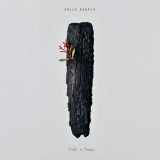
Une Fille Pétrifiée is the debut album of new Black To Comm related entity Mouchoir Ètanche (after one recent 12" on Richter's own Dekorder label). Combining real and fake acoustic instrumentation, sampling, field recordings and excessive yet inaudible post production this is another sublime and ethereal statement. Influences are ranging from (French) Classical & Opera to the anecdotical compositions of Luc Ferrari, Chinese Opera, Chanson, Sacred Music / Church Music, JG Ballard and Surrealism.
Marc Richter records as Black To Comm for Thrill Jockey, Type and Dekorder and as Jemh Circs for his own Cellule 75 imprint. He also produces soundtracks and acousmatic multichannel installations for institutions such as INA GRM Paris, ZKM Karlsruhe and Kunstverein Hamburg.
- 1: =
- 2: Sovay
- 3: A Nervous Tic Motion Of The
- Head To The Left
- 4: Fake Palindromes
- 5: Measuring Cups
- 6: Banking On A Myth
- 7: Masterfade
- 8: Opposite Day
- 9: Skin Is, My
- 10: The Naming Of Things
- 11: Mx Missiles
- 12: =/=
- 13: Tables And Chairs
- 14: The Happy Birthday Song
In 2003 Andrew Bird removed himself from the noise of city life in Chicago to work on his music in a barn in rural Illinois. The result was a career-defining record exploring childhood, creativity, and science with wit, precision, and ambition. The Mysterious Production of Eggs crystallized Bird’s signature style and introduced the live-looping ingenuity that would define his performances for decades.
Two decades later, its influence still resonates throughout the indie world, inspiring artists and audiences alike. This year, Bird marks the milestone with a limited edition boxset, a re-issue of the original album, and anniversary tour, performing Eggs in full alongside the world’s foremost symphony orchestras proving that some mysteries only grow richer with time.
Alongside the 3LP deluxe boxset, Bird is re-issuring the beloved album garnished with deluxe reimagined artwork by longtime collaborator Jay Ryan, whose whimsical artwork graced the original and is a crucial part of its lore.
- =
- Sovay
- A Nervous Tic Motion Of The Head To The Left
- Fake Palindromes
- Measuring Cups
- Banking On A Myth
- Masterfade
- Opposite Day
- Skin Is, My
- The Naming Of Things
- Mx Missiles
- =/=
- Tables And Chairs
- The Happy Birthday Song
- Sovay
- A Nervous Tic Motion Of The Head To The Left
- Blood
- Measuring Cups
- Banking On A Myth
- Masterfade
- Opposite Day
- Skin Is, My
- The Naming Of Things
- Mx Missiles
- Capital I
- Right On Time
- The Happy Birthday Song
- Measuring Cups
- Knapsack
- Fake Palindromes
- A Nervous Tic Motion Of The Head To The Left
- The Happy Birthday Song
- Tables And Chairs
- Tables And Chairs
- The Happy Birthday Song
Im Jahr 2005 war Andrew Bird eine bis dahin unvorstellbare Kombination aus virtuosem Violinisten, Singer-Songwriter, Gitarristen und Pfeifer. Mit seinem Album ,The Mysterious Production of Eggs" aus diesem Jahr schuf Bird einen neuen Sound, der bis heute nachgeahmt wird. Anlässlich des 20-jährigen Jubiläums von ,The Mysterious Production of Eggs" veröffentlicht Andrew Bird ein ganz besonderes Boxset mit einem 54-seitigen Buch mit Fotos, besonderen Überraschungen und zwei Essays: einen von Andrew selbst und einen von Anders Lindall, der den verschlungenen und faszinierenden Prozess untersucht, den Andrew und seine Mitstreiter bei der Aufnahme des Albums durchlaufen haben. Das Boxset enthält außerdem die Originalveröffentlichung des Albums sowie zwei LPs mit bisher unveröffentlichtem Material auf schwarzem Vinyl. Auf einer LP befindet sich eine vollständige Wiedergabe des Albums, jedoch mit Demos, Live-Aufnahmen und alternativen Versionen. Die dritte LP enthält weitere unveröffentlichte Raritäten auf Seite A und eine Auswahl von Songs aus dem Originalalbum, die von Andrew mit dem Nu Deco Ensemble gespielt werden. Der ursprüngliche Cover-Künstler hat ein völlig neues Artwork für das Jubiläumswerk geschaffen.
- A1: Aiwa - 04:56
- A2: Hypercube - 04:52
- A3: Yucon - 02:49
- A4: Bialystok - 04:29
- A5: The Ice House - 01:24
- A6: Sunlight On Saturn - 03:13
- B1: You’ll Find A Way - 03:18
- B2: Baltasound Feat. Dextro - 04:37
- B3: Orbiting Meadows Feat. Clark - 02:05
- B4: Slow Yamaha - 09:00
- B5: Black Drift (Outro) - 01:11
As Nathan Fake rises from the nocturnal subterranea and rave catharsis of his previous records, on Evaporator, he resurfaces into the domain of daylight, bringing a tangible sense of air rushing against your face, of big skies, and endless landscapes.
The idea of pop accessibility that trickled into 2023’s Crystal Vision is refracted here through the prism of sweeping ambient, deep electronica, and trance uplift. Evaporator is Fake’s idea of “airy daytime music”, with each track a different barometer reading across the album’s varying atmospheres, which range from vibrant sunbursts, bracing rainscapes, and fine mists of clement melodics. “It’s not overtly confrontational electronic club music,” states Fake. “It’s quite pleasant, it’s accessible. As I was progressing through making the tracklist, I called it a daytime album. It doesn’t feel like an afterparty album.” For the past decade Fake has been gingerly introducing collaborations with heroes and friends alike into his lone, idiosyncratic working process.
Border Community alumni Dextro AKA Ewan Mackenzie transmutes his ferocious drumming for Pigs Pigs Pigs Pigs Pigs Pigs Pigs into the blurred choral thump of ‘Baltasound’. ‘Orbiting Meadows’, meanwhile, is his second collaboration with Clark, an eerily idyllic duet where microtonal 18EDO piano clangs slowly twirl around wailing pads. Evaporator marks the junction point of old technology and ever fresh creativity for Nathan. The trusty “dinosaur” age software, particularly Cubase VST5, that has powered two decades of music is rarely updated. “I used to sort of feel a bit ashamed of using such old software, and then I kind of had an epiphany – that’s just how I work”, comments Fake. “That’s just how I play. I’m very fond of these old tools, and I get the most joy out of them, but now I’ve incorporated new technology too.” When an artist accumulates so much synergy with their instrument, music making becomes instinctual. By Fake’s account, much of Evaporator just fell into place. The album title arrived randomly in his head (“it felt completely perfect. Airy.”), ideas looped and developed until things locked into place and just felt right. ‘The Ice House’ is a fleeting glimpse of the sonic world he taps into in this creative state, its glassy FM synths built around a counterpoint between rough-hewn crystalline arpeggios and sparse yet gravitas-bearing bass. “That riff I just wrote out on the keyboard, I just played it forever and ever and ever.
The original track ended up being really short. Here you go, and it’s gone!” These unplanned channellings of sound call forth records from Fake’s past while he looks ahead, perhaps getting at the very essence of his musicianship. The opener ‘Aiwa’ (“the breeziest,” he muses) reminds of the introspection that characterised Providence, excited by the fire and grit of Steam Days’ textural experiments, its chunky slams and clatters surging into a flood of harmonic buzzing as they reach out for old wisdom. ‘Hypercube’ stampedes in a similar chronological confluence, infusing an incessant synth line reminiscent of the golden age of rave with the crackling, ecstatic energy of modern festival anthems. Like the vaporisation of liquid to particles, everything that Evaporator presents has a mutant desire to be amorphous. Sounds rarely settle; the irradiated garage beat of ‘Bialystok’ is pitched downwards to driving, rebounding effect, while ‘You’ll Find a Way’ warps static into shivering energy, cinematic synth strings building anticipation into a gradual gush of chords. This translates into a more expansive stereo field than Fake has explored before.
‘Slow Yamaha’ saves the wildest, most kinetic transformations for last with a cornucopia of crispy melodies and fried drums; a sibilance of cymbals on the left, a susurrus of shakers on the right, and kaleidoscopic lasers pulsing and fizzing all around. Evaporation culminating in pure excited atoms.
- Scolio
- S-Bend
- Narrow In (Feat. Daudi Matsiko)
- By Helm
- Irregular You
- Shapes In Frame
- Toast Rack
- Everyday (Feat. Ríoghnach Connolly)
- Weak Point
- Humour This
- Sastrugi
Auf seiner dritten Studio-LP präsentiert Werkha einen einzigartigen Blend aus jazziger, Breakbeat-angehauchter Elektronik und analoger Ästhetik. Mit Ríoghnach Connolly und Daudi Matsiko sind zwei renommierte Künstler mit Wurzeln in der Folkmusik dabei, die Werkhas enge Verbindung zur Natur unterstreichen. Werkha (aka Tom Leah) ist ein Multiinstrumentalist aus Manchester mit Releases auf First Word und Tru Thoughts. Seine bisherigen Kollabos umfassen Quantic, A Certain Ratio, Marcos Valle, Eska, Chunky, Andrew Ashong, Keisha Thompson und Bryony Jarman-Pinto. Er tourte zusammen mit Bonobo, Chet Faker, Mr Scruff, Crazy P, GoGo Penguin, Todd Terje, Lefto und MCDE. Zu seinen Supportern gehören Gilles Peterson, Nemone, Don Letts, Jamz Supernova, Mo Ayoub), Julie Adenuga, Scratcha DVA, Tom Ravenscroft und Afrodeutsche
- A1: Sintra
- A2: Holdin On
- A3: Left Alone; Featuring – Chet Faker
- A4: Sleepless; Featuring – Jezzabell Doran
- A5: On Top; Featuring – T.shirt
- A6: Stay Close
- A7: Insane; Featuring – Moon Holiday
- A8: Change
- B1: Ezra
- B2: More Than You Thought
- B3: Space Cadet
- B4: Bring You Down; Featuring – George Maple
- B5: Warm Thoughts
- B6: What You Need
- B7: Star Eyes
- A1: American Exterior
- A2: American Interior
- A3: The Whether (Or Not)
- A4: The Last Conquistador
- A5: Lost Tribes
- B1: Liberty (Is Where We'll Be)
- B2: Allweddellau Allweddol
- B3: Walk Into The Wilderness
- B4: Sugar Insides
- C1: 100 Unread Messages
- C2: That's Why
- C3: The Swamp
- C4: Media Quake
- D1: Cylchdro Amser
- D2: Iolo
- D3: Y Gwenan Gorn
- D4: Year Of The Dog
- D5: Tiger's Tale
- E1: I Grombil Cyfandir Pell
- E2: Ar Goll
- E3: Y Madogwys Neu Angau
- F1: Power Point Presentation
- F2: American Exterior (Extended Version For Two Synthesizers)
Black Vinyl[26,68 €]
In 2012 Gruff Rhys embarked on a solo 'investigative concert tour' through the heart of America following the route taken by his distant relative John Evans. Every night he presented songs augmented by a power point presentation that detailed his relative's unbelievable history, along with any new piece of information that had come his way during the day. He was ultimately looking for Evans's lost unmarked grave. Along with many major cities, the tour took him to play shows at the Mandan and Omaha tribe reservations, a Missouri vineyard, villages that no longer exist and lay at the bottom the Mississippi river and a New Orleans bordello. What transpired from that ‘investigative concert tour’ was a 2014 album, American Interior, plus a book, film and exhaustive tour of the same name. With the aid of the dusted-off power point presentation, Gruff Rhys and a full band revisits the project in 2025 to perform the songs that formed both the album, and the soundtrack to the film.
Gruff says of the reissue -
“Revisiting American Interior 11 years later, feels very prescient. In following the unusual story of explorer John Evans (1770-1799) it becomes clear that faked narratives can have profound and unpredictable consequences in real life. His barely believable journey of verification in searching through continental scale wilderness for a fictitious Welsh speaking tribe believed to be living on the Great Plains of North America (an ancient folk tale perpetuated by the Elizabethan court following the subjugation of Wales, to make colonial claims on behalf of the British on the Americas) had a dramatic political effect on the fledgling USA and a devastating impact on himself and some of those who helped him on his way. I wrote an album of songs inspired by his life; American Interior, which also served as a soundtrack to a documentary film based on a book that detailed his journey, intertwined with my own investigative concert tour, all three of which I worked on simultaneously during a 2-year fever 2012-14. By far the most ambitious undertaking I’ve ever attempted. Living with one foot in the 18th century, wearing the same clothes (for cinematic continuity) for that entire period, left me pretty exhausted. (Imagine a cold extra from The Revenant movie). It took me a while to process the whole experience and its lessons and feel I owe it to my former self to take these songs back on the road for a couple of months and re-tell the story for a new decade. To celebrate it further Rough Trade will reissue a remastered version of the album with previously unreleased tracks.”
COLOURED DELUXE EDITION[42,23 €]
In 2012 Gruff Rhys embarked on a solo 'investigative concert tour' through the heart of America following the route taken by his distant relative John Evans. Every night he presented songs augmented by a power point presentation that detailed his relative's unbelievable history, along with any new piece of information that had come his way during the day. He was ultimately looking for Evans's lost unmarked grave. Along with many major cities, the tour took him to play shows at the Mandan and Omaha tribe reservations, a Missouri vineyard, villages that no longer exist and lay at the bottom the Mississippi river and a New Orleans bordello. What transpired from that ‘investigative concert tour’ was a 2014 album, American Interior, plus a book, film and exhaustive tour of the same name. With the aid of the dusted-off power point presentation, Gruff Rhys and a full band revisits the project in 2025 to perform the songs that formed both the album, and the soundtrack to the film.
Gruff says of the reissue -
“Revisiting American Interior 11 years later, feels very prescient. In following the unusual story of explorer John Evans (1770-1799) it becomes clear that faked narratives can have profound and unpredictable consequences in real life. His barely believable journey of verification in searching through continental scale wilderness for a fictitious Welsh speaking tribe believed to be living on the Great Plains of North America (an ancient folk tale perpetuated by the Elizabethan court following the subjugation of Wales, to make colonial claims on behalf of the British on the Americas) had a dramatic political effect on the fledgling USA and a devastating impact on himself and some of those who helped him on his way. I wrote an album of songs inspired by his life; American Interior, which also served as a soundtrack to a documentary film based on a book that detailed his journey, intertwined with my own investigative concert tour, all three of which I worked on simultaneously during a 2-year fever 2012-14. By far the most ambitious undertaking I’ve ever attempted. Living with one foot in the 18th century, wearing the same clothes (for cinematic continuity) for that entire period, left me pretty exhausted. (Imagine a cold extra from The Revenant movie). It took me a while to process the whole experience and its lessons and feel I owe it to my former self to take these songs back on the road for a couple of months and re-tell the story for a new decade. To celebrate it further Rough Trade will reissue a remastered version of the album with previously unreleased tracks.”
- Riverside
- Marseille
- Alouette
- Blue Left Hand
- Velveteen
- Shotguns
- Rodeo
- Moon On The Water
- Talk Is Cheap
- Banshee
- Divinations
2023 was a whirlwind year for Oracle Sisters. The trio—Julia Johansen, Chris Willatt, and Lewis Lazar—followed the release of their debut album Hydranism with a globe-spanning tour that captivated fans and critics alike. From the highways between Knoxville and Nashville to sold-out clubs in rain-soaked Seattle, and festival stages across the UK, they logged countless hours on the road. Their journey was a tapestry of exhaustion and exhilaration, falling apart, brawls and disputes, love and acceptance. By the year’s end, just two days before Christmas, they found themselves in Tokyo, reflecting on the fleeting nature of time and the fragments of inspiration gathered along the way. It was there the seeds for their next album, Divinations, began to sprout. Composing as a true trio for the first time, Oracle Sisters pieced together sketches formed during stolen moments on tour. These fragments coalesced into Divinations, an album shaped by the band’s nomadic existence. The recording sessions spanned cozy Parisian studios, a barn in northern France, and the storied Valentine Studios in Los Angeles. Their creative process embraced experimentation—swapping primary instruments, playing with toy drum machines, and crafting melodies on quirky tools like the OP-1 and a baby Casio keyboard. This spirit of discovery lent the album a sense of spontaneity and wonder. At its core, Divinations channels mysticism and timeless storytelling. The band’s songwriting draws on diverse influences, from the surrealist poetry of Baudelaire and Rimbaud to the introspective philosophies of Carl Jung. Musically, echoes of Talking Heads, Air, and Leonard Cohen resonate throughout the album and tracks like “Riverside” delve into existential questions— “How far are you going? Is it more than money can buy?” Elsewhere on the album “Marseille,” born in the city that gave the song its name, kicks off as a trance with lyrics that play between the sincere and desperate self-help affirmations, we give ourselves while trying to find a bridge between our individual lives and a universal feeling. Lead-single “Alouette” is Oracle Sisters at their most direct; propelled by a driving bassline and exuberant strings, the track summons the sound of 80’s, 90’s, and early 2000’s rock n roll as they sing about “getting out of dodge, finding a pirate ship and sailing home.” Inspired by the book Caliban and the Witch, “Blue Left Hand” is a lyrical tapestry weaving together history, philosophy, and cultural critique. The lyrics, “It’s in the harbor of every page / It’s in the corner of the playwright’s stage / And every player and every fake / And every witch that we burned at the stake,” reflect on the forces that shaped the capitalist society we know today. Across Divinations’ 11 tracks it’s not only geographic boundaries that were crossed but also the boundaries of time and circumstance. While their work may not consciously reflect specific worldly events, they seek to embrace the universal and offer a space for healing. “Good music would make sense to a farmer in 17th century France as it would to a pastry chef in Slovenia in the 21st century,” shares Lazar. “It’s not written for any temporal powers that be. It’s about expressing our common humanity and taking it from there.” This intuitive approach fuels Oracle Sisters creative process - whether composing in a frozen French farmhouse or performing live with an ever-expanding lineup of collaborators, the band remains committed to exploring the unknown. Through Divinations, they hope to leave listeners feeling transcendent, levitating on waves of intuition and discovery.
Gavin Vanaelst runs the space Aboli Bibelot in Antwerp where exhibitions and musical performances can happen side to side with dealings in centuries-old furniture and unique pieces of folk art or volkskunst. Gavin makes music under the aliases DJ Charme, Kassett and So Sorry. This is the first album under his birth name. Takeaway Loops cycles back to the days when Gavin was working as a courier for .
is a food delivery company. Their couriers - ehm, brand ambassadors, as the company prefers to call them - dressed in bright orange, they race their bikes around the city. They deliver meals and groceries for all sorts. Thanks to them, the privileged can stay tucked in their private spaces. Interaction between the two groups - the privileged and the brand ambassadors - is mostly kept to the bare minimum. And sparse communications are often driven by annoyances - “my Coke is warm because you kept it too close to the French Fries.” And on the streets the general public dis-approaches the brand ambassadors with pity. We tell our peers: “That’s not a good job,” and “stay away from the Sharing Economy.” Because, you know, in our capitalistic dollhouse we all stand our grounds and play our parts wholeheartedly.
During his shifts for , Gavin recorded location sounds on his phone at fast food restaurants while waiting on the orders he had to pick up and deliver. Later in his home studio Gavin added piano and electronics to this source material. The result: a gloomy soundtrack for a shadow world. Seven songs in evening blue with a bright orange glare.
A few years ago, our favorite Belgian publishing house Het Balanseer released Seizoenarbeid by Heike Geissler (available in English trough Semiotext(e)). Geissler writes about her job at Amazon in Leipzig. Because her writing and freelance work did not pay the bills any longer, she was forced towards this underprivileged shadow-world of unwanted jobs. Seizoenarbeid shed a light on freedom in an unfree world. A monument of ‘we are all in this, but not together’. Takeaway Loops gives us a similar peak in a world that is at the same time so visible, but then also very veiled for many. A world that we prefer to use, yet that most of us prefer not to see - a world that we don’t like to enter.
Last year at Harbourland subway station in Kobe i was mesmerized by its sound design, created by Hiroshi Yoshimura. For each part of the subway station he composed a short phrase. While walking trough the station, a full composition grows in your head. The looping melodies guide you trough a microworld. Trough a blue world of commuters, of the homeless, of the lonely, of the fast paced, of the tourist. Gavin creates a similar effect with Takeaway Loops. The tonality somehow corresponds to Yoshimura’s work. Yet instead of being guided trough a building, we are now taken to the after dark. You feel the concrete evening heat of the city. You hear the rain. Stiff fingers during cold winters’ nights. You are alone on the bike, cruising. Your maps app telling you where to go. You just left the fake leather bench of the well-lit pastiche interior of a fast food restaurant.
Next order, number ECN44! Please wait outside, sir?
‘The Oakland band’s wide-ranging debut is a whirlwind of biting critique, nervy post-punk guitars, and absurdist humor. Rarely does a first record speak with such a trenchant voice.’ 7.5 PITCHFORK
‘Post-punk lovers have a new act to follow" - PASTE
Fake Fruit’s visceral indie rock operates so firmly in the present that it’s transportive and unmooring. The Oakland trio’s songs careen with volatile energy and lead singer Ham D’Amato’s lyrics are enveloped with acerbic humor and resonant perceptiveness. Though their new LP Mucho Mistrust is a sly reference to a beloved Blondie lyric, the title encapsulates both the anxieties of daily life, a bloodless music industry, and global capitalism as well as the clear-eyed skepticism needed to rebel against it. Across 12 propulsively unpredictable tracks, the album is both their most collaborative and most immediate yet.
Following the 2021 release of Fake Fruit’s self-titled debut LP, the band’s personal lives hit a turbulent and transformational period. “There were big life changes and I was so close to boiling over,” says D’Amato. “I left a bad relationship, entered a more stable and loving one, got diagnosed with alopecia, and I'm turning 30 soon too.” This personal upheaval was channeled into the explosive lead single “Mucho Mistrust.” The track is simultaneously disorienting and direct, with clanging guitars from Alex Post, off-kilter drums from Miles MacDiarmid, and D’Amato snarling, “How you gonna blame me / when you could’ve done something about it / it’s not right / How you gonna marinate me / in shitty things overnight.” She explains, “This song was a snapshot of how I got through a difficult year.”
Recorded live at the Bay Area’s Atomic Garden studio with producer Jack Shirley (Deafheaven, Home Is Where), the band’s palpable ferocity shines throughout the record. Single “Más o Menos” is searing punk, with buzzsaw guitars and surging bass. It’s a clenched-fist song, one where D’Amato sings, “I decided to assert myself / After I lost all my sense of self.” Later in the track, D’Amato, who is Chicana, sings in Spanish, “¡No me hables! / ¡No escuchare!” While some of these songs deal in heartbreak, they are charged with way bigger themes. “There's also wanting to break up with capitalism and feeling upset about things politically,” says D’Amato.
For the band, these themes are personal. “I'm managing us while I'm in between changing diapers in my day job as a nanny,” says D’Amato. “Everyone in the band still believes in it and is motivated to keep wading through the bullshit.” On this album, they had no choice but to bet on themselves and each other. No track broadcasts their evolution better than the single “Cause of Death,” which morphs from a gorgeous sax-laden banger to something cathartic and anthemic.
As adventurous and righteous as Mucho Mistrust gets, there’s still an inviting core that never takes itself too seriously. From the ripping “Cause of Death,” which self-deprecatingly takes aim at anxiety and indecision, to the searing title track, Fake Fruit imbue their songs with humor and heart. “Our band is fun,” says D’Amato. “My number one coping mechanism for all of life is to joke about it. Even when the album talks about serious things, I am proud of how funny it can be.”
The opening line of Emily Dickinson’s short poem ‘‘Hope’ is the thing with feathers’ inspired the central image of Emily Barker’s new single ‘Feathered Thing’, written while she navigated cumulative grief.
When Barker was first introduced to producer Luke Potashnick (Gabrielle Aplin, Jack Savoretti, Katie Melua) in May 2022, she brought with her a full album’s worth of songs. But after visiting Potashnick’s storied studio, The Wool Hall and hearing his ambitious production ideas, she was inspired to write one more song.
“I also needed to process some heavy news” she comments. Barker and her husband Lukas Drinkwater had been trying to start a family. Following a couple of failed IVF cycles (and other “starts that we’d lost”), they investigated adoption and had decided to relocate to Australia to be closer to Barker’s family.
“It felt like we couldn’t work out what we wanted, but we finally reached a point where we both felt at peace with not having kids,” Barker recalls. “It had been an incredibly intense time, coinciding with a house move and the pandemic.”
And then Barker found she was pregnant. “We’d done all these things to try to make it happen, and then it happened naturally (and against all biological odds). Having previously navigated losses throughout our pregnancy journey, we now had to get our heads around what having this new person in our lives might look like - emotionally and practically.”
Soon after work began on the album, Barker had a miscarriage.
“Songwriting has always been a way of processing throughout my life.” Barker reveals how the new song came quickly as she sat at her piano at home. She shared an early version with Potashnick and remembers him politely asking, “Do you mind telling me what this is about?”
“I think I’d left it too abstract, initially,” she reflects. “It was difficult to open up about the miscarriage, but Luke was very supportive and encouraged me to dig a little deeper without necessarily being specific. I revisited the lyrics, and the result is much stronger.”
“I went to the burnt-out woods/ A tourist with some damaged goods/ Remembered how the trees withstood fires before…”
“The opening line is a metaphor for knowing that I’ll get through this,” Barker clarifies. “It’s about recovery and hope, allowing yourself both the space to grieve and permission to move on”. But Barker’s optimism is never misplaced – she knows the imprint of imagined futures and lost children are carried in hearts and minds forever:
“It’s so hard to let go, wanted to know wanted to know you …”
“I think that it's important to share and normalise these stories, which are all too common, yet not openly spoken about. People hide their pain and don’t want to burden friends and family. I think behind all this anguish, there’s a deep, often untold story.”
Now that Barker is settled back in Western Australia, she’s embracing being an auntie. “I’ve got three younger siblings over here who I’m close to, and they all have kids,” she enthuses. “I look after my brother's kids, aged two and five, one morning a week.”
Recorded - along with the entirety of the new album - at The Wool Hall, ‘Feathered Thing’ begins gently, with oscillating piano and distant drums, until the arrangement gradually transforms into an instrumental dervish of vibrant strings, bass drones and cymbal crashes. Throughout, Barker’s vocals float tantalisingly like a slipstreaming feather.
Watch the video, filmed at The Wool Hall here. The Wool Hall is a studio in Beckington, Somerset, set up by Tears for Fears in the 1980s and used by artists including The Smiths, Pretenders, Joni Mitchell and many more.
Emily Barker is an award-winning singer-songwriter, best known as the writer and performer of the theme to the hugely successful BBC crime drama ‘Wallander’ starring Kenneth Branagh.
Her last album, 2020's ‘A Dark Murmuration of Words’, was produced by Greg Freeman and recorded at StudiOwz, a converted chapel in the Welsh countryside. Lyrically probing, by turns both dark and optimistic, Barker searches for meaning through the deafening clamour of fake news and algorithmically filtered conversation, delivering a timely exploration of the grand themes of our age. It garnered widespread acclaim, with Uncut calling it “…a kind of Australian equivalent of PJ Harvey’s Let England Shake”.
Barker has released music and toured as a solo artist as well as with various bands and collaborations, most notably her long association with Frank Turner, and has written for TV and film, including composing the soundtrack for Jake Gavin’s lauded debut feature ‘Hector’ starring Peter Mullan and Keith Allen.
‘Fragile as Humans’ is scheduled for release on May 3rd 2024 through Everyone Sang/Kartel Music Group. The album will also feature earlier singles: the vast, cinematic ‘Wild to be Sharing This Moment’ and the meditative, crestfallen ‘Loneliness’.
Accomplished duo Paradigm Shift debuts on Lone Romantic with a powerful new single that comes remixed by cult electronic hero Nathan Fake.
Paradigm Shift is a dynamic duo pushing the boundaries of sonic exploration with a mix of ethereal melodies and pulsating beats. The Dallas, Texas pair of Coy Wright and Trent
Pawley make everything from ambient downtempo to high-energy electro and have since their early days in the mid-90s. They show here that they are still very much at the forefront with a sound as fresh as ever.
The cinematic 'Force One' is a smooth electronic cruise on snappy drums and languid synths. It's a carefully layered track with cosmic drama coming from the evolving leads and scattered hits and one that will sweep up the dance floor and take it to all new levels.
Border Community, Ninja Tune, and Cambria Instruments associate Nathan Fake has been crafting leftfield sounds for 20 years. He is a true innovator who paints with his synths and crafts some of dance music's most immersive sounds. He flips 'Force One' into a more kinetic cut that is dense with scintillating synth craft, oversized hi hats and melancholic leads. It makes for an epic journey that never stops shifting and seducing.
This is another adventurous package from the always forward thinking Lone Romantic.
‘Force One’ (incl. Nathan Fake Remix) by Paradigm Shift is available on Lone Romantic from 29th September 2023.
Cleveland’s Heart Attack Man have been making music since 2013, originally starting as an outlet for singer/guitarist Eric Egan. It quickly became a 4 piece band that started touring throughout the mid-west. Creating their own brand of rousing, noisy post-hardcore and indie pop gems. Self-releasing the EP Acid Rain in late 2014 and set off touring the states. In 2016 the band went in the studio with Modern Baseballs Ian Farmer to record their debut full length The Manson Family. This led to non-stop touring across North America including tours with The Movielife, Drug Church, Hot Mulligan, The Early November and others. The new full length Fake Blood was produced by Brett Romnes (Sorority Noise, Boston Manor, Beach Goons) and picks up where The Manson Family left off with heavy themes, a touch of humor wrapped up in hard hitting catchy riffs with big hooks galore.
- A1: #1
- A2: Get You Back Ft Maassai
- A3: War Ft Hprizm X Funkstörung
- A4: Stop Wars
- A5: Lost My House In France (N Yama Type Beat)
- A6: Rosenheim Cops Arriving (N Yama Type Beat)
- B1: I Went Left Ft Hprizm
- B2: 247 Turmoil Interlude
- B3: Majesty Ft Coppe
- B4: There Were Times Ft Anothr
- B5: Flâner Ft Her Tree
- C1: Consume Land Flea Market
- C2: 83128 Halfing (N Yama Type Beat)
- C3: Crime Drift (N Yama Type Beat)
- C4: Ingozi Ft Silo Inf3Rnx
- C5: Someone Killed Indiana Jones Rip (N Yama Type Beat)
- D1: Neon Soul Ft Taprikk Sweezee
- D2: Unpopular Nostalgia
- D3: At 7Am (N Yama Type Beat)
- D4: Countryside
Welcome to the "Consume Land Flea Market". This is the atmospheric setting and at the same time the luminous title of the debut album of young producer Noayama. "It centers on the contradiction between turbo-capitalist consumerism and the desire for vintage stuff in all kinds of shapes and colors to escape reality for a bit. I think it's quite a nice and suitable metaphor for the position my generation is in right now" says the 21-year-old producer, musician and interdisciplinary artist.
On about 40 minutes, Noah Berger, who grew up near Munich, spans a wide musical arc with his alter ego Noayama. He combines Hip Hop aesthetics with playful Electronica and acts skillfully in the interstices of Pop. Hints of 70s Funk hedonism, Old-School House vibes and modern J-pop sensibilities can also be found on "Consume Land Flea Market." The binding agent of the album is Noayama's "Punk Attitude" which comes through clearly on his tracks and beats and is an elementary part of his producer DNA. "I just like to drift, it's very central to the way I work" adds Noah.
Just as important for him are intergenerational collaborations, which adorn his debut work in numerous ways. An illustrious round of artists is therefore represented on CLFM. It starts with young female rap artist Maassai from the New York underground scene who can be heard on the pulsating opener "Get You Back". Also from N.Y.C is Hprizm, a member of the legendary avant-garde rap group Anti-Pop Consortium, who is featured on the dark and gritty "I Went Left" and the bouncer "War." Funkstörung is also involved here. Not too much of a coincidence as Noah has been encouraged since his teenage days by his father Michael Fakesch, one half of the Glitch-hop pioneers who became famous in the late 90s. With "The Legendary Godmother of Japanese Electronica" Coppe' on "Majesty" and the German singer-songwriter her tree on the song "Flâner", introverted pieces have also found their place on CLFM. In addition multilingual verses with Silo Inf3rnx from the townships in Gugulethu on "Ingozi" and on top "the homies from the neighborhood" Anothr and Taprikk Sweezee who give the album further facets through their contribution.
Noayama combines elements and working methods of the last five decades in a relaxed manner and bundles them into a genuine piece of work. Emblematic of this approach is the choice of features. So is the gear he uses. He incorporates old synths (Roland Jupiter 8, Nordlead) and drum machines (Roland 808, Roland 909) with playful ease with common software tools. It's also pretty convenient that he's currently studying Digital Arts at the Kunstuni Linz. In fact, his semester project is the visualization of his own album which means that every single track and every interlude gets its own video. Well, Noayama is just a gambler.
"In the closed circuit screen glow with the hand scripting the events of two people staring from a long distance for a matter of moments that seemed endless, vast, the pen takes to paper and senses apprehension in the author. Leaving things out from the self, the self knows the truth is well-guarded, security and a large key ring with one thumb-drive filled with secrets carefully placed beneath a granite prism, buried in brain cells and matter. Everything left unsaid is sacred and that sacrament is gold-leafed and stoic, crackling voicemail recording leaves out details, nearly telegrammed, a post-it's worth of vital information. We keep secrets to ourselves so tightly that we hide the secret from the self. Speak the truth, the closed circuit surveillance will manage the details."
Lee Gamble completes his ‘Flush Real Pharynx 2019-2021’ album cycle with ‘A Million Pieces Of You’, the third EP of a triptych written in a time when the subjective experience of overload came to a halt, giving way to an overbearing sense of loss, burnout and a desperate need for hope. These seven tracks feel more reflective, more human than the two preceeding EPs; the serpentine dopplers and seductive supercar engines of ‘In A Paraventral Scale’, and imploding motion sculptures of ‘Exhaust’. A deepfake of Lee’s voice appears from the chaotic slow-mo crash of ‘Balloon Lossy’, timidly telling of “garbled… good news”. The uncanny spectre of deep fakes, AI and deep learning models give way to the melancholic loneliness of the solo piano in ‘Empty Middle Seat’. Then glimmering, golden pads on ‘Hyperpassive’ slowly crawl into the hopeful, bright arpeggiations of ‘Balloon Copy’. ‘A Million Pieces Of You’ is a ride through a part-synthetic, part-modelled, part-imitation, part-taught, part-human, part1hopeful, part-reflective and paradoxically affirmative space – an involuntarily fitting finale to an album originally conceived in a world different to the one we now inhabit.
"I am sitting in a garden, I haven't left the property in weeks, someone is dropping off food once a week. I haven't seen a human being in ages, I feel like a reverse Schroedinger cat - do I exist when nobody sees me? I must be somewhere in France but I don't remember. I have lost my consciousness again. When I wake up I hear a broken record looping somewhere in the mansion. A washed-out opera. Behind the trees I see the dilapidated hermaphrodite sculpture in a field of verdant nettles and fern. I hear gunshots far afield, aeroplanes in the sky, sirens on the main road.
When unconscious I dreamt of sitting on the Concorde observing the scarab blue ocean and iridescent clouds from above, an erstwhile receding memory. Sometimes I hear the organ of the nearby Renaissance Cathedral merging with the Russian Church bells.
I am hallucinating again. Someone's humming in the kitchen? Singing? A Radio? I overhear two young women talking about art galleries in the neighbour's garden. Bees attack, again…..again and again. The hairspray finally intoxicates them. An amphoric japanese voice is whispering in my head saying I will die soon. Someone (something?) bangs on the vases. The fountain's water turns dark red.
Fleur calls and says mum died. The funeral will be televised on tuesday. We opt for the synthetic choir for the service. The call is suddenly interrupted. Mold is slowly taking over the house.
I go back inside."
Une Fille Pétrifiée is the debut album of new Black To Comm related entity Mouchoir Ètanche (after one recent 12" on Richter's own Dekorder label). Combining real and fake acoustic instrumentation, sampling, field recordings and excessive yet inaudible post production this is another sublime and ethereal statement. Influences are ranging from (French) Classical & Opera to the anecdotical compositions of Luc Ferrari, Chinese Opera, Chanson, Sacred Music / Church Music, JG Ballard and Surrealism.
Marc Richter records as Black To Comm for Thrill Jockey, Type and Dekorder and as Jemh Circs for his own Cellule 75 imprint. He also produces soundtracks and acousmatic multichannel installations for institutions such as INA GRM Paris, ZKM Karlsruhe and Kunstverein Hamburg.
Back in 1999, label boss Ewan Jansen took receipt of demo tapes by Kai Kroker (AKA Rawell) who subsequently appeared on Red Ember’s very first compilation record ‘Deepsounds One’.
These forgotten demos (lost even to Rawell himself) plus further works from 1995-2002, span a 2LP release of deeply emotive minimal house, techno & leftfield; an earnest synthesis of minimalism and romance from Berlin in the 90s. Included also is an ambient/downbeat 6-track digital EP (including the original version of ‘Tailwind’).
Move D’s gloriously moody and life-affirming ‘90s galore mix’ of ‘Tailwind’ is a very special reunion between close friends; the pair’s last collaboration dates back to 2005 under the ‘Faked.Info’ moniker and both recorded together along with Jamie Hodge under the collective ‘Studio Pankow’.
- A1: Perseverance (Feat. Harry Pane)
- A2: The Brightest Light
- A3: Slide (Feat. Yudimah)
- B1: Focus Uppermost
- B2: Step By Step (Feat. Sôra)
- B3: Make A Change
- C1: Atoms (Feat. Birsen)
- C2: Believe
- C3: Where Your Heart Goes (Feat. Syml)
- D3: Better Days Ahead
- D1: Healing (Feat. Mesita)
- D2: Moment Of Truth
- D3: Late Hours (Feat. Antony Left)
- D4: Uprising
2x12"
UPPERMOST will be releasing his upcoming album on March 23, 2018 with a completely new perspective that should change the course of his career, expanding to a brand new pop oriented approach but keeping his French signature at the core of the project. His previous hit tracks Flashback and Beautiful Light have already generated more than 27 Million combined streams across platforms, while Mercedes-Benz selected Uppermost single Disco Kids to be featured in their Formula One advertising campaign and Starz/Encore chose another of his instrumentals for their 2018 TV spot only few weeks ago. Uppermost is being closely followed by international media leading to great articles from influent press channels such as DJMAG, Vice, Complex, Paper Magazine, and famous radios such as BBC 1 and Virgin. In addition to releasing music via his own independent label Uppwind Records, Uppermost has released music through powerful labels such as Sony and Ministry Of Sound and done official remixes for Dada Life, Lemaitre and Crystal Fighters. He has also already shared french festival SOLIDAYS's stage with Madeon, Yelle, Fakear and Die Antwoord. This new year, Uppermost premiered his upcoming live show at Paris . Point Ephemere . for a sold out event that turned into a great success. Meanwhile, a U.S. tour is already confirmed for the month of March.
This special collector's edition electronically reproduced stereo 7' single (only 200 copies), comes in two fantastic coloured vinyl options (100 x red vinyl and 100 x purple vinyl). A refreshingly new take on mono to stereo conversion. Elvis fans growing up in the 1960's and 1970's unwittingly listened to his 1950's catalogue in electronically reprocessed stereo, love it or loathe, it was pretty much all there was back then unless you could afford to track down expensive mono copies. To better understand where the electronically reprocessed stereo versions originate from, we need to go back to 1961, at which point RCA had begun the process of taking Elvis' 1950's mono masters and converting them into a stereo sounding effect. By 1960 when Elvis returned from the army, he was recording in true stereo and as far as RCA were concerned, mono was a thing of the past. You just need to listen to the sound quality of the 1960 'Living Stereo' version of the 'Elvis Is Back' album, to appreciate just how much the recording industry had moved on in just two years. Such was the demand for stereo records in the early 1960's most major labels had created their own process for converting mono into stereo or 'fake' stereo as it became known, with some labels producing better results than others. Opinions on Elvis' 1960's electronically reprocessed stereo versions are mixed, with some recordings making the transition from mono to stereo effect better than others. Some DJ's actually preferred playing the electronically reprocessed stereo versions, believing they gave a wider fuller sound on the dancefloor. By late 1970's, RCA had once again begun to re-issue original mono masters, giving many fans their first opportunity to hear how these tracks were originally issued. By the time compact discs had arrived on the scene in the 1980's, electronically reprocessed stereo was well and truly dead and buried. Very few electronically reprocessed stereo recordings ever made it onto a digital format and the few that did are now highly collectible. Recorded at RCA Studio 1, New York on the 30th of January 1956, My Baby Left Me is a driving powerhouse rockabilly masterpiece with a real Sun Records vibe to it (produced by Steve Scholes with Elvis on vocals and acoustic guitar, Scotty Moore on electric guitar, Bill Black on bass and D.J. Fontana on drums). Our flip side Blue Moon Of Kentucky is another rockabilly classic which first appeared as the opposite side to That's All Right (Sun 209) in 1955 (Elvis' first single). Blue Moon Of Kentucky was recorded on the 7th of July 1954 at Sun Records (produced by Sam Phillips with Elvis on vocals and acoustic guitar, Scotty Moore on electric guitar and Bill Black on bass). Both tracks have been painstakingly re-engineered to create a stereo effect sound. The result is a bigger, sharper sound that jumps straight outta the grooves at ya! One reviewer described the process as - it's as if a veil has been lifted off the tracks'. Both tracks are taken from the forthcoming album titled 'Elvis Presley - The 50's In Stereo' (mono to stereo re-visited). For best results play this killer double-sider very loud!!!
- 1