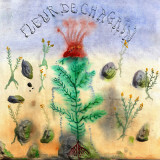
After releasing their debut album Red Forest in 2022, a stint at the Trans Musicales in Rennes and on legendary American radio station
KEXP confirmed the delicious identity of a corrosive sound that has hypnotised many. Sarakiniko is his name. It's both the name of a lunar-like beach in Greece and, without realising it, the translation of buckwheat, the emblematic plant of Brittany, where he comes from. Sarakiniko is a man, Yann Canevet (Venera 4, Future, Maria False), who writes, composes and records the music that comes from his dreams and his aesthetic vision of a magnificent world in disuse. Having first transported us into the deep forests of her heart-rending, sentimental music, Sarakiniko now unfurls her roots in an even more personal soundscape. Sophisticated, demanding music carved out of a tree trunk with chisels and chisels. A slightly grimy, slightly disturbing pop that he himself describes as "mud-pop", but which ultimately comes across as fearsomely massive shoegaze, with delightful echoes of Andrew Weatherall's productions. His second album, Dehors, takes us back to an inner child overwhelmed by his own élan vital. A naïve child who justly cries out upon his arrival on Earth. Tender, luminous and terribly fatalistic, this new stage in Sarakiniko's journey leaves us hanging in poetic and abrupt lyrics inherchildhoodlanguage,toresonateevenmoreprimal.Powerfulwords,headyrefrainstobesunguntiltheendoftime.
quête:forests
- A1: Manifest
- A2: Everything Was Set On Fire
- A3: Doba Extazy
- A4: Plague Remedy
- A5: Zmrzli
- A6: Odovzdat
- A7: Dialogicke Vyvolavania
- A8: Goddess Disappears In The Sky
- A9: Puhpowee
- A10: Artemisia
- A11: It Felt Like I Was Supposed To Follow It
- A12: Septat
- A13: Otvorit Zilu
- A14: Doba Odriekania
- A15: Devat Mien
- A16: Ked Si Pan, Zaplat Dzban
- A17: Pohar Viny
- A18: Crash It To Dust
- A19: The Catharsis Of Human Sorrow
- A20: Death Comes When You Stop Counting On It
- A21: A Goddess Comes From Within The Earth
- A22: Chytat Sa
- A23: 13Th Month
In 2020, electronic musician Nina Pixel was offered a track on a compilation album of songs from the Liptov region. What started as a rearrangement of a single folk song eventually grew in scope and size, eventually becoming a series of releases. Titled Ancestral Archaeology, the series counts two self-released EPs, an audiovisual show in co-operation with Adrián Kriška, and now, after two years, a double LP published by Weltschmerzen. In this definitive form of an album, Ancestral Archaeology reveals itself as a musical reimagination of traditional historical Slovak culture at large.
Nina Pixel averts the perils of lapsing into inauthentic fakelore by building her music with, rather than on, the ethnographic riches of Slovakia. With the eagerness of a genuine archeological prospector, Ancestral Archaeology invokes the always present but seldom perceived linchpins of folklore culture: the desperate clinging to the memory of pre-Christian paganism and witchcraft, songs with narratives of beautiful innate wyrdness that is utterly unfit for mass culture, and superstition as the most serious longing for the balance between sense and irrationality.
If we acknowledge the truism of folklore as the shared way of expression in rural society, the techno music on Ancestral Archeology proposes that, in the urban society of ours, this role is served by raves. The argument isn't as much declared as it's implied // in music and in the spoken-word lyrics that are rife with historical and contemporary sources. An 18th-century recipe by the writer and priest Juraj Fándly proposes snorting the grounded flowers of the medicinal weed Valerian as a way of curing bad vision. "It is a proven remedy!" we are repeatedly assured, and it's not hard imagining Fándly and his parishioners, strung out on Valerian, moving almost involuntarily to the rhythms of their era just as we can move to Ancestral Archeology.
Nina Pixel is a Slovak music artist based in Berlin. Lyrics are inspired by Slovak folklore traditions, songs and shared beliefs.
Manifestation tools: cello, overtone flute koncovka, fujara, gong, metal bowls, sheep bell, field recordings of Slovak forests, Andreas's tom and various drum machines.
Sechs Jahre nach "Legends Of The Shires" kehrt Progmeister Richard West an diese Gestade zurück, um uns die lang erwartete Fortsetzung zu erzählen mit seiner brandneuen Supergroup: Oblivion Protocol
Im besten Fall kann Prog ein sicherer Hafen vor dem Sturm da draußen sein, ein heilsamer Ruhepol, purer Eskapismus. Echte Musikalität, pure Emotionen und eine Vorliebe für überragende Melodien machen diese Musik zu einer Reise, einer Erfahrung, für die Platten und Kopfhörer überhaupt erst erfunden wurden. Ein ganz
besonderer Prog-Aficionado ist Richard West, seit über 30 Jahren renommierter Keyboard-Wizard und Songwriter der britischen Prog-Metal-Pioniere Threshold. Sechs Jahre nach deren epischem Meisterwerk "Legends Of The Shires" kehrt West an diese Gestade zurück, um uns die lang erwartete Fortsetzung zu erzählen. Nicht unter dem Namen Threshold, wohlgemerkt. Sondern mit einer brandneuen Supergroup. Prog-Fans weit und breit, jauchzet und jubilieret: Oblivion Protocol sind da. Und sie bringen uns "The Fall Of The Shires".
The Inter-Atlantic duo of George Btp Dan Piu & Roger K. Versey return to your shores to traverse more mystery, adventure, and musical journey with an all new double 12" album.
Passport - Wonderful Elixir. Named for its nutritious flavor and mixture, Wonderful Elixir is crafted for the deep frequency connoisseurs, explorers not constrained to genres, not afraid to vibe with the tides of life, but rather seek the deeper feeling that is true and Indigo Blue. The main ingredients are 10 visions that await inside the fine grooves of two 180 gram disks crafted to capture the moments in the best way; a seamless connection of Air, Land and Seaways that harbor elements of Jazz, Acid, Deep House and Street Beat. From the organic forests to the concrete jungles, From Zurich to St.Louis, your Wonderful Elixir is here. Featuring very special appearances from DJ Nata, Jesus Gonsev, and Grant.
Presented on 2×12" vinyl by the legendary No Acting Vibes label, and on CD and Digital by Deep Inspiration Show. Includes original acrylic paintings by Zara Versey.
Troekurovo Recordings is a production team made up of Toki Fuko, Vadim Basov and Evgeny Vorontsov and they have been hidden away deep in some enchanted Russian forests recording music. Now they are putting out the results on this superb double pack. This project started back in 2016 as a live experimental jam and is now an annual tradition made on loads of analogue gear on the banks of a canyon that was formed many years ago by a melting glacier. The locale provides inspiration - from the fresh country air to the meteor showers often visible overhead - for the music making which is strictly "no preparation, no pre-programming - hardware, friends and live improvisation only."
Gondwana Records announces 'Goodbyes' the debut album from Estonian pianist and composer, Hanakiv, a deeply beautiful, meditative piano album featuring special guest Alabaster dePlume
"This is an album about healing. It is about saying your goodbyes to everything that doesn't serve you anymore. Each of these songs has a little goodbye in it. So, these are very beautiful and necessary goodbyes".
Hanakiv is a young composer and musician from Estonia (now based in London) who creates meditative piano-based ambient music with elements from classical and electronic music. 'Goodbyes' is her debut recording and draws on influences as diverse as Tim Hecker, Björk "Vespertine", Kara-Lis Coverdale, Arvo Pärt, Erkki-Sven Tüür and Aphex Twin as well as her own cultural heritage. Music has an important part in Estonian culture, especially choir music and its traditions, but Hanakiv also draws on her love of nature – the beautiful Estonian seaside and forests - and on her time in Iceland. However, it was moving to London that gave her the freedom to make her own music: "London gave me the freedom and courage to really be who I am (as a person and musically)" and her heritage and her new home both offer inspiration to Goodbyes, as Hanakiv moves between these two opposite places, a bustling metropolis and a small country full of nature, drawing inspiration from both as she sculpts her own voice.
Hanakiv had an unconventional music education – she started studying music at a school for handbells when she was nine and was part of a handbell ensemble for eight years. Starting on piano at the same time she went on to study composition at high school, and later at the Estonian Academy of Music. Eventually switching to electroacoustic composition, she studied in Reykjavik, and did internships in Malmö, and again Reykjavik before moving to London. She grew up in a musical family and her grandmother was a piano teacher and choir conductor.
"I would always ask her to take me to her choir rehearsals. I remember sitting under the grand piano, listening to the choir and just being mesmerised by the sounds. She also teaches in a local music school in the south of Estonia with about ten pianos, and I'd spend a lot of time there as well. I believe this was the starting point for me to get to where I am now. The last two pieces on the album (Home II and Home I) are composed in this same music school, so it feels like a full circle.
An early influence was Regina Spektor "the first artist who made me really want to play piano" alongside dream pop and Sigur Rós' as well as Estonian contemporary composers such as Erkki-Sven Tüür and Arvo Pärt. Later her studies took her to Reykjavík: "There is this amazing record shop called 12 Tónar in Reykjavik where you can drink espressos and listen to all their vinyls. I spent quite a lot of time there. There is something about Icelandic music that really excited me (the mixture of contemporary electronic sounds with melancholy, emotionality). This is when I started getting more into electronic music, and experimenting outside of classical music". Following a year long break from studying and inspired by making an electroacoustic soundtrack for a friend's abstract video, she was inspired to complete a masters in electroacoustic composition, diving fully into the worlds of sound recording and mixing and focusing on surround sound and how to position and move sounds in space, eventually doing an internship with composer Kent Olofson in Malmö, who works with multi-speaker systems for theatre productions. "I learnt a lot from him and he introduced me to some of my favourite plugins I've used a lot on this album as well."
Hanakiv moved to London just as the pandemic hit and found herself trapped, in a big new city, without any network or family and so just concentrated on making music. "I stayed in my room with my basic equipment - keyboard, Korg minilogue, SM 58 and Rode nt1-a microphones, laptop and speakers. I was reading about mixing, and trying out different things and listening to a lot of music to get the sense of the mixes and production and finishing a commission piece for 5.1 multi speaker system at that time so I set up four speakers for quadrophonic surround sound in my room!". She also found her way back to piano - my instrument – and started practicing again, playing the pieces she used to play, but also just improvising, and this was the beginning of what would become her debut album, 'Goodbyes'.
"I started appreciating everything about music again (even melody!), and everything just came together naturally, and I arrived to a point where I finally found my voice, and I had something that I wanted to say and share. I composed "Meditation I" first and started with "Goodbye", and all the other pieces are derived from that. Without "Meditation I" there wouldn't be this album. If you listen closely, "Meditation I" starts where "Goodbye" ends; "Meditation II" is born from "Meditation I".
But it was meeting Fi Roberts, a sound engineer based at the legendary Strongrom Studios in Shoreditch, London in December 2020 that really brought the album into focus. The pair bonded over an interest in prepared piano and a similar approach to production ideas (a balance of not overdoing it, and letting the songs speak for themselves, but being open to explore) and Fi became a friend but also a confidant and eventually co-producer
"Fi has a big impact on this record but I don't know how to really explain that properly. Of course, this album is sonically stunning thanks to her amazing mixes and recording skills, but she also believed in this music so much and it created something very special - that's difficult to measure with words. She just works with heart, and I really appreciate that"
This then is 'Goodbyes', the first offering from a major new voice, who offers us a meditative work full of space and tranquillity but also life and friendship and meaning. And we are very proud to welcome her to the Gondwana family.
- A1: Forest Replicant
- A2: Deer Jumpscare
- A3: Theme's In Ruth's Mind
- A4: First Montage
- A5: Isn't That Enough
- A6: The Cave & Second Montage
- A7: Proposal At The Cliff Face
- B1: Harry's Return
- B2: Goodbye Ruth (Do I Love You?) (Do I Love You?)
- B3: Beach
- B4: Shark
- B5: Endcave
- B6: Ruth Smash
- B7: Dread Credits
Oliver Coates’ dense and unsettling score to
‘Significant Other’ is now available on vinyl.
The score comes pressed on blue vinyl, housed in
a spined sleeve with download card and doublesided printed insert.
‘Significant Other’ follows the sinister events
plague a young couple when they take a
backpacking trip through the forests of the Pacific
Northwest.
Oliver Coates is a cellist, composer and music
producer known for his work with Radiohead, Mica
Levi and more.
Nestled within the fields and forests surrounding Oslo you'll find Raaja Bones. There, in Raaja's secluded studio surrounded by vintage synthesisers, modular equipment, samplers and drum machines, is where he makes music that owes as much to his personal tastes as it does his identity and upbringing. 'Black Dreams', released 2nd July on Snorkel Records, is where this venn diagram of influences overlap, from the shimmer of e-funk and the effortless grooves of soul to the unashamed, heartfelt honesty of 80s pop.
Hollie Kenniff's second LP for Western Vinyl, We All Have Places That We Miss, is a gallery of cloudlike synths, seraphic strings, and humming guitars, all coaxed into cohesion by Hollie's own wordless singing. The album's 2021 precursor, The Quiet Drift, landed on Bandcamp's Best Ambient list alongside the description "Drawing on the deep tones of drone, dream pop harmonies, and new age's bright tranquility, Kenniff evokes the forests, lakes and rivers of her past and present surroundings with a zen patience." Here on Places_ she strides even further into reminiscence, seeking and commemorating the fondly tragic ache of half-remembered locales lost to time: A grandparent's dim living room from an ambiguous decade; a lonely clearing beside a trail we can't remember if we walked or just dreamt; the calming light of a movie that aired years before we were born though our feelings insist we were there with the characters. We All Have Places That We Miss transmutes such glimmers into a palpable sonic kingdom that can be revisited at will, recalling the pedal-board ambience of Windy & Carl, Adam Wiltzie, and Liz Harris.
- 1: La Nouille … L'air
- 2: Complainte De La Bete
- 3: Mordue
- 4: Les Vaches Musiciennes
- 5: La Fille Brule
- 6: Un Bezoar Dans Le Ventre
- 7: Failli Tomber
- 8: La Vie Secršte Des Doryphores
- 9: Boue Qui Roule
- 10: Vengeance Tardive
- 11: Ingurgiter Ton Image
- 12: Para Lo Lop
- 13: La Fontaine Noire
- 14: La Violeta
- 15: Je Suis Sur L'autoroute
- 16: Aucel Perdut
- 17: Chant Pour Dissuader L'etre Aim De Sortir La Nuit
Pauline Marx, formerly of the fantastic duo La Fureur de Vouivre, seems like a being from another time and place; namely, an escaped marauder lurking in the forests of a Bruegel painting and integrating the surreal flora and fauna of a Boschian creation into the scenery and lore of deep Brittany. Her invented mythology is loaded with murky rituals and contorted mantras, backed by the surprising sounds and textures of terrains so earthly and so unreal.
The Devil at the Crossroads
Where do you think you come from? Where do you think you're going? Lasciate ogni speranza, voi ch’entrate: you, with the noodle to the four winds, who pass the threshold of this disc, you better leave all hope there, and glide in the poisonous footstep of the devil your guide.
Where do you think you come from? The mountain is no longer just the mountain; after your passage, it will no longer even be a mountain. Like the whole landscape, it will have been eaten, sauced by invisible leeches. Your nostalgia for the ground and your thirst to find the source will have only discovered a forest of vain words and foul water. Where do you think you're going? At the crossroads, the world is consumed in the previous future. Only the devil will know how to make you overcome the disgust of traditions, and only the love for the devil will give you enough vim to reach your goal: a village, perhaps, but which belongs to no one, a haven to your excessiveness .
The dark tradition to which this game of ternary trampling belongs, like the rhythm of a heart in tune with the inverted world, has no country and no assigned time. Rather a topology of Eve awakened after a thousand-year sleep, an idiosyncratic and possessed reading of our common humus, made up of stories composted in the limbo of the past, of songs captured in extremis vitae and rebus in the privatized antechambers of death.
What does she tell us about? Of our automobile and in love roamings, of the porosity of the membranes that separate beings and things, of the constant inversion of signs. The seventeen stages of this short journey, where intertwine the throbbing of objects, blown horns and rubbed horsehair, form the map of a country never to be found, ours, where only the voice of an old child and the disgusting devil's poisonous charm can guide us.
Meg Baird’s songs are rarely made up of tidy stories. In fact, for Meg, mystery itself is often the
medium. With ‘Furling’, Meg’s fourth album under her own name, she explores the breadth of
her musical fascinations and the environments around them - the edges of memory,
daydreams spanning years, loose ends, loss, divergent paths, and secret conversations under
stars. ‘Furling’ moves through these varied spaces with the slippery, misty cohesiveness of a
dream - guided by an ageless, stirring voice that remains singular and unmistakable.
Since co-founding the beguiling and beautiful Espers in the mid-aughts amid Philadelphia’s
fertile underground music community, Meg’s solo recordings have constituted just a fraction of
her work.
Her first solo LP, the disarmingly out-of-time ‘Dear Companion’ (2007), saw her carve a quiet,
sunlit space away from the flickering swirl of Espers. Since her last solo releases, ‘Seasons on
Earth’ (2011) and ‘Don’t Weigh Down the Light’ (2015), Meg has lent thunderous drumming,
lead vocal, and poetry to Heron Oblivion (Sub Pop) on an album that garnered praise from the
New York Times and made Mojo’s Top Ten Albums Of 2016 list. She collaborated with harpist
Mary Lattimore on the mesmerizingly hazy ‘Ghost Forests’ (2018). She’s played drums with
Philadelphia scuzz-punks Watery Love (In The Red, Richie Records) and explored her deep
familial folk roots in the Baird Sisters (Grapefruit Records). She also contributed her vocal
arrangements to albums from Sharon Van Etten, Kurt Vile, Will Oldham and Steve Gunn, and
toured with Angel Olson, Dinosaur Jr., Bill Callahan, Thurston Moore and Bert Jansch, among
others.
Yet ‘Furling’ is the album that most irreverently explores the span of her work and musical
touchstones. It showcases her natural tether to 1960s English folk traditions. But it also reveals
her deep love for soul balladry, the solitary musings of Flying Saucer Attack and Neil Young
shackled to his piano deep in the foggy pre-dawn, dubby Bristol atmospherics, the melancholy
memory collage of DJ Shadow’s ‘Endtroducing’, and the delicious, Saturday night promise of
St. Etienne.
‘Furling’ was primarily recorded at Louder Studios by Tim Green (Bikini Kill, Nation of Ulysses,
Melvins, Wooden Shjips). Additional piano and vocal recording were captured at Panoramic
Studios in Stinson Beach, CA with Jason Quever (Papercuts). It was mastered in Brooklyn by
Heba Kadry, who mixed Bjork’s ‘Utopia’ and mastered albums for Slowdive, Cass McCombs
and Beach House.
For all its adornments, ‘Furling’ remains deeply intimate. The entire album was performed by
Meg and her long-time collaborator, partner, and Heron Oblivion bandmate Charlie Saufley.
While her prior solo work hinted at more expansive horizons, ‘Furling’ explores the idea of Meg
Baird as a band much more freely. Venturing beyond the musical confines of fingerstyle guitar,
she plays drums, mellotron, organs, synths, and vibraphone over her piano and guitar
foundations. Her distinctive, simultaneously elegiac and uplifting vocals, meanwhile, connect
surreal dream montages, graft sunshine sonics to swooning mediations on romantic solidarity
in trying times, and weave odes to the simple gestures of friendship - and the loss of family and
friends.
This rich sound world makes the songs a varied bunch: ‘Twelve Saints’ mates Pacific sunset
ambience and Pink Floyd pastoral to a meditation on mortality and escape. The infectious and
kinetic ‘Will You Follow Me Home’ contemplates hope and longing through the looking glass of
a Jimmy Miller-era-Stones strut. And in the closing piece, ‘Wreathing Days’, language
disintegrates over tone clusters that feel somewhere between falling and flying.
‘Wreathing Days’ also reveals much about Meg’s mastery of contrast - situating the dear and
delicate adjacent to chaos. And while it’s true that some songs on ‘Furling’ grapple with
humanity’s existential unknowns in stark terms, they primarily revel in the mysteries that hide in
nature and humanity at their most ordinary. ‘Furling’ lives in the notion that whole universes of
experience, enlightenment, elation and ecstasy can bloom in these corners.
Espen Friberg’s solo album debut. Sun Soon is Espen Friberg´s solo album debut, consisting of eleven compositions made up of synthesizer and field recordings. The album is formed as a collage, with compositions patched on a Serge modular synth and field recordings. The patches portray the mood and wandering in mountains and forests – while at the same time meditating on the area of the Norwegian valley Hallingdal´s local history. The collage technique is something Friberg uses in both his musical and visual art. The album is meditative and exploratory, and at the same time playful and immediate. Trucks, trash cans, flowing streams, lemon soda, horses and wandering mountains, find its place between slow melodies, scratching, sinus tones and bass lines. Dissonances and harmonies come together in gliding transitions and abrupt stops, while an electronic willow flute sings and the sun is rising. The recording is done at Leveld Kunstnartun in Ål in Hallingdal, later mixed and produced in collaboration with Jenny Berger Myhre. The project captures the ambiance in the valley around Leveld, through Espen´s experiences in nature, but also from the paintings of Marianne Røthe Arnesen and Gøsta Munsterhjelm. Espen Friberg is known as an artist, designer, illustrator, cartoon creator and musician, and has received numerous awards and stipends for his work. In the beginning of 2000 he was a part of establishing the design studio Yokoland, but later started his own studio. In addition to his visual practice he has built a sound studio consisting of complex synthesizer systems and a variety of obscure electronical instruments and effect processors. He has been a central person in experimental and electronic music in Norway. He started and runs the record company Take It Easy Policy in collaboration with Emil Høgset, and has been a curator for the concert series Rett Ned. Since 2005 he has participated in a long line of sample albums under different artist names, before releasing his first EP under his own name in 2015. After this he has released six different albums with Øivind Olsen, André Borgen and Marianne Røthe Arnesen. Friberg has been active on the concert stage, both as a solo artist and in different collaborations. 1.Lazy cobweb 2.Wandering mountain 3.Gøsta Munsterhjelm 4.Foggy glow 5.Pasture patch 6.Motor sunup 7.Thirteen paintings 8.Marianne Røthe Arnesen 9.Sinuous river (part one) 10.Sinuous river (part two) 11.Orange moss bridge
- A1: Recording A Tunnel (The Horns Play Underneath The Canal) (The Horns Play Underneath The Canal)
- A2: Les Lumieres (Part 1)
- A3: Les Lumieres (Part 2)
- A4: Throw It On A Fire
- A5: Recording A Tunnel (The Horns Play Underneath The Canal) Continued (The Horns Play Underneath The Canal)
- A6: The Upwards March
- A7: The Bells Play The Band
- B1: Recording A Tape (Typewriter Duet) (Typewriter Duet)
- B2: Nuevo
- B3: Salvatore Amato
- B4: Recording A Tunnel (The Invisible Bells) (The Invisible Bells)
Black Vinyl[17,44 €]
Clear Vinyl
Erased Tapes are immensely proud to announce the reissue of the debut album Recording a Tape the Colour of the Light by Bell Orchestre. To honour the album"s original recordings the album is also seeing its first vinyl repress since it was released in 2005. Originally formed in 1999 whilst studying at university, the first music Bell Orchestre made was live scores for contemporary dance performances. A few years later, the studio sessions for Recording A Tape.. took place simultaneously in the same studio as when Arcade Fire were recording their eponymous debut album Funeral. The two Montreal-based bands took turns to record their albums but due to the growing interest in Arcade Fire, Bell Orchestre was put on hold as band members Parry and Sarah Neufeld quickly became occupied with Arcade Fire"s busy touring schedule. "The Bell Orchestre album was almost done, but it kind of sat there. We were just sitting on this album that we were really proud of, but we didn"t have anyone to pay attention to it" Parry told Pitchfork in 2005. The album was released to critical acclaim and has since received cult status among fans. Bell Orchestre is a collaborative instrumental group based in Montreal. Its six members come from wildly divergent musical backgrounds, and the unlikely chemistry that results from their collaboration is the very thing that sustains their connection. It"s as if the group as a whole has tapped into a very particular, very distinct energy: like that of an approaching storm. In many ways, Bell Orchestre is the sum of not only its parts, but the sum of its influences and inspirations. Among those influences can be listed such diverse artists as Lee "Scratch" Perry, Arvo Pärt, Charles Mingus, and Talk Talk. But ultimately they work together to create something that none of them has quite heard before. Bell Orchestre has been known to retreat into the woods to make and write music: from a residency at the Banff Centre for the Arts, to the forests of Quebec and Vermont, and back to their hometown of Montreal. The specifics of time and place, the elemental forces at work outside, and those forces that exist inside, all come into play within Bell Orchestre"s musical process. This particular music could be made by no one else at no other time in history. The experience of listening to Bell Orchestre, whether live or recorded, is almost that of experiencing a form of synaesthesia: the result is a collage-like construction of not just sound, but visual elements as well. From a herd of elephants to that approaching storm on the horizon, from a quiet forest in the country to ice forming on a city street, from watching vapour trails disappear in the sky to watching the changing light of dusk through a window. The result then is not so much cinematic as it is evocative: Bell Orchestre have not just written the music to the film - they have created an invisible film that only comes to life in the listening
- A1: Recording A Tunnel (The Horns Play Underneath The Canal) (The Horns Play Underneath The Canal)
- A2: Les Lumieres (Part 1)
- A3: Les Lumieres (Part 2)
- A4: Throw It On A Fire
- A5: Recording A Tunnel (The Horns Play Underneath The Canal) Continued (The Horns Play Underneath The Canal)
- A6: The Upwards March
- A7: The Bells Play The Band
- B1: Recording A Tape (Typewriter Duet) (Typewriter Duet)
- B2: Nuevo
- B3: Salvatore Amato
- B4: Recording A Tunnel (The Invisible Bells) (The Invisible Bells)
Clear Vinyl[24,33 €]
Black Vinyl
Erased Tapes are immensely proud to announce the reissue of the debut album Recording a Tape the Colour of the Light by Bell Orchestre. To honour the album"s original recordings the album is also seeing its first vinyl repress since it was released in 2005. Originally formed in 1999 whilst studying at university, the first music Bell Orchestre made was live scores for contemporary dance performances. A few years later, the studio sessions for Recording A Tape.. took place simultaneously in the same studio as when Arcade Fire were recording their eponymous debut album Funeral. The two Montreal-based bands took turns to record their albums but due to the growing interest in Arcade Fire, Bell Orchestre was put on hold as band members Parry and Sarah Neufeld quickly became occupied with Arcade Fire"s busy touring schedule. "The Bell Orchestre album was almost done, but it kind of sat there. We were just sitting on this album that we were really proud of, but we didn"t have anyone to pay attention to it" Parry told Pitchfork in 2005. The album was released to critical acclaim and has since received cult status among fans. Bell Orchestre is a collaborative instrumental group based in Montreal. Its six members come from wildly divergent musical backgrounds, and the unlikely chemistry that results from their collaboration is the very thing that sustains their connection. It"s as if the group as a whole has tapped into a very particular, very distinct energy: like that of an approaching storm. In many ways, Bell Orchestre is the sum of not only its parts, but the sum of its influences and inspirations. Among those influences can be listed such diverse artists as Lee "Scratch" Perry, Arvo Pärt, Charles Mingus, and Talk Talk. But ultimately they work together to create something that none of them has quite heard before. Bell Orchestre has been known to retreat into the woods to make and write music: from a residency at the Banff Centre for the Arts, to the forests of Quebec and Vermont, and back to their hometown of Montreal. The specifics of time and place, the elemental forces at work outside, and those forces that exist inside, all come into play within Bell Orchestre"s musical process. This particular music could be made by no one else at no other time in history. The experience of listening to Bell Orchestre, whether live or recorded, is almost that of experiencing a form of synaesthesia: the result is a collage-like construction of not just sound, but visual elements as well. From a herd of elephants to that approaching storm on the horizon, from a quiet forest in the country to ice forming on a city street, from watching vapour trails disappear in the sky to watching the changing light of dusk through a window. The result then is not so much cinematic as it is evocative: Bell Orchestre have not just written the music to the film - they have created an invisible film that only comes to life in the listening
- A1: Descarga Royal - Los Royal´s De Pucallpa 03 30
- A2: La Cervecita - Sonido Verde De Moyobamba 02 09
- A3: Selva Virgen - Los Zheros 02 40
- A4: Moyobambina - Grupo Siglo Xx De Rioja 02 43
- B1: Humo En La Selva - Los Invasores De Progreso 02 58
- B2: La Hamaca - Los Cisnes 02 54
- B3: Cumbion Universal - Fresa Juvenil De Tarapoto 03 35
- B4: La Trochita - Los Rangers De Tingo Maria 02 40
- C1: La Bola Buche - Los Invasores De Progreso 03 21
- C2: Bailando En El Infinito - Ranil Y Su Conjunto Tropical 02 56
- C3: Safari En La Selva - Los Cisnes 02 52
- C4: Baila Bonito - Ranil Y Su Conjunto Tropical 02 55
- C5: Ali Baba - Los Zheros 02 43
- D1: La Palmerita - Fresa Juvenil De Tarapoto 02 57
- D2: Recordando A Aguaytia - Sonido Verde De Moyobamba 02 18
- D3: El Pasito De Miriam - Grupo Siglo Xx De Rioja 02 51
- D4: Rio Mar - Los Cisnes 02 34
- D5: La Uñita - Los Zheros 02 22
Less than a hundred miles inland from the capital city of Lima lies the great Peruvian jungle, an untamed land of impenetrable forests and endless winding rivers. In its isolated cities, cut off from the fashions of the capital, a unique style of music began to develop, inspired equally by the sounds of the surrounding forests, the roll of the mighty Amazon and Ucayali Rivers, and the rhythms of cumbia picked up from distant stations on transistor radios. With the arrival of electricity, a new generation of young musicians started plugging in their guitars and trading in their accordions for synthesizers: Amazonian cumbia was born.
Powered by fast-paced timbale rhythms, driven by spidery, treble-damaged guitar lines, and drenched in bright splashes of organ, Amazonian cumbia was like a hyperactive distant cousin of surf music crossed with an all-night dance party in the heart of the forest. While many of the genre’s greatest tracks were instrumental, and others were simple celebrations of life in the jungle, the goal of every song was to keep the party going.
Radio stations in Lima remained unaware of the new electric sounds emanating from the jungle, but a handful of pioneering
record producers ventured over the mountain passes to the cities of Tarapoto, Moyobamba, Pucallpa – even Iquitos, a city
reachable only by boat or plane – and lured dozens of bands to the recording studios of the capital to lay down their best
tracks. Although many became local hits, few were ever heard outside the Amazonian region … until now.
With eighteen tracks from some of the greatest names in Amazonian cumbia, Perú Selvatico is both the improbable soundtrack
to a beach party on a banks of the Amazon and a psychedelic safari into the sylvan mysteries of the Peruvian jungle.
(GF Col. LP + DL
Formed in 1980 by guitar prodigy Leonardo Vela Rodriguez, Sonido Verde de Moyobamba created some of the hardest, craziest Cumbia to emerge from the Peruvian jungle. With distorted, surf-addled guitar facing off against lysergic organ and hyperactive tropical rhythms, Sonido Verde conjured the organic sound of the dense forests surrounding their hometown while riding their dance-party grooves to dizzying psychedelic peaks.
Compiled by Analog Africa, Sonido Verde de Moyobamba presents eight ultra-rare tracks of guitar and organ madness drawn from the band’s five albums recorded for Discos Universal between 1981 and 1987. Pressed on Sun Yellow colored vinyl, housed in a screen-printed jacket and strictly limited to 2000 copies, Sonido Verde is a definitive trip into the heart of the jungle.
Limited Edition 180g LP - Comes with a Silk-Screen printed cover and a Sun Yellow colored vinyl
Download for LP from Bandcamp also includes unlimited streaming of *Sonido Verde de Moyobamba* via the free Bandcamp app along with high-quality download in MP3, FLAC and more Analog
- A1: La Danza Delle Foglie (The Dance Of Leaves)
- A2: Flauti (Flautes)
- A3: Osso D’aquila Per La Danza Degli Spettri (Eagle Bone For The Ghost Dance)
- A4: Rombi Volanti (Flying Rhombs)
- A5: Il Corno, La Tartaruga, L’arco E La Selce (The Horn, The Tortoise, The Bow & The Flintstone)
- A6: Le Pietre Sonore Della Caverna (Sonorous Stones In The Cave)
- B1: Le Pietre Del Fiume (River Stones)
- B2: I Semi Vegetali Voci Della Jungla (Vegetable Seeds: Jungle Voices)
- B3: Lo Spirito Della Palude (The Spirit Of The Marshed)
- B4: Il Linguaggio Del Mare (Sea Language)
- B5: Reperti Amazzonici (Amazonian Finds)
Art Of Primitive Sound is a sensational journey to the origin of Music. In his crucial research chapter on the Paleolithic, Walter Maioli between 1986 and 1991 investigates the soundscape of different geographical, climatic and botanical environments, in which the mystery of the ancient human-nature relationship resides. What emerges is an expanded and unprecedented Paleorganology, with a range of acoustic and natural instruments from all over the World. Rubbing of fossils, animal artefacts, plant elements of all sorts, everything becomes sound and each object opens up forms of imaginary communication, psychic effect and unexplored languages. Whistles, flutes, leaf and shell rattles, rhombuses, horns, bone pipes, slate slabs, bamboo arches, stones, vertebrae, seeds, stalagtites etc...how great can be the Natural Orchestra inherent in the spirit of forests, rivers, caves, seas, swamps or Amazon jungles? Thanks to an interdisciplinary partnership (Anthropology, Archaeology, Botany, Ethnomusicology) of collaborating friends, Maioli directs an Opera of universal character inspired by the archaic essence of sound and infrasonic dimension.
Cassette[20,97 €]
Self-recorded indie experimentalist from the Pacific Northwest. For fans of Grouper, The Microphones, Unwound’s Leaves Turn Inside You. Features Madeline Johnston (Midwife), Alex Kent (Sprain), Lula Asplund, a chamber ensemble and more. In 2019, Drowse’s Kyle Bates set out to produce a self-recorded new album. Marked by moving across state lines, long-distance relationships, and deaths in the family, the following years proved to be metamorphic. Now, three years later, he’s emerged with Wane Into It, continuing a distinctly Pacific Northwestern tradition of self-recording indie experimentalists (Grouper, The Microphones, Unwound’s Leaves Turn Inside You). One of the most impactful moments came during the looming passing of a family member. With death expected, the choice was made to conduct a bizarre “living-wake” gathering—with the soon-to-be1deceased in attendance. Shortly after, Bates found himself disturbed, preoccupied with the abstraction of memory. The experience led him to reassess the tool one uses to curate our selective memories: the internet. The internet, which creeped into even more aspects of life during the pandemic, serves as our self-made digital link to the past. Its uncaring presence layered over humbling thoughts of death and his own childhood memories of the Oregon Coast as he worked on Wane Into It; life’s hyperreal texture sank into the recordings as he felt his body age and wane. Big sounds were captured in bedrooms, hallways, practice spaces, forests, and on highways throughout West Coast vibraphones chime over black metal guitars, a mellotron drones under degraded samples, violins splinter against granular field recordings. In the process of documenting these aural moments Bates completed an MFA at Mills College, coloring the album with shades of avant electronic and minimalist composition (Pauline Oliveros, Terry Riley, Maryanne Amacher, Sarah Davachi etc…). To realize this scope Drowse collaborated with Madeline Johnston (Midwife), Alex Kent (Sprain), Lula Asplund, a chamber ensemble and more. Bates’s songwriting and production have never been more lucid; sounds flicker as he sings with fragile intensity. The record, Drowse’s third for The Flenser, impressionistically distills loss, distance, mystery, prescription drugs, the preservation of memory via recording, and ambient anxiety through its titular act: to Wane Into It, to disappear awaiting the next moon phase, water returning to sea before reemerging as a wave. Track Listing: 1. Untrue In Headphones 2. Mystery Pt. 2 3. (Ashes Over The Pacific Northwest) 4. Wane Into It 5. Telepresence 6. Gabapentin 7. Blue Light Glow 8. Three Faces (Cyanoacrylate) 9. Ten Year Hangover / Deconstructed Mystery
Black Vinyl LP[34,41 €]
Self-recorded indie experimentalist from the Pacific Northwest. For fans of Grouper, The Microphones, Unwound’s Leaves Turn Inside You. Features Madeline Johnston (Midwife), Alex Kent (Sprain), Lula Asplund, a chamber ensemble and more. In 2019, Drowse’s Kyle Bates set out to produce a self-recorded new album. Marked by moving across state lines, long-distance relationships, and deaths in the family, the following years proved to be metamorphic. Now, three years later, he’s emerged with Wane Into It, continuing a distinctly Pacific Northwestern tradition of self-recording indie experimentalists (Grouper, The Microphones, Unwound’s Leaves Turn Inside You). One of the most impactful moments came during the looming passing of a family member. With death expected, the choice was made to conduct a bizarre “living-wake” gathering—with the soon-to-be1deceased in attendance. Shortly after, Bates found himself disturbed, preoccupied with the abstraction of memory. The experience led him to reassess the tool one uses to curate our selective memories: the internet. The internet, which creeped into even more aspects of life during the pandemic, serves as our self-made digital link to the past. Its uncaring presence layered over humbling thoughts of death and his own childhood memories of the Oregon Coast as he worked on Wane Into It; life’s hyperreal texture sank into the recordings as he felt his body age and wane. Big sounds were captured in bedrooms, hallways, practice spaces, forests, and on highways throughout West Coast vibraphones chime over black metal guitars, a mellotron drones under degraded samples, violins splinter against granular field recordings. In the process of documenting these aural moments Bates completed an MFA at Mills College, coloring the album with shades of avant electronic and minimalist composition (Pauline Oliveros, Terry Riley, Maryanne Amacher, Sarah Davachi etc…). To realize this scope Drowse collaborated with Madeline Johnston (Midwife), Alex Kent (Sprain), Lula Asplund, a chamber ensemble and more. Bates’s songwriting and production have never been more lucid; sounds flicker as he sings with fragile intensity. The record, Drowse’s third for The Flenser, impressionistically distills loss, distance, mystery, prescription drugs, the preservation of memory via recording, and ambient anxiety through its titular act: to Wane Into It, to disappear awaiting the next moon phase, water returning to sea before reemerging as a wave. Track Listing: 1. Untrue In Headphones 2. Mystery Pt. 2 3. (Ashes Over The Pacific Northwest) 4. Wane Into It 5. Telepresence 6. Gabapentin 7. Blue Light Glow 8. Three Faces (Cyanoacrylate) 9. Ten Year Hangover / Deconstructed Mystery
The ECM New Series debut of Evgueni Galperin is one of the most
strikingly original and evocative albums of the year
A composer of Russian and Ukrainian heritage, currently based in France,
Galperin is working with sound, texture and dynamics in new and powerfully
expressive ways. As he explains, the sound world of Theory of Becoming
represents an "augmented reality of acoustic instruments, created from
recordings made with real and virtual instruments. The numerous
transformations the instruments undergo allow me to capture their acoustic
nature while also adding techniques and colours impossible to produce in
reality..."
Galperin's compositions address wide ranging subjects: from the resilience of
hope in the face of destruction to meditations on the journey of the soul, as well
as travels through space and through the magical forests of Max Ernst's
paintings.
Theory of Becoming was recorded and mixed 2020-21 in Paris, at Studio EPG and
Studios de la Seine and was produced by Manfred Eicher.
Evgueni Galperine: composition
Maria Vasyukova: voice
Sergei Nakariakov: trumpet
Sebastien Hurtaud: cello
Ethan James Startzman is a synesthete with chromesthesia, meaning his brain converts sounds to colours and shapes, and this album is an attempt into the use of sounds to “paint" a picture. Shamanic Verse is an audio journey through dark forests, cold lonely mountains, and bustling cities using Eurorack modular synthesis and the meditative technique of following the sounds to their next evolutionary destination to create a film score-like atmosphere. Ethan began as a dancer, working his way up to professional ballet dancer and later found music after an injury ended his career. Originally a bassist, who has played in every style of music from country to rock to salsa, he also works as a film composer in his native New York City. His film work is primarily orchestral and experimental electronic. Shamanic Verse will be released on 4th November, via digital platforms and limited edition pressed vinyl.
WRWTFWW Records is so happy to announce Poly-Time Soundscapes / Forest Of The Shrine, a brand new release by Japanese producer Taro Nohara (Yakenohara). 8 tracks of pure environmental ambient bliss available on LP housed in a heavy 350gsm sleeve with an artwork from the artist himself.
Based in Tokyo, Taro Nohara is a producer, beatmaker, DJ, and music activist who made a mark with his electronic / ambient unit Unknown Me ( (of Not Not Fun Records fame). His new solo project, Poly-Time Soundscapes / Forest Of The Shrine, is a unique and modern take on Japanese environmental music, a free floating re-interpretation of the sub-genre made famous by Midori Takada, Hiroshi Yoshimura, or Satoshi Ashikawa (and more!) fused with subtle nuances of various origins: downtempo, hip hop, sound design, chill-out, experimental.
Conceived as a two-part adventure of contemplative peace, Taro Nohara’s organic soundscape takes you on a mind-soothing walk through time (or memories) and the beautiful mysteries of luscious forests - don’t resist, let yourself go, explore!
OVERVIEW: After a five-year hiatus encompassing the birth of a son, a third coast to west coast and back to the third coast move, and an ongoing global pandemic – Chris Bathgate returns with ‘The Significance of Peaches’.
On this, his 6th full-length album, the NPR & BBC-lauded artist is found ruminating on time spent living in the National Forests of Michigan while homeless, his emergence into fatherhood, and yes, the significance a certain stone fruit has played throughout his life.
Sonically, ‘The Significance of Peaches’ leans heavily on the structural support of parlor organ and Bathgate’s signature multi-tracked percussion – surprisingly sparse use of guitar and strings sheathed in the middle - his haunted vocals perched atop it all.
The first release on the brand new DigBig Records comes from prolific Swedish composer, producer and DJ Joey FDH. In Level 7, Joey steps away from the harder electro beats she's known for and goes inward to explore the depths and corners of her own shadow through four slow burners. The EP rides a soft yet sinister groove with two acidic workouts on the A side - the beautifully atmospheric Acid Girl and the cosmic-dreamy eponymous Level 7. B side morphs effortlessly onto heavier but just as funky vibes with Shadow Play that slaps in the face with infectious breaks and the hypnotically thumping Shift Shaper. Spending over a decade in Berlin honing her signature dark sound, Joey FDH has recently returned to her homeland to find new inspiration in the forests and mo
URFERD signifies the beginning of a new and additional musical chapter for its founder and sole member, Daniel Beckman (TWILIGHT FORCE, AGES), and brings a refreshing new perspective to the genre, challenging the boundaries of dark atmospheric folk music.
The first album "RESAN" is a musical odyssey in both a literal and figurative sense. The album takes the listener on a journey through dark and olden Nordic forests; where strife and hardships follows in our steps, yet where the beauty and vastness of the solemn Nordic landscape persists and permeates. From the album opening's depiction of a serene morning's dawn to the closing track's respite of a hearth at nightfall, RESAN traverses a multitude of captivating musical landscapes and themes throughout its eight songs.
‘Hive Mind Records are here to help you through the winter months with this generous helping of Wet Tuna with their signature deeply fried rural psychedelia.
Matt Valentine (MV) and Pat Gubler (PG Six) have been jamming together since the mid '90s, floating around in the US psych-folk scene, playing together in Tower Recordings and separately with influential underground crews Woods, The Golden Road, Garcia Peoples and The Weeping Bong Band. Both MV and PG Six have been prolific with their solo work and over the years they've recorded for labels such as Ecstatic Peace, Drag City, Woodsist, 3 Lobed, and Crash Symbols and we are very happy to be joining such esteemed company.
On these recordings, made during the first months of the COVID lockdowns in the forests of the Vermont wilderness, MV and PG Six handle the guitars and synths but they're joined by fellow forest freaks S. Freyer Esq, Jim Bliss, Coot Moon and Carson 'Smokehound' Arnold on bass and drums. Brought to you in their patented mind-expanding SPECTRASOUND, Eau'd To A Fake Bookie Volumes 1 & 2 delivers an irresistible gumbo of deep, cosmic psychedelia, primitive drum-machine grooves and woozy country-funk jams. These 6 songs are cover versions of artists as diverse as The Blackbyrds, Michael Hurley and Jimmy Cliff, but stretched out over 4 sides, the album is entirely Wet Tuna - loose, free-flowing and lots of fun!’
Bringing together therapeutic frequencies, forest bathing
(shinrin-yoku) and binaural sound, Hinako Omori's ‘a journey...’
combines inner healing and natural landscapes into in an
immersive cartography of the mind in ambient electronics. The
album progresses not track by track but as a continuous
journey, a stream of consciousness tracing hills and valleys with
the warmth of analogue synthesis and Omori’s voice always
close at hand. Omori detuned oscillators to create binaural
beats, syncing to the Hz of our brainwaves so that listeners
might further find themselves calmed by and immersed in these
soundscapes
‘a journey...’ was recorded at Omori’s home studio and Real
World Studios, when Omori was an invited to perform at the
immersive online festival WOMAD At Home. Spatial 3D
recordings are woven throughout the album, and situate each
track in different environments, from waterways to forests in and
around the Mendip Hills.
It is Hinako’s work in sound engineering that provides the
bedrock of skills that manifest her vision for ‘a journey...’,
articulating a whole world in binaural field recordings, analogue
synthesisers, and augmented vocals.
The album sits within a rich lineage of electronic musicians who
have looked to music for its healing properties, from
Venezuelan musician Miguel Noya to Pauline Anna Strom’s
ambient soundscapes; Pauline Oliveros’ deep listening
meditations and the augmented field recordings of Irv Teibel’s
‘Environments’ series.
Mastered and cut by Matt Colton at Metropolis.
LP pressed on white vinyl.
The T Funk Collective are a synth loving duo hailing out of Manchester UK; DJ T2Funk and Atomphunk. They started out in the mid-nineties DJing playing quality house music at the CLEAR parties in warehouses, bars, clubs, forests and beaches in and around Stockport, Manchester and Wales. DJ T2Funk is a multi-genre DJ who is rostered on Manchester’s Selectahs DJ Agency and the owner of Regulate Recordings. Atomphunk has deep house roots and productions on labels such as Toko Records, 3AM Recordings, Urban Torque Records and Deepfunk Records (USA).
The fuses fuses hip hop, funk, party breaks and plenty more into a pair of authentic old school sounds.
Side A: ‘Do You Wanna Party’ blends funky guitars, snapping drums, squelching basslines, impressive horns. Do You Wanna Party once again see’s turntablist DJ Stet and DJ Deviant cutting up the vocals to culminate in a melting pot of a synth based melodic flavour.
Side B: ‘Party Time’ is synth fused party vibe track that builds with driving basslines and a vocal hook into a latin synth section of grooving layered keys.
So here it is the second release from Regulate Recordings and the T Funk Collective. What you say is important, so offer us your verdict.
repress
An underwater adventure by young Parisian Shelter. Where previous releases have seen the synth-obsessed Frenchman take his inspiration from Caribbean rhythms or Balearic attitudes, this marine missive sees Shelter turn to the lavish world of the library,creating his an alternate score to Jean Faurez' 1960 documentary short.
More submersible than snorkel, our journey begins in the very dark of the deep, mystical harp trills echoing through the inky blackness, picking up the bioluminescent shimmer of an Abraliopsis Squid. Gradually we make our way into the light, cruising past shoals of silver scales and underwater forests. Immersion' offers a placid, percolating rhythm and billowing pads, providing sonic symmetry for the dancing leaves, while the spheric soundscape of 'La Vie A L'Ombre' bubbles away like an underwater volcano. The optimistic ambience of 'Plenitude Azotee', brimming with delicate melody and glistening sequences, perfectly captures the wide-eyed wonder of a reef dive, before drifting into the serenity of 'Parade', an aquatic acquaintance of A.R.T. Wilson's 'Overworld'. A brief foray into shark fin funk sees out the A-side, before we're back amid the beauty of the ocean floor, 'Variation Abyssale II' echoing the album opener but with even more poetry. The exotic and otherworldly sine waves of 'Dans La Jungle De Varech' simultaneously sound like a rainforest canopy, alien landscape and coral microcosm, expanding our horizons nicely ahead of the adrenaline rush of 'Hors D'Haleine'. Shelter then sets us at ease with the
tidal tonality and subtle shuffle of 'Fumeurs Noirs', a sublime synthetic suite,
then leaves us to marvel at the soft focus splendour of 'Synthii Outro'.
Magic spells, time-traveling futurists, sword-bearing horse riders, mountain-residing sorcerers, possessed journeyman,
ominous warnings: Demons and Wizards lives up to its title as a collection of fantasy-based narratives rooted in dreamy,
gothic-minded arrangements. Universally recognized as the finest effort of Uriah Heep's four-decade-plus career, the 1972
LP also perseveres as a prog-rock landmark that influenced countless of bands ranging from Metallica to Styx. And now, it
sounds better than ever on this extremely cool green-vinyl gatefold pressing from Wax Cathedral.
The first album on which founding members Mick Box, Ken Hensley, and David Byron are joined by staple drummer Lee
Kerslake, Demons and Wizards captivates by way of taut songwriting and instrumental execution. Rather than function
as the primary attraction, make-believe lyrical themes augment a formidable assembly of folk-derived melodies, sharp
medleys, and powerful hooks. Acoustic guitars weave webs of finite textures through which crackling, church-like organ
passages and space-conscious bass lines maneuver. Songs come across with an ethereal, powerful feel.
Glowing with old-fashioned tube-amp warmth, concise and punchy fare like 'The Wizard,' 'Traveler In Time,' and the hit
'Easy Livin'' touch upon garage-rock basics. Epics such as 'Circle of Hands' and 'Paradise/The Spell'—a multi-part sonic
excursion whose choral grace and spiritual glide evoke distant lands, misty cloud forests, and peaceful eternities—cling to
a sensitivity underscored by deft piano touches. No wonder Uriah Heep spent the remainder of its lifespan trying to again
capture such a balance.
Hypernatural, comprises of Dan Whitford, better known as one of the pillars of Melbourne heavyweights Cut Copy, Mirko Vogel, the engineer extraordinaire who has recorded for Modular and Room40, and Mike Gamwell, also known as Knightlife, who’s racked up several releases on Cut Copy’s own Cutters Records. You could say their roots are in Melbourne, Australia, but it seems unfair to pinpoint the trio to any specific location.
That’s because their sound lies somewhere deep in misty forests, or half-remembered dreams and subconscious wells of ancestral emotion. The transformative power of these 7 tracks was no accident however. The music was pieced together during two trips - one to the remote Swedish coast and another to the Scottish highlands. The three producers used a set of guidelines that allowed each of them to compose and arrange tracks separately yet collectively, like a connected Oblique Strategy. They took inspiration from the stark beauty of their natural surroundings, which had a huge effect on the music they were making.
The resulting tracks inhabit a world of their own, full of shimmering arpeggios and drifting pads, taut drums and sound effects. The opening track Longboat cruises into view with white noise washes and galley master rhythms, conjuring Old Norse battleships and a sense of sailing the open sea, destination unknown. The single Stormfront is a depth-charged deep house burner, bristling with atmospheric energy and rolling like thunder. With its cascading synth arpeggios and weighty drops, it swells like moody clouds on the horizon and releases tension like the first rain of a summer storm.
Hypernatural particularly succeeds in its world-building, and there’s a cohesion to the tracks despite their many differences in tempo and style. Spirit Walk joins marimbas with modular pulses, as well as slide guitar and snappy shakers, to bring out some Ry Cooder swagger. Unknown Caller taps into the phone line at the speed of 5G, sending breakbeats down the wire on a cold calling mission to recruit ravers for the next after hours. But there are also tracks nodding to blissed-out comedowns and daydreams. Both Changing Tides and New Dawn slow down time to an introspective moment, a catch of the breath, the witness to a beautiful moment. Album closer Valley harks back to classic rave-era ambient, an avalanche of optimism down a majestic mountainside.

Hypernatural evokes panoramic vistas and serene countryside, and you could certainly imagine it soundtracking a hike along coastal hills, or a field at a festival. But it also resides beyond the pastoral, finding a home in airport departure lounges and autobahn service stations, until it eventually settles down inside us - even without the headphones on.
Stormfront
Hypernatural’s single Stormfront is a depth-charged house-tempo burner, bristling with atmospheric energy and rolling like thunder. With its cascading synth arpeggios, raindance incantation and weighty drops, it swells like moody clouds on the horizon, and releases tension like the first rain of a summer storm.
Returnal sees Daniel Lopatin fine tune his craft for creation of deep atmospheres and texture even further.
"Returnal" is the fourth album from Daniel Lopatin's Oneohtrix Point Never project, after "Betrayed In The Octagon" (Deception Island, 2007), "Zones Without People" (Arbor, 2009) and "Russian Mind" (No Fun, 2009). All 3 albums being superbly compiled on the "Rifts" double CD (No Fun, 2009). It sees Lopatin fine tune his craft for creation of deep atmospheres and texture even further. Starting off with the mind blowing triptych of "Nil Admiari / Describing Bodies / Stress Waves", which fires off into a noise / rhythm excess before entering a zone of relative calm building to the melancholy of the final part. This sets the tone perfectly for the albums title track, a stunning out of this world ballad featuring Lopatin's near desperate vocal delivery, ending what could be seen as one of his most chilling and thought provoking sides to date. The atmosphere is slightly lifted as the darkened sun comes up over the ruins on "Pelham Island Road" and "Where Does Time Go", with the album closing with edgy broken beats and fourth world possible landscapes of "Preyouandi", which fades into the distance with echoes of the "Returnal" chorus, closing the loop. What's burnt into memory here is Lopatin's love affair with the long, slow path back home... the cycle... the hypnotic sector... the ghost in the machine... and whether people are making dance music or hip hop or space head music or metal, the ouroboros is present in every sector - as it was in Bach's study, and in the elephant songs of the Ituri forests. Available on CD in digipack and LP in gatefold cover.
Gatefold double LP. Black Vinyl. No DL Code is out in January, 1000 copies available. Since 2006 Maybeshewill have released four full-length albums of towering, cinematic instrumental music. After a decade long career that saw them tour across four continents they bowed out in 2016 with a sold out show at London’s Koko. Having reformed briefly in 2018 at the request of The Cure’s Robert Smith for a show at Meltdown Festival, 2021 sees the band return with their first new material since 2014’s Fair Youth. Having worked on ideas separately in the intervening years, it was the sketches of music that would become ‘No Feeling is Final’ that pulled the band back together. Building on the songs that they felt needed to be heard, together. ‘No Feeling is Final’ was born from a place of weary exasperation. From the knowledge that we’re living in a world hurtling towards self-destruction. We watch as forests burn and seas rise. As the worst tendencies of humanity are championed by those in power; rage, fear, greed and apathy. We see every injustice, every conflict, every catastrophe flash up on our screens. We stay complacent and consume to forget our complicity in the structures and systems that sustain that behaviour. As the world teeters on the edge of disaster, we sigh and keep scrolling, the uneasy feeling in our stomachs eating away at us a little more each day. However easy it would be to switch off and pretend all is lost, there’s no choice but to remain engaged. To set that feeling of hopelessness aside and use the fear and frustration as fuel to make something positive. ‘No Feeling is Final’ is a message of hope and solidarity. It’s a story of growing grassroots movements across the world that are rejecting the doomed futures being sold to us, and imagining new realities based on equality and sustainability. It’s a reckoning with the demons in our histories and a promise to right the wrongs of the past. It’s a plea to take action in shaping the world we leave for future generations. It’s a simple gesture of reassurance to anyone else struggling in these troubled times: “Just keep going. No feeling is final.” Continuing and building on the self-sufficient, do-it-yourself ethos that has been core to their existence, ‘No Feeling is Final’ was once again recorded and produced by bassist Jamie Ward, and released on the bands own Robot Needs Home Collective Label, in collaboration with close friends Wax Bodega (North America), New Noise (Asia) and Birds Robe (Australasia).
Stargazing from the sands of the Niterói beach, Tempos Futuros is low-end-led Brazilian futurism from one of Brazil’s most prolific and influential bassmen. As one third of legendary trio Azymuth, Alex Malheiros has pioneered a unique fusion of space-funk, samba and jazz since the early seventies. His playing can be heard on the records of Jorge Ben, Milton Nascimento, Roberto Carlos, Marcos Valle, and Mark Murphy (to name a few), and he’s performed and toured with everyone from Stevie Wonder to Chick Corea.
Written and recorded in Niterói, Brazil, overlooking Guanabara and the beaches, mountains and forests of Rio de Janeiro, Tempos Futuros has deep roots in Brazilian soil. The rhythms of Malheiros’ homeland have always permeated his music. But just like the Oscar Niemeyer designed Niterói Contemporary Art Museum which stands spaceship-like over the water, Tempos Futuros - while inspired by terrestrial forms, reaches out, deep into the great unknown.
Produced by acclaimed London-based producer Daniel Maunick, who has worked with Marcos Valle, Azymuth, Terry Callier, and Ivan Conti, the funk comes full circle. Daniel’s father Jean-Paul “Bluey” Maunick and Alex Malheiros shared a reciprocal stream of influence throughout the 80s, between London and Rio; Azymuth and Incognito; brit-funk and samba-funk. But just as with Azymuth’s music, you can also hear the influence of stateside jazz-funk masters like Roy Ayers, Weather Report, Lonnie Liston Smith, Mtume and Pleasure.
Tempos Futuros features Alex’s daughter, a Brazilian star in her own right, vocalist Sabrina Malheiros, Brazilian percussion master Sidinho Moreira, London based saxophonist Sean Khan, Marcos Valle’s go-to drummer Massa, and Brazilian keyboard player Dudu Viana. Featuring the late Azymuth keyboard maestro Jose Roberto Bertami on Fender Rhodes, the title track “Tempos Futuros” was originally recorded as a demo in 1995. On this finished version, Alex Malheiros used Bertami’s original keyboard take, explaining the posthumous release.
* Kamana is a multiformat release inspired by and channeling the cultu- re and traditions of the Aeta, an indigenous group from the Zambales region in the Philippines. One of the oldest inhabitants of the region the Aetas are also some of the most fascinating and ancient nomadic and hunter gathering cultures. The release goes from the realms of the
real to the imaginary, from transcription to syncretism, from concrete to abstract. An (un)real Sonic Exorcism filled with
*Ancestral Frequencies, Haunted Ghosts and other animistic spirits roaming the Pinatubo forests.
The release features a series of materials released in different formats from the Field recording digital only release, an LP and CD release to a special 7inch vinyl featuring an Interview with a bat hunter.
* Kamana is a long due homage to the Aeta community that hosted me a few years back, fascinated by the endurance of these people and their connection to their land, devastated by the eruption of the Pinatubo volcano in 1991, they continued to go back to their ancestral lands surviving on basic agriculture and hunting bats and wild pigs. Living with them for weeks, I managed to capture some essential field recordings and sounds that form and com- pose the basis for this release, from the more reprocessed and interpreted LP release to the pure field recording documentation of the digital release. It is meant to be accessible to all and provide a window to the livelihoods of these unique communities. For this reason, this release serves as both an archival document and a syncretic one, trying to channel memories and feelings of living in these jungles whilst listening to their stories as well as witnessing their lifestyles.”
Carlos Casas, 2021
Kamana is a multiformat release inspired by and channeling the culture and traditions of the Aeta, an indigenous group from the Zambales region in the Philippines. One of the oldest inhabitants of the region the Aetas are also some of the most fascinating and ancient nomadic and hunter gathering cultures. The release goes from the realms of the
real to the imaginary, from transcription to syncretism, from concrete to abstract. An (un)real Sonic Exorcism filled with Ancestral Frequencies, Haunted Ghosts and other animistic spirits roaming the Pinatubo forests.
The release features a series of materials released in different formats from the Field recording digital only release, an LP and CD release to a special 7inch vinyl featuring an Interview with a bat hunter.
“Kamana is a long due homage to the Aeta community that hosted me a few years back, fascinated by the endurance of these people and their connection to their land, devastated by the eruption of the Pinatubo volcano in 1991, they continued to go back to their ancestral lands surviving on basic agriculture and hunting bats and wild pigs. Living with them for weeks, I managed to capture some essential field recordings and sounds that form and com- pose the basis for this release, from the more reprocessed and interpreted LP release to the pure field recording documentation of the digital release. It is meant to be accessible to all and provide a window to the livelihoods of these unique communities. For this reason, this release serves as both an archival document and a syncretic one, trying to channel memories and feelings of living in these jungles whilst listening to their stories as well as witnessing their lifestyles.”
Carlos Casas, 2021
Words can't fully express how honored we are to launch our label with this timeless masterpiece of a tune. And honestly, words will never do this monumental piece justice. Just focus, and the music will effortlessly take you further, and further, and further, into the beyond within. Deep and serious, yet light and uplifting, and so, so powerful. Truly devotional music.
On the B-side we find Deepbass taking the essence of the original into his signature trance-techno hybrid, suitable at any sequence of a DJ-set. We have already seen the track work wonders on dance floors up north.
Toffes Varld ends the journey perfectly with his unique eco-friendly style. The sound of an early, misty morning deep into the Varmland forests. where innocence and play still rule the environment. Wynja energy at its purest.
Based in Bristol, LTO first made waves as part of mysterious electronic collective Old Apparatus. As a solo producer, LTO has since attracted attention with three albums.
LTO's ambition to create ever more ambiguous and far-reaching sonic environments, whilst retaining something of the familiar and physical, have led him to take inspiration from imagined landscapes of the folklore of his Welsh ancestry and of the planet Mars. Both images of enchanted forests battling enraged giants from the underworld and unimaginably hostile planetary events guide this work of great magnitude.
In 'Daear', LTO explores an expansive sound pallet of swelling synths and noise, ambiguous string instruments, thunderous percussion, unearthly voices and his signature sound the piano, mostly processed beyond recognition. The result is a mysterious and deeply textured journey that could be set in both the distant past and uncertain future, on this planet or beyond.
Baroque Sunburst co-founder and Honest Jon’s team member, Big Hands displays his potent production prowess on the next Oscilla Sound release with three tracks touching on organic soundscapes, illbience and muddy bass oddities. In the old city of Lakamha ancient tombs stand tall and ruined, woven with moss. Birds as old as time beat their wings over tropical forests; their cries bouncing off wet rock lassoed with carvings of Mayan symbols. ‘1346’ begins with stirring synths and dub-echoing, low frequencies encompassing both spatiality and aberration before the heads-down atmospheric roller ‘Calix’s Head’ lays down sharp, acid flutters and ghostly ripples. ‘Louis H theme’ is an ode to the radical minimalist composer Moondog (Louis Thomas Hardin), whose experiments with polyrhythms continue to influence numerous generations of musicians. The track features swampy bass that balances weightlessly with the hypnotic sonics and breezy rhythms.