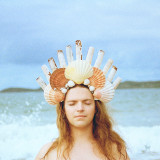
Chelsea Wolfe has always been a conduit for a powerful energy, and while she has demonstrated a capacity to channel that somber beauty into a variety of forms, her gift as a songwriter is never more apparent than when she strips her songs down to a few key components. As a result, her solemn majesty and ominous elegance are more potent than ever on Birth of Violence.
There is a core element to Chelsea Wolfe’s music—a kind of urgent spin on America’s desolation blues—that’s existed throughout the entirety of her career. At the center, there has always been Wolfe’s woeful longing and beguiling gravity, though the framework for compositions has continuously evolved based on whatever resources were available. Her austere beginnings were gradually bolstered by electronics and filled out with full-band arrangements. The music became increasingly dense and more centered around live performances. Her latest album, Birth of Violence, is a return to the reclusive nature of her earlier recordings
“I’ve been in a state of constant motion for the past eight years or so; touring, moving, playing new stages, exploring new places and meeting new people—an incredible time of learning and growing as a musician and performer,” Wolfe says of the era leading up to Birth of Violence. “But after awhile, I was beginning to lose a part of myself. I needed to take some time away from the road to get my head straight, to learn to take better care of myself, and to write and record as much as I can while I have ‘Mercury in my hands,’ as a wise friend put it.“ Birth of Violence is the result of this step out of the limelight. The songs stem from humble beginnings—little more than Wolfe’s voice and her Taylor acoustic guitar. Her longtime musical collaborator Ben Chisholm recorded the songs on a makeshift studio and helped fill them out with his modern production treatments and the occasional auxiliary flourish from ongoing contributors Jess Gowrie (drums) and Ezra Buchla (viola).
The album opens with “The Mother Road,” a harrowing ode to Route 66 that immediately addresses Wolfe’s metaphoric white line fever. It explains the nature of the record—the impact of countless miles and perpetual exhaustion—and the desire to find the road back home, back to one’s roots. Songs like “Deranged for Rock & Roll” and “Highway” offers parallel examinations on the trials and tribulations of her journeys while the ghostly “When Anger Turns to Honey” serves as a rebuttal to self-appointed judges.
While the record touches upon tradition, it also exists in the present, addressing modern tragedies such as school shootings in the minor-key lullaby “Little Grave” and the poisoning of the planet on the dark wind-swept ballad “Erde.” But the record is at its most poignant when Wolfe withdraws into her own world of enigmatic and elusive autobiography. Much like Alan Ginsberg’s hallucinatory long-form poem Howl, the tracks “Dirt Universe” and “Birth of Violence” weave together specific references from her past into an esoteric overview of the state of mankind. Though the lyrical minutiae remain secret, the overall power of the language and delivery is bound to haunt the listener with both its grace and tension.
“These songs came to me in a whirlwind and I knew I needed to record them soon, and also really needed a break from the road,” Wolfe says. “I’ve spent the past few years looking for the feeling of home; looking for places that felt like home. The result of that humble approach yields Wolfe’s most devastating work to date.
European Headline tour confirming now for 2020. UK/EU Publicity handled by Lauren Barley at Rarely Unable. Immense support from Press, including coverage with NPR, Pitchfork, FADER, Vice, Revolver, Decibel, Under The Radar.
quête:forms
Matching his signature melodic futurism with enduring club music structures, Pev brings the Pulse series to a natural conclusion with the Pulse Phase EP. On this third release he underlines the broader approach to tempos and styles he’s taken across this latest period of his output, soon to be coalesced into a new live set.
If there’s been a nostalgic streak detectable amongst the crisp modernism of the Pulse series, it comes through clearer than ever in the looped-up house jack and starry-eyed techno synth hooks of ‘Pulse IX’. ‘Pulse TEN’ pares back for a lean soundsystem workout driven by a strafing arp and fractured drums while ‘Pulse XI’ revisits 90s bleep techno with a deep, dubby intention. ‘Pulse XII’ completes the picture capturing the skeletal pressure of 2-step at its most slender and deadly.
There’s never a sense of over-familiarity — the exacting angles of the drums and alien hue of the synths maintain Pev’s distinctive sound first and foremost. But this series has also been an opportunity to hear some of his musical DNA more explicitly than before, cast in universal rave motifs propelled by the unrelenting pursuit of new forms for the dance.
Livity Sound is a label set up by Peverelist in 2011 as a vehicle for a raw and exploratory strain of UK techno, rooted in the heritage of UK dance music and sound system culture. It has since become one of the UK's foremost protagonists for cutting edge underground electronic music.
Australian bass collective Echo Chamber get busy with this supreme VA featuring a range of talented friends old and new. LQ takes the lead with the sublime 'Way Down' that bubbles and flexes in two system-primed forms: the spacious heavyweight Dubkasm mix and LQ and MSHCode's own breakbeat-heavier shakedown. Flip for more LQ goodies as he links up with Kloke for the fittingly titled groove-up 'Computer Bubblers' while Duburban and Galvatron finish the EP with the furious drum funk up 'Let Off The Music'. The only echo here is the reload.
Halocline - a visible layer of water that forms between saltwater and freshwater when there is a rapid change in salinity; they are found in colder oceans, caves, fjords and estuaries.
Malin Lewis is a queer bagpiper, fiddler, instrument maker and award winning composer. One of Scotland's most exciting innovators, Malin melds west coast tradition with a newly invented, self-made bagpipe. Hair tingling, philosophical and dance inducing melodies inspired by European folk traditions, humans, queerness and the universe. Having played in Canada, Europe and across the UK, Malin will release their long awaited debut album Halocline on the 3rd May 2024 with Hudson Records. Halocline began as a New Voices commission for Celtic Connections and was premiered to a sold out Strathclyde Suite, Glasgow Royal Concert Hall in 2023.
"I saw my first Halocline aged fourteen whilst swimming in an estuary in the Isle of Skye. I didn't know what it was at the time but the image has stayed with me ever since. Appearing like a hazy layer of cloud under the water; it floats between two worlds and provides an environment which is home to a unique microbial ecosystem. As a trans person I live in a space in between; this beautiful space between a binary with its own colourful and unique culture."
Malin's unique sound is born from the deep connection that comes with making and composing for their own instrument. Alongside whistle and fiddle, Malin plays a newly invented two octave bagpipe that, when combined with guitar FX pedals, creates a whole new world of sound which is as lively, thought provoking and sensitive.
Halocline - a visible layer of water that forms between saltwater and freshwater when there is a rapid change in salinity; they are found in colder oceans, caves, fjords and estuaries.
Malin Lewis is a queer bagpiper, fiddler, instrument maker and award winning composer. One of Scotland's most exciting innovators, Malin melds west coast tradition with a newly invented, self-made bagpipe. Hair tingling, philosophical and dance inducing melodies inspired by European folk traditions, humans, queerness and the universe. Having played in Canada, Europe and across the UK, Malin will release their long awaited debut album Halocline on the 3rd May 2024 with Hudson Records. Halocline began as a New Voices commission for Celtic Connections and was premiered to a sold out Strathclyde Suite, Glasgow Royal Concert Hall in 2023.
"I saw my first Halocline aged fourteen whilst swimming in an estuary in the Isle of Skye. I didn't know what it was at the time but the image has stayed with me ever since. Appearing like a hazy layer of cloud under the water; it floats between two worlds and provides an environment which is home to a unique microbial ecosystem. As a trans person I live in a space in between; this beautiful space between a binary with its own colourful and unique culture."
Malin's unique sound is born from the deep connection that comes with making and composing for their own instrument. Alongside whistle and fiddle, Malin plays a newly invented two octave bagpipe that, when combined with guitar FX pedals, creates a whole new world of sound which is as lively, thought provoking and sensitive.
Next up on BPitch sublabel UFO Inc. is an essential linkup from two rising Berlin-based talents, Linn Elisabet and Stina Francina. Bringing with them two distinct approaches to music production but a shared vision of techno's weirder corners, Linn and Stina go all in on their first joint release together, fusing sonic abstractions into a release that never loses sight of the club. With a classically trained musical background, Linn explores reverberant soundscapes and complex arrangements with a learned ear, but a firm rejection of the rigid forms that often taint formal musicality. Promoting a sense of non-compliance in their sonic palettes, they offer a contemporary and transgressive interpretation of techno that strives to reimagine reality and desire. Having fostered her passion for electronic music in intimate, underground spaces, Stina's approach to production is rooted firmly in affect; carefully weaving fragile emotional narratives with a generous sensitivity. With a particular penchant for old school trance, her sound is often coloured by a feeling of melancholy and hope.
Runar Magnusson is an Icelandic/Danish sound artist and musician, currently based in Austria. With a masters degree in Electronic Music Composition from The Royal Academy of Music, Aarhus, Denmark, he is inspired by the sounds of nature, noise, and meditation. Magnusson specialises in atmospheric disturbances through minimalist compositions. A sly humour cuts through the dark hues of his works.
Magnusson writes: "The two works which make up "Inside Out of Chaos" are somewhat related. They were made at the same time and share the same source materials somewhat – a pool of sounds I had been experimenting with for a couple of years. Two separate projects created the opportunities for me to realise them in these finished forms.
At the beginning of 2020 I was invited to participate in an acousmatic concert series at the Traktorfabrikken in Vienna. Curated by Austrian composer Christian Tschinkel and performed on his Akusmonautikum sound system this particular event, titled Kill & Kaoss, was the last in the series. I named my piece after the event and dedicated it to Tschinkel´s Akusmonautikum system. Without my knowing, I had witnessed this system in action half a year earlier at a concert at the Hermann Nitsch Museum in Mistelbach, with Hermann Nitch playing the organ and Tschinkel operating the sound system – a profoundly enjoyable performance. I was very happy when I connected the dots soon after the invitation to participate. I intended my work for Kill & Kaoss to be a way to greet the new lunar year of the rat – a year which held many surprises… The event took place on 22nd of February 2020 at Traktorfabrikken, Vienna.
"Inside Out (for Trattner)" was composed for Austrian artist Josef Trattner. It was the soundtrack for a film that was a part of his exhibition "Inside Out" at the Kiesler Foundation in Vienna, 2020. I assisted with the installation of the exhibition, itself a filmed action that evolved into the movie of which this is the score. The installation was a very hard physical process that left me bloody and blistered. It was also a fascinating, trance-inducing experience. Mining with ones bare hands, digging out this huge structure and creating a womblike cave, a tunnel system, a playground, a hideaway while experiencing ever-increasing pain in the fingers and hands. The exhibition ran from 27 February 2020 until 23 December 2020.
I consider this release as the final part of a trilogy I refer to as "the three sisters of sorrow". These three releases are an insight into my state of mind at the time – a mental collapse, somewhat triggered by a move to a new country, the death of my friend Jóhann Jóhannsson and the loss of my father a year later. Between 2018 and 2021 I had the trilogy almost ready but had not been able to finish them. I sought professional help to lift me up from the deep and was diagnosed with ADHD, which explained many things in my life. Only after the darkness had lifted could I see that these three releases were connected. They depicted both the mental state I had been in – an incapacitating downward spiral, a crushing chaos – and also my search for the light, a way out of the maze and my path up to the surface."
Runar Magnusson, Vienna, 13 November 2023
With words as weapons and public infrastructure as his blank slate, John Fekner's City Squad are always questing for the ineffable, even as they yearn for concrete change - Make no mistake, Idioblast is a serious party where everyone is welcome.
Released in 1984, Idioblast is a lost classic, a future shock narrative ahead of its time, and yet completely of its era, like few artifacts before or since. The cover tips you off from the jump--a crude but effective collage featuring classic Fekner slogans like Toxic Junkie, Growth Decay and Soft Brains Watch The Screen And Buy The Jeans. In an uncanny and tragic coincidence, the very first lyric on the album--"The place to be is on the space shuttle/if you're brave enough to get on it"--seems to anticipate the Challenger disaster just two years later.
But for the most part, the tracks on Idioblast directly reference the concepts that inspired Fekner's visual art. Musically, "Rapicasso" utilizes pneumatic pounding with an industrial edge as Fekner equates the great and controversial painter with risk-taking graffiti kids bombing trains and billboards across the city. Art is in a constant state of exploding--forms, paradigms, outdated ideas.
Splitting the difference between hip-hop and new wave, the Santaniello-sung "The Beat" is like Thomas Dolby meets Run-DMC and should've been a radio staple for at least one sticky summer. It could soundtrack either a couples roller skate or a drug-fueled evening out. Channeling Fekner's slogan-stencil aesthetic, "Travelogue The 80's" is a tour de force reminiscent of Negativland's experiments in audio culture jamming. As Fekner details, "I grabbed all of the sounds via a shortwave radio picking up transmissions from LaGuardia airport and the TV. I recorded and edited on a Sony Pro Walkman and an Aiwa dual cassette deck."
- A1: Post-Apocalypto Theme 0:37
- A2: Desolation 1:17
- A3: Hope 1:59
- A4: Cave Women 1:26
- A5: Making Love 2:56
- A6: Scientists 1:17
- A7: Take Us Into Space 1:56
- A8: I've Got To Go 1:50
- A9: Fuck Yo-Yo Ma 1:34
- B1: Reunion/Not So Fast 1:08
- B2: Daddy Ding Dong 1:45
- B3: Chainsaw Bazooka Machine Gun 1:00
- B4: Robot 2:26
- B5: March 1:23
- B6: Turd Whistle 0:39
- B7: Colors 2:20
- B8: Who's Your Daddy? 0:48
- B9: Jb Jr Rap 1:31
- B10: Woman Time 1:23
- B11: Save The World 0:44
- B12: Post-Apocalypto Theme (Reprise) 0:39
"Post-Apocalypto' finds Tenacious D thrust into a world of complete and utter destruction following the drop of an atomic bomb. Surviving the attack in classic cinematic fashion (a good old imperishable 1950s refrigerator), the duo quickly learns that new forms of evil have spawned from the blast. One thing becomes apparent for humanity to prevail, Tenacious D must save the world". Standard Black LP vinyl re-issue catalogue campaign. Spring UK tour dates. Promo & marketing activity around the catalogue & live dates.
- A1: Gwaing Reverie
- A2: Lucelle Sista Of The Soil
- A3: Mantis Praise
- A4: Amaseh Amen
- A5: For Peter & Ruth
- A6: Terug Blik
- A7: Threnody For The Khoisan
- A8: Ambient Khoi
- B1: Mcinci Song I
- B2: Morenga
- B3: Evidence Of Things Unseen
- B4: Lockdown Duet Milano-Cape Town
- B5: Roesdorp Requiem
- B6: The Ascension Of Milford Graves
Garth Erasmus is an artist and musician based in Cape Town, South Africa. 'Threnody for the KhoiSan' is his first album under his own name. Since 1985 his artistic interests have broadened to include music-making, designing and making his own instruments based on indigenous KhoiSan knowledge. From 1999 to 2012 he was a member of the South African First Nation activist group Khoi Khonnexion. In the past couple of years Garth Erasmus has also been a pivotal part of various international performance pieces and exhibition projects which brought him regularly to Europe. Most of these activities were developed and performed in collaboration with the Hamburg based band Kante and his band Khoi Khonnexion. In April 2024 Garth Erasmus will be part of the group exhibtion 'Oscillations' at Akademie der Künste, Berlin.
His works in music are predominantly characterized by a restless quest for alternative forms of expression and materials including self build instruments, field recordings or various electronic music devices.
In this context the music on 'Threnody for the KhoiSan' takes on a primal and metaphorical meaning. Rather than a formal, physical initiation, this process is more spiritually inclined, yet it is a spirituality which is consistently put into action.. “Ever since I was an art student I have experimented with alternative materials to release me from the Western education values I received. When I started to make these instruments in the 1980s, my intention was to create art objects but when I discovered the sound they made, it unlocked a door that transported me deeper in my quest in the realization that I was on the right path.
In fact all instruments which appear on 'Threnody for the KhoiSan' are products of a process of discovery starting from square one. All this is based and founded on the beauty of simplicity and minimalism as symbolized by the single string Khoisan musical bow and arrow as trance musical instrument. In this sense it soon became manisfest for Garth Erasmus to combine the bow instruments with various electronic instruments. Besides developing his own unique language in music he also shared an expressed interested in experimental sound aesthecis, Avantgarde composition and Free Jazz. However, his non - academic approach towards sound and music was always fueled by the desire for a reconnection to the land and to the idegenious knowledge of the KhoiSan, whose struggle for First Nation status continues.
Song for Morenga
This song is dedicated to a guerilla leader, named Jacob Morenga, who was the leader of the nama/herero anti-german uprisings that occured between 1904 and 1907.
Amaseh Amen
This is a classic mouthbow piece that conjures the spiritual nature of Khoisan cultural praxis.
Gwaing Reverie
It was composed as a personal gift to the other members of newly formed electro-acoustic trio „Gwaing". „Gwaing" is an ancient Khoisan place name, meaning the mouth of the river.
Mcinci Song
A typical meditation on the traditional Mcinci flute. This flute was originally played by shepherds and was made of reed.
The Ascension of Milford Graves
This piece attends to capture the risen spirit of the legendary African American drummer Milford Graves. It was composed soon after his death in 2021.
Song for The Sisters of the Soil
A live improvisation dedicated to Lucelle and Melissa (The Sisters of the Soil) on the occasion of visiting them at their residence, known as „Oppieyaart" on the Cape Flats. On 10 September 2022 there is an online event with them at Kunsthaus Hamburg.
Portland based act Dancing Plague has been a steady presence in the dark/cold electronic music scene for quite a few years now.
Since 2016 Conor Knowles’ solo project has been putting out one constant flow of independent releases on multiple formats such as vinyl LPs, EPs, tapes and CDs, creating one sonic palette rich with Ebm, goth, industrial and synth influences.
On their 5th studio album, Dancing Plague continues to flesh out and perfect their unique brand of crushing darkwave.
Elogium explores themes of loss, regret, rebirth and growth coupled with throbbing basslines, rave synths, and pounding drums. Knowles balances aggressive waves of electronics with enough pop sensibilities and catchy hooks to be inviting to those new to the genre.
His skills can be clearly appreciated on tracks like the first single Fading Forms which explores the somber feeling of the years passing you by. Knowles’ emotive baritone crooning paints a melancholic picture of the slow fading of time as you feel like you’re fading with it. The words fall like snow onto cold fields of pulsing 80s synths and pounding drum machine rhythms that bring forth nostalgic familiarity but feel fresh at the same time.
Fans of classic icons such as Depeche Mode, Ministry, Nine Inch Nails as well as contemporary torchbearers Cold Cave and Kontravoid do not sleep on this.
Plenty of disturbing beauty to be found in the depths of the underground
London-based four-piece Adult Jazz announce their first full-length album in a decade, So Sorry So Slow, out 26 April 2024 via Spare Thought. Alongside the announcement comes lovesick new single ‘Suffer One’ featuring Owen Pallett, a cautious excavation of self and sexuality, clambering across a gorgeously shapeshifting, filmic five-minutes.
Containing some of the band’s most abrasive but gentle, beautiful and melismatic work to date, So Sorry So Slow has many defining characteristics: romance, panic, devotion and remorse, threaded together by an intentionally laser-focused love. It’s deeply personal, bruised and candid in its expressions of tenderness, and deeply pained in its concurrent reflections of ecological regret. Across its hour-long runtime, a delicate, frenetic energy and glacial heaviness coexist, the band pitting those paces against one another. In their richly experimental timbre, dancing strings and fluttering falsettos prang against a bed of brass drones like a wounded bird.
“We started writing in 2017 and began recording in 2018,” says vocalist Harry Burgess. “We genuinely thought it might be finished in 2018! But things kept developing and, having resolutely not struck while the iron was hot, there was no real external push to rush things after that, so we just kept letting things shift and unfold until it felt right. Listening back to my voice notes it’s nice to notice that there are fragments of ideas from the whole period 2017-2023 which have shaped the record.”
Recorded in bursts at studios across London and in the band members’ flats, at Konk, on the Isle of Wight and in Sussex, So Sorry is unambiguous in its evolution. Sonically, there are sparks of the arrhythmic brightness that afforded the band’s critically acclaimed debut album Gist Is its cult adoration, for fans of Arthur Russell and Meredith Monk, but with a blossoming, melancholic darkness often overhead. Piano sprees and luscious string sections appear like low-hanging stars on a night-time drive, whilst plunging vocal distortions and humming brass loops resurrect heavy limbs in a bad dream.
“I usually have objects as kind of totems for ideas,” explains Burgess. “The album initially started out to do with performance… the totem was a head mic, one of the subtle skin-tone ones, discreet on the forehead of a West End star. A number of the first songs in their original forms were almost musical theatre piano ballads. I think that was really a device to write about my life as the ‘main character’ (pre internet-speak reframing): regrets about romance, relationships - unsustainable relationships with the self and others.”
“However, once we started writing, the ideas about unsustainable personal relationships, loving unevenly and heartbreak conflated with a more expressly ecological regret. Like contending with big feelings of loss, endings, beauty, desolation, and with how much joy the earth contains in it. Feeling so much gratitude bound up in waves of sadness. Maybe witnessing a slow-motion goodbye to all that, or its last gasps. I love the earth and the life it supports so much. I love how ecosystems fit together - even the brutal stuff. It may be basic to say, but now is the time to be laser focused on that love. I was thinking about human centrality on earth, us as the ‘main character’, the way that is served by faith and romanticism, and the subsequent disingenuous understandings of our position in the ecosystem, as only stewards somehow, rather than subjects. The totems at this point: a herald’s horn, lorry inner tubes, archaeological tools. I guess from doom, industry, history respectively.”
“Now I would say the record is about gripping. Totems being: crampons, rope, drips, desalination equipment, accruing various survival tech. I think gripping sums up both of the threads. There’s the emotionally correct clinging to the earth that is the substrate of everything we value, or the delusional clinging to our imagined dominant position. But also the practical, technological aspects of creating a sustainable relationship, of remaining here. Then I think of romance again.”
So Sorry So Slow comes out 26th April 2024 on Spare Thought, mixed by Fabian Prynn at 4AD Studios and mastered by Alex Wharton at Abbey Road.
Adult Jazz is Harry Burgess, Tim Slater, Steven Wells and Tom Howe.
For his sophomore album, songwriter William Prince begins with a single word, Reliever, which informs a collection of exceptionally rendered explorations of what, who, and how peace is found. Relievers come in all forms; for Prince, it is song. With its emphasis on words and confidently unfussed accompaniment, Reliever puts Prince's gift for sparking powerful emotions of both personal and communal relevance at the fore. A masterclass in skillful simplicity, Reliever works a generous and profound kind of magic. Now available on limited edition white-vinyl.
Hunting for rhythm, as if our lives depended on it, as if, without rhythm, we’d starve to death. Can body and soul live without rhythm? Seizing its different forms, dissecting it, ingesting it, digesting it, could very well be akin to the Rhythm Hunters’ creative process. What are the rhythmic principles that lead us to develop its polyphonic, groovy and trance-like aspects (Africa), or mathematically complex ones (India), or irregular pulsations that transcend asperities (Balkans), among others? To go on a rhythm hunt, why not explore all these places, appreciate the infinite diversity of rhythms and, back home, try to understand and experiment with enriching your own rhythmic vocabulary with the basic principles underlying each musical tradition. What can these principles contribute if you transcend borders and begin to adapt your musical knowledge and experience to the new ramifications of the rhythm you’ve just discovered? The music of The Rhythm Hunters is one of the answers.
A few years ago, the musicians in this band and I began a specific practice on unusual mixes of rhythmic ideas, inspired by traditions from various parts of the world, with the intention of integrating them until they became a personal vocabulary and means of expression. The result is on this album.
Stéphane Galland & The Rhythm Hunters by Stephane Galland & The Rhythm Hunters, released 26 April 2024, includes the following tracks: "Positivv ", "Artemis" and more.
This version of Stéphane Galland & The Rhythm Hunters comes as a 1xCD in a(n) O-Card packaging.
Iconic death thrash metal band PENTAGRAM (Chile) was formed in Santiago, Chile in 1985. At the time, the country was roiling from political upheaval, but that didn't stop Anton Reisenegger, Juan Pablo Uribe, and (former drummer) Eduardo Topelberg from ingesting and eventually emulating the brutalist, evilest forms of metal from around the world. PENTAGRAM (Chile) now unleash their new album ' Eternal Life of Madness’ and is comprised of guitarist/vocalist Anton Reisenegger, guitarist Juan Pablo Uribe, drummer Juan Pablo Donoso, and bassist Juan Francisco Cueto. PENTAGRAM (Chile) marched forward from their debut 'The Malefice' (2013) while preserving the savage DNA that informed Darkthrone, At the Gates, Dismember, Napalm Death, and many others. The band ’s new album 'Eternal Life of Madness’ feature the crushing heft of "Possessor," "El Imbunche," "The Portal," and "Deus Est Machina, » which is a far-off salute to the group's classic "Spell of the Pentagram" from their 1987 first Demo. PENTAGRAM (Chile) doesn't exist merely for nostalgia reasons—though supporting Slayer in Santiago in 2019 was a highlight of past accomplishments. Their timely resurrection is unadulterated metallic passion. "When the pandemic hit, and I was in lockdown at home in Spain, I started writing riffs for a new LOCK UP album," says Reisenegger, who plays guitar in grind legends BRUJERIA and Chilean groove-thrash masters CRIMINAL. "I realized some of the stuff I wrote had the original Pentagram (Chile) feeling, so I put those ideas aside. They started piling up, so when the LOCK UP ’The Dregs of Hades' record was done, I began arranging them and working remotely with our drummer, Juan Pablo Donoso. I didn't even realize I had all that material in me, but it was somehow untapped. We had a 'false start' a few years before when original guitarist JP Uribe, JP Donoso, and I got together and started jamming on some new riffs. 'The Portal' came out of those sessions. » Though never explicitly political lyrically, PENTAGRAM (Chile) have issued angst-ridden proclamations throughout their 39-year existence.
'Welcome to Hotel Heaven' is a fresh start for is George van den Broek, a young man with an old soul and the voice to match. His music as Yellow Days fittingly, feels both of his era and completely other: a woozy mixture of soul, blues, psych, and groove leaking through the walls of a jazz lounge that's come unstuck in time. A self-taught multi-instrumentalist, George has never fit into one style or space. Despite George being an old soul — he hates social media, loves vinyl, and collects old cameras — Yellow Days really is a project about youth and modernity: “Hotel Heaven represents fake comfort in all its forms, this whole bullshit idea of luxury where nothing is real,” explains George. “There are so many young people who are living that kind of life. Because of the cost of living crisis, people are spending all they’ve got on a bag of white powder just to make them feel nice. Their jaws are still swinging at four o’clock in the morning, but they’re not saying anything. I wanted to write about these people and everything that is happening right now. This TikTok age where everyone wants to be famous. It’s also a big 360 of my life and career to date. I wanted to get away from everything I’d done before, wash my face and start afresh.” - Yellow Days
Keplar presents the first-ever vinyl edition of the 2003 album »From Tokyo to Naiagara« by Tujiko Noriko. This reissue with new artwork by Joji Koyama is an abridged version of the album as Tomlab label owner Tom Steinle and producer Aki Onda had originally intended to publish it alongside the original CD version. Written by the France-based Tujiko while she still lived in Japan, »From Tokyo to Naiagara« followed up on her two seminal Mego albums and marked a turning point in both the artist’s career and personal life: While she was preparing to leave Japan behind, she succinctly connected the dots between her experiments in pop music and her interest for more abstract sounds. Tujiko worked primarily with a Yamaha synthesizer and an MPC sampler while also incorporating contributions by other musicians such as Onda, Riow Arai and Sakana Hosomi into the pieces. Sometimes approaching an IDM and clicks’n’cuts-style production or working with trip-hop and hip-hop beats while using conventional song structures in the most unconventional of ways, the album showcases her multifaceted influences and skills as a singer and musician to full effect.
Tujiko fondly remembers the time when she made the album. »I had a lot of time for myself back then and I didn’t even feel like I was very busy,« she says today. She describes producing it in close collaboration with Onda, who would relocate to New York City shortly after, as »quite Tokyo and very local.« They explored parts of the city that they hadn’t yet been to for a photography project (finding, among other things, a coin laundry called Naiagara—a transliteration of Niagara). This left its mark on a record that mixes melancholia with joy. The driving opener »Narita Made,« named after one of Tokyo’s airports, already makes this clear: Tujiko’s wistful vocals and lyrics like »I miss you terribly« emphasises the sense of bittersweetness that forms the common thread for a sonically diverse and stylistically open-ended album—this music is looking back while moving forward. It is probably no surprise that its reissue too evokes tender memories of Onda and Steinle in Tujiko, while also reminding her of what lies ahead. »I have so much more to do and not enough time for that,« she muses, before quickly adding: »But I also feel less alone having that album again.«
Influenced in equal parts by the experience of strolling through previously unknown Tokyoite back alleys and thinking about the paths not (yet) taken, »From Tokyo to Naiagara« is precisely that: the perfect travel companion for a journey that leads its listeners from past to future.
- 01: What Seed Quests For A Coralline Mud Slump
- 02: Where The Body&Apos;S Distant Arrivals
- 03: Bake Airwaves Into Symbols?
- 04: Like Aurochs Who Fraternized With Syntax Of The Riverbed
- 05: We Stop Short, Frothy, Outdoing The Grass
- 06: Rake A Song-Gush From The Outcrop
- 07: Or The Noun Of Naïve Particles
- 08: Leeching Off The Glow-Work Of Organ Rooms
- 09: We Go Candied In The Marrow
- 10: Grow Dream-Bark, A Tree
Music is a form of world building. I love to develop sonic characters and set them into fictional ecosystems with unique textures, acoustics and atmospheres. Each song forms a different landscape, through which a vocal character guides us and tries to tell us its stories." — Ludwig Berger
Ludwig Berger's 'fictional' debut album "Garden Ediacara" unfolds as a musical eco-fiction, guiding listeners through a speculative ecosystem with synthesized vocals. Infused with storytelling techniques from sci-fi and fantasy, the album intertwines melodic songwriting with electroacoustic sound design. Inspired by hydrofeminism and eco-fiction novels, such as "A Door Into Ocean" by Joan Slonczewski, the album delves into the geological period of Ediacara around 600 million years ago — an era so remote it resonates as a glimpse into a possible future. The Ediacaran period was characterised by a peaceful and thriving ecosystem inhabited by soft-bodied creatures without eyes and bones, which were completely wiped out through the appearance of a new species. "Garden of Ediacara" alludes to this period, celebrating both the pleasures of biodiversity as well as mourning its inevitable loss. The narrative unfolds as an exploration of growth and interconnection in the shadow of a coming extinction. The track titles, written by Daisy Lafarge, reveal themselves as a cohesive poem and contribute to the album's narrative.
Informed by his practice of field recording that focusses on intimate encounters with plants, animals and geological phenomena, as well as his studies in electroacoustic composition, Berger expands his palette for his debut in 'fictional' music. The album prominently features a post-human, non-binary death metal voice synthesizer, physical modeling instruments, and microscopic field recordings of plants, insects, as well as aquatic and geological life. With impressionistic strokes, Ludwig Berger crafts vibrant worlds using glassy timbres and more-than-human voices, guiding listeners through emotionally ambiguous terrain, seamlessly oscillating between moments of intimacy and irritation, melancholy and playfulness.
Ludwig Berger is a landscape sound artist, educator and musician. In his compositions, installations and performances, he enables intimate and playful sonic encounters with plants, animals, buildings and geological entities. He is founder and curator of the label Vertical Music, which releases field recordings and experimental music. Berger holds degrees in electroacoustic composition, as well as musicology, art history and literature. As a sound researcher and teacher at the Institute for Landscape Architecture at ETH Zurich from 2015-2022, he studied the sonic dimension of Japanese gardens, alpine glaciers and urban landscapes, which among other things led to the release of the acclaimed album trilogy 'Melting Landscapes', 'Dammed Landscapes' and 'Buried Landscapes'.
sentiment is a meditation of the poignant emotional terrains of loneliness, nostalgia, sentimentality, guilt, and sex. The album"s narrative arc is guided by delicate musical gestures and artistic vulnerability, audaciously synthesizing disparate and unexpected influences. claire rousay is a singular artist, known for challenging conventions in experimental and ambient music forms. rousay masterfully incorporates textural found sounds, sumptuous drones and candid field recordings into music that celebrates the beauty in life"s banalities. Her music is curatorial and granular in detail, deftly shaped into emotionally affecting pieces. rousay"s vocals and guitar take center stage on sentiment. Her intimate, diaristic lyrics contrast with her mechanical-inflected vocal effects, emphasizing a powerful desire for connection, a deep yearning and a lingering sense of separation. The spare guitar playing and laconic tempo both drive the songs and exude a sense of resignation. Her delicate mastery of nuance draws on her explorative musical past that she, with sincerity and admiration, seamlessly interweaves into her adventurous textures and distinctive compositions. "I want to belong to the worlds and communities I look up to. Same as someone using a Fender guitar or dressing like Kurt Cobain. Emulate your heroes," says rousay. The album balances the poetic soul of her influences with a documentarian heart, rousay capturing moments of her life while living alone in houses across the country, learning to play guitar, and reconnecting with pop music. Her innate ability to conjure pure feeling from sound derives from her delightful embrace of pop forms, the vulnerability found in field recordings, minimalistic arrangements and innovative sound choices. sentiment is blissfully, achingly melancholic, and an undeniably sensual listening experience.