It's been four years since Sweatbox Dynasty, the fourth solo LP from Pennsylvanian experimentalist TOBACCO. In that time, Tom Fec's project has toured with Nine Inch Nails, provided the theme song to HBO series Silicon Valley, and teamed with Aesop Rock for a collaborative album as Malibu Ken. He now returns to Ghostly International for Hot Wet & Sassy, a full-length album oozing with his most playful and approachable songs to date, which, conversely, express notions of antilove, self-hate, and disappointment in others. Pop impulses have always surged beneath the surface of his sound - blown-out bass, analog synths, drum machines, and Fec's unmistakable analog gurgle and hiss - here they've bubbled to the top. "I feel like it's the most I've been able to refine what I'm doing," says Fec. "For the past decade I've had this motherfxcker on my shoulder that makes me pick away at structure and melody. Purposely covering up moments because I can. That really came to a peak on Sweatbox. So I wanted the opposite this time. Write the songs without ripping them in half. I went from 'what would the Butthole Surfers do?' to 'what would Cyndi Lauper do?'" And what would Trent Reznor do? Fec found his answer straight from the source. Their collaborative track, "Babysitter," fuses their voices into one deranged presence: "I'm the new babysitter," they alert, before pivoting into a menacingly saccharine bridge. The track tumbles on a tom fill, then a punishing synth line rips into a cacophony of drums and feedback like a lawnmower gnawing through the living room carpet. "This was new for me, but I wanted to write a song that was everything I am and have been, and then like one notch further. Trent was the notch further," adds Fec. The collaboration is a work of alchemy seamlessly blending TOBACCO's trademarks with Reznor's industrial rust and sonic gore. Downcast, sincere, woozy, "Jinmenken" might be the closest Fec has come to a ballad. "Maybe you can find me down the line," his vocoded delivery bounces along the beat. "It's me trying to write a Jets song," says Fec. Album opener "Centaur Skin" presents the stylistic concoction that has been the TOBACCO MO from the beginning, crossing dreamy melodic shimmer with the sinister tones and slime. This has become easier to digest, but also far more potent. A motorik beat steadies the track's galloping arpeggio, acting as a springboard for Fec's dark ruminations as well as an uncharacteristically crystalline synth solo. "It's my feel good self hate anthem. Don't worry, I'm good. It was fun to write." TOBACCO hasn't been reinvented, but it has been refined and distilled. Brighter, sharper, and far more dangerous because of it. Hot Wet & Sassy is practically staring at the sun without shades and feeling those corneas roast. Everything looks good as your vision fades. The pop-forward structures exert their undeniable hooks with baneful precision, pulling listeners into their clutches; once there, sugary melody rewards submission.
Search:fourth inc
One of the most quietly influential underground artists of recent times, Yamaneko returns with Spirals Heaven Wide, his fourth full-length album. Since breaking through in 2014 with his cult debut album Pixel Wave Embrace, Yamaneko has been one of the key artists re-contextualising ambient music for a new generation, crafting fragile compositions that draw as much from the angular shapes of grime, techno and keygen music as they do the soothing soundscapes of new age cassettes, ambient records and video game soundtracks. Written during Yamaneko’s last winter in London before relocating to Tokyo, Spirals Heaven Wide is his longest and largest-sounding release to date, combining some of his most evocative long-form pieces with the kind of haunting miniatures that made his early music so distinctive. The majority of the tracks were written after Yamaneko's first run of audio-visual shows at the end of 2018, and so are rooted in the same kind of live workflow and production methods that he explored with those sets. As with last year’s Afterglow EP, Spirals Heaven Wide is underpinned by a underlying influence of euphoric dance music, with distant trance and hardcore signifiers - both key influences on Yamaneko from an early age - visible through the album’s thick blankets of wind and fog. These influences come fully to the forefront on ‘This Spring of Love' and 'Fall Control’, two of the most outright spine-tingling tracks Yamaneko has released to date. Elsewhere, the album explores his love of emo music’s bittersweet melancholy, a fascination with constellations and the cosmos and an increasing love of writing extended, long-form compositions: a side of Yamaneko first explored on 2017’s Spa Commissions collection and continued on his contribution to respected ambient series Longform Editions.
One of the most influential bands to emerge from the UK’s festival scene, the Ozrics layer ambient and ethereal landscapes with freeform dub trips, incredible rave grooves and psychedelic progressive rock. It is an open exploration of music and the soul.
The band’s last release to feature Merv Pepler and Joie Hinton, who left to form Eat Static, ‘Arborescence’ was the Ozrics’ fifth studio effort in as many years. Soundscape textures remained their focus and their strength, with the now trademark Steve Hillage-esque guitar, gurgling and whirling synths and tight rhythm section all wrapped around rave, techno, African and Middle Eastern influences.
The tracks alternate between the power driven (‘Myriapod’, ‘Shima Koto’, ‘Astro Cortex’), classic Ozric Tentacles space rock (‘Dance of the Loomi’, ‘There’s a Planet Here’, the title track) and those with an ethnic flavour (‘Al-Saloog’).
The powerful music here, embellished by plenty of synth dweedling and strong rhythm patterns, takes the listener of open mind and free spirit to somewhere special. Classic Ozrics then.
‘Arborescence’ will be released on 180g red vinyl as the fourth title in the Ed Wynne remasters series on Kscope.
THE KILIMANJARO DARKJAZZ ENSEMBLE are a project which has always been tied to films. Films are luxurious because they dispose of all these boring, unimportant, and trivial parts of our lives. This allows them to fully control our sensations, to put us in a very specific mood. Joy and sadness are occasionally OK, endless joy or endless sadness are clinical. But there is one sensation which can be persistent and unconditionally bearable at the same time. In the absence of a better alternative, let's call it "the mood". The mood is what TKDE are aiming at. The mood.
The mood is infinite and illimitable, but not uniform and unique. On "From The Stairwell", TKDE deliver eight new incarnations of the mood. Stairwells have always been intriguing. They appear to unavoidably lead you to your destination, but they only disclose the path bit by bit. What lies far ahead of you and far beyond you is hidden in the shadows. The stairwell could just as well be infinite. You climb up this murky stairwell, passing by many doors. Every door contains a variation of the mood, a short film, a song. You open the first one, "All Is One". The evaporating mist discloses a large and empty room with a barstool in the middle. On the barstool, a chanteuse from the roaring twenties. Her voice starts to trigger vibrations of the ground, the walls start spiralling around her, but she remains untouched in the eye of the storm. Second room, "Giallo". Sly guy, telling smile, nice suit. Walking down the streets in the dusk. The ambience starts to get out of phase, the guy stumbles in horror while blending with the surrounding to a brown soup. Fourth room. "Cocaine". Naked people with pig heads crawl on the floor, on the walls, on the ceiling. They try to hopelessly suck up the white dust which covers every single piece of this room and is constantly spit out by tubes coming out of the walls. Dissonant sounds accompany the work of this desperate hive. As the people manage to counteract the tubes, fragile melodies start to overpower the dissonances. Sixth room, "Cotard Delusion". Baby morphing into a black fluid morphing into an old man which turns his eyes inwards and finds his inside to be completely empty. The journey up the stairwell, down the stairwell, continues. The pictures fill your head and make you forget where you wanted to go in the first place.
"From The Stairwell" is a surprise and a logical step at the same time. It is a surprise because the songs are far less beat-driven in comparison to TKDE's earlier works, and even contain a few hopeful tints here and there. It is a logical step because in the end each song turns to have a very diverse dramaturgic flow. This could raise the conjecture that TKDE, initially started out to make music for existing and non-existing films, wanted to incorporate the audiovisual impression completely into songs, making the films superfluous. At times, "From The Stairwell" makes you think of 60's soundtracks, but the organic feeling of those is always interwoven with mechanical elements. Altogether, every single of the numerous details present in TKDE's new songs feels to be at the right place and you can either just dive into the mood or pick one of the many aspects and enjoy it on its own - be it Gideon Kiers' beats & fx, Jason Köhnen's bass & piano, Hilary Jeffery's trombone, Charlotte Cegarra's voice & piano, Eelco Bosman's guitar, Nina Hitz' cello, Sarah Anderson's violin, or - appearing as guest musicians - Eiríkur Óli Ólafsson's trumpet and Coen Kaldeway's saxophone & bass clarinet.
Sublime, unique, sexy and peculiar unreleased scores by electronic and jazz pioneer Ron Geesin, made for the sublime, unique, sexy and peculiar films by maverick director Stephen Dwoskin. There. we’ve said it. And if you have not heard of one or either of these two dudes it doesn’t really matter. Geesin made great music and worked with Pink Floyd. Dwoskin made odd films, most of them are in the BFI permanent collection. They are great and a bit strange.
These superb unreleased soundtracks come from a fascinating, progressive and important period in British film history. They represent an intriguing collaboration between the lively Ron Geesin from Scotland and the American Stephen Dwoskin, who both met in London.
Musically they are minimal, charismatic and quite groundbreaking. Here is the story…
HISTORY:
Steve Dwoskin arrived in London in 1964, aged 25, with several 16mm films in his trunk, shot in the cold-water flats of Greenwich Village. He had been on the fringe of the Factory scene, and some of his films starred Beverly Grant, ‘the queen of the underground’. But they had scarcely been seen, and they didn’t have soundtracks. For almost a year they stayed in the trunk, and stayed silent. Then he met Ron Geesin, somewhere around Portobello Road.
‘Slept last night, completely dressed after working over 12 hours on sound tracks at Ron’s,’ wrote Dwoskin in his diary for 29 July 1965. ‘My films are not anywhere near being anything. I need more energy, more concise and positive ideas and less inhibition. And of course space, money and people.’ Dwoskin, who taught and practised graphic design by day, had recently decided to stay in London beyond the term of the Fulbright scholarship that had brought him there.
Ron, living with Frankie in a basement flat in Elgin Crescent – they would marry the next year, with Dwoskin as best man – was about to leave the Original Downtown Syncopators, the trad jazz band he had joined aged seventeen-and-a-half, and was trying to go solo. On stage he would make vigorous use of piano and banjo; at home Frankie had bought him a new kind of instrument – a tape recorder. ‘Soon I had one tape recorder, two tape recorders, three tape recorders.’
Ron, wrote Dwoskin in his unpublished autobiography, ‘loved to record, and to cut and splice the quarter-inch recording tape to make new sounds. This triggered in me the idea of getting back to my films and finishing them’. Soon he was living in a dank basement in Denbigh Road, a few minutes’ walk from Elgin Crescent. Ron’s soundtracks for Dwoskin’ films, recorded in the Geesins’ flat, encompassed Ron’s very eclectic range of styles – madcap piano and fretted banjo as well as tape manipulation.
Aside from Ron’s soundtracks, some of which belong to films that no longer exist (including Pot Boiler), Frankie would act in one of the films that Dwoskin either lost or never finished during these years. He was disabled, having contracted polio as a child, and Ron and Frankie were both carers and collaborators; Ron had met him when he was struggling into his car.
There was no London equivalent to the underground film scene that Dwoskin had known in New York, and his films remained unseen until such a scene began to come into being, in the autumn of 1966. Some of them made their debut at the Mercury Theatre, near Notting Hill Gate, that September. Dwoskin wrote that Alone, starring Zelda Nelson (from Ron Rice’s Chumlum), and Chinese Checkers, with Beverly Grant and Dwoskin’s friend Joan Adler, went over best.
Soon both Dwoskin and Geesin became involved in the nascent London Film-Makers’ Co-op, which put on screenings in Better Books on Charing Cross Road – ‘if you can call them screenings,’ Ron recalls; ‘I’d call it fifteen blokes in various stages of disarray, peering through the smoke’. One or more of the films had been ‘striped’ with magnetic audiotape; with others ‘we had no means of direct syncing to the picture, so he started the film and I started the tape recorder’.
In the same autumn, Dwoskin moved into a flat almost opposite the Geesins on Elgin Crescent. More collaborations followed, including Naissant, on which Gavin Bryars, whom Geesin had met during a stint on the northern club circuit with novelty act Dr Crock and His Crackpots, played double bass.
Around the end of 1967 Geesin released his first solo LP, A Raise of Eyebrows, and Dwoskin won recognition the Fourth Experimental Film Competition, aka EXPRMNTL 4, an occasional film festival staged at Knokke-le-Zoute in Belgium. By now the films had optical soundtracks.
It was only after this that Dwoskin completed his first ‘British’ films, including Me Myself and I, with Barbara Gladstone, an American dancer who had appeared in Barbara Rubin’s Christmas on Earth, and with whom Dwoskin and Geesin had at one point devised a stage show, never produced. For Moment, a single-shot film, Geesin provided his most experimental score yet. At the time of its debut in 1970, Dwoskin and the Geesins were sharing a house in Ladbroke Grove.
By then, Ron was working with Pink Floyd, and soon afterwards he and Frankie moved out to the country, to be replaced by Bryars both in the house and as Dwoskin’s principal collaborator.
Until now these scores have remained part of the Geesin Archive and have never been issued.
- A1: Whirlpool
- A2: Total Recall
- A3: Under You
- A4: Burning Part Of Me
- A5: Love Is Not A Ghost
- B1: Wildest Dreams
- B2: One Thousand Reasons
- B3: Restless Time
- B4: Mining For Heart
- B5: World As It Is
- B6: Temperature Drop
Demon Records presents four new vinyl reissues from English post-punk group the Sound. Whilst the Sound may never have matched the commercial success of their peers, the group are frequently hailed as one of the greatest bands of the 1980s and have a cult following to
this day. Following on from their critically acclaimed Shock Of Daylight EP, the Sound returned to the studio to record their fourth full length studio album Heads And Hearts. Includes the singles
‘One Thousand Reasons’, ‘Temperature Drop’ and ‘Under You’.
Pressed on 140g clear vinyl for the first time, with replica artwork including a printed inner sleeve.
- A1: O-O-O Baby, Baby
- A2: Stay In My Corner
- A3: Who's Lovin' You
- A4: A Woman's Prayer
- B1: Innocent 'Til Proven Guilty
- B2: I Lost My Rainbow
- B3: Ace In The Hole
- B4: Woman Can't Live By Bread Alone
- B5: Don't Send Me An Invitation
The Honey Cone (Carolyn Willis, Edna Wright and Shellie Clark) charted nine R&B hits, including two number 1s, ‘Stick Up’ and ‘Want Ads’, the latter of which also reached number 1 on the US pop charts
This is their 1972 album released on Hotwax / Invictus Records. Their fourth studio album that is seen as a hidden classic with stand out tracks ‘Who’s Lovin’ You’, ‘Stay In My Corner’, ‘Ace In The Hole’ and the much sampled ‘Innocent ‘Til Proven Guilty’ Reissued with original artwork with printed inner sleeve and pressed on 180g heavyweight classic black vinyl.
Marking his fourth full release on the label, leading UK talent Darius Syrossian returns to Hot Creations this July with Flashlight, a heavy duty two-track release influenced by the 90’s US house sound.
Flashlight embodies the warehouse sound with tough snares, a raw bass and thunderous kicks. On the flip Boujee B' takes inspiration from Darius’ love of the Strictly Rhythm house sound.“I said this year I wanna go back to my roots and focus more on house, those US house 'dubs' that were played by people like Sneak, Van Helden, Gemini, R Sanchez, Derrick Carter etc... this is inspired by that vibe…”
Selector, producer, label curator and radio host Darius Syrossian has dedicated his life to collecting and sharing the highest quality house and techno records. His productions have landed on respected labels including Get Physical, Drumcode, 8Bit, Moon Harbour, We Are The Brave and Defected, with whom his ethos is strongly aligned. Alongside his exploits in the studio and on the road, he has also launched his own record label - Moxy Muzik, which hit the ground running in 2019 with regular sold out Moxy Muzik events at 93 Feet East in London and South Nightclub in Manchester.
"AVALPBOX4", Limited Edition- 1.000 Copies' 28-Page Hardback-Book: 10" Vinyl, Hand signed Programme, Tour Poster & DVD.
By the time The Beatles travelled to Blackpool for the first time,
they had toured with the legendary American singer, songwriter, Roy Orbison; recorded several BBC radio shows, including Saturday Club, Easy Beat and Pop Go The Beatles; appeared on many, highly popular television programmes; released their debut album, Please Please Me and issued their first three EMI singles, ‘Love Me Do’, ‘Please Please Me’ and ‘From Me To You’.
Their fourth, ‘She Loves You’ had just been recorded and mixed ready for release. It was an exciting time for the band so, when they reached the popular, seaside resort for the first time, on 7th July 1963, optimism was filling the air. This stunning AVA Editions collectors pack contains a 10" Record feat. two appearances made by the Beatles on the ABC television show, Blackpool Night Out; an impressive 28-page book, crammed full of previously unseen colour images of the group and a high-quality reproduction of an original, 1963 concert programme signed by Skiffle legend, Chas McDevitt, who supported the Beatles on several occasions.
Also included is a full colour A3 poster and an exclusive DVD feat. a new, 30-minute interview with him, alongside his previously unseen, candid, colour footage of the group backstage, and in performance at the ABC Theatre in August 1963.
So too is a unique, fully colorized version of their 17-Mins. appearance before the cameras for Blackpool Night Out in August 1965. For Beatles and music fans alike, this pack serves as a wonderful opportunity to own a unique slice of music history.
*** Side A: Recording 19th of July, 1964
*** Side B: Recording 1st August, 1965
On The Corner Records is delighted to announce the release of Dialectic Soul, the debut album from one of Cape Town's most cuttingedge, visionary artists and musicians, the drummer Asher Gamedze. This is Jazz at its most spiritual, most progressive and most appealing form. As Asher himself says: Dialectic Soul is about motion and a refusal to remain static or stay still. It's the commitment to be continually moving'. Recorded live over two days at the Sound and Motion Studios in Cape Town with renowned musicians (Thembinkosi Mavimbela (bass), Buddy Wells (tenor sax), Robin Fassie-Kock (trumpet) Nono Nkoane (voc)), Dialectic Soul is breathtaking in its musical vitality and expression of soul seeking truth. By incorporating the concept of the Total Art for this project, it fits perfectly within On The Corner's aesthetic of music, art and vision for creative innovation. Label art director Victoria Topping created the sleeve design working with Asher's drawings and concept.
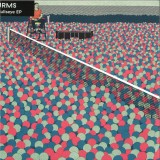
Gudu Records returns with its fourth release, courtesy of a debut EP from London-based newcomer, JRMS. His music will already be anyone who has caught Gudu boss Peggy Gou's DJ sets over the past couple of years, with JRMS tracks being mainstays of her mixes, including her 2019 DJ-Kicks compilation.
The memorable title track is a percussive, elasticated house delight, blending springing breaks with disorienting rave stabs. This taste for naive melody is further cemented on the loose-limbed 'Shake', while '3' defies it's purely numeric title with gleefully offbeat electro and a shuffling card deck of drums leading forward delicious oscillations. Finally, 'Solo' cruises on with space and sunsets in mind, a rich house journey that underscores both the distinct and versatile promise of JRMS.
‘Garlands’ was the Cocteau Twins’ debut album, released in the early autumn of 1982. It was the only album they made with original bassist Will Heggie. Describing it as “haunting,” “spellbound,” “diaphanous” and discerning a “frosting of sweetness,” the critics wore out their adjectives; this was rock music - just - but it was conjured in the unlikeliest environment from the strangest of material.
This is ‘Garlands’ first vinyl pressing in over ten years, remastered from the original analogue tapes, pressed on 140g black vinyl and includes a digital download code. ‘Victorialand’, Cocteau Twins’
fourth album, was released in spring 1986. The largely acoustic, nonpercussive album was made with Elizabeth and Robin, while Simon was working on This Mortal Coil’s second album.
Dif Juz labelmate Richard Thomas guested on tabla and saxophone. The Guardian said “It’s not quite ambient, but it’s definitely not rock’n’roll even by the Cocteaus’ standards, building on the moments of guitar shimmer from the previous years’ EPs, while also stripping back at points to where it’s nothing but a Guthrie guitar line and Fraser’s voice.
‘Victorialand’ is remastered from the original analogue tapes,
pressed on 140g black vinyl and includes a download code.
Mannequin Records is delighted to present their fourth full length of Polices des moeurs, the Canadian minimal synth duo formed by Francis Dugas and Manuelle Gauthier. With PÉRIL, Police des moeurs expands its sound and ventures into mysterious, bewitching and enigmatic landscapes. The foundation is still synthetic, minimal and punchy, relying on mechanical rhythm, powerful bass and catchy melodies, but it's now combined with more elaborate arrangements, punctuated by delicate textures and depthful laments with uncertain but sincere meanings.
Formed in 2010 in Montreal, Police des moeurs got noticed right from the start with its infectious and direct synth pop. The band has released several recordings, including Péril, their fourth full lenght album on Berlin's Mannequin Records. The Canadian group has performed in Mexico, the United States, as well as in ten European countries, and has share the stage with The Damned, ADULT., TR / ST, Xeno & Oaklander, Automelodi, Essaie Pas, Xarah Dion, Duchess Says, to name a few.
After much anticipation, our Belgian disco diamonds Rheinzand present their debut full-length album. On their self-titled record, The Belgian trio wraps the human heart in synthetic threads of modular electronic disco. 9 songs writhing on timeless dancefloors, morphing in and out of shapes of luxuriant melody and vivid instrumentation.
The album is full of classic disco and electro sounds, wielded with imposing prowess by multi-instrumentalist Reinhard Vanbergen. It’s both an exploration ofdance music’s electronic genealogy and the vintage cool that has defined its different eras. Still, an organic atmosphere pervades as the blend of real instrumentation fixes a sort of retro-futurism, imagining an alternative timeline that’s a bit more exciting, more sensuous and libidinal, maybe more human, too, than our current outlook.
We start the engines with Break of Dawn, a compelling beat rises from the basement and soon we’re submerged by the pulsing bassline. Dark sunglasses on, we cruise through the night, letting flashing city lights flow into unbroken torrents of color. Blind awakens us, a splash of handclaps in the face, vivid strings and Charlotte’s trademark slick vocals enter the stage. Tantalizing sunbeams power up circuits of electronic synths blipping and beeping away.
Later down the road, we hit the Latin part of town. Porque fits enchanting vocal spells in beautiful Spanish on playful flamenco rhythms. Fourteen Again is a throwback to early electro, playing around with knobs and buttons. An oscillating synth imagines new worlds of plastic emotion. Still disco and still very cool, though. A constant velocity is sustained throughout the album bythis recurring locomotive synth, trudging away beneath the action. Once in a while, we hear the deep, mighty, trembling voice of Mr. Rheinzand speaking to us in incantations. Someone’s pulling the strings here.
On Slippery People, the trio cover the Talking Heads classic in a characteristic procedure of bouncy funk. We’re swirled around by the delirious glasswork of You Don’t Know Me into the hypnagogic funk noir of Strange World. Drifting through the house of mirrors after the fourth mojito.
Obey collects all these threads in a full-bodied future classic disco anthem, before Queen of The Dawn wraps up the show with a sky-bound epic of operatic choirs and ceremonious drums that lands somewhere between Kate Bush’s Aerial and Peter Gabriel’s most bombastic.
transparant blue marbled vinyl
Ekman is no stranger to Shipwrec. With three EPs and an album, the dutchman's brand of fire and brimstone has seared a serious impression on the Nijmegen imprint. The fourth 12" comes with a marked difference. That burning smouldering intensity that has characterised the acid soaked electro and stained techno of past records is present, however it is now sheathed. Beats are still sharp edged, as in "Verdraaide Logica", yet keys have softened and taken on an introspection. "Kronkel" is cast in a similar mould. From a fearsome kick blooms an incredibly layered and thoughtful track where melodies bob and weave while rhythms rail. Even amidst the sinister sidling synthlines of "Anker Punten", with its piercing and punishing percussion, there are understated pads to mellow. The glass and steel of "Vast/Los" ends the EP. Angular lines permeate the piece, reflection and refractions arc and bend in this science fiction finale. Depth mixed devilment from start to finish.
- A1: Calm And Agitation (Title)
- A2: Calm And Agitation - Short Version - (30 Sec. Title)
- A3: The Twelve Challengers (Player Select)
- A4: The Way (Map)
- A5: Honor's Melody - Day (Haohmaru)
- A6: Honor's Melody - Night (Ukyo Tachibana)
- A7: Drum Roll I (Amakusa Demo)
- A8: Bambuseae (Jubei Yagyu)
- A9: Shadow (Hanzo Hattori)
- A10: Infortune (Four Wins Demo)
- B1: Tuna (Galford)
- B2: Banquet Of Nature (Nakoruru)
- B3: Indigenous (Tam Tam)
- B4: Diligence (Bonus Stage)
- B5: Exotic Lady (Charlotte)
- C1: Evil (Gen-An Shiranui)
- C2: Magatama (Kyoshiro Senryo)
- C3: Gaïa (Earthquake)
- C4: Wan Fu (Wan Fu)
- C5: Victory (Victory Demo)
- C6: Drum Roll Ii (Final Demo)
- D1: Heartbeat (Shiro Tokisada Amakusa 1)
- D2: Flames (Conversion)
- D3: Darkness (Shiro Tokisada Amakusa 2)
- D6: Revolutionary Lady (Charlotte Ending)
- D7: Celebration (Staff Roll)
- D8: Request For An Encore (Continue) - The Curtain Falls (Game Over)
- D4: Scream (Ending 1)
- D5: Harmony (Ending 2)
Brave Wave’s first 3-LP vinyls colored (Red, Black and White) set , Samurai Shodown The Definitive Soundtrack will come in a box set featuring three LP sleeves decorated with artwork from the game, with the box set featuring the original iconic Japanese cover drawn by famed illustrator Shinkiro. Both 3LP and 2CD version includes booklet.
SNK and Brave Wave Productions are proud to reveal their fourth collaboration, Generation Series 010: Samurai Shodown for both CD and vinyl.
Known as Samurai Spirits in Japan and originally released for NEOGEO in 1993, Samurai Shodown is one of SNK’s most classic and timeless 2D fighting games, featuring fast-paced gameplay, beautiful graphics and catchy music.
The soundtrack, composed by Norio Tate, achieves the difficult task of producing traditional Japanese sound comprised of instruments such as the shamisen and shachihata while maintaining a distinct NEOGEO vibe. The result is a beloved soundtrack that is simultaneous timeless, yet historical.
There are two variations of the soundtrack: an AES version and a NEOGEO CD arranged version. Samurai Shodown The Definitive Soundtrack will include both versions, featuring the entirety of the original soundtracks remastered and restored to the highest possible quality, in collaboration and consultation with SNK.
The CD and vinyl editions will feature a booklet containing artwork from the SNK archives, in addition to in-depth liner notes written by some of the original creators of the game, including series creator Yasushi Adachi, as well as Tate. In addition, the booklet will feature an in-depth essay by Greg Kasavin of Supergiant Games on the impact of Samurai Shodown on video game culture and history.
The story of 'Get Tragic' can be traced way back to the relentless gigging off the back of their 2014 self-produced and self-titled record, when the heels finally fell off of Blood Red Shoes at the end of that same year. A near-decade of incessant road time and a non-stop pace of life finally took its toll, with the band stopping only to quickly hammer out 'another ten songs' to release as their next record, before ploughing straight back into touring. The pair exhausted themselves to the point of collapse. 'We didn't, at any point, have a breather,' says Steven Ansel (drums and vocals), 'We probably didn't see each other for about 10 days a year, tops, for six or seven years.' Understandably, such incessant close proximity led to implosion. 'We got the to the end of the fourth record and were like, 'F**k you, I never want to see you again','Steven adds, half-laughing, half-sighing.
- A1: New #1
- A2: Moving Trucks
- A3: Taking Everything
- B1: First Drag Of The Day
- B2: Classifieds
- B3: Who Was Around?
- C1: Skintrade
- C2: Vaporub
- C3: Sweet Serene
- D1: Megamanic
- D2: Reflecting Pool
- D3: Along The Way
The fourth solo album from Hüsker Dü and Sugar vocalist and guitarist, Bob Mould. Reissued on vinyl for the very first time. Housed in a reverse-board sleeve and pressed on two heavyweight 180g clear vinyl. On this release, Mould continued to develop the driving alternative rock sound he had become known for as well as experimenting with sample heavy electronica which feature heavily on his future solo albums. Includes the double A-side single ‘Classifieds’ / ‘Moving Truck’.
Fully remastered from the original tapes and available on vinyl for the first time in 42 years, and CD for the first time in 30 years.
Sleevenotes by Jon Hassell and Brian Eno. Back in record shops on the day of the 2020 vernal equinox, the second release on Hassell’s own Ndeya label.
Hailed as one of the 50 best ambient albums of all time by Pitchfork, Vernal Equinox was the first commercially released work by Jon Hassell, originally put out by Lovely Music in 1977.
It's also the debut of a pioneering new form of music that would become known as “fourth world”: a subtle blend of field recordings, electric jazz, ambience and global music influences.
Hassell’s trademark FX-soaked trumpet is carefully embellished by a studio ensemble including the master Brazilian percussionist Naná Vasconcelos and David Rosenboom on synth.
The result is a quiet, meditative and highly original work of outstanding beauty. Vinyl version is housed in a reverse board outer sleeve with printed inner sleeve. Includes download code.
This album was recorded during Thollem's 2017 residency at Brooklyn-based multi-discipline mecca Pioneer Works. It's the second by Radical Empathy, which combines three uncategorizable improvisors. Michael Wimberly has been astonishing folks since his days in Charles Gayle bands and Steve Coleman & Five Elements in the early '90s, and has gone on become a composer and educator of note. Nels Cline has spent decades changing people's ideas about the role of the electric guitar in multiple contexts, ranging from Wilco to Anthony Braxton (think about that!) as well as many projects as a leader; this is his fourth album in trio with Thollem, and a fifth will follow next year, also on ESP. Some people have given ESP-Disk' flak (and "flak" was not the first word choice here) about putting out Thollem McDonas albums. "He's not in the jazz tradition," they say, and even though their idea of the jazz tradition includes Albert Ayler, we like to think that this album will make their little, closed minds explode.