It's time to present in Umor Rex a new collaboration between two great exponents of contemporary music who have been part of the electronic and experimental avant-garde for the last three decades. On the one hand, we have the Berlin-based musician, composer, and video artist Frank Bretschneider, recognized for precise sound placement, complex, interwoven rhythm structures, and his minimal, flowing approach. On the other hand, Giorgio Li Calzi, the Italian trumpeter, composer, producer, and performing director based in Turin, whose work is known for electronic/effects improvisation combined with the trumpet.
The creation process of Zero Mambo started when Giorgio and Frank met in Chamois, the Italian Alps, in 2018. A year later, Bretschneider sent to a few drafts in the form of audio files, loops, and sequences, and Li Calzi used this material quasi as a framework to create new compositions on it. At that time, in the pandemic, with the unprecedented intervention in lives and rituals, the situation led to ideal conditions to reflect and produce music, a snapshot of the weird times. Li Calzi and Bretschneider offer in Zero Mambo a fascinating album between electronic and jazz. It is clear that it is elegant, clean, and minimal, but we have to say, Zero Mambo is also exuberant and cheerful. A fantastic Berlin-Turin music connection.
Поиск:framework music
Все
After 11 years of existence, Gratitude Trio releases on September 2nd, 2022 its 4th album " Birth" on the remarkable Belgian label W.E.R.F. RECORDS in partnership with Mercury and Collectif Koa from Montpellier, France.
Protagonists Jeroen Van Herzeele (sax, analog synths), Alfred Vilayleck (electric bass, fx) and Louis Favre (drums, fx) worked for more than a year on this new album, continuing to develop the musical framework of the previous album: a blend of sensitivity and groove, contemplative vocals and raging solos.
Mixing acoustic and electronic sounds, the compositions of reflecting realities that inhabit them: to let oneself be touched by the beauty and the dark sides of life, to be amazed by nature, to accept what we cannot change, to create bonds, to commit ourselves to fulfill ourselves.
Music that is both sophisticated and organic, with an energy and boldness that characterize them.
Gratitude Trio is a Belgian/French band based in Brussels known for their strength and sensitivity that open people's hearts. The music of this power trio is tinged with spacy sounds, African rhythms, sexy grooves, endless trances, sensitive ballads, crazy free jazz, and a large dose of unpredictability. Gratitude exists since 2010 and has performed in prestigious venues in Europe. Their two first albums «Gratitude» and «alive» released in 2012 and 2015 under the label El Negocito Records have been very well received by the critics and the enthusiastic audience. The 3rd album «Gratitude III» was released in April 2018: new sound, new approach, but same soul. Gratitude Trio impressed! Indeed, voices and EWI (Electronic Wind Instrument) enrich the sound palette while the musicians have developed a new way to create together.
The brand new 4th album "Birth" is an absolute masterpiece, a synthesis of a decade of adventurous musical explorations.
The Body has been an iconic force in heavy music for over 2 de- cades with a long history of collaborations. Recent collaborators include BUMMER, Full of Hell, Thou, Uniform. Lee Buford from The Body is also in Manslaughter 777 and Sightless Pit. BIG| BRAVE have a singular voice in heavy music, honed over 5 albums The Body and BIG|BRAVE are both bands possessed with an unequaled ability to convey overwhelming weight with simplicity, repetition, and detailed sonic atmospheres; artists who continue to alter the definition of what it means to be a heavy band. The Body are consistently prolific while increasingly ambitious as untethered producers and collaborators. BIG|BRAVE shape sound with dense waves of guitar and feedback, minimalist and hypnotic crashes, and emotionally exacting vocal melodies. In collaboration, The Body and BIG|BRAVE shift the gravity of their compositions to woven layers of percussion and unspooling guitars that sprawl through stark frameworks of earthy folk. Their debut collaborative album Leaving None But Small Birds distills the two ensembles" pioneering approach to heavy music into psalms for the forgotten, threnodies of lost love, and odes to vengeance. Typical to The Body"s creative process, Leaving None But Small Birds was composed almost entirely in the studio at Machine With Magnets with engineer/producer Seth Manchester. The Body and BIG|BRAVE aimed to challenge themselves to craft a fully realized and cohesive work that strayed outside the boundaries of the music they make individually. The Body"s Lee Buford set up the initial challenge: collaborating to make an album that evoked the country and folk roots of The Band. BIG|BRAVE"s Robin Wattie compiled lyrics and melodic lines from across Appalachian, Canadian, and English hymns and folk songs. Select phrases were then reworked and precisely arranged to center the experiences of marginalized characters, victims of hardship, and those yearning for love within each story. The despair and empowerment of these traditional tunes draw remarkable parallels with each group"s focus on championing people often cast aside in history. The Body and BIG|BRAVE, following a folk tradition, make each song their own through shifts in perspective and a synthesis of passages from kindred tales. BIG|BRAVE"s roots as a minimalist folk band and The Body"s love of old-time, country blues, and folk music enable the quintet to strike a formidable balance between sorrowful lamentation and uplifting resolve to weighty effect. Leaving None But Small Birds thatches together two monumental innovative forces that render the emotionally profound with lucid, devastating vitality
- A1: Umzansi (Feat Black Quantum Futurism & Mary Lattimore)
- A2: April 7Th (Feat Keir Neuringer)
- A3: Golden Lady (Feat Melanie Charles)
- A4: Joe Mcphee Nation Time (Feat Keir Neuringer - Intro)
- A5: Ode To Mary (Feat Orion Sun & Jason Moran)
- A6: Woody Shaw (Feat Melanie Charles)
- A7: Meditation Rag (Feat Aquiles Navarro & Alya Al Sultani)
- A8: So Sweet Amina (Feat Justmadnice & Keir Neuringer)
- A9: Dust Together (Feat Wolf Weston & Aquiles Navarro)
- B1: Rap Jasm (Feat Akai Solo & Justmadnice)
- B2: Blues Away (Feat Fatboi Sharif)
- B3: Blame (Feat Justmadnice)
- B4: Arms Save (Feat Nicole Mitchell)
- B5: Real Trill Hours (Feat Yung Morpheus)
- B6: Evening (Feat Wolf Weston)
- B7: Barely Woke (Feat Wolf Weston)
- B8: Noise Jism
- B9: Thomas Stanley Jazzcodes (Feat Irreversible Entanglements & Thomas Stanley - Outro)
Coming out on July, Jazz Codes is Moor Mother's second and latest album for Anti- and a com?panion to her celebrated 2021 release Black Encyclopedia of the Air. Jazz Codes uses free jazz as a starting point but the collection continues the recent turn in Moor Mother's multifaceted catalog toward more melody, more singing voices, more choruses, more complexity. In its warm, densely layered course through jazz, blues, soul, hip-hop, and other Black classical traditions, Jazz Codes sets the ear blissfully adrift and unhitches the mind from habit. Through her work, Ayewa illuminates the principles of her multidisciplinary collaborative practice Black Quantum Futur?ism, a theoretical framework for perceiving and adjusting reality through art, writing, music, and performance, informed by historical Black ontologies.The songwriter, composer, vocalist, poet, and educator Camae Ayewa spent years organizing and performing in Philadelphia's underground music community before moving to Los Angeles to teach composition at the University of Southern California's Thornton School of Music. She released her debut album as Moor Mother, Fetish Bones, in 2016, and has since put out an abundance of acclaimed music, both as a solo artist and in collaboration with other musicians who share her drive to dig up the untold. She has performed and recorded with the free jazz groups Irreversible Entanglements and the Art Ensemble of Chica?go, and made records with billy woods, Mental Jewelry, and YATTA.
- A1: Resemblage (Parasamblaz) (Parasamblaz)
- A2: Cobra Wages Shuffle (Off! Schable W Gure!) (Off! Schable W Gure!)
- A3: Few, Far Chaos Bugles (Uff Bosch Gra Walese) (Uff Bosch Gra Walese)
- A4: Flashcube Fog Wares (Glucha Affera Slow) (Glucha Affera Slow)
- A5: Flight To Sodom (Lot Do Salo) (Lot Do Salo)
- B1: Tonight There Is Something Special About The Moon (Jaki Ksiezyc Dzis Wieczor) (Jaki Ksiezyc Dzis Wieczor)
- B2: If All Things Were Turned To Smoke (Gdyby Wszystko Stalo Sie Dymem) (Gdyby Wszystko Stalo Sie Dymem)
- B3: Anti-Antiphon (Absolute Decomposition) - Anty-Antyfona (Dekonstrukcja Na Calego) (Absolute Decomposition)
Black Vinyl[29,37 €]
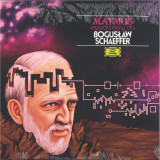
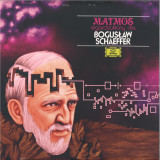
Matmos are one of the most prominent experimental electronic artists working today, crafting work by creating new conceptual frameworks & immediately testing those frameworks absolute limits. For Regards / Uklony dla Boguslaw Schaeffer they've focused on another artist known, in large part, for doing the same. Boguslaw Schaeffer was one of the first Polish artists creating electronic music. In step with American contemporaries like John Cage and Morton Feldman, he worked across the boundaries of classical composition, electronic experimentation, and radical theater in playfully form-breaking ways. Matmos are not the first ones to recognize the power of his catalog, from Solo (a 2008 documentary that garnered numerous international awards), to the annual Shaeffer's Era Festival (most recently celebrated simultaneously in Warsaw and Los Angeles) his work continues to inspire. Regards.. however, was not just inspired by his work, Matmos were given access to the entirity of Schaeffer's recorded works to use as they saw fit, commissioned by the prestigious Instytutu Adama Mickiewicza. They re-assembled & re-combined these recorded works with modern instrumentations in a way that only Matmos could, and what emerges is a composite portrait of the utopian 1960s Polish avant-garde and the contemporary dystopian cultural moment regarding each other across a distance. To facilitate the transcultural exchange that is the album's essential premise, all song titles and liner-notes are provided in both English and Polish. The album was mastered by Rashad Becker and features illustration and design by acclaimed artist Robert Beatty (Tame Impala, Osees, Mdou Moctar). Like the anagrams of the letters of Boguslaw Schaeffer's name that were re-assembled to create some of the song titles, the album itself is a musical re-assemblage of component parts into possible but unforeseen new shapes. Adding harp from Irish harpist Una Monaghan, erhu, viola and violin from Turkish multi-instrumentalist Ulas Kurugullu, and electronic processes from Baltimore instrument builder Will Schorre, and Horse Lords wunderkind Max Eilbacher, the resulting arrangements constantly toy with scale as they move from the close-mic-ing of ASMR and the intimacy of chamber music to the immensity of processed drones and oceanic field-recordings that close the album. Offering a "life review" of production styles, Regards / Uklony dla Boguslaw Schaeffer builds temporary shelters out of the panoramic wreckage of modernist composition, sixties tape music, seventies dub, eighties industrial music, nineties postrock and dark ambient, 2000s era glitch fetishism, and contemporary post-everything collage sensibilities.
- A1: Resemblage (Parasamblaz)
- A2: Cobra Wages Shuffle (Off! Schable W Gure!)
- A3: Few, Far Chaos Bugles (Uff Bosch Gra Walese)
- A4: Flashcube Fog Wares (Glucha Affera Slow)
- A5: Flight To Sodom (Lot Do Salo)
- B1: Tonight There Is Something Special About The Moon (Jaki Ksiezyc Dzis Wieczor)
- B2: If All Things Were Turned To Smoke (Gdyby Wszystko Stalo Sie Dymem)
- B3: Anti-Antiphon (Absolute Decomposition) - Anty-Antyfona (Dekonstrukcja Na Calego) (Absolute Decomposition)
Matmos are one of the most prominent experimental electronic artists working today, crafting work by creating new conceptual frameworks and immediately testing those frameworks’ absolute limits. For ‘Regards/Ukłony dla Bogusław Schaeffer’ they’ve focused on another artist known, in large part, for doing the same.
Bogusław Schaeffer was one of the first Polish artists creating electronic music. In step with American contemporaries like John Cage and Morton Feldman, he worked across the boundaries of classical composition, electronic experimentation and radical theatre, in playfully form-breaking ways.
Matmos are not the first ones to recognize the power of his catalogue, from ‘Solo’ (a 2008 documentary that garnered numerous international awards), to the annual Shaeffer’s Era Festival (most recently celebrated simultaneously in Warsaw and Los Angeles), Bogusław Schaeffer’s work continues to inspire.
‘Regards/Ukłony dla Bogusław Schaeffer’, however, was not just inspired by his work. Matmos were given access to the entirety of Schaeffer’s recorded works to use as they saw fit, commissioned by the prestigious Instytutu Adama Mickiewicza. They re-assembled and re-combined these recorded works with modern instrumentations in a way that only Matmos could, and what emerged is a composite portrait of the utopian 1960s Polish avant-garde and the contemporary dystopian cultural moment regarding each other across a distance.
Vinyl packaged with digital download card.
WRWTFWW Records and MEG Museum (Geneva) are honored to present the first new solo album by renowned Japanese percussionist Midori Takada (Through The Looking Glass) in 23 years, Cutting Branches From A Temporary Shelter, available on vinyl LP, housed in a 350gsm sleeve, with OBI, and liner notes, as well as on digipack CD.
Recorded in a live setting and played with instruments conserved in the collections of the MEG Museum, Cutting Branches For A Temporary Shelter is Midori Takada’s very own rendition of "Nhemamusasa", a traditional work emblematic of the musical repertoire for mbira of the Shona of Zimbabwe, well known worldwide, thanks notably to its version by Paul F. Berliner included on the famed 1973 album The Soul of Mbira.
The choice of this title by Midori Takada evokes the links between traditional African and contemporary music which are the foundation of this work, and it also translates the resolutely multicultural vision of the artist.
Midori Takada explains: "African music is remarkable for its polyrhythms. Not only are there simultaneously several rhythmic motifs, sometimes as many as ten, but furthermore it may be that the part played by each musician has its own starting point and its own pace, all combining to form a cycle. All the cycles progress at the same time according to a single metrical structure which functions as a reference point, but which is not played by any one person from beginning to end. The structure emerges out of the multi-level parts, all different. With the Shona, the musical system is based on the polymelody: one performs simultaneously several melodic lines which are superimposed, each having its own rhythmic organization. It is truly captivating. In Western classical music, one four-beat rhythm induces some precise temporal framework and regular reference points, which come on the strong beats 1 and 3. But in the logic of the Shona musical system, and in other African music, the melody can begin in the very middle of the cycle and be continued up to some other place in an autonomous manner, as if it had its own personality. It’s very rich."
The album comes with in-depth liner notes that include an interview by Midori Takada, a point of view by Zimbabwean scholar, musician and activist Forward Mazuruse, and background information on the project by Isabel Garcia Gomez and Madeleine Leclair from MEG Museum.
The sleeve features an artwork by celebrated Zimbabwean painter Portia Zvavahera.
Part of the budget for the album was donated to Forward Mazuruse’s Music For Development Foundation whose aim is to identify, nurture, and record young but underprivileged musicians in Zimbabwe.
The album is released in conjunction with Midori Takada and Shomyo of Koya-san's You Who Are Leaving To Nirvana, also available on LP and CD on WRWTFWW Records.
- A1: Resemblage (Parasamblaz) (Parasamblaz)
- A2: Cobra Wages Shuffle (Off! Schable W Gure!) (Off! Schable W Gure!)
- A3: Few, Far Chaos Bugles (Uff Bosch Gra Walese) (Uff Bosch Gra Walese)
- A4: Flashcube Fog Wares (Glucha Affera Slow) (Glucha Affera Slow)
- A5: Flight To Sodom (Lot Do Salo) (Lot Do Salo)
- B1: Tonight There Is Something Special About The Moon (Jaki Ksiezyc Dzis Wieczor) (Jaki Ksiezyc Dzis Wieczor)
- B2: If All Things Were Turned To Smoke (Gdyby Wszystko Stalo Sie Dymem) (Gdyby Wszystko Stalo Sie Dymem)
- B3: Anti-Antiphon (Absolute Decomposition) - Anty-Antyfona (Dekonstrukcja Na Calego) (Absolute Decomposition)
Coloured VInyl[31,05 €]
Matmos are one of the most prominent experimental electronic artists working today, crafting work by creating new conceptual frameworks & immediately testing those frameworks absolute limits. For Regards / Uklony dla Boguslaw Schaeffer they've focused on another artist known, in large part, for doing the same. Boguslaw Schaeffer was one of the first Polish artists creating electronic music. In step with American contemporaries like John Cage and Morton Feldman, he worked across the boundaries of classical composition, electronic experimentation, and radical theater in playfully form-breaking ways. Matmos are not the first ones to recognize the power of his catalog, from Solo (a 2008 documentary that garnered numerous international awards), to the annual Shaeffer's Era Festival (most recently celebrated simultaneously in Warsaw and Los Angeles) his work continues to inspire. Regards.. however, was not just inspired by his work, Matmos were given access to the entirity of Schaeffer's recorded works to use as they saw fit, commissioned by the prestigious Instytutu Adama Mickiewicza. They re-assembled & re-combined these recorded works with modern instrumentations in a way that only Matmos could, and what emerges is a composite portrait of the utopian 1960s Polish avant-garde and the contemporary dystopian cultural moment regarding each other across a distance. To facilitate the transcultural exchange that is the album's essential premise, all song titles and liner-notes are provided in both English and Polish. The album was mastered by Rashad Becker and features illustration and design by acclaimed artist Robert Beatty (Tame Impala, Osees, Mdou Moctar). Like the anagrams of the letters of Boguslaw Schaeffer's name that were re-assembled to create some of the song titles, the album itself is a musical re-assemblage of component parts into possible but unforeseen new shapes. Adding harp from Irish harpist Una Monaghan, erhu, viola and violin from Turkish multi-instrumentalist Ulas Kurugullu, and electronic processes from Baltimore instrument builder Will Schorre, and Horse Lords wunderkind Max Eilbacher, the resulting arrangements constantly toy with scale as they move from the close-mic-ing of ASMR and the intimacy of chamber music to the immensity of processed drones and oceanic field-recordings that close the album. Offering a "life review" of production styles, Regards / Uklony dla Boguslaw Schaeffer builds temporary shelters out of the panoramic wreckage of modernist composition, sixties tape music, seventies dub, eighties industrial music, nineties postrock and dark ambient, 2000s era glitch fetishism, and contemporary post-everything collage sensibilities.
Hassan Ideddir’s 1989 single “Atfalouna” sees an expanded repress courtesy of Dark Entries. Born to Berber parents in Morocco, Ideddir began making music at the age of 10 after being discovered singing in the stairwell by his school’s headmaster. Encouraged by his peers, he began playing concerts, and his status grew. In 1987, he played a string of sold-out concerts in Casablanca, Rabat, and Marrakesh, in support of a children’s charity. The success of these concerts secured him a record deal, and he went to Paris to record his debut single “Atfalouna” in 1988.
Released in 1989 on WEA, “Atfalouna” is a dense slab of multi-genre pop. An opening wash of digital synths and reverberant vocals quickly falls away to a cascade of orchestra hits and pulsing electronic drums; the monotone chant-rap of a female chorus collides with Ideddir’s soaring melismatic vocals, pleading against the injustice and hunger in the world. While Hip-Hop and New Beat borrowed tropes from Arabic music, “Atfalouna” inverts the gesture, resituating orchestra hits and sampling techniques within a Moroccan music framework. A shorter instrumental version follows, which preserves the female vocals. Also included are two tracks not on the original 12”. “Ibina” is a moody, downtempo instrumental that sounds like a cult Italo B-side. The record closes with “Ydouchababe”, an electro number driven by funky guitars, electronic claps, huge horn riff. Here, Ideddir sings of a youth festival honoring Hassan II, former king of Morocco.
All songs were remastered by George Horn. The sleeve is a replica of the original 12” cover art, featuring Ideddir set in a cheeky collage of clocks, columns, and camels. Also included is a postcard with a photo of Hassan, as well as lyrics in both Arabic and English. We will be donating 100% of proceeds from this release to Sphere who provide support to the young queer community across Ukraine and the Palestine Children's Relief Fund who help provide urgent humanitarian care for Gaza's children.
- A1: Cool Water (Feat Ivan Conti (Azymuth)
- A2: Cycle Of Many
- A3: Admira (Feat Gigi Masin)
- A4: Flowers (Feat Venecia)
- A5: Melt Into You (Feat Alex Malheiros (Azymuth)
- B1: Flos Potentia (Sugar, Cotton, Tabacco) (Sugar, Cotton, Tabacco)
- B2: Sphere (Feat Jean-Luc Ponty)
- B3: Warm
- B4: On My Way Home
- B5: What Do The Stars Say To You
White Vinyl[31,51 €]
In 1990 Ronald Lee Trent Jr. was the teenage creator of Altered States – a raw, futuristic techno-not-techno anthem, which in retrospect was something of a stylistic anomaly for the young artist. Across subsequent years, with time spent in Chicago, New York and Detroit, came the development of his signature sound, and renown as a world class purveyor of deep, soul infused house/garage. This story has already been told, and on casual inspection, the well-worn platitude ‘house music legend’ is an old shoe that still fits. However, in fact, he’s actually so much more, and has been for quite a while. A genuine musician, songwriter, and ‘producer’ in the proper, old-school sense, the artist today has more in common with Quincy Jones than he does your average journeyman DJ track-hack.
To those in the know, these broader skills haven’t gone unnoticed, which is why on the highly collaborative, career-topping new LP ‘What Do The Stars Say To You’, it took little persuasion to recruit serious star power. Brazilian royalty Ivan Conti and Alex Malheriros from Azymuth, violin maestro Jean Luc Ponty, ambient hero Gigi Masin, hype band Khruangbin and more performed, whilst NY cornerstone François K provided mastering duties. At various points Ron himself played drums, percussion, keys, synths, piano, guitar and electronics.
Harking back to the 70s and 80s boom in adventurous, luxurious albums, WDTSSTY is a love letter to the longplayer, where rich musicality and a liquid smooth, silky flow make seemingly odd genre bedfellows acquiesce harmoniously. Each song its own high-fidelity odyssey, Trent incorporated a broad range of live instruments and electronics into a sophisticated, euphonic whole. Described by him as being “designed for harmonising with spirit, urban life and nature”, this is aural soul food, gently easing you into balmy nights, where everything is alright.
Originally wanting to be an architect, Trent’s views his approach to collaboration and music in general as having the same principles. A firm believer in the nourishing qualities of sound, he sees direct parallels between the two disciplines, being as the purpose of good architecture is to improve quality of life. “With WARM, through sound design, I built frameworks for the musicians, who furnished and occupied these structures beautifully, which was a big compliment for me”, he comments.
The conditions required for a good collab are more than simply structural though, as Trent expounds, “I’m a huge fan of everyone on the record, especially Jean Luc and Azymuth, who’re part of my DNA. Each track was made with that guest in mind – for example, when I started writing ‘Sphere’, I immediately thought ‘this IS Ponty’. I played the keys in his style, and did a guide violin solo using a synth, which he then re-did, amazingly. ‘Cool Water’ is based around Azymuth themes, so when I sent it to Ivan, he could immediately see himself in the piece; He got what I was going for straight away. For ‘Melt Into You’ I hit up Alex on Instagram, sent him the track, he liked it, and within 24 hours he’d sent back six different bass passes!”
“Conversely, Admira began with a sketch sent by Gigi and became something combining Jon Hassell-esque chords and the feel of ‘Aquamarine’ by Carlos Santana, which links back to Masin’s recurrent nautical theme”, he adds.
With community, history and the need for racial equality never far from Ron’s mind, ‘Flos Potentia’ translates from Spanish as flower power, but rather than promoting some hippy idyll, instead it refers to plants which drove the slave trade: tobacco, sugar and cotton. Joined by Khruangbin, together they propel Dinosaur L, Hi-Tension and afrobeat into an ethereal, clear-skyed stratosphere.
Aside from these esteemed guests, other key influences cited by Trent include ‘Gigolos Get Lonely Too’ by Prince, ‘Beyond’ by Herb Alpert, David Mancuso, Jan Hammer, Tangerine Dream, The Cars, Trevor Horn, Alan Parsons Project and pre-Kraftwerk incarnation Organization. A multitude of others are audible too, including George Bension, Vangelis, Loose Ends, Maze, Flora Purim, Weather Report, Atmosphere, Grace Jones, James Mason and Brass Construction.
On the subject of influences, although opposed to the fences erected by genre tags, to understand where Ron is coming from, and where he’s at, it’s important to acknowledge just how big the palette is from which he paints. Traversing jazz funk, quiet storm, sophisti-pop, new age, new wave, kosmische, Balearic, samba, afrobeat, Latin rock, soft rock and yacht rock, his deeply entrenched digger’s knowledge pays off in dividends.
- A1: Cool Water Feat. Ivan Conti (Azymuth) And Lars Bartkuhn
- A2: Cycle Of Many
- A3: Admira Feat. Gigi Masin
- A4: Flowers Feat. Venecia
- A5: Melt Into You Feat. Alex Malheiros (Azymuth)
- B1: Flos Potentia (Sugar, Cotton, Tabacco) Feat. Khruangbin
- B2: Sphere Feat. Jean-Luc Ponty
- B3: Warm
- B4: On My Way Home
- B5: What Do The Stars Say To You
Black Vinyl[24,79 €]
In 1990 Ronald Lee Trent Jr. was the teenage creator of Altered States – a raw, futuristic techno-not-techno anthem, which in retrospect was something of a stylistic anomaly for the young artist. Across subsequent years, with time spent in Chicago, New York and Detroit, came the development of his signature sound, and renown as a world class purveyor of deep, soul infused house/garage. This story has already been told, and on casual inspection, the well-worn platitude ‘house music legend’ is an old shoe that still fits. However, in fact, he’s actually so much more, and has been for quite a while. A genuine musician, songwriter, and ‘producer’ in the proper, old-school sense, the artist today has more in common with Quincy Jones than he does your average journeyman DJ track-hack.
To those in the know, these broader skills haven’t gone unnoticed, which is why on the highly collaborative, career-topping new LP ‘What Do The Stars Say To You’, it took little persuasion to recruit serious star power. Brazilian royalty Ivan Conti and Alex Malheriros from Azymuth, violin maestro Jean Luc Ponty, ambient hero Gigi Masin, hype band Khruangbin and more performed, whilst NY cornerstone François K provided mastering duties. At various points Ron himself played drums, percussion, keys, synths, piano, guitar and electronics.
Harking back to the 70s and 80s boom in adventurous, luxurious albums, WDTSSTY is a love letter to the longplayer, where rich musicality and a liquid smooth, silky flow make seemingly odd genre bedfellows acquiesce harmoniously. Each song its own high-fidelity odyssey, Trent incorporated a broad range of live instruments and electronics into a sophisticated, euphonic whole. Described by him as being “designed for harmonising with spirit, urban life and nature”, this is aural soul food, gently easing you into balmy nights, where everything is alright.
Originally wanting to be an architect, Trent’s views his approach to collaboration and music in general as having the same principles. A firm believer in the nourishing qualities of sound, he sees direct parallels between the two disciplines, being as the purpose of good architecture is to improve quality of life. “With WARM, through sound design, I built frameworks for the musicians, who furnished and occupied these structures beautifully, which was a big compliment for me”, he comments.
The conditions required for a good collab are more than simply structural though, as Trent expounds, “I’m a huge fan of everyone on the record, especially Jean Luc and Azymuth, who’re part of my DNA. Each track was made with that guest in mind – for example, when I started writing ‘Sphere’, I immediately thought ‘this IS Ponty’. I played the keys in his style, and did a guide violin solo using a synth, which he then re-did, amazingly. ‘Cool Water’ is based around Azymuth themes, so when I sent it to Ivan, he could immediately see himself in the piece; He got what I was going for straight away. For ‘Melt Into You’ I hit up Alex on Instagram, sent him the track, he liked it, and within 24 hours he’d sent back six different bass passes!”
“Conversely, Admira began with a sketch sent by Gigi and became something combining Jon Hassell-esque chords and the feel of ‘Aquamarine’ by Carlos Santana, which links back to Masin’s recurrent nautical theme”, he adds.
With community, history and the need for racial equality never far from Ron’s mind, ‘Flos Potentia’ translates from Spanish as flower power, but rather than promoting some hippy idyll, instead it refers to plants which drove the slave trade: tobacco, sugar and cotton. Joined by Khruangbin, together they propel Dinosaur L, Hi-Tension and afrobeat into an ethereal, clear-skyed stratosphere.
Aside from these esteemed guests, other key influences cited by Trent include ‘Gigolos Get Lonely Too’ by Prince, ‘Beyond’ by Herb Alpert, David Mancuso, Jan Hammer, Tangerine Dream, The Cars, Trevor Horn, Alan Parsons Project and pre-Kraftwerk incarnation Organization. A multitude of others are audible too, including George Bension, Vangelis, Loose Ends, Maze, Flora Purim, Weather Report, Atmosphere, Grace Jones, James Mason and Brass Construction.
On the subject of influences, although opposed to the fences erected by genre tags, to understand where Ron is coming from, and where he’s at, it’s important to acknowledge just how big the palette is from which he paints. Traversing jazz funk, quiet storm, sophisti-pop, new age, new wave, kosmische, Balearic, samba, afrobeat, Latin rock, soft rock and yacht rock, his deeply entrenched digger’s knowledge pays off in dividends.
Once again, accordionist Vincent Peirani
reshuffles the cards. As a good jazz musician, he
likes to venture into unexplored territories. As a
good music fan and a very good musician in
general, he is curious, enthusiastic, and eager to
make new discoveries and find new things to listen
to or play. ‘Jokers’, his first album in trio, goes
even further, and elsewhere.
Vincent chose to turn to the jazz trio for the first
time, a formula with such a long history that it is
almost sacred, and certainly intimidating. But
typically, he used that framework only to escape
from it. His two accomplices, Federico Casagrande
on guitar and Ziv Ravitz on drums and keyboards,
both have a wealth of experience and skills, an
interest in rock and electronic music, and a taste
for musical hybridity.
Now available on vinyl with digital download code.
Famed free jazz concert registration of an early New Direction for the Art performance. Recorded in 1971. Old-style Gatefold LP, with rare photographs & extensive liner notes by Alan Cummings.
The performance by Takayanagi Masayuki New Direction for the Art at the Gen’yasai festival on August 14, 1971 was an intense, bruising collision between the radical, anti-establishment politics of the period in Japan and the febrile avant-garde music that had begun to emerge a few years before. The ferocious performance that you can hear here was received with outright hostility by the audience, who responded first with catcalls and later with showers of debris that were hurled at the performers. Takayanagi though described the group’s performance to jazz magazine Swing Journal as a success, “an authentic and realistic depiction of the situation”.
In 1962, Takayanagi, bassist Kanai Hideto and painter Kageyama Isamu went on to form an AACM-style musicians’ collective called the New Century Music Research Institute. Every Friday, members gathered at Gin-Paris, a chanson bar in the fashionable Ginza district of Tokyo, to push the outer limits of jazz creativity.
But the pivotal moment for his music was the creation a new trio version of his New Directions group in August 1969, with the free bassist Yoshizawa Motoharu and a young drummer Toyozumi (Sabu) Yoshisaburō. Experiments eventually led to the creation of two basic frameworks for improvisation that Takayagi referred to as Mass Projection and Gradually Projection.
“La Grima” (tears), the piece that was played at the Gen’yasai festival, is a mass projection and listening to it, you can get a clear sense of what Takayanagi was aiming at. Mass projection involves a dense, speedy and chaotic colouring in of space that destroys the listener’s perception of time, and thus of musical development.
The ferocity of the performance of “La Grima” at the Gen’yasai Festival in Sanrizuka on August 14, 1971 was consciously grounded by Takayanagi in a particular historical moment, ripe with conflict and violence. A month after the festival, on September 16, three policemen would die during struggles at the site. This was the context that the three-day Gen’yasai Festival existed within. The line-up reflected the radical politics of the movement, with leading free jazz musicians like Takayanagi, Abe Kaoru, and Takagi Mototeru appearing alongside radical ur-punkers Zuno Keisatsu, heavy electric blues bands like Blues Creation, and Haino Keiji’s scream-jazz unit Lost Aaraaff.
New Direction for the Arts trio topped the bill on the opening day, playing an aggressive, uncompromising “mass projection” set of polyphonic improvisation. Alongside drummer Hiroshi Yamazaki and saxophonist Kenji Mori, Takayanagi soloed hard and continuously for forty minutes. This was performance as precisely calibrated metaphor: three musicians responding to the demands of the moment with instinctive force and fury, untethered by rules, leaderless yet not rudderless (the direction part of the group’s name was no accident). The piece was entitled La Grima – tears - and the fusion between the palpable anger of the performance and hopeless sadness of its title were also perfectly apt for the situation. This was a fight that the state was always going to win. Yet, by all accounts, the band’s set went down like a fart at a funeral. The band were showered with catcalls and debris throughout, and by chants of “go home” when the music finally came to an end.
However, looking back at the event in the year-end issue of Japan’s leading jazz magazine, Swing Journal, Takayanagi was surprisingly upbeat: New Directions brought a solid political consciousness to our performance and succeeded in an authentic and realistic depiction of the situation. But journalism revealed its superficiality in its inability to penetrate the core of the music. I don’t know much about anyone else, but we at least left behind a competent record.
It’s a fascinating statement in many ways. Perhaps on one-hand it can be read as stubborn, solipsistic and self-justifying, yet in conjunction with his statement in 1971 there are points that guide us towards an understanding of just what Takayanagi intended with his performance at the festival. As Kitazato Yoshiyuki has argued, it becomes an almost religious act, directed at the earth deities of the land. A union of anger, sorrow and malevolence that can be placed nowhere effective, all it can do is find expression and channeling. The forcible land seizures at Narita, the eviction of farmers from land that had been in families for generations, the destruction of communities: none of this can be prevented, not least by an artistic action. All that can be done is an attempt to mark the land itself, to soak it with the combined force of emotions and the volume of the performances, to bury something there that cannot be drowned out, even by the coming roar of jet engines.
Submit to the beauty and sorrow, the poetry and power, of the sitar — that plucked string instrument with the long neck, pear-shaped gourd and origins in the courts of the Maharajahs of medieval India. Marvel at the astonishing prowess of Jasdeep Singh Degun, a sitarist who is steeped in the North Indian classical tradition — indeed, in the musical traditions of the Indian subcontinent — and proudly born, raised and based in Leeds, north of England. In May 2022, Jasdeep Singh Degun releases his debut album Anomaly on Real World Records — a project showcasing an almost preternatural musicality, a way with technique, improvisation, composition and collaboration that will dazzle purists and newcomers alike. Its twelve tracks range from inspired sitar solos and duelling sitar and guitar to all stops out cinematic journeying. Music rooted in the ancient repertoire of raags, the frameworks used in the improvised performances of Indian classical music, and delivered with contemporary flair
Kadi Yombo, published in 1989, is the most successful album in the quest for a fusion between tradition and modernity in Bwiti harp music of the Tsogho people of Gabon. Combining beating rattles with a layer of synthesizers, Papé Nziengui blends in a contrapuntal dialogue characteristic of harp playing: male song in appeal and female choir in response, male voice of the musical arc and rhythms of female worship. But above all it’s Tsogho ritual music and modern studio orchestration. The result is an initiatory itinerary of 10 musical pieces which are all milestones likely to be simultaneously listened to, danced, meditated on, and soon acclaimed. In the years since, Nziengui has traveled he world from Lagos to Paris, from Tokyo to Cordoba, from Brussels to Mexico City to become a true icon, the emblem of Gabonese music.
Like Bob Dylan, "electrifying" folk and Bob Marley mixing rock with reggae, some purists have criticized Nziengui for having distorted the music of harp by imposing a cross with modern instruments. They even went so far as to claim that Nziengui was just an average harpist covering his shortcomings with stunts that were only good for impressing neophytes; like playing a harp placed upside down behind his back or playing two or three harps simultaneously. Sincere convictions or venomous defamations, in any case, Nziengui never gave in to such attacks, imposing himself on the contrary to pay homage to the elders (Yves Mouenga, Jean Honoré Miabé, Vickoss Ekondo) while instructing the maximum of young people. He is thus the promoter of many young talents, the most prominent of which is certainly his nephew Jean Pierre Mingongué. In a conservative society where the sacred is confused with secrecy, exposing the mysteries of Bwiti in broad daylight can be punished by exclusion or even execution.
Papé Nziengui has always claimed that he faces such risks because he never felt enslaved to a community that governs his life, that regulates his conduct, that has a right of censorship over his activities. Like Ravi Shankar, the famous sitarist, Papé Nziengui is a man of rupture but also of openness, a transmitter of culture. As proof, he has established himself in Libreville, Gabo’s capital, as the main harpist for sessions and concerts, accompanying the greatest national artists (Akendengué, Rompavè, Annie-Flore Batchiellilys, Les Champs sur la Lowé, etc.) as well as foreign artists (Papa Wemba, Manu Dibango, Kassav', Toups Bebey, etc.). In 1988, he was the first harpist to release an album in the form of a cassette produced by the French Cultural Center (Papé Nziengui, Chants et Musiques Tsogho). At the same time, he created his own group (Bovenga), combining traditional music instruments (musical bow, drums, various percussion instruments, etc.) in the framework of a true national orchestra, which gave the first concert and the first tours of a traditional music that was both modern and dynamic, thus "democratizing" the harp, to the dismay of certain purists.
On the other hand, in modern music, dominated by the logic of profit or even commercialism, artistic creation must often be adjusted for a specific audience based on reason rather than heart. But instead of allowing himself to be distorted, Papé Nziengui has always tried to produce music that is not a caricature, worthy in its expression as in its content, of the sacredness and transcendence of the music of the Origins. This is what makes Nziengui not only the musician, but the man someone whose age hasn’t altered any of his freshness or authenticity
Kadi Yombo, published in 1989, is the most successful album in the quest for a fusion between tradition and modernity in Bwiti harp music of the Tsogho people of Gabon. Combining beating rattles with a layer of synthesizers, Papé Nziengui blends in a contrapuntal dialogue characteristic of harp playing: male song in appeal and female choir in response, male voice of the musical arc and rhythms of female worship. But above all it’s Tsogho ritual music and modern studio orchestration. The result is an initiatory itinerary of 10 musical pieces which are all milestones likely to be simultaneously listened to, danced, meditated on, and soon acclaimed. In the years since, Nziengui has traveled he world from Lagos to Paris, from Tokyo to Cordoba, from Brussels to Mexico City to become a true icon, the emblem of Gabonese music.
Like Bob Dylan, "electrifying" folk and Bob Marley mixing rock with reggae, some purists have criticized Nziengui for having distorted the music of harp by imposing a cross with modern instruments. They even went so far as to claim that Nziengui was just an average harpist covering his shortcomings with stunts that were only good for impressing neophytes; like playing a harp placed upside down behind his back or playing two or three harps simultaneously. Sincere convictions or venomous defamations, in any case, Nziengui never gave in to such attacks, imposing himself on the contrary to pay homage to the elders (Yves Mouenga, Jean Honoré Miabé, Vickoss Ekondo) while instructing the maximum of young people. He is thus the promoter of many young talents, the most prominent of which is certainly his nephew Jean Pierre Mingongué. In a conservative society where the sacred is confused with secrecy, exposing the mysteries of Bwiti in broad daylight can be punished by exclusion or even execution.
Papé Nziengui has always claimed that he faces such risks because he never felt enslaved to a community that governs his life, that regulates his conduct, that has a right of censorship over his activities. Like Ravi Shankar, the famous sitarist, Papé Nziengui is a man of rupture but also of openness, a transmitter of culture. As proof, he has established himself in Libreville, Gabo’s capital, as the main harpist for sessions and concerts, accompanying the greatest national artists (Akendengué, Rompavè, Annie-Flore Batchiellilys, Les Champs sur la Lowé, etc.) as well as foreign artists (Papa Wemba, Manu Dibango, Kassav', Toups Bebey, etc.). In 1988, he was the first harpist to release an album in the form of a cassette produced by the French Cultural Center (Papé Nziengui, Chants et Musiques Tsogho). At the same time, he created his own group (Bovenga), combining traditional music instruments (musical bow, drums, various percussion instruments, etc.) in the framework of a true national orchestra, which gave the first concert and the first tours of a traditional music that was both modern and dynamic, thus "democratizing" the harp, to the dismay of certain purists.
On the other hand, in modern music, dominated by the logic of profit or even commercialism, artistic creation must often be adjusted for a specific audience based on reason rather than heart. But instead of allowing himself to be distorted, Papé Nziengui has always tried to produce music that is not a caricature, worthy in its expression as in its content, of the sacredness and transcendence of the music of the Origins. This is what makes Nziengui not only the musician, but the man someone whose age hasn’t altered any of his freshness or authenticity
Kadi Yombo, published in 1989, is the most successful album in the quest for a fusion between tradition and modernity in Bwiti harp music of the Tsogho people of Gabon. Combining beating rattles with a layer of synthesizers, Papé Nziengui blends in a contrapuntal dialogue characteristic of harp playing: male song in appeal and female choir in response, male voice of the musical arc and rhythms of female worship. But above all it’s Tsogho ritual music and modern studio orchestration. The result is an initiatory itinerary of 10 musical pieces which are all milestones likely to be simultaneously listened to, danced, meditated on, and soon acclaimed. In the years since, Nziengui has traveled he world from Lagos to Paris, from Tokyo to Cordoba, from Brussels to Mexico City to become a true icon, the emblem of Gabonese music.
Like Bob Dylan, "electrifying" folk and Bob Marley mixing rock with reggae, some purists have criticized Nziengui for having distorted the music of harp by imposing a cross with modern instruments. They even went so far as to claim that Nziengui was just an average harpist covering his shortcomings with stunts that were only good for impressing neophytes; like playing a harp placed upside down behind his back or playing two or three harps simultaneously. Sincere convictions or venomous defamations, in any case, Nziengui never gave in to such attacks, imposing himself on the contrary to pay homage to the elders (Yves Mouenga, Jean Honoré Miabé, Vickoss Ekondo) while instructing the maximum of young people. He is thus the promoter of many young talents, the most prominent of which is certainly his nephew Jean Pierre Mingongué. In a conservative society where the sacred is confused with secrecy, exposing the mysteries of Bwiti in broad daylight can be punished by exclusion or even execution.
Papé Nziengui has always claimed that he faces such risks because he never felt enslaved to a community that governs his life, that regulates his conduct, that has a right of censorship over his activities. Like Ravi Shankar, the famous sitarist, Papé Nziengui is a man of rupture but also of openness, a transmitter of culture. As proof, he has established himself in Libreville, Gabo’s capital, as the main harpist for sessions and concerts, accompanying the greatest national artists (Akendengué, Rompavè, Annie-Flore Batchiellilys, Les Champs sur la Lowé, etc.) as well as foreign artists (Papa Wemba, Manu Dibango, Kassav', Toups Bebey, etc.). In 1988, he was the first harpist to release an album in the form of a cassette produced by the French Cultural Center (Papé Nziengui, Chants et Musiques Tsogho). At the same time, he created his own group (Bovenga), combining traditional music instruments (musical bow, drums, various percussion instruments, etc.) in the framework of a true national orchestra, which gave the first concert and the first tours of a traditional music that was both modern and dynamic, thus "democratizing" the harp, to the dismay of certain purists.
On the other hand, in modern music, dominated by the logic of profit or even commercialism, artistic creation must often be adjusted for a specific audience based on reason rather than heart. But instead of allowing himself to be distorted, Papé Nziengui has always tried to produce music that is not a caricature, worthy in its expression as in its content, of the sacredness and transcendence of the music of the Origins. This is what makes Nziengui not only the musician, but the man someone whose age hasn’t altered any of his freshness or authenticity
As the tides change and the majesty of the moon once more begins to illuminate our forgotten domain, the hotly-tipped Incus has made the jump to hyperspace and determined that now is the time to unleash his neoteric creation into the macrocosm of music. At the behest of the sonic social masters, "INC.AUDIO" will be deemed a passion project, but in reality it will rip the very fabric of what it means to have a personal creative outlet, curtailing boundaries and expectations alike. Based on the creed of freedom of experimentation, the label will allow Incus and close friends within the industry to share their creative expressions within a familial and contemporary framework free from third-party limitation.
For now we start at the first chapter of the INC.AUDIO narrative, and the inaugural release which comes from the architect himself. His first solo EP contains 4 tracks conceived at home during lockdown, combining new sound design techniques developed through the mediums of trusty Korg Hardware and Ableton live. The end product is a consummate representation of the benefits of free time, reckless abandon and zero red tape.
Kicking off with "Design Your Mind", Incus draws on his longstanding influences collected via years of crate-digging and supporting underground idols in the UK and Ibiza. Shuffling percussion, jittering stabs and percolatin' chords wax and wane, submitting us to the will of its deep, minimal groove with a sultry sensibility. Next is "New Dog Old Tricks", the one with "that" bassline. No holding back from the get-go, the punching percussion is waylaid sporadically by erratic tones and steadied by placid, ambient chords. The charming breakdowns are peculiarized by a haunting saxophone sample, firmly establishing the clear-cut level of advancement and attention to detail achieved by the creator.
"Calm in the Chaos" steps back from straight-up grooving, inviting an equatorial temperature to come and play. Tantalising acid-inclined bass notes perforate the horizon, aiding the insistent percussion and creating a sunny, party-ready disposition infectious as they come. Feel like you're on a beach or in a rainforest? Snap. After the party we finish in the "Morning Haze". Alien-like frequencies and UFO bleepology steer the good ship Incus on this extra-terrestrial journey through the tech-house heavens to its final resting point. The seductive vocal cut adds a beautiful edge to the track, creating a minimal yet also expansive soundscape perfect for disembarkment. So, now you see what INC.AUDIO is all about, why wouldn't you stick around? Fight the bureaucracy and become who you need to be today, not tomorrow.
ACCIDENT IN HEAVEN was originally released in 1987 as a hand-made micro-edition of about 40 cassette tapes. It was only the third ever release on the short-lived now near legendary SDV label which had been established that same year by Konrad Kraft, Bernd Sevens and Dino Oon in Düsseldorf.
Finally finding a more substantial and appreciative audience on vinyl over 30 years after its original limited release, ACCIDENT IN HEAVEN is a strong testament to the explorative experiments of Detlef Funder a.k.a. Konrad Kraft, whose homebuilt studio sound attempted to bridge the clinical roughness of Severed Heads and the psychedelia of Coil with the density and force of industrial, post-punk and prototechno. Concurrent with his ever-expanding production skills, KONRAD KRAFT's sound work in the second half of the 80s stayed firmly rooted within a highly stylised underground spirit. Both his music and also the freshly launched SDV label first and foremost served as a medium for communication. The vital urgency of ACCIDENT IN HEAVEN underlines the record's core narrative which arguably sounds even more futuristic today than it did 30 years ago.
Hallmarks of ACCIDENT IN HEAVEN are an 8-track tape recorder, a Yamaha DX7 synth and a Roland 707 drum computer and the late 80s’ internationally ubiquitous shift from analogue to digital music production. Whilst its predecessor ARCTICA (another cassette-only release from 1986/87, previously reissued on TAL in 2018) was significantly more experimental and almost an in-between-states affair, ACCIDENT IN HEAVEN was the point at which Konrad Kraft really began to experiment with beat structures, sequenced synth pads and the framework of 'dance' music. However, the rhythmic elements are submerged so far beneath his expertly crafted drones it's almost impossible to label these sounds as “dancefloor oriented” work at all, as the tracks on the album joyfully disrespect the rules and boundaries of that or indeed any other genre.
ACCIDENT IN HEAVEN also epitomizes the decade's ending energy and sharp momentum with its successful merging of highly individual production and irresistible rhythm tracks.
The rich wealth of references is mirrored within the silhouettes and the graphics of the album’s unique artwork, which was created by Dino Oon. The new mastering has all sounds on ACCIDENT IN HEAVEN emerge in fresh shades and three dimensional plasticity, inviting the listener not to merely revisit the full palette of KONRAD KRAFT’s creation but offering an entirely new sound experience.
Mathieu Harlaut has always had the audacity to push his curiosity to its logical conclusion, conjuring up unique sonic spectres. Verging on strange, these apparitions aggregate a myriad of influences and approaches combining DIY, scholarly appropriation and pop arrangements. Chamberlain, his alias, embodies the project, where classical, jazz, electro and soundtracks merge to form innovative musical compositions. Chamberlain’s vision emerges as he takes these diverse territories to create completely new landscapes. Evocative postcards of journeys to come. A present where influences and inspirations offer up the ideal framework for creating new horizons.
With his characteristic attention to detail, Chamberlain is a skilled craftsman and an alchemist in turns. With him there is no apparent "timeline". No welded joints. No stiches. The overall impression of Chamberlain's music is enveloping, finding just the right points of balance and energy to evoke a particular atmosphere. But it doesn’t diffuse atmosphere, it’s more like an ambient perfume. Chamberlain's tracks are like the many notes of a fine fragrance, infusions that elicit subtle and contrasting emotions. Be it the music lover's indulgent solitude or the sensory exultation of a shared club experience.