It has been less than a year since the dreamy 'Words of Love' single, yet Mystic Jungle is back with a new album of free-spirited forays into solar-sonic fantasy.
Despite the short time between releases, Dario di Pace’s third LP, 'Sunset Breaker', has been in gestation for a long while and reflects an arduous journey through studio closures and multiple recording locations. It also shows the stylistic variety that results when a set of songs develops over several years. Despite this difficult journey, Mystic Jungle has produced a rich and multi-colored display of sounds and styles, resulting in his most diverse and adventurous musical narrative thus far.
Standout dance tracks like “Secrets” and “Some Lovin'” feature disco beats and body-moving grooves, with searing guitars, sultry saxophones, and layers of loved-up lyrics and call-and-response vocals that add to the magical motion. Meanwhile, “Innervision” and “Twilight” draw inspiration from lovers rock and neon new-wave dub pop, where yearning vocals, ecstatic pixie hooks, and liquid fuzz leads intertwine with fantasy synths and exotic string instruments from faraway lands. On sunbaked, stoner tracks like “The Road” and “Get Me Higher”, Mystic Jungle blends harmonizing passages of 60s psychedelia, radiant summer soul, and low-down zoner jamming.
Cerca:free son
- A1: Patrick Bernard - Interieurs
- A2: Cecilia Angeles - Climax Our First Day Of Love Its A Love Day
- A3: Carla Music Orchestra - A Meet With Bond
- A4: Remy Boussengui - Coco Lando
- B1: Francisco Et Son Orchestre - Cafe Rete
- B2: Francis Bebey - Crocodile Crocodile Crocodile
- B3: Michel Lorentz - Zantye An Metro
- B4: Egide Sadey - High Emotion
- B5: Princess Erika - Trop De Bla Bla Dub Version
Isle of Jura teams up with French digger Switch Groove on the next compilation titled ‘Archipelago – Cosmic Fusion Gems from France (1978-1988)’.
Switch Groove explains the concept “When I seriously began to search for and collect records, I was mostly interested in sounds from african-american, afro-latin and UK contemporary scenes. Sounds from distant territories, faraway from my native Massif Central, a highland region in the middle of France. The grass is always greener, I guess however, as I was digging in fleamarkets in the early sunday morning light, as well as spending regular sessions in second hands record shops, I began to discover hidden treasures, underground gems and side-projects of an unknown French musical repertoire.
French music is often reduced to its most famous musical forms, characters and signatures : French songwriting and voices, 60s yéyé, prog rock concept albums and soundtrack explorations, 80’s indie rock scene or more recently electronic French touch. All these sounds have a common feature : a geographical link, forged on mainland French territory, following the contour of the so-called Hexagone, the border that shapes the grounds for an homogeneous cultural expression. But beyond this showcase lie more complex, hybrid and global French productions. From French Caribbean Antilles to Parisian suburbs - especially during the ‘Sono Mondiale’ era -, in French areas outside urban cultural centers, musicians have created fusion and cosmic musical expressions. As the mid-seventies meant a greater freedom to make and record music, a wider use of electronic instruments like synthesizers and drum machines helped to deliver some magical projects you could only find lost in the middle of cheap records during a sunny record digging session. I selected these tracks, in an attempt to shape an ARCHIPELAGO that highlights significative contributions of African diasporas and ultramarine territories into French musical borders. It is the map of a land I have gradually drawn, thanks to deep listening of amazing cosmic and fusion tunes. I hope you enjoy the journey.”
Limited 2025 Repress
Black Truffle is pleased to announce the release of Ichida, the first release from the duo of two important yet often underappreciated musicians, Eiko Ishibashi and Darin Gray. Ishibashi is a singer-songwriter, keyboardist, drummer, and multi-instrumentalist, known in Japan both for her own elaborately conceptual solo albums and for her frequent collaborations with figures such as Jim O'Rourke, Merzbow, and Phew. Darin Gray is a bassist and multi-instrumentalist known for a multitude of collaborations (with O'Rourke and Loren Connors, among many others), for On Fillmore, his cinematic post-exotica project with Glenn Kotche, and as one half of Chikamorachi with Chris Corsano, one of the finest free-jazz rhythm sections around. Presenting the entirely of a live set performed at Tokyo's Super Deluxe in March 2013, the set begins as a duet for Ishibashi's flute and Gray's upright bass. Calmly melodic yet harmonically inventive, with shades of 'spiritual jazz', the pair's acoustic ruminations are gradually joined by Ishibashi's lush electronics, which randomly flicker between chords in a manner recalling the classic work of David Behrman. As the electronics build into a gloomy fog of slowly cycling loops, Gray lays his bass aside and turns to making strangely mournful interjections on a mouthpiece. Eventually Ishibashi moves to the piano, enveloping the audience in rippling pools of sustained, octave-doubled melody, provided by Gray's bass with a fluid and dynamic foundation. For much of the second side, both Ishibashi and Gray turn to electronics, ultimately arriving in a bizarre space of melancholic arpeggios and random sputter and sizzle, oddly reminiscent of 70s outsider prog acts like Wapassou. An uneasy coda of rich piano chords ends the set. Captured in warm room ambience and beautifully mixed by Jim O'Rourke, Ichida is a rare combination of improvisational acumen and emotional directness, both adventurous and immediately accessible.
- A1: Sepehr - Twilight Calls
- A2: Sissy Fuss - No Restraint Instrumental Def
- A3: God Is God - Na Gore More Dub Edit
- A4: Alex Loveless - Voicenote
- A5: Suemori - Kisou
- A6: Mari Herzer - Limbal Ring
- A7: Elena Colombi Feat Juno Roche - Lost In A City
- A8: Loma Doom - Sisterresister
- A9: Decha - Mujeres
- B1: Pose Dia - Lovers Rock
- B2: Low End Activist - Need To Know Blue Room Version
- B3: Decha Wir Sind Da
- B4: Mayurashka - Libra Man
- B5: Nar John Silvestre - Ensel Ham
- B6: E-Bony - Slow Machines
- B7: Riva Ft Tommy Khosla - Resurfacing
- B8: Anenon - Length-Of-Night Improvisation
Following on from the celebrated first instalment, the second part of The Male Body Will Be Next compiles an entourage of daring sonic experiments, composed in response to bell hooks’ landmark book The Will to Change. Prompting artists and musicians to envision cross-gender solidarity, Osàre! Editions founder Elena Colombi presents an enrapturing, narrative album, conceptualised around collective transformation.
Resonating with hooks’ challenge to men to reclaim the sensitivity that patriarchy denies them, the name of the record arises from a photograph by Peter de Potter and Rebecca Salvadori’s film of the same title. In these depictions, naked flesh is exposed, made vulnerable and trembles with emotion as the fragility of masculine bodies are examined through the queer and female oppositional gaze. Transforming this visual language into musical expression, The Male Body Will Be Next swirls with punk vitriol, electrified noise, acid, electro and free-wheeling encounters charged by love, lust and limerence.
Gently plunking chords signal Pose Diva’s reimagining of lover’s rock before Sissy Fuss smashes in with a heavy-weight instrumental version of their erotic anthem ‘No Restraint’.
Made up of Turkish musician Etkin Çekin and Belarussian songstress Galina Ozeran, God is God delivers a gentle lullaby, while Low End Activist flirts with dark and brooding bass, shattering penetrating frequencies into luminous fragments. Riffing off the 2020 documentary about female early electronica pioneers, Loma Doom crafts a slowly oscillating drone zenith, the ultimate climax. In line with the conceptual underpinning, there are plenty of collaborations – Daytripper’s Riva and Sitar player Tommy Khosla, Lebanonese experimentalist N R and Swiss-French producer John Silvestre (AKA Typhon), as well as Colombi herself and trans author/activist Juno Roche. Within these partnerships, new modalities come alive as mediums, practices and perspectives are ignited and pushed in otherworldly, metamorphic directions.
Blissfull sounds.. moving freely between drum machines & synths to more organic instrumentation with rich arrangements never losing sight of a light ethereal feel. Check!
Sjunne Ferger was a swedish jazz and blues drummer, shifting more towards jazz after working with Don Cherry. From his ‘FAT’ Studio near the central Swedish town of Örebro, Sjunne Ferger crafted a small but radical legacy of genre bending music. With an open minded ‘anything goes’ attitude born from his jazz roots, compiled here are songs charting a transition from fusion beginnings via his debut 7″ with group ‘Exit’ through to a more blissful synthetic sound palette. Hypnotic ambient pieces written for short film swirl amongst the electronic & electrified- unreleased versions of ‘Destiny’ and ‘Candlelight’ hint at his sound to come, while the album culminates in the highlights ‘Night Rituale’ and ‘Childrens Mind’ -Intoxicating mixes of Sjunne’s influences & inspiration, they unknowingly hint at Mkwaju Ensemble and other key Japanese contemporaries, and bear witness to the Swede’s deep Eastern philosophical outlook. Retaining his own unique sound throughout, ‘Childrens Mind’ is a primer for Sjunne Ferger’s ‘Mindgames’ LP reissued on Strangelove later in 2021.
A sonic journey across Tweak's collection tracks that offering a unique blend of rhythm and atmosphere.
"Generations" stands out with its pulsating grooves and hypnotic melodies, fusing electronic precision with an old-school soul. The "Red Rover" (Rework) injects fresh energy, layering tight beats and atmospheric synths for a tension-filled club experience. "Fathorn" dives into darker, tribal territory, driven by deep bass and mesmerizing percussion that evoke a ritualistic intensity. Meanwhile, Raw Deal’s Freedom Time remix of "Fathorn" expands on this mysticism, infusing the track with a freer, more fluid groove that heightens its immersive power.
For this record, Back To Life made a 100% recycled vinyl that reduce waste, minimize environmental impact and support the planet.
MM Discos presents 'Freedom Spirit' by Pleasure Voyage: a sonic journey into the essence of Balearic Beat From the sunniest corners of the Balearic imagination, MM Discos opens the doors to a new musical expedition with Freedom Spirit, the highly anticipated vinyl release by Pleasure Voyage. A tribute to freedom, nature, and the connection to the ethereal, this EP encapsulates the spirit of eternal summer with six carefully crafted tracks that move between ambient landscapes, hypnotic downtempo, and immersive grooves. This work is a testament to Pleasure Voyage's talent for capturing the magic of the sea breeze and the ebb and flow of the waves in sound form. From the first chord of Cloud Waves (New Age Balearic Mix) to the deep reflection of Cloud Waves (Ambient Meditation Mix), each track is a gateway to a state of escape and immersive enjoyment. Side A kicks off with Cloud Waves (New Age Balearic Mix), an enveloping anthem with celestial pads and floating arpeggios, followed by Surf Meditation, an ode to the ocean with pulsating basslines and ethereal percussion. Verano Española closes the A-side with a warm groove and guitars that evoke golden sunsets and cocktails by the sea.
180 G. BLACK VINYL WITH LINER NOTES IN CREOLE, FRENCH, ENGLISH
Originally released in 1979, "Spiritual Sound" lives up to its name, a soaring, triumphant album, six tracks of spirit magic from Guadeloupe.
Telluric, intense, terribly alive, the gwoka drums of Guadeloupe carry the identity of a painful and fervent island. Marked forever by the crime of slavery, Guadeloupe's créolité cherishes the ka drums and their natural environment: the low-pitched boula drum with male goatskin, the high-pitched soloist makè drum with female goatskin, the chacha, ti bwa, triangle, calabash and other percussion instruments that surround them, and the voices - the fiery, proud, timbred, urgent voices of the gwoka.
This album is also a legend for its voices: in his then dazzling youth, singer Lukuber Séjor was one of the first gwoka artists to largely feminize the chorus of répondè, who converse with his text delivered in a straight and powerful voice.
And everything here sets new standards. In 1979, Mizik Filamonik - Spiritual Sound proclaimed a spiritual patriotism of ferocious intensity. The album by Lukuber Séjor - whose spelling alone is a battle - sets out to give Guadeloupe the intangible weapons of self-respect and self-knowledge, through a singular practice of traditional music.
The genesis of gwoka music is less straightforward than one might imagine... The drums performed the servile task of accompanying the work of slaves in the fields and during the “corvées” imposed by the administration, before being freely practiced by the common people after the abolition of 1848. At the heart of the conviviality of the Guadeloupeans furthest from the cities - geographically and socially - the gwoka drums come out for carnival, funeral wakes and neighborhood celebrations, but also during strikes, fits of anger and armed vigils of the riots and revolts that have punctuated the island's history. For generations, governors of the colony and then the prefects of the overseas department of Guadeloupe have been viewing the gwoka as a potential for turbulence and a threat to public order.
But as the Beatlesmania, “chanson engagée” and rock revolutions unfolded in Europe, young people turned to the drums of mizik a vié nèg (“bad negro music”, in Creole), which Guadeloupeans had learned to despise by following the “assimilation” process advocated by the school system and most of the political class. At the end of the sixties, in a Guadeloupe mourning the deadly repression of the May 1967 social movement, they played traditional music, refusing to wrap it up in tourist prettiness and madras folk costumes. Instinctively, they played a rough and contemporary gwoka, led by the incendiary Guy Konkèt. This was the era of decisive 45 rpm records such as Robert Loyson's Kann a la richès, which brought to light the fieriest words of union rallies.
At his home in Sainte-Anne, Lukuber Séjor played with flautist Olivier Vamur and his brother Claude Vamur, who cobbled together a drum kit from tin crockery and became, a few years later, the most influential drummer in Kassav'.
These were the years of the Bumidom program, when young Guadeloupeans were encouraged to emigrate to mainland France. At the age of twenty, Lukuber Séjor embarked on the liner Irpinia, disembarking at Le Havre and taking the train to the Gare Saint-Lazare - the route taken by thousands of young West Indians who went on to study or looked for work, all the while trying to maintain a link with their homeland. In this case, it's at the Antony university residence, where Lukuber played the drum and participated in a thousand gwoka updates and aggiornamentos, while exile reinforced the need for a spiritual link with the native land.
In 1978, Guy Konkèt played at the Salle Wagram, a historic event for West Indian music. After serving as répondè - i.e. backing vocalist - on one of his home-recorded albums, Lukuber joined his live band. Little by little, he became one of the key artists on a circuit parallel to French show business. At a student party in Caen, he met a young woman from Martinique who, at the time, was more motivated by her ambitions as a visual artist than by her vocation as a musician. Her name was Jocelyne Béroard and, a few years before she plunged into the Kassav' adventure and became the greatest West Indian singer of her generation, she designed the cover of Lukuber Séjor's LP.
This ambition was obvious and imposed its will. A more or less regular band was formed, with Roger Raspail, Rudy Mompière and Éric Danquin on ka drums, Claude Vamur on ti bwa, Olivier Vamur and Françoise Lancréot on flutes and Annick Noël on keyboards. Lukuber Séjor is set on wanting to extend the gwoka palette to other instruments, as the jazz-rock revolution opens a thousand new doors. Annick Noël will play a wide range of timbres and textures on electric piano and synthesizer. Another novelty: the répondè are two men and two women, Roger Raspail, Olivier Vamur, Françoise Lancréot and Maryann Mathéus ...
Mizik Filamonik - Spiritual Sound is a self-production in which the singer and leader sank all his savings, allowing him no more than a single day in the studio. The first side is more of a musical manifesto, with the first two tracks, Éritage and Penn é plézi, being instrumentals. The third, Son, forcefully celebrates the need for Guadeloupeans to connect with the gwoka. In fact, Jocelyne Béroard's cover shows a tambouyé in the shadow of a cloudy sky, against which a radiant sun is rising and whose light will soon flood the entire landscape. The silhouette and face of this man strongly evoke the immense Vélo, master of the ka, rejected at the time on the fringes of society.
The second side of the LP is surprising. Formally, three tracks are explicitly linked like the three parts of a triptych. Primyé voyaj evokes the appalling tribulation of Africans deported as slaves to Guadeloupe; dézyèm voyaj speaks of the Bumidom program and the economic, political and social forces driving young Guadeloupeans towards the mirage of prosperity in France; twazyèm voyaj closes the cycle with the emigrants' return from Europe after years away from their island...
This gwoka, obsessed with the need to save Guadeloupe spiritually, appeals far beyond the politicized audience. Mizik Filamonik - Spiritual Sound instantly became a classic, although Lukuber Séjor never really made a career for himself as a musician.
After all, the album was released in 1980, with no promotional resources in France or Guadeloupe - and therefore no concerts. The thirty-two-year-old author, composer and performer made his own third trip back to Guadeloupe. He set up a small woodworking business, which he lost in Hurricane Hugo in 1989. His other activity, teaching in a medical-educational institute, became the core of his professional life. He continued to be an active campaigner - a campaigner for the Creole language, a campaigner for the reawakening of identity, a campaigner for special education, a campaigner for a thousand causes that he ignited with his generous and perceptive enthusiasm, such as the defense of breadfruit fries...
The echoes of his 1979 album have not died down. Of course, the use of Penn é plézi as the theme tune for Radio Guadeloupe's funeral notices from 1980 to 1992 kept him in the collective memory, but he continues to sing and compose sporadically, as with his all-female
vocal group Vwapoulouéka... Still convinced that music is a means of liberating the spirit, he continues the journey of a young man eager to deploy the power of Creole music and language.
Bertrand Dicale
The label Remedy Music VLC has selected the song What We’ve Lost from the LP Groove Chronicles to release it in the king format of soul disco music: 7" vinyl.
This standout track features Angolan artist Mabreezee, whose powerful vocals are complemented by sweeping strings reminiscent of Morricone’s cinematic scores. It’s a stirring and soulful piece that captures the depth and emotion Freedust brings to their music.
Freedust, the duo of Italian composer Daniele Carmosino and Swedish singer Lisa Widmark, have spent two decades crafting their unique blend of jazz, funk, and hip-hop. Groove Chronicles marks a new level of sophistication in their work, delivering a vibrant, timeless sound filled with soul, sunshine, and unmistakable passion.
Liner Notes by Martyn Pepperell
A collection of ten hypnotic guitar renditions that dive deeply into the traditional compositional musicality that underpins Harakami’s hallucinatory beatscapes before reconsidering them under a fresh, innovative and engaging new light. River: The Timbre of Guitar #2 Rei Harakami signals a new level of awareness and understanding of both Rei Harakami’s significance and Ayane Shino’s undeniable talent.
VITAL SALES POINTS:
In 1996 Tokyo-based label Sublime Records received a cassette demo from Rei Harakami, a 26-year-old Japanese experimental filmmaker, and musician. Within one year Harakami’s debut LP ‘Unrest’ was released. As the 21st century dawned, Harakami was becoming a critically acclaimed figure, and there was a feeling in Japan that Harakami would be an inevitable successor to such luminaries as Haruomi Hosono and Ryuichi Sakamoto. Sadly Harakami passed away at age 40 in 2011, leaving behind a musical legacy that seemed to deserve more recognition. A fitting tribute now comes from the incredibly gifted classical guitarist Ayane Shino. Continuing her album series ‘The Timbre of Guitar’ (the inaugural release of which was ‘Sakura’ - a cover album of Susumu Yokota's seminal album, released through the Swiss label, Mental Groove Records in 2021), she now presents ‘River ???? : The Timbre of Guitar #2 Rei Harakami’. Ayane has reworked some of Harakami’s standout tracks into an album of tranquil yet complex compositions helping to build a new level of awareness and understanding of Rei Harakami’s significance. A collection of ten hypnotic guitar renditions that dive deeply into the traditional compositional musicality that underpins Harakami’s hallucinatory beatscapes before reconsidering them under a fresh, innovative and engaging new light.
In the years that followed Harakami’s untimely passing, Sublime Records continued to sign and support new artists emerging from Japan’s rich and fertile electronic music scene. This eventually led to a meeting with gifted classical guitarist Ayane Shino in 2020. Although a new name within electronica, Shino’s classical resume is impeccable. She has performed with a range of prestigious orchestras in concert halls and at music festivals across Japan, Europe, and South America while playing classical guitar for numerous animations, movies and television commercials and holding various educational roles. These days, she also hosts the Tokyo Harmonics radio show, which is syndicated through Hyogo prefecture’s Ashiya Radio and TJS Radio in Los Angeles.
During her time completing a masters at Tokyo’s University of the Arts, Shino became fascinated by Brian Eno, Aphex Twin, Oneohtrix Point Never, Steve Reich, and, closer to home, Harakami and Susumu Yokota. ”I found myself in an environment where I was surrounded by fellow students who produced computer music, live electronics, and installations,” she explains. Following her meeting with Sublime, Hideoki Amano, the producer and owner of Musicmine, the parent company of the label, asked Shino if she would be open to transcribing and recording an album of covers of the late, great composer, producer and DJ Susumu Yokota’s music in incorporate into then-upcoming events commemorating the 5th anniversary of his death and reissues of his past works. “Yokota made music with the Roland TB-303 bass synthesizer and samplers, not in a way like a conventional instrumentalist, so I was aware it might be more of a challenge for her,” Amano explains. Fittingly, Shino was up for his suggestion, leading to ‘Sakura: The Timbre Of Guitars #1 Susumu Yokota’. Song by song, Sakura highlighted Shino’s free-flowing playing and prowess at translating electronic music into classical guitar shapes.
After considering Harakami’s background as an instrumentalist, Amano felt revisiting his catalogue should be the next step for Shino. Well-versed in how often classical versions of electronic music tend to fall flat, he asked her to examine Harakami’s songs closely, select the musical phrases suitable for guitar and create arrangements that would sound interesting to music listeners with a deep engagement with ambient, techno and electronica. In Harakami’s discography, Shino discovered “a sense of simplicity, warmth, moisture and a floating sensation.” “I was gripped by his songs, which had an array of sounds that gave me a sense of mystery but also coexisted with a sense of familiarity,” she explained. Moving beyond his official releases, Shino began digging through YouTube to find live recordings, radio appearances and obscure outtakes. Within her mind’s eye, imagining playing his songs on guitar was effortless. On her approach to the album, Ayane explains: “For this album, I succeeded in spinning some exquisite, silk thread like delicate tones, interwoven with human warmth, gentleness and simplicity. And I was also able to rework Rei Harakami's distinctive sound with a floating feel to it and transform it into a very classical guitar sound. I hope many people will be able to receive this group of sounds that I created in this album that I played with all my heart.” A record of limitless innate beauty, ‘River ???? : The Timbre of Guitar #2 Rei Harakami’ is a delicate and thoughtful body of work. A true masterclass in deconstruction and subsequent rebuilding, and an eternal lesson in how the art that we leave behind can outlive us all.
"First Move" is the debut album from Luna Soul, founded by the German-Spanish duo Lisa Michèle Lietz and Jordi Arnau Rubio.
Lisa Michèle Lietz comes from Schwerin, learned the guitar from Ernst Ulrich Deuker, the bassist of German NDW heroes Ideal, and is a studied musicologist. Jordi Arnau Rubio was born in Barcelona. He left Spain as a teenager to work as a professional dancer throughout Europe. As a composer, Rubio draws inspiration from blues, jazz, soul and funk. They both started Luna Soul in 2019 and have since toured extensively through Germany, Spain and France. The ten songs from "First Move" carry the energy of countless live performances and were composed with sensitivity by Lietz and Rubio. Joel Sarakula, Daniel Fell and Paul Milne co-worked as songwriters on some of the songs. Sarakula also took over the production and gave the album its finishing touches.
The opener "Grow" is a heartfelt ode to resilience and self-discovery, before "No Way Home" paves the way to the dance floor with subtly interwoven funk and celebrates freedom and carefree joie de vivre. The first single "1979" gives the album a Mediterranean touch. The Spanish guitar provides an authentic and refreshing sound. With "Lights Out" and "City Lights," "First Move" delves deeper into the 1970s with a mood of nostalgia, optimism and urban promise: "The nighttime city skyline is a great metaphor for navigating through emotions when composing," Lietz and Rubio explain. "In our loneliness, we don't walk alone" it says in "City Lights": "We firmly believe that in moments of pain and coping with loss there are silent, invisible connections that carry us along, especially in challenging life situations, and provide a grounding. They provide support and hope in our increasingly digitalized world."
"Take yourself higher, you know you gotta do it" – that's the powerful message in "Hold On", the appropriate opener on the second side of the vinyl LP. With "Winterdance" and "Obvious" the album effortlessly glides through the sound aesthetics of the late Seventies and early Eighties.
"Just For Us Tonight" and "One More Night" finally sum up Lietz and Rubio's central credo: "It's about surrendering to the fascination of the moment," explain Luna Soul, "finding comfort in the midst of chaos and to celebrate those fleeting sparks of interpersonal connection that drive us and make us alive."
Running Back is delighted to introduce RB Studio Sessions, a new sub-imprint of music envisioned, recorded and fully realised at Running Back’s in-house studio.
Built on the promise of unfettered creative freedom and aided by agreeable local autobahn connections in the Hesse region, the RB Studio Sessions project is christened with the work of Running Back’s founder, chief dreamer, and Geschäftsführer, Gerd Janson.
For this debut edition, he is joined for a momentous jam by the new-school hero of the house, good friend and kindred spirit, Narciss.
Just as Running Back’s earliest releases dropped a stylus to preserve timeless ideals of club culture, the four tracks on ‘No Maze Like Heaven’ further this continuum by turning back the sonic clock just a decade or so. Picture, if you will, a nascent Narciss, youthfully club
hopping and deeply inspired by the selections of Gerd himself, alongside a selection of DJs coaxing the Panorama Bar blinds open with exquisite, mid-tempo precision.
As such, new light immediately floods in for ‘Chicco’s Chips’, which captures many of those irresistible elements—Italo-tinted synths, hooky vocals, and perfect percussion— regenerated with the wide-eyed, high energy of Narciss’s own solo productions. ‘Elka,
meanwhile, is a richer, deeper dish, masterfully interlocking multiple heavenly melodies under layers of optimistic analogue fuzz.
Narciss and Gerd then look to the Netherlands for further collaboration with one of electronic music’s best-loved vocalists and another fine producer, Coloray, who fills ‘Look For You’ with a yearning performance in the vulnerable, synth-pop tradition. Finally, ‘No
Maze Like Heaven’ builds on this mood and melody for a finale that hits the sweet spot between machine power and oh-so-human emotion.
Featuring labyrinthian artwork from the mighty Gasius., via a sleeve that appears to blend M.C. Escher with MC Hammer, ‘No Maze Like Heaven’ proves to be a divine foundation of RB Studio Sessions. For Narciss, “a memory they will cherish forever.”
For Gerd, a taxdeductible working lunch. For DJs and dancers? Four ebullient hits-in-waiting, sounding great and meaning more.
Christian Kleine continues to unearth long-lost transmissions with Electronic Music From The Lost World: Vol.2 - another batch of pristine artifacts from his personal DAT archive. Much like its predecessor, this release serves as both a time capsule and a reminder of Kleine’s effortless blend of melodic warmth, intricate rhythm programming, punk influences, and a deep-rooted love for the fringes of electronica.
Where Vol.1 felt like an invitation back to the late ‘90s, a time when IDM was still an evolving conversation, this second volume extends the dialogue, revealing more of the sonic experiments and fully-formed pieces that never saw the light of day. Tracks recall specific moments from Kleine’s time living in Berlin, an era of minimal comforts but maximal creativity, where all that really mattered was that the PowerPC, sampler, and synths kept running. This period of introspection, coupled with the musical freedom afforded by cheap rent and late-night school classes, shaped the deeply personal and solitary sound of these recordings.
Visually, Vol 2 shares its origins with the first volume, as Midori Hirano’s stark Berlin photography forms the foundation, and Noah M / Keep Adding pushes the imagery into a brighter, more reflective final space. Final touches remain in familiar hands, with LOOP-O on mastering and lacquer duties, bringing new life to Christian’s OG DAT recordings.
And much like the classic City Centre Offices era that shaped this sound and Kleine’s early career, this release nods to that legacy. A special limited 7” EP with two bonus tracks, designed in tribute to CCO’s iconic DIY aesthetic, will be available on release day direct from the label’s Bandcamp.
Subterranean stalwart and Underground Quality boss Jus Ed reworks a trio of archive tracks on his 'Mash Up' EP, embracing production with newfound freedom as he continues his ceaseless creative journey. The Bridgeport native has been turning out raw, uncompromising house jams for decades, routinely delivering dancefloor fire. Here, the freak flex of '209 Remix' powers over a relentless synth hook, with vocal cuts, rhythmic bleeps and emotive pads completing the stripped-back sonic landscape. The brooding dub traction of 'Back To Basics' sees hypnotic chords drift over sleazy drums as vocal delays roll into the distance before Ed gets some gripes off his chest via 'Fack Ass Muthafukas' i sending a disapproving message to someone or other, with pointed spoken words jibing over a sinister bass hook.
- A1: Raz Fresco– Who Mapped The Earth
- A2: Romderful– Maybe With You
- A3: Dowker– Call Me
- A4: Speak– Sakuraba
- A5: Cookin' Soul, Ovrkast– Flying
- A6: Monster Rally, Demahjiae– Clooney
- A7: Mr Scruff– Flute Boom
- A8: 645Ar– Shooting Star
- B1: Peanut Butter Wolf, Waragainstgod?, Mikah 9– Organic A I
- B2: Chuck Strangers, Graymatter– Marigold
- B3: La Jay, Pigeon John– Thank You
- B4: Dj Harrison– Applechopchutney
- B5: Monster Rally, Homeboy Sandman– I Love You
- B6: Low Leaf– Faerie Function
- B7: Pouya, Boobie Lootaveli– Bitch, Park Backwards
- C1: Eddie Chacon, John Carroll Kirby– Comes And Goes (Live At Isc)
- C2: Devin Morrison– Givin Up
- C3: Suzi Analogue– King
- C4: Lee Perry– Morning Star
- C5: Dayytona Fox– Woooaaah
- C6: Bombay , Rvyo– Kflex
- C7: Crimeapple, Don Leisure– Vic Damone
- C8: Eyebriss– Don't Clap When I Win
- D1: Ncy Milky Band, Quelle Chris– High Speed Clouds
- D2: Mr Mumblz, Daniel Son – Snake Eyes
- D3: Girl Talk, Freeway, Waka Flocka Flame– Tolerated
- D4: Swum, Big Lordy– Shinto
- D5: Xavier Wulf– 2 Can Wulf
- D6: Tommy Wright Iii– Chrome Thang
- D7: Tjil– Metta
Cassette[13,87 €]
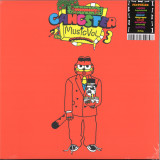
**Gangster Music Vol.3: The Most Gangster Music Trilogy of All Time Comes to a Triumphant Close**
Imagine curating a dream lineup of MCs and producers from every corner of the rap world—sounds impossible, right? Not for artist and illustrator Gangster Doodles, who has been bringing this vision to life for the past decade. Now, with “Gangster Music Vol.3”, the trilogy reaches its grand finale, and it’s bigger, bolder, and more unpredictable than ever before.
Gangster Doodles himself puts it best:
"It’s hard to believe that I’ve been actively working on this Gangster Music series for the past 10 years. The most gangster music trilogy of ALL TIME is almost complete!! And in my humble opinion Vol.3 is the most exciting out of the 3, both from a music standpoint (special shout-out to all my music heroes on Vol.3) and artistically speaking this is the most fun I’ve had in years”
Since launching Volume 1 in 2019 and following up with the second volume in 2022, Gangster Doodles has been shaping the Gangster Music series into a one-of-a-kind sonic universe—an unfiltered mix of underground titans, unsung legends, and rising stars. Volume 3 is the biggest installment yet, boasting a staggering 30 tracks that traverse the entire spectrum of rap and beat culture.
This time around, the lineup is as eclectic as ever. From legendary pioneers like Lee Perry and Tommy Wright III, to veteran producers such as Mr. Scruff and Peanut Butter Wolf, the album pays homage to hip-hop’s roots while pushing forward into fresh territory. The roster also includes established up-and-comers like Devin Morrison, Low Leaf, DJ Harrison, Quelle Chris, Homeboy Sandman, and Suzi Analogue, ensuring a mix of classic flavors and new-school innovation. The bubbling underground is well represented too, with artists like Raz Fresco, Atlanta’s 645AR, and Pro Era’s Chuck Strangers bringing their own distinct heat.
From pioneering SoundCloud rappers like Pouya to genre-bending composer John Carroll Kirby, from Birmingham’s Romderful to Chile’s RVYO, the album encapsulates a truly global soundscape, proving once again that Gangster Doodles’ ear for cutting-edge talent is second to none.
As always, the cover art is a vital piece of the puzzle. This time, Bootleg Garfield & Friends take center stage, bringing the same playful irreverence that has defined Gangster Doodles’ artwork for years. Fans are encouraged to engage, remix, and make the cover their own, staying true to the spirit of interactive creativity that has always fueled the series.
After years of meticulous curation, countless DMs, emails, and behind-the-scenes wrangling, Gangster Music Vol.3 is here to complete the trilogy in legendary fashion. Expect boundary-pushing beats, next-level lyricism, and a lineup that celebrates hip-hop in all its many forms.
“Thanks to everyone who’s actively supported and continues to tap-in. Believe & trust when I say I've got more dope stuff cookin’. STAY TUNED!! GANGSTER DOODLES 4EVER. 1LUV."
Gangster Music Vol.3 is out April 7th on All City. Stay tuned, stay tapped in, and get ready for the most gangster music experience yet.
Swedish artist Martinou crafts deeply immersive electronic music, seamlessly balancing weight and delicacy. His productions oscillate between hypnotic intensity and introspective warmth, always evoking a visceral response on the dancefloor.
After releasing on acclaimed labels like Nous’klaer, Turbo Recordings, and Mule Musiq, the Malmö-based producer now makes his long-awaited debut on Stockholm’s Studio Barnhus. His Linked EP showcases six meticulously layered compositions, where intricate rhythms intertwine with luminous melodies – ethereal synths drifting in and out of the grooves, shaping an atmosphere that’s both expansive and deeply personal.
With Linked, Martinou further refines his signature approach, crafting music that feels at once free-flowing and deliberate. It’s a record that invites deep listening yet remains primed for the floor – a testament to the Malmö maestro's knack for blurring the lines between club functionality and sonic storytelling.
Announcing the debut album from one of London’s most electrifying acts, New Regency Orchestra. An 18-piece Afro-Cuban big band, inspired by the musical melting pot of NYC in the 1950s, but with the punch and power of a whole host of London’s best Latin and jazz musicians. Blowing new life into these compositions, the album is a reimagining of some of the finest music from that golden era. From early 1950s René Hernandez and Tito Puente, through to the 1970s salsa of Rafael Labasta and Orlando Marin, produced and performed with fresh fire.
NRO is the brainchild of its artistic director, and the man behind Total Refreshment Centre and Church of Sound, Lex Blondin. Through a long-held passion for jazz, Lex discovered the explosive Afro-Cuban rhythms of mid-1940s NYC via the godfather of Afro-Cuban jazz, Mario Bauzá. A time when two musical worlds collided in a fusion of creativity and energy, jazz luminaries like Dizzy Gillespie and Charlie Parker joining forces with Cuban greats like Machito and Chano Pozo. This vibrant sound was music to dance to and found a home at The New York Palladium, a formative space of freedom and expression that was key to the scene’s development.
Although dance-focussed in their makeup, those early recordings are not often heard in modern club environments and Lex dreamt of retelling their story with a contemporary dynamism. A slice of serendipity followed, as a slot at a new festival opened up and Lex jumped at the chance to make this idea a reality, an 18-piece big band breathing new life into these beloved songs.
Enlisting the expertise of some of the capital’s finest talent, Lex and co-captain Andy Wood, of Como No fame, put together a world-class line-up of talent. Bringing in Eliane Correa as musical director and bandleader, a fluid and interchanging 18-piece band was formed.
The album itself is a hand-picked selection of timeless Afro-Cuban jazz classics, reimagined with NRO’s unbridled energy. It contains ten incredible instrumental tracks including 'Pregon' with its anthemic horn stabs and the addictive head nod bounce of 'Mambo Rama', alongside two scorching vocal numbers in 'Papa Boco' and 'Labasta Llego'. Coupling a heavyweight rhythm section with a wall of horns, they provide a fresh spin on songs from Tito Puente and Chico O'Farrill, René Hernandez through to Rafael Labasta.
“Some of the tunes like Tito Puente’s ‘Mambo Rama’ and ‘Scarlet Mambo’ might sound like they went to a gym as extra drums and bass synth were added to them whilst the tune ‘Sahib & Tito’ is a mix of Tito’s ‘Mambo Buda’ and Sahib Shihab’s ‘Nus’. Our intention is to be both respectful to the innovators and inventors of this incredible music and to pay our dues, but also to add something special from London where the city’s new jazz scene connects with its Latin American musicians and the musical influences around us.”
This pure collective joy, shared experience and music you can’t help but move to.
Slow-moving finger-picked ambient folk straddling the synthetic and organic divide – that is “The Ending Was A Typical Part”, the first album by the Zurich-based duo Gūsū. It combines the tradition of playing the guzheng with electronic instruments, allowing different yet harmonious worlds to collide.
The collaboration between Xueyan Chen and Nicolas Balmer alias Gūsū was born out of their shared musical explorations in 2022 and has evolved into a dialogue of sound. Chen’s guzheng, an instrument deeply linked to Chinese history, resonates with improvised and self-composed melodies, freeing its pentatonic scale from its traditional bounds. Her playing is underscored with the cryptic hum of Balmer’s modular synthesizers, the deep bass and layered textures that combine the organic with the electronic. Together they create a sonorous exploration of identity, displacement and unity.
Xueyan Chen has been playing the Guzheng since her early childhood. With her moving to Zurich, Switzerland she started reimagining its historical identity through improvisation and self-composed melodies. With this approach, Chen emancipates the instrument from its classical heritage, weaving a contemporary and deeply personal narrative. Nicolas Balmer meanwhile brings a contrasting yet complementary dimension with modular synthesizers, bass guitar, and electronic textures. His layered soundscapes amplify and distort the Guzheng’s pentatonic timbres, enveloping them in mysterious tones and expansive harmonics.
Portland's finest practitioners of Great Black Music offering to the planet! All Is Sound could not be a more apt title for this. Through saxophone, cello, piano, and flutes The Cosmic Tones Research Trio created a truly beautiful record. All Is Sound breaks new ground. At its heart, it's healing/meditation music, but the Gospel and Blues roots are in there too...as well as hints of forward-looking Spiritual jazz.
As sincere a record as you could ever hope for. Music is indeed the healing force of the universe. Formed by alto sax player and composer Roman Norfleet, cellist and multi-instrumentalist Harlan Silverman, and pianist Kennedy Verrett—who also plays a wide variety of wind instruments—, The Cosmic Tones Research Trio focuses on healing music. In All is Sound, delicate, profound melodies create peaceful, immersive soundscapes, which the group develops through their combined background in acoustic ecology, sound meditation, mindfulness, and active community involvement.
A noteworthy follow up to Norfleet’s first length with Mississippi Records (the self-titled Roman Norfleet and Be Present Art Group, from 2023), All is Sound offers the chance to engage with songs intended for healing. Following the steps of musicians such as Sun Ra, Alice Coltrane, and Pharoah Sanders, The Cosmic Tones Research Trio delivers music that is both restorative and sonically rich—each tone falling into perfect place, as if by magic. Praise for Roman Norfleet and Be Present Art Group: “A free-flowing suite.” — The Quietus // “Life-affirming music.
50th ANNIVERSARY EDITION
Heavyweight Vinyl 45 RPM Cut / Original glued prints on Thick Cardboard 700 gram / 2 Separated parts hand-glued / Glossy lamination / PVC outer / 30x30 cm insert with interview to Steve Kuhn by Tony Higgins printed on 250 gram Favini Lanilla Yellow / 20 Pages 21 x 30 cm "Real Book" with transcripts of the songs in the "Real Book" style, handwritten by The Maestro Carlo Spanò with main theme, chords and lyrics printed on 120 gram Shiro Eco paper, 100 gram Favini Crush Alghe. Carlo also edited an introduction with technical analysis of the session, which solves some of the little mysteries around this music gem.
Personnel:
Steve Kuhn - Vocals, Piano
Airto Moreira - Percussions
Billy Cobham - Drums
Ron Carter - Bass
Gary McFarland - Arranged by
Notes:
The album features the group playing Gary McFarland arrangements of Kuhn's compositions, accompanied by a string section on several tracks, with Kuhn delivering stream of consciousness lyrics in an unplanned and largely improvised fashion in the studio. However, that wasn't the only surprising aspect to the session. Airto Moreira's appearance was more by chance than design, he having just popped by the studio, again, unplanned. The 'Steve Kuhn' album is all the stronger for these extemporaneous and serendipitous elements and showcases a band at the top of their game; tight and funky yet relaxed and flowing like molten gold, with stabs and washes of keyboard from Kuhn. Splashes of free playing enter the session, but the band never stray too far from a melodic and harmonious centre of gravity. Kuhn's deft keyboard skills provide melodic embroidery to the impressive rhythmic textures and tonal colours of Carter, Cobham and Moreira. As if the music wasn't enough, the album is given extra significance by the fact that, within a few months of the recording, McFarland would die after being mysteriously poisoned by methadone in a New York bar. In a sense, it is a valedictory album from McFarland, channeled by Kuhn and the band.
It's among the hardest of Kuhn's albums to find so this reissue is most welcome. Luxuriate in the glow of Kuhn's Fender Rhodes and the pliant funky bass of Ron Carter; immerse yourself in the percussive interplay of Moreira and Cobham, a pairing that has rarely sounded so good. This is such an exquisite album; you will lose yourself in its delicate power and find yourself coming back to it again and again.