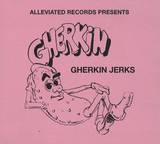
The original 12'' vinyl releases of Stomp The Beat and 1990 were two “Holy Grail†releases of Chicago House as they were only available for a short time before Gherkin Records went into inactive status in around 1991. At the time Larry Heard chose to not disclose the fact that he was the producer behind the Gherkin Jerks EPs. The two releases were a concept of experiments where he dove deeper into the equipment and do some creatively different tracks from his Mr. Fingers sound. These two legendary EPs have been heavily influential on other artists to this day. Often sampled or referenced they are true house classics and still amaze 25 years after their creation. Also on this album three bonus tracks, which are from the same Gherkin Jerks sessions but never released as such. Psychotic Fantasy was on the Dance 2000 pt. 2 album and Ecstasy is the full original take which makes its first appearence here. Reznaytor is an exclusive track for this release, never available before.
Поиск:full blast
Все
Relapse presents a remastered reissue from the undisputed king of Japanese noise-MERZBOW. "Pulse Demon" is one of the most celebrated releases of Masami Akita's storied 4 decade long career. Composed entirely by live noise concrete and the use of a fuzz box, "Pulse Demon" eschews all overdubs and studio trickery, laying MERZBOW bare. What follows in these recordings is the pure essence of unfettered noise. The rawness in "Pulse Demon" is palpable; praised as "genuinely extreme, downright torturous sounds that are strangely compelling in their shredding intensity." (A.V. Club) upon its original release in 1996. Remastered by James Plotkin (ISIS, ELECTRIC WIZARD, FULL OF HELL, and more,) the "Pulse Demon" reissues features "Extract 1", a never-before released track that was recorded as part of the original "Pulse Demon" sessions.
- A1: Logic - The Difference (Vocal Mix)
- A2: The Underground Solution - Luv Dancin' (In Deep Mix)
- B1: Armand Van Helden - Witch Doktor (Dark Ages Mix)
- B2: Photon Inc. - Generate Power (Wild Pitch Mix)
- C1: Aly-Us - Follow Me (Club Mix)
- C2: After Hours - Feel It (The Salso Mix)
- D1: Phuture - Rise From Your Grave (Wild Pitch Mix)
- D2: Joint Venture - Master Blaster (Turn It Up) (Tha Wild Pitch Mix)
Repress!
Legendary NYC house label Strictly Rhythm is celebrating a mammoth 3 decades of cutting edge, roof-raising house music. Truly a benchmark. Originally founded in 1989 by the dynamic pairing of music industry man Mark Finkelstein and A&R expert Gladys Pizarro, Strictly tapped directly into the fertile New York underground & after hours club scene, helping to launch and bolster the recording careers of dance music luminaries like Armand Van Helden, Roger Sanchez, Ultra Nate, Todd Terry, Wamdue Project, DJ Sneak, Louie Vega,
and many more ...
Strictly Rhythm is easily one of the most recognisable and respected dance music powerhouses of all time.
Across 3 limited double vinyl offerings, the Strictly catalogue has been expertly picked over to present you with a snapshot of some of the most earth shattering house music to emanate from the streets of New York City.
A who's who of producers and artists, all killer and no filler. End to end classics that help to tell the story of one of dance music's most well loved labels. Classic cuts and essentials from Armand Van Helden, Logic, Roger Sanchez (Underground Solution), Photon INC and more all feature on part 2 in their unedited, 12" mix glory.
Fully legit, remastered and selected with love courtesy of Strictly Rhythm and Above Board distribution for 2020 - Happy birthday Strictly Rhythm!
Longtime friend of the label Eraserhead returns after over a decade away from producing music due to his surreal MS Paint work as 'Jim'll Paint It' becoming an unexpected cultural phenomenon. With his debut full-length, 'Violence', Eraserhead presents a truly eclectic electronic LP featuring collaborations with established producers such as Om Unit, Enduser, and Brain Rays, as well as the vocal talents of Nadia Rose, Beans (of Antipop Consortium), and Cadence Weapon. An album held together by theme and tone rather than style or tempo, 'Violence' is the culmination of a bitter wave of inspiration, initially conceived in the wake of a personal tragedy that quickly grew into a broader polemic about the state of the world.
Originally linking up with Love Love in its breakcore netlabel infancy with his refined, breaks-heavy breakcore/gabba, Eraserhead's flair for tight, intricate productions was evident in his finely tuned tracks of controlled chaos. This time around, his work is a darker, more expansive evolution of his sound, with the scale upsized and the stylistic scope massively broadened, remaining unfaithful to any single genre, but with firm nods to Breakcore, Grime, Drum & Bass, Techno, Rave, Dubstep, and Footwork, all chewed up with a hard industrial edge and cinematically framed by a backdrop of apocalyptic synths.
Opening with the cold tech-noir of 'Shining Brainless Beacon' to set the tone, the album quickly locks in with the blistering spoken-word headrush of 'Hurricane With Teeth' alongside rapper Beans, before Om Unit lends his expertise on the sharp groove and clinical bass blasts of 'Operation Hardtack'. The album shifts and morphs constantly throughout the runtime, moving from the raw and urgent acid techno of 'Crowd Control' to the crunching military march of the Gore Tech collaboration 'No More Worlds' and the tribal sci-fi footwork of the Brain Rays collaboration 'Night Visions'. 'Monolith' provides a final burst of catharsis, channelling Underworld by way of Nine Inch Nails, complete with writhing screams from Amée Chanter of sludge-punk-noise-rock duo Human Leather, before the heart of the album is laid bare with the painfully bleak closing dirge of 'Animal'. In its final moments, 'Violence' leaves the listener suspended between devastation and awe - an unflinching portrait of an uncaring world.
Longtime friend of the label Eraserhead returns after over a decade away from producing music due to his surreal MS Paint work as 'Jim'll Paint It' becoming an unexpected cultural phenomenon. With his debut full-length, 'Violence', Eraserhead presents a truly eclectic electronic LP featuring collaborations with established producers such as Om Unit, Enduser, and Brain Rays, as well as the vocal talents of Nadia Rose, Beans (of Antipop Consortium), and Cadence Weapon. An album held together by theme and tone rather than style or tempo, 'Violence' is the culmination of a bitter wave of inspiration, initially conceived in the wake of a personal tragedy that quickly grew into a broader polemic about the state of the world.
Originally linking up with Love Love in its breakcore netlabel infancy with his refined, breaks-heavy breakcore/gabba, Eraserhead's flair for tight, intricate productions was evident in his finely tuned tracks of controlled chaos. This time around, his work is a darker, more expansive evolution of his sound, with the scale upsized and the stylistic scope massively broadened, remaining unfaithful to any single genre, but with firm nods to Breakcore, Grime, Drum & Bass, Techno, Rave, Dubstep, and Footwork, all chewed up with a hard industrial edge and cinematically framed by a backdrop of apocalyptic synths.
Opening with the cold tech-noir of 'Shining Brainless Beacon' to set the tone, the album quickly locks in with the blistering spoken-word headrush of 'Hurricane With Teeth' alongside rapper Beans, before Om Unit lends his expertise on the sharp groove and clinical bass blasts of 'Operation Hardtack'. The album shifts and morphs constantly throughout the runtime, moving from the raw and urgent acid techno of 'Crowd Control' to the crunching military march of the Gore Tech collaboration 'No More Worlds' and the tribal sci-fi footwork of the Brain Rays collaboration 'Night Visions'. 'Monolith' provides a final burst of catharsis, channelling Underworld by way of Nine Inch Nails, complete with writhing screams from Amée Chanter of sludge-punk-noise-rock duo Human Leather, before the heart of the album is laid bare with the painfully bleak closing dirge of 'Animal'. In its final moments, 'Violence' leaves the listener suspended between devastation and awe - an unflinching portrait of an uncaring world.
With »News from Planet Zombie«, The Notwist return to view after years of exploration and experiment with an album rich in both melancholy and positivity, sketched across a suite of thrilling, fiercely committed pop songs. It’s an album reflecting a chaotic world, but responding with warmth and generosity, to achieve creative and spiritual consolidation. Recorded in their home base of Munich, it reconnects with the security of the local to explore the troubles of the global: a guiding impulse writ large across this album’s eleven songs. It’s also the first studio album since 1995’s »12« that the entire band recorded together in the studio in its expanded live formation.
A new album by The Notwist is always a curious endeavour; their musical language is as consistent and resilient as the contexts for creativity are unpredictable and ever shifting. For »News from Planet Zombie«, the core trio of Markus and Micha Acher and Cico Beck embraced the plural possibilities of writing together, bringing songs to the collective and then arranging, rehearsing and recording that material live, in the studio.
The result is an album that’s energised, fully in ›the now‹, with spectacular moments where you can hear the magic bubbling up in the dynamic between the Achers, Beck, and fellow members Theresa Loibl, Max Punktezahl, Karl Ivar Refseth, and Andi Haberl. If »Teeth« begins »News from Planet Zombie« quietly and reflectively, by »X-Ray« everyone’s supercharged, blasting out future anthems with the collective energy cranked up high. The chiming keys of »Propeller« skim the instrumental’s surface like stones across burbling water; »The Turning« clangs its way into one of the album’s most heartwarming melodies.
»News from Planet Zombie« was recorded over one week at Import Export, a non-profit space for arts and music. You can tell, too; there are some pleasingly rough edges here, as though The Notwist’s striving for hazy perfection means they’re also confident enough to let the songs breathe and mutate between our ears. That openness to chance also takes in guest turns from friends both local and international, reflective of a cosmopolitan Munich: Enid Valu joins in on vocals, while Haruka Yoshizawa guests on taishōgoto and harmonium, Tianping Christoph Xiao on clarinet, and Mathias Götz on trombone.
The Notwist aren’t best known for cover versions, but »News from Planet Zombie« features two: a gorgeous version of Neil Young’s »Red Sun« (from 2000’s »Silver & Gold«), which the group originally developed for a theatre play directed by Jette Steckel, and a take on Athens, Georgia folk-pop gang Lovers’ »How the Story Ends«. They slot into the album’s narrative perfectly, nestling in like old friends, revealing The Notwist as poetic interpreters. Played well, the cover version is both acknowledgement of fellow travellers and act of generosity, and The Notwist nail both aspects here.
And that narrative, the way the album plays out? »News from Planet Zombie« acknowledges the distress of our current geopolitical impasse, while reminding us there are collective ways forward. Fed through the figure of the zombie, Markus Acher explores our anxieties: »In the title and some lyrics I reference B- and horror-movies, which is a reference to the crazy world at the moment, which seems to be like a really bad and unrealistic B-movie.« But there’s a reminder here not to lose the thread entirely, that these things, too, will pass.
»The river here in Munich I often go to has been there forever and will be there long after us,« Acher reflects, pinpointing an important source of succour for him, »always the same but always changing. Very calming, but also always reminding me that like this river time only flows into one direction and you can’t go back. Every moment is very precious.«
Artwork by Marie Vermont
The Notwist:
Markus Acher: vocals, guitar
Micha Acher: bass, sousaphone, euphonium, trumpet
Cico Beck: electronics, keyboards, guitar, recorder, percussion
Theresa Loibl: bassclarinet, clarinet, piano, harmonium, organ
Max Punktezahl: guitar
Karl Ivar Refseth: marimbaphone, vibraphone, glockenspiel, congas, percussion
Andi Haberl: drums, dulcimer
+
Enid Valu: vocals on 1, 2, 3, 4, 5, 7, 9, 10, 11
Haruka Yoshizawa: taishōgoto on 6, harmonium on 9, 10, 11
Tianping Christoph Xiao: clarinet on 4, 10, 11
Mathias Götz: trombone on 4, 10, 11
There’s an alternate reality where everyone makes a living wage and the cleanest buses you’ve ever seen arrive every other minute. Where the most intense songs are about confessing your love to a crush at the apple orchard, and where gentle feelings and chaotic energy are inseparable best friends. This is the timeline where Cootie Catcher is right at home. This Toronto based four-piece exudes both vulnerability and unbridled excitement, creating a sound that hypercharges the open-hearted tenderness of twee pop with spiraling synths and giddy electronics. New album Something We All Got is the clearest and most vibrant reading of Cootie Catcher’s vision yet, with songs of sweetness, nervousness, and expectancy that beam out unguarded.
After releasing music made primarily in basement recording environments, Something We All Got is the band’s first flirtation with studio recording. The edges are still sharp, however, with some parts assembled from time-honored lo-fi methods and fun, personally-sourced samples seeping into the production. The sound is explosive and upbeat, with euphoric guitars, bubbly synth lines, speedy drums both played and programmed, and all other manner of sound constantly colliding. Cootie Catcher has three songwriters, Sophia Chavez, Anita Fowl, and Nolan Jakupovski, all of whom have distinctive voices but still manage to overlap in their writing on shared concerns like navigating the lines of romantic and platonic relationships, their city’s social scenes, and struggles in both the microcosmic experience of playing in a band and the zoomed-out challenges of living through late-stage capitalism.
Joy still touches every surface of Something We All Got. “Quarter Note Rock” bounces around the room in a fit of jangling guitar chords, scratched samples, and interplay between breakbeat loops and somersaulting live drums. It’s a blast of positivity even with lyrics about how disappointing it can be to meet your heroes. A smiling electro pop instrumental supports lyrics about having to step painfully away from an almost realized love on “Gingham Dress,” a song that subverts themes of domesticity as a backdrop for the dashed wilt of hopeless devotion.
Cootie Catcher rolls down hills and jumps through flaming hoops throughout Something We All Got without ever dumbing down the visceral emotions that drive these songs. There’s a palpable tension between the band’s exhilarating sonics and the raw, often uneasy sentiments expressed, but it’s an integral part of what makes them unique. Rather than hide behind the kind of calculated vagueness that plagues so much of the indie rock landscape in the time of cursed algorithms, Cootie Catcher runs full-speed toward every confusion and excitement, fearlessly direct and embracing the reality they’re in.
Bristol-based provider of tough and sinewy drum & bass, Holsten has proved himself one to watch with successes on UVB-76 Music, Hotline and Rupture, not to mention a clutch of releases on the essential label, Droogs. This EP sees him offering up four battle weapons that lean towards the glory days of techstep. Opener 'Burn' goes for apocalyptic bass and a hardstepping outer shell, finished off with nicely unsettling sonics. 'Service Kru 2' is the roasting Amen-led roller, with Dillinja-esque sidewinding edits, kung fu samples and ravey stabs. Flip it over for 'Twisted Music', tense and edgy rather than full on blasting, while closer 'Projectiles', remixed by Overlook, steams its way to the run out groove with the kind of dystopian intensity that fans of classic No U-Turn will be very comfortable with. Producer and label alike are both on the rise, so get on it.
After a series of successful outings alongside sidekicks Ofofo and Zongamin, studio wizard MYTRON turns in his debut solo full-length for Multi Culti World Records. With contributions on Invisible Inc, Calypso, Bongo Joe, Kalahari Oyster Cult, LYO, Codek Records and Earthly Measures, Mytron has carved out a name for himself in a carefully-curated left-field quadrant of the indie-dance galaxy. Tuning his oscillators to myriad sounds — from dub and disco to krautrock — the London-based producer perhaps most notably channels the pristine compositional style of Kraftwerk. While most apparent in the use of vocoder, there’s a consistent efficiency of arrangement that recalls the man-machine in effervescent, idealistic fashion. Mytron manages to keep it simple, funky and musical — whimsical tunes that bop along with analog grit, wilderness, and wonk. There’s a warmth and wit that shine through every synth line, an understated confidence that speaks of years spent tangled in wires and waveforms, with an inclusive sonic eclecticism that flattens hierarchies between genres, geographies, and generations. Each influence is invited to the table, treated not as pastiche but invited to dine and dance in a space where kosmische dub disco and Afro rhythms can coexist without borders. The sleeve design echoes this philosophy: video-feedback patterns hinting at our modern screens, both portals and filters — coloured, distorted intermediaries through which we perceive the world. In the trippiest sense, the record is both reflection and refraction — a sonic mirror held up to an interconnected, glitchy reality. Tailored equally for DJ use and home-listening head trip, the album is meticulous, mischievous and merry.
BanBanTonTon review:
On Mytron’s debut long-player for Multi Culti groovy 21st Century leftfield house gear collides with Daniele Baldelli and Beppe Loda’s hugely influential `80s afro / cosmic. The 9 tracks are chunky, chugging and full of funky, funny noises. Old school B-lines mixing with eccentric electronics. Spinning, spiralling sounds.
Sugar is an electro-pop, vocoder confection, cut from the same sonic cloth as cult classics like Codek’s Tam Tam. Created from tough trap drums, splashing effects and a mutant Giorgio Moroder bass arpeggio. The title track, Propellor, pits Kraftwerk-esque hardware harmonised vocals against a bongo loop and a whistling hook. Playground has simian shrieks surround tumbling tom-toms. Highway Maintenance adds kosmische synths to a dance of woodblocks and buzzing bottom end. Keep On Dubbing is an organ-led, clip clopping percussive canter.
Tracks such as Speaker Can Talk, shot through with disco lasers blasts and recalling Curt Cress’ Dschung Tek, also lift the tempo up, but the bulk of the music here is a mid-tempo, techno drum circle. Squelchy sequences gurgling in and out of programmed percussion. On Quasar, spiky acid edges in and slowly takes over.
Key references that come to mind are Baldelli’s own turn-of-the-2000s Cosmic Sound Project productions, and Wolf Müller’s scene shaking sides on Themes For Great Cites, from around a decade later.
- 1: Urn Burial
- 2: The Redness In The West
- 3: The Third Migration
- 4: They Came Like Swallows
- 5: The Living Theater
- 6: The Oceans Are Crying
- 7: Insight
Black Vinyl[30,67 €]
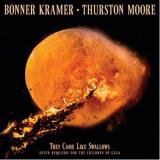
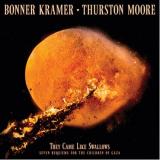
They Came Like Swallows is the first album-length collaboration between Thurston Moore and Kramer (now officially Bonner Kramer), two giants of alternative/ experimental music. The accomplishments and influence of these two artists in the world of independent music cannot be overstated and the result of their artistic union is a startlingly cohesive statement that burns through landscapes of primitive outsider rock, avant-garde composition, progressive ambient and further locales boldly and beautifully unnamable. “Kramer and I reconnected in Miami, Florida, a few years back, many many years after each of us had departed NYC on separate life adventures. It was only a matter of time before Kramer and I started making plans to record together and with his irrepressible due diligence he quickly set up a mobile recording contraption in the pad I was decamped in, the Florida sunshine flowing through the palm leaves, lithe lizards skittering across the windowsills, and we just went for it.
Kramer had the idea to cover a Joy Division tune, a left turn from the improvisations we had been tracking, though wholly in keeping with both our sensibilities of light and dark unifying in transcendent songwriting, both of us devotees of 'the song' as well as 'the freedom.’ What transpired is They Came Like Swallows, a session we immediately felt should exist as a prayer to the war-torn souls of the families of Palestine continually decimated by the brutality of genocide. We agreed beyond words to offer our music as a sonic activism and as a beneficent energy. This album is our duo exchange for human dignity, it is our soul music for any semblance of a peaceful planet.” ~ Thurston Moore “For the first time in our nearly 45 years of friendship, we had identical time windows open to make a record together,” recounts Kramer. After all this time not a moment is wasted as the duo immediately taps into the heightened core of improvisational tension across these seven offerings. Volcanic opener “Urn Burial” notches a similar historic union (John Cale and Terry Riley) to meet the circumstances of the moment, with swirling mists of organ and pounding toms over guitar that thickens the atmosphere with jagged, grimy dissonance.
Solemn strings open the second track, “The Redness In The West,” with Kramer’s cello and viola in dueling bow beneath the high tension drive and sustain of Thurston’s electric guitar, tapping out a Morse code of tension that mounts endlessly into a fog of inevitable war by the end. Moore and Kramer’s sense of experimentalism is in free and full grandeur throughout They Came Like Swallows, though the duo keep a strong and constant sideways eye on melody, composition and architecture, to the ends that any strict lines between song and improvisation are blurred beyond qualification.
As if to punctuate this point, Swallows closes with a nightwork cover of Joy Division’s “Insight,” a doleful coda that breathes out with a solemn inner grace under Thurston’s instantly stylistically recognizable guitar melodies as they weave into he and Kramer’s unison voices. As the lone vocal piece and only traditional ‘song’ form on the album, “Insight” is unique to this set and as a closing statement draws connective lines back to the kind of dynamic, electrified melodicism that wove deep, melancholy patterns into the untamed fire of Sonic Youth’s Sister and Daydream Nation. In the album’s final moments, the two voices repeat the lyric “I’m not afraid anymore” as mantra, underscoring the heavy, unsettled themes and methods that preceded it. Kramer describes the creative process of They Came Like Swallows: “I had composed and recorded a few pieces at my home studio over the course of a couple weeks. Thurston was spending the winter in South Florida, so I flew down and spent a few days recording his guitar parts in his home there. Watching him spontaneously compose his parts was pretty astonishing, to say the least. Once we'd finished working on those pieces, we began improvising and following wherever the music pointed us, and another few pieces were born. We got straight to it, without anything driving us other than the joy of finally working together.
My personal goal was to remain present and catch as many surprises as I could from Thurston's guitar work, and there were plenty during those few days. We had a fucking blast.” Thurston’s contributions here will be readily familiar to any acolytes of his other works, the through-line between his inspired playing, cradled in Kramer’s meticulous, solid arrangements. “If I had to make this record again, I'd do it all exactly the same way,” Kramer says. “It’s like jazz, you don't think about it. You just do it. It was miraculous, and you don't fuck with a miracle.”
They Came Like Swallows is the first album-length collaboration between Thurston Moore and Kramer (now officially Bonner Kramer), two giants of alternative/ experimental music. The accomplishments and influence of these two artists in the world of independent music cannot be overstated and the result of their artistic union is a startlingly cohesive statement that burns through landscapes of primitive outsider rock, avant-garde composition, progressive ambient and further locales boldly and beautifully unnamable. “Kramer and I reconnected in Miami, Florida, a few years back, many many years after each of us had departed NYC on separate life adventures. It was only a matter of time before Kramer and I started making plans to record together and with his irrepressible due diligence he quickly set up a mobile recording contraption in the pad I was decamped in, the Florida sunshine flowing through the palm leaves, lithe lizards skittering across the windowsills, and we just went for it.
Kramer had the idea to cover a Joy Division tune, a left turn from the improvisations we had been tracking, though wholly in keeping with both our sensibilities of light and dark unifying in transcendent songwriting, both of us devotees of 'the song' as well as 'the freedom.’ What transpired is They Came Like Swallows, a session we immediately felt should exist as a prayer to the war-torn souls of the families of Palestine continually decimated by the brutality of genocide. We agreed beyond words to offer our music as a sonic activism and as a beneficent energy. This album is our duo exchange for human dignity, it is our soul music for any semblance of a peaceful planet.” ~ Thurston Moore “For the first time in our nearly 45 years of friendship, we had identical time windows open to make a record together,” recounts Kramer. After all this time not a moment is wasted as the duo immediately taps into the heightened core of improvisational tension across these seven offerings. Volcanic opener “Urn Burial” notches a similar historic union (John Cale and Terry Riley) to meet the circumstances of the moment, with swirling mists of organ and pounding toms over guitar that thickens the atmosphere with jagged, grimy dissonance.
Solemn strings open the second track, “The Redness In The West,” with Kramer’s cello and viola in dueling bow beneath the high tension drive and sustain of Thurston’s electric guitar, tapping out a Morse code of tension that mounts endlessly into a fog of inevitable war by the end. Moore and Kramer’s sense of experimentalism is in free and full grandeur throughout They Came Like Swallows, though the duo keep a strong and constant sideways eye on melody, composition and architecture, to the ends that any strict lines between song and improvisation are blurred beyond qualification.
As if to punctuate this point, Swallows closes with a nightwork cover of Joy Division’s “Insight,” a doleful coda that breathes out with a solemn inner grace under Thurston’s instantly stylistically recognizable guitar melodies as they weave into he and Kramer’s unison voices. As the lone vocal piece and only traditional ‘song’ form on the album, “Insight” is unique to this set and as a closing statement draws connective lines back to the kind of dynamic, electrified melodicism that wove deep, melancholy patterns into the untamed fire of Sonic Youth’s Sister and Daydream Nation. In the album’s final moments, the two voices repeat the lyric “I’m not afraid anymore” as mantra, underscoring the heavy, unsettled themes and methods that preceded it. Kramer describes the creative process of They Came Like Swallows: “I had composed and recorded a few pieces at my home studio over the course of a couple weeks. Thurston was spending the winter in South Florida, so I flew down and spent a few days recording his guitar parts in his home there. Watching him spontaneously compose his parts was pretty astonishing, to say the least. Once we'd finished working on those pieces, we began improvising and following wherever the music pointed us, and another few pieces were born. We got straight to it, without anything driving us other than the joy of finally working together.
My personal goal was to remain present and catch as many surprises as I could from Thurston's guitar work, and there were plenty during those few days. We had a fucking blast.” Thurston’s contributions here will be readily familiar to any acolytes of his other works, the through-line between his inspired playing, cradled in Kramer’s meticulous, solid arrangements. “If I had to make this record again, I'd do it all exactly the same way,” Kramer says. “It’s like jazz, you don't think about it. You just do it. It was miraculous, and you don't fuck with a miracle.”
Hey! Cabrera is back at Bordello. Following on from Italo Void, this time he arrives with two friends and fellow countrymen in tow: Marta Paradise, the duo of Paolo Ancona and Davide Pozzovivo. A shared passion for the analogue riches of the 1980s cements this new partnership, a passion fully captured in the bold synth‑lines and heady grooves of Go By Night. Bodies swirl in the fog of “Stasera No.” Glittering melodies float above clean beats, shifts swooping and tucking before the unmistakable vocals of Fred Ventura smoulder. The mood drops from disco to basement as “Go Ahead” takes hold. Those addictive hooks remain central, but now they’re teased by breathy samples, orchestral rinses and thick basslines.
Whistle blasts and cowbell rumbles introduce the flip. Bright and luminous, vocoder verses carry this late‑night rave straight into sunrise. Tempos fall for the close. Fragile drum patterns form a base from which machined and spoken words intertwine with bubbling 303 lines. A record that captures every moment of the night.
AGT Records are back for number 008 and the smoke machine is on full blast.
Christian Llopis put out a handful of releases in the early 2000’s, each capturing the progressive machine-groove of the time, but with his own signature twist and turn that made his sound stand apart from his contemporaries. The Lobster Tan EP, first released in 2005 on Play. Out. Right. Now. Recordings, shows offhis unique style perfectly.
Each track has its own distinct personality while maintaining a relentless momentum that throws each kick drum into the next. The title track ‘Lobster Tan’ has an almost elastic groove in the low end, balanced deftly with swirling samples and melody lines. ‘Simulation’ is a more heady offering, perfect for those late night/ early morning moments where the heads are down and the lights are low. The
mood is sinister, and its growling bassline and vocal samples barrel the tune forwards. Pick of the bunch is ‘Back in the Day’, a tribal roller that combines organic melody lines and pads with an ever-evolving bassline that will refresh any discerning dance floor back into life.
Llopis is an expert at keeping things subtle while moving the gears, and this release is a prime example of prog done right. We are happy to have this one back on the shelves, all in good time.
Svogue label delivers its fourth vinyl only reference with a brilliant and versatile
journey into breaks, house, dub and a touch of electro.
No peak time or standing out tracks this time but solid underground clubbing cuts,
fully shaped through a completely analog path and fashioned with attention to details.
Matteo showcases once again his vision serving an immersive listening experience
via a nimble blend of slapping drums, dreamy synths, warm grooves and emotional
strains.
- 1: Die In Cleveland
- 2: High Resolution
- 3: Don?T Wear Me Out
- 4: Fear Of The Living
- 5: Sanctuary
- 6: Dead Alive
- 7: Public Meltdown
- 8: Depression Song
- 9: One And Only Girl
- 10: Pill
- 11: The World Doesn?T Need Your Jive
San Diego’s Mrs. Magician has always bent surf music and punk into something delightfully off-kilter — sun-soaked, hook-heavy power pop with a lyrical fixation on life’s darker undercurrents. Their 2012 debut, Strange Heaven, was a nihilistic pop statement that grew into a cult classic. The 2016 follow-up, Bermuda, sharpened the edges with punchy, nervy songwriting. Both records were produced by John Reis (Rocket From The Crypt, Hot Snakes, Drive Like Jehu), cementing the band’s place in Southern California’s underground lineage. Now, in 2026, Mrs. Magician reemerges with their long-awaited third LP, Spiritual Hangover. Recorded at Dave Grohl’s Studio 606 and Singing Serpent Studios with producer Christian Cummings, Spiritual Hangover finds songwriter Jacob Turnbloom trading youthful nihilism for something more reflective. Where earlier records wrestled with existential dread through anthemic defiance, this new collection embraces uncertainty — an admission of ignorance in the face of the human condition, paired with a genuine longing for connection and understanding. The humor remains. The hooks are sharper than ever. But the perspective has shifted.
These songs feel less like a declaration of dominance and more like a celebration of fragility — an acknowledgment that life is fleeting, confusing, and still worth enjoying. The album features Andrew Montoya (drums) and Mark Rivera (bass) of The Sess, Ian Fowles (guitar) of The Aquabats, and John Reis (guitar). Spiritual Hangover channels the bright urgency of late-’70s power pop through a distinctly Californian lens — warm, melodic, and irresistibly alive. “Super fun, well crafted, with great melodies. It gives me that late ’70s power pop energy I loved so much as a kid. Every track has something joyous to grab onto. In a world full of bleak news, Spiritual Hangover is a warming blast of California sunshine.” — Walter Schreifels (Gorilla Biscuits/Quicksand)
Ketapasando presents “Mesetarian Breaks” (KTPV004): a high-speed journey through breakbeat terrains Madrid-based label Ketapasando returns with its fourth vinyl release: “Mesetarian Breaks” (KTPV004) — a 12” compilation that celebrates the raw energy and diversity of breakbeat in all its forms.
Four artists, four unique visions, one common goal: break the dancefloor. Pressed on 180g vinyl with full-color artwork and a protective silicone sleeve, this EP delivers an explosive blend of jungle, technoid, ragga-core, and futuristic breaks.
Each track showcases a distinct approach to rhythm, crafted by key figures from both the Spanish underground and the broader European scene.
THE ARTISTS:
FFF, a cornerstone of the European jungle scene, brings a ragga-core blast soaked in rave heritage and hardcore attitude.
Berman, co-founder of Madrid’s Bellota Dubs, delivers a rolling cut built on tight vocal samples and chopped-up 160 bpm energy.
Jailed Jamie, known for his audiovisual storytelling, blends jazzy melodies with sharp breaks for a cinematic yet floor-ready experience.
Tarek, core Ketapasando producer, makes his vinyl debut with a deep, heavyhitting technoid track forged in the fires of the 174 bpm realm.
“Mesetarian Breaks” is more than a record — it's a love letter to broken rhythms, a sonic dive into the Iberian underground, and a statement of intent from a label fully committed to the breakbeat spectrum. Snippets available in this email.
Surprise Chef press two standouts from their latest album Superb on a 7" for a straight fire two-sider.The A side "Bully Ball" kicks in the door like the fellas have something to prove_Thundering drums start the affair then a haunting piano riff, guitars, bass, and glockenspiel trade places pushing through the speakers and mesmerizing the listener. The B side "Consulate Case" is another turn it up to the red banger that is sure to fill the dance floor. The rhythm section is full blast right out of the gate and the synth teases in a lush piano part that puts this one over the top and commands your attention.
The fryer’s on full blast – Pomme Frite welcomes the Parton Brothers to the kitchen!
Straight from Jolene Records, Danny & Mike make their Pomme Frite debut with a golden-crusted 4-track EP that could’ve rolled right off the Roule press back in ‘98.
The brothers serve up four slabs of vintage French touch – ‘Extraball’, ‘Gemini’, ‘Luniz’ and ‘The World Without You’ – each dripping with filter-funk, crunchy samples, and that unmistakable disco sizzle.
We’ve always had a soft spot for that authentic French sauce – and the Parton Brothers bring it homemade, hot, and with love.
Edits by Mr K
Edit heavyweight Danny Krivit edges close to full-on remixes with these two extended takes on soul genius Stevie Wonder’s timeless tunes. Using isolated instruments and vocals, the familiar classics take new shape in the able hands of Mr. K, providing a fresh look at cuts that have never faded in popularity. ‘Master Blaster’, Stevie’s tribute to Bob Marley, gets an attention-grabbing intro that is tailor-made to slide right into DJ sets, while the flip, the R&B essential ‘I Was Made To Love Her’, is filled with breakdowns and clever cuts that will open the eyes and ears of even the most jaded soul fanatic. Masterful work from NYC’s edit king and a fitting tribute to the Motown legend on a loud 12-inch readymade for club play. Record Store Day special!
10, 9, 8, 7, 6… the countdown to blastoff has started! Paris-based band Setenta is preparing for their upcoming 20th anniversary by releasing their sixth album, Apollo Solar Drive. The record is poised to be their best yet and is the culmination of an odyssey of artistic discovery. Setenta has been constantly striving for illumination through the years, yet also exploring the dark side of the human condition along the way. As the band describes it, this record is an Afro-Latin retro-futurist tribute to the sun. If their previous album, Materia Negra, launched the Setenta space shuttle crew into the void of “dark” matter and black holes, they now change course and valiantly approach the sun at full warp speed, taking us from darkness into the light. Miraculously, Setenta manage to bring some of the rhythmic and harmonic material they’ve explored on Earth with them, yet boldly dare to go where no one has gone before, challenging themselves to take their music, and their audience, to uncharted dimensions and new realms of existence.
In keeping with the themes of Materia Negra, FIP (Radio France) selection in 2020, Setenta’s sixth mission to explore “the great beyond” of “inner space” is aptly titled Apollo Solar Drive, emphasizing the band’s turning to the life-giving light of the sun for inspiration while playfully echoing the title of Eddie Palmieri’s Latin funk and social commentary masterpiece, Harlem River Drive. The overall vibe is warm and positive, propelled by the dual energy thrusters of funky, fierce beats and deceptively complex arrangements, yet going down smooth in the best sense of the word, like your favorite tropical cocktail or classic jazz dance fusion record of the 1970s. Of course this delicious treat is served with a special Setenta flavor all its own.
This time around, Apollo Solar Drive celebrates the trajectory of the band’s unique interstellar journey by deploying a resolutely jazzy, “funkadelic” angle to their beloved Afro-Latin music. Setenta’s band members tell their truths as a collective, with an emphasis on instrumental sections, focusing on the interweaving of multiple keyboards and guitars, while condensing the vocals to group choruses, as opposed to the solo voices of the past. The overall approach is more futuristic in its conception and realization, from the arrangements to the sonic engineering, although the rhythmic base still remains rooted in Afro-Cuban traditions as well as those of other Caribbean nations.
Pablo E. Yglesias (DJ Bongohead) of Peace & Rhythm (USA)
An appetite for the unknown" - Daniel Lanois
No collaboration is unlikely when the end goals are the same. A meeting of two artists who illustrate different corners of the musical landscape, come together to create a new statement that takes their collective strengths to higher elevations and encompasses new terrains.
So it is on the first collaborative journey of Canadian musicians Venetian Snares and Daniel Lanois. What started as mutual respect for one another's work, led to several years of a creative germination resulting in an eight-track full-length exploration released May 4th on Timesig/Planet Mu.
The path began in 2014, after Lanois reached out to Venetian Snares (Aaron Funk) as a fan of his work. The project started to take root in Summer of 2016, after Funk hung around Toronto between shows. Taking his gear to Lanois' studio, the two began to play for the first time together in what would prove to be a formative moment in their creative journey together.
I love making music with Dan, he has a real understanding of how to create a world and build what may exist within that world. Bassdrums are trombones and they are a colossal whale which floats on clouds of leaves speaking to the blast furnace feeding the mammoth. A small painting of forest horses hangs in the cranium of the sea horse.' - Aaron Funk
Recorded live in a former Buddhist temple-turned-studio in Toronto,
'Venetian Snares x Daniel Lanois' travels to new zones in what Lanois describes as a body of work driven by exploration'. Like all the best collaborations, it's brought something new out of both musicians. Equipped with their production acuity, they let their natural workflow guide them through uncharted waters. Funk laid the groundwork with drums while Lanois rode the pedal steel, weaving their sounds together in a new sonic tapestry. The two ultimately landed at their destination, their work ready to be shared with those willing to explore.
In Daniel Lanois 'own words:
"To come upon a new form reassures the head that frontier lives on The unlikely pairing of Venetian Snares and Daniel Lanois may very well have provided us with a nice new pair of shoes to walk to new sonic frontier A melange of gospel and electronics As madness of the world trips over its heels these Canadian sonic innovators prepare for travel A body of work driven by exploration, brings to us in our modern times what we remember and admire from the Jazz explorations of the 50s A splintering An appetite for the unknown"
Limited 2024 Black Vinyl Repress
Osaka based psych-rock three piece Hibushibire return after a long break, with a new line up and a stunning third album. Produced by Acid Mothers Temple/Mainliner guru Makoto Kawabata who also guests on the album.
Following the successes of their debut album 'Freak Out Orgasm!' (2017), the follow up ‘Turn On, Tune In, Freak Out’ (2019) and two very well received UK tours. The band headed home to Osaka, Japan and then, the pandemic hit.
During this downtime, guitarist/vocalist Changchang decided to create a new power trio. Enter Tetsuji Toyoda (Bass/Vocals) & Aoi Hama (Drums/Vocals). The new trio have spent the last three years writing new music, playing live and honing their sound in Japan, and a short well received tour of Taiwan with Riot Season labelmates Dope Purple. And now finally, Hibushibire mark 2 is born properly.
“Hibushibire has returned after a change of members. A psychedelic, progressive work, suitable for a new beginning"
Entering the studio with Acid Mothers Temple/Mainliner guru Makoto Kawabata in the producer chair (and also as a guest musician) once again, the band recorded album number three, 'Magical Metamorphosis Third Eye’. Makoto also adds some of his own trademark guitar howls throughout the album, perfectly complimenting Changchang’s own growing prowess.
Here the band have taken their trademark psych-rock blasts and blended them perfectly with some more trippy, dare I say sweet progressive psychedelic sounds.
“The idea of this album is based on the theme of "occultism and mysticism". But it's not a serious thing, it's about the things we like (UFOs, pyramids, psychic phenomena, shamanism etc) and we all had fun while making it. In terms of what makes it different from the previous Hibushibire albums, it’s where AOI HAMA's vocals are present. I had wanted to use a female vocalist for a long time, so it was a good feeling!”
Like the band's first two albums, 'Magical Metamorphosis Third Eye’ is very much an album of two halves. Side one again is full of killer shorter tracks, while side two is reserved for a blinding majestic 20 minute epic ‘Ayahuasca Witch Abduction’. Perhaps the biggest musical surprise here though is probably track two, the beautifully mellow tripped out ‘We Won't Go Back To The Past’, which sounds like it’s been beamed straight out of the late 60s/early 70s.
The band also tip a nod to the Beatles psychedelic classic ‘Tomorrow Never Ever Knows’, but with their own twist of course.
It’s clear with the line up changes, Changchang has decided to expand the band's musical pathway, and he’s achieved stunning results.
The band plan to return to the UK and Europe in 2024 to see friends old and new.
Pluto’s Plan is back with a full blast. Another four-track VA welcomes back label founders and introduces new names to the roster. The A side kicks off with Tourman, delivering a cosmic acid heat, followed by the label’s own Hatsvali with a heavy dancefloor groover. The B side is shared between Pluto's Plan co-founder Hudson with a hypnotic tech house and gents behind Fraise Records, Duowe, with a virtuously crafted tune.
Überkeine sets the tone of his own record label with four esoteric tracks, designed for the club. An obvious intention to establish a radical style with conceptualized sonorities, is revealed throughout the Ep. The sound materials are elaborate, and go straight to the point. Obsessing over the flow of creativity offered by his modular synthesizer, he delivers a very dense techno and already affirms a well-marked identity. Powerful and textured kicks, intricate synthetic sounds contained in an arrangement reduced to the essential. The tracks come to life as the forthright reflection of the thoughts of the producer. Guillotine Whistle instantly plunges into the unbridled world of the Ep. An ominous atmosphere hovers over our heads as it reveals organic and disconcerting tones. A gentle brutality emanates from this whistling guillotine that awaits to cut you up in two. Leading the way towards Drifting Data, a track inspired directly from Jungle Patterns. Überkeine is humbly trying to render DnB to a techno format. The dense, saturated Bassline sustains the idea of breaking the dancefloor in pieces. A hard hitting, broken beat environment accompanied by heavily filtered synthetic chaos. Third track’s the charm, the B side starts with Mirror Moist. A drop-down, wet and straightforward techno track with a carnal Bassline. As sensual as it gets, this track conveys a kinky loop urging intimacy and blasting heat throughout the club. Last but not least, Shaney’s remix of Mirror Moist. Picking up core elements of the original vibe and translating it into the off-beat techno nightmare it deserved to be. Full-on obscure dancefloor piece of equipment.
- A1: Euphoria (Feat Liz)
- A2: Everybody (Feat 10K Caash & Zelooperz)
- A3: Dreams 1000000 (Feat Milk)
- A4: Slip N Slide
- A5: Bite That 2 (Feat Trinidad James)
- B1: Sideroom
- B2: Bunny Lava (Feat Virgen Maria)
- B3: No Antidote (Feat Ripparachie)
- B4: Static (Feat Banshee)
- B5: Ya! (Feat 645Ar)
- B6: Never Leave (Feat Milk)
JIMMY EDGAR's latest release for Innovative Leisure, LIQUIDS HEAVEN, is a psychedelic canvas of future R&B, euphoric bass, mutant tear-theclub-up rap, foundation-splintering noise, and gossamer soul.
On a surface level, it is a starburst of avant-garde fusion, collecting a diverse cast of eccentric geniuses and re- configured into an anthology of n - musique concrete.
As with all of his work, there is a deeper and subversive intent.
Do not mistakenly believe that LIQUIDS HEAVEN is merely a technicolor dream of ethereal abstractions. It bangs as hard as anything to ever bump from a subwoofer.
Over a polychromatic blast of crunk, bounce on Everybody like a rap
rave inside a 31st century space station. Bite That 2 finds Trinidad James spitting flames over booty- shaking, wall- crumbling bass. On Ya, 645AR chirps over a metallic chassis of booming industrial funk.For all the high energy propulsion, there is a counter-balance of melancholic beauty.
The album's opener, Euphoria features a Liz Y2K vocal that levitates with plaintive longing. The Milk- aided Dreams 1000000 sounds like the chimerical soundtrack to a manga utopia that needs to be imagined. Milk also appears on the finale, Never Leave, which
captures a bittersweet sadness, the wistful emotion of the tide slipping away.
Jimmy's career has been a series of fascinating left- turns. Signed to Warp Records as a teenage electronic music prodigy, his work needs a scholarly bibliography to properly assess. He's recorded for the world's most respected imprints (Warp, K7, Hotflush, Innovative Leisure and his own New Reality Now).
Raised in Detroit, there have been stints soaking up inspiration in Berlin, Atlanta, LA, and New York. His list of close collaborators includes the most innovative musicians of the millennium, including Hudson Mohawke, Danny Brown, SOPHIE, DAWN, Mykki Blanco, Vince Staples, and several full projects with Machinedrum
as J-E-T-S.
- A1: Warm Slime
- A2: I Was Denied
- A3: Everything Went Black
- B1: Castiatic Tackle
- B2: Flash Bats
- B3: Mega-Feast
- B4: Mt Work
The ridiculously prolific Bay Area band Thee Oh Sees are back with another full-length long-player. Warm Slime is guaranteed to please fans of their whacked-out garage / psych / punk jams. Recorded by Sacramento sultan of sound Chris Woodhouse, Warm Slime carries on in the same tradition as the group's previous In The Red release, Help, showcasing their more electrified and rocking side, in comparison to other recent home-recorded releases. The centerpiece is undoubtedly the mind-bending title track, which clocks in at nearly 14 minutes and takes up the entirety of the album's first side. It's a psychedelic epic of "Inna Gadda Da Vida" proportions! John Dwyer's guitar playing is at its quadraspazzed best here, and the vocal interplay with Brigid Dawson gives it a B-52s-at-their-least-cheesy-crossed-with-the- Troggs vibe. The results are stunning. "Thee Oh Sees incorporate the oft-referenced Nuggets stuff in a way that feels reverential. With grinding guitars and bah-bah-bah vocals, but with the punk and new-wave elements also at play, they don't feel trite or plagiarized. This is like meat and potatoes prepared by a master chef-totally familiar but utterly delicious." -Pitchfork Recorded by Chris Woodhouse (Mayyors' guitarist and producer for The A-Frames, Hospitals, Coachwhips, Erase Errata, etc.) This is one of the best sonic blasts you will trash your speakers with this year....Raw, and real! Opening track is 13 minutes long, yes, we'll take it...
With »News from Planet Zombie«, The Notwist return to view after years of exploration and experiment with an album rich in both melancholy and positivity, sketched across a suite of thrilling, fiercely committed pop songs. It’s an album reflecting a chaotic world, but responding with warmth and generosity, to achieve creative and spiritual consolidation. Recorded in their home base of Munich, it reconnects with the security of the local to explore the troubles of the global: a guiding impulse writ large across this album’s eleven songs. It’s also the first studio album since 1995’s »12« that the entire band recorded together in the studio in its expanded live formation.
A new album by The Notwist is always a curious endeavour; their musical language is as consistent and resilient as the contexts for creativity are unpredictable and ever shifting. For »News from Planet Zombie«, the core trio of Markus and Micha Acher and Cico Beck embraced the plural possibilities of writing together, bringing songs to the collective and then arranging, rehearsing and recording that material live, in the studio.
The result is an album that’s energised, fully in ›the now‹, with spectacular moments where you can hear the magic bubbling up in the dynamic between the Achers, Beck, and fellow members Theresa Loibl, Max Punktezahl, Karl Ivar Refseth, and Andi Haberl. If »Teeth« begins »News from Planet Zombie« quietly and reflectively, by »X-Ray« everyone’s supercharged, blasting out future anthems with the collective energy cranked up high. The chiming keys of »Propeller« skim the instrumental’s surface like stones across burbling water; »The Turning« clangs its way into one of the album’s most heartwarming melodies.
»News from Planet Zombie« was recorded over one week at Import Export, a non-profit space for arts and music. You can tell, too; there are some pleasingly rough edges here, as though The Notwist’s striving for hazy perfection means they’re also confident enough to let the songs breathe and mutate between our ears. That openness to chance also takes in guest turns from friends both local and international, reflective of a cosmopolitan Munich: Enid Valu joins in on vocals, while Haruka Yoshizawa guests on taishōgoto and harmonium, Tianping Christoph Xiao on clarinet, and Mathias Götz on trombone.
The Notwist aren’t best known for cover versions, but »News from Planet Zombie« features two: a gorgeous version of Neil Young’s »Red Sun« (from 2000’s »Silver & Gold«), which the group originally developed for a theatre play directed by Jette Steckel, and a take on Athens, Georgia folk-pop gang Lovers’ »How the Story Ends«. They slot into the album’s narrative perfectly, nestling in like old friends, revealing The Notwist as poetic interpreters. Played well, the cover version is both acknowledgement of fellow travellers and act of generosity, and The Notwist nail both aspects here.
And that narrative, the way the album plays out? »News from Planet Zombie« acknowledges the distress of our current geopolitical impasse, while reminding us there are collective ways forward. Fed through the figure of the zombie, Markus Acher explores our anxieties: »In the title and some lyrics I reference B- and horror-movies, which is a reference to the crazy world at the moment, which seems to be like a really bad and unrealistic B-movie.« But there’s a reminder here not to lose the thread entirely, that these things, too, will pass.
»The river here in Munich I often go to has been there forever and will be there long after us,« Acher reflects, pinpointing an important source of succour for him, »always the same but always changing. Very calming, but also always reminding me that like this river time only flows into one direction and you can’t go back. Every moment is very precious.«
Artwork by Marie Vermont
The Notwist:
Markus Acher: vocals, guitar
Micha Acher: bass, sousaphone, euphonium, trumpet
Cico Beck: electronics, keyboards, guitar, recorder, percussion
Theresa Loibl: bassclarinet, clarinet, piano, harmonium, organ
Max Punktezahl: guitar
Karl Ivar Refseth: marimbaphone, vibraphone, glockenspiel, congas, percussion
Andi Haberl: drums, dulcimer
+
Enid Valu: vocals on 1, 2, 3, 4, 5, 7, 9, 10, 11
Haruka Yoshizawa: taishōgoto on 6, harmonium on 9, 10, 11
Tianping Christoph Xiao: clarinet on 4, 10, 11
Mathias Götz: trombone on 4, 10, 11
- 1: Supervisory Committee
- 2: Talkshow
- 3: Back Room
- 4: Civic Behaviour
- 5: Connecting Employment
- 6: Western Values
- 7: Lobbying
- 8: Party Donation
- 9: Pluralistic One-Party-Rule
- 10: Young Bloods
- 11: Campaigning
TALKSHOW is Haexler's 3rd EP and clearly marks an evident deep dive into the environment of purist Powerviolence. While the Hardcore influences were overtly visible on their previous releases, Haexler now turn their heads towards fully submerging in a primitively harsh tone that flirts with lo-fi soundscapes and noisey elements. On TALKSHOW, Haexler return with their concise and accurate deconstruction of political frameworks, frontally addressing the scope of formations of the liberal democracy, following the foundation of Agnoli's classic "Die Transformation der Demokratie." The full set of disputes regarding the scheme that builds the foundation of liberal democracies from lobbyism all across the possible impact of the media (talkshows), rituals of parties, political pluralism to western values is ferociously dissected with cynical implementations of snippets off the TV series "Mad Men". TALKSHOW will only take a comparably short amount of time to fittingly blast your head off. Make sure to be prepared! Classic black one-sided 11-Track 12" w/ b-side etching and lyrics insert!
There’s an alternate reality where everyone makes a living wage and the cleanest buses you’ve ever seen arrive every other minute. Where the most intense songs are about confessing your love to a crush at the apple orchard, and where gentle feelings and chaotic energy are inseparable best friends. This is the timeline where Cootie Catcher is right at home. This Toronto based four-piece exudes both vulnerability and unbridled excitement, creating a sound that hypercharges the open-hearted tenderness of twee pop with spiraling synths and giddy electronics. New album Something We All Got is the clearest and most vibrant reading of Cootie Catcher’s vision yet, with songs of sweetness, nervousness, and expectancy that beam out unguarded.
After releasing music made primarily in basement recording environments, Something We All Got is the band’s first flirtation with studio recording. The edges are still sharp, however, with some parts assembled from time-honored lo-fi methods and fun, personally-sourced samples seeping into the production. The sound is explosive and upbeat, with euphoric guitars, bubbly synth lines, speedy drums both played and programmed, and all other manner of sound constantly colliding. Cootie Catcher has three songwriters, Sophia Chavez, Anita Fowl, and Nolan Jakupovski, all of whom have distinctive voices but still manage to overlap in their writing on shared concerns like navigating the lines of romantic and platonic relationships, their city’s social scenes, and struggles in both the microcosmic experience of playing in a band and the zoomed-out challenges of living through late-stage capitalism.
Joy still touches every surface of Something We All Got. “Quarter Note Rock” bounces around the room in a fit of jangling guitar chords, scratched samples, and interplay between breakbeat loops and somersaulting live drums. It’s a blast of positivity even with lyrics about how disappointing it can be to meet your heroes. A smiling electro pop instrumental supports lyrics about having to step painfully away from an almost realized love on “Gingham Dress,” a song that subverts themes of domesticity as a backdrop for the dashed wilt of hopeless devotion.
Cootie Catcher rolls down hills and jumps through flaming hoops throughout Something We All Got without ever dumbing down the visceral emotions that drive these songs. There’s a palpable tension between the band’s exhilarating sonics and the raw, often uneasy sentiments expressed, but it’s an integral part of what makes them unique. Rather than hide behind the kind of calculated vagueness that plagues so much of the indie rock landscape in the time of cursed algorithms, Cootie Catcher runs full-speed toward every confusion and excitement, fearlessly direct and embracing the reality they’re in.
In his own time, in his own tone and in his own company.
‘Win and lose without losing oneself’’ This line from French rapper Oxmo Puccino greatly accompanied David Walters while composing his fourth studio album. Over the eleven tracks on ‘Ti Love’, David took his time to find the right tone and in turn, tell his truth.
‘Ti Love’, is a French-Creole abbreviation for “petite love”, meaning ‘little love’, evoking that sweet fondness found in those small gestures and little acts of kindness.
Think of things like young kids' brotherly love or a stranger lending you a helping hand, while expecting nothing in return. It’s these motions that allow this album to feel full of real life, carried by beating drums that also pull at our heart strings.
Basing himself in a small village in Martinique, where David had not long since scattered the ashes of his late mother, the multi-instrumentalist decided to remain there and let the writing of Ti Love pour out from deep inside him. Taking influence from around the island, the energy from his makeshift studio set up in Fort de France, allowing a resilient yet grieving man to recount, let go and come to terms with his recent loss.
So embracing these new circumstances, on the rugged coastal Caribbean island of Martinique, David took up an artist’s residency in the island’s capital Fort de France, located near the town’s port is the ‘Manoir des Artistes’, a bustling recording studio space. A place where the walls shake as the latest sounds being created are blasted by locals and visitors alike. Most studio doors are wide open; as music here is a huge part of everyday life, feedback from encouraging neighbouring musicians is on hand and welcomed. A contrast to the isolation often assumed with working in more traditional music studios.
It was here in this stimulating environment that David recorded Ti Love’s initial demos.
With his first collaborator onboard, Neeweed, a 25-year-old producer and gospel expert who David met at the Martinique Jazz Festival.
Of the album’s initial versions of the record David recollects: ‘It took me three years to write it, then I rewrote it, reworked it. In the end I'm really glad I stepped back and listened to myself.’ I found a great ally in GUTS, who ended up being the artistic director of the record”
David surrounded himself with the right people who helped him express himself in the best possible way. He called on other friends and musical comrades; album opener and title track, ‘Ti Love’ features the incomparable Fatoumata Diawara (World Circuit Records / Africa Express) and further along additional production came in from; Izem, Art Of Tones, and GUTS himself, who all added just the right amount of ‘little love’ to this
project. Further helping hands came from Californian producer and DJ Captain Planet, who David was introduced to a few years ago. Closer to home, here in Europe, the German producer Bluestaeb appears on two tracks: the very catchy disco funk ‘Mr Maraboo’ and ‘Kite Koule’, the latter being the first single lifted from the album, where David invited Nigerian guitarist Keziah Jones.
Elsewhere on the album, fellow Heavenly Sweetness recording artist Blundetto contributed two tracks; the reggae ‘Voodoo Love’, which is David's tribute to Studio One, and the very sweet and resilient ‘Bon Voyage’, which closes the album... "It's gold, it doesn't need anything changing.” remarked David - ‘Bon Voyage’ is a goodbye to his mother, whose voice called him from the bottom of the sea one night while he was surfing during the full Moon.
Released almost 20 years after his debut album ‘AWA’ released on French imprint Ya Basta, home to Gotan Project and many others, David boasts a long list of radio supporters including; Gilles Peterson, Cerys Matthews and Don Letts at the BBC, while further field Cosmo Radio in Germany, and KCRW in Los Angeles.
On this new record, David has shown sincerity and vulnerability, while still honouring the infectious groove that he is known for the world over. Despite the upsets, a little love can indeed go a long way.
CREDITS:
Produced by Bluestaeb / Blundetto / Captain Planet / Izem / Art of Tones
A&R : Guts
Mixed by Mr Gib @ Onetwopassit
Except "Bon Voyage” and "Voodoo Love" mixed by Jerome “Blackjoy” Carron
Mastered by Benjamin Joubert @ Biduloscope
Art by Elliott Walters
- 1: Heatsick (Feat. Hilary Jeffery)
- 2: Plastic Fascist
- 3: Praya (Feat. Bendik Giske, Maria W.horn)
- 4: Past Blast
- 5: Mancini Sighs
- 6: Black Metal Rewind (Night Drive Astra, 200)
- 7: Death By Nostalgia, 1688
- 8: Passengers (Feat. Bendik Giske, Maria W Horn, Adam Betts)
Loaded with tension and anchored by bold textural and stylistic contrasts, Sam Slater’s third solo full-length finds the British sound artist, composer, and engineer grappling with his creative contradictions head-on.
Having spent a life time in bands and producing records, Sam transitioned somewhat by accident through his work with Johan Johansson into working as a composer on high profile projects such as his collaboration with Hildur Guðnadóttir on the Grammy Award-winning Joker and Chernobyl, and with Pulitzer Prize-winning journalist Mstyslav Chernov on the soundtrack to the lauded 2000 Meters to Andriivka. Having a vast set of interests and influences is an asset when helping realise a directors vision for a soundtrack, but one's own musical voice can end up being constrained. In Lunng, Slater has gone back to his wildly divergent range of influences and rather than shy away from the extremes, he's used them to create a singular vision.
Take the opening track “Heatsick”: Slater imagines an extravagant fusion of 2000s drone metal and vintage British brass, welding ear-splitting overdriven drones and blown-out choral vocals to stirring trombone swells from veteran player Hilary Jeffery. On paper, it’s hard to imagine—but Slater’s intentionality conducts these polarizing elements into a surreal blur of sonic extremes, with the guitars’ relative harshness softened by Jeffery’s eerily nostalgic colliery echoes.
His last solo album, I do not wish to be known as a Vandal (Bedroom Community, 2022), showcased this breadth by assembling a team of collaborators including Sam Dunscombe and Yair Elazar Glotman. On this record he’s linking up with acclaimed multi-instrumentalist Maria W. Horn, idiosyncratic sax virtuoso Bendik Giske, versatile percussionist Adam Betts, and the aforementioned Jeffery, Slater ushers these players toward a lattice of calculated confutations.
Working to explore the tension between the divergent practices of his collaborators—Lunng was meant to be challenging. On “Praya”, Giske’s familiar overblown horn phrases are almost vaporized, vanishing among Slater’s weightless synths and Horn’s chillingly hoarse vocals. There are traces of Horn’s Funeral Folk project, but Slater shifts the emphasis, letting her voice brush past the other elements like a hallucination.
Slater’s use of extremes isn’t just in the micro; dynamics drive the album’s overall flow. “Praya” sets the stage for the record’s heaviest, most prickly moment: “Passengers”. Here, Horn’s voice cracks, rasps, and gurgles over serrated synths and Betts’ ritualistic drums. Slater turns an industrial symphony into a folk opera—dark, dramatic, and strangely beautiful—etched with Giske’s fluttering phrases.
But the mood soon shifts. Slater careens toward chaos, unleashing double-time rhythms and piercing textures familiar to anyone with a soft spot for classic black metal. These grotesque incongruities are deliberate; Slater surveys years of musical conflict and leans in, using dissent as fuel to build kinetic energy.
The weight of sentimentality bears down on “Black Metal Rewind (Night Drive Astra, 2006)”, melting teenage memories into hypnagogic ambience—shoegaze dreams whirled with angelic choral delusions. On “Death by Nostalgia, 1688”, he ventures further into polarizing territory, distorting AutoTuned voices with cryptic strings and medieval tonalities, unsettling any stable sense of past or present.
In this record Slater focuses on pure energy, color, and mood. Lunng distills years of listening into a bracing brew—boiling each sound down to its essence, then serving it with unflinching intent.
John Twells, 2025
- Somewhere, Nowhere
- Angles Mortz
- False Prophet
- Fluoride Stare
- The Void
- Ascension
- Just A Kid
- Host
- Landslide
- Renaissance
- 7: Am
- Blue In Grey
2026 Repress
Flickering in ultraviolet, there is an elusive place where blue pill meets red, ups become downs, and day merges with night. Those liminal spaces where anything is possible is where you’ll find Nightbus and their hypnotic debut album Passenger. Doom, uncertainty, and opportunity lurk in the shadowy corners of their murky existence with stops at disassociation, co-dependency, and addiction before reaching its final destination - a glimmer of hope.
The in-between of Nightbus’ own Gotham lies where Manchester’s city pulse meets Stockport’s outer realm. An audio-visual entity formed among a musical family of friends, freaks, and foes in messy mills and after hours on dancefloors alike, their sound bleeds from tension where collective creative forces are bound together and collide with the fallout of being torn apart. Before even playing a show, their So Young released single ‘Mirrors’ – a knowing nod of respect to some well-known gloomy Northerners - may have made old school indie heads shimmy at shows in Salford’s The White Hotel but also signalled the duo’s knack for offering listeners a Bandersnatch approach to hitchhiking their own personal Nightbus in whatever direction they choose to take. “Everyone can have their moment with our songs; the music is our response to who we are as young people, living in the city full of this energy right now,” they say.
Whilst reverb hefty melodies and dread-filled loops embody isolation from writing at each of their home studio set-ups, magic happens in the ether across 90s trip-hop, indie sleaze and electronica; Jake’s production layers Olive’s pop sentimentality with drums and samples whilst tales of a cast of faceless characters place Olive as puppet master; her severed self’s perspective manipulating their stringed limbs at arm’s length to see how their stories play out when scenes reflecting her own lie close to the bone. “It’s a bit fucked; like having this out of body experience with a made-up movie running through my head,” she says. “As I write I can see they’re all from a similar world, but they allow me to explore different feelings without giving away part of myself.”
Recorded at The Nave in Leeds with producer-engineer Alex Greaves (Heavy Lungs, Working Men’s Club), surprise and danger lies in every crevice. Brooding whispers turn to chants on 6-minute opus ‘Host.’ Improvised when performed live, its immersive shift in tempo leads to hefty dub courtesy of Jake’s pedals. Even then, you won’t know shit’s hit the fan until its mid-point reveal when ominous bass blasts a thunderous soundtrack as its protagonist defiantly walks away after committing the perfect crime. “It makes you wait, and more songs should have sirens,” Olive grins.
Leaning deeper into alter-egos via the video game-psychological horror of a Silent Hill dystopia, the band’s Fight Club moment ‘Angles Mortz’ turns its literal translation of death angles on its head as it reflects upon kink and internalised shame reincarnated as pride. Elsewhere the ice cool ‘Landslide’ is a Requiem for a Dream about the addiction of being in a band; ‘The Void’ explores co-dependency and estranged relationships; and carefully selected samples revive house track ‘Just A Kid’ from the band’s early incarnation. Passenger’s every direction is to face challenges head on. “That is what’s so great about horror; you can see through predictable patterns so when the unexpected occurs it's more realistic and uncomfortable… I want to own the dark stuff!”
As for Passenger’s first single, the pulsating ‘Ascension’ is a spiralling deep dive into death, suicide, and legacy around who or what we leave behind. A noughties club banger by way of NYC beats - ergonomically designed for those who like to stay out a little too often and too late - it throbs like a house party’s partition wall as the literal levelling up undergoes a neon transformation; blue glitching to pink, diffusing the white construct of the Nightbus Matrix. “It really does feel like the end of something and was purposely written that way,” they say, “the ascension is like a firework going off!”
With wheels in motion, Nightbus has become a movement surpassing sonic realms. Between shows from Porto to Brighton taking in The Great Escape, Rotterdam’s Left Of The Dial and Paris’ Supersonic; DJing; remixing; guesting (BDRMM’s Microtonic album); and even enlisting talented like-minds to craft a 3-part queer coming-of-age music video series which ties in with a new ‘hyperpop’ phase in the evolution of their popular Nightbus Soundsystem club night, heads are now being turned from sports brands to high-end fashion designers. “There are things we can’t reveal just yet,” tells Olive, “but we’re excited about the direction this beast we’ve created is heading.” As the album philosophises and asks one ultimate question; what does it truly mean to be ‘Passenger’? Nightbus may not claim to offer a definitive answer, but it might make you feel a bit better about those demons.
Known for their exhilarating live-to-record albums such as last year's critically acclaimed Wood Blues and Giant Beauty, سماع Sama'a (Audition) is the first of two releases that will surface after أحمدAhmed’s first studio recording sessions at North London’s The Fish Factory in early 2025.
Since 2014, Ahmed أحمد have excavated and re-imagined the music of Ahmed Abdul-Malik, in an ever ongoing search for future music. Over a decade on, the group were given the opportunity to set up in the studio for the first time and, with the aid of meticulous engineer Benedic Lamdin, سماع Sama'a (Audition) is the quartet's most detailed work to date.
Fastidious fans may recognise the album's tracklisting as that of Ahmed Abdul-Malik’s Jazz Sahara. After his success collaborating with the pianists Thelonious Monk and Randy Weston, Jazz Sahara was the first record Abdul-Malik made as a leader and was released in 1958. It used the flame of late Fifties jazz to light the wick of North African folk music and acted as a reminder of the Arabic origins of jazz, creating a distinct, unique sound that was far beyond its time. In Malik’s Jazz Sahara, there is no piano. The ongoing work of each member of [Ahmed] then is to think differently, to wonder how the music will work and to take a risk on trying it out - an extraordinarily compelling feat of imagination. Using group improvisation strategies and recording in single takes, سماع [Sama'a] (Audition) tackled the full suite of Jazz Sahara in just one session, with ‘Ya Annas [Oh, People’] and ‘Isma'a [Listen’] being previously unrecorded. 'Farah 'Alaiyna’, also released on 2019’s Super Majnoon, sounds unrecognisable - the slow, heady stomp and repeated phrasing of 2019’s embryonic [Ahmed] having been blast furnaced and sped up four-fold. The result is four kaleidoscopic, relative miniatures that move, unfold and re-imagine at a very different scale and proportion than [Ahmed]’s previous records. It’s a dizzying, euphoric music and an extraordinary record of a group moving through space-time like no other.
[b] Isma'a [Listen]
[c] El Haris [Anxious]
[d] Farah 'Alaiyna [Joy Upon Us]
[b] b1 Isma'a [Listen]
[c] c1 El Haris [Anxious]
[d] d1 Farah 'Alaiyna [Joy Upon Us]
[b] b1 | Isma'a [Listen]
[c] c1 | El Haris [Anxious]
[d] d1 | Farah 'Alaiyna [Joy Upon Us]
- A1: Seven Serpents
- A2: Satanic Anarchy
- A3: Krushers Of The World
- A4: Tränenpalast
- A5: Barbarian
- B1: Blood Of Our Blood
- B2: Combatants
- B3: Psychotic Imperator
- B4: Deathscream
- B5: Loyal To The Grave
- Vinyl 2 Extreme Aggression (Live At 70000 Tons Of Metal, 2023)
- Riot Of Violence (Live At 70000 Tons Of Metal, 2023)
- Terrible Certainty (Live At 70000 Tons Of Metal, 2023)
- Toxic Trace/Endless Pain (Live At 70000 Tons Of Metal, 2023)
- Awakening Of The Gods (Live At 70000 Tons Of Metal, 2023)
- People Of The Lie (Live At 70000 Tons Of Metal, 2023)
- When The Sun Burns Red (Live At 70000 Tons Of Metal, 2023)
- Some Pain Will Last (Live At 70000 Tons Of Metal, 2023)
- The Pestilence (Live At 70000 Tons Of Metal, 2023)
- Under The Guillotine (Live At 70000 Tons Of Metal, 2023)
- Terror Zone (Live At 70000 Tons Of Metal, 2023)
- Tormentor (Live At 70000 Tons Of Metal, 2023)
- Apocalypticon (Live At 70000 Tons Of Metal, 2023)
KREATOR’s Krushers Of The World is a ferocious return that finds the band at full strength, blending classic thrash fury with fresh intensity and purpose. From the relentless opener “Seven Serpents” to the darkly melodic “Tränenpalast” featuring Britta Görtz, the album shows a band unafraid to evolve while staying true to their roots. Tracks like “Barbarian” and “Psychotic Imperator” hit with unrelenting speed, while the title track and “Satanic Anarchy” deliver crushing groove and anthemic hooks. Backed by Jens Bogren’s massive production and Zbigniew Bielak’s striking artwork, Krushers of the World proves KREATOR aren’t just surviving — they’re still leading. Fueled by the reflective fire of their Hate & Hope film and Mille Petrozza’s sharpened vision, this is a statement album: heavy, focused, and unstoppable.
- A1: Seven Serpents
- A2: Satanic Anarchy
- A3: Krushers Of The World
- A4: Tränenpalast
- A5: Barbarian
- B1: Blood Of Our Blood
- B2: Combatants
- B3: Psychotic Imperator
- B4: Deathscream
- B5: Loyal To The Grave
Gold/Red Ink Spot LP & Transparent Orange 2LP[61,98 €]
Picture Vinyl[27,94 €]
Red Vinyl[27,94 €]
KREATOR’s Krushers Of The World is a ferocious return that finds the band at full strength, blending classic thrash fury with fresh intensity and purpose. From the relentless opener “Seven Serpents” to the darkly melodic “Tränenpalast” featuring Britta Görtz, the album shows a band unafraid to evolve while staying true to their roots. Tracks like “Barbarian” and “Psychotic Imperator” hit with unrelenting speed, while the title track and “Satanic Anarchy” deliver crushing groove and anthemic hooks. Backed by Jens Bogren’s massive production and Zbigniew Bielak’s striking artwork, Krushers of the World proves KREATOR aren’t just surviving — they’re still leading. Fueled by the reflective fire of their Hate & Hope film and Mille Petrozza’s sharpened vision, this is a statement album: heavy, focused, and unstoppable.
- A1: Seven Serpents
- A2: Satanic Anarchy
- A3: Krushers Of The World
- A4: Tränenpalast
- A5: Barbarian
- B1: Blood Of Our Blood
- B2: Combatants
- B3: Psychotic Imperator
- B4: Deathscream
- B5: Loyal To The Grave
Gold/Red Ink Spot LP & Transparent Orange 2LP[61,98 €]
Black Vinyl[27,10 €]
Red Vinyl[27,94 €]
KREATOR’s Krushers Of The World is a ferocious return that finds the band at full strength, blending classic thrash fury with fresh intensity and purpose. From the relentless opener “Seven Serpents” to the darkly melodic “Tränenpalast” featuring Britta Görtz, the album shows a band unafraid to evolve while staying true to their roots. Tracks like “Barbarian” and “Psychotic Imperator” hit with unrelenting speed, while the title track and “Satanic Anarchy” deliver crushing groove and anthemic hooks. Backed by Jens Bogren’s massive production and Zbigniew Bielak’s striking artwork, Krushers of the World proves KREATOR aren’t just surviving — they’re still leading. Fueled by the reflective fire of their Hate & Hope film and Mille Petrozza’s sharpened vision, this is a statement album: heavy, focused, and unstoppable.
- A1: Seven Serpents
- A2: Satanic Anarchy
- A3: Krushers Of The World
- A4: Tränenpalast
- A5: Barbarian
- B1: Blood Of Our Blood
- B2: Combatants
- B3: Psychotic Imperator
- B4: Deathscream
- B5: Loyal To The Grave
Gold/Red Ink Spot LP & Transparent Orange 2LP[61,98 €]
Black Vinyl[27,10 €]
Picture Vinyl[27,94 €]
KREATOR’s Krushers Of The World is a ferocious return that finds the band at full strength, blending classic thrash fury with fresh intensity and purpose. From the relentless opener “Seven Serpents” to the darkly melodic “Tränenpalast” featuring Britta Görtz, the album shows a band unafraid to evolve while staying true to their roots. Tracks like “Barbarian” and “Psychotic Imperator” hit with unrelenting speed, while the title track and “Satanic Anarchy” deliver crushing groove and anthemic hooks. Backed by Jens Bogren’s massive production and Zbigniew Bielak’s striking artwork, Krushers of the World proves KREATOR aren’t just surviving — they’re still leading. Fueled by the reflective fire of their Hate & Hope film and Mille Petrozza’s sharpened vision, this is a statement album: heavy, focused, and unstoppable.
- A1: Get Up I Feel Like Being A Sex Machine
- A2: Brother Rapp (Part I & Part Ii)
- A3: Bewildered
- A4: I Got The Feeling
- B1: Give It Up Or Turnit A Loose
- B2: I Don’t Want Nobody To Give Me Nothing
- B3: Licking Stick
- C1: Lowdown Popcorn 9.Spinning Wheel
- C2: If I Ruled The World
- C3: There Was A Time
- C4: It’s A Man’s Man’s Man’s World
- D1: Please, Please, Please
- D2: I Can’t Stand Myself (When You Touch Me)
- D3: Mother Popcorn
James Brown wants to know one thing before he and his band begin Sex Machine. “Can I get into the thing, really?,” he asks. His cohorts enthusiastically respond in the affirmative. And for the next hour and change, Mr. Dynamite gets into it and more, turning in a sweat-soaked, feet-moving, hip-swiveling, emotion-purging, in-the-red, drop-everything-you’re-doing-and-dance performance for the ages. Ranked by Rolling Stone among the 500 Greatest Albums of All Time, the sweeping 1970 effort towers as a testament to Brown’s inimitable legacy as well as the peak powers of his voice, vibrancy, and bands.
Sourced from the original master tapes, pressed at Fidelity Record Pressing, and housed in a Stoughton gatefold jacket, Mobile Fidelity’s numbered-edition 180g 33RPM 2LP set presents Sex Machine in audiophile sound for the first time. It explodes with the energy the lightning-strike music demands. Dynamic, immediate, present, airy: Everything from the brassiness and fluidity of the horns to the snap and decay of the snare to the swell and carry of the organ comes across in full-range perspective.
Then there’s Brown’s superhuman singing, which here emerges with a purity, naturalism, and transparency that ensure you feel everything. Screeching, shouting, pleading, moaning, preaching, stinging, commanding, testifying, crooning, humming: The Godfather of Soul contributes one of the finest vocal performances known to man. This definitive 55th anniversary reissue of Brown’s monster funk statement further exhibits a combination of clarity, solidity, separation, and imaging that helps bring to light what he and his crack ensembles committed to tape. Both in the studio and on the stage.
Just how lifelike does this reissue sound? Senior Mobile Fidelity Sound Lab engineer Krieg Wunderlich, who handled the remaster, notes: “There were some artifacts that sounded a bit like mistracking. But they turned out to be breath blasts on the vocal microphone. That is part of history. JB was workin' hard, and breathin' hard. And there was an edit the timing of that was truly strange. Again, a part of history.”
Originally marketed as a live album, Sex Machine contains six songs recorded in the studio and later overdubbed with canned crowd noise and reverberation. Save for “Low Down Popcorn,” the tracks on the latter half stem from a phenomenal performance captured in October 1969 at Bell Auditorium in Brown’s adopted hometown of Augusta, GA. The special relationship between the singer, the audience, and the location is palpable.
As the 1960s gave way to a new decade, Brown experienced immense success and dealt with unexpected change. Soul Brother Number One soon expanded his idea for an official live album captured in Augusta when the ensemble that backed him on that date morphed into the original version of the world-famous J.B.’s just months after the show. The virtuosic abilities, sticky chemistry, and rhythm-forward nature of the J.B.’s prompted him to book a one-off session in Cincinnati, OH, on a late July night.
Anchored by brothers William “Bootsy” Collins and Phelps “Catfish” Collins, the group — as well as two different drummers — laid down a nearly 11-minute rendition of “Get Up I Feel Like Being Like a Sex Machine” and a thrilling medley of “Bewildered,” “I Got the Feeling,” and “Give It Up or Turnit a Loose.” A pair of then-recent studio singles cut in separate locations in 1969, “Brother Rapp” and “Low Down Popcorn,” each featuring his prior group, took care of the second LP worth of material that complements the originally planned live set.
Complicated? Somewhat. Unusual? Definitely. But just as he elevated the expectations for all present and future R&B artists, Brown not only makes it all work. He makes it positively electrifying.
“Get Up I Feel Like Being Like a Sex Machine” is alone deserving of a dissertation on the art of funk music, seeing it moves up and down akin to an oil derrick, witnesses Brown unleashing a trademark series of grunts, squeaks, and “good god” asides, and glides to a hypnotic groove that won’t quit. Or look to the syncopated rhythms of “Brother Rapp (Part I and Part II),” one of multiple pieces here that signify the point where Brown began viewing every instrument as a percussive tool. Brown closes the three-song medley with his new band with a skedaddling “Give It Up or Turnit a Loose,” which provides jolts on the order of sticking your finger into a socket.
Not that the actual live material falls short in any way. Setting an insistent tempo for the vitality that follows, “I Don’t Want Nobody to Give Me Nothing” positions Brown as a role model, leader, and self-sufficient entrepreneur. All simmer and boil, the short and sweet “Licking Stick” dares you to keep pace. The floating, almost comforting “Spinning Wheel” spotlights the instrumental prowess of Maceo Parker and company, and functions as a seamless segue into the tender, horn-saluted “If I Ruled the World.”
And Brown and his mates still aren’t done. Just try to resist the one-two closing punch of “I Can’t Stand Myself (When You Touch Me)” and “Mother Popcorn.” Mercy.
Ain’t it funky? Sure ‘nuff.
Fracture & Neptune return to Astrophonica with their first collaborative 12” on the label since 2010.
Two epic, psychedelic, and deeply authentic tracks for both the floor and the head, carrying the unmistakable hallmarks of the duo’s classic sound — A psychedelic concoction of Jazz, Sci-Fi, Dub, and Breakbeat Choppage. Rooted in the lineage of Jungle and Drum & Bass, yet delivered in Fracture & Neptune’s unmistakably unique style.
To celebrate the release, UTILE — responsible for all Astrophonica design — have gone all out on the artwork, creating an iconic, type-based image for both tracks, presented on a full-colour, double-sided printed sleeve. Massive shout to UTILE for being as important to the label as the music.
“Erase Everything” is a journey through LA 2049 via London 1999 — as if Deckard were blasting an AWOL tape in his Spinner. Merging classic breaks and analogue saturation with soaring, cutting-edge pads and city-wide reverb, the result is both devastating and deeply thoughtful.
“Good Stuff” is inspired by a love of digging for samples across Jazz, Hip Hop, and Rock, and by a dedication to crafting kaleidoscopic soundscapes — All that good stuff, blended into one hallucinogenic trip.
Meeting at Islington Sixth Form College in 1996, Charlie (Fracture) and Nelson (Neptune) bonded over their deep love for the defining sound of London at the time — Jungle and Drum & Bass. Countless trips to Black Market Records in Soho, playing on pirate radio stations, and eventually, a makeshift bedroom studio — complete with an E-Mu ESI4000, a Mackie desk, and a few FX units — set the foundation for their journey. Their first release arrived in 2002 on Droppin’ Science, the label run by legendary Hardcore and Jungle pioneer — and fellow breakbeat manipulator — Danny Breaks. A run of mid-2000s releases on Ireland’s Bassbin, Paradox’s Outsider, and London’s Inperspective Records propelled Fracture & Neptune further into the cosmos. In 2009, they founded Astrophonica — initially as a home for their own music, but it quickly evolved into a hub for like-minded artists to experiment and explore freely. Almost 30 years on, they’re back in the studio with APHA034 — with more to come.
It was December 2015 when Simon Weiss delivered his first EP for Voyage Direct, an impressively intergalactic affair full of supersonic synthesizer arpeggio lines, Motor City influences and robotic drum machine hits. Two years on, the experienced Dutch producer returns to action for the first time since, in the process delivering another quartet of starry-eyed productions.
.
Through releases on Deepermotions, Rush Hour and Hometaping is Killing Music, Weiss has established a reputation for combining a deep understanding of dancefloor dynamics with a sci-fi inspired futurist aesthetic. Both of these complimentary traits are much in evidence on his second outing for Voyage Direct.
Weiss blasts off via Brain Fever', where raw, mind-altering arpeggio bass, fuzzy drum machine hits, spacey chords and alien electronics thrust our hero skywards. Think of it as techno for funk-fuelled, Italo-disco loving astronauts whose journey to the end of the universe is only just underway. This intergalactic funk blueprint is explored further on the deeper and more melodious You Want A Cigarette', where Weiss's vocoder vocals wrap themselves around mutant TB-303 lines, rush-inducing chords and clattering machine percussion.
On Space Ghetto (Booty)', our hero celebrates the discovery of previously unknown worlds in the only way he knows how. With kaleidoscopic, full-throttle electronic motifs and funk-fuelled synth-bass to the fore, Weiss offers his own unique take on electrofunk. Pleasingly fuzzy and tightly wrapped in the syncopated drum machine handclaps of ghetto-house, it's a typically far-sighted and attractive proposition.
With just two minutes to go until his spacecraft touches down on alien territory, Weiss rounds things off via the melancholic chord progressions and heartfelt vocoder vocals of Intro', a beat-free excursion just tailor made for dramatic set openings and spine-tingling mix endings. He may be stepping into unknown territory, but it won't be the last you'll hear from Simon Weiss.


![حمد [Ahmed] - سماع [Sama'a] (Audition) LP 2x12"](https://www.deejay.de/images/l/7/3/1192273.jpg)