quête:full intention
If you want to know what Gabe Gurnsey's debut album
'Physical' sounds like, the first thing you should do is forget all
about Factory Floor, the group he co-founded 13 years ago.
Gone are the cold, lengthy, stripped back deconstructions of no
wave electronica and industrial techno, abandoned in favour of
something altogether warmer, torrid and succinct.
'It's a real departure from Factory Floor,' he explains. 'Yeah,
that was the intention. There's only one track over six minutes
long! There's only one crossover point on the song 'Night
Track', which is 6'33' - that's probably as close to Factory Floor
as it gets. What I wanted to get into with 'Physical' had more to
do with exploring songwriting and structure. The album is very
escapist in one sense even though I don't want to escape from
Factory Floor but what I do on my own has to be separate and
it has to explore new avenues.' Gurnsey started writing tracks in his downtime from the group early 2017 and by the start of that Summer he had 30 demos ready for work. He admits he worked very quickly initially but then gave the tracks 12 months to develop fully into a new sound.
And that new sound - a 21st Century take on muscular electro,
Balearic synth pop, EBM, proto-Hacienda militant funk, early
Chicago house and minimal, Neptunes-referencing beats - can
be experienced in full on 'Physical' the album released on Erol
Alkan's Phantasy label. The album features additional production from Erol Alkan, who also mixed the record.
Double LP format includes printed inner sleeves and digital
download code. Press - Reviews in Q, Loud & Quiet, The Quietus, Record Collector, Uncut.
Features in Loud & Quiet, Electronic Sound, Q, Clash, The Quietus, Gigwise, Silver Soundz.
[]I C2 | I Get
[]J C3 | Version
Here We Are Releasing The Second Album Of Cologne Born Producer Thyladomid Who Is Familiar To Many Through His Work On Hamburg Label Diynamic Which Has Lead Him To Perform Around The World, Together With Artists Such As: Adriatique, Solomun, Kollektiv Turmstraße, Hosh, David August, Stimming, And Many More. More Then 30 Minutes Playing Time, 6 Tracks And Artwork By Florian Kramer Offer A Lot To Discover. Thyladomid Is Famous For His Forward Thinking Deep Melodic Dance Music Which Earned Him Respect And Support From Many People Of The Scene And Evolved Also In Cooperations With Adriatique And The Singer Mahfoud. You Can Find Two Tracks Featuring Mahfoud On The Album. With His First Album "interstellar Destiny" In 2015 Thyladomid Has Already Changed Towards More Introspective Music And You Will Hear He Has Taken That A Step Further Here. In Comparison To His First Album, "places" Refers To Different Places Which Inspired Him To Write The Album And Offers A Higher Level Of Complexity In The Making Of Music Which Has Helped Thyladomid To Enhance The Moody Quality In A Dazzling Way Sometimes Even Spine Tingling When You Let Yourself Go To Explore The Abundance Of The Trax. As He Said In His Own Words: - the Albums Intention Was That Of An Organic Produced Album With Different Moods. Instruments Such As Piano And And Violin As Well As Field Recording Bring Alive A Special Quality. The Bouncing Of Stones On A Frozen Pond Recorded With Multiple Microphones Suggest For Example An Authentic Spacious Quality. The Self Recorded Percussion, Sometimes Quite Exotic Were Included In All Of The Tracks. The Combination Of Synthetic Sounds With Traditionally Instruments Was One Of The Big Challenges For Me. The Piano And Prophet 6 Und The Moog Sub37 Were The Main Instruments Used For The Album'. Thyladomid Started Working On The Album 2 1/2 Years Ago. His Classical Training On The Piano Helped To Quickly Come Up With A Musical Theme Which Is Based On Different Tonalities Which Were Then Linked To Each Other And Which Actually Helped To Structure The Whole Release. The Good Weather In Summer Was A Good Inspiration And Finally Led To The Idea To Dedicate Tracks To A Certain Place, A Place Which Means A Lot For Him. From That Idea The Title Of The Whole Album Derived: "places ". "a Little Church In Amsterdam" As He Says "is Such A Track Encouraged By The City Of Amsterdam I Love And Respects So Much And Actually Have Spend So Much Time In. It Is A Track I Played Outside In My Garden To Friends And Which Works Perfectly For Me.' "a Little Church In Amsterdam" Is A Track Where Melodies Bloom And Flourish. It Feels Like Zooming In On Nature Grasping A Time Lapse Symphony. "blossoming Limburg Ft Mahfoud" Was Born In The Capital Of Limburg Which Is Located In The South Of The Netherlands And Reflects The Summer Of 2017 And Was Recorded In A Warehouse. It Reflects The Intimacy And Synergetic Level Between Mahfoud And Thyladomid. The Fantastic Deep Vocal Track Is Spiced Up With Lots Of Acoustic Details Which All Happen In The Background But Effectively Surface To Pull The Listener Into His World. "night Owl" Is A Lyrical Dreamy Piano Piece With A Melancholic Note And An Ear For Details. Acoustic Finesse Presented On An Episodic Scale. We Guess The Track Was Influenced By The Works Of Four Tet Or Pantha Du Prince. "kollwitzplatz" Is A Small Park In Berlin's Prenzlauer Berg Which Was Thyladomid's Home For 2 Years . - the Cafes And Restaurants Laced By The Alleys Of The Kollwitz District Resemble A Piece Of Home For Me And Represents The Time Of My Stay In Berlin'. Musically "kollwitzplatz" Is Full Of Life. You Can Hear Children Talking While The Piano Attracts Sounds Like Moths Are Attracted To Light. The Track Offers This Richness Of Percussive Elements And Sound Sources Creating A Stunning Complexity Which Does Not Limiting Itself But Rather Creates This Free Flow Of Acoustic Signals. You Instantly Will Feel: There Is A Lot To Discover At "kollwitzplatz". "underwater Rhapsody", The Title Says It All: It Has That Episodic, Free-flowing Structure, Featuring A Range Of Highly Contrasted Moods, Color And Tonality. What It Actually Means To The Listener Is That Grande Chords Meet Dissonances Of Sound That Fly In Like Drones Cross The Big Time Melodies That Gain A Centrifugal Force At Times... And All This Leaves You Dizzy And Creates Another Big Listening Experience As The Whole Album Is Directed To Entertain You In A Smart And Distinguished Way.
[E b2 | Places Ft. Mahfoud
In an interview with Jazz Magazine in the early 1970s, Dharma, as a collective voice, outlined their method: 'we try to reach, within free jazz, the same sort of rhythmic cohesion as in Bop, a cohesion based not exactly on tempo, but something which feels like tempo. A kind of underlying pulse'. Evidence of these ideas can be heard immediately on listening to Mr Robinson, the first album by the Dharma Quintet, for whom community living seemed obvious, in order to add to the aforementioned cohesion. Through this, the group members played together on a daily basis, trying out things which were worked on day in, day out. They were also listening to a lot of records, with of course a preference for free jazz, but not forgetting Miles Davis in his electric period, notably for the keyboards of Keith Jarrett and Chick Corea. To which should be added esthetical-political concerns based on a refusal of hierarchy, and a desire to escape from a restrictive academic approach... It was within this framework that Jef Sicard and Gérard Coppéré (saxophones, flute, bass clarinet), Patricio Villarroel (electric and acoustic piano), Michel Gladieux (bass) and Jacques Mahieux (drums) formed the first version of a collective united by structured intentions. Because, within Dharma, individual improvisation cannot be envisaged outside of a clearly designated framework, even non-tempo. The result is a beneficial cohesion, and moments of great beauty born of a collective excitement and giving rise to ambiances which seemed almost possessed. The use of modes could seem to link Mr Robinson to the spiritual jazz of the past but that is without taking into account the fact that the benevolent spirit of Eric Dolphy seems to watch over this album. In France, a similar desire for cohesion could be found in the Cohelmec Ensemble, who had parallel preoccupations, to the point where their bassist, François Méchali, ended up by joining Dharma: there is unfortunately no recorded trace of this, just the memories. As a quintet, with however some personnel changes, Dharma recorded three albums (there is also one as a trio, under the name of Dharma Trio), which are all of fundamental importance (Dharma would also accompany, and to great effect, the songs of Jean-Marie Vivier and Colette Magny). Individually, the members would record with musicians passing through (notably Anthony Ortega, Dave Burrell) and participated in other key groups including Machi Oul and Full Moon Ensemble.
'The Layered Effect' by US rapper/producer Andy Cooper offers a punchy reminder of the creative fun to be had in digging for breaks, stringing up loops and layering up stratas of sound. Brimming full of delightful inflexions from the world of jazz, easy listening, film soundtracks and Hollywood voices, it's a perfectly stitched sound patchwork that pays loving hommage to the classic, funky days of early rap. A touching testimony to the joys of Hip-Hop then and now.
More than just the skinny white dude who's into old school beats, Andy Cooper has won his stripes after a twenty year stint with Hip-Hop trio Ugly Duckling, then a couple more hanging out with The Allergies, not to mention the recent release of eight 7" singles, an EP and now his second solo LP.What is utterly charming is how enamoured and respectful he is of how it was at the beginning AND of how it still should be.Far from being the "old timer/delusional revivalist" he describes in 'Last of the Dying Breed', Cooper cares not about colour or age, but that rap stays fresh, exciting, competitive, similar to a precious martial art.
For Andy, rap is a noble form. He's a wordsmith extraordinaire, snappy and audacious, tipping his hat "to all the microphoners who still bring that dedication and expertise to their craft" and choosing to work with equally rapid sparring partners like Blabbermouf and MC Abdominal. Ownership of the genre is a constant theme throughout the LP. Like a contact sport, you punch and fight your way to the mic and once there "no one can take it from me". Reverance is constantly being paid to the dons that went before, overtly Rick Rubin & the Def Jam crew, but covertly the reggae sound systems and jazzers of old.
Not a sloppy note or shabby rhyme here.It's an album that pops and fizzes with quirky beats and funky rhythms from start to finish. With production lines neater and sharper than a pair of sta press trousers, it's impossible not to be seduced by the sheer bouyancy of the lyrics, beats and intention. A refreshingly entire body of work with no low points, only head-nodding highs. It's good to stumble across a hip hop album that has you giggling, thinking, singing and wearing out the soles of your shoes all at once.
Silencio celebrates the first year of the label with a double-pack vinyl aptly titled Uno.
Comprising of new and established artists, the tracks on Uno collectively summarize the the feel of this label's year, while giving us a hint of what to expect in the year to come.
Click Box & Stefan Dichev kick off the release with 'Memories'. Presenting a collaborative production that will prove over and over again why sound is one of the strongest senses tied to memory. Engineered with emotionally responsive rhythms that roll into a rocksteady baseline, this track evokes feelings with finesse. "Memories" also features funky squiggle sounds and trailing even-tempered tones to punctuate its procession. This is one you'll want to relive every time the opportunity arises.
New comer Wave Particle Singularity has done it again. 'Virtue' is a tremendous track that will quickly establish itself as one of your new favorite things. The drum sequence, accented by beguiling background sounds and curious vocals, gallops throughout this selection with all its feet off the ground together in each smooth stride. Plus, it also comes fully equipped with a pleasingly unpredictable pace in the form of some moody, well-orchestrated changes that result in a perfectly adjusted attitude. Never a dull moment on the dance floor.
Guaranteed.
Kepler.'s latest offering 'Tool A' possess all the qualities one would normally associate with a fine wine because the taste left on the palate after its consumption is both complex and satisfying. During its ascent, effects that compress a thousand echoes into a single sample ride alongside an active baseline that ripples accordingly. Subtle, flavorful snippets bleep and bloop in complete balance, giving this cut a coordinated, contemplative vibe that brings everything into focus.
With his first track on Silencio, Yuuki Hori's 'Scene 5' is truly a unique item. This electromechanicaly exotic sounding export from Japan makes an impression with layers that are neatly stacked and minimal to the max. Its main feature, a sample that seemingly mimics the mating call of a male bullfrog, rhythmically ribbits in harmony with the beat, bellowing over the entirety of this track. All the various elements of this composition come together in a natural way that feels symbiotic and sounds superb.
Another Silencio first, Jorge Ciccioli's 'TD8' has a deliberate intention to create momentum, with a deep, penetrating baseline that rises to the occasion by descending the darkest depths of its own digital horizon. In the midst of the mix the listener is greeted with a clever chorus that effectively sounds like air vibrating, or in layman's terms "blowing", within an empty glass bottle. As it goes through the motions, observe how every note is noticeably nuanced in an effort to reflect the subtle changes that take place.
Closing out the release and year for Silencio, is Laughing Man with 'Reach Out'. Hard, heavyand heavenly are all terms that could be used to express the sentiment of this selection.
Notice how right from the get go this production profoundly pounds out its agenda with a solid, speedy beat that relentlessly rocks throughout the recording. Accompanied by aseries of wavy, spirited vocal layers, ringing bells and an inspired intersection of cymbals,this track is one hell of a ride that will enable you to make contact with the other side.
First Word Records are very proud to present a heavyweight EP in collaboration with seminal groove collective, CoOp: 'Selectors Assemble'.
It's been almost two decades since a bunch of music makers, bored of the genre constraints of their time, began toying with time signature and syncopation to birth what is now known as broken beat. Summer 2017, the 'Selectors Assemble' EP is in our laps and we have a fitting reminder and long-overdue renaissance of one of London's most valuable musical movements.
IG Culture and Alex Phountzi were integral to this movement, the focal point being the CoOp club night, which ran predominantly on the famed floors of Plastic People, up until 2007. CoOp remerged late in 2015 as a Boiler Room session, in which the originators linked effortlessly with new school players such as K15 and Alex Nut. The following day, a session was inspired between an assortment of artists, and the seeds were planted for the 'Selectors Assemble'.
Here we have the first offering. The steady-paced roller of 'Gangz' (IG & Seiji), the dutty wine-ready getdown of Henry Wu's 'Substance', the heads-down low-end theory of '2nd Intention', the dominant soundclash call-out of the 'Spartan Riddim', riding out with the garage-flecked jam 'Can't Hold It', also featuring Sonar's Ghost (Domu). Five tracks deeply rooted in groove and as beautifully diverse as Bruk ever was.
Pressed up lovingly onto 140g vinyl, this release is accompanied with a fully-printed insert, featuring an extensive piece on the history of Bruk, written by Andwot (Touching Bass), classic photography by Sarah Ginn, and full-colour artwork by Mitchy Bwoy, a legendary artist to the original scene in his own right. This is an essential artefact for followers of the sound, new and old.
First Word prides itself on its ethos of musical diversity, and we're ecstatic to welcome aboard the CoOp foundation to the stable. A crew of British dance music pioneers, sound-system legends, and now-school heavyweights, this is but a taste of what's to come. Lead by the don IG Culture, the family spirit has quickly formed, the selectors have assembled.
The stage has been set for bruk's second wind. Be ready.
A A1 | Henry Wu - Substance (IG Culture & Alex Phountzi Remix)
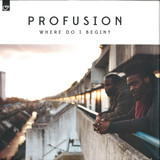
Profusion (noun): an abundance of something rich.
The sonic partnership of K15 and Emeson originated in the days of MySpace. A future of combining their skills was inevitable, and now in 2017, it's time to unleash their debut studio album into the ether.
The solo-projects of Tottenham-raised Kieron Ifill (aka K15) date back a decade, but were truly kick-started on labels such as Kyle Hall's Wild Oats and WotNot Music, with a number of genre-crossing releases dropping ever since, including the WU15 project (along with Yussef Kamaal's Henry Wu, on Eglo Records). Additionally to his production work, he has established himself internationally as a DJ, from the Jazz Cafe to the CoOp parties.
Partner in Profusion, Emeson, has many skills to his bow - singing, songwriting, producing, promoting, DJing (under the alias Ed Nice) and acting. As a musician, his varied skill-set has seen him work with Chico Hamilton, Carla Duke, Karmasound, Uzo Madu and Chris Jerome. A frontman for soul-jazz groups LifeSize, The One and Saturn's Children, he has featured on releases for BBE and Tokyo Dawn, and appeared live on stage at the likes of Ronnie Scott's.
The debut single was supported by tastemaker blogs Wonderland, XLR8R and Stamp The Wax, has been bumped by selectors such as Lefto and Jazzie B, and played on NTS, Worldwide FM, Mi-Soul, LeMellotron, Balamii Radio, Itch FM, Invader FM, Soho Radio and various stations across Europe and the US.
This album is full to the brim with summery sun-soaked synths, drifting across the warmest of basslines and heavyweight beats. Emeson's rich vocals gracefully ride atop of K15's delectably bruk twist on neo-soul sonics and electronics, this is some seriously classy contemporary London soul music, that manages to incorporate flashes of various dance music techniques, sound-system etiquette and jazz-tinged rhythms. As future-thinking as it is subtly retrospective, it doesn't lend itself to one genre, it intentionally embodies the best of many. An array of everything that is great about British black music in 2017. The message the album conveys itself couldn't have come at a more poignant time. Where do we begin
Profusion - an abundance of something rich indeed.
ears ago he started putting together some selections for a friend of his: Luca. The intention was to pick songs to be played during car rides, and like any other kind of ritual, this too would come with strict rules. You'd have to go throw the whole selection of 100 tracks without skipping, because every single one was important. Be it the sounds, the arrangement or its creativity, each track was there for a very specific reasons. It quickly became a monthly event which for several years evolved in a deep musical research without genre boundaries: Disco and psychedelic, soundtracks, library music, exotica, electronic and dance music, italo, new wave, pop or prog. Tracks of each and any historical period and provenance had been featured in this special compilations. But it wasn't always that easy to come up with the right piece and eventually Francesco started producing a few on his own to fill in the gaps. After six tracks, it was quite clear that there was a project developing, one in which he could finally experiment freely, leaving behind the rules that often come with dance tracks. Of course, no name could have been better than the one of his friend that had inspired everything And so L.u.c.a was born. Now, while preserving the same mind set, L.u.c.a is back with an album that embraces a new-hippie vibe, strongly pervaded by a mystical naturalism. This is a whole new universe in the making, where rumbling magmatic atmospheres evolve gradually in a journey through an idealist new world, celestial interludes revealing a full take over of nature, with a pervasive library feel that dates back to the great Italian masters, carrying on Edizioni Mondo's legacy.
Junior Disprol is best known as MC for Dead Residents and also from the now defunct Fleapit, along with a multitude of guest spots over the years with such artists as British Hip Hop luminaries Aspects and Sir Beans OBE. Mr (a/k/a DJ) Rumage is 1/3rd of the mighty Numskullz and nowadays half of production duo The Aroma along with fellow Numskull Rola, who deal with all sonic elements on this release and is co-founder of Ruztik Records. Between them they've delivered a hard hitting yet laid back track with Junior Disprol on top form over the crisp, dark soundscape carved out by Mr Rumage. For the turntablism fans the chorus scratching will get you asking 'how did they do that!'.
There is no current intention of Invasion becoming a track from any forthcoming album so this is the only way to get it. We've included the Instrumental Version on the flip for good measure. AE Productions like to deliver a high quality product and this is no exception, presented in a full colour card sleeve which showcases some eye catching artwork by Kaiju Blue.
When an 8 year old kid asks for a drum machine and Atari 500 computer with the intention of starting his own band, you know his future does not lie anywhere but in music. Introducing: Jeroen Hofer aka Melon. Not your average human being. Something that becomes obvious the second he enters the room - a beaming, larger than life personality that cannot possibly be ignored. Flair and charisma have never hurt anyone in this business. Melon is a natural artist, over the last few years, he has managed to create a high production profile. Nitzi' on Innervisions and Spring' on his own Ratiomusic' imprint are incredibly subtle and timeless masterpieces, while his work under his Je Dàvu moniker, such as his infamous re-edit of INXS's I Need You Tonight' and I Zebra' on Platzhirsch, showcases a more rocking side of his repertoire. In this EP he has worked with D.O.C. label mastermind Gui Boratto, their new EP sports music for the dance floor, full of groove, lush harmonies and organic undertones. Engineered to perfection by label head GUI BORATTO, it's an exciting step for the imprint and the project alike.
The enigmatic Amara Touré from Guinée Conakry finally getting a well deserved compilation showcasing all of the 10 songs ever released between 1973 and 1980. Cuban influenced music of a different kind featuring amazing spaced-out guitar works!! Analog Africa compiles a complete collection of Amara Touré's Afro-Cuban compositions, originally released between 1973 and 1980."Lamento Cubana and Temedy are the two finest Afro-Cuban compositions ever recorded. As if they were played in a smokey, poorly lit ballroom where dark rum was sipped ever so slowly" - Vikram Sohonie - Ostinato Records
Analog Africa to release a compilation by Amara Toure, the enigmatic Afro-Cuban musician from Guinea-Conakry, showcasing all of the 10 songs he ever released between 1973 and 1980.
"Latin music, is it really foreign to us Africans I don't think so. Listen to the drums, to the rhythm. It all seems very close to us - it feels like it's our own culture," declared enigmatic singer Amara Toure. It is the late 50s, and Senegal is going crazy to the groove of Son Montuno and Patchanga. Brought to West Africa by Cuban sailors in the early 40s, these styles were immediately adopted by a flourishing music scene that did not hesitate to embrace the Caribbean sound, mixed it with their own Folklore, and, in the process, created something new. Through the unique cultural fusion of West African and Caribbean influences, Latin music took on a new and unique sound - the format was reinvented. Producer Ibra Kasseì and his Miami nightclub acted as the spearheads of this movement. They brought a breath of fresh air into Dakar's nightlife, further energising one of West Africa's most exciting cities. The demand for ballroom parties and live acts exploded, attracting numerous musicians from surrounding countries. One of the musicians who answered this call was percussionist and singer Amara Toureì, from Guinea-Conakry. Spotted by Kasseì while performing with Dexter Johnson, Toureì was asked if he would like to be part of a new project. Little did he know that this project would become a phenomenon.Immensely important for the development of Senegalese modern music, Le Star Band de Dakar, led by Mady Konate, became a sort of musical incubator and workshop, where many musicians learned and practiced their trade before moving on to become stars in their own right. Toureì's talent on percussion was undeniable, but it was his powerful and raw voice that captivated the producer. The fascinating way Toure interpreted Cuban music was unparalleled, and it was this feature that encouraged Kasse to recruit the unknown artist.
Although already brimming with incredible talent, Amara Toure's joining of Le Star Band de Dakar in 1958 began the band's meteoric rise to the top. The band quickly became Dakar's number one orchestra, and it cemented the reputation of the Miami nightclub as the hottest spot in the country. The place was packed nightly, and Dakar was boiling.
Amara Toure's Senegalese adventure lasted for ten years when he received an irrefutable offer and in 1968, joined by a few talented Senegalese musicians, headed to Cameroon and immediately formed the Black and White ensemble. Many live gigs later and it was time for the first songs to be recorded. A total of three singles were produced between 1973 and 1976. These singles, representing the first six songs on this compilation, fully epitomise and distill the essence of what Toureì had learned during his career. His Mandingue roots fused with the Senegalese sound that he had mastered - the perfect foundation for the Toureì's Cuban interpretations.
If Toure's intention was to create the most sensual music ever recorded in Africa, he might very well have reached this goal. The musicians on the recording sound like they are playing in a smokey, poorly lit juke joint, where dark rum was sipped ever so slowly, and the pulse of the music took up a life of its own. How many couples have danced, swayed, and melted together to the distinct sound of Amara Toure Nobody can say for sure ...
Amara Toureì's success poured across the borders of Cameroon, and in 1980 he went to Libreville, Gabon, to team up with the powerful Orchestre Massako. Toureì recorded an LP at that time which is hailed by many music aficionados as one of the very best African albums. The songs from that LP are the last four on this compilation. It took only ten songs for Amara Toureì to become a legend. These ten treasures, representing Toure ìs complete discography, have been carefully re-mastered from original session tapes and vinyl records, and will be released by Analog Africa on 22 June 2015. After the release of his LP in 1980, Toureì seems to have disappeared. Apparently he was last seen in Cameroon but it is unknown if he is still alive today. His music though is definitely alive.
Saxophonist Sean Khan is a multi-instrumentalist distinguished for his ability to fuse traditional jazz with contemporary styles. His involvement in the West London broken beat scene as band leader of the cult soul/ jazz outfit SK Radicals and as a collaborator with the likes of the Bugz in the Attic collective, have seen his unique breed of jazz put to full effect in London's clubs, at nights like the legendary bruk orientated 'CoOp'.
In anticipation of Sean Khan's second album on Far Out Recordings: 'Muriel', this four track 12' release features remixes from 4hero and Nicola Conte with father of British Neo-Soul, Omar on vocal duties. 'Don't Let The Sun Go Down' is uplifting and sophisticated dance-floor jazz. Dego and Marc Mac (4hero), two pioneers of broken beat, jungle and UK dance music as a whole, re-work the single from 'Muriel' into a delicately crafted downtempo number, which tames the original somewhat with club focused intentions, yet retains all of its fluidity and groove. Along with the eminence of rhythmic elements, Omar's instantly recognizable, thick and soulful vocals are sparsely and subtly layered to create beguiling, unconventional harmonies. Elevating the track to its peak, Sean Khan's exquisite alto sax solo demonstrates both his technical prowess and keen understanding of jazz's history, whilst working to carve out its future. The B side hosts Nicola Conte's remix of 'Things to Say'. Renowned for his input and influence in the lineage of acid jazz and fusion, as a producer, Dj and musician, Nicola Conte provides a deeper, darker take on Sean Khan's unique blend of jazz. A bouncy 4/4 house beat skips along beneath contemplative, whirring Rhodes, while the ghostly soulful vocals of Diana Martinez and samples of Sean Khan's expressive sax playing see the track taken to more introspective yet still clearly club focused territory. The final track is the intro to 'Sister Soul', previewing more material from Muriel, Sean Khan's forthcoming studio album on Far Out Recordings.
Back in stock!
Some friends think that Shihab the man owes the balance of his soul to his beautiful Danish wife. They may be right; for Eros is the very essence of what Shihab plays.Yet Eros is a god with many a face. A tale of tender mournings Shihab's flute is telling in MAUVE - a piece that translates its title into delicately changing colors of sound. In UMA FITA DE TRES CORES he has his instrument wooing with the proud self-reliance of Latin grandezza. Calmly, softly, almost blandishly Shihab blows the solo flute in the Jimmy Woode composition MY KINDA WORLD. Serene and somewhat playful his own title ANOTHER SAMBA comes along - a most uncommon composition by the way: lasting for sixty bars as if growing independent out of itself, with solos that appear to be additional spinnings rather than improvised choruses; and yet; a perfect, self sustaining melody no element of which is superfluous. In the last of the pieces for flute, in Klook Clarke's THE WILD MAN, which is based on a flourish of trumpets, Shihab for the first time reminds of the sombre, the demon-like face of God Eros. He contrasts flawlessly intoned passages with challenging phrases, phrases raucously sung into the flute - really, he is a 'wild man' who is playing like that. This raucous challenging sound prevails throughout the four baritone-titles ('Shihab never withholds long to caress', Campi says). Shihab blows the instrument the same way he speaks: without any delay, directly coming to the point. And he treats it like a voice, not aiming at an artificially homogeneous sound in all the registers, but at their different modes of expression. In the high pitches the horn gains a brilliant tenor-like quality - for instance in PETER'S WALTZ, dedicated to Shihab's son Peter, and in Kenny Clarke's simple drum fills comprising theme JAY-JAY. In the deep register Shihab produces snotty sounds filling lady's ears with horrors like Pan - thus in JAY-JAY and in the boppy blues SET UP . Shihab's sense of a scurrilous humor breaks through in SEEDS (which reminds of the West-African heritage of jazz with its multiple rhythms and its renunciation of harmonious development - only the eight bars of the bridge base on a progression of chords): not only does he omit the notorious bombastic chord by the ensemble after his own final cadenza, he even ends with a minor second above the keynote. Seems as if Shihab now unrestrictedly conveys to his music all the experiences and emotions he formerly did not deal with in a musical way. Shihab the man need not be disturbed so that Shihab the musician may improvise passionate choruses. It would be unjust, however, to forget the choruses of the four other musicians for those by the 'born leader'. Francy Boland, taciturn and always introverted: he plays an extrovert, a masculine piano. Even with spare single note lines he produces a piercing and ringing sound that hitherto nobody except him has discovered, a bluesy sound bespeaking the very element of frustration that lies within the title of the trio number WHO'LL BUY MY DREAM. The unfailing feeling for rhythm the musicians of the CBBB praise with the arranger Boland, becomes manifest in the piano solo on SET UP. Francy's improvisation is rhythmically styled in a Monk-like manner, and yet no accent could be set differently. Maybe this is the secret of the Shihab-Combo. 'Rhythm is our business', this credo of Jimmy Lunceford could be the one of the five musicians as well. Sadi hits his vibes as dryly as if wanting to bring its ancestors to memory, the wooden chimes of West Africa's coastal tribes. To reach the fullest poignancy possible, he intentionally calms down even the resonance in MY KINDA WORLD. In UMA FITA DE TRES CORES Jimmy Woode bears out the crispy jazz beat against Sadi's Bongos and Klook's Latin-American percussion all by himself. Moreover - and that, too, is connected with the school of the Duke who was the first in the history of jazz to discover the instrument's potential as a melody instrument - Woode rips a marvelous counterpoint to the inventions of the other melody instruments, take for example PETER'S WALTZ. And then there is Kenny Clarke. Klook. On the entire record he only uses his brushes. Means by which different drummers only know to bring forward impressionistically blending noises: He drums a vigorous beat with them, fanciful fills, a solo, melodious and at once skillfully playing with cross rhythms in JAY-JAY. The 'born leader', the 'outstanding baritone saxophonist of modern jazz' (Joachim-Ernst Berendt), he could not wish himself different sidemen for this record overdue since some years.