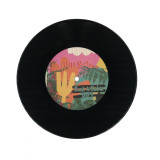
Recorded in the early 2000s, The Sand Dollars' two Tropicália-inspired remakes of classic late 60's nuggets by The Kinks and Donovan are paired together for the first time here on F-Spot Records' new subsidiary label Pangea International Recording Co., which focuses on world and global groove inspired releases, curated by David M Celia and Dan Ubick.
From the vaults of Dan Ubick's Lions Den Studios, we get the crown jewel in Ray Davies' catalog, "Waterloo Sunset" from Something Else by The Kinks, redone as a funky Tropicália-inspired track and re-named "Waterloo Bossa" complete with fuzzy compact organ, bouncy Fender bass, funky drums from Connie Price, a lush horn arrangement by Ubick's former Keystones cohort and trumpeter Todd M. Simon (Dap Kings, El Michels Affair, Macy Gray), string arrangement by mix guru and multi-instrumentalist Steve Kaye (The Lions, Inara George, Hepcat, Marley Bros.) and topped off with stereophonic vocals by jazz chanteuse Gretchen Parlato (Herbie Hancock, Wayne Shorter, Esperanza Spalding, Lionel Loueke).
Side B's "Get Thy Bearings" was initially pressed on Now-Again Records back in 2003 and quickly sampled by Lily Allen on her track "Sunday Morning" due to the raw and heavy drums and Fender bass courtesy of Connie Price and Richard "Doo" Lee along-side inventive horn arrangement by Todd Simon flipping the original on its heady head. Now freshly mastered, this B-side instrumental is available again as the hard-hitting remake of Donovan's classic from 1968's The Hurdy Gurdy Man LP that may inspire you to sample it as Biz Markie did on "I Told You."
Поиск:funk in you
Все
Die Apart Demos wurden zwischen 1980 und 1984 in verschiedenen Kellern und professionellen Studios in Chicago aufgenommen und dokumentieren 12 intime und reduzierte Skizzen, Demos und unveröffentlichte Tracks von Andre Gibson und der Universal Togetherness Band, als sie sich auf ihre Solokarrieren zubewegten. Von tief empfundenen Huldigungen an die Liebenden, die von einem seidigen Fender Rhodes verziert werden, bis hin zu Disco-Party-Startern über spirituelle Dankbarkeit - Andre Gibson lässt uns in sein Herz blicken und bringt am Ende alles zusammen. Die Universal Togetherness Band aus Chicago, verband in ihrem eklektischen Sound Funk-, Soul-, Disco-, Jazz-, Rock- und New-Wave-Einflüsse mit intelligenten und fantasievollen Texten. 1978 gegründet und geleitet von Andre Gibson, mit seinem Bruder Arnold Gibson (Schlagzeug, Bass), dem ehemaligen Colorvision-Mitglied Fred Misher (Bass, Hintergrundgesang) und Freds Bruder Leslie Misher (Leadgitarre), während Andre die Keyboards, das Vibraphon und den Leadgesang übernahm. Obwohl die Gruppe mehrere Jahre lang in den Clubs von Chicago auftrat und gelegentlich größere Auftritte absolvierte (vor allem als Vorgruppe von Peter Gabriel), hatte sie Mühe, ein größeres Publikum für ihre anspruchsvolle R&B-Melange zu finden. Zwischen 1979 und 1982 nahm die Band Dutzende von Sessions auf, die Gibsons weitreichende Vision als Komponist und Bandleader dokumentierten. Während Gibsons Zeit am Columbia College kamen Paul Hanover (Mundharmonika und Klavier) und Louis Sanford (Schlagzeug) zu den ursprünglichen vier Multiinstrumentalisten hinzu. Nachdem sich die ursprüngliche Besetzung der Universal Togetherness Band schließlich Mitte der 1980er auflöste, nahm Andre Gibson weiterhin mit einer Besetzung mit Frank Alexander (Schlagzeug), Allen Burroughs (Gitarre), Art Love (Bass) und Michael Young (Saxophon) auf. 2015 veröffentlichte Numero Group eine erste Zusammenstellung mit unveröffentlichten Aufnahmen mit dem schlichten Titel Universal Togetherness Band.
Valentine Lover Red Vinyl. Die Apart Demos wurden zwischen 1980 und 1984 in verschiedenen Kellern und professionellen Studios in Chicago aufgenommen und dokumentieren 12 intime und reduzierte Skizzen, Demos und unveröffentlichte Tracks von Andre Gibson und der Universal Togetherness Band, als sie sich auf ihre Solokarrieren zubewegten. Von tief empfundenen Huldigungen an die Liebenden, die von einem seidigen Fender Rhodes verziert werden, bis hin zu Disco-Party-Startern über spirituelle Dankbarkeit - Andre Gibson lässt uns in sein Herz blicken und bringt am Ende alles zusammen. Die Universal Togetherness Band aus Chicago, verband in ihrem eklektischen Sound Funk-, Soul-, Disco-, Jazz-, Rock- und New-Wave-Einflüsse mit intelligenten und fantasievollen Texten. 1978 gegründet und geleitet von Andre Gibson, mit seinem Bruder Arnold Gibson (Schlagzeug, Bass), dem ehemaligen Colorvision-Mitglied Fred Misher (Bass, Hintergrundgesang) und Freds Bruder Leslie Misher (Leadgitarre), während Andre die Keyboards, das Vibraphon und den Leadgesang übernahm. Obwohl die Gruppe mehrere Jahre lang in den Clubs von Chicago auftrat und gelegentlich größere Auftritte absolvierte (vor allem als Vorgruppe von Peter Gabriel), hatte sie Mühe, ein größeres Publikum für ihre anspruchsvolle R&B-Melange zu finden. Zwischen 1979 und 1982 nahm die Band Dutzende von Sessions auf, die Gibsons weitreichende Vision als Komponist und Bandleader dokumentierten. Während Gibsons Zeit am Columbia College kamen Paul Hanover (Mundharmonika und Klavier) und Louis Sanford (Schlagzeug) zu den ursprünglichen vier Multiinstrumentalisten hinzu. Nachdem sich die ursprüngliche Besetzung der Universal Togetherness Band schließlich Mitte der 1980er auflöste, nahm Andre Gibson weiterhin mit einer Besetzung mit Frank Alexander (Schlagzeug), Allen Burroughs (Gitarre), Art Love (Bass) und Michael Young (Saxophon) auf. 2015 veröffentlichte Numero Group eine erste Zusammenstellung mit unveröffentlichten Aufnahmen mit dem schlichten Titel Universal Togetherness Band.
Ches Was born in Barbados, and from that faraway small group of islands comes this outstanding piece of Caribbean Soul. Like many of the artists we love, Ches had his fair share of travels and troubles. He dedicated his whole life to music pursuing that ideal of living by the dream we all keep sticking to when it comes to soul music. After the teenage years spent listenting to the sound of the American Black Music legends of the times, whose frequencies made it to the radio stations in the middle of the Atlantic Ocean, he decided to pack up and go big studying music in New York City thus finding he was gifted with songwriting, where he always puts soul, jazz and a touch of reggae music. Wirl label (West Indies Record Ltd.) was his recording home with which he released a number of tunes both solo and with his band The Outfits. He then traveled far and wide, spending a couple of years in Canada (another proof of Canada’s music industry solid ties with the sound from the islands), eventually ending up where Funk Investigators’ patrol member Yann Vatiste has found him and secured the license for this release. Stay tuned for more tales about this man, he might be closer to you than you think.
- Moanin’ (Bobby Timmons)
- Superstition (Stevie Wonder)
- Iko Iko (James Crawford)
- Señor Blues (Horace Silver)
- When A Man Loves A Woman
- (C. Lewis & A. Wright)
- Freedom Jazz Dance (Eddie
- Harris)
- Sidewinder (Lee Morgan)
- Brother Where Are You?
- (Oscar Brown)
- Wade In The Water (Traditional)
- Work Song (Nat Adderley)
- Land Of 1.000 Dancers (Chris
- Kenner)
- Gimme Some Lovin’ (S
- Winwood & S. Davis)
- Motherless Child (Traditional)
- New Orleans Strutt (Jack
- Dejohnette)
- La Place Street (Stanley
- Turrentine)
- Amen (Traditional, Arr. By Bob
- Belden)
- Jubilation (Junior Mance)
- Joshua (Traditional)
- Mr. Magic (Ralph Macdonald &
- William Salter)
- Theme From Shaft (Isaac
- Hayes)
- Nobody Knows The Trouble
- I’ve Seen (Traditional)
Who did Aretha Franklin not want to miss out on when she recorded
her most inspiring albums in the early Seventies? Who gave Steely
Dan the beat? Who did Isaac Hayes, Donny Hathaway, BB King,
‘Sweet’ Lou Donaldson and Joe Cocker give the chair behind the
drums? No drummer has seen the inside of a studio as often as
Bernard ‘Pretty’ Purdie.
Not for nothing do colleagues attribute the ‘funkiest soul beat on the
scene’ to the drummer, and consequently, Purdie has never relied on
the genre of jazz alone, but rather curiously looked beyond the
borders. Sessions with The Rolling Stones, James Brown, Jimi
Hendrix or Tom Jones are no problem for him, whose precise and
sensitive playing is synonymous with drive and groove. This is
probably one of the reasons why his rhythms are still sampled by
many DJs today.
Released on CD back in 1996 and 1997 (and now out of print), the
two ‘Soul to Jazz’ recordings have a cult factor today and sound as
fresh as they did back then. Now both albums are released together
for the first time as a 3LP set.
These recordings are peppered with lots of prominent star guests
from jazz and soul, from Eddie Harris, Michael Brecker and Nils
Landgren to Hank Crawford, Stanley Turrentine and Cornell Dupree.
Purdie’s ‘Soul to Jazz’ project takes two different approaches: The
first part focuses on the renowned WDR Big Band led by Gil
Goldstein. Soul classics such as Stevie Wonder’s ‘Superstition’,
‘When a Man Loves a Woman’, Eddie Harris’s ‘Freedom Jazz Dance’
and Lee Morgan’s famous groove tune, ‘Sidewinder’, are interpreted
in large scale sound. One discovery of these recordings amidst all the
renowned guest soloists is the New York-born singer, Martin Moss.
The great success of this first album, released under ‘Soul to Jazz’,
led to ‘Soul to Jazz II’, a more intimate record, but one that picks up
where the first recording left off, by exploring similar themes. Again,
Purdie has called together a notable band of kindred spirits, including
saxophonists Hank Crawford (BB King, Ike and Tina Turner, Ray
Charles), Stanley Turrentine (Jimmy Smith, Shirley Scott) and Vincent
Herring, as well as guitarist Cornell Dupree (King Curtis) to pianists
Benny Green and Junior Mance.
Bernard Purdie’s ‘Soul to Jazz’ is a timeless classic and a blueprint of
the soul jazz genre in all its facets. Above all, it is a portrait of one of
the most influential and best drummers in the world, who made jazz
groove with his inimitable funky soul beat
West Seattle Soul is an oozing collaboration of 13-15 Seattle hot shots crammed into a raw, close quarters performance that is blatant and obscure. It's an accidentally defying, thoroughly enjoyable, relapse of Seattle funk. The group has spent the last two years honing their chops at a residency at West Seattle’s Parliament Tavern.
When writing original music, this outfit goes by the name "The Pulsations" as presented on the B-Side of this Juicy slice of Seattle Side A: "Soul Makossa" West Seattle Soul put an afro-soul twist on Manu Dibango’s pioneering afro-disco hit “Soul Makossa.”
Their arrangement boasts bubbling clavinet, a tenacious horn section, and energetic vocal chants reminiscent of the original with a modern, underground dance music twist.
Side B: "Black River Crisis" Forming an Artist for all original music The Pulsations summon the deep pocket in “Black River Crisis.” Spurred from a group writing session, the drum and bass groove pave the way for interlocking guitar parts and a topsy-turvy horn line. The group found inspiration in the cataclysmic nature of the Black River that fed Lake Washington in the Seattle area.
The river was inadvertently drained when a canal was constructed from the Puget Sound to Lake Washington. The dried-up river caused a catastrophic loss of a resource that affected local farmers, the salmon population, and Native tribes who still lived alongside the river. It beckons the reality of the inevitable briefness in all facets of life and thusly, “you gotta dig it while it’s happening.”
The cheeky yet sophisticated “Manzo Edit” calf returns with a fresh assortment of four lushly revisited cuts. First on the menu is “Digestif”, a laid-back Disco House track ideal for setting the dance floor groovin.
“Get It” also falls into the downtempo realm with its smoky acid beat, while “Dancecraft” hits you head-on with a load of robotic funk. Lastly, “Forneria Moderna” pays a festive homage to the Latin side of Jazzy House.
- A1: The Carver Area High School Seniors - Get Live '83 (The Senior Rap)
- A2: Mike T - Do It Any Way You Wanna
- B1: Chapter Iii - Real Rocking Groove (Rap & Breaks)
- B2: Sinister Two - Rock It, Don't Stop It
- C1: Sangria - To The Beat Y'all
- C2: Funky Four Plus One More - Rappin' And Rocking The House
- C3: The Just Four - Girls Of The World (Genius Rap & Breaks)
- D1: Eye Beta Rock - Super Rock Body Shock
- D2: Funky Constellation - Street Talk (Madam Rapper)
- E1: Kool Kyle The Starchild - Do You Like That Funky Beat (Ahh Beat, Beat)
- E2: The Just Four - Jam To Remember
- F1: Grandmaster Flash And The Furious Five - Super Rappin' No 2
- F2: Silver Star - Eei Eei O
- A1: Magic's Trick - Magic's Rap - Mono (7")
- B1: Magic's Trick - Magic's Rap - Stereo (7")
Yo! Boombox is the new instalment of Soul Jazz Records’ Boombox series on the early days of hip-hop on vinyl and features some of the many innovative underground first-wave of early rap and disco rap records made in the USA in the period 1979-83.
The album includes the first releases of seminal groups such as Grandmaster Flash & The Furious Five and The Funky Four Plus One More through to a host of rarities and little-known obscurities such as the Carver Area High School band’s ‘Get Live 83’, an awesome record made at a Chicago high school.
The album is released as a deluxe triple LP complete with 3x full inner sleeves of extensive sleeve notes, exclusive photography and original label artwork. There is also a very-limited one-pressing only special deluxe version that comes with an extra bonus super-rare 7” single of ‘Magic’s Rap’ by Magic’s Trick, aka ex-marine Magic Fraga, a record that was only ever available on US military bases!
Yo! Boombox also features the stunning photography of Sophie Bramly, one of a very select group of photographers (alongside Henry Chalfant, Martha Cooper, and Joe Conzo) who were allowed full access to document the exciting early days of hip-hop in New York.
These first exuberant wave of innocent, upbeat, party-on-the-block rap records were the first to try and create the sounds heard in community centres, block parties and street jams that first took place in the Bronx in the mid-1970s. Where the first DJs – Flash, Kool Herc and Bambaataa – were back-spinning, mixing and scratching together now classic breakbeat records like The Incredible Bongo Band’s Apache or Babe Ruth’s The Mexican, these first pre-sampling rap records were all made using live bands, often replaying then current disco tunes.
As Chic’s ‘Good Times’ was to ‘Rappers’ Delight’, the songs here feature then-current dancefloor hits such as the Tom Tom Club’s ‘Genius of Love’, Cheryl Lynn’s ‘To Be Real’, MFSB’s ‘Love Is the Message’ while MCs rapped over the top, creating a unique new sound. In fact, the links between disco and rap date back earlier to the ‘party style’ MCing of figures such as the legendary DJ Hollywood or radio DJs like Frankie Crocker.
This new Soul Jazz Records collection
celebrates these first old-school rap
records, bringing together rare, classic
and obscure tracks released in the
early days of rap.
- A1: Claudette Mclean – Give Love Another Try
- A2: Jennifer Lara – My Man
- A3: The Soulettes – A Deh Pon Dem
- A4: Della Humphrey – Dream Land
- A5: Jennifer Lara – Consider Me
- B1: Denise Darlington – War No Right
- B2: Hortense Ellis – I'm Just A Girl
- B3: Angela Prince – No Bother With No Fuss
- C1: Jerry Jones – There's A Chance For Me
- C2: The Soulettes – King Street
- C3: Jennifer Lara – Tell Me Where
- C4: The Tonettes – I'll Give It To You
- D1: Marcia Griffiths – Tell Me Now
- D2: The Jay Tees – Come To Me
- D3: Angela Prince – You A Fool Boy
- D4: Jennifer Lara – I Am In Love
Repress!
Ska, rocksteady, funky reggae, roots, dub mixes, disco mixes, they're all here from the queens of the Jamaican music scene - Studio One Women features a wide mix of classics and obscurities from the finest female voices in reggae.
Until now most of these tracks have only ever been available as extremely hard to find Jamaican 7" and 12" singles and even if you were lucky enough to find them they'd cost you a small fortune
Marcia Griffiths and Rita Marley (here with her first group The Soulettes) are two of Jamaica's most famous female singers hugely popular today. Both these artists became internationally famous as The I – Threes (along with Judy Mowatt), Bob Marley's backing singers alongside The Wailers. Also featured are Hortense Ellis, sister of Alton who cut many smash hits on the island, and Jennifer Lara, a lady who had a long career with Studio One, singing on countless sides.
Studio One is the greatest label in the history of reggae and is the foundation of all reggae music. It's where virtually every world renowned Jamaican superstar started out, Bob Marley and The Wailers included. Under the guidance of the legendary Clement Coxsone Dodd the musicians at Studio One recorded hundreds of instrumental rhythms which still provide the backbone for many of the records made in Jamaica today.
Singular Texan musician Craig Clouse hurtles unstoppably towards the 20th birthday of his dancefloor-splintering electronic project Shit And Shine, releasing a landmark LP, his first full-length for The state51 Conspiracy, ‘2222 And AIRPORT’. Acid house, minimal techno, electro, funk, krautrock, hip hop, found sound, spoken word, live percussion and industrial are blown apart stupendously and then reassembled – mad-scientist style, in a way peculiar to Clouse – into 13 hypnotic and transportative tracks.
Lead single SWISS, out 24 March, is a gloriously minimalist funk jam that sounds like the exact point at which someone turns the lights off at a lowkey house party and a wild night for the ages gets under way. An almost scornfully skeletal riff, sounding like a misfiring Cyberdine Systems Model 101 summoning up a Prince circa Sign “O” The Times riff while crashing head first into the hyper-processed early work of Prefuse 73, also featuring a cheeky sample of revered Mancunian DJ Luke Una talking about “existential fucking darkness”.
This is followed on 4 April by INFINITE SHITE, arguably the epic central track to the album, is a Shit And Shine banger for the ages, its dancefloor affect, undeniable. An unforgiving, pulsating Byetone-style bass drone worthy itself of being blasted on a Funktion-One rig, is just the background for a colossal acid b-line, destroying all in its path.
Micro details bristle at the liminal level, threatening to only reveal themselves to those in a club, those listening on headphones or those experiencing a heightened sensory state.
Foundation music are proud to present our second project with the formidable talent that is Crooked Man aka Parrot, known to his mother as Richard Barratt.
The DJ turned producer from Sheffield, founder and resident at the seminal Jive Turkey night, member of Warp’s Sweet Exorcist, musical partner with the late great Richard H Kirk (Cabaret Voltaire), producer to such maverick talents as Roisin Murphy and Add N to X, longtime Jarvis Cocker collaborator and remixer to a myriad of artists over several decades.
More recently, Parrot's project with internationally renowned Jazz singer Lady Blackbird, Athletes Of God, released two singles on Foundation Music ‘Don’t Want To Be Normal’ and the clubland hit ‘Fontella’ that were both playlisted by 6Music.
Lady Blackbird now flies the nest, with the divine Earth Angel swooping into her place. A seminal, reclusive, heavenly voiced singer, also from Yorkshire and with deep roots in the soul and dub scenes… And no, it's not Lisa Stansfield!
A project that has its roots way back in the Sheffield’s Blues parties and Jive Turkey itself. The club being a home to all forms of exciting new Black music, from ’85 through to the early days of the UK’s dance explosion. It sees Parrot take all that he has achieved, written and learnt over the years at the cutting edge of electronic, dance-inflected, production and DJing returning to those heady days of down tempo, body moving, speaker shaking music that would move the British underground soul/funk scene in the mid to late 80’s.
Call it 'street soul', '80’s soul', 'electro soul'… Earth Angel is all of those things but it is also very firmly rooted in the NOW! Not some retro pastiche, it incorporates so much more. With elements of techno, bleep, dub and any other studio trickery that Parrot cares to employ in order to suck you into Earth Angels’ druggy, hypnotic, sexy, “Mogadon Soul”. A four songed, eight tracked vinyl EP, featuring some classic songwriting from the glory days of soul and Crooked Man’s bass heavy electronic rhythms.
Welcome to the heavenly world of Earth Angel, the journey starts here.
DJ Support:
Luke Una, Ross Allen, Sean Johnson (ALFOS) & Kebal.
What can't be said about Funki Porcini. From doing Film scores to the surreal live performances with his recent 'Laserium' tour.
An Incredible album of weird & wonderful ridiculousness. An exclusive first time on vinyl, collection of Funki's Famous Fat ones. A fusion of downtempo to eclectic jazz cuts & horns with b-boy latin funk breaks with elements of blissfull strings & melodies throughout.
Funki Porcini delivers his most Incredible vinyl, buffed & ready to play. The most joy you will have with a 12" since 'Lets See What Carmen Can Do'.
Detroit's John Beltran can do no wrong if you ask us, and what he does do is always famously varied, from sound design for TV to melodic techno excellence via ambient beauty. Here for MotorCity Wine he revisits his Back To Bahia series with a third volume that finds him flexing his Afro-Brazilian deep house chops. The 7" opens up with the jazzy boogie of Lsaura' which is steeped in Minneapolis funk and will get cultured dancefloors in a spin. 'As The Sunsets' that appears on the flip and is a superbly emotive sound with wispy late night melodies and glowing harmonies and shuffling Latin grooves. Essential.
Coming straight outta Salerno's vibrant music scene, "Amo' / Voce 'e Notte" is the first 7" single from female rap duo Zetas. Released by DJ's Choice, a partner label of Four Flies Records, it contains two songs produced bybeatmaker, rapper and producer Tonico 70, a true veteran of Southern Italian hip hop.
Both young millennials, rappers Annarella and Miriade were exposed to the world of underground hip-hop from an early age, jamming, freestyling and listening to different music than their peers. Active as a duo since 2019, they're now making their official debut with this 7", which will be followed byan album at the end of September.
The A-side track "Amo'", which is about the overuse and loss of meaning of the word 'love' (amo' translates as 'luv'), makes their intentions clear. Zetas rap in the exuberant dialect and slang of their native city of Salerno, while their sound looks back to the '90s through a contemporary lens. Raw rhymes are delivered with an urgent flow over a beat that, rather than boom-bap nostalgia, is a modern take on classic production styles. The result is a happy medium between old school and fresh – one where the melody of dialect rap and rhymes blends wonderfully with the rhythms of funk, soul and reggae.
"Voce 'e notte", on side B, has a different mood, but the same approach. Here, Zetas weave wistful verses tinged with disillusionment and toughness on top of Tonico 70's 808-led beat, paying tribute to a classic Neapolitan song also titled "Voce 'e Notte". The result is a rap serenade that transforms and reimagines the Neapolitan song tradition through today's sensibility and, of course, through hip hop.
Third in a trilogy of LPs of Library Music miniatures from composer and multi-instrumentalist Daniel O’Sullivan (Æthenor, Ulver, This is Not This Heat, etc) following 2020’s Electric Māyā and 2021’s Fourth Density. For heads, the term “Library Music” in 2021 might evoke dodgy Italian gray market LPs and crate diggers hunting for “funky breaks” - but London’s venerable KPM Music is working with groundbreakers like Daniel to open up new avenues for composers to experiment. The 15 tracks on “The Physic Garden” are fully-formed and orchestrated compositions, which would be highlights on anyone’s LP, never mind as incidental music. Of the music, Dan says: “The Physic Garden is an album of diverse instrumentals inspired by a swathe of verdant vistas from manicured gardens and follies to urban common land, overgrown and forgotten. Convalescent memories in the shape of psychedelic auditory botanics.”
Key tracks include the droning acoustic folk of the title song; the Canterbury-esque rolling horn and woodwind melody of “Return the Heart” (with expert drum kit from Frank Byng); The prog-ish odd meter interlude “Buttercup Tea”; The quiet ambience and delicate melody of “Dusty Feather:”; and the Eno-like drift of “Vapourer Larvae.”
“Library music. Akasha. Here you accept that music behaves like a thing to accentuate another thing, seemingly unrelated. A beautiful, shining blankness. Not passive. An opportunity to wade. A brief encounter with an open-ended destiny. As in, you never know who or what it will be partnered with. With library music the emphasis tends to be on functionality and less on sonic self-portraiture. So it compels you to be concise, like what is the function of this work? The distance is liberating. It’s less “What Am I? and more “What Is This?”. It compels you to be brief, each little cell is a world of its own in an assemblage of miniatures all vibrating in their collective identity. Then there is the occult nature of library music which is fetishized by many for its ability to induce time travel, often to send us back to some televisual memory. However, despite its broad-brush strokes, the library can be so profoundly alien, especially when experienced independently of the televisual realm; an unruly chimera of genre mutations, compositional curiosities and the deepest wallpaper you ever laid ears on. Perhaps the observances of library music can help unshackle us from our artistic insecurities and delusions, where one is drawn to the shape of music as a whole instrument unto itself; as a vehicle carrying our intention and consisting of everything we have to give at that moment; so things that are seemingly unrelated are ultimately connected.” – Daniel O’Sullivan
Lewis II was the follow up to Lewis Taylor's epochal, self-titled debut album. It was initially released in 2000 and this double LP release, its first ever vinyl edition, has been heavily anticipated for nearly a quarter of a century. It's often years before most listeners catch up with an album's breathtaking vision and devastating execution, and so it has proved with Lewis II; it stands up exceptionally well today.
After Island rejected Lewis Taylor's second release (later released as The Lost Album), he returned to the studio to record Lewis II. Less esoteric than Lewis Taylor, Lewis II is a more polished, sophisticated funk and mature uptempo soul than the dark psych-soul of his debut. The production, whilst slicker, is a bit tougher, with more crisp, R&B-flavoured grooves and head-nod beats and more bass pumping up his voice. The vocal intensity present on album number one doesn't abate. Indeed, as Lewis himself noted, "my voice is better on Lewis II and the vocals are high in the mix."
The moody funk of "Party" sounds like a mad blend of Riot-era Sly Stone and Brian Wilson. It rides a stuttering drum machine groove with acapella harmony vocals arriving halfway through to stay for the duration. "My Aching Heart", with its clean, slick, late 90s R&B drums, could surely have been a single. Perhaps Lewis's idiosyncratic melodies would've been too challenging for the charts. Lewis *had hoped* "You Make Me Wanna" would be a single but the dank, organ-drenched groove, coupled with the growling eroticism of Lewis's vocals would've, again, made this beyond the pale for most mainstream music fans. Somewhat incongruous acidic synths and bleeps give way to a laconic summertime groove on breezy highlight "The Way You Done Me", all funky acoustic guitars and stunning, good-time vocals. Sumptuous ballad "Satisfied", a real fan favourite, marries unusual instrumentation with classic soul-ballad structure and closes with a monster guitar solo which almost out-Princes Prince in its gritty melodicism, set against sweeping strings of real majesty. Prog-Funk-Rock!
The dubbed-out, spaced-out "Never Gonna Be My Woman" is the closest the album comes to classic D’Angeloesque neo-soul, with echoes of the esoteric funk featured across Maxwell's contemporaneous Embrya. But what follows is on some next level business. As Lewis's biggest fan, Geoffrey Scull, noted, "the "I'm On The Floor" / "Lewis II" / "Into You" song cycle stacks up against any other consecutive 15 minutes of recorded music, ever!" And who are we to argue with that? These could've been hits for Justin Timberlake during his fascinating Timbaland-collaborating days, such is the sonic and textural pop experimentation at play here. The extraordinary title track sounds like an outtake from Marvin Gaye’s Trouble Man and spends its last third as a searingly dark piano-led psychedelic-guitar-crunching soul instrumental. Just astounding. And then. AND THEN! The way it segues into, er, "Into You" is just straight up genius. Goosebumps galore on this one, no words can describe its celestial brilliance. Just kick back and be beguiled by the "Let me come on over again" refrain that ornately adorns its sensational coda. Phew.
The swoonsome, lovelorn ballad "Blue Eyes", apparently written in the spirit of Marvin’s "Vulnerable", is a lush, slow swinger with some gorgeous noir touches. To close, Lewis completely retools Jeff Buckley’s beloved, beautiful "Everybody Here Wants You" and, while talking some liberties, even manages to surpass the original. Yes, really! With soaring, fiery vocals set against icy piano and psychedelic guitars, Lewis recasts Buckley's effort as dramatic, ethereal soul.
When it came to translating the original CD booklet into a 12 inch LP sleeve, thanks to some suggestions from Cally Callomon (head of Island’s art department, who designed all the sleeves for Lewis’s two Island albums and their singles) and his trusting us with his “Lewis Taylor” folder full of various negatives, test prints and whatever else he was able to salvage from the old Island art department, we’ve gotten pretty close to what the original LP sleeve would’ve looked like if it existed. Simon Francis’s vinyl mastering, presents the eleven tracks over a double LP so, as ever, the record sounds outstandingly good. The records have been cut by Cicely Balston at Air Studios and pressed at Record Industry.
First Ever Vinyl Reissue (released in collaboration with the Numero Group)
180g BLACK vinyl limited to 500 copies (w/obi strip). Non-Returnable.
Little is known about the mythical band ‘Heart-Soul & Inspiration’ and their band leader, L.A. drummer and producer Vince Howard…The crooning Howard got his start in 1957 on Herb Newman’s Era label where he released a bunch of excellent Doo Wop, Funk & Soul singles. Over the ensuing decade Howard slowly began piecing together his “Orchestra” consisting of bassist Jimmy Soul, guitarist Ron Carr, and pianist John True.
Howard’s Heart-Soul & Inspiration Orchestra cut their self-titled (and only) album in 1974 for John Spriggs’ Los Angeles-based Viscojon concern under the watchful eye of R&B godfather Johnny Otis.
The result was the birth of an astonishing piece of art filled with playful sexy moans, climaxing grooves and soulful hooks. One of the many highlights on the album (and clocking in at an epic eleven minutes), Vince Howard’s “I’m Gonna Love You More” is a tantric reimagining of Barry White’s 1973 sexually charged classic. Where White was content delivering a subtle and syrupy innuendo, Howard transformed the break-heavy track into a meandering funk workout.
Sadly, after their Barry White/Isaac Hayes facsimile LP failed to gain traction, the group released their final recordings—“Funk on Down” b/w “Fallen Angel”—for Viscojon in 1975 which became a hit among prominent DJ’s in the nightclub circuit. This ushered in the end for Howard’s Heart-Soul & Inspiration project.
Heart-Soul & Inspiration was a true example of a bright light burning out way too quickly. Thankfully we are left with the unique (and very rare) document that is their self-titled album. Almost impossible to get ahold of…a well-deserved reissue has been long overdue. This is an album that deserves a prominent place in every serious Funk & Soul enthusiast’s record collection!
Nothing compares to Lewis Taylor and nobody crafts a "B-Side" quite like him. Indeed, his long deleted B-Sides are the stuff of legend. So, gathered together for the first time on one slice of wax, we present The Damn Rest: an album's worth of B-Sides from the era of the 1996 Lewis Taylor ("Damn") album. More off-the-wall and abstract than the album proper, these rare, underheard tracks burst with Lewis's uncompromising genius. A lot more experimental, the music is still drop dead beautiful. The Damn Rest is the essential bridge between Lewis Taylor and Lewis II.
Lewis Taylor's self-titled masterpiece from 1996 was to be originally called Damn. You can see the word right there on the from cover. However, concerns over distribution in the US scuppered this desired title. When thinking about what to call this collection of essential B-Sides from the era of that first album, we thought The Damn Rest would be appropriate. But these tracks aren't simply throwaways or outtakes, as Lewis himself states: "each little group were recorded specifically for the release of each 'single'." These B-Sides were simply the next thing to happen after self-titled, and before Lewis II. In other words, you need this!
The collection opens with "Asleep When You Come", the A2 on the original "Lucky" 12". It's a slow-mo string-drenched soul offering, cast in cinematic soft-focus with a vocal performance from the heavens set against wonky, shuffling drums and delicate instrumental flourishes. Beautiful. Also from the "Lucky" single, "You Got Me Thinking" may actually be Lewis' funkiest moment and is definitely one of our favourites, a great, gently psychedelic funky club track, that's for sure. Next, the gorgeous, meandering "I Dream The Better Dream" is just sheer, metronomic bliss, with shades of Stevie Wonder. Just ask D’Angelo, who included the track on his Feverish Phantasmagoria show for Sonos. Not only a celebrity-fan-favourite, it's Lewis's, too: "My favourite has always been this track. In my fantasy it’s what early Soft Machine would’ve sounded like if Marvin Gaye was their lead singer."
As we move to the B-sides from the "Whoever" single, the first to feature is "Pie In The Electric Sky / If I Lay Down". It's a brilliantly sprawling classic. A head-nod funk workout in two parts; part psychedelic heavy soul jam, part breezy Marvin-esque near-instrumental of the deeply lush variety. It needs to be heard to be believed. Astonishing! Flip over for "Waves", a shimmering, dramatic, sweeping string-led fan favourite. The climax of the song is just too stunning for words. It's followed by the deep wyrd-soul of "Trip So Heavy" the final, dizzying track from the "Whoever" single and another celestial funk delight featuring strings, organ, twisted bass and heavy drums. From the "Bittersweet" 12", "A Little Bit Tasty" is a building, schizophrenic soul-jazz epic that starts out with Lewis performing a call and (distant) response with himself over a gentle mid-90s drum loop before snatches of heavy, crunching metal guitars blast apart the otherwise neat song structure. Ultimately, it's unarguable that The Damn Rest is worth it for the inclusion of the jaw-dropping "Lewis III" alone. A dazzlingly lush and stunningly sophisticated prog/soul hybrid that owes as much to "Pet Sounds" as "What's Going On" with arrangements that grow and unfold in layers. Just sparkling.
A compilation like this feels like one of those promo-only rarities they used to give out to a select few back in the good old days, so when it came to the artwork it only made sense to follow what Cally Callomon (head of Island’s art department) had done for the singles and promos back in the 90s. He even did us some fresh scribbles of “The Damn Rest” to match his handwriting that’s all over the first album and its singles. We hope you like it as much as the music contained within. Simon Francis’s vinyl mastering ensures these classic recordings sound as great as they deserve to. The record has been cut by Cicely Balston at Air Studios and pressed at Record Industry. We've lost Prince. We still have Lewis.
- A1: Funky Nothingness
- A2: Tommy/Vincent Duo I
- A3: Love Will Make Your Mind Go Wild
- A4: I'm A Rollin' Stone
- B1: Chunga's Revenge (Basement Version)
- B2: Basement Jam
- C1: Work With Me Annie/Annie Had A Baby
- C2: Tommy/Vincent Duo Ii
- C3: Sharleena
- D1: Khaki Sack
- D2: Twinkle Tits
”FUNKY NOTHINGNES” von ”Frank Zappa”, besteht aus Studioaufnahmen von 1970 und ist im Grunde die Fortsetzung von ”THE HOT RATS SESSIONS”. Die Musik konzentriert sich stark auf instrumentales und bluesorientiertes Material und besteht fast ausnahmslos aus im Laufe der Zeit angesammelten bisher unveröffentlichten Songs. Verfügbar ab dem 30.06.2023 als 3CD-Album Set oder 2LP.