Search:future sound of gravity

Styles
All
Secret Circuit - Green Mirror 2x12"

It seems like a long time since we last heard anything from the talented Secret Circuit aka Eddie Ruscha!
Truth is he's been more prolific than ever...just not with his Secret Circuit alias.

For those of you unfamiliar with his work Secret Circuit is audiovisual artist and L.A. native Edward Ruscha V (yes indeed, son of THEE Ed Ruscha, legendary pop artist) who’s been on the music scene since time immemorial. He has been a member of innumerable bands and projects over the years including Medicine, Maids Of Gravity, Radar Bros and punk-dub outfit Future Pigeon to name a few as well as managing to squeeze in time for his equally multifarious and highly productive solo ventures. In just the last few years he's released a string of records under his own E Ruscha V moniker for labels such as Beats In Space, Good Morning Tapes and Fourth Sounds as well as finding time for several collaborations including Doctor Fluorescent (Crammed Discs), The Parels (Lal Lal Lal) and XLNT (DFA). You could say he's prolific!

So it's definitely a long overdue and most welcome return for Secret Circuit. The "Green Mirror" album is a double LP comprised of 21 new pieces (80+ minutes of music) recorded between 2020 and 2022. It captures that spacey otherworldly quality Secret Circuit is known for, but the music also veers towards the warmer, ambient textural territories that his recent E Ruscha V and Only Thingz projects explored...an altogether softer sensibility.

Yet nevertheless this album is very much "Secret Circuit". Invisible Inc wanted to explore a side of Ruscha's that hadn't been captured so clearly before, focussing on his more emotive yet at the same time experimental side (is that a paradox?). Very rarely do we hear musicians using modular synths to create something so human sounding, and when juxtaposed alongside slide guitars, live bass and vocodered vocals, we have something very special indeed.

Then there's the artwork...all lovingly drawn by the bubbling mind and deft fingers of Eddie himself. The package is made complete with a double-sided colour insert with liner notes (which happen to be written in reverse, naturally, so you'll need a mirror to read them) and another of Eddie's mind-warping doodles.
This is not like anything else you will hear...it's true art and you'll definitely need a very open mind to reap the rewards of this beautiful piece of work. A future weirdo classic in the making

out of Stock

Order now and we will order the item for you at our supplier.

20,97

Last In: 2 years ago
QUASI - BREAKING THE BALLS OF HISTORY

Erstpressung auf pinkem Vinyl. "Breaking The Balls Of History" ist das insgesamt zehnte Album von QUASI, das am zehnten Februar, zehn Jahre nach ihrer letzten Platte, erscheint. Drei Zehner, was sich mit den dreißig Jahren deckt, die sie zusammenspielen. Sam Coomes und Janet Weiss sind zu Ikonen des pazifischen Nordwestens geworden, und QUASI hat sich immer so beständig angefühlt - ihre dauerhafte Freundschaft so generativ, ihre Energie unendlich, jedes Album rauer und eingängiger und wilder und lustiger als das letzte. Aber wir haben uns geirrt, QUASI jemals für selbstverständlich zu halten. Eine Zeit lang dachten sie, dass das komplizierte "Mole City" von 2013 ihr letztes Album sein könnte. Sie würden mit einem großartigen Album abtreten und weiterziehen. Dann, im August 2019, krachte ein Auto in Janets Haus und brach ihr beide Beine und das Schlüsselbein. Dann kam ein tödlicher Virus über uns, und niemand wusste, wann oder ob Live-Musik, wie wir sie kannten, jemals wieder würde stattfinden können. "There's no investing in the future anymore", erkannte Janet. "The future is now. Do it now if you want to do it. Don't put it off. All those things you only realize when it's almost too late. It could be gone in a second." Während des Lockdowns standen die Straßen von Portland still, Flugzeuge verschwanden, wilde Tiere tauchten auf. Und mit der ausgelöschten Normalität kam ein unerwartetes Geschenk: ununterbrochene Zeit, Stunden am Tag, um Kunst zu machen. QUASI konnten nicht auf Tournee gehen, also hatten sie eine Idee: Sie taten so, als wären sie auf Tournee und spielten jeden Tag zusammen. Jeden Nachmittag verschanzten sich Sam und Janet in ihrem winzigen Übungsraum und kanalisierten die Verwirrung und Absurdität dieser fremden neuen Welt in Songs. Sie beschlossen, dass sie die Songs live und gemeinsam aufnehmen würden, um einen Moment einzufangen. Das unglaubliche Ergebnis dieser Sessions ist "Breaking The Balls Of History", aufgenommen in fünf Tagen und produziert von John Goodmanson. Hier sind zwei Künstler*innen in ihrer Blütezeit, jede*r ein menschlicher Fundus an musikalischem Wissen und Erfahrung, völlig unverwechselbar in ihrem Songwriting und Sound. In der QUASI-Form wird die Band alchemistisch noch größer als die Summe ihrer Teile. Mitten in einem katastrophalen sozialen und politischen Moment haben sie exquisite, melodische Songs geschaffen, die vor Wut, wildem Humor und Intelligenz nur so sprühen, angetrieben von einem großen, zerschundenen, pochenden Herzen. "A last long laugh at the edge of death", singt Sam zu Beginn des Albums, und dieser fröhliche Trotz - der genauso gut der Logbuch-Eintrag unserer Gegenwart sein könnte - gibt den Ton für die kommenden Songs an. Es klingt düster, und das ist es auch, weil es sich dem Moment stellt. Aber es ist auch eine Platte, die vor Energie, Vergnügen und Freude nur so strotzt.

pre-order now12.02.2023

expected to be published on 12.02.2023

25,00
Feral Five - Truth Is The New Gold

Feral Five’s dazzling debut album ‘Truth Is The New Gold’, is an evocative voyage through a Feraltropolis style future city, and an offering of sonic elixir for heart, feet and mind. Leading us through secret spaces, changing skies, personal truths and revelations, the Ferals glide seamlessly between bold alt pop, experimental electronica, and cinematic landscapes.

With acclaimed singles, EPs, and radio play from BBC 6 Music and Radio X X-Posure under their belt, the Ferals have now signed with independent label Reckless Yes to take us on a deeper emotional journey in ‘Truth Is The New Gold’.

Across this glittering album Feral Five’s multi-layered songs and hook-laden grooves use a unique palette of tools and instruments, both hyper-modern and ancient. From the AI vocals to live coded sounds, strings, and played quartz crystals, to the skillfully interwoven electronics, synths and guitars. Always reinventing their sound, the Ferals have created their own new sonic world, but one that we can all relate to, examining the challenges of living in a 21st Century that you couldn’t make up.

pre-order now10.02.2023

expected to be published on 10.02.2023

22,27
Chrome - Red Exposure LP

Chrome

Red Exposure LP

12inchFTRSMO39A
FUTURISMO
04.11.2022

Futurismo are proud to present a deluxe remastered vinyl package of the classic 1980 album: Red Exposure by the uncompromising Chrome.

Arguably considered the San Francisco bands greatest work, Red Exposure, the fourth album to feature core members Damon Edge

and Helios Creed, was the definitive version of Chrome’s idiosyncratic approach to sound: a projected vision of near future dystopia via an undefinable guise of experimental space rock and punk-tinged alien soundscapes. Here, the band simultaneously draw from the otherworldly noises of their past records, whilst pushing their synthesizers forward into, albeit oblique, pop song structures.


Edge’s vocals are structured more like an instrument than a voice, lyrics painting images of humanities future on the edge of total destruction. As Creed’s guitar work multilayersit’s way into a completely different aural spectrum, beautiful yet violent, slashing against rhythmic pulsations, loops and experimentations, to create a sound that even today feels beyond the here and now. This distillation of the bands repertoire seemed to envision a deconstruction of rock ‘n’ roll, aimed to break past the shell of cliché that it would of course eventually come to inhabit. Which is why despite it’s age Red Exposure remains a record that still sounds like the sonic product of a far off civilisation, making this disk of new wave nihilism vital for fans of Space rock, Krautrock, Throbbing Gristle, Cabaret Voltaire and Suicide.

The deluxe remastered version of this out of print 1980 LP is presented here in ltd edition coloured vinyl. It comes packaged in a chromed mirrorboard sleeve, contains a large screen printed poster printed with neon ink featuring unseen photographs of the band, and a bonus track.

pre-order now04.11.2022

expected to be published on 04.11.2022

43,66
The Gloom In The Corner - Trinity LP 2x12"

As three souls plunge down from the heavens, death and destruction can be felt hanging in the air like a foul stench. Red clouds swirl around a black sun that never sets and an erratic clock ticks off-tempo, moving faster and slower before rewinding and starting anew.

“Let me paint you a picture…” vocalist Mikey Arthur sings, welcoming listeners with a dramatic opening scene. It takes a skillful guide to navigate the darkest depths of hell. And, as The Gloom In The Corner depict in their second full-length album Trinity, death is merely the beginning of the series of chilling adventures

Purposefully aligning their song count with unlucky number thirteen – a reoccurring symbol in the ever-unfolding Gloom Cinematic Universe or GCU – it comes as little surprise to longtime fans that each of the Australian quartet’s enticing tracks intertwine to form an interlocking tale; this time centered around the appropriately labeled unholy trinity.

Comprised of previously deceased characters Rachel Barker, Ethan Hardy, and Clara Carne, the group’s bloody battle is woven throughout the album as the anti-heroes determinedly claw their way back to Earth from the Rabbit Hole dimension, slashing, shooting, and extinguishing anyone who dares to oppose their quest. Yet, for the Girl of Glass, Ronin, and Queen of Misanthropy, there is clearly more to the story than what can be contained within a single package.

Projecting a wide and complex web of lore, plot twists, and tongue and cheek humor, frontman Mikey Arthur, guitarist Matt Stevens, bassist Paul Musolino, and drummer Nic Haberle, have been producing highly detailed concept releases since their formation. And, consistently filling in more missing pieces of the puzzle with every body of work, the band equate each new record to a fresh season of The Umbrella Academy dropping on the streaming service of your choice. Because, just as a great TV series captivates viewers with its music and storytelling, the quartet’s work provides a complete experience designed to allow fans to check in with their favorite characters, all the while enjoying a cinematic new soundtrack.

For those just joining the GCU, as well as those looking for a quick refresh, 2016 debut album Fear Me introduced listeners to main protagonists Julian “Jay” Hardy, a Section 13 agent consumed by anger over his girlfriend Rachel’s death, and Jay’s gloom (later known as Sherlock Adaliah Bones), a demonic entity who at times takes over Jay’s body as a host vessel. 2017 EP Homecoming tells the tale of Jay’s brother Ethan, a war veteran suffering from PTSD, who upon discovering his brother’s struggle, kills himself as part of a Dante-style rescue mission to bring Rachel back to life. In 2019 EP Flesh and Bones, we’re introduced to Clara Carne, a past witness to one of Jay and Sherlock’s crimes, who instead of taking revenge, began a twisted love story with Sherlock, only to be murdered by his forced hand. And 2020’s Ultima Pluvia EP where we finally learn of Sherlock’s past as an ancient warlord under the tyrannical King Baphicho, and see Sherlock and Jay’s deaths ushered in by Section 13 opponent and New Order leader Elias DeGraver and his gloom Atticus Encey.

After 2016’s Fear Me, the band admit that their original intention was to jump straight into the events of Trinity before pivoting to create Homecoming, Flesh and Bones, and Ultima Pluvia. However, upon reflection, primary storywriter Mikey Arthur believes that pushing the timeline back actually provided greater opportunity for the group to properly flesh out the songs and plotlines for their sophomore studio record.

Indeed, while Trinity re-introduces the three central “heroes” of this new arc, it’s important to understand that while familiar, the characters are not carbon copies of who they were earlier in the story. And neither is the band who brought them to life.

Fully embracing the weird and whacky has never been a struggle for The Gloom In The Corner. Rather, it’s together with this attitude that the group come away with special moments such as the fascinating old and new dynamic between neighboring tracks “Red Clouds” – a song whose initial version predates the formation of The Gloom In The Corner as an official band – and “Gravity” in which a demo intended for future material was adjusted to fit the sonic drop.

Mirroring this evolution in the band’s musical approach, a sense of growth can also be seen projected in the characters and story that the quartet chronicle across the thirteen tracks.

Classifying their individual sound as an intricate form of “cinema or theater-core” due to the depth and breadth of their musical approach, features, samples, symphonic elements, and conceptual nature, The Gloom In The Corner continue to prove that they’re more than just a simple concept band.

In fact, similar to character theme music in movies and video games, the group seamlessly play off their diverse sonic story in a variety of ways. Continuing to breathe new life into older staples from their catalog, the quartet reworked their infamous “Oxymøron” breakdown from Fear Me into an impactful moment in Trinity’s “Nor Hell A Fury” and sprinkled audio easter eggs of this sort all throughout their new music for fans to discover.

Listeners are also brought further into the world of the GCU with the help of what The Gloom In The Corner call their “casting process.” Like picking actors for a musical, the band meticulously selected eleven different vocal features and several additional voice actors to bring the album and characters to life. Described as a 50/50 split between notable talents such as Ryo Kinoshita (Crystal Lake), Joe Badolato (Fit For An Autopsy), and Lauren Babic (Red Handed Denial), as well as talented friends and family like Elijah Witt (Cane Hill) and Mikey’s sister Amelia Duffield, each featured artist brought their own touch and realistic spark to the characters they portrayed.

For in the end, as much as Trinity and it’s cast live within the confines of their own supernatural worlds, themes such as falling out of love (Gatekeeper), battling depression (Obliteration Imminent), and standing behind women’s empowerment (Nor Hell A Fury), are ones that many can relate to or understand. And, while most individuals may avoid drowning their woes by way of transforming into full-on egotistical murderers like the Queen and King of Misanthropy and the gang, The Gloom In The Corner have illustrated that time and time again, life’s a little more fun when you can crack a smile. Taking a page from the trinity’s playbook: try to avoid the end of the world. But if you can’t…at least spend it with a killer soundtrack.

pre-order now28.10.2022

expected to be published on 28.10.2022

53,36
ABUNAI - Chrysalis LP

Abunai

Chrysalis LP

12inchTARTALB017LP
Tartelet Records
14.07.2022

Tartelet are proud to introduce the blissful, psychedelic electronic soul sound of ABUNAI on his sophomore album Chrysalis out May

20th. Across 11 songs the Oakland, CA-based multi- instrumentalist lays down a dreamlike style which should chimewith fans of Tame Impala, Khruangbin and James Blake alike. As well as the sun-soaked surrounding of his Californian home, ABUNAI’s family connection to Hawaii casts its influence over an album which has all the makings of a crossover success. Look no further than early support from the likes of Gilles Peterson, Don Letts, and Wayne Snow for further proof this album is set to blow up.

“My sound is definitely influenced by the live music I grew up with in the Bay Area,” says ABUNAI. “There's plenty of musical legacy here, including the '60s psychedelic and counterculture movements, the '90s rave scene, and the hyphy movement. "I'm always trying to connect the dots and blend all of my influences.

Chrysalis was, like so many recent albums, a project made largely in isolation during the pandemic, although ABUNAI did reach out to close collaborators Gravity and Raquel Marie to contribute some guest vocals, Kevin Farzad from Sure Sure for the acoustic drum parts and a few additional production touches from Tartelet regulars Glenn Astro and Max Graef. He bills the songs as an exercise in therapeutic self-care through lockdown as much as a balm for others. “It's music for healing,” ABUNAI explains, “for the listener to be able to marinate in the slow tempos, the dreamy textures, the swirling vocals, and the lush synthesizers. It’s very much about growth, re-emergence, and dreaming of a better future.”

As well as dealing in ear-catching pop melodies and sweet vocals, there’s an underlying theme of the ocean, which stems from his coastal surroundings and his family roots in the Pacific. “I think the album is aquatic,” he reflects, “and it feels like a voyage to me, or like a long shower, being reborn in the water. I played the album for my grandpa, who's a veteran sailor and pilot from Hawaii, and he said it was the perfect music to play when you're sailing on the open ocean at sunset.” Cast in nostalgic, soft-focus tones and endlessly soothing for the soul, Chrysalis is your new favourite record for tender moments, hazy days and starry-eyed reveries alike.

out of Stock

Order now and we will order the item for you at our supplier.

21,22

Last In: 3 years ago
Nik Raicevic - Beyond The End, Eternity

If you check the credits of The Rolling Stones' Goats Head Soup LP from 1973 you'll find a certain "Pascal" listed on the percussion section. That is none other than Los Angeles based artist Nicolas Pascal Raicevik (1933-1994), aka 107-34-8933, aka Head, aka Nik Pascal, aka Nik Raicevic. Besides his hitting the bongoes on the Stones album, Nik was a great artist on his own, both as a painter and as a musician. As a musician, he was a pioneer in the use of synthesizers, preceeding the Berlin school by some years when his Head LP was released on on Buddah in 1970. Buddah probably saw in Head the opportunity to cash in some money from the remains of the psychedelic scene - the three tracks on the LP are named after drugs used in the late sixties. The sounds, however, are accomplished works that show Raicevic as one of the most interesting pioneers in the use of synths. The album probably didn't do too well, since Buddah didn't renew the contract with Raicevic, who instead took his own way releasing his works on his very own Narco Records and Tapes label. Between 1968 and 1975 Narco would issue 4 LPs credited either to Nik Raicevic (Beyond The End... Eternity) or Nik Pascal (The Sixth Ear, Magnetic Web and Zero Gravity) plus one credited to 107-34-8933 (Numbers, which is in fact the same LP as Buddah's Head, albeit with different cover art). Copies of these LPs came with an ironic sticker over the shrinkwrap that read "Do not listen to this LP if you are stoned".

"Raicevic is clearly still in the early learning-curve stages," which it a key LP to understand Nik's evolution and setting the path for more evolved works to follow.

Besides his musical explorations, Nik was also an interesting painter. His paintings are auctioned from time to time, and are consciousness expanding works influenced by abstract cubism and surrealism, some kind of Salvador Dalí on drugs exploring the outter and inner space. All the artwork on the sleeves of his LPs is done by himself. Spacey landscapes and psychedelic colours that fit perfectly to the music they contain.

"Nik Raicevic's music is at the intersection of radical psycho-electronic weirdness and kraut kosmische music (in particular the scifi-hypno-minimal modules of Conrad Schnitzler in Grun, Rot and Blau). It presents mega epic & tripped out electronic improvisations.

"This is an absolute must for collectors and fans of visceral, neurotic soundscapes."

"As far as late-60s / early-70s American Bedroom' Electronic Music goes, these LPS have to be among the first transmissions from this sector, made all the more attractive when coupled with Raicevic's alien topographIes - the covers are high-color portrayals of Venusian lanes, knotted growths, & future-past architecture in a style you might equate with Vintage' sci-fi pulp-novel covers - & copious Downer' sentiment. This music is imbued with a sort of lonely, anti-social sensibility that's about as far as you can get from the Academic' Early Electronic vector. I will say that if the Steve Birchall, Cellutron & the Invisible, and/or Pythagoron™ seed your garden, this will likely do the same."


Never reissued before on vinyl format, the Wah Wah reissue features original sleeve artwork made of paintings and drawings by Nik himself and reproduction of the famous ironic "Do not listen if you are stoned" sticker. Limited edition, 500 copies only.

pre-order now17.06.2022

expected to be published on 17.06.2022

24,08
107-34-8933 - Numbers

107-34-8933

Numbers

12inchLPS197
WAH WAH RECORDS
17.06.2022

If you check the credits of The Rolling Stones' Goats Head Soup LP from 1973 you'll find a certain "Pascal" listed on the percussion section. That is none other than Los Angeles based artist Nicolas Pascal Raicevik (1933-1994), aka 107-34-8933, aka Head, aka Nik Pascal, aka Nik Raicevic. Besides his hitting the bongoes on the Stones album, Nik was a great artist on his own, both as a painter and as a musician. As a musician, he was a pioneer in the use of synthesizers, preceeding the Berlin school by some years when his Head LP was released on on Buddah in 1970. Buddah probably saw in Head the opportunity to cash in some money from the remains of the psychedelic scene - the three tracks on the LP are named after drugs used in the late sixties. The sounds, however, are accomplished works that show Raicevic as one of the most interesting pioneers in the use of synths. The album probably didn't do too well, since Buddah didn't renew the contract with Raicevic, who instead took his own way releasing his works on his very own Narco Records and Tapes label. Between 1968 and 1975 Narco would issue 4 LPs credited either to Nik Raicevic (Beyond The End... Eternity) or Nik Pascal (The Sixth Ear, Magnetic Web and Zero Gravity) plus one credited to 107-34-8933 (Numbers, which is in fact the same LP as Buddah's Head, albeit with different cover art). Copies of these LPs came with an ironic sticker over the shrinkwrap that read "Do not listen to this LP if you are stoned".

Numbers was the first reference in the Narco catalogue (NR101), each of the three tracks it contains is named after a drug: Cannabis Sativa, Methedrine and Lysergic Acid Diethylamide. The album was credited to 107-34-8933, there is no date of release on the disc, some sources take it as back as 1968 - in any case, this is the same record that was issued on Buddah in 1970 credited to Head and eponymously-titled. The Wah Wah reissue features the original cover artwork from the Narco edition.

Besides his musical explorations, Nik was also an interesting painter. His paintings are auctioned from time to time, and are consciousness expanding works influenced by abstract cubism and surrealism, some kind of Salvador Dalí on drugs exploring the outter and inner space. All the artwork on the sleeves of his LPs is done by himself. Spacey landscapes and psychedelic colours that fit perfectly to the music they contain.

"Nik Raicevic's music is at the intersection of radical psycho-electronic weirdness and kraut kosmische music (in particular the scifi-hypno-minimal modules of Conrad Schnitzler in Grun, Rot and Blau). It presents mega epic & tripped out electronic improvisations.


"This is an absolute must for collectors and fans of visceral, neurotic soundscapes."

"As far as late-60s / early-70s American Bedroom' Electronic Music goes, these LPS have to be among the first transmissions from this sector, made all the more attractive when coupled with Raicevic's alien topographIes - the covers are high-color portrayals of Venusian lanes, knotted growths, & future-past architecture in a style you might equate with Vintage' sci-fi pulp-novel covers - & copious Downer' sentiment. This music is imbued with a sort of lonely, anti-social sensibility that's about as far as you can get from the Academic' Early Electronic vector. I will say that if the Steve Birchall, Cellutron & the Invisible, and/or Pythagoron™ seed your garden, this will likely do the same."

Never reissued before on vinyl format, the Wah Wah reissue features original sleeve artwork made of paintings and drawings by Nik himself and reproduction of the famous ironic "Do not listen if you are stoned".
Limited edition, 500 copies only.

pre-order now17.06.2022

expected to be published on 17.06.2022

24,16
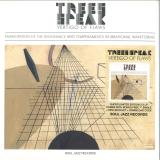
Trees Speak - Vertigo of Flaws: Emancipation of the Dissonance and Temperaments in Irrational Waveforms

Trees Speak are back!
Speak’s new album, “Vertigo of Flaws: Emancipation of the Dissonance and Temperaments in
Irrational Waveforms” comes as a double-vinyl edition, single CD and digital release. The limitededition first pressing only of the vinyl includes a bonus 45 enclosed in an 8-page 7”x7” booklet
insert housed within the gatefold sleeve with cover artwork created by Soviet Union propaganda
artist Lazar Markovich Lissitzky in 1911.
Trees Speak are back!
This new release is a vast leap into an ocean of space and sound, a quantum leap into cybernetics, biology, anti-gravity,
time travel, dream speech and transfiguration. A seriously next step release!
Showing no signs of slowing down their rapid creative pace – incredibly this is their fourth album in the space of just over
one year – ‘Vertigo of Flaws’ is a mighty 29 tracks, one and a half hours of music across one double album that is surely
going to be a defining point in their musical career, a giant leap into the sonic unknown, an epic exploration of intensity
and sound.
Alongside their now trademark German krautrock motoric-beat rhythms, angular New York post-punk attitude, tripped-out
60s spy soundtrack, psyche-rock, and 70s synthesizers and vocoders, here you will also hear a new cosmic spacial
awareness (both personal inner space and galactic outer space) and a truly wilful pushing of sonic boundaries - as police
sirens, static noise, alarms, radio signals, avant-garde voices, and orchestral string quartets, all collide to add beautiful
dissonance to uber-powerful, intense, addictive and propulsive rhythms - in the process creating a truly unique
soundscape that Trees Speak have made wholly their own.
If you ever wanted to hear Can, Hawkwind, Destroy All Monsters, Pere Ubu, electric eels, John Cage, Liquid Liquid,
Tangerine Dream, Suicide, Neu!, Laurie Spiegel, Art Ensemble of Chicago, John Barry, Mother Mallard’s Portable
Masterpiece Company, Sun Ra, Stockhausen, John Carpenter, Electro-Acoustic and Musique Concrete and Mars in one
band - then this is it!
Trees Speak are Daniel Martin Diaz and Damian Diaz from Tucson, Arizona and their music often draws on the cosmic nighttime magic of Arizona’s natural desert landscapes. ‘Trees Speak’ relates to the idea of future technologies storing
information and data in trees and plants - using them as hard drives - and the idea that Trees communicate collectively.
Special guests from the hyper-creative hub of the Tucson music scene on this release are Gabriel Sullivan, Ben Nisbet, Saul
Millan, Stephani Guilmette, and Davis Jones.
The album Vertigo of Flaws was recorded in Brooklyn, New York, and Tucson, Arizona during the plague of 2021.
Extract from Vertigo of Flaws sleevenotes:
‘As we travel through space and time, avoiding the discarded remains of the industrial period, the
deconstruction of social norms through the expression of art, music, and philosophy guide the human
experience towards the unknown.
All that remains are musical echoes scattered throughout the universe, like ancient vibrations that now
populate the cosmos. These waves now show signs of decay. Melody, beauty, tonality have all but fallen
away as dissonance blossoms. As John Cage wrote in 1937,
“Whereas, in the past, the point of disagreement has been between dissonance and consonance, it will be,
in the immediate future, between noise and so-called musical sounds. New methods will be discovered,
bearing a definite relation to Schoenberg’s twelve-tone system and present methods of writing percussion
music and any other methods which are
free from the concept of a fundamental tone”.
Similarly, George Van Tassel claimed the Integratron as capable of
rejuvenation, anti-gravity, and time travel. So, what remains of the
“people”? We have adopted from them our own Zeitgeber: their pulses
now guide our sun, our planets, our earths, and are the new circadian,
diurnal, and ultradian rhythms of the galaxy. Traumsprache, dream
speech, is now the internal language of trees.
Decaying metal and machines liberated the note unto nature’s table,
and we sip the delicious nectar of music once more irrational, elaborate,
violent, vast. The past is the future, musical disintegration its own rebirth.
We are nature, once more the computer of the Universe.’

out of Stock

Order now and we will order the item for you at our supplier.

36,09

Last In: 73 days ago
Zenith Volt - Timekeeper

Zenith Volt

Timekeeper

12inchAZT115VTR
Aztec Music
29.10.2021

Zenith Volt/ zēneTH vōlt: 1.Galaxy driven woke melodies for your thoughts and drive 2. Ethereal calibration against gravity burdened life

On TIMEKEEPER, Zenith Volt says: I am so inspired by the thought that at this very moment in time, our heels are stepping out of a past to be left forever in exchange for an unwritten future. The album TIMEKEEPER holds an amalgam of this heaviness and hope throughout. Each instrument, melody, and message has a self-reflective undertone. Speak from the heart, embrace the strange, and keep a clear head. While the past and future are overall inspirational waypoints, they are specifically stylistic ones as well. Timekeeper has a heavy retro/futuristic synthesizer tone and feel. Arpeggiating pulse and forward motion stitch each track together forging ahead through time itself.

Pulling sounds from retro and futuristic palates, Zenith Volt constructs an ethereal reality, attuned to the openness, enormity and unpredictability of the expanding universe; and the unknown that ever lies ahead.

pre-order now29.10.2021

expected to be published on 29.10.2021

22,65
Marc Melià - Veus

Born in Majorca, Marc Melià is a composer/producer, who’s been based in Brussels for over 10 years. First spotted alongside Françoiz Breut, Lonely Drifter Karen or Borja Flames, he released Music for Prophet in 2017. It was issued on Gaspar Claus’s label Les Disques du Festival Permanent, as part of Flavien Berger’s curation.

On that first album, Marc Melià had explored the possibilities of a mythic synth; on Veus, as if sloughing, he applied the process of sound modification to his own voice, until becoming an android. But an android who sings of love and dreams, a sensitive automaton who plays with the tropes of pop music. Through this device, Marc Melià knowingly seeks poetry and beauty within transgenics, in the search of a universe where one can surf though waves of profoundly moving chord patterns, hear voices unconstrained by range limitations, or dance freely, as in zero gravity.

Part of the album has been recorded in Une ferme dans les Vosges, courtesy of Rodolphe Burger. It was recorded with Roméo Poirier, one of the most promising figures of ambient, and the elegant multi-talented Lou Rotzinger. As if progressing in parallel with his own linguistic experience, to add another layer to the sloughing, side A is sung in Catalan, Marc Melià’s mother tongue, and side B in French, his adopted language.

Like an echo to his previous album, Veus opens with an instrumental, “Pulse on a E”, which starts with a sequence created with a single note transposed to its octave, just like “Fata Fou”, the last song on Music for Prophet.

Although the title seems to reference an iconic 80s synth, “DX7” is actually about the seven days of the week. It is a love song, about the temperamental oscillations which make every morning the blank canvas of an unpredictable story. Wednesday, I hate you, Sunday, I love you. With few words and a lot of emotion, a synthetic voice is trying to grow more human each day.

“Dent de Serra” deals with the weight of memory on our relationships, but also with the way we revisit them constantly in order to integrate souvenirs within present relationships. Suddenly, the song stops and enters a new dimension, everything is different, as if what had just happened was now forgotten forever.

Oxytocin (“Oxitocines” in Catalan) is said to be the hormone of love. This song deals in a playful way with the duality between science and faith, between rational and magic, when it comes to sentimental relationships. Love is a universal theme, it is everywhere in the world, and love songs have been written for a very long time. But this particular love song is an ode to an aspect of love that has been less sung about: biology, which makes it possible to feel like you’re floating in space when you fall in love.

“Les étoiles” is a trio with Flavien Berger and Pi Ja Ma. The song is about attraction. What attracts humans to each other, but also the inevitable gravitational attraction. The song is also about accidents, magic moments that take us outside of our daily lives and give us the possibility to imagine a sidereal, infinite love.

“A propos d’une chanson” was born after Marc Melià had dreamed he had written the most beautiful song he’d ever created. When he woke up, he realized that song was actually O Superman by Laurie Anderson.

Aside from these songs, Marc Melià offers a few breaks, instrumental but no less narrative.

“Final d’hivern” conjures these quiet moments between two intense events; sleeping at night between two days; the calm that settles in after a hard winter, right before spring properly starts.

Using a musical language that clearly references Ryuichi Sakamoto, “Romain”, with its theme based on a melancholic chord pattern, could be the soundtrack to a 1970s movie lost in time. Little by little, elements that seem to come from a completely different context find their place, while turning the initial mood into something strange and unexpected.

Finally, “Retorn”, which finishes the album, is a reprise of the theme of “DX7”.

From the chords that make up a song, to the days that make up our lives, existence is but a cycle, and Veus is an exploration of them. Marc Melià keeps on drifting on his personal path, between homage to the past and visions of the future.

pre-order now15.10.2021

expected to be published on 15.10.2021

16,77
Michael Beach - Dream Violence

Dream Violence, Michael Beach’s fourth full-length, is an epic album that explores the duality of the human condition. Or, as Beach himself puts it, the album is about “human futility, passion, desire, anger, frustration, and the struggle to maintain hope in a somewhat hopeless time.” Dream Violence, then, addresses the existential crisis of being an artist in 2020.

Known for his work touring with the Australian guitar pop band Thigh Master and the late, brilliantly eccentric Israeli guitarist Charlie Megira, currently the focus of a number of reissues by the Numero Group, Beach is the architect of a sound that is both well-built and ramshackle, straightforward and indeterminably complex, out of the norm yet familiar in all the best ways.

Dream Violence unfolds like a revelation, filled with sonic tumbleweeds that reference Neil Young’s On the Beach, Bruce Springsteen’s Nebraska, the Velvet Underground’s Loaded, and the Go Betweens’ Before Hollywood. Influences ranging from the enigmatic outlier Megira to Glenn Branca to the Oblivians are combined to create a new, exhilarating sound, part of the path that Beach has been on since 2008’s Blood Courses. A veteran of year-end indie rock round ups beginning with Golden Theft in 2013 and continuing with Gravity/Repulsion, released in 2017, Beach distills the best of those early albums and adds sharpened intent.

Dream Violence works beautifully as a start-to-finish album. There are magnificent stand-alone moments: “Spring,” a raggedly building ballad that perfectly captures the ennui attached to new beginnings; “De Facto Blues,” a born-to-lose anthem that, says Beach, “is the sound of people totally at their wits end;” “Curtain of Night,” a simultaneously derelict and bright tribute to the late Megira, which sounds like it could’ve been cut at Muscle Shoals Sound Studio after the Rolling Stones wrapped up sessions for Sticky Fingers; and the delicately vulnerable “You Found Me Out,” which evokes equal parts Lou Reed and Joni Mitchell. On the latter, the lyrics “You found me out, on a ship at sea, you pulled me in, made a wreck of me,” encapsulate “the aimless of a modern world view in a future without hope and the draw/dependence of love in those times,” Beach explains.

Through music, Beach strives to convey both passion and compassion, energy and action. “My hope is that something gets communicated that makes people think outside of themselves or their surroundings,” he says. “To ask questions, and consider the effects of their decisions. To communicate some essential part of the human spirit that understands intuitively how to feel connected to each other rather than divide, exploit, separate, ignore, and all the other heinous shit we have the ability to do with each other.”

Recorded on two continents, Dream Violence documents Beach’s move from Oakland, California to Melbourne, Australia as he navigated a new music scene, plenty of bureaucratic red tape, and, ultimately, citizenship. Parts of the album were recorded and mixed at Tiny Telephone Recording in Oakland, at the end of a 2019 tour with Kelley Stoltz producing. Other tracks were recorded at Beach’s new home in Melbourne, where he could be “relaxed and sloppy in all the right ways,” and partially remixed at Phaedra Studios.

At the Memphis-based Goner label, Beach joins an increasingly unique roster of international musicians that reaches far beyond garage or indie rock to encompass artists like gospel singer Rev. John Wilkins, Kentucky rockers Archaeas, New Orleans iconoclasts Quintron and Miss Pussycat, and no-wavers Optic Sink.

pre-order now19.03.2021

expected to be published on 19.03.2021

18,95
Saito - Downfall 2x12"

Saito

Downfall 2x12"

2x12inchMP9
Mille Plateaux
02.11.2020

DOWNFALL is the first album under the name SAITO created by Lena Saito, aka Galcid, and produced by accomplished analog synthesizer guru, Hisashi Saito, aka Lena’s husband. Having descended from a long line of Japanese sword-smiths, the industrial sound of smashing steel is embedded in Lena’s DNA and reflected in her music, however there are also refined, hypnotic tones showing a side with more finesse. The music itself is not scored and is predominantly improvised. Words and vocals are ad libbed as well. Sometimes the machines respond as if through telekinesis, altogether emitting a sound which can be categorized somewhere in the range between modern experimental dance music and something possibly making more sense to enlightened minds a thousand years in the future.


There is a new addition to the forge of talents of Mille Plateaux, a Japanese musician by the name of Saito whose album has been released on the label under the title of Downfall. After a whole series of releases under the signature tag clicks & cuts, there comes out a work, much more suited for a dance hall, that is different in terms of the genre from everything that has been published so far.
Like a bucket of ice-cold water poured over the head, erratic agressive hardcore rhythms pour all over the audience in the first track, interrupted only by grinding noises and minimalistic technogenic clicks.
Downfall won't fail to infect even the most experienced music connaisseur with its out-of-control energy, while offering a wide range of techniques: at times, robotic voices, one second long fragments of looped melodies and many other audio gimmicks.
Lena Saito (that is the author's name) is not afraid of conducting experiments in her chemical laboratory, freely mixing sound reagents without taking any precautions. It feels like, this new chemical substance, that she has been working on so thoroughly, contains quite a long list of ingredients, although its main component is the various rhythm breaks.
The synthesizer part of Red Hammer sounds in the best traditions of the acid style, and the rhythm section is akin to African tribal dances of the future. Downfall is absolutely unrelenting in its concept.
The melody of the composition Nucleosome is a little bit like the melancholic IDM of the 00s, finding itself secondary to the dominating, yet again convoluted rhythmical web meticulously woven by Saito.
This album can be definitely named as a big contender aspiring to start a new golden era of Mille Plateaux, and Saito as the hidden treasure of the label that can challenge even the veterans for the right to be the headliner.

out of Stock

Order now and we will order the item for you at our supplier.

23,74

Last In: 5 years ago
TV Victor - Back To The Moon

TV Victor was one of the first artists of Tresor Records where he became legendary with several of his ambient and trance productions including Trance Garden 1-3 and Trancecology Chapter 1. In 1989, he launched his first solo project: Moondance - The Magic Sound of the Moon, where he lay foundations for later explorations with experimental sounds fused with pop elements and anticipated an ambient excursion to be had in the future.

In the following decades TV Victor created impressive solo works that traversed between ambient and trance, he collaborated with artists like Moritz v. Oswald, Max Loderbauer, Ari Benjamin Meyers, Paul Browse and Tobias Freud. Contrary to common mainstream tendencies he created a very unique interpretation of both genres. In recent years Victor has concentrated on creating experimental and abstract sonic spaces for escaping reality, spaces that live through the imagination of the listener. Each piece, a segment of a larger musical movement; stands alone to create new sonic continuums. Otherworldy music that is in its own sphere.

30 years after the release of Moondance and 50 years after the first landing, Lullabies For Insomniacs revisit TV Victor's musical roots with 'Back To The Moon'. The previously unreleased works were carefully selected from his vaults and restored by Berlin based engineer Brett Olke (B Ashra), the album offers a glimpse into the future by creating a soundtrack for mankind's settlement of beyond in a conceivable hereafter.

out of Stock

Order now and we will order the item for you at our supplier.

19,62

Last In: 6 years ago
KLEFT - H+ Sexualis

Kleft

H+ Sexualis

12inchDEX005
Domestic Exile
22.01.2019

Domestic Exile are proud to present the devastatingly deplorable and malevolent recordings (that are sure to corrode yet electrify your ears) by Glasgow's very own KLEFT.

KLEFT aka Vickie McDonald is rooted in and has actively propagated the underground DIY radical queer punk and feminist movement here in Glasgow. Their projects have included the skull crushing sludge doom of Cartilage, the unflinching and infamous multi- membered hard core stars that were DIVORCE and the sacrificial, druid drone glitch of MOURN. Alongside these projects they have uncompromisingly disrupted, motivated and facilitated collective endeavors to take down the capital power structure of the dominant system of patriarchal club venues and abhorrent fuckers in this town.

For this record 'H+ Sexualis', KLEFT explores the neo-modern space where flesh is left behind. Negotiating, analyzing and tearing to shreds the relationship and balance between flesh and technology. KLEFT's expansive and palpable sonic offerings delve into themes of transhumanism and body hacking and seep into our collective skin begging the question; can flesh ever be created digitally. Does a lack of physicality alienate human experience in a post transhumanism society Are we all destined to be skinless yet digitally connected Will the body become superfluous Toward "the utopian dream of the hope for a monstrous world without gender," as stated on Donna Haraway's essay ''A Cyborg Manifesto.'

From the opening track 'Ossein' the listener grasps a foreboding lethargic build up, lurking out of the spatial ritualistic shadows into a sea of suffocating nothingness. A void where there is no gravity. Skeletal and brittle shattering rhythms which echo DMZ / Skull Disco dubstep alongside the more frozen, glacial ominous explorations of grime are often felt proving KLEFT is an artist whose inspirations run deep and wide and generally exist in the darkest recesses of our subconscious. These fearful, disjointed rhythms are set against weightless atmospheric oscillated synths, as if roaming through bleakly opaque, claustrophobic narrow corridors on a first person survival horror video game such as Resident Evil.

Moving through to 'CMBR', KLEFT's dissonant, degrading soundscape ferociously ascends. The resilient kick drum is propulsive and pulverizing akin to 'ardcore tekno - or intense gabba if you have the guts to adjust the tempo up to +8 - aesthetics that overwhelm and agitate finally revealing it's grotesque biological / amorphous bio structure. Elevating the repetitive 4/4 kick to a destructive, distorted banger of a track as layers of converging atonal noise and sound design simultaneously further enhances the sense of imminent radioactive contamination.

Next is 'Writhe, Squirm, Broken' continuing the convulsive, nauseating permutations of the prior track but reconfigured like a mangled, gruesome Cronenberg-esque parasite that has infiltrated an open wound, excruciatingly feeding off of the inner anatomy of it's hosts body from within. Repulsively reformulating the shape and dimension. The intro is akin to a panic stricken bouncy ball contracting and expanding, the spring reverb building momentum and traveling further away in distance and speed.

'Hackfleisch Deluxe' is a muuurrderous stomper and is one of the more grime / bass orientated tracks that deconstructs and disrupts the tempo familiar to sub-low producers on Black Ops / Jon E Cash / DJ Dread D. The crawling, plummeting frequency of the synth is a nauseating rush of coagulating blood to the heed; a deep throbbing sensory depravation in sharp, paradoxical contrast with the driving harmony layered on top which proves to be infectiously addictive. Furthermore are splintering programmed vocal samples that gives a sense of artificial disorientation, mind over matter, a possible hint at our evolving sentient cognition within a nightmarish simulated, augmented reality

Second to last we have 'Keratin' which is filled with the near fatal dissolving thud of Djax-Up acid that gives the impression that you're a biologist peering through a microscope into a petrie dish and witnessing the rapid and furious genetic cellular replication of bacterial and viral organisms.

Culminating in 'Bruised and Bleeding Hands' where the squashed density of a deflated and depressurized helium filled balloon and elastic umbilical cords, barbed wire and copper wires grind n' coil around the lens of a zooming camera. Taking no prisoners, this is a punishing grime weapon. A phat, surgical kick drum bulldozes its way thru causing carnage, syncopated punching snares after every rave stab and dizzying third beat. It won't be long until ye hear this on Silver Drizzle's youtube channel in the near future.

This record transports us to the hyperkinetic mutation scene on the cult cyberpunk film Tetsuo The Iron Man where the organic flesh / mechanical rust of the Iron Man metamorphoses with the Metal Fetishist during the rebirth sequence and we say 'LONG LIVE THE NEW FLESH!''.

out of Stock

Order now and we will order the item for you at our supplier.

9,71

Last In: 6 years ago
Nik Pascal - Magnetic Web

If you check the credits of The Rolling Stones' Goats Head Soup LP from 1973 you'll find a certain "Pascal" listed on the percussion section. That is none other than Los Angeles based artist Nicolas Pascal Raicevik (1933-1994), aka 107-34-8933, aka Head, aka Nik Pascal, aka Nik Raicevic. Besides his hitting the bongoes on the Stones album, Nik was a great artist on his own, both as a painter and as a musician. As a musician, he was a pioneer in the use of synthesizers, preceeding the Berlin school by some years when his Head LP was released on on Buddah in 1970. Buddah probably saw in Head the opportunity to cash in some money from the remains of the psychedelic scene - the three tracks on the LP are named after drugs used in the late sixties. The sounds, however, are accomplished works that show Raicevic as one of the most interesting pioneers in the use of synths. The album probably didn't do too well, since Buddah didn't renew the contract with Raicevic, who instead took his own way releasing his works on his very own Narco Records and Tapes label. Between 1968 and 1975 Narco would issue 4 LPs credited either to Nik Raicevic (Beyond The End... Eternity) or Nik Pascal (The Sixth Ear, Magnetic Web and Zero Gravity) plus one credited to 107-34-8933 (Numbers, which is in fact the same LP as Buddah's Head, albeit with different cover art). Copies of these LPs came with an ironic sticker over the shrinkwrap that read "Do not listen to this LP if you are stoned".

Magnetic Web was released in 1973. It appeared under the Nik Pascal monicker and showed a clear evolution in sound, favoured by the addition of an Arp 2600 and some rhythm boxes. It also included percussions and cymbals. The Two Headed Dog site thinks "this is his masterpiece in all of its acid-laced glory."

Besides his musical explorations, Nik was also an interesting painter. His paintings are auctioned from time to time, and are consciousness expanding works influenced by abstract cubism and surrealism, some kind of Salvador Dalí on drugs exploring the outter and inner space. All the artwork on the sleeves of his LPs is done by himself. Spacey landscapes and psychedelic colours that fit perfectly to the music they contain.

"Nik Raicevic's music is at the intersection of radical psycho-electronic weirdness and kraut kosmische music (in particular the scifi-hypno-minimal modules of Conrad Schnitzler in Grun, Rot and Blau). It presents mega epic & tripped out electronic improvisations.

"This is an absolute must for collectors and fans of visceral, neurotic soundscapes."

"As far as late-60s / early-70s American Bedroom' Electronic Music goes, these LPS have to be among the first transmissions from this sector, made all the more attractive when coupled with Raicevic's alien topographIes - the covers are high-color portrayals of Venusian lanes, knotted growths, & future-past architecture in a style you might equate with Vintage' sci-fi pulp-novel covers - & copious Downer' sentiment. This music is imbued with a sort of lonely, anti-social sensibility that's about as far as you can get from the Academic' Early Electronic vector. I will say that if the Steve Birchall, Cellutron & the Invisible, and/or Pythagoron™ seed your garden, this will likely do the same."

Never reissued before on vinyl format, the Wah Wah reissue features original sleeve artwork made of paintings and drawings by Nik himself, and reproduction of the famous ironic "Do not listen if you are stoned" sticker. Limited edition, 500 copies only.

pre-order now30.09.2018

expected to be published on 30.09.2018

24,08
Nik Pascal - The Sixth Ear

If you check the credits of The Rolling Stones' Goats Head Soup LP from 1973 you'll find a certain "Pascal" listed on the percussion section. That is none other than Los Angeles based artist Nicolas Pascal Raicevik (1933-1994), aka 107-34-8933, aka Head, aka Nik Pascal, aka Nik Raicevic. Besides his hitting the bongoes on the Stones album, Nik was a great artist on his own, both as a painter and as a musician. As a musician, he was a pioneer in the use of synthesizers, preceeding the Berlin school by some years when his Head LP was released on on Buddah in 1970. Buddah probably saw in Head the opportunity to cash in some money from the remains of the psychedelic scene - the three tracks on the LP are named after drugs used in the late sixties. The sounds, however, are accomplished works that show Raicevic as one of the most interesting pioneers in the use of synths. The album probably didn't do too well, since Buddah didn't renew the contract with Raicevic, who instead took his own way releasing his works on his very own Narco Records and Tapes label. Between 1968 and 1975 Narco would issue 4 LPs credited either to Nik Raicevic (Beyond The End... Eternity) or Nik Pascal (The Sixth Ear, Magnetic Web and Zero Gravity) plus one credited to 107-34-8933 (Numbers, which is in fact the same LP as Buddah's Head, albeit with different cover art). Copies of these LPs came with an ironic sticker over the shrinkwrap that read "Do not listen to this LP if you are stoned".

1972 saw the release of The Sixth Ear (Narco NR666), this time credited to Nik Pascal. A more complex work than Beyond The End..., it adds consistent rhythmic patterns to the mix with the addition of bongoes and also explores some interesting chord progressions.

Besides his musical explorations, Nik was also an interesting painter. His paintings are auctioned from time to time, and are consciousness expanding works influenced by abstract cubism and surrealism, some kind of Salvador Dalí on drugs exploring the outter and inner space. All the artwork on the sleeves of his LPs is done by himself. Spacey landscapes and psychedelic colours that fit perfectly to the music they contain.

"Nik Raicevic's music is at the intersection of radical psycho-electronic weirdness and kraut kosmische music (in particular the scifi-hypno-minimal modules of Conrad Schnitzler in Grun, Rot and Blau). It presents mega epic & tripped out electronic improvisations.

"This is an absolute must for collectors and fans of visceral, neurotic soundscapes." (progarchives)

"As far as late-60s / early-70s American Bedroom' Electronic Music goes, these LPS have to be among the first transmissions from this sector, made all the more attractive when coupled with Raicevic's alien topographIes - the covers are high-color portrayals of Venusian lanes, knotted growths, & future-past architecture in a style you might equate with Vintage' sci-fi pulp-novel covers - & copious Downer' sentiment. This music is imbued with a sort of lonely, anti-social sensibility that's about as far as you can get from the Academic' Early Electronic vector. I will say that if the Steve Birchall, Cellutron & the Invisible, and/or Pythagoron™ seed your garden, this will likely do the same." (twoheadeddog)

Never reissued before on vinyl format, the Wah Wah reissue features original sleeve artwork made of paintings and drawings by Nik himself and reproduction of the famous ironic "Do not listen if you are stoned" sticker. Limited edition, 500 copies only.

pre-order now30.09.2018

expected to be published on 30.09.2018

24,08
Nik Pascal - Zero Gravity

If you check the credits of The Rolling Stones' Goats Head Soup LP from 1973 you'll find a certain "Pascal" listed on the percussion section. That is none other than Los Angeles based artist Nicolas Pascal Raicevik (1933-1994), aka 107-34-8933, aka Head, aka Nik Pascal, aka Nik Raicevic. Besides his hitting the bongoes on the Stones album, Nik was a great artist on his own, both as a painter and as a musician. As a musician, he was a pioneer in the use of synthesizers, preceeding the Berlin school by some years when his Head LP was released on on Buddah in 1970. Buddah probably saw in Head the opportunity to cash in some money from the remains of the psychedelic scene - the three tracks on the LP are named after drugs used in the late sixties. The sounds, however, are accomplished works that show Raicevic as one of the most interesting pioneers in the use of synths. The album probably didn't do too well, since Buddah didn't renew the contract with Raicevic, who instead took his own way releasing his works on his very own Narco Records and Tapes label. Between 1968 and 1975 Narco would issue 4 LPs credited either to Nik Raicevic (Beyond The End... Eternity) or Nik Pascal (The Sixth Ear, Magnetic Web and Zero Gravity) plus one credited to 107-34-8933 (Numbers, which is in fact the same LP as Buddah's Head, albeit with different cover art). Copies of these LPs came with an ironic sticker over the shrinkwrap that read "Do not listen to this LP if you are stoned".

Nik's last album, Zero Gravity (Narco NR123) came under the Nik Pascal name and had a fantastic side long piece on the title track which reminisces of the works of Cluster. B side features four tracks that also bear some Conrad Schnitzler reminiscences. This was to be Nik's last LP before he would sell all his synths to ex car racer and future electronic/ambient music star Steve Roach.

Besides his musical explorations, Nik was also an interesting painter. His paintings are auctioned from time to time, and are consciousness expanding works influenced by abstract cubism and surrealism, some kind of Salvador Dalí on drugs exploring the outter and inner space. All the artwork on the sleeves of his LPs is done by himself. Spacey landscapes and psychedelic colours that fit perfectly to the music they contain.

"Nik Raicevic's music is at the intersection of radical psycho-electronic weirdness and kraut kosmische music (in particular the scifi-hypno-minimal modules of Conrad Schnitzler in Grun, Rot and Blau). It presents mega epic & tripped out electronic improvisations.

"This is an absolute must for collectors and fans of visceral, neurotic soundscapes."

"As far as late-60s / early-70s American Bedroom' Electronic Music goes, these LPS have to be among the first transmissions from this sector, made all the more attractive when coupled with Raicevic's alien topographIes - the covers are high-color portrayals of Venusian lanes, knotted growths, & future-past architecture in a style you might equate with Vintage' sci-fi pulp-novel covers - & copious Downer' sentiment. This music is imbued with a sort of lonely, anti-social sensibility that's about as far as you can get from the Academic' Early Electronic vector. I will say that if the Steve Birchall, Cellutron & the Invisible, and/or Pythagoron™ seed your garden, this will likely do the same."

Never reissued before on vinyl format, the Wah Wah reissue features original sleeve artwork made of paintings and drawings by Nik himself, and reproduction of the famous ironic "Do not listen if you are stoned" sticker. Limited edition, 500 copies only.

pre-order now30.09.2018

expected to be published on 30.09.2018

24,08
30drop - The Time Of Cruel Miracles LP 3x12"

3x12"

I did not know what achievements, what mockery, even what tortures awaited me. I knew nothing, and I persisted in the faith that the time of cruel miracles was not past .
Stanislaw Lem (Solaris, 1961).

This paragraph from Solaris, the novel written in 1961 by Stanislav Lem, is the starting point for the concept this 30drop album has been built upon. Science fiction masters like Lem are one of the greatest influences for the artist, who devised this album after the mental challenges that humans should overcome in a future: encounter with beings from other civilizations: capable of interacting with us in a totally unthinkable way so far.

Away from what many a sci-fi blockbuster depicts, this work revolves around the idea that such meeting with alien species will be eminently a mental experience that will shock not only our cultural values but also our very own perceptions about what space/time/reality is a mindbending experience where everything we knew before dissolves around us and propels us to uncharted grounds. Terra incognita so far.

Bypassing the random track collection syndrome that plagues many of today s so-called techno albums this LP was conceived and devised from it s very beginning as a full, complete work in itself, best enjoyed in it s totality. A story-telling journey (very much in the tradition of seminal / genre-defining albums as UR s X-102) were tracks lead you to one another. Tracks can be enjoyed on their own, being all suited for dancefloor and dj-sets alike, but take a complete different meaning when put in the right context within the album.

Musically this long-player combines stripped-down rhythms, sweeping pads and hypnotical bleeping sequences woven together in an intrincate but subtle way, a fashion that harks back to the classic minimalist yet complex mid-90 s sound of Hood, Mills and T.Dixon sounds appealing both the mind and the feet.

Classic and futuristic at the same time, this is a compelling journey that opens with the eerie atmospheres of Our Understanding before really taking off with the cadential NGC1277. The hypnotic Captured Rotation sets the pace for the rest of album which oscillates between the exhilarating cosmic groove of Beyond Language and the contemplative stasis of The Mirror. Other highlights include the entrancing Goldene Spirale or the furiously busy Approaching Light.

The whole package is further rounded up by a set of remixes which showcase the different directions taken by techno producers this days: from Substance s solid Berlin-style to Architectural s spaced-out visions via Rivet s hard-hitting club bangers and Zero Mass abrassive experiments.

Text by: Dj Zero.

out of Stock

Order now and we will order the item for you at our supplier.

16,77

Last In: 5 years ago
Phil Gerus - To Rack & Ruin Vol. 11

Those disco specialists at To Rack & Ruin are back in business, kicking off their 2016 campaign with an absolute scorcher from Moscovite producer Phil Gerus. After making waves with a string of releases for the likes of Futureboogie and Sonar Kollektiv, Gerus arrives at the Mancunian edit institution in fine form, ready to take over the world with a quartet of fully loaded floor movers for all you dancing fools.
Going hard and heavy from the off, Phil introduces himself with the tumbling toms and zero gravity sequences of 'Delicious Wishes', a neon tinged reshape of an Angelic original. Working the loops and FX like a pro, the Russian sprinkles space dust all over this camp cosmic classic, packing a whole host of extra oomph in the warp drive! "Bossy Lady" Phil turns his attention to Italo, setting pulses racing and feet stomping with the space age sound of . Playing free and easy with the pitch control, the Moscow magician conjures up a space disco body mover complete with tripped out vocals, chunky guitar and nebulous synth lines. Sticking with the moods and grooves of the Mediterranean,
Over on the flip we have "Stop! Let's Slow Down" powering into the peak time in a shimmer of sequins as it supercharges a boogie vintage for the modern DJ. The finest floor shaking boogie reheat since Tiger & Woods last hit a hole in one, this is gonna raise the temperature at any party worth its salt. Phil takes us home with a spaced out version of an all time Italo classic. Reworking the percussion and looping up that low slung baseline, our host supercharges the groove for modern club deployment, rounding off another essential release from your favourite edit imprint.

Pressed on Black Vinyl with hand stamped logo & info

out of Stock

Order now and we will order the item for you at our supplier.

9,87

Last In: 3 years ago
Items per Page:
N/ABPM
Vinyl