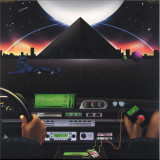
Molecular Recordings Presents "Structure Series 2" — Continuing a Legacy of Techno Innovation
Following the success of the first volume, Molecular Recordings returns with Structure Series 2, the next chapter in its celebrated vinyl series that honors the label’s enduring influence on underground techno.
This 12" release deepens the label’s exploration of forward-thinking sound, pairing iconic names from the Molecular archive with groundbreaking contributions from the new vanguard of producers. Each track reflects the uncompromising spirit and sonic evolution that have defined the label for over three decades.
Structure Series 2 is both a continuation and a progression — a curated fusion of past and future that underscores Molecular’s role as a pioneer and incubator of techno culture. It stands not only as a collector’s item but as a bold artistic statement.
With Structure Series 2, Molecular Recordings reaffirms its commitment to pushing boundaries while remaining rooted in the authenticity that has shaped its legacy since day one.
Cerca:future unit
Cromby extends the Potency family for it's 7th release, welcoming in Trax Unit by way of the Gloria EP. The release is a break neck ride of techno and house alchemy, capturing the spirit of Berlin via LA. Perfectly encapsulating the sound of the imprint, the release marks an exciting new chapter in the Potency story, with a slew of releases planned that will move label head Cromby from producer to curator, growing the roster and developing the sonic identity of Potency into the future.
Better Together Records is pleased to welcome the duo Hiworld into the BTR family with their etheral and multi genre project “Temple do Sol”.
Hiworld is the collaborative project of Eora based artists Mondowun and Toaka. Born from a long-standing friendship and shared passion for the world of electronic music. Inspired by their Portuguese and Polynesian backgrounds, nostalgic 90s culture, and reality-altering records. Their forthcoming EP ‘Temple Do Sol’ captures a world where technology does NOT reign supreme and people’s bonds are built through reality and NOT the digital realm. The record builds evocative atmospheres and distinct worlds, offering listeners a space to access personal memories and create new experiences.
As always, Solace in unity at the end of eternity.
Polar Park – Three Producers, One Unique Sound ! Stefan Müller, Andreas Thoma, and Ralph Grieco - united by a deep passion for electronic sound. Drawing from decades of experience, their music blends Minimal and House, driven by rich textures and hypnotic grooves. Each track is created
with analog synthesizers in their private Studio in Switzerland, capturing an unmistakably warm and organic tone. With all future releases coming out on vinyl, Polar Park stands for authenticity, quality, and the timeless appeal of handcrafted music in a digital world.
Bringing together the elder statesman of the Zulu guitar Madala Kunene and internationally acclaimed Sibusile Xaba, kwaNTU pulls two generations of South African guitar mastery into a single point of focus. Under-represented on recordings outside of South Africa, Madala Kunene (b. 1951), the ‘King of the Zulu Guitar’, is revered as the greatest living master of the Zulu guitar tradition. Sibusile Xaba, whose collaboration with Mushroom Hour Half Hour reaches back to his first recording in 2017 (Open Letter To Adoniah/Unlearning), has garnered international acclaim for his unique voice and virtuoso guitar stylings, which bring together multiple South African guitar lineages in an original, spiritualised fusion. Collaborating with Mushroom Hour and New Soil for kwaNTU, the two players come together to weave a filigree sonic fabric which reaches down to the heartwood of Zulu guitar music but moves resolutely outward, building on the past to create a deeply rooted statement about present conditions and future travels. kwaNTU – which can be roughly translated ‘the place of the life-spirit’ – is also conclave of teacher and student, as Xaba has been taught by Kunene for the last decade. Meditative, rich and sonically sui generis, kwaNTU finds these two musicians linking up within the inimitable space of sound and spirit that they share through Kunene’s teaching.
The great masters of South African music have not all had equal exposure. For many years the generation of musicians who were exiled during apartheid took centre stage, as the regime made it very difficult for those at home to be heard. More recently, a new cohort of important voices, especially in jazz, has broken through to international consciousness. But for the generation of musicians in between – those who shone like beacons in the most difficult final years of apartheid and immediately afterward – international recognition has been slow in coming.
Madala Kunene, ‘the King of the Zulu Guitar’, is among this number. A revered figure for current generations of South African musicians, Kunene began his recording career in 1990, at the bitter end of apartheid, with a now classic self-titled LP for David Marks’ storied Third Ear imprint. Born in 1951 in Cato Manor, near Durban, he had determined to be a musician from early childhood, and by the time he first entered a recording studio he had already had a long career as a popular performer. His virtuoso absorption and transformation of the venerable Zulu maskanda guitar tradition and his richly spiritualised approach to music immediately marked him out as someone special, and in the years that followed, Kunene cemented his position as one of South Africa’s musical elders. He is without doubt the grand master of the Zulu guitar tradition, but his sound and sensibility ranges far beyond it into varied sonic terrain, and he has collaborated with a wide range of musicians both at home and abroad. Now in his mid-seventies, he remains a shining light for those that are making music in contemporary South Africa.
‘He is really an amazing person,’ says the guitarist Sibusile Xaba, who has been mentored by Kunene for over a decade, and now invites a collaboration with him on kwaNTU. ‘As a mentor, he's really powerful in showing us the way. For us to have this opportunity to make music together and have a project together is really a blessing to me.’
Xaba himself grew up in Newcastle, KwaZulu-Natal, where his mother had been in a band and his father sang in a church choir, and from early childhood Xaba played homemade tin guitars. He only later realised that music was his calling. ‘I just loved music. I was fortunate. My parents loved music. And when it was time for me to leave home and go to study outside Newcastle, I knew that music was what I wanted to do. There was no second option. It was just music.’ Moving to Pretoria to study music formally, Xaba committed himself to his craft, developing a unique style that draws on both US jazz masters such as Wes Montgomery and Jim Hall, and the rich and varied heritage of the South African guitar, from inspirational jazz players such as Allen Kwela and Enoch Mthalane, to the music of the Malombo groups and Dr. Philip Tabane (Xaba has previously collaborated with Dr. Tabane’s late son, Thabang), and the Zulu guitar tradition embodied by Kunene.
‘I was really in love with the jazz guitar, I really admired it, and I was digging a lot in that direction,’ says Xaba, recalling his first encounter with Kunene’s music, over a decade ago. ‘And then one day on my timeline, Kunene popped up, and I was like – “What's this sound?” I was so connected to it. It really touched me deep. I started checking out his records, and then I found out he's from the same region as I am, which is Zululand.’ After Kunene played a show at the Afrikan Freedom Station in Johannesburg, Xaba make contact with him, and visited him at home in Durban. They struck up a friendship, and Xaba became the elder’s student, as Kunene began to pass on his knowledge and his inimitable way of playing.
kwaNTU is a tribute to this relationship and the deep learning that has defined it. The album was recorded in Zululand in the town of Utrecht, at a cultural centre called Kwantu Village, which gives its name to the album. ‘It's such a broad word,’ Xaba says, ‘but the elders teach us that Ntu is basically an energy, almost chi, an energy, a force that all living beings have within them. It's a living energy, so kwaNTU is like, almost the place of this energy.’ The two men sequestered themselves for five days of jamming, improvising and planning, and then the session was recorded in one take over a single night, with Gontse Makhene joining on percussion and backing vocals and Fakazile on vocals. Other voices and overdubs were later added in the studio in Johannesburg.
The result is a rich and meditative recording that finds two generations in a deeply engaged dialogue. Teaching and passing on his knowledge, the elder Kunene has brought Xaba into a space of sound and knowledge that they now share; Xaba’s own practice of deep communion with nature and his dedication to his musical craft make him the perfect interlocutor for Kunene. The result is an album that foregrounds the two musicians engaged at the highest levels of responsive listening, sympathetic unity, and collaborative concentration. Bringing an elder statesman of South African music to an international listening audience for the first time in decades by pairing him with one of South Africa’s most important new voices, kwaNTU is a meeting of generations and a powerful demonstration of musical lineage and continuity.
‘Before music, there is sound,’ Xaba observes, speaking of Kunene’s unique approach to music. ‘And sound is like a common compartment…it's not restricted to particular people or particular geographic places, you know what I mean? It's sound. Everybody can hear it. So when he constructs that sound into music, I think everybody resonates with the energy behind his construction of sound into song. Here at home, we really love him for preserving our history through the guitar, through his stories as well the music, the songs that he writes. We really, really admire him.’
Call Sender is the collaborative brainchild that unites the talents of Paul Elliott, a versatile multi-instrumentalist, composer, producer, and recording engineer from Suffolk/UK and Michael Reed, a multi-talented instrumentalist, recording engineer, and drummer residing in the Bay Area/USA. Despite working together for the past four years, the pair are yet to meet in person!
After connecting on social media over their love of drum breaks and vintage reverbs Elliott and Reed fostered their creative partnership by bouncing recordings back and forth via email and this virtual collaboration resulted in their first album, the jazz-funk inspired “Lost To The Storm” (Tru Thoughts, 2023). With four singles from the album gaining radio play and becoming a favourite for tastemakers and DJs, the pair began work on the follow up “Golden Langur”. With this new record, the aim was to retain their signature Call Sender sound, a heady mix of B-movie soundtracks, classic library music and psychedelic funk and soul, but also introduce elements of lo-fi soul as well as collaborating with some of their talented friends as featured artists.
These features include fantastic instrumental contributions from the incomparable funkmaster Shawn Lee (Ping Pong Orchestra/Young Gun Silver Fox) on “Brainforests” and the legendary JJ Whitefield (Poets Of Rhythm/Whitefield Brothers) who kicks ass in two tempos on “Two Tails”. Not to mention the silky-smooth vocals from the Bay Area’s Andre Cruz, vocal duet from Lucid Paradise that is reminiscent of Gil Scott Heron and Paul Elliott’s seven year old son Buddy drops a vocal on the future B-boy classic “Rainbow”. Together Call Sender has an old-school vintage foundation with a modern perspective. Influenced by iconic acts such as Klaus Weiss, Miles Davis and Nino Nardini and with a hip and funky sonic aesthetic, Call Sender’s music is nostalgic without being pastiche, has a sense of travelling at its core, having been recorded in different parts of the globe, while never hesitating on the direction of the music.
Designed for her 5 Hour extended sets and refined on dancefloors worldwide, "Can't Stop Loving You" - out today on slash - captures KI/KI's signature nostalgia-meets-future sound. Self-written and produced, it's an emotive trance burner built for peak time joy, unity and release, a sound that has defined her rise across global rave culture.
"Can't Stop Loving You" has become the closing moment in KI/KI's 2025 sets. From her Radio One Essential Mix, her two 5 Hours at the Woolstore, Melbourne - the only artist to ever do two back-to-back - to her AMF headline set to 40,000 fans at the Johan Cruijff ArenA! "Can't Stop Loving You" has been the emotional closer all year long.
On the track KI/KI says:
I wrote this track during the biggest heartbreak of my life. Back then I was working on music for my liveshow, and needed a track to close the show with. Can't stop loving you was the result.
Every note, every sound, every vocal helped me through how I was feeling and listening back now reminds me that eventually things will be okay again. The song evolves from an emotional track to an optimistic 172bpm banger and this perfectly describes my process - and maybe the story of almost every heartbreak?
This record is living proof to me that music can be healing. I hope it does the same for you
In just a few years, KI/KI has become one of the most exciting and influential voices in electronic music. She's sold out 20,000-capacity shows and graced the cover of DJ Mag. In 2026, she'll headline London, Dublin, Belfast, Paris, LA and NYC - all selling out in minutes.
With new music coming and her fanbase surging, "Can't Stop Loving You" now closes both her sets and her year - the emotional full stop on 2025 before an even bigger 2026.
Multi-instrumentalist, visual artist, and scene creator, Jonathan Uliel Saldanha, has been releasing music under various guises for two decades. With the successes of his moniker HHY (Nyege Nyege Tapes) whether in symbiosis with The Kampala Unit or the syncopationophilic big band of The Macumbas, Jonathan Uliel Saldanha's sonic signature continues to grow more and more singular. Ever synthetic and digital, Uliel Saldanha's work-ethic never eases—having recently started a label of his own, Horror Vector.
Surface Disorder sees the release of the music from Jonathan Uliel Saldanha's large-scale exhibition of the same name that occurred in Porto & Lisbon, (2024-25). As with much of his work, there is a Ballardian sense of a near-future in dystopia. And since we're already living the apocalypse, there's never a hidden moral to veer away from the torment. Instead, Uliel Saldanha dives into it and catalyzes it further.
Information from Angels feels like a cunty John Dee AI (credited as The Mouth) becoming an oracle of information overload, accompanied by an instrumental bidirectionally that splits into a lush harmonic layer of blissful punctuated pads and another that is a speedy but subdued melodic bassline. The Mouth intones a 15-minute fever dream that flows through themes that have occupied Uliel Saldanha for quite some time.
On Swarming the Pit, the intricacy of Jonathan Uliel Saldanha sonic wizardry is on full display. A constantly moving swarm of granulated particulates of sonic material morph into a variety of textures: coins or gunshell casings hit the floor, engines rev their monstrosity, rubber-like pulses are splayed into spectral blurs and pops. This is clearly an update on music conrète's obsessions.
The Mouth on the closing track, Wolf & Virus Dialogues, has a completely different texture from the first, alerting the listener to the uncanny nature of its genesis. Here the instrumental sounds are all triggered by the articulations of the voice: a weird unison, it serves as its own artificial accompaniment. The reiteration of a self-model (a rabid 'my') creates a greater tension between computational self-certainty and the terror of its inevitable actualization.
- A1: Design - Premonition
- A2: Vision - Lucifer’s Friend
- A3: Richard Bone - Alien Girl
- A4: John Howard - I Tune Into You
- A5: Ian North - We’re Not Lonely
- A6: Selwin Image - The Unknown
- B1: Harry Kakoulli - I’m On A Rocket
- B2: Rich Wilde - The Lady Wants To Be Alone
- B3: Billy London - Woman
- B4: Alan Burnham - Science Fiction
- B5: The Microbes - Computer
- B6: The Goo-Q - I’m A Computer
- C1: Gerry & The Holograms - Gerry & The Holograms
- C2: The Warlord - The Ultimate Warlord
- C3: Die Marinas - Fred From Jupiter
- C4: Dee Jay Bert & Eagle - I Am Your Master
- C5: Peta Lily & Michael Process - I Am A Time Bomb
- C6: Sole Sister - It’s Not What You Are But How
- D1: Alasdair Riddell - Do You Read Me?
- D2: Karel Fialka - Armband (The Mystery Song)
- D3: John Springate - My Life
- D4: Incandescent Luminaire - Famous Names
- D5: Disco Volante - No Motion
- D6: Dream Unit - A Drop In The Ocean
MB Crystal Vinyl[32,73 €]
LTD Trans Pink Vinyl[32,82 €]
LTD Trans Pink Vinyl[27,69 €]
Compiled by Philip King
“And then came the rise of synth pop : blokes with dodgy haircuts hunched over keyboard-operated
machines stuffed with wires and do-it-yourself tone oscillators making sounds like a brood of geese
passing gas in a wind tunnel. Whoopee! This is the way the ‘70s ended : not with a blood-curdling bang
bang but with a cheap, synthesized, emasculating whimper.”
NICK KENT, NME.
All The Young Droids: Junkshop Synth Pop 1978-1985 is a new compilation that charts the
underbelly of the epoch-defining sound of the synthesiser in 80s popular music. Compiled by Philip
King (previously seen compiling All The Young Droogs, Glitterbest and Boobs - The Junkshop
Glam Discotheque), the music here connects the dots between DIY synth enthusiasts grappling with
new, cheap synthesisers at the tail-end of punk and wannabe, jobbing songwriters enthral to the new
music pioneered by Gary Numan, Depeche Mode and Daniel Miller’s Mute Records. Featuring rare
tracks of auto-didactic progressive pop music, proto-techno punk, shoot-for-the-stars-land-in-the-gutter
chart flops and heralded, underground synth classics, School Daze paints a picture of beautiful failure.
Complete with extensive sleeve notes written by King and never before seen imagery, all 24 tracks
were remastered by RPM in-house engineer Simon Murphy, many from vinyl copies due to lost master
tapes. The story told on All The Young Droids is one of the dawning opportunity presented by both the
emergence to the market of cheaper analog synthesisers and the distribution networks plus indie labels
that exploded with the advent of punk music in 1976. While the music that sprouted out all over the
globe in the wake of these factors was decried as fake, plastic, a refutation of punk’s guitar-led
revolution, it’s telling that much of the music on All The Young Droids.. was created in bedrooms,
ramshackle studios and home-made set ups with often borrowed equipment. In the era of record labels
jumping to capitalise on the success of The Sex Pistols, The Clash (both on major labels, of course)
these artists struggled to stand out from a new gold-rush with next to no budget or PR team. With radio
and labels desperate for the new Yazoo, what resulted was a testament to necessity being the mother
of invention.
At the time, the synthesiser was the music of the future, a shiny new machine that could paint like an
orchestra with a single finger and a 4-track. In the hands of Manchester avant-pranksters Gerry & The
Holograms it’s a pulsing, sardonic weapon.. the only instrument on the Messthetics classic lampooning
of New Wave fashion. In Hamburg, a 16 year old Andreas Dorau used it to write and record (with his
female classmates on vocals) a global smash in Fred Vom Jupiter (later licensed to Mute Records).
The hard-to-find English version (Fred From Jupiter, natch) is included here. Many artists with alreadystoried careers caught the bug and recorded synthesiser-fuelled peons to space, computers, the future
and, of course, love-interests. Harry Kakoulli, late of Squeeze, recorded a solo album in 1979 that
included the incredible power-synth-pop smash-that-never-smashed I’m On A Rocket. Similarly, Ian
North of Neo and American Power Pop stalwarts Milk ’n’ Cookies bought a Korg MS20 and used a
tape machine to record We’re Not Lonely, an absolute lost-classic of minimal synth pop. We’re Not
Lonely also features on the Junkshop Synth Pop sampler 7” twinned with John Howard unreleased
track You Will See, released April 12th 2025.
There are plenty of compilation debuts in evidence. Sole Sister were a mysterious trio who were
featured on the Scaling Triangles compilation of female-fronted, queer-adjacent post-punk /
underground music that also featured The Petticoats. Selwin Image were from San Francisco and
featured members of the recently defunct power pop/punk group The Pushups. Their stupidly catchy
The Unknown fizzes with New Wave energy - think XTC to Sparks but remains unreleased until now.
Dream Unit’s A Drop In The Ocean is an early synth wave cut, positively teaming with Joy Division
instrumentation, previously only released on a long-forgotten and super rare, self-released EP.
Incandescent Luminaire’s Famous Names belies an archetypal struggle of a small-town trying to
make it in a cruel industry but is a thrilling New Romantic-Synth Wave cross over with a OMD
gloominess that’s a joy to hear. Feminist Minimal Wave track I Am A Time Bomb by performance artist
Peta Lilly and Michael Chance is a revelation destined for new found cult status. It was released on 7”
and lost until now.
The flipside to the subterranean, never-made-it synth pop mentioned above are the ambitious, even
fruity attempts at success that have a perennial elegance to their confidence. New Jersey-ite Billy
London (real name Ed Barth) tried to cash in on the synth boom with Woman, released by a major
label, a lurching new wave track built on the Louie Louie rhythm and a wonderfully camp Lou Reedstyle sleazy vocal before exploding in the synthesised chorus. The song bombed but with a chorus like
this, you have to wonder why? Ex-Glitter Band member John Springate’s My Life is truly epic, with
doomed chord progressions and massive sounding drums turning into at least 3 different songs in the
course of the track. Before you wonder what’s going on the song resolves with a glorious return to the
main refrain.
The dry-ice-dressed dance floor is well catered for too. Design’s Premonition and Vision’s Lucifer’s
Friend are stone-cold minimal synth bangers, well loved but given a new lease of life here. The
Warlord’s The Ultimate Warlord was released in 1978, a homespun proto Hi NRG banger that was
later re-recorded by The Immortals in Canada who had a club hit with it. One-man- band Disco
Volante’s No Motion was re-issued by Synth wave label Medical in 2012 but makes its first vinyl
compilation appearance here. Close your eyes and you can imagine what Lawrence of Felt would have
sounded like with some cheap Korgs a little earlier in his career. Gibraltar-based trio The Microbes
imagined a computer programming people to dance - how prescient - and ended up with a propulsive,
robo-funk track with splendid rubbery bass playing over a tectonic drum machine. Previously picked up
by Belgian label Stroom TV, Dee Jay Bert & Eagle’s heavily Euro-accented I Am Your Master
demands the listener to “come to paradise!” In a frankly terrifying manner.
All The Young Droids is the first compilation to peel away from the narrative that dour, Minimal Synth
and Cold Wave were the only musical children of the first rush of synth pop. Philip King and School
Daze Records describe a much more complicated world: along with the austere, Brutalist children of
Daniel Miller (who produced Alan Burnham’s Bowie-Low-influenced Science Fiction here) was a
plethora of desperate cash-ins, accidental mainstream hits, ambitious pop dramas and major label
punts that went nowhere. Crucially, the compilation blurs the line between junk and treasure. What if the
two things are interchangeable. What if it’s all science fiction?
- A1: Coaster - Simon Park
- A2: Rippling Reeds - Wozo
- A3: Leaving - Sam Spence
- A4: Northern Lights 1 - John Cameron
- A5: Spaghetti Junction - Peter Reno
- A6: Space Walk - Rubba
- A7: Prospect - Paul Hart
- B1: Tomorrow's Fashions - Geoff Bastow
- B2: Blue Movies - Brian Wade
- B3: Videodisc - Trevor Bastow
- B4: Interface - Astral Sounds
- B5: Starways - Brian Chatton
- B6: Optics - Unit 9
- B7: Atomic Station - Wozo
- C1: Future Prospect - Adrian Baker
- C2: Planned Production - Warren Bennett
- C3: Future Perspectives - Anthony Hobson Aka Tektron
- C4: Waterfall - Chameleon
- C5: Telecom - James Asher
- C6: Eagle - Simon Park Aka Soul City Orchestra
- C7: Astral Plain - Alan Hawkshaw
- D1: Drifting In Time - Paul Williams
- D2: Earth Born - Brian Bennett
- D3: Soft Waves - Harry Forbes
- D6: Infinity - John Cameron
- D7: Morning Dew - Andy Grossart & Paul Williams
- D4: Topaz - Astral Sounds
- D5: Eternity - Alan Hawkshaw
Nothing said new or modern or futuristic quite like a synthesiser in the 70s and 80s. If you were shooting an advert and you wanted your product or your company to appear forward-thinking and ahead of the game, then you would want something electronic, something out of the ordinary. When TV producers and advertising directors started searching for music that sounded like “Tubular Bells” – and then Tomita, and later Jean Michel Jarre – music libraries such De Wolfe, Bruton, Parry and Chappell had to have the tracks readily available.
Compiled by Bob Stanley, “Tomorrow’s Fashions” varies from advertising jingles and TV themes to space exploration and gorgeous, beatless ambience. Though it’s 40-to-50 years old there’s a real freshness to this music. Older jazz players Brian Bennett, John Cameron, Alan Hawkshaw and others seized the chance to operate a synth; younger pups including John Saunders and Monica Beale were simply intrigued by the new technology being wheeled into the studios. There’s a tangible sense of adventure.
“Tomorrow’s Fashions’” brand of electronica anticipated new age and ambient music. It also had both a direct and indirect influence on pop – the early Human League and the future sounds of Warp Records are all over this collection. Electronic library tracks have been sampled by everyone from MF Doom to Kendrick Lamar.
One person’s primitive and experimental is another person’s space-age lullaby. This was music made in the shadows – in Soho’s secretive music library studios – that has now become desirable and influential. The chances are chunks of it will be sampled and used on hit records that have yet to be written. If the musicians’ aim was to soundtrack tomorrow’s fashions, they couldn’t have got it more right.
- A1: Banchee - Evolmia
- A2: The Dirty Filthy Mud - Forest Of Black
- A3: Wool - Love, Love, Love, Love, Love
- A4: Spencer Mac - Ka-Ka Baya Mow-Mow (Sing A Little Love Song)
- B1: Trifle - One Way Glass
- B2: Brainticket - Black Sand
- B3: Emma De Angelis - Trip
- B4: Blonde On Blonde - Castles In The Sky
- C1: The Braen's Machine - Fall Out
- C2: Eddie Warner & Roger Roger - Shut Up
- C3: Köy Karde?Ler - Shürük
- C4: The Children - Beautiful
- D1: Moebius & Beerbohm - Doppelschnitt (Richard Norris Edit)
- D2: Demon Fuzz - Past, Present & Future
"Throughout all my time as a musician and producer, ever since Jack the Tab, I've been focused on developing a single idea: Blending psychedelic sounds and effects with rhythm." Richard Norris, Strange Things Are Happening White Rabbit 2024
Over the past few years Eskimo Recordings have invited some of the best crate diggers around to curate compilations that don't just reveal the hidden contents of their record bags but something about themselves too. Now, following in the footsteps of the likes of Bill Brewster and Psychemagik, producer, musician, DJ, writer and more, Richard Norris, takes us on a globetrotting psychedelic journey with the epic 42 track collection, Mr Norris Changes Brains.
For over forty years Richard has played a part in many of the UK's most important music subcultures. Whether sharing stages with the likes of Tracey Thorn as a pubescent punk in St. Albans, or running freakbeat nights in Liverpool and working at the pioneering psychedelic label Bam Caruso, co-producing the UK's first acid house inspired LP with Throbbing Gristle's Genesis P. Orridge or riding the wave of creativity that the second summer of love unleashed all the way to the Top of the Pop studios as The Grid, Richard's career has continually seen him work to expand both his own and the public's musical horizons.
With Mr Norris Changes Brains it's the most recent part of his mercurial career that he's focused on. Drawing inspiration from his post 2006 adventures as one half of Beyond the Wizard's Sleeve, alongside Trash's Erol Alkan, this compilation shows how a more connected world has blown the dust off a paradoxically sometimes straightjacketed scene. The result is a dizzyingly wide-ranging collection that explores the further out there reaches of worldwide psychedelia and dancefloor mayhem.
"A lot of these tracks are fairly recent discoveries, things that I've discovered from around the time I started working with Erol and going right up to today," Richard explains. "Whether that's from going out to play and finding new records in places like Istanbul or just connecting with people online from all around the world. Psych can sometimes be a sort of narrow-minded field, with everything having to sit in its specific niche, but more and more people are open to new sounds and that's allowed for a much broader selection."
Despite their disparate origins what does unite these tracks is that they aren't just there to zone out to on a bean bag as projections of swirling coloured oils and psychedelic patterns wash over you. Mr Norris may change brains but his DJ sets also move feet, and whether it's their killer guitar riffs, oscillating synths floor shaking drums or soulful Hammond organs these are all cuts that from festival tents to underground clubs have proven time and time again to get people dancing.
"With a lot of these tracks there's a kind of fun element in them," says Richard. "It's still psychedelia, but they've also got these solid, funky grooves. They sound phenomenal on the dancefloor and as much as these records might excite old psych heads, this compilation is also for a new generation out there who might have never heard anything like this before and, just like when I was 18 and heard The 13th Floor Elevators for the first time, think 'Oh, my God, what on earth is this and more importantly what else is out there?'"
AN ATLAS OF LOSS
Do minerals dream of becoming semiconductors? Do they yearn to carry charges, amplify, switch, and convert energy into emotions comprehensible to humans? And what if, from the darkness of the underground, they had been listening to us sing in caves before the emergence of the first flute? Could they have guided us, through the course of history, to find them, extract them, and create new sounds through sinusoidal waves, to form valves and bend circuits?
If so, minerals would transition from what philosopher Eugene Thacker defines as the ‘planet’—that virginal and unreachable realm for humans that we study through geology, paleontology, and environmental sciences—to the ‘world,’ the space we inhabit, interpret, and synthesise in our daily lives. Sadly, we only remember the world when it erupts violently, through climate catastrophes or when a new virus emerges. Sometimes a tsunami collides with a nuclear plant, or viruses are cultivated as biological weapons in high-security laboratories, provoking a deep biological anxiety, hard to quell, which we all feel beneath our skin.
There exists a third realm, disconnected from both the world and the planet: the ‘earth’, an immense, dense rock floating in space alongside other planets, situated in the cosmological dimension. Relating to the earth is so complex that we only do so through theoretical speculations of a scientific nature or through science fiction, interweaving until one becomes the prophecy of the other, in an infinite, pendular dance. Beyond the darkness of space and Lovecraft’s cosmic horror, the fantasy of human extinction is the most recurrent: to reach a collapse so devastating that we do not survive it, even though the earth does, without us.
In a world where we quantify everything through body sensors, financial algorithms, nanometre-scale robots, and surveillance drones—a world in which everything that can be domesticated and controlled can also be commodified—a superior artificial intelligence would survive the collapse of the species (some speculate it might even cause it) and learn from our mistakes, thanks to our obsessive gathering of data.
Long after our voices fade, minerals will persist in the darkness of screens, in the silicon of chips, and in their pure form, still unexploited underground. Over the millennia, this intelligence might piece together fragments of our reasoning, as if an alien civilization finally connected with one of our spacecrafts loaded with messages cast into the void. It would sort through endless streams of data, unable to grasp the depths of emotion behind what it quantified, recreating simulations of our past, stripped of the nuance that once defined us and conducting experiments in sandboxes.
Some remnants of our existence—faint echoes of forgotten beauty—would be pieced together in an atlas of loss, buried beneath layers of numbers, decayed bots, and corroded hard drives. What will follow? Perhaps bison will once again roam—trotting to the strange pulse of techno, their ancient forms framed by the ruins of our cities.
Buildings will crumble, slowly dissolving under the soft touch of ambient music, and a thousand flowers will bloom with that ancient music created through electrical signals and computation. 7 songs for a future both improbable and inevitable—a final message from a world lost to itself, from planet Earth to planet Earth.
Alfons Pich, 2025
PART ONE[25,17 €]
For customers of the Rush Hour shop, this item ships for its may 23rd release date. Any items ordered along with this will ship then also
After five years spent largely confined to the United States, Ron Trent is set to return to global touring in 2025. To mark the occasion, he’s partnered with Rush Hour to release Lift Off, a brand-new album of music recorded at different points over the last decade.
Arriving almost 35 years since he wowed the world with his game-changing debut, the Afterlife EP, Lift Off was inspired by Trent’s desire to ‘let the imagination speak for itself’ while exploring the diverse influences that have shaped his unique musical perspective. A departure from his previous album, 2022’s downtempo masterpiece as Warm, What Do The Stars Say To You, the 10-track set features a mixture of epic instrumentals, inspired collaborations and vocal cuts whose music was written with certain singers in mind.
While it features music that ripples with the experienced producer’s familiar aural trademarks – rich rhythms, warm chords, impeccable instrumentation, inspired arrangements, and lashings of heady hand percussion – it also consciously explores a variety of sounds and tempos, in the process blurring the lines between the past, present, and future. It’s a vision, in his words, of what dance music can become.
For proof, check the five tremendous tracks on part two. There’s the AM radio-ready warmth, guitar-flecked looseness, and eyes-closed bliss of ‘Just Another Love Song’, where Trent’s own multi-tracked vocals catch the ear, the slow-motion, head-nodding deep space bliss of ‘Juice’ and alternative Balearic love song ‘And Fly Away’.
Part two of the vinyl edition also includes two superb collaborations. Fellow Rush Hour artist Lars Bartkuhn lends his virtuoso guitar skills to ‘Street Wave’, a future house classic laden with nods to jazz-funk and fusion, while regular collaborator Harry Dennis (best known for his work as part of early Chicago house outfit Jungle Wonz) adds a poetic and emotion-filled spoken word vocal to the equally inspired ‘Her’.
For customers of the Rush Hour shop, this item ships for its may 23rd release date. Any items ordered along with this will ship then also
After five years spent largely confined to the United States, Ron Trent is set to return to global touring in 2025. To mark the occasion, he’s partnered with Rush Hour to release Lift Off, a brand-new album of music recorded at different points over the last decade.
Arriving almost 35 years since he wowed the world with his game-changing debut, the Afterlife EP, Lift Off was inspired by Trent’s desire to ‘let the imagination speak for itself’ while exploring the diverse influences that have shaped his unique musical perspective. A departure from his previous album, 2022’s downtempo masterpiece as Warm, What Do The Stars Say To You, the 10-track set features a mixture of epic instrumentals, inspired collaborations and vocal cuts whose music was written with certain singers in mind.
While it features music that ripples with the experienced producer’s familiar aural trademarks – rich rhythms, warm chords, impeccable instrumentation, inspired arrangements, and lashings of heady hand percussion – it also consciously explores a variety of sounds and tempos, in the process blurring the lines between dance music’s past, present and future. It’s a vision, in his words, of what dance music can become.
For proof, check the five impeccable cuts on part one. There’s the tactile, Wally Badarou-inspired wonder ‘Hot Ice’, the mind-soothing chords, lilting synth-strings and samba-soaked percussion of ‘Woman of Color’, the warming deep house jazziness of ‘Jazz Funk’ and the restless, far-sighted brilliance of ‘Sexstrology’, where relaxed electric piano solos dance atop an infectious, locked-in dancefloor groove.
Best of all though is Leroy Burgess collaboration ‘Let Me See You Shining’ – an inspired musical meeting of minds that cannily fuses Trent’s signature deep house sound with the soulful, vocal-driven brilliance of the New Yorker’s iconic boogie-era work. Even by the two artists’ dizzyingly high standards, it’s a very special song.
”Operation Timeframe” is a fusion of styles between two artists who have made waves in their careers: Franco Falsini and Saverio Celestri. On one side, we have a pioneer of electronic music; on the other, the product of years of evolution.
Franco has a rich musical history and a diverse array of influences: starting from progressive rock and arriving at electro-pop, he approached electronic music with a substantial musical background. After founding and participating in various bands across the United States and England, he collaborated with the renowned record label Polydoor. In the early 1990s, he combined his skills as a guitarist and producer, beginning to perform worldwide. In track A2, “A Molecular Affair,” you can clearly hear this blend, which transports us back a few decades and lets us savor a gem deeply rooted in a quality-rich past.
Saverio also had an initial approach to electronic music partly rooted in rock, though more toward alternative rock. Moving to Berlin at a young age, he developed his sense of electronic music in a city teeming with inspiration. Here, he combined his background in electronic, pop, and rock to create brilliant tracks that captivate dance floors worldwide with his Electro, EBM, Synth-Pop, and more. With the B1 track “Veleno,” Saverio follows in the footsteps of his friend Franco, closing the album with “Traveling,” a track structured in Synth Pop, enhanced by the crystal-clear voice of Brazilian artist Lourene.
This is a record that focuses on that frame in which the two artists perfectly align their past and future, projecting it directly into the present, as only two geniuses can.
The album from an association of Ukrainian artists called Noneside brought musicians and painters together under the famous words of the writer Taras Shevchenko and his poem "Make love, o dark-browed ones..". The painting by contemporary figurative artist Iryna Maksymova frames the trance and tech house music of such performers as Shjva (Warning, Terra Magica, Viscera), Lostlojic (Secret Feta, Infinite Pleasure, Deeptrax), Saturated Color (Neptune Discs, Nerang), Peshka (Visionquest, Re.Face, Banoffee Pies) and Yevhenii Loi. Mastered by Taras Bril, also typefaces of Ivan Tsanko-Khlibovych used in design. First of all, this is the music of love and unity, wherever you are - at home in the kitchen or on the big festival dance floor - common feelings will unite you and spin you in a crazy rhythm, and will make you understand that we are not strangers. Together we dance for a better future!
Two sought after artists, Deft and Manni Dee, combine their uniquely eclectic sounds on collaborative EP ‘Swamp Season’ arriving on Hooversound in March 2025.
Deft, a familiar favourite within the Hooversound family having released two EP’s on the label, is no stranger to breaking boundaries when it comes to sonic stereotypes. Enter: Manni Dee. Another equally exciting name on the London circuit who is an advocate for non-conformism. Between them they have released on Exit, 1985 Music, Critical and Fabric Originals - their style has been recognised globally and continues to grow. Both creatives bring something refreshingly new to the table, whether it’s with their amalgam style of music making, their esteemed record platforms (Silk + Steel, B4 Music) or their DJ sets - it makes perfect sense for the duo to unite on their vision.
Their latest offering combines their boundaryless artistic style of forward-thinking atmospheric production on an EP named ‘Swamp Season’. The two producers play with different elements of club music and hip hop by blurring genres and throwing the rule book out of the window. The end result highlights how Deft and Manni Dee have excelled once again across five bass-fuelled tracks which will expand your perspective on electronic music.
On their single, the duo said “‘Charged’ was the last track we wrote for the EP. Rooted in the simplicity of 00's hip hop instrumentals, on steroids, adapted with the wider electronic sphere in mind. Inspired by the past and present, facing the future.”
Deft and Manni Dee also explained how they came to collaborate; “We've always shared the same taste in hip hop and electronic music, and also share a studio together underneath FOLD in Canning Town, so it just made sense for us to make a record together. Our process was creatively free with no preconceptions, having worked together remotely and together across multiple studios around the world. The result has created a new and exciting avenue for us both, opening the floodgates to eliminate boundaries. It's Swamp Season.”