Mobach drops his lush melodic debut album ''Cold Rain'' on Syncom Data Records. Four years after his ''Metrobots'' twelve inch Mobach delves deeper into his unique hybrid form of techno, house, electro, dub and downbeat experimental electronics. Ten tracks full of infectious melodies, clever beats and weird soundscaping that creates this typical Mobach audiosyncratic world, probably best reflected in the beautiful artwork, also from the hand of the artist.
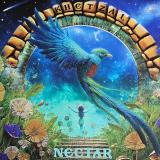
Five years after his previous album, Khetzal returns with Nectar, a brand-new digital double album accompanied by a limited physical vinyl EP. Matthieu Chamoux, a name that needs little introduction, is the creator of Corolle, still considered a milestone of 21st-century Goa-trance. With Nectar, he once again delivers his unmistakable signature: spiritual, Eastern-influenced, blissful Goa-trance. With Nectar, he dives back into his signature world of spiritual, Eastern-tinged, blissful Goa-trance. The first CD weaves a brand-new fairytale-like journey, with four standout tracks also pressed onto vinyl. Alongside these, you'll find a second bonus cd, set of unique live remixes, complete with violin, breathing fresh energy into classics like Ganesha Pramana and Listening Winds. Enjoy the journey
This Moment' - Shakti's first new studio album in more than 45 years - is
a work of immense depth and radiant optimism
With John McLaughlin (guitar, guitar synth) and Zakir Hussain (tabla) joined by
vocalist Shankar Mahadevan, violinist Ganesh Rajagopalan, and percussionist
Selvaganesh Vinayakram, the Shakti of now is a powerfully dynamic collective,
defined by deft interplay, dazzling unison passages, extraordinarily dexterous
improvisations, and the ability to draw from a vast well of global traditions and,
miraculously, put them in conversation with one another.
As a cornerstone of what is now called World Music, the vision and virtuosity of
Shakti has inspired generations of musicians from around the world to explore
sonic hybrids once thought impossible. Born of the musical and spiritual
brotherhood shared by the revolutionary British guitarist and bandleader John
McLaughlin and master Indian percussionist Zakir Hussain, Shakti's soulful,
organic intermingling of Eastern and Western musical traditions has proven
transformative for both the band's members and its listeners. Fifty years after the
informal conversations and jam sessions that sparked the band into existence,
their music continues to resonate and evolve.
Despite the large gap in their studio discography, Shakti has persisted
intermittently over the years as a live proposition, releasing several concert
recordings. "Shakti is very much a 'live' band, " explains McLaughlin. "A part of the
problem with making a studio recording has always been the fact that we live on
different continents, and we all follow our individual careers – in addition to
working together in Shakti. 'This Moment' is the result of me calling everyone in
the fall of 2021 and persuading them to use today's recording technology to
realise it."
Recorded and mixed in the U.S., Monaco, India, and Great Britain, This Moment is
nevertheless cohesive, bound by the deeply held bond shared by the players - a
bond that is audibly apparent across the album's eight tracks.
Shiftyman is a slider. He slides through his world like butter. People know him in his town. But only as a slider. What hardly anyone knows is that he also likes to listen to music. A few of his favorite songs can be found on this record. When you play this, it’s like Shiftyman’s day.
The four slider friends Andreas, Lutger, Michael and Raphael have painstakingly put together the songs over the past few years. They slid through Shiftyman’s world and felt good.
Written and performed by Andreas Haslacher, Lutger Lonin, Michael Roggon and Raphael Schindler. Mastered by Quendolin Fender.
out of Stock
Last delivered 3 years ago available to reorder, subject to availability
Note price increase and cat number change from last time around. In the late 1960s, the American trumpet player and free jazz pioneer Don Cherry (1936-1995) and the Swedish visual artist and designer Moki Cherry (1943-2009) began a collaboration that imagined an alternative space for creative music, most succinctly expressed in Moki's aphorism "the stage is home and home is a stage." By 1972, they had given name to a concept that united Don's music, Moki's art, and their family life in rural Tagårp, Sweden into one holistic entity: Organic Music Theatre. Captured here is the historic first Organic Music Theatre performance from the 1972 Festival de jazz de Chateauvallon in the South of France, mastered from tapes recorded during its original live broadcast on public TV. A life-affirming, multicultural patchwork of borrowed tunes suffused with the hallowed aura of Don's extensive global travels, the performance documents the moment he publicly jettisoned his identity as a jazz musician, and represents the start of his communal "mystical" period, later crystallized in recordings such as Organic Music Society, Relativity Suite, Brown Rice, and the soundtrack for Alejandro Jodorowsky's The Holy Mountain. The musicians in Don Cherry's New Researches, hailing from Brazil, Sweden, France, and the US, converged on Chateauvallon from all over Europe. The five-person band Don and Moki Cherry, Christer Bothén, Gérard "Doudou" Gouirand, and Naná Vasconcelos performed in an outdoor amphitheater and were joined onstage by a dozen adults and children, including Swedish friends who tagged along for the trip and Det Lilla Circus (The Little Circus), a Danish puppet troupe based in Christiania, Copenhagen. The platform was lined with Moki's carpets and her handmade, brightly colored tapestries, depicting Indian scales and bearing the words Organic Music Theatre, dressed the stage. As the musicians played, members of Det Lilla, led by Annie Hedvard, danced, sang, and mounted an improvised puppet show on poles high up in the air. The music in the Chateauvallon concert aspired to a universal language that would bring people together through song. In a fairly unprecedented move, Don abandoned his signature pocket trumpet for the piano and harmonium, thereby liberating his voice as an instrument for shamanic guidance. The show opens with him beckoning the audience to clap their hands and sing the Indian theta "Dha Dhin Na, Dha Tin Na," and the set cycles through uplifting and sacred tunes of Malian, South African, Brazilian, and Native American provenance including pieces that would later appear on Don's albums Organic Music Society and Home Boy (Sister Out) all punctuated by outbursts of possessed glossolalia from the puppeteers. "Relativity Suite, Part 1" notably spotlights Bothén on donso ngoni, a Malian hunter's guitar, prior to Vasconcelos taking an extended solo on berimbau. A vortex of wah-like microtonal rattling, Vasconcelos's masterful demonstration of this single-stringed Brazilian instrument is a harbinger of his work to come as a member, with Don, of the acclaimed group Codona. The sounds of children playing on the ensemble's achingly tender rendition of Jim Pepper's oft-covered beacon of spiritual optimism, "Witchi Tai To," lends the proceedings an especially intimate, domestic glow. Given the context of the star-studded international jazz festival, the concert's laid back, communal vibe feels like an attempt by the Cherrys to show Don's jazz audience that he was moving on. At the same time, however, Don was extending a warmhearted invitation for them to come along for the ride. With liner notes by Magnus Nygren. Track list: 1. Intro: Dha Dhin Na, Dha Tin Na 2. Butterfly Friend 3. Elixir 4. Amazwe 5. Interlude with Puppets 6. Ganesh 7. Elixir Reprise / Witchi Tai To 8. Resa 9. Relativity Suite, Part 1 10. Berimbau Solo 11. Interlude / North Brazilian Ceremonial Hymn 12. Elixir Reprise / Ganesh 13. Ntsikana's Bell / Traditional Melody
Repress on black vinyl, comes in Flatlfife label sleeve.
The 4th acid compilation is definitely a collectible! With an explicit track from Eat Static which is produced back in the 90s and has that oldschool goa touch and rave breakbeats - we love it!!! 303 Airline has his tribute on Flatlife with an excellent pounding acid techno banger which can be played loud in clubs. Together on the A-side with DJ Wank; a great acid techno producer from Sweden; pounding driving acid techno. Then last but not least; label owners Jack Wax (Flatlife Records) & Sam C. (Dosis Decibel / Cat in the Bag) team up; with this excellent dark acidcore track "Missing" - which is the 1st track they ever created together!! 4 styles of acid again on 1 vinyl! Enjoy this one!!!
Housed in a label sleeve and comes on solid blue and yellow mixed vinyl.
out of Stock
Last delivered 2 years ago available to reorder, subject to availability
Radha-Krsna Nama Sankirtana was the first of two albums Alice Coltrane released in 1977 (the other being Transcendence). Coltrane's music during this period grew out of an epiphany in which she would renounce secular life and don the orange robes of a swamini (spiritual teacher in the Hindu tradition). Musically, this meant leaving jazz behind (at least partially) and embracing the chants and rhythms of devotional music.
The first half of Radha-Krsna is mostly filled with simple arrangements of bhajans (Hindu devotional songs) and features the singing of students from the Vedantic Center, the Ashram that Coltrane founded in 1975. The group bounces with the joy of a gospel choir (not coincidentally, some had backgrounds in Southern Baptist churches).
A rapturous aura permeates opener "Govinda Jai Jai" with Alice leading on Fender Rhodes. On "Prema Muditha," she returns to acoustic piano (her main instrument in the early part of her career) to deliver a powerful and poignant theme.
Sidelong "Om Namah Sivaya" beams with probing organ improvisations accompanied by the drumming of her 13-year-old son Aruna John Coltrane, Jr. This closing track offers a strong indication that even if Alice Coltrane was turning toward new traditions for inspiration, her music was still something that only she could make.