The Italian 80s avant garde / anarcho scene is explored in this limited 12” release presenting Nengue and their previously unreleased cover version of the new wave classic Los Ninos Del Parque and the electro pop wave African Beat.
The tumultuous political climate of the 1960s through 1980s inspired Italian artists to craft an introspective, psychological musical landscape. As civil unrest, violent demonstrations, and political murders became commonplace, Italy's centres of intellect vibrated with activist energy. This atmosphere gave birth to a unique, mechanized sound that blended electronic elements with a raw, discordant aesthetic, reflecting the chaotic spirit of the times.
Through vintage forms of social networking and music sharing, a community led process steered the scene, publishing zines and records that grasped alternative concepts of music and lifestyle.
Nengue, were similar to many of these lo-fi, retro-future electronic music pioneers. Based in Rome, their music / art backgrounds flowed with anti-art, extreme noise, futurism, industrial, experimental, martial, folk, free jazz and exotica.
With a couple of releases as a duo, as was often the case, they appeared in numerous other projects and the music was a mixture of their individual backgrounds.
Extraordinarily, only appearing on a couple of obscure cassette compilations, indicative of the time, the quality of Nengue’s productions stands testament. Originally approached to reissue their Cosmic meets Kraftwerk inspired African Beat, a wonderful yet simple electronic idiom, layers of electronica rising, each element an addition flow, vocals the release’s waves.
However, the discovery of their cover of Los Ninos Del Parque – describing it as ‘powerful anarchic nonsense’ – is rightfully now the primary focus.
Acting as some Brutalist interpretation, its sharp electronics and industrial vocals, propel you to a brick-strewn squat party and a place in anarcho folklore.
These are matched with a remix / remake by Berlin’s Bionda e Lupo. Presenting a ‘Neumisch’, Sneaker’s exacting studio mastery and Sano’s additional vocals are a blessing – a new duo version – dynamic and wonderfully special.
To complete, the powerful dub of African Beat closes. Stepping out of his time as one half of Romanian duo Khidja (DFA / Hivern Discs), Andrei Rusu builds on his recent solo releases / remixes for Malka Tuti with a fantastic, bottom heavy version, perfectly building with expertise, an EP for the basements of today that was made in the dark times of the past.
Search:gras
Apollo / R&S are delighted to welcome back The Primitive Painter, aka the duo of Roman Flügel and Jörn Elling Wuttke for a timely reissue of their 1994 lost classic self-titled album of sonorous IDM.
Growing up in Frankfurt, in the 80s and 90s the duo met at an indie rock club in their home town of Darmstadt, bonding over their shared obsession with the first wave of acid, Chicago house and early Detroit techno as well as their patronage of now iconic Frankfurt club nights like The Omen or Dorian Gray or the infamous Delirium Record shop run by scene stalwarts Ata (Robert Johnson) and Heiko MSO (Playhouse).
Taking inspiration from the likes of The Black Dog and Transmat as well as seminal compilations such as Planet E’s Intergalactic Beats and Warp’s Artificial intelligence compilation the duo honed their inventive take on the Detroit techno blueprint under the monicker Acid Jesus, debuting on their freshly minted Klang Elektronik label. The label was started in conjunction with Ata and Heiko after Fluegel & Wuttke (regular patrons of the Delirium store) pressed a demo on them, muttering the immortal line; “Please listen to the tape, we are big Mr. Fingers fans.”
Through the mid ’90s the project flourished giving rise to a classic album and a brace of singles that number amongst the best of the era’s techno, winning them a influential fans most notably Sven Väth, David Holmes and Andrew Weatherall who invited them to play live at one of the legendary Sabresonic parties in London.
Alongside the success of the Acid Jesus project, the duo found great inspiration in outside of the club, including an ambient happening when the KLF came to play Frankfurt; “There were live sheep eating grass on stage while they played at Mark Spoon’s club XS”, as well as cinematic influence from the likes of Jim Jarmush and Wim Wenders. It was however the euphonic IDM grandeur of Apollo Recordings self titled compilation of 1993 that really got their creative juices flowing: “It was a ten track compilation with artists like David Morley, Model 500, Aphex Twin which still sounds so good today,” Jörn enthuses. “ It was really the trigger to go away from the Detroit sound and more towards the big melodies of B12 etc.”
Deciding to make their tribute to this style of music the duo turned out 10 tracks of gauzy, melodious electronica in a white hot fever, one after another over the ensuing months. Settling on a name for the new project they picked ‘The Primitive Painters’ taking inspiration from the band Felt. “We are both children of the C86 movement,” explains Jörn. “this attitude of noisy art school influenced rock like Primal Scream, MBV, The Jesus & Mary Chain really inspired us to take a DIY approach to our music.”
They sent the resulting demo cassette to Renaat at R&S / Apollo. “We really had no expectations,” Jörn explains. “So we were shocked and delighted when we received a fax saying that he wanted to release it”.
The resulting release was bungled by an R&S mix up that attributed the album to the duo’s own Klang Elektronik label which confused both fans and distributors alike, denying the release the critical boost and attention that it so richly deserved. Accordingly the release slipped out without much fanfare, with a chastened Fluegel & Wuttke returning to their Acid Jesus activities which would eventually lead to their blockbusting success as Alter Ego.
Over the ensuing years the reputation of The Primitive Painter album has only grown, with second hand copies (only 500 vinyl were pressed) changing hands for exorbitant amounts on Discogs, leading us to this opportune moment of a richly deserved ‘first’ release on the label for which the project was started, Apollo / R&S.
“This really brings us full circle,” says Jörn. “Apollo / R&S meant and means so much to us as artists and so it was bittersweet to not have the official release - to put that right all these years later feels really good.”
This new vinyl release comes in re-created original gatefold artwork and includes all original 10 tracks (Stoned Soul Picnic was previously on the CD only).
The Crystal Hum is the debut vinyl release by Taiwan-based artist Yuching Huang and her first release for Night School.
A beguiling dreamscape of crackles, spluttering, love-struck Casios presided over by the the spectral vocal and guitar work of Huang, Yuching sings love songs at the end of this world and the beginning of the next. Recorded during a hiatus from her group Aemong (a duo with artist Henrique Uba) in Berlin, these songs elevate Huang’s unique vocal style and grasp of atmospherics. The Crystal Hum deconstructs balladry, Garage, guitar music and reforms it into a
unified ghostly otherworld version of these languages.
The Crystal Hum thrums with buried desire, trails of nocturnal reverb seeping out of apartment windows, diaristic vocal performances and deeply emotive, evocative Western-style strings. Formulated by Yuching Huang after periods of frustration and experimentation, the album is an exercise in minimalism and paring back, with some tracks like JohnJohn featuring little else than an elastic bass, spring reverb trails, an interjecting vocal and swelling, dislocated synths. The effect is spellbinding, the soundtrack to getting lost in the labyrinthine, closed streets of Venice, Taipei, Hong Kong, or mirror versions of them in the imagination.
On opener Fly! Little Black Thing, a subterranean funk bassline roots Huang’s singing, a rudimentary, unreliable beat floundering in whimsy underneath. Demure, dream Dance music, Huang references classic lo fi experimenters Suicide and Arthur Russell as well as Night School label mates The Space Lady and Ela Orleans. In fact, after the release of Aemong’s third album Crimson, Huang credits the direction of The Crystal Hum to being enchanted by The Space Lady’s Greatest Hits,
the landmark lo-fi recording made by Susan Dietrich Schneider in 1990. The new, minimalist approach to her sound world reveals and shrouds in equal measure. On the heart-melter Love, a sultry mid-tempo Casio + bass backing drops into the ether with Huang’s vocal swimming in preternatural void before emerging anew, in awe at the world. Every chord change heralds new perspectives, every guitar flurry swells and drips emotion, nothing is wasted and space billows out from between the grooves.
Huang never reveals more than necessary, making this an in-between love album: the right amount of mystery and darkened mirror shines wanely on The Crystal Hum while remaining fragile and vulnerable in the sweet spots. Turning over in pillowing smoke and night in the dark corners, Huang sings in both Mandarin and English. The songs speak of earthly matters seemingly at the edge of dissipating into nothing. Distorted, beguiling Sambas warble like sweating dancehalls in an imagined Lynchian 60s, as on Thoughts. Closer You, An Illusion warps a classic 60s Girlgroup bassline beloved of the likes of Les Rallizes
Denudes into a slight ballad on the edge of the void, held back by the teary-eyed, wistful and enveloping vocal cooed by Huang. Each song feels like a love song dedicated to the bits between worlds, between beats, the negative space between people where desires, feelings and loss hangs in the air, resolute and unresolved.
- Glare Of Us
- Melting
- Mr. Squirrel
- Murmuration
- Agatha's Letter
- Evening Bell
- Zapad Slunce
- Ticket To The Rome
- Outro
- Things From The Past
- It's Foggy Today
- On The Waves
- Velvet Elephant
- See You Tomorrow
- Grass, Dew And
- Marmalade
- Petrel Bird
- Velvet Elephant (Band)
- Tomorrow / Hunter In Love (Live)
The album was conceived as a response to his EP Winter Sunshine. The record, recorded at his home in Istanbul, finds Evgeny in a highly intimate setting. His piano and atmospherics are complemented by his long- time collaborators Iana Chekina (cello) and Pavel Mackevitch (viola, violin). The first notes of "Glare of Us" greet the listener warmly and invite her to relax into a tour through the seasons and different moments of the day.
- LITA Exclusive pressed on Sky Blue colored vinyl - First ever official reissue - Produced in full cooperation with Hiroshi Yoshimura's estate - Liner notes by contemporary music writer and professor Junichi Konuma - Remastered from original sources by John Baldwin - First time on vinyl, cassette, and streaming - 2xLP vinyl housed in gatefold jacket - Discs cut at 45 rpm for optimal sound quality // Following their 2024 reissue of Hiroshi Yoshimura's classic album, Surround, Temporal Drift proudly presents the first-ever reissue of FLORA, Yoshimura's underappreciated ambient classic. FLORA was originally recorded and completed in 1987, and remained unreleased until 2006, nearly three years after Yoshimura's passing in 2003. The album is chronologically and stylistically a follow-up to his acclaimed 1986 works GREEN and SURROUND, wherein Yoshimura continues to play with the ambience of sound and the sound of ambience, underscoring his mastery in the field of environmental music. Yoshimura's other recorded works include Music For Nine Post Cards (1982), originally produced to be played back inside a museum space, and Pier & Loft (1983), commissioned as accompaniment to a contemporary fashion show.
2023 Repress
Robag Wruhme, working on the material. On the very same piece. And performing two different movements. First, thinking in category Album: who will hear it where? also: mood, position, length. Second, thinking in category Maxisingle: a spinning-tool for the club – another form of another functionality: accelerating the rhythm, lowering the harmonicmelodious, still preserving the nature of the song. And each version should make you HOT for the other!
Nata Alma, a voice loses itself in the infinite, a car brakes, a horse whinnies, the sun scorches relentless. Further, further on, towards the flickering, stoically. Water, flames on the horizon, Fata Morgana, a mirage. »And you might say, we've got no place to go?« - okay? no notokay at all!: Shuffle!
Nata Alma, melancholic Eight-minute-forty. A love song, a wave good-bye: »And you might say, that you need me no more?« sings Sidsel Endresen alongside Bugge Wesseltoft's swells and ebb-aways – metal never sounded so longing; a buzzing swing, a siren call from afar.
Robag Wruhme takes a seat at the organ and plays minor bass notes. He gets up, leaves the room and lays down a dry rock of funk: wooden kick on wooden snare, tight-cut voices, driving hi-hats and shakers, gated synth danglers and percussion loops. Relentless, stoically. »And you might say, that it's over?« – relentless, maybe, but that's how he creates the Further: keep going! dance it off! a new day rising!
And right here. Flip it and keep on moving: Venq Tolep. A summer meadow, grass-stains, a gentle breeze, an early smell of hay. Venq Tolep. Endorphins tickle under the skin. A
percussive spectacle, dance of the insects. Hopping around in flat shoes, the beat is phat and reverberated by a cluster of trees. Stabs on the e-piano set in, picturing the euphoric moment when Loving-feelings walk hand-in-hand with a Hint of Melancholy.
Robag Wruhme, Nata Alma and Venq Tolep - music for dance floors, inside and outside, music for the summer, day and night, and for convertibles on the way there.
- A1: Do U Fm
- A2: Novelist Sad Face
- A3: Green Box
- A4: Dusty
- A5: The Linda Song
- A6: Dm Bf
- B1: I Tried
- B2: Melodies Like Mark
- B3: Wildcat
- B4: How U Remind Me
- B5: Pocky
- B6: Bon Tempiii
- B7: Pt Basement
- B8: Alberqurque Ii
- B9: Mary's
Kneading dough is tricky – you should know how it’s supposed to feel. If you try too hard you could make it worse. It’s a beautiful practice – creation with a gentle touch, to work at something so it can be left alone. “If it’s too drawn out it’s awful. It’s easy to give too much.” Dance in the mirror. Contemplate your veiny hands. Who do they remind you of?
You begin by mixing flour and water. “What happens when your people die? Why’d they move the rock to the other side of Ulster Park?” Eliza Niemi asks two seemingly unrelated questions in a rising melody with guitar accompaniment, like fingers playing spider up to the nape of your neck. Gentle pressure. Strands of gluten form to bind the mix. A new question lingers in the binding. When she admits “but I don’t know how to tell if I’m feeling it or not,” that question surfaces through the text. It is reiterated throughout the album. When I’m working with dough I think the same thing to myself.
On Progress Bakery, her second album as a solo artist, Eliza knows to leave some questions alone – to let juxtaposition and tension be the proof. It doesn’t have to be hard. The feelings and revelations they provoke rise in the heat. The smell is sweet. Crispy on the outside and soft all the way through. She playfully slip-slides through words and sounds and images, delighting in surprise, skimming ideas like stones cast across clear water, touching down briefly with uncommon grace.
The question provoked between those opening lines resurfaces in the strands between songs – “Do U FM” is fully formed and beautifully layered, while “Novelist Sad Face” is a short, acapella rendering of gentle curiosity. What is holding these ideas together? Some songs demand more, seem to carry a whole load – eventually the skipping stone will halt to sink and resume its idle duty – while others drift in and out of focus, the way thoughts and dreams become interwoven before the mind is sunk into true sleep.
Music and words don’t always have to interact. Where she decides to keep them apart gives a new contour to where and how she puts them together. The kind of thing you’re supposed to take for granted with songs and their singers comes alive in Eliza’s hands – the little miracle of mixing, kneading, stretching, and stopping.
So often on Progress Bakery, Eliza teases out truth and meaning by asking questions. “Do I wanna be crying?” “Do you want me good or do you want me bad?” “Do I need an eye test?” “I’m writing songs in my head while you’re going over stuff with me — is that cruel??” In “Pocky” Eliza ends with a question that feels to me like the actual biography, succinct and revealing:
I don’t wanna be made to see
I just wanna ask “what’s that?”
Grace that ought to be rare, but in its care and precision is offered humbly, with great generosity, and without announcing itself. Eliza’s simple, miraculous music is given further form and shape by a group of collaborators – invaluable guest musicians Jeremy Ray, Evan Cartwright, Steven McPhail, Kenny Boothby, Ed Squires, Carolina Chauffe, Dorothea Paas, Louie Short, and Avalon Tassonyi. Together with Louie Short, who recorded, mixed, and produced the album along with Jeremy Ray and Lukas Cheung, Eliza has cultivated a richness in sound and texture that prods and provokes the ticklish ear. Barely audible guitar tinkering, a brief lo-fi field recording of trumpets, the harmonic clicking of a looped synthesizer, a flourish of reeds, a child’s conversation, each uncanny sound perfectly placed, rippling out under a soft breeze.
Lay in bed alone at night and ask aloud to the stillness,
“What were you doing at the Albuquerque Airport?
What were you doing there??”
And hear your question answered by a dream of swelling, undulating cellos. Try to grasp at the melody and structure. It’s not an answer (if there could be one), but it moves deeper, closer to the weird layer of fleeting moments and disconnected images, barely perceptible at its core. Wait for the dream reel to click into place.
Eliza took me for a ride in Nicole (her beloved Dodge Grand Caravan) and told me she’d been thinking of the album as an embodiment of transition – and I think every transition, known or unknown, carries the weight of new meaning, skittering off the surface tension of life as you know it, creating ripples, sometimes bouncing off and sometimes breaking through. There is a trick you can use to tell if a dough is glutinous enough. You’re supposed to stretch it out as thin as you can without breaking it and hold it up to the light. If you can see through, even if it renders the world murky and uncertain, you should leave it alone. I love this trick. It’s one that Eliza seems to know intuitively: work gently and ask questions and don’t always expect answers, and when you can, take a glimpse at something new, and then leave.
- 1: I Can Lie
- 2: Rolling Backwards
- 3: Charred Grass
- 4: Right Thing By Me
- 5: God Fax
- 6: Cutting A Cake
- 7: Led Through Life
- 8: Dorset Area Of Natural Beauty
- 9: Pearl Through A Funnel
- 10: Designed In Hell
- 11: Crush Me
- 12: Twisted Up Fence
Cross Record's new album, Crush Me, is steeped in the pressures and wonders of existence—a profound statement, especially coming from artist and death doula Emily Cross. A two-and-a-half-year gestation period offered challenges, disappointments, and joys reflected in the cramped space of the album, which explores how we handle the weights we carry. Emily Cross had held hundreds of Living Funerals and was as many episodes deep into her podcast, What I’m Looking At. She was five years into serving clients as a death doula and fresh off a tour with Loma, her band with Jonathan Meiburg (Shearwater) and Dan Duszynski, when she began work on her fourth album. After moving from Austin, TX to Dorset, UK, she established the Steady Waves Center for Contemplation (named after a track from her second record, Wabi-Sabi ), where she hosted Living Funerals, met clients, scheduled mindful tea sessions, and showcased experimental music nights. All the while, she was scribbling down song ideas. Cross’s Tascam four-track demos finally reached readiness, and she sent them to an interested major independent label. She was encouraged to push her imagination to the limits of what a record could be. So, unlike her usual process of recording as inexpensively as possible, she prepared a two-week recording session in Germany with a group of skilled musicians from around the world. True to her previous work, Cross left plenty of room in her demos for experimentation, collaboration, chance, improvisation, and complete obliteration, then resurrection when necessary. Comfort and traditional structure were eschewed in favor of unaccountable magic, prayers whispered into The Void. Cross is comfortable with the chaotic and unpredictable, a perspective demanded by her work and writing style. The Berlin Airbnb was packed with people, instruments and luggage. During a ride down in a tiny elevator to the studio, Cross realized how central the sense of being crushed was to the album. “I thought of it later and it dawned on me that ‘Crush Me’ perfectly embodied the record,” says Cross. Yes, the weight of a body laying limply atop yours, or the tight squeeze of a hug, can be pleasant. Go too far, and you’re in the hands of a cruel, adolescent god. Upon leaving Germany, the record was unfinished, and without a roadmap. As passages were recorded as isolated parts, Cross and musician Marcin Sulewski collaborated, facing a haphazard brick pile, waiting to be assembled. Work dipped in and out of view like a buoy bobbing in a violent sea over many months. During that time, the aforementioned interested label went radio silent, suddenly not seeming so sure of a thing. Collaborators disappeared, continuing the themes of abandonment, surrender, and disarray that followed the project. Cross physically felt her entire body go numb: In a twist of fate, the record was rescued by long-time friend and supporter Ben Goldberg at Ba Da Bing Records who was eager to help realize the project. Cross worked for months on the album, all the while nursing a pregnancy and continuing her full-time funeral work. The last minute participation of Seth Manchester of Machines with Magnets, who mixed and mastered, was an essential liferaft. He gave true final form to the abstracted songs. Crush Me has the effect of a spell being cast, with songs balancing heaviness and levity. Vocals, guitars, and keyboards float above, as drums and upright bass (often bowed) lurch beneath. On “Rolling Backwards” percussion wanders about while feedback squeals and persists in the distance. “Dorset Area Of Natural Beauty” starts with a thick, unhinged church organ progression punctuated by the disquieting sounds of laughter reaching the point of hysteria. “God Fax” is a slow-moving panic attack, with shallow breaths in and out framing a guttural cacophony like a wooden freighter encountering increasingly turbulent waters and vocals struck emotionless by autotune. The album ends with “Twisted Up Fence,” a reflection on life from outside the wall--wistful, warm, and comforting. Cross, likely with a smile on her face, sings: “You say it’s an endless abyss” “And I say the abyss is the best”
- (Into) Purging Creation
- Spinous Forms Of Mortal Abhorrence
- Essence Of Dissolution
- Corpus Offal
- Gorging Gastric Decedent
- Ripened Psychosis
- Secreted Effluence (Spilling)
Blood/Silver & Black Splatter Vinyl[34,03 €]
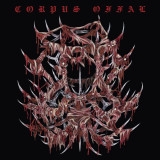
Der ranzige Kern von Cerebral Rot, bestehend aus Ian Schwab (Gitarre / Gesang) und Clyle Lindstrom (Gitarre), ist nach wie vor dabei, doch die Rhythmusgruppe von Corpus Offal, bestehend aus Jason Sachs (Bass) und Jesse Shreibman (Schlagzeug), sorgt nun für intensive Wellen von magenverbrennendem Übelkeit. Nach der letztjährigen Demo-Entjungferung präsentieren Corpus Offal ihr selbstbetiteltes Album, das wie eine eiternde Leiche aus der mitternächtlichen Kanalisation auftaucht: faulig, pulverisierend und auf perverse Weise belebend.
Eine knüppelnde Autopsie von Death Metal, Gore und Deathgrind. Die tief gestimmten Grooves, die unharmonischen Leads und das Mid-Tempo-Rumpeln von Cerebral Rot sind in Tracks wie 'Spinous Forms of Mortal Abhorrence' und dem Titeltrack zu hören, während sie die Messlatte für Tansformation in noch grässlichere, verflüssigte Formen legen. Die gurgelnden Schleimvocals von Ian Schwab sind gefährlich radioaktiv, direkt aus dem versiegelten Keller eines nuklearen Leichenschauhauses beschworen und erzählen von einem Splatterfest aus morbider Poesie, verwesendem Fleisch, absurden Experimenten und grausamen Überschreitungen. Jeder Song liest sich wie die Akte eines Gerichtsmediziners, gekreuzt mit dem fiebrigen Geschwafel eines Psychopathen - präzise in seinem anatomischen Horror und abstoßend in seiner bizarren Verderbtheit.
Wenn Corpus Offal seinen katastrophalen Abschluss findet, ist man erschöpft, desorientiert und fragt sich, ob man ein Meisterwerk überlebt oder das musikalische Äquivalent eines Snuff-Films gesehen hat - und das mit einer unglaublich schweren Billy-Anderson-Produktion. Betritt also das Krematorium, atme tief ein und lass dich vom körperlichen Rausch des Gemetzels von Corpus Offal anstecken. Dies ist ein akustisches Schlachthaus und du bist der Kadaver.
Der ranzige Kern von Cerebral Rot, bestehend aus Ian Schwab (Gitarre / Gesang) und Clyle Lindstrom (Gitarre), ist nach wie vor dabei, doch die Rhythmusgruppe von Corpus Offal, bestehend aus Jason Sachs (Bass) und Jesse Shreibman (Schlagzeug), sorgt nun für intensive Wellen von magenverbrennendem Übelkeit. Nach der letztjährigen Demo-Entjungferung präsentieren Corpus Offal ihr selbstbetiteltes Album, das wie eine eiternde Leiche aus der mitternächtlichen Kanalisation auftaucht: faulig, pulverisierend und auf perverse Weise belebend.
Eine knüppelnde Autopsie von Death Metal, Gore und Deathgrind. Die tief gestimmten Grooves, die unharmonischen Leads und das Mid-Tempo-Rumpeln von Cerebral Rot sind in Tracks wie 'Spinous Forms of Mortal Abhorrence' und dem Titeltrack zu hören, während sie die Messlatte für Tansformation in noch grässlichere, verflüssigte Formen legen. Die gurgelnden Schleimvocals von Ian Schwab sind gefährlich radioaktiv, direkt aus dem versiegelten Keller eines nuklearen Leichenschauhauses beschworen und erzählen von einem Splatterfest aus morbider Poesie, verwesendem Fleisch, absurden Experimenten und grausamen Überschreitungen. Jeder Song liest sich wie die Akte eines Gerichtsmediziners, gekreuzt mit dem fiebrigen Geschwafel eines Psychopathen - präzise in seinem anatomischen Horror und abstoßend in seiner bizarren Verderbtheit.
Wenn Corpus Offal seinen katastrophalen Abschluss findet, ist man erschöpft, desorientiert und fragt sich, ob man ein Meisterwerk überlebt oder das musikalische Äquivalent eines Snuff-Films gesehen hat - und das mit einer unglaublich schweren Billy-Anderson-Produktion. Betritt also das Krematorium, atme tief ein und lass dich vom körperlichen Rausch des Gemetzels von Corpus Offal anstecken. Dies ist ein akustisches Schlachthaus und du bist der Kadaver.
- A1: Talk Talk
- A2: Today (Single Version)
- A3: Have You Heard The News?
- A4: It's My Life
- A5: Such A Shame (Original Version)
- B1: Dum Dum Girl
- B2: Life's What You Make It
- B3: Living In Another World
- B4: Give It Up
- C1: April 5Th
- C2: Time It's Time
- C3: I Believe In You (Single Version)
- D1: Eden (Edit)
- D2: Wealth
- D3: New Grass
Die beliebte Compilation "The Very Best Of Talk Talk" wird in einer überarbeiteten und Karriere übergreifenden Fassung neu aufgelegt. Im Vergleich zur ursprünglichen Veröffentlichung von 1997 bietet die Neuausgabe die größten Hits der Band in chronologischer Reihenfolge. Zudem enthält sie eine überarbeitete Aufnahme vom letzten Album der Band, Laughing Stock.
Die Wiederveröffentlichung erscheint am 14. März als 2LP im schwarzen Klappcover sowie auf CD.
Gegründet 1981 von Mark Hollis, Lee Harris und Paul Webb, erlangte Talk Talk mit ihren ersten beiden Alben The Party's Over und It’s My Life weltweiten Ruhm. Songs wie "Talk Talk", "Today", "It’s My Life" und "Such a Shame" wurden zu zeitlosen Klassikern und erreichten die Top 40 der britischen Charts. Mit The Colour of Spring (1986) wagte die Band erste Schritte in Richtung experimenteller Klänge, die schließlich in ihrem gefeierten Meisterwerk Spirit of Eden gipfelten. Ihr letztes Studioalbum, Laughing Stock, erschien 1991 und markierte einen weiteren Wendepunkt hin zum Post-Rock.
Talk Talk wird oft als Pionier des Post-Rock angesehen. Ihr Einfluss erstreckt sich auf Künstler wie Kate Bush, Tears for Fears und Radiohead. Zudem haben viele Musiker die Werke der Band neu interpretiert, darunter No Doubt, die mit ihrer Version von "It’s My Life" einen internationalen Hit landeten.
"Big Tuba", das erste neue Album der Hot 8 Brass Band seit 2019, taucht tief in das traditionelle Jazzerbe ihrer Heimatstadt New Orleans ein. Neben der gleichnamigen Single enthält es Cover von Bill Withers ("Ain't No Sunshine"), Al Green ("Let's Stay Together") und Marvin Gaye ("Sexual Healing", Bossman Edit) - die beiden letzteren sind der LP als exklusive 7" beigelegt. Die legendäre Formation mischt Brass, Hip-Hop und R&B zu einem unverkennbaren Style, der nicht nur gerne in Filmsoundtracks (Sex Education, Venom, Chef) Verwendung findet. Sie begleitet Stars wie Mos Def, Lauryn Hill und Mary J Blidge auf Tour und ist an Grammy-gekrönten Alben beteiligt (Jon Batiste, "We Run", 2022).
9-Track-LP auf dreifarbigem Vinyl mit 7"- und Poster-Beilage.
- "The funkiest exponents of the New Orleans Mardi Gras tradition." - The Times
- Spangled
- Gateleg
- Doghole
- Mountain Language
- Sister
- Bleached
- Goat House Blues
- What's His Name
- Jody
- Big Ugly
- Heart Song
Fust--the lyrical powerhouse Southern rock band from Durham, North Carolina--announce their new album Big Ugly, out March 7th on Dear Life Records, the record label that launched the careers of MJ Lenderman and Florry and that has become a haven for contemporary songwriters. Big Ugly arrives after the release of 2024's Songs of the Rail--"one of the best alt-country compilations_in a long, long time" (Paste) -- and 2023's standout Genevieve, which unassumingly introduced new listeners to Fust's unmistakable blend of "small-town poetry" (Mojo) with a familiar yet probing "country-tinged folk-rock" (KEXP) that made it "one of the most fun rock records of the year" (Pitchfork). Genevieve was their studio debut, recorded with producer Alex Farrar (Manning Fireworks, Rat Saw God, Tomorrow's Fire) in Asheville, North Carolina. The reception was far better than the band expected, stirring them to immediately start working on Big Ugly, their second collaboration with Farrar. Recorded over ten days in June of 2024, Big Ugly is the explosive sound of Fust uncovering a freedom within their sincere form of loose and fried guitar rock, realizing more than ever before an intimacy within bigness. The members -- Aaron Dowdy, Avery Sullivan, Frank Meadows, John Wallace, Justin Morris, Libby Rodenbough, Oliver Child-Lanning--weave their voices alongside guests like Merce Lemon, Dave Hartley (The War on Drugs), and John James Tourville (The Deslondes) to form a music that sounds like a conversation between old friends. And that's exactly what it is. At its heart, Big Ugly is a story cycle, following tough-skinned characters who seem to inhabit a shared and fictional small town--Big Ugly--that in reality gets its name from a lowly populated and unincorporated area in southern West Virginia around where Dowdy's family has deep roots. The album cover_a mural from the Big Ugly Community Center just off the Big Ugly Creek--was painted by locals for a 2004 play performed by the children that interpreted their elders' stories. In a way, Fust's Big Ugly does something similar as it takes the same area as its backdrop and reimagines a life depicted in the mural between the bars, gas stations, general stores, and double-wides. Throughout the album, we join the characters in finding history and meaning in the banal theater of their own private jerkwater.The songs on Big Ugly are hearteningly varied, moving from beer-fisted radio country to elegiac drones to deconstructed ballads. Songs like "Spangled" take up the theme of past traumas and present desensitizations colliding, of the small and cosmic coinciding in the life of a heedless protagonist. "Bleached" finds the soul-searching narrator recalling the feeling of inner vacancy in their childhood: thoughtless, speechless, herded around like cattle in backseats. And "Mountain Language" laments the poverties of Southern life at the same time that it promotes a higher poverty, a country utopia that's just out of grasp, where we could live if we could only "make it up the mountain again." The mystical hermeticism and the dime-store everyday are two sides of every insignificant thing in the town of Big Ugly.
- A1: Brinna Ut
- A2: Etiopisk Hallucination
- A3: Letar Efter Nya Plågor
- A4: Köpa Saker
- A5: Verkligheten Och Jag
- B1: Balladen Om Elpriset I Augusti 2022
- B2: Coral Bass Strings
- B3: Dödsdisco
- B4: Ringer Å Ringer
- B5: Välkommen På Intervju
Cindy Lee, Arthur Russell, Viagra Boys, On-U Sound. In the discourse around new albums from singular, world-building artists, the phrase “a big step forward” can often be a blinking red warning sign. You know you’re about to be pulled somewhere new against your will. Inertia is a hell of a thing. It’s nice here. Surely, the party’s not over yet? JJULIUS’ Vol. 3 album is a big step forward, or a step up, out of the murky basement of the preceding two volumes. There’s no time to acclimate. A spindly violin grabs you by the hand and pulls you into the pastoral bounce of “Brinna ut,” which, in spite of its meaning (“Burn out”), creates the kind of blind positivity and warm stomach feeling less cynical people might find in self-help seminars. For us, we have records like this. And, inertia be damned, Vol. 3 has charm like a balm. JJULIUS records have always arrived like meteors from another planet, an impression hammered home by the fact that they’re titled like compendiums of artifacts. And while Vols. 1 and 2 carried that notable tinge of darkness, Vol. 3 has (almost!) cast that shadow, adding elements of disco (“Dödsdisco”) and dream-pop (“Etopisk hallucination”) to his forever favorites Arthur Russell, African Head Charge, and The Fall. Some of that new car smell could be attributed to a change in process. Each song was written over beats played by Tor Sjödén of the wild-eyed Stockholm group Viagra Boys, beats that were themselves inspired by tracks from the likes of Patrick Cowley, CAN, Count Ossie, Black Devil Disco Club and others that Julius would send to him as inspiration. Unless you’re Mark E. Smith, fervor fades. Eventually we all crave a lie down in some nice grass, a few minutes to gaze at the sky and wonder if everything is actually all that bad. Vol. 3 gives you 35 of those respiting minutes. “No looking back, no misery, no talking trash, no enemies.”
Music to Watch Seeds Grow By continues its series of plant-inspired soundscapes with new work from Pittsburgh-based sound artist Davis Galvin. This composition focuses on the Delphinium Elatum, capturing the quiet drama of this striking perennial through carefully constructed ambient textures.
Where their previous work explored the complex electronic territories of the outer technoid reaches, here Galvin turns their attention to the subtle processes of plant growth. The piece unfolds gradually, much like the Delphinium's own journey from seed to flowering plant. Gentle drones and atmospheric elements mirror the plant's various growth stages, from its initial emergence to its ascent to heights of up to two metres. You heard it here first.
The music creates an environment for contemplation, designed specifically for the moments of sowing and tending to these magnificent plants. Galvin's approach, as with all things they turn their ear to, emphasises patience and attention to detail, qualities essential to both gardening and deep listening.
First things first - you don’t need me to tell you about the significance of Australia in the history of punk. I mean, what am I, Jon Savage? Google it yourself, FFS. Instead, let’s just agree that the speedy, feral racket thrown together by the likes of The Saints, Radio Birdman and The Scientists in the mid-late ‘70s is AT LEAST as deliriously entertaining as anything concocted by their UK/US counterparts, sowing the seeds for seemingly endless garage-inflected noisemakers in the land down under. No one likes using words like ‘tradition’ or ‘heritage’ here - the punk rock clusterbomb is far too messy for any of that business - but also emerging from Australian rock’s primordial soup is the addictive sneer of Stiff Richards. Like their predecessors, the band are a gleefully wracked mess of full throttle energy and barrelling power chords, with songs like ‘Kids Out On The Grass’ and ‘Point of You’ proving at least the equal of ‘(I’m) Stranded’ or ‘Aloha Steve And Danno’. Nine tracks in less than 30 minutes, all winners and all determined to leave you flipping over couches and smashing your TV set. And let’s face it, you may as well; there’s nothing good on. It all builds towards frantic closer ‘Fill In The Blanks’, which rattles around your speakers like the UK Subs trying to play Ed Kuepper riffs at the centre of an earthquake, before grinding to a halt as a voice says, “That’s the one.” Does it sound self-satisfied? Hey, it’s got good reason to - this is the best no-frills garage rock party since Gino & The Goons’ ‘Do The Get Around’, and the only appropriate response is to declare yourself betrothed to Stiff Richards because you can’t imagine your life without ‘em. Don’t believe me? Sort out your ears and get ‘State Of Mind’ in ‘em. Rock’n’roll as it’s supposed to be played.
Exploding In Sound Records is thrilled to reissue Yeddo, the debut album from Boston’s Grass Is Green. Originally self-released back in 2010, the seminal record, which pre-dates the label, celebrates fifteen years in 2025, and the band will reunite to play a weekend of shows together with Ovlov, Speedy Ortiz, and special guests in Boston, Brooklyn, and Philadelphia. A truly legendary debut, this record served as a major catalyst for the formation of Exploding In Sound, and Grass Is Green’s third album, Ronson, eventually became the label’s very first release. We’re beyond excited to bring Yeddo to vinyl for the first time ever, a raw and flawless album of arty punk, post-hardcore, and math rock that feels exuberant at all times.
- Elegy
- Whiplash
- Blackhole
- Everything Ends
- Brain Dead (Feat. House Of Protection)
- Evil Eyes
- Landmines
- Judgement Day (Feat. Amira Elfeky)
- Broken Mirror
- Curse
- Seeing Red
- Chandelier
ARCHITECTS are back and charging forward in the heavy rock world with their latest sonic masterpiece, The Sky, The Earth & All Between. After two relentless years on the road-featuring massive European summer tours with Metallica and top billing at festival stages across Europe, (Rock Am Ring, Rock Im Park, Hellfest, Download, Graspop, Full Force to name a few and headlining Bloodstock) - the band has returned to the studio to deliver their most powerful collection of songs yet. With the creative force of Jordan Fish (Bring Me The Horizon) behind the boards, Architects have captured the explosive energy of their live performances while elevating their signature melodic edge. This album reflects the perfect blend of raw intensity, emotional depth, and innovative production. Already making waves, singles like "Curse" and "Seeing Red" have drawn rave reviews from all major metal press worldwide. "Seeing Red" the "anthem powerhouse" landed because of global success in the top 10 of charts worldwide-amassing over 45 million streams along the way. The Sky, The Earth & All Between builds on the momentum of their 2022 album, the classic symptoms of a broken spirit, which stormed to the top of the UK Rock and Metal Charts. With this new release, Architects are once again set to push the boundaries of modern heavy music, cementing their status as one of the most exciting and essential bands of our time.