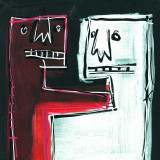
Matador
Gaz Coombes veröffentlicht die Neuauflage seines zweiten Soloalbums – ”Matador” - das 2015 erschien.
Ein Gefühl von Freiheit durchdringt jede Sekunde des Albums, das unter anderem die 2013er Single ”Buffalo” enthält. Von der astralen Pracht von ”The Girl Who Fell To Earth” bis zu den träumerischen Klängen von ”Oscillate” ist es der Sound eines Songwriters, der musikalische Grenzen wie Schnee zum Schmelzen bringt und Elemente von Neu!, Disney-Musicals, den schwedischen Psychedelikern Goat, Gyorgy Ligeti und Eno in einer eisigen Klanglandschaft vereint, die ebenso anspruchsvoll wie schön ist. Das Ergebnis ist ein Album im klassischen Sinne. ”Matador” ist der Sound eines der größten britischen Songwriters, der mit Freude in die Zukunft blickt.
World’s Strongest Man
”World’s Strongest Man” ist die großartige Neuauflage des dritten Soloalbums von Gaz Coombes, das auf das 2015 erschienene ”Matador” folgte. Inspiriert von Grayson Perrys ”The Descent of Man”, Frank Oceans ”Blonde”, kalifornischem Gras, britischen Wäldern, unkontrollierter Männlichkeit, Neu! und HipHop (und vielem mehr), ist es eine wahrhaft bemerkenswerte Sammlung von elf zutiefst persönlichen Songs, die alle von einer raumfüllenden, fesselnden Melodie begleitet werden. Vom tiefgründigen Titeltrack bis zum mitreißenden ”Deep Pockets”, über die wunderschöne rhythmische Ballade ”Slow Motion Life”, ist ”World’s Strongest Man” ein kühnes, ehrgeiziges, frei denkendes, zukunftsweisendes Rock’n’Roll-Album.
Buscar:gras
- A1: Inka
- A2: Mamba Muntu
- A3: Witness The Birth Of A Dream
- A4: Grasp Reflex
- A5: Navillera
- A6: Witness The Spread Of The Dream
- A7: Immanence
- A8: Curl Up & Die
- B1: River Mumma
- B2: Anima Sola
- B3: Snool
- B4: The Mechanical Horse
- B5: Interfusion Imperfect
- B6: Seal Water
- B7: Silent Illumination
- B8: Nzyoko
- B9: Secret Of Elegua
Originally premiered in its earliest state at Tate Britain by William Bennett and Mary DeBlois in 2010, the SIXTEEN WAYS OUT magnum opus reflects over a decade's work of compositional refinement and elaborate studio expansion, and is the first Cut Hands release since 2014's highly-acclaimed FESTIVAL OF THE DEAD on the Blackest Ever Black label. The end result is a mystical showcase of musical esoterica, its seventeen tracks fusing the most arcane elements of subliminal extralinguistics, avant-garde transformational hypnosis, and dark self-help secrets. You will never hear anything quite like it. Available on 180gm vinyl and CD. CD version includes beautiful 12page booklet with expanded texts.
- 1: Joan Baez - Donna Donna
- 1: 2 Barclay James Harvest - Brother Thrush
- 1: 3 The Seeds - Can't Seem To Make You Mine
- 1: 4 The Winstons - Color Him Father
- 1: 5 The Alan Bown - All Along The Watchtower (Stereo Mix)
- 1: 6 The Move - I Can Hear The Grass Grow (Full Length Mono
- 1: 7 The Moody Blues - Go Now
- 1: 8 Joe Tex - The Love You Save (May Be Your Own)
- 1: 9 The Critters - Mr. Dieingly Sad
- 1: 0 Paul Jones - Love Me
- 1: The Zombies - Time Of The Season
- 1: 2 Flower Pot Men - Let's Go To San Francisco, Pt I
- 1: 3 Consortium - All The Love In The World
- 1: 4 Bob Dylan - Song To Woodylp
- 2: 1 Donovan - Catch The Wind
- 2: The Turtles - Happy Together
- 2: 3 The Foundations - Build Me Up Buttercup
- 2: 4 The Archies - Sugar, Sugar
- 2: 5 Status Quo - Pictures Of Matchstick Men
- 2: 6 Genesis - Where The Sour Turns To Sweet
- 2: 7 Procol Harum - A Whiter Shade Of Pale
- 2: 8 The Beatles - Love Me Do
- 2: 9 The Searchers - Needles And Pins
- 2: 10 Sun Dragon - Green Tambourine
- 2: 13 The Pretty Things - Don't Bring Me Down
- 2: 14 Colosseum - The Kettle
- 2: 11 The Tremeloes - Here Comes My Baby
- 2: 1 Ravi Shankar - Dhun (Folk Airs)
ENG Immerse yourself in the psychedelic and rock universe of Woodstock with this event double vinyl! Find the icons of the counter-culture of the end of the 60"s who marked their generation: Joan Baez, Bob Dylan, The Beatles, Donovan, The Turtles, The Zombies, Status Quo, The Pretty Things, The Foundations, Ravi Shankar
BODYXVIII delivers his debut release on Southern Lights in the form of the “Fields” EP, straddling the fringes of ambient, experimental and linear techno. The A-side features the pulsating waves of “An Ocean of Signals” and the hypnotic and undulating atmosphere of “Swiss Army Knife in The Wet Grass”. The B-side features “Umbra”, carrying an understated energy and tension and closing with the menacing ambience of “Clearing (Clandestine I)”.
For its fourth release, Zen 2000 scales up from the 45 format and releases its first 12-inch, which, coming in at seven tracks (eight with the digital-only bonus) is either a double-wide EP or an LP in everything but name.
The artist behind it is Mogwaa, a South Korean producer who's built a reputation on meticulous and clean-lined melodies and sharp, glistening drums. Sometimes we find him in the club, slinking through dubby bass wobbles, flittering across breaks, and sometimes we find him in a grassy park, sprawled atop a soft ambient bed. No matter where he is, the trademark voicing is always present.
Here, on A Garden Within, we get equal helpings of both: the A-side is the chill-out room, spacey drifters that pulse through the cosmos and wiggle through underwater currents.
The flip is clubbier fare, with “Rejas” being a nod to electro sounds and “Tranquilizer” being a trippy bit of trance. Bookending the journey is “Melting,” an iceberg slowly cracking and falling into the ocean. “Con Fe” is an encore of sorts; it feels like a reconstituting of “Melting,” the reforming of that track's languid dissolution.
Flox is square. Square, precise, direct.
He goes straight to the point, and doesn’t waist his time with useless considerations. “I have no time to shit around”, he says. So, his seventh album is called Square. Square represents a major turning point in the career of the pioneer of nu reggae. An extraordinary architect of studio production and multi-instrumentalist who records, mixes and produces but also, for several years, performs on stage with his musicians. After recording Square, he started touring alone, equipped with a machine he designed and built with Midi controllers to launch original samples and loops - an autarky assumed from one end of the process to the other. “You have to master all the tools to deliver what you want”, he has been saying for years...
Yet, this Square is wide open: old school rhythms or techno-like approaches, vintage dub or futuristic take offs, thick sound basses and melodies, scraped to the bone...
Inspiration comes in many forms; the city in which we live, the culture from countries across the globe and our love for TV, film and books.This rings true for FFF as a move from his home of Vlissingen in 98 to Rotterdam, combined with his love for UK sounds and comic books created a unique, outward-looking perspective. The DJ, producer and long term party thrower now turns in a record for Low Battery; so come and see for yourself.
Opening track 'In Toom' launches a satellite straight into deep space, picking up transmissions from an unknown source. The track deploys alien electronics and other-worldly vocal snippets, building a curious and ghostly atmosphere. Bass lures heavy around the mid-way point creating an increasing sense of unease, as unidentifiable objects head straight for earth. The aptly titled 'Desperately Seeking Summer' is a giant leap toward the good times ahead. You can sense its energy in the air; the smell of freshly cut grass, the charcoal from a newly lit BBQ and the coastal breeze on a warm summer's day. Summer is almost here and we could all do with a serotonin boosting elixir.
The B-side opens with 'Voices' as candy-floss vocals topped with xtra sugar taste even better with every play; while ascending basslines and frenetic drums join hands to produce that FFF energy we all know and love. 'Full of Light' provides tranquility at the end of a wild ride, as shimmering synths shine with radiant bliss with the power to transcend "bathed in light and lifted in what I can only call another dimension."
- A1: Firefly
- A2: Episode I ""Night
- A3: Brothers
- A4: War Or Air Raid
- A5: Episode Ii ""Setsuko
- A6: Mother
- B1: Hotaru
- B2: Grave Of The Fireflies By The Stream
- B3: Grave Of The Fireflies Illusion Of The Breeze And The Red Parasol
- B4: Grave Of The Fireflies Black Rain ~ Summer Grass
Soundtrack Collection[44,16 €]
Directed by Isao Takahata, "Grave of the Fireflies" is now available in the analog edition
series of the popular "Studio Ghibli" works! !
The image album collection and soundtrack collection of the movie "Grave of the Fireflies
released in 1988 have been remastered with the latest remastering.
A precious analog board with a complete reprint of the gorgeous liner included.
Grave of Fireflies Image Album Collection (original LP release date 1987.11.25)
All 10 songs
Music: Michio Mamiya, Masahiko Sato, Kazuo Kikkawa
An album inspired by the thoughts of three musicians,
Yoshio Mamiya, Masahiko Sato, and Kazuo Yoshikawa,
about "war", and the story of the main characters' young siblings, Seita and Setsuko.
*Saddle-stitched 12-page liner notes
(music/round-table talks by directorTakahata and three composers) included.
With a keen grasp on textural and emotive songwriting, SYML aka Brian
Fennell combines bare piano, minimalist synth and string-scapes, and
ethereal vocals to create his music
Adopted and not knowing his history or connection to his Welsh roots, many of
these songs are influenced by the complex feelings that come from unknown
lineage.
Los Angeles Free Music Society (LAFMS) formed in the mid-1970s as a loose-knit experimental music collective and multimedia publishing vehicle. Founded by teenage Le Forte Four members Chip Chapman, Joe Potts and Rick Potts and soon joined by Tom Recchion of Doo-Dooettes, LAFMS incorporated free improvisation, modular synthesizers, tape music, sampling, musique concrète, homemade instruments, noise, mail art and avant-rock in permissive and anarchic sessions at the Raymond Building and Poo-Bah Record Shop in old Pasadena. Inspired by The Residents, LAFMS self-released records and periodicals, organized performances and connected with fellow outsiders via post in the years before punk. Their uninhibited, egalitarian ideal of music-making and DIY distribution would influence generations of underground musicians.
In 1977, LAFMS released Blorp Esette, one of several compilations tracking the collective's growth and wild-eyed experimentation. Ace Farren Ford, an early LAFMS recruit from the Poo-Bah circle, produced the album and solicited cover artwork by Don Van Vliet (Captain Beefheart). Ford appears in various configurations alongside members of Smegma, Le Forte Four and "unknown artist" (as the credit for more than one piece reads). The Residents, showing their affinity with LAFMS, contributed "Whoopy Snorp" for their first non-Ralph Records release. Blorp Esette shows the artists grasping for new, non-idiomatic voicings and collaborative modes, anticipating LAFMS affiliates and offshoots such as Airway, Human Hands and Monitor. A second volume would come out in 1980, featuring Ford's punk band The Child Molesters. If you're looking for the missing link between mid-'70s art practice and outsider music, then look no further.
This first-time vinyl reissue is limited to 500 numbered copies. Comes with inserts.
Finnegan's Hell has spawned a new subgenre within Celtic punk and folk rock by adding influences from hard rock, hillbilly country and Swedish folk. What the press has labeled "The New Wave Of Swedish Celtic Punk", takes no prisoners. With the focus on great melodies and sing-alongs, "One Finger Salute" is an album which will stand the test of time.
PRESS QUOTES ABOUT THE BAND:
"This is so good that I'd say it is superior to the latest offerings by the flagship bands of the sub-genre (looking at you Flogging Molly and Dropkick Murphys)" - The Mighty Decibel
"These Swedes have a solid grasp of the Celtic punk idiom and are able to use stomping folk melodies and traditional instrumentation to reveal, and revel in, the gnarlier side of life." - Vive Le Rock
"They may not be as well-known as the Dropkick Murphys, Flogging Molly, Blood Or Whiskey, or The Mahones, but they are gaining quite a reputation on the European scene. Listening to the band's last album, "Work Is The Curse Of The Drinking Class", it's easy to see why."
- IPA Music
"They're hard to describe, but just imagine a blend of Metallica and The Kilfenora Ceilí Band and you'd be about right." - The Irish Times
A relatively new name in the world of hard edged techno, Irish DJ & producer sjush made his presence felt with a string of selfreleased EPs and an appearance on SPEED'S free download series in 2021. The young up and comers' taste for raw, bewitching techno combined with a penchant for rave has left listeners in hypnotic euphoria, making him one to watch and gaining support from Manni Dee, Yasmin Gardezi, Pelin Vedis, Riot Code & more. Now on his first vinyl release, sjush produces four relentless and brooding cuts of late-night techno on TITDM.
'Aura' sets pace with an array of pounding kick drums and its commanding sensibility; inducing primal states through carefully selected grooves and propelling synths. 'Burner' then enters the fray with bone crushing percussion, also underlining sjush's solid grasp of mixing both aggressive techno with a 90s sheen. 'Cataclysm' feels more detached and spacey, still engrossed in powerful low end and foreboding pads, before the EP comes to a cinematic close with 'Grain Feeder'. Marching kick drums meet with equally relentless leads, while percussion that could easily replicate the noises from predator form to create a mindexpanding, sensory experience best heard under the cover of darkness.
Created and conducted by Sam McLoughlin (N.Racker, Sam and the plants) & David Chatton Barker (Folklore Tapes), Environmental Meditation Music (EMM) is a collaborative project with the natural world, where handmade instruments are placed in the environment and are played by the wind, rain, grass, snow and rivers. The instruments capture and channel the innate rhythms and frequencies of the elements, converting them into a fluid and detailed blend of modulating drones, birdsong, dripping water and the sounds of distant polyrhythmic drumming, overtone flutes and ringing chimes. The instruments include River Harps, Water Gongs, Clock Chimes and Aeolian Flutes, and are made using a variety of materials ranging from guitar strings, rubber bands, saw blades and jars, many of which are amplified using contact microphones. Since 2017 the duo have collected many hours of recorded material, which has been hewn into a long form digital edition and this two-sided 46min long playing record. For the record sleeves, a paintbrush was suspended on a branch using string. The sleeve was cut and placed upon a table with string passed around four bamboo canes in order to keep the brush contained above the card. Windy days were chosen to animate the brush. The brush was dipped into black drawing ink and begun at the middle of the card. Lastly the sleeve was left under rain drops. In total 305x card sleeves were created using this process and so each edition of the record is unique.
Felix Laband’s The Soft White Hand is the masterwork of an artist who expresses himself through musical and artistic collage acting together to reinterpret his sources and to express significant elements of his own personal story.
Released by Munich-based Compost Records, the 14-track album is Laband’s first full-length offering since the critically acclaimed Deaf Safari in 2015. It is heralded by the single “Derek and Me”, and is being pressed on vinyl for distribution globally.
In The Soft White Hand Laband works with source materials that will be familiar to those who know his previous four records – Thin Shoes in June (2001), 4/4 Down the Stairs (2002), Dark Days Exit (2005) and especially Deaf Safari which reached deep into the South Africa scene and its political culture to inspire its vocal and music sampling. However, the disengagement he felt from his homeland during his latest album’s creation – an abiding sense of untethered-ness to place and space, exquisitely rendered in tracks like “Death of a Migrant” – is perceptible in Laband’s desire to illuminate instead aspects of his own life.
“For this album, my source material became almost autobiographical as opposed to African statements I’ve worked with previously,” says the artist. “I have sampled a lot from documentaries from the 80s crack epidemic in impoverished African American communities and believe my work speaks unapologetically for the lost and marginalised, for those who are the forgotten casualties of the war on drugs. In the past, I have had my issues with substance abuse, and I know first-hand about the nightmares and fears, what it feels like to be isolated and abandoned.”
Few artists have managed to air these intimate aspects of their life so luminously as Laband does in tracks like “5 Seconds Ago”, “They Call Me Shorty” and in the strange and meditative “Dreams of Loneliness”. “I’ve been building this weird, autobiographical story using other people talking. It’s kind of humorous but it is also sad and beautiful,” says Laband.
Yet, as in all of Laband’s recorded output, the delineations between emotions are never starkly drawn and The Soft White Hand is also shot through with beauty. Nature appears in recordings made in his garden in the intimate early morning hours, whether as in the calls of the Hadada Ibis and other birdsong in “Prelude” or of the vertical-tail-cocking bird in “Derek and Me”. The last is a wonderful track with Derek Gripper, the South African experimental classical guitarist of international renown, whose 2020 song “Fanta and Felix” imagines a meeting between Fanta Sacko and Laband.
Laband’s eloquence in reinterpreting classical composers such as Beethoven in “We Know Major Tom’s a Junkie” is another thrilling aspect of the new record. “I’ve been properly exploring classical music on this album,” explains Laband, “taking melodies from classical compositions and reinterpreting them”. A fresh quality comes to his work through this sonic adventuring: the tender manipulation of the mundaneness of the computer’s AI voice to reimagine and reinvent iconic lyrics and melodies in strange and unexpected configurations.
The Soft White Hand is Laband’s most cohesive body of work to date. Yet it remains, in its sheer artistic scope, impossible to describe fully. Darkness abuts the gossamer light. A song that summons the sunrise and all the hope of a new day could also be about the final dipping down of the sun that portends a troubled night ahead. Interludes are invitations to expand outwards or shift inwards. Mistakes and “weird fuckups” in the sound are cherished as convincing statements against what Laband calls the “grossness” of perfect sound in modern music.
For this world-leading electronic artist, the boundaries are unfixed. He is inspired by the German Dada artist, Hannah Höch, who memorably declared: “I wish to blur the firm boundaries which we self-certain people tend to delineate around all we can achieve.” His music consequently reflects a primal artistic impulse that is also visible in Laband’s considerable visual art output as seen recently in several solo exhibitions such as that held in the No End Gallery in Johannesburg in 2019 and in the works he produced during his 2018 Nirox Foundation Artists Residency. “My music is always about collage, as is my art,’’ he affirms. “Everything I do is collage. It is a medium I find very interesting because you are taking history and distorting it and changing its meaning and turning it upside down and back to front.” In her book Recollections of My Non-Existence, Rebecca Solnit calls collage “literally a border art”; it is “an art of what happens when two things confront each other or spill onto each other”.
With The Soft White Hand, Laband is confirming his singular ability to achieve this in both art and music, melting the divisions between the two creative disciplines until they become one. He is also affirming his belief that an album of music should be more than a collection of unrelated tracks, but should unfold a fully integrated, cohesive story as in the song cycles of the great classical composers. In doing so, he claims his position as one of the most significant artists working today.
Artist Statement – Felix Laband – August 2022
When the Khmer Rouge took their captives for processing, they identified their class enemies by looking at their hands. If they were sunburned, rough and calloused, they were those of a peasant, a proletarian to be spared. But if they were soft and white, then they were those of a city-dweller, an intellectual or bourgeois, an adversary to be liquidated.
In calling this album The Soft White Hand, I was reflecting on the Cambodian genocide and how it resonates in contemporary South Africa. The apartheid era is over, and gone with it is white political domination. Yet economic and social privilege is still held in soft white hands. But those who grasp it know just how tenuous is their hold, how it singles them out, and my music reflects their subconscious fears, the stress and guilt of clinging on to what others envy and desire.
The soft white hand of the title suggests to me a further image, one that relates to all of postcolonial Africa. In my mind’s eye, I see the soft, duplicitous handshake of the smooth representatives of the superpowers making deals and promising gifts that benefit only them, and not their African dupes.
Yet, soaring above the wailing of sirens sampled from the first day of the invasion of Ukraine, my music is also about love gained and passion lost. It is about the tender caress of a soft white hand that conducts you into a place of dreams to be enfolded by nocturnal melodies.
Thy Listless Heart to release “Pilgrims on the Path of no Return”, just in time for 2022’s Doom Metal newcomer of the year! An epic soundtrack of sorrow and longing as we journey into the unknown. Sorrow, pain, yearning and hope all wrapped up in a solo Doom Metal project by Simon Bibby. Upon receiving the seven tracks which together make “Pilgrims on a Path of No Return”, Hammerheart Records was convinced that the world needed to hear this great album. Thy Listless Heart is the sole creation of Simon Bibby, who recorded the album at his home in Derbyshire, England and then enlisted the skills of Greg Chandler (Esoteric) at Priory Recording Studios for mixing and mastering. Simon has a great track-record in creating Metal dating back to the late 80’s when he was bassist and later, guitarist in Seventh Angel, who released a couple of cool Thrash Metal albums on Under One Flag Records. Thy Listless Heart is a different entity; it is atmospheric Metal, filled with Doom elements and sad melodies, crowned with passionate singing. Think as if the atmospheric parts of Primordial meet later Anathema, with a pinch of Dead Can Dance thrown in. The album needs to be heard in its entirity to get the full emotions and atmospheres it creates, it is indeed a pilgrimage. From melodic, heavier and doomier tracks as “As the Light Fades” and the grasping “The Precipice” to ambient/folk inspired pieces as “When the Spirit Departs the Body” and “Aefnian” resulting in the almost monstrous (in length) track “The Search for Meaning”, it is all passionate andbeautiful, although in a saddened way.
Ingredient is the elegant collaboration of Toronto poets, composers, producers and dear friends Ian Daniel Kehoe and Luka Kuplowsky. Their self-titled release is an enigmatic electronic avant-pop record attuned to the micro and macro perspectives of the natural world. Ingredient is an album whose lyrics are more poem than lyric, and whose songs exist in a merger of house music, philosophically-minded lyricism and contemporary R&B. One might recall electronic and art-pop luminaries such as Yukihiro Takahashi, The Blue Nile, and Arthur Russell, or connect it to contemporaries like Nite Jewel, Westerman and Blood Orange. A distinct world of dance, of questions, of secrecy and ultimate softness.
Eight years of friendship forges strange telepathy.
In the summer of 2020, Ian Daniel Kehoe was entrenched in a new feeling of heaviness; psychosomatic symptoms had started to proliferate; stress made new pores across the body, bending sensitivity into pain. His days were met with confusion, detachment, sleeplessness and pain without causation. Disfigured, he felt that what had been central and centering was blown out to the periphery of things. In a moment of self-preservation he reached out to his dear friend Luka Kuplowsky to make an album together. For Kehoe, it was an instinctual grasp for the anchoring truthfulness of deep friendship and the potential for a dedicated creative collaboration. Kuplowsky’s presence was light, supportful and curious, eager to explore musically the sounds they were mutually drawn to: house music, ambient pop, dub. The duality between Kuplowsky and Kehoe – between the Aflight and the Unmoored – is a portrait of a friendship whose exchanges came easy and produced an outpouring of song. Creation and therapy crisscross. In email correspondence that catalogs their process of collaboration, affection abounds: “feels bare without the Luka Licks”, or “Love you so much”, or “Kinda just overwhelmed with deadliness coming in at all angles.” When their voices first come in together on “Wolf,” that harmony arrives in a dramatic avant-pop sound that is bold and wondrous.
Kuplowsky and Kehoe both arrive at Ingredient as established artists whose works are committed to language’s propensity to provoke and mystify. Kuplowsky’s 2020 album Stardust is an idiosyncratic and otherworldly blend of pop and jazz romanticism grounded by Cohen-esque vocals and a stirring philosophical curiosity. Kehoe’s entrance into the new decade has hatched four records of pop experimentation, most recently 2022’s Yes Very So, a euphoric and bold album of poetic synth-pop and meditative ambient instrumentals. Kuplowsky and Kehoe’s union as Ingredient is a beautiful and unusual chemistry that integrates their distinct approaches while bringing forth a newness: a sound that alternates between cinematic technicolor and dubbed out fogginess; a lyricism that exchanges their lucid and clear poetics for a playful and obtuse verse. The album intuitively taps into the opposing emotional states of Kuplowsky and Kehoe during the conception of the record, contrasting the buoyancy of trumpeting keyboards (“Resurface”), angelic synthesized voices (“Come”), and rolling bass (“Photo”) with the record’s underlying darkness of whirring buzzsaw textures (“Transmission”), whooping sirens (“Wolf”) and murky ambience (“Illumination”). Lyrically, this duality arises in the record’s flux between openness (“Variation”, “Raindrop”) and existential dread (“Wolf”). “Illumination” most clearly crystalizes this opposition, reconciling the verses’ neurotic yearning for enlightenment with the chorus’ liberating doctrine of negation: “no more devotion… no more delusion”. Amidst the gradations of light and dark, Kuplowsky and Kehoe trade indelible, lush melodies as though their voices are made of a substance that melts easily one into the other. The harmony of poetry, sound, and texture cuts through your brain fog like a wet diamond.
Ingredient’s self-titled record was assembled by Kuplowsky and Kehoe over the course of six months in a home studio they frequented daily. Amidst synthesizers and drum machines they composed, re-composed, and workshopped a wide array of music, ultimately focusing on a set of eight songs that lived in a shared musical and philosophical world. Recording days often ended in basketball games at a local court or a rooftop commune over a pot of tulsi tea and a crossword puzzle. Kuplowsky brought in the Blue Cliff Record – the classic anthology of Chan Buddhism – whose inscrutable and sublime insights remained constant throughout the recording process as an activator of reorientation and reflection. While Kehoe was frequently rendered physically immobile by bouts of anxiety, a patience and mutual caring governed the pace of their creation; rest, stretching and meditation became equally important as the act of arrangement. Invited into their intimate circle of composition was Thom Gill, whose heavenly voice uplifts “Variation” and “Raindrop,” and Karen Ng, whose alto sax simmers and dances around the funky strut of “Raindrop.”
The lyrics on Ingredient reflect the persistence of change, the infinite variability of nature where randomness and divergence are no accidents. In Daoism, duality, in the form of Yin and Yang, is not contradictory as it is in Western idealist philosophy, but rather composes the eternal and lived paradox of our changeless-changing universe: changeless because all is change, and changing because the dynamism of the Dao makes each moment transformational. Kuplowsky and Kehoe refract this way of seeing the world, as in Variation: “Variation in the natural world / there it is.” Ingredient is an experience of the manifold ways of saying there it is of the transformational world, and there it is, unfolding. Elsewhere, change and ephemerality is addressed through the record’s preoccupation with non-human perspectives, reorienting the listener to the wolf, the mouse, the emerald frog, the centipede, the bird, the fly in the lamp. The album cover visualizes this fascination with the striking image of a reddish-orange frog atop a defamiliarized landscape of dark green leaves. Mirroring the exploratory process of the record’s collaboration, the frog also signals the amphibian’s natural inclination to leap into boundless potential. Kuplowsky and Kehoe’s lyrics manifest philosopher and ecologist Timothy Morton’s concept of “the mesh,” drawing attention to the “vast, entangled web” of interconnectedness that connects all life forms and interweaving the songwriters’ shared wonder into the Animal’s unknowability. As Luka narrates in the breakdown of the dance-floor ready “Photo,” “the closer we observe things, the further they retreat into abstraction.” In Ingredient’s ecosystem, perception is a reversible fractal where the world’s minutest details mirror the shape of the cosmos.
According to the Dao, the path to healing starts by reorienting perception away from the self and toward the self’s subsumption in Totality. For Kehoe, collaborating with Kuplowsky became the reorientation necessary for the self-preservation he was seeking, opening up a shared creative practice to navigate and soften the complexity of his psychological shattering. The album begins with Kuplowsky intoning “colossal faith” which bounces around the stereo field in a cloud of echo, and it is the enormity of “faith” that centers both Kuplowsky and Kehoe’s collaboration and their inquisitiveness in the vast mysteries of our very being. Truth in Ingredient is not an essential nugget, but a bending of the light – it is the equivocal entanglement of how we are in nature as nature, but with a plea or prayer under our breath that marks our felt distance from what we are a part of: “carry me towards the mountains of my birth / returning to the nest / the silence of the earth.”
STEPPENDOOM ist das spannende neue Projekt des in New York City und London lebenden italienisch-schweizerischen Toningenieurs, Sounddesigners, Komponisten und Multiinstrumentalisten Marc Urselli. Der Produzent hat herausragende Musiker aus dem Genre des Doom Metal und legendäre indigene Sänger aus aller Welt, die sich der uralten Tradition des Kehlgesangs widmen, eingeladen und zusammengebracht.
Zu den renommierten Künstlern, die dem Ruf des dreifachen Grammy-Preisträgers Marc Urselli gefolgt sind, zählen unter anderem aus dem Metal-Bereich Matt Pike (SLEEP, HIGH ON FIRE), Aaron Aedy (PARADISE LOST), Steve Von Till (NEUROSIS), Christopher Juul (HEILUNG), Dave Chandler (SAINT VITUS) und Scott "Wino" Weinrich (THE OBSESSED) und solche berühmten Meister des Kehlkopfgesangs wie das Alash Ensemble, Batzorig Vaanchig "Zorigoo", HUUN-HUUR-TU, Tanya Tagaq, Albert Kuvezin (YAT-KHA) und Alexey Tegin.
Die uralte Kunst des Gutturalen Gesangs lebt in den Grasländern, Tundren und in den Herzen der Menschen weiter, die in ihrer lokalen Umwelt in und mit der Natur leben. Der Heavy Metal entstand dagegen in Englands industriellem Herzen unter dem Schlagen von Stahlhämmern und dem Lärm des mechanisierten Abbaus von Kohle. Beide Musikstile haben jedoch eine tiefe Sehnsucht nach Freiheit und Menschenwürde gemeinsam.
Gängige literarische Floskeln, mit denen eine Fusion von Musik aus scheinbar gegensätzlichen Genres und Gruppen mit Schlagzeilen wie "Clash of Cultures" oder "Kollision der Welten " beschrieben werden, treffen auf Marc Ursellis STEPPENDOOM offensichtlich nicht zu. Dieses Fest der künstlerischen Einheit lässt sich vielmehr mit der Phrase "Wenn sich Welten vereinen" zusammenfassen.
Marc Urselli's STEPPENDOOM braucht am Anfang unvoreingenommene Ohren und einen offenen Geist, um Gehör zu finden. Obwohl das Album und seine Lieder eine gewisse Aufmerksamkeit und Zeit benötigen, um sich an die ungewohnten Klangwelten zu gewöhnen, offenbaren sie letztendlich eine atemberaubende Schönheit. Vor dem geistigen Auge schweben Adler über Städte, Steppenwinde erwecken Herzen und Geis, während sich Eis in arktische Tiere verwandelt und viele andere Wunder geschehen. Uralte Magie verbindet sich in diesen Songs mit moderner Energie und schafft etwas revolutionäres Neues, in dem eine der ältesten Ausdrucksformen der Menschheit enthalten ist: der Schrei nach Freiheit!
STEPPENDOOM ist das spannende neue Projekt des in New York City und London lebenden italienisch-schweizerischen Toningenieurs, Sounddesigners, Komponisten und Multiinstrumentalisten Marc Urselli. Der Produzent hat herausragende Musiker aus dem Genre des Doom Metal und legendäre indigene Sänger aus aller Welt, die sich der uralten Tradition des Kehlgesangs widmen, eingeladen und zusammengebracht.
Zu den renommierten Künstlern, die dem Ruf des dreifachen Grammy-Preisträgers Marc Urselli gefolgt sind, zählen unter anderem aus dem Metal-Bereich Matt Pike (SLEEP, HIGH ON FIRE), Aaron Aedy (PARADISE LOST), Steve Von Till (NEUROSIS), Christopher Juul (HEILUNG), Dave Chandler (SAINT VITUS) und Scott "Wino" Weinrich (THE OBSESSED) und solche berühmten Meister des Kehlkopfgesangs wie das Alash Ensemble, Batzorig Vaanchig "Zorigoo", HUUN-HUUR-TU, Tanya Tagaq, Albert Kuvezin (YAT-KHA) und Alexey Tegin.
Die uralte Kunst des Gutturalen Gesangs lebt in den Grasländern, Tundren und in den Herzen der Menschen weiter, die in ihrer lokalen Umwelt in und mit der Natur leben. Der Heavy Metal entstand dagegen in Englands industriellem Herzen unter dem Schlagen von Stahlhämmern und dem Lärm des mechanisierten Abbaus von Kohle. Beide Musikstile haben jedoch eine tiefe Sehnsucht nach Freiheit und Menschenwürde gemeinsam.
Gängige literarische Floskeln, mit denen eine Fusion von Musik aus scheinbar gegensätzlichen Genres und Gruppen mit Schlagzeilen wie "Clash of Cultures" oder "Kollision der Welten " beschrieben werden, treffen auf Marc Ursellis STEPPENDOOM offensichtlich nicht zu. Dieses Fest der künstlerischen Einheit lässt sich vielmehr mit der Phrase "Wenn sich Welten vereinen" zusammenfassen.
Marc Urselli's STEPPENDOOM braucht am Anfang unvoreingenommene Ohren und einen offenen Geist, um Gehör zu finden. Obwohl das Album und seine Lieder eine gewisse Aufmerksamkeit und Zeit benötigen, um sich an die ungewohnten Klangwelten zu gewöhnen, offenbaren sie letztendlich eine atemberaubende Schönheit. Vor dem geistigen Auge schweben Adler über Städte, Steppenwinde erwecken Herzen und Geis, während sich Eis in arktische Tiere verwandelt und viele andere Wunder geschehen. Uralte Magie verbindet sich in diesen Songs mit moderner Energie und schafft etwas revolutionäres Neues, in dem eine der ältesten Ausdrucksformen der Menschheit enthalten ist: der Schrei nach Freiheit!
STEPPENDOOM ist das spannende neue Projekt des in New York City und London lebenden italienisch-schweizerischen Toningenieurs, Sounddesigners, Komponisten und Multiinstrumentalisten Marc Urselli. Der Produzent hat herausragende Musiker aus dem Genre des Doom Metal und legendäre indigene Sänger aus aller Welt, die sich der uralten Tradition des Kehlgesangs widmen, eingeladen und zusammengebracht.
Zu den renommierten Künstlern, die dem Ruf des dreifachen Grammy-Preisträgers Marc Urselli gefolgt sind, zählen unter anderem aus dem Metal-Bereich Matt Pike (SLEEP, HIGH ON FIRE), Aaron Aedy (PARADISE LOST), Steve Von Till (NEUROSIS), Christopher Juul (HEILUNG), Dave Chandler (SAINT VITUS) und Scott "Wino" Weinrich (THE OBSESSED) und solche berühmten Meister des Kehlkopfgesangs wie das Alash Ensemble, Batzorig Vaanchig "Zorigoo", HUUN-HUUR-TU, Tanya Tagaq, Albert Kuvezin (YAT-KHA) und Alexey Tegin.
Die uralte Kunst des Gutturalen Gesangs lebt in den Grasländern, Tundren und in den Herzen der Menschen weiter, die in ihrer lokalen Umwelt in und mit der Natur leben. Der Heavy Metal entstand dagegen in Englands industriellem Herzen unter dem Schlagen von Stahlhämmern und dem Lärm des mechanisierten Abbaus von Kohle. Beide Musikstile haben jedoch eine tiefe Sehnsucht nach Freiheit und Menschenwürde gemeinsam.
Gängige literarische Floskeln, mit denen eine Fusion von Musik aus scheinbar gegensätzlichen Genres und Gruppen mit Schlagzeilen wie "Clash of Cultures" oder "Kollision der Welten " beschrieben werden, treffen auf Marc Ursellis STEPPENDOOM offensichtlich nicht zu. Dieses Fest der künstlerischen Einheit lässt sich vielmehr mit der Phrase "Wenn sich Welten vereinen" zusammenfassen.
Marc Urselli's STEPPENDOOM braucht am Anfang unvoreingenommene Ohren und einen offenen Geist, um Gehör zu finden. Obwohl das Album und seine Lieder eine gewisse Aufmerksamkeit und Zeit benötigen, um sich an die ungewohnten Klangwelten zu gewöhnen, offenbaren sie letztendlich eine atemberaubende Schönheit. Vor dem geistigen Auge schweben Adler über Städte, Steppenwinde erwecken Herzen und Geis, während sich Eis in arktische Tiere verwandelt und viele andere Wunder geschehen. Uralte Magie verbindet sich in diesen Songs mit moderner Energie und schafft etwas revolutionäres Neues, in dem eine der ältesten Ausdrucksformen der Menschheit enthalten ist: der Schrei nach Freiheit!