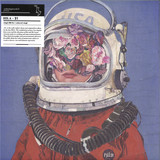
Pitchfork 9.4 ‘the first vital band of the 21st century’ Billboard "ágætis byrjun" is alluring, exotic, and unspoiled, just like the country that spawned it. Q Magazine ‘the last great record of the 20th century’ ‘Ágætis byrjun’ is the critically acclaimed second album by Icelandic band Sigur Rós. Their break-through album that propelled them to international fame winning numerous awards and selling over a million records. Tracks from the album have been synched in several notable films such as Vanilla Sky and The Life Aquatic and the album was placed number 2 on the Pitchfork albums of the year 2000. Ágætis byrjun’ was recorded by the band with producer Ken Thomas in 1999 at their Sundlaugin studio in the Icelandic countryside. The out of print vinyl record comes packaged on 2 x 12-inch heavyweight vinyl to the exact original packaging spec. Originally released on Fat-Cat & Smekkleysa this repress see’s the album being released on the bands own record label Krunk.
Search:hama
A Fable is Tigran Hamasyan’s first solo album after having recorded three previous albums as a leader. Released in 2011 it was hailed for the rare maturity of an all young musician to deliver such a landmark recording. At that time the pianist has been identified as one of the most important jazz revelations by critics impressed by his artistry. Well known for the way he fuses potent jazz improvisation with the rich folkloric music of his native Armenia, Tigran once again borrowed from the rich tradition he inherited and made a giant step with A Fable. Hamasyan gives a stunning one-man show with definite nods to Monk and Miles Davis, to Liszt and Debussy, while creating a space that is distinctly his.
Forming off the back of contemporary jazz outfit Zeitgeist, Voronoi take the power and rhythmic complexity of heavier prog-metal and fuse it with the sophistication of classical music and jazz. A passion for science fiction thematically drives the band’s heaving and
chopping style, whereas artists such as Autechre, Car Bomb, Tigran Hamasyan and J.S. Bach help shape the rigid, experimental structure of The Last Three Seconds.
“Compositionally and stylistically we have moved into much heavier territory than our contemporary jazz foundations,” says Keyboardist Aleks Podraza. “It really shows. If you were to put this record against the first tunes we played together as Zeitgeist, it would be like introducing a much capable Thelonious Monk to a less hectic Dillinger Escape Plan.”
As the first single off The Last Three Seconds, Gamma Signals serves as a toe in the water for the depth of things to come. The full-bodied riffwork captures the stop-start format of prog-metal heavyweights without being explicitly metal. Yet beyond this, glitchy, experimental electronics cut through the composition like a knife. The final product is something that captures the magic of the cosmos – a place where worlds orbit worlds, genres orbit genres. Each element remains different and unique, but still intrinsically tied to the other.
“Gamma Signals is about pulsars and how when Jocelyn Bell-Burnell first discovered them, the media thought they were aliens trying to contact us,” says Podraza. “Broadly, this song is about my love for and fascination with cosmology as a whole. That's a theme that runs through the veins of most of the album.”
Those following Vorono’s career will need little convincing on the quality of The Last Three Seconds. Collectively, band members have performed and recorded with groups like The Cinematic Orchestra, KOYO, NJYO, Jenova Collective, The Often Herd, Mik Artistik’s Ego Trip, Wandering Monster and more. This in turn has garnered sizable attention at festivals such as Leeds and Reading Festival, Download Festival, Ronnie Scott’s Jazz Club - not to mention Voronoi’s thrashing set at 2019’s ArcTanGent.
The cool and collected chaos of The Last Three Seconds serves as a snapshot of this live energy, as passion and fury hum at the end of every complex composition. From start to finish, the record is nothing less than executed perfectly, undoubtedly appealing to even the most seasoned of prog-lovers
Sundial[10,71 €]
Para One, whose real name is Jean-Baptiste de Laubier, releases " Shin Sekai ", the new extract from the upcoming SPECTRE: Machines of Loving Grace. The " Shin Sekai " video is directed by William Laboury, who created a visual tryptic around Para One's SPECTRE: Machines of Loving Grace.
Resonating percussions by Wadaiko Hama and Le Mystère des Voix Bulgares ethereal voices frame Para One's ever evolving electronic music, drawing a new frontier in the artist's musical landscape, bringing together his experience as a film composer and his career as a dj and performer.
The original track comes with 3 remixes: British producer Actress (Ninja Tune) uses Arthur Simonini's strings as the backbone to his emotional climb, German musician Alva Noto (Noton) gives a minimalist stripped down version of the score, while speakwave, the new moniker of French artist dynaRec, proposes a total remake of the melody, the harmonies, and the rhythmic structure of Shin Sekai.
- 01: Seki Taneko - Akemi&Apos;S Poems
- 02: Kusunoki Shigeo - Longing For The Shadow
- 03: Yayoi Tanaka - Sad Gull
- 04: Akasaka Koume - Please Forgive Me
- 05: Ichimaru - If You Go Down The Tenryū
- 06: Mitsuko Nemoto - Cosmos Elegy
- 07: Ichirō Fujiyama - Tokyo Daughter
- 08: Chiyako Sato - Skyscraper
- 09: Yayoi Tanaka - The Dream Is Short Lived
- 10: Ichirō Fujiyama &Amp; Masao Koga - Is Sake Tears Or Sighs?
- 11: Otomaru - Yoneyama Sanri
- 12: Hamako Watanabe - I Don&Apos;T Forget
- 13: Akasaka Koume - Asama Smoke
- 14: Yoshio Tabata - Farewell Ship
- 15: Ichirō Fujiyama - Farewell Youth
- 16: Kouta Katsutaro - Stand Up Tomorrow
DEATH043LP[11,56 €]
Emerging during the early stages of the recording industry in Japan, the ryūkōka style adopted western classical, blues & jazz elements into traditional and classical Japanese music.
This collection of 1920s & 30s ryūkōka recordings follows on from the Kouta Katsutaro tape we put out a couple of years back, and further captures the hauntingly unique sound of a cultural merging that was starting to reflect itself via popular song, ahead of the widespread influence of western pop music during post-war US occupation.
Repress
Baris K and Jonny Rock don their incognito aliases for the second Disco Hamam release. Straight up ottoman disco business strictly from the vaults. Killer artwork, killer music. ( Baris Manco, Timur Selcuk, Istanbul Calgicilari etc)
- 01: Music Box Lba (Aka Lba’s Theme)
- 02: The Empire
- 03: Mother Earth
- 04: In The Temple
- 05: Desert
- 06: Emerald Moon
- 07: Hamalayi
- 08: The Quest
- 01: Opening For Lba (Lba1)
- 02: The Quest (Lba1)
- 03: The Rebels (Lba1)
- 04: Village (Lba1)
- 05: Hamalayi (Lba1)
- 06: Lba’s Theme (Lba1)
- 07: Song For Gabriel (Lba2)
- 08: The Empire (Lba2)
- 09: Honey Bee (Lba2)
- 10: Emerald Moon (Lba2)
- 11: Zeelich (Lba2)
The cult French game is celebrating its 25 years old with Wayô Records! Philippe Vachey, the original compositeur of this game series, achieved this fantastic Symphonic Suite with the Scoring Orchestral, recorded at the Seine Musicale of Paris!
1994-2019. For the 25th anniversary of the Little Big Adventure game series, here come the fully-licensed Symphonic Suite based on the music from these cult games by their composer Philippe Vachey, with the official support of the original team led by Didier Chanfray and Frederick Raynal! This project is, of course, led by the composer himself!
In the mid-nineties, Little Big Adventure (Relentless: Twinsen’s Adventure in USA and Asia) revolutionized the video gaming with an innovative system, a captivating storyline and characters that live in everyone’s memories. The hero, Twinsen, fights evil in a journey that leads him to discover the secrets of his destiny and to explore fantastic places around the world, and beyond!
It is the symphonic music composed by Philippe Vachey which adorns the two opuses of Little Big Adventure, with an extraordinary orchestration and quality of writing. These two titles are two standouts in the action adventure and fantasy genre. 25 years after the creation of the game, Philippe Vachey finally realizes the project of arranging the music of Little Big Adventure 1 & 2 for an exceptional symphonic suite, in collaboration with the best talents of the symphonic production in Europe!
Remastered from the original tapes in 2004 for release on World Circuit, 2021 sees this classic album back on vinyl for the first time since its original 1984 release.
In 1982, the great Malian singer songwriter and guitarist Ali Farka Touré, then still in the early years of his recording career, teamed up with the brilliant percussionist Hama Sankare. Together, from a base in Ali’s home village of Niafunké they travelled through Northern Mali, refining a collection of new songs. When they were ready to record they followed the River Niger as it wound down through the desert, to the capital city of Bamako.
In one afternoon, the great Radio Mali house engineer Boubacar Traore captured these eight superb performances on two microphones: two voices so close it was thought they were double tracked, one guitar (the distinctive Bulgarian acoustic model that Ali treasured) and Hama’s calabash percussion making its first appearance on record. The album, which includes some of Touré’s best loved songs, was released self-titled with no sleeve notes, just an enigmatic group photo on the cover. It became known as the ‘Red’ album due to the colour of its original sleeve.
Vinyl and cassette copies of ‘Red’ began to circulate in West Africa, as well as making their way to Ry Cooder in the US and to specialist journalists and DJs in the UK and France. It was popular in Mali and the Tuareg refugee camps in Libya, where it became an influence on the musicians who came together as Tinariwen.
On a tip from Toumani Diabaté and with a copy of ‘Red’ in hand, World Circuit’s Anne Hunt travelled to Mali in the mid 80s to find Ali to invite him to record and tour. An appeal was broadcast over Radio Mali, and Ali, who by chance was visiting the capital Bamako, heard it. Thus began Ali’s incredibly successful international career which took him around the world and resulted in the release of eight acclaimed albums including three GRAMMY winning collaborations, with Ry Cooder (Talking Timbuktu) and Toumani Diabaté (Ali & Toumani; In The Heart of the Moon).
With Uma Elmo, his fifth album as a leader for ECM, Danish guitarist Jakob
Bro presents a new trio featuring Norwegian trumpeter Arve Henriksen
and Spanish drummer Jorge Rossy.
Astonishingly, given the trio’s musical synergy, the first time these three musicians ever performed together was for the album’s sessions at the Swiss Radio
studio in Lugano, with ECM founder Manfred Eicher producing.
Uma Elmo reaffirms the observation about Bro’s work by London Jazz News
that “there is no hurry to this music, but there is great depth.” Among the
album’s highlights is opener “Reconstructing a Dream,” a darkly lyrical reverie.
“To Stanko” is Bro’s hushed tribute to the late, great Polish trumpeter Tomasz
Stanko, who featured the guitarist in his quintet for the ECM album Dark Eyes.
Another homage to a late elder is “Music for Black Pigeons,” which was given
its evocative title by saxophone sage Lee Konitz.
Listeners will recognize Henriksen’s whispering, poetic sound from his 2008
ECM album Cartography, as well as his collaborations for the label with Trio Mediaeval and Tigran Hamasyan. Rossy is well known to jazz fans on both sides of
the Atlantic, particularly for his decade-plus tenure in Brad Mehldau’s careermaking first trio.
As for the leader, DownBeat aptly noted in its review of his previous ECM album, Bay of Rainbows, that “Bro’s guitar is luminous... his music both hypnotic
and dramatic.”
Jakob Bro: guitar
Arve Henriksen: trumpet, piccolo trumpet
Jorge Rossy: drums
WRWTFWW Records is beaucoup happy to announce the official reissue of Pierre Barouh's hard-to-describe-but-easy-to-enjoy French flair meets Japanese avant-garde lost treasure of experimental-electronic-chanson-pop with a new-wave-minimal-bossa touch, Le Pollen. Originally recorded July 1982 at Nippon Columbia Studio in Tokyo and composed, arranged, and played by a who's who of Japan's most groundbreaking musicians of the 80s, the album comes as a LP with bonus 7inch, housed in a heavy sleeve displaying two immaculate photos of Barouh and holding a printed lyrics insert.
A free-spirited world traveler with an incredible ear for music, Paris-born singer and activist Pierre Barouh introduced the sounds of Brazil (and more) to Europe and pushed the envelope with his pio-neering label Saravah, home of adventurous innovators Brigitte Fontaine, Areski, Jacques Higelin, Naná Vasconcelos, and Roland Bocquet's Catharsis among many others. His bohemian border-free vision of modern chanson, blending musical tradition from various parts of the globe with forward-looking artistry, resonated particularly well in Japan, where the scene spearheaded by Yellow Magic Orchestra fell in love with everything Barouh.
And so one day in 1981, Pierre Barouh received an invitation from a Japanese label to come record an album in Tokyo. Not one to turn down an escapade around the world, the French visionary jumped on a plane and landed in a studio surrounded with a dream line-up of musicians: Yukihiro Takahashi (who had named his solo debut Saravah! after Barouh's imprint) and Ryuichi Sakamoto of YMO, Yasuaki Shimizu and his Mariah bandmates Masanori Sasaji and Hideo Yamaki, members of the Moonriders, Motohiko Hamase, Mitsuru Sawamura of Interior, Kazuhiko Katoh and the list goes on. Also participating in the making of the album were longtime collaborator Francis Laï and the mys-terious and beautiful David Sylvian.
The result is Le Pollen, a sincere and affectionate mix of nouveau chanson, techno-pop, post-punk, jazz, bossa, ambient, and minimalism. And probably something else entirely. Honestly impossible to classify in a particular genre, Pierre Barouh's fascinating cosmopolitan music melting pot is, above all, a reassuring ode to humanity, where friendship, exchange, and collaborative creativity breeze freely. Making music together. It's all love.
Pierre Barouh sadly passed away in December 2016, leaving behind a monumental legacy of music and art for us to cherish, and a life philosophy that's well worth considering:
La vie, qu'elle soit longue ou brève
Moi, tous mes rêves
Je les prends toujours au sérieux
Quand l'utopie brise les chaînes
C'est l'oxygène,
De ceux qui sont restés curieux
Life, be it long or brief
Me, all my dreams
I always take them seriously
When utopia breaks the chains
It's the oxygen,
Of those who've remained curious
From the song "L'Autre Rive" on Le Pollen.
Black Truffle is very proud to present Peaks by Australian cellist Judith Hamann, her debut release of electro-acoustic music. Known mostly for her live performance work with composers including Sarah Hennies, Yvette Janine Jackson, Alvin Lucier, Tashi Wada, and La Monte Young, here she steps away from the cello, moving into an intimate dreamscape woven from recordings gathered over years of itinerant touring.
Peaks is a work in two distinct parts, crossfading between different landscapes and apertures; from rooftop to church, from stasis to flares of momentary romanticism. Peaks considers summits as being both above and below, reframing the idea of apex from a more intimate perspective. Hamann considers how our domestic and personal geographies might form their own apogees, meridians, or nadirs.
Assembled in 2019 while an artist in residence in Krems, Austria, Peaks begins with Hamann’s more familiar cello but soon unravels into resonant electronic interiors; Southern California nightscapes heard through windows, San Francisco bathroom fans, snatches of recordings of friends, hand organs, and engines. signal/centinela draws primarily on recordings from Hamann’s time living in San Diego, and carries with it a certain sense of nostalgia in the sense of homesickness, longing, and displacement of distance and time. Side B is composed from recordings gathered on a different continent, Europe, weaving piano with recordings of sleep, breath, church organ, and the act of climbing. under/over emerges as it recedes, overlapping moments of arrival to create another kind of ‘spire’ in the sense of spir (breath). Peaks, with its omission of any recordings from Hamann’s home of Australia, hints at how the very construction of home itself, might be restless, untethered, changeable, and malleable.
On Peaks, Hamann interrogates tropes of ambient concrète musics, intentionally pivoting formally around material which teeters on the edge of cliche. This exploration asks whether familiar frames of harmony, field recordings and narrative trajectories can excavate new territories, or be ruptured. Peaks untangles a very personal sense of tension between beauty and shame in experimental music: treating lushness and harmony as possessing potentially muscular musical properties that might wrestle with or construct senses of belonging and home.
WRWTFWW Records is very happy to announce the official reissue of Motohiko Hamase’s astounding ambient house album Technodrome (1993). The album is sourced from original masters and available on vinyl for the first time ever as well as on CD. It comes with liner notes from the artist. This marks the fourth release from the ESPLANADE SERIES which focuses on the works of Yoshio Ojima, Motohiko Hamase and Satsuki Shibano. Inspired by John Cage, Jon Hassel, Brian Eno, and the emergence of house and techno music, Technodrome is jazz bassist turned electronic experimentalist Motohiko Hamase’s foray into what he calls ambient house or, as he explains, “using the gritty sensation inherent to the core of house music” to create an ambient record “aiming to express inverted images, optical illusions, and the sense of déjà vu that modern people can get in the city". Technodrome is constructed around innovative minimalism, a robotic funk orchestrated by bass lines and percussions, and monochrome moods. It’s the most intriguing project in Hamase’s discography, a ghostly ride set in 90s urban landscape, where repetition sets the groove and brings things to life, echoing Hamase’s deeper subtext for his compositions: “and attempt to recreate (as metaphor) the time in our mother’s womb". The album was initially released in 1993 by Newsic, the cult label started by Tokyo’s Wacoal Art Center (also known as Spiral), home, notably, of Yoshio Ojima who co-produced the album. It is now reissued in conjunction with Motohiko Hamase’s #Notes of Forestry and Anecdote albums.
WRWTFWW Records is excited to announce the official reissue of Motohiko Hamase’s remarkable ambient/environmental/minimalism project #Notes of Forestry, available for the first time since 1988. The album is sourced from original masters and available on vinyl and CD with liner notes from the artist. This marks the third release from the ESPLANADE SERIES which focuses on the works of Yoshio Ojima, Motohiko Hamase and Satsuki Shibano. One of the most fascinating and peculiar works from the golden era of Japanese ambient, #Notes of Forestry was initially released in 1988 by Newsic, the cult label started by Tokyo’s Wacoal Art Center (also known as Spiral), home, notably, of Yoshio Ojima who co-produced the album. Conceived by Jazz bassist turned experimentalist Motohiko Hamase, the magnum opus offers an enchanting mix of free-form pastoral electronics, otherworldly percussions by Yasunori Yamaguchi, and delightfully allusive piano played by none other than Satsuki Shibano (Sound Process’ Wave Notation 3). Vibrant, sometimes eerie, and absolutely captivating, #Forestry captures Hamase’s quest for musical freedom, he explains: “Inside the body of a musician, music is always transcendentally resonating. More than language, music reigns. When creating music overlaps with the moment my body performs, I strive to be as close as possible to the feeling of musical freedom. I feel that this notion lies at the foundation of this album". Musical freedom, here, provides an essential escape, extending the path uncovered by pivotal releases such as Midori Takada’s Through The Looking Glass, Satoshi Ashikawa’s Still Way, and Yutaka Hiros’s Nova. #Notes of Forestry is reissued in conjunction with Motohiko Hamase’s Technodrome and Anecdote albums,
- A1: Tyuyntro
- A2: Everyonesaysho
- A3: Lennox Schnabel
- A4: Easy Peeler
- A5: Braune Autos
- 6: One For Frau Hamacher
- A7: Wasabi Terraces
- A8: Alone W/U
- A9: Molly Street Scene
- A10: Larry Wah Nam
- B1: Fokan
- B2: Tessel
- B3: Westcoastin‘
- B4: Nacada Drive
- B5: Rotor Skate
- B6: Gohead
- B7: Hit The Aa
- B8: Kein Front
- B9: Künstlerzigarette
- B10: Ynterlude
- B11: Zeytin
- B12: Off Minor
Testiculo Y Uno sind Hulk Hodn und Twit One, zwei einflussreiche Instrumental-Hip-Hop Produzenten aus Köln. Im Jahr 2009 produzierten sie die erste Ausgabe der bahnbrechenden "Hi-Hat Club"-Serie, die die Karriere von Beatmakern wie Suff Daddy, Dexter und Brenk Sinatra startete. Die LP kommt in einem speziellen Stanz-Cover mit bedruckter Innenhülle.
"21" is the well-crafted, sharp and original first album by the duo HILA, composed by American cellist Artyom Manukyan (who already worked with Kamasi Washington, Daedalus, Flying Lotus, Run DMC, Gretchen Parlato, Raphael Saadiq, Clive Lowe Mark...) and french producer Dawatile.
The combination of jazz, Los Angeles beat-scene and the vibrations of 80s and 90s Soviet Armenia make it a striking and unprecedented fusion. These kind of nostalgic and unconventional references forcefully shake the codes of mainstream culture to create a sincere, raw and intimate expression.
"HILA" was born from a spontaneous and intense creative impulse between Artyom Manukyan, a Los Angeles-based Armenian celloist and his partner in crime, David Kiledjian aka Dawatile, a French multi-instrumentist of Armenian descent. This project is proving to be a true master stroke given that it only took 21 days for the duo to make it a reality.
"HILA" was made in less a moon cycle but captivates and electrifies audiences upon its first outings. "H.I.L.A" colors the warmth of the Californian "High" with Armenian vibes. The artists chose this name for their creation since both have a close and valuable connection to these locales. This journey began in 2007, on the day Dawatile went to Yerevan, the capital of this small country in the Caucasus mountain to realize a first fusion project centered around local folkloric music genres.
There he was introduced to local musicians including the Armenian Navy Band, one of the country's foremost groups in which Artyom played the bass and cello. In this context, he also met many musicians such as Tigran Hamasyan and Norayr Kartashyan. This will be the beginning of connections between Lyon, Yerevan and Los Angeles. The following year, the two artists will be be seen performing next to Taylor Mc Ferrin at the Jazz à Vienne festival. More recently, they partnered up again when the cellist, who had freshly relocated in California, invited Dawatile to produce his album. As soon as the studio’s threshold was crossed, they decided to postpone this record and create a joint project: Hay (as the Armenians call themselves) / High In Los Angeles. HILA was born at the end of these 21 days of intense creation. The association of Artyom Manukyan and Dawatile is the combination of two visions, two versions of Armenia, two personalities, the reunion of the Eastern and Western blocs.
One grew up nurtured by the sounds of hip-hop and jazz in Europe and the other by art music and Russian-influenced 1980s Armenian folkloric music before moving to L. A., Ca. The cornerstone of it all, the glue that unites everything : Armenia and music. They generate a new identity synthesizing two perceptions, their complicity transcending these cultural discrepencies. To achieve this, they will scour through images of Artyom’s childhood, within the popular culture of Soviet Armenia. Together, they revisit this decidedly retro vibe, based on the work of Caucasian groups inspired by African American music. This background is rehashed and fused with ancestral Armenian sounds. The DNA of the album "21" is molded by these dear influences.
We can also hear the ancestral sounds of Armenia, a country at the edges of both Europe and Asia. The presence on two tracks of Armenian music Master Norayr Kartashyan, infuses the languor of past melodies and traditions. These purposeful anachronistic sounds offer a fantastic depth to this powerful opus. Listening to the album, one can appreciate the successful fusion of styles and influences. Those combinations, however, manage to preserve individual identities only to enhance the art through an adamant musical dialogue.
Being driven by the urge to transpose Armenian musical traditions into a unique universe, the daring artists, offer an innovative combination by blending, for the first time, these ancestral sounds with the world of Los Angeles beat-scene and jazz. An invention largely fueled by the magic strings of Artyom and maestro Miguel Atwood-Ferguson, a pillar of the genre in Los Angeles combined. These associations resonate with a triumphant equilibrium. HILA is musical uncharted territory in which Artyom's cello strings intertwine to ignite the harmonies of keyboards, the machines, the vocals and electronic layers Dawatile pieced together. HILA plays the soundtrack of an adventure set between Armenia around the end of the Soviet era and a mysterious near future.
Artyom Manukyan grew up in Armenia in the 90s. At the time, he studied Russian classical music while learning jazz with assistance by his father, a music journalist. Being an unconditional music lover, he went on to sharpen his skills at the prestigious Berkelee College of Music. Subsequently, he’s been lucky enough to travel the world touring with numerous acts and mainly with the Armenian Navy Band. The group has fostered alacritous success honored by a BBC Award as a crowning achievement. He moved on 10 years ago and made his way to L.A. with his cello on his back. In the City of Angels, he quickly became a popular figure of the jazz and hip-hop scenes thanks to his first album "Citizen". He’s accompanied prestigious musicians such as Kamasi Washington, Melody Gardot, Daedalus, Flying Lotus, Run DMC, Gretchen Parlato, Raphael Saadiq, Clive Lowe Mark, or Vulfpeck. He released his solo album on the cello, "Alone" in October 2019.
Dawatile is a bold producer and multi-instrumentist as well as a passionate and resolute musician molded by jazz. As a versatile artist, he handles and juggles the saxophone, the keys, the bass and composition. Simultaneously, Dawatile produces cross-over projects and soundtracks for the movie industry. He, as well, has had the opportunity to be a part of many tours, including with his electro hip-hop band, Fowatile and more recently with the "Future Kreyol" trio, Dowdelin. Being the ever workaholic, he has under his belt a string of prestigious collaborations with the likes of Talib Kweli, Foreign Beggars, Roy Ayers, Tigran Hamasyan, Mathieu Boogaerts, Voodoo Game and Piers Faccini. His taste for developing new musical recipes and his know-how in production make him a much sought-after album producer. In concert, the HILA duo offers a sober, precise and rhythmic performance. "21" is an aerial and lively album taking the audience on an at times joyous and sometimes melancholic dreamlike journey. The magic of "HILA" operates at the speed of light and positions it already as an avoidable group.
Tape / Cassette
Mark Gergis is a producer, musician and audiovisual archivist known for his radio and video productions, recordings and performances. His work has focused on regional folk-pop music from the Middle East and Southeast Asia, including choubi and dabke from Iraq and Syria. As an archivist, Gergis is currently working on the project Syrian Cassette Archives, for which he aims to restore, preserve, catalogue and share his large collection of Syrian media from what can be called Syria’s ‘cassette era’ (1970s–2010). As an artist, under his name and others (Porest) he has released music on the Sublime Frequencies, Discrepant and Nashazphone to name just a few. It’s a wonder that amongst this hectic schedule he still finds time to present us with a new (old) collection of early century recordings (1999-2013).
Locational recordings, radio and TV intercepts, cassette excerpts, environments and street music all expertly all expertly meshed up into a vivid sound journey from places that were (and might) never be again.
Riotvan premiere! This EP marks the first release of an act on the Leipzig-based label which was not contrived in its direct commuting area. Which obviously doesn't mean that the city lacks fresh output at the moment. But these five Thomalla tracks are simply too good to leave them to another label.
The lighter shades of electronic music found a home in our very own Horoom for quite a while already. It's time to bring our love for melodies and rhythms into an output: under the roof of Bassiani records we are proud to announce a new sublabel. HOROOM001 inaugurates the platform that will be home to the likes of virtuoso Francis Harris and the craft of Hamatsuki. They've contributed, A to B, to the first release on the new imprint and be sure to find tracks that are going to enchant you with both beauty and depth. Jazzy, elegant and yearning: no more words needed.
Names You Can Trust presents the second installment of Rueda de Bullerengue, a collaborative series with NY-based Bullerengue collective, Bulla En El Barrio. Named after the group's ongoing monthly performance and workshop in Brooklyn, Bulla's collaborative spirit and dedication to the tradition of los bailes cantados has made an indelible mark on the bubbling tropical music scene of New York City, and in turn, found their way into the crates and sets of DJs and vinyl aficionados via their first 7-inch release on NYCT in 2017. Since those initial moves, Bulla has continued to grow and add working members while maintaining a philosophy and connection grounded in the traditions of their Colombian origins. They've studied and collaborated with elders and legends like Emilson Pacheco and Darlina Sáenz, and this past year embarked on a recording with Barranquilla-based collective Tonada Baile Cantado — the focus of this edition's recording and release.
Considered one of the premier groups advancing the tradition of Bullerengue within Colombia, this incredibly talented group of young musicians are a rarity for their skill and age. In a region where there are ongoing festivals celebrating the tradition of Bullerengue that still command massive audiences and performers, Tonada is a true representative of what can happen when such an amazing tradition is passed forward to an eager next generation. Produced by Bulla members Camilo Rodriguez and Diana Herrera (aka Carolina Oliveras) in between their time smashing stages across the U.S. for Combo Chimbita, this is a carefully nurtured and powerful bridge to the beloved traditions of Colombia's Caribe region.
Without further ado, here lies Volume 2 of Rueda de Bullerengue, featuring Tonada Baile Cantado, a new generation of traditional Colombian dance music transmitted directly from Barranquilla — Four dance floor crashers in the styles of fandango and chalupa, ready-made for your 45 spins in the inimitable style of Names You Can Trust.