Nightlands is the solo project of The War on Drugs’ bassist and multi-instrumentalist Dave Hartley. Amid massive global paradigm shifts Dave Hartley (aka Nightlands) became a father twice over and left his native Philadelphia for Asheville, where the pace of daily life is slower and it's easier to maintain a zoomed-out perspective on modern life. From the newfound refuge of a studio he built using the bones of a barn attached to his hundred-something-year-old house in the mountains, Hartley has tailored a collection of well-crafted pop rock, pointedly titled Moonshine. Guided by some of the harmonic sensibilities that have helped make The War on Drugs a force in modern music, Moonshine combines immaculate-yet-dense vocal stacks and billowy clouds of effected keyboards with classic songcraft, revealing previously unseen acreage in the unfurling dreamscape that is Nightlands. The surrealistic album art by Austin-based illustrator Jaime Zuverza depicts an archway opening to the stars over the surface of an idyllic sea flanked by both moon and sun. Similarly, Moonshine reveals portals within portals leading to ever deeper places in Hartley's vocal-centered labyrinth. Throughout the album, there are plenty of buoyant high moods where the pitter-patter of drum machine and humming digital organ hints at Hartley's low-key tropicalia streak, but the lyrics anchor the dreaminess in real-world sorrow and resignation. Nowhere are these sentiments more apparent than on the title track, a nearly acapella recitation of "America the Beautiful" that poignantly hovers over a mirage of soft keyboards before dovetailing into Hartley's own words about the hypocrisy of the American dream. "This was never intended to be an overtly political record" he admits. "I have so many friends who are able to process the frustration of current events gracefully or with wisdom or in a nuanced way, but I often find myself just consumed with anger about it all. I decided to just let that come out, and it manifested itself lyrically." Moonshine's wide-eyed, utopian instrumental backdrops provide sharp contrast to Hartley's lyrics, which sting even harder within the sweetness. Even in light of the album's vocal emphasis, Hartley's history as a bassist brilliantly beams through Moonshine, giving effortless and sprightly movement to songs like "Down Here," which also features an extended section of saxophone lent by his Western Vinyl labelmate, Joseph Shabason. In addition to Shabason, the album hosts a short list of remote collaborators including four of Hartley's bandmates from The War on Drugs, Robbie Bennet, Anthony Lamarca, Eliza Hardy Jones, and Charlie Hall, as well as exotica virtuoso Frank Locrasto (Cass McCombs, Fruit Bats), and producer Adam McDaniel (Avey Tare, Angel Olsen). Hartley was forced to keep the guest list small out of the necessity of pandemic isolation, coupled with his move to a smaller city, all of which challenged him to do most of the album's heavy lifting right down to the mixing duties, resulting in the most independent effort of his career. By that measure, Moonshine is also the clearest image yet of Dave Hartley as a person and creator.
Buscar:hard left
Incl. Schacke Remix
Having been extensively road-tested this past year by DJs including Daniel Avery, HAAi and Gerd Janson, Highdive arrives with tangible anticipation. The work of less-than-shadowy figures Gramrcy and John Loveless, the pair have passed lockdown and beyond remixing artists such as WH Lung, Discovery Zone and Ghost Culture. Debuting their first original material, closely following Gramrcy’s recent appearance on Loveless’s own Hot Concept imprint, Highdive is a long-anticipated explosion of energy.
Built around a sonic-boom breakdown, glossy rave chords and pounding post-punk drums, Highdive feels immediately at home on Phantasy. Having worked closely alongside founder Erol Alkan in recent years to shape the imprint's diverse output, Loveless' collaboration with the Peach Discs founder nods to the electro landscape of the label's earliest days. Having never left dance floors since, Gramrcy & John Loveless take a golden opportunity to plunge dancers into the sublime and the ridiculous.
While a stripped-down ‘Beats Mix’ sees the pair adopt a less-maximal approach, leave it to Schacke to stretch Highdive into hardcore rave heaven. The already-influential Copenhagen artist underscores his refreshing funk in the ‘fast-techno’ scene through which he has risen, turning the screws and upping the tempo with intense but elastic results.
It’s going off and The Chisel are back to cause a bit of bovver. Following a trio of explosive singles, the band finally bring us their debut full-length album, Retaliation, on the London-based punk institution La Vida Es Un Mus. Having formed in early 2020 and featuring a crew of members with long-term associations to the London punk scene, The Chisel quickly secured a reputation as one of the most exciting bands from a pool of contemporaries that includes Chubby & The Gang, Stingray and Big Cheese. Their sound is rooted firmly in Punk but with influences that run across the board to create a distinctive blend of Oi!, anarcho, UK-82 and hardcore. Retaliation is an unmistakably British record that draws a line from 1982 up to the present day, pushing its way into your collection and torching your stereo. Opening with the agitated force of ‘Unlawful Execution’, the tone is firmly set by a song that addresses the brutality of the Met Police (“Tell me what’s the difference between right or wrong / When a copper gets to blast a lad who did nothing wrong”). ‘Come See Me’ is a ferocious ode to camaraderie in the face of mouthy boneheads and bellends. ‘Shit Life Syndrome’ is a poisoned reference to the same cynical phrase used by physicians to describe the effects of people living under poverty and in the grips of substance abuse (“How can you expect people to act nicely, they’ve all been left on the edge of society”). It’s one of many songs influenced by singer Cal’s experiences of growing up in the working-class town of Blackpool. Cal states: “Blackpool as a town is often overlooked or even looked down upon, I wanted to write lyrics which gave the people of my town a voice”. With tunes like these The Chisel show that they’ll never pull any punches. However, beyond the fury and the swagger there’s another side that plays to an additional strength; the ability to write a memorable hook. Songs like ‘Retaliation’, ‘Tooth & Nail’ and ‘Not The Only One’ could be described as modern day anthems (the latter has become a fan favourite since the arrival of their first live shows) and cement their identity as a band not to be defined by their influences. Recorded by Jonah Falco at Total Refreshment Centre, London, March 2021.
Mixed by James Atkinson at the Stationhouse in Leeds. Mastered by Daniel Husayn at North London Bomb Factory. Cover painting by Tara Atefi.
BBE Music presents the first ever reissue of ‘Classifieds’, an ultra-rare, privately pressed 1985 album by Moonshine aka Monica Rypma & Friends. A naive and charming dose of dreamy DIY synth-pop interspersed with off-kilter, ambient interludes, original copies of ‘Classifieds’ are now almost impossible to dig up, but lately, thanks to the internet, the album has earned a cult following from music obsessives all over the globe. Created by aspiring songwriter and recent music-school dropout Monica Rypma, incredibly the album’s recording and production was entirely financed from sponsorship and advertising, way back in 1985. Inspired by René Van Helsdingen, the Amsterdam based composer, pianist and crowd-funding pioneer, Monica decided to sell advertising space on the album sleeve and name the album 'Classifieds', designing the cover to mimic a newspaper’s small ads layout. Written and recorded in only 5 days with René Van Helsdingen collaborator, synth wizard and multi-instrumentalist Brian Batie producing, the album was engineered by Wil Hesen at Studio Farmsound in Heelsum. With Rypma assisting, Batie composed and arranged almost all of the music on the spot, and lyrics were dreamed up by Batie, Rypma and Brian’s friend Jenny Garner. With an album full of music she could be proud of, Monica called in help from friends and family to print, fold and assemble the albums. “The original cover sleeve had three coloured bands; yellow, green or pink” says Rypma. “These were not different pressings, as most people presumed, but came from the limited budget that was left for printing. As one ink ran out, another colour was used, and this method produced the three versions.” Once copies had been distributed to the record’s advertisers and sponsors, hardly any were left. Until now, that is!
Alex the Fairy is an artist based in Berlin producing music with an emphasis on electronic and concrete methods. Alex the Fairy is also part of the 3Ddancer trio, a live act focusing on improvisation and expression using electronics.
Alex The Fairy writes: "I had sent The Tapeworm tracks before, but I was being difficult so was asked to send a new bunch, with a deadline. I sent the new bunch, a fairly odd collection expecting perhaps some of them to be combined with the older stuff but not seeing any coherence in them. I figured The Tapeworm would find at least something. To my surprise the suggestion that came back was exclusively the tracks I had sent the second time, and, re-listening through the tracks in this new order after returning from a Christmas dinner lying on the floor of my nephews bedroom gave them a completely new context. Despite them being quite varied in terms of age (one had been flung together a few days earlier on the train while another was approaching Schulreife) they seemed to meld together in such a way that I hardly recognised them…
Last year my grandmother died. My last grandparent. I had put off seeing her during corona, as I thought it best not to put her at risk and had almost left to visit her days before her death but had delayed my departure because of a medical appointment. My failure to her weighs heavy on my mind - fates grimacing grin: too little, too late. The approaching march of death, one generation closer was a confrontation I wasn't prepared for.
While clearing out her flat in the following weeks I had kept some of my grandfathers cassettes, live recordings of jazz greats, Pink Floyd, Sade and some classical among them, none originals, several presumably from the radio e.g. a church organ rendition of Bach. At the time I wasn't sure why I was hanging on to them, other than the urge to hoard, and that it felt wrong not at least to keep some. Half a year later, half way through mixing this cassette, suffering from my first bout of COVID, I had the insatiable urge to hook up the cassette player I had received from my grandfather after his death around nineteen years earlier and had been dragging along with me since. I stuck a cassette in only to immediately return to the safety of my covers. I began to work my way into what I had saved, hearing the fruits of my grandfathers labour decades before. It felt like quite an intimate interaction with someone I had long lost contact to/was long gone. Quite a wonderful thing, these time traveling cassettes.
I returned to the tracks to mix them shortly before my corona/cassette experience, with a new mixing console at hand. I had been looking for one for several years, but nothing had ever clicked, until I found this old broadcast desk 30 minutes from my place (it also coincided with a payment from a job the sum of which matched the price identically… fates return). Installing became a massive hassle and I doubted my decision continuously, but the further it was implemented the more it made sense. The first track I recorded with the mixer is on this cassette. Shortly before the mixing I was introduced to an Effektgerät by a friend, Rapha. Another good friend Art lent me their one, and I ended up using copious amounts of it throughout mixing, alongside my usual space creators. All the tracks on this release were mixed again on this mixer and are in a sense all a bit of a dub of the originals. I wouldn't have worked this way without the mixer, and the effect gave me a dimension I hadn't had before, so, from a technical perspective, the mixer and this effect define this release, giving it a coherence, at least for me. Emotionally of course the chaos and turbulence of the preceding year and my newfound appreciation for the medium give it a meaning I will struggle to formulate." – Alex The Fairy, Berlin, 9 May 2022
A classic and essential Hi-Life & Afro Funk album from one of the greatest Ghanaian singers and composers reissued for the first time!
The legendary Alhaji Kwabena Frimpong's fantastic rare album was recorded in 1984 in Germany and originally produced and distributed from Hamburg. K . Frimpong was born on July 22nd 1939 at Ofoase in the Ashanti - Akim district, died Oct 18th 2005 in Kumasi (Ghana).
He entered right into music after elementary school by joining "Star de Republic" and later "Oko's band" after which he left for K. Gyasy's band where he worked for more than 6 years. As a prolific songwriter and singer, here's the reissue of his amazing album, a modern fusion of Hi-life and Soul . The excellent background is given by the famous Cubanos Fiesta with members of Vis-A-Vis band such as the famous Sammy Cropper on guitar or Slim Manu on bass.
Originally produced by Atakora Mensah in Hamburg, this four songs recording is a blend of danceable and spiritual Soul and straight Hi-life. A must-have vinyl of percussive Afro Funk for all the music connoisseurs, Abrabo is a true masterpiece, so hard to find and reaching crazy skills for a decent copy affordable.
Remastered by Frank Merritt at The Carvery. Pressed on Replika format. Fully licensed by the Alhaji Kwame Frimpong Family.
Purple Vinyl
A Leftfield journey of rockin' sleezy disco edits! It feels like something weird and sinister is going to happen from the moment you drop the needle and keeps that energy throughout. Limited Heavy weight colored vinyl. Fans of DJ HARVEY, RON HARDY, PATRICK COWLEY and THEO PARRISH take notice
HIGHLIGHTS! Acting as an artistic ambassador for Cuba, the Orquesta Revé made several tours abroad, traveling to Peru in 1971. This extremely scarce LP was recorded for MAG in Lima and comprises mostly Cuban songs -like the outstanding Vicente Rojas' original 'Mi Son Combinado'- and also a rare cover of Jorge Ben's 'Domingas'. Quite an invisible record even for hardcore collectors, and almost impossible to find in any condition, "De Habana a Lima" is now reissued for the first time. More: In 1956, the percussionist and composer from Guantanamo, Elio Revé, founded the orchestra popularly known as La Revé, which in the space of a few years became the Cuban music group par excellence for foreign audiences. Elio, dubbed the father of changüí for his seminal work on this genre, is also considered one of the forerunners of salsa music and his orchestra included musicians of the stature of vocalist Ibrahim Ferrer; pianists Chucho Valdés, César Pedroso and Juan Carlos Alfonso; and bass guitarist Juan Formell, who left the group in 1969 to form Los Van Van. Acting as an artistic ambassador for Cuba, the Orquesta Revé made several tours abroad in the seventies, traveling to countries such as Spain, Belgium and the People's Republic of Angola, and these journeys are well documented on the internet. However, little is known about their trip to Peru in 1971_ The local record label MAG quickly signed the Cuban groups that arrived in the Peruvian capital and that the head of the label, Manuel Guerrero, agreed to record. The La Revé LP was followed by a Los Compadres album the following year. "De Habana a Lima..." comprises a dozen songs labeled changüis, mostly written by Cuban composers, the exception being the closing track: 'Domingas', an original song by Brazilian artist Jorge Ben. In contrast, the album opens with the distinctly Cuban song 'Guajira guantanamera'.
LIMITED TO 500 COPIES // HIGH-QUALITY TIP-ON COVER // INCL. DOWNLOAD CODE
OFFICIAL RE-ISSUE, DONE IN COOPERATION WITH THE FAMILY OF BOBBY COLE !!!
If you lived in New York during the 1950s through the 1990s and liked jazz, you knew about Bobby Cole. He played piano, sang, composed, arranged and, in 1967, released an album of original compositions titled "A Point of View" (Concentric Records). He had fans but avoided becoming mainstream. He stayed contemporary without becoming current. Jazz, folk, rock, modern dance scores…he wrote and performed them all. He smoked too much, drugged too much, drank too much. He was also cerebral, curious, a prodigious reader of poetry, philosophy, theology, and an uncommonly intelligent and literate lyricist.
On a December night in 1996, he had a heart attack while walking to work. An ambulance brought him to New York Hospital where, a few hours later, he died. Bobby Cole performed throughout Manhattan for forty years, but he spent most of the 1960s headlining at Jilly's, the midtown bistro owned by Frank Sinatra and his friend Jilly Rizzo. Sinatra called Bobby "my favorite saloon singer."
Bobby Cole caught the attention of Judy Garland, who visited Jilly's one night in 1964. She was hosting a weekly television show, and in the midst of a feud with her special materials arranger, Mel Torme. Three weeks later, Mel was out, and Bobby was in. He performed on Judy's show with his Trio. Bobby was scarcely 30 years old and it was his first time on television, but he was unruffled, sophisticated, and so damn cool. After Judy's show ended, Bobby occasionally arranged and conducted for her until she died.
Today, Jilly's is called the Russian Samovar and the piano is in the same spot. My husband and I ate there a few years ago. As we enjoyed our meal, I talked about Jilly's in the Sinatra era. Jilly had an apartment on the upper floor. I pointed up to the apartment and the balcony, where Jilly and Frank would sometimes drop water-balloons on unsuspecting pedestrians below. Another story described Jilly's as "tough, and you had to be tough to work there. Bobby Cole was tough. Frank and Jilly used to throw firecrackers at him to see if they could rattle him, but nothing rattled Bobby Cole. He ignored them and kept on playing." In the 1980s, Bobby headlined at a club called the Café Versailles. His daughter sometimes visited with her friends. She recalled that when she and her father would exit the club after work, a panhandler would be waiting for him. Bobby, who fought his own losing battle with the bottle, would slip the guy twenty dollars and wryly admonish him, "Be sure not to spend it on food." The night my husband and I visited the Russian Samovar there was a guy playing piano there, very young, and trying hard. I talked to him a little bit between his numbers about Bobby and the history of Jilly's and he was sweet, but I could tell he didn't care. I felt like one of those old people who bore young people to death with stories about things that happened before they were born – which, let's face it, is what I was. Nonetheless, when we were ready to leave, I put twenty dollars in his tip jar and said, "This is with compliments from Bobby Cole." After we left my husband said I should have added, "Be sure not to spend it on food."
Marie Hegeman (December 2021)
Incl. Schacke Remix
Having been extensively road-tested this past year by DJs including Daniel Avery, HAAi and Gerd Janson, Highdive arrives with tangible anticipation. The work of less-than-shadowy figures Gramrcy and John Loveless, the pair have passed lockdown and beyond remixing artists such as WH Lung, Discovery Zone and Ghost Culture. Debuting their first original material, closely following Gramrcy’s recent appearance on Loveless’s own Hot Concept imprint, Highdive is a long-anticipated explosion of energy.
Built around a sonic-boom breakdown, glossy rave chords and pounding post-punk drums, Highdive feels immediately at home on Phantasy. Having worked closely alongside founder Erol Alkan in recent years to shape the imprint's diverse output, Loveless' collaboration with the Peach Discs founder nods to the electro landscape of the label's earliest days. Having never left dance floors since, Gramrcy & John Loveless take a golden opportunity to plunge dancers into the sublime and the ridiculous.
While a stripped-down ‘Beats Mix’ sees the pair adopt a less-maximal approach, leave it to Schacke to stretch Highdive into hardcore rave heaven. The already-influential Copenhagen artist underscores his refreshing funk in the ‘fast-techno’ scene through which he has risen, turning the screws and upping the tempo with intense but elastic results.
New compilation, pressed on black vinyl. Featuring many unreleased recordings and rarities from the cult favourite and all endorsed by the Tom Rapp estate. The grand masters of acid folk, Pearls Before Swine outline the genius of leader Tom Rapp on an album created from a dusty box of tapes left behind by the incisive tunesmith. Never before heard recordings remastered to create the perfect route into the essential ‘Balaklava’ and ‘One Nation Underground’ albums that kick started a whole genre. This new vinyl compilation was made in collaboration with, and fully endorsed, by the Tom Rapp estate.
Just as one can smell a storm swelling on the horizon, the cataclysmic tremor that is IMMOLATION approaches to unleash its latest, immense creation: ACTS OF GOD. Due to be released in winter of 2022, this 11th studio album serves as the next chapter of IMMOLATION’S Death Metal epic. With 5 long years passed since the most recent studio album, ATONEMENT, ACTS OF GOD vigorously showcases IMMOLATION’s ability to consistently create fascinating sounds, while still keeping their feet firmly rooted in the old school, New York Death Metal for which they are renowned.
Emblazoned with a haunting new masterpiece by artist Eliran Kantor, ACTS OF GOD displays a trifecta of angelic beings desperately trying to prevent one another’s flesh from melting in a blackened light from above. The muted colors and ethereal images will ring familiar to fans of IMMOLATION’s previous album covers. “We wanted this cover to feel much darker; more melancholy and hopeless. The music has always been very dark, and a lot of Kantor’s work had the feeling that we were going for; the semi-surreal colliding with a classic, almost renaissance feel,” explains founder and vocalist/bassist Ross Dolan. “It’s unnerving. It really reflects the music perfectly,” agrees founder and guitarist Robert Vigna.
The album’s third track “The Age Of No Light” is a powerful, hard hitting song with an extreme yet catchy melody. “It’s quick, hits hard, and gets straight to the point” explians Vigna. Consistently changing speeds and patterns throughout, the song is short but remains both dynamic and memorable.
“Blooded” has all the usual IMMOLATION elements: the slow, the fast, the explosive, the big overlaid sections of groovy harmony eventually dropping into evil, ripping guitar work. “It’s a little powerhouse,” describes Vigna, “it’s straightforward, and it has all the elements you would expect from us in a nice, neat package.”
A song like “Immoral Stain” is a slightly mid-paced track with an intense, creepy atmosphere. Equipped with plenty of unusual moments, the beat is catchy, dark, and echoing. Searing guitar starts to recite a story and then quickly begins a conversation with thunderous vocals and a vociferous beat. “That whole section of build up just needed to be done exactly as it is. That’s what makes it sound different and interesting,” describes Vigna. Much like the rest of the album, while the lyrics cover the usual, general topics of genuine evil and the great deception of religion, the specifics are most certainly left to the listener’s interpretation. Fortunately for IMMOLATION fans, there is no shortage of corruption and catastrophe in this world.
Fittingly, the concluding track “Apostle” was the last song written for the album. “Some of those chorus sections have a weird almost dream-like quality,” describes Dolan. Its steadily growing momentum discharges rounds of guitar solos and relentless vocals which eventually lead way to an explosive finale to the album.
The creative journey for ACTS OF GOD began with years of notes, and an abundance of inspiration. With Vigna at the helm of the structural writing as usual, further composing and concepts were tossed back and forth amongst all 4 members. Eventually, they began to skeletonize the beginning of what would become a full length, studio album. While the recording process and entering the studio can be a very sterile experience for some musicians, the ferocity of the demos combined with the expertise of long time friend and recording counterpart Paul Orofino of Millbrook Studios (BLUE OYSTER CULT, BAD CO, GOLDEN EARRING), assured that this would not be an issue for IMMOLATION. “Having such a level of comfort is key,” remarks Dolan. Final touches were brought about on the mixing and mastering by Zack Ohren of Castle Ultimate Studios.
Firmly aligned with Nuclear Blast Records, the often coveted sound of IMMOLATION has reemerged from the depths of a cursed and cruel world to illuminate our minds and ears with exquisite, sonic destruction.
LIMITED EDITION OF 300 YELLOW VINYL COPIES
Shawn Lee follows up his country-soul solo album "Rides Again", released in 2019, with an even more personal, intriguing set of songs. The US born and London based prolific singer, songwriter, musician, producer, arranger, filmmaker and author puts the story of "Rides Yet Again" in his own words.
"When the original pandemic lockdown of 2020 ascended upon the world, I found myself like many others a prisoner in my own home. I began thinking about making new music. What do I wanna do I pondered… 'Rides Again' was a personal once in a lifetime album or was it? After some reflection, I realised there was more to this story, this sound. As I eventually crept back to my studio ducking and diving all the way, I started writing and recording new songs for Rides YET Again. The lyrics heavily informed by life during lockdown, my new dog Carla and my recent health problems. I had suffered a stroke which left me with some brain damage and I struggled with Aphasia for well over a year with extremely impaired speech. It was hard … I found solace in song and a musical context to share my ups and downs. It was a beautiful place to retreat to. John Pickup brought his brilliant orchestral treatments. Also Nichol Thomson, Tom Walsh, Mike Davis & Andy Ross blessed me with their sublime horn stylings. Suffice to say I'm really quite fond of this little record. Much love to you wherever you may be."
Awe Kid explores ideas of trans-humanism, evolution and digital immortality on Body Logic, a fantastically lush new album for Atomnation. The immersive 10 track record plays with organic, breathing textures punctuated by moments of digital unrealness to result in an album permeated with a dream-like quality. This contrast is mirrored by the artwork from Portugal's acclaimed The Royal Studio.
Awe Kid is an alias of Sine Language Records co-founder Rick Parsons. It is the product of years spent exploring a multitude of different music. From early days in post-hardcore groups and on to a love of 90s Warp, electronic jazz and more experimental niches, the multi-instrumentalist has now settled on his own unique fusion of breaks, ambient and left-field dance music. This deft studio wizard mixes up melodic nostalgia with forward-thinking sound design using whatever he can get his hands on, from analog and modular hardware, to samplers, field recordings to digital techniques.
Says Parsons, “I love working with digital processes because you get these unexpected moments where you dial something in, that somehow takes on a tangible, organic form in the real world. Searching for these sweet spots was the motivation for the album, contrasting natural textures against synthetic elements, and finding ways to create something that feels like it exists outside of the computer.”
While the album pays homage to dance music traditions, such as the broken beat of title track 'Body Logic', and full-throttle breaks of 'Zenith', these are assimilated and repurposed to create something that defies genre categorization. The listener's journey is perfectly paced, with broody but uplifting cuts of electronica giving way to shimmering, celestial melodies, and dusty breakbeats emerging from dense layers of atmosphere, only for the mood to be reset with soothing, suspenseful synths and haunting vocal samples. Elsewhere, devastatingly emotional ambient is followed by punchy grooves and propulsive melodies to make for a real ride.
Many will know Bernie Marsden for being a founder member of Whitesnake, one of the biggest rock bands of all time, and writing the iconic global smash, “Here I Go Again”.Since leaving Whitesnake almost 40 years ago, Bernie has forged an impressive solo career. He is acclaimed as one of the premier British blues guitarists. He has written and recorded with some of the biggest names in the industry, composed music for film & TV, forged a successful career as an author, and amassed a priceless collection of guitars. Most recently, Bernie partnered with Joe Bonamassa to write half of his hit album, Royal Tea. Rewind to Summer 2018… Bernie was invited to join Billy Gibbons on stage, when he said “Bernie, wouldn’t it be great if we could all record the songs we grew up with as we learned to play the guitar?” Rather than suffer the usual fate of great ideas that are left to litter the dressing room floor, Bernie immediately set about making a list, and the “Inspirations” Series was born. KINGS” is the first album of Bernie Marsden’s “Inspirations”. Featuring 10 songs that were originally recorded by Albert, B.B. & Freddie King, and recorded in a studio in Oxfordshire with a band that just locked into a groove, “KINGS” is chock full of blues and soul. Two Bernie Marsden penned instrumentals inspired by The Kings appear as the final two tracks on the album. Features appeared / appearing in Blues Matters, Classic Rock, Fireworks, Rock Hard (Germany), Sweden Rock, Rock N Reel magazines, with great reviews given by most of the premier UK Rock, Blues and Guitar publications around the release of “KINGS”. Radio support at Planet Rock, The Max, Radio Caroline and was IBBA’s #4 most played album in 2021.
Emotional Rescue looks back again with a 2022 repress, digging deep in to the early 80s Bristol post punk scene of Pig Pag, the Wild Bunch and the Dug Out club. A short lived project of just 3 releases, Mouth trail-blazed leftfield percussive jams in the rich vain of Liquid Liquid and ESG but in their own jazz-infused way.
Centered round the cultural melting post of the St Paul's district, it's pubs, clubs and blues parties threw together young and old to the sounds of dub, funk, jazz and soul and took the spark lit by punk rock and new wave and spawned music that still resonates today.
Consisting of a floating line up based around main members Andy Guy and Rob Merrill, alumina included a young Nellie Hooper before he would go on to be a founding member of the Wild Bunch and on to produce the likes of Bjork, U2 and Madonna.
Based around a hard tribal drumming, mixing guitar, trumpet, shouted vocals and effects, the thrown in the mix nature was inspired as much by avant-jazz than punk's do it yourself attitude.
Here then, on one EP are their complete recordings, including as the title cut, their best and deepest, Voyage To The Bottom Of The Sea. Featured on a compilation LP from the legendary Y Records, its bottom heavy dub sound is augmented by female and toasted vocals riding a top a heavy stepper style riddim.
This is followed by an increasingly dizzy array of percussion jams. Acab (Part 2) is all skips and trumpets, while the versions of Take Your Coat Off perfect skat vocal / tom interplay, before the finale busts out the rockabilly influences in full effect with jagged guitar, skipping hats meets double bass punk style.
Black vinyl edition. Available for the first time ever on vinyl, cassette tape and digital, the reissue features fully remastered tracks and new artwork along with a 12“ size insert, 2x12“ size poster, sticker and DL-Card. Vocalist Chaka Malik and guitarist Chris Traynor met in the New York hardcore band Burn and began playing together as early as 1992. With an early version of Orange 9mm, the duo released a live EP in 1993. The recording earned the band a contract with East West, and after picking up bassist David Gentile and drummer Matthew Cross, Orange 9mm began recording. Driver Not Included was released in 1994, and the band spent time touring with Helmet before signing with Atlantic the following year. Gentile left later in 1995 and was replaced by Taylor McLam just after recording ended for Tragic, with production by Barkmarket's David Sardy. Tragic was released in 1996; it would be three years before Orange 9mm issued a follow-up, which bore the title of Pretend I'm Human.
Long overdue pressing of cult band’s most sought after release. Engineered and remastered by Jack Shirly (Deafheaven, Bosse-de-Nage, Oathbreaker). For fans of Have a Nice Life, Xasthur, and Planning For Burial. Entirely remastered and includes a never before heard bonus track!! Mamaleek’s Kurdaitcha is finally back in print! The San Francisco-based duo released their third album of weirdo black metal, Kurdaitcha, on the legendary cult label Enemies List Home Recordings (Have a Nice Life, Giles Corey), and it quickly sold out. For years the LP has been a hard to find collector’s item. Kurdaitcha finds the project in its initial period of creating music influenced by black metal, hip hop, jazz, and spirituals. Founded in 2008 in the Bay Area by two anonymous brothers, Mamaleek has explored a vast sonic territory on the edge of a genre renown for its aversion to change. Their expert utilization of left-field samples and unconventional instrumentation, and their insistent drive to experiment continues to set the band apart from their peers. This pressing of Kurdaitcha has been remastered and features a previously unreleased bonus track with a gold foil stamped jacket. “Mamaleek are the great destroyers.” — Invisible Oranges // “An incredibly rich and rewarding experience.” —Heavy Blog Is Heavy // “Is it good, though? It’s fucking mental. It’s amazing. It’s absolutely horrible. It’s barely listenable at times and yet you can’t turn it off. The music is perfect. Like broken glass is perfect.” —Echoes And Dust // “The group cloaks its music in the kind of warm, hypnotic distortion that defines shoegaze, and underneath that haze is a style that’s conceptually abrasive yet altogether beautiful.” — FORBES
Very limited vinyl pressing, 500 copies in a gatefold sleeve, a printed inner housing white and marbling effect vinyl with full download included. CD in a 4 panel digipack with a 4 page booklet. New Heavy Sounds is very proud to bring you Moongazer, the 2nd album by the 4 piece stoner rock powerhouse from Italy, TENEBRA. The band had already made waves on the scene with their debut album ‘Gen Nero’ before delivering ‘What We Do is Sacred’ their debut EP for New Heavy Sounds last year, 3 killer tracks that were but a taster of things to come. Moongazer takes the story a stage further with 9 slabs of crushing fuzzed up grooves, fuelled by 70’s proto metal, hard rock, punk, psych-blues and noise, loaded with great riffs and melody and topped off by gutsy soulful vocals. Musically, you could say that TENEBRA occupy similar musical terrain to bands such as Graveyard, Witchcraft, Kadaver and other bands of that ilk, but TENEBRA are very much their own beast. They have all the chops of course, but are musically less slavish, often adding a twist that keeps the songs fresh and now. There’s also very little reliance on Sabbath-isms (apart from one cheeky nod) and though occult rock is also part of the vibe, the music steers well clear of the cliches. In fact the band bring a clutch of left field influences into their melting pot as well, from June of 44 and Love Battery to the Misfits and the psych grunge of Screaming Trees. Of the 4 members, Claudio (bass), Emilio (guitar) and Mesca (drums) came from the hardcore and post-hardcore squat scene that gathered around Bologna, whereas their formidable vocalist Silvia (the youngest of the crew) is immersed in the underground rock of the '60s and' 70s. When you hear her sing you’ll know where she’s coming from as she has one helluva rock voice, laced with whiskey, smoke, grit, late nights and a whole lotta soul. Think Maggie Bell meets Betty Davis with a smattering of Gillan, and you'll be in the right ballpark. So what you get with ‘Moongazer’ is a band revelling in the spirit of 70’s rock rather than recreating it. ‘Heavy Crusher’ lulls you with its dreamy intro, but it’s not long before the riffs hit with Silvia in full effect. This pretty much sets the tone for the record, coiling proto metal riffs, executed with gusto and joie de vivre. And as with every track on this album, Silvia belts it out like she absolutely means it man. ‘Cracked Path’ continues the journey and ups the heavy fuzz a notch or 2. First heard on ‘What We Do Is Sacred’ (full length album version). ‘Black Lace’ is a brooding beast, epic and melodic, almost a ballad, with a heap of soul lurking within, courtesy of Silvia’s mighty voice. ‘Carry My Load’ keeps the brooding vibe going till the loping off kilter killer riffs kick in. This is definitely Silvia at her most Gillan-esque. ‘Winds Of Change’ does just that, dial things down to bluesy, almost psych feel, with dreamy solos and a hooky guitar break. ‘Stranded’ is a full on stoner rocker as is ‘Space Child’ with its short homage to the dark lords, there’s even a a sax solo. Never one’s to just play it straight these guys. ‘Dark And Distant Sky’ is pure proto metal, a la Bloodrock or Grand Funk, it truly rips, and once again, it’s construction veers it away from anything approaching what you’d expect. ‘Moon Maiden’ is the album’s closer, featuring Gary Lee Conner (no less) of the aforementioned grunge legends Screaming Trees, guesting on guitar. It’s a fitting and epic closer, by turns hard ‘n’ heavy, psychedelic and chock full of great ideas. MOONGAZER is without doubt an accomplished sophomore release that deserves to be heard and appreciated, purely because, though it may appear to reside in the world of stoner, it is so much more.
Ferocious JP / US free jazz bomb. A rare meeting between the NYC free jazz scene and the Japanese free music scene. Old-style Gatefold LP, with rare photographs & liner notes by Alan Cummings.
Following hot on the heels of the first, mid-sixties generation of Japanese free jazz players like Kaoru Abe, Masayuki Takayanagi, Yōsuke Yamashita, Motoharu Yoshizawa, etc., an exciting second wave of younger players began to emerge in the seventies. Two of its leading members were the saxophonist Kazutoki Umezu and multi-instrumentalist Yoriyuki Harada. Both were post-war babies and immigrants to the city, Umezu from Sendai in the north and Harada from Shimane in the west. They first met as students in the clarinet department at the Kunitachi College of Music, a well-known conservatory in western Tokyo. Harada was already securing sideman gigs on bass with professional jazz groups and was active in student politics, making good use of his connections to set up jazz concerts on campus. It was around this time that the two began to play together in an improvised duo, with Umezu on clarinet and bass clarinet and Harada on piano. They also experimented with graphic scores and prepared piano.
These experiments eventually led to the creation of a trio, with a high-school student called Tetsuya Morimura on drums, that they decided to name Seikatsu Kōjyō Iinkai (Lifestyle Improvement Committee) in joking reference to the Marxist discourse of the student radicals of the time. Around 1973, Umezu and Harada decided to call it a day and go their separate ways. Umezu began playing with the Toshinori Kondo Unit and Harada with the Tadashi Yoshida Quintet. In 1974 Harada formed his own trio and began to play at jazz coffeehouses across Japan.
Then, in September 1974 Umezu travelled alone to New York, where he set about building connections with the loft jazz scene in the city. It was a fortuitous moment to arrive in New York. Rents were cheap in the Lower East Side, possibilities for squatting existed, so many musicians and artists had moved to the area. Umezu soon became known on the scene as Kappo and he started to make connections with some of the young musicians like David Murray, Arthur Blythe, and Oliver Lake. He recalls making the rounds of the lofts every evening, checking out the performances, and getting the chance to sit in with many groups including Juma Sultan’s Aboriginal Music Society and trumpeter Ted Daniel’s orchestra.
Things were going so well that Umezu wrote to Harada and invited him to come to New York. He accepted and arrived in the city in July 1975. Harada and Umezu took the opportunity to resume their artistic collaboration. Their first concert together in over two years took place on July 20th at another loft, Sunrise Studios at 122 2nd Avenue. Umezu remembers Sunrise as an unusually sunny loft with the rarest of things, a grand piano. He invited along Ahmed Abdullah, a trumpeter he had got to know while playing with Ted Daniel. Abdullah led his own group and was a long-term Sun Ra sideman. William Parker, one of the key figures in the loft jazz scene of the period, was on bass. Abdullah also brought along Rashid Sinan on drums. Sinan drummed in Abdullah’s units throughout the seventies, but he had also played on Frank Lowe’s immortal Black Beings album and collaborated with Arthur Doyle, playing on Doyle’s Alabama Feeling album. By all accounts the evening was a huge success, with speed and dynamism of Harada’s piano playing gaining him lots of support.
Since they had managed to save some money from their day jobs, Umezu and Harada decided to set up a recording session with the same line-up on August 11 at Studio We, where there was a well-equipped studio on the third floor. Umezu recalls the session as follows, Of course, we recorded our performances in one take, with zero retakes as far as I remember. On all the tracks we recorded, we moved as one unit, sharp and fast. That was the nature of Lifestyle Improvement Committee, New York Branch.
Umezu and Harada would later become known for the elements of parody and entertainment that they brought to their music, a freewheeling blend of pastiche, humour and on-stage performativity that paralleled the approaches of the Art Ensemble, Sun Ra, and Holland’s ICP. But here, on their first recordings, the humour element is not yet present. Instead, there is a febrile sense of joy in creation and connection. On the Umezu-penned “Kim”, for example, Harada opens the piece with a speedy exploration of the full-range of the keyboard, hitting hard on the bass keys to create a rhythmic bed out of which patterns begin to emerge. Umezu enters at a much slower pace, longer held notes that at first float weightlessly over the urgency of the piano before they begin in splinter and accelerate. When Parker and Sinan kick in, it’s a rollicking tempo with Parker plucking deep and hard and the left-handed Sinan skittering hard across the topside of his kit. Abdullah kicks in a glorious solo twelve minutes in, bright and breathy at once. The piece slows and grows more spacious towards the end, giving Parker a chance to showcase some arco work that shades beautifully into the air against Abdullah’s trumpet.
“Radiate Like This” - Warpaint’s much anticipated new record, not to mention their first in almost 6 years - arrives with its own very modern mythology intact, continuing the strange, brilliant, beautiful story of the band and quite neatly picking up where “Heads Up” left off. It’s an album that pulsates with ideas, energy and- most crucially – gorgeous melodies. Listen on in wonder. Pres includes Total Guitar - 3 page feature - April 2022 issue , Dork - 4 star album review. The band will have a UK tour in May. Available formats include releases on Black LP.
Famed free jazz concert registration of an early New Direction for the Art performance. Recorded in 1971. Old-style Gatefold LP, with rare photographs & extensive liner notes by Alan Cummings.
The performance by Takayanagi Masayuki New Direction for the Art at the Gen’yasai festival on August 14, 1971 was an intense, bruising collision between the radical, anti-establishment politics of the period in Japan and the febrile avant-garde music that had begun to emerge a few years before. The ferocious performance that you can hear here was received with outright hostility by the audience, who responded first with catcalls and later with showers of debris that were hurled at the performers. Takayanagi though described the group’s performance to jazz magazine Swing Journal as a success, “an authentic and realistic depiction of the situation”.
In 1962, Takayanagi, bassist Kanai Hideto and painter Kageyama Isamu went on to form an AACM-style musicians’ collective called the New Century Music Research Institute. Every Friday, members gathered at Gin-Paris, a chanson bar in the fashionable Ginza district of Tokyo, to push the outer limits of jazz creativity.
But the pivotal moment for his music was the creation a new trio version of his New Directions group in August 1969, with the free bassist Yoshizawa Motoharu and a young drummer Toyozumi (Sabu) Yoshisaburō. Experiments eventually led to the creation of two basic frameworks for improvisation that Takayagi referred to as Mass Projection and Gradually Projection.
“La Grima” (tears), the piece that was played at the Gen’yasai festival, is a mass projection and listening to it, you can get a clear sense of what Takayanagi was aiming at. Mass projection involves a dense, speedy and chaotic colouring in of space that destroys the listener’s perception of time, and thus of musical development.
The ferocity of the performance of “La Grima” at the Gen’yasai Festival in Sanrizuka on August 14, 1971 was consciously grounded by Takayanagi in a particular historical moment, ripe with conflict and violence. A month after the festival, on September 16, three policemen would die during struggles at the site. This was the context that the three-day Gen’yasai Festival existed within. The line-up reflected the radical politics of the movement, with leading free jazz musicians like Takayanagi, Abe Kaoru, and Takagi Mototeru appearing alongside radical ur-punkers Zuno Keisatsu, heavy electric blues bands like Blues Creation, and Haino Keiji’s scream-jazz unit Lost Aaraaff.
New Direction for the Arts trio topped the bill on the opening day, playing an aggressive, uncompromising “mass projection” set of polyphonic improvisation. Alongside drummer Hiroshi Yamazaki and saxophonist Kenji Mori, Takayanagi soloed hard and continuously for forty minutes. This was performance as precisely calibrated metaphor: three musicians responding to the demands of the moment with instinctive force and fury, untethered by rules, leaderless yet not rudderless (the direction part of the group’s name was no accident). The piece was entitled La Grima – tears - and the fusion between the palpable anger of the performance and hopeless sadness of its title were also perfectly apt for the situation. This was a fight that the state was always going to win. Yet, by all accounts, the band’s set went down like a fart at a funeral. The band were showered with catcalls and debris throughout, and by chants of “go home” when the music finally came to an end.
However, looking back at the event in the year-end issue of Japan’s leading jazz magazine, Swing Journal, Takayanagi was surprisingly upbeat: New Directions brought a solid political consciousness to our performance and succeeded in an authentic and realistic depiction of the situation. But journalism revealed its superficiality in its inability to penetrate the core of the music. I don’t know much about anyone else, but we at least left behind a competent record.
It’s a fascinating statement in many ways. Perhaps on one-hand it can be read as stubborn, solipsistic and self-justifying, yet in conjunction with his statement in 1971 there are points that guide us towards an understanding of just what Takayanagi intended with his performance at the festival. As Kitazato Yoshiyuki has argued, it becomes an almost religious act, directed at the earth deities of the land. A union of anger, sorrow and malevolence that can be placed nowhere effective, all it can do is find expression and channeling. The forcible land seizures at Narita, the eviction of farmers from land that had been in families for generations, the destruction of communities: none of this can be prevented, not least by an artistic action. All that can be done is an attempt to mark the land itself, to soak it with the combined force of emotions and the volume of the performances, to bury something there that cannot be drowned out, even by the coming roar of jet engines.
At times music gets lost for years in virtuality… And like an archeologist of modern times he wandered into his own archives, rifling through old hard drives and files exchanged with fellow musicians throughout the years to uncover music from the likes of Arnaud Rebotini, Acid Washed, Rambal Cochet, Danton Eeprom, Mount Kismet, Commando Variété & Seb El Zin.
What other than « Black Ink », as a name, could portray the impression brought on by this collection of tracks? A compilation that writes an original scenario between space opera and romantic Sci-fi story. As the music unfolds, the listener discovers treasures spanning genres such as Indie Dance, Leftfield, Detroit Techno, Electro, EBM…
The second strike of Leipzig’s new electro offshoot sets
Friedrich Ernst on the offensive. With these four new tracks
he progressed his sound signature from a playful but
reected 8bit world soundtrack on SELF001 to a rm and
gritty b-boy attitude. With SELF002 the do-it-yourself label
team of DJ Unisex and Friedrich Ernst back up nothing less
than their label mission: "We believe in the human mind as a
self-learning system" – and it has the basement dance in the
eye. Classic electro otakus will parté about the succinct
elements that ts each other seamlessly on Class Beat while
the groove remains alert and phantasmagoric. Back 2 The
Ol_ Skool invites two breakdance crews to battle out who
owns the oor: the pale electro robot boys on the left and the
hoover sound loving UK hardcore girls on the right. Wildstyle
is the living proof that a tight 808 groove still smashes
especially hard when complimented with a proper breakbeat.
Best played loud and from vinyl. The last bit of the whole
enchilada is almost tranquilizing until you realise how far
your stone rolled already. Rhythm Control is a crowd pleaser
with endless qualities. Collaboration partner Dominik
Widmann delivers the stunning artwork again for their
ongoing conceptual series with his acrylic paintings.
Included as A2 inlay print in every record.
HOROJO Trio is the soul-rocking rhythm and blues trio that won Best
Band at the 2020 International Blues Challenge in Memphis Drummer Jamie Holmes, singer/keyboardist Jeff Rogers and guitarist/singer JWJones (who also won Best Guitarist at International Blues Challenge 2020) have individually helped to create music that reached the Top 10 Billboard Blues Charts, was nominated for JUNO Awards, and have performed in live music venues internationally. Set The Record is their debut album.
The trio came together in a chance jam session that was so inspired, it left both the audience and the trio wanting more. Even before their first gig, the blues music media called them a "blues super- group". The band have performed at several top blues festivals and venues including a high profile spot on the stage of the Legendary Rhythm & Blues Cruise in January 2022.
Take cover: there’s a storm coming !
With its lyrical thunderbolts, lightning-flash fretwork and ground-shaking grooves, Black Wind Howlin’ is a record to blow your roof off – and Samantha Fish is stood at the eye of the hurricane. Released on September 20th through Ruf Records, Black Wind Howlin’ flips a finger at the cliché of the ‘difficult second album’, firing off 12 classic tracks that chart Samantha’s evolution as songwriter, gunslinger
and lyricist. While lesser artists work to a template or settle into a pigeonhole, Samantha shifts her shape across the Black Wind Howlin’ tracklisting. She can be brutally rocking on cuts like the tourbus snapshot of Miles To Go (“Twelve hours to Reno/ten hours til the next show”), the swaggering Sucker Born (“Vegas left me weary, LA bled me dry/skating on fumes as I crossed the Nevada line…”) and the
venomous Go To Hell (“Oh, this ain’t my first rodeo/You hit yourself a dead end/ Your voodoo eyes, ain’t gonna cast a spell/ So you can go to hell!”). And yet, elsewhere, backed by the versatile production of Royal Southern Brotherhood guitarist and longtime collaborator Mike Zito, you’ll find Samantha shifting gears to the aching slide- guitar balladry of Over You (“Echoing words, said I’d never make it on my own…”) and the redemptive country strum Last September (“Don’t
remember the curves of my face/Can’t feel the warmth in my embrace/Well I’m here to remind you…”). She might stop off for a gritty cover of Howlin’ Wolf’s.
Who’s Been Talkin’, and co- wrote Go To Hell with Zito, but all other tracks are Samantha’s self-penned originals, and it’s a mix to keep listeners on their toes. “I wanted this record to have a modern rocking sound,” she explains of the lightfooted vibe. “I also wanted it to have elements of Americana, country and roots.”
Therefore she had support from a first- call band that included Royal Southern Brotherhood rhythm section Yonrico Scott (drums) and Charlie Wooton (bass), back- up guitar and vocals from Zito, plus guest appearances from Johnny Sansone (harmonica), Bo Thomas (fiddle on Last September) and Paul Thorn (vocals on Go To Hell). So here it is. Harder, darker, bolder and better than even its revered predecessor (Runaway), this is the sound of an artist on the brink of the huge-time with both hands on the wheel.
- 1: Aaron Lee Tasjan - Traveling After Dark
- 2: Jaime Wyatt - Need Shelter
- 3: Beachwood Sparks & Gospelbeach - You Don't See Me Crying
- 4: Marcus King With Eric Krasno - No One Above You
- 5: Fruit Bats - Feathers For Bakersfield
- 6: Billy Strings With Circles Around The Sun - All The Luck In The World
- 7: Dori Freeman W/ Teddy Thompson - Sweeten The Distance
- 8: Hiss Golden Messenger - Time Down The Wind
- 9: Johnathan Rice - Me & Queen Sylvia
- 10: Mapache - The Wisest Of The Wise
- 11: Phil Lesh & The Terrapin Family Band - Freeway To The Canyon
- 12: Leslie Mendelson - Feel No Pain
- 13: Jonathan Wilson With Hannah Cohen - Detroit Or Buffalo
- 14: Susan Tedeschi & Derek Trucks - Day In The Sun
- 15: Jimmy Herring With Circles Around The Sun - Bird With No Name
- 16: Shooter Jennings - Maybe California
- 17: Vetiver - White Fence Round House
- 18: Todd Scheaffer - December
- 19: Courtney Jaye - Grand Island
- 20: Oteil Burbridge, Nick Johnson, Steve Kimock, John Morgan Kimock, Duane Trucks - Superhighway
- 21: Britton Buchanan - Willow Jane
- 22: Kenny Roby W/ Amy Helm - Too Much To Ask
- 23: Bob Weir - Time & Trouble
- 24: J Mascis - Death Of A Dream
- 25: Tim Heidecker - The Cold & The Darkness
- 26: Warren Haynes - Free To Go
- 27: Rachel Dean - So Far Astray
- 28: Steve Earle & The Dukes - Highway Butterfly
- 29: Victoria Reed - Angel & You're Mine
- 30: Jason Crosby - Pray Me Home
- 31: Lauren Barth - Lost Satellite
- 32: Jesse Aycock - The Losing End Again
- 33: Puss N Boots - These Days With You
- 34: Tim Bluhm With Kyle Field - Cold Waves
- 35: Zephaniah Ohora With Hazeldine - Best To Bonnie
- 36: The Mattson 2 - Let It All Begin
- 37: Cass Mccombs, Ross James, Joe Russo, Farmer Dave Scher, Dave Schools - You'll Miss It When It's Gone
- 38: Angie Mckenna - Fell On Hard Time
- 39: Allman Betts - Raining Straight Down
- 40: Hazy Malaze Featuring Jena Kraus - Soul Gets Lost
- 41: Robbi Robb - I Will Weep No More
Highway Butterfly: The Songs of Neal Casal is a 5LP vinyl boxset
celebrating the prolific body of work Casal left behind over the course of
14 studio albums
Recording sessions for the project began in February 2020 led by co-producers
Dave Schools of Widespread Panic and seven time Grammy- Award winning
recording engineer/ producer Jim Scott at PLYRZ Studios in Valencia, CA.Over
forty artists appear on the tribute including Susan Tedeschi and Derek Trucks,
Jonathan Wilson, Phil Lesh and The Terrapin Family Band, Steve Earle, Warren
Haynes, Jaime Wyatt, and Shooter Jennings among numerous others. The first
single and video from the recording was captured during the initial sessions in
February 2020. It features Billy Strings with Circles Around the Sun performing
"All The Luck In The World.
Vienna 2009; Whizz Vienna, an Austrian musician is nominated for the Amadeus Austrian Music Award in the category 'Album of the year'. Why and how that happened, he is still not sure of to this day. By now, the album in question 'Versager ohne Zukunft', which is produced in collaboration with Kamp, has turned into a classic.
Even though he has released several projects since then, such as the renowned 'Wiener Staub' Beat-LP, it has become quiet around the producer. His studio existence and his musical creation more or less turned into dust.
Darmstadt 2020; during a thorough tidying up of old hard drives a folder labeled 'Whizz Vienna Beatz' experiences a musical renaissance. The dopeness of the material is undeniable to this day and that kind of freshness cannot be just left in the digital wasteland ready to rot.
The search for the missing Whizz Vienna was more challenging than expected due to the fact that he enjoyed his own presence to be buried in the underground. In the end, the hidden asset has been unvcovered, plans have been cultivated and now after a two year waiting time the final product is ready to be launched.
13 long-lost instrumentals, Kamp and Prinz Pi spitting on 2 of them, cuts by DJ Vektor, 1 love for Eva.
Life moves in cycles. As things change and morph over time, it circles back to key points and offers second chances. Volumes find themselves at such a point in 2020. After four years apart, the group—Myke Terry vocals, Raad Soudani [bass], and Nick Usich [drums]—reconvenes with original vocalist Michael Barr. In doing so, they perfect a boundary-breaking balance of guttural grooves, magnetic melodies, proficient metal, and unbridled hardcore. In essence, the guys pick right up with they left off in 2015…In 2010, Volumes burst out of the gate with The Concept of Dreaming EP. The hypnotic and hard-hitting Via [2011] and No Sleep [2014] inspired the enthusiasm of a diehard fan base. After parting ways with Barr during 2015, the band maintained its prolific output on Different Animals [2017] and the Coming Clean EP [2019]. Their total stream tally exceeded 40 million as they incited applause from Alternative Press, New Noise Magazine, Rock Sound, Metal Injection, and more.
- A1: Chamber Spins Three
- A2: Punishment
- A3: Shades Of Grey
- A4: Business
- A5: Black And White And Red All Over
- B1: Man With A Promise
- B2: Disease
- B3: Urban Discipline
- B4: Loss
- C1: Wrong Side Of The Tracks
- C2: Mistaken Identity 4
- C3: We’re Only Gonna Die (From Our Own Arrogance)
- C4: Tears Of Blood
- C5: Hold My Own
- D1: Business (Demo)
- D2: Urban Discipline (Demo)
- D3: Loss (Demo)
- D4: Black And White And Red All Over (Demo)
BIOHAZARD formed in Brooklyn in 1988 and soon after released their first demo. The band consisted of founding members Billy Graziadei (vocals, guitar), Bobby Hambel (lead guitar) and Evan Seinfeld (vocals, bass). After the release of their second demo in 1989, drummer Anthony Meo left the band and drummer Danny Schuler replaced him. BIOHAZARD released their combined the urban sounds of hard-core, metal and rap with scorching lyrics describing the forces at work in our modern urban lives. With an impressive career spanning over 20 years with 10 albums (on both indie and major labels), the band sold over 5 million records. In 1990, Biohazard signed a recording contract with Maze Records. The band's self-titled debut album was poorly promoted by the label and sold approximately 40,000 copies. The album's subject matter revolved around Brooklyn, gang-wars, drugs, and violence.
In 1992, Biohazard signed with Roadrunner Records and released Urban Discipline, which gave the band national and worldwide attention in both the heavy metal and hardcore communities. The video for the song "Punishment" became the most played video in the history of MTV's Headbanger's Ball, and the album sold over one million copies. The band also began opening for larger acts such as Pantera, Suicidal Tendencies, House of Pain, Fishbone, and The Cro-Mags. In 1993, the hardcore rap group Onyx brought on Billy Graziadei for an alternate "Bionyx" version of their hit single "Slam" with Biohazard as their backup band. This led to a collaboration on the title track of the Judgment Night soundtrack. The soundtrack would go on to sell over two million copies in the United States. Months later, the band left Roadrunner Records and signed with Warner Bros. Records Inc. who released their third studio LP, State of the World Address. The album was produced by Ed Stasium in Los Angeles and contained the single "How It Is" featuring Sen Dog of Cypress Hill, for which a video was also shot. During their 1994 tour, the band made an appearance on the second stage at the Monsters of Rock festival held at Castle Donington. State of the World Address went on to sell over one million copies, and Rolling Stone magazine selected the Biohazard logo as the best logo of the year.
This was the last Biohazard album with Bobby Hambel, who left due to differences with the rest of the band. The band recorded their fourth studio album, Mata Leao, as a three piece in 1996. It was produced with the help of Dave Jerden. For the 1996-97 Mata Leao Tour, former Helmet guitarist Rob Echeverria joined the band. The band also played on the Ozzfest mainstage alongside Ozzy Osbourne, Slayer, Danzig, Fear Factory, and Sepultura. While touring Europe in support of the Mata Leao album, the band recorded their Hamburg, Germany, show for their first live album, No Holds Barred (Live in Europe), which was released in 1997 through their former label, Roadrunner Records. The band signed to Mercury Records and released their fifth studio album, New World Disorder, in 1999, once again with Ed Stasium as a producer.
The relationship with Mercury Records soured quickly as the band felt betrayed and misunderstood by the label. They severed their ties with the label amidst the merger of Mercury Records, Island Records, Def Jam Records, and Polygram into the Universal Music Group. The following year, Biohazard signed two new record deals with SPV/Steamhammer in Europe and Sanctuary Records for the remainder of the world. Despite the new record deals, the band took some personal time in order to work on other projects. Graziadei and Schuler also collaborated in transforming the band's rehearsal Brooklyn studio into a digital recording studio, known as Rat Piss Studios and soon after changed the name to Underground Sound Studios. Re-investing into the band, Graziadei and Schuler honed their engineering and productions skills while recording and producing local acts and new Biohazard demos. The band then undertook the process of writing, recording, and producing their own music. Their studio work led to the band's sixth studio album, Uncivilization, released in September 2001.
The album featured several guest appearances by members of bands such as Agnostic Front, Hatebreed, Pantera, Slipknot, Sepultura, Cypress Hill, Skarhead, and Type O Negative. Shortly after the release of Uncivilization, guitarist Leo Curley left the band and was replaced by former Nucleus member Carmine Vincent, who had previously toured with Biohazard as part of their road crew. The band had to cancel scheduled European festival dates when Carmine Vincent underwent major surgery. The band did manage to find a temporary guitarist, Scott Roberts, formerly of the Cro-Mags and the Spudmonsters, in time to join the Eastpak Resistance Tour with Agnostic Front, Hatebreed, Discipline, Death Threat, Born From Pain and All Boro Kings. Biohazard completed their seventh studio album in seventeen days; Kill Or Be Killed was released in 2003. While touring North America with Kittie, Brand New Sin and Eighteen Visions, Biohazard announced that Roberts would remain as their permanent lead guitarist. The tour was curtailed when it was announced that Seinfeld had fallen ill. With more downtime due to Seinfeld's illness, Graziadei and Schuler collaborated to mix Life of Agony's live comeback album, River Runs Again: Live 2003. Once Seinfeld was healthy again, the band toured Japan and North America, headlining over bands such as Hatebreed, Agnostic Front, Throwdown, and Full Blown Chaos.
By the end of 2003, the band had begun recording its eighth studio album, Means To An End. The completed album was lost in a studio disaster, forcing the band to completely re-record the album, which was finally released in August 2005. In October 2004, Graziadei announced that Means To An End had been the final Biohazard album and that he would continue playing with his new band Suicide City as his main focus. One month later, on the Biohazard website, it was announced that there would in fact be a 2005 Biohazard tour. On December 15, 2005, Seinfeld and Graziadei participated in the Roadrunner United conglomerate event at the Nokia Theater in New York for an all-star event. The show opened with Biohazard's "Punishment," performed by Seinfeld, Graziadei, Sepultura's Andreas Kisser, former Fear Factory member Dino Cazares, and Slipknot's Joey Jordison. Graziadei and Schuler relocated their recording studio to South Amboy, New Jersey and renamed it Underground Sound Studios. The studio was renovated to include a live room with 20-foot (6.1 m) ceilings and 4,000 square feet (370 m2) of studio space. After Schuler's departure from the studio business, Graziadei relocated the studio to Los Angeles and changed the name to Firewater Studios. In January 2008, the classic lineup of Evan Seinfeld, Billy Graziadei, Danny Schuler and Bobby Hambel made the announcement that rehearsals had begun for a 2008 summer tour to commemorate the band's 20th anniversary. They toured Australia and New Zealand in April with Chimaira, Throwdown, Bloodsimple and headliners Korn to celebrate their newly declared reunion. The band also took part in Persistence Tour 2009, and announced at one of their shows that they were working on a new record. Biohazard brought in producer Toby Wright to work on the album and after several months at Graziadei's Firewater Studios in Los Angeles, the band completed their recording sessions. In June 2011, Biohazard announced that Evan Seinfeld had quit the band and Scott Roberts returned to replace Seinfeld for two UK dates but no decision regarding a permanent replacement was made. In January 2012, the band decided that Scott Roberts would remain with the band as a permanent member. The new album, Reborn In Defiance, was released worldwide, with the exception of North America, on January 20, 2012 through the Nuclear Blast label. In support of the album, Biohazard embarked on a short co-headlining tour of Europe with Suicidal Tendencies in the latter half of January 2012. After touring the world in support of Reborn in Defiance, the band entered the studio to work on a new release and after a falling out, Roberts departed the band.
Biohazard remains as it’s core founding members of Graziadei, Shuler and Hambel. Graziadei has since ventured off onto a solo career as BillyBio and teamed up with Cypress Hill frontman Sendog to start Powerflo. Both groups are working on their second releases due out late 2021 and early 2022.
Tripe. It’s what graces the cover of Cassels’ third album, A Gut Feeling. It looks gross. And Cassels are a rock band who’ve often sounded gross. You know the adjectives. ‘Discordant’. ‘Angular’. ‘Cynical’. Shellac quickly mentioned. I’ve done it already, see?Listening to A Gut Feeling, though, Cassels sound different. Not too different – the molten riff of advance single ‘Mr Henderson Coughs’ puts paid to the idea that the London-based duo have taken a hard 180. But instead of writing as quickly as possible, riding the churn forced on DIY bands by an indifferent ecosystem, the Covid-19 pandemic gave the brothers Beck (Jim, guitar/vocals, and Loz, drums/BVs) some time to mull things over. Instead of sticking with the stripped-back recording approach of previous LPs, Jim and Loz spent time at Tom Hill’s Bookhouse Studios in South London, considering tone, layering tracks, and bringing new instruments into the fold. Lyrically, the approach has changed too. Rather than presented as personal experience, Jim notes that his words this time around “are an intentionally muddy mix of experience, opinion, red herrings and fiction,” adding, “I found that setting myself the brief of writing character pieces offered a nice way of sneaking quite personal things into the songs without being explicitly autobiographical.” The result is the most satisfying and unexpected collection of songs in the Cassels catalogue. Instruments at turns razor-sharp and bludgeon-blunt provide the backing track to a savage, hilarious, and tender collection of short stories. Jim notes that “writing can be a great way of unearthing hang-ups and becoming acquainted with your own anxieties”. Hardly new ground for a rock band, but presented in this third person format – unbiased and filled to the brim with human warmth – these songs are more empathetic than anything the band have written before. You might have been Michael on his daily commute. Perhaps you’re Sarah, or have a mum like her. And many of us will recognise ourselves in the heart-breaking ‘Family Visits Relative’. It’s clear that the band still aren’t afraid to tackle weighty subjects too, with A Gut Feeling picking up where their previous album, The Perfect Ending, left off. ‘Charlie Goes Skiing’ pulls a similar trick to Future of the Left’s ‘Goals in Slow Motion’ – setting a screed against consumerism to one of the most propulsive, catchy tracks on the record. It’s followed by ‘Dog Drops Bone’, a rustling loop overlaid with sad, simple chords reminiscent of a Sparklehorse tune, which uses the internal monologue of a beloved canine companion to question the true depth and sincerity of human relationships. This kicks into the breakneck ‘Beth’s Recurring Dream’ – a track exploring a sexual identity crisis which owes as much to early Los Campesinos! as it does Steve Albini. Of ‘Your Humble Narrator’, the album’s punishing, pulsing opener and A Gut Feeling’s thematic frame, Jim explains: “I liked the idea of introducing an unreliable narrator who frames the album as an exercise in manipulation for personal gain. When a person engages with a piece of art they are invariably being manipulated by the artist to some degree – that’s part of the fun. The artist aims to elicit some sort of emotional response, the audience buys into the conceit at the promise of experiencing some form of escape.” as listeners, we experience that manipulation first-hand on A Gut Feeling. But the fact Cassels have packaged it up as offal feels like another bleak wink. This is far from a stinking by-product, salvaged and sold to maximise profit. It’s nothing less than the most complete, relatable, and fully realised piece of art the duo has produced to date. Emotional response elicited. Conceit embraced.
As funny as it may sound, Anaïs Mitchell has spent the past 15 years in some kind of hell. OK, not actual hell, but the multi-faceted world of Hadestown, a musical project she began in Vermont in 2006 that has grown into a Tony®- and Grammy®-award-winning Broadway phenomenon with touring editions now delighting audiences as far away as South Korea.
“I experienced so much joy working on Hadestown, but it just kept ramping up and up and requiring more and more attention,” Mitchell admits. “I had to become so single-minded and really put blinders on to my other creative life.” As it did for many artists, the COVID-19 pandemic unexpectedly offered Mitchell a blank slate to reconnect with her own music. The result is a new self-titled album made with close collaborators from Bon Iver, The National and her own band Bonny Light Horseman, Mitchell’s first collection of all-new material under her own name since 2012’s Young Man in America.
“I was nine months pregnant when the pandemic reached New York, so we made an 11th hour decision to leave and have the baby in Vermont,” Mitchell recalls. “We left the city and had the baby a week later, and then like everyone, we were in the midst of this unprecedented stillness. It felt like I could see behind me: oh, there’s New York City. There’s Hadestown. There’s my life with just one kid. A certain kind of stress and expectations. In Vermont, we moved onto my family farm and lived in my grandparents’ old house, with a new baby. I’d look at pictures on my phone from a few months earlier and wonder, whose life was that? This record, and the songs that are on it, came out of that time. I got into a flow again that I hadn’t felt in a really long time.”
Dubbed by NPR as “one of the greatest songwriters of her generation,” Mitchell is a master of the worlds of narrative folksong, poetry and balladry. Those talents are evident from the first moments of the new album, as Mitchell narrates what she calls “an unbearably romantic” trip over the Brooklyn Bridge colored by Bon Iver member Michael Lewis’ heartstring-tugging saxophone accompaniment. “Having left New York, I was able to write a love letter to it in a way I never could when I was living there,” she says. “It was like, fuck it. This is how I feel. There is nothing more beautiful than riding over one of the New York bridges at night next to someone who inspires you.”
Produced by Mitchell’s Bonny Light Horseman bandmate Josh Kaufman, the album proceeds to chronicle Mitchell’s reconnection with the Vermont roots that have been so formative in her life and music. “Bright Star” finds her making peace with the idea of being at peace in the familiar setting of her grandparents’ house, while “Revenant” was inspired by paging through a box of journals and letters belonging to herself and her grandmother — “a very pandemic activity,” she says. “That house is literally my happy place. I can picture myself as a kid, in this house, laying on the carpet with a sunbeam coming through the sliding glass door. There’s something about it that is really connected in my mind to my childhood and a very free, imaginative, creative time. “Revenant” has a lot to do with that house and reconnecting with my childhood self.”
Mitchell concedes that she tends “to be someone who thinks it has to be hard in order for it to be good or beautiful,” but that feeling has changed, partly thanks to her deep connection with musicians she’s met through the 37d03d collective established by The National’s Aaron and Bryce Dessner and Bon Iver’s Justin Vernon. During the pandemic, some of those artists participated in a “song a day” writing group — an idea Mitchell says is usually “totally opposite of how I roll. But it really helped me to gain access to some kind of trust and intuition and flow. I began a bunch of these songs while doing that.”
“It unlocked something that allowed me to finish a bunch of songs I’d been sitting on, and feeling a bit paralyzed about how to finish them,” she continues. “Because no one was touring, it’s not like I was playing them for anyone before we were in the studio. In other times, I’ve trotted things out in advance. Here, it was like, here’s all these brand new songs. Let’s discover what they can be. That was really exciting.”
That discovery process took flight at Dreamland Recording Studios outside Woodstock, N.Y., which Mitchell describes as “this weird, janky, beautiful church - it’s my favorite studio in the world.” Kaufman, Lewis and Big Red Machine drummer JT Bates formed a core band around Mitchell, while Aaron Dessner and Thomas Bartlett joined the sessions mid-week on guitar and piano, respectively.
After the appropriate COVID tests came back negative, “it was a pretty extraordinary feeling to hug, kiss and share the same space playing together,” Mitchell says. “We went into that world for a week and didn’t leave the studio for any reason. I felt very safe with all those guys. It was warm and joyful.”
Mitchell says this environment brought out unexpected details in the material, which was recorded almost entirely live together in the room. “Sometimes we tried separating things out, like vocals, but we always ended up back in the room together,” she says. Indeed, after spending the better part of a day recording overdubbed versions of “Little Big Girl” that nobody loved, the musicians gave up and tracked it again live. “We got so frustrated that we went in and I was like, I’m just going to sing this as hard as I fucking can. It felt like that’s what the song wanted to be,” Mitchell says. “It felt like all those songs wanted to be recorded as live as possible.” The exception to the rule was Nico Muhly's arrangements for strings and flute, which were added from New York City afterward.
Mitchell will debut the new material during various headline tours in the U.S. and Europe in 2022, at which she’ll be accompanied by players from the album. On stage, she can’t wait to further hone the sights, sounds and scenes that bring the songs to such vivid life. “I’ve spent a lot of time trying to write in the voice of other characters, especially with Hadestown. It’s fun for me, but these songs are not that,” she says. “Weirdly, they’re all me. The narrator is me. That’s why it felt right to self-title the album. It felt like after so many years of working on telling other stories, now here are some of mine.”
As funny as it may sound, Anaïs Mitchell has spent the past 15 years in some kind of hell. OK, not actual hell, but the multi-faceted world of Hadestown, a musical project she began in Vermont in 2006 that has grown into a Tony®- and Grammy®-award-winning Broadway phenomenon with touring editions now delighting audiences as far away as South Korea.
“I experienced so much joy working on Hadestown, but it just kept ramping up and up and requiring more and more attention,” Mitchell admits. “I had to become so single-minded and really put blinders on to my other creative life.” As it did for many artists, the COVID-19 pandemic unexpectedly offered Mitchell a blank slate to reconnect with her own music. The result is a new self-titled album made with close collaborators from Bon Iver, The National and her own band Bonny Light Horseman, Mitchell’s first collection of all-new material under her own name since 2012’s Young Man in America.
“I was nine months pregnant when the pandemic reached New York, so we made an 11th hour decision to leave and have the baby in Vermont,” Mitchell recalls. “We left the city and had the baby a week later, and then like everyone, we were in the midst of this unprecedented stillness. It felt like I could see behind me: oh, there’s New York City. There’s Hadestown. There’s my life with just one kid. A certain kind of stress and expectations. In Vermont, we moved onto my family farm and lived in my grandparents’ old house, with a new baby. I’d look at pictures on my phone from a few months earlier and wonder, whose life was that? This record, and the songs that are on it, came out of that time. I got into a flow again that I hadn’t felt in a really long time.”
Dubbed by NPR as “one of the greatest songwriters of her generation,” Mitchell is a master of the worlds of narrative folksong, poetry and balladry. Those talents are evident from the first moments of the new album, as Mitchell narrates what she calls “an unbearably romantic” trip over the Brooklyn Bridge colored by Bon Iver member Michael Lewis’ heartstring-tugging saxophone accompaniment. “Having left New York, I was able to write a love letter to it in a way I never could when I was living there,” she says. “It was like, fuck it. This is how I feel. There is nothing more beautiful than riding over one of the New York bridges at night next to someone who inspires you.”
Produced by Mitchell’s Bonny Light Horseman bandmate Josh Kaufman, the album proceeds to chronicle Mitchell’s reconnection with the Vermont roots that have been so formative in her life and music. “Bright Star” finds her making peace with the idea of being at peace in the familiar setting of her grandparents’ house, while “Revenant” was inspired by paging through a box of journals and letters belonging to herself and her grandmother — “a very pandemic activity,” she says. “That house is literally my happy place. I can picture myself as a kid, in this house, laying on the carpet with a sunbeam coming through the sliding glass door. There’s something about it that is really connected in my mind to my childhood and a very free, imaginative, creative time. “Revenant” has a lot to do with that house and reconnecting with my childhood self.”
Mitchell concedes that she tends “to be someone who thinks it has to be hard in order for it to be good or beautiful,” but that feeling has changed, partly thanks to her deep connection with musicians she’s met through the 37d03d collective established by The National’s Aaron and Bryce Dessner and Bon Iver’s Justin Vernon. During the pandemic, some of those artists participated in a “song a day” writing group — an idea Mitchell says is usually “totally opposite of how I roll. But it really helped me to gain access to some kind of trust and intuition and flow. I began a bunch of these songs while doing that.”
“It unlocked something that allowed me to finish a bunch of songs I’d been sitting on, and feeling a bit paralyzed about how to finish them,” she continues. “Because no one was touring, it’s not like I was playing them for anyone before we were in the studio. In other times, I’ve trotted things out in advance. Here, it was like, here’s all these brand new songs. Let’s discover what they can be. That was really exciting.”
That discovery process took flight at Dreamland Recording Studios outside Woodstock, N.Y., which Mitchell describes as “this weird, janky, beautiful church - it’s my favorite studio in the world.” Kaufman, Lewis and Big Red Machine drummer JT Bates formed a core band around Mitchell, while Aaron Dessner and Thomas Bartlett joined the sessions mid-week on guitar and piano, respectively.
After the appropriate COVID tests came back negative, “it was a pretty extraordinary feeling to hug, kiss and share the same space playing together,” Mitchell says. “We went into that world for a week and didn’t leave the studio for any reason. I felt very safe with all those guys. It was warm and joyful.”
Mitchell says this environment brought out unexpected details in the material, which was recorded almost entirely live together in the room. “Sometimes we tried separating things out, like vocals, but we always ended up back in the room together,” she says. Indeed, after spending the better part of a day recording overdubbed versions of “Little Big Girl” that nobody loved, the musicians gave up and tracked it again live. “We got so frustrated that we went in and I was like, I’m just going to sing this as hard as I fucking can. It felt like that’s what the song wanted to be,” Mitchell says. “It felt like all those songs wanted to be recorded as live as possible.” The exception to the rule was Nico Muhly's arrangements for strings and flute, which were added from New York City afterward.
Mitchell will debut the new material during various headline tours in the U.S. and Europe in 2022, at which she’ll be accompanied by players from the album. On stage, she can’t wait to further hone the sights, sounds and scenes that bring the songs to such vivid life. “I’ve spent a lot of time trying to write in the voice of other characters, especially with Hadestown. It’s fun for me, but these songs are not that,” she says. “Weirdly, they’re all me. The narrator is me. That’s why it felt right to self-title the album. It felt like after so many years of working on telling other stories, now here are some of mine.”
- 1: Twilight
- 2: Hanging On
- 3: In A Million Years
- 4: Lighting Up My Dark
- 5: Staring At The Sun
- 6: The Warrior
- 7: Up To You
- 8: Ain’t Gonna Let You Go
- 9: Only You Can Teach Me How To Love Again
- 10: Not Tonight
- 1: Let The Good Times Rock
- 2: Burning Heart
- 3: Save Me
- 4: Open Your Heart
- 5: Momentum
- 6: Superstitous
- 7: Ready Or Not
A mandatory disc for those who loved Europe and Fair Warning, but highly recommended for those who love good music of those years.“ METAL HAMMER (IT), Andrea Lami „OUT OF THIS WORLD has it all. An album and musicians who will give you total happiness!“ METAL INTEGRAL (F), Laudrome „This album was just sheer enjoyment from start to finish“ METAL TEMPLE (ISR), Will Travers "1988 saw the release of Swedish hard rock superstars EUROPE‘s fourth album entitled “Out Of This World”, which has sold over 3 million units to date and contains hits such as “Open Your Heart”, “Superstitious” and “Let The Good Times Rock” . Ex-EUROPE guitarist Kee Marcello intends to tie in with that era’s style with his new formation that he recruited the perfect companion for: FAIR WARNING-vocalist Tommy Heart. Their self-titled debut album was mixed by Ron Nevison (KISS, OZZY OSBOURNE), who had also refined the aforementioned EUROPE classics in 1988. So they connected all of the obvious dots, with a neverending list of renowened musicians joining in on the recordings. Don Airey (DEEP PURPLE) contributed the keyboards on four songs, while the rhythm section is complemented by Darby Todd (GARY MOORE, THE DARKNESS) and Ken Sandin (ALIEN). Every track of their debut work deserves undivided attention, be it the anthemic “Twilight”, the gripping “Lightning Up My Dark”, the timeless “Warrior” or the amazing ballad “Only You Can Teach Me How To Love Again”. This epic piece makes melodic rock dreams come true and sounds modern while traditional at the same time. Kee Marcello is a genius in his field and carries that certain something in his blood, so wonderfully and emotionally implented by Tommy Heart‘s vocals. OUT OF THIS WORLD is the new star in Melodic Rock heaven, a liaison that has yet a lot left in store. "
The third release on U-TRAX in 1993 was also a third debut, this time by Natasja Hagemeier and Jeroen Brandjes. Early in their career, they used several artist names, but became most commonly known as The Connection Machine. With their debut mini-album The Dream Tec Album they more or less described their style: dreamy techno. It became an instant Dutch techno classic and U-TRAX is proud and delighted to offer a fully remastered re-release, including three never before released bonus tracks (one of which is digital-only).
Natasja and Jeroen resided in Utrecht back in the 90s. In 1991 they assembled all their ideas and recorded the track "24 Hours" with DJ Paradize. Soon after this experience, they started to buy their own gear, all strictly MIDI (which wasn't too obvious in those days). In their early recording years, they had three producer-names (Syndrome, The Connection Machine and Bitch&Bites), that were all collected under the The Utroid Machine Missions umbrella, which was used for their debut on U-TRAX.
All tracks on The Dream Tec Album are The Connection Machine's earliest works, from the 1991/1992 years.
"An Overflow of the Mind" is a beautiful, dreamy track with almost divine sounds and strange voice-samples that serves perfectly as an introduction to their entire repertoire.
Their first production was "24 Hours", and what a brilliant one it is! A well-known jazz-musician talks about a "24 hour party going on", on top of a sinister and trancey rug, woven of sampled sounds from pioneers in electronic music and nailed down to the floor with a deep pounding bassdrum. At the time they made this track, 141 bpm was unbelievably fast...
"Evilish Cosmos" is all about a very sad and personal emotion, so everything we say about it will be absolutely wrong. Just listen to the meandering piano line, distorted voice samples - and feel it.
The first bonus track on this release is "Recognized Pain", which was intended to be part of the original The Dream Tec Album. It had appeared on the Phuture Classical Section C cassette in 1993, on the famous Drome Tapes label that formed the roots of U-TRAX. It truly is an amazing track: pure sonic terror with haunting rhythms, psychedelic synth lines and shards of voice samples that make the listener feel slightly uncomfortable.
"X_Manray" is many electronic music lover's favorite track. It is sooo deep that it is hard not to get hypnotized by it. Warm strings are coupled with deep beats that show up and disappear every now and then. Could serve perfectly to start off any DJ's set, as long as she or he has the guts.
Though "Braindrain" is probably the most danceable track on this album, it is carefully designed to tease the listener. Everything in this track drops in too late and every tone, melody or loop last exactly a few bars too long. Designed as a DJ-teaser and so it is.
The second bonus track, "Cafe d'Anvers", is another previously unreleased work, of which unfortunately no master recording was saved. All that is left, as far as we know, was an old VHS Hifi tape from the U-TRAX Archives. And that is where this bonus track was taken from. Mastering engineer Thee J Johanz managed to restore the quality of the recording somewhat, while at the same time maintaining its dark, clubby sound, a tribute to the famous club of the track's name in Antwerp, Belgium.
"Dream Affected Dream" is one of the most recent productions on this album. It was recorded with CNN playing live on top of it. At this exact moment, CNN was having an interview with David Koresh, the leader of the infamous Branch Davidians sect from Waco, Texas, while they were under siege by an armed police force. Natasja and Jeroen were just ready to record Dream Affected Dream, and spontaneously decided to mix in the audio from CNN. Not very long after that, the cult members set fire to themselves. A very strange and oddly funky track, that also serves as a time-document.
The final track is another bonus track. Like Cafe d'Anvers, "Voight-Kampff" is taken from on old U-TRAX VHS Hifi tape and masterfully mastered into a lovely relaxed dreamtech piece. Very suitable to start the Sunday after a long night of clubbing. This track is available for free to buyers of the complete digital album only.
Original release date: July 1993.
The third release on U-TRAX in 1993 was also a third debut, this time by Natasja Hagemeier and Jeroen Brandjes. Early in their career, they used several artist names, but became most commonly known as The Connection Machine. With their debut mini-album The Dream Tec Album they more or less described their style: dreamy techno. It became an instant Dutch techno classic and U-TRAX is proud and delighted to offer a fully remastered re-release, including three never before released bonus tracks (one of which is digital-only).
Natasja and Jeroen resided in Utrecht back in the 90s. In 1991 they assembled all their ideas and recorded the track "24 Hours" with DJ Paradize. Soon after this experience, they started to buy their own gear, all strictly MIDI (which wasn't too obvious in those days). In their early recording years, they had three producer-names (Syndrome, The Connection Machine and Bitch&Bites), that were all collected under the The Utroid Machine Missions umbrella, which was used for their debut on U-TRAX.
All tracks on The Dream Tec Album are The Connection Machine's earliest works, from the 1991/1992 years.
"An Overflow of the Mind" is a beautiful, dreamy track with almost divine sounds and strange voice-samples that serves perfectly as an introduction to their entire repertoire.
Their first production was "24 Hours", and what a brilliant one it is! A well-known jazz-musician talks about a "24 hour party going on", on top of a sinister and trancey rug, woven of sampled sounds from pioneers in electronic music and nailed down to the floor with a deep pounding bassdrum. At the time they made this track, 141 bpm was unbelievably fast...
"Evilish Cosmos" is all about a very sad and personal emotion, so everything we say about it will be absolutely wrong. Just listen to the meandering piano line, distorted voice samples - and feel it.
The first bonus track on this release is "Recognized Pain", which was intended to be part of the original The Dream Tec Album. It had appeared on the Phuture Classical Section C cassette in 1993, on the famous Drome Tapes label that formed the roots of U-TRAX. It truly is an amazing track: pure sonic terror with haunting rhythms, psychedelic synth lines and shards of voice samples that make the listener feel slightly uncomfortable.
"X_Manray" is many electronic music lover's favorite track. It is sooo deep that it is hard not to get hypnotized by it. Warm strings are coupled with deep beats that show up and disappear every now and then. Could serve perfectly to start off any DJ's set, as long as she or he has the guts.
Though "Braindrain" is probably the most danceable track on this album, it is carefully designed to tease the listener. Everything in this track drops in too late and every tone, melody or loop last exactly a few bars too long. Designed as a DJ-teaser and so it is.
The second bonus track, "Cafe d'Anvers", is another previously unreleased work, of which unfortunately no master recording was saved. All that is left, as far as we know, was an old VHS Hifi tape from the U-TRAX Archives. And that is where this bonus track was taken from. Mastering engineer Thee J Johanz managed to restore the quality of the recording somewhat, while at the same time maintaining its dark, clubby sound, a tribute to the famous club of the track's name in Antwerp, Belgium.
"Dream Affected Dream" is one of the most recent productions on this album. It was recorded with CNN playing live on top of it. At this exact moment, CNN was having an interview with David Koresh, the leader of the infamous Branch Davidians sect from Waco, Texas, while they were under siege by an armed police force. Natasja and Jeroen were just ready to record Dream Affected Dream, and spontaneously decided to mix in the audio from CNN. Not very long after that, the cult members set fire to themselves. A very strange and oddly funky track, that also serves as a time-document.
The final track is another bonus track. Like Cafe d'Anvers, "Voight-Kampff" is taken from on old U-TRAX VHS Hifi tape and masterfully mastered into a lovely relaxed dreamtech piece. Very suitable to start the Sunday after a long night of clubbing. This track is available for free to buyers of the complete digital album only.
Original release date: July 1993.
Westbound 1976 Funk classic - Featuring an all-star Parliament/Funkadelic line-up - Limited 180g TANGERINE COLOR Vinyl Edition (400 copies) - Comes in Deluxe Gatefold Jacket with Obi Strip - Comes with liner notes // A co-founder of the P-Funk movement, Clarence Eugene "Fuzzy" Haskins was born in West Virginia in 1941 and started as a singer in the doo-wop vocal group The Parliaments, led by George Clinton in the late 1950s. He was a founding member of the groundbreaking and influential 1970s funk bands PARLIAMENT-FUNKADELIC. Fuzzy Haskins toured and appeared on P-Funk albums as a singer, and occasionally as a guitarist, throughout the 1970s. He is a member of the Rock and Roll Hall of Fame, inducted in 1997. Despite the success of Mothership Connection, Fuzzy Haskins was growing frustrated that his songs were no longer being featured on albums by Funkadelic and Parliament. He also watched as Bootsy Collins, a relative newcomer to the family, embarked upon a solo career. This added to Haskins' frustration and at the height of P-Funk's popularity, Fuzzy left the ensemble to pursue a solo career. Fuzzy Haskins released his first solo album, A WHOLE NOTHER THANG, in 1976. The album features funk `all-stars' from the likes of Bernie Worrell, Donald Austin and Bootsy Collins. Haskins wrote eight of the nine songs and served as producer, singer, songwriter, guitarist and even drummer. The result was an album that oozed quality. With his brand of earthy and heavyweight funk, Fuzzy Haskins' solo work fits right in with many of the other great P-Funk side projects. Also featured on the album is the track "Cookie Jar", which was later recorded by Prince. Despite the quality of music, the album didn't sell in vast quantities and didn't find the audience it deserved. `A Whole Nother Thang' is a true gem to funk fans, mint vinyl copies are hard to find and pricey these days. If you are a Funkateer_this one's for you. Originally released on Westbound Records in 1976, now back available as a limited deluxe 180g TANGERINE COLORED vinyl edition packaged in a gatefold jacket featuring the original artwork and liner notes.
Me Da A Onnda by K. Frimpong and his Cubanos Fiesta isclassic and essential Hi-Life & Afro
Funk album from one of the greatest Ghanaian singer and composer, finally reissued for the first time!
This legendary K Fimpong's fantastic rare album was recorded in 1980.
K . Frimpong was born on July 22nd, 1939 at Ofoase in the Ashanti - Akim district and entered right
into music after elementary school by joining "Star de Republic" and later "Oko's band" after which he left
to K. Gyasy's band where he worked for more than 6 years. As a prolific songwriter and singer, here's
the reissue of his amazing album, a modern fusion of Hi- life and Soul.The excellent background is given
by the famous Cubanos Fiesta with members of Vis-A-Vis band.
Originally produced on the major Polydor, this four songs recording is a blend of danceable and
spiritual Soul and straight Hi-Life. A must-have vinyl of percussive Afro Funk for all the music
connoisseurs, K. Frimpong backed by Cubanos Fiesta LP is a true masterpiece, so hard to find and
reaching crazy skills for a decent copy affordable.
Remastered by Frank Merritt at The Carvery. Pressed on Replika format. Fully licensed by the Alhadji
Kwame Frimpong Family
The long awaited follow up to Osaka's Hibushibire 'Freak Out Orgasm!' debut album from 2017 is almost upon us ...
Who are Hibushibire ?
821 (Hani) on bass
Ryu Matsumoto on drums
Changchang on guitar and vocals
It would be fair to say Hibushibire’s 2017 debut album ‘Freak Out Orgasm!’ went down well with fans of psych-rock (call it what you will). So far it’s had three vinyl pressings, two cassette pressings and a CD run back in Japan. It garnered quite a few influential underground (if not mainstream) reviews and seemed to sell through on word of mouth alone - which in these times seems to be the way things are going: thriving social media groups sharing their love of recent purchases and fellow vinyl lovers going out and scooping them up without the need to buy a magazine or read an online review to make their mind up. My favourite review of ‘Freak Out Orgasm!’ came from UK based music blog Dayz Of Purple And Orange as I think he nailed it perfectly...
“Fuck me! I think I've died and gone to psychedelic heaven! If anyone had asked me what I would really want from a freak out, heavy-as-fuck psych band I would have to say I would want the sheer guitar pyrotechnics of Acid Mothers Temple, the hard-as-nails scuzziness of The Heads, the lead heaviness of a fucked-up Blue Cheer and the instrumental dexterity of Hendrix on speed. Guess what, that band exists and they are called HIBUSHIBIRE!"
That, to me, said it all. Nail hit hard.
But let's get onto 'Turn On, Tune In, Freak Out!'
Once again the album is produced by Makoto Kawabata (Acid Mothers Temple, Mainliner) and for me it's the next logical step in the bands sonic development. As with its predecessor, side one consists of three tracks, "Ecstasy Highwaystar / Blow! Blow! Blow! / Overdose, Pussycat! More! More!", (they do like an exclamation mark). Some of these titles will be familiar if you've followed the band's live shows in recent times, and it's pretty much a guitar to the front, full gonzo-style hard-rocking psychedelic freak out from the first blast of Changchang's guitar panning from left to right before the main riff kicks it all off.
Again, as with their debut, side two comprises of just one epic length track. 'Rollercoaster Of The Universe' clocks in at seventeen minutes and is, in my humble opinion, the sound of the band moving onto the next level during its journey. It's a shudderingly beautiful piece, with many hypnotic twists and turns. I can't wait to hear how they play this live.
The band did initially attempt to produce this album by themselves, but got 'brain fever' in the studio and called their old friend Makoto to come down and help them finish it off. As he had no preparation in advance, he knew nothing about how the recording was going in the studio, and moreover there was little time left for adjustments to be made. But his technique of mixing was, as always, both mighty and almost destructive.
GENRE: Modern Classical, Experimental, Ambient Metal. RIYL: György Ligeti, Sarah Davachi, Stars Of The Lid. 180g LP pressed at Optimal, 350gsm jacket, inner & DL card. Jessica Moss Also Known For Her Tenure In Thee Silver Mt. Zion (2002-2015), Black Ox Orkestar (2002-2007), Recordings By Vic Chesnutt, Carla Bozulich, Arcade Fire, Basia Bulat, Roy Montgomery, Sarah Davachi, Big Brave & More. A phosphene is “the phenomenon of seeing light without light entering the eye.” The title of the heart-rending and resolute new album by composer/violinist Jessica Moss could not be better chosen. Moss is by now a seasoned practitioner of immersive isolation music; across three previously acclaimed solo records of minimal and maximal post-classicism, her acoustic, amplified, and electronically-shifted violin is the raw material for deeply expressive, palpably haunted, wholly committed compositions. But Phosphenes inscribes fleeting halos of refracted ghostly light out of a prevailing darkness with especially plangent determination and intensity. This is the most overtly searching, mournful and inexorable music Moss has made to date. The pieces on Phosphenes exquisitely navigate consonance and dissonance, building patiently from single notes to multiple voicings, harmonic stacks and clusters. These compositions channel themselves like slow-moving water in a dark cave, finding small eddies and catching glints of luminescence from within. Signal processing is kept to a minimum in the three-movement “Contemplation” suite on Side One, where Moss deploys amplification chiefly in the service of activating overtones and pitch-shifts, thickening and widening the sonics, carving out her unique timbral space. Based on a four-note sequence that sets whole tones against one another, “Contemplation” is a bona fide requiem that finds Moss at her most instrumentally naturalistic, measured, and modern. Side Two unfolds in a more foreboding vein: “Let Down” is marked by cavernous octave-dropped arco and pizzicato, providing a gothically-inflected substratum upon which hauntingly wordless vocal invocations and cumulative gyres of violin melody unfurl. “Distortion Harbour” grinds with noisier grit and a more harrowing complexion, highlighting Moss’s ambient-metal sensibility and her distinctive palette of industrial-inflected power electronics a reminder of why she’s also been a go-to player on albums by the likes of Big Brave, Oiseaux-Tempête and Zu in recent years. These two songs also feature upright bass from old friend and former bandmate Thierry Amar (Godspeed You! Black Emperor, Thee Silver Mt. Zion, Black Ox Orkestar). Album closer “Memorizing & Forgetting” is inarguably the most tender and beautiful song in Jessica’s oeuvre: a keening lullabye of sorts, on which she plays piano, violin and guitar, joined by her partner Julius Levy in a lustrous ambient vocal duet. Everyone has been trying to find a way through and out of pandemic, lockdown, social isolation and often darkened hope and for many musicians, the absence of touring, of live performance, live sound, live audiences, and a living. For Moss, it’s also been “like when you press your fists hard against your eyes and eventually there is fireworks.” The light gets in where it can, even or maybe especially as imaginative sensory simulacra (if/when we shut down our screens and are left to our own devices). Phosphenes is a stoic, acutely sensitive, superlative musical statement from Moss
Game returns after their 2019 full-length No One Wins with the Legerdemain EP. Piercing the listener with nonstop aural carnage, the EP would be an apt soundtrack to the armageddon. Part Venom, part Death Side, all live and loud, Legerdemain offers no restful moments. An instrumental masterclass with blistering drumming from Jonah Falco, weird and wonderful guitar melodies conjured up by Cal Baird, and a rumbling and decapitating buzzsaw bass by Nicky Rat, the release's finishing move is an ever-changing vocal tone by Ola H. Legerdemain can be a rewarding, or punishing, aural journey depending on your perspective. The new release, which was recorded and mixed by Jonah and mastered by extreme music legend Arthur Rizk finds Game leaning heavily into their metal influences, with sounds of early 80s UK steel given extra ferocity through the lens of Japanese hardcore punk from the same era. Having toured multiple times in Europe and North America, Game, which features members of Fucked Up, Arms Race and Violent Reaction, is equally comfortable playing to punks, metalheads and everyone in between. ‘Legerdemain’ is a magician’s term meaning sleight of hand, a key skill of deception. The term is used as a metaphor for our current post-truth society where governments, technocracies, and financial institutions use smoke and mirrors to create a farcical and bewildering existence where one cannot know if something is real or not in order to cover up social injustice and mechanisms that drive inequality. As Legerdemain progresses, one is being continually dragged along towards an apocalyptic ending on "Release", which reflects on this current predicament as a nuclear explosion approaches with nothing left to do except give into the madness. There is a constant cycle of rising again, fighting against wrongdoing, exhaustion, and endings. The lyrics in Polish, English and a sprinkle of French, represent the multinational members of the band, who feel culturally in a no man’s land, which in fact is everyone’s experience in 2021. Legerdemain tries to answer this anomie with urgent metal punk that is hauntingly relevant. Check out the music video for single "Atomowa Rekonstrukcja," from NYC punk freaks D4MT Labs here
Art Blakey’s 1960 hard bop classic The Big Beat introduced one of the greatest line-ups of The Jazz Messengers with the legendary drummer joined by trumpeter Lee Morgan, tenor saxophonist Wayne Shorter, pianist Bobby Timmons, and bassist Jymie Merritt. Three of the six tunes here were composed by Shorter including “Lester Left Town,” but the album is best-known for an unforgettable version of Timmons’ enduring hit “Dat Dere”. This Blue Note Classic Vinyl Edition is all-analog, mastered by Kevin Gray from the original master tapes, and pressed on 180g vinyl at Optimal.
When you’re trying to make it through tough times, you need a little light to find your way. That light blazes brightly on the alchemical second album from Penelope Isles, an album forged amid emotional upheaval and band changes. Setting the uncertainties of twentysomething life to alt-rock and psychedelic songs brimming with life, colour and feeling, ‘Which Way to Happy’ emerges as a luminous victory for Jack and Lily Wolter, the siblings whose bond holds the
band tight at its core.
Produced by Jack and mixed by US alt-rock legend Dave Fridmann, the result is an intoxicating leap forward for the Brighton-based band, following the calling-card DIY smarts of their 2019 debut, ‘Until the Tide Creeps In’. Sometimes it swoons, sometimes it soars. Sometimes it says it’s OK to not be OK. And sometimes it says it’s OK to look for the way to happy, too. Pitched between fertile coastal metaphors and winged melodies, intimate confessionals and expansive cosmic pop, deep sorrows and serene soul-pop pick-you-ups, it transforms ‘difficult second album’ clichés into a thing of glorious contrasts: a second-album surge of up-close, heartfelt intimacies and expansive, experimental vision.
Field recordings were made during a stay at a small cottage in Cornwall, where Penelope Isles began work on the album. With romantic heartache already in the air, things swiftly got worse:
lockdown began, claustrophobia kicked in and emotions ran high. As Jack puts it, “We were there for about two or three months. It was a tiny cottage with four of us in and we all went a bit bonkers, and we drank far too much, and it spiralled a bit out of control. There were a lot of emotional evenings and realisations, which I think reflects in the songs.”
At different points along the way, Jack Sowton and Becky Redford left the Isles. An old friend, multi-instrumentalist Henry Nicholson, stepped in swiftly - “A godsend after a low time,” says Lily. Another friend, Hannah Feenstra, contributed drum parts; now, Joe Taylor is the band’s drummer. After Cornwall, the band redid many of the rhythm tracks, recorded a little in Brighton, then recorded more in Cornwall at their parents’ house. “It was,” says Jack, “a proper
rollercoaster ride.”
The ride continued with Fridmann, whose recent credits include Isles’ favourites Mogwai’s No 1 album, ‘As the Love Continues’. As Lily puts it, the process of sending Fridmann a mix, receiving it back in the morning and then having five hours to make decisions on it resulted first in stress, then in something sublime. “I love everything he’s touched - MGMT, Mogwai, Mercury Rev. He would turn our mix into this electric, fiery thing. There were some moments that were
initially hard, like on ‘Miss Moon’, where he took out the bass when it gets to the chorus. But now it’s my favourite bit on the record. He made everything so colourful. It’s an intensesounding record - a hot record. It was so refreshing to have that blast of energy from Dave - it’s like he framed our pictures.”
Away from the confines of the cottage, the Wolters also opened the door to a collaboration with storied composer Fiona Brice, whose credits include John Grant, Lost Horizons and Placebo. A
“big bucket-list tick” for Jack and Lily, the team-up results in glorious arrangements across the album: for Lily, ‘11 11’ stood out. “I was in absolute tears when she sent back the strings for ‘11 11’. It was like, oh my goodness, she’s nailed it.”
On its release, ‘Until the Tide Creeps In’ received rave reviews from Q, DIY, The Line of Best Fit and many others, while finding champions in Steve Lamacq and Shaun Keaveny. It also become part of a lifeline for music fans during the 2020 lockdown when the band participated in Tim Burgess’s Twitter Listening Party. Meanwhile, extensive touring saw the Isles develop into a formidable live force, with ‘Gnarbone’ emerging as a sure-fire showstopper.
Now, the Isles have 11 more showstoppers to add to the mix. At the album’s heart, the band’s core traits have never been stronger: the bond between the Wolters, a sensitivity towards complex feelings, a desire to celebrate life in all its facets and an ambitious reach combine to create an album that feels utterly, emphatically present on every front, rich in depth and uplift.
LP pressed on 180g clear vinyl with A4 print.
• Within a year of her ground-breaking Double-Album “Bad Girls”, Donna Summer left Casablanca Records
to become the first Artist signed to the new Geffen Records label.
• The third album released for the label was 1984’s “CATS WITHOUT CLAWS”, which was produced by
Michael Omartian, who followed-up his production duties on “She Works Hard For The Money” by giving
the album a mid-80s dance/pop themed sound. The album includes the singles ‘Supernatural Love’, ‘There
Goes My Baby’ and ‘Eyes’.
• “CATS WITHOUT CLAWS” reached the Top 30 in several countries across Europe, also becoming a Top 40
album in the USA and Japan.
• Michael Omartian’s production credits include albums with Michael Bolton, Peter Cetera, Christopher
Cross, Amy Grant, Whitney Houston, The Jacksons, and Rod Stewart. Alongside Quincy Jones, he coproduced USA For Africa’s 1985 No. 1 hit, "We Are the World".
• Donna won a Grammy Award for Best Inspirational Performance for the album’s final track, ‘Forgive Me’.
• This special edition revisits the original album on 180g Pink Colour vinyl.
• Within a year of her ground-breaking Double-Album “Bad Girls”, Donna Summer left
Casablanca Records to become the first Artist signed to the new Geffen Records label.
• The fourth album released for the label was 1987’s “ALL SYSTEMS GO”, was recorded in both Los
Angeles and Munich and was predominantly produced by long-term Giorgio Moroder
collaborator and movie soundtrack composer, Harold Faltermeyer, giving the album a slightly
harder-edged, FM-radio friendly sound with a heavier R&B influence.
• Out of the two further tracks recorded for the album, ‘Dinner With Gershwin’, which was
produced by Richard Perry and written by Brenda Russell, gave the album that desired FMradio sound, with the single becoming a worldwide hit reaching #13 in the UK singles chart.
Other singles include ‘Only The Fool Survives’, a duet with Starship’s lead-singer Mickey Thomas
and the album’s title track ‘All Systems Go’.
• This special edition revisits the original album on 180g Orange Colour vinyl.
What happens when you put four of the most creative musicians from the Norwegian jazz scene in lockdown? They create. In march 2020, when the corona pandemic forced Norway into lockdown, Flukten found their oasis. Flukten springs out of one thing - the will to create music. Flukten consists of musicians from some of the most critically acclaimed jazz groups in Norway: Hanna Paulsberg Concept, Atomic, Moskus, GURLS, Wako, Espen Berg Trio, Hullyboo, Skadedyr and Trondheim Jazz Orchestra.After Flukten's debut concert last year one music critic wrote: "if there is one band debut that really has left their mark in soul and heart, it is this".With a musical reference library filled with the likes of John Scofield, Joe Lovano, Per "Texas" Johansson, Salif Keita and Paul Motian, they take detours through hip hop, soul and folk music from all over the world. Here, all spontaneous whims can be cultivated and explored. Flukten gives you dirty jazz that makes you move, and soft, fine tuned jazz that makes you think. This is music that celebrates life and embraces the unbelievable. In February 2021, the four musicians entered the recording studio with the same open attitude as when they first jammed together. On Flukten`s debut album you hear saxophonist Hanna Paulsberg's eternal vocabulary and multifaceted tone unfold completely without compromises. You hear guitarist Marius Klovning somewhere in the middle of John Scofield, sharp soul, western and Norwegian folk music. Hans Hulbækmo's drumming is tempting to compare with the playing of a solo pianist in his melodic repertoire. Bassist Bárdur Reinert Poulsen drives everything with his punchy, hard swinging hand, but also provides us with emotional solos.Together, Flukten are an explosion of joyful playing from some of Norways most talented musicians. The songs of Flukten's debut album span from playful melodies to dissonant harmonies. Sometimes it's a composition based on a voice memo of someone humming. Other times we hear snapshots from improvisations in the vivid studio atmosphere. The music dances, other times it is like a soft caress. Suddenly they fly into ecstasy. This album is the sonic equivalent to jumping from a hot sauna and into cold water. The music wakes you up. This is music that could only appear this exact moment from these exact musicians. Maybe you spend hours lying on the floor, lost in a book. Maybe you get drunk, or you run into the woods? We all need to escape now and then.
Unter der Regie des Produzenten Chris Cohen und mit Gast-Beiträgen unter anderem von Buck Meek und Tenci, weben die organischen und doch akribischen Folk-Klanglandschaften und tief empfundenen Texte auf dem Debütalbum von Le Ren aus Montreal einen reichen musikalischen Wandteppich. Mit der Veröffentlichung ihrer Secretly Canadian EP "Morning & Melancholia" im Jahr 2020 hat sich Le Ren den Vergleich mit der Musikalität und den kargen, eloquenten Texten von John Prine und Neil Young verdient. Auf "Leftovers" zeigt sie uns die lebendige Tiefe ihres klanglichen und thematischen Spektrums und schreibt mit einer kühnen Klarheit, die sie zwischen klassischen Ikonen wie Joni Mitchell, Vashti Bunyan und Karen Dalton sowie einer neuen Klasse von Folk-Ausnahmekönnern wie Adrianne Lenker, Jessica Pratt und Laura Marling beheimatet. "Leftovers" präsentiert zu gleichen Teilen Melancholie, tiefe Liebe und Heiterkeit, um die Trauernden aufzumuntern, während es ein Patchwork aus persönlichen Liedern über verschiedene Beziehungen zusammennäht: die, die wir mit Müttern, Liebhabern und Freunden teilen. Auf "Leftovers" destilliert Le Ren jahrelanges Material zu zehn straff ausgeführten Tracks, die durch das schwelgerische Zupfen ihrer Gitarre und das kristallklare Timbre ihrer Stimme vereint werden. Im April 2021 traf sie sich mit Chris Cohen in einem gemieteten Haus in Portland, Oregon, wo sie warten mussten, bis ein Nachbarsjunge aufhörte, draußen Lärm zu machen, bevor sie aufnehmen konnten. Die musikalischen Gastbeiträge wurden anschließend hinzugefügt: Kori Miyanishi, Cedric Noel, Saltwater Hank (Jeremy Pahl), Eliza Niemi, Kaïa Kater, Aaron Goldstein, Buck Meek und Tenci (Jess Showman) nahmen ihre Parts separat in ganz Nordamerika auf.
Imagine Andrew Weatherall producing Pere Ubu. The 7” Taki Chrome / Strummer Maxxx single by Pink Skull released on Höga Nord Rekords give a hint of how such a collaboration would sound. Mid seventies kraut rock á la “Neu 75” meet leftfield and sophisticated punk. The record has an organic warmth to it yet the excessive use of electronics: most instruments on the tracks are synthesizers and drum machines – all Moog, Korg and whatnot.
In the warmth of the Pink Skull-sound you suddenly get a wash of cold, hard rain from all directions. These elements of surprise create edges in the round soundscape and brings chaos to the mix. This is of course all part of Julian Grefes (founder of Pink Skull) plan.
Pink Skull propels you out of the quarantine like a shiny metal free bird released from its rusty cage.
SUB PLATES Vol 5!! - SUB PLATES is back and in the original format that made it such collectable item when it launched back in the day! 2 x 10 inch vinyl replicating the dubplate style acetates. And picking up from where it left off with Vol 5 like it's never been away!
First up is the return of Suburban Base recording artist Cool Hand Flex, who had music featured on the first generation SUBPLATES! The track here 'Get Down' is a piece of uncovered treasure that has been rediscovered having sat on DAT master in storage since around 1994 and never been released. Exclusively held on dubplate by Randell, Hype, and Flex himself, it is finally getting a release as part of this special package.
Next up we introduce brand new music from brand new Suburban Base recording artist Sound Shifter collaborating with the legend Marvellous Cain on the beautiful 'Light Source One', a rolling piece of DnB which manages to keep classic elements of production whilst at the same time delivering stunningly fresh Drum & Bass.
Subbase veterans Sophisticated Bad Boyz open record 2 with the DJ Phantasy VIP '94 Dubplate version of 'Feel The Magic', only held on Dub Plate by a very select few, and appeared only once on the D&B selection album 3 (The Dub Plate Selection) with very limited vinyl of that cut as 5 tracks per side, now for the first time ever you can get this stunningly remastered dubplate cut on a side all by itself sounding truly amazing.
Flipped with another much sought after classic dubplate special 'Intelone' by Asend was a Kool FM only VIP Dubplate around the time Asend aka Dead Dred hosted his show on the Midlands version of the infamous pirate radio station, it made only one appearance on a 1996 Kool FM dubplate special project and has been hard to find ever since. Remastered and sounding incredible!
4 amazing tracks on one highly collectible EP including unreleased tracks and limited dubplates, stunning value from SUBURBAN BASE RECORDS once again, in stock and ready to ship!
During the production of two singles (This being the first) unfortunately William Stuckey passed away, below are some words from my partner in the project Brian Sears regarding our work with him pm his LP.
Brian Sears - I'm not one that likes to write but I wanted to say a few things about William Stuckey. William Stuckey passed away last in August 2021 at age 73, and is an artist that I've been working with since last summer. He was a key fixture in the Little Rock music scene and most notably was one of the driving forces behind the legendary True Soul label. Lee Anthony, the owner of True Soul Records, once told me that William Stuckey was the most talented musician he had ever worked with, and if you know anything about that label or Lee Anthony, that's quite a compliment.
When I reached out to William last summer about re-releasing his material, he ignored my calls and messages. Fortunately, I was able to reach his son, Erreyon who was kind enough to listen to me. I've worked a lot of terrible sales gigs in my past and "getting to the point" is sometimes a hard thing to achieve, especially when you're trying to talk about the music business and music that's 50 years old. But the point was simple, his music matters and deserved to be preserved. This resonated with William and Erreyon and they gave Euan Fryer and myself a chance.There was a memorable handoff of the master tapes in a parking lot and from that point forward I knew William Stuckey trusted me. Trust is something he had to do a lot in his life due to the fact that he was visually impaired and I'm thankful he trusted us. As I wrote before, there was a long process of transferring the tapes, but it was successful, and the album has never sounded so good. William had incredible hearing and was able to pick out details most might not detect. He was gifted and that shined through his own playing and voice through copious recordings. Speaking with him after he finally heard the newly remastered album, the way he had intended for it to sound, is something I'll never forget. Moments like that are really the reason why I feel so compelled to work with older musicians that didn't get a fair shake the first time.
Meeting William Stuckey face to face earlier this summer was one of the highlights of my year. We laughed and hung out at his place where he had lived for the past 50 years. I told him his music was internationally known and the re-release was well received. He was humble and felt like a long lost friend that I hadn't seen in a long time. I'll never forget that. I told him I wanted to take some photos, and I'm so glad I did.We had a good time and it was a beautiful summer night and as I left his place his neighbours noticed me walking to my car and wanted to chat, so we talked briefly and it ultimately lead to one of them getting into their car and cranking "The First Time" on the stereo system in their driveway. I wasn't sure if Stuckey could hear it from his house, but part of me knew he probably could and hearing his song echo in the background as I drove off and thinking about Stuckey and the time we shared and his music being appreciated by so many, even in that moment, is a wonderful memory. I'd like to think he was smiling.His music and legacy will live on forever.
Rest in peace to a great one.
- 1: Novocaine/Astronaut Mile Thunder
- 2: Novocaine
- 3: The Needle And The Damage Done
- 4: The Little Drummer Boy
- 5: Astronaut
- 6: Treasure Chest
- 7: Furnace
- 1: Bear Catching Fish . Bear Catching Fish
- 2: Rockford Files
- 3: Treasure Chest
- 4: Cabin Fever
- 5: 1/4 Mile Thunder
- 6: Bullfight
- 7: Mountain High
- 8: Winter Time
- 1: Angel Wings . Holes To Fight In
- 2: Windsheildn
- 3: Nailgun
- 4: Fanbelt
- 5: Anchor
- 6: Herbie Hancock
- 7: Expressionists
- 8: Jumper Cables
- 9: Stitches
- 10: A Quinn Martin Production
- 11: Angel Dust
- 12: Lies Like Knives
- 13: Olé
- 1: Split With Iceburn & Everything Left . Trailhead At Lake 22
- 2: Hiking The Circumference Of The Mountaintop Lake
- 3: The Shining Path
- 4: Insulate
- 5: Thigh With A Desolate Thorn
- 6: Breakdown
- 7: The Heater Sweats Nails
- 8: Husk
VERY LIMITED COPIES OF THIS PREVIOUSLY RSD U.S. ONLY RELEASE
Engine Kid, the post hardcore collective featuring Greg Anderson (Southern Lord label owner, also in Sunn O))), Goatsnake & Thorr's Hammer) announce a special Record Store Day 6 x LP box set release Everything Left Inside, featuring the Novocaine/Astronaut 12 inch, Bear Catching Fish 2xLP, Angel Wings 2xLP and Split w/ Iceburn / Everything Left Inside 12 inch.
Almost 30 years since the inception of Engine Kid and the trio find themselves comprehending the enormity of their creation, honouring and celebrating the mountains they formed and the canyons they created.
Engine Kid was born in Seattle, WA 1991. The band's original lineup consisted of guitarist/vocalist Greg Anderson (Southern Lord, Sunn O))), Thorr's Hammer, Goatsnake), drummer Chris Vandebrooke & bassist Art Behrman. The three had all been in hardcore/punk bands around town and all had a burning desire to create a sound that was unlike anything they had done in the past. After just a few months of existence they quickly recorded and self-released the Novocaine 7”. Circa 92’ a close friend and bassist Brian Kraft (Krafty) replaced Behrman, and at that moment the entire aesthetic and execution of sound became heavier, darker and extremely dynamic. The power trio was picked up by local label C/Z records and set out upon recording the new music they were quickly creating. In 1993 the band had two releases on C/Z; their first offering was the Astronaut five song EP recorded by John Goodmanson. The songs were primitive and exemplified the bands worship of Slint and their loud/quiet song dynamic In the summer of 93’ the band drove all the way to Chicago to record with their hero Steve Albini in the basement of his house. They emerged with the eight song album they called: Bear Catching Fish. Albini intuitively captured the band exactly as they were at that moment: raw, vulnerable and mammoth.
Shortly after the albums’ release Jade Devitt replaced Vandebrooke on drums. This transition was extremely crucial in the “second phase” of the group. Devitt was an absolute beast and his power helped launch the band miles beyond where they had ever been before. The sound of “The Kid” started to transform into a sound much more of their own. The three dudes were hellbent on pushing the bounds of sonic exploration to its absolute fullest. Suddenly there was an abundance of depth within the sounds they were creating. Eclectic influences of punk/hardcore (Black Flag, Die Kreuzen), Metal (Entombed, Carcass) and even jazz (Mahavishnu Orchestra, Miles Davis electric era) were in a full collision course with the already dynamically heavy foundation of the band. The levee had broken and the resulting flood of sound completely saturated everything in its path.
Engine Kid toured relentlessly. They were constantly on the road playing every nook and cranny they possibly could. Any moment not spent on the road was instead spent focused on making their new material as potent as possible. Early in 94' the band decided to pay homage to their mutual love of jazz/fusion and recorded three instrumental pieces that would become a split album with like minded powerhouse Iceburn. The Engine Kid/Iceburn album showcased each group's love of jazz loosely framed by the intense enthusiasm of underground music. The album was released by Revelation records in 1994.
During the summer of 94’ the band reconvened with producer John Goodmanson at Bad Animals & AVAST! studios to record the new material that was literally bleeding out of the reinvigorated trio. These recorded songs were much more progressive, heavier, harder and more focused than past works. They even tackled John Coltranes’ “OLE” adding saxophone and trumpet from their brothers in Silkworm. In March of 1995, Revelation Records released these recordings as the Angel Wings album. Unfortunately "the Kid" flew too close to the sun and broke up very shortly after the album's release.
Everything Left Inside 6xLP box set (RSD release) includes:
LORD 288.1 Engine Kid-“Novocaine/Astronaut” 12”
LORD 289 Engine Kid-Bear Catching Fish 2xLP
LORD 290 Engine Kid-Angel Wings 2xLP
LORD 288.2 Engine Kid-Split w/ Iceburn /Everything Left Inside 12”
16-page color photo/liner note booklet.
- A1: Ghetto Priest - Hercules (North Street West 'Late Night Tales' Dub) *Exclusive Remix
- A2: Prince Fatty &Shniece Mcmenamin - Black Rabbit
- A3: Wrongtom Meets The Rockers - Dub In The Supermarket *Exclusive Remix
- A4: Gaudi Meets The Rebel Dread Ft. Emily Capell - E = Mc2 *Exclusive Track
- A5: Rude Boy - Superstylin' *Exclusive Remix
- B1: Capitol 1212 Ft. Earl 16 - Love Will Tear Us Apart (Full Vocal Dub) *Exclusive Remix
- B2: Quantic Presenta Flowering Inferno - All I Do Is Think About You (Far East Dub) *Exclusive Remix
- B3: Zoe Devlin Love Ft. Tim Hutton - Caroline No
- B4: John Holt - You'll Never Find Another Love Like Mine (Mad Professor 2021 Dub) *Exclusive Remix
- B5: Cornell Campbell - Ital City Dub *Exclusive Remix
- B6: Matumbi - (I Can't Get Enough Of) That Reggae Stuff (Dennis Bovell Remix) *Exclusive Remix
- C1: Gentleman's Dub Club Ft. Kiko Bun - Use Me (Ben Mckone Dub)
- C2: Black Box Recorder - Uptown Top Ranking
- C3: Obf - Sixteen Tons Of Dub
- C4: Yasushi Ide - Ain't No Sunshine (Space Dub Mix) *Exclusive Remix
- D1: The Tamlins - Baltimore
- D2: 15 16 17 - Emotion (Dennis Bovell Remix) *Exclusive Remix
- D3: Ash Walker - There's Nothing Like This *Exclusive Track
- D4: The Senior Allstars - Slipping Into Darkness
- D5: Easy Star All-Stars - Within You Without You
- D6: Khruangbin - Dern Kala (Khruangbin Dub Mix) *Exclusive Remix
Born in Brixton, a child of the Windrush Generation, Letts’ slippery and unorthodox career is somewhat hard to define, without taking a few detours around London, New York and Jamaica. He began his working life managing the dauntingly hip Acme Attractions on Chelsea’s Kings Road, where he made a mark with his attitude, dress and, especially, the pounding dub reggae that vibrated the shop’s walls. His first gig as a DJ at the short-lived Roxy in Neal Street, became mythical for turning a generation of punks on to reggae. They in turn hipped him to their DIY ethos resulting in his reinvention as a filmmaker. This led to a shed-load of music videos (Linton Kwesi Johnson, The Clash, Bob Marley) not
to mention documentaries on the likes of Gil Scott-Heron, George Clinton and Sun Ra.
In the ’80s, he was part of Mick Jones’ new venture, Big Audio Dynamite and his innovative use of samples were a core part of their sound. Listeners of his weekly 6 Music radio show are taken on a musical safari that moves seamlessly between time, space and genre. It’s not called Culture Clash Radio for nothing. So this latest bulletin from Letts HQ is merely one angle of a multifaceted personality, his take on the JA tradition of the cover version.
The history of Caribbean music owes a debt to R&B as many of the early island releases were cover versions of US 45s. Ska’s breakthrough commercially, Millie Small’s ‘My Boy Lollipop’, was originally recorded by Barbie Gaye in ’50s New York. Cover versions became quite a thing in Jamaica and Don, following in that tradition, has dug deep with a selection of interesting dubbed out covers including thirteen exclusives.
“A disciple of sound system, raised on reggae n’ bass culture my go to sound was dub. Besides being spacious and sonically adventurous at the same time, its most appealing aspect was the space it left to put yourself ‘in the mix’ underpinned by Jamaica’s gift to the world - bass. But that’s only half the story as the duality of my existence meant I was also checking what the Caucasian crew were up to not to mention the explosion of black music coming in from the States. That’s why this version excursion crosses time space and genre, from The Beach Boys to The Beatles, Nina Simone to Marvin Gaye, The Bee Gees to Kool & The Gang, The Clash to Joy Division and beyond. You’d think it impossible to draw a line between ‘em but not in my world. Fortunately, the ‘cover version’ has played an integral part in the evolution of Jamaican music and dub covers were just a natural extension.”
There’s a diverse mix of classic and new, with legendary figures like John Holt, The Tamlins and Cornell Campbell, mixed in with British veterans Mad Professor and the irrepressible Dennis Bovell, while (relatively) young striplings Kiko Bun, Emily Capell and Prince Fatty deliver the goods, with laidback Texan groovers Khruangbin also offering an exclusive bass heavy-delight.
The song choices are diverse, from French dubsters’ OBF’s renditions of ‘Sixteen Tons’, the miners’ paean popularised by Tennessee Ernie Ford in the 1950s, to Ash Walker’s refix of Omar’s ‘There’s Nothing Like This’ and ‘All I Do Is Think About You’, immortalised by the ill-fated Tammi Terrell and preserved here by Quantic (the latter two both exclusives). Being a Rebel Dread compilation, there’s a cover (by Wrongtom Meets The Rockers) of The Clash’s ‘Lost In The Supermarket’ while Don’s exclusive, naturally, is a rendition of Big Audio Dynamite’s debut hit, ‘E = MC2’.
“Truth be told I’ve wanted to work with the Late Night Tales crew from the get go. We’re talking nearly two decades such was the allure of their musical aesthetic typified by curators like Nightmares on Wax, The Flaming Lips, MGMT, Trentemoller, Khruangbin and countless others. Now being as old as rock n’ roll (born in ‘56) and having nearly 20 years of Culture Clash Radio under my belt I figured I was tooled up to musically juggle with the best of ‘em. But I wanted to carve out a space that was distinctly my own - something that reflected my musical journey and the culture clash that’s made me the man I am today.”
The edition that marks the start of the brand-new Comets Coming could not be more suitable: it is that Rodrigo Brandão, like his grandfather Herman Poole Blount, dust of stars that the world knows as Sun Ra, may have his feet on the Earth, but he has definitely a sidereal head.
Brandão arrived recently to Portugal, but already left a strong mark in the most adventurous Lisbon scene, having performed several concerts in which his language has been wrapped in the exploratory sounds of musicians such as Rodrigo Amado, João Valinho, and Hernâni Faustino. The agitator, poet and spoken word artist, brought a vast experience that over the years saw him collaborate with artists as distinct as the members of Metá Metá or Prince Paul (that one!) on BROOKZILL!.
This work, however, came in his luggage, across the ocean, on the rediscovery trip that brought him from Brazil to Lisbon. OUTROS ESPAÇO was recorded in São Paulo in late 2019 with a luxury crew: Tulipa Ruiz and Juçara Marçal added to the microphone, Thiago França played flute and alto & tenor saxophones, Guilherme Granado dealt with the synthesizers and effects, Marcos Gerez measured the overall pulse with his electric bass, Thomas Rohrer played soprano and 'rabeca' (fiddle), and Paulo Santos dealt with the percussion. In addition to the base band, OUTROS ESPAÇO also features some members of Sun Ra Arkestra's current incarnation. Respectively: Danny Thompson (RIP) on baritone and bongo, Elson Nascimento on 'surdo' (tom drum), Knoel Scott on tenor and soprano, with the giant Marshall Allen in a prominent role leading the collective towards the unknown, while playing the alto sax and synthesizer.
In OUTROS ESPAÇO, Brandão reaches for words from different origins, from contrasting times and cultures, all with magnetic resonance imaging: what is not from his furrow comes to him from Candomblé (“Quando Os Orixás Desfilam Sobre A Cracolândia”), from his readings of Sun Ra (“Eu Sou 1 Instrumento” is an adaptation of the poem I Am An Instrument), or from the school's playgrounds (“Jamais Nos Esqueceremos”). And in these words there are teeth and nails ingrained in injustice (“Quantos Coltrane...?, “Todo o Dia Tem +”) and kaleidoscopic delusions that result from the speed of light (“Sol da Meia Noite”).
The crew that travels through these OUTROS ESPAÇO (PT for "Other Spaces") has freedom as the main fuel, jazz as a measure of their reach, and all swings in the world as maps, so they can lose themselves at the end of the cosmos. There is urgency and reflection, craziness and precision, surprise and well-known ancestral raw material, that makes us vibrate inwardly with the same trembling as the comets that are coming.
The visionary and veteran Scotty Hard was responsible for making everything sound like the music of the spheres, dealing with the mixing from his INGUASONIC SOUND studio in Brooklyn, NY.
And lastly, in January, Rob Mazurek, another frequent ally of Brandão, another notorious space traveler, offered a poem that frames this project. Among other things, he writes:
Make this place sing
Make this place thunder
Make this place shake
It couldn't be in any other way.
When his mother brought Stanley Turrentine’s Salt Song LP back from a trip to Canada, Julien Lourau, then a teenager, was impressed by the scope of the sound and the groove of the saxophone. He was also charmed by the lush arrangements and funky sound of the record, typical of releases on the CTI label. Created by producer Creed Taylor, CTI left an imprint in the minds of 70s jazz fans much like Blue Note did in the 60s, and it even ended up releasing work by artists who started out on this mythical label such as Stanley Turrentine and Freddie Hubbard. The two even shared the same sound engineer, the great Rudy van Gelder.
Yet CTI, though highly prolific during its 15 years of activity, has not benefitted from the same aura as its predecessor. “To breathe life into this album, I listened to a wealth of CTI releases and discovered some I had never heard before. I noticed, oddly, that many of today’s musicians know very little about CTI - a label unfairly considered as minor.”
The choice of tracks was determined by Julien’s personal tastes, always keeping in mind a desire to help people discover them yet focusing on the joy of actually playing them too.
"The album is made up of 9 pieces. Mathieu Débordes got everything down to the nearest note before we even attempted to play them. CTI didn’t hold back in fuelling their compositions with brass and violins, but I erased this aspect and pared things down to a bass, drums and two keyboards."
English drummer Jim Hart, someone Julien worked with during his London years, propels the group - from hard-bop polyrhythms with “drum & bass” inflections to a reworking of classic Red Clay.
Sylvain Daniel on the bass and Arnaud Roulin on the analogue keys are two musicians close to the saxophonist, and that he met when they were students in 1999 while organising a master class at the Conservatoire de Nantes. Since then, they have become his esteemed companions.
The collaboration with young pianist Léo Jassef began on this recording, where he also plays the Prophet 5. The dynamic and overlap of the many keyboards played by Arnaud and Léo bring the record a richness of timbre and harmony that the strings and brass provided on the CTI recordings.
For the final track on the record, Julien called upon his friend of 30 years, guitarist Bojan Z, for a fresh, Gospel take on Love and Peace, a track recorded by Quincy Jones in 1969, which here, is dedicated to Bojan’s recently departed brother.
“When it comes down to it, this album really is as I had imagined it, with, luckily, a few unexpected turns. I created a playlist I then claimed as my own. But in the end, I must admit that I would have loved to have composed some of these tracks.”
After the release of ‘Kuarahy’ concurred with the blast of the worldwide pandemic and all the consequences it has generated, WHITE STONES - Martín Mendez’s project (OPETH’s bass player) - are ready to launch their second record.
When WHITE STONES released ‘Kuarahy’ they became the first Spanish band signed to Nuclear Blast Records, cementing their first album as an unprecedented milestone. Now, with ‘Dancing Into Oblivion’, the band returns with a more compact sound, having been hard at work ensuring the utmost attention to every detail for a result that is even better than the first record.
The topics covered on this second album draw on the feelings that Martín himself affirms he has lived through during the lockdown imposed by the covid-19 pandemic. “I started it very calmed in March when »Kuarahy« was released and the lockdown started. I wrote the new record and it just flowed so well. It’s my point of view, of the feelings I had during the lockdown period, in this weird year. I took advantage of the moment and I feel excited about it”, reveals the musician.
The most outstanding musical elements on this new record are the disparate genres that manage to co-exist. There is an element of aggression, that can be seen rearing its head in an instrumental frenzy, as well as soft and delicate intricacies that develop an atmosphere which surrounds the listener. There are distinct dynamics among the songs, with interludes allowing the listening to take a breath and appreciate what they’re hearing.
The writing process of ‘Dancing Into Oblivion’ has been pretty similar to the previous ‘Kuarahy’ but with some clear changes. Martín composed all of the instrumentals for the album but, as he says, “I’ve left sections open to the interpretation of each of the other musicians, both in the drums and in the vocals. Eloi wrote the lyrics this time and we then workshopped them together whilst working out the vocal parts to get the final result in the studio”.
WHITE STONES once again recorded at Farm Of Sounds Studios (Barcelona), owned by their singer Eloi. They were satisfied with the sound of ‘Kuarahy’ and the experience of the recording of that album and the comfort of making everything with their own tools made it all easier. “Everything has been ‘homemade’ because it’s a way of working and a philosophy I like. You have more control and you can better enforce your ideas”, Méndez explains -who also created the cover for ‘Dancing Into Oblivion’ together with Sandra, his partner for many years.
The final mix and mastering of this second album was done by Jaime Gómez Arellano at Orgone Studios (UK) because the band were more than satisfied with the work he did on ‘Kuarahy’ and they wanted to repeat that great experience. Eloi, as the singer and also the guy who recorded the music sent to Orgone Studios, acknowledges “the recording had more experience and a better sound quality because we made better decisions during the pre-production thanks to a higher level of self-awareness of ourselves as a band. Jaime knew us better too, so that simplified the process and in turn helped to make »Dancing Into Oblivion« as good as it can be”.
The line-up has been enhanced with the participation of the multifaceted Joan Carles Marí Tur on drums (who also plays in other bands like FACE THE MAYBE). The guitar solos were the job of Joao Sassetti (who was already a member of the touring line-up of WHITE STONES). Sassetti lives in Portugal and he couldn’t be in the studio in Barcelona, so he recorded his solos and digitally sent them over for integration into the final songs. The recording of the instruments has been more organic and as Boucherie says. “The original sound has been retained as much as posible in each and every element” and it has brought a natural/raw touch for ‘Dancing Into Oblivion’ just as the band had hoped and expected.
Through their relentless hard work, non-stop touring and critically acclaimed/chart-topping releases gaining them over 250 million cross-platform streams/views – JINJER are inarguably one of modern metal's hottest and most exciting bands active today. The band has become synonymous with doing things their own way and breaking every rule in the heavy metal handbook, which is keenly evident on their highly anticipated fourth studio album and follow up to the groundbreaking Macro album, Wallflowers. The new album not only presents a methodical and premeditated next step in the band's already imposing career, but moreover, it mirrors the personal adversities they’ve faced due to the worldwide events over the last year. Wallflowers is not only an upgrade to the progressive groove metal sound that all JINJER fans crave, but also a sonic pressure cooker of technical musicianship, emotional fury and an intense soundtrack befitting the harrowing state of the world today. Hailing from the conflict-ridden Ukrainian region of Donetsk but now calling Kiev their home base, JINJER truly do not mince words – or riffs – on Wallflowers. Their exceptional precision of modern metal paired with tough as nails attitude has earned them a fiercely loyal, rabid fanbase and massive critical acclaim, making JINJER one of the most talked about bands today and garnering them many sold out performances across the globe. With nearly all of JINJER’s releases composed between vans, backstage rooms and constant touring, Wallflowers continues where its predecessor Macro left off, only this time with less distraction and more time to focus on songwriting.
This is the first official re-release on vinyl under licensed courtesy of BMG Rights Management,UK, remastered from an original master copy out of the vaults of BMG, originally released in 1972 on Bronze Records.
Co-founder of Colosseum in 1968 with Jon Hiseman, he knew from his Jazz Club years as drummer for Georgie Fame, Dick ran through this group's hectic recording and touring schedule for over 3 years until November 1971, when it disbanded.
In his late 30s at that time, on top of his musical shape, he moved on to start recording on his first solo project, with material left over from Colosseum days (written by D. H.-S., Clem Clempson and Jon Hisemann) and new material jointly composed with well-known lyricist Pete Brown. He recruited the help of Colosseum mates, Hiseman, keyboardist Dave Greenslade and vocalist/bass player Mark Clarke, plus the brilliant ex-Elton John group Caleb Quaye (Hookfoot) on guitars and Rob Tait (ARC, Battered Ornaments) on drums; old pal G. Bond is featured providing remarkable moog work on 'Pirate's Dream', funky organ on 'Moses In The Bullrushourses' and sharing piano duties with Gordon Beck (G.B. Trio, Nucleus) on 'What The Morning Was After'; Paul Williams (Juicy Lucy) gets the lion share of vocal duties, and Chris Farlowe and Chris Spedding (Nucleus, Battered Ornaments) have respectively a sole vocal and a guitar spot on 'Pirate's Dream'.
The album track by track:
Side one starts with 'Future Song', the track that really rises above the other tracks here. The guitar, vocals (by Mark Carke) and sax are great on this one. Killer sax 2 minutes during an excellent instrumental interlude. H.-S. sounds slightly eastern-influenced on his outstanding sax lines. Such an uplifting track with it's repetitive riff and hard, driving sound! Next is 'Crabs', starting off in a mellow way with Greenslade's piano and reserved vocals as the sax joins in followed by guitar and drums as it builds. Irresistable! Great vocals by Paul Williams. One could easily imagine both tracks on a Colosseum album. 'Moses In The Bullrushourses' is uptempo, owing just as much to jazz, blues and hard rock. Great groove! Lots of organ here to send shivers down your spine and perfect guitar playing. 'What The Morning Was After' opens with some sax excursions as the drums help out. Acoustic guitar by Quaye and powerful vocals by Paul Williams take over as the piano joins in. Our second favourite tune on here after the opener. A folky song really until it picks up half-way through.
Side 2 opens with the 11 minutes 'Pirate's Dream', with Farlowe on vocals and Spedding's initial rock blues riff, but soon evolving to a complex multi parted composition in the best spirit of Valentyne Suite, driven by Hiseman multi faceted drumming. D. H.-S. twin saxes soar on a calmer mid section with Spedding doubling the licks and the bass grumbling relentlessly behind; it slowly gains speed with moog, sax and vocalizations duelling and answering each others with dazzling, demanding and inspired phrasings on top a thundering rhythm section; after the lyrics resume it evolves into a majestic, grandiose finale. A bluesy clean guitar lick opens 'Same Old Thing', a swinging, calm heavily modulated twisted blues, with a punchy rhythm section, a soulful Williams on vocal, Quaye delivering an inspired sparkling solo and D. H.-S.'s sensitive fat sax enhanced with some double tracking on the solo part. A great ending to a great album.
Album comes with the reproduction of original gatefold cover sleeve, additional cover-sized insert with band story, lyrics and photos. A highlight! Highly recommended!
- 1: All I Need
- 2: Kiss Like The Sun
- 3: About Last Night
- 4: Downtown
- 5: Rabbit Hole
- 6: Lost
- 7: Scene
- 8: Lonely Hours
- 9: Maybe It’s Today
- 10: Screaming
- 11: Hold Tight
It may be his fifth album, but Saturday Night, Sunday Morning marks the start of chapter two for Jake Bugg. Arguably his most complete and coherent record to date, Saturday Night, Sunday Morning manages to combine a love of ABBA, the Beach Boys, Supertramp and the Bee Gees, with a contemporary pop sound: one that’s already spawned his most ubiquitous song in years via euphoric lead single, All I Need. “I knew what I was looking for this time around,” the 27-year-old says, firmly. “And I feel like I accomplished it.” It’s almost 10 years since a two-fingered Bugg burst onto the scene with his eponymous debut, one that topped the UK album charts and saw the then 18-year-old from Nottingham fêted as the next Bob Dylan. A Rick Rubin-produced follow up, Shangri La, quickly followed. But progress stalled with Bugg’s third, largely self-produced, record, On My One, in 2016. “I was having a hard time on that third record,” Bugg admits, five years removed. “The support from the industry wasn’t what it was. All those people telling you how great you are weren’t there anymore. It does feel like the rug’s been swept from under your feet.” What that record provided, however – along with its comparatively stripped-back follow up, Hearts That Strain (2017) – was a much-needed course corrector: one that set Bugg on the upward trajectory he finds himself on today. “When I came to terms with that was when I left the ego at the door,” he says. “It didn’t work out. But it led here. And this is probably my strongest record." It’s testament to Bugg’s rediscovered confidence that Saturday Night, Sunday Morning – a nod to the debut novel by Nottingham author Alan Sillitoe – sees him working with some of his highest profile collaborators to date, most notably American songwriters Andrew Watt and Ali Tamposi, best known for their work with pop heavyweights Post Malone, Dua Lipa, Miley Cyrus, Camila Cabello. “I was looking for how I can incorporate my sound for a more modern era. And I kind of struck gold working with Andrew Watt and Ali Tamposi,” Bugg says. Convening in LA, the first track the trio wrote together is the jealousy-inflected About Last Night, a song about the “insecurities you go through as a young person in a relationship with someone.” “It’s got such dark undertones, which I love,” Bugg says, of a song that showcases a newly discovered, Beach Boys-esque falsetto. “But it’s also very, very pop. That’s what I’ve always loved. With ABBA, with Supertramp. I love pop music. But when you can get it to be dark, I love it even more.” It’s a trick the trio repeated again on Scene, Bugg’s personal favourite from the album and a song that best encapsulates the combination of old and new: Watt’s George Harrison-esquire guitar brushing up against contemporary melodic choices by Tamposi. “I love writing with her,” Bugg says of the Havana hitmaker. “She brought that women’s perspective. And I knew that I’d got that balance of what I wanted. That old school chorus with contemporary verses. That to me was my favourite song when I wrote it, and it still is.” Perhaps the biggest example of Bugg’s newfound ego-less approach to writing, however, came in the shape of Downtown, a song that grew from an idea by Jamie Hartman (Celeste, Lewis Capaldi, Rag'n'Bone Man), and sees Bugg deploy the higher range of his voice to ethereal, ’60s Bee Gees effect. “Usually, the initial spark of an idea comes from me. And when it doesn't, it sometimes loses my attention,” Bugg admits. On Downtown, however, he relished his role as arranger: “Because there were a lot of moving parts and chords, it was almost like a puzzle,” he says. “I’d never approached a song like that before. “What I’ve been enjoying on this record is the collaborative process,” he continues. Working with people, writing with people. Because I’ve realised all I really want to achieve is to be the best writer I can possibly be. And I think by working with other people, it allows you to learn a lot as well.” It’s a theory Bugg has put to the test during lockdown, when he was approached by his manager about writing the soundtrack to an upcoming documentary, The Happiest Man In The World, about Brazilian footballer Ronaldinho. “It’s kind of a completely different experimental outlet,” Bugg explains of his first ever score. “I approach my own work quite professionally. But with this I can just switch off and go into a different world. And it’s been brilliant – I’ve had to learn different styles of guitar: bossa nova, samba. It’s a bit Vangelis, who’s probably my favourite artist – which may surprise people.” Possibly. But you get the impression that surprising is what Bugg likes to do. “I don’t like to be stuck doing the same thing,” he admits. “And that’s what this record Saturday Night, Sunday Morning was. I wanted to push myself. I’m always learning new influences. I’m careful not to get stuck on the same thing. “It’s not going to be right every time. It’s not going to be good every time,” he continues. “But if that’s the process it takes to get to this record, where people are loving the songs again, then that’s the journey we have to take.” For Jake Bugg, chapter two starts now. New album ‘Saturday Night, Sunday Morning’ is out August 20th on RCA Records
Limited Coke Bottle Green vinyl, 250 copies only for the UK. Any future pressing will be on black vinyl. Massage feature Alex Naidus from Pains At Being Pure At Heart. Recorded by Lewis Pesacov (Fool’s Gold, Foreign Born, Peel’d). Massage was supposed to be low-stakes, no big deal "anti-ambition," as Andrew Romano, guitarist and vocalist, put it. The L.A.based jangle-pop group's first album, 2018's Oh Boy, was a sweet and simple weekend warrior's affair, or more specifically, an every-other-Monday one, as the band members gathered to bash out songs that offered messy but heartfelt tribute to their chosen heroes: The Feelies, the Go-Betweens, Twerps, Flying Nun. For Romano, not taking things too seriously is a dead-serious affair: “Nothing kills the kind of music we want to make faster than the sense that a band is trying too hard,” he says. The kind of music Massage makes sunny, bittersweet, tender is less a proper genre than a minor zip code nested within guitar pop. Take a little "There She Goes" by the La's, some "If You Need Someone" by the Field Mice; the honey-drizzled guitars from The Cure's "Friday I'm In Love," a Jesus & Mary Chain backbeat, and you're almost all the way there. Indie pop, jangle pop, power pop whatever you call it, pushing too hard scares the spirit right out of this sweet, diffident music, and Massage have a touch so light the songs seem to form spontaneously, like wry smiles. Still, on their sophomore effort, Still Life, they manage to take a quantum leap forward in songwriting, production, and depth, all somehow without seeming to try. These 12 deft songs are full of late-summer sunlight and deep shadows, pained grins and shared jokes, shy declarations of love and quietly nursed heartbreak. Still Life resurrects a brief, romantic moment in the late-'80s, right after post-punk and immediately before alt-rock, when it seemed like any scrappy indie band might stumble across a hit. When Andrew Romano and Alex Naidus first met in 2007, Naidus had just joined a band with his friends Kip Berman and Peggy Wang that was about to stumble into many of them. When Naidus finally left Pains for L.A. in 2013, two hit albums and a few world tours later, he started playing with Romano to recapture the no-stakes, suburban-garage joy of making music for its own sake. It was "friendship incarnate," Naidus remembers. The other members came from within the friend circle Gabrielle Ferrer (keyboard/vocals) is Romano's sister-in-law, Michael Felix (drums) is one of Naidus’ best friends, and David Rager (bass) is a childhood friend of Felix’s. When Felix moved to Mexico City in early 2020, Naidus’ wife, Natalie de Almeida, stepped in. The result is the finest batch of songs they've ever produced. From Naidus' velvet-lined JAMC tribute "Half A Feeling" to Ferrer's Let It Be-era Replacements-tinged lament "The Double" to Romano's "In Gray & Blue," these are gold-standard indie-pop gems from emerging masters of the form. Still Life glows with the sincerity and unfakeable warmth of the era they so lovingly channel. Like the best Gin Blossoms chorus you still remember, the songs on Still Life stir big, pure emotions, but beneath them, uneasy truths about adulthood linger, just below the surface. Maybe the exact mix of ringing guitars and two-part harmonies can chase those feelings away, or redeem them, for at least a minute or three. Massage won't stop trying.
Pleasure is a Sydney based music project that utilizes distorted synths, irregular drum beats and fluid song structures to create energetic and hypnotic pieces that straddle the line of bright and abrasive.The trio is comprised of Adam Connelly (synthesizers + vocals) Jonathan Boulet (bass guitar + fx pedals) and Hugh Deacon (drums). When playing live and on record, their music is improvised and unrehearsed with no laptops or backing tracks. “One of us will introduce an idea and the rest will follow.”
Their debut LP Saint Albans, was conceived and recorded in a small farm house in the town of Saint Albans, New South Wales, over 3 days from the 12th to the 14th of October 2019. The building has since burned down in the 2019 Australian Bushfires. “We came away from this session with close to 20 hours of material that we edited down into consumable pieces.” This is the case for all tracks except BRAIN WASTE 191013 which was left intact and unedited.
They launched the Australian release of the album by playing a 6 hour endurance set in a warehouse in Sydney’s Inner West. “Our sonic influences seem very obvious but we haven't been called out yet. Mainly Boards of Canada, Black Moth Super Rainbow, Aphex Twin, Fuck Buttons, Blanck Mass and Lightning Bolt.”
Action/Adventure (A/A) is a pop-punk band hailing from Chicago ready to shatter the decades-long stereotypes of the scene. As a band comprised solely of BIPOC, their mission is to create #PopPunkInColor and ensure pop punk is a genre where everyone is represented on and off stage. Playing collectively together since 2014, the band has gotten the attention of alt scene tastemakers like Alt. Press and Kerrang!, garnered nearly 20k monthly listeners on Spotify, over one million plays on TikTok, and even secured a slot at the final Vans Warped Tour in 2018. The band consists of Adrian Brown (drums), Blake Evaristo (lead vocals), Manny Avila (bass), Oren Trace (guitar), and Brompton Jackson (vocals/guitar). Pulling Focus will be the bands fourth EP joining Going Heal (2018), Last Minute Stuntman (2016), and Ruble Pak (2016). The dynamic five-piece collectively write music that slides along the vast spectrum of pop punk, typically landing in the area of melodic hardcore. Poppy lyrics and melodies bring an air of familiarity that are simultaneously bringing a fresh perspective through a new lens, and gripping riffs and trashing breakdowns that you can nod your head to. A/A has now successfully planted their flag into the national landscape of the pop-punk scene following the release of their powerful 60-second single, “Barricades,” which details the discrimination the band has faced while gigging at pop-punk shows across the country. On a whim at the suggestion of a friend, the band posted the impactful music video for “Barricades” onto TikTok one afternoon with their hashtag #PopPunkInColor, and uninstalled the ap shortly after. By the end of the day, they had over 60k plays #PopPunkInColor. Within three weeks, the guys had over one million plays and an email from their dream label in their inbox.
Milanese imprint Ansia returns with a new V/A of warped, unconventional techno. Following his critically acclaimed debut LP 'Perdu', label-head Piezo continues to carve out his club-ready and explorative sonic niche, this time calling on a team of kindred left-field sound manipulators to get the job done. Manchester's BFFT (Whities, Gobstopper, Cong Burn) leads the charge with a dexterous cut that marries mind-bending sound design with club-ready functionality. Next up is Timedance-affiliate Metrist, who is as playful as ever on 'LB Steaua': a deceptively simple 4/4 beat peppered with distorted glitches and psychedelic details reminiscent of Perlon's more left field releases. Moving to the B-side, Piezo delivers his trademark brand of ruffneck techno - buzzing with off-grid tribal drums, cartoon synths and nonsense vocal samples. To close, Mexican leading-light Siete Catorce ratchets up the tempo for a singular track in a world entirely of its own: rude, fast, no-frills, sitting somewhere between digital cumbia and hardcore tekno. Unsurprisingly this one ended up in Batu's relentlessly forward thinking BBC Essential Mix.
In this solo EP syberian98 builds up a shelter and escapes nowaday brutal and generic technoish sound. You find here acidized, much more soulful, trancy, leftfield tools. And sure, this simple three note sequence going thru the both sides reminds you a bored happy morning feelings of a loud warehouse party which you want to leave slightly away soon.
Returning with their first new music in 8 years, Stubborn Heart have announced their anticipated new album 'Made Of Static'. Luca Santucci and Ben Fitzgerald, who have spent the last few years developing the ten brooding electro-soul tracks that make up the successor to their lauded 2012 self-titled debut, have once again struck a fine balance between ominous synth-soundscapes and introspective songwriting. Balance is the key theme here. With Fitzgerald leading the production and manning the machines, the sound is rawer than on their previous album. Left-field pop with dark, icy edges, it finds a home somewhere in between r&b and cold wave. Santucci brings the heart and with it his aching, obsessive lyrics and a desire for something grittier in its presentation. The duo's talents complement each other perfectly throughout. Santucci has amassed an impressive list of writing and vocal credits in his time, with the likes of XL and Warp signee Leila Arab, Plaid, Riton and Soulwax amongst them. Fitzgerald has also been hard at work at his home studio programming various styles of music for artists and producers from around the world. As Stubborn Heart, they come armed with some serious experience and a wealth of influences. There's an honest simplicity in the way they create, with lyrics written in an immediate, direct fashion with the aim to catch a feeling rather than emulate one. On their first album Stubborn Heart garnered praise from the likes of Pitchfork, NME and the UK broadsheets. It was named album of 2012 at Gilles Peterson's Worldwide Awards and Rough Trade placed it in their top 20 best albums the same year. However, it's now that we're presented with an album they feel better represents their dynamic - an album born from the duos combined creative static - as such, 'Made Of Static' is the first fruit of their reunion, aiming to step on from where they left off, and with the promise of much more to follow.
A new title in the series of full-album reissues that Vampisoul (co-produced in collaboration with Little Butterfly Records) is releasing as a valuable addition to the largely acclaimed compilation “América Invertida”, focusing on the obscure leftfield pop and experimental folk scene from ‘80s Uruguay, making some of these elusive and essential albums available again.
Hugo Jasa aimed to merge the glamour of the 80s (drum machines and Yamaha DX7 and Roland D50 synthesizers command the timbre of the album) with Uruguayan Afro-candombe sound in his songs. A deep bench of national talent, as Eduardo Mateo, Hugo Fattoruso, Jorge Galemire or Mariana Ingold, took part in these sessions. The album was originally released in 1990 with a single pressing of 300 copies, and then recently rediscovered by new generation of DJs, musicians and hardcore record collectors around the world thanks to the internet, reaching a cult status and becoming a top want.
Hugo Jasa’s “Estados de ánimo” is reissued here for the first time, in its original artwork with an extra OBI and including an insert with liner notes by Uruguayan music writer Andrés Torrón.
Fiddlehead wasn’t supposed to make a second record. But, if we’re being totally honest, they weren’t supposed to make their first record either. Formed in what singer Pat Flynn describes as “a deeply, deeply, laughably depressing part of my life,” Fiddlehead was born with modest intentions. Flynn and his then-roommate, guitarist Alex Dow, decided to work on some songs, and with Basement having just broken up, guitarist Alex Henery entered the fold. Drummer Shawn Costa and bassist Adam Gonsalves—who has since been replaced by Casey Nealon—linked up with them and, all together, they wrote what would become the Out Of The Bloom EP. Those five songs established what Fiddlehead would be, a band that merged elements of post-hardcore, post-punk, and classic ‘80s emo into something that felt distinctly theirs.
Between The Richness effectively picks up where Springtime & Blind left off, as Flynn dives headfirst into that same subject. But astute listeners will notice a major difference this time: Flynn is singing about himself. “These massive things happened in my life between the first record and this record. It just so happened that I ended up getting married, I had a child, and it was around the 10-year anniversary of my father’s passing. So what if I want to write another record about how I feel about the loss of my father? Will people be like, ‘Pick another topic, dude.’ So, the opening track is called ‘Grief Motif’ because it’s the idea that this is an eternal struggle that will never go away. Take it or leave it, but it will be part of this dude as long as he’s got a pen in the hand.”
Between The Richness explodes with an energy that usurps that of Springtime & Blind. The guitar riffs of Dow and Henery are their most anthemic and combustive yet, making songs like “The Years,” “Get My Mind Right,” and “Down University” not just serve as the backbone for Flynn’s personal ruminations, but empathetic, emotional musical stabs that hit the listener just as hard. Meanwhile, Costa and Nealon give the songs a propulsive heft, allowing a track like “Million Times” to dart into unexpected territories without ever feeling alien
Fiddlehead wasn’t supposed to make a second record. But, if we’re being totally honest, they weren’t supposed to make their first record either. Formed in what singer Pat Flynn describes as “a deeply, deeply, laughably depressing part of my life,” Fiddlehead was born with modest intentions. Flynn and his then-roommate, guitarist Alex Dow, decided to work on some songs, and with Basement having just broken up, guitarist Alex Henery entered the fold. Drummer Shawn Costa and bassist Adam Gonsalves—who has since been replaced by Casey Nealon—linked up with them and, all together, they wrote what would become the Out Of The Bloom EP. Those five songs established what Fiddlehead would be, a band that merged elements of post-hardcore, post-punk, and classic ‘80s emo into something that felt distinctly theirs.
Between The Richness effectively picks up where Springtime & Blind left off, as Flynn dives headfirst into that same subject. But astute listeners will notice a major difference this time: Flynn is singing about himself. “These massive things happened in my life between the first record and this record. It just so happened that I ended up getting married, I had a child, and it was around the 10-year anniversary of my father’s passing. So what if I want to write another record about how I feel about the loss of my father? Will people be like, ‘Pick another topic, dude.’ So, the opening track is called ‘Grief Motif’ because it’s the idea that this is an eternal struggle that will never go away. Take it or leave it, but it will be part of this dude as long as he’s got a pen in the hand.”
Between The Richness explodes with an energy that usurps that of Springtime & Blind. The guitar riffs of Dow and Henery are their most anthemic and combustive yet, making songs like “The Years,” “Get My Mind Right,” and “Down University” not just serve as the backbone for Flynn’s personal ruminations, but empathetic, emotional musical stabs that hit the listener just as hard. Meanwhile, Costa and Nealon give the songs a propulsive heft, allowing a track like “Million Times” to dart into unexpected territories without ever feeling alien
Riley Downing (The Deslondes) sat down one day and decided he wanted to record a song or two for a simple 45. The Deslondes had been on a hiatus for a while and Downing had the creative itch to put something down on record. He had been in contact with his bandmate John James Tourville and they decided to work on a split 7” with a friend.
The recording session felt like a breath of fresh air and the communion of talented musicians produced more songs than expected. Downing left the session energized and continued to record and trade demos with Tourville. Downing and Tourville decided that there were enough ideas to make an album. There were not going to be any rules and nothing would be discarded. All notes and lyrics would be considered. ‘Start It Over’ is the result of that creative effort. An album where each song was crafted with a different idea in mind. Some of the songs are more nostalgic than others and some were just written for good oldfashioned fun. There is a romantic quality in each song. One song might help someone get through a hard time while one song might contribute to a good time. One song might bring up memories of a better time or just get you far enough down the road to start over.
LP pressed on Sea Glass & Turquoise coloured vinyl
‘Archive Series Volume no. 5: Tallahassee Recordings’ is the lost-in-time debut
album from Iron & Wine. A collection of songs recorded three years prior to his
official Sub Pop debut, ‘The Creek Drank the Cradle’ (2002). A period before the
concept of Iron & Wine existed and principal songwriter Sam Beam was studying
at Florida State University with the intent of pursuing a career in film.
‘Archive Series Volume no. 5’ documents the very first steps on a journey that
would lead to a career as one of America’s most original and distinctive singersongwriters. ‘The Creek Drank the Cradle’ arrived like a thief in the night with its
lo-fi, hushed vocals and intimate nature, while almost inversely Tallahassee
comes with a strange sense of confidence. Perhaps an almost youthful discretion
that likely comes from being too young to know better and too naïve to give a
shit.
The recordings themselves are more polished than ‘The Creek Drank the Cradle’
and give a peak into what a studio version of that record might have offered up.
‘Archive Series Volume no. 5’ was recorded over the course of 1998-1999 when
Beam and future bandmate EJ Holowicki moved into a house together. Beam
had not been performing publicly however, he was known for playing an original
song or two in the early morning glow of a long night. Holowicki - also in the film
program and who would go onto a career as a sound designer at Skywalker
Sound - had a mobile recording device and after some prodding convinced his
friend to record these late-night meditations.
Together they would record close to twenty-four songs, ideas and sketches, with
EJ on bass and Sam on vocals, guitar, harmonica and drums. The recordings -
all captured in the house where they lived - have a ‘live in the room’ feel akin to
say Neil Young’s ‘Harvest’ or Nick Drake’s ‘Five Leaves Left’, rather than the
homespun lo-fi 4-track home recording experiment taking place at the time.
These recordings, minus one track, have never been made available and were
instead left preserved on a hard drive for the last twenty years. The one track
that floated out there, called ‘In Your Own Time’ was shared without a title to
childhood friend Ben Bridwell (Band of Horses) at some point. The song became
known as the ‘Fuck Like A Dog’ song and Ben shared it with more than a few
folks during the golden era of mix CDs. Two of those folks were Jonathan
Poneman from Sub Pop and journalist Mike McGonigal, who included it on his
best songs of 2001 mix CD, passed out to friends and acquaintances. And for
many that is where the Iron & Wine story begins, until now.
‘Archive Series Volume no. 5’ is the foreword to your favourite book that you’ve
somehow skipped over time and time again. It’s an alternative history mixed with
some revisionist history told over the course of eleven songs. It’s also the debut
record by Iron & Wine some twenty years after the fact.
Pixey grew up in the sleepy but picturesque village Parbold, Lancashire before moving to Liverpool for school and remaining there to this day. Now signed to Chess Club - a label famed for breaking new talent, where recent exciting signings include AlfieTempleman and Phoebe Green, and past successes include Jungle, Wolf Alice and Easy Life - Pixey is making more waves than ever before. ‘Just Move’ drew attention from BBC Radio 1 DJs Jack Saunders (who made Pixey one of his Next Wave artists) and Huw Stephens amongst many other admirers like Radio X’s John Kennedy who added the band to the X-Posure playlist at the station in October. Pixey has also featured as the cover artist of Spotify’s Indie Brandneu (GER) and Peach editorial playlists, and wasamongst the artists named in major annual tips lists, the Dork HYPE List and the NME 100.
New single ‘Electric Dream’ - with its accompanying video by Thomas Davies - combines cavernous drum machines and dreamy pop melodies with a signature dance stomp. Speaking about new single, Pixey explains: “‘Electric Dream’ was originally written as a piano ballad but after finishing the lyrics I felt the song worked as a dance track. I wrote it to make sense ofbeing locked in with nothing to rely on but technology. The verses are all of my anxieties that come with that - like trying to simulate humanity digitally and what kind of a future that would be - but the choruses are about the imperfections of real life that technology and AI can’t give us.”
Debut EP Free To Live In Colour was written, recorded and produced in Pixey’s bedroom in Liverpool - with additional production added by frequent Gorillaz and Jamie T collaborator James Dring - and draws inspiration from genres like hardcore breakbeat and
dream pop. Pixey says: “I wanted a collection of tracks which gave a quick snapshot into me and my brain - where I’m from, where I want to be and what I’m thinking about. I hope people can take something meaningful from it or simply have a dance.”
Pixey first discovered music as a toddler - she remembers not even being able to walk yet but desperate to sing and dance to Queen - before discovering the likes of Kate Bush, Björk, and George Harrison, whose classic songwriting struck a chord with her in her youth. The catalyst for Pixey’s musical coming of age however, was a near fatal viral illness suffered in early 2016 which hospitalised her, she says: “When I thought I was going to die I thought of all the things I wish I’d done and music was the first thing I thought of. As soon as I started recovering I started learning to record and produce.” She taught herself Ableton production software before mastering guitar and eventually drums and bass after her previous (and current) boyfriend(s) left their instruments lying around to prove she could learn it quicker and play it better.
Once able to carve out her own sound, Pixey turned to The Verve, The Prodigy and De La Soul for sonic inspiration, adding: “I particularly like the idea of using samples/making my own riffs sound like samples which was heavily inspired by the De La Soul album 3 Feet High and Rising. Starting out initially though Grimes was a huge catalyst when I realized she wrote, recorded &produced herself.” Her prolific and unusual songwriting style stems from an original riff or beat, with further layers added as she records and produces, and lyrics being added last - the process taking only a day or two.
With Free To Live In Colour and a whole arsenal of further material being readied on her new label home, Chess Club, Pixey is primed for big things in 2021 and beyond.
‘The Watchful Eye Of The Stars’ is Adrian’s ninth studio album.
Produced by luminary John Parish (Aldous Harding, PJ
Harvey), this sublime collection of ten songs invites us to join
Adrian at his storytelling best, regaling us with tales of travel
and wonder, by sea, by road, all quietly transfixing,
transformative and wholly captivating.
Suffused with a hazy and surreal quality, Crowley describes
‘Watchful Eye’’s poignant narratives as those which insisted
themselves upon him. After the fact, it seemed these songs
came to him more or less fully formed. “It’s a beautiful and
mysterious thing,” he says. Perhaps it is a tendency to hold onto
memories (“It’s taken me so long to write to you / Well I just
couldn’t find a pen,” he laments in ‘Bread And Wine’), that
allows him to unleash them lyrically in completion. For Crowley,
the creative process is an organic event rather than a practice
he feels compelled to regulate or control. He approaches lyrics
much like he does short story writing. “The songs straddle the
conscious and subconscious world and some are even
psychedelic in my mind, but to me they are all at once true
stories and born of another place,” he shares.
In making the album, Crowley moved between studio and at
home recording, while John Parish produced. The pair worked
from tracks made initially by Crowley on a charity shop ¾ size
nylon string guitar or Mellotron: “In this way, John wanted to
keep some of the magic of that first take,” says Crowley.
Contradictions and complexities are left intact, initial recordings
were limited to one or two takes and the songs feel more like a
dream recounted upon waking.
Jim Barr of Portishead contributed double bass and was
brought in to engineer parts of ‘Watchful Eye’ in Bristol. Nadine
Khouri and Katell Keineg were invited in as guest backing
singers.
The heavyweight vinyl includes a digital download card.
Dead-eyed post-punk from Olympia’s reigning noise-niks. Repetition rejects the major label signing spree of the mid-’90s entirely, training its hulking focus on haircut hardcore, white belt Jiujitsu, and frenzied feedback. The soundtrack to a fantasy Halloween candy heist, now on vinyl for the first time since 1996.
- Rare 1987 Detroit experimental Funk/Soul album - Solo album by Tony Newton (Motown, Funk Brothers) - First ever vinyl reissue - 180g Black Vinyl Edition - Limited to 500 copies // Antonio L. Newton AKA Tony Newton (born 1948) is a multi-instrumentalist from Detroit, MI who began his professional career at the age of thirteen, playing bass guitar with blues legends like John Lee Hooker and T-Bone Walker. Discovered by Motown executive Hank Cosby while playing the Detroit blues circuit at the age of 18, he became the touring bassist with Smokey Robinson and the Miracles on the famed 1965 European 'Motown Review' tour. Within two years, Newton became the Miracles' musical director. Tony Newton also toured and recorded with other Motown artists such as The Supremes, Marvin Gaye, Stevie Wonder, The Jackson 5_and countless others. Earning the nickname "the Baby Funk Brother" he left his trademark of solid, hard-driving and deftly clever grooves on such timeless hits as "Where Did Our Love Go," "Baby Love," "Stop In The Name Of Love," "Nowhere to Run," "ABC," "Never Can Say Goodbye," "Don't Leave Me This Way," and many others. Next to his impressive body of work for Motown, Newton can be heard on several hit singles from labels like Invictus-Hotwax and Stax. Later, Newton gained recognition as a member of both the acclaimed jazz-rock fusion group: The New Tony Williams Lifetime (headed by Miles Davis' drummer Tony Williams) and the British hard rock group: G-Force (with veteran guitarist Gary Moore). Tony Newton also recorded several solo albums during his impressive career, including the two total classics: 'Mysticism & Romance' (1978) and 'Novaphonia' (1987). On the album, we are presenting you today (Novaphonia from 1987) the listener is treated to something UNIQUE (and this is not an overstatement). Newton really puts the 'multi' into multi-instrumentalist, playing the synthesizers, the electric bass and the drum machine. Experimental is the keyword here, sounds vary from psych/trance (almost like a soundtrack from a space movie), to funk, fusion, rock, R&B, soul and jazz. Novaphonia has both elements of Tony Newton's impressive musical past and his vision for the future. Spacious synths, unusual instruments and an all-around cosmic approach make this an 'out of this world' and VERY intriguing album. Resonant, sonically rich, sonorous, colorful, mind-expanding sounds are what one should expect from the 20th century Novaphonic sound developed to its greatest extent. These harmonies are innately pleasing to the human ear, mind and nervous system.
Antonio L. Newton AKA Tony Newton (born 1948) is a multi-instrumentalist from Detroit, MI who began his professional career at the age of thirteen, playing bass guitar with blues legends like John Lee Hooker and T-Bone Walker. Discovered by Motown executive Hank Cosby while playing the Detroit blues circuit at the age of 18, he became the touring bassist with Smokey Robinson and the Miracles on the famed 1965 European ‘Motown Review’ tour. Within two years, Newton became the Miracles’ musical director.
Tony Newton also toured and recorded with other Motown artists such as The Supremes, Marvin Gaye, Stevie Wonder, The Jackson 5…and countless others. Earning the nickname “the Baby Funk Brother” he left his trademark of solid, hard-driving and deftly clever grooves on such timeless hits as “Where Did Our Love Go,” “Baby Love,” “Stop In The Name Of Love,” “Nowhere to Run,” “ABC,” “Never Can Say Goodbye,” “Don’t Leave Me This Way,” and many others. Next to his impressive body of work for Motown, Newton can be heard on several hit singles from labels like Invictus-Hotwax and Stax. Later, Newton gained recognition as a member of both the acclaimed jazz-rock fusion group: The New Tony Williams Lifetime (headed by Miles Davis’ drummer Tony Williams) and the British hard rock group: G-Force (with veteran guitarist Gary Moore).
Tony Newton also recorded several solo albums during his impressive career, including the two total classics: ‘Mysticism & Romance’ (1978) and ‘Novaphonia’ (1987).
On the album, we are presenting you today (Novaphonia from 1987) the listener is treated to something UNIQUE (and this is not an overstatement). Newton really puts the ‘multi’ into multi-instrumentalist, playing the synthesizers, the electric bass and the drum machine. Experimental is the keyword here, sounds vary from psych/trance (almost like a soundtrack from a space movie), to funk, fusion, rock, R&B, soul and jazz. Novaphonia has both elements of Tony Newton’s impressive musical past and his vision for the future.
Spacious synths, unusual instruments and an all-around cosmic approach make this an ‘out of this world’ and VERY intriguing album. Resonant, sonically rich, sonorous, colorful, mind-expanding sounds are what one should expect from the 20th century Novaphonic sound developed to its greatest extent. These harmonies are innately pleasing to the human ear, mind and nervous system.
Explore new musical frontiers intended to catapult the listener towards new dimensions…this is an album that just begs for a special place in your record collection!
Tidal Waves Music now proudly presents the first-ever vinyl reissue of ‘Novaphonia’ since its release in 1987. This rare & private-pressed album (original copies tend to go for large amounts on the secondary market) is now finally back available as a limited 180g vinyl edition (500 copies) complete with the original artwork.
Out on Friday 4 October, independent label Low Key Source is proud to be releasing Raiza Biza’s forthcoming album Bygones.
A hypnotic culmination of hundreds of hard drive demos, eclectic musical inspiration and collaboration, enter Bygones - a record striking the balance between the intricacies of electronic production and at times, melodic half-sung poetry, delivered with raw intensity.
The nine track record features cameo appearances from Sudanese-American rapper/producer extraordinaire Oddisee, Australia’s REMI and B Wise along with AmmoNation collaborators Blaze the Emperor, Embher, VULC, and more.
Speaking with a sense of urgency in his flowing baritone voice, Biza’s work has always carried a socially conscious heart, backed up by honest storytelling and captivating jazz/soul infused
production as the aura to his words. His new material follows a new sound arch, and with those changes comes a newly found freedom.
On Bygones, Biza found inspiration in the deeply written metaphors of the Marvin Gaye-era soul and the heart-hitting rhythms of 1970’s funk groups like Gapp Band. Binding his grounding in socially conscious thought and observational storytelling, he studies the human condition and the world around us - from his own experience.
Though this time, he admits, the record finds the balance between fun and seriousness. Rather than be ruled by the lyrics, the music plays an emotive part.
“I wanted to create space for emotional interpretation of the audience,” he reflects. “I’ve tried to find a balance between the things I’ve released in the past and the further left-sitting things on my hard drive.”
The newest generation of hip-hop has forced him to just do; and overthink less. “Being able to take that fun within the music and combine it with raw melody, you hopefully connect with people.”
He tells the angles of the human condition through high octane moments, the party life, through to the low, self-reflective moments found in tracks like ‘Stolen Youth’ and ‘Trouble’ where he teams up with Oddisee and Zenyth. Both tracks have gone onto become student radio network hits, sitting in the top 10 of the Radioscope Alternative Airplay chart in New Zealand for consecutive weeks.
A humble titan within the antipodean isles and Aotearoa’s underground scene, Biza has firmly planted roots, supporting the up-and-coming generation of local MCs and hip-hop producers. As the hearty driving force behind AmmoNation, Biza believes in the power of community and the sharing of knowledge. A voice from within the African-New Zealand diaspora, Biza has strived to bridge the gaps of understanding and preservation of his experience in New Zealand, while also supporting his fellow artists on the same mission.
“We, the African diaspora, we are no longer toddlers in the places we immigrated to. We have an identity and a growing presence.”
Across The Globe is the new series of releases from Low Key Source which sees established producers team up with vocalists and MC’s from Australia, New Zealand and beyond.
Volume 1 showcases the beats of Detroit’s Apollo Brown known for his production through Mello Music Group which has seen him work with the likes of Oddisee, Guilty Simpson, Skyzoo, Ras Kass, OC, Sean Price, Boog Brown, Big Pooh and most recently Planet Asia on their new album “Anchoives”.
“Reminiscing” sees the UK’s Jehst team up with Children Of Zeus vocalist Tyler Daley and has them reflecting about back in the day and giving a special mention to the passing of UK Producer Mark B. It’s special boom-bap throwback sound with sweeping strings captures perfectly the message of what life was once like being free from responsibilities.
The English city of Nottingham is represented on the posse cut “Time’s Different” showcasing the lyrical skills of up and comers Juga-Naut and Vandal Savage alongside veteran Cappo. It’s hard hitting snare snaps into a crispy beat which instantly takes you into headnod mode.
Apollo Brown never fails to execute his signature robust Hip Hop production as heard on "World Revolves" where Dialectrix spits fire with a rhythmical flow that resembles the way a sparrow would slice across the air - in short bursts left and right, up and down with ease. Rounding out the EP is Brisbane’s Lazy Grey with “First Come First Served”. Another sharp serving of distinct Apollo Brown production paired with Grey's own verbal dexterity.
With the renowned illustrator and designer Dan Lish holding down the artwork for each volume in this series, “Across The Globe” is a limited edition release every good music lover needs in their collection.
Les Disques du Crepuscule presents Subway, a collection of singles by cult NYC duo Thick Pigeon, originally released on Crepuscule, Factory and Factory Benelux between 1981 and 1991.
Comprised of vocalist Stanton Miranda and instrumentalist Carter Burwell, Thick Pigeon emerged from the downtown New York artrock scene which also spawned Glenn Branca, Bush Tetras, DNA, Arthur Russell and Sonic Youth. Like their chosen name, the duo were typically atypical: Miranda was previously a dancer with the Marthe Graham ballet company, and Carter a film animator and Harvard fine arts/architecture graduate. Very much a studio project, the ‘group’ hardly ever performed live.
Poised and subtle debut single Subway appeared on Crepuscule in January 1981, a connection forged by Miranda’s partner Michael Shamberg. Dog followed a year later, along with wry Christmas single Jingle Bell Rock, before the duo switched to Factory Records, recording debut album Too Crazy Cowboys in Manchester with Stephen Morris and Gillian Gilbert of New Order producing. Released simultaneously on Factory and Factory US in 1984, the album was billed as “a walk through the civilisation of you soul”.
Having now embarked on a career scoring movies (becoming the Coen brothers’ composer of choice), Carter was absent from the next TP project, 1986 dance single Wheels Over Indian Trails, although Morris and Gilbert remained on board as guest musicians. However Miranda and Carter would reunite for a second (and final) leftfield pop album, Miranda Dali, issued by Crepuscule in 1991.
As well as singles Subway, Dog, Jingle Bell Rock, Jess + Bart and Wheels Over Indian Trails, TWI 351 also includes b-sides (Sudan, Tracy + Pansy), album highlights (Crime, Riding) and a second festive track, Blue Christmas, previously issued only on cassette as part of a Factory Christmas card in 1986.
Alongside Stephen Morris and Gillian Gilbert, the stellar cast of guests include Fred Szymanski (of Ike Yard), Ikue Mori (DNA), remixer John Robie, and even artist and event designer Jean-Paul Goude on backing vocals.
Limited to just 500 copies, Subway (Singles) is newly remastered and pressed on transparent violet vinyl, reflecting the original 1981 sleeve artwork by legendary Crepuscule designer Benoit Hennebert. The album includes a free digital copy (MP3).
There’s something new under the sun. If you look at it closely,
something new is only (and always) created at crossroads –
when different and signi¦cant traditions are connected and
combined. On their own, these traditions have often existed
for a while. However, in this new form they have never
appeared together. The latest manifestation of something
new can now be found on the album “No Future Dubs”, the
interpretations of “No Future Days” – the most recent album
by German band Messer – by Finnish producer and old
friend of the group Kimmo Saastamoinen aka Toto Belmont.
The intentional traditions that merge on this grand and
digni¦ed album are post-punk, dub and techno. A new
chapter in the culturally constant narrative of dub is written
here. Through their past and parallel activities in hardcore
and post-punk bands, Messer drummer Philipp Wulf met and
befriended Kimmo, originally a drummer too. In their
continuous dialogue discussing their musical journey, Philipp
and Kimmo over the years more and more immersed
themselves in the aesthetic possibilities of dub and reggae.
Indeed, lots of musicians do not listen to the type of music at
home that they write and play in their respective projects
(Take me as an example: House is the music that I produce
and put on as a DJ. On my own, I listen to various stuff,
music by Monk and Messer for example). The same applies
to the protagonists involved here. By discussing dub und
through Toto Belmont’s steadily increasing producingexpertise, the idea of creating dub versions of selected
Messer tracks was born. The Messer album “No Future
Days”, released in 2020, proved to contain the perfect raw
material as the songs on this album are already produced in
a much more transparent way than on previous LPs – and
are hence more suitable for dub. Still, it’s a giant leap from
the originals to the dubs. These add a third dimension to the
described character of the post-punk/dub amalgam: techno.
The result is a sound that hasn’t existed before, especially
not with German lyrics (which scarcely, however, carry
meaning or messages here. Hendrik Otremba’s voice is used
more like an instrument, as if he was the ghostly ¦gure which
he often sings about and which now §oats and screams
through the sound space). The history of mutual contact and
in§uence of (post-)punk and dub (reggae), which Messer
have kept on writing, is glorious and reaches back far in
musical history. Still, it has always been a rather marginal
chapter not only in punk but also in dub history. But already
in the beginnings of punk (the British version, less the
American one), the presence and in§uence of reggae was
obvious in many places as both are united in their resolute
attitude as rebel music. This is how the two genres
recognized each other – especially the punks regarded
reggae as rebellious. As is known, already Johnny Rotten
mainly listened to dub in private. By using the name John
Lydon, he then – together with bass player Jah Wobble –
established the group PiL as one of the most exemplary
bands at the crossroads of dub and punk. The Slits, Pop
Group, Killing Joke, The Ruts and last but not least The Clash
along with the Mick Jones offshoot Big Audio Dynamite –
the thriving British music scene in the early 80s was full of
dub-in§uenced acts. The echoes meandered everywhere. In
the USA, it took longer until the in§uence of dub became
noticeable and it has never been as distinctive as in the UK.
The history of US hardcore, however, cannot be told without
bands like Bad Brains from Washington D.C. who on their
albums occasionally inserted conscious reggae and dub
tracks between breakneck hardcore tracks. Another
important group is Blind Idiot God who similarly included
dub tracks on their LPs – the contrast between densely
droning rock tunes and widely breathing dub versions can be
experienced very vividly here. In the 90s, dub’s in§uence on
post-punk decreased while turning up even more distinctively
somewhere else: Techno was in many respects susceptible
to dub, to say nothing of the music from the so-called British
hardcore continuum (jungle, drum & bass etc.), which directlydeveloped from dub and reggae. But also “pure” techno –
meaning techno without breakbeats – discovered its a¨nity
for the possibilities of dub at an early stage, in England for
instance in projects like Left¦eld or The Orb. In addition, the
project Rhythm & Sound was established in Berlin with close
ties to the Hardwax record store. With regard to this project,
you can’t really say where dub ends and where techno begins
(or vice versa) because of the interconnection of the two
genres here – everything is based on the steppers pulse
which links the two styles like a common DNA. With dub
techno a new genre was created. Until the present day, there
are producers who don’t produce anything else and DJs who
don’t put on any other music. The Messer dubs are
characterized by a grand majestic manner and force that
presumably someone like Mad Professor is able to produce
and that is also inherent in many Scandinavian productions
of the last 15 years; a crystal-clear aesthetic which locates
itself far away from Kingston or Brixton, but features a pulse
referring clearly to Berlin and Helsinki. The songs appear in a
completely new and deconstructed form, the instruments are
exclusively used as particles and raw material, not as riffs;
merely glaring guitar textures ¦ll the wide dub space. There
are many new elements that were added by Toto Belmont,
especially synthesizer sounds and drums. The ¦nal result
creates an enormous aesthetic power and dignity, and an
atmosphere you don’t want to leave anymore. “No Future” is
a well-chosen title as a reference to the protagonists’ punk
association; as a main thrust of the album, however, a
comma between these two words is imaginable as well.
As long-time fans of this sublime four-track compacto 7" by the illustrious Brazilian duo Luli Lucinha e O Bando, we have floated the idea of re-issuing this beauty for several years now. So finally, the time feels right to release this beloved gem back into the world.
Originally issued on Som Livre Records in Brazil in 1972, this rarity has long been lost to only but the most hardened Brazilian record collectors and those lucky few who own an original copy. The four genre-defying compositions blend elements of psychedelic rock, MPB and folk, and are glued together by the synergy of Luli and Lucinha's vocals and the outstanding arrangements by Zé Rodrix. Whether it be the lost Brazilian-psych anthem of 'Flor Lilás’, or the tripped out folk-funk of 'Dourado Da Manhã’, the EP oozes magic and brilliance. The record also features the Brazilian percussionist, Alyrio Lima, who later became a member of the iconic Weather Report.
Luli (Heloisa Orosco Borges da Fonseca) and Lucinha's (Lucia Helena Carvalho e Silva) records have become extremely sought-after in recent years. Their inclusion on John Gómez's superb 2017 'Outro Tempo' compilation helped spread the gospel about their beautiful folky, MPB, private press albums from the late '70s and '80s. Prior to their musical partnership back in 1965, Luli released a heavenly Bossa Nova 7" nugget entailed 'Baleiro' and a self-titled solo album on Philips Records, which are now also highly-prized by collectors.
Here at Mr Bongo we feel Luli and Lucinha's names should be more widely recognised and break out of their cult artist status. They should be rated up there amongst some of the progressive, left-field greats of Brazilian music of their era. Sadly Luli passed away in 2018, but left behind an inspiring musical legacy for us all to savour.
Over the course of four albums, Manchester based trumpeter, composer, arranger and band-leader Matthew Halsall has carved out a niche for himself on the UK music scene as one of it's brightest talents. His languid, soulful music has won friends from Jamie Cullum and Gilles Peterson to Jazz FM and Mojo as well as an ever-growing international following. His label Gondwana Records is home to GoGo Penguin and his own albums have found Halsall exploring the modal jazz of John and Alice Coltrane, paying tribute to the hard bop of the late '50s and early '60s or most recently on Fletcher Moss Park drawing on Eastern influences in his most personal statement yet. His latest album When The World Was One is something of a companion piece to Fletcher Moss Park (much of the music was written at the same time) but draws more explicitly on Halsall's love of spiritual jazz and Eastern music as well as his own studies in meditation and travels in Japan. Beautifully recorded at Hasall's favourite studio, 80 Hertz in Manchester, and engineered by Brendan Williams and George Atkins it features the recording debut of Halsall's large ensemble, The Gondwana Orchestra, which utilises the exotic flavours of harp, koto and bansuri flute and Eastern scales to create a global palate for Halsall's life-affirming sounds.
The Gondwana Orchestra features long time collaborators Nat Birchall, saxophone, Gavin Barras, bass and Rachael Gladwin, harp as well as Taz Modi on piano. Modi who also plays with Halsall in their more electronic trio shares his passion for spiritual jazz and plays the music with real feeling while the role of the harp here is to bring a touch of 'magical reality' a floating dreaminess that is a vital part of Halsall's elegiac and beautiful music. The drummer Luke Flowers is perhaps best known as part of Cinematic Orchestra, and Halsall describes him as 'one of the best drummers in the world' and hails him for 'playing the music exactly as I heard it in my head', Keiko Kitamura is a Japanese Koto player who is becoming an increasingly important part of the Gondwana Orchestra, her role is similar to Gladwin's in that the koto helps free up the music while also bringing a real sound of the East. Finally, flautist Lisa Mallett brings a love of Indian music to the orchestra, much travelled on the continent she brings all of her knowledge and experience to play offering a unique texture to Halsall's dreamy melodies.
The album opens with the title track, When The World Was One, an expansive ascending tune that nods to Art Blakey and McCoy Tyner and draws the listener in before giving way to the dreamy, meditative A Far Away Place which features great work from Gladwin on harp and draws on Eastern influences alongside the music of Alice Coltrane and Yusef Lateef. Falling Water which features the beautiful soprano of Nat Birchall nods to classic spiritual jazz as well, but mixes in the more contemporary influences of Nostalgia 77 and Cinematic Orchestra, while the hard-driving Patterns conjures an up-lifting celebratory vibe with fine work from pianist Modi to set the mood. The beautiful Kiyomizu-Dera is inspired by Halsall's travels in Japan and in particular his visit to the Buddhist temple of the same name. Likewise Sagano Bamboo Forest is named for another place that left a deep imprint on Halsall and aims to capture his feelings as he worked through the vast maze of bamboo trees. Finally the album closes with the self-explanatory Tribute To Alice Coltrane a grooving tribute to one of Halsall's key influences. Driven by a powerful bass line and featuring wonderful work from Mallet on bansuri flute and harpist Gladwin, the band all really find their way into Halsall's groove before the leader plays a beautiful wistful solo of his own and it is the oneness of the Gondwana Orchestra that makes it such a powerful vehicle for Halsall's music as the leader takes you on his very own journey through his musical and spiritual world.
- A1: Bring It On
- A2: Guitar In The Corner
- A3: The Wall
- A4: Whenever You Come Around
- A5: Wives And Girlfriends
- A6: I Thought I Left You
- A7: Send Me A Picture
- B1: Used To Her
- B2: The Git Go (With Jamey Johnson)
- B3: Band Of Brothers
- B4: Hard To Be An Outlaw
- B5: Crazy Like Me
- B6: The Songwriters
- B7: I’ve Got A Lo T Of Traveling To Do
Band Of Brothers is the 63rd studio album by country music singer songwriter Willie Nelson. Produced by Buddy Cannon, the album was recorded by Nelson in October 2013 and March 2014. The sessions took place at Nashville’s Sound Emporium Studios with additional recordings at Pedernales Studio in Austin, Texas and The Hit Factory Criteria in Miami, Florida.
Nine of the fourteen tracks of the album consist of newly written compositions by Nelson, the most included in one of his album releases since 1996’s Spirit. The album includes covers of Vince Gill’s “Whenever You Come Around”, Gordie Sampson’s “Songwriter” and a duet with Jamey Johnson of Billy Joe Shaver’s “The Git Go”.
The video for the first single, “The Wall” premiered on May 6, 2014 by Rolling
Stone. The single “Bring It On” was later premiered on June 3 by ESPN Music.
Now available as a limited edition of 1000 numbered copies on transparent blue vinyl.
It took Sibille Attar five years and a lot of soul searching to produce Paloma’s Hand, the 2018 EP that served as the long-awaited follow-up to her debut album, Sleepyhead. Both that record and her first EP, 2012’s The Flower’s Bed, seemingly left her with the world at her feet, with widespread critical acclaim, television appearances and a Swedish Grammy nomination for Best Newcomer. The years that followed, though, involved both creative and personal turmoil, and left her feeling increasingly adrift musically as the uglier side of the industry reared its head.
“For a long time in my life, I tried to sit in certain constellations to please other people,” she says. “And it didn’t work, because I could only do it for a little while before I’d get frustrated and want to do things my own way. There was a time when I felt like I couldn’t trust the business, and it was draining me of my love for the music. Eventually, I realised you can’t live your life trying to fit into somebody else’s mould all the time.”
Paloma’s Hand, a six-track pop odyssey that slalomed through genres, brought years of struggle to a long-overdue end. Just as importantly, though, it served as a much-needed palate cleanser for Attar, breaking through the barrier of writer’s block. Just two years later, she’s back with her second full-length, the aptly-titled A History of Silence, a reference to that long period of searching for her voice. “I thought about calling it A History of Violence, because in many ways, the album is like a violent attempt to tell my own story when I’ve been silenced,” she explains.
Key to the pace at which she was able to work this time around was a realisation that she functions best on her own - “I just felt like, “fuck it - I can’t be bothered dealing with other people and their opinions.” Accordingly, A History of Silence was written, recorded and mixed entirely by Attar herself, and where she needed a little bit of outside help - sweeping strings on the epic "Dream State", for instance - she penned the arrangements herself and had friends record them exactly as directed. “It seems like that’s the way I have to work to get things done, and it helped things come together really quickly - the first song was done at the start of 2019, and the last one was finished around the time the pandemic was taking hold. It was frantically fast, but I work one song at a time, so it was never too chaotic."
The album never sounds too chaotic, either; like Paloma's Hand, it takes a broad approach to pop, but one that’s anchored by the key through-lines of sharp melodies and atmospheric soundscapes. Largely recorded in Attar’s Stockholm apartment, A History of Silence finds room for everything from sparse alt-rock ("Go Hard or Go Home") to spacey, electropop (the Madonna cover "Oh Father"), via the more up-tempo likes of "Somebody’s Watching". “On some tracks, I had really specific influences in mind,” says Attar. “There’s a lot of eighties stuff going on, and I was deliberately tracking down those kinds of synthesizers to try to capture that sound.”
Attar shies away from talking in too much detail about the themes that run through A History of Silence - she wants the record to be received as universally as possible - but it’s clear that the album marks the beginning of a hugely exciting new chapter after the rebirth that Paloma’s Hand represented. “If anything, it’s like a preacher’s album,” she says. “I’m preaching to myself, teaching myself, telling myself off in the lyrics. It’s about accepting loss of power, changing expectations, and getting rid of some heavy baggage. That’s the way I made the album, and it meant I had no limits - every single idea I had, I tried. When I said I was falling out of love with music, that feels like a very long time ago now.”
A
few years ago, All Is Well visited his good friend Martin Iveson in the UK for a studio session. A few tracks were written in the analog lab but one especially stood out. It was the then unnamed Cosmos. A kind of Jean-Michel Jarre vs Norwegian Cosmic disco melting pot dictated by the odd nature of the main theme from the Korg Monopoly’s weird Paraphony, and rhythmically sustained by the Arp
2600 Bass line. The track was left to sleep on a hard drive for a few years but never forgotten. AIW decided to bring it back to life during the first confinement in the Spring, stripping it down to its essential message. It was a natural decision to bring it to Prins Thomas’s label Internasjonal via a common friend in Ivaylo Kolev, the label manager. Remixes comes courtesy of exile Norwegian via Berlin Telephones and label boss Prins Thomas. Both Martin Iveson and All Is Well have been releasing music since the mid 90s under different names, Martin as Atjazz and All Is Well as Fred Everything.
All Is Well has been released on Drumpoet Community and Permanent
Vacation."
Jossy Mitsu (Rinse FM / 6 Figure Gang) makes her production debut on Astral Black. A resident DJ for the labels monthly club residency and host for their monthly radio shows, the club night-cum-label is the perfect home for Jossy's debut solo release. The Birmingham-raised, London based DJ has become known for her ability to shell down any club, whether that’s rinsing out a twisted concoction of sweaty House, Techno and left field club heaters, firing heavy-weight Rave and Jungle sets, or serenading you with her 2-step vinyl collection. Now holding down a Rinse FM residency and part of the much loved ‘6 Figure Gang’, the past 18 months has seen Jossy DJ across Europe and the UK, alongside artists such as Joy Orbison, Dance System, Maya Jane Coles & Dusky and perform at events such as The Warehouse Project, Glastonbury & Outlook Festival among many others.
Throughout the 4-tracks here on 'Planet J', Jossy invites the listener to take a step inside her sonic world. The meandering pads and scattering drum patterns of EP opener 'Odyssey' are seasoned with warped chords 8-bit arpeggiators and ticking cow bells reminiscent of producers such as Skee Mask or INVT. '1997' brings together pounding 4x4 kicks, bouncing basslines and pitched vocal samples, giving the track the makings of a house anthem and leaving the listener yearning for a return to sweaty basement clubs. The high octane energy of 'Turismo' takes the records BPM up a notch for a marathon of skittering snares drums, raucous percussion and menacing sub bass. Whilst the heavily reverbed chords and melodic basslines of subdued EP closer 'Ø' demonstrate Jossy's ability to create thoughtful electronic music whilst still retaining a
hard, dance-floor focussed edge.
The EP comes in a full colour sleeve with Planet J’s capital city visualised in a high-res CGI rendering courtesy of London-based designer Kerrie.IRL
Turning into a label and putting out our first record was an exhilarating process. Shoutouts again to everyone who's bought Aroent's "Eleese" EP, gave it airplay or left positive feedback. All of this certainly left us hungry for more, which is why we couldn't be happier to announce our next EP, AWK002 - "Nines" by Lårry.
After solid recent releases on Super Hexagon and Fusion Diagnostics, our dear Lårry goes from strength to strength with this versatile and atmospheric four tracker. From idiosyncratic techno swirls to emotive peak time bangers, every track has its own story and character, all served with immaculate sound design and the inimitable Lårry touch. Without further ado, we'll stop our excited rambles and let the music do the talking.
Thanks for the continued support and we hope you enjoy!
As Dense & Pika, Alex Jones and Chris Spero have garnered an enviable reputation for making devastating club ordnance that finds the sweet spot between dark, mysterious house and roaring, brawny techno. With over a decade of material under their belt, Jones and Spero are set to release their first studio length debut album, ‘Colour Burn’ via London major imprint BMG on 4th December, home to the likes of Leftfield, The Prodigy, Holy Ghost and Faithless.
‘Colour Burn’ is a 13-track composition crossing through downtempo house and electronica, built as a conceptual sonic representation of the pair’s live audio and visual set up. The album is a step away from harder and faster material and a move towards a more leftfield sonic trajectory, featuring a handful of impressive heavyweight features of Jones & Spero’s musical heroes who have informed the Dense & Pika output.
Released today, album moment ‘Honey’ features the master of sensual, slow-burn techno, Matthew Dear whose contribution to ‘Honey’ arrives in vocal form – a breathy, brooding ensemble of spoken word that glues perfectly with the duo’s trademark rough and textured sound palette. It helps turn what Alex calls “a headsy, dusty piece of housey tech” into something sensual and otherworldly.
Dark and smouldering, it seems to the suck the air out of the room like a tightly packed subterranean dancefloor deep in the throes of night. Glitched out percussion and fizzling hi-hats feel caustic against the track’s low-end frequencies. The thumping bassline and kick drum combination delivers punch and pressure to the mix in a true Dense & Pika format. Matthew’s sauntering vocal contribution guides the track into a deep and hypnotic groove well equipped for any late-night excursion. “The boys sent over a lengthy jam, but there was that simple loop that stood out and had me hooked. I put it on repeat and let the mind and pen wander. It’s a bit of cosmic abandonment, brazenly sung by a professional of the night.” Matthew Dear
Elsewhere on the LP, standout track ‘Hidden’ features the drums of Sepultura’s legendary metal icon Igor Cavalera resulting in a fabulous frenzy of percussion and driving rhythm. The equally momentous and unforgettable ‘Control’ features the heavily robotic vocoder of Leftfield’s Neil Barnes aiding and abetting in its quest to be a high-octane, twisted rave jam.
The impressive features on ‘Colour Burn’ are an insight into the hugely artistic and visionary A&R skills of Alex and Chris and the start of a new chapter for Dense & Pika kicking off with the long-awaited release of their first studio length album.
- 01: Stained Glass Body (2020 Remaster)
- 02: Star Garden (20 Remaster)
- 03: Loving Love (2020 Remaster)
- 04: Where I End _ You Begin (2020 Remaster)
- 05: Body Within Body (2020 Remaster)
- 06: Where You End _ I Begin (2020 Remaster)
- 07: Orbiting Love _ White Dwarf Butterfly (2020 Remaster)
- 08: Womb Night (2020 Remaster)
- 09: River Like Spine (2020 Remaster)
- 10: Wild Moon And Sea (2020 Remaster)
- 11: Mirrors Death (2020 Remaster)
Limited
LOVE IS A STREAM :: 10 year anniversary edition. Remastered by Stephan Mathieu. Design by Farbod Kokabi.
Jefre Cantu on Guitar & Electronics. With Lisa McGee, John Twells, and Maxwell August Croy on vocals. Orginally released October, 2010 on TYPE records, UK.
From the original press release: As a member of San Francisco legends Tarentel and Type’s premier astral travellers The Alps, Jefre Cantu-Ledesma is hardly a new addition to the label, so it’s hard to believe that ‘Love Is A Stream’ is his first Type solo album. Previously releasing on Arbor, Spekk and his own Root Strata imprint, this latest album marks his journey into the beautifully cacophonous world of dream pop. Shoegaze music has been much maligned in recent years, probably due to its rebirth and subsequent explosion of popularity (which gave rise to hundreds of young bands aping the over twenty-year-old sound). However it was only a fragment of the genre that these bands attempted to re-create, and on ‘Love Is A Stream’ Cantu, instead of focusing on tired weeping melancholy ballads, focuses solely on expansive, almost noise-ridden hopefulness. This is the kind of noise we fell in love with when My Bloody Valentine blew our ear drums performing ‘Loveless’, or the kind of harmonic excess we heard on hundredth listen to Catherine Wheel’s ‘Ferment’, but taken into deeper, more abstract realms. ‘Love Is A Stream’ is dedicated to love itself, and the dreamy, shimmering blown-out textures might at first sound like white noise before they ultimately give way to blissful harmony and hidden melody. Underneath the grit and growl are hidden guitar parts, synthesizer drones and even vocals (provided by Lisa McGee, John Twells and Maxwell August Croy) that succeed in swelling the dense, tape-saturated songs to heady new heights and belie any influences they might have. On each listen the mind strips away another layer of dust and bones to reveal haunting and deeply moving beauty. The world might be spiralling into despair, but Jefre Cantu-Ledesma has brought us a record that isn’t afraid to share the love. All that’s left to do is drown in it.
It has been almost 30 years since Mantris shared music with the world. Together with his good friend Christoph Waelkens, the producer was the driving force behind pioneering house outfits The Black Sun and Brown Hardware Inc. Their creative connection led to three consecutive releases in 1992 on cult label Elektron, a short-term sublabel of USA Import Records. A productive music career was forecasted, but Mantris vanished into thin air and no more music was ever heard of him.
Until early 2020, when Brussels based Kong DJ got his hands on a mysterious playlist. Sent from Bombay in India, little information was annexed apart from a reference to the above mentioned records Mantris produced - favorites in Kong’s record bag for many years. Blown away by what he heard, the DJ decided to launch a new record label and invited good friends Hill Men to join forces. Borrowing the original playlist’s title ‘Souvenirs From Imaginary Cities’ as label name, their first release is what you hold in front of you.
mantris, real name Dirk Eggermont, prefers to stay under the radar. In his small apartment in Bombay he hasn’t stopped making music ever since he left Belgium twenty years ago. He composes instinctively, far away from hypes and contemporary scenes, creating intriguing and timeless jams. Utterly cinematic, his story-telling is rich and phantasy provoking. Each of the 10 tracks pencils a singular atmosphere, yet the 40 minutes entirety comes as a coherent whole full of surprising sounds and meandering dreams. Close your eyes for a unique musical vision here offered as a 12” album, reminiscing of the finests UK leftfield experiments, Detroit future sounds of jazz and sophisticated house not house.
GILA is an electronic music producer from Denver, Colorado. His debut album, Energy Demonstration, blends bass-heavy, leftfield techno with detailed ambient textures, and showcases GILA’s impeccable production style.
Energy Demonstration - out 20th November on Lex Records - follows earlier, club-focused releases on XL Recordings, LuckyMe & Benji B’s Deviation. GILA, (pronounced “hee-la”) takes his name from the gila monster, the only venomous lizard native to the United States -- slow yet powerful with a potentially deadly bite, this colourful reptile possesses many of the same qualities as GILA’s music.
GILA started to make his mark as one half of rap duo, Gorgeous Children, before striking out on his own. As GILA, his signature, hard-edged sounds have been championed by Thom Yorke, Flying Lotus, Benji B, Jamz Supernova, and led to collaborations with Boys Noize and Rustie. Since signing with Lex, GILA’s released a pair of EPs; 2019’s Trench Tones and 2020’s Three Riders.
As a DJ GILA has shared stages with Metro Boomin, Telefon Tel Aviv and fellow Lucky Me alumni Rustie & Hudson Mohawke.
Over two years in the making, and it’s finally here. Amsterdam based, brand new old-school label “Betonska” kicks off with this highly diverse release for the selector, collector, radio host and club DJ.
Crisp instrumentation, tight retro drum computer programming and propulsive danceable bass lines are what you will find here. The Amsterdam based label will be focusing on previously unreleased and tough-to-find material from the 80s and 90s – all re-mastered, officially licensed and in collaboration with the original artist. In addition to the original material an occasional modern twist will be given by contemporary artists who cherish that signature sound.
The first release is an alternative issue of Flo Sullivan’s “Higher” release, originally recorded in 1984 in the world famous Amazon Studios in Liverpool and released in 1985. On the A-side both the 12” and the 7” version of the hard-to-get, firm synth-pop track “Higher” will be pressed on a loud 45rpm vinyl. The 12” version is the (bass-)heavier one, while the 7” version sounds more “organic” with an extended intro and an added horns part. The tracks on the A-side have been pressed before and are made available now again for the wider public, giving those tracks the recognition and attention they deserve.
The B-side focuses on previously unreleased original downtempo material by the same artist but released under her real name: Gayna Rose Madder. This, accompanied by a refreshing club-ready remix of one of those tracks by Vienna’s top-notch selector, producer and Neubau label owner: Heap.
Neither of the two original tracks “Over” and “Element” have ever been released on vinyl before, up until now. “Over” was written and recorded in 1983 in Splash Sound Studios in Liverpool. A beautiful melancholic synth-pop track, which was meant to be released, but unfortunately never saw the light of day. At the time it was recorded Gayna left her band “Shiny Two Shiny” and therefore needed a new deal from a different company for her solo releases. But by the time she found the right one, many newer songs needed release. Much later, in 2005, Gayna decided to self-release “Over” on a compilation CD to sell copies online.
“Element” is a spoken-word poem accompanied by a fire-crackling tribal kind of rhythm. It was written for a musical play and recorded in Sparks Studio Liverpool in 2004 and has never officially been released before. (For a short period it was available on a self-released CD on Gayna’s website; a compilation of the songs written for one of her musicals).
And last but not least, the icing on the cake is Heap’s remix of “Element”. He translated this spoken word poem into a refreshing 90s-style and danceable club-track to complete the diversity of Betonska’s first release. A chugging acid bass, breakbeat rhythms, crisp claps and sharp snares and a screeching lead synth to get you screaming on the dance floor.
After their two acclaimed edits EPs, Mister T. Records are now joining forces with LA based producer DJ Duckcomb, to deliver a groovy selection of leftfield italo-disco cuts reworked for dancefloors. One year after the release of their 2nd EP, a tribute to Brazilian music, Mister T. records are now back with a 12” EP showcasing their love for obscure disco and Duckcomb’s amazing digging skills. This record aims to be a tribute to the very special sound of the late 80s electronic music and to both the artist’s and label’s lifelong passion for obscure italo disco.
Famous as a record collector, Duckcomb has also made himself a name by editing forgotten jewels from classic disco to islands reggae. Part of both duos Sharegroove and Trap.Avoid, he’s been
sharing his work and latest discoveries on his bandcamp and soundcloud for years and he has already released two EPs on Universal Cave and Pleasure of Love as well as edits on Cultures of
Soul and Emotional Rescue.
He’s now joining Mister T. Records with a 3-track EP compilation of hard to classify, slow-tempo, disco edits. On the A-side, Duckcomb partnered up with his longtime friend and DJ partner Dino
Soccio, boss of California label Pleasure of Love, for a powerful rework of the German protohouse tune “Holidays”, with a new dancefloor oriented beat and emphasized tropical influences.
On the B-side, he showed his editing skills working on two obscure downtempo tracks with that recognizable late 80s melancholic atmosphere. By removing not danceable parts, building DJfriendly grooves and removing unnecessary vocal parts, he managed to come up with a smooth italo ballad with acid accents on “S.O.S.” and a beautiful balearic new-beat jam on “King (of) a Beat”.
- 1: The Mabon Dawud Quintet - Abeba
- 2: Thomas Meloncon - Ain't Gonna Wait Too Long
- 3: Al Williams Quintet Plus One - Sandance
- 4: Deep Jazz - Mystic Sky
- 5: Sheila Landis - Leigh Ann's Dance
- 6: Sal Nistico - Beautiful Black Casanova
- 7: Roy Hytower - Song Of Deliverance, Pt. 1 (Feat. The Crowd Pleasers)
- 8: Now - Easy Tune For Dancing
From 1963 to 2014: "Peace Chant - raw deep and spiritual jazz" exhibits 51 years of music. A well matched anthology with sounds to dive into, hard rhythms to dance to and vocals to meditate on.
The Tramp Records crew has compiled 8 tracks in nice order and dramaturgy. Some tunes you might have never heard before unless you own one of the rare original vintage vinyl records. Peace Chant is released on two separate LPs with own catalogue numbers and on one CD. Some songs I can't get out of my mind.
These days Mabon Dawud Quintet from Ethiopia is on the trail of Mulatu Astatke. Tramp Records provides the first release of "Abeba" - a funky and stoic track in Amharic mother tongue sung by a high male lamenting voice.
Even more haunting is "Ain't Gonna Wait Too Long" by Thomas Meloncon. The self-taught guitar player recorded this protest song at the age of 20. Voice, guitar, congas and double bass are plenty enough for a heavily pushing song complaining that black man's slavery isn't gone after 400 years. Artist, poet and civil right activist Meloncon (alias Muntu Mwaminifu) wrote and directed theatre and radio plays. His works are collected at Texas Southern University in Houston. "Ain't gonna wait too long" probably is his earliest artistic outing, he just had left school in 1968.
The compilation concludes with a song by Now, a band no one outside Munich might know. "Easy Tune for Dancing" can be found on a record of cultural and concert location Feierwerk form 1990. It really was a surprise to hear the quintet of trumpeter Konstantin Kern and Klaus Pfister on sax playing Afro-Cuban jazz that easily and nonchalant. If Dizzy Gillespie turned up with his bent trumpet and Lalo Schifrin sat in like he did on "Gillespiana Suite" I wouldn't be astonished!
Caiphus Semenya, AKA Mr Letta Mbulu, is a South African legend, and Listen To The Wind, his iconic debut album, is simply a superb modern-soul/boogie album. It’s also incredibly rare, especially in good condition, so Be With is delighted to present this reissue.
Now a revered composer, musician, and arranger, Caiphus left apartheid South Africa in the 60s for self-imposed exile in Southern California together with his wife, Letta Mbulu. Settling in Los Angeles he started working with the likes of Hugh Masekela and Miriam Makeba and other exiled and semi-exiled South african artists, as well as, of course, his wife Letta.
Caiphus also found himself working with and composing for a broad range of jazz and pop artists, including Lou Rawls, Nina Simone and Cannonball Adderley. His facility with both jazz and African forms served him well. His LA stay was also the beginning of an ongoing collaboration with Quincy Jones, the fruits of which can be tasted in Caiphus’s African compositions for the scores to Roots and Spielberg’s adaptation of The Color Purple.
Given his decades of work behind the scenes, it’s no surprise that it took until 1982 for Caiphus to get around to putting out the first album of his own. But all that experience shows. Listen To The Wind is a deeply impressive synthesis of early 80s US production and instrumentation together with his traditional South African musical roots.
It’s stylistically diverse but the ingredients are never diluted. There are elements of boogie, soul, funk and jazz, all shot through with pan-African flavour, and moving effortlessly from uptempo floor fillers to more meditative, slower soulful tracks. Produced by Caiphus himself, he makes full use of a stellar line up of session musicians including Nathan East, Michael Stanton, Sonny Burke and Paulinho DaCosta. And of course, there are Letta’s show-stopping vocals. To our ears, Listen To The Wind is just one big party, and lord knows we need that more than ever right now.
Opener “Angelina” is one of Caiphus’s most beloved tracks at Be With HQ. It’s a breezy, feel-good SA boogie-funk classic. Harmonic and horn heavy, it sounds as fresh today as it would’ve done in the early 80s. If this one doesn’t make you move, you may need your pulse taking. The drum breakdown alone, a little over halfway through, is sensational.
It’s followed by the gentle reggae lilt of “Play With Fire”. A real melodic slo-mo delight, carried by the tropical vibes and, above all else, by the extraordinary performance of Caiphus himself and his backing singers.
Closing out side one, the spectacular “Umoya” is driven by triumphant horns and slick bass. With its proto-Graceland vibes, we reckon Paul Simon must’ve been listening. Hard. Caiphus trades verses with the unmistakable tones of Letta, and it sounds divine. Yes, it’s as good as anything on Letta’s canonical In The Music… The Village Never Ends. A wide-eyed wonder, made for unity and togetherness, it’s all infectious, smiling faces for nearly nine minutes. But never mind nine, we could party to this for ninety minutes and “Umoya” would leave us re-energised for ninety more.
Elegantly firing up side two is perhaps the album’s best known track. “Without You” is a heavenly slice of modern soul, an end-of-nighter to end them all. Smooth strutting, disco-fied funk with that unmistakably South African sound, it’s just sublime, with those lyrics that keep coming back to smiling faces and community, “without You the sun won’t shine”. Big with the likes of Rush Hour’s Antal, this is aural perfection.
“Ziph’inkomo” is a soul-soothing, swooning epic. Gently building throughout, its final few minutes are genuinely stirring as the backing vocals and instrumentation swell. Jaw-dropping. The irresistible groove of frantic, percussive workout “Gumba Boogie” closes out what must surely be one of the greatest artistic statements of the 1980s. If his friend Quincy wasn’t feverishly taking notes for Thriller, then you could’ve fooled us.
With Simon Francis handling the mastering of this Be With edition, you know it sounds as fantastic as ever. The cover art, as breezy as the music, has been faithfully restored. All that’s missing is you.
HIGHLIGHTS First ever reissue of "Kabwlú", a very hard-to-find album released by Discos Fuentes in 1965. The mysterious Los Picapiedra (which translates as The Flintstones, inspired by the 1960s American cartoon show), was a short-lived studio group with one albumto their name, "Kabwlú", mixing 'folkloric' and 'modern' elements with calculated 'caveman' humor. It is very musically diverse; not only are there the requisite genres that could be found on similar Colombian teenage-oriented groups' records of the time, such as cumbia, gaita, rock, twist and pachanga, but there is also a smattering of surf, doo-wop, Latin jazz, guajira, ska, and calypso. But what makes the whole thing so special is the odd, off-kilter arrangements, spooky tunings, rudimentary clanging percussion, invented 'cave' language, prominent twanging electric guitar and many zany sound effects. Several of Los Picapiedra's songs became very popular in Colombia as well as Venezuela and especially in the 'rebajada' (slowed down) version as played by the 'sonidero' sound system DJs in Mexico, such as "La Hossa". Presented in its original artwork and pressed on 180g vinyl. Part of Vampisoul's reissue series of classic Fuentes LPs. DESCRIPTION While Discos Fuentes was known for recording all sorts of interesting sounds from traditional folkloric Colombian music to the latest popular international styles, every once and a while they would put out a "novelty" record, perhaps to exploit a passing fad, and at times the label would green-light something strange or even outlandish. Many of those left-field releases have their merits and have subsequently become collectors' items over the years. One such case is the mysterious Los Picapiedra (which translates as The Flintstones, no doubt inspired by the 1960s American sitcom cartoon show), a short-lived studio group with one album to their name, "Kabwlú" (an unpronounceable, invented "caveman" term that is also untranslatable, but seems to have been the 'traditional rhythm' of Los Picapiedra's 'homeland'). What is interesting about the record is that it is very musically diverse; not only are there the requisite genres that could be found on similar Colombian teenage-oriented groups' records of the time, such as cumbia, gaita, rock, twist and pachanga, but there is also a smattering of surf, doo-wop, Latin jazz, guajira, ska, and calypso. But what makes the whole thing so special is the odd, off-kilter arrangements, spooky tunings, rudimentary clanging percussion, invented 'cave' language, prominent twanging electric guitar and many zany sound effects. Much like its namesake American cartoon The Flintstones, "Kabwlú" trades in creative anachronism, mixing 'folkloric' and 'modern' elements with calculated 'caveman' humor that works on many different levels. For instance the title tune seems to have been inspired by the pachanga craze and recalls the vibe of Ray Barretto's massive 1962 hit, 'El Watusi', but it has a certain joyful simplicity and rock-solid underpinning that elevates it beyond mere novelty or exploitation - and argues for its timely reissue for today's audience. The band was a studio invention that had no major significance in Medellin's live music activity. However, several of Los Picapiedra's songs were very popular in Colombia as well as Venezuela and especially in the 'rebajada' (slowed down) version as played by the 'sonidero' sound system DJs in Mexico, such as "La Hossa". Pablo E Yglesias (aka DJ Bongohead, Peace & Rhythm) Additional research by Luis Daniel Vega
»Efia,« the sophomore album by Rosaceae, picks up where the Hamburg-based sound artist’s 2019 debut on Neoprimitive left off, further exploring the topics that had already informed »Nadia’s Es- cape«. From its confrontative front cover to the eight tracks on the album, »Efia« is fully dedicated to the motif of resistance, but does not exhaust itself in polemics. Rather, it masterfully translates the complexities of its underlying central themes into a visceral narrative.
»Efia« was originally conceived as a commissioned work for the 2019 edition of Hamburg’s Noise- xistance festival and departed from a sentence uttered in the British 1980s TV show »Sapphire & Steel« which inspired cultural theorist Mark Fisher in his analysis of what he had coined »hauntolo-gy,« a term originally coined by the Algerian-French philosopher Jacques Derrida in the early 1990s: »There is no time here, not anymore.«
The album again showcases Rosaceae’s knack for combining abstract experimental sound art with a form of storytelling that had already been at the centre of »Nadia’s Escape« and which relies on both verbal and musical means of giving a voice to the voiceless. The disembodied voice of - amongst others - Jesseline Preach and manipulated vocal samples blend in with dense soundscapes, elements of Neue Musik and occasional pure harsh noise. It’s a mix that deliberately puts different artistic tradi-tions into a dialogue with each other: the hallmarks of European salon culture are con- fronted with Kurdish wedding music and the unnerving loop of someone demanding a »Zugabe« (»encore«).
Thus, »Efia« not only blurs the lines between cultural and regional traditions, but also conjures up the ghosts of a past, ghosts that are more than ready to haunt the timeless present trying so hard to repress the atrocities happening at its fringes. As a whole, this makes »Efia« both a chilling work of sound art and a vibrant political statement fuelled by burning hot energy.
2x12"
Parisian label Another Moon are pleased to announce the imminent release of the second collaborative album by Scott Monteith aka Deadbeat and Paul St Hilaire aka Tikiman entitled 4 Quarters of Love and Modern Lash. When asked about about the album's motivations and production process, Monteith had the following to say: “I first heard Paul's voice back in 1996 when I stumbled upon the first Burial Mix 10 inch in a local shop, and it would be no exaggeration to say it has echoed in my mind ever since. We began working together in 2008, and it's fair to say the experience of performing and learning from him has left an indelible mark on my artistic process and my outlook on life in general. He is possessed of a truly electrifying spirit. I’ve had a folder on my hard drive called “For Tiki” for 14 years now, for those more often than not late night studio moments when I stumble upon a rhythmic or musical phrase and hear that unmistakable voice bubbling up in my mind. When that folder fills up with enough of those little magic moments I know it's time to call him, though strangely enough, he more often than not ends up calling me around those times. Such is his deep universal awareness.” “I wrote the initial sketches for what would eventually become this new album over the course of last year to a large extent as a way of trying to process what I perceived as a creeping darkness and sickness in both my own life and the world in general that desperately needed exorcising. When I received his initial responses I nearly fell off my chair. It goes without saying that Paul is a lyricist and poet second to none, and anyone familiar with his enormous body of work can attest to that. And yet, there was something in these latest pieces that hammered the proverbial nail clean through the wood. They perfectly captured this sense of rising tension, of a world that was getting almost psychedelically weirder and darker by the day, and both held a mirror up to this and offered some much needed release. Little did we know, nor could we possibly have imagined, that by the time the record actually hit the shelves, things would get exponentially weirder and darker still.” “It is my great hope that at some point in the coming months we will be able to get back on the road and share these new pieces with people in a live setting, as performing with Tiki is truly one of my greatest joys, and I think it’s where the fire in our work together truly burns brightest. In the meantime, it is my great hope that these 4 long form meditations might provide a little solace for people in their isolation, be it quietly, eyes closed lying on the coach, or cranked up, full on raving in their living rooms.”
Sludge machine music slapped through the infinite mixing desk by SRS - the combined mind of Sunun and Robin Stewart. At any pointData Fossil'sgiddy industrial riddims could collapse under their own weight. There are Sunun inputs and there are Robin Stewart inputs - but everything is offered up to their machines gladly for an output of nu-human-beat. Voices drift through the mix in hushed Italian and Robin's gruff roboticized drawl, floating dub chords left hanging for cavernous subs and rattled bones, distant harps and arps, a sudden blast of trills. 'Spit Fossil' itself is a clipped noise-pop wonder - the aural equivalent of a lights-on Avon dancefloor with only the weirdest left standing.
Recorded on the rooftop of a housing project called Camelot in 2018, the two Bristol locals debuted the live / unplanned collaboration in an inflatable arena called 'Toldo' in the Brunswick Club ballroom (RIP). Then again at Young Echo at the Cube Microplex - a night where it's said anything is possible (Sunun even dubbed Guest's live human heartbeat there recently….). IfData Fossilis hard to describe - it's just the sound of the musical freedom of a city that will never run dry.
It's a high Bokeh honour to welcome Sunun back after we helped release her 2018 debut,Ooid EP. Her live show continues to be the most inspiring re-use of dub principles we've witnessed (again and again). Time only grows her music outwards causing the Young Echo collective to demand she join them. SinceOoid,she's released a 12" of MPC wonders with close Bristol pals Cold Light.
Recently bearing his dub-side to all that didn't know on Trilogy Tapes'Time Travel EP, Robin Stewart is half of world conquering techno-cult Giant Swan. Also a veteran of Rwdfwd stable of imprints (Fuckpunk and NoCorner) - his music DNA is equal parts shoegaze and steppas. In 2020 he was officially recognised for having the largest collection of Bokeh t shirts.
This Spring, Life And Death hits a half century of releases with a suitably standout album from leftfield innovator Autarkic. Terms and Conditions is a 10 track window into the Tel Aviv artist's rich, wildly-infused electronica.
Critical acclaim has followed Nadav Spiegel's every move since he debuted in 2015. He is impossibly hard to pin down, and brings real songwriting ability to club tracks that colour far outside the usual lines. Weird dub, psychedelic rock, all forms of wave, sideways pop, swampy techno, Middle Eastern subtleties and plenty experimental in-between sounds all inform his work. It defies convention in ways many cannot, and has come on labels like Disco Halal and Turbo, as well as Life And Death with the Heavy Dreamer EP in 2018.
2016 and 2017 brought his first two albums, Can You Pass The Knife? and I Love You, So Go Away, both on Disco Halal. Both were full of intensely emotional wave, synth and lo-fi sounds that fizzed with innovation. Says the artist of its follow up, "Terms and Conditions was created to celebrate the moment in time that is now. The moment we became peasants in a new digital-feudal world, happily giving away our privacy for the privilege of owning a smart phone."
Terms and Conditions is a unique melting pot, a reimagining of familiar sounds in unfamiliar ways, and is another standalone record from Autarkic.
If Galaxy Lane’s first EP didn’t send the portals of time and space upside down, then the second EP will throw you down a vortex of hypnotic grooves juxtaposed with eerily erratic rhythms built in outer space.
The first of two EP’s to be trusted in the hands of Lone Romantic, ‘Night’ and ‘Later That Night’ will explore the concept of capturing moments in time.
Maybe Galaxy Lane can best summarise…
“I want people to really feel the mistakes in this music, the dirt, the rough and raw approach, the ‘sitting on the floor surrounded by wires at 3am messing with synths’ approach. That to me is the magic of this music, the interaction of man and machine, to hear the nuances, the tweaking of knobs and pushes of faders. I think we have lost that somewhat with digital technology, and have lost a lot of feeling in the process”
‘Night’ will propel the listener into ethereal textures layered over rough and raw beats, as outlined on opening track ‘Deep Space Nine’. If that sets you up for thinking this will be a dreamy ride, ‘Communication’ hits hard at the rear of the spaceship, coming at you with intergalactic bleeps, zaps and back cracking rhythms made for getting down.
Side 2 sets off on an exploration of wild eyed boundary flexing in the shape of ‘Enter The Light’. Pushing the machines to near breaking point whilst just hanging on, it’s a track that shows what can be done when the spaceship is left to drive itself, you can do nothing more than go with it and and see what happens.
‘Snow Day’ is perhaps the perfect way to round us back in. A more calmer, smoother ride, it’s unmistakable polyrhythms soothing the soul and setting us up for the next chapter…
If Galaxy Lane’s first EP didn’t send the portals of time and space upside down, then the second EP will throw you down a vortex of hypnotic grooves juxtaposed with eerily erratic rhythms built in outer space.
The first of two EP’s to be trusted in the hands of Lone Romantic, ‘Night’ and ‘Later That Night’ will explore the concept of capturing moments in time.
Maybe Galaxy Lane can best summarise…
“I want people to really feel the mistakes in this music, the dirt, the rough and raw approach, the ‘sitting on the floor surrounded by wires at 3am messing with synths’ approach. That to me is the magic of this music, the interaction of man and machine, to hear the nuances, the tweaking of knobs and pushes of faders. I think we have lost that somewhat with digital technology, and have lost a lot of feeling in the process”
‘Night’ will propel the listener into ethereal textures layered over rough and raw beats, as outlined on opening track ‘Deep Space Nine’. If that sets you up for thinking this will be a dreamy ride, ‘Communication’ hits hard at the rear of the spaceship, coming at you with intergalactic bleeps, zaps and back cracking rhythms made for getting down.
Side 2 sets off on an exploration of wild eyed boundary flexing in the shape of ‘Enter The Light’. Pushing the machines to near breaking point whilst just hanging on, it’s a track that shows what can be done when the spaceship is left to drive itself, you can do nothing more than go with it and and see what happens.
‘Snow Day’ is perhaps the perfect way to round us back in. A more calmer, smoother ride, it’s unmistakable polyrhythms soothing the soul and setting us up for the next chapter…
Gigantic producer/DJ from Scotland, Creep Woland, lands back on the Astral Black heli-pad with his 'Chamberlain' EP. Four blistering breaks-led, club ready, jungle tracks intended as an ode to the rolling bass and rainy days that raised him. Picking up near enough where his Close Reading debut left off, Chamberlain sees a more refined and honed execution of the hard hitting electronica Woland has become known for.
Informed by the experience of playing to dance-floors, as well as educational journeys down to London for radio sets, these new tracks are fine tuned and bass heavy - perfect for existential club experiences or the driving of sports vehicles. The subdued intrigue of EP opener 'Imposter Syndrome' sets the mystical and reflective tone of the record, while down the line junglist anthems 'Medieval Draw' and '0800-Falkirk Triangle' call for slow motion gun finger. Written at a time of personal hardship and mastery of oneself, the hopeful promise of closer 'Lord Chamberlain' acts as a sonic representation of the proverbial light at the end of the tunnel of this particular time in Woland's life.
Recently, Chamberlain EP's 'Imposter Syndrome' has been receiving early radio support from Rinse FM's Jossy Mitsu & Impey on NTS, whilst his debut release Close Reading received radio support from the likes of Josey Rebelle (in her award-winning Essential Mix), Om-Unit and JD. Reid as well as critical acclaim from FACT, CLASH & Hyponik. In addition to its various accolades, Close Reading also lead to Woland being handpicked by Lanark Artefax as the opening act for his 'Enter The Gateway' performance, and has since performed alongside the likes of Om-Unit, Proc Fiskal, DJ Storm and more.
22a main man Tenderlonious returns with a brand new 4 track EP, seamlessly cooking up a blend of hybrid house and broken beat with his unique analogue productions and signature flute instrumentation. The title track 'After The Storm' picks up where 2019 album 'Hard Rain' left off (Bandcamp's electronic albums of 2019) - a stormy, atmospheric 4/4 groove, with flute flurries, build the track to a state of euphoria. The EP continues with 'G Flex', a tune dedicated to Tender's mentor Sterling Styles, aka Equinox (Scientific Wax). Broken drum machine loops are brought to life by classic Tender flute and synth solos. Fans of his 2016 'On Flute' EP will be feeling this one!
Matt Karmil's fifth album is a meditative collection of woozy loops and soft focus house. STS371 is the follow-up to IDLE033, - - - -, ++++ and 2018's acclaimed Will. Matt Karmil is British born - growing up in the rural town of Salisbury, near Stonehenge. Suffering a prolonged illness as a child, he spent much time indoors whiling away the long hours by playing with a classical guitar. Eventually he was well enough to see the world that had almost left him behind, and he spent his early twenties as an international traveller, DJing, record collecting and working as a producer-engineer in London, Paris, Stockholm and Berlin. In 2012 he decided to settle on Cologne âÇ" a city famed for its excellent club scene and ultra-minimal take on techno via the collective of artists and producers around the Kompakt label. With a studio established in Cologne, Matt made his LP debut with the well received (but hard to Google) "----", combining dusty samples and elegant tape hiss with scuba-diving grooves and minimalist vibes. In the same year he released the jubilant club anthem 'So You Say' on Tim Sweeney's Beats In Space label and remixed John Talabot and Axel Boman's (Talaboman) single 'Sideral'. Recent years have seen a raft of new releases from Matt, remixing XPress 2 for Skint, the albums idle 033 and ++++, as well as 12"s for YumAc Records, Idle Hands, Endless Flight and Studio Barnhus, received with great reviews in publications from The Wire to Resident Advisor and beyond. 2016 also saw Matt much in demand for his skills in engineering, mixing and mastering, working extensively with Matias Aguayo for Crammed Discs, Kornel Kovacs for Studio Barnhus and Talaboman for R&S, among many others. At the invitation of artist Christine Sun Kim, Matt composed a sub-20Hz piece for Bounce House at Sound Live Tokyo 2015, while his video collaboration with Boston's MIT Media Lab, Time Moods, was premiered in late 2017.
Third time is a charm they say. But if the first 2 times were already so memorable, what more can you ask for?
Nebraska comes in with a bang for his third release on Heist after ‘Soften the Wireless’ EP in 2016 and ‘Metaphor to the floor’ in 2017. It’s hard to believe it has been 3 years since his last appearance on Heist, but with ‘Y’miss me baby?’, Nebraska takes back center stage with another releasefull of disco flavored electronics. Italian disco man-of-the-moment Giovanni Damico comes along for the ride and delivers a stunning 80’s flavoredremix.
It’s not to say that Nebraska (Alistair Gibbs) has been sitting still since 2017. He’s launched his own label ‘Friends & Relations’ where he explores his cut-and-paste style even more with some seriously cool disco dubs and other sonic adventures. Furthermore, he made a guest appearance on Aaron Dae and JKriv’s Razor ‘n tape Reserve. Apart from his regular musical explorations, he has also published a book (Surprise party every week) where we get a glimpse of how Gibbs sees the world.
His view is one of humor and positivity and one of creating new meaning through rearranging context. This is certainly true for his music and this new EP on Heist. The title track ‘Y’miss me baby?’ oozes funk with a clever combination of samples from different contexts put together to create something altogether new, yet familiar. The track has a real 80’s disco vibe to it and the vocoder adds even more to the ‘Zapp & Roger’ flavor of things. It’s a laidback track that feels like it was recorded on a gloomy Sunday evening with no pressure on anything and just room for fun.
The vibe takes a complete left-hand turn with ‘Dip and Flip’, a high energy house track that rattles, loops and bleeps into a full-on disco frenzy.
The b-side kicks off with Italian disco wizard Giovanni Damico remixing the title track. He’s had a great run recently with releases on Lumberjacks in Hell and more recently on Star Creature, where he’s found a home to explore his own view on modern day boogie. His ‘jam’ remix flips the track into a freeform arrangement where guitars, disco claps, delays and retro synth licks all work together for a great taste of Italian boogie.
The EP finishes off in true Nebraska style, with yet another curveball. ‘Xia long bao’ sounds like a lost Nick Holder track from the 90’s with its loopy island style Rhodes and lazy chanting. The choice of samples along with the catchy groove makes this a signature Nebraska track and a quality closer for this single.
We are super happy to have Nebraska back on Heist and with this amazing EP, you are certainly going to create smiles on your dancefloor of choice.
Yours Sincerely,
Lars & Maarten
On his third and album, Rainbow Doll, the New Jersey house mystic Joey Anderson speaks to us. Of course, like everything Anderson does, the message is encoded. On tracks like "Beside Me" and "Cindy," his voice rings out in dream incantations-on the latter, he repeats a Mark Hollis-like mantra over a perfect, minimalist house loop while the former sounds like the late, great Ron Hardy taking the razor-and-tape to Ike Yard.
It's his third record for the Berlin-based label Avenue 66, and graciously illuminates the dream logic introduced on his debut for the imprint, the 2013 leftfield classic "Above The Cherry Moon." While Rainbow Doll satisfies those outre impulses, the album's core comprises what are perhaps Anderson's most indelible dance tracks to date, like "Bounce With It," a jacking anthem which sees him at mission control, sending widescreen synth lines soaring through the atmosphere.
With the aforementioned vocals punctuating five of the eight tracks, Rainbow Doll is Anderson's most personal work to date. It's his first album in four years, but also his shortest, most concise full-length. Even with a more direct approach, the elusive, dreamlike quality which has made his work so intriguing remains intact. He speaks of dreams throughout the record, even as his uncanny methodology comes into focus. More than ever before, we understand the materials Anderson uses to construct his Escher-like tracks. We hear his fingers on the keys, the sturdy east coast house beats he learned to dance to. The dreams have become lucid. As he puts it deep in the album, they "seem so real."
First Word Records is incredibly proud to present 'Starts Again', the debut album from Tawiah.
The latest signing to the Worldwide Award-winning indie label, Tawiah is somewhat of a trailblazer in the world of alt-soul. Despite this being her debut album, she's long-established in the UK music scene, having previously self-released two EPs and a mixtape, as well as high-profile collaborations with Cinematic Orchestra, Blood Orange, Mark Ronson, Kindness, Cee-Lo, Wiley, Zed Bias and Eric Lau. Additionally being championed by the likes of Zane Lowe, Gilles Peterson and The Guardian, and supporting Moses Sumney on his recent EU tour, it's finally time to unleash a full solo project into the world.
'Starts Again' is an exploration of her identity as a queer woman of colour, raised in a pentecostal family, and a determination to express her musicianship in all its raw glory, free of the constraints of major label wrangles from before.
Co-produced with Sam Beste (Hejira), the album also features vocals from Sharlene Hector, Vula Malinga, Ladonna Young, Ade Omotayo and Rahel Debebe-Dessalegne, as well as glorious string arrangements composed by Miguel Atwood-Ferguson, with a series of field recordings from Ghana, amongst the varied components.
In Tawiah's words; "the process of creating this record independently has taken years!! From self-produced demos to live recording sessions with my good friends; Blue May, Sam Beste, Alex Reeve, Alex Bonfanti, Nathan Allen and Lewis Wright. Sam and I then had two years of long joyful studio sessions working on the post production. With no external deadlines or briefs we had the freedom to create whatever came. It was a privilege to collaborate in this way".
A triumphant 10-piece opus, the music seamlessly blends avant-garde sensibilities with low-slung beats and layered harmonies. The vestiges of Tawiah's early church vocal training contrast subtly against a distinctive South London accent, which has helped place her firmly at the vanguard of the British alternative soul movement, and establish a rep as one of the country's most exciting live performers. Time Out even saying "she slays so hard, you better hope there's a doctor in the house".
With a series of immersive live shows being planned in collaboration with spatial artist, Studio Myrrh, the latter half of 2019 headed into 2020 is looking to be a busy time for Tawiah. A decade on from her debut EP, 'Starts Again' is a creative reset of-sorts, though she is already highly revered within the music industry. A unique talent, this debut album should rightly cement her status as one of the UK's finest recording artists and songwriters.
Rocksteady Disco's newest recruit is Eddie Logix. He's been at the heart of the Detroit underground for over 15 years, most recently with his Technically Yeah live hardware nights, a grip of ambient and hip-hop releases, engineering for Assemble Sound. He’s one half of left-field funk-hop duo Mega Powers with Pig Pen, and of 'BLKSHRK' alongside Blair French, who first appeared on Rocksteady Disco
back in 2016 on; For Todd.
Placebo Palace is Eddie's first solo dance EP, combining all of this experience into a diverse offering for discerning dance floors.
The EP leads with “Que Locos”, a tropical house banger driven by brass and Latin-Jazz piano. “Baby Girl” rounds out the A side, with a dusty R & B vocal sample coupled with a massive and unexpected bassline. The B side is darker and deeper, starting with the frantic Afro-Jazz-Deep House “Sunday Palaver”. Closing the EP is “Bottle Rocket”, a psychedelic surf rock-tinged disco-not-disco chugger, with live guitar by Daniel Monk and electric bass by stphn-b. More forward thinking music from Detroit via Rocksteady Disco!
A record to be enjoyed to its very last second AM Jazz is set to place this songwriter where he just might, finally, receive the recognition he deserves; from unsung hero to a truly worthy candidate for being called up to join the City of Manchester’s ranks of great musical icons. Whether you prefer to know him as Mr. Roberts or simply call him Al, it’s time to become acquainted with the real Jim Noir.
Tossing his bowler onto the hat stand and sliding on his slippers, AM Jazz sees ‘Jim’ putting his feet up whilst Alan Roberts takes the lead. A creative masterpiece for the record player and the mantlepiece, it’s a multi-layered album that features close friends including those dearly departed, and is his truest record to date, by a songwriter painting his own hypnotic Portrait of the Artist as a Young Man.
“I haven’t 'felt' like Jim Noir for a long time. I’m not sure I ever did; it was a construct of other people’s imaginations,” reveals Al. “AM Jazz is definitely the kind of music I make generally. It harks back to when I started making music years ago and didn’t worry about capturing a particular style. It will be nice to show people more of that.
It's the best album I've written; real hypnotic minimalism, the good stuff!” 15 years since he recorded the first ever 'Jim Noir' EP, AM
Jazz is the record all Noirheads won’t be surprised Al had inside him.
Letting the Beatlesesque stylings of his most recent album Finnish Line be (5 years ago no less), AM Jazz suits the Noir repertoire of his catalogue so far and is another homegrown offering which sees the Daveyhulme composer tinkering in his suburban Manchester studio once more, with the magic of his computer work sorcery, analog and tape recordings.
“For this I went back to the slightly more haphazard way I wrote my first album, Tower Of Love, wherein I’d use things in front of me, or a bit wrong like headphones for a microphone, to make the most Hi-Fi Lo-fi album ever.”
Whilst a brief disappearance of Jim’s online persona may have provoked bleak theories as to his whereabouts, Al had little time for digital distraction. Whilst writing and creating with friends, he has worked on electronic pet project, FAX with former Alfie guitarist, Ian Smith, and the vintage analogue house meets electro sound of his own solo EP Granada Personnel Recovery, as well as producing local band, Shaking Chainsor, and helping long-time musical colleague, Aidan Smith with his long-awaited 'The Planets' project; “I’ve been writing in dribs and drabs when I feel like it,” Al says. “I used to write all day everyday but it’s a lot harder now I’m (feeling) over 100 years old.” Never not sonically exploring or being inspired by the sounds around him, there was even a red-carpet moment when he appeared as a film premier guest after a couple of his songs were selected for the OST of director Jason Wingard’s film Eaten By Lions.
Performing all AM Jazz’s instrumental parts himself but also, at the right moment, bringing in present and past pals along the way, sexy lounge song, ‘Hexagons’ features 'Phil Anderson' and Mark Williamson singing and playing “legendary OTT guitar solo” respectively. Meanwhile the orchestration of ‘Peppergone’ waltzes like a beautifully romantic ode to Beethoven’s Moonlight Sonata – a tribute to dearly departed best friend 'Batfinks' who originally wrote the chords in his song 'Peppercorn.' “I hope he doesn’t think it’s shit,” Al jests. Listen closely and you may even find a few unsuspecting celebrity guest appearances as, perhaps, it could be the very first album to feature soundbites of podcasts sneaking onto the recordings. “I will have a podcast on if I’m recording; Adam Buxton, Athletico Mince, Frank Skinner or Richard Herring… I’m sure some mics will have picked them up, like in the old Tower of Love days,” he says referring to his breakout debut.
Culled from around 50 tunes AM Jazz moves like the time of the day, from dawn to night, stirring from the pop of ‘Good Mood’ and ‘Upside Down’s Beta Band groove. “As the album was playing, I imagined this smoky backstreet with all those neon signs outside clubs at about 4am,” Al says. Mellow ‘TOL Circle’ is like Percy Faith’s Theme From A Summer Place synthesized, capturing the style of TV library music or movie soundtrack obscurity that has always stirred Al’s curiosity, and the album plunges into a vast chasm of instrumental exploration with ‘Mystermoods,’ visiting Japan’s funky synth whiz duo Testpattern and Hakabashi Sakamoto. Darkening and deepening in intensity, ‘Eggshell’ is like an undiscovered gem from Angelo Badalamenti’s cutting room floor, the Panda Bear shimmer of ‘Lander’ is where blissful positivity and sadness meet, about another of his friends who left the world too young. “By the album’s close, its nearly time to let go and enter the ether,” he says of the album’s story. “Like one would do when they take their final sigh on this earth.”
They Say: “Documentary and industrial underlays for current themes of modern life”.
We say: Mind-blowing, percussion-heavy, Afro-tinged, cosmic-disco library bomb.
This is the one. An absolutely outstanding record from 1983 and definitely one of the hardest to find on the collectable German library label, Coloursound. The Now Generation (Percussive Underscores) is comfortably one of the very best library records full stop.
The record comes galloping out the gate with a pair of rapid synthy-eurodisco bombs - the title-track and “Panama” - before slowing down to a woozy pace on “Inorganic Matter”. “African Nightclub” sounds like it reads, and is a particular favourite of Prins Thomas. Indeed, it was used to great effect on his seminal Cosmo Galactic Prism mix for Eskimo back in 2007. It’s followed by the dark, druggy, slow motion industrial groove of “Grease Plant” before “Southerly” lifts the tempo to close out side A with its Latin funk strut of bells and melancholic keys.
For us, though, it’s all about the opener to side B: “Mechanical Heart”. Seven minutes of building, mid-tempo disco-funk joy, deceptively explosive, club-ready gear for body and soul. The back cover dryly describes the track as “Guitar and percussion, light industrial underlay”. Hmmm. How about, “after finally emerging from a particularly heavy week jamming in a sunless, lawless German warehouse, Chic warily press record on a wayward, illicit instrumental for basement gatherings”. Just wait for those drums at the 3 minute mark…
The beatless ambience and menacing stabs of the proto-electro “Chemical Threat” follows, before the open drums and incredible fills of the metronomic “Steady Going” and fantastically monotonous funk breaks of “Nepal Trek” round out this sensational set.
This is a library masterpiece in no uncertain terms, full of synth funk, afro beats, exotica, leftfield madness, dance floor dynamite and all-around greatness.
As with our KPM and Themes re-issues, the audio for The Now Generation comes from the original analogue tapes and has been remastered for vinyl by Be With regular Simon Francis. Richard Robinson has brought the original Coloursound sleeve back to life in all its metalic silver glory.
Clear Vinyl.
Raime explore exquisitely honed rhythmic instincts with scintillating results on the 2nd release on their RR label.
Where the London duo’s 2018 EP and RR debut ‘We Can’t Be That Far From The Beginning’ evoked a meditative mood from the info overload of their home city that left acres of space to the
imagination, the ‘Planted’ EP rejoins the dance with four tracks that icily acknowledge strong influence from Latin American and Chicago footwork styles in a classically skooled mutation of hardcore British dance music.
In four fleetingly ambiguous dancefloor workouts they carry on a conceptual theme exploring the digital subconscious with persistently invasive, alien ambient shrapnel - half-heard voices, aleatoric prangs, and tag-covered signposts - woven into and thru their tightly coiled and reflexive drum programming.
UPTOWN, ’Num’ flexes tendons and hips like a Leonce riddim that danced all the way from NOLA and ATL to the wintery dawn of a LDN warehouse, while the lip-biting tension of minimalist 160bpm jungle/ footwork patterns and jibber-jawed vocals in ‘Ripli’ suggests the Alien film’s protagonist lost in a mazy rave space, chased by H.R. Giger-designed face huggers (or gurning energy vampires).
DOWNTOWN, ‘Kella’ then catches them on a grimy dubtech bounce, cocked back and straining at the harness, before ‘Belly’ shuts down the dance with invasive, demonic motifs exploding over dark blue chords and palpitating jungle subs with impeccable darkside style.
'Pulse Code EP' by Amberflame - Andrei Zakharov's (aka An-2) side project aimed at finding the right balance between organic yet experimental sound - is a selection of top-notch electronica with the flair of old-school disco and everything inbetween. The crafty and meticulous use of a variety of custom analogue hardware give way to keeping an open mind with production and sound design, which varies greatly, but at the same time, shares a coherent quality throughout the EP.
The opening track "Hope" sets the mood with its melancholic airy strings and pulsating arpeggios developing effortlessly until the groovy guitar bass kicks in lighting things up and giving the mix a completely new perspective.
Taking a more experimental edge 'Pulse Code' is a PCM-inspired leftfield electronica piece which goes a new direction with its solid synthwork and fluent drum programming.
The title of the closing cut 'Dreamscape' speaks for itself: it is a meditative electro-focused affair
Rounding-off a landmark year for Clark which saw an accelerated drive for variety and freshness - including skewed renditions of Bach performed at the Royal Albert Hall and a hugely acclaimed score for TV series ‘Kiri’ - the leftfield legend takes it back to the source with two bangers for the massive.
The riff-powered heavy electrics of ‘Branding Problem’ romp from Detroit to Belgium via Chicago and the M25. It’s platinum-grade dancefloor techno, but it’s more too. The production flair and inventive sound sculpting ensure a level of quality and originality not found in your average grist-for-the-mill DJ fodder.
‘Legacy Pet’ is hardcore and tech step dipped in loopy juice; it’s the sound of a raver wandering out from a cavernous warehouse, across fields and into an enchanted dingily dell dance, throwing gun fingers with the goblins and faeries.
“I’ve been quite amused at how easy it is to stream background music these days. How accessible it all is and how entitled we all feel to it, like it’s some sort of air freshener you spray in your Uber.
For some reason I’m imagining a future where Elon Musk does a streaming deal, so he can prance around controlling nano implant VR chips for 1 million amortal coastal elites, while the rest of us don’t have electricity and only manage one rave a year - to a sound system powered by rationed candles. This is music for that fantasy scenario, ha.
Anyway, I don’t want these 2 tracks to be part of background air freshener world. They are limited edition club gear. I wanna play them out so badly in my live show.
Influences: Hardcore UK rave, Detroit techno, Jungle, Oizo, Ed Rush and Optical, No U-Turn. The origins, the source and it’s constant subsequent mutations. BEHOLD THE CONTINUUM, HARDCORE WILL NEVER DIE.” Clark
- A1: Music To My Ears
- A2: Little Journey
- A3: Birds Of A Feather
- A4: Golden Dream
- A5: Chubby Cheeks
- A6: Guiding Light
- B1: Saskamodie
- B2: Somehow Someway
- B3: Jiinti
- B4: Music To My Ears (Reprise)
- B5: Sleepy Time
- B6: For Pepecito
- A1: Birds Of A Feather (Single Edit) 7
- A2: Guiding Light (Gonzales Solo Piano Version) 7
- B1: Birds Of A Feather (Vulfpeck Version) 7
- B2: Birds Of A Feather (Remix Feat Gza) 7
12" + 7"
In 2009 Mocky made a radical decision: after having become one of the cult figures of the leftfield Berlin electronic music scene of the early 2000s, Mocky retired his sampler and travelled to Paris to embark on an all acoustic journey with the producer Renaud Letang in the vintage Studio Ferber, previously inhabited by the likes of Nina Simone and Serge Gainsbourg.
Named after a song he made up when he was 7, using imaginary words, "Saskamodie" was an instant new future/retro classic: a return to pure musical expression by a cutting edge artist who was no longer bound by the electronic music scene. "Saskamodie" was a brave step into unchartered waters, the sound of a musician exploring where his talent can take him with rare confidence and authority. At different points you could hear a vintage soundtrack suite, a debonair jazz record (minus the solos) or a golden era '60s soul ballad recording ... yet, as if all these charming stylistic sorties weren't loveable enough, cut "Saskamodie" through the middle and you'll find that sweet, inescapably infectious melody is the lifeblood trickling through its core.
Mocky is listed as playing drums, bass, rhodes, piano, guitar, percussion, bells, recorder, vocals, whistle, organ and toys as well as writing string arrangements. Taylor Savvy, Gonzales, Jamie Lidell and Feist contribute additional instrumental and backing vocal performances that make this record sound more like a live performance than a studio creation.
"Saskamodie" has definitely stood the test of time and Mocky still successfully follows the path he started with this recording - be it on his series of digital Moxtapes, his album "Key Change", his recent "recorded-in-one-day" jazz album "A Day At United", his score for the japanese Netflix anime "Carole & Tuesday" or his writing and production work for the likes of Feist or Kelela.
Originally only released as CD/Digital Download, this 10 years anniversary limited vinyl edition brings us "Saskamodie" in it's original form, re-mastered for deluxe 180g vinyl and accompanied by an exclusive bonus 7" with a new single edit of the album's hit "Birds Of A Feather", a solo piano version of "Guiding Light" by Chilly Gonzales, the recent coverversion of "Birds Of A Feather" by LA's underground funk sensation Vulfpeck and a remix featuring a collaboration with noone less than the Wu Tang's GZA.
"An exceptionally musical album – there’s no other word for it – that could fail to seduce only the hardest of hearing, or the hardest of hearts" (Pitchfork, 8.0 review)
"An amazing record…a big hit for me" (Gilles Peterson)
"If Saskamodie was a film, it would undoubtedly be The Science of Sleep by Michel Gondry. Please take that as a wholehearted endorsement" (BBC)
A-Future presents a fierce electro-charged production debut for EON Records.
After a solid summer of gigs at IICON Glastonbury, Inner City Electronic Leeds, Gottwood and Boiler Room, A-Future now shares a progression for his DJ project which has been impressing crowds across the UK with its range of left field beats and punchy up-tempo tracks.
Deploying tricks learned from his weighty record collection, the Birmingham based producer works in hardcore breakbeat flares, deep electro basslines and headsy IDM synths into original track No Era for what is a high-grade first showing.
Censor records head and long time friend Alex Jann and Berlin’s mysterious electronica producer Secret Universe provide a remix each. Jann comes in deep with a gritty bass line that drives his version with a solid flow primed for 140bpm dance floors. Secret Universe then sets etherial moments beside to belting syncopated jungle beat programming for a headsy and heavy take on No Era.
This is the second release on A-Future’s EON Records label which launched in March 2019 with Sepehr’s Cybernetic EP featuring Stratowerx and A-Future remixes.
Beijing-based techno producer HWA (aka ELVIS.T) is releasing his first 12" EP "Granular Line" on Ran Groove, the sub-label of Bejing's Ran Music. This EP has 2 Deep Pulsating Techno tracks included as well as one Droning Ambient track produced using his customized modular synth system. As one of the leading figures in China's techno music scene, HWA's left-field experimental sound design, delicate poly rhythmic beat groove, dark and twisted massive soundscapes and the full hardware workflow, have earned him a reputation across China's dance music scene. Granular Line is the crystallization of HWA's persistent efforts on using the modular synth to produce techno music, it is the new envelope of his techno sound aesthetic.
HWA was born and grew up in Taipei and kicked off his DJ career in 1998 and soon started to produce his own music. He relocated to Beijing in 2006 and immediately became a part of China's electronic music scene, which had just emerged a few years before and was on its fast-rising phase. HWA is considered a brute force in the promotion of techno music and culture in the country, he was the early co-founder of Beijing's Lantern club, the most influential techno club in China's capital, he was also the co-owner of Acupuncture Records, which is the only techno label in China back in the 00's. In the past decade, he has played in the finest clubs and festivals in Europe, such as Tresor in Berlin and ADE festival in Amsterdam, as well as the top clubs in Toyko, Seoul, and Taipei, where Asian's best dance music scene exists. In 2016, he appeared in China's first ever Boiler Room event with his modular synth system, created the climax of that night and his live set was considered one of the best moments of Boiler Room China.
HWA has deeply embraced modular synthesis in recent years and it has become the centerpiece of his music production workflow and live performances. He attempts to explore randomized beat sequences and experimental sound design furthermore. He's one of the initial members of The Modular Commune, a Beijing artist community focused on the use of modular synths, which has gained a lot of attention across the globe. Through his music work and live sets, HWA's unique athletics and understanding of techno music made by machines, has become a unique label of his.
Vegan straight edge outfit SECT unites vocalist Chris Colohan (Cursed, Burning Love, Left For Dead), guitarists James Chang (Catharsis, Undying) and Scott Crouse (Earth Crisis, The Path Of Resistance), bassist Steve Hart (Day Of Suffering), and drummer Andy Hurley (Racetraitor, The Damned Things). .
The result is a caustic, riotous, belligerent style of vile hardcore fed by a boundless well of socio-political vitriol. Blood of Beasts was recorded with Kurt Ballou at GodCity Studios and mastered by Alan Douches at West West Side Music.
.
"Blood of the Beasts" is ten reflections on the myth of progress, the new old tribalism, the single face of all subjugations, the broken promise of automation, love, loss & obsolescence set against the dying light of a better tomorrow.
White Vinyl
Lars Hemmering is back with his second solo ep on Fullpanda records.
Also known as half of Live Duo – LADA with Dasha Rush, beside his own productions on DOCK records and among few others.
“Bloody &Soul “
Vinyl version – a collection of 4 intense left-field, abstract tracks, ranging from eerie cosmic like techno, throughout harder yet abstract beats, closing with dark ambient. Plus a digital bonus track.
A1.”Bless”
Dynamically hypnotic piece, where synth dominated baseline meets broken beats with barely present percussions, if refereeing to the classic techno approach, blending with dreamy chorals on the background.
A2. “Releasing Strains “
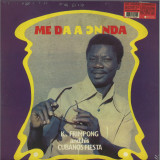
A moody melancholic cut with atmospheric, reverberating analogue synths and poly rhythmical structures.
B1. “Lars wars”
Takes us to more rougher side of techno, frantic energy with distorted syncopated rhythms tiny bouncing sounds that respond to over all dynamics.
B2. “Artarpet”
Closing track comes towards the dark ambient, that bring us to an empty like sound fields.
Yeketelale is the third album from Franco-Ethiopian group uKanDanz, combining a heady brew of rock energy, saxophone zigzags and Ethiopian melodies, all fronted by veteran singer Asnake Gebreyes grooving harder than ever.
In Ethiopia, sons follow fathers and, together, their names tell a story. Some discographies are the same way. After Yechelal (''It's Possible''), Awo (''Yes!''),here's Yeketelale (''It Continues''), the third album from Ukandanz.
The adventure that links Damien Cluzel (guitars) and Lionel Martin (tenor sax), the two founders of the group, with the Ethiopian singer Asnake Guebreyes continues and, with this album, takes on new colors and a new dimension. It is a polished synthesis that keeps the rock energy of their first recordings and gives even more space to the subtle vocal ornamentations that mark great Ethiopian singers. Add to that a groove that is more danceable than ever, carried by Adrien Spirti's synth bass and Yann Lemeunier's drums, and you have the magic formula of Yeketelale.
This came about slowly over the course of a dialogue that began in the early 2000s when Damien Cluzel, arriving with a circus in Ethiopia, met up with the occupant of the next room in their hotel. A stroke of luck: this was Francis Falceto, high priest of the Ethiopiques collection (Buda, 30 volumes to date) which had introduced to the West the treasures of swinging Addis, the capital that vibrates to the sound of big brass orchestras. With him, he dives into the capital's nightlife and meets a galaxy of musicians. The singer Asnake Guebreyes is among them.
Recruited by the famous Police Orchestra at the tender age of 16, he already had all the power, energy and class of his role model, Tlahoun Guessessé ''the Ethiopian James Brown''. He began his solo career at the beginning of the 1990s with several major successes, most famously an explosive duo with the singer Fekker Addis.
This experience made a big impact on the French guitarist. Having learned how to blend in with a uniquely Ethiopian groove, he was now ready to take it to other places and in other directions. In his old friend Lionel Martin, he found an ideal partner to engage in such experiences. But they needed a singer. The idea of Asnake Guebreyes was mentioned. Then Francis Falceto called and suggested going to see him at the Addis Music Festival. Ukandanz, a rock version of Ethiopian groove, was born.
Some pieces, like the disturbing Yene Hassab, call to mind Herbie Hancock's experiments in the seventies, as well as the Juju guitars of the Gulf of Guinea. Others, like the dark Fetsum Deng Ledj Nesh, allow Asnake's voice to soar above the synthetic waves, like a siren song for a freighter in distress. Dance and trance are not left out, with inspiration from the inexhaustible Ethiopian traditional repertoire. In a nod towards Asnaké's first album (Ahadu, also reissued by Buda) Ukandanz returns to its track Ajiré, transfigured by the guitar, claps and synthetic bass and takes us back to the glory days of breakdancing. Listening to the two versions gives the key to understanding the unique touch of Ukandanz and of the rich musical colours of Yeketelale (''It Goes On''), a fusion musical journey that brings the electric spark of the Frendj (Westerners) to Ethiopian lyricism.
“Ta Da” is the debut full length from J. McFarlane Reality Guest, the collective name for the trio headed by the eponymous McFarlane. As a member of the group Twerps, McFarlane has traversed guitar-centric, melodic pop music for some years while honing a highly unique, personal musical language. Ta Da is the first recorded unveiling of McFarlane’s affecting, oblique songwriting panache. Originally released in her native Australia on Hobbies Galore, Ta Da will be released worldwide by Night School in June 2019.
Wheezing into view with a troubled reed instrument set against a s of whoozy synth lines, Human Tissue Act is a foggy curtain the listener is invited to peel back. The dissonant notes are left to dance entwined, with clarinet heralding a Harry Partch-esque mallet percussion interlude. It’s a mood. With no resolution in sight, an audience dragged closer into uncertainty is suddenly drenched with the light of inter-weaving wah wah synth and saxophone. I Am A Toy introduces us to McFarlane’s vocal, an effortless and matter-of-fact, accented statement that quietly takes the reins. While McFarlane’s previous work in Twerps might reference 80s UK and antipodean guitar pop, Ta Da showcases a different influences immersed in psychedelic music and synths. It’s a brilliant, deft concoction swimming in Young Marble Giants-type minimalism washed with bare pop and harmony similar to Kevin Ayers making sense of a Melbourne suburb full of faces half-recognised in the blanching sun.
What Has He Bought begins with a Casio-keyboard rhythm pattern, palm-muted guitars and immaculately enunciated vocal give way to a burnt melodica part that elevates the spirits. Simple patterns repeated, like a well-tempered pop song that does what it needs to do and no more, build into the sound of summer leaking orange juice. They’re moments of joy, layered on top of each other like a melting cake. Do You Like What I’m Sayin’ recalls Marine Girls covering a classic ‘66 Garage nugget, organ lines fighting funk with guitar chords played just behind the percussion. “In a talking world, meanings are the same. Words want to hold on to the people they contain. Do you like what I’m sayin’?” We’re in a Beckett play perhaps, obtuse absurdities rendered pretty. Alien Ceremony is a heart-melter, given a melancholic timbre by bowed double bass it’s a tragi-comic piece that almost reeks of Robert Wyatt at his mid-whimsical twisting a fugue completely out of shape. Beneath the layers of harmony and twinkling instrumentation you sense there’s a genuine sadness somewhere even if it remains veiled.
Through out Ta Da, McFarlane plays with counterpoint and contrast to sometimes delirious effect. On Your Torturer, a simple, upbeat chord progression is hard panned, underpinning a flute solo which seems out of place, hence making it completely in place on this warmly surreal album. My Enemy is a slowly swinging eulogy to a failed relationship punctuated by analogue synth burbles, with our protagonist simply asking, in the aftermath, “can we be nice?” Here McFarlane’s vocal is straight forward, lyrically conversational but still not completely in focus, a surreal kitchen sink drama filtered through a dream where everything is in the wrong place. It’s a fine precursor to Heartburn, which similarly borrows BBC Radiophonic Workshop-style noise synths and the use of space to carve up the simple “You Will Make My Heart Burn” line. At this point, the listener has been in such close proximity to McFarlane’s show, the reality guest in a performance where they’re the sole audience member, that when Where Are You My Love rises on the horizon as a sleepy, psychedelic send off it’s uplifting. The vocal drifts away into the sunset, simple and direct. It leaves the listener slightly confused, perhaps, but grateful for the gentle surprise.
Standing tall above his peers, multi instrumentalist Guy Bartell AKA Bronnt Industries Kapital has left an impressive mark on cinematic electronica, having spent the last decade being commissioned to soundtrack everything from legendary silent film Haxan: Witchcraft Through The Ages to 1930s Soviet documentary Turksib, Bronnt has been there long before the 3rd wave of Italian Library Fetishists and long before this thing called Horror Disco even had a name. Force The Line sees a group soaked in the soundtracks of a thousand low-budget-straight-to-video action-slashers, the sound of heavily dubbed Martial Art imports where vampires jump and acid-laced revenge thrillers invented on demoscene message boards. Bronnt’s first studio album since the 2009 Get Physical LP ‘Hard For Justice’ is all that we might ever want from this underground legend, dance floor heavy, krautrock zombie epics for the past present and future. Miss this at your peril.
Bristol stalwarts October & Borai join forces once again for their second outing on Happy Skull. The pair join the dots between sleazy EBM and rugged, hardcore atmospherics.
Lead track 'Fatal Rumba' is a titanium plated slab of latin funk for freakier, late night dance floors. On the B-Side 'Swipe Left' drops the tempo but turns the pressure up to boiling point, a chugging drum machine workout complete with pulsating 303's and dub techno chords. To round things off, Conch bosses Bash & T give 'Swipe Left' the full UK treatment, flipping it to a mutant funky roller.
Ekin Fil is the solo moniker of Ekin Üzeltüzenci from Istanbul and 'KOMA' is her first release on Stockholm imprint Possible Motive.
'KOMA is an album which is based on the combination of separate songs made in various times in the last two years. Songs that sometimes include unwanted noises caused by my broken sound card, songs that I left unfinished with the intention of finishing later. The sleepy and still mood that's all over the 8 tracks may be the response to the hard times that I was not able to react sober to until recently.'
Ekin has been releasing albums on LP/digital and cassette formats on American and European labels under her moniker Ekin Fil since 2007. She was awarded 'Best Original Film Music' for her first Soundtrack 'Kaygi' at SIYAD, 2017 and 'Best Film Music' for the Soundtrack of 'Korfez - The Gulf' at Turkisches Film Festival in Frankfurt, 2018.
Exactly two years after their latest Front Teeth LP, the Zürich-based duo VEIL OF LIGHT is back with a new album called Inflict which will be out May 10 on Avant! Records. This is their fourth full-length and their industrial-tinged synth-based post-punk keeps on getting better, making Inflict their strongest release to date. In these eight new cuts you'll hear how their sound has gotten heavier, bulkier, even more beat-driven. Tracks like So Hard and Holy Wars display drums pounding like noises from a rusty machinery, synths on You Done Me Wrong and Fact2019 they’re so sharp they can slice through your skin, Europe and Animal Instinct feature melodies from the abandoned industrial district of your ghost town. We could go on but you are probably aware of what these two Swiss are all about, and if you don’t you'll know the Veil Of Light when you face it. Artwork by Basel-based visual artist and photographer Samuel Trümpy. Limited edition LP on orange vinyl!
Warehouse Find!
Danish producer Paxton Fettel joins Delusions for his debut EP for the label entitled Night Waves. Despite his youth, he has notched up an enviable catalogue of original, eclectic releases including two LP's for Greta Cottage Workshop as well as EP's for Plumage, Kolour LTD and Apersonal. Paxton's unique sound and audiophile approach to production has led to remixes for Uffe on Tartelet, Chocky on Secret Reels and most recently Sunrom on edgling vinyl-only label The Bricks.
For his Night Waves EP we get a snapshot of the mans diversity across three original tracks. The opener sees Paxton in his most raw, jacking, dance oor focussed mood to date and the result is a high energy house track which punches hard on a big system. Featuring his own bass playing, snipped and squeezed through the sonic mangle, Night Waves steams along with big bold pianos, swinging hats and just the right amount of oating synths. Simple elements which combine to be so much more than the sum of its parts and one of those stand-out cuts that will be stuck in your head long after you've left the danceoor.
Flipping over we have Paxton going full-on jazz mode in Pacica 399 To Freedom. A track which once again has his beloved Sandberg California live bass part pushed to the fore, pianos, strings and synths building around the driving disco groove. Feel-good sunshine vibes oozing from the speakers as little melodies dance around the sizzling hi hats and encompassing pulse of the kick drum.
Finally we have a deeper note to close on with It's Clear. A repeating vocal hook runs throughout the intro while intricate drum programming gives a nod to the sounds of broken beat and live jazz sensibilities. The end result is a warm, loose and dubby jam which completes the package in ne style and leaves us looking forward to hearing more from this talented young producer from Copenhagen.
- A1: Ich Will Dir Helfen
- A2: A La Manière (With Roya Arab)
- A3: Ondine
- B1: Aspiration (With Mona Soyoc)
- B2: One Of These Days (With Hafdis Huld)
- B3: Théorème
- B4: Mortel Battement / Nocturne (With Alain Bashung)
- C1: Organique
- C2: The Watcher (With Mona Soyoc)
- C3: Qu’est-Ce Qui M’a Pris (With Philippe Poirier)
- D1: Xr 116 / Messe Rouge
- D2: Untitled
- D3: Ondine (Alt Take)
- D4: Piasong
The sensitive mountain » (la montagne sensible) is the nickname Alain Bashung came up with for Arnaud Rebotini. At the height of his fame, after the success of Fantaisie Militaire in 1998, Bashung readily agreed to create an album with Rebotini. The two men didn’t know each other; their record label had introduced them. Bashung brought in “Mortel Battement” and “Nocturne,” two poems by Jean Tardieu, which he recited in a voice simultaneously warm and flat, and Arnaud produced an impressionist soundscape that ended with an apocalypse of metal. Bashung was so proud of their collaboration that he offered to give several interviews to promote the record. Today, listening back to this moving Léo Ferré influenced "talking singing" exercise, it’s hard not to hear the template for L'Imprudence, the album that Bashung went on to record with Rebotini two years later. In a similar way, the album Organique sparked a productive partnership between Rebotini and filmmaker Robin Campillo, which resulted in their being awarded a César for Best Original Music in 2018. The director, who trusted Rebotini to create the soundtracks for his films Eastern Boys and 120 Beats per Minute, never kept his love for the 2000 record a secret.
Yet it’s an understatement to say that when it was released, Organique was not in the spirit of times. That year was all about the French touch. The funky samples of Modjo’s “Lady” and Superfunk’s “Lucky Star” ruled the sweaty dancefloors. Although Rebotini was familiar with the electronic scene, he had something else in mind when he set about creating Organique. Under his own name or under the pseudonyms Aleph, Avalanche, Black Strobe, Maison Laffitte, and of course Zend Avesta, he had already released several quite bizarre and experimental techno, house, or jungle maxi singles on pioneering labels like P.O.F., Source, and Artefact, run by his friend Jérôme Mestre’s, whom he had met back when both were working as record salesmen at Rough Trade’s ephemeral Parisian store. It was at Artefact, still financed at the time by Barclay and Universal, that he naturally proposed this record project, which was a bit "different." It was his first real album.
Arnaud Rebotini has never hidden his love-hate relationship with the electronic scene. He’s a fan of rave music, Rex, and later Pulp, but he listens mostly to metal and contemporary music, mainly American minimalists such as Terry Riley, Philip Glass, Steve Reich. He wanted to mix this genre with a more French aesthetic inspired by Debussy, whose unconventionality fascinates him. From the first suspended guitar note of Organique, you can pick up another influence, possibly poppier. In the style of Mark Hollis, the erratic leader of Talk Talk, whose only solo album’s silences and dissonances left their mark two years earlier, we hear the fingers touching the keys of the clarinet on “Ondine.” The instruments have presence, character. Nothing is smooth. Everything is organic.
Although it’s sometimes labeled as electronica because of Rebotini’s career, there’s nothing digital about Organique. No "pro tools" editing or samples, only programmed drums and some synth layering. And his guest vocalists. Playing the role of electro producer, he invited Bashung, of course, to join him on the album, but also Roya Arab, who Rebotini first spotted while she was playing in Archive, and her sister Leila, Gus Gus alum Hafdis Huld, Kat Onoma’s Philippe Poirier on the “Samuel Hall” inspired track “Qu’est ce qui m’a pris,” and former KaS Product member Mona Soyoc.
The frustration of a tour where he had "little to do on stage," the desire to sing himself, and the creation of the Black Strobe project, a haunting mix of blues and rock, stopped Zend Avesta from putting out another album. Eighteen years later, the Organique we rediscover today has lost nothing of its strangeness, nor beauty. When it came out, Bashung said, "What is interesting for a musician is to feel that you have a piece of wasteland in front of you, something to clear.” That remains true today.
Les Points Pay A Twisted Homage To The Early Foundations Of Electronic Music Where Hard To Get Tapes, Dystopia And The Sound Of The Wretched Worker Where Present In Genres Like Post-punk, Industrial, Minimal Synth, New Beat And Wave.
It's changing, the worker searched for post-leftist solutions and got lost.
Nine circles applauded the proletariat and imagined how a community
could be congregated, while screams of violence would be filtered by boiling blood.
Exploiters of labor either find themselves rotting away in a never ending icy rain or are dragging their selfish accumulations on their chests for eternity - while the worker slowly identifies himself as a counter-commodity. Algorhythms (fraud) always mislead - once the worker gets past them only Dis will be awaiting her/him.
The Seeds of Fulfillment by David Drazin (November 2018)
Andrew Venson founded Seeds of Fulfillment (SOF) in early 1978. In the 1960s he had played electric bass with Arthur Conley, and later the original Peaches and Herb. On the same bill with Big Brother and the Holding Company, he hung out backstage with Janis Joplin. Yes! Vince was hoping SOF would get all of us to the top. He composed three tunes for the band, and we always had a ball playing them.
Roger Myers is a marvelous drummer. We co-composed Namaste. Roger would settle on a drum pattern of four measures at a time that he wanted to keep, and I'd put chords and melody right on top of his pattern. When he layered a second drum pattern on top of the first one, we'd get two melodies at the same time. We thought we were going to collaborate on more songs this way, but it didn't happen.
Lee Savory is a very inventive jazz man. He's musically literate, and wrote excellent transpositions. I remember Lee's asking for my input while he was composing Tight Squeeze, but it was clear he had it down. Once when I was visiting a DJ who played the album in a local radio station, the total of checks next to Tight Squeeze for number of plays was by far the highest!
Randy Mather's sax playing always knocked me out. I could hardly wait to hear him solo. When he left SOF to go with Woody Herman's orchestra it was amazing, but true.
Jeanette Williams had recorded 45s for the Duke and Peacock label when she was 17 years old. Her powerful singing was incredible to me. When we needed an original for Jeanette, Vince composed it, and Roger's wife Linda wrote the lyrics.
In 1978 I was in my senior year at Ohio State University when I met Vince. He came into a bar called My Brother's Place where I was playing with a trumpet player named Bobby Alston. When I was a freshman at OSU I'd played in an off campus band called Akadama. Before that I played in my home town of Cleveland, Ohio in the Brush High School Stage Band and a jobbing band called The Midnight Combo.
Everyone in the band contributed something to Egg Cartons in a composition jam session. We rehearsed in Vince's basement, and he had covered the walls with egg cartons to make the room sound more like a recording studio. The Provider was inspired by Country Preacher by Joe Zawinul. In those days I especially admired the way Zawinul would get his soulful feelings across, but also loved Herbie Hancock and to a lesser degree Chick Corea too. It took two years (with a break of several months) for the band to conquer Self-Fulfilling Prophecy. It shows you what consideration and dedication is, that ultimately they felt it was worth learning.
We recorded at Fifth Floor Studios in Cincinnati, Ohio. While we were there I got to shake hands with Bootsy Collins, who was recording in the rooms downstairs at the same time. Years later, Fifth Floor burned down and all the master tapes were destroyed.
The story of Seattle's rise to global rock supremacy in the late 80s and early 90s begins with Green River. Made up of Jeff Ament (bass), Mark Arm (guitar/vocals), Bruce Fairweather (guitar), Stone Gossard (guitar) and Alex Shumway (drums), the
quintet put out three 12's and a 7' single during its brief existence.
Green River's influence on Seattle's music scene spread far and wide thanks to the members' dispersion into bands including Pearl Jam, Mudhoney and Love Battery, as well as the punk glam sludge rock songs they left behind. 'By '83, '84, there was
definitely a movement that was happening within hardcore, like Black Flag slowing down for My War,' says Arm. 'The Replacements and Butthole Surfers were rearing
their heads, and they're very different bands, but they're not hardcore - the Replacements are pretty much straight-up rock, and Butthole Surfers were God knows what. Sonic Youth's Bad Moon Rising was around, and a lot of really
interesting post-hardcore things were happening.'
Green River, formed in 1984, were part of that evolution, with a sound that straddled a lot of different genres - blues, punk, bloozy straight-ahead rock. The mini-LP 'Dry As A Bone' - which came out in 1987 - and the band's lone full-length
'Rehab Doll' - which came out in 1988 - were released as a single CD with a few bonus cuts, including their sneering cover of David Bowie's 'Queen Bitch' and their marauding version of Dead Boys' 'Ain't Nothin' to Do', in 1990 - but they've been
unavailable on vinyl for years.
Now, these slices of Seattle music history are not only back in print, they're accompanied by items from the vaults that had been forgotten about for decades.
'Dry As A Bone' was recorded at Jack Endino's Reciprocal Recording in 1986 and it shows the band in furious form, with Arm's yowl battling Fairweather and Gossard's
ferocious guitar playing on 'This Town' and 'Unwind' opening as a slow bluesy grind then jump-starting itself into a hyperactive chase. The deluxe edition includes Green
River's cuts from the crucial Seattle-scene compilation 'Deep Six', as well as long-lost songs that were recorded to the now-archaic format Betamax.
'Rehab Doll', recorded largely at Seattle's Steve Lawson Studios., bridges the gap between the taut, punky energy of 'Dry As A Bone' and the bigger drums and thicker
riffs that were coming to dominate rock in the late 80s. This new edition of 'Rehab Doll' includes a version of 'Swallow My Pride' recorded to 8-track at Endino's Reciprocal Recording, which features a more accurate depiction of how the band
sounded when they played live. 'When I listen to these mixes, I think, 'This is how we actually sounded - this is the kind of energy we had,'' says Shumway.
Green River's place in American music history is without question but these recordings paint a more complete picture of the band - and of rock in the mid to late 80s, when punk's faster-and-louder ideals had begun shape-shifting into other ideas.
CDs in digipack with 12-page booklet. 2LP formats in gatefold jacket with custom dust sleeve and digital download code.
Domestic Exile are proud to present the devastatingly deplorable and malevolent recordings (that are sure to corrode yet electrify your ears) by Glasgow's very own KLEFT.
KLEFT aka Vickie McDonald is rooted in and has actively propagated the underground DIY radical queer punk and feminist movement here in Glasgow. Their projects have included the skull crushing sludge doom of Cartilage, the unflinching and infamous multi- membered hard core stars that were DIVORCE and the sacrificial, druid drone glitch of MOURN. Alongside these projects they have uncompromisingly disrupted, motivated and facilitated collective endeavors to take down the capital power structure of the dominant system of patriarchal club venues and abhorrent fuckers in this town.
For this record 'H+ Sexualis', KLEFT explores the neo-modern space where flesh is left behind. Negotiating, analyzing and tearing to shreds the relationship and balance between flesh and technology. KLEFT's expansive and palpable sonic offerings delve into themes of transhumanism and body hacking and seep into our collective skin begging the question; can flesh ever be created digitally. Does a lack of physicality alienate human experience in a post transhumanism society Are we all destined to be skinless yet digitally connected Will the body become superfluous Toward "the utopian dream of the hope for a monstrous world without gender," as stated on Donna Haraway's essay ''A Cyborg Manifesto.'
From the opening track 'Ossein' the listener grasps a foreboding lethargic build up, lurking out of the spatial ritualistic shadows into a sea of suffocating nothingness. A void where there is no gravity. Skeletal and brittle shattering rhythms which echo DMZ / Skull Disco dubstep alongside the more frozen, glacial ominous explorations of grime are often felt proving KLEFT is an artist whose inspirations run deep and wide and generally exist in the darkest recesses of our subconscious. These fearful, disjointed rhythms are set against weightless atmospheric oscillated synths, as if roaming through bleakly opaque, claustrophobic narrow corridors on a first person survival horror video game such as Resident Evil.
Moving through to 'CMBR', KLEFT's dissonant, degrading soundscape ferociously ascends. The resilient kick drum is propulsive and pulverizing akin to 'ardcore tekno - or intense gabba if you have the guts to adjust the tempo up to +8 - aesthetics that overwhelm and agitate finally revealing it's grotesque biological / amorphous bio structure. Elevating the repetitive 4/4 kick to a destructive, distorted banger of a track as layers of converging atonal noise and sound design simultaneously further enhances the sense of imminent radioactive contamination.
Next is 'Writhe, Squirm, Broken' continuing the convulsive, nauseating permutations of the prior track but reconfigured like a mangled, gruesome Cronenberg-esque parasite that has infiltrated an open wound, excruciatingly feeding off of the inner anatomy of it's hosts body from within. Repulsively reformulating the shape and dimension. The intro is akin to a panic stricken bouncy ball contracting and expanding, the spring reverb building momentum and traveling further away in distance and speed.
'Hackfleisch Deluxe' is a muuurrderous stomper and is one of the more grime / bass orientated tracks that deconstructs and disrupts the tempo familiar to sub-low producers on Black Ops / Jon E Cash / DJ Dread D. The crawling, plummeting frequency of the synth is a nauseating rush of coagulating blood to the heed; a deep throbbing sensory depravation in sharp, paradoxical contrast with the driving harmony layered on top which proves to be infectiously addictive. Furthermore are splintering programmed vocal samples that gives a sense of artificial disorientation, mind over matter, a possible hint at our evolving sentient cognition within a nightmarish simulated, augmented reality
Second to last we have 'Keratin' which is filled with the near fatal dissolving thud of Djax-Up acid that gives the impression that you're a biologist peering through a microscope into a petrie dish and witnessing the rapid and furious genetic cellular replication of bacterial and viral organisms.
Culminating in 'Bruised and Bleeding Hands' where the squashed density of a deflated and depressurized helium filled balloon and elastic umbilical cords, barbed wire and copper wires grind n' coil around the lens of a zooming camera. Taking no prisoners, this is a punishing grime weapon. A phat, surgical kick drum bulldozes its way thru causing carnage, syncopated punching snares after every rave stab and dizzying third beat. It won't be long until ye hear this on Silver Drizzle's youtube channel in the near future.
This record transports us to the hyperkinetic mutation scene on the cult cyberpunk film Tetsuo The Iron Man where the organic flesh / mechanical rust of the Iron Man metamorphoses with the Metal Fetishist during the rebirth sequence and we say 'LONG LIVE THE NEW FLESH!''.
Dublin's Pear label return with the new EP Soma from Donabate legend Bryan Mooney (aka DJ
Moonbeam) under his New Members alias. 3 spaced out & illimitable club cuts make up this
latest dancefloor offering on the 6th release from the year-old imprint.
The title track has been a sought after, certified Pear party anthem; timeless dancefloor alchemy
rolled into 9 minutes of dub tech(no) club magic. Yep, 'tis a big one.
B Side swerves left and then some. Good Morning drifts along effortlessly, buoyant with minimal
garage swing and touched ever so slightly by late 90's french deep house-isms (surely destined
to soundtrack many sunrise sets for the next while). Eclipse then consummates this extended
affair with a nod to the hardcore continuum through a ruff'n'rugged jungle number, dashed with
Mooney's signature dreamscapes.
Literature Recordings Are A Brand New Label Who Have Launched At One Of The Most Successful Times For Independent Dance Music Imprints. It's A Time Where They're Currently Reigning Supreme Over The Charts, Becoming A Formidable Force Against The Majors Who Have For Too Long Dominated The Scene And Proving That Music Is Just As Expansive And Full Of Ideas As It Has Ever Been. The Different Music Alumnus Cuelock Stands At The Helm Of This Brand New Project And He Brings With Him A Range Of Experience To Help Give His Expert A&r Advice To The Artists About To Make Their Debut On The Label. And The First Vinyl Release Comes From Eusebeia - The Upcoming Producer Has Shown His Hard Work And Dedication Through His Forthcoming 'breakdown Of Illusion' Ep, Where He Delivers Seven Brand New Records Which Pedestal His Stellar Talents As An Artist. Between 'truth Is Stranger Than Fiction' And 'annihilation Of Inhibition' There's A Range Of Diversity Which Eusebeia Shows His Audience Throughout The Journey Of 'breakdown Of Illusion'. The Carefully Sequenced Drums And Weaving Bassline Of 'truth Is Stranger Than Fiction' Is The Perfect Way To Begin The Ep, Whilst Tracks Like 'charade' And Titletrack 'breakdown Of Illusion' Continues Eusebeia's High-reaching Trend. Coming Along Next, Both 'no Stone Unturned' And 'camouflage, Pay Homage To The Roots Which Have Built Eusebeia As A Multi Faceted Artist And Demonstrate Why There's So Much Heat Around The Newly Discovered Artist. They Also Highlight The Eye For Blossoming Newcomers Which Cuelock Has Administered For This Release, It'll Be The Gift Which Enables Literature Recordings To Build A Roster Which Will Hold Themselves Up Against Their Counterparts.then Finally You're Left With Both 'dreams Into Reality' And 'annihilation Of Inhibition', Which Leave A Lingering Aftertaste - The Type Which Keeps You Coming Back For More Listen After Listen. It Completes A Package Which Proves The Capabilities Of Eusebeia As Well As Literature Recordings As An Imprint. You Can Expect More Music And Artists Of
Lost Futures is a new label that explores experimental and often radical approaches to dance music from the past. In a musical landscape that increasingly claims to seek and reward new forms and ideas, Lost Futures delves into the recent past to revisit forward-thinking, optimistic projects that, owing to the social, musical or outright political climate, perhaps struggled to find an audience. Allowing only time to re-contextualise these leftfield, sometimes misunderstood and ultimately human bodies of work, Lost Futures taps into the inherent idealism of rave.
LF001 trips back until the early nineties to revisit the alternative scene emerging from the Dutch city of Utrecht. Here, three young men - DJ Zero One (Sander Friedeman), TJ Tape TV (Arno Peeters) and DJ White Delight (Richard van der Giessen) - joined forces to form 'The Awax Foundation'. Inspired by the transcendent and revolutionary electronic music arriving on their shores imported from Chicago and Detroit, combining their knowledge, gear and ever-expanding vinyl collection allowed additional freedom in paying sincere tribute to these intoxicating sounds, while also developing their tastes in a more personal, eclectic direction.
The musical flavours of Awax initially leaned toward acid house and the roots of techno. However, with three different mindsets in the mix, their tastes were rarely fixed. One thing each shared in common was a devotion to collecting rare sounds, specifically more adventurous and international samples than those emanating from the increasingly-hard, masculine dance music emerging from the Netherlands during the period. Inspired by the cross-over global sound of bands like Suns of Arqa, or 'World Music', as it was perhaps patronisingly termed at the time, the trio became interested in the idea of making techno with 'ethnic instruments'.
Of course, this being 1992, none of The Awax Foundation had access to such instruments, instead, they had a vast, collective library of samples from all over the world. There were no collaborations and no clear plan. Instead, they set to work using a Yamaha TX16W sampler, the legendary Atari 1040ST computer, a cheap mixing desk and a couple of low-end synths and FX machines. When Richard mentioned the project to his friend, Akin Fernandez, the London DJ and owner of cult label Irdial Discs, Fernandez was intrigued enough to invite the trio to record a one-hour show for his 'Monster Music Radio' series on London's then-burgeoning Kiss FM.
Forced to come up with a name, 'CultureClash' seemed like the obvious choice, even if the members of Awax were only creatively sparring among themselves. Along with the term 'ethno-techno', slightly dubious to a hopefully more conscious Western audience in 2017, these were the only guiding principles to the quietly ambitious project that soon combined cutting-edge machine rhythms with samples sourced from everywhere from Bolivia to Togo, and inspired by everything from Ravi Shankar's epic soundtrack to the Oscar-winning movie Ghandi, to the technical limits of their own setup requiring a dazzling degree of cut-and-paste work. Some tracks even emerged out of academic studies within the ethnomusicology department at The University of Amsterdam.
The show aired on October 2nd, 1992, recorded in one blistering take and without any rehearsals, traversing a huge variety of tempos and styles. If the performance wasn't seamless, it was undeniably thrilling, fresh and ambitious. As such, several labels, including Fernandez's aforementioned Irdial Discs expressed an interesting in commercially releasing CultureClash, while another imprint proposed a series of twelve-inches and an album. But the sheer complexity of the project meant that it never saw the light of day, while the trio embarked on different journeys ahead, both creative and personal.
Twenty five years later, and the original CultureClash lineup and founding members of The Awax Foundation provide the sound of the first release from Lost Futures. An otherworldly, ambitious and optimistic compilation, accompanied by extensive sleeve notes from the trio, CultureClash is a timeless ode to experimentation in dance music's ever-overlapping culture.
Produced by Jenn Wasner of Wye Oak. LP is on coloured coke bottle green vinyl + inclues download code and 12x12' lyric sheet/ liner note insert.
Madeline will be on tour throughout the UK and Europe this Autumn.
'Building from understated beauty to dense guitar theatrics. It reminds me of Chicago circa '93 as remembered in a dream — a little bit of Liz Phair 'Exile In Guyville' - rendered in soft-focus with the graceful confidence of a young master. ' STEREOGUM
In January of 2018, five months after the release of her debut album Night Night at the First Landing, Madeline Kenney traveled from Oakland, California to the woods outside of Durham, North Carolina to record her sophomore album with a new collaborator, Wye Oak's Jenn Wasner.
The choice was a conscious decision to explore new methodology in writing, recording, production and even genre. Perfect Shapes sees Kenney leaping headfirst into fresh and adventurous territory, largely eschewing conventional rock structures in favor of theme and melody. Its ten songs are full of surprises big and small - from vibrant synth lines to taut bass figures and subtly modulated vocals - that instead of feeling fussed over, reveal Kenney's penchant for elegant and abstract composition.
Kenney's 2017 debut, Night Night at the First Landing, was a guitar-centric rock album, produced by friend and collaborator Chaz Bear of Toro Y Moi, Perfect Shapes leans on the foundational pieces of Night Night - fuzzed-out guitar tones, coy wordplay and Kenney's notably strong voice - but with an unconventional approach that allows them to bloom, reincarnated. Perfect Shapes marks Wasner's first foray into producing another artist's work and is permeated by the pair's collaborative spirit. Both Wasner and Kenney play multiple instruments on the record, and engineered the session alongside Kenney's touring percussionist, Camille Lewis.
An eagerness to explore and experiment is apparent from start to finish, as Kenney and Wasner weave endless sonic curve balls into the arrangements. From the delightfully warped percussion on opening track 'Overhead' to the burbling synths on the R&B-tinted 'The Flavor of the Fruit Tree' and the left-field trumpet solo in 'Your Art,' these rich and inventive ideas echo Yo La Tengo's everything-but-the-kitchen-sink mentality, as well as the surging soundscapes of Tame Impala and Wye Oak at their most impressionistic. Lead single "Cut Me Off" is a surprise of its own - the most pop-forward song Kenney has written yet. 'Bad Idea,' finds her balancing fragility as foil; later, 'I Went Home' manages to evoke both frustration and affection in a single breath.
The complex and open-ended questions that lay at the core of Perfect Shapes mark Kenney's arrival into a hard-hitting reflective space: How do you love another when it hurts to do so What is the physical limit to which one can carry the emotions of others How does a modern female artist reckon with the expectations demanded of her femininity Yet for all the notes of doubt and fear that Kenney raises, she delivers each song with confidence and poise, grounded by the pointedly laid and surging soundscape.
Kenney has always had a penchant for curiosity and experimentation. Raised in the Pacific Northwest, she began studying classical piano and dance in kindergarten, and grew to believe her future lay in modern dance choreography. Not one to be tied to a singular pursuit, however, Kenney took a hard left in college, studying Interpersonal Neurobiology and supporting herself with a career in baking. Music remained a constant however, and after moving to the Bay Area in 2013, Kenney quickly found footing in the supportive arts community in Oakland. There, she met and began collaborating with Chaz Bear (Toro Y Moi), which led to the production of her Signals EP and later her debut album, Night Night at the First Landing. Both releases were received with great critical acclaim, and saw Kenney exploring the sounds within her self-proclaimed twang-haze genre, defined by cathartic fuzz breakdowns and lyrical sensitivity.
LAATE is a project from Clayton Guifford (Fragil / Recordeep ). Pierre Codarin is our guest on LAATE006. This British/
Italian guy with a french name is a big record selector and Hardware enthusiast. Pierre have perfect skills to producer
whatever he wants and he shows us! At the menu, 3 original tracks Deep & House with an Electro touch.To close the Ep , we
have the honor to welcome our friend Le Loup with a mental & spacy remix !!!!
It'd be hard to start a label to take pot shots at the increasing cultural value placed on popularity over talent, and then name the participants, right
Right
Rome may well be burning, but we're dancing in the flames
Reserve Not Met will not be undersold
Reserve Not Met will not provide a money back guarantee
Reserve Not Met will not be held responsible for poor use of Reserve Not Met product
Expectations are left at customers own risk
* BIG, BAD AND HEAVY! Two of Pinch's biggest dance floor bangers, remixed by one of UK dubstep's hardest hitters, Kromestar. Guaranteed rewinds.
* 'The Boxer' first appeared on Tectonic back in 2010, fusing grime and dubstep with tribal drums and tearing squarewave bass. Kromestar stays true to the original but switches his stance to swing hard with a left hook, Southpaw style. After a moody build up, the intro breaks away into a brief moment of calm, before bass comes out fighting, throwing knock out punches hard and fast. Tried and tested dancefloor damage of the highest order.
* Flip then for an equally dangerous remix of Pinch's Deep Medi release 'Swish', from back in 2011. Simple, effective and deadly, Kromestar gives this classic an update, setting it up for another few years of wheel-ups!
* DJ Support from: Kahn & Neek, Mala, RSD, Joker & many more.
On The Latest Release From Make Mistakes, Roy England And Friends Take Us On A Ride Into The Beautiful, Soulful Depths. From Uplifting Love Jams, To The Chunkiest House Funk, As Always, The Gang Has You Covered.
Roy England's Original Mix Soars Through The Night Skies. Pitter-patters, Emotive Pads, And A Driving Groove Bring Us The Softer Side Of Our Little Boogie Baron. Perfect For The Euphoric Abandon Of A Sweat Soaked Dance Floor.
Alexi Delano, A Man Who Needs No Introduction, Kicks Things Up A Notch, Taking The Original And Giving It A Restructured, Pumping Groove. A Dubby Line Runs Through, With Echoing Pads, A Pulsing Bass, And Fluttering Keys And Synths. A Beautiful Dance Floor Meditation, With Plenty Of Junk In The Trunk.
Fredy Grogan Takes A Hard Left, And Steps Confidently Into A Psychedelic, Tribal Funk. Teasing New Vibes Out Of The Original Material, Grogan Transforms Beauty In Rhythm Into A Classic House Groove, Before Settling Us In To A Hypnotic Groove.
Make Mistakes Keeps On Keepin' On. That's All We Know. the Tears Of The World Are A Constant Quantity. For Each One Who Begins To Weep Somewhere Else Another Stops. The Same Is True Of The Laugh. Let Us Not Then Speak Ill Of Our Generation, It Is Not Any Unhappier Than Its Predecessors.
Samuel Beckett, Waiting For Godot
Very LIMITED album discs available now:
This is the first album Oscar Mulero has released under his own name, after two acclaimed LPs under the moniker Trolley Route. Well known for his skills as a hard-edged, raw and floor-orientated techno dj, his productions go far beyond, digging deep into the intricate landscape of intelligent techno, floating moods, reminiscent atmospheres, harmony and detail.
Grey Fades To Green is the affirmation of his maturity as a producer, using both hardware and software in the pursuit of a highly coherent and diverse album.
The concept is split into two parts: The Grey and The Green, each one with its own character. The first part is rougher and meant for the dance floor, although pays full attention to detail and complexity. The second part is quieter, has a slower pace and is best enjoyed at home.
In The Green Oscar goes deep into the intellectual side of techno music and is heavily influenced by the post rave sound emerging from the UK in the nineties: Aphex Twin, Gescom, B12, Plaid, Autechre.. but with a contemporary approach.
This part of the album brings you melodies, harmonies, endless atmospheres, and hours of studio work. Each sound has been carefully constructed, nothing is left to chance: Every stereo panning, every change to the synth's parameters has been meticulously designed for your listening pleasure; just what you want when you listen to techno on headphones. Futuristic music made with the utmost care.
'Last Regrets' shows how melancholic harmonies can be a perfect match for abstract beats and a dub-step reminiscence. A fine piece of sci-fi techno.
'Grey Fades To Green' makes a clean break by offering us an industrial drum'n' bass piece with a techno approach that mutates as the minutes tick by. A dub-step melodic track. Futuristic breakbeat for the decades to come.
The final track of The Green, 'Silent Air', picks up the homage to the intelligent techno sound of the beginning and returns to random grooves, crunchy samples, impossible hi-hats and massive synthesizer and step sequencer routines. A perfect ending to this sound journey from the heart of the dance floor to the core of your mind.
A mature work that confirms Oscar Mulero as one of the most qualified studio animals on the techno landscape.
Dark hypnotic hardcore influenced leftfield odd house perfection. TIP.
Prairie is the project of multi-instrumentalist and producer Marc Jacobs, hailing from Brussels with roots in The Netherlands. He previously released an EP (I'm so in love I almost forgot I survived a Disaster - 2013) and an LP (Like a Pack of Hounds - 2015) on the Berlin imprint Shitkatapult. On stage, Prairie plays with two or three musicians and together they re-create a free association of musical ideas and atmospheres. Prairie has played in selected venues and festivals across Europe and toured with Apparat in 2016.If the apocalypse was painted in several layers of pastel gouache, its soundtrack might be PRAIRIE's Flash Flood. Listening to the album, we drift through a series of frozen landscapes that gesture at a post-apocalyptic ambience. This is a kind of blackened music that has been left to sediment, excavated from traces in ice core samples. Flash Flood showcases a deep sensitivity to narrative and rich cinematic textures as Marc Jacobs returns with palimpsestic sonic layers. It has been three years since PRAIRIE's last release—the 2015 Cormac McCarthy-inspired Like a Pack of Hounds—and it is clear that it has been several years of pensive reflection. Now, PRAIRIE takes the sentiment of his 2012 debut, I'm So In Love I Almost Forgot I Survived A Disaster, several steps further: it is after the apocalypse, and no one has survived. And yet with Flash Flood, we can hear the hum of this impossible future.
'After the Flash Flood' introduces the sonic ruins of distorted guitars, field recordings, drum programming and synths that create the textures of the entire album. The melancholic and subdued black metal churn of 'Raindeath' becomes the cold backdrop for unnerving, paranoiac speech. The third track, 'Sisters', foregrounds this coldness while slowly moving away toward alternate vistas where the acoustic timbres of the saz-driven 'A Permanent War Economy' take over. 'Underwater Body Hunting' and 'Rabid Ibrahim' are hard hitting beat-oriented tracks that insist on burning slow. There is a patience with PRAIRIE's FLASH FLOOD that is difficult to deny. The lamentation of 'Elephants Will Rise Again' perhaps signals that it is not only the human that is lost after catastrophe. The album closes with 'Hard Water: Cracked Ice' and 'Hayashi Clock'. The former is a beautiful coalescence of clean harmonious tones and softly overdriven drums, while the latter brings us back to a meditative state, drifting through the final pastel tapestry.
"... his cosmos is located somewhere between Bohren & der Club of Gore and Sunn O))), ambient is as familiar to him as brachial sounds, and he is as much acquainted with guitars as with synths and modern technology" (GROOVE)
"... Like Ben Frost, (Prairie) exudes a certain harshness while tempering his work with moments of sublime beauty. This isn't club material, it's music for the hammer in one's hand, the confrontation of the demon, the soul-shattering revelation." (A Closer Listen)
· Album presentation live @ Camden Assembly London, 13th June
· Genre-spanning UK jazz artist who has worked with the likes of Craig Charles Fantasy Funk Band, Nightmares On Wax, The New Mastersounds, and Rae & Christian
· Follow-up to the debut and highly credited La Sombra from 2017
· Features guest UK trumpeter Matthew Halsall on 'The Mirage'
· La Sombra made Gilles Peterson's 'Best albums of 2017' list, with a track included on Brownswood Bubblers 12
· Part of the Matthew Halsall live band and toured with Dwight Trible
Recorded in Madrid in July 2017, Shamal Wind combines Chip Wickham's globetrotting, spiritual jazz expeditions with hard-won schoolings in the funk. Following his critically acclaimed 2017 debut, La Sombra, the record draws on spiritual jazz influences like Yusef Lateef and Sahib Shihab, and rests on Chip's many-sided experience as a musician, spanning left-field beat experiments to hard-hitting funk heavyweights.
After the Latin and flamenco whispers on La Sombra, Shamal Wind adds some Arab-influence percussion to the mix, most notably on the title track. Elsewhere, 'Barrio 71' sees him nodding to Shihab: high energy, lyrical and absorbing, with sax and the vibraphone taking the lead. 'Snake Eyes' taps into the meditative exaltations of modal jazz, while 'Soho Strut' nods to the jazz fusion, funk-influenced side of Chip's playing.
Like the Persian Gulf winds referenced in the album title, which often mark the shift to a new season, this album signals a new chapter for Chip, opening up a newfound energy and inclusiveness in his music, and further expanding on what he achieved in the past year. "Shamal Wind" is a heavy record, built on strong foundations.
Over the past 3 decades Chip Wickham has worked, written, recorded, and toured with the likes of Rae & Christian, Fingathing, The Pharcyde, Jimpster, Nightmares On Wax, Graham Massey, Roy Ayers, Nat Birchall, The New Mastersounds, Lack Of Afro, Craig Charles Fantasy Funk Band, Matthew Halsall, and Dwight Trible.
On "La Sombra":
"This is coming from the outside, I was like whooooa, easy. Blowing hard - they got it right! Gilles Peterson
"I'm becoming convinced that Chip Wickham is a genius" Craig Charles
"An impressive solo debut" London Evening Standard
"Majesterial and electrifying stuff" 9/10 Blues & Soul Magazine
"Tonally and melodically elegant and with a distinct 1960s/1970s vibe" Scotsman
Over the course of four unforgettable EPs released on Throne of Blood since 2013, Hardway Brother Sean Johnston has cultivated a broad international following for his singular brand of dancefloor fodder.
Best known as one half of legendary DJ team A Love From Outer Space alongside the one-and-only Andrew Weatherall, Johnston's roots in the dance music scene include a clutch of leftfield 90's era bangers on labels like Sabres of Paradise and Flashcomm. Beyond his original output, Johnston has also remixed the likes of Man Power, The Asphodells, Museum Of Love, Split Secs, Clandestino and many more.
The Laser EP is peaktime Hardway Bros business. 'Friedman Feedback Loop Revision' (a nod to TOB boss James Friedman's highly-valued opinions) is a masterclass in efficient simplicity, elevating a few basic loops into an exhilarating 8 minute monster. 'The Laser' rounds out the a- side with a classic electro rhythm/bass/vocal sample combo could easily have landed in retro territory. Instead, Hardway Bros easily flips a clutch of oldschool tricks into an utterly modern execution. The b-side finds TOB's label manager Max Pask injecting 'Friedman Feedback Loop Revision' with his love for all things analog and Italo. With his impressive collection of synths brought to life by Chinatown Records' Brennan Green, the song is transformed into an epic set- closer that's already devasting dancefloors like Berlin's Panorama Bar. The EP closes with 'Afro Sirene,' a midtempo groover with melodic arpeggios built for the discerning DJ's warm-up set.
Ryuji Takeuchi provides Instruments Of Discipline with an EP of noisy, hypnotic tracks, ranging from giddy, stomping, left-field techno to melancholic ambience; the EP's title 'One's Sentiment' provides a thoughtful angle to this at times cacophonous collection, for while they are bristling with noise there is something contemplative about the pieces, expressed in a way that suggests more than one thought trying to take life at the same moment, Ryuji finds space for conflicting voices both spatially and in terms of mood, the first three tracks, 'Ambivalence', 'Sadness' & 'Sorrow' crawl with competing elements, synth lines drool over and meld with throbbing kick patterns, anxiety & excitement are tightly wound in focus as tracks build and develop, leaving the listener to navigate these abstract planes, intoxicated; while the final track 'Regret' is a compelling piece of noisy, ambient minimalism that allows for an austere pause after the eruption of the initial works. It becomes evident that Ryuji's journey as a producer, through periods of hard-techno, deep-minimalism and the more abrasive ventures on HueHelix, has created a powerful and nuanced voice that is fully on display in 'One's Sentiment'.
Ryuji Takeuchi - Artist Bio
Ryuji Takeuchi (Local Sound Network / LSN, HueHelix) was born in Osaka, in the late 90s, he moved to the United States where he discovered Techno, House and Electro Music, influencing his desire to produce & DJ. His first wave of releases on LK Records, Arms, Mastertraxx, FK Records, SWR, Innervate, I.CNTRL, Impact Mechanics, Silent Steps, GSR & Brood Audio to name a few, were straight-up, hard techno,
In 2011, Ryuji started his own imprint, 'Local Sound Network / LSN', a platform for a new generation of both Japanese & global electronic music & later on, in collaboration with Tomohiko Sagae, Go Hiyama & Kazuya Kawakami, the label, 'HueHelix / HHX', developing further the voice of Japanese techno & experimental electronics, with a focus on distorted, industrial sounds.
In 2012, Ryuji launched the 'Local Sound Network Digital Solutions / LSNDS' series born from a desire to both discover and introduce a wider range of electronic music to the world.
Ryuji Takeuchi provides us with an EP of noisy, hypnotic tracks, ranging from giddy, stomping, left-field techno to melancholic ambience; the EP's title 'One's Sentiment' provides a thoughtful angle to this at times cacophonous collection, for while they are bristling with noise there is something contemplative about the pieces, expressed in a way that suggests more than one thought trying to take life at the same moment, Ryuji seems to find space for conflicting voices both spatially and in terms of mood, the first three tracks, 'Ambivalence', 'Sadness' & 'Sorrow' seem to crawl with competing elements, synth lines drool over and meld with throbbing kick patterns, anxiety & excitement are tightly wound in focus as tracks build and develop, leaving the listener to navigate these abstract planes, intoxicated; while the final track 'Regret' is a compelling piece of noisy, ambient minimalism that allows for a pause after the . It is testament to Ryuji's journey as a producer through periods of hard-techno, electronic minimalism
Techno Album of the month March 2018 in Mixmag UK!
Central to the Israeli club scene, Deep'a & Biri have long been defying expectations even within a community they helped construct. Serving as resident DJs, activists and bookers for Tel Aviv's legendary Barzilay Club, the pair helped build a transcendent club scene. Hugely influential artists such as Robert Hood, Derrick May, Rødhad, Ben Klock and Moritz Von Oswald passed through the club, enjoying legendary crowds and what they could surely sense was a genuine air of anarchy, rebellion and unadulterated rave pleasure.
As the duo held down dozens of parties with dozens of DJs, there was no 'eureka' moment for their emerging sound; just a steady stream of brilliant, inspiring electronic music, much of which left an indelible imprint on the pair. Now based in Berlin, for Deep'a & Biri, things are much the same, even if the landscape and the city is different. Always rooted in the fertile ground between machines and emotion, on their second full-length LP, 'Dominance', the duo demonstrate their unique grasp of the sensitive, unfolding relationship between man and machine. Steadfast in their insistence never to remain in one lane in terms of their sound, 'Dominance' flawlessly segues between forcefulness and weightlessness. From beginning to end, this is not a record afraid to show its teeth with an uncompromising, instantly recognisable techno palette that kicks the foundations of any sound system with menace, anger and determination, particularly on tracks such as the dense 'Voltage' and pulsing throughout the more industrial flourishes of 'Ecole De Nancy' and 'Seeking Solace'.
Beyond these grittier, although never mindless, moments of authority, a sense of escapism and curiosity imbues the album. 'Alpha Cephei' offers the first hint of Deep'a & Biri's more wistful concepts, producing a smoke trail of twinkling electronics out of a smudged but distinctive bassline. That understated sense of emotional catharsis carries throughout, to be found between the complex-yet-familiar bells that drive 'Flow Diverter's' rhythm to a Detroit-indebted landscape that will surely instantly elasticate any keen dancers, while 'False Memories' offers big-room techno fulfillment with none of the character or sincerity removed for cheap thrills. Saving the most remarkable moments for last, the pair sign off 'Dominance' with the poignant and purifying 'Astral Trails', fusing an ethereal, ambient landscape with the more pronounced rhythms of their hardware.
The album's distinctive artwork comes from the studio of Jewish orthodox artist Avraham Guy Barchil, who forged a powerful connection with Deep'a, both was immediately drawn to 'weird atmosphere, amazing technique and emotions involved with his work'. Perhaps one of the most interesting painters from Israel, Avraham is known for his unique perspective, taking his inspiration from the Zohar - the foundational work in the literature of Jewish mystical thought known as Kabbalah. The ambiguous figures represent mystical aspects of the Torah (the five books of Moses), as well as material on mysticism and mythical cosmogony.
Ensuring their natural, conscious touch always remains at the forefront of this unapologetically machine-driven music, Deep'a & Biri have produced an album in the lineage of their heroes and greatest influences. Cerebral yet satisfying, deep yet always engaging, 'Dominance' both reasserts and evolves Deep'a & Biri's forward facing and singular sound.
Akelarre' is the fourth studio album of Synths Versus Me. Its black (sadness) and white (happiness) design explain the concept and feelings behind it creation, majorly composed and written during the death by sickness of a very close friend of the duo to whom the album is dedicated, it swims between the positive and negative feelings felt by SVM during this hard process suffered. Is remarkable that in this occasion SVM counted with the collaboration of the british band The Underground Youth for a new remixed version of 'The Rules Of Attraction' originally released by TUY back in 2009. This special edition arrives on 2×12 EP format and produced in a ONE-OFF truly limited edition of 200 copies lacquered pressed on 180 gr. high quality black and white vinyl. All tracks have been specially mastered remastered for LONG CUT vinyl by Eric Van Wonterghem
It'd be hard to start a label to take pot shots at the increasing cultural value placed on popularity over talent, and then name the participants, right
Right
Rome may well be burning, but we're dancing in the flames
Reserve Not Met will not be undersold
Reserve Not Met will not provide a money back guarantee
Reserve Not Met will not be held responsible for poor use of Reserve Not Met product
Expectations are left at customers own risk
Jonra & e:machinery are an electronic music performance and
recording duo comprised of long time Los Angeles based Designforms
Research label boss Jonra Babiracki and electronic music artist Eric Cowden aka e:machinery.
Combining analog hardware, software and processed vocals in a live performance setting, their music spans many styles including techno, house, acid, darkwave, and electro. Their improvisational technique results in tracks that twist and turn, keeping the listener's ears perked while always encouraging the dance floor. With releases on Designforms, Blaq Records, Superfreq and now Chem Club, this veteran duo plans to continue on their path of proud abnormality.
Frenzied and unhinged, the Ritual Casting EP by Jonra & e:machinery is the third vinyl release by Oakland based label Chem Club Records. The title track, Ritual Casting, coils into a bottom heavy head spinner that takes a left turn towards the end. The second A side track, Take A Trip, is indeed just that, a roller coaster ride using their signature vocal style paired with classic bass and percussive sounds. The DJ friendly B side kicks off with Douchebag Frog, a bubbling bass sequence centered track with pad stabs that get bounced around by those eerie vocals again. Lastly, Catch Me If You Can, with a heaving acid bassline, is a sure way to end the EP with a bang.
Mastered and cut by Rashad Becker at Dubplates & Mastering in Berlin.
Hana's first and self-titled LP was recorded in Autumn 2010 at Facta non Verba and consists out of 5 tracks which are techno oriented with disposal of experimental and abstract elements.
Reviews
OMG Vinyl
Hana s S/T LP is easily the best promo records we ve gotten in months. This Greek duo has somehow, almost entirely below the radar, released one of the most exciting electronic records of 2011. Their wobbly brand of techno sometimes chugs ahead at full-speed, other times easing back into a wider waver, almost resembling some weird, warped IDM. I will be shocked if this record doesn t get wider appreciation very soon. Whether that happens or not, we fully recommend it, track one down.
Cyclic Defrost by Oliver Laing
Granny Records duo Hana come correct with their first album, offering a refreshing take on techno and IDM variants in the vein of Jan Jelinek, Raime, Actress and hints of the mighty Chain Reaction label. Mastered at Berlin s Dubplates and Mastering by none other than Rashad Becker, a name that often appears in the run-out groove of artists who inhabit a curiously funky techno-not-techno netherworld Hana s debut self-titled release grows in stature and listening enjoyment with every spin. With a sense of fun and adventure inhabiting the grooves, Hana (who are also part of label-mates, Good Luck Mr Gorsky), explore experimental timbres and ghostly vocalisations with a lightness of touch that belies their recording credentials.
Starting off with an abstract, Clicks and Cuts style intro, Liv slowly finds the sweet spot between mutant Detroit electro funk, a hint of the indie/dance territory of Matthew Dear and the abstract, yet rhythmic 12 releases on the Beatservice label, by Norwegian duo Information from the mid 90s. Obermaier implies the groove to begin with, until a wrong-footed man-with-two-left-feet rhythm leads into minimal acidic flourishes. Album opener SM heads in a Ricardo Villalobos vs. Nonplace Urban Field direction, as the lopsided rhythm and sepulchral vocals add a haunted edge to proceedings. CR80 uses beautifully syncopated live drums and urgent female vocals, and adds a driving, belligerent synth riff falling somewhere in between DMZ and Gary Numan. Echoic, boingy sounds threaten to derail the beat, but somehow it manages to maintain, reminding me of Shed and A Made Up Sound; more in overall feel than in the specific sounds. For those that enjoy abstract electronics that work just as well on headphones as on the dance floor, Greece s Hana are a duo to watch.
Textura
Hana's self-titled debut album arrives saddled with a (literally) cheeky front cover one would more associate with a 70s band like Wild Cherry than a Greece-based techno outfit formed in Thessaloniki last summer. Recorded in fall 2010 at Facta non Verba, the five-cut release finds Good Luck Mr Gorsky members Thanasis Papadopoulos and Thanos Bantis hunkered down in their chemical lab concocting formulae to go along with their material's stripped-down techno beats. Using analogue synths, samplers, and sequencers, the duo brings a decidely experimental edge to their productions, sprinkling as they do liberal doses of burble and flutter over bass-heavy techno rhythms.
The opening track, Sm, sets the scene with a heavy low-end pulse thudding alongside a steady kick drum and joined by acidy synths and percussive effects that suggest a lighter being repeatedly flicked open. On a slightly more aggressive tip, the B-side's Cr80 adds truncated vocal yelps to its bleepy, elephantine throb. A dubby dimension emerges in the track, too, when echoing waves drift repeatedly across the huge bass that slithers across the track's underbelly. The album's most elaborate track comes last. Liv opens beatlessly with flickering shudders and what could pass for the amplified workings of an ant community but then progressively fills in the dots with an insistent beat pattern, voice fragments, and even the demented meander of accordion playing. Though Hana hardly rewrites the techno guidebook on the release, it's nevertheless a pleasurable listen, in part due to the multi-dimensional experience provided by the vinyl format and the always superb mastering work done by Rashad Becker at Berlin's Dubplates & Mastering.
Acts like Legion & Logam have been pivotal for bringing the Ram Records sound transatlantic. Becoming the first US act into break their renowned roster, the trio have time and time again delivered hard-driving riddims and melodic rollers for Ram's sought after compilation series and their genre defining sister labelProgram. However, this time they've recieved their first standalone single on Ram, which is set to establish them as an even more integral part of drum & basses expansion throughout America. From the tearaway success of 'House of Cards', their first single on Program, to the release of 'Coming Home / When Stars Fall' on Ram Records, Legion & Logam are continuing their meteoric ascent. Following the same carefully strung melodies and voice overtures which has become a signature for the production outfit, 'Coming Home' takes you on a heartfelt journey underpinned by its tightly knit composition. A wavering bassline pitches between each signature of eight, helping to create a more driving force perfect for the dancefloor and bolstering the mix, whilst keeping its softer touch with 'House of Cards' Adam Wrightreturning on vocals.
On the flipside 'When Stars Fall' featuring Wendy Johnson follows the same vibe, with intricately layered instrumentals helping to set out a journey which flips between more percussive elements and well-orchestrated breakdowns. Each segment builds on the next until you're once again left with a record which exemplifies the producers' stellar song writing ability. Together both tracks help to pedestal an act whose versatility can be seen across each addition to Program, and now Ram's, vast back catalogue. Legion & Logam's story on Ram has only just begun - with more releases scheduled for the coming year, it's an exciting time for US drum & bass and its growth.
After the last years widely appreciated 12 with two extraterrestrial dancefloor cuts on Jon Rust's Levels imprint and a handful of now hard-to-find 7 releases, the estonian musician/producer Ruutu Poiss returns to his minimal funk and leftfield synth-pop roots releasing a debut EP on International Major Label. The six selected homerecordings from 2011-2016 reflect almost a chronological and kaleidoscopic journey through the authors musical explorations, instrumental storytelling and unique sound design, imaginatively non-locking to existing genres. From subtle vocals to vicious toms; celestial soundscapes over restless rubbery bass; shimmering synths over polyrhythmic structures - an environment of romantic futurism and organic transformation appears, surrounded by a warm psychedelic sound palette. Previous releases played and supported by Secretsundaze, Benji B, James Blake, Mary-Anne Hobbs, Call Super, Omar-S and many others.
Silencio celebrates the first year of the label with a double-pack vinyl aptly titled Uno.
Comprising of new and established artists, the tracks on Uno collectively summarize the the feel of this label's year, while giving us a hint of what to expect in the year to come.
Click Box & Stefan Dichev kick off the release with 'Memories'. Presenting a collaborative production that will prove over and over again why sound is one of the strongest senses tied to memory. Engineered with emotionally responsive rhythms that roll into a rocksteady baseline, this track evokes feelings with finesse. "Memories" also features funky squiggle sounds and trailing even-tempered tones to punctuate its procession. This is one you'll want to relive every time the opportunity arises.
New comer Wave Particle Singularity has done it again. 'Virtue' is a tremendous track that will quickly establish itself as one of your new favorite things. The drum sequence, accented by beguiling background sounds and curious vocals, gallops throughout this selection with all its feet off the ground together in each smooth stride. Plus, it also comes fully equipped with a pleasingly unpredictable pace in the form of some moody, well-orchestrated changes that result in a perfectly adjusted attitude. Never a dull moment on the dance floor.
Guaranteed.
Kepler.'s latest offering 'Tool A' possess all the qualities one would normally associate with a fine wine because the taste left on the palate after its consumption is both complex and satisfying. During its ascent, effects that compress a thousand echoes into a single sample ride alongside an active baseline that ripples accordingly. Subtle, flavorful snippets bleep and bloop in complete balance, giving this cut a coordinated, contemplative vibe that brings everything into focus.
With his first track on Silencio, Yuuki Hori's 'Scene 5' is truly a unique item. This electromechanicaly exotic sounding export from Japan makes an impression with layers that are neatly stacked and minimal to the max. Its main feature, a sample that seemingly mimics the mating call of a male bullfrog, rhythmically ribbits in harmony with the beat, bellowing over the entirety of this track. All the various elements of this composition come together in a natural way that feels symbiotic and sounds superb.
Another Silencio first, Jorge Ciccioli's 'TD8' has a deliberate intention to create momentum, with a deep, penetrating baseline that rises to the occasion by descending the darkest depths of its own digital horizon. In the midst of the mix the listener is greeted with a clever chorus that effectively sounds like air vibrating, or in layman's terms "blowing", within an empty glass bottle. As it goes through the motions, observe how every note is noticeably nuanced in an effort to reflect the subtle changes that take place.
Closing out the release and year for Silencio, is Laughing Man with 'Reach Out'. Hard, heavyand heavenly are all terms that could be used to express the sentiment of this selection.
Notice how right from the get go this production profoundly pounds out its agenda with a solid, speedy beat that relentlessly rocks throughout the recording. Accompanied by aseries of wavy, spirited vocal layers, ringing bells and an inspired intersection of cymbals,this track is one hell of a ride that will enable you to make contact with the other side.
Eric Copeland (Black Dice) returns to DFA with a brand-new set of hyper and hectic leftfield club music. 'Goofballs' places its emphasis on playful melodies, ear worm hooks and vocals mixed with trademark machine funk rhythms that hit hard and land off balance. Any other way would be too obvious for an artist like Eric.
Eric explained the creation of this new album via email from his home on an island in lovely Balearic Palma Spain: i made it here in Palma at my studio, this is the first full record i've made entirely here since moving. some of this material was road tested September 2016 on tour supporting Animal Collective. This album was the result of real isolation here, countless hours, focused only on this. The whole recording & writing was a fast process. I focused most on the bass groove. I had a very minimal gear setup: 90's drum machine, cheap bass machine and a sampler. But most important was a homemade 'drum brain' that Barry's London custom made for me. Barry was in the Van Pelt Soldiers of Fortune & Oneida. That piece of gear was a big part of this record and informed the direction it took the most.'
Eric Copeland is a founding member of Black Dice as well as a prolific solo artist. Besides DFA, he has released albums on L.I.E.S., Post Present Medium and Paw Tracks.
Very LIMITED album discs available now:
This is the first album Oscar Mulero has released under his own name, after two acclaimed LPs under the moniker Trolley Route. Well known for his skills as a hard-edged, raw and floor-orientated techno dj, his productions go far beyond, digging deep into the intricate landscape of intelligent techno, floating moods, reminiscent atmospheres, harmony and detail.
Grey Fades To Green is the affirmation of his maturity as a producer, using both hardware and software in the pursuit of a highly coherent and diverse album.
The concept is split into two parts: The Grey and The Green, each one with its own character. The first part is rougher and meant for the dance floor, although pays full attention to detail and complexity. The second part is quieter, has a slower pace and is best enjoyed at home.
In The Green Oscar goes deep into the intellectual side of techno music and is heavily influenced by the post rave sound emerging from the UK in the nineties: Aphex Twin, Gescom, B12, Plaid, Autechre.. but with a contemporary approach.
This part of the album brings you melodies, harmonies, endless atmospheres, and hours of studio work. Each sound has been carefully constructed, nothing is left to chance: Every stereo panning, every change to the synth's parameters has been meticulously designed for your listening pleasure; just what you want when you listen to techno on headphones. Futuristic music made with the utmost care.
The Green starts with 'Letters From Madrid', a dreamy and melancholy track, where an introspective melody leads to a slow-building drumbeat. Broken rhythms and distorted drums go side by side with the piano riffs and analogue bleeps: intelligent techno by definition.
'Dreams of Happiness' is a sci-fi soundtrack where pads and the different atmospheres are the main stars, and where subliminal drums add flow to this tune from outer space.
'After All' departs from calm dreamy territories with its grounded beat, complex 303 programming and micro synth sounds. A track which is as good for listening at home as it is for the dance floor.
'The Darker Days' uses a similar formula. Slow bpm, fat drums and weird 303 lines that make infinite layers of sound.
With this album Cypress Hill turned towards a more tranquil, sedate, slower, spooky sound with beats. The dark mood of this album reflects the strife within the band during this era, when member Sen Dog temporarily left the band to pursue other projects.
On this album both Wu-Tang Clan members RZA and U-God make appearances on "Killa Hill Niggas". Also notable was track "No Rest For The Wicked" which ignited the feud between Cypress Hill and rapper Ice Cube, who they claimed, stole material from the band.
At the time this album was well received by critics worldwide.
Q - 4 Stars - Excellent - "The production is sophisticated, incorporating Indian sitar and sloping, almost psychedelic bass grooves to create a vaguely threatening ambient hardcore."
Melody Maker - Bloody Essential - "...resonates with freakish cheese-wire paranoia...a gobsmacking paradox of expansive claustrophobia.... The funk patters like an erratic heartbeat, the voices are stretched to bursting with menace and loathing and mockery..."
- A1: Intro
- A2: Soufflé
- A3: Cobra Water
- A4: Mungo's Groove
- A5: The Rubaiyat Of Leisure
- A6: Obsidian Eyes
- A7: Stanis
- A8: Relish Interlude
- A9: Cha Cha Dum Dum
- A10: Ottoman Bounce
- A11: Can You Dig That
- A12: Tartu Moonshine
- A13: Dem Bones
- B1: Mr. Sweet Potato Pie
- B2: Yesterday For Tomorrow
- B3: Proper Weirdo
- B4: Plot Thinner
- B5: Soul Control Trio
- B6: Capricorns
- B7: Jubilee Arts
- B8: Nougat
- B9: Morning Dub
- B10: Thing's Tip Beat
- B11: Tell Me
- B12: Outro
This is a journey into sound. A series of journeys across the globe, in-fact. This time with Don Leisure from Darkhouse Family. Let us tell you a story. Firstly, we first need to answer a question. Who is Shaboo
It began in Africa. Nasser Barwani was the son of Shabudin. At the age of 15, Nasser (Don's Uncle) left Kenya and hitch-hiked his way to London. Nasser entered the movie business, occasionally finding himself in front of the camera, acting in Bollywood films. It was then that Nasser changed his surname to adopt a screen name - Shaboo.
According to Don, "Shaboo was the most colourful character in my family. I have fond memories of him playing tabla at family parties. When I was about 17, I was on a journey with my Uncle. Whilst Shaboo drove me around, he was playing the steering wheel as if it were a tabla. It was then I nervously asked "do you think, one day, I'd be able to make music too...". Shaboo was so furious he nearly crashed the car, slamming his hand hard against the wheel. He screamed "OF COURSE YOU WILL!! IT IS IN YOUR BLOOOOOD!!!"...
A week later, inspired by the creative energy of my Uncle, I acquired some music software, and began an all new journey. A journey through the beats..."
Long family car journeys were a constant in Don Leisure's life growing up. "We'd take frequent trips from Wales to London to visit family in the late 80s / early 90s. There I'd mainline into my cousin's record collections, and make full use of the signal radiance to the M4, searching the airwaves for pirate radio stations. However, I wasn't the only one to make use of this. Every trip, my parents would routinely tune their dial into Sunrise Radio - the only Asian radio station around back then.
The soundtrack of these road trips were somewhat unique. Whilst I tried to learn the lyrics to 90s hip hop songs taped off my cousins, my Mum would constantly interrupt, interspersing my boom bap with bonkers Indian radio ads. And here we have the premise of this album. An attempt to recreate this sonic mix, with sounds pulled in from dusty crates and breaks dug from all over the globe."
25 instrumental Hip Hop tracks, linked together in a truly unique style and fashion, this is much more than a beat tape. This is a journey into sound. For real.
Dedicated to Nasser 'Shaboo' Bharwani.
RELEASE
'The Practice of Pseudoscience', a three track EP by M Parent, is the second vinyl release from the US based label Chem Club Records. Having been inspired by peripheral thoughts about pseudosciences, this EP is washed in steady emotional build ups using airy reverb, scattering percussion, throbbing stabs and solid kicks. The title track (A1) uses these elements to move towards a piercing synth peak while 'Cycle of Intellect' (A2) spaces out these features as it creeps to a dubby impactful end. The B side 'Temazcal Rites' was directly motivated by a scorching summer day when the intensity of the sun sparked an idea for a sizzling percussive experiment. What we're left with is a funky but emotive soundscape that tops off the EP in a unique fashion.
ARTIST
M Parent, the artist behind Chem Club's second vinyl release entitled 'The Practice of Pseudoscience', is a Brooklyn based animator who uses his background in this story-driven medium to further express himself musically. His storyline approach to producing makes for an attentive listening experience full of arcs and plot twists that still maintains it's focus on the dancefloor. Using hardware exclusively, M Parent's aim is to produce emotive tracks that exist somewhere between a continuously evolving song and a fully functional track. M Parent DJs regularly at Bossa Nova Civic Club in Brooklyn and has a monthly residency at Jupiter Disco called Modal Form with fellow Blankstairs artist, Nathaniel Young.
Cookin' On 3 Burners are Australia's foremost organ trio joining the dots between funk, soul, boogaloo & jazz. Long time partners Lance Ferguson (guitar), Ivan Khatchoyan (drums) and Jake Mason (organ) have taken their home brew of soulful Hammond get down everywhere from jazz festivals to after hours bars and clubs. Their top notch reputation led to them supporting Sharon Jones & The Dap Kings in Sydney, jamming live with Breakestra and becoming THE in demand band south of the equator. With a musical CV that includes names like Joe Bataan, Alice Russell, Mark de Clive-Lowe and The Quantic Soul Orchestra, as well as the world beating outfit The Bamboos, it's not surprising this latest CO3B album has generated huge interest even prior to its' release. Their first Freestyle album 'Baked, Broiled or Fried' featured the group in a hardcore funk groove but on 'Soul Messin' sees the sound, feel and influences widened further with some quite magical results. Versatile singer Kylie Auldist (Tru Thoughts Recordings) opens proceedings on the deep funk groove of 'Push It Up' but it is the Freestyle 45 'This Girl' (FSR7057) that provides the mellow, beautiful and incredibly catchy vocal highlight of the entire collection, shimmering horns ride over this laid back, future deep soul classic. We don't yet know what Gary Numan will make of CO3B's version of his 80's synth pop hit 'Cars' (CD only) but Jake Masons organ playing (including simultaneously supplying the super funky bass lines via his Hammond foot pedals and left hand) takes this track in a direction no one was expecting! Drummer and top notch singer Fallon Williams provides his gritty, searing voice on 'Hole In My Pocket' and 'Seen Through Your Disguise' sounding very much like US soul legend Robert Moore and the band display their versatility whilst doffing their caps in the direction of The Meters on the numbers 'Dog Wash' and 'Piranha' The down tempo, moody album closer 'The Proving Grounds' (CD only) once again shows the groups expanding musical textures and rounds off 'Soul Messin' the bands most varied and accomplished recording so far.
Recent Mark Lamar Live Session on Radio 1
"This Girl" has been Freestyle's top selling single of 09 so far !
Virginia-born singer/songwriter Nicole Wray has everything you'd want in a singer: an infectious Jackson-5-family-member flare, a range like Aretha's, and a church upbringing that's brought a pure, healing texture to her voice. But the struggle she's been through has made her more than a singer. Nicole Wray is an artist. When talking about Queen Alone, her first solo album in some time, Nicole explains, It's a reflection of my soul. It's who I am today.' And aptly so. Nicole is writing and singing songs about her life. And yet to even start to know her soul, you have to go back to the beginning. Growing up in Portsmouth was tough at times for Nicole. However, at the age of fifteen, life opened up quickly when Missy Elliot paid a visit to Nicole's family home to audition her on the spot. Missy was there on the rumored strength and quality of her voice. Instantly blowing her away, she signed and left with Missy that night. Two years later, at age 17, she had a hit gold single off a solid debut album (Make It Hot). Suddenly she was part of a team that included late '90s R&B and rap royalty: Missy, Aaliyah, Ginuwine, Playa, Timbaland and Magoo. She made it, and fast. However, as rapidly as she achieved success, Nicole then found herself needing to re-make it. By late 2001, her time with Missy and company had run its course. They amicably parted ways and Nicole, once on top of the R&B world, was unsure of what was next. It was a very low, but important, point in her life. While neck-deep in this struggle, Damon Dash and Roc-A-Fella Records called. They signed an album deal and by 2004, in what was starting to be a pattern, just as things were looking up Roc-A-Fella suddenly (famously) split. Nicole found herself in a familiar situation. In 2013, Nicole paired up with London vocalist Terri Walker and released the album Lady. Once again, Nicole was tested. Terri parted ways with the group to pursue her own projects shortly after the album's release. Fast forward to now-the transformation from singer-for-hire to pure artist is evident in this new full-length solo release, Queen Alone. The record was written and recorded in 10 days at the legendary Diamond Mine Studios, in Queens NY with Leon Michels and Tom Brenneck handling production. Nicole says she is Singing out loud now-singing from the stomach.' Back in 1998 she was coached how to sing, and told to stay in a pocket that never let her show her range, power, and passion. Today, after stutter-stepping in and out of the industry, there is a new soul and substance to her songs-all of it from her life. They Don't Hang Around", tells the story of her post Roc-a-Fella days, Guilty", is about her brother's incarceration, Make Me Over" tells the relatable story of being broke with expensive taste, and 'Let It Go', a perfect way to end the record, is about the simple act of letting go and moving on. Almost echoing her new record, Nicole says, You have to go through something for it to be real.' She has been living with one foot in fame and the other in real life. The result is clear: she's feeling something real in her music again. And it's hard for us as listeners not to follow suit.