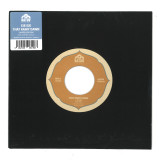
Batov Records' Middle Eastern Grooves 45s series welcomes the latest addition to its eclectic roster - a two-track EP from Eje Eje, the psych and funk inspired project from Şatellites band leader and producer, Itamar Kluger. Featuring the tracks "That Rainy Down" and "Coral Sex," the EP showcases Eje Eje's unique blend of Middle Eastern melodies, soulful grooves, and psychedelic sounds.
On the A-side "That Rainy Down," The electro baglama player takes the lead, building and building as if, “he is pushing himself to his limit”, says Itamar, “seeking catharsis as he walks to the edge of the cliff with confidence”, whilst the a baladi rhythm plays like an immense march of drummers. On the B-side we find the funkier "Coral Sex", which according to Itamar tells a story of a drunk tramp bothering the refined and self-important occupants of an exclusive hotel lobby. Reflecting this friction, the track juxtaposes a silky and sophisticated R&B sound, with loosely, pr even drunkenly, played take on rebetiko, a traditional Greek music associated with the poorest of city dwellers, played on a long-necked Greek lute known as a bouzouki.
As each track develops, new layers are revealed, inviting the listener to delve deeper. The effect is intentional. As Itamar says, "there is this kind of music that hooks you in a different way every time you hear it, different places in the songs lighting up in different colors, like slowly revealed layers. In our (Eje Eje) case, it is just such a hazed blend. It could make a very specific atmosphere, color a very specific movie scene that is lost in time or yet to be directed, or a very specific moment with your headphones on a long bus to the desert."
Itamar Kluger is best known for his work with the Şatellites, a six-piece band whose blend of Turkish folk and psych with funk and disco won them champions and listeners across the globe, from KEXP in Seattle to BBC Radio 6 Music, and FIP in France.
Eje Eje’s first 45 promises to be at least as quirky and original, if not more so, since the project is even more unshackled from traditional concepts of a band.
Поиск:headphone
Все
Studio One was founded by Clement "Coxsone" Dodd1 in 1954, and the first recordings were cut in 1963 on Brentford Road in Kingston.1[2] Amongst its earliest records were "Easy Snappin" by Theophilus Beckford, backed by Clue J & His Blues Blasters, and "This Man is Back" by trombonist Don Drummond. Dodd had previously issued music on a series of other labels, including World Disc, and had run Sir Coxsone the Downbeat, one of the largest and most reputable sound systems in the Kingston ghettos.
In the early 1960s, the house band providing backing for the vocalists were the Skatalites[3] (1964–65), whose members (including Roland Alphonso, Don Drummond, Tommy McCook, Jackie Mittoo, Lester Sterling and Lloyd Brevett) were recruited from the Kingston jazz scene by Dodd. The Skatalites split up in 1965 after Drummond was jailed for murder, and Dodd formed new house band the Soul Brothers (1965–66), later named the Soul Vendors (1967) and Sound Dimension (1967-). From 1965 to 1968 they played 9 a.m. to 5 p.m., 5 days a week, 12 rhythms a day (about 60 rhythms a week) with Jackie Mittoo as music director, Brian Atkinson (1965–1968) on bass, Hux Brown on guitar, Harry Haughton (guitar), Joe Isaacs on drums (1966–1968), Denzel Laing on percussion, and on horns (some initially and some throughout): Roland Alphonso, Dennis 'Ska' Campbell, Bobby Ellis, Lester Sterling, among others on horns during the era of Rock Steady. Headley Bennett, Ernest Ranglin, Vin Gordon and Leroy Sibbles were included among a fluid line-up, to record tracks directed by Jackie Mittoo at Studio One from 1966-1968.
During the night hours at Studio One from 1965-1968, singers like Bob Marley, Burning Spear, The Heptones, The Ethiopians, Ken Boothe, Rita Marley, Marcia Griffiths, Judy Mowatt, Alton Ellis, Delroy Wilson, Bunny Wailer[4] and Johnny Nash, among others, would put on headphones to sing lyrics to original tracks recorded by the Soul Brothers earlier each day. These seminal recordings included "Real Rock" (by Sound Dimension), "Heavy Rock", "Jamaica Underground", "Wakie Wakie", "Lemon Tree", "Hot Shot", "I'm Still In Love With You", "Dancing Mood", and "Creation Rebel".
Jackie Mittoo, Joe Isaacs, and Brian Atkinson left Studio One in 1968, recorded drums and bass for Desmond Dekker's and Toots' biggest hits at other Kingston studios, then moved to Canada. Hux Brown stayed in Jamaica to record on the soundtrack The Harder They Come, The Harder They Fall, and toured in Nigeria with Toots and the Maytals and Fela Kuti. The Soul Brothers (a.k.a. Sound Dimension) formed the basis of reggae music in the late 1960s, being versioned and re-versioned time after time over decades by musicians like Shaggy, Sean Paul, Snoop Lion, The Clash, String Cheese Incident, UB40, Sublime, and countless other Billboard originals and remakes trying to emulate their original Rock Steady sound at Coxsone's Studio One.
The label and studio were closed when Dodd relocated to New York City in the 1980s.
Studio One was founded by Clement "Coxsone" Dodd1 in 1954, and the first recordings were cut in 1963 on Brentford Road in Kingston.1[2] Amongst its earliest records were "Easy Snappin" by Theophilus Beckford, backed by Clue J & His Blues Blasters, and "This Man is Back" by trombonist Don Drummond. Dodd had previously issued music on a series of other labels, including World Disc, and had run Sir Coxsone the Downbeat, one of the largest and most reputable sound systems in the Kingston ghettos.
In the early 1960s, the house band providing backing for the vocalists were the Skatalites[3] (1964–65), whose members (including Roland Alphonso, Don Drummond, Tommy McCook, Jackie Mittoo, Lester Sterling and Lloyd Brevett) were recruited from the Kingston jazz scene by Dodd. The Skatalites split up in 1965 after Drummond was jailed for murder, and Dodd formed new house band the Soul Brothers (1965–66), later named the Soul Vendors (1967) and Sound Dimension (1967-). From 1965 to 1968 they played 9 a.m. to 5 p.m., 5 days a week, 12 rhythms a day (about 60 rhythms a week) with Jackie Mittoo as music director, Brian Atkinson (1965–1968) on bass, Hux Brown on guitar, Harry Haughton (guitar), Joe Isaacs on drums (1966–1968), Denzel Laing on percussion, and on horns (some initially and some throughout): Roland Alphonso, Dennis 'Ska' Campbell, Bobby Ellis, Lester Sterling, among others on horns during the era of Rock Steady. Headley Bennett, Ernest Ranglin, Vin Gordon and Leroy Sibbles were included among a fluid line-up, to record tracks directed by Jackie Mittoo at Studio One from 1966-1968.
During the night hours at Studio One from 1965-1968, singers like Bob Marley, Burning Spear, The Heptones, The Ethiopians, Ken Boothe, Rita Marley, Marcia Griffiths, Judy Mowatt, Alton Ellis, Delroy Wilson, Bunny Wailer[4] and Johnny Nash, among others, would put on headphones to sing lyrics to original tracks recorded by the Soul Brothers earlier each day. These seminal recordings included "Real Rock" (by Sound Dimension), "Heavy Rock", "Jamaica Underground", "Wakie Wakie", "Lemon Tree", "Hot Shot", "I'm Still In Love With You", "Dancing Mood", and "Creation Rebel".
Jackie Mittoo, Joe Isaacs, and Brian Atkinson left Studio One in 1968, recorded drums and bass for Desmond Dekker's and Toots' biggest hits at other Kingston studios, then moved to Canada. Hux Brown stayed in Jamaica to record on the soundtrack The Harder They Come, The Harder They Fall, and toured in Nigeria with Toots and the Maytals and Fela Kuti. The Soul Brothers (a.k.a. Sound Dimension) formed the basis of reggae music in the late 1960s, being versioned and re-versioned time after time over decades by musicians like Shaggy, Sean Paul, Snoop Lion, The Clash, String Cheese Incident, UB40, Sublime, and countless other Billboard originals and remakes trying to emulate their original Rock Steady sound at Coxsone's Studio One.
The label and studio were closed when Dodd relocated to New York City in the 1980s.
A Bad Diana is a project from Diana Rogerson, someone I first became aware of aged 12 when I read about Nurse With Wound and their United Dairies label in Smash Hits magazine. I was confused, mystified and intrigued in equal measure, and a couple of years later as a result I bought my first Nurse With Wound album. This led to an interest in all things NWW related. I guess Diana could be described as the matriarch of the Nurse With Wound world but she also had her own very distinguished pre-history with Fistfuck, an early-80s extreme noise outfit. She then made two mid 80s cult classic albums as Chrystal Belle Scrodd, both far out there rollercoaster rides of audio wildness, highly recommended to anyone with wide open ears. She then moved to rural Ireland and raised a family. There was the odd collaboration and then in 2007 A Bad Diana’s “The Lights Are On But No-One’s Home” was released on CD. I feel this is her meisterwerk and it has become something of a cult favourite over the years. Now for the first time, almost two decades later it is available on vinyl on Optimo Music Archiv. Produced in association with Steven Stapleton and Colin Potter from Nurse With Wound and irr. app. (ext.)’s Matt Waldron this is some seriously beautiful and strange listening. Next level sound design means this is an incredible headphone record but it is also a deeply warm and engaging home listening gem. Beautiful, magical, ultra hypno, soulful reverberations with the deep emotion of Diana’s voice tones and bio-vibrations.
Stolen Body is delighted to be working with Bristol progressive psych and jazz legends The Brackish for their fifth album ‘Donor Zone’. Attempting to capture our live sound and intensity, Donor Zone was recorded live at gig volume without the tyranny of headphones. The album kicks off with an ADHD epic ' Willox for a new Age' , apocalyptic coda morphing into the fuzz bass drone of 'Donor Zone'. Forboding chord sequences set up ' J und J' before a gargantuan riff drops, motorik middle section developing into a highly satisfying ripping fuzz guitar finish. Last tune BUABB has the faved Tortoise/ beefheart stylings around a Kraut- inspired improv section. The single 'J und J' draws the listener in to a false sense of uneasy security with it's pensive and motorik sections before it's gargantuan riff payoff. The track shifts dynamically back to it's uneasy base, developing into an extremely satisfying and belligerent ripping fuzz guitar ending.
Repress
As we continue the five part journey to say goodbye to the Telomere Plastic series, we as always, are excited to share with you Telomere 020.2.
This second VA, features producers, Anderson, Aspetuck, Bænglund and Watch Patrol.
We begin off the record with ‘Funk Inspector’ from Bænglund. The track name here sums it up pretty well. Full on quirky funk in the airwaves. A delicious cut to keep everyone on there toes!
Next on the A2 we have Aspetuck with his ‘As the Fog Rolls In’, Starting off with a bubbly soundscape the track progresses into a hypnotic acidic journey keeping the mood deep and melancholic. Handle this one with care!
On the B1 we have Anderson who delivers another deep and beautifully crafted soundscape. This is a timeless tune that takes you on a sonic journey from start to finish. This will work wonders on the dance floor and during your introspective moments laying in bed with your headphones bumping.
Lastly, we close out the release with the one and only Watch Patrol who we have all dearly missed. We hope you enjoy this slowed down IDM breakbeat gem!
Very limited black copies as always with a few colored copies available via the Wex bandcamp, be quick!
- A1: Freedom
- A2: Popular Demand (Popeyes) (Feat. Cam’ron & Pharrell)
- A3: Kinda Like A Big Deal (Feat. Kanye West)
- A4: Showing Out (Feat. Yo Gotti)
- A5: I’m Good (Feat. Pharrell)
- A6: There Was A Murder
- B1: Door Man
- B2: Never Will It Stop (Feat. Ab Liva)
- B3: All Eyes On Me (Feat. Keri Hilson)
- B4: Counseling (Feat. Nicole Hurst)
- B5: Champion
- B6: Footsteps
- B7: Life Change
PRESSED ON FRUIT PUNCH COLORED VINYL WITH HAND NUMBERED OBILIMITED TO 2000 COPIES
The contemporary realm of hip hop music can be seen as polarized between two sides; mainstream versus underground, industry versus independent, at a base level boiled down to catchy sounds & infective hooks over higher quality lyrical content. These elements don’t need to be mutually exclusive, but these days it’s rare to find an act that can please all sides of the discussion. Clipse are one of the few groups that successfully and consistently caters to both sides of rap’s splintered psyche, simultaneously serving the scene with upbeat bangers that get the club poppin’ & subwoofers rattlin’ while crafting clever quotable compositions deserving of repeated headphone submersions. Though their preceding official albums Lord Willin’ (2002) & Hell Hath No Fury (2006) made bigger splashes commercially, 2009’s Til The Casket Drops is surely no slouch, a gem which deserves to be revisited with fresh ears – good thing Get On Down has given it the proper treatment it deserves with its first-ever vinyl pressing!
Til The Casket Drops was a departure from the duo of Malice & Pusha T’s previous works in that it was their first LP not completely produced by The Neptunes. However, the celebrated team who brought us ‘Grinding’ & ‘Mr. Me Too’ still helmed 8 of the album’s 13 tracks, thus dominating the soundscapes and aesthetic of the album anyway. With the remaining beats handled by Hitmen Sean C & LV (Jay-Z, Big Pun, Ghostface) and Aftermath’s DJ Khalil (Kendrick Lamar, Aloe Blacc, Eminem) clearly Clipse stock hadn’t lowered in the game. While boasting notable vocal features from Kanye West, Pharrell, Cam’ron, Keri Hilson, Yo Gotti & their Re-Up Gang affiliate Ab-Liva, Casket Drops leaves ample space for the core emcee duo of Pusha & Malice to shine in the spotlight, with verses revolving around each other succinctly in-synch and bonded by an exceptional creative rhythm only biological brothers could share.
Clipse have always delighted in dualities, juxtapositions and contradictions, unabashedly celebrating the capitalistic lifestyle and the grind as the kings of ‘coke-rap’, while taking hard looks at society’s mores and those of their own individual journeys. We hear Malice’s eventual transition to No Malice taking form on this album as he found religion, warning others who might follow in his path on ‘Footsteps’: “don’t let my wrongs give you the right of way/ to emulate my past escaping the law’s grasp” while refusing to be pinned down in one lane: “it weights on my conscience and I hate conscious rap”. Meanwhile Pusha T continues his lyrical ascent into the King Push persona with bars like “pompous motherfucker, look what them jewels made me/ I’m only finding comfort in knowing you can’t replace me/ What a thing to say, but what am I to do/ I’m role-playing a conscious nigga and true is true/ Cocaine aside, all of the bloggers behooved/ My critics finally have a verse of mine to jerk off to” decisively on album opener “Freedom”.
Since it dropped, the Clipse have stated that Casket… is their final album together while subsequently alluding to the possibility of an eventual reunion. Only time will tell, but until then it’s time to re-celebrate one of hip hop’s most dynamic duos by hearing Til The Casket Drops in a whole new light with its long-overdue, first time on vinyl pressing via Get On Down featuring all 13 original tracks on wax and cover art by the legendary KAWS! It’s kinda like a big deal…
Easy Listening Recordings is here, and to kick things off we've got a new three-track EP from Vancouver's Teen Daze.
We begin with the title track, Quiet City, and immediately conjure up images of late night drives through anonymous city streets. Brimming with emotion, and a gentle energy, this one could find itself at home in a warmup set, early in the night, or one of those aforementioned late night drives. No matter where you hear it, this is one of Teen Daze’s most beautiful tunes.
Life Style brings us out of the car, and onto the sidewalks of that once quiet city. Now there’s a bustling energy from crowds of people, steam rising from the sewers below. You’re navigating it all in stride, with Life Style in your headphones. This is City Music.
We start Side B with an ode to Vancouver, BC, aka The Glass City: Night Club. The soft, swung drums, the walking bassline, the dubbed out bongos; this one feels at home across the entire Lower Mainland. Maybe you’re taking a stroll along the Sea Wall, maybe you’re watching the sun set while sipping on something at Juice Bar, maybe you’re walking up to Paradise at 12 am. No matter how you might experience Vancouver, Night Club has got your soundtrack covered.
Finally, we wrap up this first disc for Easy Listening Recordings with a special vinyl-only track, called New Mood. Pulsating percussion lead this dream-like track through 4 ½ minutes of Balearic Bliss. A beautiful way to finish this first release.
Early support from:
Paula Tape, NIKS, Eug (Public Records), Pleasure Voyage, Masha Mar, Massimiliano Pagliara, Loz Goddard
These outstanding Technics slipmats featuring the skull and headphones dj design will look great on any set of turntables.
Based on iconic, Mexican Day of the Dead imagery, cleverly features a distressed vintage, tattoo style print of classic dj related equipment;
Including turntable tone arms, 7” single adapators, 12” vinyl, cross-faders, speakers, switches and headphones.
These slipmats are suitable for any set of vinyl decks.
Made from the finest but strongest felt material, DMC slipmats are the no.1
choice for djs and vinyl lovers across the World.
Dependable & hard wearing, they are also resistant to dust & other
particles, so will not scuff, scratch or damage vinyl.
Great for your home, studio, club or in competition.
It's hard to place Frieder in any kind of genre: his sound is unique and impossible to replicate, something in between 80s synth, downtempo and minimal electronica. It's easy on the ears and always keeps you guessing, teasing and cajoling the listener.
He doesn't follow any rules and stays in his bubble: each track is unpredictable. Don't believe it? Listen for yourself :)
Whether you're diving into his world on your headphones, blasting his sounds on your speakers or enjoying the entire vinyl album on your record player - savour each sound to the max.
We present Frieder's debut vinyl - incl. remix by the inimitable Beazar. Enjoy!
Stepping out of the bedroom and into the Real World, Liverpool’s Strawberry Guy headed down to Peter Gabriel’s idyllic Real World Studios with Manchester’s Northern Session Collective in tow and set about trying to soften and expose the bare bones of his two biggest streaming tracks 'F Song' and 'Mrs Magic'.
Stripped of drums & synths, the music is pared down to piano and romantic new strings arrangements, bringing the careful melodies & indrawn lyrics to the fore.
Having recorded the original tracks in his Liverpool bedroom, swapping the originals’ string samples for their real-life counterparts lends the tracks an even more ethereal quality than the self-produced originals. The trip to Real World marks a first foray into studio recording for Strawberry Guy, and a new high-fidelity direction for the project, as he begins the process of making his sophomore album.
The vinyl edition of these new songs is out November 10, and features the two new strings versions along with the originals of both tracks, meaning fans can finally get their hands on a physical version of early single “F Song.”
While the music of Strawberry Guy favours a hermetic, headphones-forward sound lying somewhere between Bryter Layter-era Nick Drake, The Clientele, Slowdive’s Pygmalion, and the psychedelic 70s output of fellow Liverpudlian Paul McCartney, it’s nonetheless become a smash on TikTok and streaming services with a fanatical young and diverse fan base.
Having toured the world with Mczo and been at the helm of his own studio Pamoja Records since he was just 18, influential Singeli producer Duke, now 25, is one of Tanzania's busiest club alchemists. On his acclaimed solo debut "Uingizaji Hewa" we were introduced to his idiosyncratic "hip-hop Singeli" sound, a slower cousin to the Dar Es Salaam-rooted hard 'n fast club template that takes as much special sauce from Busta Rhymes and Eminem as it does the 200BPM clatter of genre veterans Jay Mitta and Sisso. On September's "Sounds Of Pamoja," we were treated to a closer look into Duke's studio, and specifically at his work with the city's best young MCs like Dogo Kibo, Pirato MC and MC Kuke. "Early Instrumentals" allows us to witness the depth of Duke's evolution with a selection of unearthed genre melting Singeli mutations laid completely bare without vocals. This 11-track set features some of his most arresting hybrid dance music yet, expressing his visionary fusion of contemporary rave sounds, US rap attitude, and Tanzanian dance history. While the roots of Singeli are in taraab, a popular fusion of East African and Middle Eastern traditional dance rhythms and melodies, Duke steers the sound into a synth-led, syncopated firework display that sounds spry and futuristic. Centered arounda bumping staccato melody and urgent synth strings 'Dukelo Fl Sing' echoes the lo-swung swagger of early Dr. Dre productions, but kicks the tempo into overdrive, decorating any gaps with flickering late-nite synths. 'Beat Kali Duke' meanwhile drives carnival trance leads through hard and fast rolls of kick drums, whistles and woodblock cracks. It's not all completely high speed either: 'Duke Selecta' is almost afro-house, with slow, sexy bass and woozy vocal melodies, and 'KKKKKKKKKKKKKKK' absorbs the propulsive spirit of South African gqom. "Early Instrumentals" is the most varied picture we've been presented yet of Duke's rousing dance cocktail. IT's a physical call to action that assures listeners the genre is for movement, not headphone listening
- 1: Get Down (Extended Mix) 04:46
- 2: Second Step 04:31
- 3: Flashback 04:28
- 4: Only One 03:52
- 5: Take A Chance 04:04
- 6: No Greater Love 04:03
- 7: The Don 04:08
- 8: Holy Sound 05:50
- 9: Snap To It! (Extended Mix) 05:00
- 10: Break From It! 05:00
- 11: Pursuit 05:29
- 12: Crash N Burn 05:58
- 13: Cosmic Evolution 07:08
- 14: Written In The Stars 02:37
Back in 2018 we dropped 'SOULACOASTA', our first long-form body of work - we were blown away by the reactions and still to this day the title track is a favourite in our live show with the full band. We now present to you 'SOULACOASTA II', a colourful sonic journey over 60 minutes in length that's full of energy for vibrant club floors, but equally ready for a headphone journey or long car ride. It’s a 14 track expedition through soul, house, broken beat and beyond, with the bass and beats driving the vehicle as the synths, keyboards and samples decorate the view. This record was an opportunity to get deeper into dance music and dive into niche sounds and samples that we’ve collected from trawling through movies, archives, digging through the crates across Australia, UK and Europe, weaving new inspiration and textures into our music. This record also features some drums and percussion by Lucky Pereira, and bass guitar by Matthew Hayes.
The UDG Ultimate Waist/Sling Bag is a stylish bag made from Ballistic Nylon that is designed to hold your daily essentials such as smartphone, passport, wallet, USB drives, SD cards, in-ear headphones, business cards and keys while on the go.
Long-time house music producer, DJ and journalist Anthony Teasdale is back with a new four-track EP for London’s Pamela Records.
The lead track is ‘Tango de la Boca’, an uplifting house tune with an unforgettable piano line and a groovy disco beat. Named after the barrio of La Boca in Buenos Aires, the tango feel is supplemented with layers of percussion, electric guitar stabs and moody strings. So far, it’s been played in clubs and on the radio by DJs like Rocky, David Holmes and Richard Sen.
“I think this is the most uplifting record I’ve ever made,” says Anthony. “Hearing those piano lines come in on a club system is a massive buzz.”
Second up is ‘A Pavement in Palma’ – a chilled jazz-house track. Inspired by lazy afternoons in Majorca’s capital, its swinging beat is joined by electric piano chords, live bongos and a bassline you can’t help but move to.
On Side B, we set sail on the good ship disco for ‘Deep in the Forest Something Stared’. Opening with bucolic bird noises – referencing the title – the track adds ’80s-style bass, glockenspiel melodies and soothing strings. It ends with a haunting piano motif that’s well worth the wait.
Finally, we return to 2023 with ‘It’s 5am Somewhere’, which blends old-school Roland 909 drum beats with minor chord synth stabs and rumbling piano melodies – plus an atmospheric breakdown guaranteed to excite any dancefloor.
Anthony says: “The EP reflects the music I’m listening to at the moment – which goes from classic techno to uptempo disco-house (and lots of synth pop!). The fusion of beautiful, often brittle, melodies with percussive house beats sets these records apart. And they sound as good on a dancefloor as they do in headphones when you’re relaxing at home.”
Having been deck slaying as near their London headquarters as Germany and as far as Canada, goth techno prodigy Lesser Of is steadily approaching double digit release count. With an established residence at queer x trans focused, revolutionary event series Subverted, their efforts have been welcomed to a formidable list of industrial electronic labels and remixed by a tidy sum of high profile scene icons.
Here at Depth.Request our sonars are attuned to emanant potential, and so we conscript Lesser Of to hammer out our fourth acetate offering to date. To this, harsh noise and drone music inspirations are declared, alongside an artistic secret of the trade: lights-off sessions in live room of a recording studio vibrating with the pulse of a bass guitar ran through a freeze pedal were what begot the tracks, and they are well intent on assaulting your headphones with noise. Reeko on the remix - yes, this record fucks.
Prolonged, ominous intro? Nah. Have a face full of Crude Manifestation Of Power instead, as an insatiable, 10-minute long opener braces your ears for a week of ringing with a sonic equivalent of metallic thrashing one could expect from being a sinful, rave-lusting scoundrel. On title-diverting continuation Within My Fragility the words "strength in fragility" are truly alliterated as the pace, abrasiveness and intensity of pummelling are all ramped up fiercely, with linear open hats thrown against them from time to time for good measure. Having reached 140 BPM and concrete mean, Masked proceeds in a well anticipated ra(n)ge: infernal atmosphere, sandy hats and layered tectonic tremors achieved with increasingly undefined low end consisting of a rumble line and rolling kick morphing into abrasive haze. Winding the tempo back a notch, a halftimearranged contemplation Our Descent grows in direct, hyperborean vector: glassy drones and sharp syncopulsation first - atonal reverberations, distorted arpeggios and punchy stabs endwise. Reeko's analog reinvention of Masked convolves the drum structure by borrowing from breakbeat narratives and authorizes the dystopian ambiance to rise and fall on more gradual, panning, confined terms; adding, however, more disorder to the mix with spectrum slicing, high-range chaos.
As you would have learned to expect from Depth.Request, Within My Fragility EP is not an easy listening five-tracker. If by the end of it you find yourself feeling as if you just stepped out of a pounding warehouse at 3AM and you don't know what day it is, you wouldn't have been experiencing this mindspace alone.
Black Truffle is pleased to announce its first release from celebrated London-based Canadian composer Cassandra Miller. Though her body of mature work stretches back almost twenty years, many listeners were introduced to Miller through the success of her astonishing 2015 Duet for Cello and Orchestra, which sets an imperturbable two-note cello part against a series of increasingly dense orchestrations of an Italian folk melody; in 2019, it was selected by The Guardian as one of the ‘best classical music works of the 21st century’. Traveller Song / Thanksong, the first release of her music on vinyl, presents a pair of compositions for voice and ensemble that exemplify Miller’s gently absurd, strikingly beautiful, and utterly unique work.
Like many of Miller’s compositions, these pieces originate in existing music. Traveller Song (2016/2018) begins from a 1950s song of an anonymous Sicilian cart driver recorded by Alan Lomax and Diego Carpitella, which Miller recorded herself singing along to, going on to then record herself singing to her own layered voices. Miller’s untutored voice is an unsteady, wavering wail that has, in her words, ‘more in common with a quasi-shamanistic keening than anything Sicilian’. Heard sometimes alone, sometimes layered, her pre-recorded voice is accompanied by a chamber sextet drawn from London’s Plus-Minus Ensemble. In the first section, Miller’s exposed warble is set to a spare piano accompaniment, somehow both faintly preposterous and magisterial. Following the voice note for note, the piano part often makes use of almost mechanical sequences of parallel chords, reminiscent both of Satie’s Rosicrucian period and the abrupt harmonic movements of a chord organ. The orchestration then opens up to guitar, clarinet, and sliding strings, a delicate environment for Miller’s voice, which, especially when it begins to be layered, generates a powerful sense of intimacy. In its concluding minutes, the folk roots of the original melody return in the form of a glorious full ensemble setting dominated by accordion, clarinet, and strummed guitar. Thanksong begins from recordings of Miller singing along to the third movement of Beethoven’s late quartet in A minor (Op. 132), the ‘holy song of thanks’ the composer wrote to express his gratitude for (temporarily) recovering from illness. Recording herself singing along repeatedly to each of the individual parts of the quartet, Miller created an aural score where each member of the string quartet listens to their own part on headphones, playing by ear. Performed on this recording by Montreal's Quatuor Bozzini, with whom Miller has a decades-long relationship, they are joined by the British soprano Juliet Fraser, who sings material from the Beethoven quartet ‘as slowly and quietly as possible’. The atmosphere of the opening of Beethoven’s Dankgesang, of hushed reawakening and thoughtful reflection, is sustained throughout the fourteen minutes of Miller’s piece, building at points almost to sentimentality before the five individual parts again fall back into a gentle burble of unsynchronised melodic gestures. Like Traveller Song, here the use of the voice is a long way from the mannered performance of much contemporary music, reaching for a human and bodily presence more connected to the reality of the everyday, albeit suffused with wonder. Presented in a stylish sleeve adorned with photography by Lasse Marhaug and liner notes by Cassandra Miller, this is a key release from a major contemporary composer whose work challenges and dazzles in equal measure. .
Two Saviors is Buck Meek's second album, following 2018's self-titled LP also released on Keeled Scales and currently on its third pressing. The Big Thief lead guitarist worked with producer and engineer Andrew Sarlo on this album (who's produced all four of Big Thief albums, as well as coproducing Bon Iver's i,i ). Andrew agreed to record it only if it was made under his conditions-- that they make the album in New Orleans during the hottest part of the year, spend no more than seven days tracking live, on an 8-track tape machine, with only dynamic microphones and no headphones, and not allowing the players to hear back any of the takes until the final day. The band, featuring Adam Brisbin (guitar, vocals), Mat Davidson (bass, pedal steel, fiddle, vocals), Austin Vaughn (drums), and Buck's brother Dylan Meek (piano, organ, vocals), set up in a Victorian house one block from the Mississippi River, and worked within these limitations, encouraging every recording to be imbued with the living, intuitive, and human energy of a first take.
Pressed On Clear Vinyl! 'We are the planters of the weeds or roses in our garden. Take the plunge within yourself to find The Main Ingredient.' So reads CL Smooth's album dedication in the liners to Pete Rock & CL's underrated, soulful and deeply grooving sophomore album. For fans, it was bittersweet, as it would be their last as a duo. By 1994, Pete and CL were darlings of both fans and critics, still on a high after 1992's Mecca & The Soul Brother and the album's emotional smash single 'They Reminisce Over You (T.R.O.Y.).' Two years later, they had grown even more as men and artists. Gone was some of the righteous striving of their earlier work, replaced by mature - yet still righteous - wisdom. And a lot more love as well, bringing a larger female constituency into their fanbase. They were adults now, reveling in the plateau they had reached. The duo's '90s swan song is a powerful double album that still resonates with Golden Era hip-hop fans: 16 cuts deep and full of intelligence, fire and warmth. Beats-per-minute-wise, the album mostly clocks at a comfortable strutting pace, bolstered by Pete Rock's pioneering use of filtered basslines and a recently-hatched obsession with Rhodes piano. The new tracks filled speakers and headphones with soul, as CL continued to assert his lyrical prowess all throughout. The lead single, 'I Got A Love,' is a perfect example of the group's '94 steez: a super-catchy and respectful, but far-from-soft love track, suitable for any rap fan's romantic needs. 'Take You There' and 'Carmel City' cover similar ground. Considering CL Smooth's top-level brag rapper status, cuts like 'I Get Physical,' 'Get On The Mic' and 'Check It Out' effectively reminded competitors not to test him. Pete also gets in the game on the mic several times on the album, acquitting himself nicely (and solo) on the cloudy day soul of 'Escape,' alongside other cuts. Add more pensive lyrical forays like 'All The Places,' 'Searching,' and - perhaps the album's sleeper cut - 'It's On You' and you have one of the more complete rap full-lengths of the mid-1990s. This isn't surprising, considering the wonder twins-esque skills of Pete and CL. But it does make fans wonder what would have happened if they had stayed together longer.
n
This new album compiles several songs made in the years following Black To Comm's classic "Alphabet 1968" album. Originally released on the seminal Type label in 2009 (and to be reissued on Cellule 75 this year) "Alphabet 1968" combined the sound of vintage shellac and vinyl loops with broken electronics and field recordings, the press release mentioning disparate influences "ranging from Moondog to Basic Channel by way of Bernard Herrmann". In a beautiful one-page review in The Wire magazine (later reprinted in his book Ghosts Of My Life) Mark Fisher compared Richter's music to JF Sebastian’s miniature automata in Blade Runner ("with their bizarre mixture of the clockwork and the computerised, the antique and the ultramodern, the playful and the sinister"), ETA Hoffmann's inventor-magicians and Auguste Villiers de l'Isle-Adam's 1886 tale of Thomas Edison's (fictitious) construction of an artificial human.
Now titled "Coh Bâle" (inspired by a strange dream) these recordings were supposed to become a follow-up to said album but for reasons unknown it never materialized and the album seemed forever lost. At the time Richter started to dive deeper into several strains of (so-called) world music aka the folk music of Southeast Asia and Eastern Europe as well as liturgical and medieval music, the Kraut-Electronica of Harmonia and several certain Mediterranean experimentalists from the 1980's who started to merge their mostly electronic and field recording based compositions with traditional musics from all over the world by way of new sampling technology.
Many of the songs for the album were recorded while travelling and at various residencies around Europe: a detuned piano in a Thessaloniki basement (Richter played at a children's birthday party there), vintage synthesizers in the GRM studios in Paris, decaying acoustic instruments found in an old Black Forest mansion, childrens' voices at a workshop in Karlsruhe's ZKM Institute; then mixed on headphones in the ICE trains running between these places and his hometown Hamburg.
"Coh Bâle" is taking inspirations from old Nonesuch Explorer and Ocora LP's, Crammed Records, 80s Mediterranean Ambient (Nuno Canavarro, Roberto Musci) combined with the DIY spirit of Deux Filles and Flaming Tunes and the playfulness of Asa Chang & Junray. The songs are both mysterious and transparent, intricate and frugal, vibrant and patient. One of the album's unexpected climaxes is a gorgeous (artificial) berimbau version of the Welsh traditional "Iechyd o Gylch".
No two songs feature the same instrumentation and many acoustic sources (pianos, flutes, wood percussion, viola, tablas, autoharp) were disassembled and later coalesced into new configurations or used as virtual instruments; later combined with samples, field recordings, electronics and (on a few tracks) autotuned vocals reminding of recent works by the likes of Claire Rousay or More Eaze.
We had to wait for a worldwide pandemic for Richter to dig deep into the vaults and finally bring these recordings to light. This is the 2nd release from his archives after the "Diode, Triode" LP which presented Musique Concrète/Acousmatic recordings made at INA/GRM and ZKM. Another massive Double-CD (MM∞XX Vol. 1 & 2) was released last year featuring collaborations with 33 artists such as Andrew Pekler, Richard Youngs, Eric Chenaux, Maja Ratkje, Radwan Ghazi Moumneh of Jerusalem In my Heart, GRM boss François Bonnet (Kassel Jaeger), Felix Kubin, Timo van Luijk (In Camera, Af Ursin), Luke Fowler and many others, showing Richter's versatility and his willingness to reinvent himself for every new release.
Marc Richter is widely known under his Black To Comm moniker, having released (at least) 12 albums under this alias in the last 20 years. He is currently signed to the Thrill Jockey label. Richter composes soundtracks for film and has worked with visual artists such as Mike Kelley and Ho Tzu Nyen. He also records as Jemh Circs and Mouchoir Étanche for his own Cellule 75 label (named in tribute to the late Luc Ferrari).