Re-mastered from the original master tapes.
180 gr vinyl pressed by Optimal in Germany using the Metal Mothers from Pallas.
Facsimile reissue using the original photo by Jean-Pierre Leloir.
Double insert using an original color photo by JP Leloir.
Each record has been visually checked to prevent defects.
Recorded October 22, 1958, Olympia hall, Paris.
Original LP issue: Brunswick 87 903.
“They’d been living in Europe for months. They’d appeared in Cannes and at Knokke (…) yet the only thing missing was the consecration that a great concert in Paris would bring. They won that last battle with astounding brio, in front of an audience of connoisseurs. There were many there who thought modern jazz had never been so well- served in Paris.” (Jazz Magazine). Hard bop had arrived! Hallelujah! On its first French appearance, in July ‘58 at the Cannes Festival – the first and only Cannes jazz festival – the Donald Byrd Quintet had brought the house down. Yet four of its five members were relatively unknown in France… The French knew that the leader had replaced Kenny Dorham in the Jazz Messengers, that Doug Watkins was the Messengers’ bassist, and that pianist Walter Davis Jr. was still only 18 when he’d played with Charlie Parker. As for Art Taylor, even if his name meant something to fans, it was still difficult for people to have a more precise idea of his musical qualities. Only Bobby Jaspar was well-known to Paris audiences, and the tour marked the return of the prodigal son, the musician who’d decided, after setting the Club St. Germain on fire, to try his luck in the States early in 1956 – J.J. Johnson had hired him, and then Miles Davis (for a short spell) before Donald Byrd brought him into the group he was taking to Europe. This new tour would climax at the Olympia theatre during one of the “Jazz Wednesdays” that were organised there, ever since the Jazz At Carnegie Hall” tour – Zoot Sims, JJ. Johnson, Lee Konitz, Phineas Newborn – had inaugurated the series a little earlier. Byrd and his band took pains not to disappoint a Paris audience they knew to be particularly fickle, and they astutely varied the public’s pleasures throughout the evening. The complicity that united the rhythm section – Walter Davis Jr., Doug Watkins and Art Taylor – was much in evidence on Ray’s Idea; mistrusting the traps of the spectacular at all costs, Donald Byrd, producing brilliant inventions on the trumpet, took the lion’s share of the honours on a theme that was then much in fashion, Dear Old Stockholm, adapted from a Swedish traditional song; on Flute Blues, Bobby Jaspar proved he was still a specialist on that instrument, and Paul’s Pal showed that, on tenor, the playing of Sonny Rollins hadn’t gone unnoticed. It must be said that it didn’t have much effect on the discreet lyricism underlying the choruses he played during his “St. Germain” period. The Olympia spectators weren’t sparing in their applause for the five musicians. How else could they have reacted, faced with the fire the band showed during a tune like The Blues Walk? It wouldn’t take much for us to applaud, too, even if it is fifty-five years later…
Text – Alain Tercinet
Search:hir
Re-mastered from the original master tapes.
180 gr vinyl pressed by Optimal in Germany using the Metal Mothers from Pallas.
Facsimile reissue using the original photo by Jean-Pierre Leloir.
Double insert using an original color photo by JP Leloir.
Each record has been visually checked to prevent defects.
In its October ‘58 issue, the title carried by Jazz Hot magazine was: »Revelation at the Chat Qui Pêche. The spirit of jazz (which some thought was dying) is sparkling with life in the Donald Byrd Quintet.« And indeed, on its first appearance at the Cannes Festival in July (the Jazz Festival, not the other one), the Donald Byrd Quintet brought the house down. Its members were hardly the Who’s Who of jazz, however. People vaguely knew that the leader had replaced Kenny Dorham in the Jazz Messengers, that Doug Watkins had played bass with them, and that pianist Walter Davis Jr. had been with Charlie Parker before he was 19. As for Art Taylor, if he’d already enjoyed a career longer than that of his colleagues, it hadn’t yet brought him recognition beyond a small circle of cognoscenti. Only Bobby Jaspar – who’d shone at the Club St. Germain – was famous with the Parisian audience. At the beginning of 1956, he’d decided to try his luck in the United States; J.J. Johnson had hired him, and then Miles Davis (for a brief spell) before Donald Byrd brought him into his own group. After appearing in Cannes (in the sun) and Knokke-le-Zoute (a much smaller audience) for almost three months, the Donald Byrd Quintet settled down for the autumn in one of the capital’s top jazz spots, the Chat Qui Pêche on the Rue de la Huchette. »In that tiny room,« wrote Frank Ténot, »where the owner used to bump into the soloists by accident when she was serving her customers, the music they played was hot, and always surprising.« To crown a tour that had been extremely satisfying for everyone, a concert at the Olympia theatre was organised (there were gigs there called “Jazz Wednesdays”). Byrd and Co. took things very seriously, even though they preserved the relaxed approach that their (relatively) long association now permitted: "La Marseillaise", and "And The Angels Sing" are both present in the introduction to Parisian Thoroughfare played by the two horns. The latter then went on to imitate other horns, those of the cars on 52nd Street ... However, when it came to "Stardust", it was with all the seriousness in the world, almost in meditation in fact, that Donald Byrd improvised over the backing provided by just Walter Davis Jr. and Doug Watkins. Bobby Jaspar, of course, was marvellous. If he showed a marked obedience to Sonny Rollins, he still preserved, intact, the virtues of sobriety that prevented him falling into the trap of serving up torrents of notes in pieces taken at a rapid tempo ("At This Time", for example). During the exchanges on "Formidable", you’d be forgiven for saying that he gets the better of Donald Byrd. As for the complicity that reigned between the members of the rhythm section, it gave the formation a homogenous character that was very rare in a quintet. One can’t thank François Postif enough for taking the risk to release this concert at the time. Now, almost half a century later, one
Zopelar arrives on Tartelet with Charme - an album of effervescent machine funk harking back to a golden era of Brazilian party music, releasing October 21st.
The era of interest for Sao Paulo’s Pedro Zopelar begins in the 1980s in Rio de Janeiro, when a particular phenomenon caught on at suburban parties which became known as Charme. “Charme was like a mix of slow boogie, RnB and new jack swing,” explains Zopelar. “DJ Corello started calling ‘charme’ the moment of the party when he played slow grooves and felt that the people started dancing differently, with sexier synchronized moves. Some years later, charme evolved from an awaited moment of a night to a whole movement of parties just playing that kind of music. On this record I tried to make something that brings this emotional feeling to my music in a modern way.”
Much like the original genre-not-genre he drew inspiration from, Zopelar’s approach across his latest LP spans different moods and tempos. There’s blissful, sultry mystery lingering around ‘Clara’ and ‘Do You Feel?’ while OSAGIE lends some chops to the exquisite, Rompler-powered synth funk of ‘Chain Net’. The lead singles ‘Shibuya’, ‘Charme’ and ‘Passado’ all tap into varying shades of deep house, from slinky City Pop-tinted loungers to peak-time dance pop and Larry Heard-influenced flavours, with the constant being Zopelar’s immaculate production and the unbridled warmth of his compositions.
Continuing the Latin-rooted theme of the album, the artworkconception of Charme was realized by multidisciplinary artist and curator Ode, showcasing a popular style of street paintings made by anonymous artists throughout Latin America. It’s not about graffiti-culture but a popular solution utilized by small restaurants, bars and other establishments to use their own walls for commercial purposes, hiring artists to paint food and drink menus or other information about their products.
With an emotional sincerity stemming from his move to reconnect with the Brazilian dimension of his creative background, Charme arrives as Zopelar’s heartfelt celebration of life and music, of sentimental moments shared and good times enjoyed.
Creme White Vinyl - On the cover of their debut album "Wilde deutsche
Prärie" (Wild German Prairie) from 2018, we saw a burning house
surrounded by apparently insane figures
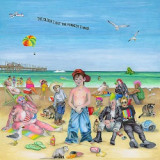
Almost four years later, on the cover of their second album, the band is standing
on the dike in Husum. In the background we see the Nordsee Hotel, which burned
out in the year of the debut's release. The looks of the band members reveal
friendly determination, which is very North German in its nonchalance.
Nevertheless, I don't doubt for a moment that Swutscher still know how to set
their surroundings on fire, even leave a trail of destruction. Their reputation is
legendary. Every person who has experienced Swutscher live knows that it is not
only a spiritual but also a physical experience. Reason down and thus lead it into
a wonderful dissolution of boundaries. This LP format is released on ltd ed cream
vinyl.
PR Agency (Print/Online/Radio GSA): Community Promotion PR Agency (Print/
Online/Radio Worldwide): La Pochette Surprise Marketing: Print/Online: 2500€ /
Radio: 2000€ / Social Media: 3000€ / Ads: 3000€ PrintAds: Westzeit Cover
(Feb2022), Musikexpress, Visions, OX Fanzine, Flight13 Mailorder, Schall TOUR
DATES Präsentiert von DIFFUS, OX FANZINE, BYTEFM 20.4. A- Wien - Rhiz 21.4.
München - Heppel & Ettlich 22.4. CH-Basel - Hirscheneck 23.4. Stuttgart - Club
Cann 28.4. Düsseldorf - KulturSchlachthof 29.4. Husum - Speicher 30.4. Hamburg
- Molotow 05.5. Kassel - Goldgrube 06.5. Münster - Gleis 22 07.5. Bremen - Tower
08.5. Hannover - Bei Chez Heinz 17.5. Köln - Bumann & Sohn 18.5. Nürnberg -
Muz Club 19.5. Chemnitz - Nikola Tesla 20.5. Dresden - Groove Station 21.5.
Berlin - Urban Spree Separater PR Report verfügbar
Prärie" (Wild German Prairie) from 2018, we saw a burning house
surrounded by apparently insane figures
Almost four years later, on the cover of their second album, the band is standing
on the dike in Husum. In the background we see the Nordsee Hotel, which burned
out in the year of the debut's release. The looks of the band members reveal
friendly determination, which is very North German in its nonchalance.
Nevertheless, I don't doubt for a moment that Swutscher still know how to set
their surroundings on fire, even leave a trail of destruction. Their reputation is
legendary. Every person who has experienced Swutscher live knows that it is not
only a spiritual but also a physical experience. Reason down and thus lead it into
a wonderful dissolution of boundaries. This LP format is released on ltd ed cream
vinyl.
PR Agency (Print/Online/Radio GSA): Community Promotion PR Agency (Print/
Online/Radio Worldwide): La Pochette Surprise Marketing: Print/Online: 2500€ /
Radio: 2000€ / Social Media: 3000€ / Ads: 3000€ PrintAds: Westzeit Cover
(Feb2022), Musikexpress, Visions, OX Fanzine, Flight13 Mailorder, Schall TOUR
DATES Präsentiert von DIFFUS, OX FANZINE, BYTEFM 20.4. A- Wien - Rhiz 21.4.
München - Heppel & Ettlich 22.4. CH-Basel - Hirscheneck 23.4. Stuttgart - Club
Cann 28.4. Düsseldorf - KulturSchlachthof 29.4. Husum - Speicher 30.4. Hamburg
- Molotow 05.5. Kassel - Goldgrube 06.5. Münster - Gleis 22 07.5. Bremen - Tower
08.5. Hannover - Bei Chez Heinz 17.5. Köln - Bumann & Sohn 18.5. Nürnberg -
Muz Club 19.5. Chemnitz - Nikola Tesla 20.5. Dresden - Groove Station 21.5.
Berlin - Urban Spree Separater PR Report verfügbar
Prärie" (Wild German Prairie) from 2018, we saw a burning house
surrounded by apparently insane figures
Almost four years later, on the cover of their second album, the band is standing
on the dike in Husum. In the background we see the Nordsee Hotel, which burned
out in the year of the debut's release. The looks of the band members reveal
friendly determination, which is very North German in its nonchalance.
Nevertheless, I don't doubt for a moment that Swutscher still know how to set
their surroundings on fire, even leave a trail of destruction. Their reputation is
legendary. Every person who has experienced Swutscher live knows that it is not
only a spiritual but also a physical experience. Reason down and thus lead it into
a wonderful dissolution of boundaries. This LP format is released on ltd ed cream
vinyl.
PR Agency (Print/Online/Radio GSA): Community Promotion PR Agency (Print/
Online/Radio Worldwide): La Pochette Surprise Marketing: Print/Online: 2500€ /
Radio: 2000€ / Social Media: 3000€ / Ads: 3000€ PrintAds: Westzeit Cover
(Feb2022), Musikexpress, Visions, OX Fanzine, Flight13 Mailorder, Schall TOUR
DATES Präsentiert von DIFFUS, OX FANZINE, BYTEFM 20.4. A- Wien - Rhiz 21.4.
München - Heppel & Ettlich 22.4. CH-Basel - Hirscheneck 23.4. Stuttgart - Club
Cann 28.4. Düsseldorf - KulturSchlachthof 29.4. Husum - Speicher 30.4. Hamburg
- Molotow 05.5. Kassel - Goldgrube 06.5. Münster - Gleis 22 07.5. Bremen - Tower
08.5. Hannover - Bei Chez Heinz 17.5. Köln - Bumann & Sohn 18.5. Nürnberg -
Muz Club 19.5. Chemnitz - Nikola Tesla 20.5. Dresden - Groove Station 21.5.
Berlin - Urban Spree Separater PR Report verfügbar
- 1: An Experience
- 2: Stay
- 3: Calling Me Home
- 4: White Lilly
- 5: Eternal Winter
- 6: A Second Time
- 7: Beside The Well
- 8: Apparition
- 9: Down And Up
- 10: Me In My Glas
- 11: Kingdom Comes
- 12: Only The Wind
- 13: Final Charity
- 14: The Tyger
- 15: Wolf In A Trap
- 16: Frantic Pain
- 17: An Experience (Single Version)
- 18: Doloures Echo
- 19: Response
The Local Moon (East Berlin 1987/88) The name The Local Moon originated from an intimation by the oriental jester Nasreddin that every city had its own moon. This idea did not go without a certain local colour in the bipolar frontline city of Berlin; from an astropolitical view, its divided sky never saw a full moon, the light conditions were ideologically broken. From the black light of those years emerged The Local Moon. René Le Doil and Ronald Lippok took wings like two crows from a pigeon’s nest when quite suddenly in 1987 light entertainment permeated East Berlin’s Offground and the two musicians were hired for the New Romantic revue New Affair. Before that, Le Doil had been involved in the Stattgespräch fashion spectacle and in Allerleirauh, the “thing of light, space, sound and leather”. Lippok had been the drummer for Rosa Extra, one of the earliest punk rock bands in East Berlin. Together with his brother Robert, who had already come into the picture with an avant-punk project named after the Jules Verne novel Fünf Wochen im Ballon (Five Weeks in a Balloon), Ronald Lippok then founded the post-punk commune Ornament & Verbre- chen, for whom Le Doil would occasionally guest as an... more credits released July 20, 2022 Tape (Side A, B, C – Track #1 - #16) Music by The Local Moon, recorded in April 1987 René Le Doil: accordion, bass, guitar, keyboards, piano, voice Ronald Lippok: acoustic guitar, keyboards, percussion, voice Produced by The Local Moon Single (Side D – Track #17 - #19) Music by The Local Moon, recorded in May 1988 René Le Doil: keyboard Ronald Lippok: keyboard, voice Charlotte Jansen: oboe, voice Alex Wolf: percussion Bo Kondren: emax, traktor Detelf Pegelow: guitar Robert Lippok: clarinet, ethno brass Produced by Bo Kondren Recorded at Gunther Krex Studio Vinyl published by Henryk Gericke Texts and liner notes by Henryk Gericke Remastered by Calyx/ Bo Kondren Digital distribution via aufnahmeundwiedergabe.de
The musician Roberto Enrique "Tito" Chicoma forged one of the most solid and constant career paths in Peruvian music. Self-taught, he started playing tenor saxophone in his father's orchestra, also playing the trumpet, piano or trombone when the occasion arose. In 1959, at the age of 23, Tito moved to Lima, where he soon joined ensembles such as the Koki Palacios and Armando Boza orchestras, which took him abroad for the first time on tour. A recognized musician in his own right, Tito would later decide to form his own orchestra, which was soon hired by América Televisión, starring on programs such as "El Show de Juan Silva", where he accompanied international artists that visited Lima. In 1966, Tito made his first record under his own name on the MAG label, performing two cumbias by the Colombian group Los Teen Agers. The praise the single received led to the recording of his first LP, "El ritmo de moda", where he continued to compile Colombian songs. At the end of 1967, he dedicated his new LP project to recording two fashionable rhythms at the time: cumbias y boogaloos. The Colombian cumbia became popular in Peru from 1964 onwards, when local orchestras like those of Andrés de Colbert, Mario Cavagnaro, Eulogio Molina and Lucho Macedo recorded cumbia hits, then the genre soared when groups like Los Pacharacos and Los Demonios del Mantaro mixed it with Andean music.
2022 limited edition of this Japanese no wave gem from 1982. With extended liner notes and interviews with band members about the recordings of the album, as well as unpublished photographs from 1981 by Jibiki Yuichi.
The Japanese punk rock movement known as Tokyo Rockers began in the summer of 1978. It incubated an independent music culture as well as a host of fascinating, individualistic musicians. One of the more striking units was the male-female duo Maria 023. NON played bass for them, and it was here that she first attracted attention. However, Maria 023 was short-lived, and NON would not reappear until the following year, August 1979, on stage at the legendary concert event "Drive to 80s". Her unbilled performance at the event consisted of several songs for solo bass and vocals, and her combination of intensity and a distinctly female emotionality made a striking impression. In the months that followed, NON continued to play solo and she became a pivotal presence among the female rockers on the scene at the time.
Finally she shifted from solo to group performance, and formed NON BAND. After several member changes, the line-up stabilized into a unique trio with Kinosuke Yamagishi on violin and clarinet, and Mitsuru Tamagaki on drums. It was with this line-up that the group reached a musical peak. At the same time, the Japanese punk and new wave rock scene was moving in a new direction, as a second generation of artists appeared and mushrooming independent labels began to play an increasingly important role. I myself started a label called Telegraph Records in 1981 and worked hard on record releases and building a distribution network.
Since starting the label, I had wanted to release a record by NON BAND. There were many vicissitudes before it could happen, but in February 1982 NON BAND's first album was released as a 10-inch LP on Telegraph Records, the label's fifth release. In the early Japanese indies scene, if a release sold 1000 copies it was counted as a significant success. The NON BAND album went through several repressing and sold 2000 copies. The album was a hit and the band's critical reception and popularity suddenly took off.
The shows that followed the release of the album were given a boost by the addition of two female rockers, the guitarist Kummy and keyboard player Mitsuwa. The group was reaching a real musical peak and everyone expected more great developments, but just six months after the release of the album the group would grind to a halt. Members quit the band one after another, and with no possible replacements to be found, NON herself faded away from the scene.
NON BAND's career in the early Japanese indies scene was thus short-lived. But their sole album was reissued twice on CD, and remained popular with listeners. However, the group's history was to have a second chapter.
NON ended up returning to her hometown, snowy Hirosaki in the far northern prefecture Aomori. There she raised two children and took over the running of the family business, an arts supplies store. Her thoughts turned once again towards music, and in 1999 she took up her bass again and began to sing. She invited two fabulous musicians, Keiji Haino and Tatsuya Yoshida, to Hirosaki, and performed together with them as well as solo. This marked the beginning of a new phase for her, and she played live in Tokyo and released a solo album, "ie". She got back in touch with Yamagishi and Tamagaki and reformed NON BAND. They added Emi Sasaki on accordion and began to play a handful of gigs each year, bringing a mature depth to their undiminished power and dazzling a new generation of fans. In 2012 the group released an album of recent live performances entitled " NON BAND Liven' 2009-2012". I released the album on the newly reanimated Telegraph Records.
NON still lives in the north, in Hirosaki. The city is famous for its summer Neputa festival. The first track on this album, "Duncan Dancin'" is almost a theme song for NON BAND, but its rhythm is taken from the ohayashi music that is performed in this festival, as large floats and troupes of dancers wind their way through the streets. The title refers to the legendary dancer, Isadora Duncan. The image perfectly represents NON herself: Isadora Duncan dancing to the earthy rhythms bubbling up out of the north land.
Nov 9, 2016 Jibiky Yuichi (Telegraph Factory)
In order to achieve a meticulous sound quality the reissue version is cut on 12" vinyl instead of the original 10" format. The original cover artwork has been reproduced and there are liner notes by Jibiky Yuichi with unpublished photos of NON BAND.
From the moment that German producer, Fejká, burst onto the scene at the age of 17, he has captivated listeners with an unrivaled ability to sit comfortably at the intersection of expression and introspection. Where night and day, dreaming and dancing, the fast and the slow, might naturally diverge, he is able to balance them delicately, creating sounds which are, in the same moment, wonderfully ethereal, but also thrillingly dynamic.
His new single Hiræth, meaning ‘long gone’, offers a soundscape full of warmth and calm, enhanced by the unique soothing quality of Kim van Loo’s distinctive vocals – a sound which Fejká accidentally discovered during their time as roommates in lockdown. The track describes a certain sense of nostalgia for a place that might never be reached, or a place that might never be returned to, with an overarching feeling of longing throughout. Working from his studio in
Stuttgart, Fejká processed synths, pads and piano with a tape machine to heighten the nostalgic ambience and, through grainy imperfections, establish a more intimate relationship with the listener. The track is restrained and subtle, yet it cycles through the ups
and downs of an ever-changing landscape keeping listeners on their toes, “Like the feeling of being taken on a journey for the last time“, says Fejká Delving into a vast range of emotions and musical approaches, Fejká’s most recent album,
Reunion, cemented the young producer’s position in the downtempo electronic scene. The album’s single, Svanur, has been streamed over 15 million times with Fejká having recently performed sold-out shows at EartH London, Cross Club Prag, Kater Blau, and Klein Istanbul.
- A1: The Howard Lemon Singers - I Know God Is Real
- A2: John Fiddy - Baddy
- A3: Keith Mansfield - Omen
- A4: Masaaki Hirao - Track 4
- A5: Bernard Lubat - Super Smog 2
- A6: Eleanore Mills - He Said Goodbye
- A7: Detroit Emeralds - So Long
- B1: Syd Dale - Web Of Fear
- B2: Bennie Maupin - Farewell To Rahsaan
- B3: Procul Harum - Repent Walpurgis
- B4: Elkie Brooks - Honey Can I Put On Your Clothes
- B5: Solaris - Rainbow Music
- B6: The Smith Connection - Under My Wings
- B7: Les Mccann - Roberta
- B8: Junior Mance - I Believe To My Soul
Debut album from Cardiff indie-pop collective Live, Do Nothing (ex-members of Rosehip Teahouse/Deadlines). Hiraeth & Loathing explores feeling disconnected from your childhood self. The record questions if there is value in re-discovering this inner child, or if we’re better off eschewing the trappings of nostalgia and living for our current reality instead. Since their debut Ep, 2018’s “Oh Dear”, a collection of scrappy indie-punk songs from the original four-piece line-up, the band has doubled in size (and is still growing!). Countless numbers of new instruments have been added to the mix, including: vibraphone, toy piano, violin, flute and saxophone. Recorded by Thomas V. Westgård at Sail Loft Studios, mixed by Bob Cooper at Chairworks Studios and mastered by Leon West at After Life Studios. Track listing: The Hardest Band In Cardiff Presents...; The Real Animals Of...; Mouse Death; All Wax No Honey; Novelty is the Best Policy; A Legendary Run; Hopelash; Delusions Of Ganja; Oso Jugoso; Too Late In The Day; Chromatic Delight
Es zirkulieren wenige LPs, die über die gesamte Albumlänge die Schönheit und Wärme des „Balearic Sound“ widerspiegeln. Man kann das auch dem Genre “Cosmic“ zuordnen. Arno E. Mathieu aus Südfrankreich schafft auf “Contemplation” das einzigartige flimmernde Licht des „Mediterranen“ einzufangen, und in einem modernen Sound die Stimmungen der Natur des Mittemeerraumes rüber zu bringen. Die Songtitel und das Cover Image ergänzen das abgerundete Stimmungsbild.
Es kommt nicht von Ungefähr, dass DJ Harvey großer Fan von Arno E Mathieu ist und viele seiner Tunes spielt. Wer auch in diesen Kosmos passt, ist Joe Claussell, der neben Franck Roger, I:Cube, Beanfield, Julien Jabre, Mark E, Simoncino, Woolfy, DJ Deep, Gigi Testa, Next Evidence, Max Essa jeder für sich einen tollen Remix abliefert. Fast jeder Track des Albums wurde geremixt.
More solid UK boogie & brit-funk courtesy of Freestyle Records - this time giving the 12" reissue treatment to short-lived group Cool Runners' 1982 single Checking Out, backed up with sought-after High on a Feeling.
-------
As Cool Runners' Paul Tattersall recalls, "this single was a follow-up to the "Play The Game (So You Think It Funny) / Hawaiian Dream" 12" which we believe got to around number 60 in the national charts, and was at the time heavily played on the radio by DJ Greg Edwards who sadly passed away earlier this year..." Recorded mixed and mastered then licensed for release to MCA, this initial single also relased in 1982 was voiced by Tony Jackson, then part of Paul Young's backing band as his career took off in the charts. Tony formed part of a string of funk groups throughout the 70s and early 80s - Sweet Dreams, Midnight, Ritz & Indigo - and later went on to be successful as lead singer in Rage.
These tracks "Checking Out" and "High on a Feeling" on the other hand features the vocal talents of Rush Winters, who would go on to record with the likes of Carmel, Yello, D.C.Lee and others. "It received little in the way of promotion by the record company at the time", Tattersall continues "so it has produced a cult following and has become rather sought-after, as few copies were actually released at that time."
After release, Cool Runners' Paul Tattersall and Chris Rodel then played with several different bands, with Chris moving onto double bass. He still plays professionally today as an accomplished jazz bass player. Paul has run a successful musical hire company in North London, with a specialism on synths and keyboards, since the eighties - and continues to this day.
- A1: Plays Albert Ayler 1 10 01
- A2: Plays Albert Ayler 2 09 45
- B1: Plays John Cassavetes 1 09 58
- B2: Plays John Cassavetes 2 09 57
- C1: Plays Hubert Fichte 1 10 01
- C2: Plays Hubert Fichte 2 09 59
- C3: Plays Cornelius Cardew 1 04 01
- D1: Plays Cornelius Cardew 2 04 03
- D2: Plays Robert Johnson 1 04 04
- D3: Plays Robert Johnson 2 04 00
Ekkehard Ehlers' seminal plays series was originally released on three 12inches (Staubgold) and two 7inches (Bottrop-Boy) in very limited runs. The entire series was previously only available as a CD compilation or digitally. Keplar finally presents it on double vinyl for the first time, featuring a new cover artwork.
Domestic ethnology: Ekkehard Ehlers plays.
‘Play’ is a word in English with many meanings attached. Each one sends you down a different cognitive pathway. When I think of ‘playing’, in the sense of a game, I think of an activity involving more than one person. When Ekkehard Ehlers plays, he is very much on his own. Or, at least, alone but at the same time keeping intimate company with the artistic innovators named in his titles. Robert Johnson. John Cassavetes. Albert Ayler. Cornelius Cardew. Hubert Fichte. Is he playing with them, against them, about them, for them, to them? This can never be known.
It is certainly a mistake to try to hear the ‘work’ of these originals in the sounds played by Ekkehard. They’re not cover versions. They’re hardly tributes in the conventional sense. Cassavetes and Fichte are not even musicians, although music played an important part in both their careers. Sure, there are little nods and flashes of recognition – tiny guitar licks among the minimal beats of ‘Robert Johnson 2’; rich bowed instruments in ‘Albert Ayler’, recalling the violin, cello and double bass arrangements on Ayler’s 1967 Live in Greenwich Village LP; the elongated organ lines of ‘Cornelius Cardew 1’ gesturing towards passages in Paragraph 1 of the British composer’s 1971 Marxist monolith, The Great Learning. Ekkehard is not so much playing these figures as allowing himself to be played by them.
Playing as an activity also suggests freedom. Maybe the only thing all five named persons have in common is that they were all quiet radicals. In music, literature and cinema, they all stepped, without self-promotion or fanfare, into unmapped territories. Once there they found it necessary to invent new languages in order to survive. Necessity was the mother of their inventiveness. They were also uncomfortable avant gardists. Lonely types, fighting their corners out on the margins, with little reward, often misunderstood, ridiculed or ignored.
All died unfairly young. Fichte a victim of HIV/AIDS, Cassavetes of cirrhosis of the liver. (‘Cassavetes 2’ sounds like a tender farewell played across the 59 year old alcoholic director’s death bed.) The deaths of Johnson, Ayler and Cardew have never been satisfactorily explained, and remain shrouded in myths and conspiracy theories. The pioneering expeditions of all five began in that spirit of playful freedom, but inexorably drew them towards the heart of darkness.
So these ‘plays’ are micro-dramas, sonic soliloquies, monolog-ins to the private accounts of various geniuses in Ekkehard’s ‘follow’ list. Hacked sensibilities. Artistic manifestos boiled down and distilled, skinned and dried in the digital smokehouse. (Ekkehard Ehlers Flays.) Each of these plays was originally floated out into the world alone on its own disc. The collected works play well as a team – a tranquil, introspective experience where each artist has his own identifiably unique sound character. As an album, Plays is a ‘Plattenragout’ – a ‘record stew’ – which was the title of Hubert Fichte’s LP review column in the leftist culture magazine konkret in the 1960s. The novelist’s work investigating the cultures of South America and the Caribbean islands has been called ‘domestic ethnology’. The writer himself referred to his ‘ethnopoesie’. Ekkehard Ehlers’s intuitive electronic portraits are a form of domestic ethnology in themselves. Invoking another of Ekkehard’s musical aliases, they are portraits of cultural ‘autopoiesies’ – creators whose works were strong enough to have their own self-regenerating life force. (by Rob Young)
All tracks written and produced by Ekkehard Ehlers.
Featuring Stephan Mathieu, Joseph Suchy, Anka Hirsch.
Tracks A1 to C2 originally released on three 12inches via Staubgold.
Tracks D1 to D4 originally released on two 7inches via Bottrop-Boy.
Plays originally released as CD compilation in 2002 by Staubgold.
Mastered by Rashad Becker.
Cut to vinyl by Lupo, Berlin, 2022.
Redesigned by Sandra Kastl, 2022.
Photos by Ludger Blanke
The Older I Get, the Funnier I Was, which follows Thomas’ brilliant 2020 HBO special The Golden One and his Can't Believe You're Happy Here EP released earlier this year, surveys a range of emotion and offers a broad sonic palette, moving between pop punk, electro, and the obvious influence of the singer-songwriters he grew up listening to in early childhood. It conjures the ennui of Bright Eyes alongside the barefaced storytelling of John Prine, the overstuffed lists of Fred Thomas with the lackadaisical humor of Colleen Green, among many others.
Thomas attributes the dexterity of the record to Duterte, who recorded and engineered most of it in addition to serving up plenty of encouragement when Thomas got down on the process. “As a comic, I used to test out new songs during sets to see if the funny bits were hitting, but since I wrote this in isolation I ended up writing lyrics and worrying less about making jokes,” Thomas says. That said, the album’s plenty funny. Stand-out and lead single “Rigamarole” opens with a Thomas-voiced infomercial that recalls his oft-cited lookalike Jim Carrey as the Grinch, before launching into a buoyant pop song about being depressed.
Whitmer Thomas will admit that when he traveled home to small town Gulf Shores, Alabama to record his HBO stand-up special, The Golden One, he expected to be greeted as a returning hero, a conquering king, or at minimum, a guy with a moderately successful career as an entertainer in Los Angeles. “I expected a big welcome home, open arms, but when I went back I realized: nobody fucking knows me. Nobody remembers me,” Thomas says. “In the years I’d been performing that show, I’d been romanticizing my childhood in this mythologized place, but the visit made me see that I’m not really from there anymore.”
The sense of alienation compounded when Thomas recognized how few people in town remembered his mom, to whom The Golden One is dedicated and largely about. Thomas grew up watching her perform with her twin sister at the legendary Flora-Bama Lounge, where he set the special, and still counts her as one of his musical influences. His new album, The Older I Get, the Funnier I Was, isn’t overtly about his mom, her presence is deeply felt throughout. While in Gulf Shores, Thomas discovered dozens of her old recordings, all of which had been wrecked by Katrina, but upon returning to LA, Thomas paid “a fancy place in Hollywood” to fix the tapes and hired Melina Duterte (Jay Som, Bachelor, Routine) to mix them. The two struck up a collaborative friendship, and Thomas had the sound of his mom’s voice back. “I was listening to songs she recorded when she was about my age, just these heartfelt, sweet Americana songs,” he says. “I decided then that I wanted to lose the Ian Curtis voice I always sing with; I wanted to do what came naturally, because my mom always sounded like herself, even when she was singing some cheesy reggae song about, like, Jamaica.”
Thus he went into The Older I Get, the Funnier I Was knowing it was time to retire his darkwave persona, and leaning into his natural, chirpier voice, which he says sounds “like a 12-year-old’s.” It makes sense: much of the album chronicles what Thomas calls “being a kid and feeling like you have no control and overcompensating by being annoying.” “So much of the album is about witnessing drug and alcohol addiction as a kid and seeing what it does to people, but also realizing that there's nothing you can do about it,” Thomas says. It’s familiar territory (see: “Partied to Death”) but the methodology is different this time around; true to its title, The Older I Get, the Funnier I Was isn’t always looking for laughs. Thomas might’ve left his hometown behind, but his kid self is still tagging along, a Peter Pan shadow he can’t untether himself from. The first line he sings on The Older I Get, the Funnier I Was is: “There should be a room at every party where you can just sit and watch a movie.” Find a 12-year-old who wouldn’t say the same.
By early 2020, Kayleigh Goldsworthy had finally figured out who she was. The long-time hired-gun musician from Syr- acuse and based in south Philadelphia, who had spent a decade backing up the likes of Dave Hause, Bayside, Frank Iero, and others, was ready to commit fully to a solo career of her own work. The day after New Year’s Day 2020, Gold- sworthy started recording her second solo LP, seven years after her debut Burrower, with Will Yip at Studio 4 outside Philly.
Then everything changed. The job and life Goldsworthy had pursued since her teen years was ripped away: tours, shows, studio time, even band practices and writing sessions, all gone. Along with those went away a hard-won sense of self.All those things that had given Goldsworthy the confidence and push to believe in herself and her work disappeared.
“I had figured out who I was,” says Goldsworthy, “then this whole thing happened, and I had to figure out who I was again.”
- A1: The Dukes - Mystery Girl
- A2: Prime Time Band - Fall In Love In Outer Space
- A3: Kenny Nolan - You're So Beautiful Tonight
- A4: Peter Skellern - Now That I Need You
- B1: Marc Jordan - Generalities
- B2: Severin Browne - Stay
- B3: The Faragher Brothers - Stay The Night
- B4: Alan Price - Groovy Times
- C1: James Felix - Open Up
- C2: Hirth Martinez - Altogether Alone
- C3: Max Leake - Tell Me The Reasons Why
- C4: Stpehen Encinas - Music In Me
- D1: Eric Andersen - Can't Get You Out Of My Life
- D2: Jimmie Spheeris - Beautiful News
- D3: Jeannine Otis & Heikki Sarmanto - Magic Song
- D4: Pleasure - Nothin' To It
Purple Vinyl[25,17 €]
mp3 Download PostCard
After smooth detours into Soul covers, French Neo-Disco, modern Sunset Disco and Brazilian AOR, in 2022 DJ Supermarkt's Too Slow to Disco series makes a joyous return to its original Westcoast AOR/Yacht roots. Celebrating the 10th TSTD compilation. Who would have thought….
The Berlin curator releases a killer 4th edition of the original compilation art form, "Too Slow to Disco", featuring forgotten and overseen gems from the mid 70s to the early 80s from a global world of smooth, brilliant lost and overproduced tracks from Finland via London and L.A. to Trinidad and beyond.
The great 'un-vanisher' of lost lazy classics, DJ Supermarkt once again unearthed some incredible music that labels, publishers (in many cases also those, who actually own the rights to those tracks…) and streaming services have often long overlooked. You're welcome, world!
WRWTFWW Records is so happy to announce Poly-Time Soundscapes / Forest Of The Shrine, a brand new release by Japanese producer Taro Nohara (Yakenohara). 8 tracks of pure environmental ambient bliss available on LP housed in a heavy 350gsm sleeve with an artwork from the artist himself.
Based in Tokyo, Taro Nohara is a producer, beatmaker, DJ, and music activist who made a mark with his electronic / ambient unit Unknown Me ( (of Not Not Fun Records fame). His new solo project, Poly-Time Soundscapes / Forest Of The Shrine, is a unique and modern take on Japanese environmental music, a free floating re-interpretation of the sub-genre made famous by Midori Takada, Hiroshi Yoshimura, or Satoshi Ashikawa (and more!) fused with subtle nuances of various origins: downtempo, hip hop, sound design, chill-out, experimental.
Conceived as a two-part adventure of contemplative peace, Taro Nohara’s organic soundscape takes you on a mind-soothing walk through time (or memories) and the beautiful mysteries of luscious forests - don’t resist, let yourself go, explore!
4LP Deluxe Edition[60,92 €]
Following on from the success of 2020's deluxe reissue of 'Vienna',
Chrysalis Records are proud to release a 40th Anniversary of the bands
second album with Midge Ure, 'Rage In Eden'
Originally released in October 1981 and like the bands previous two albums, it
was produced by Conny Plank (Kraftwerk, Can, Neu!), this time recorded at
Conny's studio in Cologne during the summer of '81.
This new 6 Disc box set contains 52 tracks, with 22 previously unreleased
recordings. CD's 1 to 5 contain the original 1981 album production master, a new
stereo mix by Steven Wilson, A-sides, B-sides & live tracks along with previously
unreleased cassette rehearsals and a newly mixed concert recorded at
Hammersmith Odeon in October 1981. The DVD (Audio Only) contains a new 5.1
Surround Sound Mix of the Album/B-sides by Steven Wilson along with 24/96 HiRes audio of the new mixes and the original 1980 Master/B-sides.
The set is packaged in a 12"x12" Rigid Slipcase and contains a 20 page 12"
square booklet featuring contributions from the band, unseen photos from Midge
Ure's and Chris Cross' personal collection, reproduction of the Rage In Eden tour
programme, 6 discs in card wallets housed in two 12" gatefold album sleeves.