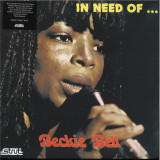
Strut proudly reintroduces a sought after independent disco gem from the Topomic catalogue: Beckie Bell"s "In Need Of...", reissued in full for the first time. Originally released in 1980, In Need Of... quickly became a cult classic of the French disco scene. After relocating from New York to Paris in the late 1970s, Bell carved out a unique space for her sound, blending the soulfulness of New York disco with the high energy sophistication of the European market. The full debut album features some of Bell"s earliest recordings, including the full length version of "Super Queen" (1979) and "In The Right Place" (1980), showcasing her commanding vocal delivery and distinct musical style. Standout track "Music Madness" has since become a much-loved disco anthem, revered by collectors and DJs alike.
Search:home recordings
Morning Stone is Pacific nostalgia. Now based in Mohkintsis territory on the Eastern side of the Rocky Mountains, Benoit Guimond, under his moniker Angel Science, draws us into his early life in Vancouver. That coast is still home, and his conifer-covered memories have been shaped into the organic textures of this record. Waving filtrations, archival recordings, rewinding spins and ethereal pads signal a return to the stones, sand and organic beach drift of the Pacific Northwest. Environmental rhythm and free-flowing flourishes reveal a musician in the core of his memory, at the forefront of an ever-evolving sonic journey.
Guimond has rapidly become a standout figure in Canada’s underground dance scene, celebrated for his subtle grooves and esoteric soundscapes with releases on PHTM, Echolocations, PPRZ and more. While he’s often linked to techno, Morning Stone reveals a softer, slower side that pushes through any previously held genres he has been confined to. The euphoria of Madrugada, the deep and hypnotic energy that reverberates in tracks Cee Dub and Shale, alongside the ambient textures of Alborz, all come together to strike a specifically pacific balance between the blissful and the raw. It offers a refreshing growth and a hit of balearic beyond conventional techno, while retaining the depth and edge that encapsulate a signature style.
Elena Colombi approved material!
Tondiue “Yesssssss”
- Apartment Life
- The Machinist
- The Men Are Fighting
- Lakeland
- Seven And Seven
- Over & Over, Pt. 1
- Bells And Bells
Fit for Consequences: Original Recordings, 1984–1987 is the first ever archival release from Repetition Repetition, the “two-man electric minimalist band” consisting of Ruben Garcia and Steve Caton hailing from Los Angeles in the mid 1980’s. Repetition Repetition’s unique blend of cosmic art-rock minimalism / maximalism was self-released across a series of cassettes produced in micro editions, and while garnering the attention and participation of luminaries such as Harold Budd, remained under the radar during the band’s existence. Fit for Consequences: Original Recordings, 1984–1987 collects select material from across the duo’s catalog.
It was over a plate of Mexican breakfast food when Ruben Garcia and Steve Caton first told Harold Budd of Repetition Repetition and the worlds they intended to explore by respective way of synthesizers and guitars --- a rendezvous instigated by the former’s fan mail to the legendary composer. If the upstarts entered this restaurant from a one-way street of admiration, they would leave with not only Budd’s interest but, sometime later, a blessing in the wake of many hours shared by the three in Garcia’s Los Angeles home recording studio: “This is going to be difficult, but God help them, I think they’re great,” noted Budd in a USC lecture in 1985. Now several degrees removed from prior rock music aspirations, the real game was afoot.
Between 1984 and 1988, Repetition Repetition operated within something akin to the underground of the experimental underground, although even that designation perhaps overstates the case. The duo’s sparse output consisted of three cassettes self-released on Garcia’s Third Stone Music label: Repetition Repetition (1985), Lakeland (1987), and The Machinist (1987). Their songs would also be included during this period on Trance Port Tapes’ vital scene-scanning compilations assembled by A Produce. Live performances occurred with similar infrequency, but Garcia and Caton counted converts in quality over quantity, numbering among them the aforementioned Budd, a Chambers Brother, and, judging by a memorably drop-jawed reaction following a rare Repetition Repetition gig, Jackson Browne.
Likewise, critical support materialized in the form of KCRW deejays Brent Wilcox and Dean Suzuki, whose steady airplay positioned Repetition Repetition’s music amidst fearless company like Jon Hassell, Hiroshi Yoshimura, and Richard Horowitz. Yet, to hear fellow Trance Port featured players like Tom Recchion and Bruce Licher of Savage Republic tell it, Garcia and Caton moved as ghosts --- a notion more vexingly endorsed by the silence of record companies that failed to come knocking --- and therein lies an overarching truth to the work itself.
Journey to the heart of Repetition Repetition and one discovers a collective ear impossibly attuned to the hypnotic possibilities of stylistic convergence, the resulting music possessed of seamless multimodalities which beckon to a glimmering plane of the disembodied. Where Caton sought his artistic fixes at an intersection of popular genres, Garcia zoned in on the sonically spare, drawing from the same wellspring as the Enos and Rileys of his personal avant-garde pantheon, and in their coming together the two tapped into a deeper cosmic source. Synthetic walls of keyboard sound in forever states of reprise met waves of shimmering --- and at times even punishing --- guitar in reply, their soundscapes hovering convincingly between, as suggested in fittingly dualistic fashion in a press kit assembled by Garcia, such disparate sensations as bird flight in one song and oil drilling in the next.
But don’t call it a push-pull dynamic, as this was a creative partnership founded upon fluidity and organicism by way of, naturally, repetition. In contrast to, say, the Bressonian ideal of repetitive motion as a great stripping away, the concept in the hands of Garcia and Caton equated to ascendancy via continuous unfolding, a maximal route to minimalism. To be sure, their recording philosophy morphed over the course of the act’s short history, and what started as a process defined by consistent in-person interplay developed into a more isolated method formulated by Garcia, who eventually took to his own one-man bedroom-studio sessions in order to fully chart any and all potential ostinato-loaded paths which he could travel down, the Tascam-captured resonances subsequently provided to Caton as blueprints from which to take flight himself, adding layer upon layer of steel to the proceedings.
If the practice and execution changed, however, the evidence certainly didn’t rest in the results: The seamlessness remained, and, despite the brevity of their time together, so has Repetition Repetition. With this finely calibrated collection of songs in Fit for Consequences: Original Recordings, 1984–1987, Freedom To Spend sees to it that the private worlds of Garcia and Caton can now be visited by all rather than just the count-‘em-on-both-hands lucky few whose musical endeavors or collector vocations carried them into this once-distant dimension.
Repetition Repetition’s Fit for Consequences: Original Recordings, 1984–1987 will be released on Freedom To Spend in vinyl and digital editions on May 30, 2025. The collection includes extensive liner notes from Bill Perrine, and wil be offered alongside Over & Over, a supplemental collection of music available exclusively as a mail order cassette from Freedom To Spend and RVNG Intl.
After 45 years, Trigger’s never-released second album, Second Round, invites listeners to rediscover the hard rock sound that made the band a standout act of the 1970s. In early 1979, Trigger walked out of Electric Ladyland Studios with a completed second album. Mere months had passed since their self-titled debut came out on Casablanca Records, home to KISS and Parliament. The band had toured with Cheap Trick and The Godz, met Bruce Springsteen and Joni Mitchell, and things were looking bright. But Casablanca unexpectedly went bankrupt, and the label’s artists went into freefall. Trigger unsuccessfully sought interested parties, shelved the recordings and disbanded; a disappointing end for a band who dominated the Jersey Shore club scene on their way up with fiery, kick ass live shows. RIP Trigger: 1973-1979. Jump to 2024. Guitarist Richie House is living in Northern New Jersey with his wife, enjoying a relaxing afternoon at the community pool with neighbors. One of them, Andrew Wexler is shocked to discover his friend had a band in the ’70s. He listens to their recordings, and as an avid record collector, assumes the mission of getting that unheard second album released. He writes to Ba Da Bing, a label with Jersey roots. Much excitement ensues. Second Round’s long-awaited release will now be available. All original members—Derek Remington (vocals/drums), Jimmy Duggan (guitar/vocals), Tom Nigra (bass guitar/backing vocals), and Richie House (lead guitar/vocals)—are present on the recordings. Sadly, Duggan and Nigra have passed away, but Remington and House have overseen this reissue, with songs sourced directly from the analog masters.. The Trigger of today maintains a high level of quality, albeit with a bit less flair, and even less hair. And there’s more going on here than at first listen. While the band carries the earmarks of their era—melodic hard-rock fashioned for Saturday night parties—they override the cliché with incredibly catchy songs. How would a ripping song like “Back Talk” have been received in 1979? It’s a question we’ll never be able to answer, but the raw energy of the track spans generations. “One In A Million,” however, with its full harmonies and forceful chorus, could have easily made the soundtrack for Fast Times. Celebrate the discovery of this lost gem by giving it a listen. You’ll be Trigger happy…
In 1968, Vince made a label switch from his long-time home, Fantasy Records, to his new label, Warner Bros. Records. For his inaugural album, he decided to re-interpret his Peanuts classics on Oh, Good Grief! In addition to the instantly recognizable Guaraldi sound of piano, bass, and drums, this time he added electric guitar and electric harpsichord to the mix. The record was a smash hit. Omnivore Recordings is proud to, once again, present the album the way the world first heard it—as stated on the original album’s back cover, “on shiny black vinyl.” Well, actually, this special pressing is “on shiny yellow vinyl!” This timeless album has never sounded better. In addition to this special vinyl pressing, we now have this classic album available on CD for all shiny disc lovers.
LG Records presents a vinyl-only collection of songs from the archives of the friends and family of Sam Jayne. A very personal assembly of ten songs spanning over 20 years that were compiled from home demos, studio outtakes, obscure compilations, and out of print EPs. Many of these recordings had only been circulated for years amongst friends and fans, never having been formally released on a vinyl album format until now. A condensed and intimate collection of five cover songs and five original compositions that embody Sam’s endless depth of wit, absurdity, humility, passion, and heartache. Dedicated to all of the people who were graced to have shared their lives and fellowship with this beloved, one of a kind human being. Compiled by Zeke Howard and mastered by Tim Green at Louder Studios. 180g black vinyl, 500 pressed with Stoughton 28 pt tip-on sleeve.
- Breakdown
- Dying Witch
- Don't Wanna Go Home
- You Just Liked My Item
- Is It Even Gonna Snow
- Find Things Beautiful
- Dusk In The City
- Teenager
- Living In A World Like This
What We Have Now is a love-letter to New York City, written by a breaking heart weathering the deep indigo night of a soul realizing dawn will release it from the dried tears of youth. There is no brighter or harsher wasteland of self-discovery than the one in which we see that childhood is a dream and the now is something we will have to fabricate alone, from those broken mirror shards of memories in service to a world that does not seem to know how to care for us any longer. Full of feeling and shepherded by Clara's intensely honest vocals, these songs transcend place and time to share a universe of wonders beneath the hard-wrought questioning of the deeply human condition we are all living within. Clara Joy is a songwriter full of melody and vision. These home recordings were made by Clara in NYC between 2020 and 2024. The songs were then arranged, mixed & mastered by Kramer in December 2024 in his studio in the mountains of North Carolina. Clara is at the dawn of her career and Shimmy-Disc is proud to bring this amazing work to the world. This creation is a beacon on the murky horizon of this Pyrocene age landscape we find ourselves traversing.
Amuleto Apotropaico has a way to fend off demons by channeling a secular spiritualism rooted in a rigorous but playful connexion to the infinite possibilities of noise. The propulsion of their continuous music ebbs into and flows out of this primordial flux through their unique brand of brutalist liturgy.
Amuleto Apotropaico is a Portuguese duo consisting of António Feiteira (drums & electronics) and Francisco Pedro Oliveira (guitar, flute & electronics) formed in 2021. Having grown up together, saturated in the lore of their hometown of Santa Maria da Feira, the duo now resides in Porto and continues to moor their rhythmic rituals in the traditions of Northern Iberia.
None of this is a nostalgic look back to a time-that-never-was. Amuleto Apotropaico's cycles are ouroboric: every step forward invokes a simultaneous step backward such that their observance of sonic ceremony (seeming to invoke a now-forgotten tradition) becomes a constructivist gesture that shapes its own legacy. If time-travel exists, this duo has found out how.
For their self-titled first release (also the first release of the Perf label), António Feiteira has culled, recomposed and processed recordings from the band's last two years of concerts in order to create a exciting 4-tracker. Apotropia I & II, which open sides A and B on the vinyl release, are both textural meditations on subtle density. Feiteira's sensitive percussion flourishes are married to Oliveira's modular-enhanced flute and guitar patterns. Albedo e Rito showcases the duo's sense of melodic contour while crescendoing to a peak of lightness. Bruxa do Calhau Branco, lifts the whole journey into an astral dimension where multi-layered drums, synths and digital clicks breathe out, announcing that their moment of worship has settled back into the ubiquitous hubbub of room hum.
What We Have Now is a love-letter to New York City, written by a breaking heart weathering the deep indigo night of a soul realizing dawn will release it
from the dried tears of youth. There is no brighter or harsher wasteland of self-discovery than the one in which we see that childhood is a dream and
the now is something we will have to fabricate alone, from those broken mirror shards of memories in service to a world that does not seem to know
how to care for us any longer.
Full of feeling and shepherded by Clara’s intensely honest vocals, these songs transcend place and time to share a universe of wonders beneath the
hard-wrought questioning of the deeply human condition we are all living within.
Clara Joy is a songwriter full of melody and vision. These home recordings were made by Clara in NYC between 2020 and 2024. The songs were then
arranged, mixed & mastered by Kramer in December 2024 in his studio in the mountains of North Carolina.
Clara is at the dawn of her career and Shimmy-Disc is proud to bring this amazing work to the world. This creation is a beacon on the murky horizon of
this Pyrocene age landscape we find ourselves traversing.
- A1: What’llya Do / What‘llya Say?
- A2: The Blues Had Gone Away
- A3: Pretty Girl On Rollerskates
- A4: The Tea Song
- B1: Intersoular Blules
- B2: I Like My Wine
- B3: Hey Hey Hey Hey
- B4: I Love You Babe
"The recordings Contained herein are contained here after many years on the shelf..." So begin Michael Hurley's notes to these unbelievably great recordings from 1964...never before heard. Recorded by Fred Ramsey as part of the same sessions that resulted in Michael's First Songs LP on Folkways. Side A starts with What'llya Do, What'llya Say?, a pretty psychedelic classic that can very well put you into some kinda trance. After that we hear The Blues Had Gone Away - a sad drifty little tune, then Pretty Girl On Rollerskates, with a rare Hurley harmonica solo & hallucinatory lyrics worthy of some examination, and then a beautiful alternate take on one of Michael's all time greats - The Tea Song. Side B starts up with yet more alternate takes of songs from the Folkways LP - this time of Intersoular Blues & I Like My Wine. After that we get to hear two great compositions for the first time, & man oh man are they pretty - Hey Hey Hey Hey & I Love You Babe. Real great stuff all around that we recommend for deep into it Hurley fans & newcomers to his art alike. Michael Hurley is a great American song writer with his own unique way of seeing the world & this LP is a great testament to his vision. Co-release with our friends Nero's Neptune.
A fully licensed, analogue reissue -- sure, on cassette and not on vinyl, that's a
long story -- of the first Index LP, originally released in 1967
The "Black Album" is one of the all-time holy grails of psychedelia, with originals going
for more than $4,000. It is an album "with a really druggie sound, full of feedback and
fuzzy guitars. The vocals, when present, are not easily heard. The cover of 'Eight Miles
High' is very good, probably one of the best cover versions I have ever heard. The
original songs all follow a similar pattern as the covers, with hazy guitar riffs and loud
rhythms. The last track is particularly noisy and unstructured. Hidden in amongst the
echoing canyons of sound there's some really snotty punk attitude wrapped up in
trippy velvet fuzz."
This record is magnificent-- bizarre, atmospheric, amateurish (in the best of all
possible ways). It has a wonderful bleak sound, both droning and murky... the atonal
sound of 1960's rock that would leave the most lasting impression on what would
become future punk, post-punk and indie rock artists.
"Much has been written about this incredible band. Much of it isn't true. Index was
formed in the early spring of 1967 in Grosse Pointe, Michigan. I was 18 years old
when I met a chain-smoking 16-year-old named Gary Francis. Our conversation soon
got around to rock and roll. He told me that he and his friend, John Ford, were forming
a band. I told him that I played drums and we arranged a jam session at John's home
on Lakeshore Drive. Our first meeting was incredible. Our sound was full and
powerful. John's lead guitar techniques were fresh and innovative. After our first
sessions we knew we had something special. Index was born. Soon we hit the local
'sock hop' circuit, playing at high schools and teen clubs in the area. We poured our
unique sound out at The Hideout, Undercroft and G.P. War Memorial every weekend.
One afternoon John pulled out a new album he had been listening to. It was a new
band with a mind-shattering sound called 'The Jimi Hendrix Experience.' John played
some songs he had written inspired by this 'psychedelic' sound. Over the next few
days, 'Fire Eyes,' 'Shock Wave' and 'Feedback' were written. This album was recorded
in December of 1967 at the Ford estate. It is recorded in mono with literally one
microphone and with all instruments and vocals recorded at the same time. The cover
photo is of founders of a singing group John joined at Yale. The stiff, board- like
figures seem to characterize the exact opposite of this musical collection. This
reissue is taken from the original recordings. Nothing has been added and all songs
are in their original length. Over the years various bootleg copies of this album have
surfaced but this is the original work." --Jim Valice
- Rumbon En Casa De Cando
- Afro Funky
- Sabor A Mantecado
- Abacua
- Son Montuno
- Cosas De Manteca
- Gozando El Timbal
Proudly presenting our reissue of the sought-after 1978 album 'Ritmo Y Sabor' from Cuban, master bongo player, Manteca. A deep, hypnotic, sonic excursion of Afro-Cuban/mambo rhythms to get lost within. Released in 1978, there are a number of different pressings of the album coming out on labels including GRC, Desca Records and Sound Triangle Records. Stripped-back and low-fi, this is a pulsating hit of instrumental Latin-jazz dance magic.
Predominantly made up of just percussion and bass, the album comes courtesy of Carlos "Rico" Ramirez on bass, Carlos Patato on congas, timbales by Nelson Padron and Lazaro Pla aka Manteca as band leader. A Cuban legend, Manteca rose to fame playing with Ernesto Lecuona and the Cuban Boys. Although he featured on numerous recordings in his home of Cuba, only a handful exist of his as featured soloist or band leader.
A whirlwind of percussive brilliance, ‘Ritmo Y Sabor’ is brimming with energy regardless of the tempo of the track. An instantaneous ability to make you move, the grooves come alive with each new rhythm introduced. Take for instance, the track 'Afro Funky' that more than lives up to its name. A breakbeat Latin-funk workout, with a mighty fine walking bass line that provides the basis for the drummers to vibe off. Elsewhere, 'Rumbon En Casa De Cando' is fast and furious perfect for the jazz dance specialist, whilst 'Sabor A Mantecado' keeps you on your toes with its trance-like repetitive bassline and percussive interplay. 'Cosa De Manteca' is another heavy-Latin funk gem with a rough and raw feeling of relentless yet groove-driven percussion.
A must-have Afro-Cuban, rhythmic funk triumph, that shows Manteca and his band in full flight
- Gummy
- Etch
- Chainsaw
- Heaven's Leg
- Philadelphia Get Me Through
- Mainstage
- Snare
- Uno
- Bonehead
- Ring Size
Growing up is painful, brutal, and sometimes beautiful _ something Brooklyn-based indie-rock band Bedridden knows all too well. The band's name is even a nod to that ineffable period between childhood and the jagged edges of the real world. "When I was 21, I kind of lost my home," says frontman/guitarist Jack Riley. "I was couch-surfing. I was having a hard time.The next iteration in the band's maturation, then, is their debut, LP Moths Strapped To Eachother's Backs, 10 fuzzed-out (and sometimes gnarly) ruminations on dating, drugs, and survival out April 11 on Julia's War. The title came from a mysterious missive Riley received on astrology app Co-Star. "Last year I was way too reliant on other people _ my partner at the time, my friends," he says. "I was strapped to them in a weird way _ and flying in circles. This album is about that time."The current incarnation of Bedridden encompasses a patchwork of styles, influences, and friends Riley accumulated over the years. A Chicago native who first started making music at age five on a thrift-store guitar emblazoned with Kurt Cobain's name, Riley moved to New Orleans for college where he dabbled in punk before falling in love with shoegaze. There, he launched the first version of Bedridden. Sebastian Duzian (bass) _ a jazz musician and Pasadena native _ linked up with Riley in NOLA along with his bandmate, drummer Nick Pedroza. Pedroza, from Claremont, grew up on rock, metal, and jazz, honing his style after joining the band. Wesley Wolffe _ a guitarist fed on a steady diet of New Wave and `90s alt _ rounded out the crew just a few months back. Bedridden's previous lineup released their first EP, Amateur Heartthrob, in 2023 _ a noise-washed blend of shoegaze, DIY, and indie that Riley says is a "coming-of-age EP _ these formative stories about not having a bed, dating, being kind of a jackass. I was making fun of myself a lot." That release caught the attention of Douglas Dulgarian from Philly Label Julia's War (and TAGABOW), who signed them for Moths."Some of these songs have been around for years," says Riley, adding that they were recorded last February at Studio G Brooklyn; the album was produced by Aron Kobayashi Ritch (Momma). "As opposed to Amateur Heartthrob, we attempted to blend more clean guitars into a driving sound to capture more clarity _ one that also sounds live_ and raw," Riley says. That rawness thrums through the record, which kicks off with the thrashed "Gummy," about an incident when Riley had to gently fend off a co-worker's unwanted advances while both drunk and high on an MDMA gummy. And then there's mournful rager "Etch," which sees Riley daydreaming about beating up a meddler in his personal life _ in the minor key.The annihilating "Chainsaw" revs in next, a lightning-fast Lemonheads-inspired track that recalls Riley moving in with new roommates who were unnaturally obsessed with purchasing a lamp. "For some reason that pissed me off," he laughs; that rage is evident in the album cover, which shows said power tool demolishing a lampshade. Heavy-shredding "Heaven's Leg" showcases the band's affinity for `90s mainstays like Smashing Pumpkins while telling the tale of a gig at a local church. "The lyrics are about a pastor I had met that had lost his leg," Riley says. "The church had signs about not cussing and I had a feeling that neither of us had anything to talk about without potentially offending the other."The band's not afraid to get confrontational, though, on the anger-fueled, drum-heavy "Philadelphia, Get Me Through," which deals with a dead-end relationship and the mistaken assumption that getting drunk in the titular city would be a balm against the pain. And the nasty, brutist, and short hardcore-adjacent "MainStage"? "It's about being disrespected at a show on New Year's and how I lashed out," Riley says. "I then began to take it out on other people, which was a quality that I despise."Things get contemplative and mournful from here on out _ the emo-edged "Snare" is about bringing flowers to a hospital room where you're not welcome, while the Smiths-inspired "Uno" wrestles with self-loathing. "I guess the big finale of that song was my response to dealing with this recurring experience of feeling like I wasn't good enough by getting really into whippets," Riley says. Nu-metal bop "Bonehead," then, recalls an embarrassing dinner that turned into an argument _ the name applies both to that incident and the delicious simplicity of the guitar parts.After all that turmoil and pain, the band caps everything off with their eyes to the future on the jangle-pop "Ring Size." "All my friends are getting married _ do I follow in their footsteps? Or is it all a waste of time?" Riley says of the song. "At the end, through it all, I guess that's what I've been trying to figure out _ how to grow up, how to move on. I'm trying to navigate things as an adult and I'm not very good at it. But this is just the first record. This is just the beginning."And, hey, at least now he has a bed.
Panos Alexiadis is a sound artist based in Athens, Greece, active in the field of contemporary electro-acoustic music. He founded and co-curated the tape label Thalamos, a home for exploratory sounds, where some of his own works also found their place. Marking a return after a period of (sonic) reflection, Cestrum Nocturnum is an album of remembrance and renewal. Through a lattice of self-sampled piano, fragmented voices, field recordings, and transient digital traces, Alexiadis composes a space of warmth—an electronic tapestry woven from the ephemeral. Across six pieces, sound unfolds like memory: layered, textured, dissolving at the edges yet leaving an imprint. A meditation on the cyclical nature of being and the often unnoticed beauty that quietly persists, even in the darkest hours. Cestrum Nocturnum is both a shelter and a signal.
--
The night has a thousand eyes,
And the day but one;
Yet the light of the bright world dies
With the dying sun.
The mind has a thousand eyes,
And the heart but one:
Yet the light of a whole life dies
When love is done.
Francis William Bourdillon, 1899
--
All music composed, recorded & mixed by Panos Alexiadis
Spoken word on 'But One' & ‘Follower' by Fotini Stamatelopoulou
'The Night Has a Thousand Eyes' poem by Francis William Bourdillon
Mastered by Christophe Albertijn
Once regarded as an up-and-comer to watch, it’s fair to say that the past eighteen months have seen Dutch DJ/producer and live artist Locklead establish himself as one of the most in-demand artists emerging onto the global house stage. From his collaborative ‘Across Boundaries’ with close friend Chris Stussy to music via Dungeon Meat, Pilot, and Up The Stuss, the Utrecht-based talent has set his stall and is showing no signs of slowing. Adding to a first outing on sister label LOCUS two years ago, April welcomes a big debut appearance on FUSE as head honcho Enzo Siragusa invites him to the label for the first time to release his latest EP, ‘Kemickal Affairs’.
Opening the record, A1 ‘Zero’s Delight’ is a funk-fulled and spacey ride armed with resonant chords and swirling leads, while ‘State of Peace’ is a blissful ride through rich yet driving house spheres and showcases the second of two heavily requested anthems that have been go-to records for the likes of Stussy and Siragusa over recent months. The flip sees title cut ‘Kemickal Affairs’ open the b-side with authority, as bumping kicks and slinking grooves go to work beneath swirling synth lines and hazy tones, before wrapping things up with more modulated goodness and off-kilter vocal snippets on the chunky and trippy ‘Morning Krew’ - expect this to come out to play in those weird and wonky early-hours afters!
DJ Feedback:
Laurent Garnier - Very cool Ep
Jamie Jones (Hot Creations / Paradise) - Feeling this.
Joseph Capriati (REDIMENSION) - nice, will try soon. thanks !
Seth Troxler (Circoloco / Lost Souls Of Saturn) - lov
Paul Woolford / Special Request - State Of Peace is a killer house record, lovely chords and groove, thanks!!
Stacey Pullen (Blackflag Recordings / Transmat) - COOL THANKS!
Chris Stussy (Up The Stuss) - already on heavy rotation for the last couple of months, absolute heat!!
Rossi. (HOMEGROWN. / NO ART / LOCUS) - Immense music :)
Ziúr lines up with The Tapeworm for an exclusive cassette-only release featuring Kenichi Iwasa, exploring the electroacoustic realms.
Invited to perform solo at Tarek Atoui's performance series at Kunsthaus Bregenz in October 2024, Ziúr decided to write a new piece for the occasion. This composition, 'Turn Liquid Into Dust', was then performed within the framework of Tarek Atoui's 'Waters' Witness' exhibition as an 8-channel spacial audio piece, transmitting sounds through the installation's structure – metal bars, stones, compost piles… Composed in London in autumn 2024, its principal source of sonic material is recordings of Atoui's instruments which Ziúr had recorded in his studio in Paris during the summer of 2024. In addition, she invited the Japanese woodwind player and virtuoso Kenichi Iwasa to join on all pieces, his contribution providing a binding element, tying the pieces together.
Opener 'A Cold Drip' consists solely of Iwasa's spectral squalls. The tense noir drone of 'Long Call' features a string instrument built by Atoui. For the airy yet dense title track, Ziúr recorded an organ named The Reed Box, with Iwasa floating atop its smoggy soundbed. Closer 'Chips 'n' Crumbles' echos and reverberates with the rattles of household items Ziúr found around her home.
Driven by a relentless appetite for boundless experimentation, Ziúr has been subverting expectations since she was a teenager, corkscrewing through hardcore, metal and punk before veering towards electronic music's turbulent fringes. She produces just like she DJs, gathering a wide variety of ingredients and figuring out the most intriguing, unexpected ways to simmer them into a coherent narrative that helps listeners synchronize the conflicting messages that surround them. Genre isn't a fixed point for Ziúr, but a colour in a vast palette that stretches across history and borders, helping illustrate music that's powerfully subversive. Her The Tapeworm edition follows acclaimed recordings for Planet Mu, PAN, Objects Limited and Hakuna Kulala.
Kenichi Iwasa is a London-based improviser and multidisciplinary artist from Japan, also known for his legendary Krautrock Karaoke night as well as collaborations with visual artists and musicians such as Beatrice Dillon, Maxwell Sterling and Linder Sterling. He currently performs with Naima Karlsson under the name Exotic Sin.
- A1: Love To All Doulas! 03 52
- A2: Some Rest For The Midwives . . . 07 19
- A3: Real Vital Organs 03 57
- A4: Surges, Expansions 02 43
- A5: In Appreciation Of Chico Hamilton's Vast Influence On The West Coast Sound 02 44
- B1: Birthworkers Magic, And How We Get Hear . . . 07 21
- B2: This "I" Was Not 02 37
- B3: Placenta, Nourishment, New Home, The Galaxy 09 03
- C1: Carla's Beads 01 51
- C2: Moonlight Watsu In Dub 04 34
- C3: Generous Pelvis 04 26
- C4: Bi-Location 09 08
- D1: Play Kerri Chandler's Rain" 17 32
black 2x12"[28,15 €]
Placenta is the fourth collection of broadly imaginative and highly collaborative Carlos Niño & Friends music released on International Anthem since 2021. But perhaps more notably for the zeitgeist of today, it is the first new music to be released by Carlos Niño & Friends following the November 2023 release of André 3000’s New Blue Sun – an album which Carlos produced alongside André, while co-writing, performing, and co-mixing every song. The announcement of Placenta also comes while Carlos is in the middle of tours with André to support New Blue Sun, where Carlos wields an immense presence as music director, bandleader, and percussionist, and performs alongside many of the same musicians that are present on his recent & Friends albums, including this new one.
Placenta is announced on the 1st solar return of Moss Niño, of whom Carlos and his partner Annelise are Earth parents. Their experience of pregnancy, labor and delivery were all profoundly impactful for Carlos. Becoming a father again (a whole 25 years after the birth of Azul Niño, who has become a regular artistic collaborator for Carlos) he felt total Inspiration for this set of recordings, and hence it is perhaps the most conceptually-grounded Carlos Niño & Friends album we've yet to present–fully connected to the spirit of family, birth, and "how we get here."
In Niño’s words, Placenta is “dedicated to Mothers, Children, Babies, Aunties, Doulas, Midwives, Birthworkers...,” and a short list of track titles includes: "Love to all Doulas!," "Some Rest for the Midwives," "Real Vital Organs," and "Generous Pelvis." The centerpiece of the album, the sprawling "Placenta, Nourishment, New Home, The Galaxy," is an unbelievably vivid immersion in the sonic architecture of Niño's memory-scape...like being present in his energy field...or being present in a birthing room, or maybe even being born yourself. And it just might be the most powerful, unique piece of music Niño has ever created.
Featured artists on Placenta, in order of their entry on the album, include: Nate Mercereau, Jamire Williams, Sam Gendel, Jamael Dean, Dexter Story, Brandon Eugene Owens, Maia, André 3000, Jesse Peterson, Ariel Kalma, Surya Botofasina, Annelise, Haize Hawke, Aaron Shaw, Devin Daniels, Tiffany de Leon, Michael Bolger, Michael Alvidrez, Moss, Iasos, Photay, Deantoni Parks, Adam Rudolph, Andres Renteria, and Cavana Lee.
- A1: My Little Girl - Bobby Garrett
- A2: Baby, Without You - Danny Monday
- A3: Lighten Up Baby - Ty Karim
- A4: You Hit Me (Right Where It Hurt Me) –Alice Clark
- A5: Cigarette Ashes - Jimmy Conwell
- A6: (Just A Little) Faith And Understanding - The Magicians
- A7: I Can Feel Your Love - Felice Taylor
- B1: Gone With The Wind Is My Love – Rita & The Tiaras
- B2: You Turned My Bitter Into Sweet - Mary Love
- B3: Would You Believe - Jackie Lee
- B4: Try My Love - Toni & The Showmen
- B5: The Same Old Thing - The Olympics
- B6: What Good Am I Without You - Darrow Fletcher
- B7: What Should I Do - Little Ann
Northern soul is in the news again, as once more this most resilient of dance floor cults is discovered by a new generation. For four decades now Ace Records has been a natural home for the music and using that experience we are bringing you our first ever all classics collection of some of the scene's greatest hits. All on one LP.
The recordings featured on this release are tried and tested, often in the hot forge of the scene's earliest day, when new discoveries were coming thick and fast, and only the strong survived. These did.
So we have 14 tracks which filled floors in Wigan, Blackpool, Cleethorpes, London's 100 Club and many other legendary venues. From West Coast Mirwood and Kent/ Modern label classics by Jackie Lee, Bobby Garrett, Mary Love and Danny Monday, to the big City Chicago soul of Darrow Fletcher via the super rare recordings by Rita & The Tiaras and Little Ann, which are now accepted standards of the scene.
This is an album for the beginner, those who want to know what all the fuss is about, or those older hands who just want to relive some exceptional memories.
- 01: I Think I Just Died A Lil Bit
- 02: Buzz 1
- 03: Cosas Mueren
- 04: Going Back Home On Street View
- 05: Buzz 2
- 06: Twerk Class (Radio Mix)
- 07: Buzz 3
- 08: There`s Still Fun Stuff To Do
- 09: In This Together
- 10: Buzz 4
- 11: 60° Easy Care
- 12: 143
- 13: Buzz 5
- 14: Tuesday Gossip
- 15: Buzz 6
- 16: I`ll Wait For You In The Mcdonalds Car Park
"The album was created in this back and forth of snapshots - we made most of the decisions impulsively without much questioning. That takes a lot of trust." — Violeta García & Hora Lunga
"I'll Wait For You In The Car Park", the first full length collaboration between Argentinian cellist, improviser and composer Violeta García and Swiss musician and composer Hora Lunga, is a work of extremes. Drawing from the realities of life on two continents, and embodying moods ranging from stoic desire to violent bursts, the album enciphers so-called ordinary moments from everyday life into an alluring collection of musical scenes. Seemingly inconspicuous moments are condensed into a tale of synchronicity: colliding time zones and seasons, metropolitan rhythms raining down onto a glacier's ice field, exploring places through street view, the serendipity of loitering at a kiosk. As such, "I'll Wait For You In The Car Park" brings documentary film essays to mind that carefully observe the private and everyday occurrences.
Violeta García and Hora Lunga crossed paths by chance in 2023 and began discussing and sharing music shortly afterwards. What started as a loose exchange of ideas, sending back and forth sketches and demos between South America and Europe, grew into several studio sessions in 2024. Being sucked into a "quite extraordinary flow", the two musicians recorded, arranged and intervened on a level playing field, using the studio as a playground to record musical layers and interweave them with field recordings and audio notes gathered over the course of a year. Speaking a kindred musical language, they quickly realized how their ideas clung to each other like two familiar souls, complementing, intertwining and merging. From gauzy and eerie textures, musical miniatures floating through time, howling and screaming strings, to tumbling and thundering basses – the sound of the ordinary shapes a body that vibrates, writhes and breathes.
Violeta García is a cellist, improviser and composer from Buenos Aires, Argentina. Based in Spain, she tours a lot with her band Blanco Teta. She is a performer in many art forms, including free improvisation, contemporary and trans-media experimental repertoire in violoncello and electronics and collaborations with dancers, film makers and visual artists. After years of studying classical and popular music on violoncello and, later, contemporary composition and improvisation, Violeta has developed her own musical voice needed to emerge beyond outside specific genres.
Throughout Swiss composer and musician Hora Lunga's work, the focus lies is on exploring boundaries, both musically and in terms of performance and content. Above all, genre designations lose all meaning, as the music always takes place within a dramaturgically conceived overall framework. In recent years, his projects have ranged from pop music productions to experimental works and sound performances, as well astheatre and film productions. His ensemble WIRREN consists of up to fifteen performers.
Hermon Mehari and Tony Tixier first met in 2010, in their early twenties, in a club on Paris's Rue des Lombards for a concert with saxophonist Rodolphe Lauretta. Over the next decade, the two musicians took opposite paths, while continuing to collaborate on two continents. The American trumpeter moved to France to discover European culture and the world cultures that coexist there, while the Parisian pianist of Martinican origin spent several years in the USA, immersing himself in the roots of jazz and Afro-American music.
In June 2024, the two musicians, who had been working for fifteen years on numerous albums and collaborations, and whose musical understanding had continued to be forged in clubs, festivals, and on recordings, met again for a duet at the TOC-TOC festival in the Puisaye region, where Antoine Rajon was a collaborator. Enthusiastic about the idea, the artistic director of the KOMOS label invited them back to his home in this corner of Burgundy to record this Fender Rhodes/trumpet formula. He called on sound engineer Christian Hierro, who traveled with his mobile studio for the album recording, then mixed and produced the master in his studio in Lyon, using the best analog equipment and his expert ear.
At dusk on November 12, 2024, the duo played eight tracks in a single, direct take on a 33-minute magnetic tape.
Four unusual cover versions were carefully chosen. "Maimoun" is a composition emblematic of pianist Stanley Cowell's style, also recorded by Marion Brown. George Duke's "The Black Messiah" was captured live by Cannonball Adderley's band on an album of the same name but has never been released as a studio version. "Hello To The Wind" was created by Bobby Hutcherson in 1969, sung by Eugene McDaniels. Finally, "Laini," dedicated by the great Martinican pianist Marius Cultier to one of his daughters, is a mazurka dear to Tony's heart.
Each of the musicians also contributed a composition: Hermon with "This Is Our Fantasy," written especially for the session, and Tony with "Poem For The Oppressed," a moving composition with an explicit title. Lastly, the duo improvised two tracks, without repetition, in mutual symbiosis and echo.
SOUL SONG captures a moment without enhancement, transformation, or additives, far removed from contemporary virtual technologies.



