This is the year of Peder Mannerfelt's rebirth. After seven years he's laid The Subliminal Kid to rest. With this new 12", the chains have been locked in and the road map has been obliterated. EP1 is focused like a laser etching out intricate patterns in massive, humming machines. Mannerfelt's ideas have been reduced to a razor's edge and he balances these freeform compositions like a master.
This EP could be seen as a prelude to Peder Mannerfelt's debut album under his own name that will be released by Digitalis Industries in February and at the same time is the first part in a ongoing series of self released records by Mannerfelt.
Opener "Hook (end)" crashes like waves from a metallic ocean bearing down on the shore. The bass craters beneath, digging its way to the listener's core. Each idea is stripped down and simplified to the point of near exhaustion, resulting in tracks that are relentless and infecting. "Psalms and Songs and Voices" is propelled forward by crushing kick drums and rhythmic bass pounding. Somehow, though, Mannerfelt works unsuspecting hooks in between the peaks. It's incredible. "With Psalms and Songs and Praises," the final track on this 12", everything is pushed to the limit. This is absolute maximalism; an overload of the senses that cannot be escaped. It's the opposite of everything else on the EP, combining everything into a single, massive escape.
This is the sound of machines humming. This is the sound of the factory floor in rebellion. And yet, this is only the beginning; the first chapter of a novel yet to come. This is the sound of Peder Mannerfelt finding his voice.
Buscar:hook records
D-Edge are proud to present "Black Belt", the stunning debut from one of Brazil's most important figures.
D-Edge Records are proud to present Black Belt, the debut
album from Brazilian DJ, producer, club and label boss Renato
Ratier. After emerging with some already impressive EPs, the
time has now come for a full artistic statement that spans 17
tracks of slo mo electronics, deep house ambiance and tripped
out, disco inflected grooves.
Rather than this being a collection of dancefloor tracks, its
more a carefully programmed journey that takes you up and
down through many different moods and grooves, but all of
them untied by Ratier's analogue textures, unfamiliar hooks
and futuristic melodies.
Opening with the found sound recordings and muffled ambiance
of 'Love Me Tokyo' the album goes through the funky licks of
'Jamaicanese', the well-sampled 'Midnight Sun' and freewheel-
ing deep house and ethereal melodies of 'Teatime'. The latter
half of the album points more towards the dancefloor with the
title track's knotted bassline, the deep and spaced out house
hypnosis of 'Fetisshu' and plenty more besides. It's a stunning
debut from one of Brazil's most important figures.
Rogue Vogue has been making a name for himself as a producer worth keeping an eye on with releases on French Express and remixes on Deep&Disco & French Horn Rebellion. He's finally ready to release his next original EP titled 'Say You Will' on his new home at House of Disco Records.
'Say You Will' includes 2 originals that brim with the joyous side of 90's house backed up with 3 remixes from Dublin Aunts, LeSale and House of Disco's Sixth Avenue Express. The originals are in keeping with each other while each of the 3 remixes bring something new to the table.
First up is the title track, 'Say You Will' which is a hip swaying homage to the sunny side of 90's house with more hooks than a 'Hellraiser' film. Addictive vocal stabs and sax hits are the name of the game as this one will have you digging in your drawer for those stonewashed jeans you'd forgotten about.
The first of the remixes by Dublin Aunts has a day rave written all over it with an epic acid tinged bassline and clever vocal treatments. The second remix by LeSale takes a slower, sexier tip and just grows and grows, leaning heavily on the keys but also introducing some strings into the equation.
Next up is the second original 'More Than Enough' which samples a vocal that many will recognise and makes it his own. A lot of this originals charm is in the lower end and will come to life on the right system. A dreamy breakdown cements this as a track that you'll keep coming back to.
Finally the last remix of the package by Sixth Avenue Express ads a heavy dose of sleaze to the original with a swinging melody line. Choosing to do away with the dreamy breakdown and instead replace it with an dramatic, elongated and memorable dancefloor moment.
The story of Bonobo is one that's become uncommon in contemporary music. There was no sudden, viral internet sensation, no one-off big hit, no abrupt, accidental alignment with the zeitgeist. Instead, over the course of four albums, myriad tours, singles, remixes and production work for other artists, he quietly but very definitely became one of the most important artists in electronic music. The hard work paid off, and culminated in 2010's 'Black Sands,' a masterful album that married Green's inimitable melodic genius and musicianship to bleeding edge electronics, bass and infectious drums.
After a year plus of touring the hypnotic, extended live versions of Black Sands, he finally found time last year to embed himself in his New York studio and write his fifth studio album. Now, in 2013, he stands ready to take things up yet another notch. 'The North Borders' is a long stride forward - both a natural evolution and a continuation of the electronic palette of Black Sands. Thematic, resonant, addictive and perfectly formed, it's a thrillingly coherent statement piece.
It's also an album that shows just how far electronic music has come. Its richness of texture, emotive force and all round depth are facets found more often within, dare we say it, classical music. If there's a renaissance taking place within this scene, Simon Green could make a strong claim to being one of its key driving forces.
As with previous albums, The North Borders features a careful balance between vocal tracks and instrumentals, ensuring that the productions themselves get room to breathe and shine. When Green discovered that he and Erykah Badu shared a mutual appreciation for each other's work, he leapt at the chance to collaborate. The resultant 'Heaven for the Sinner' is one of the album's triumphs, a transcendental, incanted vocal masterclass married to a brilliant two-step glitch and a yearning melody.
NYC folk underdog Grey Reverend appears on album opener 'First Fires,' providing a raw, emotion-laid-bare growl that sets the tone for an album that's joyously unselfconscious. Bonobo has a long history of unearthing new talent, Black Sands having launched the solo career of guest vocalist Andreya Triana. The North Borders sees him do so once again. The startling, ethereal vocals of new collaborator Szjerdene are sprinkled across the album, and Green has yet again found the perfect voice to express where he's at. 'Transits' sees her vocal weave around a garage beat that's somehow fragile and purposeful all at once, a gradually emerging hook rising from the depths of the song.
'Emkay' is a stunning example of the album's marriage of addictive, urban-inflected drums to rise-and-swell melody that never fails to move the listener. Opening single 'Cirrus' sees a clockwork-precise rhythm drive a chiming, insistent melody that builds to one of the record's great emotional climaxes. This is where Green excels, he knows how to invest electronic music with immense feeling.
The North Borders - like all great records - is an album that demands to be listened to as such, a body of work with its own internal logic, themes and narrative arc. Bonobo's abilities are at an all time high, and The North Borders everything his growing army of fans will have hoped for - a sheer delight.
As with their first various artist compilation EP, Let's Play House has chosen to grab tracks from a handful of artists both new and old to the label and party. Portuguese duo Johnwaynes released the I Can See EP on the imprint in July of 2012 and Belgium's Mugwump has been part of the company's NYC party stable since 2010. The newcomers here—montel and Last Waltz—are obvious shoe-ins for inclusion in the roster.
As with the last V/A, this one tells a cohesive aural story. montel kicks the thing off with a no-nonsense jackin' house boogie, underscored by a slightly-out-of-tune and elastic bass that infects your whole body. Johnwaynes darkens the mood a bit without loosing montel's sense of urgency. The track throbs forward with the assistance of another thick bass, scattered synth ditties, herky-jerky hats, and breathy overlaid effects, giving it a cavernous vibe.
Brussels-based troublemakers Mugwump start the flip with a tune that seamlessly fits into their cannon—it sounds so familiar that it's hard to believe it's only just come out. As always, the duo's foundation is a choppy, hook-laden bass that's wrapped in playful synth lines, water-submerged effects, and big drums suitable for the largest of rock stadiums. Then Last Waltz wraps the whole affair up with their own melodious house boogie. As with the A2, theirs is more somber and spooky, yet just as catchy and addictive as the brighter montel and Mugwump songs. Imagine this EP as a miniature rendering of one of LPH's warehouse parties: it's big, bold, and lots of fun, while still having an obvious sense of a buildup, peak, and comedown.
Brooks Mosher's return on Dolly with three hot new tracks, with his trademark analog synths and catchy hooks all present, effectively shape-shifting between moody Detroit / classic Chicago house and just plain & uplifting comtemporary underground club music. Three tracks that will unite dancefloors worldwide.
Up and away / To your journey to the sun / Drink your rocket juice / Fly away (Hey, Shooter).
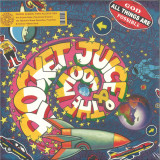
High up in the skies, amongst the clouds, Rocket Juice & The Moon was born. Literally. It happened back in 2008, when Damon Albarn, Flea and Tony Allen convened on the same Lagos flight, to play and exchange musical ideas in that city as part of the Africa Express collective. Relishing a shared enthusiasm for one another's work, and bonding immediately, there and then the triumvirate laid down the blueprint for Rocket Juice.
Still, more than a year passed before conditions were set for three weeks together at Albarn's West London studio, recording and refining two-dozen startlingly out and deeply funky instrumental grooves. The next stage was to invite onboard some extremely talented friends, with further sessions in Dallas, New York, Chicago and Paris... Erykah Badu, no less, queen of contemporary soul. Three companions from Africa Express: Malian singer Fatoumata Diawara, whose debut album has topped World Music charts since its release last Autumn; her multi-talented compatriot Cheick Tidiane Seck, whose prodigious keyboardism has lit up releases by artists ranging from Youssou N'Dour to Hank Jones; the young, Ghanaian rapper M.anifest, quizzically existential, switching seamlessly between Twi and English. And the Hypnotic Brass Ensemble, long-time stalwarts in the Honest Jon's set-up — since one of the team discovered them busking near the shop in Portobello Road, on his lunchbreak — with a second album for the label due in May... Finally, the tracks were dispatched for mixing to Berlin, to be meticulously honed, polished and envenomed by Mark Ernestus, one half of the legendary Basic Channel and Rhythm & Sound partnerships.
The result is Rocket Juice & The Moon — out March 26, 2012, on Honest Jon's Records — a triumphant exploration and proliferation of kinetic Afro-funk rhythms: organic, exuberant, communal music-making, evidenced by the project's live debut on stage as part of the Honest Jon's Chop Up in late 2011, which hit London, Marseille, Dublin, and Cork to such great acclaim (witness the flurry of smart-phone film-clips uploaded in the days thereafter).
From the inaugural bars — that absurdly funky slice of instructional timekeeping, 1-2-3-4-5-6 — the liquid pulse of Fela Kuti's classic recordings drives the action through a suite of 18 shape-shifting compositions. The greatest drummer in the world has never sounded so good as he does here. His intricate cross-patterns jostle and lock with Flea's nimble, rumbling bass riffs. Joined by Seck on There and Extinguished — 'when you dispose of something burning, be sure it's out' — Albarn's keyboards spray synth fusillades up top, over, and under... splicing into the mess of wires running between the freaked Afro-disco of William Onyeabor and the space-jazz-moog of Sun Ra. The HBE brings extra intensity and drama to Leave-Taking — likewise Flea's trumpet to Rotary Connection — teasing out the haunting melody coiled in the mix.
Where the best of vintage Afrobeat sides sustained their concentrated energies over the course of sprawling, marathon jams, RJ & TM manages something altogether different: the group bottles the idiom into capsules of funk... and real songs. Beautifully buoyed by Erykah Badu's unmistakable vocals, Hey, Shooter brilliantly traverses metaphysical spaceways sans any semblance of noodling. Lolo and Follow-Fashion — featuring the open-hearted sensuality of Diawara's singing, M.anifest's quick, brawny science, and more brass blasts — play like its musical cousins or codas. Indeed, the album's shrewd sequencing creates the composite effect of tracks working both individually or within the context of an extended song-cycle.
The lovely ballad, Poison, is bittersweet and ruminative: 'If you're looking for love, beware the signs / They will paralyze you one by one / Poison, it will only break your heart.' Down-tempo and dubby, Check Out and Worries amplify the range of styles and moods. And by the time of Fatherless — a chugging Afro blues that evokes John Lee Hooker lost in Lagos, one gets the sneaking suspicion there's very little outside the reach of this collective's inventive musical grasp.
There is, in fact, a palpable openness pervading Rocket Juice & The Moon — the sense of a limber willingness to follow creative impulse — right down to how the group acquired its name. When Ogunajo Ademola — the Lagotian commissioned to do the album's cover artwork — dubbed his submission 'Rocket Juice & The Moon', it quickly morphed into the formal name of the project, like trying to hold onto mercury.
Surely, the stars above also approved.
Kenny Gino and Big Mike a.k.a. the Solid Gold Playaz both started playing records in the late 70's/early 80's. Having family from Chicago, who were DJ's and down with some of the big guys at the time, "heavily influenced our music and production styles" both say. "Living so close to the city, we could go down to all the legendary night spots. The Rainbow and the Warehouse, the Box, the Shelter... places where you could just feel the vibe. And you could hear guys like Farley Funkin' Keith, Ron Hardy, and Jammin' Gerald (the Chicago DJ/producer who is Kenny's cousin) play these incredible records". They both were hooked on the house sound, and would bring it back to their home, a small city named Racine, Wisconsin, located about an hour and half north of Chicago. They continued to develop their DJ and production skills into the 90's, but musically, weren't taking things very seriously until they met Chicago producer Louis Bell. He introduced them to many of the people who were building the mid-90's Chicago sound. "Louis gave us access... access to places we hadn't been before. He took us into the offices of Cajual/Relief Records and Underground Construction, and suddenly we were face to face with guys who were doing what we wanted to do... Cajmere, Paul Johnson, Glenn Underground... showing us that we could do this too. We did a few releases just to get our name out, and soon we had some pretty big named DJ's playing our music. We had DJ's actually looking for our records, and telling us how much they liked our sounds... that just blew us away, especially with very little promotion and in the limited numbers we were pressing... our music just started to build a name for itself."