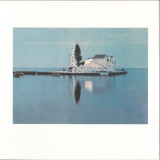
Imaginative re-workings and improvisations by Andrew Tuttle of the late great Michael Chapman's unfinished instrumental album. Sonic explorations that bridge the Southern and Northern Hemisphere via the Caribbean, remote Northumberland and sub-tropical Australia. Navigating calm seas and turbulent waters of ambient corals, new-age pirates, waves of lapping banjos and drifting eroding guitars.
When Michael Chapman passed away in September of 2021, at the age of 80, he did so – as he spent much of his life – as both a pioneer and a legend. A veteran of the British blues/folk/jazz scene, Chapman emerged in 1966 and continued working throughout his life, always pushing the boundaries of his creations while collaborating with a slew of similarly heralded musicians along the way: Bert Jansch, Mick Ronson, Elton John, Thurston Moore, Steve Gunn; to name just a smattering of those he worked alongside over the years.
It's the latter of those – Brooklyn guitarist and songwriter Steve Gunn – who Chapman flourished alongside in recent years, the two collaborating on 50 and True North, two of Chapman’s final and finest records. It was through that friendship that Chapman’s music found Andrew Tuttle, the Brisbane-based multi-instrumentalist who has toured Australia several times alongside Gunn.
In the aftermath of Chapman’s passing, his partner Andru discovered Tuttle’s Fleeting Adventure LP, describing it as “one of the albums that kept me sane during that first brutal winter on my own.” The pair met in Australia shortly after, and before Andru had even made it back home to the north of England, Tuttle had begun working on the recordings she shared with him at that time. Those recordings were part of a project Chapman was working on at the time of his death, called Another Fish – what would have been a companion piece to his previously-released LP, simply called Fish.
Though Chapman had spent time in his local studio playing all the guitars, layering the different sounds and effects, he’d always intended to do much more work on the songs, however fate had its way and he never got to ribbon-bow those ideas and bring the album to its conclusion.
Though there was little intention in terms of how to finalise the project, Tuttle spent valuable time with those recordings. What materialised, eventually - with time, care, and diligent attention - is a two-disc set Another Tide, Another Fish, something both unusual and completely distinctive. The first disc, Another Tide is centred around Tuttle’s own work, which shaped all seven of Michael’s songs and ideas into new songs of their own, and the second disc which simply incorporates the recordings that Michael left behind.
“On all of the tracks I also ‘played along’ on banjo to the originals several times until I learned an approximation,” Tuttle continues. “This ended up resulting in a ‘hybrid’, where some works are easily identifiable to those who know Michael’s originals, and some took that inspiration to head altogether elsewhere. Each of the tracks, even where not obvious, does have at the very least a trace element sample of the original recordings so that it’s a true collaboration.”
What we’re left with is indeed a hybrid: part remix album, part cover album, both a solo work and a collaboration, of sorts. Inspired by Chapman’s original ideas and with new track titles directly referencing the numbered but otherwise untitled source material, Tuttle adds his own flashes of colours throughout, including editing, sampling, MIDI transposing and signal processing that twists these songs into beautiful new shapes. Perhaps Tuttle’s greatest achievement here then is that Another Tide sounds so effortlessly free of all this context.
Whether you know Michael’s, Andrew’s or even Andru’s story or not, these recordings will bristle with enchantment and intrigue, worlds are built, and while some thrive and grow, others fizzle out in a burst of light, such is the way. “It's been a long, long road but we got there and I think it's been more than worth it,” Andru says in the record’s liner notes. “I really hope you think the journey was worth it too.”
Guitars and effects by Michael Chapman recorded by Alex Warnes at Phoenix Studio, Brampton, Cumbria, 2017 Banjo, effects and edits by Andrew Tuttle at Bella Vista, Brisbane / Meanjin, 2023-2024
Suche:howe
Smutty Edits is the brainchild of Jeroen Van der Smut, a music aficionado who after indulging himself in kilos of Gouda Cheese, Fritjes with Mayo and Ban-cakes, left Amsterdam over 30 years ago for Anjuna Beach in India. Jeroen quickly got into Raving in the world of Goa Trance and electronic music. However, his love for Disco, Synth-Pop, and New Wave, where his musical journey began, brought him back to his roots. This passion led to the creation of Smutty Edits, as he decided to release carefully chosen edits from some of the most talented artists in the industry.
This first 12” features contributions from renowned artists who have left an indelible mark on the music scene. These collaborations ensure that each edit is of the highest quality, maintaining the integrity and spirit of the original tracks while adding a fresh perspective.
With occasional trips to Europe to reconnect with family and old friends, Jeroen remains deeply rooted in his heritage while continually seeking out new musical inspirations. Smutty Edits is set to release a series of records, each showcasing the label’s dedication to quality and innovation in Italo, Proto-House, Synth-Pop etc
"Allegra Krieger’s ""Art of the Unseen Infinity Machine"", her second full-length album with Double Double Whammy, is a collection of 12 songs that pick at the fragile membrane between life and death.
Krieger’s previous album, ""I Keep My Feet on the Fragile Plane"", hewed more closely to the domestic spaces of city and mind. Rolling Stone regarded the album as “ten songs of heady philosophical meanderings packed with emotional dynamite,” and likened her “finely phrased lyrics” to those of “Joni Mitchell, Leonard Cohen, and David Berman.” Krieger’s existential meditations remain on ""Art of the Unseen Infinity Machine"", however her meandering melodies have taken on a stronger sense of direction. She narrates candidly and assertively; the full-band arrangements never overpower, only offer a robust platform on which Krieger’s voice reaches new heights.
The full band brings a heightened sense of drama to the album’s arrangements, which contrasts the quieter approach of Krieger’s previous LP. There are noisy interludes, jazz-inflected discursions, impactful stops and starts, and occasional spaces for Krieger to stretch out her impressive vocal range (most prominently at the dazzling climax of album stand out “Came”). In ""Art of the Unseen Infinity Machine"", Krieger invites us to a place where transfiguration is not only possible but actively happening. From this place, the beautiful and the banal and the terrible are all laid out before us. And Krieger asks us not to look away. Instead, she invites us to stare down the beautiful and terrible in the world, and to realize that sometimes the only way out is through."
- A1: Welcome (Feat. Brittney Carte)
- A2: All Live (Feat. Abstract Orchestra)
- A3: All Live Pt. 2 (Feat. Sango, Phat Kat, & Daru Jones)
- A4: To The Disco (Feat. Abstract Orchestra)
- A5: Yeah Yeah (Feat. Karriem Riggins)
- A6: Just Like You (Feat. Larry June & The Dramatics)
- A7: F.u.n
- B1: Request (Feat. Abstract Orchestra & Earlly Mac)
- B2: So Superb (Feat. Cordae & Earlly Mac)
- B3: Keep Dreaming (Feat. Karriem Riggins & Fat Ray)
- B4: Factor (Feat. Elijah Fox & Eric Roberson)
- B5: Since 92 (Feat. Robert Glasper)
The latest full length album from Detroit mainstays Slum Village, F.U.N., has now made its way to vinyl. The 12-track project is their first album in nearly ten years and includes fresh collaborations with Larry June, Cordae, Eric Roberson, Robert Glasper , Karriem Riggins, Abstract Orchestra, Sango, Phat Kat, Daru Jones, Earlly Mac, The Dramatics and more. 2015's critically acclaimed Yes! further cemented T3 and Young RJ's ability to effectively carry on the legacy of the seminal rap group, retaining its essence while evolving its sound with fresh new energy. However, with last year's sold out tour in Europe, and the release of the Larry June and The Dramatics-assisted "Just Like You", it was revealed that the duo was back in the lab together working on a new Slum Village album. F.U.N. finds Slum Village expanding on their signature certain sound, but still staying close to their hometown roots: Young RJ explains- “We wanted to just try something new, so we focused on making Disco-inspired music,” and T3 notes that the recording process all “began with collecting old Disco records.” For fans who wonder why the sonic shift, and why the long hiatus between proper albums, T3 says “Slum is still here. We’re still relevant and we’re still trying to push the envelope. Sometimes people put too many rules on music, and without sounding cliche, we wanted to just have fun with this album.” F.U.N., indeed.
Born in Los Angeles in the early 1990s via a residency of week after week jam sessions at a dive club called Raji’s—then relocating to New Orleans—the band’s trajectory lasted about a decade and ended when Hurricane Katrina demolished their homes and the band members scattered. Key members included Vicki Peterson (Bangles), Susan Cowsill (The Cowsills), Peter Holsapple (The dBs, R.E.M.), and many more—including the only member who has been with them from the beginning, Mark Walton (Giant Sand, The Dream Syndicate). However, there were also several singer/songwriters (Carlo Nuccio, Gary Eaton, Ray Ganucheau) without an impressive pedigree that shine as brightly as their slightly more famous bandmates. The best possible comparison that we can make is that the Continental Drifters had a similar vibe to the classic roots combo Delaney & Bonnie & Friends—more of a “collective’ than a band—in which there were several distinctly original lead singers, blistering sidemen instrumentalists and an inspiring blend of both original and seminal cover songs with a southern fried blue-eyed soul approach that couldn’t be beat.
Formed in London in 1976, The Damned became one of the most groundbreaking and influential bands coming out of the 70s British punk rock scene. Their debut single “New Rose” (1976) is considered the first punk single to be ever released in the UK. Throughout their impressive 45+ year career (and counting), The Damned have experimented with various musical styles, incorporating elements of gothic rock, psychedelia, and new wave into their sound. In October 2020, over 40 years after the founding members parted ways, The Damned announced a series of reunion shows with the original line-up consisting of Dave Vanian (vocals), Brian James (guitar), Captain Sensible (bass), and Rat Scabies (drums). However, due to the pandemic, they were forced to postpone the shows until 2022. November 3rd, 2022, saw the band performing at the fully packed O2 Apollo in Manchester, UK, delivering an energetic 21-song set drawn from the first two albums, the 1977’s “Damned Damned Damned” and “Music for Pleasure”, the only albums to feature the four founding members. This legendary reunion show is captured on the worldwide release “AD 2022 – Live In Manchester” which perfectly portrays the unique magic around The Damned.
Admittedly, I'm not a great salesperson when it comes to running our little label. I do my best not to give into hyperbole or build something up too intensely if someone has not heard a new artist yet. I prefer to simply present the music and let the listener decide how they feel about it. However, we live in an age when the "story" put together by publicists, labels, and managers are often the driving force of an artist's ascension into the zeitgeist. And for me, that's always felt rather artificial, even when the narrative is genuine. But every once in a while, a project comes along that takes on a life of its own. And I can say without a doubt that the growth of Pale Jay's reach since we first started working with him has little to do with conjured narratives or clever marketing, but more to do with how the music makes the listener feel. It's that simple. In fact, Jay is so enigmatic and without a narrative that the mere absence of a story has become the story. Who is he? Where is he from? What's next? Some questions are better left unanswered in my opinion, my friend. Including the question, "Why does this music make me feel so much?" You're better off just sitting back, disconnecting, and letting Low End Love Songs by Pale Jay wrap you up. Enjoy and spread the good word. - Terry Cole
"Low End Love Songs", more so than previous releases, is a diary in form of song. I knew I just had to wait for the songs to be ready to be picked, like ripe fruit from a tree. Each tune encapsulates a distinct moment in my life, with music serving as my means of processing complex and sometimes conflicting emotions. In this album, I depart from loop-based song structures towards more intricate and lush compositions. Latin influences permeate the music, adding new layers of rhythms and textures to my soul-music roots. - Pale Jay
Cantoma’s new album, “See In The Sun” feels like the welcome return of an old friend. This sensation perhaps reflecting the recording, which found Phil Mison working with a team of trusted talent. More than 20 singers, players and engineers were involved , including Quinn Lamont Luke , Luna Asteri, Robin Twelftree , Justin Drake , Andre Espeut, Robin Lee, Patrick `Dawes, Gizelle Smith and Audun Waage. Collectively they’ve created 10 tracks - joyful jams between accordion, flute, and kalimba, Reeds, orchestral strings, brass, bongos, and Spanish guitar.
The LP possesses fewer introspective moments than its predecessors. The music, on the whole, is moving its feet. Making its way toward a twilight dance floor. There’s also an emphasis on “proper” songs. Lyrics are sung, and spoken, in English, Spanish and Japanese. Their predominate themes are friendship, togetherness and love.
Unashamedly optimistic in its outlook, “See In The Sun” seems to wish only the very best for everyone. Phil says he never planned it that way, it just happened. Perhaps a consequence of all the friends gathered. However, this message comes at a point when the world is poised, hoping, more than ready for positive change.
Robert Harris - Ban Ban Ton Ton.
Christian Schoppik aka Läuten der Seele brings his “Water” trilogy to a close with his new album ‘Die Reise zur Monsalwäsche’ (The Journey to Monsalwäsche) following up ‘Die Mariengrotte als Trinkwasseraufbereitungsanlage’ (2022, Hands in the Dark) and ‘Ertrunken im seichtesten Gewässer’ (2023, World of Echo).
This final instalment takes the listener on a sacred odyssey searching for the fulfilment of one's (or is it his own?) spiritual destiny, from beginning (‘Entschluss, Abschied & Aufbruch’ / ‘Decision, Farewell & Departure’) to end (‘Verirrung, Ankunft & Erlösung’ / ‘Losing Way, Arrival & Salvation’).
While the compositional technique of this opus still relies primarily on samples and altered audio-collages, each chapter of the trilogy was intentionally created from very different sources. The present collection is arguably less "experimental" than some of Läuten der Seele's previous works, as classical music takes center stage this time. However the mastery in crafting such magnificent and intriguing narratives sees the simplicity and emotional depth of these sonic mariages become the beauty of it all.
Schoppik remains consistent as ever in his creative explorations, and this release feels very much like a culmination of his past projects. “Die Reise zur Monsalwäsche” will probably come to be known as a standout entry in the German artist's music catalog, showcasing a new facet of his talent.
Rain and experimental music have had an interesting connection for decades. Under the umbrella of American film music promotion, Hanns Eisler was already looking for "Vierzehn Arten, den Regen zu beschreiben” (fourteen ways to describe the rain) in 1941. A good 20 years later, The Cascades interpreted the periodicity of rain as a rhythm of mourning. For the Beatles ("If the rain falls, they run and hide their heads"), the precipitation inspired the band to use backward running tapes. However, it seems that there has always been a lot of rainfall in popular music. In the early seventies, David Toop and Paul Burwell even had a band project with the great name Rain In The Face...
That was a long time ago and today, rain, which in the age of climate catastrophe mainly occurs as heavy rain or an enervating endless loop, has lost a great deal of its inspiring quality. Perhaps as a reminder of the musical quality of rain, but knowing full well that it can only be enjoyed in theory, Razen call their new album "Rain Without Rain". In the music of the Brussels collective led by the two multi-instrumentalists Brecht Ameel and Kim Delcour, it certainly pours down on the roofs. In fact, the album opens with the sound of pouring rain before we hear the sequence of an oscillator played through a guitar amp on the first track „Lazy, Lazy Eye“.
The album is the captivating result of an one-night mobile studio field recording in an abandoned pedestrian tunnel in the centre of Düsseldorf, and it is finding beauty with brutal(ist) means: recorder, oscillator, guitar amp and reverberation, two musicians and four microphones, early electronics versus Early Music. “Suicide meet Hildegard von Bingen”, as Stefan Schneider, who recorded the session, admits. “Ghostly occurrences”, he adds.
Brecht Ameel states: “We do put a lot of weight and care on acoustics. On some of our recordings, the room acts as another band member, or as the main ‘mixing board’. Most of the albums we have recorded so far are not mixed in the traditional sense: they are simply „captured”, and we let the room decide what is left on the tapes. The studio recordings, then, give us the possibility of bringing other elements to the fore; precision of interplay, or tiny variations in breathing.”
The group Razen exists since 2010 and has since released numerous records on labels such as KRAAK, Marionette and Hands In The Dark. "Rain Without Rain" is their debut on the Düsseldorf label TAL. If there has been an increased international interest in experimental music from Belgium in recent years, this is not least due to musician collectives such as Razen. In terms of its electro-folkloristic intensity and instrumentation, Razen's music is quite unique worldwide. What does Razen actually mean? “We took the word from a poem by Paul Van Ostaijen, not specifically because of its meaning but because of the way it looked on paper”, Ameel explains. “But the meaning goes in the direction of ‘thundering / raging / speeding’ … although we prefer playing with a strong notion of restraint, building our world from (and with) silence.”
Olaf Karnik, Köln 2024
Lukas de Clerck brings us the ancient greek instrument, the aulos, of which his new interpretation of long form expression is coaxed forth on this tremendous recording. Lukas de Clerck explores a niche of archaeological research in music; the aulos is a historical Greek instrument that Lukas analyzed and reinterpreted by a luthier in modern times_navigating this impression as an artwork or living sculptural object, as there is an absence of historical partitions or written information about how to recreate technique on the instrument. Lukas de Clerck has interpreted information from the rare archaeological resources and visual art of the classical Greek period to recreate both playing technique and possible sound timbres with the instrument. With his contemporary approach to drone, post-minimalist music, and contemporary folk, we find a deeply satisfying and compelling, even playful set of songs, timbral exercises and compositions. An important document of new music meets contemporary archaemusicological research via Stephen O'Malley of SUNN O)))'s label Ideologic Organ. _ The telescopic aulos is speculative: might it have existed? It takes on features from the historical aulos, a double-reed instrument of which we know how it looked but little about what music was played on it or how it would have really sounded. It's an instrument without the limitations of canon or manual, providing creative freedom and awakening curiosity. The new instrument featured on this album is ancient and futuristic at once. The aulos has no tone holes; instead, each of the two tubes consists of three parts that can slide into each other. In this sense, the metal pipes bear a certain resemblance to the principle of a trombone. However, since both hands are already in use to hold both tubes, the sliding has to be done by way of gravity and the help of a «phorbeia», a leather mask which helps keep the reeds in place. The aulos's material is metal (instead of wood), which gives it a certain electronic allure and intensity, as well as a variety of sonic possibilities and textures. It produces overtones efficiently and allows them to play with their microtonality. The aulos Lukas plays on this recording was developed at Brasserie Atlas, a temporary occupation of a former brewery in the heart of Brussels where Lukas lives. It is quite a poetic coincidence that the birthplace of the instrument is named after the Greek titan condemned to carry the sky, while this instrument needs to be turned skywards to lower its pitch with the help of gravity. At Brasserie Atlas, Lukas has found collaborators who have shared in the process of building this new instrument: the collective Noir Métal has constructed the tubes, in this way becoming instrument builders; the phorbeia has been manufactured by Jot Fau; a former water reservoir in the vast cellar of the building carried the instruments' resonance for its first sounds. The place has left an imprint on this new instrument. With all of the telescopic aulos' layers, its sonic, musical and extra-musical components are still unfolding their potential as a medium for discovery and research, next to being an instrument of great musical potential. The music on The Telescopic Aulos of Atlas reflects this spirit. In several miniature pieces, it presents an encyclopaedia of musical possibilities that the instrument offers while keeping an intense and corporeal sonic specificity. The short pieces are studies that reflect on the sonic possibilities of this instrument that are yet to be explored. It meanders, searches and interacts with itself and the space. It needs to answer common expectations of old instruments being harmonious or pleasing. It transports a kind of experimental archaeology that, by formulating hypotheses in the present, allows us to reflect on what might have been in the past and simultaneously questions concepts of beauty, harmony or virtuosity. However, in the end, this instrument might have never existed before. -Julia Eckhardt
Admittedly, I'm not a great salesperson when it comes to running our little label. I do my best not to give into hyperbole or build something up too intensely if someone has not heard a new artist yet. I prefer to simply present the music and let the listener decide how they feel about it. However, we live in an age when the "story" put together by publicists, labels, and managers are often the driving force of an artist's ascension into the zeitgeist. And for me, that's always felt rather artificial, even when the narrative is genuine. But every once in a while, a project comes along that takes on a life of its own. And I can say without a doubt that the growth of Pale Jay's reach since we first started working with him has little to do with conjured narratives or clever marketing, but more to do with how the music makes the listener feel. It's that simple. In fact, Jay is so enigmatic and without a narrative that the mere absence of a story has become the story. Who is he? Where is he from? What's next? Some questions are better left unanswered in my opinion, my friend. Including the question, "Why does this music make me feel so much?" You're better off just sitting back, disconnecting, and letting Low End Love Songs by Pale Jay wrap you up. Enjoy and spread the good word. - Terry Cole
"Low End Love Songs", more so than previous releases, is a diary in form of song. I knew I just had to wait for the songs to be ready to be picked, like ripe fruit from a tree. Each tune encapsulates a distinct moment in my life, with music serving as my means of processing complex and sometimes conflicting emotions. In this album, I depart from loop-based song structures towards more intricate and lush compositions. Latin influences permeate the music, adding new layers of rhythms and textures to my soul-music roots. - Pale Jay
- 01: Johnny April - She Had A Pikanese (Feat. Mat Matthews Quartet)
- 02: Lu Elliott - Common Sense
- 03: Lloyd Fatman - No Big Thing (Pt.1&Amp;2)
- 04: Billy J - Teacher Teach Me
- 05: Wayne Johnson - Scram Gravy Ain&Apos;T Wavy (Feat. Brigade)
- 06: 4 Dimensions - Hipper Snapper
- 07: The Villagers - Funky Broadway
- 08: The Rippers - Honesty
- 09: Exceptional Citizens Band - Proud Mary
- 10: Gus Brendel - Sax On The Rocks
- 11: The Hornets - Seven Days To Tahiti
- 12: Bret Breitinger - Jive Samba
- 13: Downtown Trio - Summertime
- 14: Onyx - Break It Loose (Pt.1)
- 15: The Shake And Bake Band - Shake And Bake (Pt.1&Amp;2)
- 16: Lou Jackson - Outside Looking In
- 17: Energy Crisis - Tough Times Blues
- 18: Soul Unlimited - Do It
- 19: Soul Unlimited - Darkside Of Town
** INITIAL 400 LPs CONTAIN A BONUS 7" SINGLE **
MOVEMENTS Vol.12 – A bag full of rare rhythm & blues, mod-jazz, and mid 70s funk.
Side A starts with rhythm & blues from the 1960s. Most of the tracks were pulled from hopelessly obscure 7" singles. The only names of which some of you might be familiar with are most likely Mat Mathews and Lu Elliott. However, both original 45 RPM singles are pretty hard to find these days, especially in playable condition.
Side B is all about deepfunk this time. "Hipper Snapper " is a prime example of that genre. Some say its groove is reminiscent of Charles Wright's "Express Yourself. Agreed! The Villagers are responsible for the first 'aha' moment. Their (previously unreleased!) version of "Funky Broadway" would have certainly astounded even Dyke & The Blazers. Representing Germany on this volume: The Rippers, also called the "Offenburg Beatles"! Back in the USA, John Fogerty has probably never heard of this heavy school-funk cover of "Proud Mary". Drum breaks galore!
Side C begins with another German contribution. Saxophonist Gus Brendel delivers a mod-jazz belter of the highest order as do The Hornets. Definitely sure-shots for any dance floors! High time for 'aha' moment #2. Many bands have tried their hands on a cover version of the Nat Adderley jazz classic, incl. vibraphone player Bret Breitinger! The perfect choice to finish this side is Downtown Trio's smooth and groovy cover of Gershwin's "Summertime ".
Side D is reserved for proper 1970s funk. ONYX's "Break It Loose " has become a certified Rare Groove classic. Here you can enjoy it for the first time with the blessing of the band! Glenn Doughty and his Baltimore Colts Shake and Bake Band of the 70's is the first musical group consisting of former NFL All-Pro players that Tramp Records has partnered with in its history! Watch out, "Shake and Bake " will be re-released on a good old 45 RPM single, too!
Those of you who have been enjoying the detective work of the people behind the label over the past 21 years know that the Movements series can be easily considered as the flagship compilation series on Tramp. So, after having listened to the entire selection of this brand new volume we sincerely hope that we will have achieved our aim to surprise, delight, and enlighten you once again!
Key selling points:
- initial 400 LPs contain a bonus 7" of a SUPERRARE funk 45
- incl. full album download code
- deluxe double-gatefold LP with detailed liner notes & unseen photographs
- ALL but three songs appear on CD, LP & digital for the very first-time
If there's one musician in the last decade that you may hear in wildly diverse musical contexts it is Belgian electric bassist and sound sculptor Farida Amadou. Not only can you enjoy the unerringly skillful command she has over her instrument but also the transformative power to reinterpret and expand her material in spontaneous and unconventional ways.
Amadou is self-taught and radically aware of her idiosyncratic relationship with the bass guitar. She neither emulates the virtuosos of the electric bass, nor does she use the instrument as a pure sound generator that merely emits humming and feedback. She takes a completely independent and unique approach. This freedom enables her to create an overwhelming wall of sound, as well as simple, clear structures that are rhythmically concise yielding a wide associative space that lands somewhere between free jazz and noise.
Her work is often concentrated and circular where motifs are established and developed outward. It is an organic sound in the literal sense of the word, constantly in motion, yet resting in itself. The three solo pieces she has recorded for Week-End Records emphasize her impressive ability to ignite ecstasy from tranquility, to fan out a whole range of moods from a few potent ideas.
These attributes make her a musician who enriches every group she plays in, because she is present with her assured and crystallized sound but refrains from being domineering. However, her strengths are even more apparent when she plays solo: the contrasts between the dark, heavy clouds of sound and the rhythmic passages, and the transitions between movements which always sound "logical" yet surprising.
Her new solo album, "When It Rains It Pours" presents Amadou as an inspired improviser who follows her musical intuition and acumen to create a truly unique soundworld. Rarely has improvised music sounded so succinct and compelling.
Wenn es in den letzten zehn Jahren eine Musikerin gegeben hat, die man in den unterschiedlichsten musikalischen Kontexten immer wieder hören will: nicht weil sie eine passable Mitspielerin wäre, sondern weil sie diese Kontexte jedes Mal bereichert und auf spontane, unkonventionelle Weise erweitert, umdeutet, in neue transformiert, dann ist es die belgische E-Bassistin und Klangskulpteurin Farida Amadou.
Sie ist Autodidaktin - und sie versteht diese Selbstaneignung des Instruments radikal. Weder eifert sie den Virtuosen des E-Basses nach, noch verwendet sie das Instrument als reinen Klangerzeuger, der bloß Brummen und Feedbacks von sich gibt. Sie geht von einem völlig eigenständigen Ansatz aus. Der ermöglicht es ihr, eine überwältigende Wall of Sound zu kreieren genauso wie einfache, klare Strukturen, die rhythmisch prägnant sind und einen weiten Assoziationsraum zwischen Free Jazz und Noise eröffnen.
Ihre Musik ist konzentriert, hat einen langen Atem, kreist um Motive, entwickelt daraus neue Linien, die Amadou im Spiel weiterverfolgt. Es ist ein im Wortsinne organischer Sound, ständig in Bewegung, dabei in sich ruhend. Die Stücke, die sie für Week-End Records aufgenommen hat, unterstreichen ihre beeindruckende Fähigkeit, aus der Ruhe die Ekstase zu entfachen, aus wenigen Ideen eine ganze Palette an Stimmungen aufzufächern.
Das macht sie zu einer Musikerin, die jede Gruppe, in der sie spielt, bereichert, weil sie präsent ist, ohne zu dominieren, weil ihr Sound so prägnant ist, ohne die anderen zu übertönen. Im Solo treten die Stärken ihres Spiels aber noch stärker hervor: die Kontraste zwischen zwischen dunklen, schweren Klangwolken und den rhythmischen Passagen, vor allem die Übergänge, die immer „logisch“ klingen, aber zunächst unerwartet kommen und ihren eigenen Weg einschlagen. Ihr neues Solo-Album, “When It Rains It Pours” zeigt sie als inspirierte Improvisatorin, die sich nie bloß ihren Einfällen hingibt, sondern die Ideen zu Ende denkt, oder besser: spielt. Selten klang improvisierte Musik so kompakt und zwingend.
Coming out on September 6th on Sharptone Records, Sundiver is Boston Manor’s fifth album and one that represents a glimmering dawn for the Blackpool five-piece. Grown from a seedbed of optimism and sobriety, the LP celebrates new beginnings, second chances and rebirth. With two members recently stepping into fatherhood, hope is baked into every note. “Datura came out of these really dark few years over the hangover of the pandemic,” Henry reflects. “I'd been struggling a lot with drinking and not taking care of myself and bad mental health and stuff. We wanted Sundiver to be the next morning of the following day.” He explains that it feels good this time round to write through the lens of positivity. “The themes began to emerge, of rebirth, spring, dawn, sunshine and then other elements just started to fit into that.” It was during the making of Sundiver that Henry found out he was going to be a dad. This album is a significant one for the band. Originally coming out of the emo and pop punk scene, they’ve explored sonics and genres throughout their career, taken risks and achieved more than they could ever had dreamed of. They’ve grown up as Boston Manor – their lives and the world changing around them. They’re now taking stock, at a crossroads of the band they were and the band they could be.
While writing the album, they revisited the bands that shaped them in the late 90s and early 00s. “I was listening to the music I loved when I was a teenager and I just thought, why don't we make music like our favourite bands?”, guitarist Mike Cuniff remembers with a smile. “So we brought our interests to the table that way. Y2K kind of vibe. There are elements of Deftones, there are elements of Portishead in there, some Garbage, The Cardigans.” He laughs and adds NSYNC to the list of inspirations. From this cocktail of classics comes a dynamic and ambitious record, rich with depth, groove and more hooks than Peter Pan’s nightmares. Lyrics that foxtrot from parallel universes to personal growth, vivid dreamscapes to raw grief. Individually they’re single strokes full of meaning and magic. Together they’re a landscape.
Container (out Feb 15th) is the first single and it’s them at their best – impassioned and infectious. “This song is about the stagnancy of life creeping up on you & how that can bring about change.,” Henry explains, citing Ocean Song by US band Daughters as an inspiration.
The concept of the butterfly effect is present on Sundiver – how small actions can lead to big changes. This is no clearer than on their second single, Sliding Doors (out April 5th). It has the golden sound of late 90s Lollapalooza rock – think Smashing Pumpkins - rebooted with crisp 2024 production and a potent heaviness. In the lyrics Henry wonders, what if?, pondering on what could be. The idea that there are infinite versions of you whose lives splinter off in different directions at every decision you make. That there’s another you out there somewhere right now reading this sentence, and another me writing it. “So much is down to chance and circumstance,” Henry says. “You might catch that train and your life totally changes. Or you might miss it and things stay the way they are.”
Heat Me Up (out May 30th) is defiant and victorious, the audio equivalent of quitting your shit job and driving into the hot summer sun with a head full of dreams. “The lyrics are about love and gratitude,” Henry shares. “Another theme on the record is just appreciating what you have. It’s about not taking for granted the things that you've been afforded.”
There was some natural magic in the creation of Sundiver. They worked with their usual producer, Larry Hibbitt, and engineer, Alex O’Donovan, but instead of recording in London again they ended up in the green pastures of Welwyn Garden City. “Because Larry lives out in the countryside now, it was a way different environment and way different experience recording this time,” Mike remembers. “That contributed a lot to the brighter sound of the record.” The daily barbecues they had during their recording sessions imbued the process with harmony – five old friends spending quality time together and making quality music.
However, the album is by no means one-note. Birthing this new world they’ve created wasn’t without it’s pain, and that can be heard in the heavier moments on Sundiver. What Is Taken Will Never Be Lost is the most-stripped back on the album, a slow rock number seasoned with the downtempo Portishead influence. The heartfelt lyrics are Henry’s way of processing the loss of his grandfather, who died in a hospice last year(?). “It was just fucking horrible. It was always cold when I went there and they were always trying to get rid of me. The song title, What Was Taken Can Ever Be Lost, is the idea of his memory fading at the time because of dementia.” Henry goes onto explain that shoeboxes of photographs, diaries and a legacy is what he’s left behind. “He lived a really rich life and it has really impacted me and my father. His legacy is etched into the fabric of history in a very small way.” This song continues the connection between his grandfather and the band, as his painted face is emblazoned on the cover of the very first Boston Manor EP, Driftwood. As well as emotionally heavy themes, there’s heaviness in the music of Sundiver too. The closing song, Oil In My Blood, descends into an intense shoegaze outro with Debbie Gough from Heriot screaming hellfire. It’s in moments like this that the band show us aggression and fury can be as much a part of positive change as quiet introspection. The last lyrics of the song, “It resets and starts again,” leaves us in contemplation as the final chord rings out.
Touring the US, Europe and Japan over the years makes for an impressive CV, but if you know anything about Boston Manor you’ll know that they’re all about their hometown. Their choice to work with Blackpool-based photographer Nick Barkworth is testament to that. They’ve been working with him since the pandemic. “He captures Blackpool in a light that really reflects the weirdness and quirkiness of the town,” Henry says.” He's got a really good way of presenting that.” For the Sundiver cover, Nick photographed a 30ft tall abstract glass sculpture made by the local artist John Ditchfield. A striking and bewitching monolith that’s familiar to them but unusual to most people. “It has such kind of a gravity and power to it,” Henry describes the sculpture which stands in a field just outside of the seaside town. “It reminds me of either an explosion or a star or a supernova. To me it represents new life, power and radiance.” Boston Manor have got a knack for that - connecting the otherworldly and the everyday, the stars and the streets.
They’re a band known for using their music to make bigger statements about society. This time round they’re harnessing the uplifting power of music, and the communion it creates, as an antidote to the daily doom and isolation. “It seems like absolute chaos out there at the moment,” Henry says. “You’ve got Gaza and Israel, you've got Russia, you've got the fact that 40% of the world is going to have an election this year and increasingly most governments are leaning very far to the Right. The internet is dividing everybody, people are getting poorer and more desperate. It's really, really scary.” They considered trying to tackle the weight of it all in their music. “We could’ve written Welcome to the Neighbourhood on steroids, where it's just absolute darkness and misery”. He’s referring to their 2018 concept album that deals with class, inequality and the bleaker side of Blackpool. “But I think it's really important to write something that people can be immersed in and find some sort of solace in. Somewhere they can escape to from the modern day pressures and everything that’s going on. We’re all in this together.”
Maurizio 'Angus' Bidoli's brilliant 'Diary Of Dreams' was issued in 1998 as a very limited CD only release given to friends and colleagues. It has never been re-issued, and therefore this is its’ first ever appearance on vinyl and official CD. Angus is a native of Rome, and has played guitar with many bands, most notably the Italian metal outfit Fingernails. However, his love for the trippier, Hendrix-inspired psych jamming has manifested itself in several solo projects, and this is a great example of that. Angus plays all the instruments on this outing, and it's his wonderful guitar playing that comes to the fore. Blue Matter are genuinely thrilled to be able to make this great album available for the first time in 25 years. We've been fans of Angus since we met him at a gig in Rome in the early 90s, and he gave us a cassette of some of his solo psych jamming. To share his talent with other like-minded souls is something we’ve wanted to do all that time, and finally we’ve been able to put out one of his projects. We truly hope you enjoy it.
Welcome to the fascinating musical universe of EXOTIC ROOSTERS! It emerges as a burst of freshness and originality, blending an eclectic variety of musical influences to create a truly unique and exciting auditory experience. Comprised of experienced and virtuosic musicians on their respective instruments, the group captivates audiences of all ages with its energy and unmistakable style. Exploring the intersection between tradition and modernity, EXOTIC ROOSTERS combines the rich soundscapes of marimba, vibraphone, double bass, percussion, and drums to create an expansive and nuanced musical landscape. From frenetic rhythms that invite dancing to captivating melodies that transport the listener on an emotional journey, each performance aims to be a celebration of cultural diversity and artistic expression.
In the relentless musical era of the late 90s, two passionate souls, Eugeni Camacho and Rafa Navarro, embarked on a unique sonic odyssey by blending the melodious marimba with the pulsating drums. Together, they successfully created STAMINA PERCUSSIO in their concerts. However, life composed its own score, separating Rafa, who was abducted by the Canary Islands, and Eugeni, who was drawn to vibrant New York. Upon their return, after years of musical exploration in different projects with the Oscars (Oscar Cuchillo and Oscar Rocher), their hearts aligned with a new melody. In the loom of destiny, they discovered the emerging talent of Bernat Cucarella. A prodigy with drumsticks and a 4.0 brain. By uniting Rafa's island experiences, Eugeni's resonant jazz from the Brooklyn alleys, and the rich musical diversity harvested in life's journeys by each of the members, they gave birth to a magical musical tale: EXOTIC ROOSTERS
At once a spiritually-charged journey and a shit-kicking party record, American Cream Band comes to Quindi covering all the bases.
American Cream Band was formed by Twin-Cities musician Nathan Nelson around 10 years ago, taking the form of improvised live shows and albums Frankensteined from these sessions into exultant, fully-formed records you can sink your teeth into. The trick with improvised music is to start with intentions, however abstract they might be, and Nelson leads his rolling cast of collaborators into the creative fray with subtle guidance which drives the impulsive musical moment forward.
The band's previous records have manifested on labels like Moon Glyph and Medium Sound, and now Presents arrives in a freewheeling flash of snappy new wave, skronky sax, call and response sass and some krautrock-minded sonic cosmology. The album came together in December 2021, when Nelson took ten musicians to legendary studio Pachyderm in Cannon Falls, Minnesota. Living together, eating together, and with Nelson quietly setting up his low-key magick intentions around Jupiter's planetary frequency and the studio's abundance of elephant statues and carpets, they laid down some drum-heavy sessions that became the building blocks of the record.
'Taste What We Taste' is the perfect example of an exuberant groove pounded on skins as a vessel for a joyous get-down, with the singers and players free to freak out on top. Nelson remains at the centre of the melee, throwing half-sardonic, half-heartfelt calls out for connection. 'Banana' celebrates nonsense and holds down the most serious of beats - a disco-not-disco deadeye dripping in late night sleaze and lysergic potential. On 'Royal Tears', the jagged guitar chops call back to Gang Of Four, while the hot n' heavy sax from Cole Pulice baits James Chance and all the other angular New York un-jazz misfits.
Amongst his other implied intentions for the recordings, Nelson wanted to channel opposites, not least the distinct male-female energies in his vocal sparring with the girls on assistance duties. It wouldn't be right to call them backing singers as they shoot back at his punchy mantras, bringing a certain fierce femininity that tips its hat to The B-52's Cindy Wilson and Kate Pierson, not to mention iconic post-punk bands like Au Pairs, Delta 5 and Bush Tetras.
There's space for the dreamier kosmische which has crept into the American Cream oeuvre in the past, as 'Sirens' opens the album up in a swirling pond of rag tag percussion and molten synths. 'Words Would Handcuff Us' cools the whole riotous assembly down in unmoored perfection, a strung-out Bossa nova seance dusted with celestial drips from analogue spaceships.
Equally treading the line between light and dark, conscious and unconscious, the sacred and profane, Presents is a life-affirming, creep-under-the-skin listening experience - a joyously transient chapter in the evolution of American Cream Band.
Love Rudiments is a meditation by Ty Segall on his first love: the drums. Known popularly as a singing guitar player, he generally starts the recording of his songs by laying down a drum track. Love Rudiments kicks off with drums and percussion then adds a few other percussive and production aspects. It travels a great journey in this configuration. However, Love Rudiments wasn"t written or performed to present as some kind of solo drums album - it"s just another music album, with vibes (figurative as well as literal), feels, a theme and a through-line. Never one to shy away from a challenge, Ty"s made an instrumental album of percussive music that rides the wild surf of a waxing-then-waning love affair - from the first blinding look, to the eventual recognition, that look back at love"s rudiments, viewed from beyond and outside that seemingly infinite sensation And why not? Drums are a melody instrument too. Ty plays them with precision and sensitivity, delving deep into the textures of timpani, vibraphone, xylophone, percussion and e-drums, all of them occupying space within the luxe stereo spread of the drum kit. In the process, a psychological space is opened - a private emotional location where only two can meet. Love Rudiments reembodies the passion and compulsion that drives all of Ty Segall"s music in a suite of moments played on orchestral batterie to explore the most delicate passages of human interaction - playing on the bones of love.