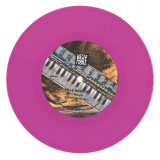
Hailu Mergia & Dahlak Band's Wede Harer Guzo is the third release on Awesome Tapes From Africa for Ethiopian keyboard and accordion maestro. In the years since Shemonmuanaye, Mergia has revamped his touring career, playing festivals and clubs worldwide, including a recent tour supporting Beirut. By 1978, Addis Ababa's nightlife was facing challenges. The ruling Derg regime imposed curfews, banning citizens from the streets after midnight until 6:00 am. But that didn't stop some people from dancing and partying through the night. Bands would play from evening until daybreak and people would stay at the clubs until curfew was lifted in the morning. One key denizen of Addis' musical golden age, Hailu Mergia, was preparing a follow-up to his seminal Tche Belew LP with the famed Walias Band. It was the band's only full-length record and it had been a success. But his Hilton house band colleagues were a bit tied up recording cassettes with different vocalists. Still Mergia, amidst recording and gigs with the Walias, was also eager to make another recording of his instrumental-focused arrangements. So he went to the nearby Ghion Hotel, another upmarket outpost with a popular nightclub. Dahlak Band was the house band at Ghion at the time. Together they made this tape Wede Harer Guzo right there in the club during the band's afternoon rehearsal meetings, with sessions lasting three days. Dahlak Band catered to a slightly more youthful, local audience, while Mergia's main gig with the Walias at Addis' swankiest hotel had a mixed audience that included wealthy Ethiopians, foreign diplomats and older folks from abroad. Therefore, their sets featured lighter fare during dinnertime and a less rollicking selection of jazz and r&b. Meanwhile, Dahlak was known more for the mainly soul and Amharic jams they served up for hours two nights a week to a younger crowd. Mergia released Wede Harer Guzo ("Journey to Harer," a city in eastern Ethiopia) with Sheba Music Shop, which was located in the Piazza district but has long since shut down. His cassette copy is the only known source we could find. Jessica Thompson at Coast Mastering managed to restore the recording to clean up layers of hiss, flutter and distorted frequencies, made worse by years of storage. Although there are some remaining sonic artifacts of the era's recording and cassette duplicating quality, this reissue captures the band's inimitable vibe. Recalling the audience's positive reaction to Wede Harer Guzo's novel arrangements, he says it sold well and found many fans. However, as no trace of the tape can be found online, there's no indication as to why the cassette appears largely forgotten until now
Поиск:howe
Все
- A1: Time Again
- A2: Wildest Dreams
- A3: One Step Closer
- B1: Roundabout
- B2: Without You
- C1: Cutting It Fine
- C2: Intersection Blues
- C3: Fanfare For The Common Man
- D1: The Smile Has Left Your Eyes
- D2: Don't Cry
- D3: In The Court Of The Crimson King
- D4: Here Comes The Feeling
- E1: Video Killed The Radio Star
- E2: The Heat Goes On
- E3: Only Time Will Tell
- F1: Sole Survivor
- F2: Ride Easy
- F3: Heat Of The Moment
Die englische Rockband ASIA, die 1981 in London
gegründet wurde, verkaufte mehrfach Platin und gilt
weltweit als Superstars. "Heat Of The Moment", eine
riesige Soft-Rock-Hymne mit anhaltendem, weltweitem
Radioerfolg, ist ihr bestes und bekanntestes Stück, das in
über einem Dutzend Ländern die Top 40 erreichte. Diese
mitreißende Live-Show mit 18 Titeln von der Welttournee
zum 25-jährigen Jubiläum von Asia im Jahr 2007 zeigt die
neu formierte Originalbesetzung mit Sänger/Bassist John
Wetton von King Crimson, Gitarrist Steve Howe und
Keyboarder Geoff Downes von Yes und Schlagzeuger
Carl Palmer von Emerson, Lake & Palmer. Das Album
wurde am 8. März 2007 in der "Shinjuku Kosei Nenkin
Hall" in Tokio, Japan, aufgenommen und erscheint
erstmals auf Vinyl.
Das Booklet dieser neuen 3LP-Veröffentlichung enthält
seltene Fotos und Anmerkungen des bekannten
Asia-Autors Dave Gallant mit Originalzitaten der
Bandmitglieder. Das Cover-Artwork stammt von dem
legendären Designer Roger Dean, der alle Original-Cover
der Asia-Alben entworfen hat. "Fantasia" ist eine
beeindruckende Erinnerung an das majestätische
Vermächtnis dieser unglaublichen Band und an den
künstlerischen Werdegang der vier Originalmitglieder von
Asia. Dieses wegweisende Konzert ist ein unverzichtbares
Set
Das Debüt-Solo-Album von Billy Howerdel (A Perfect
Circle) nun auch auf Vinyl erhältlich.
Der in New Jersey geborene und in Los Angeles
lebende Sänger, Multiinstrumentalist, Produzent und
Komponist Billy Howerdel (A Perfect Circle) hat sich in
aller Stille als Musik-Autor mit einem ausgeprägten
emotionalen Verständnis, klanglicher Schärfe und einem
Händchen für große Hooks durchgesetzt. Nachdem er
Pink Floyd live erlebt hatte, widmete er sein Leben der
Musik und arbeitete als gefragter Tournee-und
Studiotechniker für Bands wie David Bowie, Guns N'
Roses und Nine Inch Nails
Within any creative expression about love there's a shared experience, a sentiment hard to articulate but understood through emotion. One of the defining examples of a song that holds such sincerity is 'My Heart Is Broken' by 'The Four Dudes'.
Charles 'Pooky' Russell, the lead singer of 'The Four Dudes' shares his story of a broken heart; his ambition to pursue a life immersed in music is what led Charles to leave his hometown of San Antonio for Houston and in doing so, leaving his lady. Charles' music career began whilst studying at Sam Houston High during the mid-60s. During choir is where he met Reginald Whitaker & Lawrence Alexander, and the trio would go on to establish their first vocal harmony group, 'The Three Dudes'. The Dudes, inspired by groups such as The Cadillacs & The Platters, would gain a strong local following that led to their first single 'Sad Little Boy' & 'I'm Beggin' You' produced & released in 1967 on E.J. Henke's 'Satin' label.
By 1969, 'The Three Dudes' had become 'The Four Dudes' with the addition of Kenneth Ball. The Dudes had made the decision to pursue a full time career with their music and the opportunities available Houston propelled the move. Within the first year 'The Four Dudes' had found themselves a manager, James Davis, whom pieced the vocal group with Houston's own 'The Heavy Accents Band'. The group were gaining notoriety around town, performing several times a week, which led Davis to bring the outfit into the studio to release a single on his independent label, 'Sivad-J'. It was when Davis heard 'My Heart Is Broken' for the first time that they decided this would be the single, and within the same year would be recorded at SugarHill Studios & released as a 7" single.
The sincerity of the song is what serenaded Houston across the airwaves in 69', a staple for George 'Boogaloo' Frazier on his show for KYOK 1590 AM amongst many others. The single became a local hit however, due to the lack of distribution and small pressing, the single barely made it out the city limits. 'The Four Dudes' continued to perform in Houston for 3/4 more years before heading to Philadelphia and forming a group called 'Image'.
For the first time since its 1969 release, 'The Four Dudes' single is once again available through Symphonical Records as a limited 7" pressing. Licensed directly through the Davis family with the approval of Charles Russell.
"Hello It’s Me" sings Signe Marie Rustad in her crystal clear, inimitable voice. And with that, she’s back, three years after the release of her successful third album, When Words Flew Freely. The above lyric is taken from a song bearing the same name, the first single off Rustad’s fourth album, Particles of Faith. Known for her poetic lyrics and vivid songwriting, and backed by a tight knit band that’s been with her for years, Rustad’s new album offers a natural transition from the already classic When Words Flew Freely (WWFF). However, Particles of Faith also brings something completely new and fresh. WWFF presented a broader, organic and piano-driven Laurel Canyon-sound, and less of the americana sound present on Rustad’s first two releases. Particles of Faith is harder to place in any genre, other than in the broader singer-songwriter tradition, helmed by pioneers such as Joni Mitchell and Carole King. But Rustad also points to a host of other inspirations. Alternative pop/rock from the 80’s and 90’s have always been a big influence on Rustad, and on Particles of Faith, this is more evident than ever. R.E.M., Fiona Apple, Crowded House and Tori Amos were important components both in the artist’s record collection and on her TV screen via MTV. Seeing as this era was also the golden age of the saxophone, it was only natural to include a three-minute-long sax solo, courtesy of acclaimed Norwegian jazz musician Harald Lassen – a solo that “made me cry” says Rustad. The album is produced by Rustad along with indie pop hero Kenneth Ishak. “This is the music coursing through my veins,” says Rustad about the album. Rustad has been critically acclaimed ever since her 2012 debut, but with WWFF, things really took off. Rave reviews, inclusion on several year-end lists, live performance on Norway’s biggest talk show and a booking to Norway’s biggest festival followed the release. The album was awarded a Spellemann award (Norwegian Grammy) for lyricist of the year. After widespread touring since the fall of 2019, Rustad’s performance on Øyafestivalen’s main stage in August 2022, marked the wrap up of the WWFF project, while it simultaneously introduced the next chapter, announcing the new album with the performance of two new songs. The songs on the album are snapshots from a life, and “particles of faith” refers to keeping the faith in yourself, love, the people around you and the world in general throughout everything that you endure in life. It can be a kind of strength that you may think comes from the outside, but is actually found inside of us.
In the two years since their last full length outing, Let There Be Nothing, JUDICATOR have returned from collective and personal turmoil brought on by both the Covid-19 pandemic and foundational lineup changes. The US power metal group are now primed and proud to release their triumphant sixth studio album, The Majesty of Decay, via Prosthetic Records. Refreshed and revitalized, JUDICATOR are eager to let this beastly album out of the gate and into your stereos. Whilst the album’s story remains somewhat shrouded in mystery, JUDICATOR utilizes compelling plot devices as a means to encourage fans to piece together the album’s meta-contextual threads. What we do know, however, is that The Majesty of Decay explores the subjects of love, family, and the transformation of suffering into something meaningful. JUDICATOR invites you to step into this world and contemplate how the story might relate to you. The album is a carefully constructed puzzle of mirrors and metaphor that cries out for Judicator fans everywhere to solve it. What began as a humble homage to their favorite band quickly grew into something that hads fans begging for more, and JUDICATOR is happy to oblige. The band has produced a catalog of music that spans multiple sub-genres and breaks conceptual boundaries. With this latest offering, The Majesty of Decay, JUDICATOR have delivered yet another thought provoking album that fits nicely into their discography.
"Hello It’s Me" sings Signe Marie Rustad in her crystal clear, inimitable voice. And with that, she’s back, three years after the release of her successful third album, When Words Flew Freely. The above lyric is taken from a song bearing the same name, the first single off Rustad’s fourth album, Particles of Faith.
Known for her poetic lyrics and vivid songwriting, and backed by a tight knit band that’s been with her for years, Rustad’s new album offers a natural transition from the already classic When Words Flew Freely (WWFF). However, Particles of Faith also brings something completely new and fresh.
WWFF presented a broader, organic and piano-driven Laurel Canyon-sound, and less of the americana sound present on Rustad’s first two releases. Particles of Faith is harder to place in any genre, other than in the broader singer-songwriter tradition, helmed by pioneers such as Joni Mitchell and Carole King. But Rustad also points to a host of other inspirations.
Alternative pop/rock from the 80’s and 90’s have always been a big influence on Rustad, and on Particles of Faith, this is more evident than ever. R.E.M., Fiona Apple, Crowded House and Tori Amos were important components both in the artist’s record collection and on her TV screen via MTV. Seeing as this era was also the golden age of the saxophone, it was only natural to include a three-minute-long sax solo, courtesy of acclaimed Norwegian jazz musician Harald Lassen – a solo that “made me cry” says Rustad. The album is produced by Rustad along with indie pop hero Kenneth Ishak. “This is the music coursing through my veins,” says Rustad about the album.
Rustad has been critically acclaimed ever since her 2012 debut, but with WWFF, things really took off. Rave reviews, inclusion on several year-end lists, live performance on Norway’s biggest talk show and a booking to Norway’s biggest festival followed the release. The album was awarded a Spellemann award (Norwegian Grammy) for lyricist of the year. After widespread touring since the fall of 2019, Rustad’s performance on Øyafestivalen’s main stage in August 2022, marked the wrap up of the WWFF project, while it simultaneously introduced the next chapter, announcing the new album with the performance of two new songs.
The songs on the album are snapshots from a life, and “particles of faith” refers to keeping the faith in yourself, love, the people around you and the world in general throughout everything that you endure in life. It can be a kind of strength that you may think comes from the outside, but is actually found inside of us.
Little is known of GROUP, and their origins. However it has been heard on the grapevine, that it is a top secret collaborative project between Uk Hip Hop legends Jehst & Lee Scott - The EP also features legendary Detroit rap hero Quelle Chris. . This is their second EP as the illusive GROUP, 'GROUP 1' is now a highly sought after collectible, Not to be slept on!
It seems fitting that a trilogy of albums celebrating nature should conclude some eight years after its second chapter. Manchester-via-Todmorden based instrumental trio Plank’s first two LPs – 2012’s kosmiche-inspired Animalism and 2014’s more expansive and structurally disruptive follow-up Hivemind – enjoyed relatively quick gestation periods. However, Plank are firm believers in letting nature run its course, and so it is that their third LP Future of the Sea arrives early in 2023. “I always knew I wanted to make three albums inspired by nature” says Plank main-man David Rowe (synths / guitar). “Future of the Sea is another exploration into odd time signatures and traditional rock instruments alongside synths and electronics.”
“Future of the Sea is a celebration of the power and majesty of our oceans and how humankind has been destroying them through industrial scale fishing and global warming” says Rowe. “Rachel Carson put it more eloquently in her book The Sea Around Us: ‘It is a curious situation that the sea, from which life first arose should now be threatened by the activities of one form of that life. But the sea, though changed in a sinister way, will continue to exist; the threat is rather to life itself.’” A post apocalyptic underwater city scape adorns the cover in an illustration by Jake Blanchard, whose work you'll also see on Richard Dawson's latest album 'The Ruby Cord'.
The synthetic nature of Plank’s sprawling rock odysseys feel at their most pronounced on Future of the Sea which leans to the band’s love of Pink Floyd era Meddle, Camel, film score composers like John Carpenter and Vangelis, 70s experimentalists Harmonia, 1980s King Crimson and 90s post-rock adjacent group Tortoise. In polyrhythmic dexterity if not heaviness, Plank also take some influence from Meshuggah, and it’s in their movement between the 16 minute final album track’s sections that it feels most prominent. They swerve from crunching stoner rock jams to more ambient spatial explorations, crescendoing progressive peaks, 80s synth pop and finally a crushing riff-laden finale.
Idlewild South is the second studio album by American southern rock band the Allman Brothers Band. Produced by Tom Dowd, the album was released on September 23, 1970 in the United States by Atco Records and Capricorn Records. Following the release of their 1969 debut, the Allman Brothers Band toured the United States extensively to promote the album, which had little commercial success. Their performances, however, did create positive word of mouth exposure that extended to more famous musicians, such as Eric Clapton, who invited group leader Duane Allman to contribute to his 1970 album Layla and Other Assorted Love Songs.
“Baile en el Infierno” & “Villa Incepciòn” are the new singles from Bogota-based cumbia band Conjunto Media Luna. Directed by accordionist and producer Ivan Medellin, Conjunto Media Luna makes a sound shift towards fresher and more street sounds influenced by the Sonideros from Monterrey, and the Chicano movement of the Low Rider Kumbias from California. However, Conjunto Media Luna still sticks to their roots by homaging the original format of the traditional Cumbia Sabanera from the Montes de Maria region of Colombia and including accordion licks that remind of Andres Landero’s style.
Edition of 500 copies, coming in a plastic sleeve including artwork printed cardboard.
Pressed on high quality Black vinyl wax (40 gr.).
Magenta Vinyl
“Baile en el Infierno” & “Villa Incepciòn” are the new singles from Bogota-based cumbia band Conjunto Media Luna. Directed by accordionist and producer Ivan Medellin, Conjunto Media Luna makes a sound shift towards fresher and more street sounds influenced by the Sonideros from Monterrey, and the Chicano movement of the Low Rider Kumbias from California. However, Conjunto Media Luna still sticks to their roots by homaging the original format of the traditional Cumbia Sabanera from the Montes de Maria region of Colombia and including accordion licks that remind of Andres Landero’s style.
Edition of 500 copies, coming in a plastic sleeve including artwork printed cardboard.
Pressed on high quality Black vinyl wax (40 gr.).
The original soundtrack for “Il Casanova di Federico Fellini” (1976) sees Nino Rota putting into music Federico Fellini’s opus on the legendary Venetian icon and “tombeur des femmes” Giacomo Casanova.
Winner of an Oscar for Best Costumes in 1977, the film is one of Fellini's finest, a grotesque and hyperbolic take on the life of Casanova that is matched by Rota’s compositions.
“Il Casanova di Federico Fellini” possibly is one of Rota’s most eerie and enigmatic scores, as if the Maestro had finally poured into a soundtrack all of his love for esotericism.
The music wraps you up like the Venetian mist. The compositions are constantly on the edge of classical music with playful nuances and the use of instruments like viola and cello. Vocals become a cornerstone, echoing the tradition of 18th century Italian opera. However, Rota also leaves room for more experimental and estranging vibes that make the soundtrack a one-of-a-kind voyage into the creativity of the Maestro.
- A1: The Pitts
- A2: Lad Life
- A3: 92
- A4: Rave Slave
- A5: Rbb
- B1: Lust Forevermore
- B2: Glamour
- B3: Gabbertron
- B4: Warrior
- B5: Crash
2023 repress of Low Life's second album from 2019 on coloured vinyl, in a single LP sleeve with insert. Colour effect is a seafoam green smear with a transparent base. Arriving with an aura of anticipation, 'Downer Edn' (read: Edition) feels like a collective document of the band's timeline since their unforgettable debut `Dogging'. Recorded over two years and mixed in 2018 by Mikey Young (Total Control / Eddy Current Suppression Ring), `Downer Edn' sees the core trio of Mitch Tolman, Cristian O'Sullivan and Greg Alfaro expand their ranks to a five piece. Dizzy Daldal and Yuta Matsumura of Oily Boys & Orion were brought in to reinforce the thick wall of guitars, freeing Tolman up as a dedicated front man for live duties. The hours of studio work have resulted in the band sounding more confident and fully realised, reaching and finding a sound that was perhaps unattainable 5 years prior. However, lurking behind the bigger vision and polished production, `Downer Edn remains a dark blast of an album. Expansive and cohesive, yet shimmering and rough; something they can be proud to call a definitive statement. As far as Australian punk is concerned, Downer Edition not only shatters the boundaries applied by that descriptor, it does so with the lushest attack conceivable. The visceral pounding of melodies throughout the album transforms their inspirations; desperation, neuroses, trauma, survival, hooliganism, violence, hope, rejuvenation, and their hometown of Sydney's full architectural and social scope - from a realm of intangibility to the very, very tangible. Unified on `RBB,' ruminating on `92', chasing the escape on `Rave Slave,' and unwillingly defiant on `Warrior,' Downer Edition reaches past the wild ride of Dogging - this truly is the album that Low Life have been threatening to make for nearly a decade. Released in conjunction with Goner Records in the USA and Cool Death in Australia.
THE CULT DEBUT ALBUM OF INDUSTRIAL BLACK METAL FROM THE
NORWEGIAN PIONEERS, PRESENTED ON VINYL FORMAT WITH
ORIGINAL COVER ART
One of the pioneering industrial black metal forces to emerge in the early 90's,
Mysticum brought to the world a completely unique brand of extreme &
psychedelic discordant black metal with insane drum machine patterns & synths.
They were originally signed to Euronymous' Deathlike Silence Productions label;
such was his belief in the band (Mysticum even featured Hellhammer from
Mayhem in their line-up for a brief period). However, this venture proved to be cut
short following his death, forcing Mysticum to look elsewhere for the release of
their eventual debut album, 'In The Streams Of Inferno', finally surfacing in 1996.
A perfect concoction of cold, primitive black metal & forward-thinking ideas from
an act unafraid to push boundaries, the hell of 'In The Streams Of Inferno' has had
a lasting & profound impact on many since 1996. For this release, the album has
had some extensive remastering work courtesy of Tom Kvålsvoll at Strype
Studios in Oslo to give a better representation of the sound the band initially
intended & includes 2 bonus songs in the form of 'Eriaminell' & 'Black Magic
Mushrooms'.
This vinyl edition of 'In the Streams Of Inferno' includes the original's cover art,
plus printed inner sleeve.
- A1: Logic System - Unit
- A2: Kraftwerk - Computerwelt (2009 Remastered
- B1: Whodini - Magic's Wand
- B2: Rocker's Revenger - Walking On Sunshine (Feat Donnie Calvin
- C1: Klein & Mbo - Dirty Talk (European Connection
- D1: Liaisons Dangereuses - Los Niños Del Parque
- D2: Yello - Bostich
- E1: The The - Giant
- F1: The Residents - Kaw-Liga
- G1: Clan Of Xymox - Stranger
- G2: A Split - Second - Flesh
- H1: Severed Heads - Dead Eyes Opened
- H2: The Weathermen - Poison!
- I1: New Order - Blue Monday
- J1: Anne Clark - Our Darkness
- J2: 16 Bit - Where Are You?
- K1: Phuture - We Are Phuture
- K2: Model 500 - No Ufo's (Vocal
- L1: Frankie Knuckles Feat Jamie Principle - Your Love
- L2: Quest - Mind Games (Street Mix
- M1: Jasper Van't Hof - Pili Pili
- N1: Guem Et Zaka Percussion - Le Serpent
- N2: Hugh Masekela - Don't Go Lose It Baby
- O1: Sly & Robbie - Make 'Em Move
- Q1: The Ecstasy Club - Jesus Loves The Acid
- R1: Foremost Poets - Reason To Be Dismal?
- S1: Lhasa - The Attic
- S2: A Guy Called Gerald - Voodoo Ray
- T1: M/A/R/R/S - Pump Up The Volume - Usa 12" Mix
- T2: Bobby Konders - Nervous Acid
- U1: Meat Beat Manifesto - Helter Skelter
- V1: Raze - Break 4 Love
- W1: Sueño Latino With Manuel Goettsching Performing E2-E4 - Sueño Latino (Paradise Version
- X1: Off - Electrica Salsa
- O2: Brian Eno - David Byrne - Help Me Somebody
- P1: Primal Scream - Loaded (Andy Weatherall Mix
For this uniquely personal retrospective spread over twelve vinyl discs, Sven Väth takes us back to the early days of his DJ career. On What I Used To Play we meet great pioneers of electronic music, gifted percussionists, obscure wave bands, and innovative producers of a bygone 'new electronic' era. Rough beats and irresistible grooves from the identification stage of house, techno, and acid remind us not just how far electronic music has evolved over the past four decades, but how great it was to dance to EBM, techno, and house for the very first time.
If there is one protagonist of the electronic music scene who has remained curious, innovative and at the very cutting edge of music for over four decades, it's Sven Väth. His multi-layered artist albums and Sound of the Season mix compilations have been defining the genre for over two decades, and even today, he is constantly on the lookout for the next top tune to add to the highlights of his next set. At least, that's the case when he's not producing them himself as an artist or remixer. "Actually, it's always been part of my DNA to think ahead," and nothing had been further from his mind than looking back at his past, but when in spring of 2020 the international DJ circuit had to be scaled down to virtually zero, the 'restless traveler' suddenly had time. Time to stop and reflect on "how it actually was back then, at the very beginning of my career..."
"It was a great trip and with every track, beautiful memories came flooding back".
In the London apartment, he had just moved into, Sven has set up a "little music room", where he cocooned himself for several days, "to look way back for the first time and review my musical journey through the eighties, so to speak."
The interim result was six thematically oriented playlists with a grand total of 120 tracks from 'early 80s' to 'Balearic late 80s', together with excursions into afrobeat, European new wave, and EBM sounds and a few epochal techno/house tracks from the USA in between. From these 'Best of Sven Väth's favorites', the project What I Used To Play crystallized. Sven remembers how the Cocoon team reacted to his proposal: "They found the idea of making a compilation out of it MEGA from the beginning and everyone said 'Sven, go for it', but then, of course, the work really started, namely, to clear the rights and to get clean sounding masters of the up to 40-year-old tracks. There was also disappointment, of course. We couldn't clear certain titles because the rights holders in the USA had fallen out with each other or simply disappeared from the scene. In short, it wasn't easy, but now I can safely say we got the most important tracks."
Finally, after two years of research, curation, design, and administrative fine-tuning, the "little retrospective" from 1981 to 1990 is available. The exquisitely packaged, and three-kilo heavy box set is not only physically impressive, WIUTP is also the definitive record of Sven Väth's musical development. On each of the twenty-four sides of vinyl, you can trace track by track, what influenced him during which phase, and how he took off as a DJ from his parents' Queen's Pub straight into the spotlight at Dorian Gray. There and at Vogue (later OMEN), Sven became the style-defining player in the DJ booth that he still is today.
1981 - 1990: Future Sounds of Now
In the early eighties, the crowd in clubs like Vogue and Dorian Gray danced to what nowadays we call 'dance classics' - mainly disco, funk, soul, and chart pop. It was up to a new generation of DJs, including Sven Väth, the youngest protagonist in the Rhine-Main area at the time, to create their own club-ready music mix. Good new tracks and potential floor-fillers were rarities that had to be sought out and found, in order to prove oneself worthy.
Without MP3s, internet streaming, or other digital download possibilities, music didn't just gravitate to the DJ, instead, it had to be tracked down. In well-stocked record stores in Frankfurt and Wiesbaden or even in Amsterdam, London, or New York, Sven and friends sourced the material for countless magical nights. On WIUTP we can follow Sven's very personal journey through this wild, innovative era in which synth-pop, funk, hip-hop, and disco were successively replaced as 'club music' by house, techno, acid, and breakbeat. By the end of the decade, it was clear to see that these once exotic 'fringe' phenomena would soon become 'mass' phenomena.
Early 80s
Dirty Talk by the Italian-American duo Klein & M.B.O. represents the most innovative phase of the Italo-disco genre in the early eighties like no other track. Mario Boncaldo (I) and Tony Carrasco relied entirely on the original synthetic drum and percussion sounds of the Roland TR-808, coupled with the raunchy vocals of Rossana Casale and guitar accents of Davide Piatto. Of course, other tracks from this period were also influential in style, most notably Unit by Logic System, which worked as the perfect soundtrack to the laser lighting system at the legendary Dorian Gray club. With stomping beats and robotic rap interludes, Bostich by Yello also belongs on Sven's eternal playlist - after all, it caught the attention of Afrikaa Bambaataa, who invited the Swiss duo to perform at the Roxy in New York in 1983.
EBM Wave - Mid 80s
From today's point of view, the almost ten-minute-long, downtempo track Giant by Matt Johnson's band project The The, would probably not be considered an obvious club classic. However, a closer (re)listen reveals the rhythmic intricacies of the percussion overdubs by JG Thirlwell (aka Foetus) on Johnson's composition, and it becomes clear why this exceptional piece of music is one of Sven's absolute favorites. Other classics from this phase include Kaw-Liga by the mysterious The Residents, the hypnotic-synthetic Our Darkness by Anne Clark (and David Harrow), and last but not least, the somber, monotonous anthem Where Are You? by 16Bit, one of Sven Väth's projects together with Michael Münzing, Luca Anzilotti from 1986.
US House - Late 80s
You certainly can't talk about Chicago house without mentioning Frankie Knuckles. The resident DJ at the Warehouse not only gave the name to an entire genre, but also produced epochal floor fillers on the Trax label like the timeless Your Love, sung (and moaned) by Jamie Principle. Acid house protagonists Phuture also hail from Chicago, and on We Are Phuture (also released on Trax) we hear the chirping acid sounds of the legendary Roland TB-303 in full effect. Another featured classic is No UFO's by Detroit's Model 500 aka Juan Atkins, who is rightly considered the 'Godfather of Techno' even if the genre-defining track from 1985 still breathes with the spirit of hip-hop and electro from the first breakdance era.
Afrobeat
Le Serpent, by Algerian-born Abdelmadjid Guemguem, is a track that sounds completely different from everything else on WIUTP. Made in 1978, it's a monumental, rousing groove created without bass or synths, just with five congas! Even though Guem sadly passed away in 2021, his immortal, acoustic beats are understood all over the world and will continue to enrich many thousands of DJ sets for years to come. Another classic that not only Sven appreciates beyond measure is Hugh Masekela's Don't Go Lose it, Baby. In addition to being one of the most important jazz pioneers, the trumpeter and freedom fighter from Johannesburg was very experimental, integrating electronic sounds into his music in later years, in a similar vein to Miles Davis and Herbie Hancock. Dutch jazz pianist Jasper van't Hof's afrobeat project Pili Pili has also aged well. The trance-like, almost sixteen-minute-long track of the same name, manages to fill a whole side on the seventh of twelve vinyl discs in the WIUTP box.
UK-US-Euro - Late 80s
Time for a change of scene, in the truest sense of the word, and from a musical perspective, this section is like landing on another planet. First up is Andrew Weatherall's classic remix of Primal Scream's Loaded, featuring the iconic Peter Fonda sample (lifted from the 1966 biker film Wild Angels) that came to personify the mood triggered by the British Second Summer of Love in the late eighties: "We wanna be free to do what we wanna do, and we wanna get loaded...". This period also saw the emergence of M/A/R/R/S whose only single, 1987's Pump Up The Volume, became a club classic with support from DJ legend CJ Mackintosh. In this most eclectic of sections, we also encounter New York house and reggae producer Bobby Konders and his seminal Nervous Acid.
Balearic - Late 80s
Those who know him, know that Sven had already lost his heart to the 'magic island' of Ibiza as a teenager, so with that in mind, the WIUTP project couldn't end without a Balearic chapter. Inspired by Manuel Göttsching's E2-E4, the immortal, eponymously titled Sueño Latino belongs in there without question. Equally popular on the island was, and still is Break 4 Love by Raze, which thinking about it, would also fit perfectly into the house chapter. Last, but not least, there's an overdue reunion with Sven Väth himself, in his role as frontman of the successful Frankfurt trio OFF. Together with Michael Münzing and Luca Anzilotti (later of Snap!) this 'Organization For Fun' created the off-the-wall club hit Electric Salsa in 1986 which incidentally turned into an international chart smash, putting Sven in the enviable position of having to decide between pop stardom and a DJ career. Well, we all know how that decision turned out and the rest, as they say, is history. A not insignificant part of his story is What I Used To Play. Enjoy!
Rubinho E Mauro Assumpção's 'Perfeitamente, Justamente Quando Cheguei' has to be up there as one of the finest Brazilian-psych-folk-MPB records we know. Unfortunately, it's very hard to find in the wild; even on digging trips to Brazil, an original copy rarely shows up, and when it does, it comes with a hefty price tag.
This highly sought-after rarity was released on the Brazilian label Tapecar Records in 1972 and is the one and only album by the sensational pairing of Rubinho and Mauro Assumpção. Effortlessly blending folk, MPB, funky-psych, rock, and relaxed, swaggering samba, this record ought to be heralded as a true Brazilian classic. However, maybe due to its scarcity and the previous reissue predominantly being only available to the Brazilian market, it has not had a chance to fully shine and find the wider audience it deserves. Through our reissue we hope to put things right. Fans of records by Milton Nascimento and Lô Borges are sure to enjoy the same magic and allure in 'Perfeitamente, Justamente Quando Cheguei'.
In addition to being the album’s songwriters, Mauro Assumpção took on the role of producer and Rubinho was co-producer as well as playing piano, organ, acoustic guitar and performing vocals. The record features the drummer Gegê who worked with Milton Nascimento, Edu Lobo, Nana Caymmi, Dom Um Romão and more. It also features guitarist Rick Ferreira, who played with Erasmo Carlos, Gal Costa and other greats. Rounding off the players on the album are Darcy Da Cruz and Formiga who have graced many a fine recording on horns.
'Perfeitamente, Justamente Quando Cheguei' is a truly stunning work that washes over you with beauty. Delve in and savour.
As one of the three co-founders of Washington D.C. production and DJ trio Black Rave Culture, James Bangura is no stranger to situating electronic music within its most purposeful and potent contexts. With this new duo of tracks, however, Bangura taps into a deep, personal internality, metabolising visceral experiences and personal transitions into unexplored phases of his musical life.
The bass-forward “Harrar” is a complex organism which operates on two planes: a sweat-drenched 150pm symphony of synth pulses, fidgety percussion, shimmies and distorted vocals, that falls into lockstep with a
meditative, dubby bass tone that calmly swells and recedes. Emerging out of Bangura’s high intensity hardware jam sessions with friends and collaborators, both the depth and energetic fizz of “Harrar”’ are signified by its name, borrowed from Harrar Coffee & Roastery--a beloved Ethiopian coffee house and community meeting place in Washington D.C. that radiates warmth and familiarity.
“Witness Dub” occupies less of the senses, exploring a state of liminality through a contemplative deep house signature. Having emerged from an extended period of active duty in the military, Bangura had to navigate civilian life for the first time, causing him to process multiple culture shocks that stretched across culture, language, communication and identity. “Witness Dub” finds Bangura at this crossroad, juxtaposing the steady propulsion of kicks and drums with pensive minor key chords, as he begins to explore the other side of the self, letting the energy guide the music.
An EP whose purpose denounces our society’s thirst for technological progress, essentially fed with analogical instruments and sounds evoking the beginnings of techno in the late 80s and early 90s. However, if the timeless sounds of the EP evoke the past, the music of Cuften alchemizes a contemporary, inventive sound and an anti-commercial approach. A nostalgic music that deconstructs the rave heritage towards futuristic sounds, with the help of his old analogical synthesizers. A rather raw and rave first approach where the groove is however omnipresent, making Cuften's music a resolutely accessible and federative whole with its combination of D.I.Y aesthetics and vocals, mixed with an ingenious and inventive technique on the machines.
The EP opens with Animal Suicide, a melancholic and analogical melody, dark and luminous, progressively settling towards a rave rhythmic with a powerful kick. A vaporous and vintage electro with a futuristic look with its vocoded voice and its cinematographic touches.
No More Sunday Regrets is more experimental and brutal at first before giving way to a synthetic and psychedelic melody with singular rhythms and organic synths.
Unibios captivates with its luminous melody before a bewitching acid line which snakes gradually settles, accompanied by a heavy bassline.
Heart Particles calls out with a sharp contrast, with its soft voice and melody, as if the shuffle mode had landed us on an ambient record. The tempo increases progressively with an acid line and a slow and powerful rhythms, between the psychedelia of The Orb and Warp’s reveries of the 90's.
Final track is a remix by Dutch pioneer Legowelt, master of synthesizers and underground electro who has always been a great source of inspiration for Cuften.
‘Living Rooms’ is a full-blooded debut of rich, playful, experimental pop from the artist Fe Salomon – full of unabashedly big songs and sumptuously big sounds. Fe’s soulful and arresting lead vocals weave amongst soaring strings and big band brass sections; clattering percussion and disjunctive rhythms; dirty electro synth and butchered guitar. A collaboration with producer and contemporary classical composer Johnny Parry, ‘Living Rooms’ is a true pop album with a distinct, exuberant and deeply generous sound.
Born in Northampton, Fe moved to London at 18 for a place at Theatre College; but soon left to concentrate on music and songwriting, falling quickly into the Camden music scene, and earning her a prolific career as a singer. Building on her diverse musical background and honing her unusual sonic style, this album has been percolating at the back of Fe’s mind for a long time. The perfect storm of personal and external factors thus created the moment to make it. ‘Living Rooms’ tells stories of multiple lives lived and lost
in the city, of friendships that meant everything and the characters you’ll never meet again, of transience and loneliness, and of getting by and moving on.
At the forefront of the album is an organic and fiercely honest lead vocal performance. However, Fe permits her voice to be twisted and distorted into the fabric of the instrumentation. The un-doctored lead vocals are frequently haunted by angels and demons, created through Fe’s uninhibited willingness to this manipulation, and capturing the more visceral emotions within the expression of the human voice.
‘Living Rooms’ navigates a wide spectrum of sounds and emotions. Take album opener “Polka Dot”, a track that mixes emotive vocals with an avant-garde alt/pop production to conjure a cut as stylish as it is shrouded in shadowy mystique. A track “about mourning innocence, and the darkness that’s picked up along the way, with an ‘up yours’ sarcastic tone, and not wanting to grow old”, it sets the scene for a twisting collection that up-ends expectations at every opportunity.
Elsewhere, the chunky hooks of “Super Human”, the sci-fi/country/big band of “Wired of Caffeine”, or the intimately sung vocals and Vaughan-Williams-esque string sections of “Taxicabs”, all contribute to an album that evolves like a rich and constantly surprising tapestry.
Although the conception of the album was a frenzy of wild experimentation. The album is faithful too, and celebratory of many joyous pop traditions; but searches for ways to reinterpret the familiar. And no less so than on the off-kilter centre-piece “Quintessential England”. Through wry lyricism and vivid imagination, the track paints a lucid, if lonely, depiction of a life lived out in the sticks; one that ultimately arrives at the conclusion that perhaps “the grass isn’t always greener”.
Gifted with the kind of superpowers that have blessed Alison Goldfrapp with her unwavering glam-pop allure and Stevie Nicks with that invincible soul, Fe Salomon’s empowering first release will prove she’s cut from the same cloth and ready to be your newest musical hero.