Dusky’s music has always been built on the pleasure principle, but JOY – as the title makes absolutely clear – takes that to new levels of purity and intensity.
Looking back to more innocent times and to rave music’s halcyon days, the duo of Alfie Granger-Howell and Nick Harriman have tapped into that special moment when raving was still a voyage into the unknown.
This project is a distillation of the spirit of people coming together in hard times, forgetting their troubles and celebrating life. All of the core elements here are familiar from the peak rave era and the birth of hardcore – the cascading pianos, the infectious bleep melodies, the Chicago and Detroit grooves, the rugged Belgian techno riffs, and the proto-jungle break beats – but retooled, rewired, and refreshed for this brave new world.
It’s both a natural development and noticeable evolution from the pair’s previous work. Natural, because these musical elements have always been apparent in Dusky’s sound, but a clear evolution in they way they are presented, with such an unreserved and joyous tone.
The result is a celebration - and expression - of the communal ecstasy of the dance floor experience. An expression of 18 months yearning to be back out there communing and celebrating. An expression of everything that dance music - and dance culture - is about at its very best.
JOY brings together all the finesse and subtlety that Dusky have honed while traversing the various corners of clubland over the past decade, all their understanding of fundamental dance floor dynamics, and channels it all to a single, unified purpose. At a time when we’ve all suffered, we’ve all struggled, and we’re all uncertain, we’ve never needed this sense of unity more. All the release we’ve so badly wanted is here: we all need JOY.
credits
Search:howe
UDO DIRKSCHNEIDER is the voice of Heavy Metal! "My Way" is the most personal and extraordinary album to date and It contains 17 cover versions of the very songs that have influenced the musician and singer from Germany the most.
He is THE constant of the German metal scene: On April 6, 2022, icon Udo Dirkschneider will be 70 years old. Born in post‐war Wuppertal, when heavy metal was far from being invented, he has for many years been one of the decisive characters who have helped shape this musical genre so decisively. For about five decades, it is impossible to imagine it without him. On April 22nd his most personal and extraordinary album will be released: it contains 17 cover versions of exactly those songs that have influenced the musician and singer the most. Among them are all kinds of classics of music history ‐ even those you might not have expected from Udo. Behind all the tracks is not only a very personal story, but also a sometimes surprising arrangement, which despite their very individual implementation, however, live and breathe Udo's signature at all times. The cover album also makes one thing clear: how many in the music business have come and gone over the years. Udo Dirkschneider is still here. If his unchanging nature was briefly what almost doomed him in the midst of the norm‐constructed music industry in the 80s, it has long since become his very great strength. All this makes Udo Dirkschneider one of the greatest and most imposing rock and metal icons of the last decades.
Millions Now Living Will Never Die is the second full-length offering from Tortoise. The majority of the material was first conceived during an idyllic 10-day retreat in Northern Vermont, where the group were able to explore their ideas in a setting that fostered introspection and inspiration: the results are clearly evident in the washes of Klangfärben (tone color) and rhythm that permeate the album. The sounds and ideas contained therein can be viewed as a logical extension of those found their first (eponymous) LP on Thrill Jockey where the group outlined an agenda exploring texture, space, and mood. MNLWND, however, offers not only an expansion of those ideas but also the introduction of several new elements into the musical equation. New instrumental textures (marimbas and other mallet percussion on "Djed" (pronounced "jed"); conventional electric guitar on "Glass Museum"; analog synthesis/sequencing and found sound on "Dear Grandma and Grandpa") and structural ideas (the extended formal procedures of "Djed"; the non-narrative song "Along the Banks of Rivers") represent clear developments and redefinition's of the group's sound.
- A1: Resemblage (Parasamblaz) (Parasamblaz)
- A2: Cobra Wages Shuffle (Off! Schable W Gure!) (Off! Schable W Gure!)
- A3: Few, Far Chaos Bugles (Uff Bosch Gra Walese) (Uff Bosch Gra Walese)
- A4: Flashcube Fog Wares (Glucha Affera Slow) (Glucha Affera Slow)
- A5: Flight To Sodom (Lot Do Salo) (Lot Do Salo)
- B1: Tonight There Is Something Special About The Moon (Jaki Ksiezyc Dzis Wieczor) (Jaki Ksiezyc Dzis Wieczor)
- B2: If All Things Were Turned To Smoke (Gdyby Wszystko Stalo Sie Dymem) (Gdyby Wszystko Stalo Sie Dymem)
- B3: Anti-Antiphon (Absolute Decomposition) - Anty-Antyfona (Dekonstrukcja Na Calego) (Absolute Decomposition)
Black Vinyl[29,37 €]
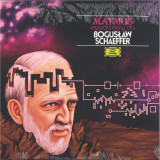
Matmos are one of the most prominent experimental electronic artists working today, crafting work by creating new conceptual frameworks & immediately testing those frameworks absolute limits. For Regards / Uklony dla Boguslaw Schaeffer they've focused on another artist known, in large part, for doing the same. Boguslaw Schaeffer was one of the first Polish artists creating electronic music. In step with American contemporaries like John Cage and Morton Feldman, he worked across the boundaries of classical composition, electronic experimentation, and radical theater in playfully form-breaking ways. Matmos are not the first ones to recognize the power of his catalog, from Solo (a 2008 documentary that garnered numerous international awards), to the annual Shaeffer's Era Festival (most recently celebrated simultaneously in Warsaw and Los Angeles) his work continues to inspire. Regards.. however, was not just inspired by his work, Matmos were given access to the entirity of Schaeffer's recorded works to use as they saw fit, commissioned by the prestigious Instytutu Adama Mickiewicza. They re-assembled & re-combined these recorded works with modern instrumentations in a way that only Matmos could, and what emerges is a composite portrait of the utopian 1960s Polish avant-garde and the contemporary dystopian cultural moment regarding each other across a distance. To facilitate the transcultural exchange that is the album's essential premise, all song titles and liner-notes are provided in both English and Polish. The album was mastered by Rashad Becker and features illustration and design by acclaimed artist Robert Beatty (Tame Impala, Osees, Mdou Moctar). Like the anagrams of the letters of Boguslaw Schaeffer's name that were re-assembled to create some of the song titles, the album itself is a musical re-assemblage of component parts into possible but unforeseen new shapes. Adding harp from Irish harpist Una Monaghan, erhu, viola and violin from Turkish multi-instrumentalist Ulas Kurugullu, and electronic processes from Baltimore instrument builder Will Schorre, and Horse Lords wunderkind Max Eilbacher, the resulting arrangements constantly toy with scale as they move from the close-mic-ing of ASMR and the intimacy of chamber music to the immensity of processed drones and oceanic field-recordings that close the album. Offering a "life review" of production styles, Regards / Uklony dla Boguslaw Schaeffer builds temporary shelters out of the panoramic wreckage of modernist composition, sixties tape music, seventies dub, eighties industrial music, nineties postrock and dark ambient, 2000s era glitch fetishism, and contemporary post-everything collage sensibilities.
- A1: Hand In Hand Through Wonderland
- A2: I Can Remember It So Vividly
- A3: Love Reigns
- B1: Understand (Feat Brendan Yates)
- B2: Patience (Feat Nia Archives)
- B3: Without The Sun
- B4: Spirit Wave
- C1: Breathing
- C2: Intercity Relations
- C3: Time Change (Feat Novelist & D Double E)
- D1: Distant Conversation
- D2: Metaphysical
- D3: Lost In Harajuku
Solid White Vinyl[29,83 €]
What I Breathe is the debut album from Mall Grab AKA Jordon Alexander. The Australia-born London-based powerhouse reaches within to create the most comprehensive demonstration of his style to date – loudly defining the raw energy that has become synonymous with the moniker.
“This album is deeply personal and an exploration of all influences, sounds and sides of the Mall Grab project. It follows my journey of the last 6 years from a university dropout in Newcastle (Australia), making music as a source of happiness and expression.”
While glances of what Jordon gravitates towards in dance music can be heard in the record label imprints he steers—Looking For Trouble and Steel City Dance Discs—it's with What I Breathe that he elaborates on and articulates his diverse ear for music. Through collaborations with Brendan Yates of Turnstile, Novelist, D Double E and Nia Archives, the Mall Grab repertoire of emotive electronics is used to traverse his love of hard-to-define energies that exist between genres like Hardcore, Hip-Hop and Soul.
“I have been lucky enough to work with some of my favourite artists which have really been the glue that keeps the project coherent. There are a lot of familiar sounds on this album that my listeners and followers have become accustomed to and joined me in the deep dive. Elements of emotional but hard and pumping club music are intertwined with House, Jungle, Rave and Grime. My adopted home city of London has been a huge inspiration to how my music has evolved and progressed, and on What I Breathe I wanted to create a body of work which not only had something for everyone who has been with me the past 6 years, but also those who aren’t yet aware of what I’m about or the music I make.”
Jordon’s long-standing penchant for all things DIY blossoms in tracks like Lost In Harajuku and Without The Sun which feature his own original lyrics and vocals. As the album twists and weaves from one song to the next, gleaming melodies flare up into club-ready anthems such as Metaphysical and Breathing. The kinetic flow of the music as a whole can be attributed to the many years of cutting his teeth as a DJ, a skill that can be testified by anyone who has witnessed a Mall Grab set.
“As I was a DJ for many years before I delved into producing electronic music, I had a wide appreciation and love for all types of music, predominantly gravitating towards ‘band' music when creating my own projects, before evolving into a fully-fledged electronic producer – however always retaining the influence and love for all things live and genre-fluid.”
Even with a stack of very well-received projects already under his belt, What I Breathe can be seen as the first deep breath in and a fierce declaration of what’s to come for Mall Grab.
“I’m grateful for everything and everyone in my life, those I love and those who support my music, through all the ups and downs. I live and breathe this shit. I cannot do anything else. I will continue until there is nothing left for me to say.”
British soul royalty John Turrell's classic debut solo album 'The Kingmaker' is given a much-deserved release on a limited edition yellow vinyl LP. Delivering eleven stunning raw vocal performances on emotionally searing tracks, Turrell manages to span upbeat northern soul jaunts, downtempo bluesy groovers and emotive ballads in a cohesive collection that never ceases to treat the listener.
Created with writing partner and producer Nick Faber as a reflection and meditation on the ebb and flow of a normal man's life, authenticity and relatability are two key characteristics of the writing style on this record. While it is an album that references a diverse set of influences there is an unmistakable soul and blues sensibility that courses throughout the tracks. There are the same recognisable soaring vocals and heartfelt lyricism from the 'Smoove & Turrell' frontman that long term fans are used to (Smoove even lent a helping hand with engineering duties on the record) however this is undoubtedly a case of John running his own show.
LIMITED NEON YELLOW LP with gatefold insert and digital download card.
- A1: Testimonial
- A2: Damned Le Monde
- A3: Transparency
- A4: Mourners
- A5: Birthday
- B1: Terminal Love
- B2: Worth Less Than Deutsche Marks To Me
- B3: Orchestra Of Knives
- B4: Stand On Ceremony
- B5: San Zero
- C1: Mourners (Sebastian Komor Remix)
- C2: Damned Le Monde (Love + Revenge Rework)
- C3: Terminal Love (Architect Remix)
- C4: Mourners (Rotersand Rework)
- D1: Terminal Love (L'âme Immortelle Remix)
- D2: Damned Le Monde (This Eternal Decay Remix)
- D3: Mourners (Electro Spectre Remix)
- D4: Damned Le Monde (Exfeind Remix)
- D5: Terminal Love (Sniffergod Remix)
STRICTLY LIMITED COLLECTOR'S 'ART EDITION' OF THE ALBUM OF THE SAME NAME + TONS OF BONUS SONGS.
Elegantly electronic as ever, the new songs draw a remarkable strength from their monumental arrangements and foreboding aura. Embellished by a vague sense of nostalgia and enhanced by old family photos from the private Ljung vaults, "Orchestra Of Knives" is ZEROMANCER's dark night of the soul, an odyssey trying to coming to terms with the ineffable fact that we're all going to die. Instead of wallowing in misery and self-pity, however, the Norwegians chose to use this intense realization to craft some of their most touching, most heartfelt and easily most monumental songs ever.
The harsh and the mellow, the dark and the light, the depression and the elation all flow together on "Orchestra Of Knives", an album worthy of the turmoil of our age. Once and for all, ZEROMANCER are the masters of electronic melancholy, the designers of a musical world nourished by the shadows we cast. It's been too long since we felt understood and at ease merely by listening to a song.
- Multicoloured vinyl
- Black, red and white in the form of rotating rays
- Each record individually made by hand
- Differences in pattern shapes and colours are therefore possible
- Every copy is unique
- 2 x180g 12" vinyl
- In total 9 bonus tracks off the EPs 'Damned Le Monde', 'Mourners' and 'Terminal Love'
- Sumptuous gatefold sleeve
- Printed inner sleeve and containing lyrics
- Printed vinyl labels
- Strictly limited to 300 copies only!!!
It is to the detriment of our understanding of musicality that we mostly measure it by the capacity to produce, and much less by the capacity to receive some sort of acoustic information or event. The virtuosity of listening, of understanding the sonic situation and its potential, is, however, that which defines one's capacity to interact – with other musicians, with the audience, and with the environment. This could also be taken to mean that an ethical act is implied in the situation of listening – the decision to relate, to be attentive to, to actively position oneself in relation to what is heard.
Rarely is this capacity so thoroughly pronounced and ethically conscious as in the case of Manja Ristić, the Belgrade-born and Royal Academy of Music-schooled musician, composer, sound and multimedia artist (the list could go on), who currently lives on the island of Korčula in the Croatian part of the Adriatic. Ristić’s recent, field recording-based work, is indeed all about attentiveness, most of all towards the environment and the acoustic traces of the endangered ecological layers of her old-new Mediterranean surroundings. With that in mind, it is indeed no wonder that her newest album draws from Milton’s Paradise Lost, which could easily be the anti-slogan of the endangered Croatian coast, eaten up by the pressures of touristification and the usurpation and privatization of once common space. More precisely, the album is inspired by one of the fifty Gustave Doré illustrations of Milton’s epic, Him, fast sleeping, soon he found, In labyrinth of many a round, self-rolled, from which it draws its title. The verses and the scene are from Book IX, and depict the moment Satan inhabits the Serpent, the beginning of his subversion of God’s autocratic rule, as some interpretations would have it.
For Ristić, the actual Paradise she introduces us to is in a state of imbalance – the idyllic soundscapes of her island surroundings overlain with sonic anxiety, such as on the album’s first track, The Flies, with its unrelenting, nervous buzzing evoking the ominous Biblical entity of Beelzebub, or The Lord of the Flies. The next track, Whales, which beautifully utilizes archival whale recordings, could also be taken to establish an intertextual relation to Milton through Melville, whose Moby Dick was strongly influenced by Paradise Lost. The middle track of the album, dedicated to the Croatian-American painter and muralist Maksimilijan Vanka, uses to great, unsettling effect what to my ears sounds like a buried hydrophone, a technique often employed by Ristić in her work, giving us a rough, grinding impression of water beating the pebbles over a high-pitched drone. But perhaps the most ominous, pessimistic image is painted in The Flag Pole, in which the symbol of revolutionary victory (I’m thinking of the Yugoslav modernist Tin Ujević and his proto-avant-garde sonnet Farewell from 1914) becomes a source of terrifying sonic unease, as we are listening to the incessant sound of its rope hitting the metal pole. However, with Dlana Night comes relief – the drones become airier, calmer; there is a distant notion of people, dogs, everyday life, all shrouded in the calming sound of the crickets on the island of Silba. Ristić, ultimately, serves us some hope on this wonderful new album, showing us that something has been lost, but that something can also be gained through the thoughtful attention with which she listens to the world around her.
„My recording techniques all boil down to one thing – intuition. I do not use expensive or highly sensitive equipment nor do I employ special techniques. On the contrary, I believe that the information regarding a space or an object can be recorded well enough on an average device. My personal guideline when recording sound is the positioning of myself as the listening medium, active and with the intention of establishing a connection that is sometimes intellectual, sometimes conceptual, and sometimes phenomenological.” - Manja Ristić, in an interview for Kulturpunkt.hr
*Gatefold sleeve - black vinyl**
In many ways Kumoyo Island represents the culmination of a journey for Kikagaku Moyo. While their decade-long career can be summarized as a series of kaleidoscopic explorations through lands and dimensions far and near, there’s a strong intention in each of their works to take the listener to a particular place, however real or abstract they may be. In that sense, the title and cover art for the band’s fifth and final album draws you into a magical mass of land surrounded by water—but the couch suggests that Kumoyo Island may not be a fleeting stop, but rather a place of respite, where one could pause and take it all in.
Reconvening at Tsubame Studios in Asakusabashi, Tokyo, where their earliest material had been recorded, the five members of Kikagaku Moyo found new inspiration in a familiar and comfortable environment. With their adopted homebase of Amsterdam under lockdown and their touring activities halted due to the pandemic, the band felt a renewed sense of freedom being back in shitamachi, or the old downtown area of their hometown. With unrestricted time in the studio, they began to build upon the demos and song fragments they’d amassed since their last tour. In the 1.5 months spent in Tokyo, everything started to come together.
“Monaka”, its name taken from a type of Japanese wafer sweets, takes melodic inspiration from traditional minyo folk styles, while “Yayoi Iyayoi” is a rare instance of the band singing in their native tongue, its evocative lyrics utilizing archaic words taken from old poetry and nature books found in one of the many secondhand bookstores of Tokyo. For “Meu Mar”, an Erasmos Carlos cover, the original Portuguese lyrics were translated into English, then to Japanese. Strangely enough, the words seem to conjure an image of the protagonist floating among the clouds, looking down upon Tokyo Bay.
In fact, it may be possible to draw a parallel between the topography of the band’s home country—an island nation, surrounded by bodies of water—and the mysterious isle of Kumoyo. Are they one and the same? Has the band finally made it back home? It’s up to the listener to decide.
Tel Aviv super group Megaphonim are bringing their off-kilter energy to Feines Tier in form of their new „Namal Ashdod“ EP with four original tracks and hell of a Simple Symmetry remix. Even though they’re all quite unique on their own, what unites the tracks is the combination of raw beats and vocals with an oddly catchy pop approach to the writing of the music. Be it in the aptly titled „After of Disaster“ with its let-loose energy, the slow-rolling „Lo Titfos Oti“, which could have been picked from an Andrew Weatherall (RIP) dj-set, or the title track with its break-beats and its unforeseeable left-turns, there’s always this playful and off-the-wall energy keeping the ball going and bouncing. And let’s not forget about the remix! Endlessly rising duo Simple Symmetry do what they have become known for very well here: Deliver an insanely groovy and relentless weapon of a track, guaranteed to blow the roof of every club, festival floor or after, however disastrous it might be. The EP also comes in form of a limited vinyl edition, so don’t sleep!
Available on vinyl for the first time in 10 years, with new cover design by Tim Rutilli Califone's earliest roots lie in the band Red Red Meat, from whence came Califone's founding members Tim Rutili and Ben Massarella and its longtime producer Brian Deck. The band's first release was a self-titled EP on Flydaddy in 1998, followed later by the full-length debut, Roomsound, in 2001 (later reissued on Thrill Jockey) and eventually the band's Thrill Jockey debut, Quicksand/ Cradlesnakes in 2003. After touring for the release of Roomsound, Califone had little time off to take in the impact of the music they were creating. In three years, they recorded four albums (two instrumental, two song-based including Heron King Blues) and toured heavily in between with Wilco, Modest Mouse, The Sea and Cake and others. After the tour for Heron King Blues in 2004, Califone finally took a breath and came back together in late 2005 to begin recordings. They worked on it in chunks at 4Deuces Studio in Chicago with Brian Deck, in Long Beach and Phoenix with Michael Krassner, and at home in Los Angeles and Chicago until May 2006. The time away and each member's individual work naturally brought new elements into the sound of Califone's music. Both Rutili's and Becker's soundtrack work are more atmospheric, however the challenge of enhancing a scene of film without cluttering it or overwhelming it informed their approach to the new recording. Similarly, the burglary of Califone's equipment during the band's last tour (including guitars, banjo, a 1917 violin, bells and more) altered the sound as they had to find new gear on a tight budget. The instruments are new partners, new sounds that forced them to stretch in new directions. Limitations, obstructions and darkness, and the new possibilities they illuminate; roots and crowns. "In that way", says Rutili, "this album is a conscious and resolved thing. It fully realizes ideas we touched on in the past and where we come from as a band, and takes us into our next phase of life."
Canada’s WAKE have never been a band interested in repeating themselves, this abundantly apparent from their discography, having evolved with every release. 2020’s Devouring Ruin made this more clear than ever, hammering the point home with the Confluence EP in the same year, and now they return with Thought Form Descent, their most dynamic, diverse and emotional release to date. “I’d describe the record as a place to reconsider what ‘extreme’ means. The words ‘brutal’, ‘crushing’, ‘devastating’ are overused adjectives for extreme music. We wanted to force people to confront the idea that ‘brutal’ or ‘extreme’ ideas aren’t just blastbeats or angular tritones, or, more importantly, ‘brutal’ elements alongside pointedly passive elements can create their own experience that can channel both and neither.” The result is eight nuanced tracks that run the gamut from relentlessly heavy to exquisitely beautiful, often simultaneously, and instantly grab hold of the listener, demanding their full attention. However, at the same time, they are lushly textured and densely layered, and offer more with every subsequent exposure, unfurling to show hidden depths, and taking WAKE to a whole new level.
Following on from acclaimed recent releases on Hallow Ground and Boomkat’s Documenting Sound series, NOISEEM is a major new work from Japanese sound artist/instrument inventor Yosuke Fujita, who performs under the name FUJIIIIIIIIIIIITA. Where Fujita’s recent recorded output has focussed primarily on documentation of his remarkable self-built pipe organ, NOISEEM is the culmination of half a decade of work with highly amplified water. The evocative and timbrally rich sound of water has inspired concrete and experimental music practices since ground-breaking works such as Hugh Le Cain’s ‘Dripsody’ and Knud Viktor’s obsessively aquatic ‘Images’. However, other than his compatriot Tomoko Sauvage, few have explored the possibilities of water in live performance to the extent that Fujita has, constructing a series of water tanks that, with their pumps and amplification controlled by the performer, become a new musical instrument. The recordings contained here are drawn from live performances in Tokyo and London, edited and mixed by Fujita into two side-length pieces dominated by water, pipe organ, voice and subtle electronics. On ‘AWA’, which occupies the LP’s first side, the listener is immediately immersed in an aqueous world of recognisable drips and splashes, as well as more mysterious squeaks and squawks. While the liberal use of delay at times conjures up the sound world of early electronic music, the sparklingly clear amplification is unmistakably contemporary, lending the music a stunning weight and tactility. Building over several minutes, the piece eventually comes to a rapid boil, criss-crossed by washes of white noise splashes of electronics, before the untempered long tones of the pipe organ enter. The slowly shifting harmonies lend the remainder of the side a meditative, almost oneiric quality, inviting listeners to lose themselves in the aquatic layers that ripple across the harmonic foundation. On the second side, ‘UZU’ begins more starkly, with a single rapid bubble, quickly joined by full-spectrum wooshes and silvery, ringing tones. After a few minutes, the music undergoes a radical, entirely unexpected shift with the entry of a distorted, auto-tuned voice that repeatedly cycles through ascending and descending melodies. Left alone at times to be heard acapella, this mysterious element at times takes an odd resemblance to dhrupad singing. Eventually joined by rich, sonorous chords from the organ, the high tones of Fujita’s voice, and water, the piece takes on an ecstatic quality, channelling the sublime expansiveness of the natural element on which it is built. Disappearing as abruptly as they entered, the voices then make way for a haunted coda of isolated drips and distant whistles. Far from the intellectualised abstraction of much sound art, NOISEEM is strikingly immediate, both rigorously experimental in its explorations and unashamedly direct in its musicality. Tracklist 1. Awa 2. Uzu
After almost a decade-long hiatus, cult 6-piece MFMB announced their
return with the long-awaited album "Sugar"
The followup to 2012's critically- acclaimed "Colossus", "Sugar" revives the dark
and driven alt- rock the Swedes made their name with - equal parts rigor and
finesse, wracked with nervous tension. This time around, however, a democratic
approach to the writing process was decided on, with each member contributing
equally to the sound and feel of the record. The result is unmistakably the sound
of MFMB, but reinvented for these tempestuous times. The making of the album
is a story in itself. "Sugar" is seven years in the making. It has been a bumpy ride.
They were not always the best of friends. Priorities changed. Members quit, then
joined again. It was never easy. We believe you can hear it on the album, how
every song is a result of differing opinions fighting it out until they landed. In the
end, it's MFMB, but ringing purer than ever before. MFMB have remained prolific
throughout their hiatus, which includes Joakim Lindberg becoming one of the
underground scene's most in- demand producers, working with the likes of Hey
Elbow, Spunsugar, This Is Head, and many more.
- A1: Resemblage (Parasamblaz)
- A2: Cobra Wages Shuffle (Off! Schable W Gure!)
- A3: Few, Far Chaos Bugles (Uff Bosch Gra Walese)
- A4: Flashcube Fog Wares (Glucha Affera Slow)
- A5: Flight To Sodom (Lot Do Salo)
- B1: Tonight There Is Something Special About The Moon (Jaki Ksiezyc Dzis Wieczor)
- B2: If All Things Were Turned To Smoke (Gdyby Wszystko Stalo Sie Dymem)
- B3: Anti-Antiphon (Absolute Decomposition) - Anty-Antyfona (Dekonstrukcja Na Calego) (Absolute Decomposition)
Matmos are one of the most prominent experimental electronic artists working today, crafting work by creating new conceptual frameworks and immediately testing those frameworks’ absolute limits. For ‘Regards/Ukłony dla Bogusław Schaeffer’ they’ve focused on another artist known, in large part, for doing the same.
Bogusław Schaeffer was one of the first Polish artists creating electronic music. In step with American contemporaries like John Cage and Morton Feldman, he worked across the boundaries of classical composition, electronic experimentation and radical theatre, in playfully form-breaking ways.
Matmos are not the first ones to recognize the power of his catalogue, from ‘Solo’ (a 2008 documentary that garnered numerous international awards), to the annual Shaeffer’s Era Festival (most recently celebrated simultaneously in Warsaw and Los Angeles), Bogusław Schaeffer’s work continues to inspire.
‘Regards/Ukłony dla Bogusław Schaeffer’, however, was not just inspired by his work. Matmos were given access to the entirety of Schaeffer’s recorded works to use as they saw fit, commissioned by the prestigious Instytutu Adama Mickiewicza. They re-assembled and re-combined these recorded works with modern instrumentations in a way that only Matmos could, and what emerged is a composite portrait of the utopian 1960s Polish avant-garde and the contemporary dystopian cultural moment regarding each other across a distance.
Vinyl packaged with digital download card.
“Total Terror” is the second of two self-released cassette tapes by EBM-industrial act Front Line Assembly. At this point, Bill Leeb was the band's only dedicated member, with some help from Rhys Fulber. Most of the original cassette was remixed and remastered to be commercially released on CD in 1993 as “Total Terror 1”. This edition added three previously-unreleased bonus tracks from other old sessions: "Freedom", "Distorted Vision" and "Cleanser”. The original recordings of these songs were done in 1986 using nothing more than a four track recording system. This would be quite primitive for today's standards and sound quality will not be so effective, however the ideas are all there letting us enjoy some of the first songs created by Front Line Assembly.
Deluxe re-release including all tracks from “Total Terror 1” plus the rare song “Eternal” and some bonus taken from old compilations. Limited pressing of 500 copies with double vinyl record, deluxe gatefold sleeve and new vintage artwork.
Alison Moyet, a British pop singer known for her rich, remarkably bluesy voice, went on to become a steady presence on the U.K. charts, however, with each of her studio albums reaching at least the Top 30. The Minutes was Produced by Guy Sigworth , and was first released in 2013. The Minutes marked a return to club minded electronics while keeping her sound distinctly contemporary. It became her highest charting album since Raindancing in the U.K., reaching number five.
- 1: Dark Day Road
- 2: I Need Help Feat. Sick Jacken
- 3: Waging War Feat. Rite Hook
- 4: Murdered Tonight
- 5: Stay True
- 6: Blind Feat. Q-Unique & Sadie Vada
- 7: Crispy Innovators Feat.vinnie Paz
- 8: Archie Bunker Feat. Nems
- 9: High Times Feat. Sick Jacken
- 10: America Feat.apathy
- 11: Now Or Never Feat. Skam2? & Rite Hook
- 12: To Thine Own Self Be True Feat. Rite Hook
Repressed
It's been four-years since La Coka Nostra released their sophomore album, Masters Of The Dark Arts, (the groups first project without Everlast was also their most critically acclaimed project - featured collaborations with Vinnie Paz, Sean Price & production from DJ Premier and Statik Selektah) and the music industry has changed considerably in that time. However, a few things still remain constant; La Coka Nostra will always be as their aptly-titled 2009 debut verified, A Brand You Can Trust, and the group will continue to dazzle their rapid fan-base with sold out shows around the globe with their rau-cous live performances. Always known for tackling controversial topic matter, the group’s new album, To Thine Own Self Be True, finds them once again in torchbearing mode, addressing subjects that most artists shy away from.“This album was created during a time of unique and individual transformation for each member of the group” ILL Bill stated. “Speaking for myself, it’s been a heavy last couple of years.It’s definitely the most personal record we’ve made under the La Coka banner and while we’re still making music that’s hard as fuck, there’s a maturity to this latest batch of songs that makes it different from a lot of the older stuff. I notice the biggest reactions come from the songs our listeners can personally relate to and we needed to make a record like this right now, not only for the fans, but for ourselves. I got alot off my chest on this one. Making music can be extremely therapeutic and making To Thine Own Self Be True was a rebirth and a re-ignition for me.” Slaine had a similar take on the projects thera-peutic manifestation “You don’t put as many years in the game as we have without having ups and downs. We all have gone through struggle and adversity—personally and professionally”Slaine la-mented. “This album was recorded as I walked out of a very dark time toward a place of truth and understanding. Music has been how I feed my family, my plane ticket around the world and a place I’ve built real friendships; but at the very core it’s a tool I use to get through life.This album is a moment in time. It is visceral and real.” While DJ Lethal continues to oversee the production end ofToThine Own Self Be True, the group also enlisted Statik Selektah, Marco Polo, Salam Wreck (D-12, Obie Trice, Proof, B-Real, Tha Dogg Pound) & ChumZilla (from the Demigodz) and get vocal contributions from extended family members such as Vinnie Paz, Apathy, Q-Unique, Sick Jacken, SKAM2? & Rite Hook.
Decomposed recalls classic American hardcore like Bad Brains, Poison Idea and Jerry’s Kids or Japanese ragers like Paintbox, The Comes, Eiefits and Skizophrenia. But there’s also a healthy slug of classic UK and US punk and even a bit of Krautrock, psychedelia and Black Sabbath in there too. Nottingham has always been a melting pot for heavy music. For a small city, it has boasted more than its fair share of genre defining bands and artists, not to mention record labels. Bands cross-pollinate, form projects and offshoots and play one-off gigs that would result in lengthy careers and world tours if they had happened across the Atlantic. It has always been like that there. No big deal (but yet, a really big deal if you know). One such band/project/offshoot were Endless Grinning Skulls. Formed by guitarist Andy Morgan (also from Bloody Head, Army Of Flying Robots, Nadir and countless more), drummer Steve Charlesworth (Heresy, Wolves Of Greece, Meatfly, Geriatric Unit) and bassist Gords (Hard To Swallow, John Holmes, Geriatric Unit) in the early twenty-teens, they re-set the bar for the 3-piece hardcore band before (perhaps inevitably) burning out in 2018. Morgan and Charlesworth weren’t done though. They’d forged a bond in EGS and wanted to carry on playing together so - in a familiar Nottingham storyline - they recruited former Pitchshifter guitarist Stu Toolin on bass and Anmarie Spaziano (who you might know from running a famous burger joint) on vocals and formed Blind Eye. They knew Toolin was about to relocate to Portland, Oregon so they wrote and recorded an EP (released on Morgan’s own Viral Age Records). Quick-sharp. No messing about. And that – by rights – should have been that: over and out. New band please. However, the demo captured a rare intensity and vitality that more considered projects often fail to achieve. This was a band let loose, free from previous shackles and loving the noise they made. It seemed a shame to stop there. Recruiting Matt Grundy (a former bandmate of Morgan’s in both Nadir and Dead In The Woods) to the bass vacancy they went back to Stuck On A Name Studios in 2021 with Ian “Boulty” Boult at the helm again and delivered the album Decomposed.
Decomposed genuinely rocks out without losing one iota of the effervescent anger that made the demo such an essential listen. From the insistent, minimal opener Ready To Go Now via the unhinged thrash of Straw Man and the menace of the stomping Pero No Quieres, to the measured chugging and epic crescendo of closer Broken Star, this record is a fucking blast. Needle off, flip it back over, play it again. Your neighbours are loving it so much they’re banging on the walls to tell you. “I suppose the intention was to write high energy, catchy hardcore, with a nod to what has come before, but also to do our own thing,” explains Andy. “Lyrically, the album was written during the pandemic, and although it’s not ‘a pandemic album’, I think it deals with a lot of the feelings of loss, separation and isolation