The Sex featuring members of Mercenary God and No Suicide. A mixture of different elements with a rock substrate for an uncategorized result. Another Post-Punk gem from the 80's Italian North-Eastern scene.
My adventure buddies? The silent, enigmatic Patti, former singer of the mysterious No Suicide, and the young, faithful Chris, a passionate Police fan, we met on the battlefield and he immediately became my brother. For him, learning to play the bass was a way to get close to Sting, in other words, just one step below Paradise. Patti instead played keyboards as an extension of her mysterious and glacial presence, so still and distant that the audience sometimes wondered if she was real. And then there was my fixation for the drum machine, a futuristic device which could transform the drumming sweat into an invisible, yet physical, dreamlike pulsation. A particular combination of characters and a special astral conjunction, that’s what you need to get a nucleus source of sonic emotions, and in some ways this is what we were. You could clearly feel it during the concerts. When at the end of ‘81 My Mercenary God lost their drummer and had to disband, I felt clearly that the music had already changed.
Our old 70’s rock ‘n’ roll sound was no longer representative of the day. We were like some sort of yesterday’s newspaper. Thus I Sex was born (later The Sex). According to Freudian thought that sees sexual instinct as the driving force behind every (creative or destructive) human act. And in fact we immediately started creating, destroying, assembling and deconstructing our sound. Suddenly “tomorrow became now”. It was an outburst of creative independence in the form of homemade cassettes put together with makeshift tools, at least until the arrival of the legendary 4 track recorder. I was 19 years old, Chris was only 17. Nothing more than kids after all. Yet we were already veterans, veterans of a lost war. Wise, naive, disillusioned dreamers, everything and the opposite of everything. But, above all, we were totally devoted to our creative delirium up to the point of losing touch with reality, crossing limits, breaking down barriers and almost bordering on madness. Perhaps we were just too involved, especially if in relationship with what we could receive in return. We always spread our energies as if there was no future. We unconsciously felt that we had to live in the moment, now or never, and in retrospect it really was like that, and this is why these songs exist now. Songs created with the intent to tell an inner universe that is, now as then, far from any convention.

Cerca:human in paradis
The debut recording by Setting, a trio comprising Nathan Bowles (solo/trio, Pelt, Black Twig Pickers); Jaime Fennelly (Mind Over Mirrors, Peeesseye); and Joe Westerlund (solo, Califone, Sylvan Esso, Jake Xerxes Fussell). Deluxe LP edition features 140g black virgin vinyl and a reverse board jacket with art by Timothy Breen. Deluxe CD edition features a gatefold jacket with art by Timothy Breen. RIYL: Popol Vuh, Brian Eno’s Ambient 4, Harmonia, The Necks. Setting, befitting its name which can be read as noun or verb, and simultaneously suggests the sun, or any star in the firmament from our earthbound perspective; a story and its surroundings, its scenic context or mise en scène; or a psychedelic experience, as in the prescription to mind one’s “set and setting” arose outdoors, uncontained and unconstrained by architecture. The group’s debut recording Shone a Rainbow Light On traverses textural, phosphorescent topography with a certified organic folk-engine. Kosmische correspondences are inevitable and valid, but also somewhat deceptive, given this meditative music’s terrestrial rootedness in the familiar natural world, more in native humus and humidity than in outer space. Fuelled by a vibratory hybrid of acoustic and electronic instrumentation, these four stately longform pieces sound like a UFO slowly sinking into a peat bog (or, as we call it in North Carolina, a pocosin). An instrumental trio comprising Nathan Bowles (solo/trio, Pelt, Black Twig Pickers) on strings, keys, and percussion; Jaime Fennelly (Mind Over Mirrors, Peeesseye) on harmoniums, synthesizers, and piano zither; and Joe Westerlund (solo, Califone, Sylvan Esso, Jake Xerxes Fussell) on drums, percussion, and metallophones, Setting established its own setting and found its footing in regularly scheduled improvisational sessions outside Westerlund’s home in Durham, North Carolina, beginning in 2021. The three players began as two, in the context of occasional Bowles and Westerlund percussion duo performances dating back to 2018. Fennelly provided the initial impetus to gather and play together with intentionality and discipline, as well as an harmonic adhesive and thickening agent in the grain and gravity of his harmonium and synthesizer. As always, Bowles’s background as a pianist and drummer informs his approach to banjo, imparting a woodiness, a piney verticality and resinous tang. Westerlund’s training with Milford Graves is apparent in his polyrhythmic flow and its correspondences to human circulatory and corporeal rhythms. They recorded their collective discoveries with engineer Nick Broste in the spring of 2022.The record begins, like the group’s name, and like the language of its unique instrumental interplay, with ambiguous grammar: “We Center,” the first and longest track at thirteen and a half minutes, builds patiently to a percolating climax of tidal heaving, with ceremonial connotations. “Zoetropics,” the shortest piece, follows, offering a more diaphanous counterpoint to the density of its predecessor. The zithery, shivering “A Sun Harp,” its title redolent of Sun Ra, showcases Westerlund’s unfettered drumming, which skitters restlessly until anchored, at its conclusion, by a minor bass progression. Finally, “Fog Glossaries” exhales through the maritime and meteorological evocations of its title, distant buoys clanging. Although certainly elements and strategies of so-called ambient and drone musical traditions are invoked and deployed, those diffuse terms feel inadequate to describe everything else happening here: the devotional valences, the minimalist rigor, and even submarine jazz inclinations perceptible beneath the surface. Throughout this four-movement program, which invites deep listening, it is often difficult to differentiate individual instruments from the massed choir of the group’s unified sonic presence. At times what sound like field recordings cicadas, birds, wind, water splash out of this slow but powerful current, only to be revealed as overtones produced by harmonium, banjo, or cymbals. Setting’s sound is fundamentally synthetic in the sense of synthesis, not artifice—in a manner remarkable for its almost entirely acoustic arsenal of instrumentation, often registering as the product of a single alien technology, perhaps the rainbow lights of that bog-marooned UFO. (“Setting,” of course, can also refer to a machine’s variable operational amplitude its temperature, volume, speed, elevation, etc.) Sometimes the most seemingly extraterrestrial lifeforms are in fact our unfamiliar earthbound neighbors. Despite the destruction of many such habitats, the coastal plains of eastern, tidewater North Carolina is home to more pocosins freshwater, evergreen wetlands with deep, acidic, sandy, peat soils than anywhere else in the world. These threatened peat-bog ecosystems are the only native environment to sustain the carnivorous Venus flytrap, among other oddities. The sonic ecosystem of Setting similarly deep, acidic, and boggy contains equivalent wonders, savage and delicate, for listeners willing to take the time to sink.
Chicago"s Axis: Sova hit the beaches of southern California with Ty Segall to make a total hi-fi classic. Often feral and consistently catchy, Blinded By Oblivion is lit up with interlocking drum kit + drum machine, adventuresome guitar, bass, and harmonic vocals on every song. Icy lyrical perspectives, rendered in a sunshiny natural paradise, transmit the fun and fraud of human polarities with urgency and an occasional eye roll. Making for an undeniably good/bad time, streamlined and more reflexibly physical than previously known, Blinded By Oblivion begs the universe to bring back rock and roll radio. All the elements are there: compassion for our collective fallibility, rebuke on the tip of the tongue, all rolled tight with hook-laden, high-energy construction. "Bout halfway through Blinded By Oblivion, we hear Sova say, "I think my heart is made of metal." Yuuuup. But we"d argue there"s at least a ventricle or two made of post punk! And with vena cavae split between psych and southern boogie. And cardiac veins of glam, power pop, and punk Sometimes the heart is simply filled with sweet melody - so man, the beats of this metallic muscle are insane!
- A1: Inhalation / Вдох
- A2: 1981
- A3: Ambinature / Амбинатура
- A4: Binaural / Бинауральный
- A5: Choral / Хорал
- A6: Quiescence (Grain Version) : Покой (Гранулярная Версия)
- A7: Stone / Камень
- B1: Aurora (Feat. Alek Fin) / Аврора (Совместно С Алек Фин)
- B2: Grainy Dialogue / Зернистый Диалог
- B3: Soviet Power / Советская Власть
- B4: Echo / Эхо
- B5: Childhood (Alternative Version) (Feat. Alek Fin) / Детство (Альтернативная Версия) (Совместно С Алек Фин)
- B6: Mirror (Synth Version) / Зеркало (Синтезаторная Версия)
Now in its eleventh year and following hype for recent releases from Osaka's Kiji Suedo (Hosek EP & Riot album) and Edinburgh's George T (Roll On, King's Cross single), Edinburgh's Hobbes Music label burrows deeper into experimental ambient terrain with brand new signing Galun. With a discography over 15 years deep, Galun brings no shortage of his own props.
Galun is the solo project of Moscow musician, artist, and producer Sergei Galunenko (currently based in Tallinn), who has performed at numerous prestigious Russian events and collaborated on projects internationally in a career spanning more than 15 years, with a discography to match, turning his attention to myriad styles: IDM, funk, techno, juke, post rock, beatboxing, free improvisation, drone.
“In my project, Galun, I do not use musical instruments,” he explains. “All the sounds are produced with only the use of my voice through beatbox and special vocal skills. Some effects are used to produce electronic sounds.”
Hot on the heels of the new Golos album (out now via Berlin's One Instrument) plus a remix for US collaborator Alek Finn via Nevada's Mystery Circles label, Galunenko’s eighth studio album, Glagol (or Glagolь / Глаголь in Russian) is an ambient collection, recorded between 2013 and 2022. The title is an old Russian word which translates as ‘Speak’.
"This album consists of tracks written in different periods, so it turned out to be diverse," he says. "There are classic ambient tracks, as well as experimental ones in search of new possibilities for voice processing."
Why "glagol"? “Since the music on this album is 90 percent processed voice, it's a form of conversation for me," he reveals, “where I talk about my thoughts and mood, so speak music, while using my voice, is an amazing way of expressing.”
Five singles will be released on streaming platforms only, at intervals, over summer, with the full album released on digital 25.8.23 and a limited edition cassette plus lathe cuts out from 8.9.23.
"How gorgeous is that?! I have heard the rest of the LP and it is all equally gorgeous" DEB GRANT played ‘Mirror’ (New Music Fix show, BBC 6 Music, 17.8.23)
"'Glagol' translates as 'speak', an apt title when you consider 90 percent of the noises contained on it originated as recordings of his own voice, and that lends the ambient experiments here a very human, tactile feel. Closing tune 'Mirror' is a serene masterpiece, '1981' is an evocative phase-fest, the stuttery 'Stone' is endearing and enrapturing and Galunenko generally displays a knack for communicating clear emotions through abstract sounds. Recommended." ELECTRONIC SOUND
‘Really beautiful’ AVALON EMERSON (US)
‘Really loving the Galun tracks!’ INTERGALACTIC GARY (NL)
‘Super!’ JD TWITCH (Optimo, UK)
'Wow, this sounds amazing. Loving the atmosphere here, ambient with some groove somehow, really feeling this one.' DAN CURTIN (US/DE)
"Sounds great. Looking forward to getting into this properly" LORD OF THE ISLES
‘Wicked. It’s great stuff’ DRIBBLER (Pikes, Ibiza // Paradise Lost, Red Light Radio, Pure; SP)
‘Very nice, will play on Cashmere Radio here in Berlin. Keep up the good musical works x ALEX VOICES (DE)
‘Sounds really nice. The sort of thing I’d absolutely listen to on streaming etc’ AUSTIN ATO (UK)
‘Excellent stuff as always’ PAT BENSBERG (The Eccentric Selection, Phonic FM, UK)
‘Digging this one! Right up my street and just the ticket for my Radio Buena Vida show’ TOM CHURCHILL (UK)
BOTANICA is the newly established Japanese label created by DJ/ Producer, Iori Wakasa. It was formed for him to utilize it as a foundation for the realization of his own unique, artistic expression.
And now, he has the pleasure to announce his label’s inaugural title with the release of his own BOTANICA EP.
Born in 1988 in a rural Japanese city surrounded by mountains and the sea with a mild climate, Iori grew up playing RPGs with a father who was a devoted game aficionado. And he was introduced to electronic music through game music from an early age and formed his musical sensibilities through playing the classical piano around the same time.
Influenced by the spirituality and idiosyncrasies of punk rock and ethnic and indigenous music in his youth, also gradually influenced by the Tokyo club scene and the music, it didn't take him long before
he made the choice to start DJing at the age of 17 and soon afterwards, started exploring the path of music production as a form of self-expression.
Iori set up Botanica to convey 2 main concepts of 'presenting music that provides each listener with their own viewpoint' and ‘to construct a fusion between 'nature' and 'man-made objects and human
activity’. Through the experience of traveling around Japan, Europe and Asia and connecting with people of different languages and cultures, he became to appreciate that music transcends all languages and grooves, and the framework in which he would like to shape his perspective and embody it as his way of life is what he envisions as the vital expression for BOTANICA, The two tracks and the artwork included in this first EP are the first steps towards hopefully chronicling the story of the vortex that he resides in now and the new forest that he plans to weave in the future with his label.
'The Pure Land' means in Japanese 'Gokuraku-Jodo (= a space where you can live in bliss)', but in English it is closer to 'utopia' or 'paradise'. However, 'The Pure Land' is a musical work that evokes a
hypnotic and pleasant euphoria through the gradual layering of multiple rhythms and soft particles of spatial sound design. It is also shaped with the aim of liberating the listener and guiding them towards their primal self.
In contrast, 'Lunar Down' expresses the changes that occur in the human state of mind during the extended period from moonrise to moonset especially when the moon sets from its zenith and is completed with a focus on maximum dance floor impact via an inner voice that resonates in the brain that echoes throughout a well-textured bass line and rhythm track.
The artwork for the front cover of this EP was created by SHINOZAKI HILOSHI, an illustrator who has been traveling and painting to express his true way of life that he learnt in the 10+ years of commuting between Tokyo (the end) and the Hawaii Islands (the beginning), and the graphic designer hiro, who stands by Iori`s side as his life partner and as the person who understands him the best. Iori`s first steps are complemented by the label design and art direction by graphic designer hiro, who stands by his side as his life partner and most understanding partner, and the proof is the physical cut, which is presented as the foundation for the future.
Portland, OR-based multimedia artist William Selman returns to Mysteries of the Deep with his third album for the label. Drawing on influences such as David Toop, Beatriz Ferreyra, Elizabeth Waldo, and David Behrman, “The Weather Indoors” melds live and synthesized instrumentation, field recordings, and digital processing techniques in a new, more melodic and approachable direction.
Immersive site recordings open into melodic woodwinds, orchestral instrumentation, bass guitar, gongs, and vibraphone. Borrowing from the anthropologist Tim Ingold’s concept of “inversion,” this widescreen staging cuts immediately to the core of the project: the way human beings use the faculty of imagination to aestheticize their built surroundings with architecture, images of distant locales, and domesticated flora and fauna to contain the anxiety for the natural world that surrounds human life.
A clear peak in Selman's extensive catalog, “The Weather Indoors” captures his work at a moment expanding his musical and aesthetic project: Neither genre ambient nor musique concrète, but a unique sound world dense with conceptual play and moments of more traditional harmonic beauty.
“We are contaminated by our encounters: they change who we are as we make way for others. As contamination changes world-making projects, mutual worlds—and new directions—may emerge. Everyone carries a history of contamination; purity is not an option.” —Anne Lowenhaupt-Tsing, The Mushroom at the End of the World
----
'A Soft Degeneration' was featured in a mix from Mysteries label boss, Grant Aaron, entitled 'Sundays are for' – hosted by Delayed.
William Selman has releases on Mysteries of the Deep, Critique of Everyday Life, Going In, Hausu Mountain.
The state51 Conspiracy is proud to announce Wacław Zimpel’s long-awaited fourth solo album, ‘Train Spotter’, due for release on 31 March 2023 on state51 Records.
In the seven years since the release of his debut solo album, ‘Lines’, Wacław Zimpel has developed from his idiosyncratic approach to jazz to growing into a potent and inventive force in the field of electronic music.
‘Train Spotter’ was created for a specific brief from The City of Warsaw: to capture the Sound of the City of Warsaw. But, as Zimpel soon found out, the sounds of a city don’t exist in isolation; they’re part of a wider environment that is itself undergoing upheaval against a background of internal and external forces.
“Train Spotter is about my experience of a city that recently went through a pandemic, endless anti-government demonstrations against human rights violations against women’s right to choose and the LGBTQ community, as well as waves of war refugees from Ukraine and the extraordinary solidarity of people willing to help and unite across political divides to help others in need.”
Spread over six tracks, the manipulated samples are blended with Zimpel’s own electronic production flourishes and playing to create a seamless blend that’s uniquely his. Recording a variety of mechanised and repetitive sounds including tramlines, baggage carousels and bouncing basketballs in municipal parks among many other found sources, Zimpel fed the results through a host electronic equipment including synthesisers, keyboards and plug-ins.
For all its production methods, ‘Train Spotter’ bears an organic warmth that reflects the city that inspired it. But what also adds to the sonic intrigue is a rise in intensity within each of the individual tracks that themselves become ever more forceful as the album continues.
DMX Krew unearths the lost Cold War LP.
Created for 1983. Created in 2003. Released in 2023. In mistrust and blindness mankind wages a COLD WAR, East against West in a spiraling cycle of mindless escalation. For 40 years the madness continues until it reaches its inevitable climax, NUCLEAR WAR.
Armageddon is achieved at the push of a button, millions of lives are destroyed. Those who are spared struggle for survival in the bleak conditions of NUCLEAR WINTER.
Acid rain destroys the landscape, darkness falls across the face of the
earth and hope is lost as the population falls prey to radiation sickness and cancer. Deep underground, the last survivor works feverishly in his isolated laboratory. A lone scientist attempting desperately to save mankind, he uses occult technology and deep-frozen human tissue to create a group of 12 radiation-resistant HUMAN CLONES.
They set forth to rebuild and repopulate the planet, whilst the scientist continues his work to improve and strengthen mankind. He develops a technique to fuse his own living flesh with the transistorized mind of a supercomputer, transforming himself into FUTURE MAN. Synergy of man and machine. Having transcended his mortal condition, he is now deemed ready to meet THE ELOHIM, a race of super-evolved aliens who created mankind 40000 years ago and have been watching and waiting ever since for the day when man at last becomes enlightened.
They descend from the heavens in their storship telling Future Man to
rejoice, for the trials of mankind are over and they sing to him of their long wait and THE GOLDEN AGE which is about to begin. Future Mom and the Clones are taken on board the spacecraft whereupon the Elohim transport them through the STAR GATE to a planet paradise where they are able to live in peace and happiness and once again become prosperous and many.
Like a winding system of trails and paths cutting through a digital forest-scape, M. Sage's Paradise Crick is shaped by time. Full of wonder and charm, designed patiently and from a rich, curious mulch of synthesized and acoustic sound, the versatile American artist and magic realist's new suite of music is an imaginary destination and a pastoral fantasy that envisions the natural and fabricated worlds as one. Matthew Sage is a musician, intermedia artist, recording engineer and producer, publisher, teacher, partner, and parent. Assembling a sprawling and idiosyncratic catalog of experimental studio music between Colorado and Chicago since the early 2010s, recent highlights include The Wind of Things (Geographic North, 2021), an ensemble-recorded expression of bow-splashed nostalgia, and the four seasonal albums of Fuubutsushi, the improvisatory ambient jazz quartet he formed with friends from afar in 2020. Sage renders projects with nuanced velocity and a completist sensibility _ when it's finished, it's done _ which is what makes Paradise Crick, his debut for RVNG Intl., a compelling outlier. Sage first staked his tent in Crick's conceptual campground five years ago from his home studio in Chicago (he's since returned to Colorado, home to the mountains and prairies often personified in his work). He had just read Richard Brautigan's Trout Fishing in America, a kaleidoscopic reflection of pastoral America's shifting identity by way of magical fishing sojourns. Inspired by that feeling, of getting lost but finding oneself in through the outdoors, he amassed over seventy demos documenting a fictional soundtrack for camping. Pull up to this park, and the sign might read, "Welcome to Paradise Crick. Fire Danger Is Low." The sequence, pruned down to thirteen tracks, courses the dewy mornings, afternoon hikes, and firelit nights of a weekend expedition. While Sage is not a filmmaker, he views the method of making this album as a similar form of world-building via structure, narrative, formal elements, and editorial refinement. Contrasted with his collaborative craft, here he is a sole auteur reclined in total autonomy, able to improvise scenes and implement special effects at will. A parallel precedent for such unchecked imagination in the M. Sage canon is A Singular Continent, his 2014 album that tilted its compass to a faraway land. Where Continent built its world layering samples as composition, Paradise Crick deploys a balance of accessible song structures with experimental instrumentation and sound design. Speckled with harmonica, autoharp, chimes, penny whistle, voice, hand percussion, and other mysteries, Crick's texture is treated as a sensorial adventure; the swamps gurgle, the lakes glisten, and the valleys breathe in robust HD. The rhythms are loose and buoyant, bursting with a few `kick and snare' moments shaped by Sage's lifelong love for drumming and headphone prone electronic music. Crick bumps more than most anything he's done before; crackling static pulses and lush vibrations reveal an intrinsic groove, a hidden beat map. In the landscapes of Paradise Crick, science and magic co-exist, 5k boulders and midi frogs share the frame with real-life memories of Midwest camping trips and the desire to feel extra human in a digitized space. Sage strived for "nature in the holodeck" but couldn't help leaving fingerprints in the simulation, and it's these traces of spirit and character that give Paradise Crick its strange allure. The album's bubbling sense of play, melody, and timbre takes cues from left-field electronic lineage; synth pioneers like Tomita and Raymond Scott up through the more expressive pop tendencies of Woo, Stereolab and the Cocteau Twins, and into contemporary composers like Sam Prekop. The album's vocabulary is uncomplicated; the gestures are sweet and inviting, intended to lull the listener. As much as Sage continues to be an experimentalist by nature in his work, with Paradise Crick, he spins a narrative. Not necessarily a concept album, but rather an invitation to take off for a weekend. That's the modus operandi down here in the Crick, we stretch out. M. Sage's Paradise Crick will be released May 26, 2023 in LP, CD, and digital editions. A portion of the proceeds from this release will benefit Earthjustice, the premier nonprofit public interest environmental law organization.
- A1: Welcome To Brexit Britain
- A2: Meanwhile In Wuhan
- A3: Astrazeneca
- A4: Herd Immunity
- A5: Care Homes Catastrophe
- A6: Why? Why? Why?
- A7: Why Are They Not Testing?
- A8: A Very Different Britain
- A9: 15,000 Discharged From Care Homes
- B1: No Morality
- B2: National Health Service
- B3: Test! Test! Test!
- B4: Another Break At Chequers
- B5: Jobs For The Boys
- B6: Forget About The Floods
- B7: Human Too Human
- B8: Failure Of Leadership
David Holmes' (Out of Sight, Oceans 11 trilogy, 71, Hunger, Killing Eve, Good Vibrations) new soundtrack to Sky limited series ‘This England’ is released via Stranger Than Paradise Records.
The show is co-written and directed by Michael Winterbottom (A Mighty Heart, The Road to Guantanamo) and stars Kenneth Branagh as Boris Johnson and Ophelia Lovibond as Carrie Symonds. The 6-part drama is based on Boris Johnson’s tumultuous first months as Prime Minister and traces the impact on the country of the first wave of the Coronavirus pandemic.
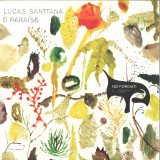
With this new solar album, Brazilian singer-songwriter Lucas Santtana wishes to re-enchant our life on earth. For his ninth album "O Paraíso" (Paradise), the free heir of the Brazilian tropicália intends to redefine our idea of Paradise. "It is in front of us, we must open our eyes and learn to contemplate it in depth," he explains. The Earth is a living organism also called "biosphere", a unique planet in the solar system where all the conditions are gathered to welcome life. Lucas places life at the heart of his songs and celebrates the collective forces that resist to preserve it. His guitar-vocal songs with bossa nova sounds are mixed with organic sounding percussions, enriched with electronic orchestrations and textures. The Brazilian composer gets closer to his French audience by collaborating with Flavia Coelho, Flore Benguigui (from the band L"Impératrice) or the saxophonist Laurent Bardaine, and by even trying his hand at French on one of his tracks. It"s a festive new album, which helps us better understand where we live and with whom we share this heavenly home.
repress !
Wax’o Paradiso Recordings presents its debut outing on vinyl, OK EG’s Intertidal Zone EP. The new label from the long standing Naarm (Melbourne) party is set to explore hi-fidelity, landscape-driven and cerebral music from the antipodes and beyond.
After sold out pressings on local imprints Animalia and Steeplejack, this EP explores a more contemplative side of OK EG, suitable for discerning dancefloors and meditative home listening alike.
Conceived in 2019 and completed in 2020, Intertidal Zone was recorded in collaboration with percussionist Phil Stroud. The rhythm tracks are a fusion of drum machines and hand drums, loose percussion, human voices and tuned percussion immersed in water. Joined by analog synthesisers, layered vocals, processed guitar and field recordings, the music evokes solastalgia and a reverence for nature.
The final track, Golden Hour, came from an improvisation with multi-instrumentalist Adam Halliwell on flute and jazz musician Jack Doepel on Korg bass, later transposed to modular synthesiser.
Wax’o Paradiso and OK EG acknowledge the traditional owners of the land on which this music was recorded, the Wurundjeri people of the Kulin nation, and pay their respects to elders past, present and emerging.
'Rambler of Aeons' is an album of extremes. Musically, both melody and brutality are pushed beyond the boundaries explored in previous albums. The band spans from Motörhead to Black Sabbath passing through Sepultura, Exploited, Paradise Lost, Cro-Mags and everything that is badass. Dealing with all things human and beyond, BARK runs all the red lights from the mundane to the metaphysics, taking us on a euphorical suicide spree between life and death.
Toronto’s Dan Lee steps out of the spotlight and into the producer’s chair on the new collaborative Lee Paradise LP, Lee Paradise & Co., due October 28 2022 on Telephone Explosion. Lee Paradise & Co. follows 2020’s critically acclaimed The Fink LP, and finds Lee flipping the shadowy nihilism of the project’s previous releases upward into a sort of cybernetic universality. This is Dan Lee in producer mode, veering away from the pursuit of a singular musical direction rooted in personal vision, towards of a process rich in collaboration, emotional expansion and tonal exploration.
Starting off as a set of mood-focusedinstrumental sketches drafted by Dan on his own, the compositions began coloringthemselves in after he started sending the tracks out to collaborators, asking them to contribute without much in the way of direction or intention. With help from an ensemble cast of artists including Carlyn Bezic (Jane Inc.), Jonathan Pappo (Scott Hardware, No Frills, Ducks Ltd), Scott Hardware, Isla Craig, Victoria Cheong (New Chance), Jay Anderson, Charise Aragoza & Lukas Cheung (Mother Tongues) and Daniel Woodhead (Moon King), nearly every aspect of this album’s creation eventually became open to collaboration, from musical performances, lyric writing, and vocals all the way through to mixing and mastering.
Sonically, the record is still unmistakably Lee Paradise: a widescreen polyrhythmic psychedelia that melts, bubbles, whirrs and klanks; the sound of the human and the machine grooving in accordance towards new futures. The album’s sonic palette is at once synthetic, warm and extraterrestrial. Arpeggiated square wave melodies dance in lockstep with crunching hi-hats, digital bells and chimes fall like crystal rain in stereo above plush pads and gurgling bass figures. Used to finishing the records on his own, Lee mixed this album with Montreal’s Asher Gould-Murtagh and the results are spacious, dusty and dubbed out. “Carnival” sets the scene with it’s stuttering, busted funk groove and ribbons of aqueous vocal harmony from New Chance’s Victoria Cheong. “Raffles”(featuring one of Daniel’s two vocal performances on the record) radiates a mellow optimism in its solar-warped balearic bliss. The album’s final track, “Youngish” is a gliding, melancholic downtempo instrumental thumper saturated in a kaleidoscopic array of lysergic tones. As always, the record anchors itself to the dancefloor with the screwed-down electro of “Cement”, the swinging midnight afterglow of “Leaving” and “CS2X”’s fluttering rave arpeggios.
Lee Paradise & Co. is the sound of an expert producer and sound sculptor conceding to the elusive flows of inspiration, knocking genre conventions askew and hopscotching between a variety of styles, musical identities and sound worlds with absolute panache.
“I think it’s a mistake to equate ‘perfection’ with flawlessness. To be human is to be perfectly flawed,” Johanna Warren observes while describing the joys of analog recording. Her new LP Lessons for Mutants was tracked live with a band to two inch tape—a revelatory new way of working for Warren. “Tape forces you to commit to a performance, eccentricities and all. The little glitches and anomalies that we’re tempted to ‘correct’ are often what make a thing magical.”
Lessons for Mutants is the prolific songwriter’s sixth solo LP and her second for Wax Nine/Carpark Records. The album’s running theme of metamorphosis (the title of the closing track, “Involvulus,” is Latin for “caterpillar”) reflects major changes in Warren’s personal life: after a decade of relentless touring, as the world was closing its borders, the American multi-instrumentalist unexpectedly found herself quarantining in rural Wales, where she’s now permanently homesteading.
Though tracking for the new album began in New York in 2018 in tandem with the sessions for 2020’s Chaotic Good, the majority of Lessons for Mutants was recorded in the UK surrounded by sheep, cows and a forager’s paradise of wild edible plants—a far cry from the urban jungle of LA that Warren had most recently called home. The body of work that emerged from this dramatic about-face is Warren’s most dynamic to date, shapeshifting seamlessly from searing punk screams to sparkly psych-folk soundscapes, from the bootleg ambivalence of Dylan’s Basement Tapes to cosmic stoner grooves reminiscent of Black Sabbath’s acoustic moments.
“Sometimes I can relate to myself/ I disassociate more than I’d like to, but what can you do?” Warren croons in “Tooth for a Tooth,” a wistful piano ballad that conjures the grainy romance of some smoke-filled 1940s jazz club. This kind of to-the-bone lyrical honesty has always been one of Warren’s strong suits, but these latest reflections are especially unflinching. Being forced to stop touring brought no shortage of self-examination for Warren, who quickly came to view her history on the road as an addiction from which she’s been detoxing. This sentiment dances through opening track “I’d Be Orange,” a drum-driven indie rock number replete with Beatles-esque male backing vocals: “Thirst for power, hunger for fame/ Always was a junkie for pain,” Warren confesses. This exploration of masochistic ambition and artistic martyrdom overflows into grunge anthem “Piscean Lover”: “It’s alright, we’re not ok/ We burn out not to fade away.”
“There’s this unspoken rule in modern music—modern life, really—that everything needs to be Auto-Tuned and ‘on the grid,’” Warren concludes. “This record is an act of resistance against that. There’s beauty and power in our aberrations, if we can embrace them.”
Garden Gaia is a part of Pantha du Prince’s ongoing exploration into the theme of ‘humans as nature’, a theme previously explored on his records Elements of Light (recorded with The Bell Laboratory) and 2020’s Conference of Trees.
Pantha du Prince on Garden Gaia: “There are scientists who say that we humans are ocean that’s been folded together. My music is about raising consciousness, about describing the reality of life and the lost paradise through the means of music. It’s about entering a free space and developing a maximum degree of openness and sensitivity to our bodies – to our mental states and the atmosphere that surrounds us. It’s about mindfulness and a high level of awareness towards what’s happening around and within us. I’ve poured all of these experiences into Garden Gaia as music. And that’s to be taken in the literal sense of ‘pouring,’ since we belong to a flowing process on this planet. A tree also flows into the air, just as it’s connected to other trees beneath the ground through currents of communication. Our lungs flow into our bodies. And as embryos, we were flowing beings. The question is: to what extent can we adult humans continue to flow?”
Gazelle Twin, Lali Puna, This Mortal Coil, Slow Walkers, Atlas Sound, Bowery Electric, Broadcast Press Release: Snakeskin is an album of visionary electronic dream pop, shapeshifting above ambient and industrial undercurrents. It is moody, unsettling, luminous – the culmination of a decade of collaboration and friendship between Lebanese producer/musician/ engineer Fadi Tabbal and singer-songwriter Julia Sabra from Beirut-based indie trio Postcards. The duo began working on Snakeskin in the aftermath of the August 2020 Beirut port explosion, which killed at least 218 people, injured 7,000, and left over 300,000 people homeless. Indeed, Julia's home was destroyed by the explosion and her partner and bandmate Pascal badly injured. The first song that they wrote together afterwards was 'Roots', which closes out the album and was composed for the Ruptured-curated series The Drone Sessions in the fall of 2020. Snakeskin utilizes tape loops, synthesizers, vocals, and drum machines, combining Julia’s pop-inspired melodies and choral roots (an echo from her religious upbringing) with Fadi’s affinity for minimalism and musique concrète. The album seamlessly incorporates the melancholy electro-pop of 'All The Birds', the quiet menace of 'In Our Garden' (long-lost treasures, ancient lies / another buried paradise), and the beat-driven 'Signs'. The title track sums up their frame of mind, beginning as a lullaby and evolving into a glittering tapestry of distortion and feedback. As the artists write, Snakeskin is a product of "the disappearance of life as we know it, and with it the decay of nature and living creatures. There is no rebirth, no renewal. It’s about what it means to feel at home in such a place." Some tracks were also inspired by events happening in the surrounding region, such as the invasion of Armenia by Azerbaijan and the Palestinian uprising of May 2021 in Sheikh Jarrah - both events shedding light on relationships to home and land across the wider region. That such compelling art can emerge from unceasing tragedy may be the ultimate testament to human resilience and the pursuit of freedom and justice. "The moon speaks in tongues we can't discern / A plastic dove hangs from a cypress branch / Haven't you heard? / Nothing grows here anymore / The air is burnt / Nothing grows..." Highlights: – This is the second volume in the Corrosion Series, a collaborative effort by Beacon Sound and Ruptured, and the sixth collaboration between the two labels. – Fadi used samples of Julia's voice on his fifth solo album Subject to Potential Errors and Distortions (2020, Beacon Sound/Ruptured) – The Tunefork Studios team, led by Fadi, administered the Beirut Musician's Fund after the port explosion, as covered by Pitchfork, NME, and the Financial Times. – Julia's band Postcards released their third full-length album After The Fire, Before The End on Berlin label T3 Records in 2021 and are currently touring Europe. Credits: All music composed, performed and produced by Julia Sabra and Fadi Tabbal between November 2020 and December 2022. Lyrics by Julia Sabra. Drum samples by Pascal Semerdjian. Recorded by Fadi Tabbal, mixed by Sary Moussa and Fadi Tabbal at Tunefork Studios, Beirut. Cover photo by Lujain Jo. Design by Josette 'ZOoz' Khalil. Mastered by Rashad Becker. Bios: Julia Sabra is a Lebanese musician, songwriter and composer. She co-founded acclaimed Lebanese dream-pop outfit Postcards in 2013 and is the band’s multi-instrumentalist, lead singer and lyricist. Postcards have released two EPs (2013, 2015) and three albums (2018, 2020, 2021) and have been regularly touring Europe and the Middle East since 2015. She has been the manager of Tunefork Studios since 2017. Lebanese musician, producer, and sound engineer Fadi Tabbal’s work consist of minimalist pieces ranging from ambient and electronic to drone and contemporary classical. He has released six solo albums and has collaborated with various musicians, artists and filmmakers through the years. Often referred to as “the hardest-working person in Lebanon’s alternative music scene”, Tabbal established Tunefork Studios, a collective of producers, engineers and musicians, which has helped shape Beirut's contemporary music scene since 2006.
Last years Black Friday release now available in the Now Again catalogue. The compilation features a collection of small run releases and private press releases. All long out of print and impossible to find. Now-Again’s follow up to one of its most well-loved compilations, Forge Your Own Chains, and this, as the title hints, a recollection and rumination of what might befall the human race made especially salient by the past year’s trials and tribulations as performed by prison funk ensembles, Krautrock legends, Turkish teenagers, Icelandic prog-rock bands and even E-40’s uncle, the man to first distribute No Limit, and the creator of this album’s title track, St. Charles “Chucky” Thurman. Tracks: A Side. 1. Golden Wing - Hari Yang Mulya 2. Beybonlar - Nenni? 3. Icecross - Sad Sad Man 4. Paternoster – Realization 5. Christopher - In Your Time. B Side. 1. Chucky Thurmon - Tickets For Doomsday 2. Upheaval - Paradise Lost 3. DR Hooker - The Bible 4. Jean and Donella - Get Ready (For That Day)
“Irreverent and playful” MOJO // “...an utterly distinctive, mental world.” The Financial Times // “From keening ballads to haunting waltzes, Paradise has never seemed stranger” Shindig // “There’s a buoyancy to even the most lacerating lines now, a liberating relief in pressing on” Uncut // Way back when, before the pandemic, and before the release of Alex Rex’s last album Paradise escaped the confines of lockdown, Alex Neilson took a break from the road and set about putting together a record of poems extracted from the collapsed goldmine of his brain. Returning to his experimental roots, Mouthful of Earth’s cutting and oft heart-wrenching stanzas are set to music largely from underground legends Alastair Galbraith, Richard Youngs and Alex’s cult experimental drone record Belsayer Time (originally released on Time Lag Records in 2006. This is the first time that this music has ever been made available digitally). And for one track, Alex reunites with ex-Trembling Bells mucker Lavinia Blackwall for some free-form experimental jazz, reminiscent of the more psychedelically unhinged moments of Cammell/Roeg´s Performance soundtrack. To quote Stuart Maconie’s sleeve notes for the record, “One of the first things I learned about Alex’s musical imagination and modus operandi was a joy in collaboration, and Mouthful Of Earth continues in a tradition that has seen him work with many kindred spirits across many genres; Bonnie ‘Prince’ Billy, Current 93, Jandek, Kan Mikami, Shirley Collins, Six Organs of Admittance, Josephine Foster and Baby Dee. The list is disparate and stellar, the results are always interesting and alive.” Continuing in the spirit of collaboration, Mouthful of Earth’s words and music are accompanied by a digital book of drawings by Kent-based visual artist, musician and art psychotherapist, Benjamin Prosser (Insta: @benjaminprosser). These are not so much literal illustrations as reactions. The combination of poems and visuals works a suite of haunted vignettes, dense with bleak humour and hallucinatory images. “The phantom hand of a lover pressed over the mouth of your mother” / “the whole gurning universe” / “the collapsed farmhouse of my mouth”. Mouthful of Earth is both visceral and corporeal, flecked with blood, sweat and beers. Or as Alex puts it "a continuous project of describing the human spirit pushed to the point of crisis”. Mouthful of Earth finds beauty in scarring and peace in torment. It’s both an assault and a balm of sorts. Life, says Neilson “is not a golden arc / It's a bent aerial / connected to a vast and terrible machine/operated by a child”. But listen hard and you will also hear beauty… “The song of yourself, roaring like a cloud, explicable only by light”. With sleeve notes by BBC Radio presenter and author Stuart Maconie, Mouthful of Earth is released on limited edition vinyl (300 copies only) and digitally via Neolithic Recordings. Reminiscent of his early work with Trembling Bells, and again featuring Lavinia Blackwall on vox, the track is a red herring; a nod towards a lighter shade of darkness.