Fetter’s Body of Noise erupts at the threshold between ravey hypnosis and avant-pop experiment, slithering through the hinterlands of unconscious desire. Nine shape-shifting tracks conjure haunted landscapes where beauty refuses clarity and dancefloor logic warps underfoot. Vocals swoon, drift, and demand—stacking into fragments that multiply and weave through saturated pulses and shimmering, snarling synths.
Opening track "Like a Rose" traces a dreamer’s transition into the unstable physics of a perplexing but familiar dream world, where they gradually become lucid. “Beast” follows up humming with shadowed urgency, threading a path through self-sabotage and metamorphosis. “Spathiphyllums” drifts a while in a lush lostness, aching for something new before fracturing into wild, cathartic collapse. Side B’s “Do I Exist? (D.I.E)” and “The Longing” spiral into existential wonder, searching for a human origin story—both personal and collective—against a backdrop of uncertainty, while “Headache” thrusts forward as an absurd and insistent manifesto to stay the course and harness one’s own power within the madness.
Body of Noise is crafted not only for sweating bodies in motion, but for distorting time and opening psychic portals, where surrender becomes strategy and uncertainty transforms into ecstatic navigation. Rooted in all-hardware improvised production and shaped by Fetter’s years of boundary-blurring visual and performance art, their debut LP feels alive and in flux. Reminiscent of a spectral pop chorus trapped in a loop of broken machinery, or a lost broadcast from a dancefloor in a parallel realm, Body of Noise is a journey into chaos, transformation, and a bold refusal to be contained.
About Fetter:
Fetter makes clubby self-destructing noise pop to dance and weep to. Oscillating between ethereal and pounding, their all-hardware, largely improvised live sets take listeners through a foggy wilderness of saturated rhythms and menacing synth lines, a golden voice guiding the way through. Fetter is the stage moniker of multimedia artist Jess Tucker. Their performances take place in clubs as well as galleries, often incorporating video, installation, and interactive performance art elements to create other-worldly surrounds of mesmerizingly unhinged bodies and faces.
Поиск:human machine
Все
- A1: Emerge / Fischerspooner
- A2: Seventeen / Ladytron
- A3: Strict Machine/ Goldfrapp
- A4: Girls On Pills / The Droyds
- A5: Hooked On Radiation (Pet Shop Boys Orange Alert Mix) / Atomizer
- B1: Fuck The Pain Away / Peaches
- B2: Do I Look Like A Slut? (Original Version) / Avenue D
- B3: Galang / M.i.a
- B4: Kernkraft 400 (Dj Gius Mix) (Radio Edit) / Zombie Nation
- B5: Poney Pt. 1. (Edit) / Vitalic
- B6: The Game Is Not Over / T. Raumschmiere Feat. Miss Kittin
- C1: Over And Over (Naum Gabo Remix) / Hot Chip (7.05)
- C2: Banquet (Phones Disco Remix) / Bloc Party (5.25)
- C3: E Talking (Nite Version) / Soulwax (6.08)
- C4: ?Zdarlight» / Digitalism (5.44)
- D1: Daft Punk Is Playing At My House (Edit) / Lcd Soundsystem (3.23)
- D2: Hustler / Simian Mobile Disco (3.43)
- D3: We Share Our Mother's Health / The Knife (4.09)
- D4: Missy Queen's Gonna Die / Tok Tok Vs. Soffy O (4.13)
- D5: What Was Her Name (Radio Edit) / Dave Clarke Featuring Chicks On Speed (4.44)
- D6: I Am The Fly / Adam Sky And Crossover (4.59)
- E1: We Are Your Friends / Justice Vs. Simian
- E2: Take Me Out (Daft Punk Remix) / Franz Ferdinand
- E3: Slow (Chemical Brothers Remix Edit) / Kylie Minogue
- F2: Warm Leatherette / The Normal
- F3: Empire State Human / The Human League
- F4: Tryouts For The Human Race / Sparks
- F5: Telephone Operator / Pete Shelley
- F6: Nag Nag Nag / Cabaret Voltaire
- E4: Let's Make Love And Listen To Death From Above / Css
- E5: Solta O Frango / Bonde De Rolê
- E6: Club Action / Yo Majesty
- F1: Numbers / Kraftwerk
‘When The 2000s Clashed: Machine Music For A New Millenium’ is the story of how, 25 years ago, a new form of electronic music – known as electroclash - reignited a tired clubland and gave the indie scene and mainstream pop a shot in the arm in the process. Over this 3LP highlights set, carefully curated from the 5CD box of the same name (also released, 3rd October) the collection showcases the back-to-basics electronic beats that heralded in a new generation of exciting and innovative new artists - Hot Chip, Peaches, LCD Soundystem, and Ladytron, to name a handful. It also shows how the sound and attitude of electroclash plugged into the decade’s cutting-edge indie bands, (Franz Ferdinand, Bloc Party), and became intrinsic to the way chart pop would sound in the first decade of the 2000s (Kylie, Goldfrapp).
The collection also shows how the scene’s underground DIY ethos evolved and inspired the next generation of electronic buccaneers (Simian Mobile Disco, Justice Vs. Simian). ‘When The 2000s Clashed’ brings together a dazzling, diverse selection of artists, producers and remixers from right across the 2000s zeitgeist – from The Chemical Brothers and Daft Punk, from M.I.A. to Soulwax and many points in-between. For good measure, there’s also one side of LP3 given over to the original post punk and electronic sounds (including Kraftwerk, The Human League and Cabaret Voltaire) who’d played such a big influence on the electroclash sound. ‘
When The 2000s Clashed’ was compiled and sequenced for Demon / Edsel by Jonny Slut, founder of London’s electroclash citadel Nag Nag Nag. Established in 2002, in a small Soho venue called Ghetto, ‘Nag’ quickly became THE hottest club, first in London and then in the whole world. A glorious mess and hedonists’ hotspot, a night at ‘Nag Nag Nag’ (if you could get in!) saw the capital’s club kids, students and creatives rub up alongside names from the fashion and music worlds - Björk, Pet Shop Boys, Kate Moss, Boy George, Alexander McQueen, and Pam Hogg were among the regulars. Madonna visited, so did John Peel, Yoko Ono asked to perform and did, Throbbing Gristle’s Chris and Cosey DJ’d, so did Marc Almond, and Too Many DJ’s.
Justin Timberlake was refused entry (too many bodyguards)… even Cilla Black was spotted getting down! Jonny shares these reminisces – and many more - in the collection’s sleevenotes. Named after the 1979 Cabaret Voltaire classic, ‘Nag, Nag, Nag’ became the first place to hear the seemingly endless flow of thrilling new tunes coming from every direction during that decade of dance. Many of them are included on this collection.
The KNOW was an early 80's electronic duo, comprised of brothers Garry and Neil Todd from Stoneydelph, Tamworth (near Birmingham), UK. After playing in a conventional rock group and having to deal with the issues of too many cooks spoiling the broth, they decided to stay a two piece while the affordability of synthesisers and drum machines came in handy to replace additional human band members – shall we say for the better in the end?!
Regarding the name, Neil says: “Garry and I came up with this name in relation to the saying, oh you know he’s in “The Know” you know.“ The KNOW released only two tracks “Times Change“ and “Knights of Pleasure“ on a 7“ single in 1982, which is ultra rare now (only being sold once on Discogs for almost €300). Neil used Korg Micro Preset M-500, Moog Liberation, Roland Jupiter-8 synthesisers, and a Roland CR-8000 drum machine to create these two minimal synth pop anthems.
The original masters have been lost over the years, but the recordings have been carefully digitized from vinyl and meticulously restored and remastered and sound better than ever before. Additionally, five cover versions have been added by no less than minimal electronic synth pop heroes BLIPBLOP, doing both tracks, the THE SILICON SCIENTIST adding his dreamy synth pop melancholia signature sound, FLASHBACKS (aka Echo West, Silent Signals) with his icy cold yet playful minimal electronics, and TWINS NATALIA featuring KRIISTAL ANN delivering a rather faithful to the original yet up-to-date version while adding lots of new bits like a choir, vocoder, and one of Dave Hewson's unique synth solos.
All of this is pure and classy 80s electronic synth pop bliss!
Lucy Duncombe and Feronia Wennborg compose a modern symphony for virtual choir on 'Joy, Oh I Missed You', muddling sound poetry with Nuno Canavarro and ‘Systemische'-style machine-damaged surrealism. Like a mashup of Lee Gamble's 'Models', Akira Rabelais' 'Spellewauerynsherde' and Robert Ashley's timeless 'Automatic Writing’ screwed to perfection.
Duncombe and Wennborg have been chewing over ‘Joy, Oh I Missed You’ for four long years, working their process until they were "queasily intimate" with their arsenal of artificial voice tools. Tracing the history of the technology, from voice synthesisers and chatbots to AI voice analysis tools, the duo experiment relentlessly to develop a digital-age response to IRL extended vocal technique - think François Dufrêne, Yoko Ono or Phew. Less interested in replicating human sounds exactly, they instead test how various tools might cough up their own idiosyncratic tics as they stretch and stutter through attempts to mimic their "fleshware" counterparts.
Duncombe's got prior form here, most recently re-synthesising her voice on the brilliantly oily 'Sunset, She Exclaims' 45 for Modern Love, following a stunner for 12th Isle in 2021. Wennborg brings along experience from her tenure as one half of microsound duo soft tissue, whose 2022 LP 'hi leaves' (Students of Decay) was a haptic treasure. These approaches mesh remarkably well on their first collaborative full-length, with Duncombe's eerie bio-electronic incantations providing the ideal foil for Wennborg's carbonated hardware processes. It's not completely clear where the human voice ends and the zeroes and ones begin on 'Your Lips, Covering Your Teeth', as rolling cyborg syllables tumble over OS-startup womps and surprisingly svelte outcroppings of glassy, synthetic glitches. The music is surprisingly mannered, a sonic reflection of the cover, where a mouth is pixellated until only colour swatches remain. Duncombe and Wennborg trace the gradual erosion of their voices, leaning into the chaos as their various tools veer off into unique patterns of failure.
What sounds like a far-off, ghosted folk rendition (we're reminded of the Icelandic laments that Rabelais chewed up on 'Spellewauerynsherde') is offset by gnarled, bitcrushed machine faults and pneumatic lip smacks on the brilliant 'Residue', and on 'Brushed My Hair', the duo massage the voice until it sounds like a flute. Assembling stutters and barks and sighs into a celestial chorus alongside time-stretched moans, they create a levitational atmosphere on 'Smell It', freezing the energy from bizarre pitch steps to configure a zonked vocal ensemble.
'Joy, Oh I Missed You’ is an album that, like its source material, constantly morphs, testing the boundaries of its concept repeatedly without bubbling over into conceptual goo. In fact, it's remarkably euphonious, even at its most theoretically abrasive; Duncombe and Wennborg wring out uniquely angelic formations through a process of trial and error that packs a surprising, hefty emotional punch.
- 1: Holiday Party At The Cryptozoological Museum (Entrance) 0:22 Video
- 2: Abominable Snowman 0:38
- 3: Unholy Night - Mini Exhibit On Ritualistic Holiday Burnings 01:21
- 4: Coventry Carol For The Dead (Exhibit Hall A - Human Sacrifice As Holiday Tradition) 02:8
- 5: Hoofsteps Approaching (Mini Exhibit: Malfunctioning Yuletide Countdown Clocks) 01:06
- 6: Krampus Is Coming To Town - Exhibit Hall B 02:58
- 7: A Last Noel (Mini Exhibit: Collection Of Animatronic Christmas Decorations) 01:26
- 8: Sugar Plum Faeries: Friends Or Foes (Exhibit Hall C) 03:0
- 9: The Bells Toll (Mini Exhibit: Collection Of Vintage Holiday Carnival Games And Pinball Machines) 01:14
- 10: Christmas Luau (Snack Bar) 02:37
- 11: The Aritifical Aviary 01:04
- 12: God Rest Their Souls (Closed For Renovations) 02:42
- 13: Off-Limits Stairwell 01:14
- 14: Deadly Night (Members Only Ritual Chamber) 02:48
- 15: Cursed Artifiact Storage Room 01:21
- 16: Carol Of Hells Bells 02:53
- 17: Escape 01:21
Following the release of Haunted House Party, Bradley Thomas Turner was contacted by the Cryptozoological Society of New York City to create music for their museum’s holiday exhibitions. As enigmatic as they are controversial, the secretive society gave the composer free rein to create music that celebrated their profane (and, according to their critics, pseudoscientific) explorations of the darker side of yuletide folklore. The endeavour was denounced by religious groups, the scientific community and even parts of the cryptozoological community as “blasphemous,” “irresponsible”, and “a dangerous topic to make light of” respectively. Not much is known about the pandemonium that broke out on the night of the opening reception, but one journalist (who has been granted anonymity by request) infiltrated the event and captured the recordings that follow. Death cult ritual? Mishandling of cursed artifacts? Elaborate practical joke? Publicity stunt? No one can (or will) say for sure as no person in attendance has been willing to speak on record. Therefore, we present these recordings so the general public can decide for themselves.
‘Absurd Matter’ is a labyrinthine sonic conundrum that spirals around the two poles of extreme noise and hiphop. It's Berlin-based Italian producer Shapednoise's first album in four years and confidently advances his narrative into the next chapter, building on the groundwork of his prior abstractions to emerge with a coherent genre-warped fusion of urgent rap, crushing bass weight and idiosyncratic sound design. After spending years scrupulously deconstructing club music, Nino Pedone has rebuilt it brick by brick in his image.
The album is the first release on Pedone's brand new imprint WEIGHT LOOMING, a multidisciplinary label platform that's set to explore the depths of bass music, textured noise and abrasive transcendence. It follows a slew of acclaimed releases for Numbers,
Opal Tapes, Type and his own Cosmo Rhythmatic label, and forward thinking collaborations with Kenyan beat alchemist Slikback and Hyperdub-signed Angolan producer Nazar. Pedone's most ambitious project to date, ‘Absurd Matter’ taps into kinetic energy from a hand-picked selection of collaborators, including New York rap duo Armand
Hammer, French DJ/producer Brodinski, Bruiser Brigade's ZelooperZ and vanguard Philly poet, musician, and activist Moor Mother.
On ‘Family’, Billy Woods and Elucid weave a dismal, apocalyptic landscape with their razor-sharp anecdotes. The duo’s macabre imagery is given artificial life by Pedone's industrial scrapes and rattles that curl around their worlds like thick smoke. It's still rap, just about, but lodges itself in the back room of a factory, machines running themselves to an early death. Pairing with techno-rap trailblazer Brodinski, Pedone edges further towards the sound system, spatializing rhythms in four dimensions around Detroit rapper
ZelooperZ's playful expressions. This is the Italian producer's sci-fi tinged liquefaction of radio echoes, a way to fire familiarity into the void and sublime the human voice into weightless mist. When Moor Mother arrives shouting "me me me" on the aptly-titled 'Poetry', it sounds as if all of Pedone's loose threads are being tightened into a knot. His misshapen neo-grime beats sound like a broken jet engine, but smartly cede power to Moor Mother's resonant rhymes. "You can't cancel me" she assures. ‘Absurd Matter’ is a defining personal development for Pedone that not only appraises his career so far, but diverts its logic into frighteningly new sonic territory. From great loss, the producer has determined his work's cardinal themes, and sounds more strident and far heavier than ever before.
ZUG is without a doubt one of the leading and most compelling forces in contemporary European body and minimal electronic music. Once again joining forces with Oráculo Records, they present a retrospective that traces the arc of their already extensive and influential career. The result is a powerful compilation that blends previously unreleased material with some of their most iconic tracks to date—specially remixed and remastered for this edition. Every piece captures ZUG’s signature approach: a fusion of machine precision and raw physicality that transcends genre limitations. Tailored for fans of truly experimental, humanized electronica, primal drum patterns, and proto, body-shaking basslines, this release is a visceral listening experience from beginning to end. This is body music in its purest form. Presented in a ONE-OFF, truly limited edition of 300 copies, lacquer-cut and pressed on 180g high-quality solid BLACK vinyl. All tracks have been specially remastered and mastered for vinyl by Daniel Hallhuber at Young and Cold Studios (Germany).
Veteran Japanese electronic music producer, AKIO NAGASE, a leading player in the Kansai underground music scene since the late 1990s teams up with Yukino Inamine, a gifted and young female singer from Okinawa who magically mixes traditional Ryukyu (Okinawa) folk songs with her sanshin (Okinawan Shamisen) playing into the modern age, to create this wonderful collaborative album, Yugafu ai KAJI. This album is set to be released on GLOCAL RECORDS, a record store/ record label run by Genta Minowa, an ex-staff at the record store, Disc Shop Zero in Shimokitazawa, Tokyo and who still continues to introduce a great selection of dubby, club music from his HQ in Harajuku.
AKIO NAGASE regularly organised parties at his own venue, as well as ran a record store of the same name while actively being part of the Kansai scene at legendary clubs such as Tsuru no Ma, Sound Channel, etc., the best of what was offered in the Kansai underground dance scene in the 2000s.
As an artist, he released his own productions out of labels such as Sound Channel and RUDIMENTS run by Minowa. His album, Make Dub was released in 2003 out of the label, Sound Channel featured an innovative, techno meets dancehall track, Dance Hall King which connected techno, acid house with reggae and dub. This album is an undiscovered gem whose sound still emulates freshness and originality today (my wish is for it to be reissued on vinyl!) After a brief hiatus of releasing music, he released the EP, Delusion out of Chillmountain Records, a label run by his friend, Ground in 2018 and at his own leisurely pace, he has been slowly but surely releasing material that oozes originality, expressed through a robust acid sound and a variety of elements such as afro and Ryukyu folk music that is then incorporated into the medium of dub. Recently, he has also started to gain international attention by releasing original material and remixes out of labels such as the UK label, Emotional Especial, etc.
For this album, NAGASE teams up with Yukino Inamine who brings her own distinctive singing and sanshin playing magic into this collaboration and they fuse electronic music sounds with Ryukyu folk songs to create this wonderfully imaginative album that has no precedence or equal. Apart from the song, Ishikawa Koiuta, all other songs are covers of Ryukyu folk standards that were handpicked by NAGASE from the repertoire of songs that Inamine regularly performs live. They met up when NAGASE was commissioned to remix one of her original compositions, Miyagi Kaigan that was released in 2023 and that evolved into a collaboration with a concept that mixed Inamine singing Ryukyu folk standards with a backing tracks produced by NAGASE. Whenever she went to the the Kansai area, she would work on the basic track material created by NAGASE at the dub master of Osaka, Soulfire’s studio, HAV who would then additionally edit her takes to create the finishing tracks.
This album, Yugafu ai KAJI opens with Shirahamabushi, a track that slowly builds with an interesting mix of slow acid techno and sanshin and then moves onto the easy-going electro dub of Tinsagu nu hana (it is actually a cover of the track of the same title that first appeared in the label sampler, Comuni ó n Especial that was released on Emotional Especial. NAGASE initially wanted to feature Inamine on vocals for this track but due to scheduling issues, it did not happen but with good fortune, the new version of this track is now included in this album). A side closes with the optimistic Balearic sounds of Tsuki nu Kaisha that converges immaculately with slow-mo steppers. It is also worth noting that the person who introduced NAGASE to Inamine was the Okinawa dub master, HARIKUYAMAKU. They met at a concert held by both him & Yukino Inamine hosted by BUN BUN THE MC at the venue, RAGGA CHANNEL. From this encounter, this album came into fruition and they also asked HARIKUYAMAKU to produce an earthy, traditional rootsy, dub version of Tsuki nu Kaisha that is included as the 3rd track on the B Side.
Ashimizubushi, the track that magically blends old school Chicago house ala TRAX with Ryukyu folk music starts off the B side and it carries on to an uplifting track with a Skaouse (ska + house) feel, Hounen Ondo. Inserted after HARIKUYAMAKU’s dub of Tsuki nu Kaisha, this album closes out with the song, ‘Ishikawa Koi Uta’, the only song written by Inamine who said that she wrote it after falling in love with chill-out music. It is an ambient dub track with a collage like flavour, reminiscent of early The Orb (remixed by Mad Professor) and the latter half of the track finishes off with a message presented by Masao Itokazu (her uncle) who received tutelage from the prior owner of her sanshin that Inamine plays, Moritomo Inamine (her grandfather).
Incidentally, the album title, YUGAFU ai Kaji is derived from an auspicious word from Okinawa, Yugafu which means fruitful year, happiness, prosperity and ai (indigo) is a word that Yukino found inspiration few years ago (she wears a Okinawan indigo clothing called kinonuno in the front cover of this album).
The unique indigo colouring produced by nature overlaps with the unique charm of the human personality, and she wanted to present that current along with the music so the name was integrated to ‘indigo wind’, and the two were connected to form the album title, ‘YUGAFU ai Kaji’.
The photo of the front cover was taken by a young, Uchinaanunishie—- (meaning a boy from Okinawa) 17 year old photographer named Ratio and the designer of this album is Anmonaito who is a childhood friend of Inamine who also did the artwork for her album, Miyagi Kaigan. And the mastering and cutting of this album was done by Rei Taguchi.
The cosmology existing in Yukino Inamine’s singing is fully amplified by AKIO NAGASE’s spacey, abundant with many ideas, dance machine beat~ambient music and all of these elements are organically linked by the adhesive effect of dub.
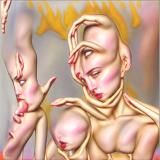
2025 Repress
Chlar returns to his Primal Instinct label with 'Modern Survival'
Following the widely praised Funk Assault (Chlar & Alarico) 'Minimum One Post A Week' EP, which kicked off the Primal Instinct label last summer and won the support of the likes of Rodhad, Tasha, and Luke Slater, as well as routine plays from Sarah Story on BBC Radio 1, Chlar now returns to his imprint with solo venture 'Modern Survival'. While the first Primal Instinct release saw references to artist urges and behaviours on social media, this next instalment explores a modern recontextualisation of humanity's hierarchy of needs in yet another high-concept EP.
First up, 'Internet Soulmate' boasts a crunchy bassline as its drum work chugs along the track playfully. The groove twists and turns before the hypnotic and tribal 'Supermarket Hunting' continues with sounds of nature, loopy rhythm and syncopated bleeps.
On the B-side's 'Body Control Officer', human-made grooves intertwine with machine-like thrum, synths whirring and zapping, while 'Competitive Influencing' takes off with rolling percussion, subtle whistles and distorted vocal one-shots. Closing out another stellar offering from the Primal Instinct frontman, Chlar brings the dark 'Scout My Algorithm', a brooding slow-burner offset by smooth arpeggio snippets and warped slices of digital noise.
"In an era where technology entwines our everyday existence, where the virtual realm shapes our interactions, and where the pursuit of influence takes centre stage comes an EP that delves deep into the modern tapestry of human existence. 'Modern Survival' is not merely a collection of songs and visual clips, but a poignant reflection on the intricate dance between our primal instincts and the brave new world we navigate today. The EP invites listeners on a journey of self-discovery and reflection, prompting them to ponder the fundamental essence of our existence in an environment of fast-paced technological evolution." - Chlar
- 1: Peace & Purpose
- 2: Safe Room
- 3: Not The Same Thing
- 4: Life On A Farm
- 5: Pick Apart
- 6: Marathon Of Hope
- 7: Stop Cutting Me Down
- 8: Shut The Fuck Up
- 9: Reunion
- 10: Phantom Limb
- 11: Thoughts On My Faith
- 12: Eris On The Run
- 13: Red House
- 14: Truth In Trauma
Can’t go over it. Can’t go under it. Gotta go through it. And somewhere out there in the Pitch black beyond all darkness lies Peace & Purpose. The horizon you never quite crest until the inevitable end. Breathe deep — this fearful moment is the most alive you’re ever gonna feel. For the last decade, Crack Cloud’s vision has grown ever more expansive, more cinematic. Last go around, they dropped from The Heavens and then performed with their bare backs to an endless darkening desert. Now they’ve crammed all that life into some metallic and strange object called Peace & Purpose. All the terror of living. All the helplessness. All the raw human will. All glued and screwed and locked into this impossible tactile shape of dungeon dub; sour milk vox; Avant-protest music. Music arm wrestling itself to the ground. Far afield of beauty. The discordant symphony of factory farming and grim timber of the meat processing plant. The grinding din of the cogs. And yet, never giving up in spite of all good sense. Even in death, we are a coterie of survivors. Look now: There’s Terry Fox on his one-legged Marathon of Hope across The Great White North while cancer spreads through his lungs. A self-annihilating drive to feel alive. Rage against the dying of the light, they say. Well, how ‘bout it then!??! Peace & Purpose is not in any way some art project meditation on Punk Rock. It is Punk Rock. Terrifying, inspiring, vital, invigorating and most importantly, utterly unexpected. Every goddamn stupid day is a sublime slice of fresh hell. That’s the point. Gotta go through it. Wishing you Peace & Purpose — if only in that last big breath.
"After being praised as one of the best releases of 2025 by multiple platforms, the highly praised debut album from Obeka lands on vinyl via YUKU.
The rhythmic dynamics and emotive attitudes of A World No More captures the density of soundsystem culture in Obeka's ancestral roots. YUKU presents the Bermudians debut album capturing a Neo-Colonial dystopia, protest and Afro-Futurism hyperextended through decaying sonic structures of a dark past and its grievances which very much exist today.
Growing into adulthood within the walls of British and European Colonial systems meant the disconnection and lostness in a new country hid me from the world at a young age. Unlike London's vast and culturally engaging migrant communities, the industrial milling town of Stockport introduced a coldness towards people from other countries I experienced in my first year after relocating from Bermuda. I couldn't understand why. Whether cold words thrown towards me or actions upon other people who look like me, it has shown to be a dooming societal virus with no cure. The most comfort was found through what was familiar - drums and rhythmic spirituality of my homeland. It was a safe-haven, a place to empty the anger and confusion. It's been 15 years since relocating and as my sound evolved, it seems classism, racism, oppression and civil control of ethnic peoples has become worse - even now more legalised and normalised. Ogun (a powerful Yoruba deity associated with anger, justice and war) acts as the opening sequence of the record and its symbolism. Using distorted bass frequencies and dissected Regga-Dub immersed in live-sampled ghostly voices of the lost ones. This sonic exercising is also applied in Drillaman - a stampede of industrial framework and metallic instruments wielded over moody Dancehall MC'ing, magnifying two parallel worlds in cocooned evolution. The resurrection of Transatlantic African cultures and identity have never been silenced, rather carried elsewhere through trade routes of enslavement, which was pivotal when composing and completing the album upon returning home to the Caribbean for the first time ever. After reconnecting with my heritage my blurred vision of what's wrong in the world became so clear. Guidance in empty plains seek truth throughout the pain - A statement of finding oneself expressed on the poetic closing track A World No More.
On Fawohodie (A West African Adinkra symbol that represents independence, freedom, and emancipation stamped on the album cover) the motive and atmosphere begins to change. Afro-Caribbean idealism which refers to the philosophical concept that emphasizes the interconnectedness of individuals and the importance of community, often contrasting with Western individualism, begins to take shape in a new universe. We can co-exist. The track framework uses machine-led software forming frequencies we have no control over, then manipulated through decomposing soundscapes, scattered hand-drums and human-made weapons of control - exposing the hidden disparity that's been carried over generations whilst balancing hopeful and musical foundations towards equality and peace. On Pressure and Kuduro! the writing direction attempts to wake people up. Not settling for a composed approach like in past projects, quite the opposite. A call for native sonic awareness, dismantled vocals of protests, eroded percussion using chains, gears and motorised harmonies sculpted in challenging abstract behaviors far outside my comfort zone. A direct abrasiveness and weight I want people to feel, whilst finding hope and solace through enchanting choirs and hypnotic basslines in complete synchrony.
"Purity in sound manifests when you least expect it. The smallest memory or feeling grows from a seed into a sonic language that you, and only you can interpret and release back into the world." "
The experiment aboard orbital station Sequoia-4 began as a routine test of the acoustic array. The team attempted to synchronize an analogue resonator with a quantum audio synthesizer. The two incompatible frequencies were expected to cancel each other out. Instead, the instruments registered a stable wave. It didn’t fade, on the contrary, it did respond to every sound, every movement around it.
At first, they assumed a coding error, but the wave began adapting to the researchers’ voices, shifting its amplitude and rhythm. Within hours, its spectrum started to resemble a heartbeat. The recording was forwarded to the Analysis Division, where it was named Hybrid Dub — a hybrid resonance formed between the machine and the human senses. The phenomenon proved unpredictable: each listener described different effects, from gentle euphoria to vivid recollections of memories that had never occurred.
Even after the system was powered down, a faint signal persisted in the ether — as if the mechanism had learned to breathe on its own. Some claimed that, when replayed, traces of the ocean, rustling leaves, and distant voices could be heard — as though the signal had passed through layers of living matter and remembered them.
The project was shut down, and the archive sealed. Only one line remained in the final report: “The signal wasn’t created — it discovered us.”
Evighet proudly unveils its fifth release, EVIGHET005, featuring the Sky City EP by Dave N.A., the prolific producer from Yerevan known for his refined sound design and emotionally resonant compositions. With a catalog that spans labels such as Typeless Records and Uppers & Downers, his work continues to bridge precision and sensitivity, exploring the borders between rhythmic architecture and ambient introspection. On Sky City EP, Dave N.A. constructs an intricate sonic landscape where lush atmospheres coexist with fractured breaks and IDM-inspired rhythms. Rooted in the traditions of Jungle and Breakbeat yet unbound by genre, each piece reveals a narrative built from texture, movement and space. His music invites reflection while maintaining a dynamic forward energy, evoking the sense of motion through memory and dreamlike transitions. A central moment in the release is “Bloom”, which features a collaboration with Hayk Karoyi on flute. His performance adds an organic depth and melodic fluidity, weaving through electronic layers with warmth and clarity. The result is a delicate interplay between human breath and machine pulse, blurring the boundary between the natural and the synthetic. Sky City EP marks a new chapter for Evighet, reaffirming the label’s dedication to sound as a medium of exploration and storytelling. Through this release, Dave N.A. captures both emotional immediacy and compositional detail, expanding the label’s evolving narrative with a vision that feels deeply personal yet universally resonant.
Mannequin Records presents Artificial Salvation, the long-awaited next chapter from Taiwan-born, Berlin-based artist Jing. A visceral journey into fragmented identity, post-human desire, and sonic disobedience, the album marks a bold evolution in Jing's unmistakable language—where rhythm is weapon, voice is distortion, and silence is political.
Known for her uncompromising DJ sets and past releases exploring industrial textures, field recordings, and haunting spoken word, Jing now delivers her most narrative-driven and confrontational work to date. Artificial Salvation lives at the intersection of club dystopia and spiritual unease: glitched-out techno structures collide with ghostly chants and collapsing machinery, echoing themes of surveillance, digital exile, and existential displacement.
Crafted between Taipei and Berlin, the album draws from a palette both hyper-modern and deeply ancestral—melding broken beats, noise, and vocal manipulation into an unflinching statement of intent. This is not music for escapism. This is a sonic exorcism.
SHDW's Mutual Rytm imprint is back with its third release of 2024, marking a full label debut from Sonic Propaganda with their 'Native' EP.
Sonic Propaganda comes from the collaborative minds of Earwax and Rosati, a pair who favour dark and intense techno sounds and take inspiration from Jeff Mills and Robert Hood. In the studio, they blend analog and digital technologies into smoky warehouse atmospheres and immersive journeys that connect with listeners on an emotive level, and this full EP lands following their contribution to the third instalment of the Mutual Rytm's Federation Of Rytm compilation series in February.
The powerful 'Native' opens up at high speed with tightly coiled drum loops that never let up. Sleek metal percussive sounds peel off the grooves and lock listeners into a perfect state of hypnosis. 'Soul Pressure' is just as absorbing, with a tense bassline keeping you on edge as the train-like drums march under incendiary hi-hat ringlets. There is plenty of perfect machine funk to 'Terminal', which has more rusty synth textures and chopped-up vocal fragments humanising the turbulent grooves. 'Basic Path' brings an extra skip to the kicks as they enter, scuffed up and flowing just above the groove, while vocal pulses and twitchy synth modulations bring the detail. 'Body Empire' closes the vinyl package with a deeper vibe and pensive synths that add warmth and soul to the brilliantly mechanical grooves, while digital bonus 'Acid Riot' closes with squelching acid lines amongst a swell of analog crunch and laser-sharp percussion.
On June 27, 2025, a long-dormant signal reactivates from Hamburg’s hidden places: Helena Hauff and F#X return as Black Sites with R4 on Tresor Records—their first full-length album and the first release under the moniker since 2014. Like a hieroglyphic recently discovered and translated, R4 feels more like a long-awaited resumption than a comeback.
Recorded to tape with minimal editing or post-production the record is a classic example of the symbiotic relationship that can come from the interaction of human and machine. This punk ethos isn’t invoked through distortion alone, but through method; in the album’s breaking from the received wisdom of hardness tethered to speed as most of the tougher pieces are lower BPM and vice versa (with one notable exception in the mind-melting stomp of BLOKK).
Across ten tracks, Black Sites traverse a landscape where genre dissolves into intention. It migrates through electro’s danceability, acid house’s corrosion, and into the liminal realm of machine funk—a genre coined by Andrew Weatherall, which sounds like the results of technology dreaming of soul where the emphasis is on live execution, on immediacy over perfection—a sound forged in the act of creating, not polishing.
In a 2013 interview, around the time of the first Black Sites EP, Hauff was quoted as saying that she wants “things to fit together properly, but on another level, I really want them to make sense together.” That principle animates R4: The album’s form reveals itself in time, with each movement echoing and amplifying the others to create a synergistic whole.
From the opening crawl of C4 (a name that like the music foreshadows the explosions to come) to the end-of-the-night bliss of MOTHERJAM via the intense peaks of BLOKK, 707, and classic acid track 3D it’s clear that R4 is a work made with serious intent; a refutation of a world where streaming has made the two-minute single the dominant musical form again. R4 demands immersion, not just attention. It is not a collection of tracks, but a singular, recursive experience: a mirror in which sound and listener repeatedly rediscover one another.
Fashion Flesh tears the fabric of space and time. This is his first offering for the ESP Institute. With side A’s 'Atoms Revolt', ESP cordially introduces Fashion Flesh, AKA John Talaga, to the deepest corners of your mind. Using largely homemade electronics, circuit-bent gadgets, and tape manipulation, John manages to tap into the innate character of these otherwise introverted machines, eavesdropping and documenting their buried inner dialogue. His command of distortion is multi-tiered. On a micro level, he induces happy accidents and shepherds stray elements. Zooming out a bit, we begin to understand the sonic meat grinder that equalizes his bag of disparate ingredients. And from a macro vantage point, we fully recognize the greater tool that sculpts all of the above into form. Side B’s 'New Freedom' conjures a specific dystopian image—the byproduct of an artist involuntarily conditioned by the commute between up-river Bay County, Michigan and the Detroit metropolitan area. Like cutting away at flesh and muscle, breaking through the bone to suck the marrow, John depicts both the contrast and parallels between two post-industrial urban landscapes, the banal trek across The Thumb between them, and the gradual disintegration of agriculture as one nears the Techno city. Voice fragments begin to stutter in syncopation like radio frequencies interfering with our psyche, Geiger counters wail and moan, untamed oscillations mimic caged primates rioting at the zoo, and a steady-firing piston of drums struggles to break through a dense harmonic soot. The depth of personality John extracts through his manipulation process is remarkable— a point-of-view that foreshadows humanity’s looming technological singularity while hinting that it may have always been here, hiding in plain sight, waiting to be given a voice. These two songs will trip your circuit breakers.
- A1: What Lies Beneath 3 Arp 5 02
- A2: What Lies Beneath 2 5 43
- A3: Forrest Gump 3 01
- A4: Spiderman 2 08
- A5: Chilling Adventures Of Sabrina 2 35
- A6: Mad Men S04 1 1 46
- B1: Mad Men S04 2 1 18
- B2: Stranger Things S02 E07 3 55
- B3: Stranger Things 2 3 55
- B4: Stranger Things 3 4 00
- B5: Reacher S01 E07 2 03
- B6: Reacher S01 E08 2 44
- B7: Irma Vep S01 E05 2 31
LIMITED VINYL COMES IN CARDBOARD SLEEVE WITH BOOKLET!
OSTRANENIE is a collection of digitally manipulated, impressionistic piano miniatures — each named after blockbuster films and TV series. Improvised late at night as a reaction against passive media consumption, these pieces function as both homage and critique, navigating the space between classical impressionism and contemporary digital manipulation. They don’t just deconstruct traditional piano expression; they interrogate the emotional stakes of sound in an era where immersion culture flattens meaning and algorithmic logic erodes agency.
The album’s title references the Russian formalist Viktor Shklovsky’s concept of “ostranenie” (ɐstrɐˈnjenjɪj, estrangement/defamiliarization), a term he introduced in the early 1920s to describe art’s role in resisting the indifference of habitual perception.
“And so, held accountable for nothing, life fades into nothingness. Automation eats away at things, at clothes, at furniture, at our wives, and at our fear of war.”
—Viktor Shklovsky, Theory of Prose (1925)
Shklovsky saw art as a way to break through the anesthetizing effects of routine, stripping away the layers of habit that dull our senses. By making the familiar strange, art reclaims perception from the mechanical and the automatic. His argument wasn’t just a theoretical exercise — it was a response to a world rapidly consumed by industrialization, war machines, and the alienation of a technologically dominated modern life. In this context, he positioned artistic technique as something autonomous, distinct from mere social criticism or psychological reflection. Art seeks to remove “...the crust that the world of things deposits on our senses, with routine’s unending murder of the real.” Ben Ehrenreich on Serena Vitale’s Making Strange (The Nation, 2013)
This tension—between revolutionary/artistic and industrial technologies—defined the 20th century, and it continues to resonate today. The mechanization and automation that fueled the First World War’s devastation, alongside the social and economic turbulence of the 1920s, became central to the era’s self-conception. But just as technology was a source of alienation, it was also positioned as an agent of radical change. As the shock of modernity disrupted the human condition, it also became the driving force behind an ideological utopia — one that ultimately deformed into political totalitarianism — a paradox that remains unresolved.
OSTRANENIE plays within this contradiction. The music shifts seamlessly between an uncanny black MIDI dismantling of traditional piano virtuosity and moments of raw, fragile intimacy. The result is a work that resists automatic anonymity while questioning what it means to create in an era where the technological mediation of sound — and experience itself — is unavoidable: Art in the age of its technological constructedness.
Back on the machines once again, Image Recordings returns with its fourth release — a 4-track EP that stays true to the label’s stripped-back ethos.
Raw and hypnotic techno, rooted in the spirit of that 90s UK sound, but with eyes fixed firmly on the future.
Limited run. No repress!