arbitrary presents the second in a series of 10" vinyl remix collaboration releases by Danish musician Mads Emil Nielsen and Chromacolor.
Side A features Heartbeats, a composition Nielsen originally made for a radio soundtrack. The track is derived from loops and granulations of sine waves and pulses from Nielsen’s modular synth, which he later combined with recordings of synthesized bass and layers of organ-like tones.
On side B is a remix by German sound artist and producer Hanno Leichtmann under his Chromacolor moniker. As on the first split 10" (Constellation, 2022), Leichtmann worked with sounds from the original mix, combining it with his Hohner Guitaret, Fender Rhodes and Moog bass. Additional cello tones by Anthea Caddy and vocal contributions from Annie Garlid round out the remix.
Heartbeats written & produced by Mads Emil Nielsen in Copenhagen. Heartbeats / Chromacolor Remix written & produced by Hanno Leichtmann. with: Annie Garlid: voice, Anthea Caddy: cello.
Mastered and cut by Kassian Troyer at D&M, Berlin. Artwork by Karel Martens.
Cerca:i tones
Dawson’s latest offering, The Tinnitus Chorus, is an album of wide-eyed collaborations. He is joined by an inspired cast of revered friends and kindred strangers including Suso Saiz, M. Sage (Fuubutsushi), Eli Winter, K. Freund, (Trouble Books / Lemon Quartet), Dasom Baek, Lina Langendorf (Langendorf United), Vumbi Dekula, Jairus Sharif, Yutaka Hirasaka, and his bandmates in Peace Flag Ensemble. The collection is bookended by two pieces with Michael Grigoni. From birdsong and decaying tape to Western sprawl, each of Dawson’s previous solo records have moved in a singular direction but here he approaches things through a kaleidoscopic lens. While his weathered ambient sketches serve as a through line, they are woven with all manner of instrumentation from clarinet and modular synth to steel guitars and flugelhorn. Improvised Congolese guitar nuzzles next to American experimental folk. Handmade electronics give way to spiritual sax. M. Sage contributes something referred to as a “mystic music box”. The result is a strange and beautiful journey that feels lost between genres and yet wholly unified. Dawson reflects on the genesis of album with a smirk and a shrug. He has been marred by ear troubles in recent years and had been struggling to complete an album of solo material. The clicks, ringing tones, and hiss in his ears had been drowning out the ringing tones, clicks, and hiss in his studio. When he reached out to We Are Busy Bodies to provide an update on the record he was met with an unsuspecting proposal that perhaps he shift focus to an album of collaborations. The truth is he had been ruminating on the idea for years and the nudge from WABB proved to be the motivation he needed to shelve his insecurities and invite artists he admires to join him for The Tinnitus Chorus.
This eponymous release from Three Body fuses digital futurism with cosmic organica. Hedonistic breakbeats, woodwind and keys interpolate six melodious tracks, stemming from live recordings, revolving around percussive conversations. With the band's raw minimal approach and combination of natural and synthetic instrumentation, this elemental EP offers an innovative study of contemporary electronic music and its relationship with ethnic rhythms and tones.
With the world in the throws of lockdown, the record never received its live inauguration, but it got nuff love on radio, with 6Music, WWFM and NTS all championing the release. It's since gained cult status amongst DJs with an ear for earthy tones, with tracks 'Palm Leaf' and 'Jampa Gawa' regularly spreading their wings. The trio's unique approach to sound is shaped by years of impromptu improvisations. The characterful drums and synthesis of Tom Towle, masterful sampling and engineering from Guohan and the wandering woodwind of Pete Beardsworth form the skeleton of this record, meticulously fleshed out in subsequent studio sessions.
Isik Kural returns with Moon in Gemini, a luminous scrapbook of slow-flowing narratives couched in intuitive and symbolic storytelling. Bending a playful take on environmental music to the folk song form, Isik's vocals coo atop pastoral field notes, airy chamber instrumentation and archival recordings culled from a curious musical life. A tender pastiche coalesces across the suite of Moon in Gemini's fourteen pieces, and Isik invites the listener to daydream as-deep-as-possible. "The songs on Moon in Gemini don't mind being slower or taking their time to reach the listener," says Isik, who wanted the title to speak to the album's dreamy, liminal nature. "I enjoyed how the phrase could be used to describe an object, a time or a place simultaneously," he explains. Similarly and subsequently, these songs contain a multiplicity of sonic artifacts, moments and spaces that span Isik's rich musical career to date. With the bulk of the album realized between Amasya, Turkey and Isik's current home in Glasgow, in both domestic and studio recording environments, additional tracks unearthed from his personal recording archive lend their lush patina. The record emerged as a fertile space to reimagine a handful of previously unreleased songs and unfinished ideas spanning the past fifteen years of his life and work, including streetside sounds documented while growing up in Turkey and recordings made while studying music engineering in Miami, Helsinki and Glasgow. Looking to the more recent past, Isik found himself wanting to build upon some of the methodologies and textures explored on his 2022 album in february, seeking a newly intimate, vocal-forward sound. He points to the track "film festival" from that album as a door through which to enter Moon in Gemini, where sample-based arrangements are presented in the context of asymmetrical "build ups and progressions" and ambience and vocals intertwine. Inspired in part by listening to iconic, if not sometimes misunderstood, singers such as Nina Simone, Aldous Harding and Ed Droste of Grizzly Bear, Isik aimed to carve out a new space for his voice on Moon in Gemini, experimenting with novel recording and mixing techniques. Captured at his aunt's farmhouse in Amasya during an extended three week recording session, we find Isik's vocal high in the mix, front-and-center and on newly expressive terms. As a songwriter, Isik is an intuitive and playful lyricist who allows his deep love of literature to flow through his off-kilter texts. Here, echoes of Silvina Ocampo's poem "Dialogues of the Silence" reverberate from the margins of "Most Beautiful Imaginary Dialogues". Likewise, Elliott Smith and Virgina Astley shapeshift through "Behind the Flowerpots," some lines of which were based on misheard lyrics from Smith's "Stickman" and Astley's "Some Small Hope." Attuned to the magic of happy coincidences, other unexpected "themes and connections between tracks flourished" during the recording process, resulting in some songs being more "thematically and lyrically connected to each other compared to previous records." The duos "Prelude" and "Interlude" as well as "Grown One Iota" and "After a Rain" explore connected stories, while "Almost a Ghost" and "Behind the Flowerpots" serendipitously emerged out of a conversation with Stephanie "Spefy" Roxanne Ward, whose balmy vocals heard highlighting in february return and call out to Isik's in sweet dialogue. Plumbing these new potentials of structure and songwriting, Isik also developed a taste for an expanded sonic palette, one enriched by the lulling undertones of live woodwinds and strings. The resulting collaborations with flutist Tenzin Stephen, harpist Kirstin McCarlie and clarinet player Giulia Tamborino envelop the record in an altogether "dreamier sound," swaying pastel and awash in lunar light. Moon in Gemini, brimming with natural imagery and lullaby-inflected tones, tunes into states of being where the wonder filled sound of everyday is heard and felt, perfectly imperfect in its poetry; where the invisible steps forward; where dauntless ghosts wait around every corner and play enriches the soul; where bird song fills sun-soaked afternoons and carries us on its wings into each enchanted evening. Isik Kural's Moon in Gemini will be released on vinyl, Japanese import CD, and digital editions on September 6, 2024. On behalf of Isik and RVNG, a portion of the proceeds from this release will benefit Mor Çaty Women's Shelter Foundation, whose social work at their solidarity centers and shelters supports women building lives unhindered by gender-based discrimination and male violence under free and equal conditions.
Copenhagen’s Echocord returns this September with the ‘Invincible Nature’ EP by Altone, backed by a remix from Thomas Fehlmann and Another Channel. Atone is the guise of Tokyo’s Yuki Takasaki, one of the leading figures of the genre out of Japan with releases on the likes of Greyscale, Lempuyang, Vuo, Æ Recordings, Primary colours and many more. His distinctive twist on Dub Techno has earned him accolades worldwide within the underground and here he joins the roster of the esteemed Echocord, the Kenneth Christiansen helmed label that’s been at the forefront of Dub Techno for more than two decades now. The original mix of ‘Naturally Unnatural’ opens, showcasing Altone’s unique style via subtly nuanced chord flutters, expansive reverberations, pulsating low end tones and ever unfolding, subtly unfurling feel. The ‘Naturally Flowing Thomas Fehlmann Remix’ follows, the Swiss sonic wizard and former member of the legendary The Orb among many other projects delivers deep, throbbing subs and glitched out synth modulations intertwined with fragments of the original composition. ‘Unnaturally Balanced’ then opens the B-Side with Altone diving deeper into dub realms courtesy of ever alternating, billowing dub echoes and a raw, reduced rhythm section. The ‘Another Channel Version’ of ‘Unnaturally Balanced’ then rounds out the EP, embracing a more classic dub techno aesthetic as crunchy drums, swirling atmospherics and spaced out echoes ebb and flow amongst one another across the six and half minute duration.
Black Truffle is thrilled to present a Song for two Mothers / Occam IX the first ever solo release from Laetitia Sonami. Born in France in 1957, Sonami studied with Éliane Radigue in Paris before moving to California in 1978 to study electronic music at Mills College, going on to make important innovations in the field of live electronics interfaces and multi-media performance. Sonami is perhaps most closely associated with one of her inventions, the Lady’s Glove, an arm-length tailored glove fitted with movement sensors allowing the performer fluidly to control digital sound parameters and processing, as well as motors, lights and video playback. Having performed with the Lady’s Glove for 25 years, Sonami retired it in 2016, turning her attention to the interface/instrument heard and pictured here, the Spring Sprye.
In Sonami’s own description, “The Spring Spyre is composed of three thin springs that are attached to reverb tank pickups, mounted on a metal ring. The audio generated when the springs are touched, rubbed or struck is analyzed in Max/MSP. The extracted features are then used to train machine learning models in Wekinator and Rapidmax and control the audio synthesis in real time. We never actually hear the springs.” After decades of aversion to documenting her work on recordings, a Song for two Mothers / Occam IX treats listeners to two side-long performances with the Spring Spyre: the very first piece developed for the instrument and the most recent, the two contrasting remarkably in sound palette, energy and form. A Song for two Mothers (2023) spins an intricate web of rippling synthetic burbles, rapid sweeps and fizzing textures. Performed in real time with the sensitive and partly uncontrollable Spring Sprye ("a bit tyrannical," Sonami calls it), the music is delicate yet chaotic. Abrupt gestures hover against a backdrop of silence, "devoid of spatial or temporal direction". After several minutes, the sound-world becomes metallic and percussive, tapping and ticking in pointillistic flurries before a wavering harmonic cloud emerges, sprinkled with resonant drips and pops.
Occam IX is a radically different proposition. At the outset of Sonami’s exploration of the Spring Sprye, she asked her former teacher Éliane Radigue to compose a piece for it—and her: like all of Radigue’s work since she ceased working with analogue electronics at the beginning of the 21st century, Occam IX is written not only for an instrument but also for a particular performer. These scores are developed verbally, through meetings and conversations between performer and composer; each is grounded in an image (usually kept from listeners, to avoid influencing their experience); all magnify the subtlest acoustic phenomena and require great commitment and patience from the performer. Sonami’s is one of the few Occam pieces to make use of electronics, bringing it closer to Radigue’s famous longform pieces for ARP 2500. Beginning from a rumbling low tone, the listener is gradually immersed in slowly lapping waves of synthetic tones, eventually thinning out into delicate bell-like pings against a background of white noise, reminiscent of one of the most beautiful sections of Kyema from the Trilogie de la Morte.
Accompanied by notes from Sonami, her longtime collaborator Paul DeMarinis, and Radigue, and illustrated with scores, photographs and images of the Spring Spyre, a Song for two Mothers / Occam IX is an essential document celebrating an under-recognised pioneer of electronic music and performance.
Dutch artist LEYO delivers his debut album via Cécille Records this September, comprised of eight originals and featuring collabs with Toman and Thierry Ganz.
LEYO is a project based out of Amersfoort in the Netherlands, marking its beginnings here with an LP composed utilising a
full band set up, vocals from Thierry Ganz and a singular collaborative appearance from fellow Dutch artist, Toman. The debut album showcases LEYO’s depth of influences, straddling the lines throughout between soulful electro-pop and funkinfused disco jams through to more raw house and sun drenched lounge cuts.
Opener ‘Hello (Intro)’ sets the tone with bumpy drums, psychedelic guitar tones and a dreamy phone call voice before
‘Don’t Do It’ picks up the pace, blending funky guitar lick, organic percussion and resonant synth leads with sporadic vocal
chants. Thierry Ganz first appearance on the album follows with ‘Know Your Name’, merging together Ganz hypnotic vocal
stylings with choppy bass stabs, cinematic strings and crisp disco drums. ‘Open Up The Trunk Do It’ then shifts gears into
jazz-tinged raw house territory via twinkling keys, saturated drums and a vacillating low-end drive.
Up next LEYO welcomes both Toman and Thierry Ganz into the mix for ‘That Booty’, a high octane disco house jam fuelled
by swinging drums, soulful vocals and tension building atmospherics. ‘That’s Why’ then brings down the pace to a more
dreamy aesthetic with fluttering keys and wandering synths intertwined with congas and breathy vocals. The final full
length track ‘Without You’ then lays down a shuffled rhythm section and plucked guitar lines with hypnotic chords and
filtered vocals throughout its six and a half minute duration before ‘On My Mind ft. Thierry Ganz (Outro)’ concludes the
package in a fully- fledged funk fashion, Ganz lays down his signature vocal style uttering the tracks title while underpinned
by wandering bass notes, bouncy drums, wandering guitar notes and Moog style synth licks.
The world is a firework of overstimulation - and Future Palace have dedicated an album to this feeling of overwhelm. On the new record "Distortion", the Berlin post-hardcore trio deals with an almost oppressing mass of mental illnesses and problems. In doing so they create music that - appropriate to this topic - hits more hooks than ever before from one moment to the next, from the quietest depths to the loftiest heights. While the band had already leaned more towards musical extremes on their previous album, "Run", "Distortion" is the ultimate culmination of all the tones that Future Palace have absorbed on their Europe-wide journey as one of the most exciting acts in alternative guitar music: the most powerful metalcore breakdowns meet trembling darkwave beats, anthemic emocore refrains a la Bad Omens are contrasted with sacred choirs, the coldness of industrial encounters the powerful emotionality of Sleep Token. An album like a manifesto.
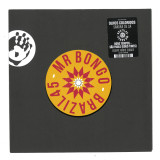
Two 1980s Brazilian boogie bombs from Sandra de Sá and Equipe Rádio Cidade get a remastered reissue as part of Mr Bongo Brazil 45’s series.
Sandra de Sá’s ‘Olhos Coloridos’ is an ‘80s MPB/boogie jam, taken from her self-titled 1982 LP on RGE Brazil, that sits perfectly alongside the likes of Tim Maia, Marcos Valle, Robson Jorge and Lincoln Olivetti. No surprise then that Lincoln Olivetti and Robson Jorge feature on the track, backed by some of the members from Banda Black Rio. A joyous combination of funk basslines and dreamy Rhodes that marry with jubilant horns and Sá’s incredible vocal tones.
On the B side, Equipe Rádio Cidade ‘Bons Tempo Sao Paulo (Good Times)’ was originally released on a rare promo only 7 inch from 1980. Giving a Brazilian boogie makeover to Good Times by Chic / Rapper’s Delight by Sugarhill Gang, the track is voiced by radio DJs from Sao Paulo wishing their listeners a Merry Christmas and Happy New Year.
This replayed version, heavy on the clavinet with a samba-infused, cuica-laced percussion breakdown, gives a true Brazilian spin on one of the most distinctive melodies out there.
Remastered with refreshed artwork.
Dubstep's origins lie in dark 2-step mutations that evolved on dancefloors and in studios in the early 2000s. That same fusion of swing and space and subs can be found by the bucketload throughout the new EP by one of DNO’s staples, Kercha.
Skippy speed garage hats and slippery globules of bass animate the otherwise sparse production on the opening track ‘Feature’, while the wild beat on ‘Absurd’ could catch out any DJs not giving it their full attention. Wrapped in Kercha’s signature sonic debris, it delivers three and a half minutes of rattling, clicking, squelching wizardry.
The B-side gives us ‘Stimulate’, a collaboration with new-gen rising star Hypho. Indebted to trap, it’s full of militant 808 hi-hat rolls and the kind of firing synth tones that spell doom in a sci-fi movie (and tear up festival stages).
Finally, ‘Saturday’ is classic Kercha: sub-bass from the Seventh Circle, and so many suspicious chirps, whistles and hoots that it could soundtrack a nighttime stroll through the woods just as easily as skanking in a smoked-out sweatbox. The track is peppered with voice notes from a friend — snatches of funny, halfcut chatter, as random in content as Kercha's non-vocal sampladelia. The final snippet, which translates to “Saturday dictates its rules”, gives the track its name. A statement that can be read in all sorts of ways, it could even confer a motto for this whole collection, reflecting Kercha’s trademark originality.
The ‘Absurd’ EP is one of Kercha’s most dancefloor-directed releases to date, and whether conjuring the ghosts of club nights past or envisioning the raves of the future, it’ll be dominating sound systems for a long time to come.
Rhythms of postmodern realism at the very bottom of the DNO.
A slick techy dance-floor banger featuring the sultry tones of US Vocalist ‘Brutha Basil’.
Hand Made has been a go-to number from Abel’s well-received ‘Cosmic Law’ album. Taking a deeper and much more techy approach to sound design, Abel and Atjazz enlisted the brilliant ‘Brutha Basil’ to lay down some truth about ‘doing this music thing for the right reasons’. With some incredible remixes from Peacey who swipes things up to a new energy level, Rocco Rodamaal whose punchy re-work takes us way back to NYC’s early days of house music, and South Beach Recycling’s Chicago and Detroit-inspired late-night groover. This is one of those releases that will stay on target for a long time, no doubt!
The very first Buchla synthesiser performance by revolutionary composer Suzanne Ciani finally makes its fifty year journey from its switch-on New York art gallery to its long deserved and discerning global phonographic audience.
With this previously unheard vinyl pressing, Finders Keepers Records are proud to present an archival project of ‘art music’ that not only redefines musical history but lays genuine claim to the overused buzzwords such as pioneering, maverick, experimental, groundbreaking and esoteric, while questioning social politics and the evolution of music technology as we have come to understand it. To describe Italian-American composer Suzanne Ciani’s resurrected Buchla concert records as genuine gamechangers would be a gross understatement. These records represent a musical revolution, an artistic revelation, a scientific benchmark and a trophy in the cabinet of counterculture creativity. This sonic installation album, alongside her recently liberated WBAI/Phill Niblock 1975 sessions (FKR082), are triumphant yardsticks in the synthesiser space race and the untold story of the first woman on the proverbial musical moon. While pondering the early accolades attached to these golden era New York recordings it’s daunting to learn that these records were in fact not even records at all.
What exists on this disc now was a manifesto and a one-time gateway to a new world, which somehow was only partially pushed ajar. Captured here is a genuine live act exploring new territories with a fully performable music instrument. If the unfamiliar, modernistic, melodic pulses, tones and harmonics found on these 1970’s artistic gallery collaborations/ live presentations (then soon to be followed by academic grant applications and educational demonstrations) had been placed in a phonographic context alongside the widely marketed work of Morton Subotnick, Walter Carlos or Tomita, then the name Suzanne Ciani and her infectious influence would have already radically changed the shape, sound and gender of our record.
With the light of Buchla and Ciani’s initial flame Finders Keepers continues the journey through the vaults of this increasingly celebrated music legacy, illuminating these ‘non-records’ that evaded the limelight for almost half a century. You can’t write history when you are too busy making it. With fresh ink in the bottomless well, let’s start at the beginning. Again
Having established himself as one of the most energetic and exciting Jazz musicians within the already thriving worldwide scene, New Zealand born, London based Drummer & Producer Myele Manzanza has made a major impact upon the global music landscape.
A founding member of Electric Wire Hustle, Myele has released five solo albums, and racked up tours and collaborations with Jordan Rakei, Theo Parrish, Miguel Atwood-Ferguson, Recloose and Amp Fiddler amongst others . Myele has developed a strong live presence in his new London base; his quartet has shared stages with the likes of Hiatus Kaiyote, The Bad Plus, Alfa Mist, and drawing packed houses to top venues such as The Jazz Café and Ronnie Scott’s. Last year, the first two instalments of his 'Crisis & Opportunity’ record series saw him garner praise from Mary Anne Hobbs, Cerys Matthews, Jamie Cullum, Huey Morgan, The Guardian, Complex, Jazz FM, Lefto, Worldwide FM, Jazzwise and more.
Following the release of his last offering, a chance conversation between Myele and a young Barista at a local coffee shop occurred - their topic (centred around the trials and tribulations of following your musical passions) sent Myele down a spiralling path of internal reflection, spawning a new lease of creative energy and examination of new ways to approach his craft. The third addition to the heralded series, ‘Crisis & Opportunity Vol.3 - Unfold’ sees Myele change his approach from drummer / improviser, altering his sonic output to a more electronic dance music output, opting for a more producer / beatmaker focussed role. Sharing production duties with Lewis Moody (Zeitgeist Freedom Energy Exchange) and taking a more producer / beatmaker focussed role. His initial instinct was to create music that could be played in a club, but also incorporate elements music of the Jazz and technical musicianship he’s renown for.
Articulating his thoughts on the record’s genesis, Myele explains: ‘‘As the process developed, I was also drawing a lot of inspiration from vocal driven soul, RnB and songwriter-driven music to a point where I had lit a new creative fire. Reconsidering the direction of the album, I was left with the creative question “What broader ranges of emotion might my music be able to access, and what kinds of art could be made possible if I were to open up my music to hold space for singers and for stories?”
First single ‘Silencing The Sun’ features the vocal talents of fast-rising fellow Kiwi artist Wallace, whose spectral tones glide gracefully over the pulsating rhythm section and twinkling keys. On second single ’Therapy’ UK Soul royalty Omar weaves his trademark magic over a solid 4/4 beat, soulful key stabs and lush synths, bottling lightning into dancefloor alchemy. Final single ‘Unfold’ sees Rachel Fraser deliver a delicate and introspective vocal performance over stripped back instrumentation as cold, angular electronics juxtapose the warmth of piano keys and sweeping strings. With a wealth of additional incredible talent (such as China Moses and Rosie Frater Taylor) enlisted to further compliment the record’s grainy synth textures, emotive chord changes, driving low end sonics and expressive percussion, the scene is set for a beautiful, shifting and engaging listening experience.
UNSURPASSED SPACIOUSNESS, IMAGING, AND TRANSPARENCY: MASTERED FROM THE ORIGINAL TAPES, MUSIC EMERGES WITH NEW DETAILS AND TONES
1/2" / 30 IPS analogue master - Plangent Processed - to DXD to analogue console to lathe
Love Over Gold is all about contrast, tension, and crafty composition. Dire Straits' fourth album finds the band continuing to evolve by welcoming increasingly bold arrangements and exploring moody variations. Parts edgy and sharp, and part seductive and relaxed, the five lengthy songs on Love Over Gold sprawl out like a long, winding road cutting through a pastoral landscape. The addition of a new rhythm guitarist, Hal Lindes, encourages deeper atmospheric interplay while the presence of engineer Neil Dorfsman – his first appearance in what would be a long string of collaborations with Mark Knopfler – ensures stunning sonic properties that now come to life like never before.
Mastered from the original master tapes and pressed at RTI, Mobile Fidelity's 180g 45RPM 2LP version of Love Over Gold teems with superb balances, front-to-back soundstages, and crystalline purity. The dead-quiet surfaces and extra-wide grooves bring forward previously obscured details, extra information, and mastering-studio-quality transients. The distinctive textures of a host of instruments – marimbas, acoustic and electric guitars, vibes, synthesizers – further enhance the ambitiousness of the 1982 album.
On this audiophile pressing, everything Knopfler does seemingly turn to gold. Gearheads will hear the unique characteristics afforded by his use of a Mesa Boogie Mark II guitar amplifier (soon again employed on Brothers in Arms) and carefully chosen selection of Schecter Stratocasters, 1937 National steel guitar, and Ovation six- and twelve-string models. Reference-level separation and lifelike imaging place Knopfler and company in your room, while tube-like warmth, spaciousness, and airiness causes the music to breathe anew. This LP will be in your rotation for months.
It doesn't take long to realize Love Over Gold is like no other Dire Straits album – and a staunch proclamation of independence from a band that continued to take longer creative strides with each successive project. Fearlessly extending over metaphoric hills, valleys, and plains for nearly 14-and-a-half minutes, the opening "Telegraph Road" is a guitar hero's dream and exhilarating showcase for Lindes' give-and-take capabilities. In tandem with keyboardist Alan Clark, Lindes provides the ideal foil for not only Knopfler but the long-time rhythm section of bassist John Illsley and drummer Pick Withers.
Taking its time to arrive at destinations, the quintet paints evocative musical and lyrical portraits steeped in patience, drama, and, often times, sadness. Desolate emotions colour the sweeping "Telegraph Road" and barren "Private Investigations," which finds Knopfler in the role of a tired private eye contemplating the emptiness and scars of his profession. Vocally, the Dire Straits leader remains in top form throughout, his whiskey-coated rasp conveying romantic ache, ongoing frustration, and what Rolling Stone beautifully deemed "wracking schizophrenia between the heart and the heartless, the loving and the pain."
Called Dire Straits' prog-rock statement, Love Over Gold is a classic that defies labelling and avoids ageing.
More than two years after the release of 'Impressões de Outra Ilha', Discrepant's head honcho returns home under his birth name with the appropriately titled 'Exotic Immensity'. Conjured from the seeds of an exhibition of dioramas at Le Bon Accueil in Rennes, this double LP feels quietly epic in scope, a sprawling travelogue through imagined scenarios and what if possibilities. Discarding the more rough around the edges collages of previous works under a myriad of aliases - Discogs it, if you will -, Cardoso's approach here is more meticulously composed, with seamless transitions within his own personal soundworld giving way to this hallucinated landscape of field recordings, subtle electronic tweaks, cascading patterns, queasy ambiences and kösmiche-like synth harmonies.
Perfectly embodied in Evan Crankshaw's cut up poem, filled with occult and sci-fi references such as Agrippa's Book of the Occult, William Blake's Book of Urizen, Dr. Moreau or 50's pop-science books, the music on 'Exotic Immensity' transverses time and cartography in a deeply personal matter, from the cricket-like textures and reverse loops of 'Réplica(s)' until the closing moments with the touching chord progression and mangled voices of 'Pó Nuno'. In-between, the foghorn meets bass clarinet melody of 'Ossos' recalls the unassuming but essential harmonic patterns of Laurence Crane, surrounded by an almost percussive sheet of field recordings that drift into the gliding synth tones of 'Desumanização (I & II)' until tape orchestral swells carry us into the aether. 'Aquário Novo Mundo' brims in an undisplaced cartography, from electronic marimba stabs to synth choirs, the call of the loom to labyrinthine keyboard harmonies and underwater radiance. Are we still here? Somewhere? The muffled looped rhythmic sequence of 'Imagem/Miragem', cut by the glow of cascading synths doesn't offer a reply. Nor does it need to.
'Exotic Immensity' exists on the perpetual outside. Blessed be Cardoso for showing us a way in.
Rising UK label Human Worth proudly present TORPOR's third full length album Abscission. A fine tapestry of sludge metal, lumbering doom riffs, forward thinking post-rock dynamics, cerebral drone passages, ambient textures and stark spoken poetry. Recorded by producer Wayne Adams (whose credits include Wallowing, Green Lung, Possessor and more), 'Abscission' is a paean to earth shattering tones, subtle detailed textures, immersive sound design and most importantly... ABSOLUTELY CRUSHING HEAVINESS. For their third album, TORPOR were compelled to withdraw into the bleak and elemental vistas of rural Wales, embracing isolation and solitude in order to craft this autumnal sonic landscape. The trio brought producer and frequent collaborator Wayne Adams (Petbrick, Big Lad) out of his London city studio to work at Giant Wafer Studios.
TORPOR's excursions into the wilderness can really be felt across these lengthy songs. Bludgeoning riffs show a new found density and weight reminiscent of gallant trees standing tall amongst battering wind and rain. All of this sonic magnitude has been finely captured by Adams, with the final master by James Plotkin (Khanate) completing this all-encompassing experience – quite fittingly the trio were also invited to showcase the album in full at the 2023 Roadburn Festival, on the day that Khanate headlined! Abscission is the sound of Torpor fully realising their visceral and cinematic vision, turning an unflinching gaze towards the unrealised lives we all carry with us. Human Worth have pressed a limited edition of environmentally conscious Eco-Mix Vinyl in a stunning packaged designed by Jack Burley, featuring a 12" foldout insert, with 10% of all proceeds donated to charity Second Step – a leading mental health charity in Bristol and the South West.
The learning process is just as much an act of healing as betterment. The enabling of solutions through sheer willpower and openness to discovery, or a noble mission, never completed. In that spirit, the latest album by Berlin-based Slovak duo Päfgens – comprising Jana Drábeková Kočišová and Filip Drábek – represents a pensive development for the project.
Drifting from their lo-fi shoegaze beginnings, Päfgens drone-infused soundscapes have become increasingly immersive and expressive “framed improvisations,” where spontaneous passages are captured, then revisited with fresh layers upon layers over the course of months, breathing and evolving naturally, mirroring the unpredictability of nature. Songforms have all but melted away, with ethereal guitars and bass nestling up against field-recorded sounds, synth beds, percussion, and singing bowl tones.
The framed improvisation on ‘Aspect of What’ explores love and loss, relishing both the joy and melancholy of paying tribute to Filip’s late ethnologist grandmother, Božena Filová (1926-2020). Her voice opens track 2, ‘Particles’, speaking of the humble desire to “help the people in the rural environment”, and the goal of “uplifting people to better living through education”. The album’s emotionally charged approach to improvisation is suitably uplifting and seemingly made without ego, the couple melting away into the flitting wall of rustling drones and heavenly fuzz. Even at their most serrated (the groaning guitar amp squall underpinning ‘Journey’) or when surrounded by chiming bells, clocks and bowls (‘Around the Clock’), Päfgens is ready to listen, rest, learn, and improve, extracting and nurturing hidden abstract emotion in every piece, plundering something universal and teachable from very personal depths.
On ALPHA WAVES, AUX88 ventures into uncharted sonic territories by subtly incorporating 432 Hz alpha wave tones. This forward-thinking approach to sound exploration is a testament to their creativity and commitment to pushing the boundaries of electronic dance music.
It is believed that 432 Hz is the healing frequency of the universe and has the power to improve our bodies' natural healing abilities. Similarly, alpha brain waves are associated with restful, meditative states and are believed to reduce depression, combat anxiety, and increase creativity. By blending these healing frequencies with their classic techno-bass fusion, AUX88 offers listeners a unique auditory experience that is both soothing and energizing, especially powerful during their all-sensory-consuming live performances, where fans can fully immerse themselves in the music and experience its transformative effects.
Konerytmi's upcoming release is a captivating blend of retro charm and futuristic allure. Each track resonates with the spirit of the 80s, where the pulsating rhythms of old-school drum machines intertwine with the evocative tones of vintage synthesizers.
Drawing inspiration from the hooks and melodies that defined a generation, Konerytmi skillfully weaves a tapestry of sound that is both timeless and contemporary. These tracks are not just made for dancefloors, they are crafted to evoke emotions and stir memories, inviting listeners into a realm where past and present converge seamlessly.