Slowdive’s 5 EP was released in 1993 and contains 4 songs, 3 of which are instrumental. Neil Halstead had a blast experimenting with electronic beats. The instrumental tracks on this EP are all accompanied by a solid beat.
Slowdive once again succeed beautifully in producing tones that leave you numb as to how you should feel. There is an unmistakably euphoric edge to it, something heavenly, something convincing, something that takes you to places where everything is more beautiful, more colorful.
5 EP captures a brief moment of Slowdive’s journey - not quite like anything they did before it and not quite like anything after it, though it does have elements of both Souvlaki and Pygmalion in there.
“In Mind”, “Good Day Sunshine”, “Missing You” & “Country Rain” are trippy, dreamy, spaced, melancholic and cinematic... Overall an essential part of the history of one of the most influential acts of the late 20th century.
This rare and sought-after EP is now finally available as a limited edition of 4000 individually numbered copies on pink & purple marbled vinyl. The jacket has a special deluxe “alubrush” finish. The package includes an insert with the Slowdive catalogue.
Suche:i tones
Hanagasumi - hazy curtain of flowers, cherry blossoms appearing from afar like a white mist - this phenomenon can be seen during the sakura blossom in Japan.
The third release on the label from the musician Shine Grooves. This vinyl is a mini LP of five tracks with different moods. The release is opening with a melodic track with exciting keyboard chords, performed in the best traditions of electro rhythm. On the second track, the mood changes towards a glitch house with a 4x4 beat and a naive melody that penetrates deeply into the mind. The first side of the vinyl is closing with a techno track - a loop recorded on a Roland TR-606 drum machine with an atmospheric melody that flutters in the air throughout the entire composition.
The second side of the vinyl starts with a 10-minute ambient ode, with cosmic synthesizer sequences and fragments of phrases from telephone conversations - a slow entrance to another reality. The last track on the record has an experimental IDM flavor with melodic guitar tones.
This LP is made on 12" vinyl, hand stamped, limited to 300 copies. High quality analogue mastering by Sergey Luginin at Luginin Studio.
Queen B and US vocalist Lee Wilson collaborate together for this smooth soulful sounding house track entitled ‘Nobody Else’. With it’s infectious groove, topped off with Lee's sublime vocal tones this really is a gem of a record.
Let There Be House label head Glen Horsborough delivers a huge remix which is only available and exclusive to this vinyl release.
Black Truffle is thrilled to announce ViewFinder / Hide & Seek, a new release from acclaimed American experimental composer David Behrman, presenting recordings made in collaboration with Jon Gibson and Werner Durand between 1989 and 2020. Last heard from on Black Truffle as part of the collaborative art song/live electronics madness of She’s More Wild, these recordings find Behrman continuing the pioneering work in interactive electronics that have established him as one of the major living experimental composers.
Side A presents excerpts from two live realisations of Unforeseen Events (1989), the fourth in a series of pieces focussing on the interactions between instrumental performers and responsive software. Like the classic earlier works in the series, On the Other Ocean (1977), Interspecies Smalltalk (1984) and Leapday Night (1986), Unforeseen Events is an “unfinished composition” in which a computer system listens for and responds to specific pitch cues from an instrumentalist. Performed by the composer on electronics and Werner Durand on soprano saxophone in Berlin in 1989, the first realisation immediately ushers the listener into an environment of long soprano notes, lush, sustained synth harmonies, randomised percussive interjections and distantly burbling arpeggiated patterns.
The 1999 realisation recorded in New York with Jon Gibson on soprano shows how much room for the instrumentalist to affect the course of the music exists in Behrman’s interactive pieces, in which, as he notes, ‘performers have options rather than instructions’. Beginning in a roughly similar area to the version with Durand, this later recording eventually becomes substantially more active, as polyrhythmically layered arpeggios and percussive patterns respond to fast chromatic lines and dynamic phrases from the saxophone, moving Gibson in turn to respond with cycling figures and moments of extended technique that touch on the soprano languages pioneered by players like Steve Lacy and Evan Parker. Yet even at its most active, the lack of conventional forward movement in the music allows it to retain what Behrman’s friend Jacques Bekaert called its ‘fragile tranquillity’, as episodes of activity appear only as momentary disruptions of an underlying calm.
On the B side, we are treated to a new collaborative work from Behrman and Werner Durand, building on the 2002 installation work ViewFinder, in which a camera detecting physical motion triggered changes to electronic sound. The piece presented here is a long-distance studio construction, recorded by Behrman in the Hudson Valley and Durand in Berlin, offering up an expansive duet between Behrman’s lush, gliding synth tones and the alien, untempered tones of Durand’s invented and adapted wind instruments. Presented in a stunning gatefold sleeve with art from Terri Hanlon, archival photographs and new liner notes from Behrman and Durand,ViewFinder / Hide & Seek is an essential release showcasing the continuing vitality of a legendary figure in experimental music.
The Mecánica Clásica project combines modified elements of early electronics, krautrock, ambient, minimalism & fourth world music, generating an interplanetary space where enterprising guitar tones, lush synth sequencing & off-kilter percussion coalesce.
‘Mar Interior’ the new album by Mecánica Clásica is a fusion of kosmische & fourth world music inspired by ancient Mediterranean culture. Loosely translated as ‘Inland Sea’, ‘Mar Interior’ is thematically centred on the history & legacy of the ancient civilizations that proliferated around the Mediterranean Sea.
Augmented by environmental recordings, Mecánica Clásica renew the extensive topographies opened up by early pioneers like Craig Leon, Jon Hassell, Brian Eno & Cluster, in an immense vision of Spanish space ambient. On ‘Mar Interior’ their work expands upon these influences, moving into a shimmering, hypnotic sound world which finds common ground with the likes of O Yuki Conjugate, K. Leimer, Roberto Musci & X.Y.R.
Mastered by Colin Potter (Nurse With Wound)
Diving into the archives of Alter Ego - the Italian experimental ensemble of Manuel Zurria, Paolo Ravaglia, Aldo Campagnari, Francesco Dillon, Oscar Pizzo, and Eugenio Vatta - Die Schachtel is thrilled to present Microwaves, a never before released body of recordings of works composed by Atli Ingólfsson, Giovanni Verrando, Yan Maresz, and Riccardo Nova, made with Pan Sonic (Mika Vainio and Ilpo Vaisanen) in 2005. Resting at the outer reaches of avant-garde chamber and electronic music, the LP’s blistering structures, tones, and textures - plowing forward with frenetic energy - remain radical and ahead of their time, more than 15 years after they were first laid to tape.
A modular chamber ensemble with a pointedly anti-academic approach to music, over the course of its activities - running roughly between 1990 and 2010 - Alter Ego developed a devoted following among some of the most forward thinking voices in experimental music, all the while collaborating widely with artists spanning a vast range of practices and disciplines, including Robin Rimbaud, Philip Jeck, Matmos, Gavin Bryars, Andrew Hooker, William Basinski, David Moss, Alvin Curran, Terry Riley, and near countless number of others.
Alter Ego’s diverse activities can be understood as interventions with the disposition toward formality within contemporary chamber music, often pairing themselves with artists working well beyond their own context as a means to develop highly original interpretations of a specific composer’s work. In 2004, this process led them to instigate a collaboration Pan Sonic, the Finnish duo of Mika Vainio and Ilpo Vaisanen, pioneers of a remarkably distinct form of rhythmic, experimental electronic music, and regarded by many as one of the most visionary and irreverent projects working in the field during the '90s and 2000s.
Initially conceived with Fausto Romitelli in 2004 before being sidelined by the composer’s untimely passing the following year, Microwaves acts, in part, a remembrance in sound, featuring four works by some of his closest friends, the composers Atli Ingólfsson, Giovanni Verrando, Yan Maresz, and Riccardo Nova. Each composition, Ingólfsson’s Snap, Verrando’s Harmonic Domains #3, Maresz’s Link, and Nova’s Thirteen13x8@Terror Generating Deity, have roots in a pallet of samples and fragments drawn by each composer from existing works by Pan Sonic. Upon completion, these compositions then entered into a collaborative process between Mika Vainio and Ilpo Vaisanen (Pan Sonic) and Alter Ego (Manuel Zurria, Paolo Ravaglia, Aldo Campagnari, Francesco Dillon, Oscar Pizzo, and Eugenio Vatta), and were performed collectively by both groups during an extensive tour that year.
Distinct and free-standing, while operating as a seamless whole, the four works encountered across the album’s two sides - built from the sounds of flute, clarinet, violin, cello, piano, electronics, and further treatments - present an engrossing intersection between electronic and acoustic sound that diverges from most standing conceptions of electroacoustic music. Each composer’s carefully rendered structures rise and fall within the startling, conversant interplay between the two groups, finding perfect balance - between the frenetic and restrained - in what can only be regarded as one of the most striking and singularly unique expressions of contemporary chamber music realized during the 2000s.
Vast in scope, visionary in concept and artistry, and sonically engrossing, Die Schachtel is thrilled to present these never before heard recordings from the archives of Alter Ego. Microwaves is available on black vinyl, in a limited edition of 350 copies.
Diving into the archives of Alter Ego - the experimental ensemble of Manuel Zurria, Paolo Ravaglia, Aldo Campagnari, Francesco Dillon, Oscar Pizzo, Fulvia Ricevuto, and Eugenio Vatta - Die Schachtel is thrilled to present Pranam - A(Round) Giacinto Scelsi, a never before released body of recordings interpreting the works of the legendary Italian composer Giacinto Scelsi, made with Matmos (Martin Schmidt and Drew Daniel) in 2005. Resting at the outer reaches of avant-garde chamber and electronic music - moving at a glacial pace of tightly wound energy - Pranam’s two sides radically rethink the terms electroacoustic music in ways that still feel radically ahead of their time, more than 15 years after they were first laid to tape.
A modular chamber ensemble with a pointedly anti-academic approach to music, over the course of its activities - running roughly between 1990 and 2010 - Alter Ego developed a devoted following among some of the most forward thinking voices in experimental music, all the while collaborating widely with artists spanning a vast range of practices and disciplines, including Robin Rimbaud, Philip Jeck, Pan Sonic, Matmos, Gavin Bryars, Andrew Hooker, William Basinski, David Moss, Alvin Curran, Terry Riley, and near countless number of others.
Alter Ego’s diverse activities can be understood as interventions with the disposition toward formality within contemporary chamber music, often pairing themselves with artists working well beyond their own context as a means to develop highly original interpretations of a specific composer’s work. In 2005, this process led them to invite Matmos, the American duo of Drew Daniel, Martin Schmidt - acclaimed for a body of visionary albums at the vanguard of electronic process and sampling - to collaborate on a series of interpretations of works by the legendary Italian composer Giacinto Scelsi.
Realized in collaboration with The Fondazione Isabella Scelsi, which holds Giacinto Scelsi’s archives, and performed at the Festival Roma Europa and the Festival Aeterforum during May of 2005, the album’s four works - Estratti dal Quartetto per archi n.3 (1963), Ko-Lho (1966), Riti: I Funerali di Carlo Magno A.D. 814 (1976), Aitsi (1974) - shift the boundaries of 20th Century chamber music toward markedly new and contemporary terms, incorporating everything from the sounds of the Revox tape machine that Scelsi used to record his own improvisations and processed electronics, to the plastic trumpets used by fans during football matches.
From intertwining, shifting lone-tones that render startling resonances and dissonances, to passages guided by a vast pallet of electronics and flurries of acoustic sounds, joined as a single ensemble, across the two sides of Pranam, Alter Ego and Matmos infuse these four works by Scelsi with humor and playfulness, while retaining all the urgency and rigour with which they were initially composed.
Delicate and meditative, while tightly wound and brooding, Pranam brings the works of Giacinto Scelsi to life in ways that almost no group ever has. Riveting and immersive from start to finish, Die Schachtel is thrilled to present these never before heard recordings from the archives of Alter Ego. Pranam is available on black vinyl, in a limited edition of 350 copies.
Domino are immensely proud to announce the signing of my bloody
valentine, with new physical editions of the band’s seminal catalogue
being made available. ‘Isn’t Anything’ and ‘loveless’ have been
mastered fully analogue for deluxe LPs and also mastered from new
hi-res uncompressed digital sources for standard LPs, with each
being made available widely for the first time ever. Fully analogue
cuts of ‘m b v’ will also be available on deluxe and standard LPs
globally for the first time.
my bloody valentine, the quartet of Bilinda Butcher, Kevin Shields,
Deb Googe and Colm Ó Cíosóig, are widely revered as one of the
most ground-breaking and influential groups of the past forty years.
During an era in which guitar bands denoted, at best, a retroclassicism, not only did my bloody valentine sound unlike any of their
contemporaries, the band achieved the rare feat of sounding like the
future.
The second my bloody valentine album, ‘loveless’, was released in
1991. Musically, it took an unexpected leap forwards, standing ahead
of anything released at the time. Shields and the band moved further
towards a music of pure sensation, creating textures and tones that
could be felt as much as heard; with ‘loveless’ the band created an
album that overwhelmed the senses. ‘loveless’ is widely considered a
flawless whole and rightly regarded as a masterpiece; a 1990s
equivalent to ‘Pet Sounds’, ‘In A Silent Way’ or ‘Innervisions’, a record
constructed by exploring the edges of what a recording studio is
capable of. It is a record best experienced as a whole, in one sitting -
a listening experience like no other and unmatchable in its sonic
brevity.
Happenstance can be a fortuitous element. A union funded single discovered in a dusty store, a long disbanded band found, leads to unreleased post punk dubs in a box of unreleased demos.
Formed during the mid-80s in the downbeat town of Walsall, their music a blend of disparate influences from 50s crooners, blues and reggae to Killing Joke and The Bunnymen; Ron's Neighbours were out of step with the perfect pop of the C86 indie generation.
Their only single - "To The Fight" - a split 7" was supported by the Trade Union Resource Centre, while many gigs were benefits for striking miners, leading to a loyal local following.
Engineered by Ozzy Osbourne's brother Tony, tracks were recorded at an 8 track bedroom / home studio, while a terraced house served as rehearsal space. Here Ron Next Door was born. When a tape recorder was left running it captured the long-suffering neighbour for posterity. His outburst gave the band and song, its name.
Experimenting with drum machines, the resultant jam track, here in its "Alternative Mix", languished unheard until now. Ron's 'Black Country' tones lead to driving bass / percussion against crashing Stratocasters and repeating, refrained vox - a post punk dub turned symphony.
The B side, Sitting On Top of the World, is an indie anthem, becoming their theme, a blend of grandiose and banal that characterised their songs.
In the afterglow of her acclaimed 2020 album Silver Ladders, Los Angeles-based harpist Mary Lattimore returns with a culminating counterpart release, Collected Pieces: 2015- 2020. The limited-edition LP features new and previously unreleased material, Bandcamp-only singles, and other obscurities alongside standouts from her 2017 tape Collected Pieces. Beyond the vinyl compendium, an expanded tracklist on the cassette/digital version brings more of Lattimore's archives together for the first time. Lattimore has described the process of arranging these releases as akin to "opening a box filled with memories," and here that box continues to populate, accessible for both the artist and fans. Evocative material separated by years, framed as a portrait of an instrumental storyteller who rarely pauses, recording and often sharing music as soon as it strikes her. Seemingly in constant forward motion for the last five years since her Ghostly debut, Lattimore glances back for a breath, inviting new chances to live in these fleeting moments and emotions; all the beauty, sorrow, sunshine, and darkness housed within. Opening the cassette version is "Mary, You Were Wrong," which mirrors an author's bout with a broken heart. "It's about how you have to keep on going even if you make some mistakes," she says. The bittersweet refrain cycles throughout, a little brighter every time, slowly, like the way time tends to heal. Unreleased track "Sleeping Deer" came together during Lattimore's artist residency on a cattle ranch in Wyoming. She remembers, "a small deer whose mother I think had been run over by a car would hang out in the yard. I called him Lollipop and would leave vegetable scraps out." Lollipop returned daily to eat, rest, and wait for more. The music this vision inspired is patient and droning, with light plucks giving way to deeper, vibrating tones, permeating with a sense of anticipation. Next is a newer single, "We Wave From Our Boats," which she improvised after walking her neighborhood during the early days of lockdown in 2020, and shared on her Bandcamp. "I would just wave at neighbors I didn't know in a gesture of solidarity and it reminded me of how you're compelled to wave at people on the other boat when you're on a boat yourself, or on a bridge or something. The pull to wave feels very innate and natural." The heart of the track is a somber loop, over top which Lattimore's synth notes ruminate, each a gentle shimmer of optimism in the most anxious and absurd of days. Also recorded in 2020, "What The Living Do" is inspired by Marie Howe's poem of the same name, which reflects on loss through an appreciation for the mundane messiness of being human. The echoed, slow-marching track has a distant feel to it, as if the listener is outside of it, watching life play out as a film. "Princess Nicotine (1909)" scores actual footage, a dream sequence Lattimore imagined for J. Stuart Blackton's surreal silent film Princess Nicotine; or, the Smoke Fairy. She adopted the same approach for "Polly of the Circus," explaining it was the name of one of the old silent films discovered in permafrost in the Yukon featured in the documentary Dawson City: Frozen Time, "the only copy that survived and it kind of warped in the aging process." A trove of pieces are collected here, most recorded in the moment, just Lattimore and her Lyon and Healy Concert Grand Harp, contact mics, and pedals. Like her most affecting work, these songs showcase Lattimore's gifts as an observer, able to shape her craft around emotional frequencies and scenes. Her power as a musician is rooted in how she sees the world: in vivid detail, profoundly empathic, with deep gratitude for nature and nuance.
After a trilogy of spectacular explorations of relentlessly driving rhythms – Sagittarian Domain (2012), Quixotism (2014) and Hubris (2016) – Simian Angel finds Oren Ambarchi renewing his focus on his singular approach to the electric guitar, returning in part to the spacious canvases of classic releases like Grapes from the Estate while also following his muse down previously unexplored byways. Reflecting Ambarchi's profound love of Brazilian music – an aspect of his omnivorous musical appetite not immediately apparent in his own work until now – Simian Angel features the remarkable percussive talents of the legendary Cyro Baptista, a key part of the Downtown scene who has collaborated with everyone from John Zorn and Derek Bailey to Robert Palmer and Herbie Hancock. Like the music of Nana Vasconcelos and Airto Moreira, Simian Angel places Baptista's dexterous and rhythmically nuanced handling of traditional Brazilian percussion instruments into an unexpected musical context. On the first side, 'Palm Sugar Candy', Baptista's spare and halting rhythms wind their way through a landscape of gliding electronic tones, gently rising up and momentarily subsiding until the piece's final minutes leave Ambarchi's guitar unaccompanied. While the rich, swirling harmonics of Ambarchi's guitar performance are familiar to listeners from his previous recordings, the subtly wavering, synthetic guitar tone we hear is quite new, coming across at times like an abstracted, splayed-out take on the 80s guitar-synth work of Pat Metheny or Bill Frisell. Equally new is the harmonic complexity of Ambarchi's playing, which leaves behind the minimalist simplicity of much of his previous work for a constantly-shifting play between lush consonance and uneasy dissonance. Beginning with a beautiful passage of unaccompanied percussion dominated by the berimbau, the side-long title piece carries on the first side's exploration of subtle, non-linear dynamic arcs, taking the form of a gently episodic suite, in which distinctive moments, like a lyrical passage of guitar-triggered piano, unexpectedly arise from intervals of drifting tones like dream images suddenly cohering. In the piece's second half, the piano tones becomes increasingly more clipped and synthetic, scattering themselves into aleatoric melodies that call to mind an imaginary collaboration between Albert Marcoeur and David Behrman, grounded all the while by the pulse of Baptista's percussion. Subtle yet complex, fleeting yet emotionally affecting, Simian Angel is an essential chapter in Ambarchi's restlessly exploratory oeuvre. --- Oren Ambarchi - guitars & whatnot Cyro Baptista - percussion & voice Recorded by Randall Dunn, Joerg Hiller, Iuri Oriente and Oren Ambarchi. Edited by Joerg Hiller and Oren Ambarchi at Choose Studios, Berlin. Mixed by Joe Talia and Oren Ambarchi at Good Mixture, Tokyo. Cut by Rashad Becker at D&M, Berlin. Executive Producers: Konrad Sprenger & Dick Wolf. Photography by Traianos Pakioufakis. Design by Lasse Marhaug.
- A1: The Fate Of The World On Our Shoulders
- A2: Existential Terror
- A3: Necromantic Fantasies
- A4: Crawling King Chaos
- B1: Here Comes A Candle.. (Infernal Lullaby)
- B2: Black Smoke Curling From The Lips Of War
- B3: Discourse Between A Man And His Soul
- B4: The Dying Of The Embers
- C1: Ashen Mortality
- C2: How Many Tears To Nurture A Rose?
- C3: Suffer Our Dominion
- C4: Us,Dark.invincible
- D1: Sisters Of The Mist
- D2: Unleash The Hellion
Black vinyl[30,71 €]
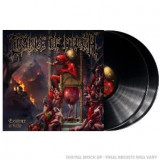
Belched from Hell’s depths into the rustic charms of the Witch County, Suffolk thirty long and disturbing years ago, CRADLE OF FILTH are undisputed giants of the heavy metal realm. Imperious purveyors of a perennially unique strain of dark, dastardly and wilfully extreme metal, with deep roots in the worlds of gothic horror and occult curiosity, the band led by Dani Filth has weathered three decades of tumult and trial, earning a formidable reputation as both a singular creative force and one of the most riotously entertaining live bands the metal world has ever produced.
From primitive early works like 1992 debut »The Principle Of Evil Made Flesh« to more expansive and theatrical classics like ‘Cruelty And The Beast’ and ‘Midian’, CRADLE OF FILTH defied trends and constructed their own idiosyncratic world of foul grandeur, becoming one of the UK’s most notable metal bands in the process. Since then, they have traversed the world countless times, hoovering up plaudits and praise from an ever-expanding international fan base. Resolutely prolific, the band’s catalogue has grown in depth and stature all the while, irrespective of line-up changes or the whims of the faithful.
In more recent times, CRADLE OF FILTH have hit an unmistakable hot streak of creativity and urgency. As a new line-up coalesced around the creation of 2015’s »Hammer Of The Witches«, fresh impetus propelled the band to new heights, as the revitalised crew became more in demand around the world than ever before. 2017’s ‘Cryptoriana - The Seductiveness Of Decay’ repeated the trick with even more explosive flamboyance. Until a global pandemic brought the music industry to a jarring halt, CRADLE OF FILTH were almost permanently on the road and absolutely fucking flying. As a result, it should surprise no one that the band’s brand new album, ‘Existence Is Futile’, is yet another monumental and electrifying journey through the dark.
Buoyed by these recent triumphs, CRADLE OF FILTH recorded »Existence Is Futile« during 2020, piecing the record together in isolation, at Grindstone Studios in Suffolk with studio guru Scott Atkins (Devilment/Benediction/Vader). Although instantly recognisable as the work of these veteran blackhearts, the thirteenth CRADLE OF FILTH album is a wholly different beast from its immediate predecessors. Pitch-black, perverse and at times absurdly brutal and extreme, it hangs together with mesmerising fluidity. It is also absolutely rammed with giant, rousing melodies and moments of jaw-dropping invention. No one could mistake the venomously catchy likes of ‘How Many Tears To Nurture A Rose?’ or monstrous ballad ‘Discourse Between A Man And His Soul’ for anything other than CRADLE OF FILTH, of course, but ‘Existence Is Futile’ confirms that the band’s exploratory instincts remain as sharp as ever.
Underpinned by its huge and disarmingly organic production, »Existence Is Futile« is plainly the darkest and most unsettling album CRADLE OF FILTH have made in a while. Eschewing the band’s trademark twisted storytelling in favour of horrified glimpses into the mortal void and ruminations on the inevitable destruction of life on Earth, its poignancy and relevance to the cluster of nightmares facing humanity in 2021 is impossible to ignore, even if Dani Filth insists, not unreasonably, that he didn’t anticipate a global pandemic when the news songs were being written.
With the best possible timing, CRADLE OF FILTH were already due to make a new album during those long, lonely months of lockdown in 2020. Having grabbed the opportunity with both hands, Dani avows that unavoidable isolation from the rest of the world was the best possible incentive to get the job done, while also adding plenty of eerie atmosphere to the whole experience.
Sonically speaking, ‘Existence Is Futile’ is easily the most powerful and dramatic record CRADLE OF FILTH have ever made: it’s the sound of band’s enviable onstage chemistry spilling over into the studio, propelling each member of the band to new levels of intensity. Combined with the expected labyrinthine arrangements and moments of spellbinding bombast, ‘Existence Is Futile’ may be the most vivid representation of the CRADLE OF FILTH experience yet.
Also, diehard fans will be thrilled to learn that horror icon Doug 'Pinhead' Bradley makes a welcome return to the CRADLE fold, lending his dulcet tones to the epic ‘Suffer Our Dominion’, and to one of the forthcoming new record’s bonus tracks, as Dani explains.
“There are also two bonus tracks in addition to the album, one of which is the culmination to the ‘Her Ghost In The Fog’ trilogy, which began on »Midian«.
For this we had little hesitation in enlisting our friend and actor Doug Bradley to reprise his narrative role. Doug lives in Pittsburgh, which he refers to ‘The Pit’, thus we directed his narrative over Skype from his local studio. He adopts this almost David Attenborough-ish role on ‘Suffer Our Dominion’, which is possibly the most politically astute song we’ve written of late. As a band we usually shy from branching into politics, but it’s something that needed spouting. The fact we’re fucking our ecology up and desperately need to address the situation pronto…”
So, if we’re all going to perish in the fire of our own stupidity, we might as well have a suitably deranged and destructive soundtrack to do it by.
A bewitching, fearless nosedive into the abyss, the band's thirteenth studio album confirms the ferocious efficacy of CRADLE OF FILTH in 2021. Bold, brave, wildly imaginative and heavy as hell, the band’s latest runaway train-ride through the flames is the perfect album for these most imperfect of times. As Dani concludes, “Be like the virus! Mutate and survive!”
- A1: The Fate Of The World On Our Shoulders
- A2: Existential Terror
- A3: Necromantic Fantasies
- A4: Crawling King Chaos
- B1: Here Comes A Candle.. (Infernal Lullaby)
- B2: Black Smoke Curling From The Lips Of War
- B3: Discourse Between A Man And His Soul
- B4: The Dying Of The Embers
- C1: Ashen Mortality
- C2: How Many Tears To Nurture A Rose?
- C3: Suffer Our Dominion
- C4: Us,Dark.invincible
- D1: Sisters Of The Mist
- D2: Unleash The Hellion
Purple/Black Marbled Vinyl[39,62 €]
Belched from Hell’s depths into the rustic charms of the Witch County, Suffolk thirty long and disturbing years ago, CRADLE OF FILTH are undisputed giants of the heavy metal realm. Imperious purveyors of a perennially unique strain of dark, dastardly and wilfully extreme metal, with deep roots in the worlds of gothic horror and occult curiosity, the band led by Dani Filth has weathered three decades of tumult and trial, earning a formidable reputation as both a singular creative force and one of the most riotously entertaining live bands the metal world has ever produced.
From primitive early works like 1992 debut »The Principle Of Evil Made Flesh« to more expansive and theatrical classics like ‘Cruelty And The Beast’ and ‘Midian’, CRADLE OF FILTH defied trends and constructed their own idiosyncratic world of foul grandeur, becoming one of the UK’s most notable metal bands in the process. Since then, they have traversed the world countless times, hoovering up plaudits and praise from an ever-expanding international fan base. Resolutely prolific, the band’s catalogue has grown in depth and stature all the while, irrespective of line-up changes or the whims of the faithful.
In more recent times, CRADLE OF FILTH have hit an unmistakable hot streak of creativity and urgency. As a new line-up coalesced around the creation of 2015’s »Hammer Of The Witches«, fresh impetus propelled the band to new heights, as the revitalised crew became more in demand around the world than ever before. 2017’s ‘Cryptoriana - The Seductiveness Of Decay’ repeated the trick with even more explosive flamboyance. Until a global pandemic brought the music industry to a jarring halt, CRADLE OF FILTH were almost permanently on the road and absolutely fucking flying. As a result, it should surprise no one that the band’s brand new album, ‘Existence Is Futile’, is yet another monumental and electrifying journey through the dark.
Buoyed by these recent triumphs, CRADLE OF FILTH recorded »Existence Is Futile« during 2020, piecing the record together in isolation, at Grindstone Studios in Suffolk with studio guru Scott Atkins (Devilment/Benediction/Vader). Although instantly recognisable as the work of these veteran blackhearts, the thirteenth CRADLE OF FILTH album is a wholly different beast from its immediate predecessors. Pitch-black, perverse and at times absurdly brutal and extreme, it hangs together with mesmerising fluidity. It is also absolutely rammed with giant, rousing melodies and moments of jaw-dropping invention. No one could mistake the venomously catchy likes of ‘How Many Tears To Nurture A Rose?’ or monstrous ballad ‘Discourse Between A Man And His Soul’ for anything other than CRADLE OF FILTH, of course, but ‘Existence Is Futile’ confirms that the band’s exploratory instincts remain as sharp as ever.
Underpinned by its huge and disarmingly organic production, »Existence Is Futile« is plainly the darkest and most unsettling album CRADLE OF FILTH have made in a while. Eschewing the band’s trademark twisted storytelling in favour of horrified glimpses into the mortal void and ruminations on the inevitable destruction of life on Earth, its poignancy and relevance to the cluster of nightmares facing humanity in 2021 is impossible to ignore, even if Dani Filth insists, not unreasonably, that he didn’t anticipate a global pandemic when the news songs were being written.
With the best possible timing, CRADLE OF FILTH were already due to make a new album during those long, lonely months of lockdown in 2020. Having grabbed the opportunity with both hands, Dani avows that unavoidable isolation from the rest of the world was the best possible incentive to get the job done, while also adding plenty of eerie atmosphere to the whole experience.
Sonically speaking, ‘Existence Is Futile’ is easily the most powerful and dramatic record CRADLE OF FILTH have ever made: it’s the sound of band’s enviable onstage chemistry spilling over into the studio, propelling each member of the band to new levels of intensity. Combined with the expected labyrinthine arrangements and moments of spellbinding bombast, ‘Existence Is Futile’ may be the most vivid representation of the CRADLE OF FILTH experience yet.
Also, diehard fans will be thrilled to learn that horror icon Doug 'Pinhead' Bradley makes a welcome return to the CRADLE fold, lending his dulcet tones to the epic ‘Suffer Our Dominion’, and to one of the forthcoming new record’s bonus tracks, as Dani explains.
“There are also two bonus tracks in addition to the album, one of which is the culmination to the ‘Her Ghost In The Fog’ trilogy, which began on »Midian«.
For this we had little hesitation in enlisting our friend and actor Doug Bradley to reprise his narrative role. Doug lives in Pittsburgh, which he refers to ‘The Pit’, thus we directed his narrative over Skype from his local studio. He adopts this almost David Attenborough-ish role on ‘Suffer Our Dominion’, which is possibly the most politically astute song we’ve written of late. As a band we usually shy from branching into politics, but it’s something that needed spouting. The fact we’re fucking our ecology up and desperately need to address the situation pronto…”
So, if we’re all going to perish in the fire of our own stupidity, we might as well have a suitably deranged and destructive soundtrack to do it by.
A bewitching, fearless nosedive into the abyss, the band's thirteenth studio album confirms the ferocious efficacy of CRADLE OF FILTH in 2021. Bold, brave, wildly imaginative and heavy as hell, the band’s latest runaway train-ride through the flames is the perfect album for these most imperfect of times. As Dani concludes, “Be like the virus! Mutate and survive!”
In what seems like some sort of cosmic alignment bound to happen, the ever prolific and somewhat elusive Niagara make their way into the Discrepant catalogue with '1807'. Compiling tracks recorded between 2014 and 2018 that appeared scattered among very limited and long out of print self released CDRs, the record feels as much out of time as deeply resonant with these times with no dancefloors. Stripping away most of the beat based approach of early Príncipe releases and Ascender EPs, these 17 vignettes presented in the classic dance maxi 12" format dabble with escapism in a manner that projects them as potential DJ tools for lockdown.
Deeply idiosyncratic, the trio from Loures shows an internal coherence that while not easy to grasp given their mutating creative impulses, weaves each different path into a sonic fiction all their own. Cobbled together from countless hours of jamming on warm spectral synths, field recordings, otherworldly textures or devious drum machines '1807' paints a vivid and dreamlike escape route that goes from the hypnotic arpeggios and rarefied synths of 'Esc8' through the glowing tones and fragmented melodies of 'Egyptiu' and into the malfunctioning swirl of the stark 'Esc 10' or the polluted 4/4 thump and funky guitar line of 'Mapas'. Equally disruptive and inviting.
All tracks composed by Niagara between 2014 – 2018
Nanocluster Vol 1. is an album with some serious pedigree. It sees Immersion (aka Malka Spigel and Colin Newman of influential groups Minimal Compact and Wire respectively) collaborating with some of the finest left field artists of our era: Tarwater, Laetitia Sadier, Ulrich Schnauss and Scanner. The project was born out of a Brighton based club night, also called Nanocluster, run by Spigel and Newman alongside writer, broadcaster and DJ Graham Duff, and promoter Andy Rossiter. The club features a range of influential and cutting edge music acts. But the unique aspect of the evenings is that each show climaxes with a one off collaboration between Immersion and the headliners. The songs having been written and recorded in the studio in just three days prior to the performance - or one day in the case of Schnauss. "It could have just been a series of performances." Says Newman.? "But the fact that we had built the tracks in the studio for the performances means we had these recordings." Says Spigel. The recordings have since been developed with Immersion heading up pro- duction duties. The result is a beautiful and unique album.? "I think the really interesting thing is how different everybody is," says Spigel. "Both as people and creatively." - Immersion and Tarwater: The German duo of Ronald Lippok and Bernd Jestram have created an impressive body of work. Yet their involvement with Immersion has opened out their sound, creating a more panoramic soundscape. The opening instrumental 'Ripples' is a gentle breathe of optimism, all purring tones and sun dazzled synths. Meanwhile, 'Mrs. Wood' is a dubby psychedelic shuffle, Lippok's vocal cool and assured over a fat bass line and skybound eastern melodics. It feels like a more spacious take on the Tarwater of albums such as 'Suns, Animals and Atoms'. The four musicians' 3rd collaboration is Nanocluster's most pop moment: with a heartfelt yet unsentimental lyric unfurling over feline rhythms, 'All You Cat Lovers' is a feel-good anthem for cat lovers everywhere. - Immersion and Laetitia Sadier: An original and distinctive presence in contemporary music, Sadier made her name with the inimitable Stereolab, but she's also created several impressive solo works. The instrumental 'Unclustered' sees Sadier's spidery guitar weaving through Immersion's lush web of synths drones. The following 'Uncensored' has a subtle melodic tug with a classic Spigel guitar line underpinning Sadier's sweet yet worldly wise vocal. 'Riding the Wave' is another feel good song, swapping between Newman's plaintive vocal, and Spigel's vocal and Sadier's backing vocals. With its uplifting chorus: 'Things have a way of working out' 'Riding The Wave' feels like it might be the sound of the summer we've all been waiting for. - Immersion & Ulrich Schnauss: A highly respected solo artist, as well as being a member of Tangerine Dream, Schnauss' skill with electronics is legendary. The opening 'Remember Those Days On The Road' skips along on a rimshot rhythm with Spigel's honeyed vocal telling a tale of life on tour. Yet it is far removed from such usual fare. This feels vulnerable and flecked with melancholy. 'Skylarks' opens with a lattice of arpeggios before a gently nag- ging guitar enters and everything takes a turn for the sublime. 'So Much Green' is everything you'd hope a collaboration between Newman, Spigel and Schnauss could be. A constantly spiralling urban-kosmisch, with Spigel's plangent bass anchoring the celestial sounds. The addition of her wordless backing vocals and recordings of real birdsong only serve to elevate the mood further. - Immersion & Scanner: Scanner - aka Robin Rimbaud - is one of the most prolific and diverse artists currently working in contemporary music. Spigel and Newman have of course collaborated extensively with Rimbaud before: alongside Max Franken in the art-pop group Githead. But this is something very different. Their opening piece together: 'Cataliz' is the album's moodiest moment. With its serpentine synth drones it sounds like the soundtrack to a mysterious thriller. The rich pulsing 'Metrosphere' recalls Immersion's early work whilst adding another layer of grainy uncertainty. The closing 'The Mundane and the Profound' opens with a "Rimbaud scanned" recording of an irritated flight attendant but this is eventually subsumed by a simple yet emotive piano figure: a gentle and touching end to a unique collection of songs. Nanocluster Vol.1 is a testament to a remarkable synergy between a diverse assembly of strongly individual talents. The fact that it not only succeeds, but excels should be cause for celebration.
- A1: Deep In The Forest, A Sacred Pool
- A2: As I Fear The Ground Opening
- A3: Unturned
- B1: One Hundred Ideas
- B2: My Own Moon
- B3: The New Face Of England
- C1: Nothing Is Enough
- C2: The Myth Of Visibility
- C3: Void Hopping
- D1: Prisoner Of The Sun
- D2: Summer Of '18 Ft. Guy Liner (Album Version)
- D3: Let These Waves Wash Upon You
Following the release of Twisted Heads comes Slacker’s most complete work to date. The artist's debut LP - What Would I Do With Saturn - arrives on Lobster Theremin on Friday 2nd July and demonstrates Slacker’s killer ear for capturing the cross-sections that exist within UK sound; floating between the artist's drum & bass upbringing and introspective, world-building electronica.
“The main idea was to think 'what would an outside observer to our planet think when looking down at this moment in time, what does the moon think when looking down on us?'” he says. “It was a way of me both building another world whilst also expressing the strife of the world that we were living in. I was lucky enough to be quite secluded in the first lockdown around a lot of nature, but then feeling the isolation ten-fold as I was so far away from civilisation. I think that the album has this schism represented in it with the more classically "nice" tracks standing next to the more aggressive and expressive tracks; it is both an escape and capturing of the world we live in.”
Designed to have inward-gazing and aggressive tracks side by side - to represent the day to day mood swings that only extensive isolation can bring - the record is a tripped-out voyage through rich, flora-drenched ecosystems and Halo ring worlds. A cathartic release to heavy isolation, the album opens with ‘deep in the forest, a sacred pool’ - angelic tones and tranquil chords symbolising a melting in the ocean, the contemplative silence that comes when one puts their head beneath water, shutting out the outside world.
‘As I Fear The Ground Opening’ represents the anxious rush when the bubbles start to rush and your time of total freedom reaches its inevitable end; it’s frantic drum patterns scoring an intense scene, trancey atmospherics enticing you to keep turning the corner. ‘Unturned’ continues down the cinematic route, before the B-side introduces Slacker’s breaks heritage: ‘One Hundred Ideas’ sounding reminiscent of the fire wave of experimental, stripped-back percussion currently championed by the likes of Al Wooton and his TRULE label; green fields, optimism and wicked breaks.
‘My Own Moon’ channels open-the-clubs energy with a percussive melter, before completing the B-side with a call to arms on ‘The New Face of England’; it’s trap-techno energy encapsulating the anger and frustration felt in the face of rising English nationalism.
Staying true to the testament of his most complete work to date, Slacker relentlessly switches up his sonic palette in pursuit of differing - yet uniquely connected - experiences, entering future-electro territory on the C-side; ‘Nothing Is Enough’ giving off Tron Legacy largeness - temporarily paused by the emo-ambience of ‘the myth of visibility’ - before ‘Void Hopping’ crashes back down to earth with that rough-edged, raw aesthetic that has become so synonymous with the Slacker name.
The climatic D-side provides the most mixed bag yet; ‘Prisoner Of War’ opening an unmarked door as we venture further into the UK’s underground; the smells and sights of a packed-out jungle rave being expressed through ripples, blares and vaporous breaks, while the nostalgia inspired ‘Summer Of ‘18’ - featuring Guy Liner - offers a synthy, nu-disco vibe that manages to incorporate the emotional aesthetic that has been built throughout the album.
‘let these waves wash upon’ you draw the curtains as we take a deep breath to venture back into a scary world that lies beyond the door. A world of dreams, fears, love and sadness. Optimism, hopelessness, anxiety and inspiration. The world is opening up, and Slacker’s rise is imminent.
Reinvigorated and revitalized, REAPING ASMODEIA are back and set to leave their mark on 2021 with their third full length, Darkened Infinity - due for release via Prosthetic Records on October 15. The Minneapolis, Minnesota three-piece present twelve tracks of rhythmically acerbic modern technical death metal and thematically dauntless songwriting, weaving together a conceptual story of transcendence, consciousness and humanity’s ongoing struggle with the psychological self. Darkened Infinity sees REAPING ASMODEIA capitalize on a growing reverence within extreme metal circles for their off-kilter time signature changes and complex songwriting, thanks in no small part to Alexander Kelly (guitars) and Daniel Koppy (drums)’s blistering sonic camaraderie that make the foundations of the band’s assault. Replete with an inhumanly savage vocal performance across Darkened Infinity’s runtime from Steven Lane, the trio shine on apocalyptic album highlights False Awakening, Oneironautic Oblivion and Simulacra. Produced and engineered by the band themselves in Minneapolis before being mixed and mastered by Zack Ohren (Machine Head, All Shall Perish, Carnifex) at Castle Ultimate and Sharkbite Studios, Darkened Infinity’s intricate lead melodies unfurl with a menacing clarity when set against the album’s more abrasive tones.
Repress
Finnish sound scientist Aleksi Perälä presents 'Paradox', a double EP landing 15 th of December on . Using a microtonal tuning method known as Colundi - with which his work is now synonymous - he guides us through a ritualistic journey of ten formidable tracks.
Glistening scales cascade over peculiar tones. Aleksi Perälä explores the powers of an alternative tuning system in dance-floor structures, tapping into the veiled potential of his sound palette with stunning physical consequences.
Saccharine and mysterious, 'Paradox' channels elements of Electro, Techno and Italo, ultimately achieving a transcendental form of its own.
It was the mid 80s. A musical revolution was already steamrolling throughout the French West Indies when the band Kassav' produced what was to become the sound of the decade. With a now wider use of synthetic and digital tones, the "zouk" wave literally swept away to sea the biguine and cadence from the West Indian musical landscape. While this took place, some musicians chose to make an alternative use of the new techniques brought on by the advent of synthesizers. Musicians like Serge Fabriano.
It was back in 1980 that Serge, a talented young musician from Guadeloupe, while studying for a degree in 'Arts & Informatique' (Computers & Arts Cycle) at the Université De Vincennes near Paris, discovered early computer-generated digital music (MAO in French) thanks to his roommates, who both taught computer-generated graphic arts. In 1982 Fabriano and his Fabriano Unité Zion project recorded, with the help of Alain-Jean Marie, Mario Canonge and Pierre Labor, Cosmik Syndika*, which to this day remains a masterpiece of made-in-Guadeloupe Caribbean jazz.
The following years saw him tour the US and Canada as well as several other countries. By 1986 he was back in Guadeloupe, teaching music in the secondary schools of Point-à -Pître and Sainte-Rose. While doing this, his ongoing passion for the budding MAO led him to kit himself out: the Yamaha CX5M (MSX Music Computer), the Macintosh Plus, the legendary synthesizers DX7 and DX11 and several other early rhythm machines became his new toys.
Him and his partner at the time, Marie-Reine Lamoureux, who was also both a teacher and a musician, as well as a member of the Fabriano Fuzion project, decided to involve their pupils in his electronic musical experimentations. They recorded an album, composed of five tracks deliberately titled Demain, under the name 'Digital Caresse' (the idea behind this was that instead of hitting the percussions to make music, one stroked the computer keyboard to coax a sound). The combination of the children's choir, enchanting wonky flutes, saturated electronic beat and cosmic atmosphere perfectly outline the purity of this rough diamond.
Sound Wonders: A Series of Epics is the second compilation from Touchtheplants, the imprint and multidisciplinary creative environment founded by Kaitlyn Aurelia Smith and Sean Hellfritsch (aka Cool Maritime). Following 2020's Breathing Instruments, the new collection features sonic responses to a new prompt. Like its predecessor (which explored music as an extension of the human body and the natural world), the medium of focus here dates back to ancient civilizations. Smith invited artists to compose music based on the idea of epics: the long poems and narrative verse works that have detailed deeds and adventures since the dawn of storytelling. The musicians — some of today's most exciting practitioners of experimental sound design, instrumentation, and synthesis — took this directive loosely, realizing a series of vibrant and transportive songs evoking wondrous visions, subjects, and locales.
From Elori Saxl’s chamber piece to Olive Ardizoni’s ode to the strange and beautiful phenomenon of starling murmurations with synth and xylophone tones the album splays out like chapters in a panoramic account of all that surrounds us.